check engine JAGUAR XF 2009 1.G User Guide
[x] Cancel search | Manufacturer: JAGUAR, Model Year: 2009, Model line: XF, Model: JAGUAR XF 2009 1.GPages: 391, PDF Size: 19.32 MB
Page 144 of 391
Brakes
144
PRINCIPLE OF OPERATION
Brake pads
Brake pads require a period of bedding in when
new. Drive with extra caution for the first
500 km (300 miles) to avoid the need for heavy
braking.
Brake pad wear warning
When the brake pads are wearing low, the
warning message BRAKE PADS LOW is
displayed in the message centre. Arrange for
your vehicle to be se en by your Dealer/
Authorised Repairer at the earliest opportunity.
Wet conditions
Driving through heavy ra in or water can have
an adverse effect on braking efficiency. Under
such circumstances, it is recommended that
you lightly a pply the brakes intermittently to
dry the brakes.
ABS warning indicator
If this amber warning indicator
illuminates while driving and/or
ABS FAULT is displayed in the
message centre, drive with extra caution, avoid
heavy braking where possible, and seek
qualified assistance as soon as possible.
If this red warning indicator
illuminates while driving and/or the
message LOW BRAKE FLUID is
displayed in the message centre, check the
brake fluid level at the earliest opportunity and
top-up as required. See BRAKE FLUID CHECK
(page 206).
HINTS ON DRIVING WITH ABS
ABS (Anti-Lock Braking System) allows
maximum brake pressure, and thus maximum
braking efficiency, to be applied, and prevents
the road wheels locking. This allows the driver
to retain steering control during heavy braking
under most road conditions.
ABS optimises tyre to road adhesion under
maximum braking conditions, though it cannot
provide increased cornering ability.
WARNINGS
Do not rest your foot on the brake
pedal whilst the vehicle is in motion.
This may cause a light application of
the brakes, which can result in overheating,
reduced brake performance, and excessive
brake wear.
Never allow the vehicle to coast
(freewheel) with the engine turned
off. The engine must be running to
provide full braking assistance. The brakes will
still function with the e ngine off, but far more
pressure will be required to operate them.
If the red brake warning indicator
illuminates, safely bring the vehicle to
a stop, as quickly as possible. Seek
qualified assistance before proceeding.
Never place non-approved floor
matting or any ot her obstructions
under the brake pedal. This restricts
pedal travel and braking efficiency.
WARNINGS
ABS cannot overcome the physical
limitations of braking distance. Nor
can it overcome the lack of grip on a
road surface (e.g. aquaplaning on water).
Braking distance is increased on a
slippery surface. This applies to all
vehicles, even those fitted with ABS.
The driver should not be tempted to
take risks when driving, in the hope
that ABS will correct errors of
judgement. In all cases it remains the driver's
responsibility to driv e with due care and
attention, payi ng particular attention to the
effects of speed, weather, road conditions etc.
Page 155 of 391
155
Driving hints
ECONOMICAL DRIVING
There are two main factors which influence fuel
economy, the way the vehicle is driven and
maintenance.
Driving tips for economy
•Avoid unnecessary jour neys, especially
short stop-start trips.
• Accelerate smoothly and gently from a
stand still.
• Allow time to brake gently and smoothly.
• Be aware of traffic and road conditions
ahead, and take action in time to avoid
hard braking or acceleration.
• When stationary apply the park brake, and
select neutral.
• Turn off the air conditioning when not
needed.
Maintenance and fuel economy
Regular servicing by a Dealer/Authorised
Repairer, along with regular checks by the
driver are essential fo r vehicle longevity and
fuel economy.
The condition of the engine (oils, filters, spark
plugs, settings etc.) tyre pressures, and wheel
alignment, will all have a bearing on fuel
economy. For this reason it is essential that the
vehicle is checked regularly by the driver and
serviced by an approved Dealer/Authorised
Repairer at the correct intervals.
Note: If you are in any doubt about the
maintenance requirement s, intervals, or
checks required, contact your Dealer/
Authorised Repairer for advice.
Page 175 of 391
175
Fuel and refuelling
Unleaded fuel
Unleaded fuel must be used for the emission
control system to operate properly. Its use will
also reduce spark plug f ouling, exhaust system
corrosion and engine oil deterioration.
Octane rating
The recommended unleade d fuel should have
an octane rating of 95 RON (Research Octane
Number) or higher. Howe ver, you may also use
unleaded fuel with a lower RON, but
performance will be reduced. The minimum
octane rating for fuel to be used is 91 RON.
Note: Using unleaded fuel wi th a lower octane
rating than recommended, can cause
persistent heavy engi ne knock (a metallic
rapping noise). If severe , this can lead to
engine damage.
If a heavy knock is dete cted, even when using
fuel to the recommended octane rating, or if
you hear knock while ho lding a steady speed
on level roads, consult your Dealer/Authorised
Repairer to have the problem corrected. Failure
to do so is misuse of the vehicle, for which
Jaguar Cars is not responsible. However,
occasional, light knock for a short time while
accelerating or driv ing up hill, may occur.
ALTERNATIVE FUELS FOR PETROL
ENGINES
Fuels containing alcohol
Some fuel suppliers sell fuel containing alcohol
without advertising its presence. Where
uncertainty exists, check with the service
centre operator. Note:
Some difficulty in starting may be
encountered when using alcohol blended fuel.
Ethanol
Fuels containing up to 10% Ethanol (grain
alcohol) may be used. Ensure that the fuel has
octane ratings no lower than those
recommended for unleaded fuel. Most drivers
will not notice any opera ting difference with
fuel containing Ethanol. If a difference is
detected, the use of c onventional unleaded fuel
should be resumed.
Methanol
Some fuels contain Meth anol (Methyl or wood
alcohol). If you use fuels containing Methanol
the fuels must also contain co-solvents and
corrosion inhibitors fo r Methanol. Also, do not
use fuels which contain more than 10%
Methanol even if they contain co-solvents and
corrosion inhibitors. Fuel system damage or
vehicle performance pr oblems resulting from
the use of such fuels is not the responsibility of
Jaguar, and may not be covered under the
warranty.
CAUTIONS
Fuel containing alc ohol can cause paint
damage, which may not be covered
under the warranty.
CAUTIONS
This vehicle is not suitable for use with
fuels containing more than 10%
Ethanol.
Do not use E85 fuels (85% Ethanol
content). Equipment necessary for the
use of fuels containing more than 10% Ethanol
is not fitted to this vehicle. If E85 fuels are
used, serious engine a nd fuels system damage
will occur.
CAUTION
Wherever possible avoid using fuel
containing Methanol.
Page 178 of 391
Fuel and refuelling
178
Resetting the fuel cut-off
1.Switch the ignition off and wait for one
minute.
2. Turn the ignition on for 30 seconds.
3. Check the vehicle thor oughly for fuel leaks.
If a leak is detected switch the ignition off
immediately.
• Do not start the vehicle if a leak is
present. Seek qualified advice and have
the vehicle recovered.
4. If no leaks are detected, start the vehicle.
FUEL FILLER FLAP
Note: The fuel filler flap cannot be opened
when the alarm system is armed.
The fuel filler flap is located on the right-hand
side of the vehicle, at the rear.
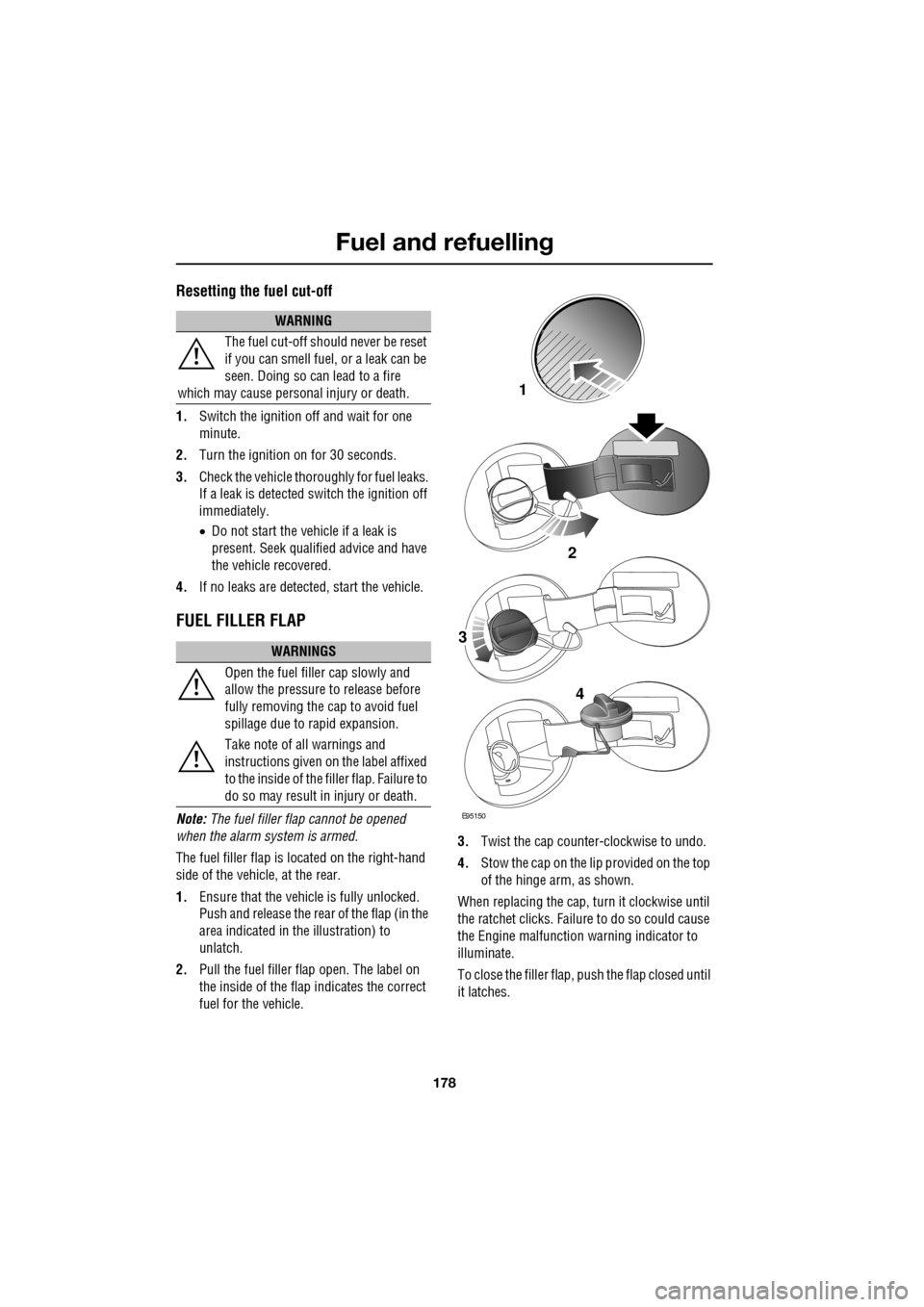
1. Ensure that the vehicle is fully unlocked.
Push and release the rear of the flap (in the
area indicated in the illustration) to
unlatch.
2. Pull the fuel filler flap open. The label on
the inside of the flap indicates the correct
fuel for the vehicle. 3.
Twist the cap counte r-clockwise to undo.
4. Stow the cap on the lip provided on the top
of the hinge arm, as shown.
When replacing the cap, turn it clockwise until
the ratchet clicks. Failur e to do so could cause
the Engine malfunction warning indicator to
illuminate.
To close the filler flap, pus h the flap closed until
it latches.
WARNING
The fuel cut-off should never be reset
if you can smell fuel, or a leak can be
seen. Doing so can lead to a fire
which may cause persona l injury or death.
WARNINGS
Open the fuel filler cap slowly and
allow the pressure to release before
fully removing the cap to avoid fuel
spillage due to rapid expansion.
Take note of all warnings and
instructions given on the label affixed
to the inside of the fi ller flap. Failure to
do so may result in injury or death.
E95150
2
1
3
4
Page 179 of 391
179
Fuel and refuelling
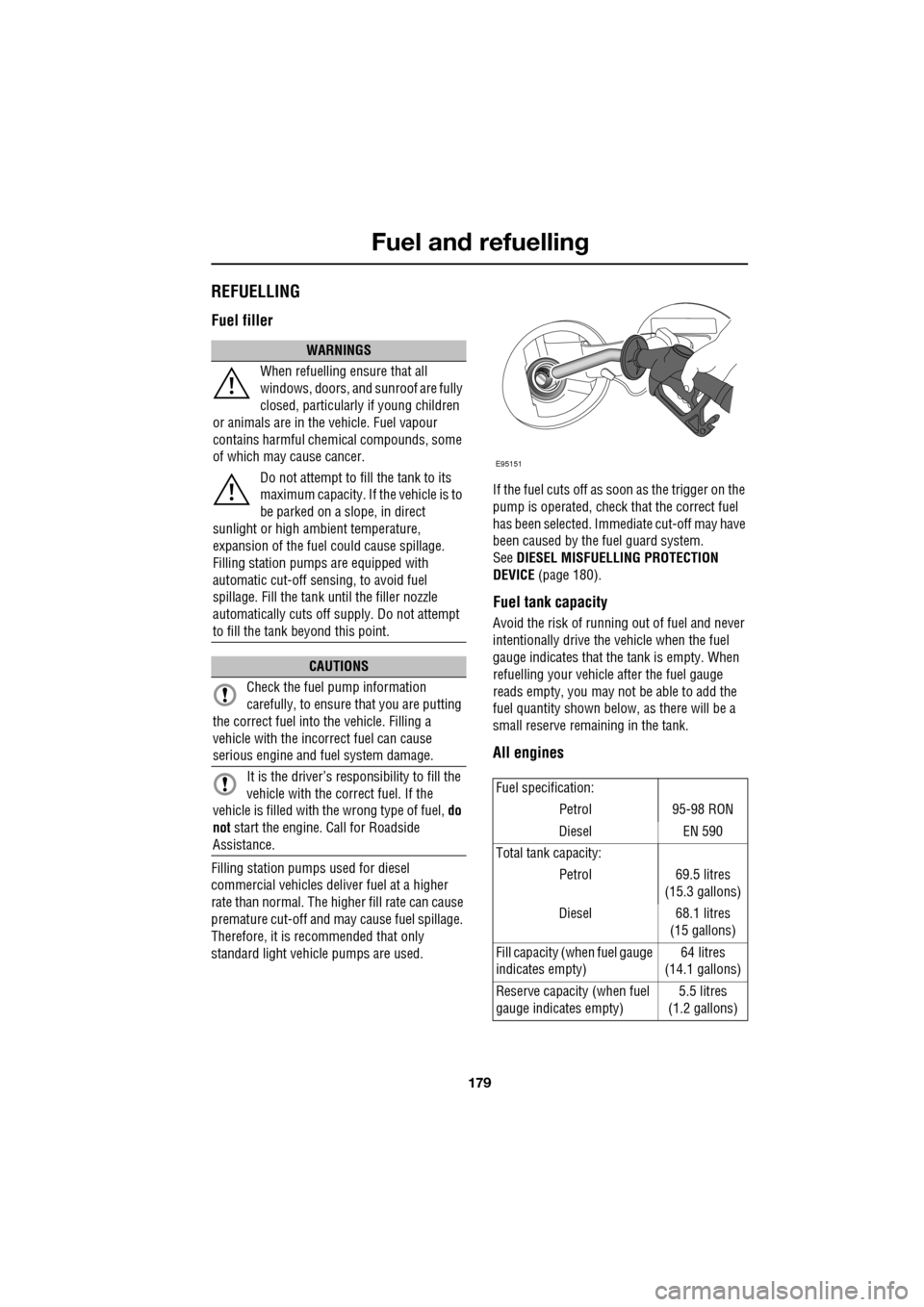
REFUELLING
Fuel filler
Filling station pumps used for diesel
commercial vehicles deliver fuel at a higher
rate than normal. The hi gher fill rate can cause
premature cut-off and ma y cause fuel spillage.
Therefore, it is recommended that only
standard light vehicle pumps are used. If the fuel cuts off as soon as the trigger on the
pump is operated, check that the correct fuel
has been selected. Immediate cut-off may have
been caused by the fuel guard system.
See
DIESEL MISFUELLING PROTECTION
DEVICE (page 180).
Fuel tank capacity
Avoid the risk of running out of fuel and never
intentionally drive the vehicle when the fuel
gauge indicates that the tank is empty. When
refuelling your vehicle after the fuel gauge
reads empty, you may not be able to add the
fuel quantity shown below, as there will be a
small reserve remaining in the tank.
All engines
WARNINGS
When refuelling ensure that all
windows, doors, and sunroof are fully
closed, particularly if young children
or animals are in the vehicle. Fuel vapour
contains harmful chemical compounds, some
of which may cause cancer.
Do not attempt to fill the tank to its
maximum capacity. If the vehicle is to
be parked on a slope, in direct
sunlight or high ambient temperature,
expansion of the fuel could cause spillage.
Filling station pumps are equipped with
automatic cut-off sensing, to avoid fuel
spillage. Fill the tank unt il the filler nozzle
automatically cuts off supply. Do not attempt
to fill the tank beyond this point.
CAUTIONS
Check the fuel pump information
carefully, to ensure that you are putting
the correct fuel into the vehicle. Filling a
vehicle with the incorrect fuel can cause
serious engine and fu el system damage.
It is the driver’s responsibility to fill the
vehicle with the correct fuel. If the
vehicle is filled with the wrong type of fuel, do
not start the engine. Call for Roadside
Assistance.
Fuel specification:
Petrol 95-98 RON
Diesel EN 590
Total tank capacity:
Petrol 69.5 litres
(15.3 gallons)
Diesel 68.1 litres
(15 gallons)
Fill capacity (when fuel gauge
indicates empty) 64 litres
(14.1 gallons)
Reserve capacity (when fuel
gauge indicates empty) 5.5 litres
(1.2 gallons)
E95151
Page 180 of 391
Fuel and refuelling
180
DIESEL MISFUELLING PROTECTION
DEVICE
Diesel engine vehicles in some markets are
equipped with a misfuelling protection device,
incorporated into the fuel filler neck, designed
to alert that the wrong fuel type has been
selected. If the narrow filler nozzle fitted to
pumps delivering unleaded petrol is correctly
inserted (i.e. fully inserted) into the filler neck,
the misfuel protection de vice will activate.
The protection device c ontinually interrupts the
fuel flow from the pump, until the protector
mechanism in the filler neck is reset.
When activated, the yellow protection device
will be visible in the f iller neck. The device will
need to be reset before the tank can be
correctly filled with dies el fuel. This is achieved
using the reset tool, lo cated in the luggage
compartment, clipped onto the battery
restraining bar.
Note: It is the driver’s responsibility to fill the
vehicle with the correct fuel. The diesel
misfuelling protection devi ce only reduces the
risk of filling the vehicle with the incorrect fuel.
Note: When refuelling the vehicle using a
disposable fuel canister, use a canister
designed for diesel fuel where possible. The
spout on petrol canist ers may activate the
protection device. The device may also be
activated by fuel pumps with a smaller nozzle
than those fitted to standard diesel pumps.
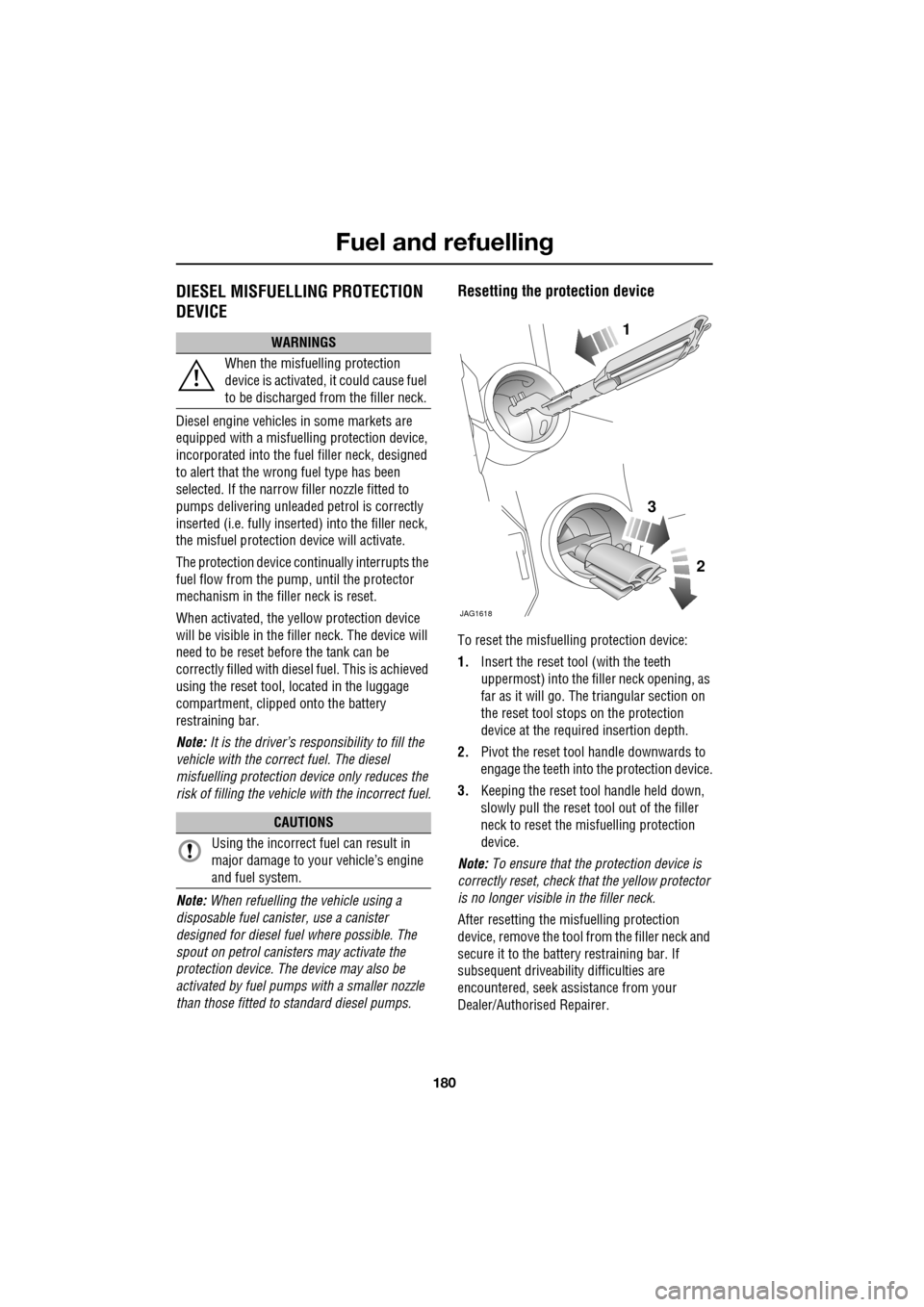
Resetting the protection device
To reset the misfuelling protection device:
1. Insert the reset tool (with the teeth
uppermost) into the fi ller neck opening, as
far as it will go. The triangular section on
the reset tool stop s on the protection
device at the requi red insertion depth.
2. Pivot the reset tool handle downwards to
engage the teeth into the protection device.
3. Keeping the reset tool handle held down,
slowly pull the reset tool out of the filler
neck to reset the misfuelling protection
device.
Note: To ensure that the pr otection device is
correctly reset, check that the yellow protector
is no longer visible in the filler neck.
After resetting the misfuelling protection
device, remove the tool fr om the filler neck and
secure it to the battery restraining bar. If
subsequent driveability difficulties are
encountered, seek assistance from your
Dealer/Authorised Repairer.
WARNINGS
When the misfuelling protection
device is activated, it could cause fuel
to be discharged from the filler neck.
CAUTIONS
Using the incorrect fuel can result in
major damage to your vehicle’s engine
and fuel system.
JAG1618
1
2
3
Page 193 of 391
193
Maintenance
Weekly checks
•Engine oil level (non- electronic dipstick
vehicles). See ENGINE OIL CHECK - V6
Petrol engines (page 197).
• Engine coolant check. See ENGINE
COOLANT CHECK (page 204).
• Brake fluid level. See BRAKE FLUID
CHECK (page 206).
• Power steering fluid level. See POWER
STEERING FLUID CHECK (page 208).
• Screen washer fluid level. See WASHER
FLUID CHECK (page 209).
• Tyre pressures and condition. See TYRE
CARE (page 217).
• Operate air conditioning. See AUTOMATIC
CLIMATE CONTROL (page 116).
Note: The engine oil level on V6 petrol engines,
should be checked more frequently if the
vehicle is driven for prolonged periods at high
speeds. The engine oil level on diesel and V8
petrol engines is checked automatically at all
times by the electronic dipstick.
Severe driving conditions
When a vehicle is operated in severe
conditions, more frequent attention must be
paid to servicing requirements.
Severe driving conditions include:
• Driving in dusty and/or sandy conditions.
• Driving on rough and/or muddy roads
and/or wading. •
Driving in extremely hot or cold
conditions.
• Driving in areas using road salt or other
corrosive materials.
• Towing a trailer or driving in mountainous
conditions.
Contact your Dealer/Authorised Repairer for
advice.
Emission control
Your vehicle is fitted with various items of
emission and evaporati ve control equipment,
designed to meet specific territorial
requirements. You should be aware that
unauthorised replacemen t, modification or
tampering with this equipment by an owner or
repair shop, may be unlawful and subject to
legal penalties.
In addition, engine se ttings must not be
tampered with. These have been established to
ensure that your vehicle complies with
stringent exhaust em ission regulations.
Incorrect engine settings may adversely affect
exhaust emissi ons, engine performance and
fuel consumption. The y may also cause high
temperatures, which will result in damage to
the catalytic converter and the vehicle.
Road testing dynamometers (rolling
roads)
Because your vehicle is equipped with anti-lock
brakes, it is essential that any dynamometer
testing is carried out only by a qualified person,
familiar with the dynamometer testing and
safety procedures practised by
Dealers/Authorised Repairers.
CAUTION
Ensure that you take notice of any
message centre information and
warnings relating to engi ne oil level (V8 petrol
and diesel engines only). Top-up the level
when advised to do so. See ENGINE OIL
CHECK - V8 Petrol engines (page 199).
Page 197 of 391
197
Maintenance
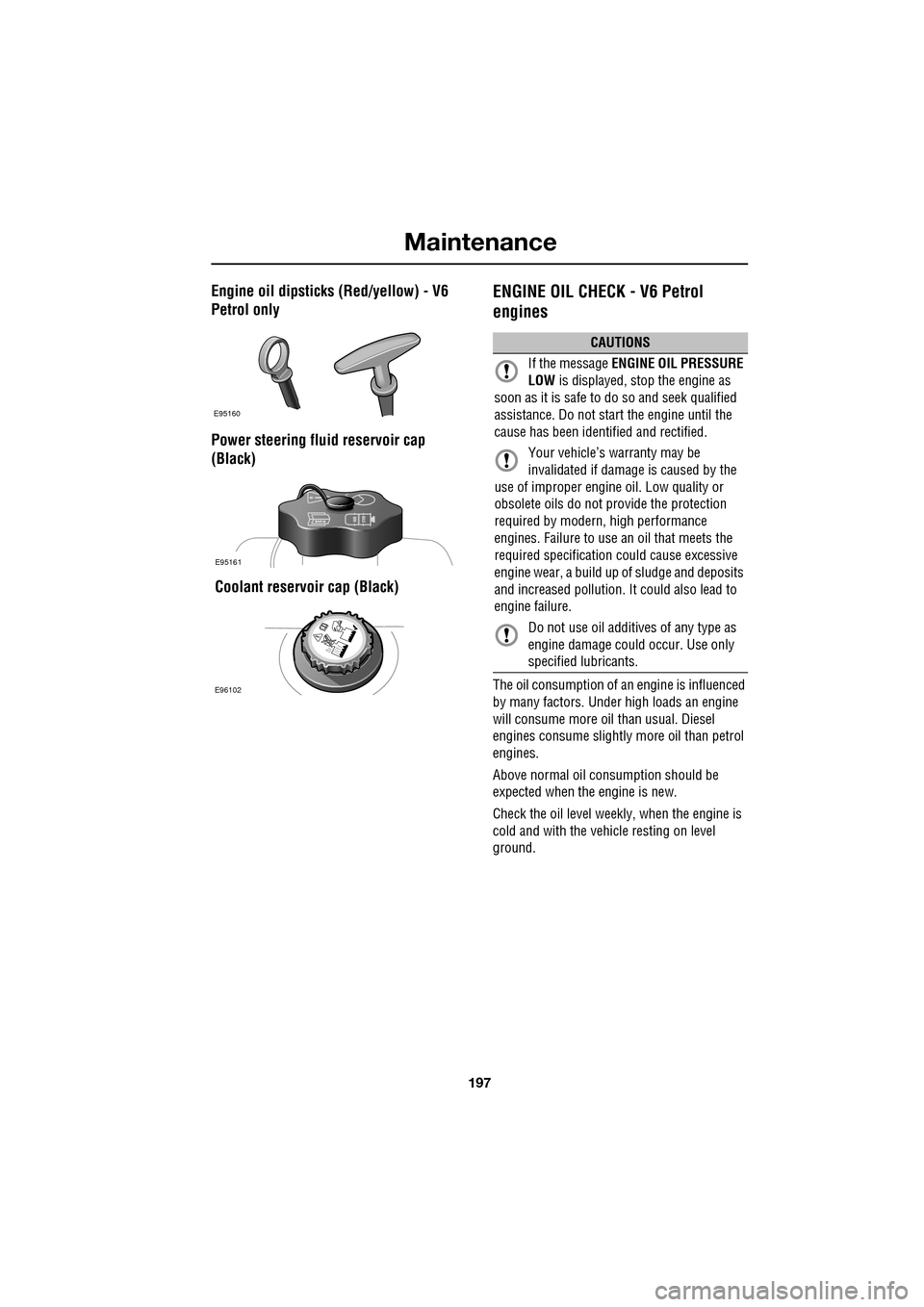
Engine oil dipsticks (Red/yellow) - V6
Petrol only
Power steering fluid reservoir cap
(Black)
Coolant reservoir cap (Black)ENGINE OIL CHECK - V6 Petrol
engines
The oil consumption of an engine is influenced
by many factors. Unde r high loads an engine
will consume more oil than usual. Diesel
engines consume slightly more oil than petrol
engines.
Above normal oil consumption should be
expected when the engine is new.
Check the oil level weekly , when the engine is
cold and with the vehicle resting on level
ground.
E95160
E95161
E96102
CAUTIONS
If the message ENGINE OIL PRESSURE
LOW is displayed, st op the engine as
soon as it is safe to do so and seek qualified
assistance. Do not start the engine until the
cause has been identified and rectified.
Your vehicle’s warranty may be
invalidated if damage is caused by the
use of improper engine oil. Low quality or
obsolete oils do not pr ovide the protection
required by modern, high performance
engines. Failure to use an oil that meets the
required specification could cause excessive
engine wear, a build up of sludge and deposits
and increased pollution. It could also lead to
engine failure.
Do not use oil additi ves of any type as
engine damage coul d occur. Use only
specified lubricants.
Page 198 of 391
Maintenance
198
Checking the oil level
Note: If it is necessary to check the oil level
when the engine is hot, switch off the engine
and let stand for five minutes to allow the oil to
drain into the sump. Do not start the engine.
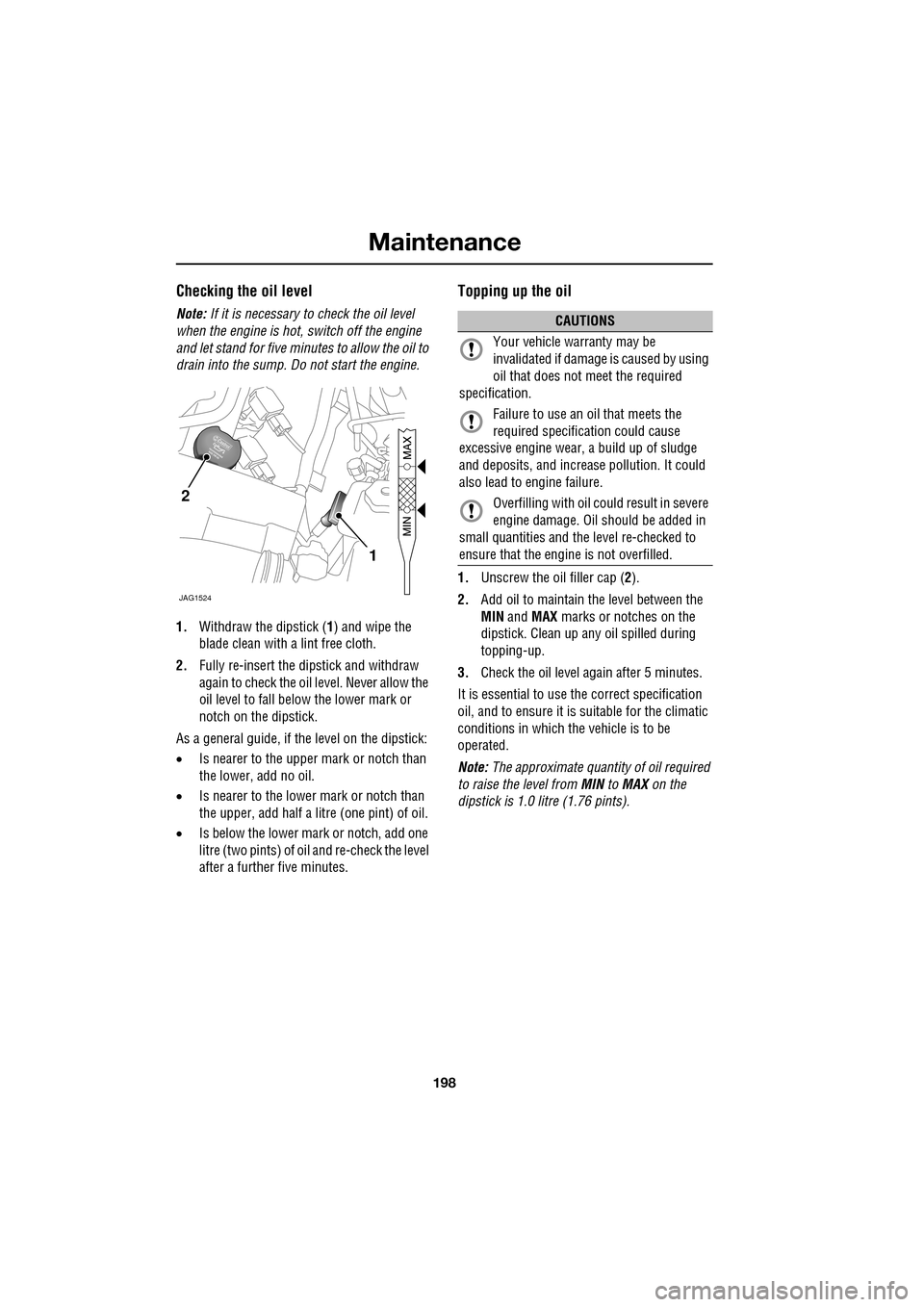
1. Withdraw the dipstick ( 1) and wipe the
blade clean with a lint free cloth.
2. Fully re-insert the di pstick and withdraw
again to check the oil level. Never allow the
oil level to fall below the lower mark or
notch on the dipstick.
As a general guide, if the level on the dipstick:
• Is nearer to the upper mark or notch than
the lower, add no oil.
• Is nearer to the lower mark or notch than
the upper, add half a litre (one pint) of oil.
• Is below the lower mark or notch, add one
litre (two pints) of oi l and re-check the level
after a further five minutes.
Topping up the oil
1. Unscrew the oil filler cap ( 2).
2. Add oil to maintain the level between the
MIN and MAX marks or notches on the
dipstick. Clean up any oil spilled during
topping-up.
3. Check the oil level again after 5 minutes.
It is essential to use the correct specification
oil, and to ensure it is suitable for the climatic
conditions in which the vehicle is to be
operated.
Note: The approximate quant ity of oil required
to raise the level from MIN to MAX on the
dipstick is 1.0 litre (1.76 pints).
JAG1524
1
2
CAUTIONS
Your vehicle warranty may be
invalidated if damage is caused by using
oil that does not meet the required
specification.
Failure to use an oil that meets the
required specificat ion could cause
excessive engine wear, a build up of sludge
and deposits, and increa se pollution. It could
also lead to engine failure.
Overfilling with oil c ould result in severe
engine damage. Oil should be added in
small quantities and the level re-checked to
ensure that the engine is not overfilled.
Page 199 of 391
199
Maintenance
ENGINE OIL CHECK - V8 Petrol
engines
Engine oil consumption
A certain amount of oil consumption is normal.
The rate of consumpt ion will depend on the
following:
• The quality and viscosity of the oil.
• Climatic conditions.
• The speed at which th e engine is being
operated.
• Road conditions.
Drivers should expe ct above normal
consumption when th e engine is new.
Checking the oil level
For an accurate oil level reading to be taken, the
following conditions must be met:
•The vehicle needs to be parked on level
ground. •
The oil level should be checked when the
oil is hot. It is therefore recommended that
a reading is taken after a journey.
• The vehicle needs to stand for
approximately 10 minutes after the engine
is switched off, to allow the oil to drain
back into the sump.
Note: The system will not gi ve a reading until
the oil level has stabilised.
Once the above conditions are met, check the
oil level as follows:
1. Switch on the ignition - do not start the
engine.
2. Set the transmission to Park ( P).
3. Press the TRIP butt on on the end of the
left-hand column stalk repeatedly, until the
oil can icon is displa yed at the bottom of
the message centre.
4. The oil level and topping- up advice will be
shown in the message centre. Top-up as
instructed.
CAUTIONS
It is recommended that the oil level is
checked weekly. If any significant or
sudden drop in oil level is noted you should
seek qualified assistance immediately.
Your vehicle’s warranty may be
invalidated if damage is caused by the
use of improper engine oil. Low quality or
obsolete oils do not provide the protection
required by modern, high performance
engines. Failure to use an oil that meets the
required specification could cause excessive
engine wear, a build up of sludge and deposits
and increased pollution. It could also lead to
engine failure.
Do not use oil additi ves of any type as
engine damage could occur. Use only
specified lubricants.