wheel size JAGUAR XF 2009 1.G Owners Manual
[x] Cancel search | Manufacturer: JAGUAR, Model Year: 2009, Model line: XF, Model: JAGUAR XF 2009 1.GPages: 391, PDF Size: 19.32 MB
Page 223 of 391
223
Wheels and tyres
USING WINTER TYRES
Winter tyres are more suitable during extremes
of low temperatures, snow and ice and will
considerably improve the vehicle’s handling
during these conditions.
Do not exceed 240 km/h (150 mph) when
using Jaguar approved winter tyres.
Winter tyres must be fitted to all four wheels.
Approved winter tyre sizes
Front :
• Dunlop Wintersport M3 - 235/55R17 99H,
245/45R18 96V, 245/45R18 100V,
245/40R19 98V.
• W240 Pirelli Sotto Zero - 245/45R18 100V,
245/40R19 98V, 255/35R20 97V
Rear:
• Dunlop Wintersport M3 - 235/55R17 99H,
245/45R18 96V, 245/45R18 100V,
245/40R19 98V.
• W240 Pirelli Sotto Zero - 245/45R18 100V,
245/40R19 98V, 285/30R20 99V
Winter tyre pressures
USING SNOW CHAINS
Snow chains, of the recommended type, can
only be fitted to rear wheels. They should not
be used on temporary use spare wheels.
You should contact your Dealer/Authorised
Repairer for details and availability of approved
snow chains.
The maximum speed when using snow chains
is 50 km/h (30 mph).
Remove the snow chains immediately the
roads are clear of snow.
Ensure the fitting instructions supplied with the
snow chains are kept in a safe place, for
example, with this literature pack.
Note: When using snow chains, select
JaguarDrive Control Winter mode with DSC
switched on.
CAUTION
Tyres with an all season icon or M+S
have a level of winter performance and
need not be replaced.
Up to 240 km/h (150 mph)
Front 2.0 bar (30 lbf/in², 207 kPa)
Rear 2.3 bar (33 lbf/in², 230 kPa)
CAUTION
It is essential that only snow chains of
the recommended type are fitted, other
snow chains may cause damage to the vehicle.
Page 225 of 391
225
Wheels and tyres
CHANGING A ROAD WHEEL
If a wheel change is required, pull off the road
completely. Park on ground which is as level
and solid as possible. Ensure that the vehicle is
clear of any objects that will obstruct the safe
removal of the wheel. Switch on hazard
warning lamps and, where legally required,
display the warning triangle.
Regular maintenance of tyres contributes not
only to safety, but to the designed function of
the vehicle. Road-holdi ng, steering and braking
are especially vulnerable to incorrectly
pressurised, badly fitted or worn tyres.
Tyres of the correct size and type, but of
different make can have widely varying
characteristics. It is therefore recommended
that Jaguar approved tyres are fitted to all
wheels.
Temporary use spare wheel
Observe the following wa rnings before using
the wheel:
WARNINGS
Always ensure replacement tyres
have the correct rating and
specifications (e.g. load index, size,
speed rating) for your vehicle.
When using tyres other than those
recommended by Jaguar, do not
exceed the speed capacity
recommended by the manufacturer.
Wheels are extremely heavy. Take
care when lifting and particularly
when removing and replacing a wheel
in its storage position in the luggage
compartment.
CAUTION
Ultra high performance tyres. This
vehicle is equipped with an Ultra High
Performance (UHP) tyre and wheel
combination designed to give maximum dry
road performance with consideration for
aquaplaning resistan ce. UHP tyres have
performance enhancing soft rubber tread
compound. If driven aggressively they may
suffer rapid tread wear and a shorter life than
can be expected from other tyre types. This
wheel and tyre comb ination is more
susceptible to damage from road hazards.
Do not use this combination for driving on
snow or ice. High perf ormance tyres must be
replaced with winter tyres when weather
conditions dictate.
WARNINGS
Note the temporary use spare wheel
warning label. Adhere to instructions
on the label. Failure to comply can be
dangerous.
When a temporary use spare wheel is
fitted, drive with caution and replace
with the specified wheel and tyre as
soon as possible.
Do not fit more than one temporary
use spare wheel and tyre assembly at
one time.
The temporary use spare wheel must
be inflated to 4.2 bar (60 lbf/in²,
420 kPa) and cannot be repaired.
Temporary use spare wheel,
maximum speed is 80 km/h
(50 mph).
Page 228 of 391
Wheels and tyres
228
Wheel changing procedure
1.Ensure that all passengers are in a safe
place, clear of the vehicle.
2. Apply the parking brake and select gear
position P (Park).
3. Ensure that the jack is placed on firm and
level ground.
Observe the instructions printed on the jack.
Use the jack only for lifting the vehicle during
wheel changing and only us e the jack which is
stored in the vehicle.
Before raising the vehi cle slacken but do not
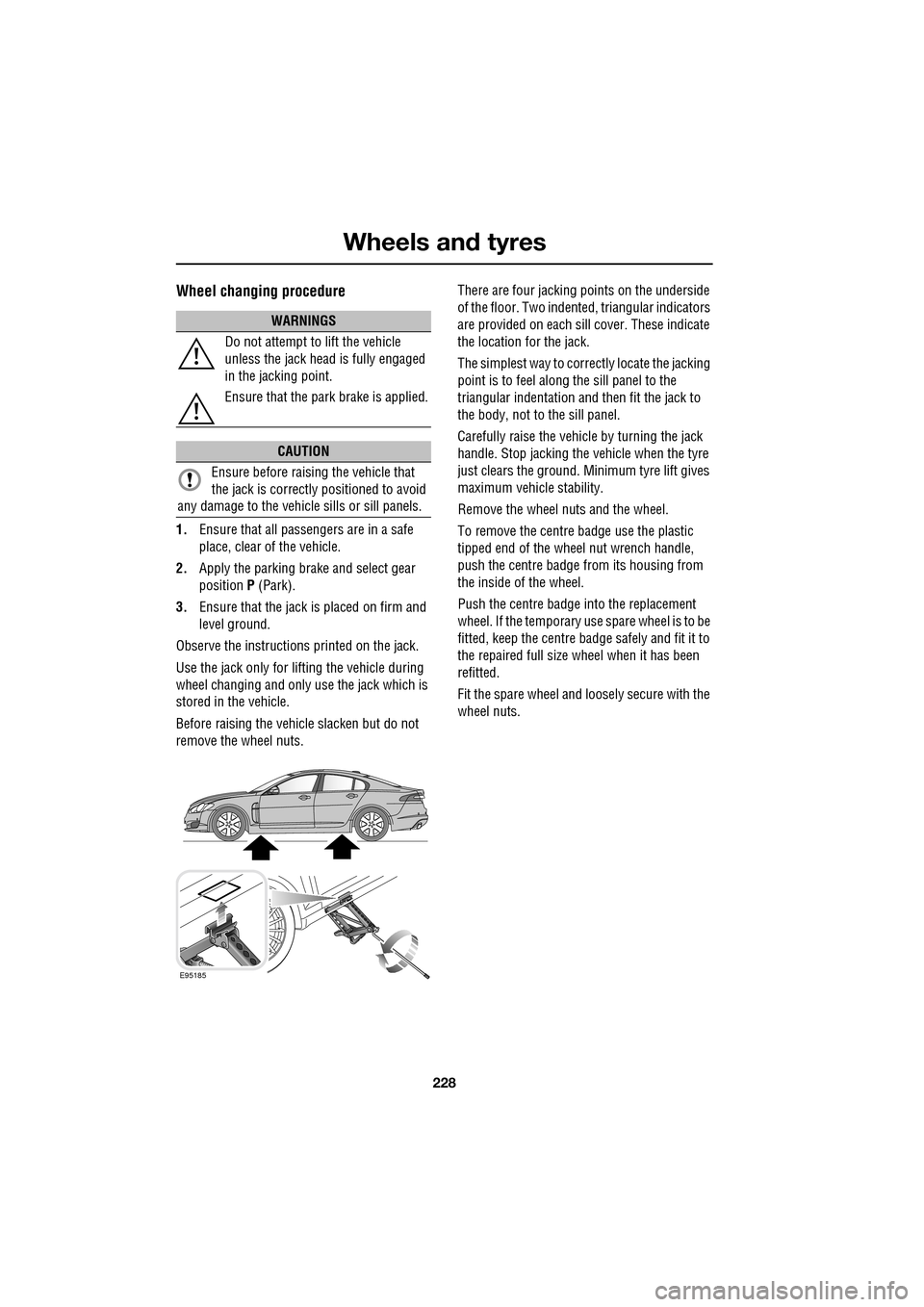
remove the wheel nuts. There are four jacking points on the underside
of the floor. Two indented, triangular indicators
are provided on each sill cover. These indicate
the location for the jack.
The simplest way to correctly locate the jacking
point is to feel along
the sill panel to the
triangular indentation and then fit the jack to
the body, not to the sill panel.
Carefully raise the vehicle by turning the jack
handle. Stop jacking the vehicle when the tyre
just clears the ground. Minimum tyre lift gives
maximum vehicle stability.
Remove the wheel nuts and the wheel.
To remove the centre badge use the plastic
tipped end of the wheel nut wrench handle,
push the centre badge from its housing from
the inside of the wheel.
Push the centre badge into the replacement
wheel. If the temporary use spare wheel is to be
fitted, keep the centre badge safely and fit it to
the repaired full size wheel when it has been
refitted.
Fit the spare wheel and loosely secure with the
wheel nuts.
WARNINGS
Do not attempt to lift the vehicle
unless the jack head is fully engaged
in the jacking point.
Ensure that the park brake is applied.
CAUTION
Ensure before raising the vehicle that
the jack is correctly positioned to avoid
any damage to the vehicle sills or sill panels.
E95185
Page 236 of 391
Wheels and tyres
236
Tyre pressure warning with speed
If the vehicle is to be driven at speeds in excess
of 160 km/h (100 mph), the tyre pressures
should be increased as stated in this handbook
or on the placard label. Failure to increase the
tyre pressures and driving in excess of
160 km/h (100 mph), will illuminate the yellow
warning telltale and display a text message
TYRE PRESSURES LOW FOR SPEED . In the
event of this warning be ing displayed, vehicle
speed should be reduced
Temporary use spare wheel and tyre
change
If the temporary use spare wheel is fitted the
system will automatically recognise the change
in wheel positions. The n after approximately
ten minutes of driv ing above 25 km/h
(18 mph), a message TYRE NOT MONITORED
will be displayed accompanied by illumination
of the warning telltale and the corresponding
block in the vehicle graphic.
The warning telltale will initially flash and will
subsequently revert to continuous illumination.
Extended use of the temporary use spare wheel
will produce an additional text message TYRE
PRESSURE SYSTEM FAULT .
This TPM system display sequence will be
activated at every ignition cycle until the
temporary use spare wheel is replaced by a
fully operational full size wheel and tyre
assembly.
Always replace the temporary use wheel before
having TPM system faults investigated. The
fault may well be rectified with the fitment of a
fully operational full size running tyre in lieu of
the temporary use spare wheel assembly.
Tyre changing
Always have your tyres serviced or changed by
a qualified engineer.
Care must be taken to avoid contact between
the bead of the tyre and the sensor during
removal and refitting of the tyre, otherwise the
sensor may become damaged and or
inoperable.
Sensors can be removed from the wheel by the
unscrewing of the va lve retention nut.
Replacement sensor
Should the sensor require replacing, it should
be carried out by a Dealer/Authorised Repairer.
A replacement sensor must be fitted to a
running wheel in order to be recognised by the
system. The vehicle needs to be stationary for
15 minutes during the se nsor fitment before
the system is ready to detect the new sensor.
The vehicle must be driven for a minimum of
fifteen minutes after the sensor change, and
then remain stationary for fifteen minutes to
activate full TPM system operation.
If the TPM system warning for any wheel does
not clear, even after ensuring correct inflation
and driving for more than ten minutes above
25 km/h (18 mph), you should seek qualified
assistance as soon as possible.
CAUTION
Valve stem seal, washer, nut, valve core
and cap should be replaced at every tyre
change. Valve stem seal, washer and nut must
be replaced if valve re tention nut is loosened.
Sensor units and nuts must be refitted using
correct torque figures and associated profile.
Damage to the vehicle may result if these
precautions are not taken.
Page 239 of 391
239
Wheels and tyres
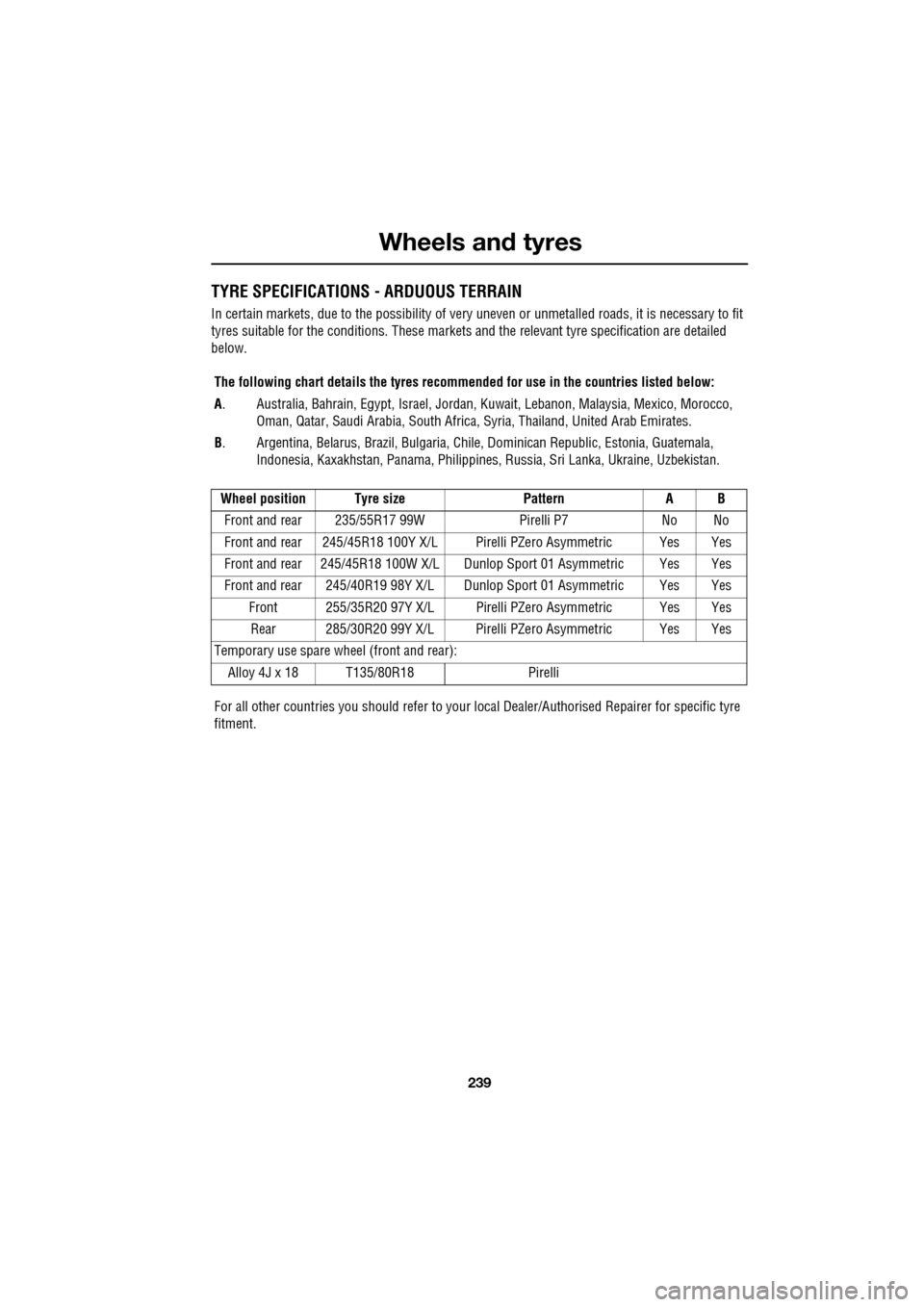
TYRE SPECIFICATIONS - ARDUOUS TERRAIN
In certain markets, due to the possibility of very uneven or unmetalled roads, it is necessary to fit
tyres suitable for the conditions. These markets and the relevant tyre specification are detailed
below.
The following chart details the tyres recomm ended for use in the countries listed below:
A . Australia, Bahrain, Egypt, Is rael, Jordan, Kuwait, Lebanon, Malaysia, Mexico, Morocco,
Oman, Qatar, Saudi Arabia, South Africa, Syria, Thailand, United Arab Emirates.
B . Argentina, Belarus, Brazil, Bulgaria, Chile, Dominican Republic, Estonia, Guatemala,
Indonesia, Kaxakhstan, Panama, Philippines, Russia, Sri Lanka, Ukraine, Uzbekistan.
Wheel position Tyre size PatternA B
Front and rear 235/55R17 99W Pirelli P7No No
Front and rear 245/45R18 100Y X/L Pir elli PZero Asymmetric Yes Yes
Front and rear 245/45R18 100W X/ L Dunlop Sport 01 Asymmetric Yes Yes
Front and rear 245/40R19 98Y X/L D unlop Sport 01 Asymmetric Yes Yes
Front 255/35R20 97Y X/L Pirelli PZero Asymmetric Yes Yes Rear 285/30R20 99Y X/L Pirelli PZero Asymmetric Yes Yes
Temporary use spare wheel (front and rear):
Alloy 4J x 18 T135/80R18 Pirelli
For all other countries you should refer to your local Dealer/Aut horised Repairer for specific tyre
fitment.
Page 240 of 391
Wheels and tyres
240
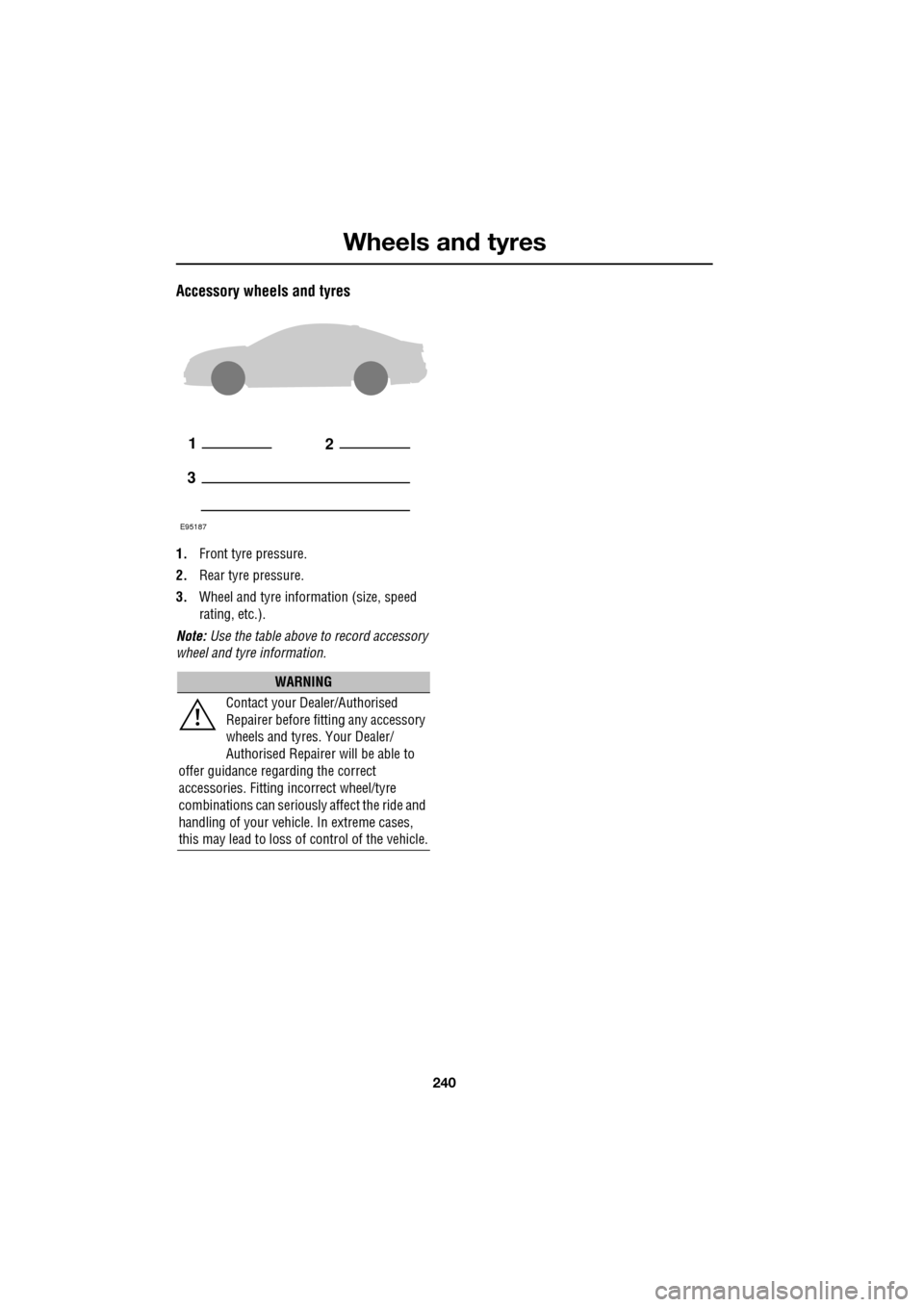
Accessory wheels and tyres
1.Front tyre pressure.
2. Rear tyre pressure.
3. Wheel and tyre information (size, speed
rating, etc.).
Note: Use the table above to record accessory
wheel and tyre information.
WARNING
Contact your Dealer/Authorised
Repairer before fitting any accessory
wheels and tyres. Your Dealer/
Authorised Repairer will be able to
offer guidance rega rding the correct
accessories. Fitting incorrect wheel/tyre
combinations can seriously affect the ride and
handling of your vehicl e. In extreme cases,
this may lead to loss of control of the vehicle.
12
3
E95187
Page 322 of 391
Telephone
322
Making/ending a call
To dial:
Key in the phone number, including the area
code. The number will be displayed.
To connect:
To end a call:
OTHER FEATURES
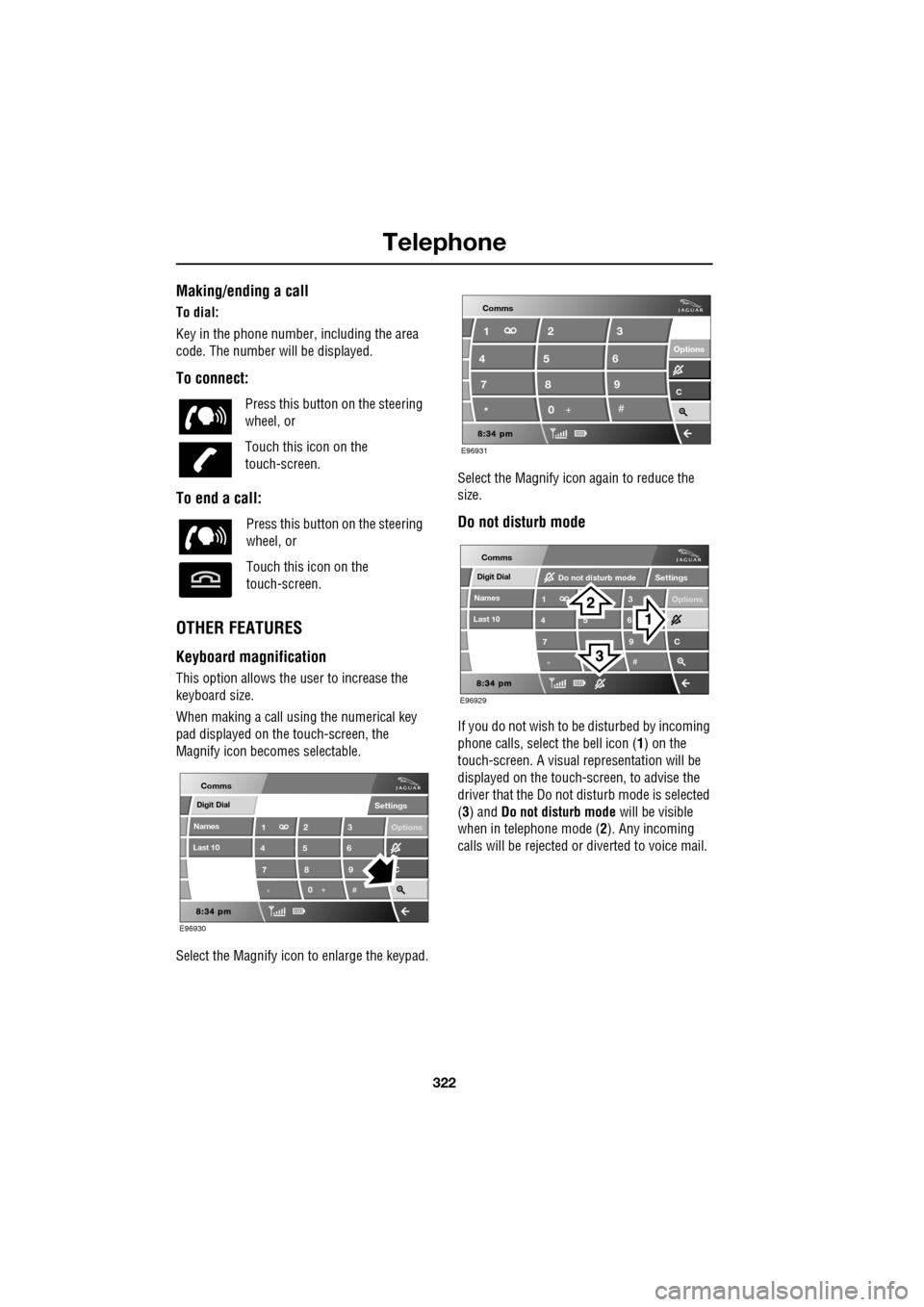
Keyboard magnification
This option allows the user to increase the
keyboard size.
When making a call using the numerical key
pad displayed on the touch-screen, the
Magnify icon becomes selectable.
Select the Magnify icon to enlarge the keypad. Select the Magnify icon
again to reduce the
size.
Do not disturb mode
If you do not wish to be disturbed by incoming
phone calls, select the bell icon (1) on the
touch-screen. A visual representation will be
displayed on the touch-screen, to advise the
driver that the Do not di sturb mode is selected
(3) and Do not disturb mode will be visible
when in telephone mode ( 2). Any incoming
calls will be rejected or diverted to voice mail.
Press this button
on the steering
wheel, or
Touch this icon on the
touch-screen.
Press this button on the steering
wheel, or
Touch this icon on the
touch-screen.
Digit Dial
Names
Last 10
Settings
7
1
4
*8
2
5
0 9
3
6
Options
C
E96930
Comms
E96931
Comms
Options Options
C7 1
4
* 82
5
0 93
6
Digit Dial
Names
Last 10
Settings
7
1
4
*
5 9
3
6
Options
C
E96929
Comms
Do not disturb mode
Page 390 of 391
Index
390
Using the telephone . . . . . . . . . . . . . . . . . 309answer options . . . . . . . . . . . . . . . . . . 314
changing a phone number . . . . . . . . . 317
changing the docked phone . . . . . . . . 312
continuity of calls . . . . . . . . . . . . . . . . 317
deleting a paired phone . . . . . . . . . . . . 312
deleting names from the Directory . . . 319
directory contact types . . . . . . . . . . . . 319
ending a call . . . . . . . . . . . . . . . . . . . . 317
erase entire phonebook. . . . . . . . . . . . 316
hands-free controls . . . . . . . . . . . . . . . 321
keyboard magnification . . . . . . . . . . . . 322
last 10 option . . . . . . . . . . . . . . . . . . . 320
making a call . . . . . . . . . . . . . . . . . . . . 317
making-ending a call . . . . . . . . . . . . . . 322
message centre messages . . . . . . . . . 327
names . . . . . . . . . . . . . . . . . . . . . . . . . 318
operating the system . . . . . . . . . . . . . 323
other features . . . . . . . . . . . . . . . . . . . 322
pairing other phones . . . . . . . . . . . . . . 311
phone options . . . . . . . . . . . . . . . . . . . 314
phonebook . . . . . . . . . . . . . . . . . . . . . 315
phonebook capacity . . . . . . . . . . . . . . 316
receiving a call . . . . . . . . . . . . . . . . . . 317
register . . . . . . . . . . . . . . . . . . . . . . . . 313
retrieving voice mail . . . . . . . . . . . . . . 313
telephone pairing and do cking . . . . . . 309
telephone voice control . . . . . . . . . . . . 323
voice mail . . . . . . . . . . . . . . . . . . . . . . 313
Using the television . . . . . . . . . . . . . . . . . 330
analogue/digital option . . . . . . . . . . . . 331
finding TV channels . . . . . . . . . . . . . . 331
full screen view . . . . . . . . . . . . . . . . . . 331
on/off control . . . . . . . . . . . . . . . . . . . 330
using preset channels . . . . . . . . . . . . . 332
volume control . . . . . . . . . . . . . . . . . . 330
Using winter tyres . . . . . . . . . . . . . . . . . . 223 Approved Winter tyre sizes . . . . . . . . . 223
Winter tyre pressures . . . . . . . . . . . . . 223
V
Valet mode . . . . . . . . . . . . . . . . . . . . . . . . 30
Vehicle build date plate . . . . . . . . . . . . . . 257
Vehicle identification num ber (VIN) . . . . . 257
Vehicle identification plate . . . . . . . . . . . . 257
Vents . . . . . . . . . . . . . . . . . . . . . . . . . . . . 115 VIN . . . . . . . . . . . . . . . . . . . . . . . . . . . . . . 257
Voice control. . . . . . . . . . . . . . . . . . . . 69, 373
activating the system . . . . . . . . . . . . . . . 70
command help . . . . . . . . . . . . . . . . . . . . 71
language and accent. . . . . . . . . . . . . . . . 70
nametags . . . . . . . . . . . . . . . . . . . . . . . . 72
notepad . . . . . . . . . . . . . . . . . . . . . . . . . 73
using the system . . . . . . . . . . . . . . . . . . 70
voice commands . . . . . . . . . . . . . . . . . . 73
voice system tutorial . . . . . . . . . . . . . . . 71
voice volume adjustment . . . . . . . . . . . . 73
Volume control . . . . . . . . . . . . . . . . . . . . . 271
volume settings . . . . . . . . . . . . . . . . . . 272
W
Warning labels . . . . . . . . . . . . . . . . . . . . . . 10
Warning lamps and indicators . . . . . . . . . 100adaptive cruise control . . . . . . . . . . . . . 102
adaptive front lighting . . . . . . . . . . . . . 102
airbag . . . . . . . . . . . . . . . . . . . . . . . . . . 102
anti-lock braking system (ABS) . . . . . . 102
automatic speed limiter . . . . . . . . . . . . 103
beltminder . . . . . . . . . . . . . . . . . . . . . . 101
brake . . . . . . . . . . . . . . . . . . . . . . . . . . 101
direction indicators. . . . . . . . . . . . . . . . 103
dynamic stability contro l (DSC) . . . . . . 102
engine malfunction . . . . . . . . . . . . . . . . 102
forward alert . . . . . . . . . . . . . . . . . . . . . 102
hazard warning indicators . . . . . . . . . . 103
high beam . . . . . . . . . . . . . . . . . . . . . . 103
indicator check . . . . . . . . . . . . . . . . . . . 100
rear fog lamps . . . . . . . . . . . . . . . . . . . 102
seat belt . . . . . . . . . . . . . . . . . . . . . . . . 101
side lamps . . . . . . . . . . . . . . . . . . . . . . 103
tyre pressure monitoring system . . . . . 102
Warning triangle . . . . . . . . . . . . . . . . . . . . 250
Warnings . . . . . . . . . . . . . . . . . . . . . . . . . . . 9
Washer fluid check . . . . . . . . . . . . . . . . . . 209 topping up the fluid . . . . . . . . . . . . . . . 209
Washing . . . . . . . . . . . . . . . . . . . . . . . . . . 187
Waveband button . . . . . . . . . . . . . . . . . . . 274
Weights . . . . . . . . . . . . . . . . . . . . . . . . . . 259
Wheels and tyres
general information . . . . . . . . . . . . . . . 216
technical specifications . . . . . . . . . . . . 239
Whiplash protection . . . . . . . . . . . . . . . . . . 57