oil JAGUAR XFR 2010 1.G Owner's Manual
[x] Cancel search | Manufacturer: JAGUAR, Model Year: 2010, Model line: XFR, Model: JAGUAR XFR 2010 1.GPages: 3039, PDF Size: 58.49 MB
Page 260 of 3039
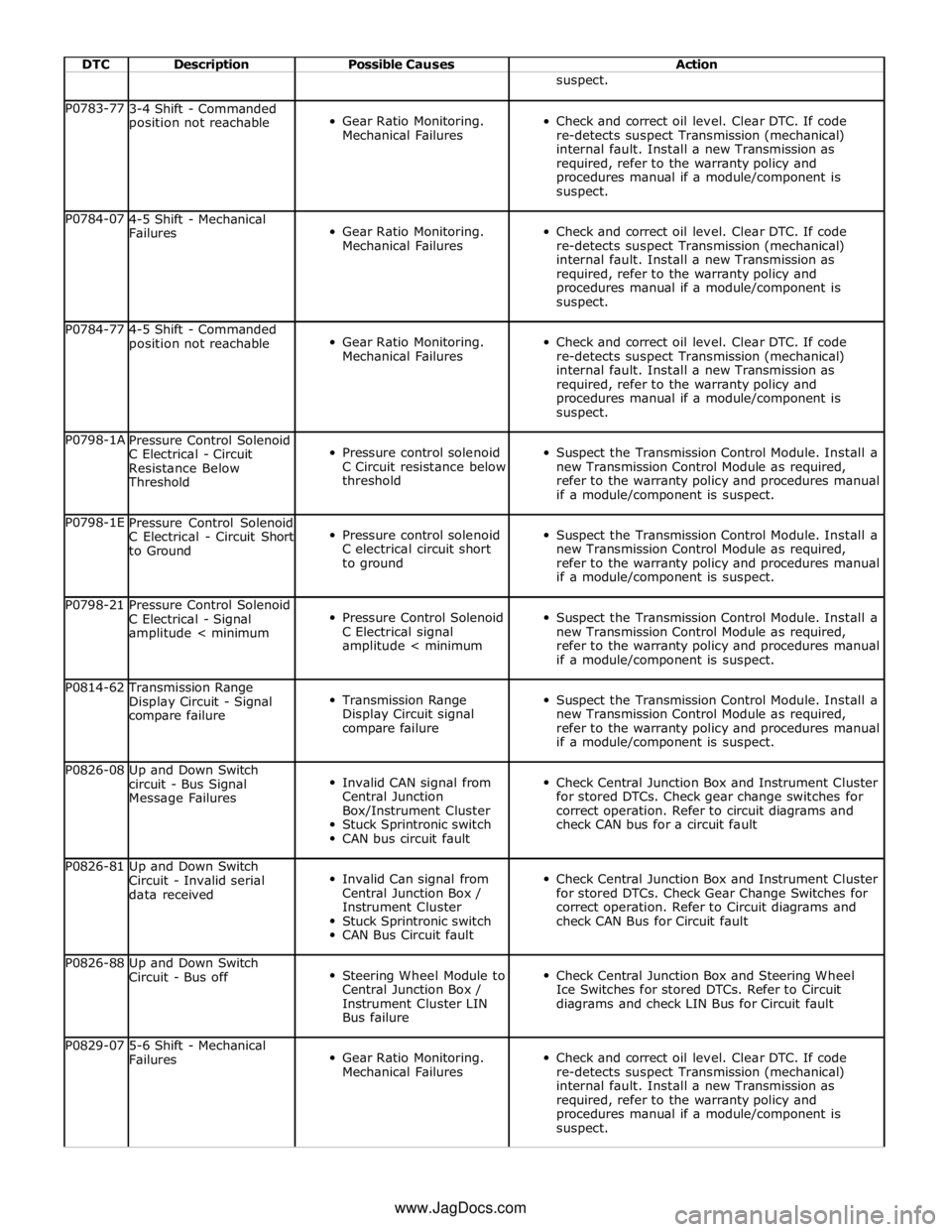
DTC Description Possible Causes Action suspect. P0783-77
3-4 Shift - Commanded
position not reachable
Gear Ratio Monitoring.
Mechanical Failures
Check and correct oil level. Clear DTC. If code
re-detects suspect Transmission (mechanical)
internal fault. Install a new Transmission as
required, refer to the warranty policy and
procedures manual if a module/component is
suspect. P0784-07
4-5 Shift - Mechanical
Failures
Gear Ratio Monitoring.
Mechanical Failures
Check and correct oil level. Clear DTC. If code
re-detects suspect Transmission (mechanical)
internal fault. Install a new Transmission as
required, refer to the warranty policy and
procedures manual if a module/component is
suspect. P0784-77
4-5 Shift - Commanded
position not reachable
Gear Ratio Monitoring.
Mechanical Failures
Check and correct oil level. Clear DTC. If code
re-detects suspect Transmission (mechanical)
internal fault. Install a new Transmission as
required, refer to the warranty policy and
procedures manual if a module/component is
suspect. P0798-1A
Pressure Control Solenoid
C Electrical - Circuit
Resistance Below Threshold
Pressure control solenoid
C Circuit resistance below
threshold
Suspect the Transmission Control Module. Install a
new Transmission Control Module as required,
refer to the warranty policy and procedures manual
if a module/component is suspect. P0798-1E
Pressure Control Solenoid
C Electrical - Circuit Short
to Ground
Pressure control solenoid
C electrical circuit short
to ground
Suspect the Transmission Control Module. Install a
new Transmission Control Module as required,
refer to the warranty policy and procedures manual
if a module/component is suspect. P0798-21
Pressure Control Solenoid
C Electrical - Signal
amplitude < minimum
Pressure Control Solenoid
C Electrical signal
amplitude < minimum
Suspect the Transmission Control Module. Install a
new Transmission Control Module as required,
refer to the warranty policy and procedures manual
if a module/component is suspect. P0814-62 Transmission Range
Display Circuit - Signal
compare failure
Transmission Range
Display Circuit signal
compare failure
Suspect the Transmission Control Module. Install a
new Transmission Control Module as required,
refer to the warranty policy and procedures manual
if a module/component is suspect. P0826-08
Up and Down Switch
circuit - Bus Signal
Message Failures
Invalid CAN signal from
Central Junction
Box/Instrument Cluster
Stuck Sprintronic switch
CAN bus circuit fault
Check Central Junction Box and Instrument Cluster
for stored DTCs. Check gear change switches for
correct operation. Refer to circuit diagrams and
check CAN bus for a circuit fault P0826-81
Up and Down Switch
Circuit - Invalid serial
data received
Invalid Can signal from
Central Junction Box /
Instrument Cluster
Stuck Sprintronic switch
CAN Bus Circuit fault
Check Central Junction Box and Instrument Cluster
for stored DTCs. Check Gear Change Switches for
correct operation. Refer to Circuit diagrams and
check CAN Bus for Circuit fault P0826-88
Up and Down Switch
Circuit - Bus off
Steering Wheel Module to
Central Junction Box /
Instrument Cluster LIN
Bus failure
Check Central Junction Box and Steering Wheel
Ice Switches for stored DTCs. Refer to Circuit
diagrams and check LIN Bus for Circuit fault P0829-07
5-6 Shift - Mechanical
Failures
Gear Ratio Monitoring.
Mechanical Failures
Check and correct oil level. Clear DTC. If code
re-detects suspect Transmission (mechanical)
internal fault. Install a new Transmission as
required, refer to the warranty policy and
procedures manual if a module/component is
suspect. www.JagDocs.com
Page 261 of 3039

DTC Description Possible Causes Action P0829-77
6-5 Shift - Commanded
Position Not Reachable
Gear Ratio Monitoring.
Mechanical Failures
Check and correct oil level. Clear DTC. If code
re-detects suspect Transmission (mechanical)
internal fault. Install a new Transmission as
required, refer to the warranty policy and
procedures manual if a module/component is
suspect. P084F-01
Park / Neutral Switch
Input Circuit - General
Electrical Failure
Wrong voltage level
detected on Park/No Park
signal
Check for correct output at Transmission Control
Module park signal pin (check in all positions) 12
volts in Park, 0 volts in all other positions. If fault
identified, suspect the Transmission Control
Module. Install a new Transmission Control Module
as required, refer to the warranty policy and
procedures manual if a module/component is
suspect. If no fault identified, check Park signal
circuit to Transmission Shift Module for short, open
circuit P0850-01
Park / Neutral Switch
Input Circuit - General
Electrical Failure
General electrical failure
Suspect the Transmission Control Module. Install a
new Transmission Control Module as required,
refer to the warranty policy and procedures manual
if a module/component is suspect. P0850-02
Park / Neutral Switch
Input Circuit - General
signal failure
General signal failure
Check Parklock mechanism, If Parklock operation
correct suspect the Transmission Control Module.
Install a new Transmission Control Module as
required, refer to the warranty policy and
procedures manual if a module/component is
suspect. P0850-29
Park / Neutral Switch
Input Circuit - Signal
invalid
Signal Invalid
Check Parklock mechanism, If Parklock operation
correct suspect the Transmission Control Module.
Install a new Transmission Control Module as
required, refer to the warranty policy and
procedures manual if a module/component is
suspect. P0850-1C
Park / Neutral Switch
Input Circuit - Circuit
voltage out of range
Circuit voltage out of
range
Suspect the Transmission Control Module. Install a
new Transmission Control Module as required,
refer to the warranty policy and procedures manual
if a module/component is suspect. P0919-93
Gear Shift Position
Control Error - No
operation
No shifting despite driver
request
Suspect the Transmission Control Module. Install a
new Transmission Control Module as required,
refer to the warranty policy and procedures manual
if a module/component is suspect. P0919-94
Gear Shift Position
Control Error -
Unexpected operation
Shifting without driver
request
Suspect the Transmission Control Module. Install a
new Transmission Control Module as required,
refer to the warranty policy and procedures manual
if a module/component is suspect. P0938-29
Hydraulic Oil Temperature
Sensor
Range/Performance -
Signal invalid
Transmission fluid
temperature compared
with module temperature
fault
Clear DTC. Carry out cold start road test, continue
driving vehicle until normal operating temperature
is achieved. Read DTCs, if DTC returns, suspect
the Transmission Control Module. Install a new
Transmission Control Module as required, refer to
the warranty policy and procedures manual if a
module/component is suspect. P0963-12
Pressure Control Solenoid
A Control Circuit High -
Circuit Short to Battery
Pressure control solenoid
1 Circuit Short to Power
Suspect the Transmission Control Module. Install a
new Transmission Control Module as required,
refer to the warranty policy and procedures manual
if a module/component is suspect. P0964-13
Pressure Control Solenoid
B Control Circuit / Open -
Circuit Open
Pressure Control Solenoid
B Control Circuit Open
Suspect the Transmission Control Module. Install a
new Transmission Control Module as required,
refer to the warranty policy and procedures manual
Page 263 of 3039

DTC Description Possible Causes Action P1674-04
Control Module Software
Corrupted - System
Internal Failures
System internal failures
Suspect the Transmission Control Module. Install a
new Transmission Control Module as required,
refer to the warranty policy and procedures manual
if a module/component is suspect. P1674-48
Control Module Software
Corrupted - Supervision
Software Failure
Supervision software
failure
Suspect the Transmission Control Module. Install a
new Transmission Control Module as required,
refer to the warranty policy and procedures manual
if a module/component is suspect. P1707-07 Transfer Case Neutral or
Park/Neutral Indication
Circuit - Commanded
position not reachable
Transfer case neutral or
park/neutral indication
circuit - mechanical
failures
Clear the DTC. Test drive the Vehicle, engaging
and disengaging the parking lock several times. If
the DTC recurs, check parking lock components
and replace as required. If no faulty parklock
component is found Clear DTC and the DTC returns
suspect the Transmission Control Module. Install a
new Transmission Control Module as required,
refer to the warranty policy and procedures manual
if a module/component is suspect. P1707-72 Transfer Case Neutral or
Park/Neutral Indication
Circuit - Actuator Stuck
Open
Transfer case neutral or
park/neutral indication
circuit - Actuator stuck
open
Clear the DTC. Test drive the Vehicle, engaging
and disengaging the parking lock several times. If
the DTC recurs, check parking lock components
and replace as required. If no faulty parklock
component is found Clear DTC and the DTC returns
suspect the Transmission Control Module. Install a
new Transmission Control Module as required,
refer to the warranty policy and procedures manual
if a module/component is suspect. P1707-77 Transfer Case Neutral or
Park/Neutral Indication
Circuit - Commanded
position not reachable
Commanded position not
reachable
Clear the DTC. Test drive the Vehicle, engaging
and disengaging the parking lock several times. If
the DTC recurs, check parking lock components
and replace as required. If no faulty parklock
component is found Clear DTC and the DTC returns
suspect the Transmission Control Module. Install a
new Transmission Control Module as required,
refer to the warranty policy and procedures manual
if a module/component is suspect. P2700-07 Transmission Friction
Element A Apply Time
Range/Performance -
Mechanical Failures
Gear Ratio Monitoring.
Mechanical Failures
Check and correct oil level. Clear DTC. If code
re-detects suspect Transmission (mechanical)
internal fault. Install a new Transmission as
required, refer to the warranty policy and
procedures manual if a module/component is
suspect. P2701-07 Transmission Friction
Element B Apply Time
Range/Performance -
Mechanical Failures
Gear Ratio Monitoring.
Mechanical Failures
Check and correct oil level. Clear DTC. If code
re-detects suspect Transmission (mechanical)
internal fault. Install a new Transmission as
required, refer to the warranty policy and
procedures manual if a module/component is
suspect. P2702-07 Transmission Friction
Element C Apply Time
Range/Performance -
Mechanical Failures
Gear Ratio Monitoring.
Mechanical Failures
Check and correct oil level. Clear DTC. If code
re-detects suspect Transmission (mechanical)
internal fault. Install a new Transmission as
required, refer to the warranty policy and
procedures manual if a module/component is
suspect. P2703-07 Transmission Friction
Element D Apply Time
Range/Performance -
Mechanical Failures
Gear Ratio Monitoring.
Mechanical Failures
Check and correct oil level. Clear DTC. If code
re-detects suspect Transmission (mechanical)
internal fault. Install a new Transmission as
required, refer to the warranty policy and
procedures manual if a module/component is
suspect.
Page 264 of 3039

DTC Description Possible Causes Action P2704-07 Transmission Friction
Element E Apply Time
Range/Performance -
Mechanical Failures
Gear Ratio Monitoring.
Mechanical Failures
Check and correct oil level. Clear DTC. If code
re-detects suspect Transmission (mechanical)
internal fault. Install a new Transmission as
required, refer to the warranty policy and
procedures manual if a module/component is
suspect. P2713-04
Pressure Control Solenoid
D - System Internal
Failures
System internal failures
Suspect the Transmission Control Module. Install a
new Transmission Control Module as required,
refer to the warranty policy and procedures manual
if a module/component is suspect. P2713-48
Pressure Control Solenoid
D - Supervision Software
Failure
Supervision software
failure
Suspect the Transmission Control Module. Install a
new Transmission Control Module as required,
refer to the warranty policy and procedures manual
if a module/component is suspect. P2716-22
Pressure Control Solenoid
D Electrical - Signal
amplitude > maximum
Pressure Control Solenoid
D Electrical signal
amplitude > maximum
Suspect the Transmission Control Module. Install a
new Transmission Control Module as required,
refer to the warranty policy and procedures manual
if a module/component is suspect. P2716-1A
Pressure Control Solenoid
D Electrical - Circuit
Resistance Below Threshold
Pressure control solenoid
D circuit resistance below
threshold
Suspect the Transmission Control Module. Install a
new Transmission Control Module as required,
refer to the warranty policy and procedures manual
if a module/component is suspect. P2716-1E
Pressure Control Solenoid
D Electrical - Circuit
Resistance Out Of Range
Pressure control solenoid
D circuit resistance out of
range
Suspect the Transmission Control Module. Install a
new Transmission Control Module as required,
refer to the warranty policy and procedures manual
if a module/component is suspect. P2718-14
Pressure Control Solenoid
D Control Circuit / Open -
Circuit Short to Ground or
Open
Pressure control solenoid
D Circuit Short to Ground
or Open Circuit
Suspect the Transmission Control Module. Install a
new Transmission Control Module as required,
refer to the warranty policy and procedures manual
if a module/component is suspect. P2720-11
Pressure Control Solenoid
D Control Circuit Low -
Circuit Short to Ground
Pressure control solenoid
D Circuit Short to Ground
Suspect the Transmission Control Module. Install a
new Transmission Control Module as required,
refer to the warranty policy and procedures manual
if a module/component is suspect. P2721-12
Pressure Control Solenoid
D Control Circuit High -
Circuit Short to Battery
Pressure control solenoid
D Circuit Short to Power
Suspect the Transmission Control Module. Install a
new Transmission Control Module as required,
refer to the warranty policy and procedures manual
if a module/component is suspect. P2722-04
Pressure Control Solenoid
E - System Internal
Failures
Pressure Control Solenoid
E system internal failures
Suspect the Transmission Control Module. Install a
new Transmission Control Module as required,
refer to the warranty policy and procedures manual
if a module/component is suspect. P2722-48
Pressure Control Solenoid
E - Supervision Software
Failure
Pressure Control Solenoid
E supervision control
software failure
Suspect the Transmission Control Module. Install a
new Transmission Control Module as required,
refer to the warranty policy and procedures manual
if a module/component is suspect. P2725-22
Pressure Control Solenoid
E Electrical - Signal
amplitude > maximum
Pressure Control Solenoid
E Electrical signal
amplitude > maximum
Suspect the Transmission Control Module. Install a
new Transmission Control Module as required,
refer to the warranty policy and procedures manual
if a module/component is suspect. P2725-1A
Pressure Control Solenoid
E Electrical - Circuit
Resistance Below Threshold
Pressure control solenoid
E electrical resistance
below threshold
Suspect the Transmission Control Module. Install a
new Transmission Control Module as required,
refer to the warranty policy and procedures manual
if a module/component is suspect.
Page 268 of 3039

DTC Description Possible Causes Action U0401-08
Invalid Data Received
From ECM/PCM A - Bus
Signal Message Failures
Inaccurate engine speed,
torque information
Check Engine Control Module for stored DTCs,
Check CAN Bus circuit for faults U0401-68
Invalid Data Received
from ECM/PCM A - Event
information
Inaccurate engine speed,
torque information
Check Engine Control Module for stored DTCs.
Check CAN Bus Circuit for fault U0401-86
Invalid Data Received
from ECM/PCM A - Signal
Invalid
Inaccurate engine speed,
torque information
Check Engine Control Module for stored DTCs.
Check CAN Bus Circuit for fault U0404-68
Invalid Data Received
from Gear Shift Control
Module A - Event
information
Incorrect CAN data
received from
Transmission Shift
Module
Check Transmission Shift Module for stored DTCs.
Refer to Circuit diagrams and check CAN and LIN
Bus for Circuit fault U0404-81
Invalid Data Received
from Gear Shift Control
Module A - Invalid Serial
Data Received
Incorrect LIN data
received from
Transmission Shift
Module
Check Transmission Shift Module for stored DTCs.
Refer to Circuit diagrams and check CAN and LIN
Bus for Circuit fault U0416-68
Invalid Data Received
From Vehicle Dynamics
Control Module - Event
information
Event information brake
information
Check Engine Control Module for stored DTCs.
Check CAN Bus Circuit for fault U0422-68
Invalid Data Received
From Body Control
Module - Event
information
Event information invalid
Power mode information
Check Central Junction Box for stored DTCs. Check
CAN Bus Circuit for fault U101B-87
Lost Communication With
GSM - Multiple Bus -
Missing message
Missing message lost
communication with
Transmission Shift
Module (multiple Bus)
Check Transmission Shift Module for stored DTCs.
Refer to Circuit diagrams and check CAN and LIN
Bus for Circuit fault U3000-49
Control Module - Internal
electronic failure
Internal electronic failure
Suspect the Transmission Control Module. Install a
new Transmission Control Module as required,
refer to the warranty policy and procedures manual
if a module/component is suspect. U3000-4B
Control Module - Circuit
resistance above
threshold
Internal electronic failure
Check and correct oil level. Check hydraulic flow
through oil cooler and pipe circuit for restriction or
blockage. If no restrictions found, suspect the
Transmission Control Module. Install a new
Transmission Control Module as required, refer to
the warranty policy and procedures manual if a
module/component is suspect. U3000-81
Control Module - Invalid
serial data received
Vehicle or Engine type
signal incorrect from
Central Junction Box or
incorrect Transmission
Control Module software
installed
Reflash the Transmission Control Module using the
manufacturer approved process U3001-94
Control Module Improper
Shutdown - Unexpected
operation
Control Module Improper
Shutdown (voltage
related)
Check Engine Control Module For Power
(alternator) faults. Check Power and Ground
Circuit and Battery for fault. Clear DTCs. Road
Test. If DTC reoccurs suspect the Transmission
Control Module. Install a new Transmission Control
Module as required, refer to the warranty policy
and procedures manual if a module/component is
suspect.
Page 309 of 3039
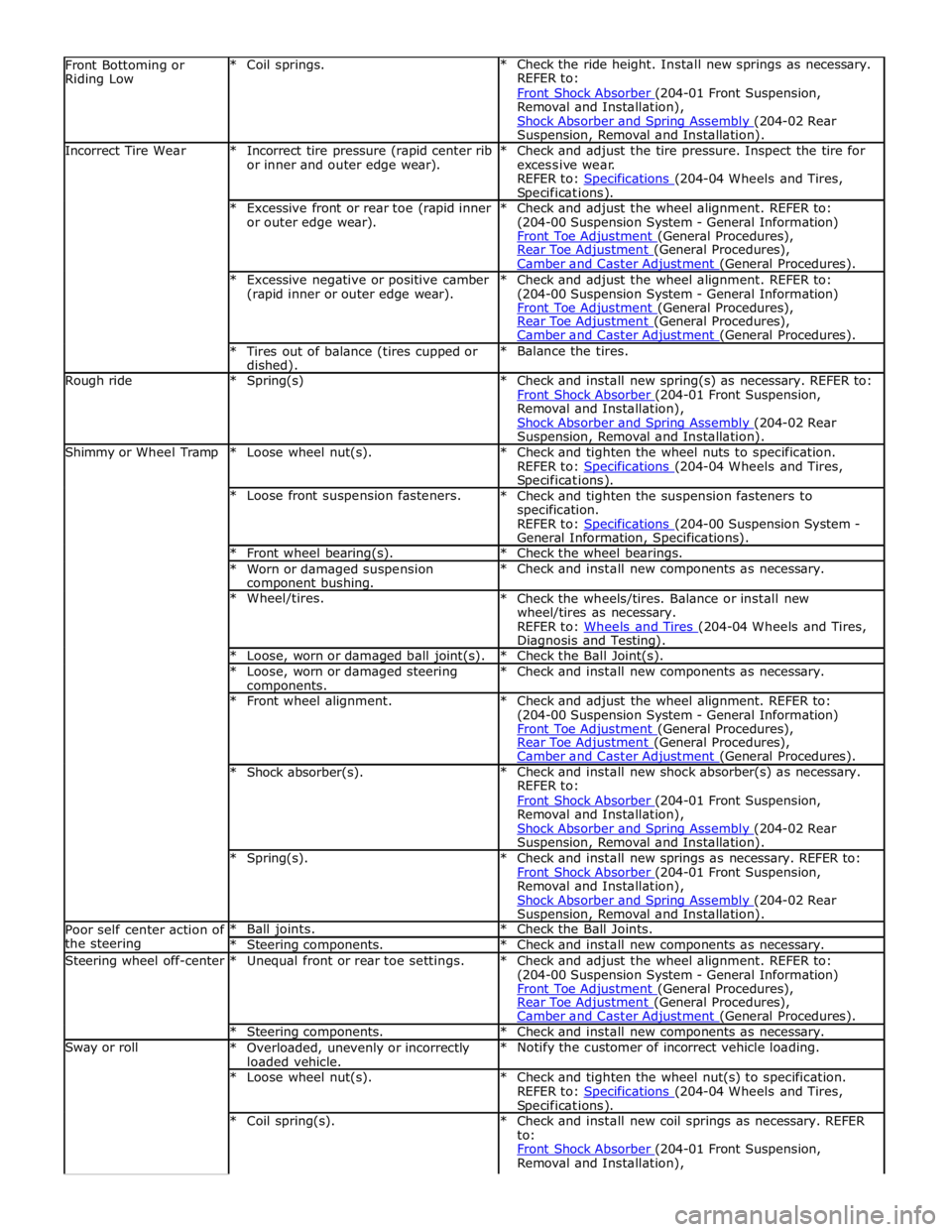
Removal and Installation),
Shock Absorber and Spring Assembly (204-02 Rear Suspension, Removal and Installation). Incorrect Tire Wear
* Incorrect tire pressure (rapid center rib
or inner and outer edge wear). * Check and adjust the tire pressure. Inspect the tire for
excessive wear.
REFER to: Specifications (204-04 Wheels and Tires, Specifications). * Excessive front or rear toe (rapid inner
or outer edge wear). * Check and adjust the wheel alignment. REFER to:
(204-00 Suspension System - General Information)
Front Toe Adjustment (General Procedures), Rear Toe Adjustment (General Procedures), Camber and Caster Adjustment (General Procedures). * Excessive negative or positive camber
(rapid inner or outer edge wear). * Check and adjust the wheel alignment. REFER to:
(204-00 Suspension System - General Information)
Front Toe Adjustment (General Procedures), Rear Toe Adjustment (General Procedures), Camber and Caster Adjustment (General Procedures). * Tires out of balance (tires cupped or dished). * Balance the tires. Rough ride * Spring(s)
* Check and install new spring(s) as necessary. REFER to:
Front Shock Absorber (204-01 Front Suspension, Removal and Installation),
Shock Absorber and Spring Assembly (204-02 Rear Suspension, Removal and Installation). Shimmy or Wheel Tramp * Loose wheel nut(s).
* Check and tighten the wheel nuts to specification.
REFER to: Specifications (204-04 Wheels and Tires, Specifications). * Loose front suspension fasteners.
* Check and tighten the suspension fasteners to
specification.
REFER to: Specifications (204-00 Suspension System - General Information, Specifications). * Front wheel bearing(s). * Check the wheel bearings. * Worn or damaged suspension component bushing. * Check and install new components as necessary. * Wheel/tires.
* Check the wheels/tires. Balance or install new
wheel/tires as necessary.
REFER to: Wheels and Tires (204-04 Wheels and Tires, Diagnosis and Testing). * Loose, worn or damaged ball joint(s). * Check the Ball Joint(s). * Loose, worn or damaged steering components. * Check and install new components as necessary. * Front wheel alignment.
* Check and adjust the wheel alignment. REFER to:
(204-00 Suspension System - General Information)
Front Toe Adjustment (General Procedures), Rear Toe Adjustment (General Procedures), Camber and Caster Adjustment (General Procedures). * Shock absorber(s). * Check and install new shock absorber(s) as necessary.
REFER to:
Front Shock Absorber (204-01 Front Suspension, Removal and Installation),
Shock Absorber and Spring Assembly (204-02 Rear Suspension, Removal and Installation). * Spring(s).
* Check and install new springs as necessary. REFER to:
Front Shock Absorber (204-01 Front Suspension, Removal and Installation),
Shock Absorber and Spring Assembly (204-02 Rear Suspension, Removal and Installation). Poor self center action of
the steering * Ball joints. * Check the Ball Joints. * Steering components. * Check and install new components as necessary. Steering wheel off-center * Unequal front or rear toe settings.
* Check and adjust the wheel alignment. REFER to:
(204-00 Suspension System - General Information)
Front Toe Adjustment (General Procedures), Rear Toe Adjustment (General Procedures), Camber and Caster Adjustment (General Procedures). * Steering components. * Check and install new components as necessary. Sway or roll
* Overloaded, unevenly or incorrectly
loaded vehicle. * Notify the customer of incorrect vehicle loading. * Loose wheel nut(s).
* Check and tighten the wheel nut(s) to specification.
REFER to: Specifications (204-04 Wheels and Tires, Specifications). * Coil spring(s).
* Check and install new coil springs as necessary. REFER
to:
Front Shock Absorber (204-01 Front Suspension, Removal and Installation),
Page 310 of 3039
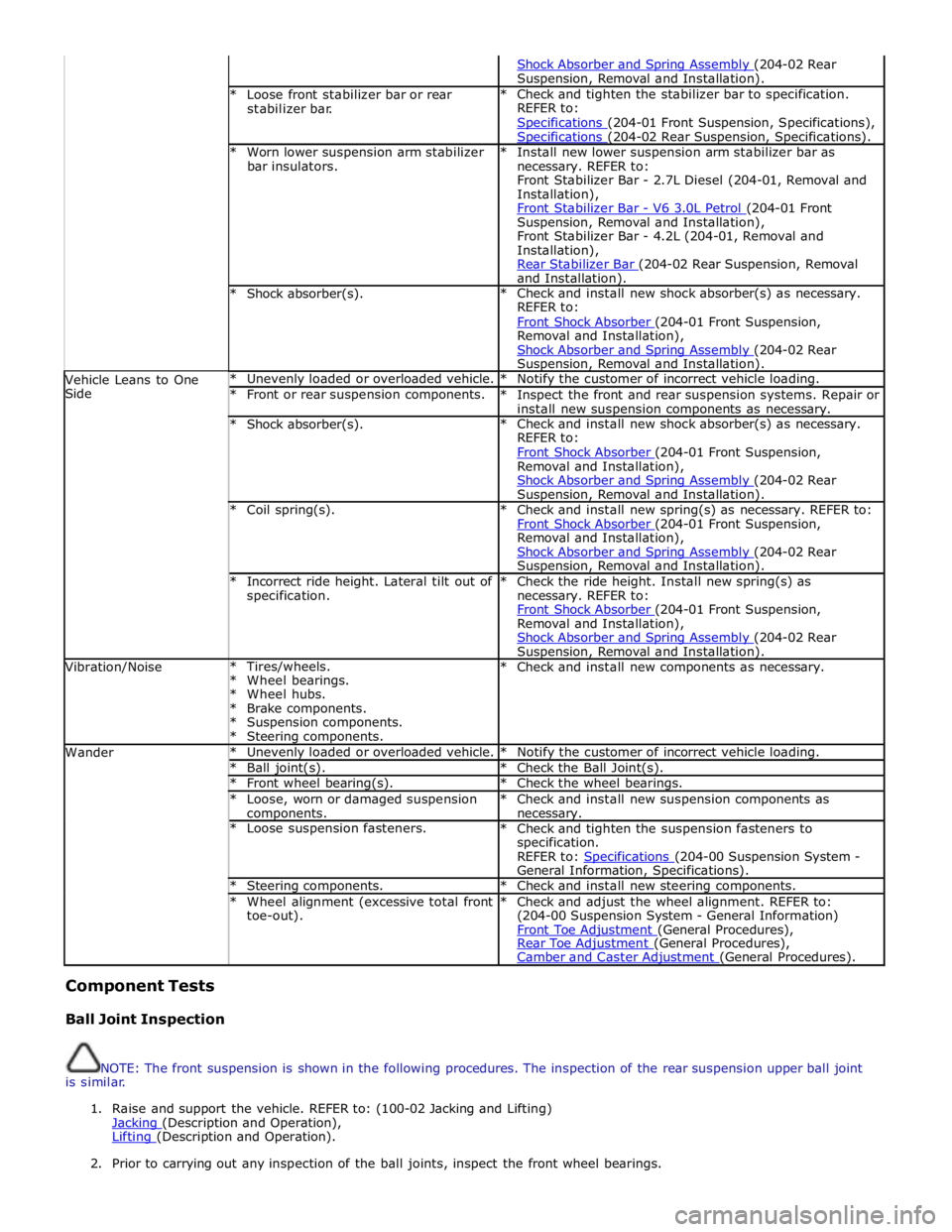
Shock Absorber and Spring Assembly (204-02 Rear Suspension, Removal and Installation). * Loose front stabilizer bar or rear
stabilizer bar. * Check and tighten the stabilizer bar to specification.
REFER to:
Specifications (204-01 Front Suspension, Specifications), Specifications (204-02 Rear Suspension, Specifications). * Worn lower suspension arm stabilizer
bar insulators. * Install new lower suspension arm stabilizer bar as
necessary. REFER to:
Front Stabilizer Bar - 2.7L Diesel (204-01, Removal and
Installation),
Front Stabilizer Bar - V6 3.0L Petrol (204-01 Front Suspension, Removal and Installation),
Front Stabilizer Bar - 4.2L (204-01, Removal and
Installation),
Rear Stabilizer Bar (204-02 Rear Suspension, Removal and Installation). * Shock absorber(s). * Check and install new shock absorber(s) as necessary.
REFER to:
Front Shock Absorber (204-01 Front Suspension, Removal and Installation),
Shock Absorber and Spring Assembly (204-02 Rear Suspension, Removal and Installation). Vehicle Leans to One
Side * Unevenly loaded or overloaded vehicle. * Notify the customer of incorrect vehicle loading. * Front or rear suspension components.
* Inspect the front and rear suspension systems. Repair or
install new suspension components as necessary. * Shock absorber(s). * Check and install new shock absorber(s) as necessary.
REFER to:
Front Shock Absorber (204-01 Front Suspension, Removal and Installation),
Shock Absorber and Spring Assembly (204-02 Rear Suspension, Removal and Installation). * Coil spring(s).
* Check and install new spring(s) as necessary. REFER to:
Front Shock Absorber (204-01 Front Suspension, Removal and Installation),
Shock Absorber and Spring Assembly (204-02 Rear Suspension, Removal and Installation). * Incorrect ride height. Lateral tilt out of
specification. * Check the ride height. Install new spring(s) as
necessary. REFER to:
Front Shock Absorber (204-01 Front Suspension, Removal and Installation),
Shock Absorber and Spring Assembly (204-02 Rear Suspension, Removal and Installation). Vibration/Noise * Tires/wheels.
* Wheel bearings.
* Wheel hubs.
* Brake components.
* Suspension components.
* Steering components. * Check and install new components as necessary. Wander * Unevenly loaded or overloaded vehicle. * Notify the customer of incorrect vehicle loading. * Ball joint(s). * Check the Ball Joint(s). * Front wheel bearing(s). * Check the wheel bearings. * Loose, worn or damaged suspension components. * Check and install new suspension components as necessary. * Loose suspension fasteners.
* Check and tighten the suspension fasteners to
specification.
REFER to: Specifications (204-00 Suspension System - General Information, Specifications). * Steering components. * Check and install new steering components. * Wheel alignment (excessive total front
toe-out). * Check and adjust the wheel alignment. REFER to:
(204-00 Suspension System - General Information)
Front Toe Adjustment (General Procedures), Rear Toe Adjustment (General Procedures), Camber and Caster Adjustment (General Procedures). Component Tests
Ball Joint Inspection
NOTE: The front suspension is shown in the following procedures. The inspection of the rear suspension upper ball joint
is similar.
1. Raise and support the vehicle. REFER to: (100-02 Jacking and Lifting)
Jacking (Description and Operation), Lifting (Description and Operation).
2. Prior to carrying out any inspection of the ball joints, inspect the front wheel bearings.
Page 332 of 3039

Upper Control Arm
The forged-aluminum upper control arm is a wishbone design and connects to the vehicle body through two plain bushes, and
links to the swan neck wheel knuckle by an integral ball joint. The upper control arm is inclined to provide anti-dive
characteristics under heavy braking, while also controlling geometry for vehicle straight-line stability.
Lower Control Arm
The forged aluminum lower control arms are of the wishbone design; the arms separate to allow for optimum bush tuning:
The rear lateral control arm is fitted with a bush at its inner end which locates between brackets on the subframe. The
arm is secured with an eccentric bolt which provides the adjustment of the suspension camber geometry. The outer end
of the control arm has a tapered hole which locates on a ball joint fitted to the wheel knuckle. An integral clevis bracket
on the forward face of the lateral control arm allows for the attachment of the forward control arm. A bush is fitted
below the clevis bracket to provide for the attachment of the stabilizer bar link. A cross-axis joint is fitted to a
cross-hole in the control arm to provide the location for the clevis attachment of the spring and damper assembly.
The forward control arm is fitted with a fluid-block rubber bush at its inner end which locates between brackets on the
subframe. The arm is secured with an eccentric bolt which provides adjustment of the castor and camber geometry. The
outer end of the control arm is fitted with a cross-axis joint and locates in the integral clevis bracket on the lateral
control arm.
Wheel Knuckle
The cast aluminum wheel knuckle is a swan neck design and attaches to the upper control arm and lower lateral control arm.
The lower lateral control arm locates on a non serviceable ball-joint integral with the wheel knuckle. The lower boss on the
rear of the knuckle provides for the attachment of the steering gear tie-rod ball joint.
The wheel knuckle also provides the mounting locations for the:
wheel hub and bearing assembly
the wheel speed sensor (integral to the wheel hub and bearing assembly)
brake caliper and disc shield.
Stabilizer Bar
The stabilizer bar is attached to the front of the subframe with bushes and mounting brackets. The pressed steel mounting
brackets locate over the bushes and are attached to the cross member with bolts screwed into threaded locations in the
subframe. The stabilizer bar has crimped, 'anti-shuffle' collars pressed in position on the inside edges of the bushes. The
collars prevent sideways movement of the stabilizer bar.
The stabilizer bar is manufactured from 32mm diameter tubular steel on supercharged models and 31mm diameter tubular
steel on diesel and normally aspirated models and has been designed to provide particular characteristics in maintaining roll
rates, specifically in primary ride comfort.
Each end of the stabilizer bar curves rearwards to attach to a ball joint on a stabilizer link. Each stabilizer link is secured to a
bush in the lower lateral arm with a bolt and locknut. The links allow the stabilizer bar to move with the wheel travel providing
maximum effectiveness.
The only difference between the front stabilizer bars, in addition to the diameter, is in the shape to accommodate engine
variant:
a slightly curved bar, between bush centers, for V6 diesel (31 mm dia) and V8 gasoline supercharged (32 mm dia),
a straight bar, between bush centers, for V6 and V8 normally aspirated gasoline engines (31 mm dia).
Spring and Damper Assembly
The spring and damper assemblies are located between the lower lateral arm and the front suspension housing in the inner
wing. Dependant on vehicle model there are three types of coil spring and damper available:
a standard oil passive damper (All models except supercharged),
an adaptive damper, also known as Computer Active Technology Suspension (CATS) on 4.2L supercharged vehicles up to
2010MY, For additional information refer to Vehicle Dynamic Suspension 4.2L.
a continuously variable adaptive damper, also known as Adaptive Dynamics System on 5.0L supercharged vehicles from
2010MY. For additional information refer to Vehicle Dynamic Suspension 5.0L.
The dampers are a monotube design with a spring seat secured by a circlip onto the damper tube. The damper's lower
spherical joint is an integral part of the lateral lower control-arm, and the damper takes the form of a clevis-end, which
straddles the spherical joint.
The damper piston is connected to a damper rod which is sealed at its exit point from the damper body. The threaded outer
end of the damper rod locates through a hole in the top mount. A self locking nut secures the top mount to the damper rod.
The damper rod on the adaptive damper has an electrical connector on the outer end of the damper rod.
Supercharged 4.2L vehicles up to 2010MY: The adaptive damper functions by restricting the flow of hydraulic fluid through
internal galleries in the damper's piston. The adaptive damper has a solenoid operated valve, which when switched allows a
greater flow of hydraulic fluid through the damper's piston. This provides a softer damping characteristic from the damper. The
adaptive damper defaults to a firmer setting when not activated. The solenoid is computer controlled and can switch between
soft and hard damping settings depending on road wheel inputs and vehicle speed.
Supercharged 5.0L vehicles from 2010MY: The variable damper functions by adjustment of a solenoid operated variable orifice,
which opens up an alternative path for oil flow within the damper. When de-energized the bypass is closed and all the oil flows
Page 334 of 3039
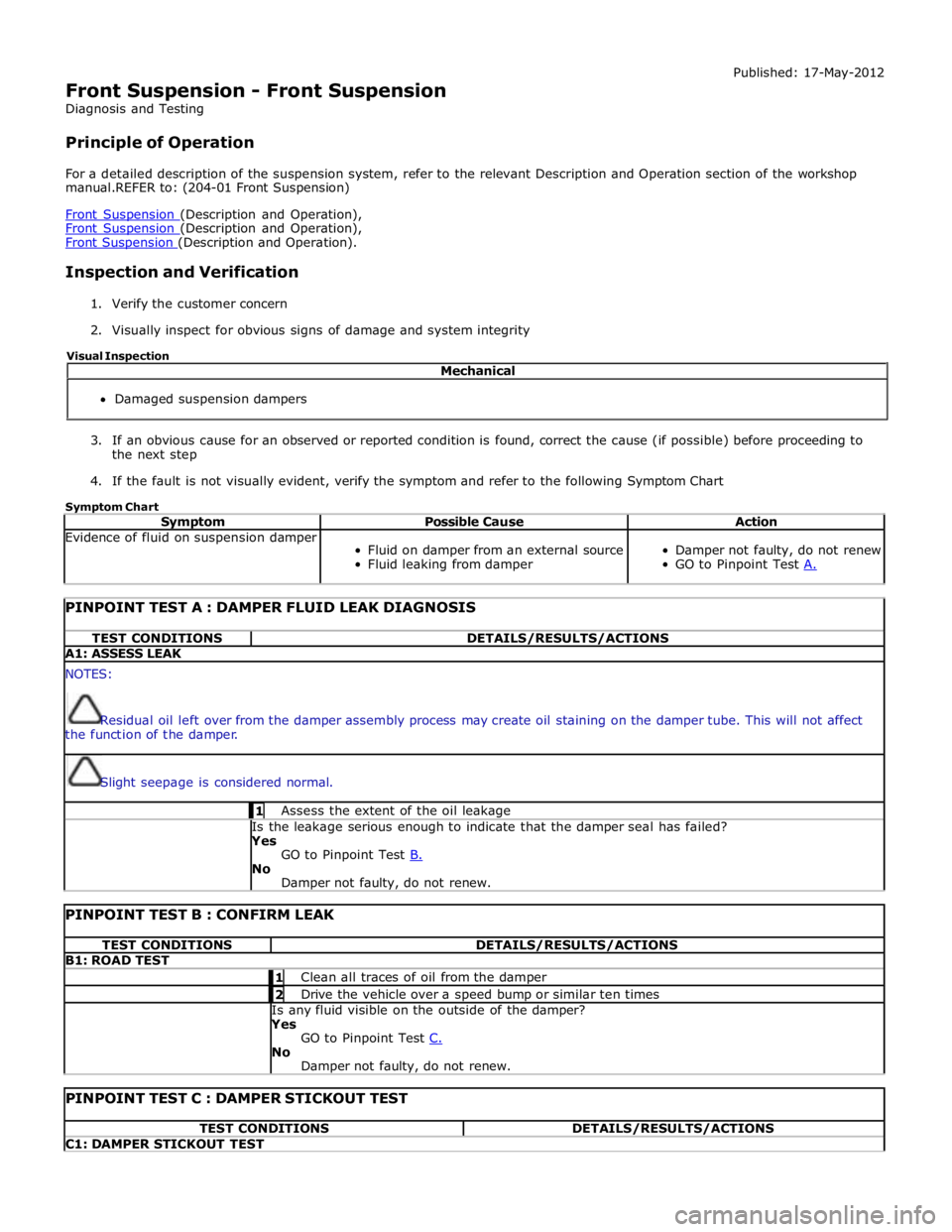
Front Suspension - Front Suspension
Diagnosis and Testing
Principle of Operation Published: 17-May-2012
For a detailed description of the suspension system, refer to the relevant Description and Operation section of the workshop
manual.REFER to: (204-01 Front Suspension)
Front Suspension (Description and Operation), Front Suspension (Description and Operation), Front Suspension (Description and Operation).
Inspection and Verification
1. Verify the customer concern
2. Visually inspect for obvious signs of damage and system integrity
3. If an obvious cause for an observed or reported condition is found, correct the cause (if possible) before proceeding to
the next step
4. If the fault is not visually evident, verify the symptom and refer to the following Symptom Chart
Symptom Chart
Symptom Possible Cause Action Evidence of fluid on suspension damper
Fluid on damper from an external source
Fluid leaking from damper
Damper not faulty, do not renew
GO to Pinpoint Test A.
PINPOINT TEST A : DAMPER FLUID LEAK DIAGNOSIS TEST CONDITIONS DETAILS/RESULTS/ACTIONS A1: ASSESS LEAK NOTES:
Residual oil left over from the damper assembly process may create oil staining on the damper tube. This will not affect
the function of the damper.
Slight seepage is considered normal. 1 Assess the extent of the oil leakage Is the leakage serious enough to indicate that the damper seal has failed? Yes
GO to Pinpoint Test B. No
Damper not faulty, do not renew.
PINPOINT TEST B : CONFIRM LEAK TEST CONDITIONS DETAILS/RESULTS/ACTIONS B1: ROAD TEST 1 Clean all traces of oil from the damper 2 Drive the vehicle over a speed bump or similar ten times Is any fluid visible on the outside of the damper? Yes
GO to Pinpoint Test C. No
Damper not faulty, do not renew.
PINPOINT TEST C : DAMPER STICKOUT TEST TEST CONDITIONS DETAILS/RESULTS/ACTIONS C1: DAMPER STICKOUT TEST Mechanical
Damaged suspension dampers Visual Inspection
Page 393 of 3039

Rear Suspension - Rear Suspension - Overview
Description and Operation
OVERVIEW Published: 11-May-2011
The double wishbone type rear-suspension is a fully independent design assembled on a steel subframe; large diameter
bushes isolate the subframe from the vehicle's body.
A toe-link located between the wheel knuckle and the subframe is used to adjust the toe angle of the rear wheels.
The wheel knuckle attaches to the upper and lower control arms, and the coil spring and damper assembly is located between
the lower control arm and the vehicle body.
Dependant on vehicle model there are three types of coil spring and damper available:
a standard oil passive damper (All models except supercharged),
an adaptive damper, also known as Computer Active Technology Suspension (CATS) on 4.2L supercharged vehicles up to
2010MY, For additional information refer to Vehicle Dynamic Suspension 4.2L.
a continuously variable adaptive damper, also known as Adaptive Dynamics System on 5.0L supercharged vehicles from
2010MY. For additional information refer to Vehicle Dynamic Suspension 5.0L.