lock JAGUAR XFR 2010 1.G Workshop Manual
[x] Cancel search | Manufacturer: JAGUAR, Model Year: 2010, Model line: XFR, Model: JAGUAR XFR 2010 1.GPages: 3039, PDF Size: 58.49 MB
Page 2125 of 3039

locking the active anti-theft system. The intrusion detection modules can also be de-activated by deselecting the 'Alarm
Sensors' option in the 'Vehicle Settings' screen on the Touch Screen Display.
NOTE: The Touch Screen method of de-activation of the intrusion detection module is only for one arm cycle, it will revert
to active once the engine is next started.
When the volumetric mode is active and the vehicle battery voltage falls below 9 volts, the CJB will ignore any inputs from the
intrusion detection module to prevent false alarm activation.
www.JagDocs.com
Page 2127 of 3039

Check DDW for open campaigns. Refer to the corresponding bulletins and SSMs which may be valid for the specific
customer complaint and carry out the recommendations as required.
DTC Description Possible Causes Action B1087-83
LIN Bus "A" - Value of
signal protection
calculation incorrect
Checksum of the received LIN
frame from battery backed
sounder, roof header console,
and/or rain/light sensor is
incorrect
Check operation of rain/light sensor by
covering sensor or applying water to screen,
install a new sensor as required B1087-88 LIN Bus "A" - Bus off
Bus off. Battery backed sounder,
roof header console, and/or
rain/light sensor LIN circuit -
short to ground, power
Carry out any pinpoint tests associated with
this DTC using the manufacturer approved
diagnostic system. Refer to the electrical
circuit diagrams and check battery backed
sounder, roof header console, and rain/light
sensor LIN circuit for short to ground, power B108F-23
Cabin Lock/Unlock
Switch - Signal stuck
low
Cabin lock/unlock switch signal
stuck
Switch pressed for longer than
20 seconds
Switch circuit short circuit to
power or ground
Switch failure
Check the switch operation and
serviceability. Refer to the electrical circuit
diagrams and check the switch circuit B109C-11
Front Courtesy Light -
Circuit short to ground
Short to ground
Refer to the electrical circuit diagrams and
test front courtesy light circuit for short to
ground B109C-15
Front Courtesy Light -
Circuit short to battery
or open
Short to power or open circuit
Refer to the electrical circuit diagrams and
test front courtesy light circuit for short to
power or open circuit B10EB-11
Driver Door Double
Locking Motor - Circuit
short to ground
Driver door double locking motor
control circuit - short to ground
Refer to the electrical circuit diagrams and
test driver door double locking motor control
circuit for short ground B10EB-15
Driver Door Double
Locking Motor - Circuit
short to battery or open
Driver door double locking motor
control circuit - short to power,
open circuit
Carry out any pinpoint tests associated with
this DTC using the manufacturer approved
diagnostic system. Refer to the electrical
circuit diagrams and test driver door double
locking motor control circuit for short to
power or open circuit B10EC-11
Passenger Door Double
Locking Motor - Circuit
short to ground
Passenger door double locking
motor control circuit - short to
ground
Refer to the electrical circuit diagrams and
test passenger door double locking motor
control circuit for short ground B10EC-15
Passenger Door Double
Locking Motor - Circuit
short to battery or open
Passenger door double locking
motor control circuit - short to
power, open circuit
Carry out any pinpoint tests associated with
this DTC using the manufacturer approved
diagnostic system. Refer to the electrical
circuit diagrams and test passenger door
double locking motor control circuit for short
to power or open circuit B10ED-11
Rear Door Driver Side
Double Locking Motor -
Circuit short to ground
Rear door driver side double
locking motor control circuit -
short to ground
Refer to the electrical circuit diagrams and
test rear door driver side double locking
motor control circuit for short ground B10ED-15
Rear Door Driver Side
Double Locking Motor -
Circuit short to battery
or open
Rear door driver side double
locking motor control circuit -
short to power, open circuit
Carry out any pinpoint tests associated with
this DTC using the manufacturer approved
diagnostic system. Refer to the electrical
circuit diagrams and test rear door driver
side double locking motor control circuit for
short power, open circuit
Page 2128 of 3039

DTC Description Possible Causes Action B10EE-11
Rear Door Passenger
Side Double Locking
Motor - Circuit short to
ground
Rear door passenger side double
locking motor control circuit -
short to ground
Refer to the electrical circuit diagrams and
test rear door passenger side double locking
motor control circuit for short ground B10EE-15
Rear Door Passenger
Side Double Locking
Motor - Circuit short to
battery or open
Rear door passenger side double
locking motor control circuit -
short to power, open circuit
Carry out any pinpoint tests associated with
this DTC using the manufacturer approved
diagnostic system. Refer to the electrical
circuit diagrams and test rear door
passenger side double locking motor control
circuit for short power, open circuit B10F1-11
Key In Switch - Circuit
short to ground
Keyless vehicle module, key IN
status circuit - short to ground
Carry out any pinpoint tests associated with
this DTC using the manufacturer approved
diagnostic system. Refer to the electrical
circuit diagrams and check keyless vehicle
module, key IN status circuit for short to
ground B10F1-12
Key In Switch - Circuit
short to battery
Keyless vehicle module, key IN
status circuit - short to power
Refer to the electrical circuit diagrams and
check keyless vehicle module, key IN status
circuit for short to power B10F1-13
Key In Switch - Circuit
open
Keyless vehicle module, key IN
status circuit - open circuit
Refer to the electrical circuit diagrams and
check keyless vehicle module, key IN status
circuit for open circuit B1108-11
Driver Door Central
Locking Motor - Circuit
short to ground
Driver door central locking motor
control circuit - short to ground
Refer to the electrical circuit diagrams and
test driver door central locking motor control
circuit for short ground B1108-15
Driver Door Central
Locking Motor - Circuit
short to battery or open
Driver door central locking motor
control circuit - short to power,
open circuit
Carry out any pinpoint tests associated with
this DTC using the manufacturer approved
diagnostic system. Refer to the electrical
circuit diagrams and test driver door central
locking motor control circuit for short to
power, open circuit B1109-11
Passenger Door Central
Locking Motor - Circuit
short to ground
Short to ground
Refer to the electrical circuit diagrams and
test passenger door central locking motor
circuit for short to ground B1109-15
Passenger Door Central
Locking Motor - Circuit
short to battery or open
Short to power or open circuit
Refer to the electrical circuit diagrams and
test passenger door central locking motor
circuit for short to power or open circuit B110A-11
Rear Door Driver Side
Central Locking Motor -
Circuit short to ground
Rear driver door central locking
motor control circuit - short to
ground
Refer to the electrical circuit diagrams and
test rear driver door central locking motor
control circuit for short ground B110A-15
Rear Door Driver Side
Central Locking Motor -
Circuit short to battery
or open
Rear driver door central locking
motor control circuit - short to
power, open circuit
Refer to the electrical circuit diagrams and
test rear driver door central locking motor
control circuit for short to power, open circuit B110B-11
Rear Door Passenger
Side Central Locking
Motor - Circuit short to
ground
Rear passenger door central
locking motor circuit short circuit
to ground
Refer to the electrical circuit diagrams and
check the circuit B110B-15
Rear Door Passenger
Side Central Locking
Motor - Circuit short to
battery or open
Rear passenger door central
locking motor circuit short circuit
to power or open circuit
Refer to the electrical circuit diagrams and
check the circuit B1163-11
Left Mirror Heater
Output Short To Ground
- Circuit short to ground
Short to ground
Refer to the electrical circuit diagrams and
test left mirror heater output circuit for short
to ground
Page 2131 of 3039

DTC Description Possible Causes Action security. Clear the DTC and retest. If the
problem persists, renew the driver door
window switch B11F6-11
Driver Folding Mirror
Motor - Circuit short to
ground
Driver folding mirror motor
circuit short circuit to ground
Mirror motor failure
Refer to the electrical circuit diagrams and
check the mirror fold circuit between the
drivers door module and the mirror
assembly. Repair as necessary B11F6-15
Driver Folding Mirror
Motor - Circuit short to
battery or open
Driver mirror heater output
circuit short circuit to power or
open circuit
Mirror motor failure
Refer to the electrical circuit diagrams and
check the mirror fold circuit between the
drivers door module and the mirror
assembly. Repair as necessary B11F7-11
Passenger Folding Mirror
Motor - Circuit short to
ground
Passenger folding mirror motor
circuit short circuit to ground
Mirror motor failure
Refer to the electrical circuit diagrams and
check the mirror fold circuit between the
passenger door module and the mirror
assembly. Repair as necessary B11F7-15
Passenger Folding Mirror
Motor - Circuit short to
battery or open
Passenger mirror heater output
circuit short circuit to power or
open circuit
Mirror motor failure
Refer to the electrical circuit diagrams and
check the mirror fold circuit between the
passenger door module and the mirror
assembly. Repair as necessary B1222-23
Master Lock/Unlock
Switch - Signal stuck
low
Master lock or unlock switch
digital input circuit - signal
stuck low
Refer to the electrical circuit diagrams and
check master lock and unlock switch digital
input circuits for short to ground, open
circuit B1A98-83
LIN Bus Circuit #1 -
Value of signal
protection calculation
incorrect
Value of signal protection
calculation incorrect
Refer to the electrical circuit diagrams and
check the LIN Bus circuit between the rear
door control unit and the Driver Door
Module. Check the connectors for integrity
and security. Clear the DTC and retest. If
the problem persists, renew the rear door
control module B1A98-86
LIN Bus Circuit #1 -
Signal invalid
Signal invalid
Refer to the electrical circuit diagrams and
check the LIN Bus circuit between the rear
door control unit and the Driver Door
Module. Check the connectors for integrity
and security. Clear the DTC and retest. If
the problem persists, renew the rear door
control module B1A98-87
LIN Bus Circuit #1 -
Missing message
Missing message
Refer to the electrical circuit diagrams and
check the LIN Bus circuit between the rear
door control unit and the Driver Door
Module. Check the connectors for integrity
and security. Clear the DTC and retest. If
the problem persists, renew the rear door
control module B1C09-11
Driver Left/Right Mirror
Motor Circuit - Circuit
short to ground
Driver mirror adjustment motor
circuit short circuit to ground
Mirror left/right motor failure
Refer to the electrical circuit diagrams and
check the mirror motor circuit between the
drivers door module and the mirror
assembly. Repair as necessary B1C09-15
Driver Left/Right Mirror
Motor Circuit - Circuit
short to battery or open
Driver mirror adjustment motor
circuit short circuit to power or
open circuit
Mirror left/right motor failure
Refer to the electrical circuit diagrams and
check the mirror motor circuit between the
drivers door module and the mirror
assembly. Repair as necessary B1C10-11
Driver Up/Down Mirror
Motor Circuit - Circuit
short to ground
Driver mirror adjustment motor
circuit short circuit to ground
Mirror motor failure
Refer to the electrical circuit diagrams and
check the mirror motor circuit between the
drivers door module and the mirror
assembly. Repair as necessary
Page 2133 of 3039

DTC Description Possible Causes Action B1C39-29
Key Lock Switch - Signal
invalid
Key lock switch signal invalid,
stuck/jammed
Switch held for longer than 20
seconds
Key lock switch circuit short to
ground (where connected)
Key lock switch failure
Central Junction Box fault
Refer to the electrical circuit diagrams and
the key lock switch circuit. Clear the DTC
and retest. If no other DTCs are present,
ignore this fault. If the DTC returns, suspect
an internal fault with the Central Junction
Box. Refer to the warranty policy and
procedures manual if a module is suspect B1D06-11
Left Turn Indicator -
Circuit short to ground
Left turn signal short circuit to
ground
Refer to the electrical circuit diagrams and
check left turn signal for short circuit to
ground B1D06-15
Left Turn Indicator -
Circuit short to battery
or open
Left turn signal short circuit to
power
Left turn signal high resistance,
open circuit
Refer to the electrical circuit diagrams and
check left turn signal for short circuit high
resistance, open circuit B1D07-11
Right Turn Indicator -
Circuit short to ground
Right turn signal short circuit to
ground
Refer to the electrical circuit diagrams and
check right turn signal for short circuit to
ground B1D07-15
Right Turn Indicator -
Circuit short to battery
or open
Right turn signal circuit short
circuit to power
Right turn signal circuit high
resistance, open circuit
Refer to the electrical circuit diagrams and
check right turn signal for short circuit high
resistance, open circuit B1D17-11 Battery Backed Sounder
- Circuit short to ground
Battery backed sounder
inclination sensor control circuit
- short to ground
Refer to the electrical circuit diagrams and
check battery backed sounder inclination
sensor control circuit for short to ground B1D18-11
Volumetric Sensor -
Circuit short to ground
Intrusion sensor module supply
circuit - short to ground
Carry out any pinpoint tests associated with
this DTC using the manufacturer approved
diagnostic system. Refer to the electrical
circuit diagrams and check intrusion sensor
module supply circuit for short to ground B1D97-96 Tilt Sensor - Component
internal failure
Component internal failure
Suspect the battery backed sounder, check
and install a new battery backed sounder as
required C1B14-11
Sensor Supply #1 -
Circuit short to ground
Short to ground
Refer to the electrical circuit diagrams and
test window sensor supply circuit for short
to ground C1B14-15
Sensor Supply #1 -
Circuit short to battery
or open
Short to power or open circuit
Refer to the electrical circuit diagrams and
test window sensor supply circuit for short
to power or open circuit C1B15-11 Sensor Supply Voltage A
- Circuit short to ground
Position sensor supply circuit
short to ground
Position sensor fault
Refer to the electrical circuit diagrams and
check the position sensor supply circuit
between the rear door module and the
window motor. If the problem persists,
renew the window motor C1B15-15 Sensor Supply Voltage A
- Circuit short to battery
or open
Position sensor supply circuit
short to power or open circuit
Position sensor fault
Refer to the electrical circuit diagrams and
check the position sensor supply circuit
between the rear door module and the
window motor. If the problem persists,
renew the window motor P1624-13
Anti-Theft System -
Circuit open
RJB anti-theft signal circuit -
open circuit
Refer to the electrical circuit diagrams and
check RJB anti-theft signal circuit for open
circuit
Page 2142 of 3039
Published: 22-Apr-2013
Anti-Theft - Passive - Anti-Theft - Passive - System Operation and
Component Description
Description and Operation
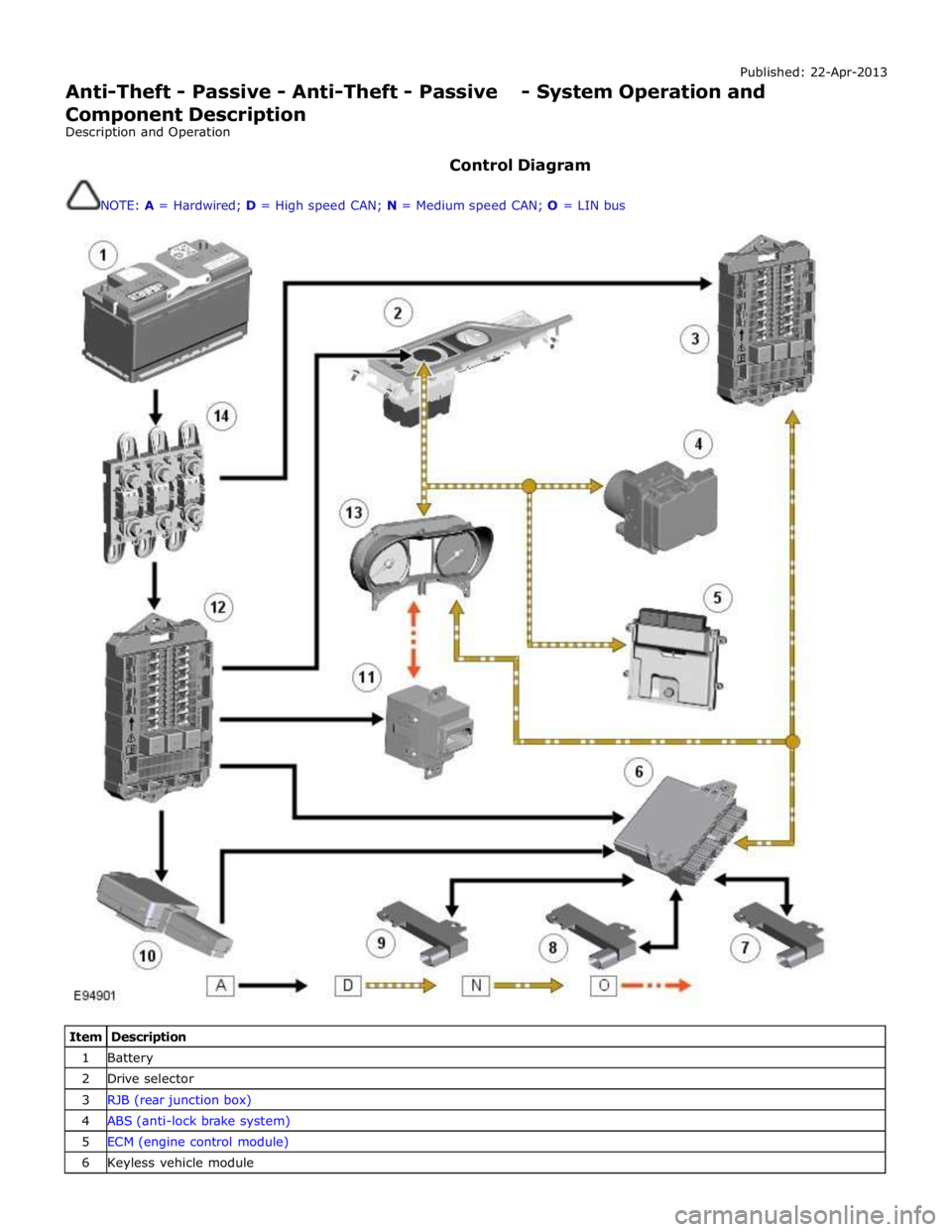
Control Diagram
NOTE: A = Hardwired; D = High speed CAN; N = Medium speed CAN; O = LIN bus
Item Description 1 Battery 2 Drive selector 3 RJB (rear junction box) 4 ABS (anti-lock brake system) 5 ECM (engine control module) 6 Keyless vehicle module
Page 2143 of 3039
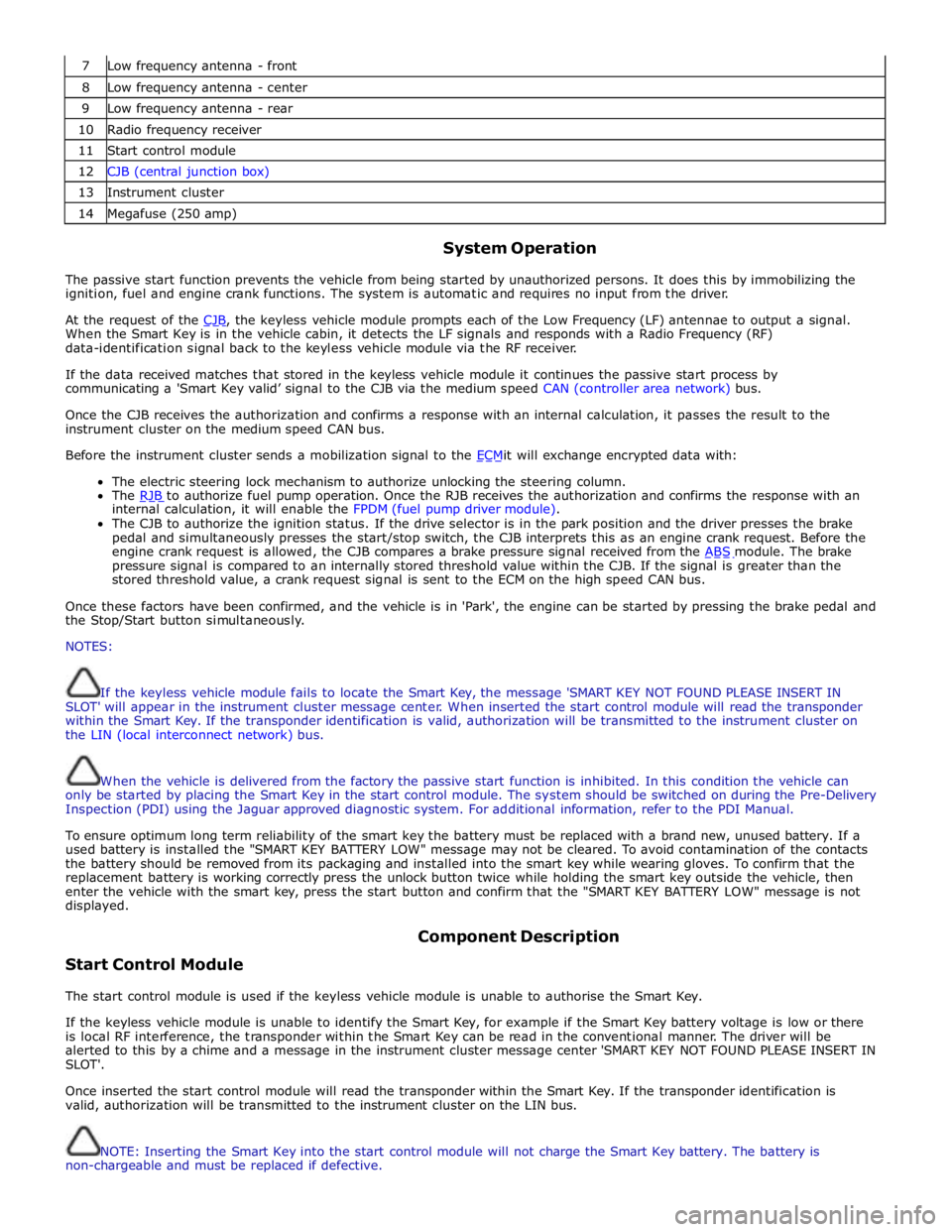
7 Low frequency antenna - front 8 Low frequency antenna - center 9 Low frequency antenna - rear 10 Radio frequency receiver 11 Start control module 12 CJB (central junction box) 13 Instrument cluster 14 Megafuse (250 amp)
System Operation
The passive start function prevents the vehicle from being started by unauthorized persons. It does this by immobilizing the
ignition, fuel and engine crank functions. The system is automatic and requires no input from the driver.
At the request of the CJB, the keyless vehicle module prompts each of the Low Frequency (LF) antennae to output a signal. When the Smart Key is in the vehicle cabin, it detects the LF signals and responds with a Radio Frequency (RF)
data-identification signal back to the keyless vehicle module via the RF receiver.
If the data received matches that stored in the keyless vehicle module it continues the passive start process by
communicating a 'Smart Key valid’ signal to the CJB via the medium speed CAN (controller area network) bus.
Once the CJB receives the authorization and confirms a response with an internal calculation, it passes the result to the
instrument cluster on the medium speed CAN bus.
Before the instrument cluster sends a mobilization signal to the ECMit will exchange encrypted data with: The electric steering lock mechanism to authorize unlocking the steering column.
The RJB to authorize fuel pump operation. Once the RJB receives the authorization and confirms the response with an internal calculation, it will enable the FPDM (fuel pump driver module).
The CJB to authorize the ignition status. If the drive selector is in the park position and the driver presses the brake
pedal and simultaneously presses the start/stop switch, the CJB interprets this as an engine crank request. Before the
engine crank request is allowed, the CJB compares a brake pressure signal received from the ABS module. The brake pressure signal is compared to an internally stored threshold value within the CJB. If the signal is greater than the
stored threshold value, a crank request signal is sent to the ECM on the high speed CAN bus.
Once these factors have been confirmed, and the vehicle is in 'Park', the engine can be started by pressing the brake pedal and
the Stop/Start button simultaneously.
NOTES:
If the keyless vehicle module fails to locate the Smart Key, the message 'SMART KEY NOT FOUND PLEASE INSERT IN
SLOT' will appear in the instrument cluster message center. When inserted the start control module will read the transponder
within the Smart Key. If the transponder identification is valid, authorization will be transmitted to the instrument cluster on
the LIN (local interconnect network) bus.
When the vehicle is delivered from the factory the passive start function is inhibited. In this condition the vehicle can
only be started by placing the Smart Key in the start control module. The system should be switched on during the Pre-Delivery
Inspection (PDI) using the Jaguar approved diagnostic system. For additional information, refer to the PDI Manual.
To ensure optimum long term reliability of the smart key the battery must be replaced with a brand new, unused battery. If a
used battery is installed the "SMART KEY BATTERY LOW" message may not be cleared. To avoid contamination of the contacts
the battery should be removed from its packaging and installed into the smart key while wearing gloves. To confirm that the
replacement battery is working correctly press the unlock button twice while holding the smart key outside the vehicle, then
enter the vehicle with the smart key, press the start button and confirm that the "SMART KEY BATTERY LOW" message is not
displayed.
Start Control Module Component Description
The start control module is used if the keyless vehicle module is unable to authorise the Smart Key.
If the keyless vehicle module is unable to identify the Smart Key, for example if the Smart Key battery voltage is low or there
is local RF interference, the transponder within the Smart Key can be read in the conventional manner. The driver will be
alerted to this by a chime and a message in the instrument cluster message center 'SMART KEY NOT FOUND PLEASE INSERT IN
SLOT'.
Once inserted the start control module will read the transponder within the Smart Key. If the transponder identification is
valid, authorization will be transmitted to the instrument cluster on the LIN bus.
NOTE: Inserting the Smart Key into the start control module will not charge the Smart Key battery. The battery is
non-chargeable and must be replaced if defective.
Page 2146 of 3039

Check the Starter Relay circuit.
NOTE: On petrol engine variants, due to Smart Start, both sides of Relay Coil are switched directly from ECM (If
conditions correct). On diesel engine variants the low side only is switched directly from the ECM.
Check that the Steering Column Lock correctly operates and the steering wheel can turn freely.
Check that the High Speed CAN network is not malfunctioning, i.e. the CAN circuit is open or short circuit. This would mean
that the instrument cluster and ECM would be unable to communicate resulting in no Challenge being performed to enable the
ECM. This would be supported by LED Flash Code 24, see PATS Fault Code Table.
Also check the CAN network between the ABS module and the CJB. The CJB uses the CAN_BrakePressureTMC signal to
determine if the brake pedal has been pressed in order to allow an engine crank. The CJB uses a value of 0x05, if the CJB sees
a value less than this, it will not enable the Crank Request Output.
Engine cranks but will not start
If the Engine is cranking it means that the ECM has passed the authorisation required with the Instrument Cluster. If this
authorisation failed, the ECM would not engage the starter relay. This could be confirmed by verifying the PATS LED prove out
(illuminated solid for 3 seconds) or by reading DTCs from the instrument cluster and ECM.
In this case, the fuel pump circuit should be verified. The Fuel Pump Delivery Module (FPDM), which is supplied via the RJB
(authentication required with the instrument cluster) and controlled by the ECM, supplies the fuel pump.
In all cases of suspected non-start issues, the most logical failure modes should be eliminated first. i.e.
1. Check all relevant supplies and grounds to the relevant modules listed herein.
2. Note any unusual behaviour from other systems/functionality.
3. Note any functions that are not operating as expected.
PATS Fault Codes
For the various PATS modes/faults listed in the table , the instrument cluster will store a DTC and indicate this to the customer
during the detection period defined in the 'when logged' column, by illuminating the indicator as described for 60 seconds and
then flashing the LED 10 times as appropriate. The indication will stop immediately the ignition status is set to OFF any time
during the fault indication sequence. Up to 4 DTCs could be stored per key read sequence (1-10 read attempts). No DTCs will be
stored until all retry attempts are complete. Only the highest priority fault code will be flashed.
To determine the fault code from the LED: The LED will flash initially ten times with 1.5 seconds between. The LED will remain
OFF for 2.5 seconds then flash a number of times with 0.5 seconds between (the number of times the LED flashes represents
the first digit of the code), the LED will remain OFF for 1.5 seconds then flash a number of times with 1.5 seconds between
(the number of times the LED flashes represents the second digit of the code).
The PATS LED will be commanded on as shown under 'indication'. Normal PATS operations are complete within 400ms of the
ignition switch transition from OFF to ON or START, worst case for ECM communication problems will be less than 2 seconds. If
PATS is not complete during the 2 seconds the ECM will terminate PATS and await the next ignition ON or START event. PATS
faults will be indicated via the LED as soon as possible and will terminate the LED prove out. At ignition OFF all previous
flashing will cease and the perimeter anti-theft system will control the LED when the vehicle is locked and armed.
PATS Fault Code Table
Mode of Operation/Fault
When Logged
Ignition
Status
DTC LED
Fault
Code
Indication Prove out N/A Transition
from OFF to
ON N/A N/A
3 Seconds of steady
illumination Perimeter Anti-theft Control N/A OFF -
Vehicle
locked and
armed N/A N/A
Off or 0.5Hz flashing
at 5% duty cycle ±
20% until Off Start Control Unit already programmed Key Insert Any B1B0105 N/A No Indication Start Control Unit status = invalid response Key Insert Any B1B0167 N/A No Indication Start Control Unit programming error Key Insert Any B1B0151 N/A No Indication Start Control Unit challenge response error Key Insert OFF B1B0162 N/A No Indication Key Programming timer expired or Key Auth Timer expired Key Insert Any B1B0187 N/A No Indication Transponder challenge response error Key Insert Any B1B0164 N/A No Indication Transponder keys stored below minimum number required B&A/Dealer Any B1B0100 N/A No Indication Transponder not programmed B&A/Dealer Any B1B0155 N/A No Indication If the instrument cluster sends a 'theft' key status
to the ECM or the ECM returns a status message
containing the data 'Disabled/Theft', the instrument
cluster will set this DTC EMS CAN
communication OFF to ON B1B3364 16
60 seconds of 4Hz
flashing at 50% duty
cycle followed by fault
code 16 flashing 10
times
Page 2152 of 3039

TEST
CONDITIONS DETAILS/RESULTS/ACTIONS E1: VEHICLES CURRENT POSITION MARK TURNS INDEPENDENTLY 1 Determine if the ignition status was turned to Auxiliary or On, while the vehicle was in motion with steering turned such as after an engine stall. Was ignition status set to Auxiliary or On?
Yes
The angular speed of the vehicle at the time of the ignition status change will be logged as the standard
value. To re-set the standard value, turn ignition status to 'OFF' then to 'Auxiliary' or 'On' with the
vehicle stationary.
Re-test the vehicle.
No
Check and install a new Navigation Control Module (NCM) as required. Refer to the new module/component installation note at top of DTC Index.
PINPOINT TEST F : CAR CURRENT POSITION NOT STABLE TEST
CONDITIONS DETAILS/RESULTS/ACTIONS F1: SYSTEM CHECK FOR DTCS 1 Check the system for DTCs which may be logged. Are any system DTCs logged? Yes
Carry out repair actions to correct the DTCs logged.
Re-check the system for car current position not stable.
No
GO to F2. F2: VEHICLE SPEED INPUT CHECK 1 Select Vehicle Sensor from the navigation diagnostic menu screen (PIN code 660), check Current speed. The current speed must match the speedometer. From the Vehicle Sensor screen, does the current speed must match the speedometer? Yes
GO to F3. No
Carry out MOST ring circuit checks.
Check the Anti-Lock Brake System Module for related DTCs and refer to the relevant DTC Index.
Carry out network integrity tests using the manufacturer approved diagnostic system. Refer to electrical
circuit diagrams and check CAN circuits if required. Repair wiring harness as required. F3: CHECK NUMBER OF SATELLITES 1 From the navigation diagnostic GPS information screen (PIN code 662), check the number of satellites displayed. Is the number of satellites displayed on the screen 0? Yes
Carry out pinpoint test A "Poor Satellite Reception"
No
GO to F4. F4: CHECK IF SYMPTOMS ARE OCCURRING IN PARTICULAR LOCATIONS 1 Confirm if the 'car current position not stable' symptom is occurring in particular locations. Is the 'car current position not stable' symptom occurring in particular locations? Yes
Signal reflections from buildings or a particular location may be responsible.
No
Carry out pinpoint test A "Poor Satellite Reception"
PINPOINT TEST G : MAP DISPLAY IS INCOMPLETE TEST
CONDITIONS DETAILS/RESULTS/ACTIONS G1: SYSTEM CHECK FOR DTCS 1 Check the system for DTCs which may be logged. Are any system DTCs logged? Yes
Carry out repair actions to correct the DTCs logged.
Re-check the system for 'Map display is incomplete'.
No
GO to G2. G2: CHECK MAP DISC 1 Check map disc for contamination, deformation, cracks, scratches or non-genuine disc and correct market. module/component installation note at top of DTC Index.
Re-check the system.
Page 2154 of 3039

Check the "Loading" button on the navigation diagnostics screen (PIN code 660) has been pressed, and "YES" has been selected. Has the "Loading" button on the navigation diagnostics screen been pressed, and has "YES" been selected? Yes
Check the correct map disc is inserted into the Navigation Control Module (NCM). Start the engine and
allow to idle for 15 minutesTurn the engine 'OFF', and then start the engine again.
No
Refer to electrical circuit diagrams and check integrity of navigation system wiring harness and
connectors.
GO to I4. I4: SYSTEM CHECK FOR DTCS 1 Check the system for DTCs which may be logged. Is DTC U300055 logged? Yes
Using the manufacturer approved diagnostic system check/amend the Car Configuration File parameter in
block 2, byte 127 to match vehicle market/specification. If the DTC remains check navigation system
module part number and ensure the correct component is installed to vehicle market/specification.
No
GO to I5. I5: NO RESPONSE TO PRESSING NAVIGATION MENU 1 Turn the engine 'OFF', wait for a moment, and then turn the engine 'ON' again. Does the navigation screen fail to display even if the navigation button is pressed? Yes
Check the HLDF is installed correctly.
Check the Navigation Control Module (NCM) is installed correctly.
No
Operation is normal. DTC Index
For a list of Diagnostic Trouble Codes (DTCs) that could be logged on this vehicle, please refer to Section 100-00.
REFER to: Diagnostic Trouble Code (DTC) Index - DTC: Navigation Control Module (NCM) (100-00, Description and Operation).