power steering JAGUAR XFR 2010 1.G Repair Manual
[x] Cancel search | Manufacturer: JAGUAR, Model Year: 2010, Model line: XFR, Model: JAGUAR XFR 2010 1.GPages: 3039, PDF Size: 58.49 MB
Page 749 of 3039
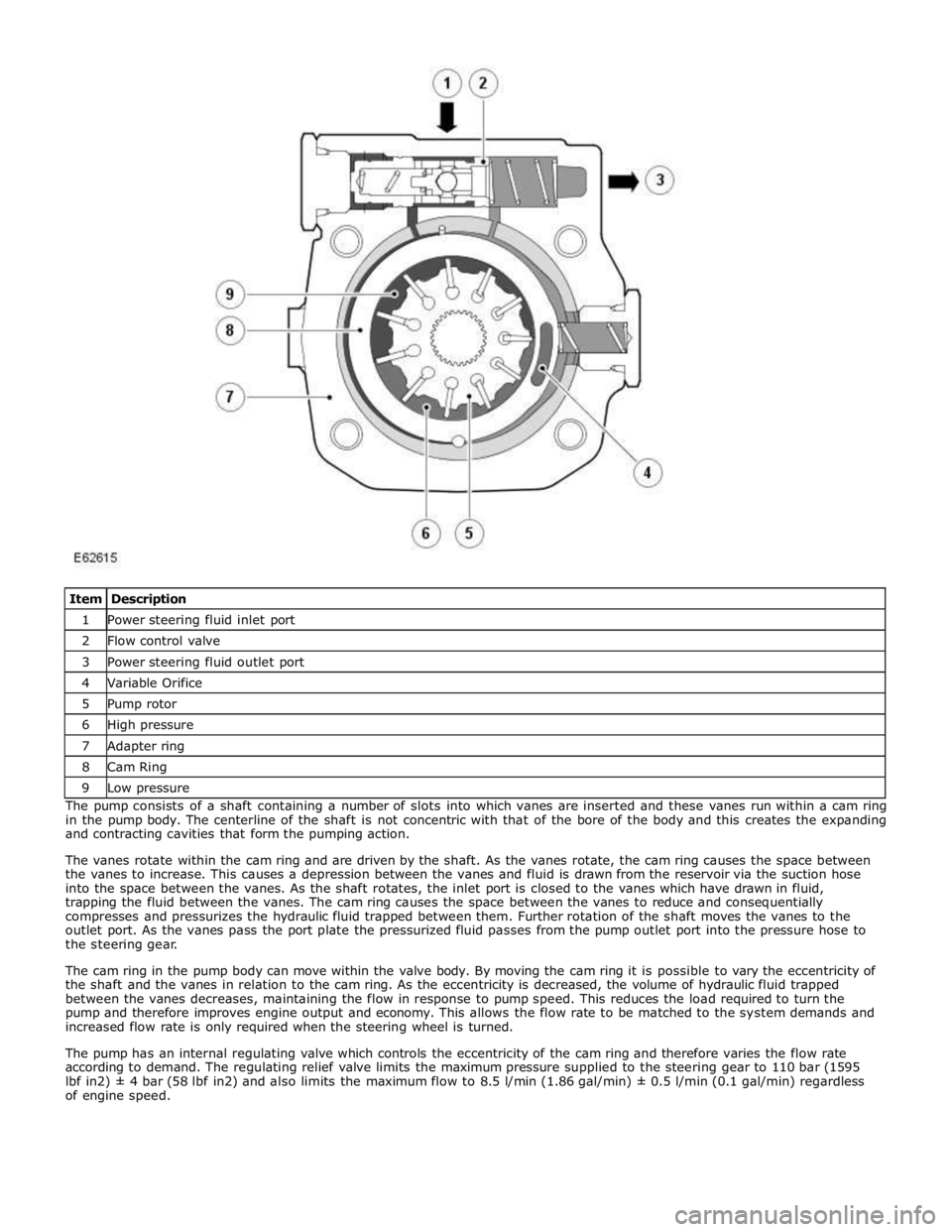
1 Power steering fluid inlet port 2 Flow control valve 3 Power steering fluid outlet port 4 Variable Orifice 5 Pump rotor 6 High pressure 7 Adapter ring 8 Cam Ring 9 Low pressure The pump consists of a shaft containing a number of slots into which vanes are inserted and these vanes run within a cam ring
in the pump body. The centerline of the shaft is not concentric with that of the bore of the body and this creates the expanding
and contracting cavities that form the pumping action.
The vanes rotate within the cam ring and are driven by the shaft. As the vanes rotate, the cam ring causes the space between
the vanes to increase. This causes a depression between the vanes and fluid is drawn from the reservoir via the suction hose
into the space between the vanes. As the shaft rotates, the inlet port is closed to the vanes which have drawn in fluid,
trapping the fluid between the vanes. The cam ring causes the space between the vanes to reduce and consequentially
compresses and pressurizes the hydraulic fluid trapped between them. Further rotation of the shaft moves the vanes to the
outlet port. As the vanes pass the port plate the pressurized fluid passes from the pump outlet port into the pressure hose to
the steering gear.
The cam ring in the pump body can move within the valve body. By moving the cam ring it is possible to vary the eccentricity of
the shaft and the vanes in relation to the cam ring. As the eccentricity is decreased, the volume of hydraulic fluid trapped
between the vanes decreases, maintaining the flow in response to pump speed. This reduces the load required to turn the
pump and therefore improves engine output and economy. This allows the flow rate to be matched to the system demands and
increased flow rate is only required when the steering wheel is turned.
The pump has an internal regulating valve which controls the eccentricity of the cam ring and therefore varies the flow rate
according to demand. The regulating relief valve limits the maximum pressure supplied to the steering gear to 110 bar (1595
lbf in2) ± 4 bar (58 lbf in2) and also limits the maximum flow to 8.5 l/min (1.86 gal/min) ± 0.5 l/min (0.1 gal/min) regardless
of engine speed.
Page 750 of 3039
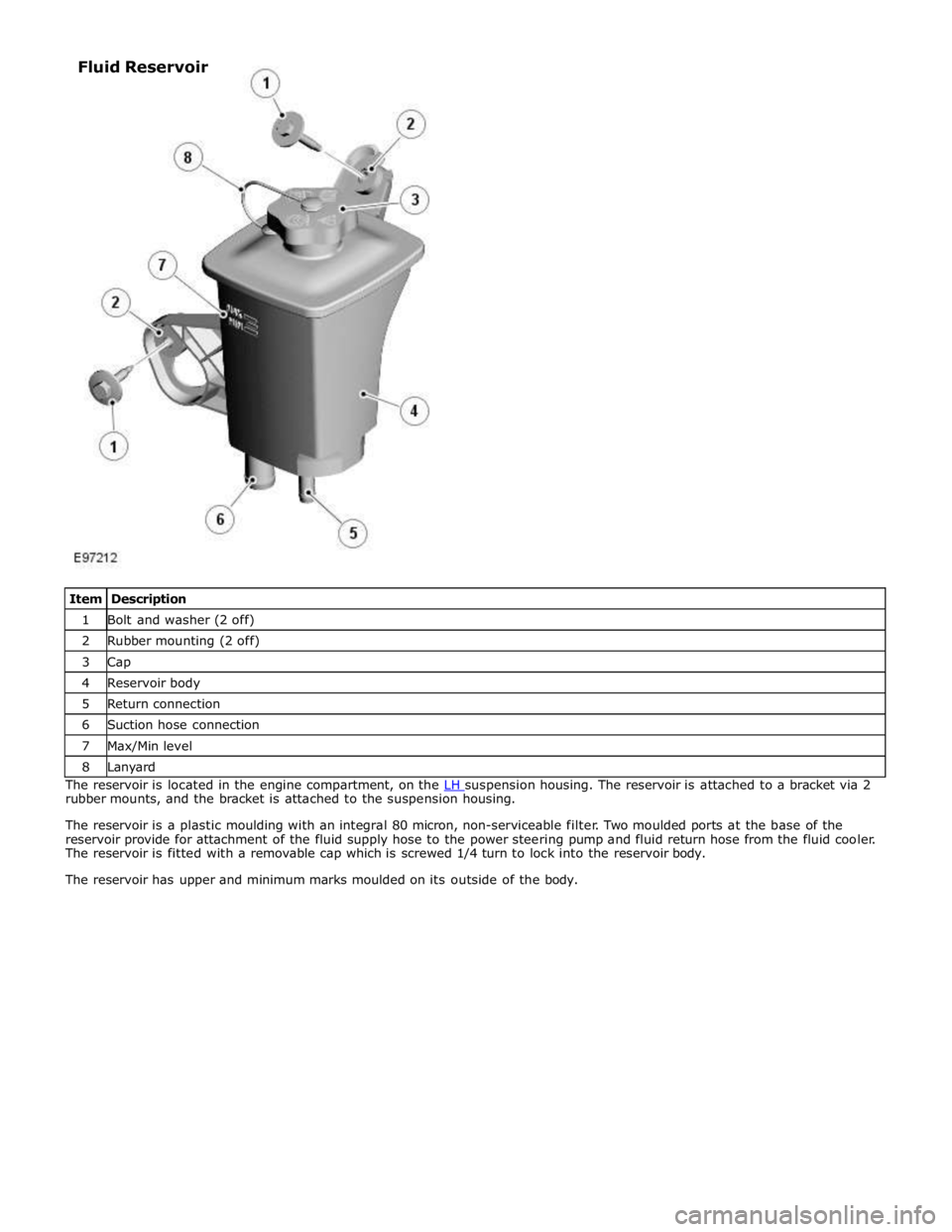
1 Bolt and washer (2 off) 2 Rubber mounting (2 off) 3 Cap 4 Reservoir body 5 Return connection 6 Suction hose connection 7 Max/Min level 8 Lanyard The reservoir is located in the engine compartment, on the LH suspension housing. The reservoir is attached to a bracket via 2 rubber mounts, and the bracket is attached to the suspension housing.
The reservoir is a plastic moulding with an integral 80 micron, non-serviceable filter. Two moulded ports at the base of the
reservoir provide for attachment of the fluid supply hose to the power steering pump and fluid return hose from the fluid cooler.
The reservoir is fitted with a removable cap which is screwed 1/4 turn to lock into the reservoir body.
The reservoir has upper and minimum marks moulded on its outside of the body. Fluid Reservoir
Page 753 of 3039

Power Steering - Steering Gear
Removal and Installation Published: 04-Jul-2013
CAUTIONS: Removal
Make sure that only the manufacturers' recommended four wheel alignment equipment is used.
Do not turn the steering wheel with the steering column lower shaft disconnected as damage to the clockspring and
steering wheel switches may occur.
NOTES:
Make sure the steering is in the straight ahead position.
RHD illustration shown, LHD is similar.
Some variation in the illustrations may occur, but the essential information is always correct.
1. Raise and support the vehicle.
2. Center the steering wheel.
Lock in position and remove the ignition key.
3. Remove the front wheels and tires.
For additional information, refer to: Wheel and Tire (204-04 Wheels and Tires, Removal and Installation).
4. Remove the air deflector.
For additional information, refer to: Air Deflector (501-02 Front End Body Panels, Removal and Installation).
Page 754 of 3039
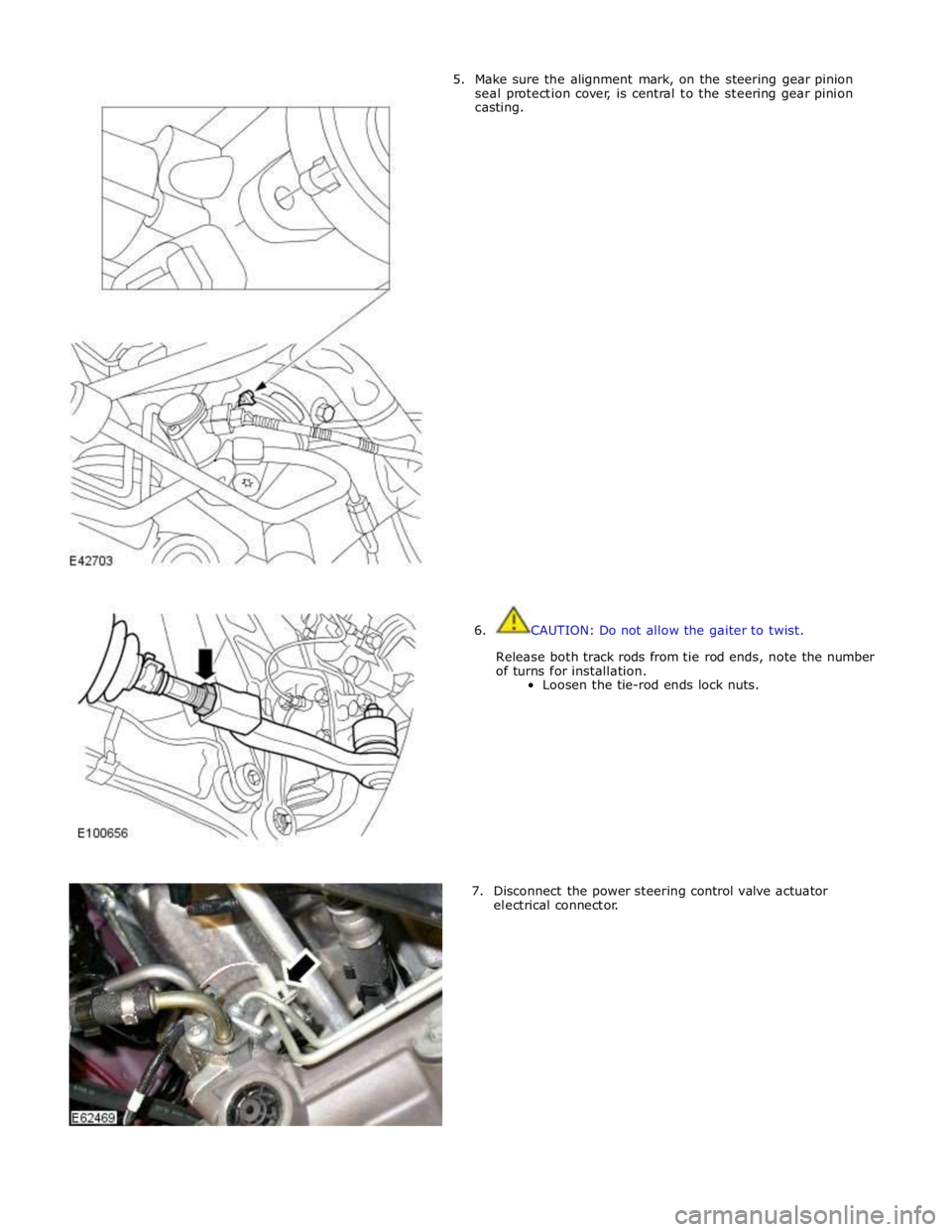
5. Make sure the alignment mark, on the steering gear pinion
seal protection cover, is central to the steering gear pinion
casting.
6. CAUTION: Do not allow the gaiter to twist.
Release both track rods from tie rod ends, note the number
of turns for installation.
Loosen the tie-rod ends lock nuts.
7. Disconnect the power steering control valve actuator
electrical connector.
Page 755 of 3039
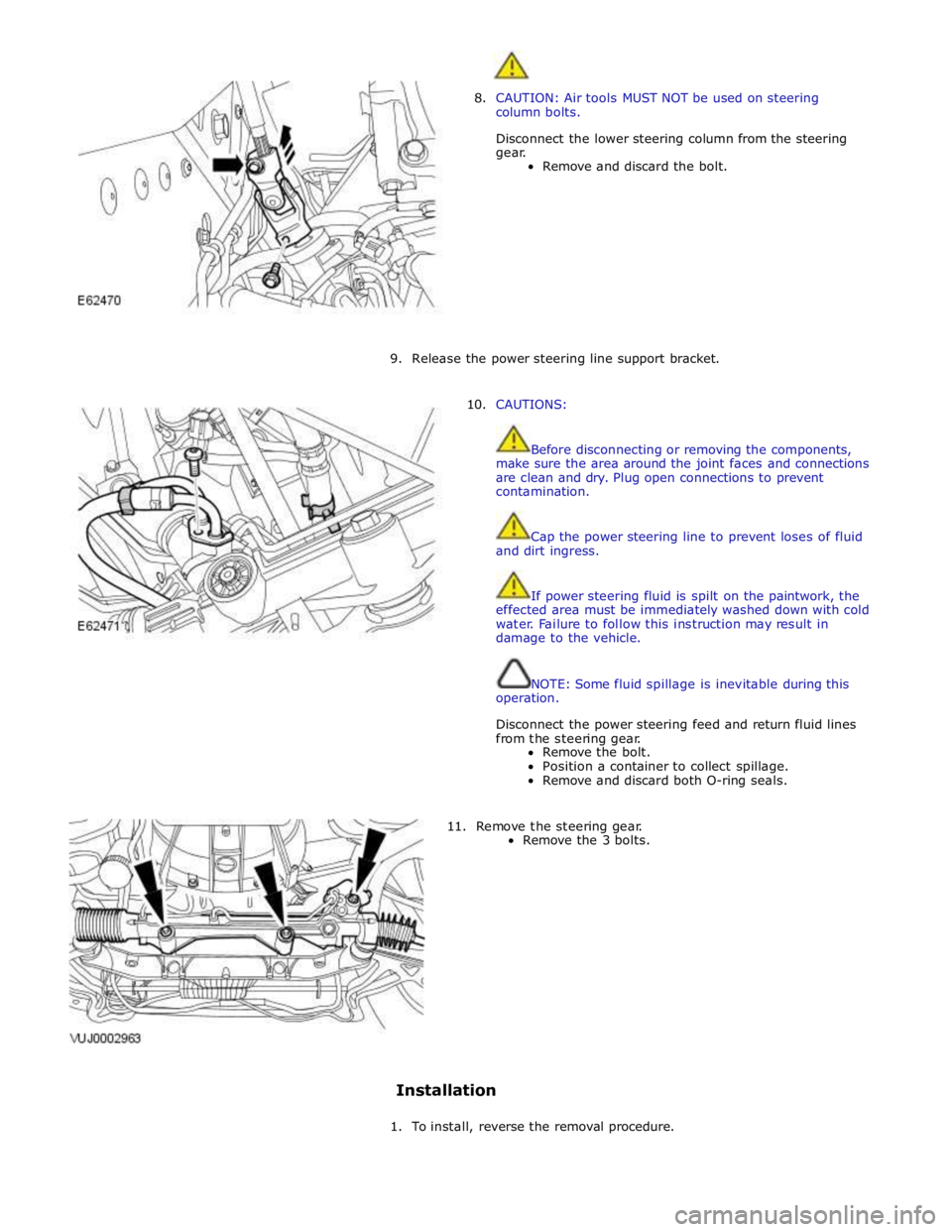
8. CAUTION: Air tools MUST NOT be used on steering
column bolts.
Disconnect the lower steering column from the steering
gear.
Remove and discard the bolt.
9. Release the power steering line support bracket.
10. CAUTIONS:
Before disconnecting or removing the components,
make sure the area around the joint faces and connections
are clean and dry. Plug open connections to prevent
contamination.
Cap the power steering line to prevent loses of fluid
and dirt ingress.
If power steering fluid is spilt on the paintwork, the
effected area must be immediately washed down with cold
water. Failure to follow this instruction may result in
damage to the vehicle.
NOTE: Some fluid spillage is inevitable during this
operation.
Disconnect the power steering feed and return fluid lines
from the steering gear.
Remove the bolt.
Position a container to collect spillage.
Remove and discard both O-ring seals.
11. Remove the steering gear.
Remove the 3 bolts.
Installation
1. To install, reverse the removal procedure.
Page 758 of 3039
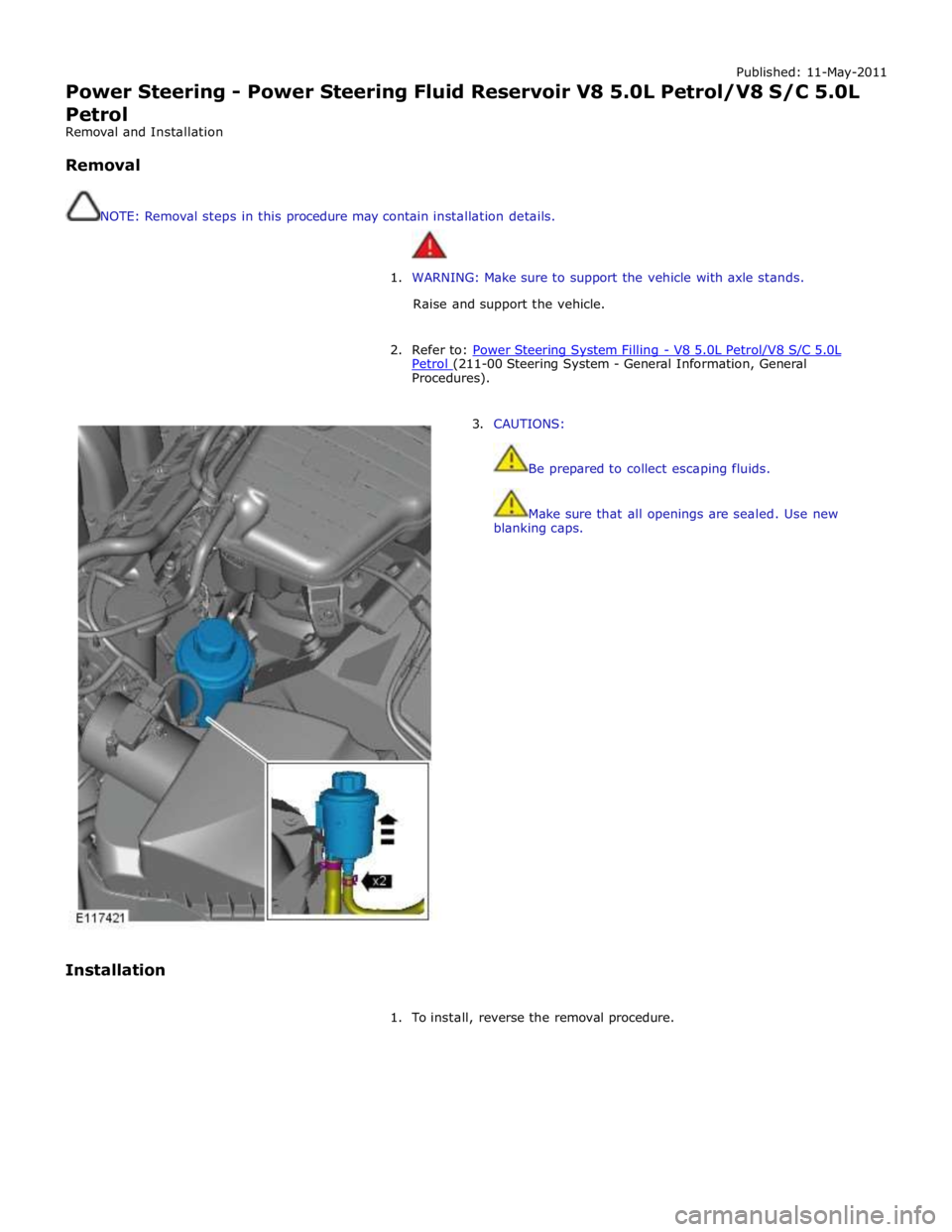
Published: 11-May-2011
Power Steering - Power Steering Fluid Reservoir V8 5.0L Petrol/V8 S/C 5.0L
Petrol
Removal and Installation
Removal
NOTE: Removal steps in this procedure may contain installation details.
1. WARNING: Make sure to support the vehicle with axle stands.
Raise and support the vehicle.
2. Refer to: Power Steering System Filling - V8 5.0L Petrol/V8 S/C 5.0L Petrol (211-00 Steering System - General Information, General Procedures).
Installation
3. CAUTIONS:
Be prepared to collect escaping fluids.
Make sure that all openings are sealed. Use new
blanking caps.
1. To install, reverse the removal procedure.
Page 759 of 3039
Published: 11-May-2011
Power Steering - Power Steering Pump V8 5.0L Petrol/V8 S/C 5.0L Petrol
Removal and Installation
Removal
NOTES:
Removal steps in this procedure may contain installation details.
Some variation in the illustrations may occur, but the essential information is always correct.
1. Refer to: Battery Disconnect and Connect (414-01 Battery, Mounting and Cables, General Procedures).
2. WARNING: Do not work on or under a vehicle supported only by a jack.
Always support the vehicle on safety stands.
Raise and support the vehicle.
3. Refer to: Power Steering System Bleeding (211-00 Steering System - General Information, General Procedures).
4. Refer to: Air Cleaner Outlet Pipe LH (303-12D Intake Air Distribution and Filtering - V8 S/C 5.0L Petrol, Removal and Installation).
5. Refer to: Air Cleaner LH (303-12D Intake Air Distribution and Filtering - V8 S/C 5.0L Petrol, Removal and Installation).
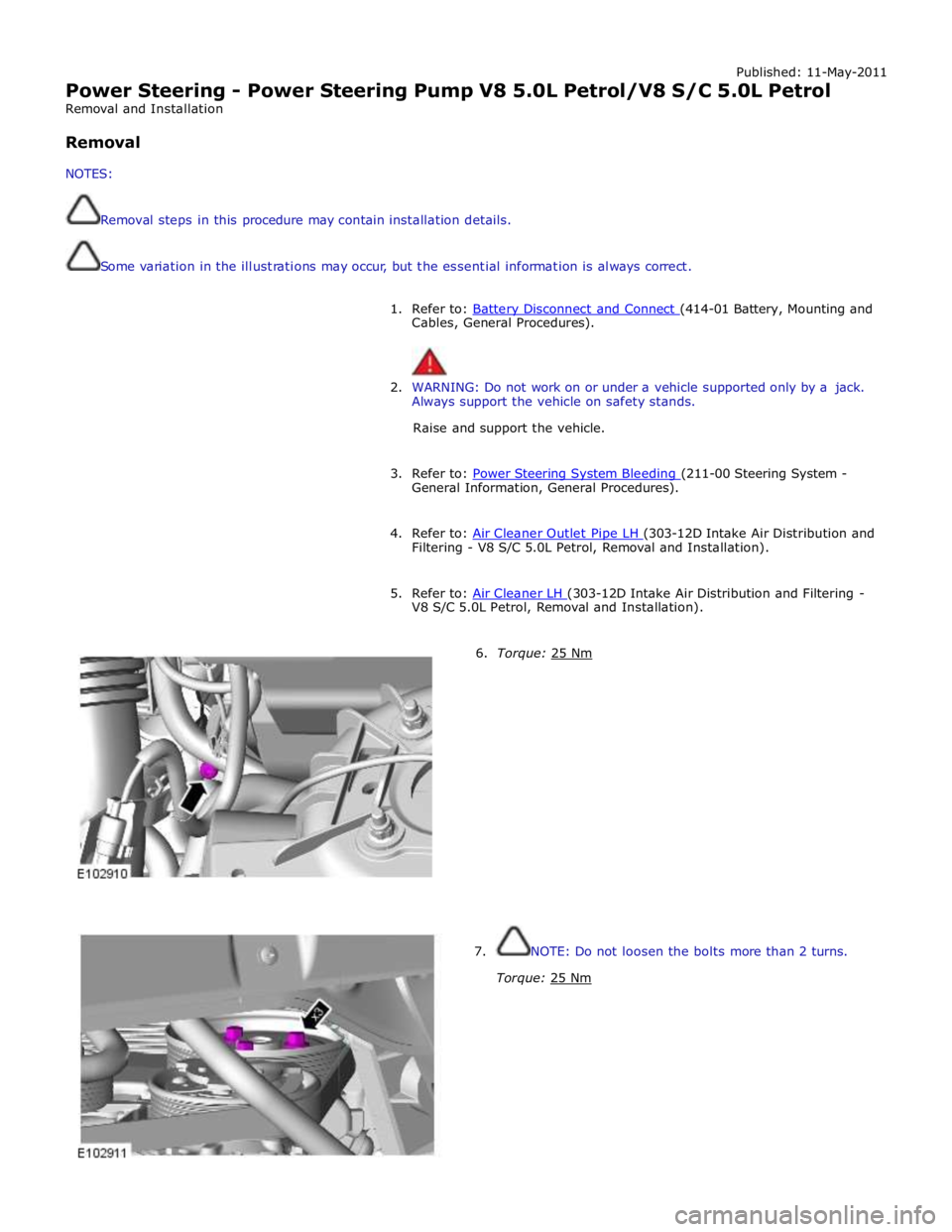
6. Torque: 25 Nm 7. NOTE: Do not loosen the bolts more than 2 turns.
Torque: 25 Nm
Page 763 of 3039
Published: 05-Feb-2014
Power Steering - Power Steering Pump to Steering Gear Pressure Line V8 5.0L Petrol/V8 S/C 5.0L Petrol
Removal and Installation
Removal
NOTE: Removal steps in this procedure may contain installation details.
1. WARNING: Make sure to support the vehicle with axle stands.
Raise and support the vehicle.
2. Refer to: Power Steering System Filling - V8 5.0L Petrol/V8 S/C 5.0L Petrol (211-00 Steering System - General Information, General Procedures).
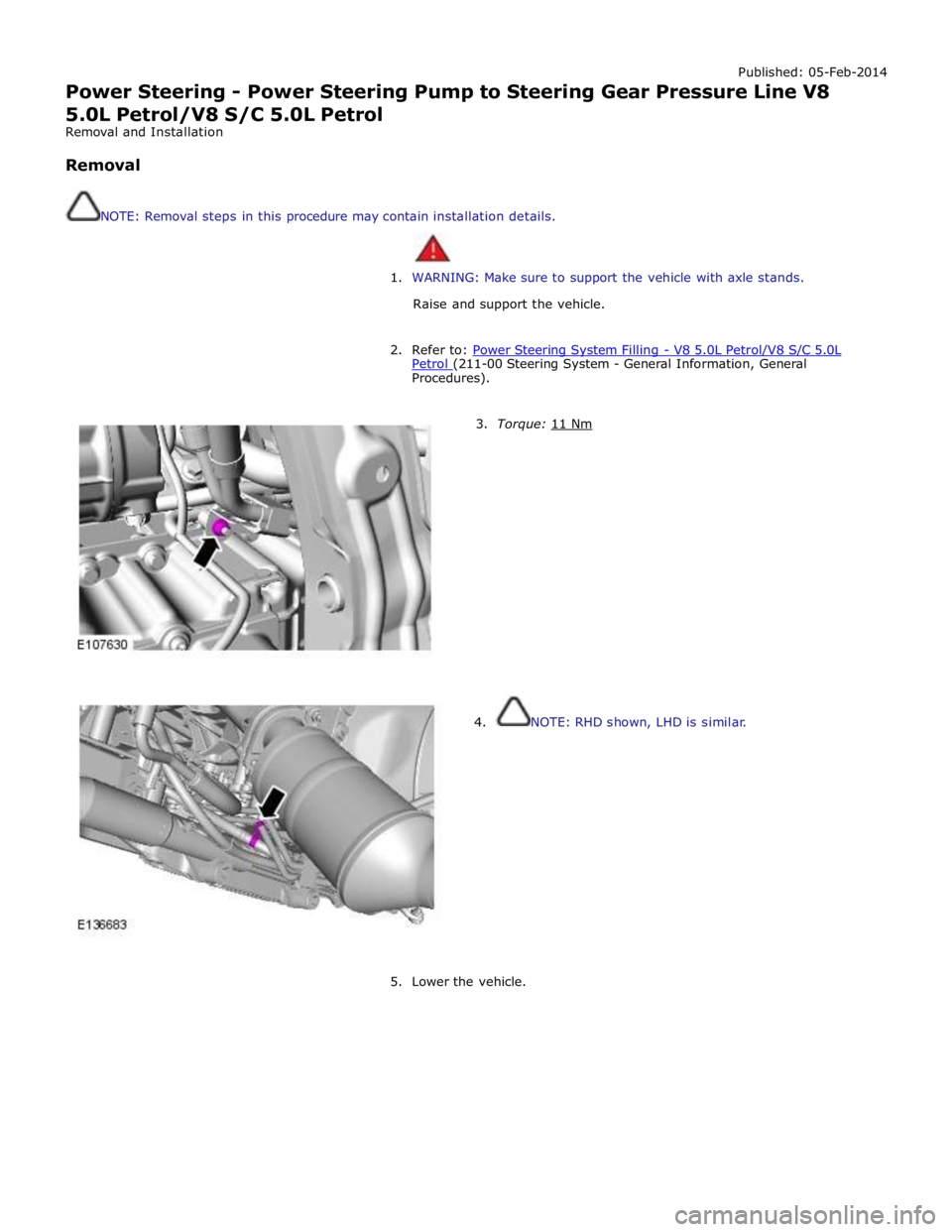
3. Torque: 11 Nm 4. NOTE: RHD shown, LHD is similar.
5. Lower the vehicle.
Page 766 of 3039
Published: 03-Jun-2011
Power Steering - Steering Gear to Fluid Cooler Return Hose V8 5.0L Petrol/V8 S/C 5.0L Petrol
Removal and Installation
Removal
NOTES:
Some variation in the illustrations may occur, but the essential information is always correct.
Removal steps in this procedure may contain installation details.
All vehicles
1. WARNING: Make sure to support the vehicle with axle stands.
Raise and support the vehicle.
2. Refer to: Power Steering System Filling - V8 5.0L Petrol/V8 S/C 5.0L Petrol (211-00 Steering System - General Information, General Procedures).
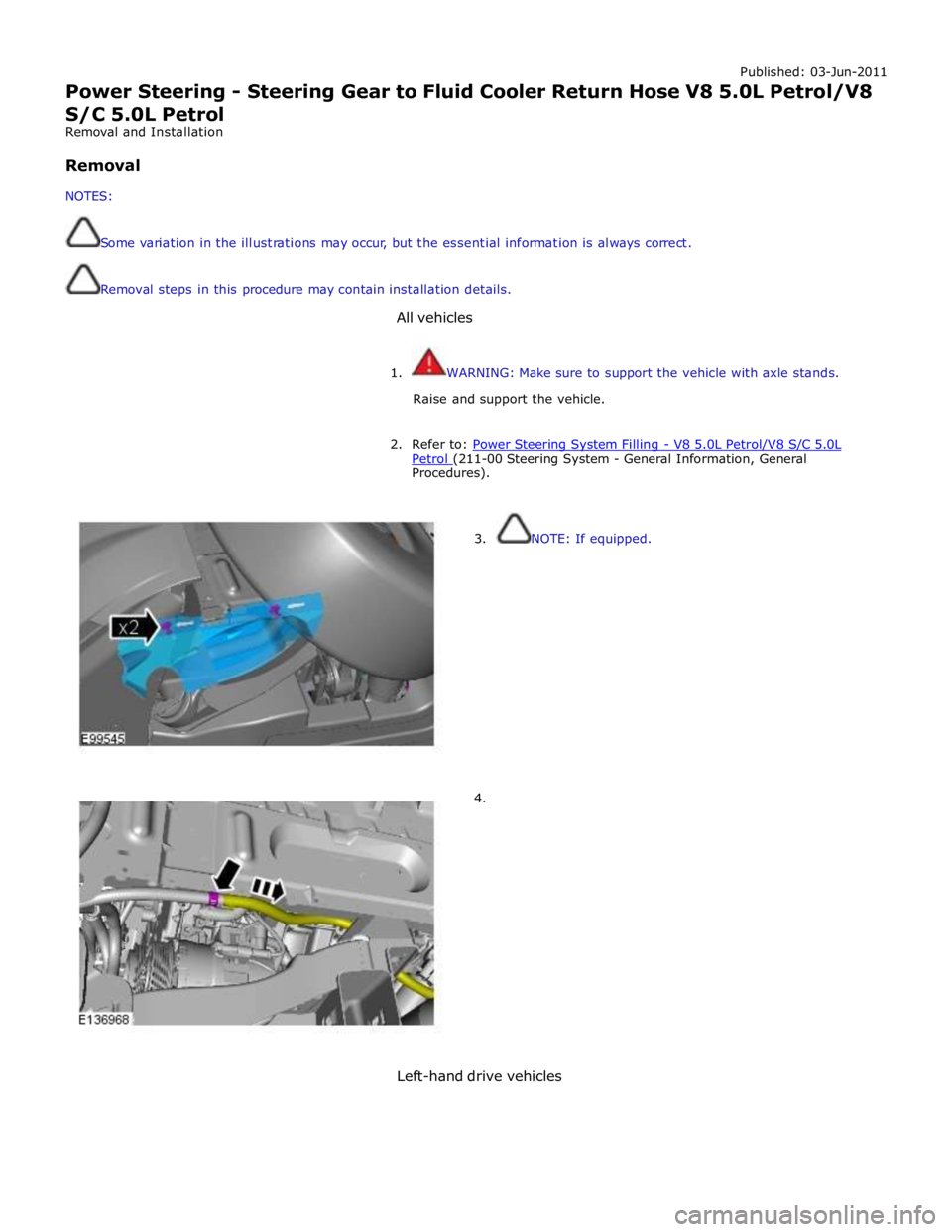
3. NOTE: If equipped.
4.
Left-hand drive vehicles
Page 779 of 3039
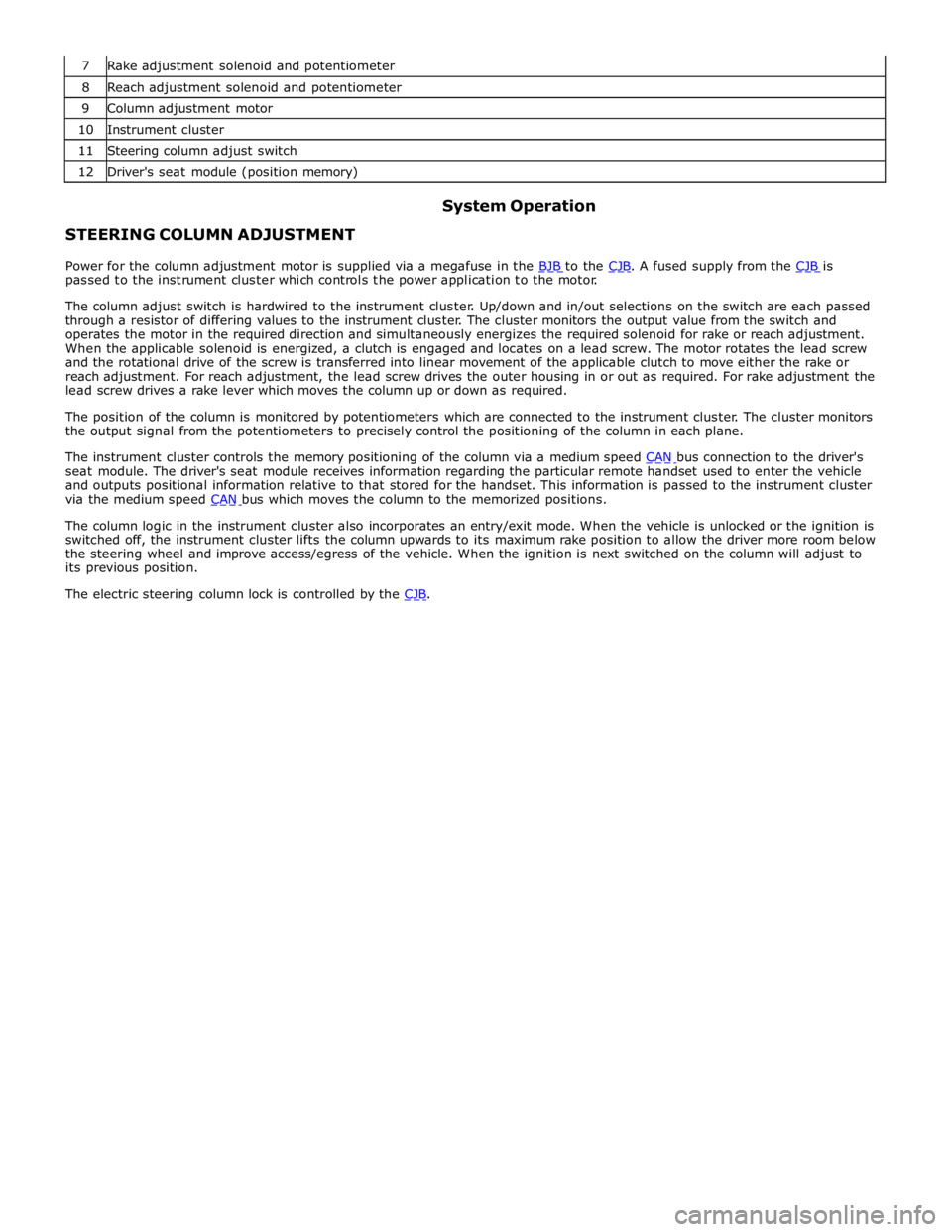
8 Reach adjustment solenoid and potentiometer 9 Column adjustment motor 10 Instrument cluster 11 Steering column adjust switch 12 Driver's seat module (position memory)
STEERING COLUMN ADJUSTMENT System Operation
Power for the column adjustment motor is supplied via a megafuse in the BJB to the CJB. A fused supply from the CJB is passed to the instrument cluster which controls the power application to the motor.
The column adjust switch is hardwired to the instrument cluster. Up/down and in/out selections on the switch are each passed
through a resistor of differing values to the instrument cluster. The cluster monitors the output value from the switch and
operates the motor in the required direction and simultaneously energizes the required solenoid for rake or reach adjustment.
When the applicable solenoid is energized, a clutch is engaged and locates on a lead screw. The motor rotates the lead screw
and the rotational drive of the screw is transferred into linear movement of the applicable clutch to move either the rake or
reach adjustment. For reach adjustment, the lead screw drives the outer housing in or out as required. For rake adjustment the
lead screw drives a rake lever which moves the column up or down as required.
The position of the column is monitored by potentiometers which are connected to the instrument cluster. The cluster monitors
the output signal from the potentiometers to precisely control the positioning of the column in each plane.
The instrument cluster controls the memory positioning of the column via a medium speed CAN bus connection to the driver's seat module. The driver's seat module receives information regarding the particular remote handset used to enter the vehicle
and outputs positional information relative to that stored for the handset. This information is passed to the instrument cluster
via the medium speed CAN bus which moves the column to the memorized positions.
The column logic in the instrument cluster also incorporates an entry/exit mode. When the vehicle is unlocked or the ignition is
switched off, the instrument cluster lifts the column upwards to its maximum rake position to allow the driver more room below
the steering wheel and improve access/egress of the vehicle. When the ignition is next switched on the column will adjust to
its previous position.
The electric steering column lock is controlled by the CJB.