Battery JAGUAR XJ 2004 X350 / 3.G User Guide
[x] Cancel search | Manufacturer: JAGUAR, Model Year: 2004, Model line: XJ, Model: JAGUAR XJ 2004 X350 / 3.GPages: 227, PDF Size: 4.22 MB
Page 99 of 227
4-28 On the Road
Illuminated entry/exit
The interior lights fade on when a door is
opened and go out when the engine is
started or 15 seconds after the last door
is closed. If any door is left open,
the lights will fade off after two minutes.
When the vehicle is unlocked with a key
or the key transmitter, the courtesy lights
will come on at maximum brightness for
two minutes if a door is not opened.
With the engine running, opening any
door will put on all interior lights, they
will go out immediately after the last door
is closed.Battery Saver
If the interior lights are switched on using
the centre switch in the overhead console
and the ignition swit ch is turned to
position ‘0’, the lights will automatically
turn OFF after 40 minutes.
If the interior lights are switched on by
opening a door and the ignition switch is
in position ‘0’, the lights will
automatically turn off after 10 minutes.
If the glove compartmen t or vanity mirror
lights are switched on and the ignition
switch is turned to positions ‘0’ or ‘I’ or
the key is removed, the lights will
automatically turn OFF after 40 minutes.
Page 101 of 227
4-30 On the Road
Immobilising the rear windows
To immobilise the rear windows (and
operation of the front seat by a rear seat
passenger, when this feature is fitted),
press button (A) (see previous page
illustration). The LED in the button will
light up showing that the rear windows
cannot be operated by rear seat
occupants. Pressing the button again will
enable occupants to operate the rear
windows. See also Rear Seat
Adjustment on page 3 - 4.
Window Anti-trap Protection
Each electrically operated window has an
anti-trap protection feature.
If the upward movement of the window
detects an obstacle the anti-trap system
will immediately stop the window
closing, then move it downwards for a
short distance.
!WARNING:
If the battery is disconnected or
discharged the window anti-trap
feature is lost. When the battery is
reconnected or recharged the
window anti-trap system must be
reset. To reset the electrically operated
windows anti-trap system
• Fully close the window, hold the
switch in the close position for two
seconds and then release the switch.
Wait for two seconds, do not open
the window.
• Again, select the same window to close, holding the sw itch for a further
two seconds.
• Check to confirm the operation by opening the window and then use
one-touch operation to close the
window.
• Repeat for the remaining electrically operated windows.
To override the anti-trap protection
The anti-trap system will also stop the
window closing if a bl ockage or resistance
occurs e.g. in the wi ndow guide channels.
Typically this might be due to icing in
winter but could also be caused by
damage or mis-alignment of the guide
channels or seals. To override the anti-trap action:
• After the initial attempt to close the
window, operate the close switch a
second time.
• When the window has reversed from the blockage, operate the switch
(within 10 seconds) until the window
stops again (it will not reverse on the
third attempt).
• Immediately operate the close switch again. The window will now move up
a short distance with increased force
to override the blockage.
• Repeat the override action until the window has closed. Each time the
window stops, the switch must be
operated immediately to initiate
further override action.
If this procedure fails to move the
blockage, the anti-trap feature will be lost
and must be reset (see previous column)
after the blockage has been cleared.
Thermal overload
If the windows are repeatedly opened
and closed (e.g. by a child), a protection
system will deactivate window operation
for a short period to avoid overheating of
the window motors.
Page 105 of 227
4-34 On the Road
Parkbrake
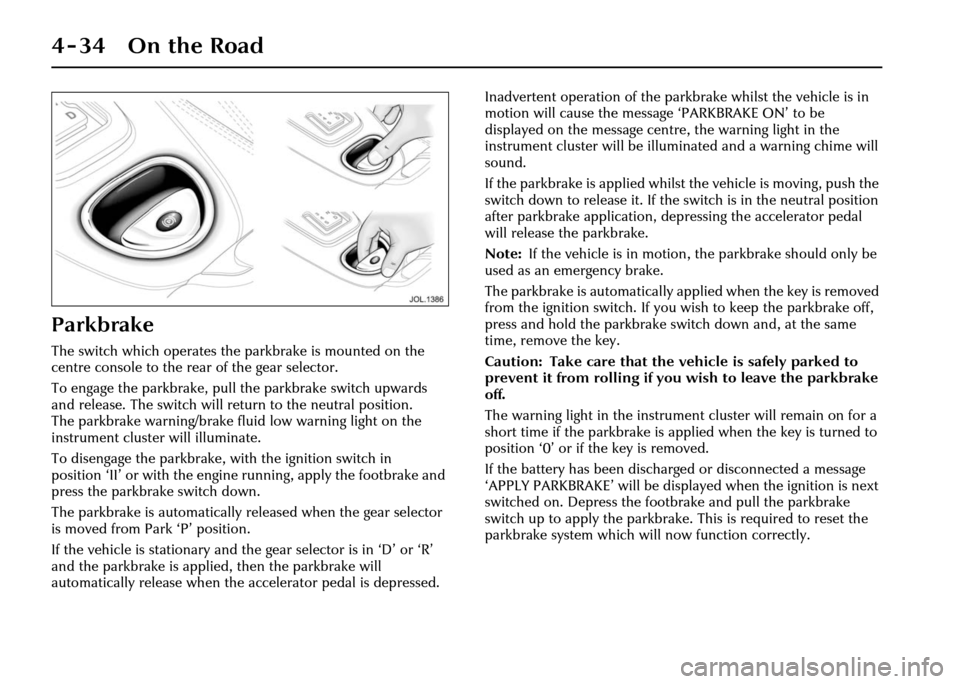
The switch which operates the parkbrake is mounted on the
centre console to the rear of the gear selector.
To engage the parkbrake, pull the parkbrake switch upwards
and release. The switch will return to the neutral position.
The parkbrake warning/brake fluid low warning light on the
instrument cluster will illuminate.
To disengage the parkbrake, with the ignition switch in
position ‘II’ or with the engine running, apply the footbrake and
press the parkbrake switch down.
The parkbrake is automatically released when the gear selector
is moved from Park ‘P’ position.
If the vehicle is stationary and the gear selector is in ‘D’ or ‘R’
and the parkbrake is applied, then the parkbrake will
automatically release when the accelerator pedal is depressed. Inadvertent operation of the parkbrake whilst the vehicle is in
motion will cause the message ‘PARKBRAKE ON’ to be
displayed on the message centre, the warning light in the
instrument cluster will be illuminated and a warning chime will
sound.
If the parkbrake is applied whilst
the vehicle is moving, push the
switch down to release it. If the switch is in the neutral position
after parkbrake application, depressing the accelerator pedal
will release the parkbrake.
Note: If the vehicle is in motion, the parkbrake should only be
used as an emergency brake.
The parkbrake is auto matically applied when the key is removed
from the ignition switch. If you wi sh to keep the parkbrake off,
press and hold the parkbrake switch down and, at the same
time, remove the key.
Caution: Take care that the vehicle is safely parked to
prevent it from rolling if you wish to leave the parkbrake
off.
The warning light in the instrument cluster will remain on for a
short time if the parkbrake is applied when the key is turned to
position ‘0’ or if the key is removed.
If the battery has been discharged or disconnected a message
‘APPLY PARKBRAKE’ will be displa yed when the ignition is next
switched on. Depress the footbrake and pull the parkbrake
switch up to apply the parkbrake. This is required to reset the
parkbrake system which will now function correctly.
Page 113 of 227
4-42 On the Road
Starting/Stopping the
Vehicle
When the vehicle is stationary the
automatic gear selector may be left in ‘D’,
‘ 2 ’, ‘ 3’, ‘ 4’ or ‘ 5’, unless the vehicle is to
be parked. When stopping for traffic
lights, junctions etc., either select ‘ P’ or
apply the parkbrake and select ‘ N’.
Before Starting
Before starting the engine, new owners/
drivers should familiarize themselves with
the layout and operation of the controls
and instruments.
!WARNING:
Before attempting to start the engine,
check parkbrake is ON and gear
selector lever is in position ‘P’ or ‘N’.
To Start the Engine
The engine cannot be started until the
gear selector is in ‘ N’ or ‘ P’.
Insert the key into the ignition switch and
turn clockwise to position ‘II’ to switch
on the ignition.
When the key is turned to position ‘III’
the starter motor will turn the engine
until:
• The key is released and automatically returns to position ‘II’.
• The ignition switch is turned to ‘0’ or ‘I’.
• The gear selector is moved out of ‘P’ or ‘N’.
• The engine starts.
If the engine fails to start, the key must be
turned to position ‘0’ before attempting
to restart.
Do not use the starter continuously for
longer than six seconds. Continued use of
the starter will disc harge the battery and
may damage the starter mechanism.
Wait until the engine stops turning before
re-using the starter.
When the engine starts, release the key. The red charge light and the oil pressure
light in the instrument cluster should go
out when the engine is running.
If the engine fails to start
If an ignition key is placed in the ignition
switch and turned to position ‘II’ and the
alarm security light is flashing, it is
possible that the engine will not start.
In any event, please contact a Jaguar
Retailer to investigate the cause of the
light flashing.
It is possible that the fuel system inertia
switch may have tripped, see page 6 - 3
for the resetting procedure.
If the engine persistent
ly fails to start and
flooding is suspected, depress the
accelerator pedal fully, hold it in this
position and turn the key to position ‘III’
for six seconds. Release the key, remove
your foot from the accelerator pedal and
then attempt to restart the engine.
Note: The engine cannot start whilst the
pedal is fully depressed, it must be
released to enable the engine to start.
If the engine still fail s to start, switch the
ignition OFF and contact a Jaguar
Retailer.
Page 114 of 227
On the Road 4 - 43
To Stop the Engine and Lock
the Steering
Turn the key from position ‘II’ to the
‘lock’ position ‘0’. This turns off the
ignition and stops the engine.
The steering will be locked when the key
is removed from the switch.
Leaving the key in position ‘I’ or ‘II’ will
discharge the battery.
Automatic Transmission
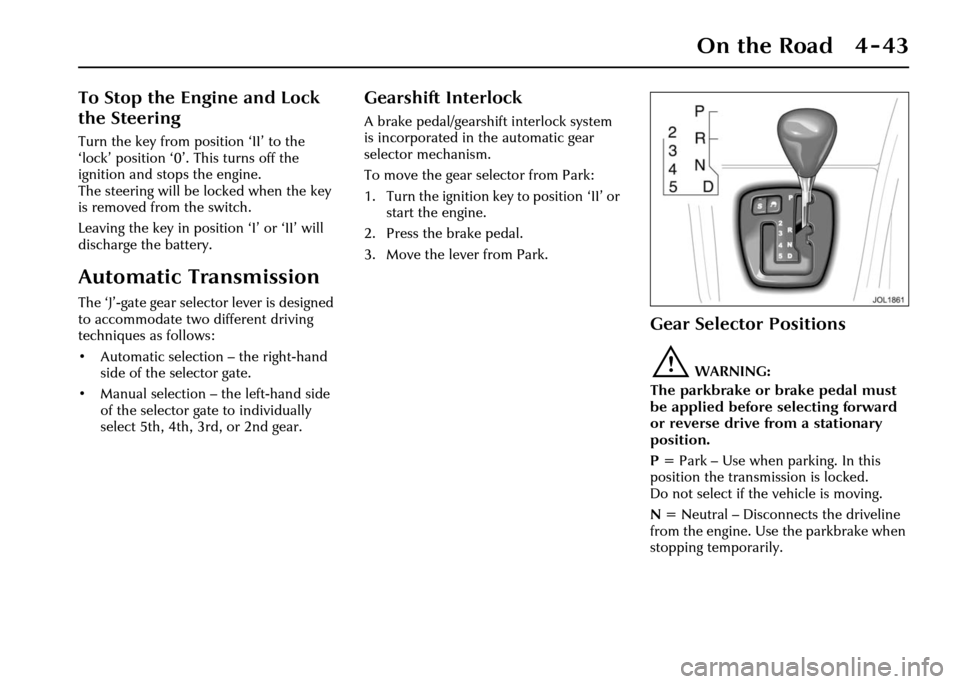
The ‘J’-gate gear selector lever is designed
to accommodate two different driving
techniques as follows:
• Automatic selection – the right-hand side of the selector gate.
• Manual selection – the left-hand side of the selector gate to individually
select 5th, 4th, 3rd, or 2nd gear.
Gearshift Interlock
A brake pedal/gearshift interlock system
is incorporated in the automatic gear
selector mechanism.
To move the gear selector from Park:
1. Turn the ignition key to position ‘II’ or start the engine.
2. Press the brake pedal.
3. Move the lever from Park.
Gear Selector Positions
!WARNING:
The parkbrake or brake pedal must
be applied before selecting forward
or reverse drive from a stationary
position.
P = Park – Use when parking. In this
position the transmission is locked.
Do not select if the vehicle is moving.
N = Neutral – Disconnects the driveline
from the engine. Use the parkbrake when
stopping temporarily.
Page 155 of 227
6 - 4 Roadside Emergency
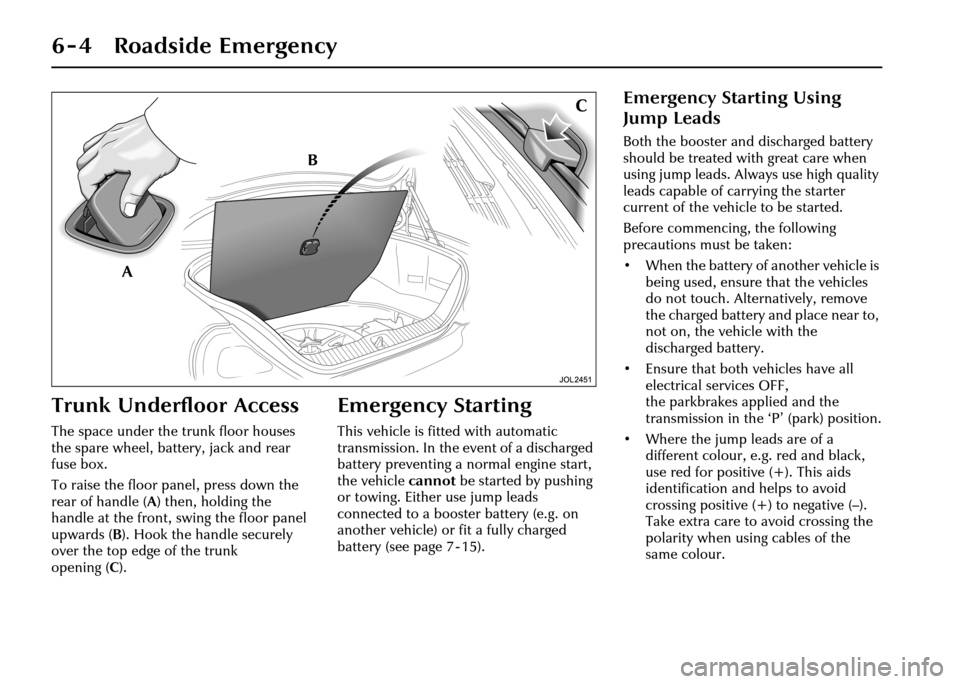
Trunk Underfloor Access
The space under the trunk floor houses
the spare wheel, battery, jack and rear
fuse box.
To raise the floor panel, press down the
rear of handle (A) then, holding the
handle at the front, swing the floor panel
upwards ( B). Hook the handle securely
over the top edge of the trunk
opening ( C).
Emergency Starting
This vehicle is fitted with automatic
transmission. In the event of a discharged
battery preventing a normal engine start,
the vehicle cannot be started by pushing
or towing. Either use jump leads
connected to a booster battery (e.g. on
another vehicle) or fit a fully charged
battery (see page 7 - 15).
Emergency Starting Using
Jump Leads
Both the booster and discharged battery
should be treated with great care when
using jump leads. Al ways use high quality
leads capable of carrying the starter
current of the vehicle to be started.
Before commencing, the following
precautions must be taken:
• When the battery of another vehicle is being used, ensure that the vehicles
do not touch. Alternatively, remove
the charged battery and place near to,
not on, the vehicle with the
discharged battery.
• Ensure that both vehicles have all electrical services OFF,
the parkbrakes applied and the
transmission in the ‘P’ (park) position.
• Where the jump leads are of a different colour, e.g. red and black,
use red for positive (+). This aids
identification and helps to avoid
crossing positive (+) to negative (–).
Take extra care to avoid crossing the
polarity when using cables of the
same colour.
Page 156 of 227
Roadside Emergency 6 - 5
Caution:
1. If using a jump start vehicle, under no circumstances should the
vehicles come into contact with
each other. This could establish an
earth connection, which may
cause sparks and damage.
2. Do not run the engine of the jump start vehicle when boost starting a
Jaguar vehicle. If the jump start
vehicle’s engine is running and
the jump leads ar e disconnected,
damage to the Jaguar vehicle’s
electrical system will result.
3. The booster battery voltage must not exceed 12 volts.
The procedure must be followed exactly,
being careful not to cause sparks:
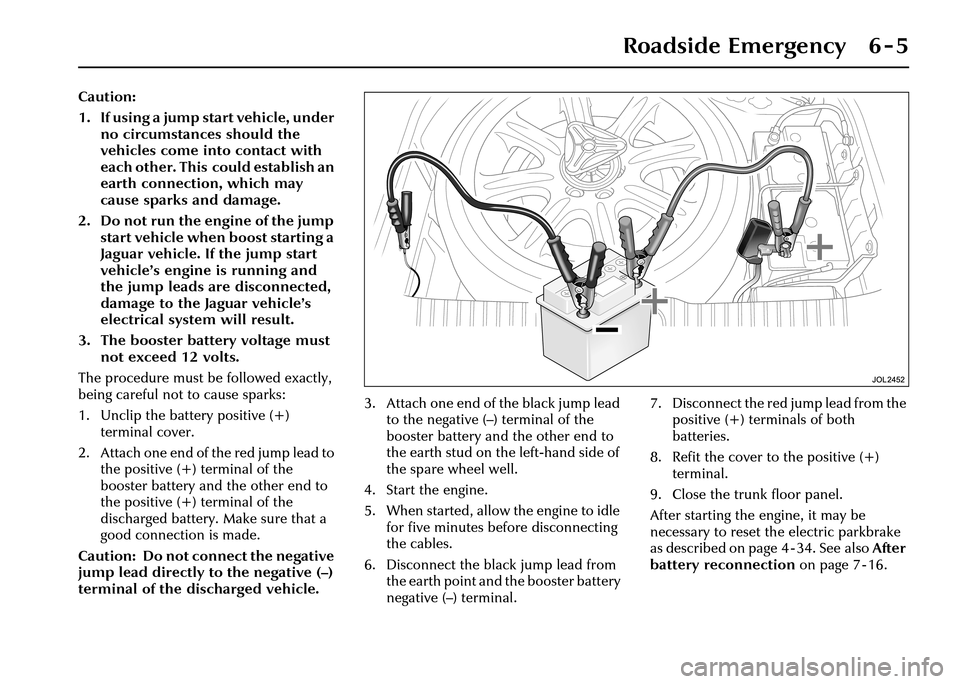
1. Unclip the battery positive (+) terminal cover.
2. Attach one end of the red jump lead to the positive (+) terminal of the
booster battery and the other end to
the positive (+) terminal of the
discharged battery. Make sure that a
good connection is made.
Caution: Do not connect the negative
jump lead directly to the negative (–)
terminal of the discharged vehicle. 3. Attach one end of the black jump lead
to the negative (–) terminal of the
booster battery and the other end to
the earth stud on the left-hand side of
the spare wheel well.
4. Start the engine.
5. When started, allow the engine to idle for five minutes before disconnecting
the cables.
6. Disconnect the black jump lead from the earth point and the booster battery
negative (–) terminal. 7. Disconnect the red jump lead from the
positive (+) terminals of both
batteries.
8. Refit the cover to the positive (+) terminal.
9. Close the trunk floor panel.
After starting the engine, it may be
necessary to reset th e electric parkbrake
as described on page 4 - 34. See also After
battery reconnection on page 7 - 16.
Page 172 of 227
Roadside Emergency 6 - 21
Fuses and Fuse Boxes
Do not fit a new fuse if the wiring is
damaged; contact a Jaguar Retailer.
After renewing a fuse have the circuit
checked by a Jaguar Retailer.
Two types of fuses are fitted in the fuse
boxes, ATO type and Midi type.
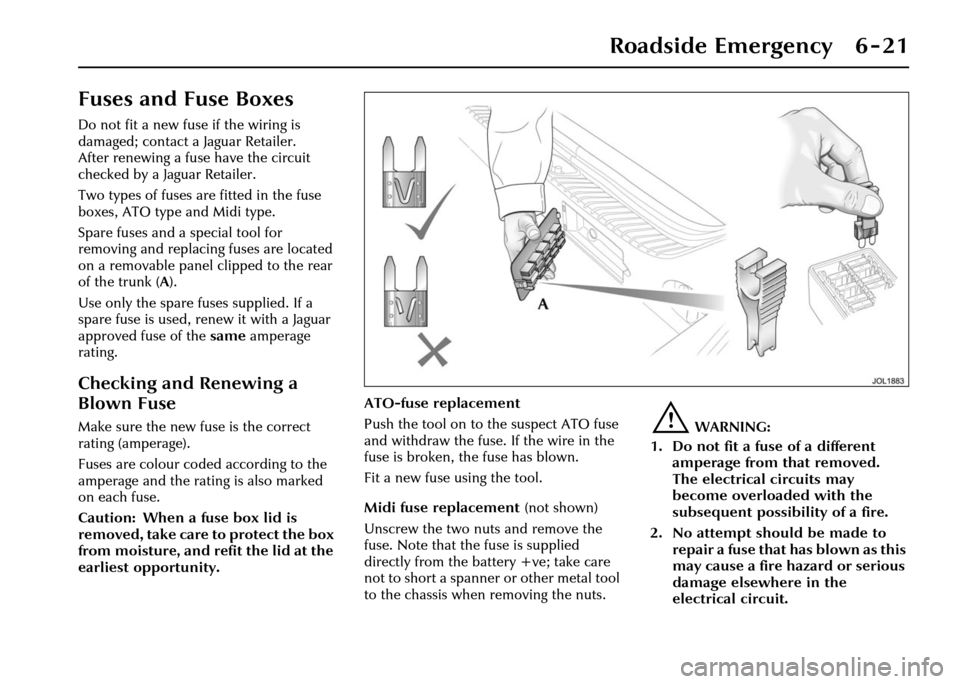
Spare fuses and a special tool for
removing and replacing fuses are located
on a removable panel clipped to the rear
of the trunk ( A).
Use only the spare fuses supplied. If a
spare fuse is used, renew it with a Jaguar
approved fuse of the same amperage
rating.
Checking and Renewing a
Blown Fuse
Make sure the new fuse is the correct
rating (amperage).
Fuses are colour coded according to the
amperage and the rating is also marked
on each fuse.
Caution: When a fuse box lid is
removed, take care to protect the box
from moisture, and refit the lid at the
earliest opportunity. ATO-fuse replacement
Push the tool on to the suspect ATO fuse
and withdraw the fuse. If the wire in the
fuse is broken, the fuse has blown.
Fit a new fuse using the tool.
Midi fuse replacement
(not shown)
Unscrew the two nuts and remove the
fuse. Note that the fuse is supplied
directly from the battery +ve; take care
not to short a spanner or other metal tool
to the chassis when removing the nuts.!WARNING:
1. Do not fit a fuse of a different amperage from that removed.
The electrical circuits may
become overloaded with the
subsequent possibility of a fire.
2. No attempt should be made to repair a fuse that has blown as this
may cause a fire hazard or serious
damage elsewhere in the
electrical circuit.
Page 173 of 227
6 - 22 Roadside Emergency
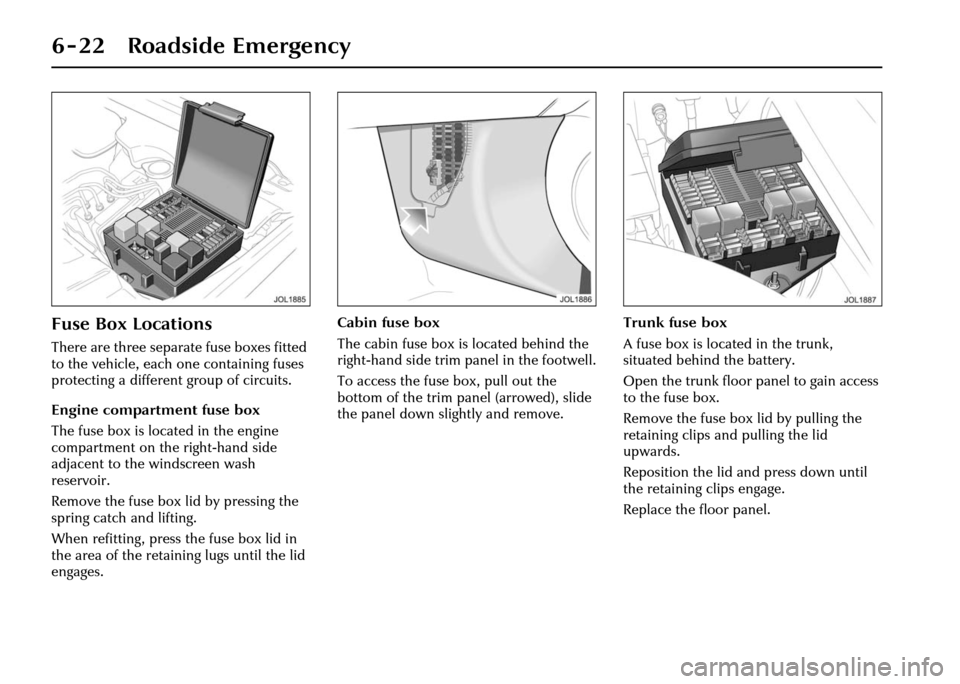
Fuse Box Locations
There are three separate fuse boxes fitted
to the vehicle, each one containing fuses
protecting a different group of circuits.
Engine compartment fuse box
The fuse box is located in the engine
compartment on the right-hand side
adjacent to the windscreen wash
reservoir.
Remove the fuse box lid by pressing the
spring catch and lifting.
When refitting, press the fuse box lid in
the area of the retaining lugs until the lid
engages. Cabin fuse box
The cabin fuse box is located behind the
right-hand side trim panel in the footwell.
To access the fuse box, pull out the
bottom of the trim panel (arrowed), slide
the panel down slightly and remove.
Trunk fuse box
A fuse box is located in the trunk,
situated behind the battery.
Open the trunk floor panel to gain access
to the fuse box.
Remove the fuse box lid by pulling the
retaining clips and pulling the lid
upwards.
Reposition the lid and press down until
the retaining clips engage.
Replace the floor panel.
Page 178 of 227
Roadside Emergency 6 - 27
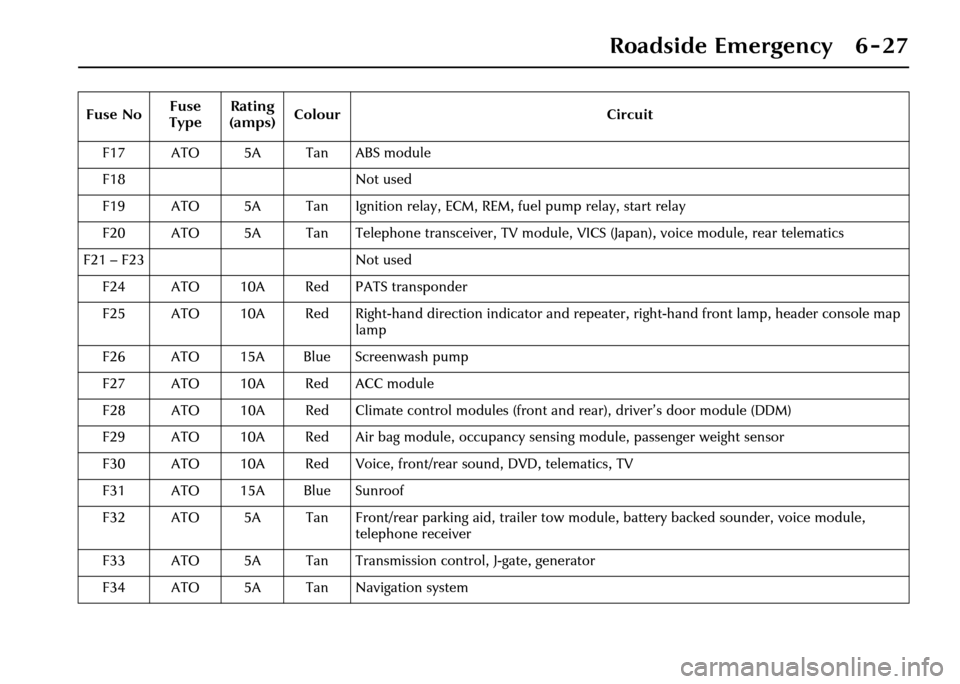
F17 ATO 5A Tan ABS module
F18 Not used
F19 ATO 5A Tan Ignition relay, ECM, REM, fuel pump relay, start relay
F20 ATO 5A Tan Telephone transceiver, TV module, VICS (Japan), voice module, rear telematics
F21 – F23 Not used
F24 ATO 10A Red PATS transponder
F25 ATO 10A Red Right-hand direction indicator and repe ater, right-hand front lamp, header console map
lamp
F26 ATO 15A Blue Screenwash pump
F27 ATO 10A Red ACC module
F28 ATO 10A Red Climate control modules (front and rear), driver’s door module (DDM)
F29 ATO 10A Red Air bag module, occupancy se nsing module, passenger weight sensor
F30 ATO 10A Red Voice, front/rear sound, DVD, telematics, TV
F31 ATO 15A Blue Sunroof
F32 ATO 5A Tan Front/rear parking aid, trailer tow module, battery backed sounder, voice module, telephone receiver
F33 ATO 5A Tan Transmission control, J-gate, generator
F34 ATO 5A Tan Navigation system
Fuse No
Fuse
Type Rating
(amps) Colour
Circuit