Release JAGUAR XJ 2004 X350 / 3.G Service Manual
[x] Cancel search | Manufacturer: JAGUAR, Model Year: 2004, Model line: XJ, Model: JAGUAR XJ 2004 X350 / 3.GPages: 227, PDF Size: 4.22 MB
Page 127 of 227
4-56 On the Road
Notes on using adaptive cruise
control
1. Adaptive cruise control operates when the gear selector lever is in
position ‘2’, ‘3’ ‘4’ ‘5’ or ‘D’.
2. When engaged, the accelerator pedal rests in the raised position.
Fully release the pedal to allow
normal ACC operation.
3. When braking is applied by the ACC
the brake pedal will move down and
up as braking is applied or removed.
The vehicle brake lights will be
switched on while braking is applied.
!WARNING:
The driver must not rest a foot under
the brake pedal, as it may become
trapped. Driving with ACC active
The system acts by regulating the speed
of the vehicle using engine control and
the brakes. Gear changes may occur in
response to decelerati
on or acceleration
whilst in ACC.
ACC is not a collision avoidance system,
however, during some situations the
system may provide the driver with an
indication that intervention is required.
An audible alarm will sound,
accompanied by a re d warning light and
the message ‘DRIVER INTERVENE’ if the
ACC detects:
• That using maximum ACC braking only is not sufficient.
• That the vehicle speed has decreased below the minimum for ACC
operation.
• A failure has occurred whilst the system is active.
Page 134 of 227
On the Road 4 - 63
Fuel and Refuelling
Before refuelling, switch off the ignition
and remove the key.
Note:Do not leave the ignition key in the
vehicle; vehicles have been stolen from
garage service/filling stations whilst the
driver is absent from the vehicle. It is
recommended that the vehicle is locked,
if left unattended.
Caution: No additives of any kind
(fuel or oil) must be put into the fuel
tank. Additives could reduce engine
life or affect exhaust emissions.
!WARNING:
1. Fuel vapour is highly flammable and in confined spaces is
explosive and toxic. In the event
of inadvertent spillage, and before
refuelling, always switch OFF the
engine. Do not use exposed flame
or light. Do not smoke. Do not
inhale fumes.
2. Do not fill the tank so that fuel is visible in the fuel filler intake
tube. This could cause spillage
and danger from exposed fuel.
Fuel Tank Filling
Caution: Your vehicle is fitted with
catalytic converters and must only be
filled with ‘Unleaded Fuel’.
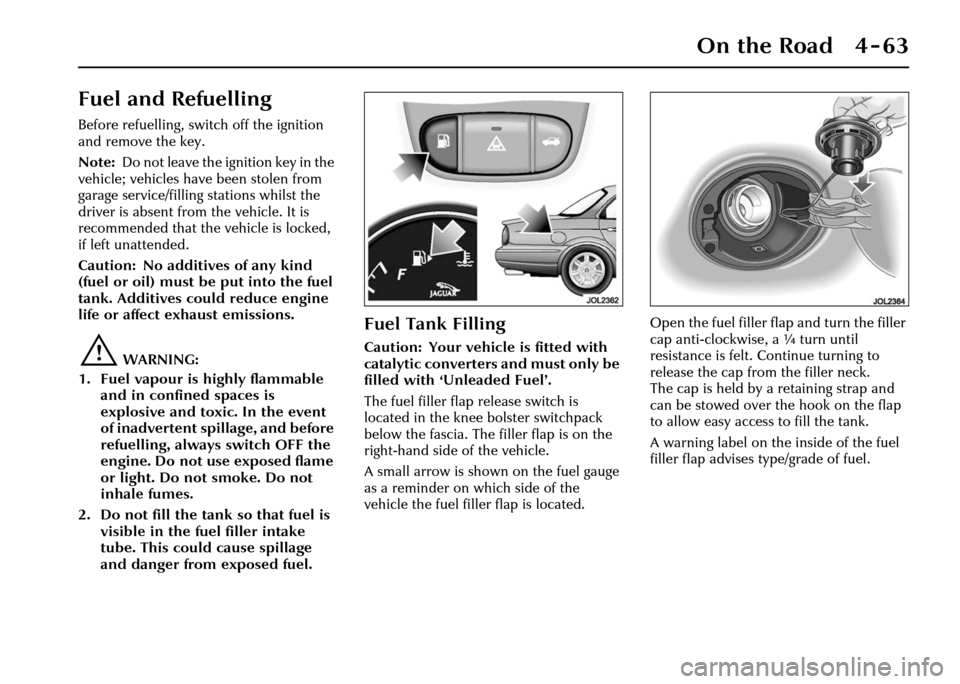
The fuel filler flap release switch is
located in the knee bolster switchpack
below the fascia. The fi ller flap is on the
right-hand side of the vehicle.
A small arrow is shown on the fuel gauge
as a reminder on which side of the
vehicle the fuel filler flap is located. Open the fuel filler flap and turn the filler
cap anti-clockwise, a ¼ turn until
resistance is felt. Continue turning to
release the cap from the filler neck.
The cap is held by a retaining strap and
can be stowed over the hook on the flap
to allow easy access to fill the tank.
A warning label on the inside of the fuel
filler flap advises type/grade of fuel.
Page 137 of 227
4-66 On the Road
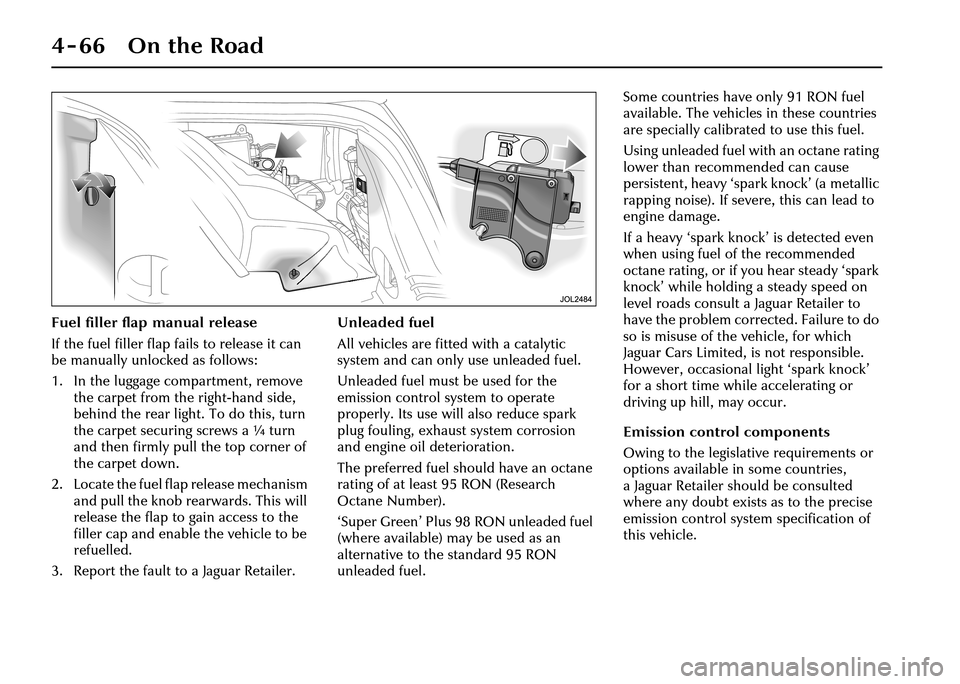
Fuel filler flap manual release
If the fuel filler flap fails to release it can
be manually unlocked as follows:
1. In the luggage compartment, remove
the carpet from the right-hand side,
behind the rear light. To do this, turn
the carpet securing screws a ¼ turn
and then firmly pull the top corner of
the carpet down.
2. Locate the fuel flap release mechanism and pull the knob rearwards. This will
release the flap to gain access to the
filler cap and enable the vehicle to be
refuelled.
3. Report the fault to a Jaguar Retailer. Unleaded fuel
All vehicles are fitted with a catalytic
system and can only use unleaded fuel.
Unleaded fuel must be used for the
emission control system to operate
properly. Its use will also reduce spark
plug fouling, exhaust system corrosion
and engine oil deterioration.
The preferred fuel should have an octane
rating of at least 95 RON (Research
Octane Number).
‘Super Green’ Plus 98 RON unleaded fuel
(where available) may be used as an
alternative to the standard 95 RON
unleaded fuel. Some countries have only 91 RON fuel
available. The vehicles in these countries
are specially calibrated to use this fuel.
Using unleaded fuel with an octane rating
lower than recomm
ended can cause
persistent, heavy ‘spark knock’ (a metallic
rapping noise). If severe, this can lead to
engine damage.
If a heavy ‘spark knock’ is detected even
when using fuel of the recommended
octane rating, or if you hear steady ‘spark
knock’ while holding a steady speed on
level roads consult a Jaguar Retailer to
have the problem corrected. Failure to do
so is misuse of the vehicle, for which
Jaguar Cars Limited, is not responsible.
However, occasional light ‘spark knock’
for a short time while accelerating or
driving up hill, may occur.
Emission control components
Owing to the legislative requirements or
options available in some countries,
a Jaguar Retailer should be consulted
where any doubt exists as to the precise
emission control system specification of
this vehicle.
Page 163 of 227
6 - 12 Roadside Emergency
Transporter tie-down procedure
!WARNING:
Avoid body contact with a hot
exhaust pipe when securing the
vehicle to the transporter.
IMPORTANT – Use straps over the
wheels/tyres only, to secure the vehicle to
the transporter.
Caution: Do not use the tie-down
brackets on the vehicle rear
underbody; these are for Jaguar
factory use only. In time, with the
engine switched off, the vehicle body
will drop due to settling of the air
suspension system and cause the tie-
down chains/straps to become slack if
connected to these brackets.
The towing eye is not designed for
securing the vehicle during
transportation. Vehicle failure
The removable towing eye is primarily for
emergency use when towing for SHORT
DISTANCES, e.g. removing the vehicle if it
is causing an obstruct
ion or for winching
the vehicle onto a re covery transporter.
To prevent damage to the automatic
transmission whilst the vehicle is being
towed with the rear wheels on the
ground, towing distance must be
restricted to 0.5 miles (0.8 kilometres).
Towing speed must not exceed 30 mph
(48 km/h).
Always obey towing regulations.
In certain countries the registration
number of the towing vehicle and an
‘ON TOW’ sign or warning triangle must
be displayed in a prominent position at
the rear of the vehicle being towed. When being towed, the gear selector
lever must be in neutral (position ‘N’)
with the ignition key turned to
position ‘II’ to release the steering lock
and render the indicators, horn and
brake lights operational.
!WARNING:
When the engine is not running the
steering and brakes will no longer be
power-assisted.
Therefore, be prepared for relatively
heavy steering and the need for
greatly increased brake pedal
pressure.
Page 166 of 227
Roadside Emergency 6 - 15
Dipped beam (outer) headlights
Caution: Halogen bulbs will be
damaged if touched by hand or
contaminated with oil or grease. It is
important to use clean gloves or cloth
when handling a bulb which is to be
used again. A contaminated bulb may
be cleaned with methylated spirit
before refitting.
Open the hood and remove the top cover
as shown on page 6 - 14.
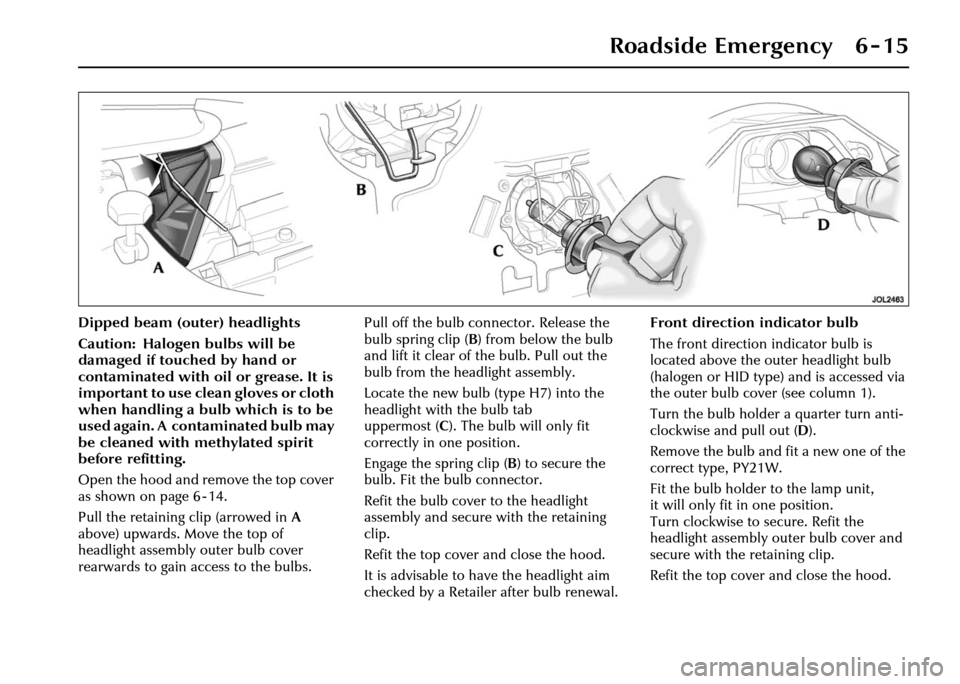
Pull the retaining clip (arrowed in A
above) upwards. Move the top of
headlight assembly outer bulb cover
rearwards to gain a ccess to the bulbs. Pull off the bulb connector. Release the
bulb spring clip (
B) from below the bulb
and lift it clear of the bulb. Pull out the
bulb from the headlight assembly.
Locate the new bulb (type H7) into the
headlight with the bulb tab
uppermost ( C). The bulb will only fit
correctly in one position.
Engage the spring clip ( B) to secure the
bulb. Fit the bulb connector.
Refit the bulb cover to the headlight
assembly and secure with the retaining
clip.
Refit the top cover and close the hood.
It is advisable to have the headlight aim
checked by a Retailer after bulb renewal. Front direction indicator bulb
The front direction indicator bulb is
located above the outer headlight bulb
(halogen or HID type) and is accessed via
the outer bulb cove
r (see column 1).
Turn the bulb holder a quarter turn anti-
clockwise and pull out ( D).
Remove the bulb and fit a new one of the
correct type, PY21W.
Fit the bulb holder to the lamp unit,
it will only fit in one position.
Turn clockwise to secure. Refit the
headlight assembly ou ter bulb cover and
secure with the retaining clip.
Refit the top cover and close the hood.
Page 167 of 227
6 - 16 Roadside Emergency
Main beam (inner) headlight
Caution: Halogen bulbs will be
damaged if touched by hand or
contaminated with oil or grease. It is
important to use clean gloves or cloth
when handling a bulb which is to be
used again. A contaminated bulb may
be cleaned with methylated spirit
before refitting.
Open the hood and remove the top cover
as shown on page 6 - 14.
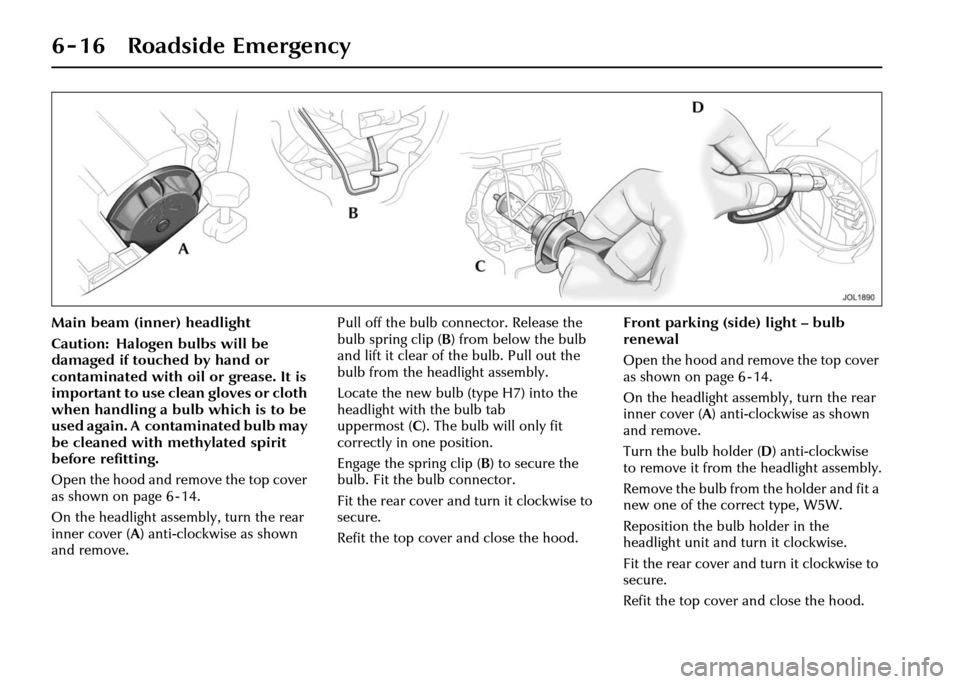
On the headlight assembly, turn the rear
inner cover (A) anti-clockwise as shown
and remove. Pull off the bulb co
nnector. Release the
bulb spring clip ( B) from below the bulb
and lift it clear of the bulb. Pull out the
bulb from the headlight assembly.
Locate the new bulb (type H7) into the
headlight with the bulb tab
uppermost ( C). The bulb will only fit
correctly in one position.
Engage the spring clip ( B) to secure the
bulb. Fit the bulb connector.
Fit the rear cover and turn it clockwise to
secure.
Refit the top cover and close the hood. Front parking (side) light – bulb
renewal
Open the hood and remove the top cover
as shown on page 6 - 14.
On the headlight asse
mbly, turn the rear
inner cover ( A) anti-clockwise as shown
and remove.
Turn the bulb holder ( D) anti-clockwise
to remove it from the headlight assembly.
Remove the bulb from the holder and fit a
new one of the correct type, W5W.
Reposition the bulb holder in the
headlight unit and turn it clockwise.
Fit the rear cover and turn it clockwise to
secure.
Refit the top cover and close the hood.
Page 171 of 227
6 - 20 Roadside Emergency
Fire Extinguisher
Many countries make it compulsory to
carry a fire extinguisher. Your Jaguar
Retailer can supply and fit one.
Mexican vehicles have a factory fitted fire
extinguisher which contains 2.2 lbs (1 kg)
of BC powder pressurised with nitrogen
to a working pressure of 180 psi (12 bar)
at 68°F (20°C).
This extinguisher can be used on liquid
fires, electrical equipment fires and, if no
explosion risk, gaseous fires.
!WARNING:
1. Do not test the fire extinguisher prior to use. Partial discharge will
render the extinguisher
inoperative.
2. Do not use the fire extinguisher closer than 8 feet (2.4 m) to the
base of a liquid fire as the force
may splatter the burning liquid to
the surrounding area. To operate the fire extinguisher:
1. Unclip and remove the extinguisher
from the bracket.
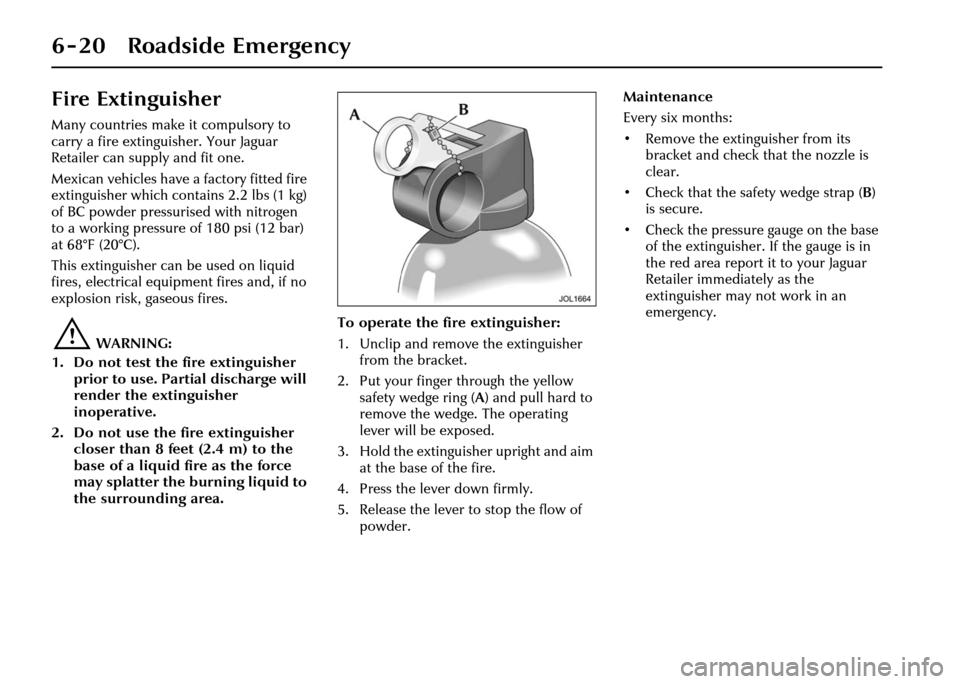
2. Put your finger through the yellow safety wedge ring ( A) and pull hard to
remove the wedge. The operating
lever will be exposed.
3. Hold the extinguisher upright and aim at the base of the fire.
4. Press the lever down firmly.
5. Release the lever to stop the flow of powder. Maintenance
Every six months:
• Remove the extinguisher from its
bracket and check that the nozzle is
clear.
• Check that the safety wedge strap ( B)
is secure.
• Check the pressure gauge on the base of the extinguisher. If the gauge is in
the red area report it to your Jaguar
Retailer immediately as the
extinguisher may not work in an
emergency.
Page 184 of 227
Maintenance
Regular Checks . . . . . . . . . . . . . . . . . . . . . . . . . . 7 - 3
Hood Release . . . . . . . . . . . . . . . . . . . . . . . . . . . 7 - 4
Checking and Top Up . . . . . . . . . . . . . . . . . . . . . 7 - 6
Check Engine Oil Level . . . . . . . . . . . . . . . . . . . . 7 - 6
Check Power Steering Fluid Level . . . . . . . . . . . . 7 - 8
Check Brake Fluid Reservoir . . . . . . . . . . . . . . . . 7 - 9
Check Windscreen/Headlight Washer Reservoir. . . . . . . . . . . . . . . . . . . . . . . . . . . 7 - 10
Check Coolant Level . . . . . . . . . . . . . . . . . . . . . 7 - 11
Capacities . . . . . . . . . . . . . . . . . . . . . . . . . . . . . 7 - 12
Battery . . . . . . . . . . . . . . . . . . . . . . . . . . . . . . . 7 - 13
Battery Warning Signs. . . . . . . . . . . . . . . . . . . . 7 - 14
Check/Top Up Battery Electrolyte . . . . . . . . . . . 7 - 15
Windscreen Wipers . . . . . . . . . . . . . . . . . . . . . 7 - 17
Tyres . . . . . . . . . . . . . . . . . . . . . . . . . . . . . . . . 7 - 18
Tyre Pressures . . . . . . . . . . . . . . . . . . . . . . . . . 7 - 18
Vehicle Care . . . . . . . . . . . . . . . . . . . . . . . . . . . 7 - 22
Interior Care . . . . . . . . . . . . . . . . . . . . . . . . . . . 7 - 22
Exterior Care . . . . . . . . . . . . . . . . . . . . . . . . . . 7 - 23
Electrical Accessories . . . . . . . . . . . . . . . . . . . . 7 - 25
Page 187 of 227
7 - 4 Maintenance
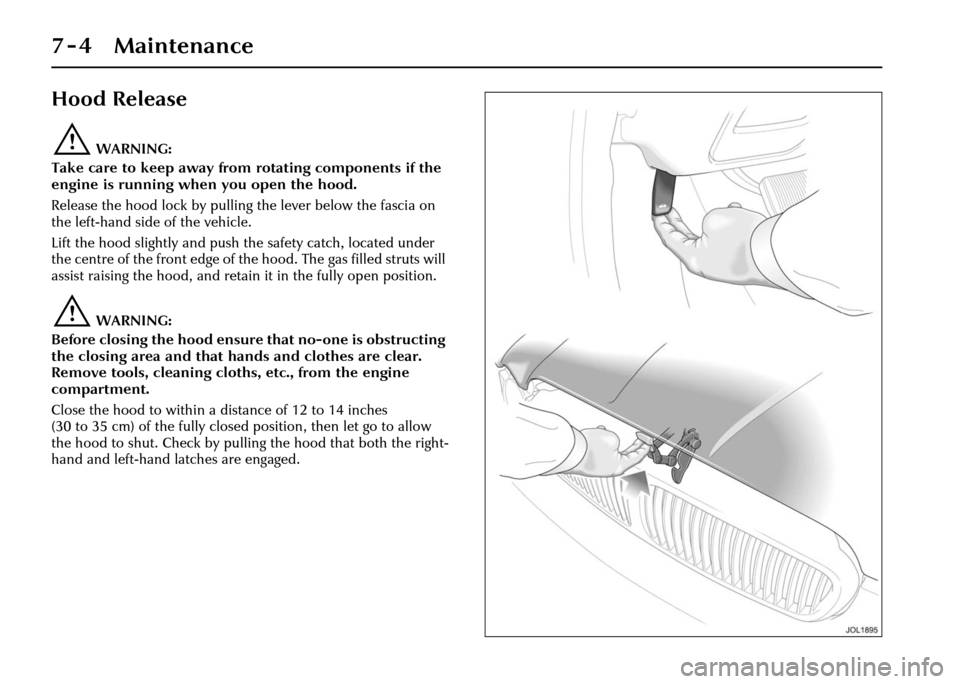
Hood Release
!WARNING:
Take care to keep away from rotating components if the
engine is running when you open the hood.
Release the hood lock by pullin g the lever below the fascia on
the left-hand side of the vehicle.
Lift the hood slightly and push the safety catch, located under
the centre of the front edge of th e hood. The gas filled struts will
assist raising the hood, and retain it in the fully open position.
!WARNING:
Before closing the hood ensure that no-one is obstructing
the closing area and that hands and clothes are clear.
Remove tools, cleaning cloths, etc., from the engine
compartment.
Close the hood to within a distance of 12 to 14 inches
(30 to 35 cm) of the fully closed position, then let go to allow
the hood to shut. Check by pulling the hood that both the right-
hand and left-hand latches are engaged.
Page 194 of 227
Maintenance 7 - 11
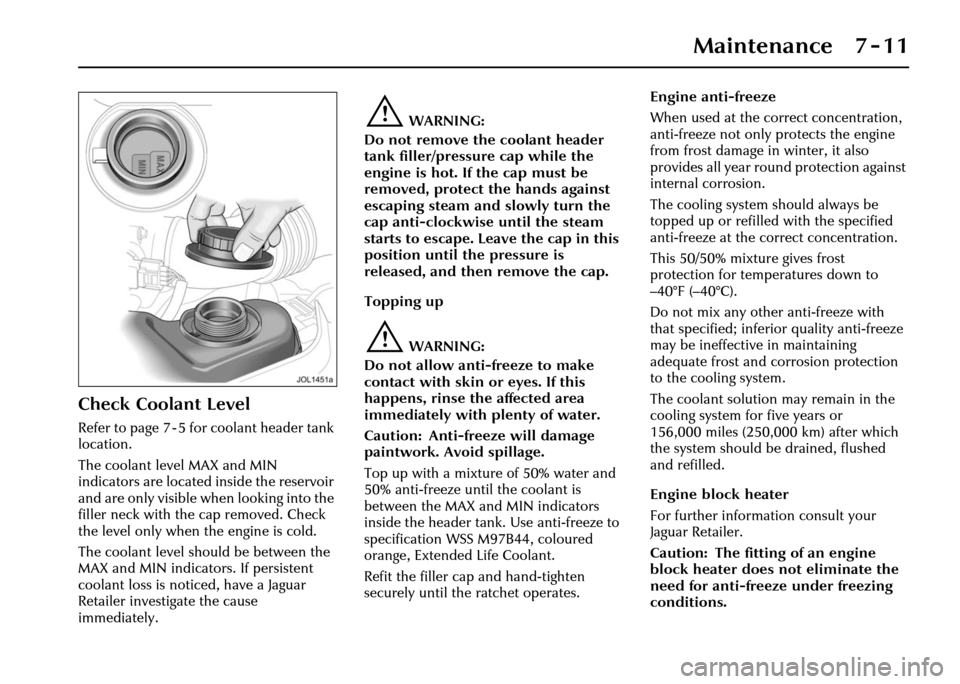
Check Coolant Level
Refer to page 7 - 5 for coolant header tank
location.
The coolant level MAX and MIN
indicators are located inside the reservoir
and are only visible when looking into the
filler neck with the cap removed. Check
the level only when the engine is cold.
The coolant level shou ld be between the
MAX and MIN indicators. If persistent
coolant loss is noticed, have a Jaguar
Retailer investigate the cause
immediately.
!WARNING:
Do not remove the coolant header
tank filler/pressure cap while the
engine is hot. If the cap must be
removed, protect the hands against
escaping steam and slowly turn the
cap anti-clockwise until the steam
starts to escape. Leave the cap in this
position until the pressure is
released, and then remove the cap.
Topping up
!WARNING:
Do not allow anti-freeze to make
contact with skin or eyes. If this
happens, rinse the affected area
immediately with plenty of water.
Caution: Anti-freeze will damage
paintwork. Avoid spillage.
Top up with a mixture of 50% water and
50% anti-freeze until the coolant is
between the MAX and MIN indicators
inside the header tank. Use anti-freeze to
specification WSS M97B44, coloured
orange, Extended Life Coolant.
Refit the filler cap and hand-tighten
securely until the ratchet operates. Engine anti-freeze
When used at the correct concentration,
anti-freeze not only protects the engine
from frost damage in winter, it also
provides all year round protection against
internal corrosion.
The cooling system should always be
topped up or refilled with the specified
anti-freeze at the correct concentration.
This 50/50% mixture gives frost
protection for temperatures down to
–40°F (–40°C).
Do not mix any other anti-freeze with
that specified; inferior quality anti-freeze
may be ineffective in maintaining
adequate frost and corrosion protection
to the cooling system.
The coolant solution
may remain in the
cooling system for five years or
156,000 miles (250,000 km) after which
the system should be drained, flushed
and refilled.
Engine block heater
For further information consult your
Jaguar Retailer.
Caution: The fitting of an engine
block heater does not eliminate the
need for anti-freeze under freezing
conditions.