ABS JAGUAR XJ6 1994 2.G Electrical Diagnostic Manual
[x] Cancel search | Manufacturer: JAGUAR, Model Year: 1994, Model line: XJ6, Model: JAGUAR XJ6 1994 2.GPages: 327, PDF Size: 13.73 MB
Page 69 of 327
Brakes (a)
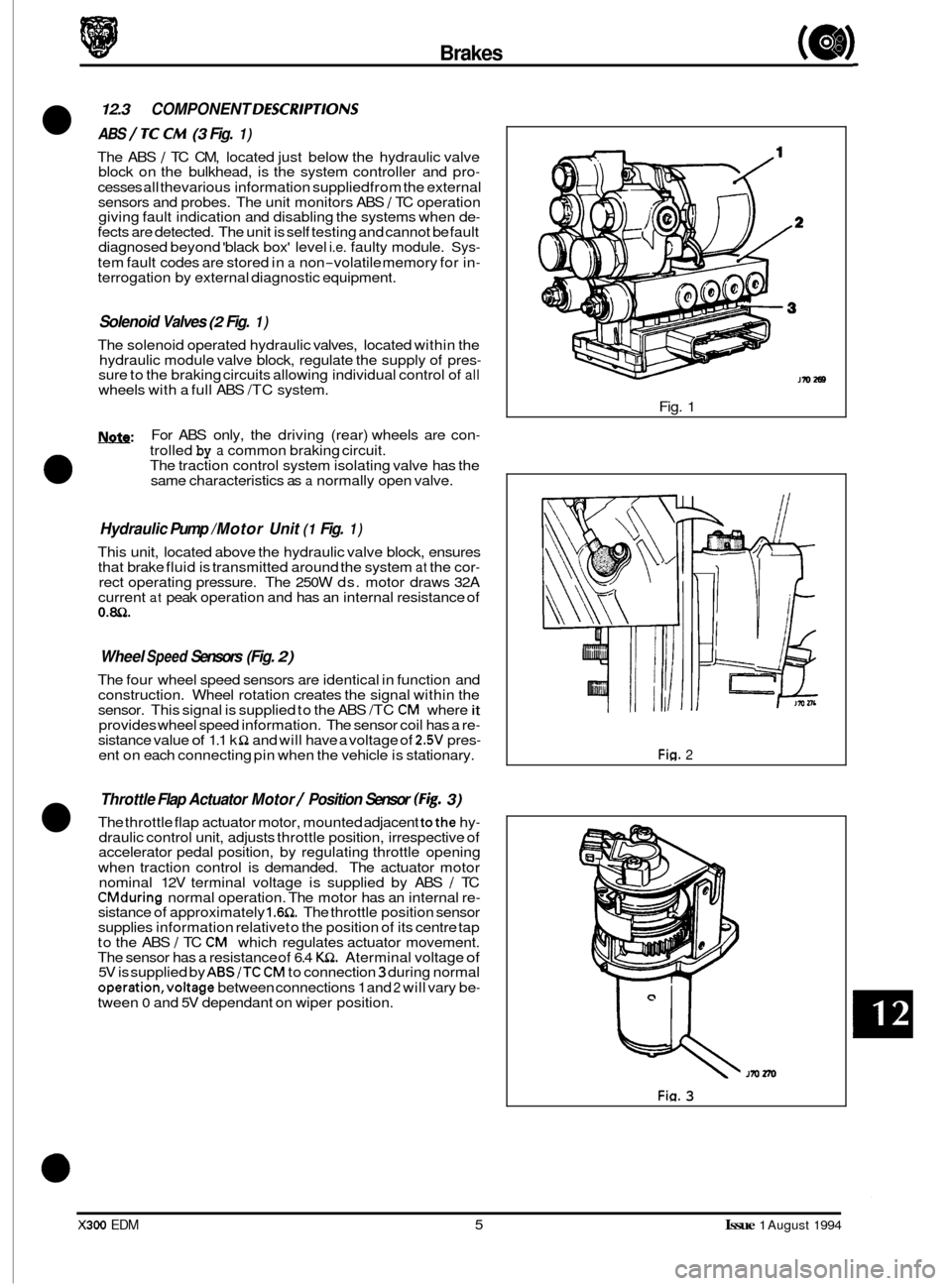
12.3 COMPONENT DESCRlPTlONS
ABS / TC CM (3 Fig. 1)
The ABS / TC CM, located just below the hydraulic valve
block on the bulkhead, is the system controller and pro-
cesses all thevarious information supplied from the external
sensors and probes. The unit monitors ABS / TC operation
giving fault indication and disabling the systems when de- fects are detected. The unit is self testing and cannot be fault
diagnosed beyond 'black box' level i.e. faulty module. Sys-
tem fault codes are stored in a non-volatile memory for in- terrogation by external diagnostic equipment.
Solenoid Valves (2 Fig. 1)
The solenoid operated hydraulic valves, located within the
hydraulic module valve block, regulate the supply of pres- sure to the braking circuits allowing individual control of all wheels with a full ABS /TC system.
Nnfe: For ABS only, the driving (rear) wheels are con-
trolled by a common braking circuit.
The traction control system isolating valve has the
same characteristics as
a normally open valve. a
Hydraulic Pump /Motor Unit (1 Fig. 1)
This unit, located above the hydraulic valve block, ensures
that brake fluid is transmitted around the system at the cor- rect operating pressure. The 250W ds. motor draws 32A
current at peak operation and has an internal resistance of 0.m.
Wheel Speed Sensors (Fig. 2)
The four wheel speed sensors are identical in function and
construction. Wheel rotation creates the signal within the
sensor. This signal is supplied to the ABS /TC
CM where it provides wheel speed information. The sensor coil has a re- sistance value of 1.1 k Q and will have a voltage of 2.5V pres- ent on each connecting pin when the vehicle is stationary.
Throttle Flap Actuator Motor / Position Sensor (Fig. 3)
The throttle flap actuator motor, mounted adjacent tothe hy- draulic control unit, adjusts throttle position, irrespective of
accelerator pedal position, by regulating throttle opening
when traction control is demanded. The actuator motor
nominal 12V terminal voltage is supplied by ABS
/ TC CMduring normal operation. The motor has an internal re- sistance of approximately 1.6Q. The throttle position sensor
supplies information relative to the position of its centre tap
to the ABS
/ TC CM which regulates actuator movement.
The sensor has a resistance of 6.4 K!2. Aterminal voltage of 5V is supplied by ABS/TC CM to connection 3 during normal
operation,voltage between connections 1 and 2 will vary be- tween 0 and 5V dependant on wiper position.
Fig. 1
Fig. 2
Jrn 270
Fia. 3
X300 EDM 5 Issue 1 August 1994
Page 70 of 327
Brakes
12.4 SYSTEM FAULT INDICATION
Fault Indication:
ABS MIL lamp is still illuminated after ignition switch on and instrument pack self test.
h:
Possible causes
Fuses blown.
Faulty wheel speed sensor or harness.
Faulty wiring.
Faulty ABS
/ TC CM.
It is likely that theTC MIL lamp and Traction OFF lamp will also illuminate on vehicles with traction control fitted.
Fault Diagnosis
On the first ignition cycle after afault has been sucessfully diagnosed and corrected the vehicle must bedriven to a speed above 20kph (12.5 mile/ h) before warning lamps will extinguish. If lamps remain on after this exer- cise repeat fault diagnosis.
. Check fuses (F7) in battery feed lines and (F16) in ignition line. Battery fuses are located in the left and right hand
. Unbolt 28 way multi-plug connector from ABS / TC CM.
. Measure resistance across each wheel speed sensor.
No - Unplug sensor flying lead and re-measure sensor resistance.
N&:
heelboard fuse boxes. The ignition supply fuse is located in the left hand heelboard fuse box.
Is value measured 1 10052, f 50%?
Rear sensor connectors are located beneath the rear seat. Seat must be removed to gain access to connector.
Forward sensor connectors are located adjacent to the hood catch bracket.
Is value now within range?
Yes
- Examine harness between ABS I TC CM and sensor.
No - Renew sensor.
= Check continuity to ground from ABS 1 TC CM harness connections 13 and 14. If value is much greater than 0.152
renew harness.
. With the ignition switch ON, measure voltage between ABS /TC CM harness connection 14 and connections 1 and 2 respectively. If value is not approximately equivalent to battery voltage renew harness.
. With the ignition switch ON, measure voltage between ABSITC CM harness connections14 and 15. If value is not
approximately equivalent to battery voltage renew harness.
Renew ABS /TC CM if fault is not located during the above procedures.
fault Indication:
ABS MIL lamp illuminates at 20 kph.
m:
Possible Causes
Fuses blown.
Faulty hydraulic module pump
/ motor unit or circuitry.
Faulty ABS
/ TC CM.
Fault Diagnosis
Check fuses.
. Disconnect pump / motor unit and measure resistance across two pin connector. Measured value should be in the
. Unbolt 28-way connector from ABS /TC CM and measure voltage between harness connections1 and 14. If value
. Renew ABS 1 TC CM if fault is not located during the above procedures.
It is IikelythattheTCMILlampandTraction OFFlampwill also illuminateonvehicleswithtractioncontrolfitted.
region of 0.852. Renew unit if excessive resistance or short circuit is recorded.
is not approximately equal to battery volts renew harness.
Issue 1 August 1994 X300 EDM
Page 71 of 327
Brakes
Fault Indication:
0 ABS MIL lamp illuminates on 'pull-away' or during driving
U:
Possible Causes
Faulty sensor or wiring.
Faulty rotor or wheel bearing installation giving inconsistent signals to
ABS / TC CM.
Fault Diagnosis
Check sensor installation for:
Security of sensor lead fixing bolt.
Damage to sensor lead.
Possible damage to rotor.
Excessive play in wheel bearing.
Intermittent faults caused by poor harness connection or damage.
It is IikelythattheTC MIL lamp andTraction OFF lamp will also illuminate on vehicles with traction control fitted.
Fault Indication:
TC MIL lamp only is still illuminated after ignition switch on and instrument pack self test.
Possible Causes - Faulty throttle position actuator.
Faulty actuator potentiometer.
Faulty wiring.
Fault Diagnosis
Disconnect flying lead to actuator motor bi-pin connector and measure motor resistance, reading should be approxi- mately 1.6Q. Renew actuator if value is excessive or short circuit.
Disconnect actuator potentiometer and measure resistance across pins 1 and 3, reading should be approximately 6.4kQ. Renew actuator if value indicates open or short circuit. If value is correct, operate accelerator pedal while
measuring resistance between pins 1 and 2, readings should vary in accordance with pedal travel.
. With the ignition switch ON, measure voltage across harness connections to potentiometer pins 1 and 3, reading
should be
5V+ 0.5V. If a voltage below 4.5 Vis recorded ensure that supply fuses are intact and all connections secure
before renewing harness.
m: Examine ABS MIL lamp at ignition switch-on. If lamp illuminates briefly, then goes out the supply fuses will
be intact. If lamp does not illuminate at all supply fuses may be blown, or MIL lamp may be faulty.
. Check continuity between harness connection to potentiometer pin 2 and pin 26 of 28-way multi-pug connector to
ABS I TC CM.
Fault Indication:
TC MIL lamp only is still illuminated 8 seconds after ignition switch on.
Possible Causes
Faulty harness or TCS switch.
Fault Diagnosis
= Check pin 18 of 28 way multi-plug connector is not shorted to ground.
X300 EDM 7 Issue 1 August 1994
Page 72 of 327
(a) Brakes
Pin Point Tests
Wheel Sensor
The wheel sensors are connected across ABS / TC CM pins 5 - 12 inclusive, one sensor per pair of pins (see 'Control
Module Connections', page 3).
. Testing between pins of the 28 way multi-plug connector, checkthat the resistance of each sensor coil is 1.1kQ (toler- ance of * 50%).
Hydraulic Pump Motor
rn Disconnect the pump motor bi-pin connector.
rn Check the resistance value of the motor winding is approximately 0.m.
Throttle position sensor
With the vehicle ignition ON, test the throttle position sensor harness between ABSITC CM pins 25 and 27. Avoltage
of 5V (k 0.5V) should be recorded.
Repeat the test between ABS
/ TC CM pins 26 and 27 with the accelerator pedal pressed down approximately half
of full travel. Avoltage of approximately half the first value should be recorded. Variation in accelerator pedal posi- tion should cause a varying voltage value to be recorded.
Throttle Flap Actuator Motor
. Test the throttle flap actuator motor between ABS /TC CM multi-plug connector pins 16 and 17. A resistance value
of 1.651 should be recorded.
Brake Switch
. Measure the voltage at the brake switch between ABS /TC CM pin 20 and ground. With pedal UP, ie not operated,
a reading equivalent to battery voltage should be achieved. Operate brake pedal fully ensuring coinciding ground,
ie
0 volts, through switch.
Traction Switch
Check continuity of traction OFF / ON switch between ABS /TC CM pin 18 and ground. Operate switch ensuring CO- inciding short circuit.
Issue 1 August 1994 8 X300 EDM
Page 73 of 327
Brakes
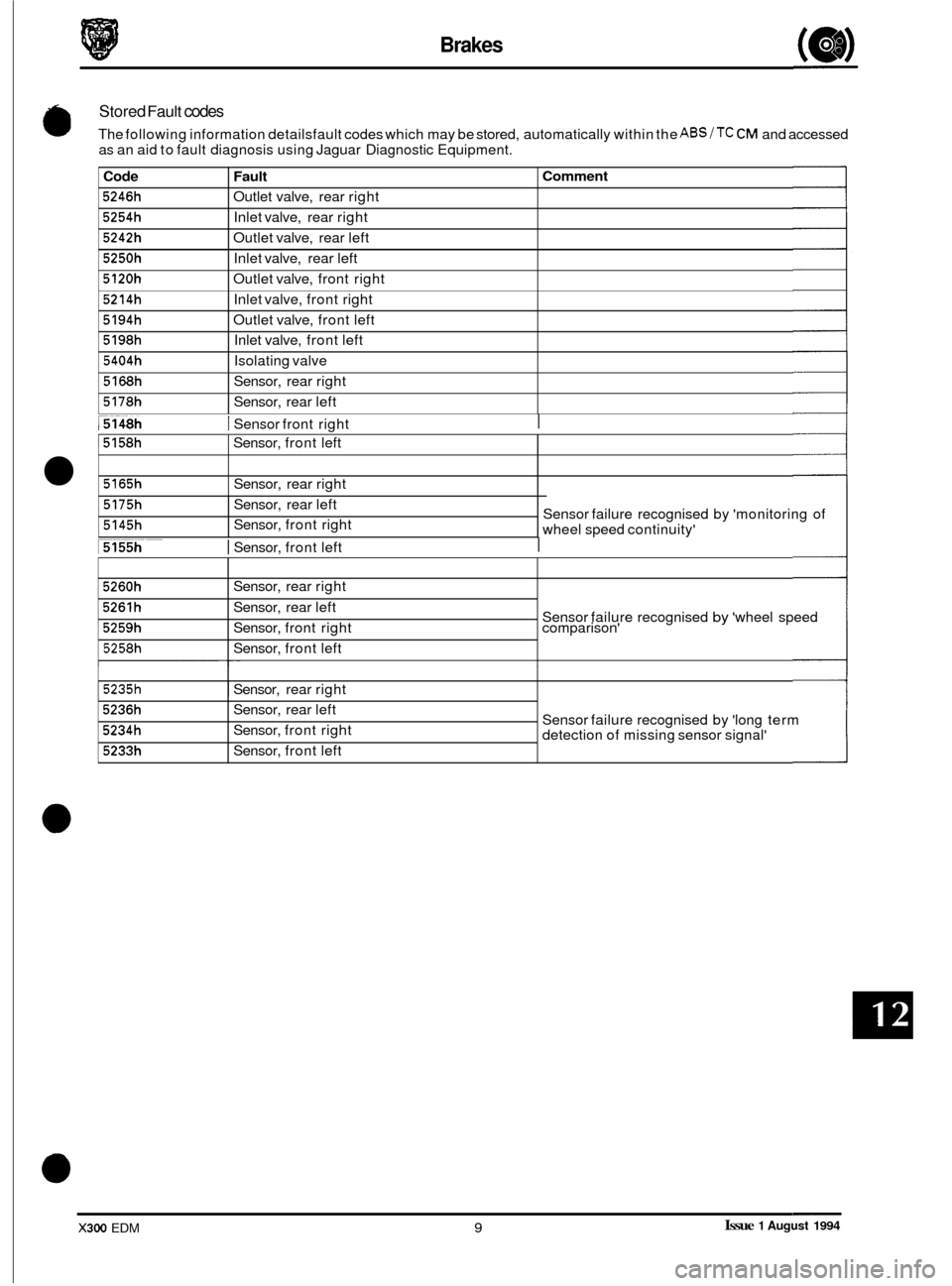
Code Fault
5246h Outlet valve, rear right
5254h Inlet valve, rear right
5242h Outlet valve, rear left
5250h Inlet valve, rear left
5120h Outlet valve, front right
5214h Inlet valve, front right
5194h Outlet valve, front left
5198h Inlet valve, front left
5404h Isolating valve
5168h Sensor, rear right
5178h Sensor, rear left
Stored Fault codes
The following information detailsfault codes which may be stored, automatically within the ABS/TC CM and accessed
as an aid to fault diagnosis using Jaguar Diagnostic Equipment.
Comment
r5148h 1 Sensor front right I
5158h Sensor, front left
5165h Sensor, rear right
5175h
5145h
Sensor, rear left
Sensor, front right Sensor
failure recognised by 'monitoring of
wheel speed continuity'
Fi&h- I Sensor, front left I
5260h
5261h
5259h
5258h
Sensor, rear right
Sensor, rear left
Sensor, front right comparison'
Sensor, front left Sensor
failure recognised
by 'wheel speed
1--- r- I
5236h
5234h
5233h
5235h I Sensor, rear right
Sensor, rear left
Sensor, front right
Sensor, front left Sensor
failure recognised by 'long term
detection of missing sensor signal'
Issue 1 August 1994 X300 EDM 9
Page 79 of 327
Climate Control Systems
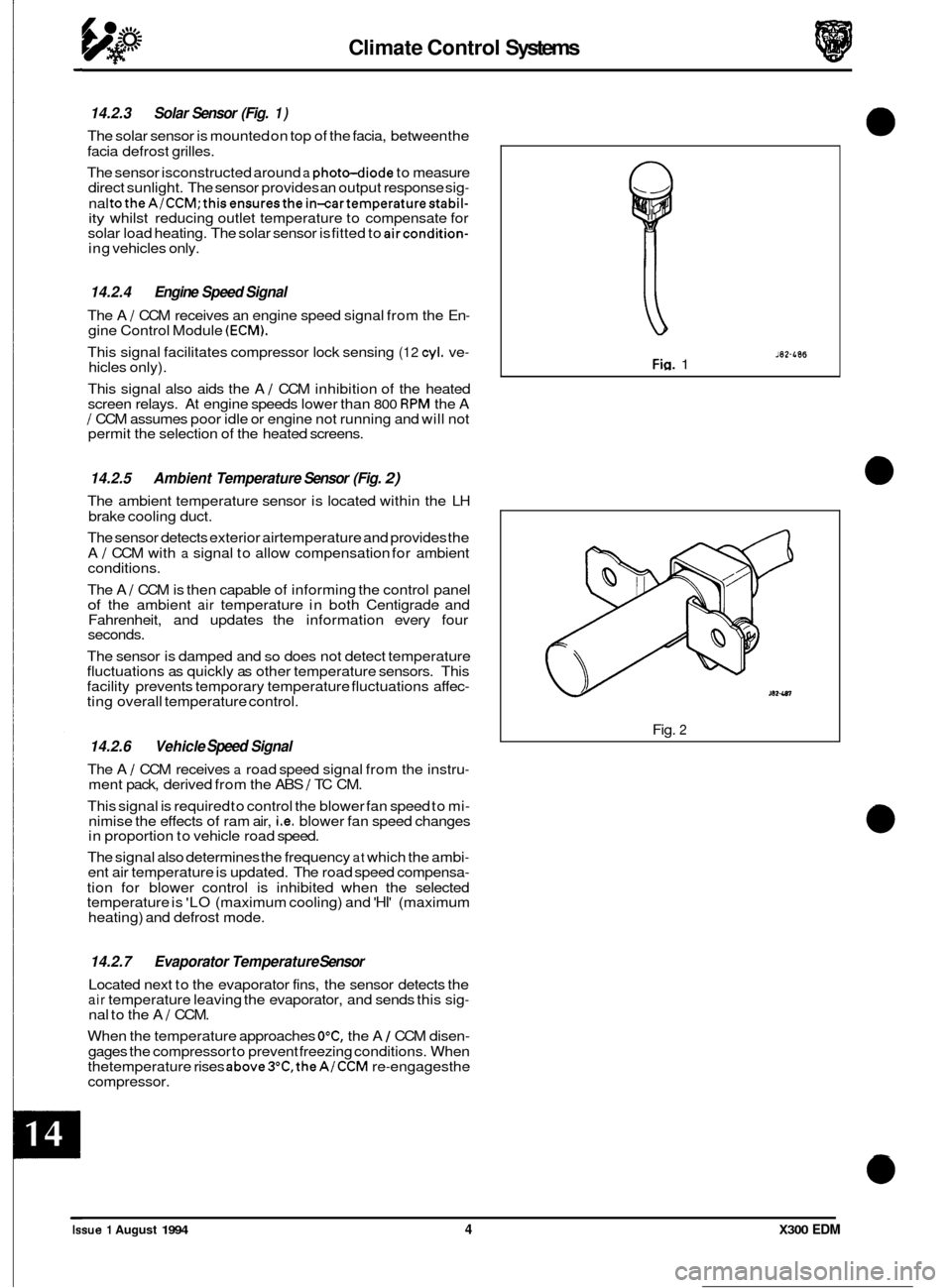
14.2.3 Solar Sensor (Fig. 1)
The solar sensor is mounted on top of the facia, between the
facia defrost grilles.
The sensor isconstructed around
a photo-diode to measure
direct sunlight. The sensor provides an output response sig-
nal totheA1CCM;thisensuresthe in-cartemperaturestabil- ity whilst reducing outlet temperature to compensate for
solar load heating. The solar sensor is fitted to aircondition- ing vehicles only.
14.2.4 Engine Speed Signal
The A 1 CCM receives an engine speed signal from the En- gine Control Module (ECM).
This signal facilitates compressor lock sensing (12 cyl. ve- hicles only).
This signal also aids the A
1 CCM inhibition of the heated
screen relays. At engine speeds lower than 800 RPM the A I CCM assumes poor idle or engine not running and will not
permit the selection of the heated screens.
14.2.5 Ambient Temperature Sensor (Fig. 2)
The ambient temperature sensor is located within the LH
brake cooling duct.
The sensor detects exterior airtemperature and provides the
A
I CCM with a signal to allow compensation for ambient
conditions.
The A
1 CCM is then capable of informing the control panel of the ambient air temperature in both Centigrade and
Fahrenheit, and updates the information every four
seconds.
The sensor is damped and
so does not detect temperature
fluctuations as quickly as other temperature sensors. This
facility prevents temporary temperature fluctuations affec
- ting overall temperature control.
14.2.6 Vehicle Speed Signal
The A 1 CCM receives a road speed signal from the instru- ment pack, derived from the ABS 1 TC CM.
This signal is required to control the blower fan speed to mi
- nimise the effects of ram air, i.e. blower fan speed changes
in proportion to vehicle road speed.
The signal also determines the frequency
at which the ambi- ent air temperature is updated. The road speed compensa-
tion for blower control is inhibited when the selected
temperature is 'LO (maximum cooling) and 'HI' (maximum
heating) and defrost mode.
14.2.7 Evaporator Temperature Sensor
Located next to the evaporator fins, the sensor detects the air temperature leaving the evaporator, and sends this sig- nal to the A 1 CCM.
When the temperature approaches
OOC, the A 1 CCM disen-
gages the compressor to prevent freezing conditions. When
thetemperature rises above3OC.theAlCCM re-engagesthe
compressor.
J82-L06 Fig. 1
Fig. 2
0
0
Issue 1 August 1994 4 X300 EDM
Page 157 of 327
E I ect r ical
15.2.3 COMPONENT DESCRIPTION
15.2.3.1 Speedometer
The speed indication input signal, sent as a pulse rate, is generated by an open collectortransistor within the ABS con- trol module. The instrument pack converts the frequency of this signal to drive the speedometer and to provide two
road speed outputs:
Speed output
1 (pin 2,48 way connector)
This output is connected to the radio head unit, security control module and the power steering module.
Speed output 2 (pin
3,48 way connector)
This output is connected to the body processor unit, cruise control control module, air conditioning control module
and the engine management system.
15.2.3.2 Tachometer
The tachometer input, all engine variants, is provided by the engine management control module. When the engine
is running the control module generates three high state pulses per engine revolution.
15.2.3.3
This signal comes direct from the variable resistance type oil pressure sensor, mounted on the engine. The sensor
resistance values range from 75Q (8 Bar) to 330Q (0 Bar).
When the gauge reaches
a pre-determined reading the instrument pack illuminates the warning light.
Engine Oil Pressure and Warning lamp
15.2.3.4 Engine Coolant Temperature
This signal comes direct from the coolant temperature sensor (variable resistance type), mounted on the engine. The
sensor resistance values range from 34Q (hot) to 241Q (cold), when disconnected from the vehicle.
Note: The coolant temperature gauge is calibrated to indicate at approximately 'Normal' for a wide range of normal
engine operating temperatures.
15.2.3.5 Fuel Tank level Gauge and Warning lamp
This signal (pin 20,24-way connector) comes direct from the variable resistor type fuel level sensor. The sensor resis- tance values range from 80 ohms (full tank) to 900 ohms (empty tank).
When the gauge reaches a pre
-determined reading, the instrument pack illuminates the warning lamp.
15.2.3.6
Battery voltage is displayed on the gauge by measuring the ignition voltage.
The red charge warning lamp will illuminate if either the voltage is too low (below
10.5V) or too high (above 15.5V). In addition, the generator provides a low signal to the instrument pack (pin 9,48-way connector) when battery charging
is unsatisfactory.
Battery Voltage Gauge and Warning lamp
15.2.3.7 Liquid Crystal Display
A single line, six digit, 7 segment display with six trip function flags used for odometer, trip computer and driver mess- ages.
!Y,Q&: If the instrument pack has not been PECUS programmed, the back illumination of the LCD will not switch on.
Check that a PECUS label is attached to the back of the pack.
Issue 1 August 1994 15.2 - 4 X300 EDM
Page 158 of 327
15.2.3.8 Trip Computer
The instrument pack provides the trip computer functions, selected via the momentary stalk input and two action in- puts: 'Reset' and 'Odo'.
The signal used for each function are:
Distance:
Computed from the speed signal from the ABS control module.
Average Speed
Computed from the speed signal from the ABS control module.
Fuel Used
Computed from a pulsed signal from the engine management system.
Average Fuel Consumption
Computed from the speed signal and the fuel used signal.
Range
Computed from the speed signal, the fuel used signal and fuel level.
instantaneous Fuel
Computed from the speed signal and the fuel used signal.
15.2.4 PRIMARY WARNING LAMPS - ILLUMINATED RED
15.2.4.1 Exhaust Temperature (Japan only)
The exhaust temperature input (pin 23,48 way connector) is provided by the catalyst switching module (pin 6), which
pulls the line low when a fault occurs.
15.2.4.2 Low Oil Pressure
This signal comes direct from the variable resistance type oil pressure sensor. The sensor resistancevalues range from
7552 to 310Q.
15.2.4.3 Seat Selt
The seat belt input (pin 15,48 way connector) is provided by the seat belt stalk switch, via the body processor unit
(pin 26).
The seat belt lamp will illuminate when
a low signal is seen on the instrument pack input.
15.2.4.4 Trunk Lid Open
A microswitch located in the trunk lid lock provides a signal (pin 16,4&wayconnector) causing the trunk lid open indi- cator to illuminate whenever the trunk lid is opened or not closed correctly.
The trunk lid open indicator will illuminate when
a low signal is seen on the instrument pack input.
15.2.4.5 Door Ajar
Switches located in each door closing mechanism supply signals to indicate when any door is either open, or has not
been closed correctly. The system operates from two signals; an input from the driver's door (pin 46, 48-way con- nector) or a combined signal input from the passenger doors (pin 47,4&way connector).
The door ajar lamp will illuminate when
a low signal is detected on either of the two inputs.
X300 EDM 15.2 - 5 Issue 1 August 1994
Page 160 of 327
15.2.5 SECONDARY WARNING LAMPS - ILLUMINATED AMBER
15.2.5.1 Transmission Fault
The transmission fault indicator is controlled by a signal from the Transmission Control Module (TCM). The signal to
the instrument pack (pin 44,48-way connector) is switched high when a transmission fault occurs, and the indicator
lamp is illuminated.
15.2.5.2 Washer Fluid Level
The washer fluid level sensor, mounted in the fluid reservoir, provides a signal (pin 13, 48-way connector) when the
amount of fluid drops below a predetermined level. The switch is normally in the closed position, providing a low sig-
nal to the instrument pack, when the fluid level is acceptable. If the fluid level drops, the switch will open, removing
the low signal and illuminating the indicator lamp.
15.2.5.3 Bulb Fail
Bulb failure indication is controlled from two different sources:
If a direction indicator lamp fails, a signal is sent to the instrument pack (pin 18,48-way connector) from the Body. :o- cessor Unit (BPU). The signal is normally low but switched high if a bulb failure occurs; thuscausing the bulbfail indica-
If any of the other bulbs, monitored by the three lamp control modules, fail, a signal is sent direct to the instrument
pack (pin 43, 48-way connector). The signal is normally low but switched high if a bulb failure occurs; thus causing
the bulb failure indicator lamp to illuminate.
tor lamp to illuminate.
15.2.5.4 Traction Control Fail
Two traction control lamps are provided: control fail and control off. Both lamps are controlled from one input from
the ABS / TC Control Module.
Under normal operating conditions, the input signal should be high.
If the input line is continuously low, traction con- trol has failed and both lamps will illuminate. If the input signal is a 4 Hz square wave the traction control system is
switched off, therefore the ‘traction off lamp will illuminate.
15.2.5.5 Anti-lock Fail
The input to the instrument pack (pin 7,24-way connector) is provided by the ABS Control Module. The warning lamp
illuminates if the signal voltage is less than 5.0 volts or greater than 11.9 volts.
- 15.2.5.6 Low Fuel Level
This signal (pin 20,24-way connector) comes direct from the variable resistor type fuel level sensor. The sensor resis-
tance values range from 80 ohms (full tank) to 900 ohms (empty tank).
When the gauge reaches
a pre-determined reading, the instrument pack illuminates the warning lamp.
15.2.5.7 Check Engine
The ’checkeng’ indicator will illuminate when the Engine Control Module (ECM) detects a fault within the system, and
sends a signal to the instrument pack (pin 22,48-wayconnector). The signal line is pulled low by the ECM when a fault
is detected.
The indicator lamp will illuminate during each ignition cycle, until the engine fires.
X300 EDM 15.2-7 Issue 1 August 1994
Page 161 of 327
rl E I ect r i ca I
15.2.6 STATUS AND WARNING LAMPS
15.2.6.1 Transmission Sport Mode (green)
The transmission sport mode indicator is controlled by a signal from the Transmission Control Module (TCM). The
indicator is illuminated whenever 'Sport' mode is selected; a low signal is sent to the instrument pack (pin 14,48-way connector).
15.2.6.2 Traction Control OFF (green)
Two traction control lamps are provided: control fail and control off. Both lamps are controlled from one input from
the ABS I TC control module.
Under normal operating conditions, the input signal should be high.
If the input line is continuously low, traction con- trol has failed and both lamps will illuminate. If the input signal is a 4 Hz square wave the traction control system is
switched off, therefore the 'traction
off lamp will illuminate.
15.2.6.3
The operation of the direction indicator 'tell-tales' is controlled by the BPU. The 'tell-tales' are the only indicators on
the instrument pack which can be illuminated with the ignition OFF, for hazard warning.
The signal from the BPU to the instrument pack is pulsed, switching the direction indicators on and
off at the correct
frequency. The 'tell-tales'will illuminate when the signal is low. If the frequency doubles, this signifies that an exterior
direction indicator bulb has failed; the bulb failure warning lamp should also be illuminated.
The signal is fed to two separate inputs to the instrument pack, on the 48
-way connector; pin 40 for LH directional indi- cator 'tell-tale' and pin 41 for RH.
!We: If both direction indicator 'tell-tales' are permanently illuminated; this indicates that the BPU has not been
PECUS programmed. Check that a PECUS label is attached to the BPU.
Direction Indicators - LH & RH (green)
15.2.6.4 Main Beam (blue)
A low signal is supplied to the instrument pack (pin 24,48-way, connector) from the BPU when main beam is selected.
This illuminates the main beam 'tell-tail' indicator lamp.
Issue 1 August 1994 15.2 - 8 X300 EDM