battery JAGUAR XJ6 1994 2.G Electrical Diagnostic Manual
[x] Cancel search | Manufacturer: JAGUAR, Model Year: 1994, Model line: XJ6, Model: JAGUAR XJ6 1994 2.GPages: 327, PDF Size: 13.73 MB
Page 72 of 327
(a) Brakes
Pin Point Tests
Wheel Sensor
The wheel sensors are connected across ABS / TC CM pins 5 - 12 inclusive, one sensor per pair of pins (see 'Control
Module Connections', page 3).
. Testing between pins of the 28 way multi-plug connector, checkthat the resistance of each sensor coil is 1.1kQ (toler- ance of * 50%).
Hydraulic Pump Motor
rn Disconnect the pump motor bi-pin connector.
rn Check the resistance value of the motor winding is approximately 0.m.
Throttle position sensor
With the vehicle ignition ON, test the throttle position sensor harness between ABSITC CM pins 25 and 27. Avoltage
of 5V (k 0.5V) should be recorded.
Repeat the test between ABS
/ TC CM pins 26 and 27 with the accelerator pedal pressed down approximately half
of full travel. Avoltage of approximately half the first value should be recorded. Variation in accelerator pedal posi- tion should cause a varying voltage value to be recorded.
Throttle Flap Actuator Motor
. Test the throttle flap actuator motor between ABS /TC CM multi-plug connector pins 16 and 17. A resistance value
of 1.651 should be recorded.
Brake Switch
. Measure the voltage at the brake switch between ABS /TC CM pin 20 and ground. With pedal UP, ie not operated,
a reading equivalent to battery voltage should be achieved. Operate brake pedal fully ensuring coinciding ground,
ie
0 volts, through switch.
Traction Switch
Check continuity of traction OFF / ON switch between ABS /TC CM pin 18 and ground. Operate switch ensuring CO- inciding short circuit.
Issue 1 August 1994 8 X300 EDM
Page 83 of 327
Climate Control Systems
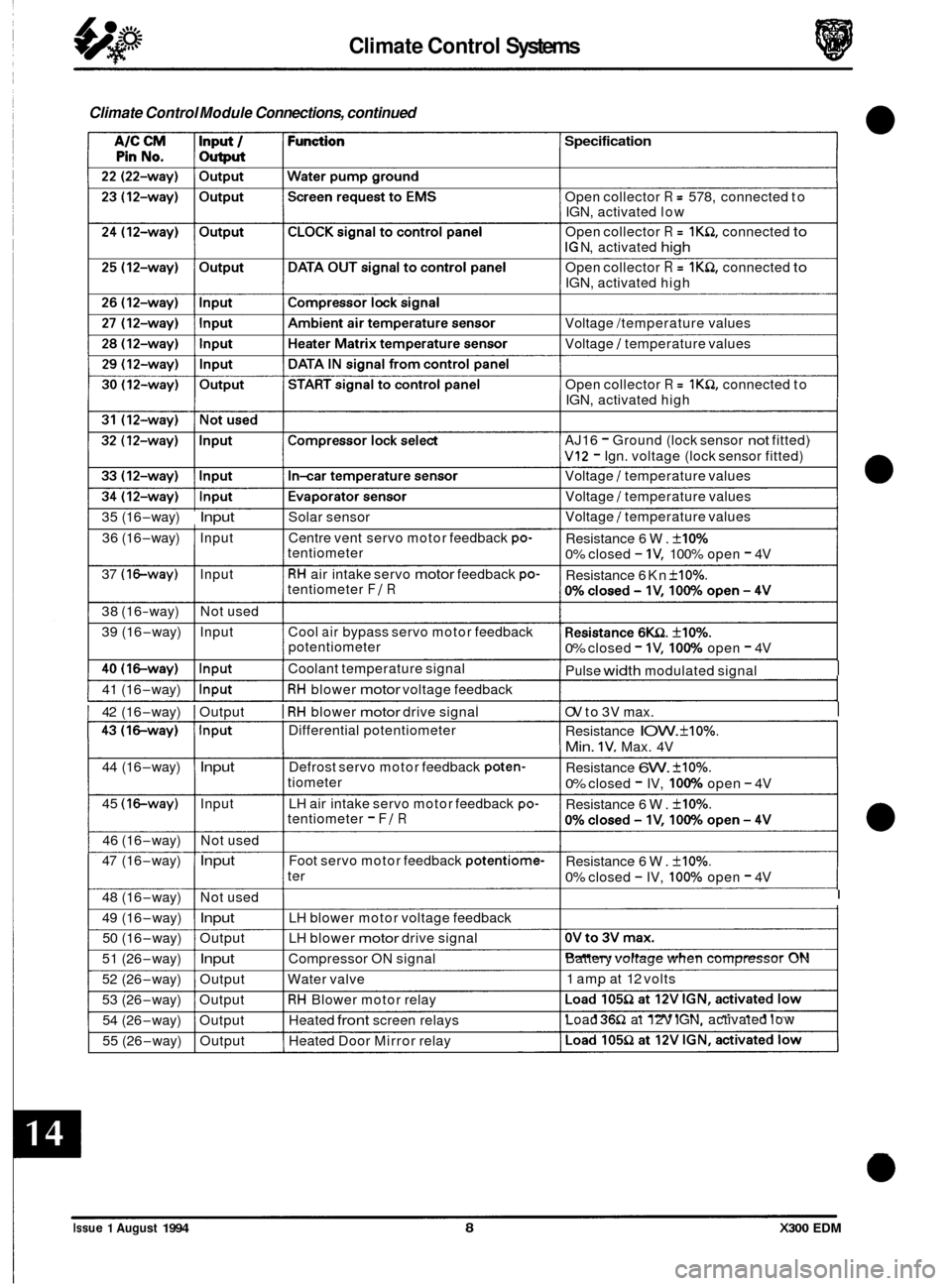
Climate Control Module Connections, continued
35 (16-way) Input Solar sensor
36 (16
-way) Input Centre vent servo motor feedback po- tentiometer
37
(16-way) Input RH air intake servo motor feedback po- tentiometer F / R
38 (16-way) Not used
39 (16
-way) Input Cool air bypass servo motor feedback
potentiometer
I 40(16-way) llnput I Coolant temperature signal
1 41 (16-way) llnput I RH blower motor voltage feedback
I 42 (16-way) I Output I RH blower motor drive signal
I 43(16-way) I Input
I Differential potentiometer
44 (16
-way) Input Defrost servo motor feedback poten-
tiometer
45
(%-way) Input LH air intake servo motor feedback po- tentiometer - F / R
46 (16-way) Not used
47 (16
-way) Input Foot servo motor feedback potentiome-
ter
48 (16
-way) Not used
49 (16
-way) Input LH blower motor voltage feedback
50 (16
-way) Output LH blower motor drive signal
51 (26
-way) Input Compressor ON signal
52 (26
-way) Output Water valve
53 (26
-way) Output RH Blower motor relay
54 (26
-way) Output Heated front screen relays
55 (26
-way) Output Heated Door Mirror relay
Specification
Open collector R = 578, connected to
IGN, activated low
Open collector
R = IKn, connected to
IG N, activated high
Open collector R = IKQ, connected to
IGN, activated high
Voltage /temperature values
Voltage
/ temperature values
Open collector
R = IKQ, connected to
IGN, activated high
AJ16
- Ground (lock sensor not fitted)
VI2 - Ign. voltage (lock sensor fitted)
Voltage
/ temperature values
Voltage
/ temperature values
Voltage
/ temperature values
Resistance 6W.
&IO%
0% closed - IV, 100% open - 4V
Resistance 6Kn
+IO%.
0% closed - IV, IOW0 open - 4V
Pulse
width modulated signal I
OV to 3V max. I
Resistance IOW. &IO%.
Min. IV, Max. 4V
Resistance
6W. +IO%.
0% closed - IV, IOW0 open - 4V
Resistance 6W.
+IO%.
Resistance 6W. &IO%.
0% closed - IV, 10096 open - 4V
I
Battery voltage when compressor ON
1 amp at 12 volts
Load
36Q at 12V IGN, activated low
0
0
0
0
Issue 1 August 1994 8 X300 EDM
Page 84 of 327
Climate Control Systems
0
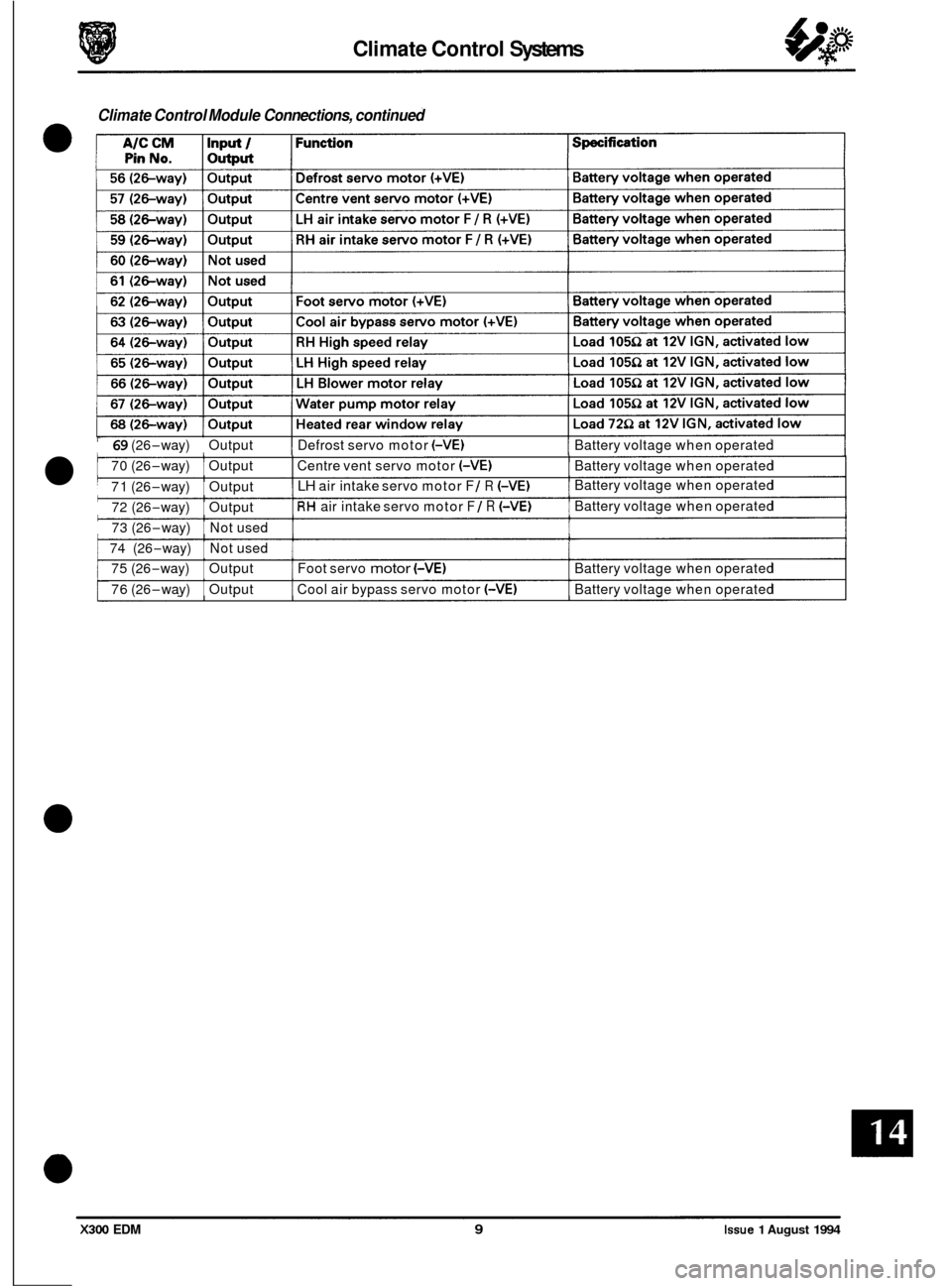
Climate Control Module Connections, continued
69 (26-way) Output Defrost servo motor t-VE) Battery voltage when operated
70 (26
-way) Output Centre vent servo motor (-VE) Battery voltage when operated
71 (26
-way) Output Battery
voltage when operated
72 (26
-way) Output Battery
voltage when operated
73 (26
-way) Not used
LH air intake servo motor F / R (-VE)
RH air intake servo motor F / R (-VE)
74 (26-way) Not used
75 (26
-way) Output Foot servo motor (-VE) Battery voltage when operated
76 (26
-way) Output Cool air bypass servo motor (-VE) Battery voltage when operated
0
0
X300 EDM 9 Issue 1 August 1994
Page 96 of 327
Climate Control Systems
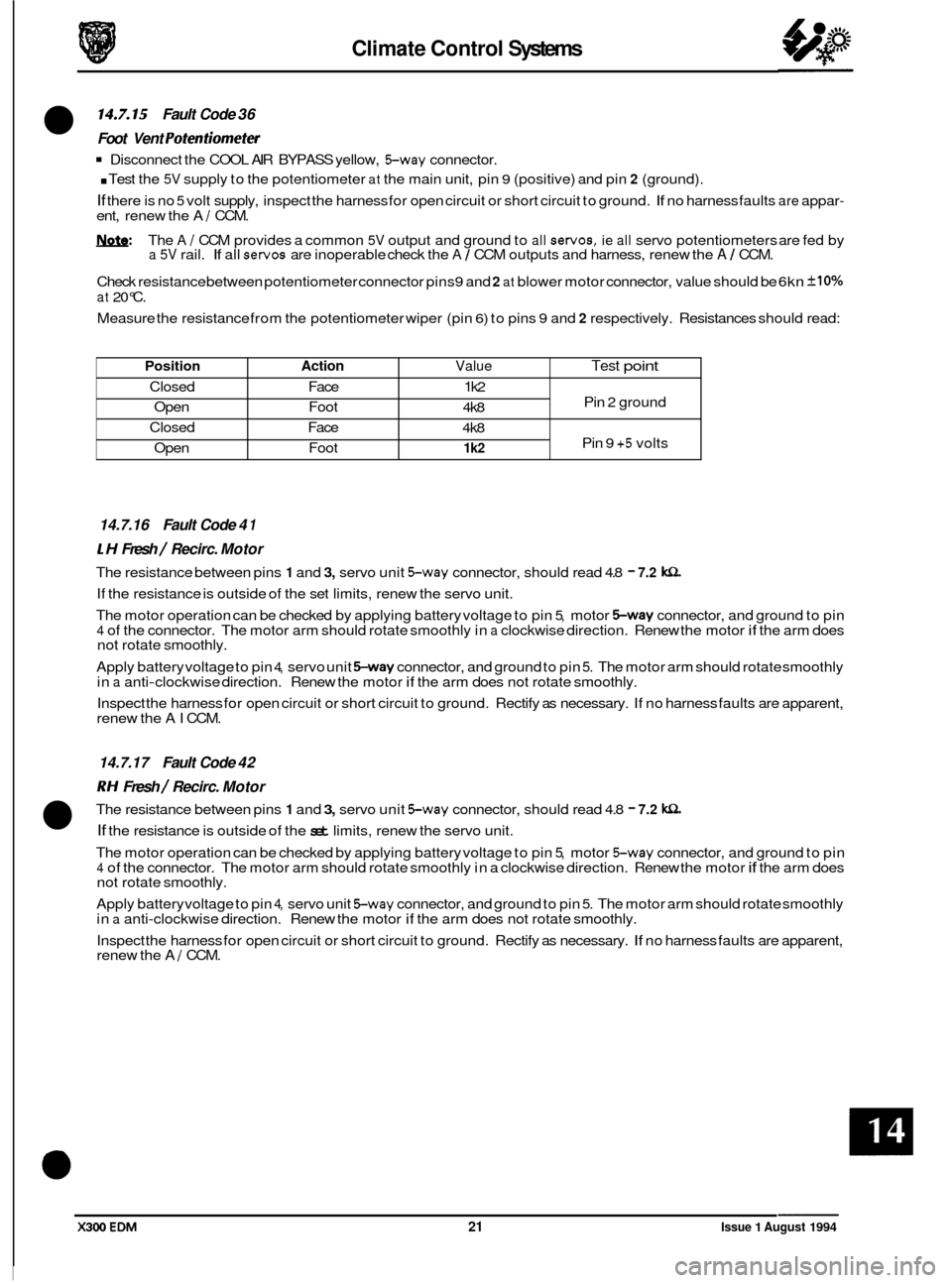
Position Action Value Test point
Closed Face 1 k2
Open Foot
4k8
Closed Face
4k8
Open Foot
1 k2
Pin 2 ground
Pin
9 +5 volts
14.7.15 Fault Code 36
Foot Vent
Potentiometer
Disconnect the COOL AIR BYPASS yellow, Sway connector.
. Test the 5V supply to the potentiometer at the main unit, pin 9 (positive) and pin 2 (ground).
If there is no 5 volt supply, inspect the harness for open circuit or short circuit to ground. If no harness faults are appar- ent, renew the A I CCM.
&&: The A I CCM provides a common 5V output and ground to all servos, ie all servo potentiometers are fed by a 5V rail. If all servos are inoperable check the A 1 CCM outputs and harness, renew the A 1 CCM.
Check resistance between potentiometer connector pins9 and
2 at blower motor connector, value should be 6kn +10%
at 20°C.
Measure the resistance from the potentiometer wiper (pin
6) to pins 9 and 2 respectively. Resistances should read:
14.7.16 Fault Code 4 1
1 H Fresh / Recirc. Motor
The resistance between pins 1 and 3, servo unit Sway connector, should read 4.8 - 7.2 kn.
If the resistance is outside of the set limits, renew the servo unit.
The motor operation can be checked by applying battery voltage to pin
5, motor %way connector, and ground to pin 4 of the connector. The motor arm should rotate smoothly in a clockwise direction. Renew the motor if the arm does
not rotate smoothly.
Apply battery voltage to pin
4, servo unit %ay connector, and ground to pin 5. The motor arm should rotate smoothly
in a anti-clockwise direction. Renew the motor if the arm does not rotate smoothly.
Inspect the harness for open circuit or short circuit to ground. Rectify as necessary.
If no harness faults are apparent,
renew the AI CCM.
14.7.17 Fault Code 42
RH Fresh / Recirc. Motor
The resistance between pins 1 and 3, servo unit Sway connector, should read 4.8 - 7.2 kn.
If the resistance is outside of the set limits, renew the servo unit.
The motor operation can be checked by applying battery voltage to pin
5, motor Sway connector, and ground to pin 4 of the connector. The motor arm should rotate smoothly in a clockwise direction. Renew the motor if the arm does
not rotate smoothly.
Apply battery voltage to pin
4, servo unit Sway connector, and ground to pin 5. The motor arm should rotate smoothly
in a anti-clockwise direction. Renew the motor if the arm does not rotate smoothly.
Inspect the harness for open circuit or short circuit to ground. Rectify as necessary.
If no harness faults are apparent,
renew the A I CCM.
21 Issue 1 August 1994
Page 97 of 327
Climate Control Systems
14.7.18 Fault Code 43
Cool Air Bypass Servomotor
The resistance between pins 1 and 3, motor Sway connector, should read 4.8 - 7.2 WZ.
If the resistance is outside of the set limits, renew the motor.
The motor operation can be checked by applying battery voltage to pin
5, motor Sway connector, and ground to pin
4 of the connector. The motor arm should rotate smoothly in a clockwise direction. Renew the motor if the arm does
not rotate smoothly.
Apply battery voltage to pin
4, motor Sway connector, and ground to pin 5. The motor arm should rotate smoothly
in a anti-clockwise direction. Renew the motor if the arm does not rotate smoothly.
Inspect the harness for open circuit or short circuit to ground. Rectify as necessary.
If no harness faults are apparent,
renew the AI CCM.
14.7.19 Fault Code 44
Servomotor
- Defrost
The resistance between pins 1 and 3, motor Sway connector, should read 4.8 - 7.2 kQ.
If the resistance is outside of the set limits, renew the motor.
The motor operation can be checked by applying battery voltage to pin
5, motor Sway connector, and ground to pin 4 of the connector. The motor arm should rotate smoothly in a clockwise direction. Renew the motor if the arm does
not rotate smoothly.
Apply battery voltage to pin
4, motor Sway connector, and ground to pin 5. The motor arm should rotate smoothly
in a anti-clockwise direction. Renew the motor if the arm does not rotate smoothly.
inspect the harness for open circuit or short circuit to ground. Rectify as necessary.
If no harness faults are apparent,
renew the A I CCM.
14.7.20 Fault Code 45
Servomotor
- Face
The resistance between pins 1 and 3, motor &way connector, should read 4.8 - 7.2 WZ.
If the resistance is outside of the set limits, renew the motor.
The motor operation can be checked by applying battery voltage to pin
5, motor Sway connector, and ground to pin 4 of the connector. The motor arm should rotate smoothly in a clockwise direction. Renew the motor if the arm does
not rotate smoothly.
Apply battery voltage to pin
4, motor 5-way connector, and ground to pin 5. The motor arm should rotate smoothly
in a anti-clockwise direction. Renew the motor if the arm does not rotate smoothly.
Inspect the harness for open circuit or short circuit to ground. Rectify as necessary.
If no harness faults are apparent,
renew the AI CCM.
14.7.21 Fault Code 46
Servomotor
- Foot
The resistance between pins 1 and 3, motor Sway connector, should read 4.8 - 7.2 WZ.
If the resistance is outside of the set limits, renew the motor.
The motor operation can be checked by applying battery voltage to pin
5, motor Sway connector, and ground to pin 4 of the connector. The motor arm should rotate smoothly in a clockwise direction. Renew the motor if the arm does
not rotate smoothly.
Apply battery voltage to pin
4, motor Sway connector, and ground to pin 5. The motor arm should rotate smoothly
in a anti-clockwise direction. Renew the motor if the arm does not rotate smoothly.
Inspect the harness for open circuit or short circuit to ground. Rectify as necessary.
If no harness faults are apparent,
renew the AI CCM.
0
0
0
Issue 1 August 1994 22 X300 EDM
Page 98 of 327
Climate Control Systems
14.7.22 BLOWER MOTORS
Disconnect the blower motors (LH & RH) multi-plugs and check motor operation by applying battery voltage (+12V) across pin 5 (+vel and pin 9 (-ve).
Non-functioning of both L H and RH motors *
Cause:
1. Loss of ignition voltage.
Remedy:
1.
2.
*
Examine fuse F12 in RH heelboard fuse-box. If fuse is blown determine reason for failure and renew.
Examine harness wiring from
RH heelboard fuse-box connection CA044/010 to splice CAS53. Repair or renew
wiring as necessary.
This fault will also affect the operation of seat control modules, power steering control module and door mirror
heaters.
Non-functioning of RH blower motor only
Cause:
1. Faulty relay operation.
2. Faulty harness wiring.
Remedy:
1. Ensure 12Vsupply between relay pin 1 and ground.
Ensure continuity between pins 3 and
5 when relay operated.
Ensure relay coil impedance of
7552 to 135Q across pins 1 and 2.
Ensure correct seating of relay on base. Examine pins for damage or deformity.
Check continuity of wiring from fuse F12
(RH heelboard fuse-box) to relay pin 1 and from relay pin 2 to A / CCM
pin 53 (26-way connector).
Check continuity of wiring from fuse
F11 (RH heelboard fuse-box) to relay pin 3, from relay pin 5 to motor pin 5, from motor pin 13 to A / CCM pin 41 (16-way connector), from motor pin 8 to ground and from motor pin 10 to A / CCM pin 42 (16-way connector).
2.
Non-functioning of L H blower motor only
Cause:
1. Faulty relay operation.
2. Faulty harness wiring.
Remedy:
1. Ensure 12V supply between relay pin 1 and ground.
Ensure continuity between pins 3 and
5 when relay operated.
Ensure relay coil impedance
of 7552 to 135Q across pins 1 and 2.
Ensure correct seating of relay on base. Examine pins for damage or deformity.
2. Check continuity of wiring from fuse F12 (RH heelboard fuse-box) to relay pin 1 and from relay pin 2 to A / CCM
pin 66 (26-way connector).
Check continuity of wiring from fuse
F11 (LH heelboard fuse box) to relay pin 3, from relay pin 5 to motor pin 5, from motor pin 13 to A / CCM pin 49 (16-way connector), from motor pin 8 to ground and from motor pin 10 to
A / CCM pin 50 (16-way connector).
X300 EDM 23 Issue 1 August 1994
Page 100 of 327
Climate Control Systems
High speed operation at all times - RH blower
a Cause:
1. Faulty high speed relay.
2. Faulty harness wiring.
Remedy:
1. Check the relay contact is not stuck 'ON'.
2. Check continuity of wiring harness between blower motor pin 8 and ground, pin 10 and A / CCM pin 42 (16-way connector) and pin 13 and A/ CCM pin 41 (16-way connector).
High speed operation at all times - LH blower
Cause:
1. Faulty high speed relay.
2. Faulty harness wiring.
Remedy:
1. Check the relay contact is not stuck 'ON'.
2. Check continuity of wiring harness between blower motor pin 8 and ground, pin 10 and A / CCM pin 50
(16-way connector) and pin 13 and A / CCM pin 49 (16-way connector).
14.7.23 Water Valve
For mechanical diagnosis of the water valve, refer to section 14 of the Vehicle Service Manual.
The solenoid coil fitted to the water valve housing has
a resistance of 17.4Q f 1P at 5 - 35 "C.
Check the continuity between pin 2 water valve white 2-way multi-plug and the A/ CCM (pin 52,26-way connector).
Check for ground
at pin 1 water valve white 2-way multi-plug.
14.7.24 Wafer Pump
Disconnect the black 2-way connector.
The motor operation can be checked by applying battery voltage to pin 1, motor 2
-way connector, and ground to pin 2.
Inspect the harness for open circuit or short circuit to ground. Rectify as necessary. If no harness faults are apparent,
renew the
A / CCM.
CAUTION: If removed the water pump should not be operated dry, and for a maximum of five minutes when wet. Failing to observe this may result in pump rotor and shaft damage.
The application of reverse polarity voltage at pins 1 and 2 will result in damage to the pumps internal cir-
cuitry.
X300 EDM 25 Issue 1 August 1994
Page 102 of 327
Electrical IT
SECTION CONTENTS
Sub
-Section 15.2 lnsfrumenfs
Subsection Title SRO Page
15.2 ............. Instruments .................................................................... 15.2-1
15.2.1
............ Introduction .................................................................... 15.2-1
15.2.2
............ Instrument Pack Connectors - Pin Locations ......................................... 15.2-3
15.2.3
............ Component Description .......................................................... 15.24
15.2.3.1 .......... Speedometer ................................................................... 15.24
15.2.3.2 .......... Tachometer .................................................................... 15.24
15.2.3.3
.......... Engine Oil Pressure and Warning Lamp ............................................. 15.24
15.2.3.4 .......... Engine Coolant Temperature ...................................................... 15.24
15.2.3.5 .......... Fuel Tank Level Gauge and Warning Lamp .......................................... 15.24
15.2.3.6
.......... Battery Voltage Gauge and Warning Lamp .......................................... 15.24
15.2.3.7
.......... Liquid Crystal Display ........................................................... 15.24
15.2.3.8 .......... Trip Computer .................................................................. 15.2-5
15.2.4
............ Primary Warning Lamps (Illuminated Red) .......................................... 15.2-5
15.2.4.1
.......... Exhaust Temperature ............................................................ 15.2-5
15.2.4.2
.......... Low Oil Pressure ................................................................ 15.2-5
15.2.4.3
.......... Seat Belt ....................................................................... \
15.2-5
15.2.4.4
.......... Trunk Lid Open ................................................................. 15.2-5
15.2.4.5
.......... DoorAjar ...................................................................... 15.2-5
15.2.4.6
.......... Engine Coolant LeveL ............................................................ 15.24
15.2.4.7
.......... SRS Airbag Fault ................................................................ 15.24
15.2.4.8 .......... Charging Fault .................................................................. 15.24
15.2.4.9 .......... Brake System Fault .............................................................. 15.24
15.2.4.10 ......... Bark Brake ..................................................................... 15.24
15.2.5. ........... Secondary Warning Lamps (Illuminated Amber) ...................................... 15.2-7
15.2.5.1
.......... Transmission Fault ............................................................... 15.2-7
15.2.5.2
.......... Washer Fluid Level .............................................................. 15.2-7
15.2.5.3
.......... Bulb Fail ....................................................................... \
15.2-7
15.2.5.4
.......... Traction Control Fail ............................................................. 15.2-7
15.2.5.5
.......... Anti-lock Fail .................................................................. 15.2-7
15.2.5.6
.......... Low Fuel Level ................................................................. 15.2-7
15.2.5.7
.......... Check Engine ................................................................... 15.2-7
15.2.6.1
.......... Transmission Sport Mode ......................................................... 15.2-8
15.2.6.2
.......... Traction Control OFF ............................................................ 15.2-8
15.2.6.3
.......... Direction Indicators ............................................................. 15.2-8
15.2.6.4
.......... Main Beam .................................................................... 15.2-8
15.2.6
............ Status
and Warning Lamps ........................................................ 15.2-8
m
a
0
e
0
X300 EDM ii Issue 1 August 1994
Page 103 of 327
Electrical IT
SECTION CON TENTS
Subsection 15.2 Instruments (continued)
Sub-Section Title SRO Page
15.2.7 ............ Fault Diagnosis ................................................................. 15.2-9
15.2.7.1
.......... Active High /Low Inputs ......................................................... 15.2-9
15.2.8.
........... Instrument Pack Pin-point Tests .................................................. 15.2-1 0
15.2.8.1 .......... Oil Pressure, Battery Condition, Coolant Temperature and Fuel Gauges ................. 15.2-1 0
75.2.8.2
.......... Speedometer .................................................................. 15.2-10
15.2.8.4
.......... Liquid Crystal Display .......................................................... 15.2-17
15.2.8.6
.......... Door Open Warning Lamp ...................................................... 15.2-12
15.2.8.7
.......... Exhaust Temperature Warning Lamp .............................................. 15.2-1 3
15.2.8.8 .......... Luggage Compartment Warning Lamp ............................................. 15.2-14
15.2.8.9
.......... Seat Belt Warning Indicator ...................................................... 15.2-1 5
15.2.8.3
.......... Tachometer ................................................................... 15.2-11
15.2.8.5
.......... Trip Computer ................................................................. 15.2-11
15.2.8.70
......... Park Brake Indicator ............................................................ 15.2-16
15.2.8.71
......... Main Beam Indicator ........................................................... 15.2-17
75.2.8.12
......... Direction Indicator Tell Tales ..................................................... 15.2-18
15.2.8.14
......... Washer Fluid Level Indicator ..................................................... 15.2-20
15.2.8.16
......... Brake Fluid Level Indicator ...................................................... 15.2-22
75.2.8.17
......... General Bulb Failure Indicator ................................................... 15.2-23
15.2.8.18
.........
75.2.8.19 .........
15.2.8.20 ......... Traction Control OFF Tell-tale .................................................... 15.2-24
0
75.2.8.13 ......... Generator IND Voltage Indicator ................................................. 15.2-19
7 5.2.8.15 ......... Engine Coolant Level indicator ................................................... 15.2-2 1
Transmission Sport mode Indicator ................................................ 75.2-24
Traction Control Failure Warning Lamp
............................................ 15.2-24
15.2.8.21
......... Anti-lock Failure Warning Lamp .................................................. 15.2-24
15.2.8.22
......... Check Engine Warning Lamp .................................................... 75.2-24
Issue 1 August 1994 iii X300 EDM
Page 107 of 327
E I ect r ica I
15.1 SUPPLEMENTAL RESTRAINT SYSTEM
15.1.1 System Description
The Supplemental Restraint System (SRS) installation comprises:
0 electronic Diagnostic Module (DM)
0 driver and passenger-side air bag modules (including firing mechanisms)
0 two front impact sensors (left and right)
0 one safing sensor
0 dedicated wiring harness
0 two cable reel cassettes (integral part of the steering column harness)
0 Malfunction Indicator Lamp (MIL) and driver information message
The system is designed to provide protection for both driver and front seat passenger by automatically deploying air
bags in the event of a collision during forward travel. The driver
-side air bag is located in the centre of the steering
wheel assembly and the passenger-side air bag in the fascia panel.
In the event of a collision the impact
/ safing sensors operate, completing the electrical firing circuit and causing the
air bags to inflate within 32 milliseconds. At least two of the three sensors (at least one impact, and the safing sensor)
.must be activated to initiate firing. System operation is dependent upon battery voltage supplied directly, and via the
ignition switch, to the DM and the correct installation and operation of all system components, including the wiring
harness. Faults in system components, installation or wiring will be indicated by the MIL Lamp, located on the instru
- ment panel, which will illuminate 'SRS AIR BAG'. Indication is also given by the driver information message'AIR BAG'
displayed on the LCD panel below the speedometer.
15.1.2.1 Diagnostic Module (Fig. I)
The Diagnostic Module (DM), mounted below the passenger-side air bag module, behind the console fascia panel, is
the electronic microprocessor unit which monitors the whole SRS system. The state of the three system sensors, two
air bag modules and the wiring harness is monitored constantly to detect activation criteria and component faults.
15.1.2 COMPONENT DESCRIPTIONS
The unit also confirms correct supply conditions by compar- ing a direct battery voltage input with an input, via the igni- tion switch, of the same voltage value. Detection of system
faults will be relayed by the DM to the instrument panel and
the air bag MIL Lamp illuminated.
The DM contains a reserve power supply unit, enabling the
air bagsto fire even if supply voltage is lost during an impact
situation. The reserve power charge will be retained for ap
- proximately one minute after the positive supply voltage is
disconnected. An auxiliary internal circuit, known as the
'dwell enhancer', provides a temporary ground to compen
- sate for damaged primary crash sensors. If either primary
crash sensor operates for 5 milliseconds the 'dwell en- hancer' circuit will turn on, completing the firing circuit to
ground for 90 milliseconds. The purpose of this is to allow
air bag deployment even if the operated primary crash sen- sor circuit is defective or opens.
15.1.2.2 Wiring Harness
Fig. 1
A dedicated wiring harness, covered with yellow sheathing, independent of any other vehicle system, is used to electri- cally connect all the component items. To allow movement of the steering mechanism, two cable reel cassettes are
incorporated into the driver-side air bag module circuitry, as a means of compensating for steering wheel rotation is
required to prevent harness damage or disconnection. The two cable reel cassettes form an interface between the
steering column and air bag module and, due to their coiled construction, are able to contract or expand as required.
15.1.2.3 Air Bag Modules
The two air bag modules, driver and passenger side, are
each activated when either front impact sensor (Fig. 2) and
the safing sensor operate simultaneously. Both modules
contain a charge of sodium
azide/copper oxide which, when
ignited by an electrical impulse, generate a volume of ni
- trogen gassufficientto inflatetheair bag. Theamountof gas
generated is greater in the passenger-side air bag due to its
larger size. Both modules, including surrounding trim pan- els, are non-serviceable and once activated must be re-
newed as a complete assembly.
Fig. 2
X300 EDM 15.1 - 1 Issue 1 August 1994