battery JAGUAR XJ6 1994 2.G Electrical Diagnostic Manual
[x] Cancel search | Manufacturer: JAGUAR, Model Year: 1994, Model line: XJ6, Model: JAGUAR XJ6 1994 2.GPages: 327, PDF Size: 13.73 MB
Page 109 of 327
Electrical rl
15.1.3 AIR BAG DISARMING/ ARMING PROCEDURE
warnings and cautions
WARNING: DISARM SRS BEFORE SERVICING ANY SRS OR STEERING COLUMN COMPONENT.
ALLOW A MINIMUM OF ONE MINUTE TIME DELAY FOR THE BACK
-UP POWER SUPPLY TO DISCHARGE,
AFTER THE BATTERY GROUND LEAD HAS BEEN DISCONNECTED.
THE SYSTEM COMPONENTS ARE NON
-SERVICEABLE, IF FAULTS ARE SUSPECTED, CHANGE COMPO- NENTS FOR NEW ITEMS ONLY.
NEVER PROBE THE CONNECTORS OF AN AIR BAG MODULE.
FAILURE TO OBSERVE THE ABOVE PROCEDURES MAY RESULT
IN ACCIDENTAL DEPLOYMENT OF AIR
BAG.
ALWAYS WEAR SAFETY GLASSES WHEN WORKING ON AIR BAG EQUIPPED VEHICLES.
PERSONNEL CARRYING AN AIR BAG MODULE MUST ENSURE THAT THE MODULE AND TRIM COVER
ARE POINTED AWAY FROM THE BODY. WHEN POSITIONED ON A BENCH
OR WORK SURFACE ENSURE
THAT THE AIR BAG MODULE AND TRIM COVER FACE UPWARDS, LIMITING MOTION ON ACCIDENTAL
DEPLOYMENT.
ALWAYS WEAR GLOVES WHEN HANDLING DEPLOYED AIR BAG MODULE, DEPOSITS OF SODIUM HY
- DROXIDE MAY BE PRESENT ON THE MODULE SURFACE. IF SODIUM HYDROXIDE CONTACTS ANY
AREA OF SKIN, WASH THE AFFECTED AREA IMMEDIATELY WITH MILD SOAP AND WATER. DISPOSE OF
THE DEPLOYED AIR BAG USING THE CORRECT PROCEDURES, REFER TO SECTION
15 OF THE VSM.
CAUTION:
When scrapping vehicles ensure air bags have been deployed.
If
a component has been renewed and the fault does not clear, refit original item and repeat diagnostic
procedure.
After servicing repeat diagnostic procedures to ensure correct system operation.
Renew air bag module if surrounding trim panels are damaged.
Do not attempt to repaint trim covers as paint may damage cover material.
Disarming
. Allow a minimum 1 minute time delay before attempting to diagnose or renew any component in the SRS system.
Remove driver-side air bag module and connect air bag simulator to cable reel cassette multi-plug.
. Remove passenger-side air bag module and connect air bag simulator to harness.
. Re-connect battery ground lead.
Disconnect
the battery ground lead.
This delay allows the DM back
-up power supply to discharge, preventing accidental firing of the air bag.
0
Arming
Disconnect the battery ground lead.
. Remove air bag simulators and install driver and passenger-side air bag modules. Ensure fasteners are tightened
. Re-connect battery ground lead.
Switch ignition 'on' and ensure air bag MIL Lamp extinguishes.
to specified torque.
X300 EDM 15.1 -3 Issue 1 August 1994
Page 111 of 327
Electrical IT
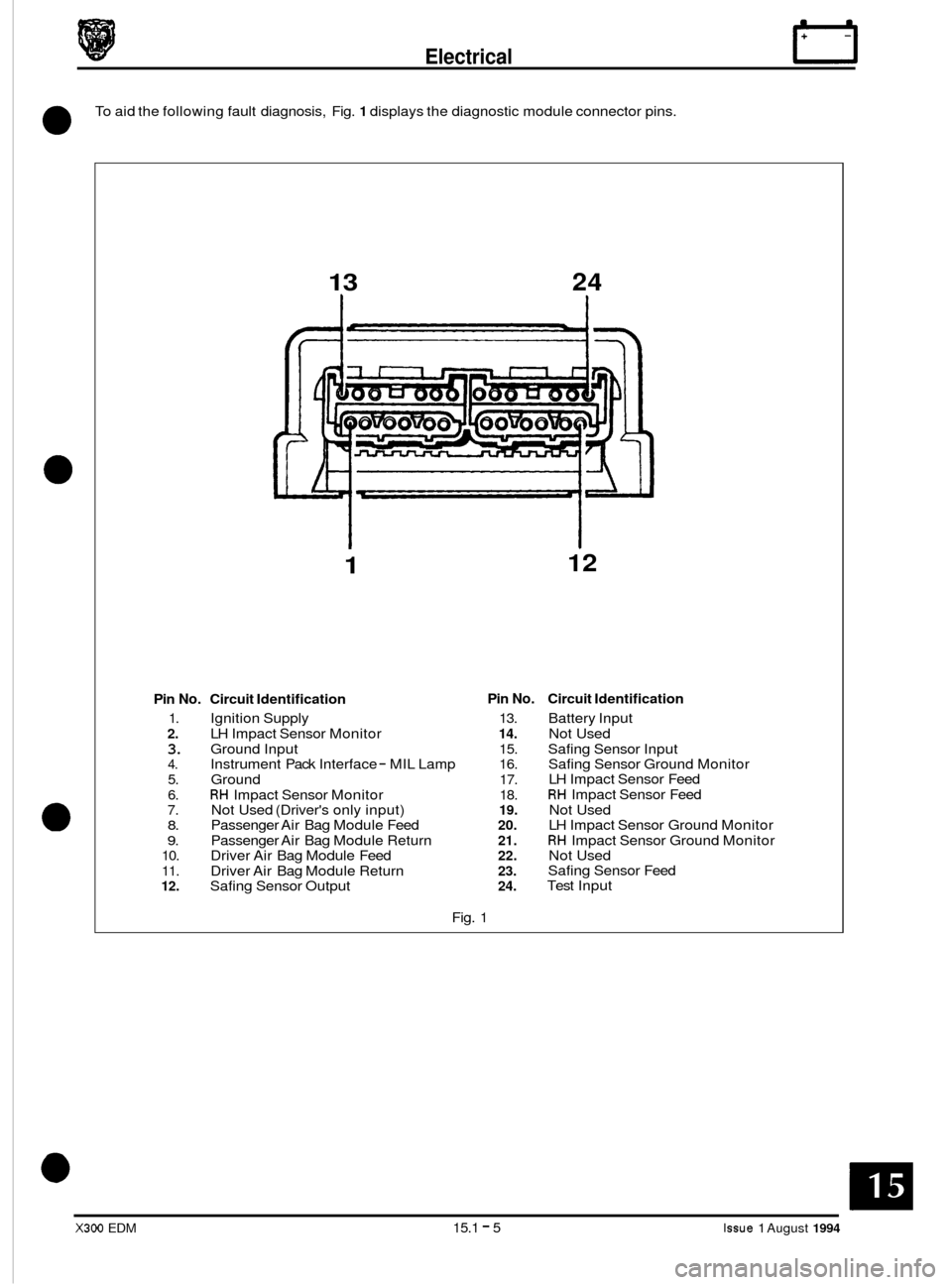
To aid the following fault diagnosis, Fig. 1 displays the diagnostic module connector pins.
0
13 24
1
Pin No. Circuit Identification
1. Ignition Supply
2. LH Impact Sensor Monitor
3. Ground Input 4.
5. Ground
6. RH Impact Sensor Monitor 7. 8.
9. 10.
11.
12. Safing Sensor Output
Instrument
Pack Interface
- MIL Lamp
Not Used (Driver's only input)
Passenger Air Bag Module Feed
Passenger Air Bag Module Return
Driver Air Bag Module Feed
Driver Air Bag Module Return
Fig.
1
Pin No.
13.
14.
15.
16. 17.
18.
19.
20.
21.
22.
23.
24.
12
Circuit Identification
Battery Input
Not Used
Safing Sensor Input
Safing Sensor Ground Monitor
LH Impact Sensor Feed
RH Impact Sensor Feed
Not Used
LH Impact Sensor Ground Monitor
RH Impact Sensor Ground Monitor
Not Used
Safing Sensor Feed
Test Input
X300 EDM 15.1 - 5 Issue 1 August 1994
Page 112 of 327
Electrical
0
NO AIR BAG MIl LAMP
Inoperative lamp Circuit or No Ignition to the Diagnostic Module
Normal Operation
The air bag MIL Lamp is designed to illuminate for approximately six seconds when the ignition is switched ‘on’; this
time has been allocated to prove the MIL Lamp operation.
The DM requires an ignition supply to Pin
1, to energize the air bag MIL Lamp circuit. If the MIL Lamp is open circuit
or the DM does not receive ignition voltage at Pin 1, the MII Lamp will not illuminate.
Open circuit in the
MII Lamp supply will cause the DM to emit five tones, or ‘beeps’ every 30 minutes while ignition
is on. Repair faulty circuitry before further diagnostics.
Possible Causes
0 Bulb blown or faulty wiring in the air bag MIL Lamp circuit.
0 Loss of ignition voltage at DM pin 1.
Fault Diagnosis
1. Ignition voltage -check
8 Disarm the SRS system.
8 Switch on the ignition.
8 Measure the voltage between pin 1 (+vel and pin 3 (-vel of the connector.
8 Battery voltage present, proceed with step 2.
8 Battery voltage not present; open circuit on R / W wire from RH fuse-box or faulty ground at pin 3.
8 Check fuse 17, RH fuse-box.
8 Check the fuse connectors and wiring.
8 Check the ground at pin 3 of the DM connector.
8 Arm and verify the SRS system.
2. MIL Lamp open circuit
8 Renew the DM.
8 Arm and verify the SRS system.
If the MIL Lamp is not illuminated, check the bulb, instrument pack and associated wiring.
Issue 1 August 1994 15.1 - 6 X300 EDM
Page 116 of 327
n E I ectr ica I
FAULT CODE 12
Low Battery Voltage
Normal Operation
The DM monitors voltage at pin 13 which should be equal to battery voltage. If a voltage lower than 9V is detected at pin 13 the MIL Lamp will illuminate and fault code 12 will be present.
Possible Causes
Drop in battery voltage to DM pin 13 caused by:
0 Open circuit to pin 13 from battery.
0 Short circuit to ground on battery feed circuit.
0 Safing sensor feed shorted to ground.
0 Safing sensor internal short to ground.
0 Faulty charging system draining battery voltage.
Fault Oiagnosis
1. Battery voltage test
Disarm the SRS system.
8 Disconnect the DM.
8 Switch on the ignition.
Measure the voltage between DM connector pin 13 (+ve) and pin 3(-ve).
If battery voltage is present at pin 13, renew the DM.
8 Arm and verify the SRS system.
8 If battery voltage is not present, go to step 2.
2.
Fusecheck
8 Check fuse 17 in the RH fuse-box.
If the fuse has blown, check for short circuit to ground between fuse and pin 13 DM connector.
8 Renew the fuse, go to step 3.
8 If the fuse has not blown, check for open circuit between battery positive terminal and pin 13 DM connector.
3. Short circuit check
* Switch off the ignition.
8 Connect the DM.
8 Has the fuse blown 1
Yes -
= Short circuit to ground from pin 15 DM (R/ W) to pin 3 safing sensor, or from pin 23 DM (Y / P) to pin 6 safing sensor.
8 Intermittent short circuit to ground; check wire (R / W) from pin 15 DM to pin 3 safing sensor, and, wire (Y/ P) from
NO -
pin 23 DM to pin 6 safing sensor.
4. On completion
8 Renew the fuse as necessary.
8 Arm and verify the SRS system.
Issue 1 August 1994 15.1 - 10 X300 EDM
Page 122 of 327
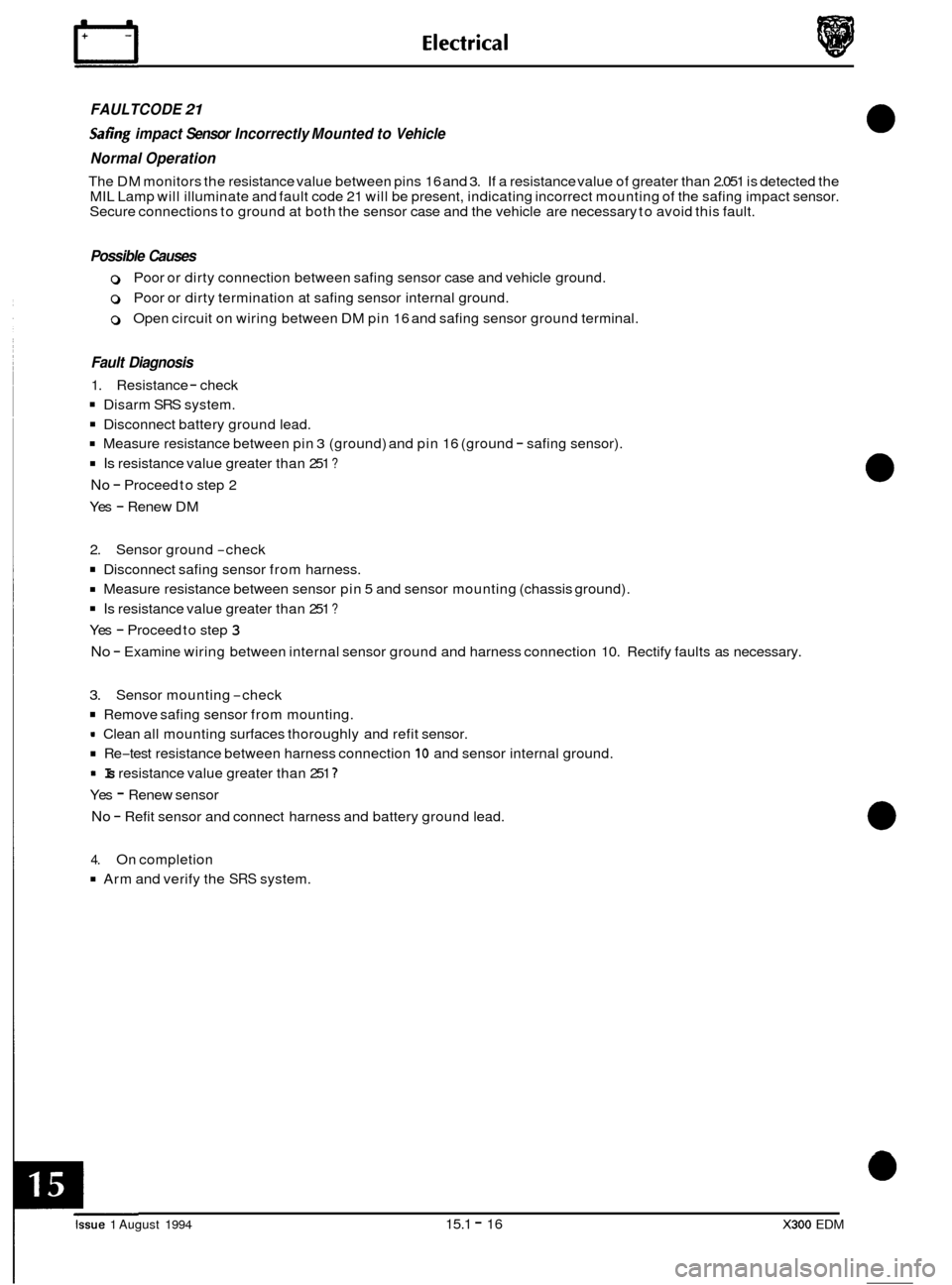
FAULTCODE 21
Safing impact Sensor Incorrectly Mounted to Vehicle
Normal Operation
The DM monitors the resistance value between pins 16 and 3. If a resistance value of greater than 2.051 is detected the
MIL Lamp will illuminate and fault code 21 will be present, indicating incorrect mounting of the safing impact sensor.
Secure connections to ground at both the sensor case and the vehicle are necessary to avoid this fault.
Possible Causes
0 Poor or dirty connection between safing sensor case and vehicle ground.
0 Poor or dirty termination at safing sensor internal ground.
0 Open circuit on wiring between DM pin 16 and safing sensor ground terminal.
Fault Diagnosis
1. Resistance - check
Disarm SRS system.
Disconnect battery ground lead.
Measure resistance between pin 3 (ground) and pin 16 (ground - safing sensor).
Is resistance value greater than 251 ?
No - Proceed to step 2
Yes
- Renew DM
2. Sensor ground
-check
Disconnect safing sensor from harness.
Measure resistance between sensor pin 5 and sensor mounting (chassis ground).
Is resistance value greater than 251 ?
Yes - Proceed to step 3
No - Examine wiring between internal sensor ground and harness connection 10. Rectify faults as necessary.
3. Sensor mounting -check
Remove safing sensor from mounting.
* Clean all mounting surfaces thoroughly and refit sensor.
Re-test resistance between harness connection 10 and sensor internal ground.
* Is resistance value greater than 251 ?
Yes - Renew sensor
No - Refit sensor and connect harness and battery ground lead.
4. On completion
Arm and verify the SRS system.
0
0
0
Issue 1 August 1994 15.1 - 16 X300 EDM
Page 124 of 327
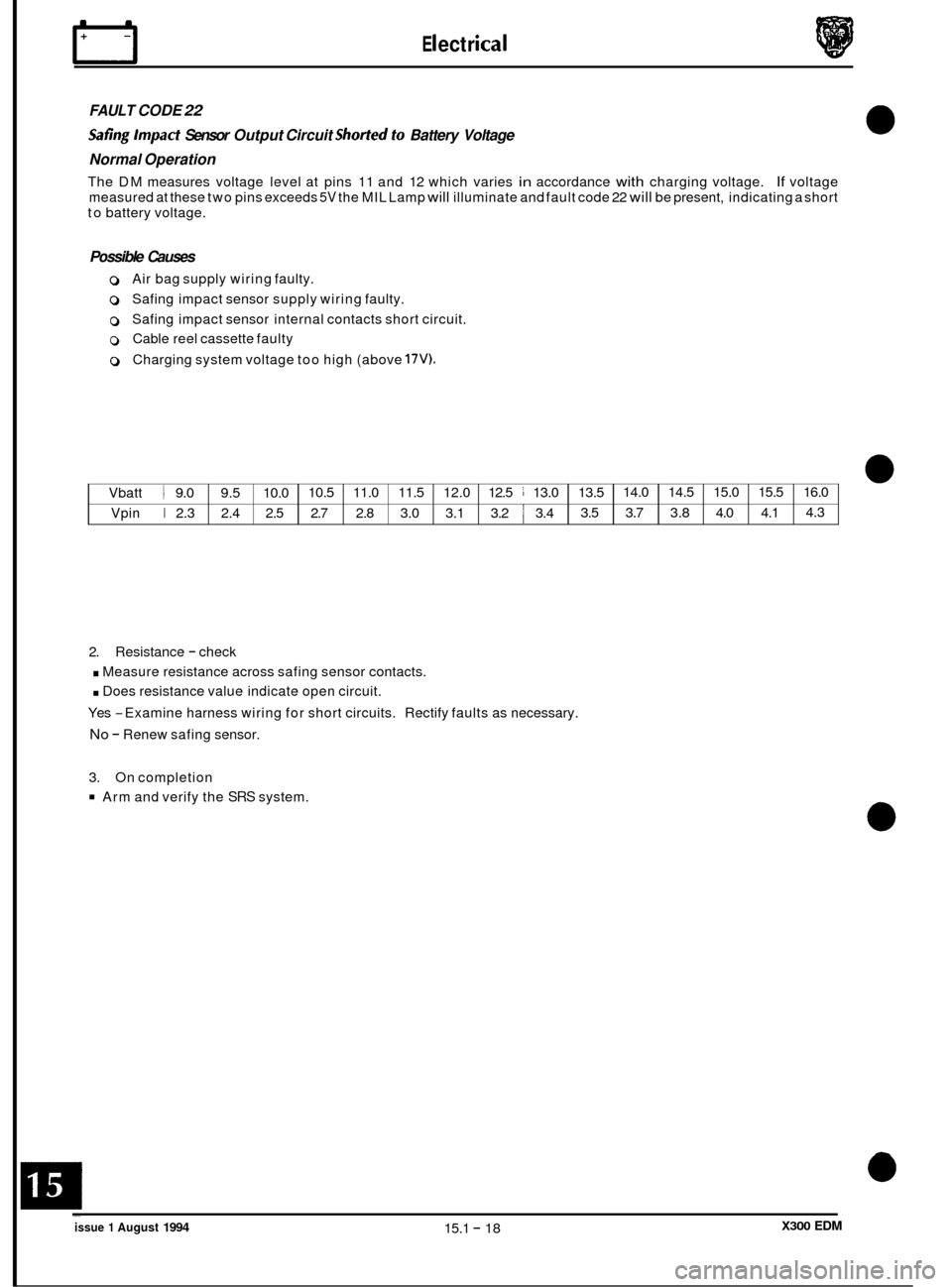
rl E I ect r ica I
Vbatt 1 9.0 9.5
10.0 10.5
11.0 11.5 12.0 12.5 ~ 13.0
13.5
Vpin
I 2.3 2.4 2.5 2.7 2.8 3.0 3.1
3.2 1 3.4 3.5
FAULT CODE 22
Safing Impact Sensor
Output Circuit Shorted to Battery Voltage
Normal Operation
The DM measures voltage level at pins 11 and 12 which varies in accordance with charging voltage. If voltage
measured at these two pins exceeds
5V the MIL Lamp will illuminate and fault code 22 will be present, indicating a short
to battery voltage.
14.0 14.5 15.0 15.5 16.0
3.7 3.8 4.0
4.1 4.3
Possible Causes
0 Air bag supply
wiring faulty.
0 Safing impact sensor supply wiring faulty.
0 Safing impact sensor internal contacts short circuit.
0 Cable reel cassette faulty
0 Charging system voltage too high (above 17V).
2. Resistance - check
. Measure resistance across safing sensor contacts.
. Does resistance value indicate open circuit.
Yes
-Examine harness wiring for short circuits. Rectify faults as necessary.
No - Renew safing sensor.
3. On completion
Arm and verify the SRS system.
0
0
0
0 ~
issue 1 August 1994 15.1 - 18 X300 EDM
Page 128 of 327
Electrical
0
FAULT CODE 24
Safing Impact Sensor Output Feed / Return Open Circuit
Normal Operation
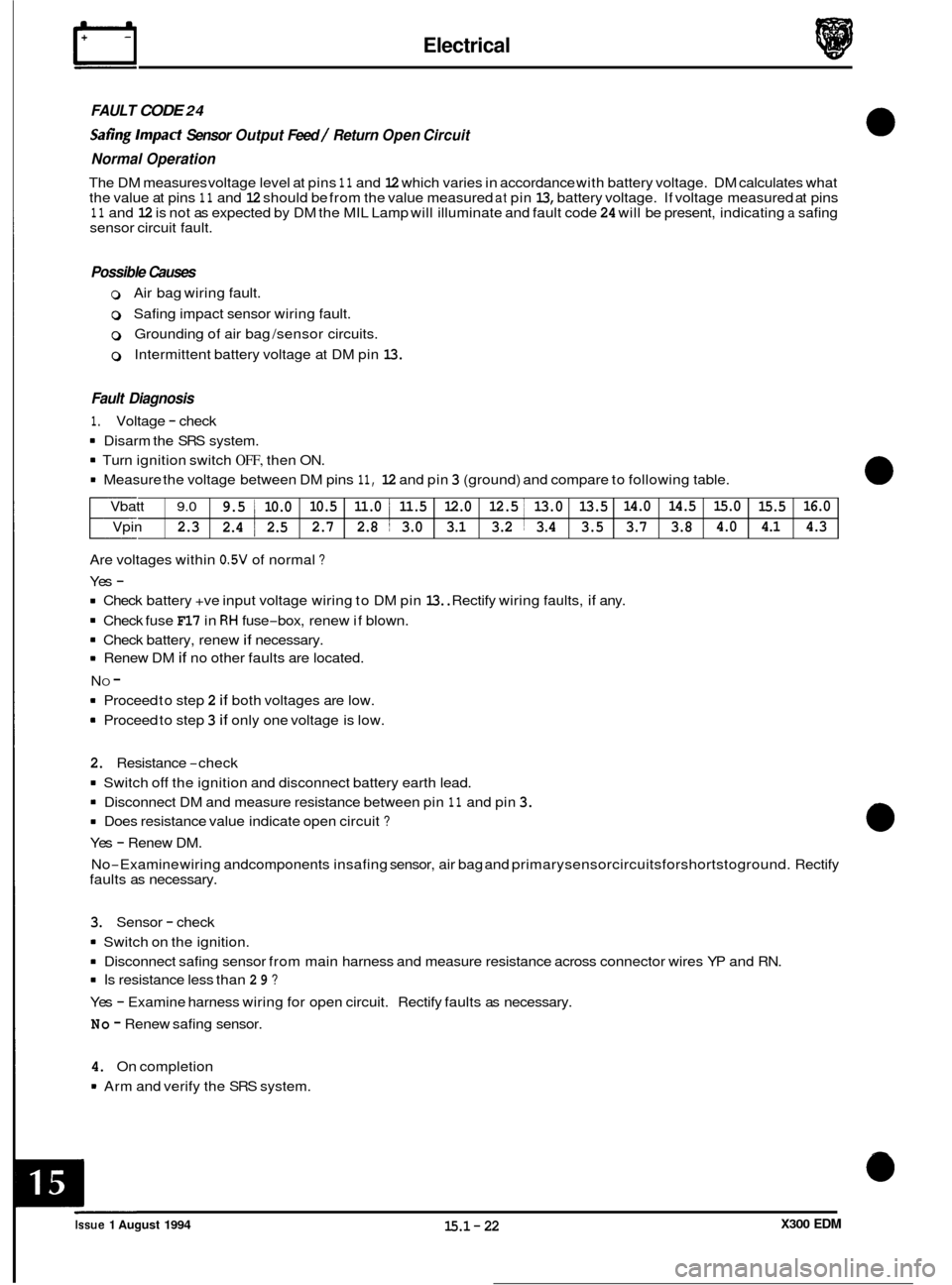
The DM measures voltage level at pins 11 and 12 which varies in accordance with battery voltage. DM calculates what
the value at pins 11 and 12 should be from the value measured at pin 13, battery voltage. If voltage measured at pins 11 and 12 is not as expected by DM the MIL Lamp will illuminate and fault code 24 will be present, indicating a safing
sensor circuit fault.
Vbatt
9.0 9.5 1 10.0 10.5
11.0 i 11.5 12.0 12.5 I 13.0 13.5 14.0
14.5 15.0
15.5
Vpin 2.3 2.4 ~ 2.5
2.7
2.8 ~ 3.0
3.1 3.2 1 3.4 3.5 3.7 3.8 4.0
4.1
Possible Causes
0 Air bag wiring fault.
0 Safing impact sensor wiring fault.
0 Grounding of air bag /sensor circuits.
0 Intermittent battery voltage at DM pin 13.
16.0 4.3
Fault Diagnosis
1. Voltage - check
8 Disarm the SRS system.
8 Turn ignition switch OFF, then ON.
8 Measure the voltage between DM pins 11, 12 and pin 3 (ground) and compare to following table.
Are voltages within
0.5V of normal ?
Yes -
8 Check battery +ve input voltage wiring to DM pin 13.. Rectify wiring faults, if any.
8 Check fuse F17 in RH fuse-box, renew if blown.
8 Check battery, renew if necessary.
8 Renew DM if no other faults are located.
8 Proceed to step 2 if both voltages are low.
8 Proceed to step 3 if only one voltage is low.
N
O -
2. Resistance -check
8 Switch off the ignition
and disconnect battery earth lead.
8 Disconnect DM and measure resistance between pin 11 and pin 3.
8 Does resistance value indicate open circuit ?
Yes - Renew DM.
No
-Examine wiring andcomponents insafing sensor, air bag and primarysensorcircuitsforshortstoground. Rectify
faults as necessary.
3. Sensor - check
8 Switch on the ignition.
8 Disconnect safing sensor from main harness and measure resistance across connector wires YP and RN.
8 Is resistance less than 29 ?
Yes - Examine harness wiring for open circuit. Rectify faults as necessary.
No - Renew safing sensor.
4. On completion
8 Arm and verify the SRS system.
X300 EDM Issue 1 August 1994 15.1 - 22
Page 142 of 327
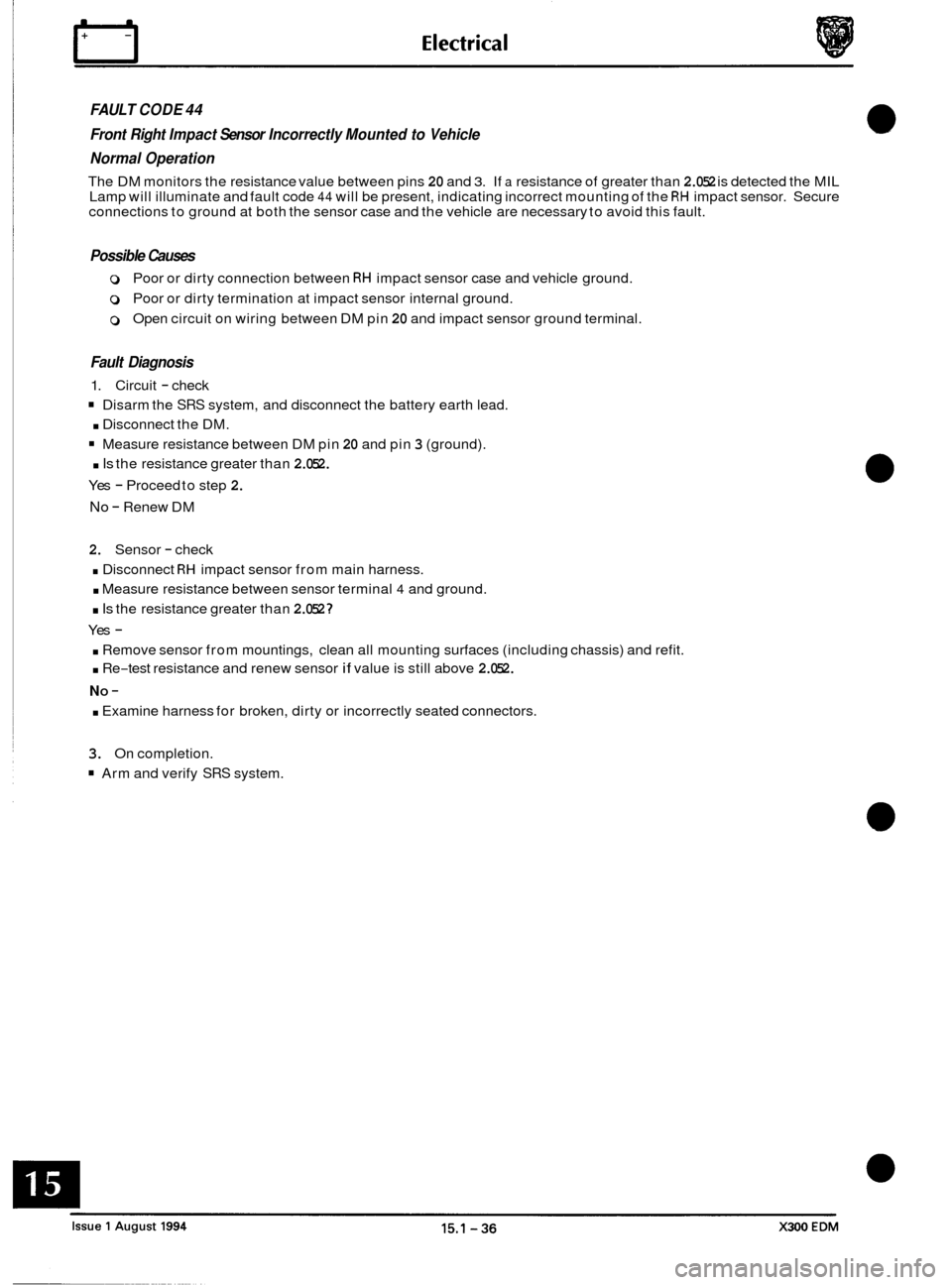
FAULT CODE 44
Front Right Impact Sensor Incorrectly Mounted to Vehicle
Normal Operation
The DM monitors the resistance value between pins 20 and 3. If a resistance of greater than 2.052 is detected the MIL
Lamp will illuminate and fault code 44 will be present, indicating incorrect mounting of the RH impact sensor. Secure
connections to ground at both the sensor case and the vehicle are necessary to avoid this fault.
Possible Causes
0 Poor or dirty connection between RH impact sensor case and vehicle ground.
0 Poor or dirty termination at impact sensor internal ground.
0 Open circuit on wiring between DM pin 20 and impact sensor ground terminal.
Fault Diagnosis
1. Circuit - check
Disarm the SRS system, and disconnect the battery earth lead.
. Disconnect the DM.
Measure resistance between DM pin 20 and pin 3 (ground).
. Is the resistance greater than 2.052.
Yes - Proceed to step 2.
No - Renew DM
2. Sensor - check
. Disconnect RH impact sensor from main harness.
. Measure resistance between sensor terminal 4 and ground.
. Is the resistance greater than 2.052 7
Yes -
. Remove sensor from mountings, clean all mounting surfaces (including chassis) and refit.
. Re-test resistance and renew sensor if value is still above 2.052.
NO -
. Examine harness for broken, dirty or incorrectly seated connectors.
3. On completion.
Arm and verify SRS system.
e
0
Page 144 of 327
Electrical
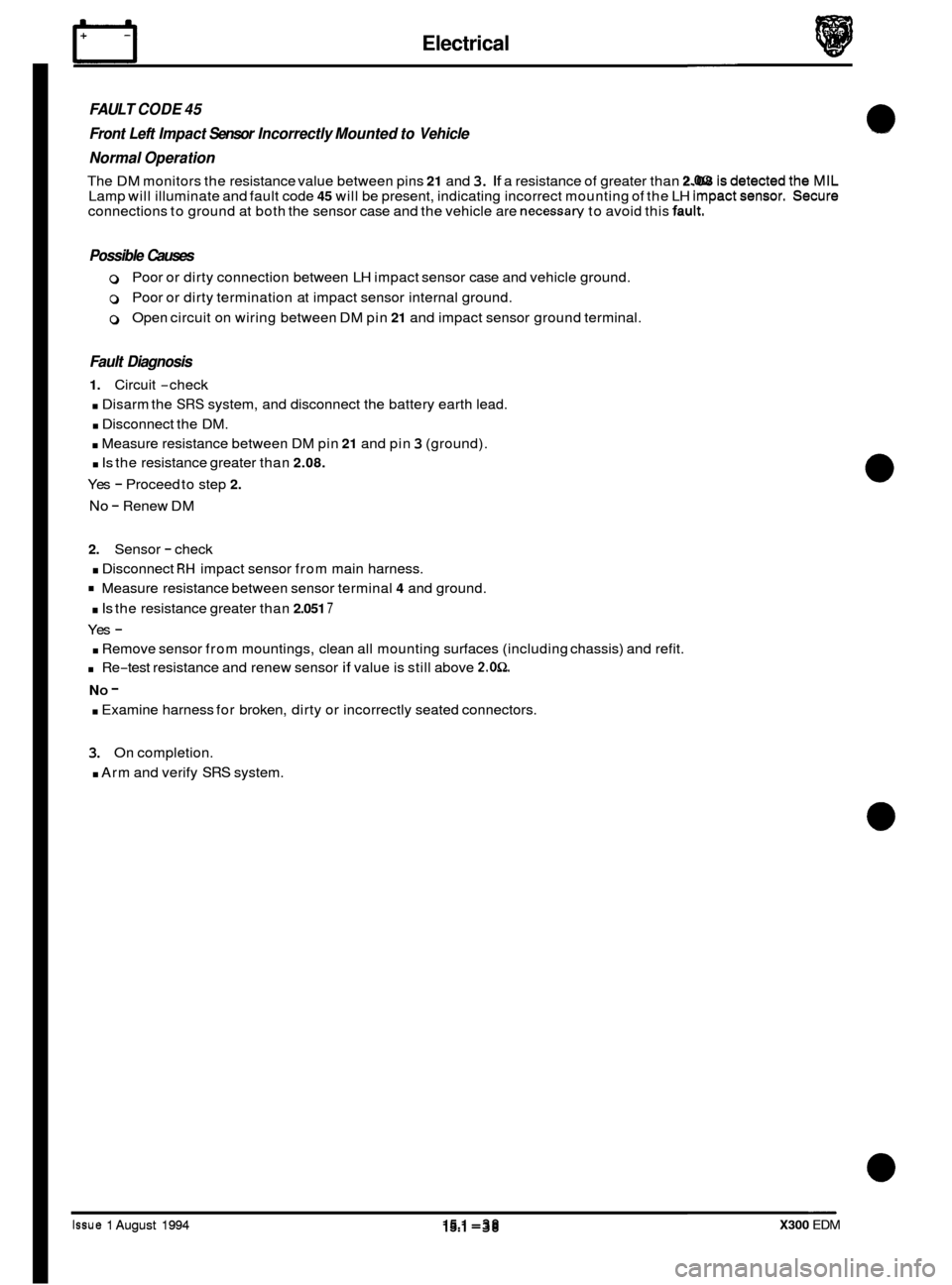
FAULT CODE 45
Front Left Impact Sensor Incorrectly Mounted to Vehicle
Normal Operation
The DM monitors the resistance value between pins 21 and 3. If a resistance of greater than 2 Lamp will illuminate and fault code 45 will be present, indicating incorrect mounting of the LH
connections to ground at both the sensor case and the vehicle are necessaw to avoid this fa!
Possible Causes
0 Poor or dirty connection between LH impact sensor case and vehicle ground.
0 Poor or dirty termination at impact sensor internal ground.
0 Open circuit on wiring between DM pin 21 and impact sensor ground terminal.
Fault Diagnosis
1. Circuit -check
. Disarm the SRS system, and disconnect the battery earth lead.
. Disconnect the DM.
. Measure resistance between DM pin 21 and pin 3 (ground).
. Is the resistance greater than 2.08.
Yes - Proceed to step 2.
No - Renew DM
2. Sensor - check
. Disconnect RH impact sensor from main harness.
Measure resistance between sensor terminal 4 and ground.
. Is the resistance greater than 2.051 7
Yes -
. Remove sensor from mountings, clean all mounting surfaces (including chassis) and refit.
Re-test resistance and renew sensor if value is still above 2.0Q.
NO -
. Examine harness for broken, dirty or incorrectly seated connectors.
3. On completion.
. Arm and verify SRS system.
Issue 1 August 1994 15.1 -38
!.On is detected the MIL
impact sensor. Secure
Jlt.
Electrical
FAULT CODE 45
Front Left Impact Sensor Incorrectly Mounted to Vehicle
Normal Operation
The DM monitors the resistance value between pins 21 and 3. If a resistance of greater than 2.08 is detected the MIL
Lamp will illuminate and fault code 45 will be present, indicating incorrect mounting of the LH impact sensor. Secure
connections to ground at both the sensor case and the vehicle are necessaw to avoid this fault.
Possible Causes
0 Poor or dirty connection between LH impact sensor case and vehicle ground.
0 Poor or dirty termination at impact sensor internal ground.
0 Open circuit on wiring between DM pin 21 and impact sensor ground terminal.
Fault Diagnosis
1. Circuit -check
. Disarm the SRS system, and disconnect the battery earth lead.
. Disconnect the DM.
. Measure resistance between DM pin 21 and pin 3 (ground).
. Is the resistance greater than 2.08.
Yes - Proceed to step 2.
No - Renew DM
2. Sensor - check
. Disconnect RH impact sensor from main harness.
Measure resistance between sensor terminal 4 and ground.
. Is the resistance greater than 2.051 7
Yes -
. Remove sensor from mountings, clean all mounting surfaces (including chassis) and refit.
Re-test resistance and renew sensor if value is still above 2.0Q.
NO -
. Examine harness for broken, dirty or incorrectly seated connectors.
3. On completion.
. Arm and verify SRS system.
Issue 1 August 1994 15.1 -38 X300 EDM - X300 EDM
e
0
0
0
Page 150 of 327
rl Electrical
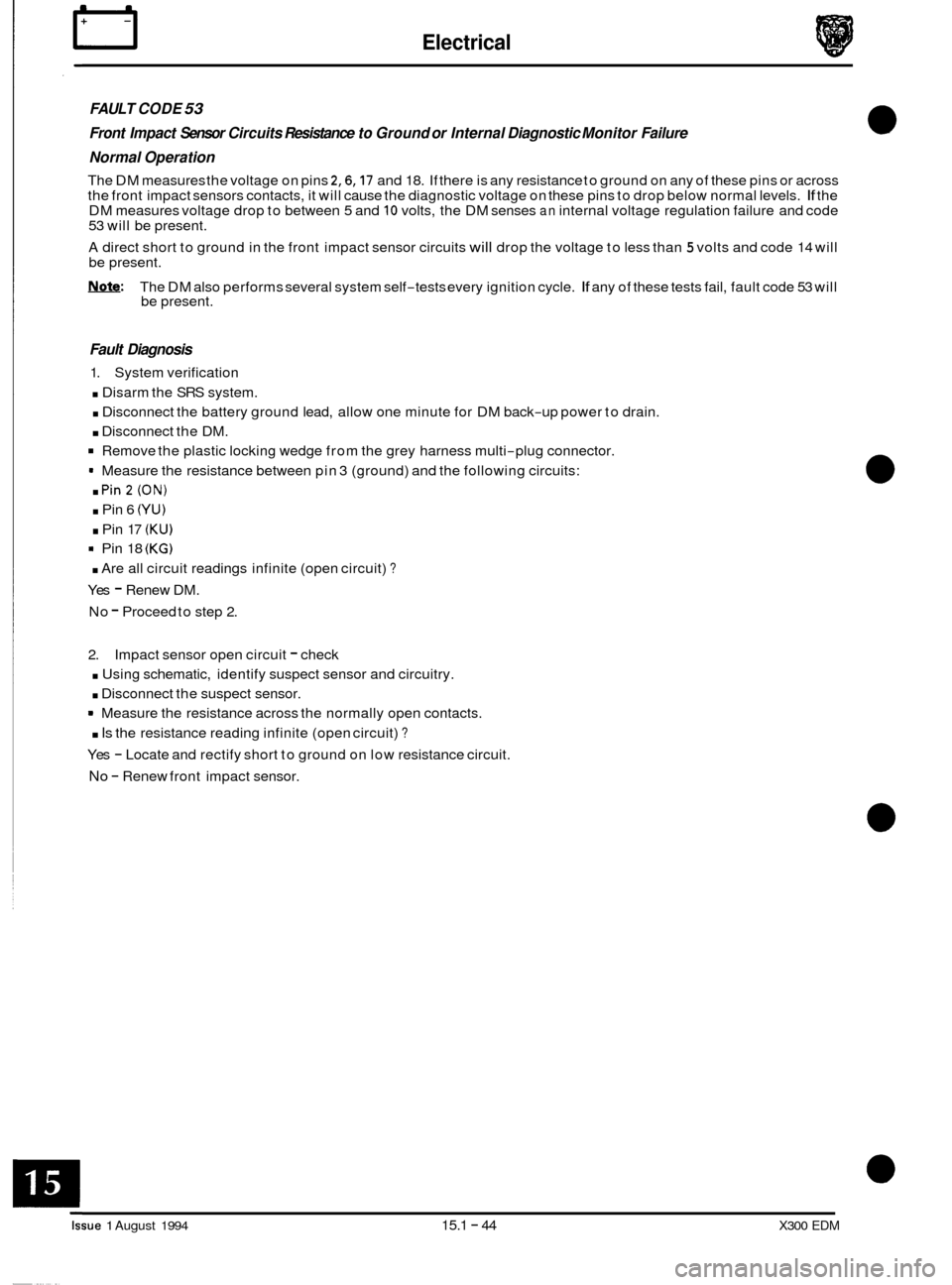
FAULT CODE 53
Front Impact Sensor Circuits Resistance to Ground or Internal Diagnostic Monitor Failure
Normal Operation
The DM measures the voltage on pins 2,6,17 and 18. If there is any resistance to ground on any of these pins or across
the front impact sensors contacts, it will cause the diagnostic voltage on these pins to drop below normal levels. If the
DM measures voltage drop to between 5 and 10 volts, the DM senses an internal voltage regulation failure and code
53 will be present.
A direct short to ground in the front impact sensor circuits
will drop the voltage to less than 5 volts and code 14 will
be present.
!!IQ&: The DM also performs several system self-tests every ignition cycle. If any of these tests fail, fault code 53 will
be present.
Fault Diagnosis
1. System verification
. Disarm the SRS system.
. Disconnect the battery ground lead, allow one minute for DM back-up power to drain.
. Disconnect the DM.
Remove the plastic locking wedge from the grey harness multi-plug connector.
= Measure the resistance between pin 3 (ground) and the following circuits:
. Pin2(ON)
. Pin 6 (VU)
. Pin 17 (KU)
* Pin 18 (KG)
. Are all circuit readings infinite (open circuit) ?
Yes - Renew DM.
No
- Proceed to step 2.
2.
. Using schematic, identify suspect sensor and circuitry.
. Disconnect the suspect sensor.
9 Measure the resistance across the normally open contacts.
. Is the resistance reading infinite (open circuit) ?
Yes - Locate and rectify short to ground on low resistance circuit.
No - Renew front impact sensor.
Impact
sensor open circuit
- check
0
0
e
0
Issue 1 August 1994 15.1 - 44 X300 EDM