Diagnostic JAGUAR XJ6 1994 2.G User Guide
[x] Cancel search | Manufacturer: JAGUAR, Model Year: 1994, Model line: XJ6, Model: JAGUAR XJ6 1994 2.GPages: 521, PDF Size: 17.35 MB
Page 204 of 521
10.2 SERVICE
PROCEDURES - SAFETY RELATED
10.2.1
Airbag
The electrically activated driver's side airbag is attached to the steering wheel hub and is fed by two wires from the
column stalk assembly. Electrical input to the column stalk assembly for the airbag is provided by a dedicated harness
which is encased in a yellow sleeve. A mechanism in the stalk assembly called the 'cable reel cassette' provides conti
-
nuity from the static column to the steering wheel. The 'cable reel cassette' is driven by a tang which locates in the
steering wheel. Because the connection is by wires, and the cassette assembly is only capable of approximately five
(5) full turns,
it is critically important that initial positioning is correct, see Section 15. It is equally important that fitting of the steering wheel, connection of the column, lower shaft and steering rackshould
ONLY be made with the steering rack in the center of its travel.
WARNING: DO NOT REMOVE THE STEERING COLUMN FROM THE VEHICLE WITH THE STEERING WHEEL AT- TACHED UNLESS THE STEERING IS CENTERED AND THE COLUMN LOCK IS ENGAGED. IF THE LOCK
BARREL
IS TO BE RENEWED, 'LOCK-WIRE THE ASSEMBLY TO PREVENT ROTATION. FAILURE TO OB- SERVE THIS AND CONSEQUENT DAMAGE TO THE 'CABLE REEL CASSETTE MAY RESULT IN AN INOP- ERATIVE AIRBAG SYSTEM. SEE LABEL ON STEERING WHEEL HUB.
10.3 SERVICE PROCEDURES
10.3.1 Working Practices
It is not recommended that either the steering rack or engine driven pump assemblies are repaired in any way other
than in accordance with the repair procedures described in this manual. The fluid reservoir and filter is a disposable
assembly and no attempt should be made to clean it internally. Genuine replacement units must be fitted following
routine service or diagnostic confirmation of the failure of any component.
The importance of cleanliness cannot be over
-stressed, not only with new parts but also those which may havefailed.
In-service contamination of the hydraulic system is a major cause of failures and may be avoided with good working
practices and care. All new units and pipes must be supplied with suitable blanks in every orifice. Should a unit not
have blanks fitted, do not use
it - return it to the supplier with an appropriate reason for your action.
To help the manufacturer diagnose problems and avoid post-removal contamination; provide full details of the fault
and plug all connections as soon as they are released. All suspect units must be returned to Jaguar Cars complete
with relevant documentation.
CAUTION: It is imperative that the power steering system does not become contaminated in any way. Always de- cant fluid from afresh sealed container and clean the area around the reservoir neck both before and after topping-up. Never return drained fluid to the system.
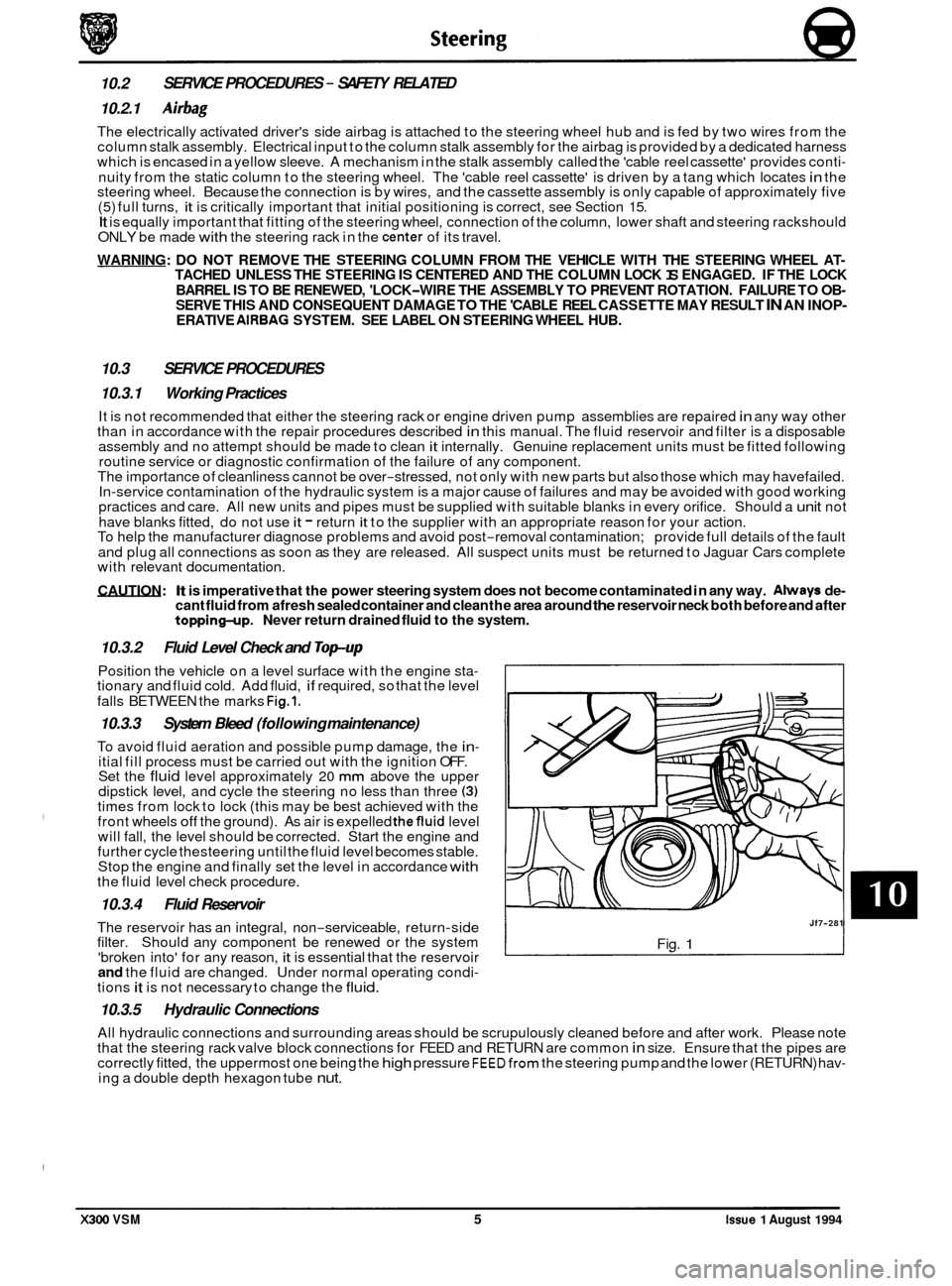
10.3.2
Position the vehicle on a level surface with the engine sta- tionary and fluid cold. Add fluid, if required, so that the level
falls BETWEEN the marks
Fig.1.
10.3.3 System Bleed (following maintenance)
To avoid fluid aeration and possible pump damage, the in- itial fill process must be carried out with the ignition OFF.
Set the fluid level approximately 20 mm above the upper
dipstick level, and cycle the steering no less than three (3) times from lock to lock (this may be best achieved with the
front wheels off the ground). As air is expelled thefluid level
will fall, the level should be corrected. Start the engine and
further cycle thesteering until the fluid level becomes stable.
Stop the engine and finally set the level in accordance
with the fluid level check procedure.
10.3.4 Fluid Reservoir
The reservoir has an integral, non-serviceable, return-side
filter. Should any component be renewed or the system
'broken into' for any reason,
it is essential that the reservoir and the fluid are changed. Under normal operating condi- tions it is not necessary to change the fluid.
10.3.5 Hydraulic Connections
Fluid
Level Check and
Top-up
Jf7-281
Fig. 1
All hydraulic connections and surrounding areas should be scrupulously cleaned before and after work. Please note
that the steering rack valve block connections for FEED and RETURN are common in size. Ensure that the pipes are
correctly fitted, the uppermost one being the high pressure FEEDfrom the steering pump and the lower (RETURN) hav- ing a double depth hexagon tube nut.
X300 VSM 5 issue 1 August 1994
Page 205 of 521
@ Steering
Cause
Fluid level low?
Drive belt slack
(V12)
Pump drive loose (6cyl)
center pressures low
Air in system due to loose connection
Pump shaft seal faulty (fluid loss)
Delivery pressure or flow too low
Return flow restricted by blocked reser
-
voir filter
Both check valves blocked
Rack damper too
tight
Lower column incorrectly set
Excessive upper column friction
Faulty rotary valve or seal
Drive belt slack
(VI217
Engine idle speed too low
Pump drive loose
(6cyl)
Air in system due to loose connection
Pump shaft seal faulty (fluid
loss)
Delivery pressure or flow too low
Fluid level low?
tire pressures
high
Air in system due to loose connection
Stiff or seized steering joint
Rack damper too tight
Castor or tracking error
Lower column over extended
Fluid level low?
Air
in system due to loose connection
Pump shaft seal faulty (fluid
loss)
Rack damper loose
Pinion bearing faulty
Rack or column fixings loose
Rack mounting bracket loose
Rack mounting bush loose
Free play in column assembly
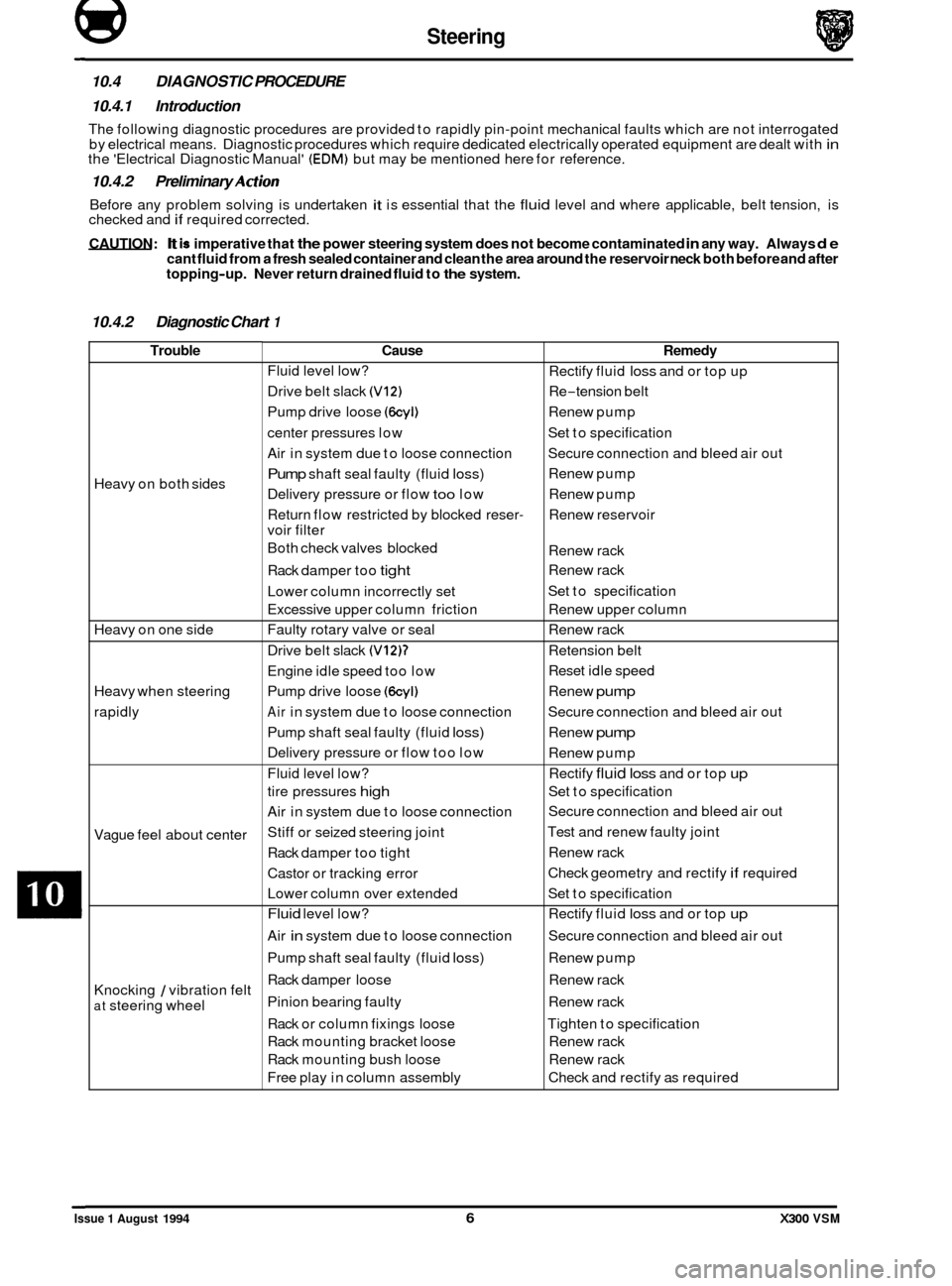
10.4 DIAGNOSTIC PROCEDURE
10.4.1 Introduction
The following diagnostic procedures are provided to rapidly pin-point mechanical faults which are not interrogated
by electrical means. Diagnostic procedures which require dedicated electrically operated equipment are dealt with in the 'Electrical Diagnostic Manual' (EDM) but may be mentioned here for reference.
10.4.2 Preliminary Action
Before any problem solving is undertaken it is essential that the fluid level and where applicable, belt tension, is
checked and if required corrected.
CAUTION: It is imperative that the power steering system does not become contaminated in any way. Always de cant fluid from a fresh sealed container and clean the area around the reservoir neck both before and after
topping-up. Never return drained fluid to the system.
10.4.2 Diagnostic Chart 1
Remedy
Rectify fluid loss and or top up
Re
-tension belt
Renew pump
Set to specification
Secure connection and bleed air out
Renew pump
Renew pump
Renew reservoir
Renew rack
Renew rack
Set to specification
Renew upper column
Renew rack
Retension belt
Reset idle speed
Renew
pump
Secure connection and bleed air out
Renew
pump
Renew pump
Rectify
fluid loss and or top up
Set to specification
Secure connection and bleed air out
Test and renew faulty joint
Renew rack
Check geometry and rectify
if required
Set to specification
Rectify fluid
loss and or top up
Secure connection and bleed air out
Renew pump
Renew rack
Renew rack
Tighten to specification
Renew rack
Renew rack
Check and rectify as required
Trouble
Heavy on both sides
Heavy on one side
Heavy when steering
rapidly
Vague feel about center
Knocking
1 vibration felt
at steering wheel
0
0
0
0
Issue 1 August 1994 6 X300 VSM
Page 206 of 521
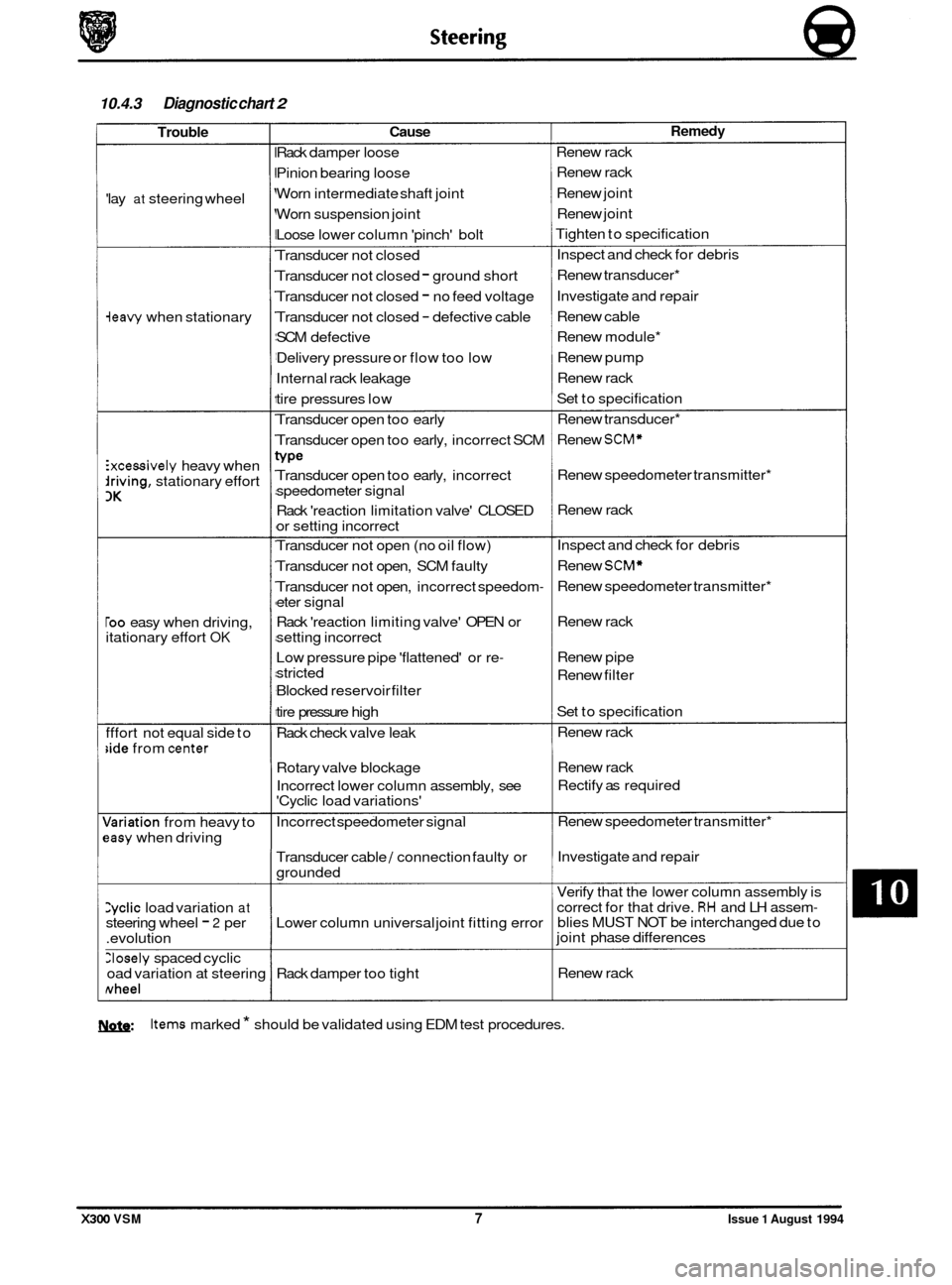
10.4.3 Diagnostic chart 2
0 Trouble
'lay at steering wheel
ieavy when stationary
Excessively heavy when
hiving, stationary effort
3K
Too easy when driving,
itationary effort OK
fffort not equal side to
;ide from center
dariation from heavy to
?asy when driving
:yclic load variation at steering wheel - 2 per
.evolution
:losely spaced cyclic
oad variation at steering
Nheel
Cause
Rack damper loose
Pinion bearing loose
Worn intermediate shaft joint
Worn suspension joint
Loose lower column 'pinch' bolt
Transducer not closed
Transducer not closed
- ground short
Transducer not closed
- no feed voltage
Transducer not closed
- defective cable
SCM defective
Delivery pressure or flow too low
Internal rack leakage
tire pressures low
Transducer open too early
Transducer open too early, incorrect SCM
h/Pe
Transducer open too early, incorrect
speedometer signal
Rack 'reaction limitation valve' CLOSED
or setting incorrect
Transducer not open (no oil flow)
Transducer not open, SCM faulty
Transducer not open, incorrect speedom
-
eter signal
Rack 'reaction limiting valve' OPEN or
setting incorrect
Low pressure pipe 'flattened' or re
-
stricted
Blocked reservoir filter
tire pressure high
Rack check valve leak
Rotary valve blockage Incorrect lower column assembly, see
'Cyclic load variations'
Incorrect speedometer signal
Transducer cable
/ connection faulty or
grounded
Lower column universal joint fitting error
Rack damper too tight
Remedy
Renew rack
Renew rack
Renew joint
Renew joint
Tighten to specification
Inspect and check for debris
Renew transducer*
Investigate and repair
Renew cable
Renew module*
Renew pump
Renew rack
Set to specification
Renew transducer*
Renew
SCM*
Renew speedometer transmitter*
Renew rack
Inspect and check for debris
Renew
SCM*
Renew speedometer transmitter*
Renew rack
Renew pipe
Renew filter
Set to specification
Renew rack
Renew rack
Rectify as required
Renew speedometer transmitter*
Investigate and repair
Verify that the lower column assembly is
correct for that drive.
RH and LH assem- blies MUST NOT be interchanged due to
joint phase differences
Renew rack
W: Items marked * should be validated using EDM test procedures.
X300 VSM 7 Issue 1 August 1994
Page 207 of 521
@ Steering
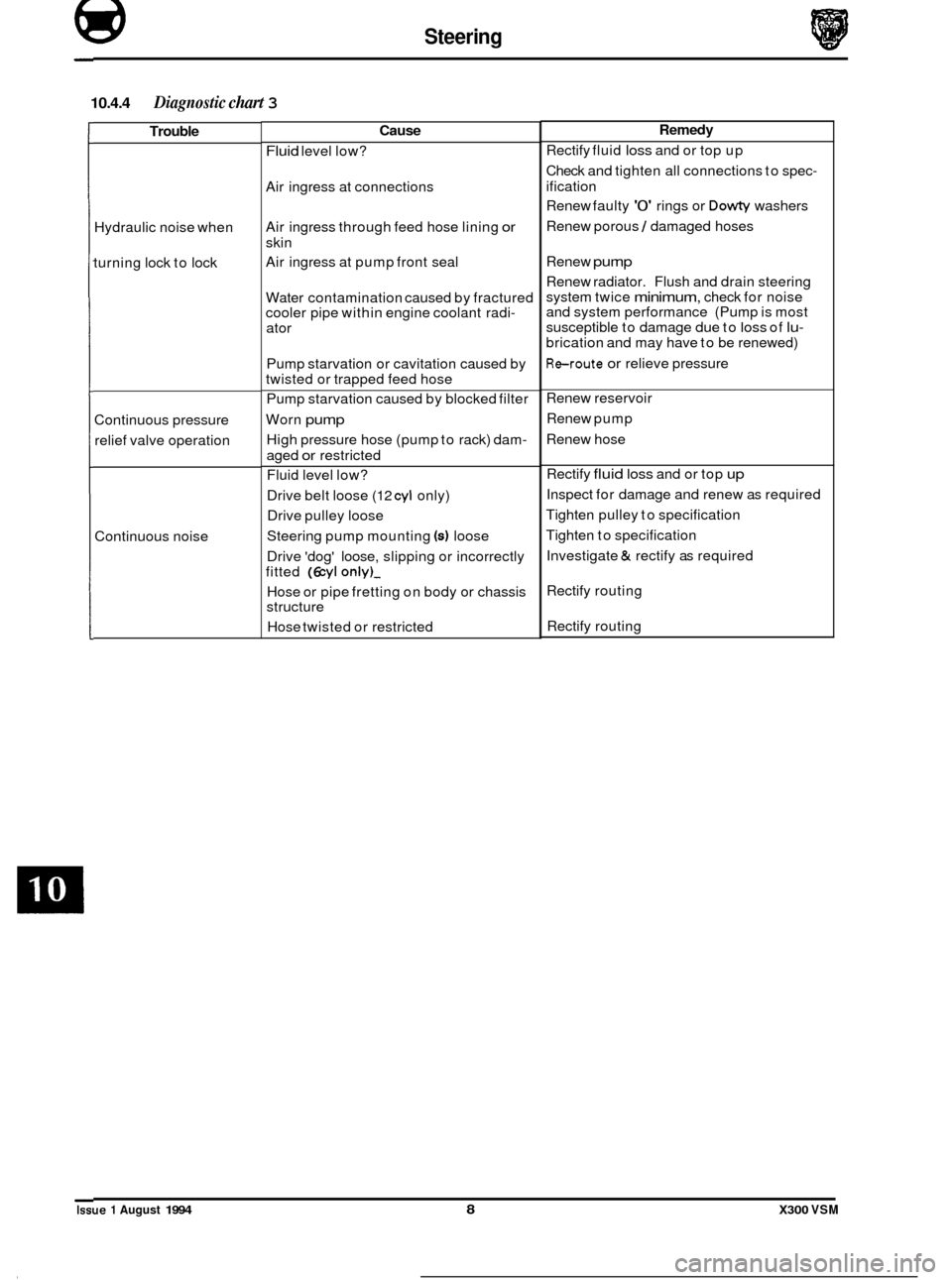
10.4.4 Diagnostic chart 3
Trouble
Hydraulic noise when
turning lock to lock
Continuous pressure
relief valve operation
Continuous noise
Cause
Fluid level low?
Air ingress at connections
Air ingress through feed hose lining
or
skin
Air ingress at pump front seal
Water contamination caused by fractured
cooler pipe within engine coolant radi
-
ator
Pump starvation or cavitation caused by
twisted or trapped feed hose
Pump starvation caused by blocked filter
Worn
pump
High pressure hose (pump to rack) dam-
aged or restricted
Fluid level low?
Drive belt loose
(12 cyl only)
Drive pulley loose
Steering pump mounting
(4 loose
Drive 'dog' loose, slipping or incorrectly
fitted
(6 cyl only)-
Hose or pipe fretting on body or chassis
structure
Hose twisted or restricted
Remedy
Rectify fluid loss and or top up
Check and tighten all connections to spec
-
ification
Renew faulty
'0' rings or Dowty washers
Renew porous
1 damaged hoses
Renew
pump
Renew radiator. Flush and drain steering
system twice
minimum, check for noise
and system performance (Pump is most
susceptible to damage due to
loss of lu-
brication and may have to be renewed)
Reroute or relieve pressure
Renew reservoir
Renew pump
Renew hose
Rectify
fluid loss and or top up
Inspect for damage and renew as required
Tighten pulley to specification
Tighten to specification
Investigate
& rectify as required
Rectify routing
Rectify routing
Issue 1 August 1994 8 X300 VSM
Page 210 of 521

Suspension Systems
. .
SECTION CON TENTS
Subsection Tjf/e
.
SRO
I to IV ........... Preliminary Pages ................................................................... i
11.1 ............. Introduction ........................................................................\
. 1
11.2 ............. Front Suspension. Description ......................................... ..
Page
11.3 ............. Rearsuspension. Description .......................................................... 2
11.4.1
............ Diagnosis & Testing. Tire Wear ......................................................... 3
11.4.2
............ Diagnosis & Testing. Vibration & Roughness .............................................. 3
11.4.3
............ Diagnosis & Testing. Front End Inspection ................................................ 4
11.4.4 ............ Diagnosis & Testing. Upper/Lower Ball Joint Inspection ................................... 4
11.4.5
............ Diagnosis & Testing. Damper Inspection ................................................. 4
11.4.6
............ Diagnosis & Testing. Rear Suspension Inspection .......................................... 5
11.4.7. ........... Diagnosis & Testing. Vehicle Inspection .................................................. 5
11.4 ............. Diagnosis & Testing .................................................................. 3
. 1 1.4.8 ............ Diagnosis & Testing. Diagnostic Procedure Chart ............ ...
. .
........ .....
-
I X300 VSM i Issue 1 August 1994
.
............. 1
............. 6
Page 214 of 521

Suspension Systems
11.1 INTRODUCTION
This section describes the front and rear suspension systems, and also covers diagnostic procedures.
Fig. 1 Front Suspension Layout
11.2 FRONT SUSPENSION, DESCRIPTION
Theupperrearwishbone(1 Fig.l)andthe upperfrontwishbone(2 Fig.1)arepivotedon the upperfulcrum bolt (3Fig.l), passing through the front cross beam assembly. They are also fitted via an upper ball joint assembly (4 Fig.1) to a verti- cal linkaccommodating the stub axle (5 Fig.l), whereas the vertical linkisfittedvia a lower ball joint assembly (6 Fig.1) to the lower wishbone assembly.
The lower wishbone assembly comprises
a lower rear wishbone (7 Fig.l), lower front wishbone (8 Fig.l), damper (9 Fig.1) (incorporating damper bush 10 Fig.1) and spring pan (1 1 Fig.1) supporting the road spring (12 Fig.1). The lower
wishbone assembly is pivoted on the bushed lower fulcrum shaft (13 Fig.1) which also passes through thecross beam
assembly.
Both independent front suspension assemblies are linked by a stabilizer bar (14 Fig.1) which is secured to the cross
member using a fixing arrangement of mounting rubbers (15 Fig.1, clamps (16 Fig.l), nuts bolts, washers (17 Fig.1) and two link arm assemblies (18 Fig.1). Each link arm assembly is fitted to one end of the stabilizer bar and to one end
of the lower front wishbone using a fixing arrangement of bolts washers and self locking nuts.
All suspension loads, except the damper, are fed into a pressed steel crossbeam which is isolated from the body by
rubber bushes. This mounting method allows the necessary amount of compliance.
The degree
of caster is adjustable via shims positioned on either side of the upper ball joint assembly but camber is facton/ set and is not adjustable. The vertical link and the steering arm form a single forging. Cast iron hubs rotate
on twin tapered roller bearings.
X300 VSM 1 Issue 1 August 1994
Page 219 of 521
Suspension Systems
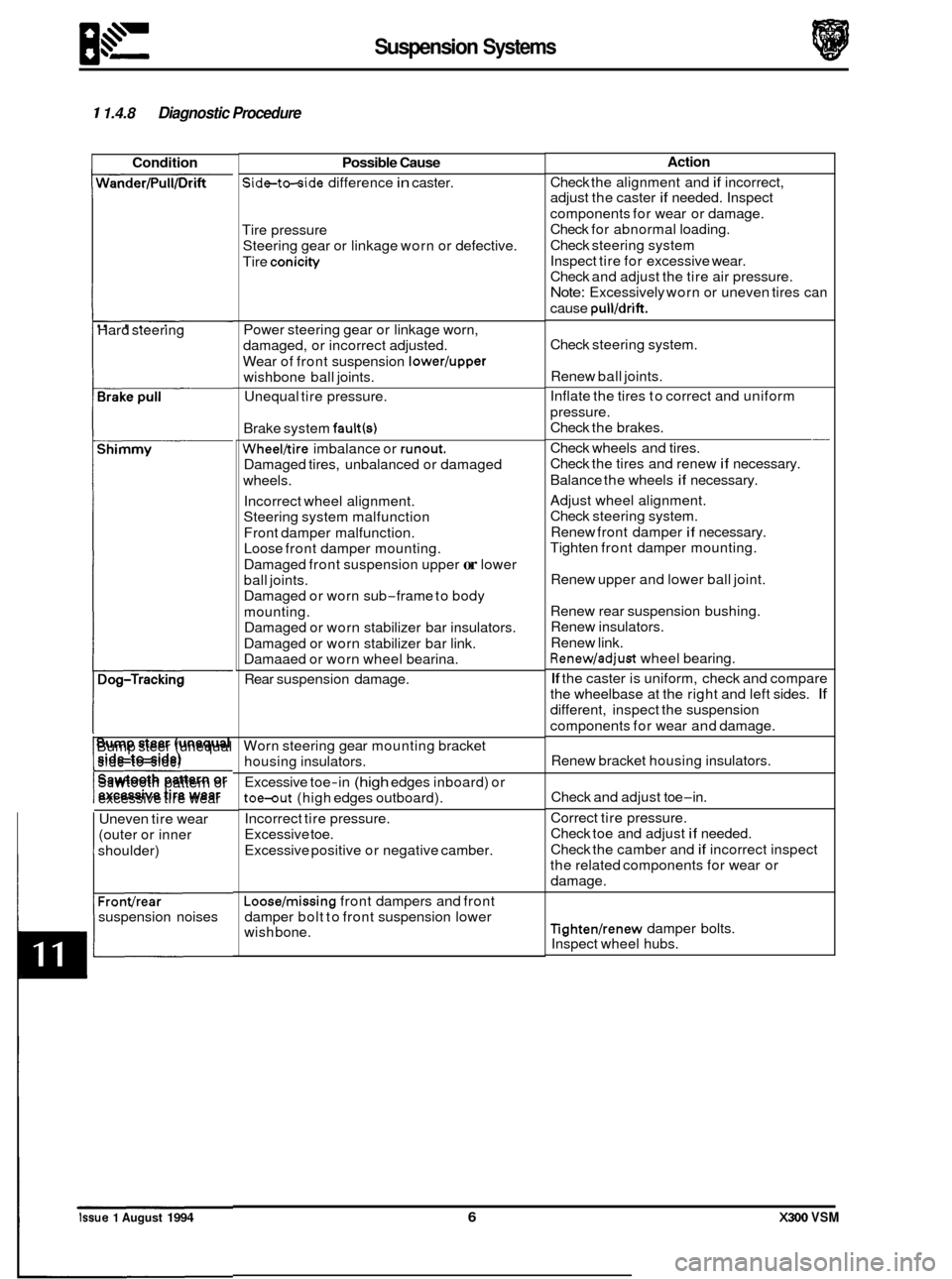
1 1.4.8 Diagnostic Procedure
Condition
Hard steering
Shimmy
I----
Bump steer (unequal
side-to-side)
Sawtooth pattern or
t excessive tire wear
Uneven tire wear
(outer or inner
shoulder)
Fronvrear
suspension noises
Possible Cause
Side-to-side difference in caster.
Tire pressure Steering gear or linkage worn or defective.
Tire
conicity
Power steering gear or linkage worn,
damaged, or incorrect adjusted.
Wear of front suspension
lower/upper
wishbone ball joints.
Unequal tire pressure.
Brake system
fault(s)
Wheel/tire imbalance or runout.
Damaged tires, unbalanced or damaged
wheels.
Incorrect wheel alignment.
Steering system malfunction
Front damper malfunction.
Loose front damper mounting.
Damaged front suspension upper
or lower
ball joints.
Damaged or worn sub
-frame to body
mounting. Damaged or worn stabilizer bar insulators.
Damaged or worn stabilizer bar link.
Damaaed or worn wheel bearina.
Rear suspension damage.
Worn steering gear mounting bracket
housing insulators.
Excessive toe
-in (high edges inboard) or
toe-out (high edges outboard).
Incorrect tire pressure.
Excessive toe.
Excessive positive or negative camber.
Loose/missing front dampers and front
damper bolt to front suspension lower
wish bone.
Action
Check the alignment and if incorrect,
adjust the caster
if needed. Inspect
components for wear or damage.
Check for abnormal loading.
Check steering system
Inspect tire for excessive wear.
Check and adjust the tire air pressure.
Note: Excessively worn or uneven tires can
cause
pull/drift.
Check steering system.
Renew ball joints.
Inflate the tires to correct and uniform
pressure.
Check the brakes.
Check wheels and tires.
Check the tires and renew
if necessary.
Balance the wheels
if necessary.
Adjust wheel alignment.
Check steering system.
Renew front damper
if necessary.
Tighten front damper mounting.
-
Renew upper and lower ball joint.
Renew rear suspension bushing.
Renew insulators.
Renew link.
Renew/adjust wheel bearing.
If the caster is uniform, check and compare
the wheelbase at the right and left sides.
If
different, inspect the suspension
components for wear and damage.
Renew bracket housing insulators.
Check and adjust toe
-in.
Correct tire pressure.
Check toe and adjust
if needed.
Check the camber and
if incorrect inspect
the related components for wear or
damage.
Tighten/renew damper bolts.
Inspect wheel hubs.
0
0
0
lssue 1 August 1994 6 X300 VSM
Page 220 of 521

Condition
30dy rolls
3ody leans
oor ride comfort
Seneral driving
nstability
Steering wheel does
lot return properly
S")
Suspension Systems I.\" b-
1 1.4.8 Diagnostic Procedure (continued)
Condition
30dy 'rolls'
3ody leans
'oor ride comfort
Seneral driving
nstability
Steering wheel does
lot return properly
Steering wheel pulls
:o one side
4bnormal noise
from suspension
system
Possible Cause
Weak front stabilizer bar.
Damaged or worn lower wishbone stabilizer
bar insulator. Damaged or worn stabilizer bar link
Damaged or worn rear suspension
wishbone bushing.
Damper malfunction.
Worn or deteriorated rear stabilizer bar
bushing(s). (supercharged, sports and XJ12
only)
Damaged or worn rear wishbone bushing
and weak springs.
Worn or deteriorated rear stabilizer bar
bushing(s). (supercharged, sports and XJ12
only)
Front or rear damper malfunction.
Weak
spring(s1
Damaged tires or unbalanced wheels.
Incorrect wheel alignment.
Steering system malfunction.
Damaged front suspension lower and upper
ball joints.
Damaged or worn sub
-frame to body
mounting.
Damaged or worn stabilizer bar link
Damaged or worn lower wishbone stabilizer
bar insulator.
Weak
spring(s)
Worn or deteriorated rear stabilizer bushing
(s). (supercharged, sports and XJ12 only)
Damaged tires or unbalanced wheels and
incorrect tire pressure.
Incorrect wheel alignment.
Steering system malfunction.
Damaged front suspension lower and upper
ball joints.
Incorrect tire pressure.
Damaged front suspension lower and upper
ball joints. Braking system malfunction.
Steering system malfunction.
Damaged or worn sub
-frame to body
mounting.
Damaged tires, unbalanced wheels and
incorrect tire pressure.
Poor lubrication /wear of wheel bearing.
Wear of front suspension lower and upper
ball joints.
Damaged or worn front stabilizer bar
Damaged or worn stabilizer bar link.
Damaged or worn stabilizer bar bracket.
Looseness of suspension connections.
Damaged or worn rear wishbone bushing.
Front and rear damper malfunction.
Weak
spring.Worn or deteriorated rear
stabilizer bushing
(s). (supercharged, sports
and
XJ12 only)
Action
3enew front stabilizer bar.
3enew insulators.
3enew link.
Renew bushing.
Renew damper
if necessary.
Renew Bushina
Renew bushings and springs.
Renew Bushings.
Renew dampers.
Renew springs.
Check the tires.
Adjust the wheel alignment.
Check steering system.
Renew ball joints.
Renew bushing.
Renew link.
Renew insulator.
Renew springs.
Renew bushing
Check tires.
Adjust the wheel alignment.
Check steering system.
Renew ball joints.
Check and correct tire pressure.
Renew ball joints.
Check brakes.
Check steering system.
Renew bushing.
Check tires.
Renew wheel bearing.
Renew ball joints.
Renew stabilizer bar.
Renew link.
Renew bracket.
Tighten connections.
Renew bushing.
Renew dampers.
Renew bushing
Issue 1 August 1994 X300 VSM 7
Page 224 of 521
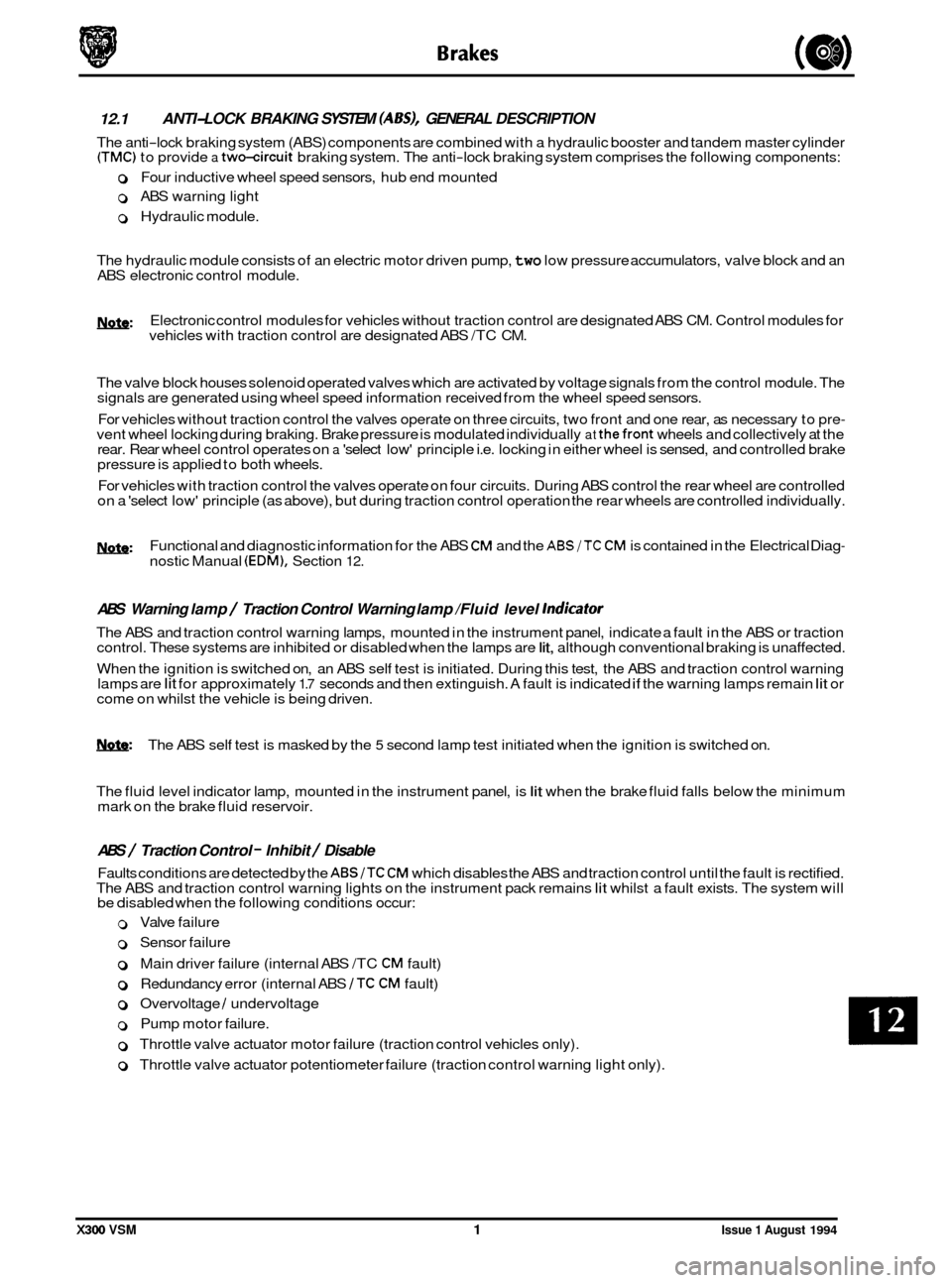
12.1 ANTI-LOCK BRAKING SYSTEM (ASS), GENERAL DESCRIPTION
The anti-lock braking system (ABS) components are combined with a hydraulic booster and tandem master cylinder (TMC) to provide a two-circuit braking system. The anti-lock braking system comprises the following components:
0 Four inductive wheel speed sensors, hub end mounted
0 ABS warning light
0 Hydraulic module.
The hydraulic module consists of an electric motor driven pump,
two low pressure accumulators, valve block and an
ABS electronic control module.
m: Electronic control modules for vehicles without traction control are designated ABS CM. Control modules for
vehicles with traction control are designated ABS /TC CM.
The valve block houses solenoid operated valves which are activated by voltage signals from the control module. The
signals are generated using wheel speed information received from the wheel speed sensors.
For vehicles without traction control the valves operate on three circuits, two front and one rear, as necessary to pre
- vent wheel locking during braking. Brake pressure is modulated individually at thefront wheels and collectively at the
rear. Rear wheel control operates on a 'select low' principle i.e. locking in either wheel is sensed, and controlled brake
pressure is applied to both wheels.
For vehicles with traction control the valves operate on four circuits. During ABS control the rear wheel are controlled
on a 'select low' principle (as above), but during traction control operation the rear wheels are controlled individually.
0
1yQfB: Functional and diagnostic information for the ABS CM and the ABS/TC CM is contained in the Electrical Diag-
nostic Manual (EDM), Section 12.
ABS Warning lamp / Traction Control Warning lamp /Fluid level Indicator
The ABS and traction control warning lamps, mounted in the instrument panel, indicate a fault in the ABS or traction
control. These systems are inhibited or disabled when the lamps are lit, although conventional braking is unaffected.
When the ignition is switched on, an ABS self test is initiated. During this test, the ABS and traction control warning
lamps are
lit for approximately 1.7 seconds and then extinguish. A fault is indicated if the warning lamps remain lit or
come on whilst the vehicle is being driven.
W: The ABS self test is masked by the 5 second lamp test initiated when the ignition is switched on.
The fluid level indicator lamp, mounted in the instrument panel, is
lit when the brake fluid falls below the minimum
mark on the brake fluid reservoir.
ABS / Traction Control - Inhibit / Disable
Faults conditions are detected by the ABS/TC CM which disables the ABS and traction control until the fault is rectified.
The ABS and traction control warning lights on the instrument pack remains lit whilst a fault exists. The system will
be disabled when the following conditions occur:
0
0 Valve failure
0 Sensor failure
0 Main driver failure (internal ABS /TC CM fault)
0 Redundancy error (internal ABS JTC CM fault)
0 Overvoltage J undervoltage
0 Pump motor failure.
0 Throttle valve actuator motor failure (traction control vehicles only).
0 Throttle valve actuator potentiometer failure (traction control warning light only).
X300 VSM 1 Issue 1 August 1994
Page 225 of 521
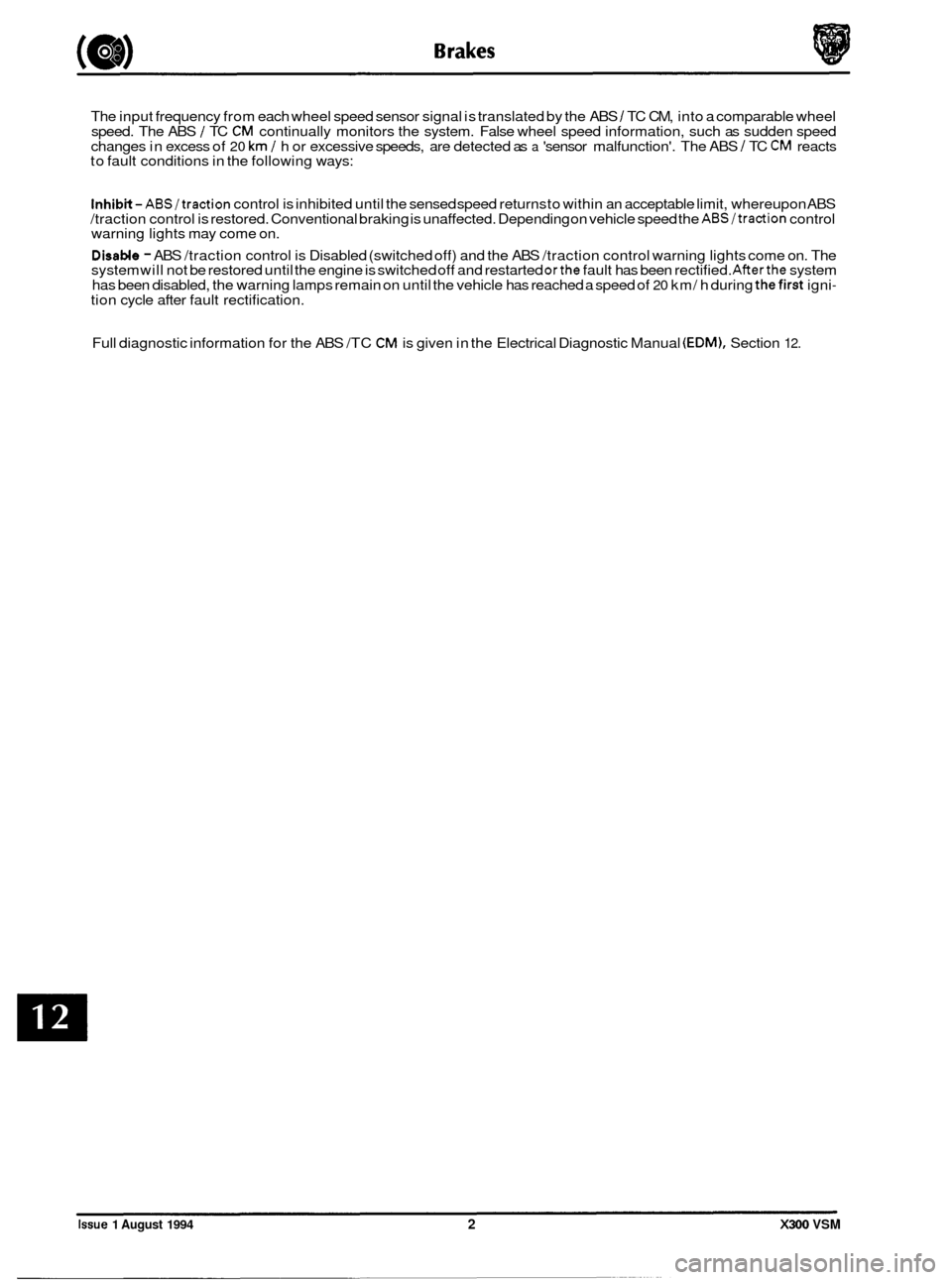
The input frequency from each wheel speed sensor signal is translated by the ABS I TC CM, into a comparable wheel
speed. The ABS / TC CM continually monitors the system. False wheel speed information, such as sudden speed
changes in excess of 20 km / h or excessive speeds, are detected as a 'sensor malfunction'. The ABS / TC CM reacts
to fault conditions in the following ways:
Inhibit- ABS/traction control is inhibited until the sensed speed returns to within an acceptable limit, whereupon ABS
/traction control is restored. Conventional braking is unaffected. Depending on vehicle speed the ABS/traction control
warning lights may come on.
DisaMe - ABS /traction control is Disabled (switched off) and the ABS /traction control warning lights come on. The
system will not be restored until the engine is switched off and restarted orthe fault has been rectified. Afterthe system
has been disabled, the warning lamps remain on until the vehicle has reached a speed of 20 km/ h during thefirst igni- tion cycle after fault rectification.
Full diagnostic information for the ABS /TC
CM is given in the Electrical Diagnostic Manual (EDM), Section 12.
Issue 1 August 1994 2 X300 VSM