airbag JAGUAR XJ6 1994 2.G User Guide
[x] Cancel search | Manufacturer: JAGUAR, Model Year: 1994, Model line: XJ6, Model: JAGUAR XJ6 1994 2.GPages: 521, PDF Size: 17.35 MB
Page 280 of 521
Body Components & Trim -
. From behind the fascia passenger side, disconnect the
passenger airbag harness multi-plug.
. With assistance, remove the fascia from the vehicle and
place on a suitably protected bench.
Place the fascia
in position in the vehicle with the center
location peg correctly engaged.
Reconnect the passenger airbag module harness multi-
Plug.
. Carefully fit and align the fascia to the mounting position.
. Fit and tighten the fascia to outer body brackets securing
bolts.
Fit and tighten the fascia assembly lower securing nut.
Reposition and
fit the airbag control module to the mount-
ing bracket.
Reposition and fit the fascia harness ground eyelets to the
ground stud.
Fit and tighten the ground eyelet securing
nut.
harness multi-plug. . Reconnect the left hand fascia harness to cabin housing
. Reconnect the fascia harness to console harness multi- plugs.
Fit and align the passenger side outlet duct.
. Fit and tighten the fascia to console securing screws.
. Reconnect the speed control harness multi-plug.
. Reconnect the speaker tweeter harness multi-plug.
. Reconnect the exciter coil harness multi-plug.
Reconnect the column switchgear and column motor har-
. Reconnect the right hand fascia harness to cabin harness
. Place the instrument pack / fascia switchpack in position.
. Reconnect the instrument pack harness multi-plugs.
. Reposition and fitthe instrument packassemblytothefas-
cia.
Reconnect the fascia switchpack harness multi-plugs.
Reconnect the steering column harness multi
-plugs.
. Reposition and fit the switchpack harness multi-plug mounting bracket.
ness
multi
-plugs.
multi-plug.
. Fit and tighten the instrument pack/ switchpack securing
bolts.
- Fit and align the fascia tie bars.
. Fit and tighten the tie bar securing nuts.
9 Refit the center veneer panel.
Refit the fascia closing panels.
. Refit the steering wheel.
. Refit the drivers airbag module.
. Refit the underscuttle pads.
. Reconnect the battery and refit the battery covers.
Issue 1 August 1994 X300 VSM 25
Page 288 of 521
Body Components & Trim -
13.3.3 1 Steering Column Switchgear Mounting Bracket,
Renew
SRO 76.46.33
J 76-1 082
Fig. 1
Remove the steering column lower and upper cowls, see
. Remove the battery cover and disconnect the battery.
. Remove the driver airbag module, see section 15.1.
. Remove the steering wheel, see section 10.
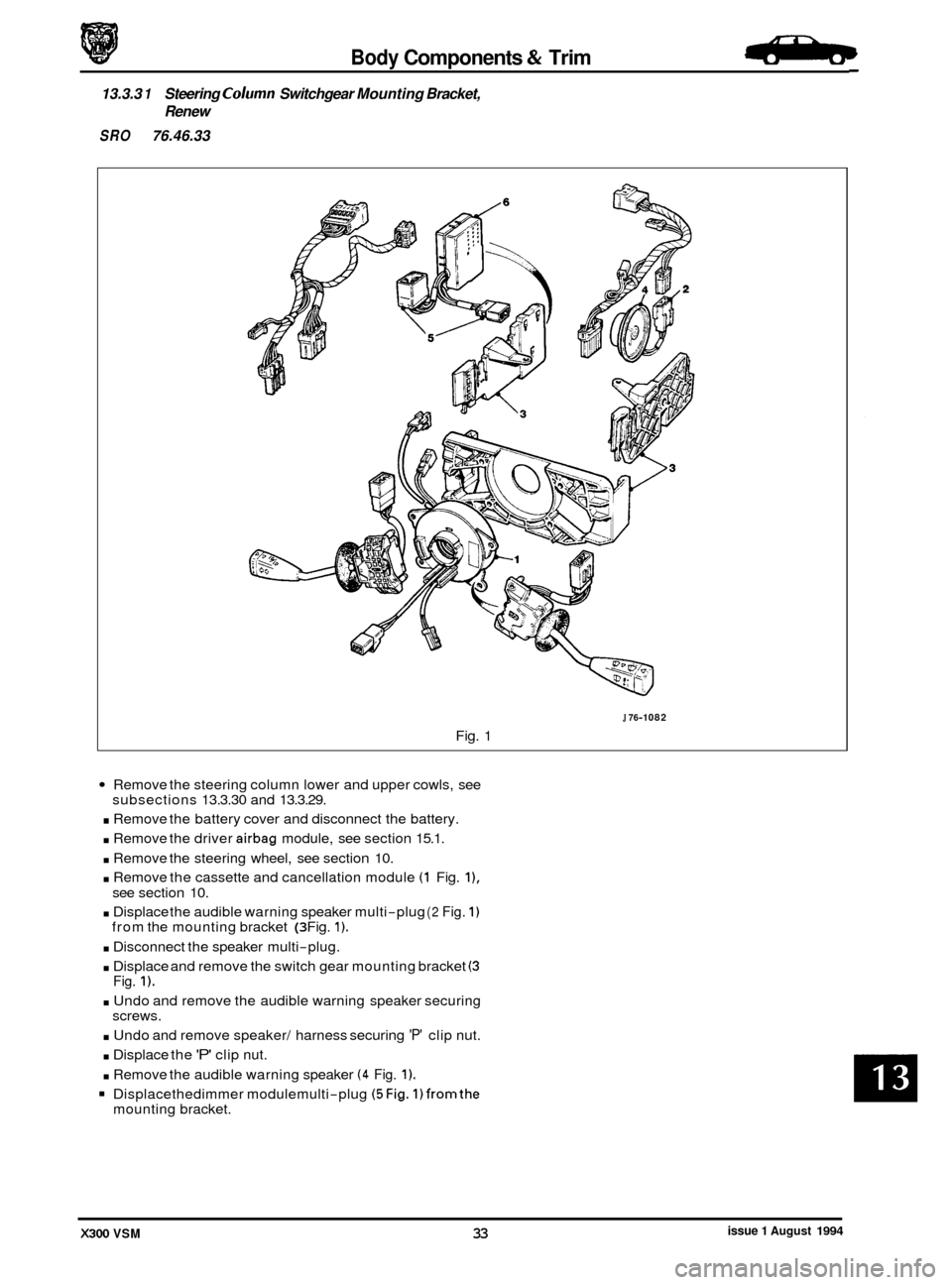
. Remove the cassette and cancellation module (1 Fig. I),
. Displace the audible warning speaker multi-plug (2 Fig. 1)
. Disconnect the speaker multi-plug.
. Displace and remove the switch gear mounting bracket (3
. Undo and remove the audible warning speaker securing
. Undo and remove speaker/ harness securing 'P' clip nut.
. Displace the 'P' clip nut.
. Remove the audible warning speaker (4 Fig. 1).
Displacethedimmer modulemulti-plug (5Fig. 1)fromthe
subsections 13.3.30 and 13.3.29.
see section 10.
from the mounting bracket
(3 Fig. 1).
Fig. 1).
screws.
mounting bracket.
issue 1 August 1994 X300 VSM 33
Page 289 of 521
Body Components & Trim
J76-1082
Fig. 1
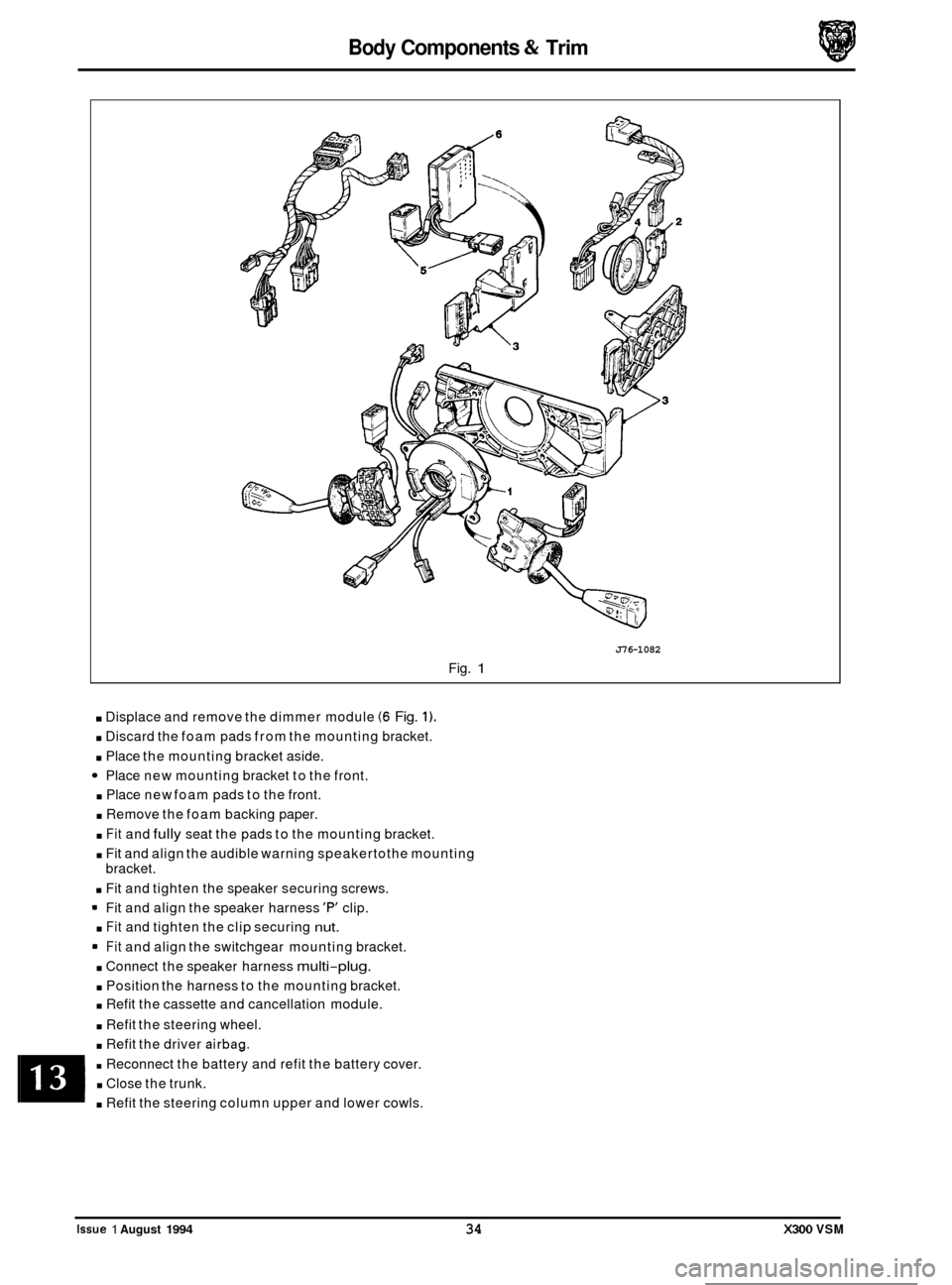
. Displace and remove the dimmer module (6 Fig. 1).
. Discard the foam pads from the mounting bracket.
. Place the mounting bracket aside.
Place new mounting bracket to the front.
. Place new foam pads to the front.
. Remove the foam backing paper.
. Fit and fully seat the pads to the mounting bracket.
. Fit and align the audible warning speakertothe mounting
bracket.
. Fit and tighten the speaker securing screws.
Fit and align the speaker harness
'F" clip.
. Fit and tighten the clip securing nut.
Fit and align the switchgear mounting bracket.
. Connect the speaker harness multi-plug.
. Position the harness to the mounting bracket.
. Refit the cassette and cancellation module.
. Refit the steering wheel.
. Refit the driver airbag.
. Reconnect the battery and refit the battery cover.
. Close the trunk.
. Refit the steering column upper and lower cowls.
0
0
0
0
Issue 1 August 1994 34 X300 VSM
Page 305 of 521
Body Components & Trim .Birpa,
13.8.8 Seat Belts, Description
Three types of seat belt are used: tear loop inertia seat belts used on front seats in association with driver and passenger
airbags, standard inertia types fitted to the outer, rear seats and static belts fitted to the
center, rear seat.
Front passenger seat belts are fitted
with tear loop buckles while drivers seat belts have the tear loop fitted to the out- board anchorage. The front seat belts are provided with height adjuster units which are attached one to each of the
'B' posts.
13.8.9
Where emergency locking retractorlautomatic locking retractor seat belts are provided, the belts have two operating
modes:
1.
2.
The inertia reel mode operates to allowthe occupant some freedom of torso movement. The static reel mode prevents
belt payout and thereby does not allow the occupant freedom of torso movement. When the seat belt is attached to
a child seat which has its own independent harness, the static mode must be used.
The seat belt defaults to the inertia reel (adult passenger) mode when
in the stowed (fully retracted) position.
To activate the static reel (child seat) mode, pay out the belt to its
full extension. The ratchet mechanism is now en- gaged. When retracting the belt back into the reel, the ratchet operation may be felt. It can be noticed that the belt is
unable to reverse direction.
To revert to the inertia reel mode, pay the belt back into the reel to the stowed position.
Emergency Locking Retractor / Automatic locking Retractor Seat Belts
Inertia reel mode, emergency locking retractor, for adult passengers
Static reel mode, automatic locking retractor, for children
(in child seats).
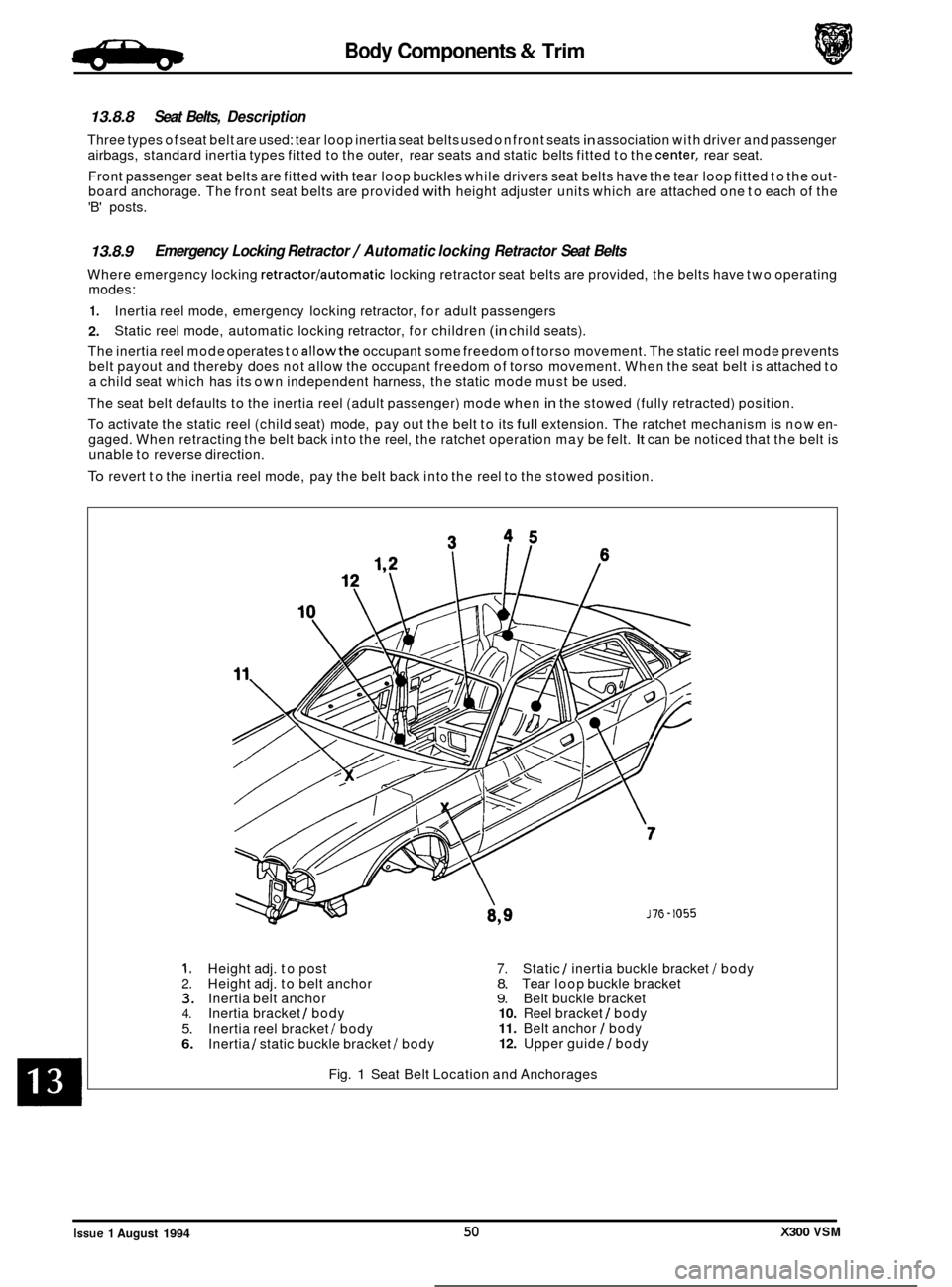
1. Height adj. to post 7. Static 1 inertia buckle bracket I body 2. Height adj. to belt anchor 8. Tear loop buckle bracket 3. Inertia belt anchor 9. Belt buckle bracket 4. Inertia bracket / body 10. Reel bracket 1 body
5. 11. Belt anchor I body
6. 12. Upper guide I body
Inertia
reel bracket I body
Inertia 1 static buckle bracket I body
Fig.
1 Seat Belt Location and Anchorages
0
0
Issue 1 August 1994 50 X300 VSM
Page 306 of 521

Body Components & Trim
13.8.10 Tear loop Seat Belts, Description
The tear loop seat belt (Fig.1) is used to control the rate of forward travel of the occupant towards the deployed airbag
(the airbag is covered in Section 15, Electrical). The tear loop assembly is designed to release additional webbing when
the stitching, which retains the webbing loops, breaks under
a predetermined load. The wires (1 Fig. 1) within the as- sembly have the following functions:
0 To protect the stitching from 'normal' loads such as heavy braking or cornering.
o To control the rate of deployment.
0 To support the extended head following deployment.
When the passenger unit has been activated, the buckle will extend from the shroud and reveal
a warning label (2 Fig. 1); the extent of deployment will depend upon the severity of the load.
-: IF THE LABEL IS VISIBLE AT ALL (3 FIG. 3). THE COMPLETE ASSEMBLY MUST BE RENEWED, AS MUST
ANY SEAT BELT WHICH HAS BEEN WORN IN AN ACCIDENT.
2
Fia. 1 Tear LOOO Seat Belt
X300 VSM 51 Issue 1 August 1994 ~~
Page 338 of 521
Electrical cl
.
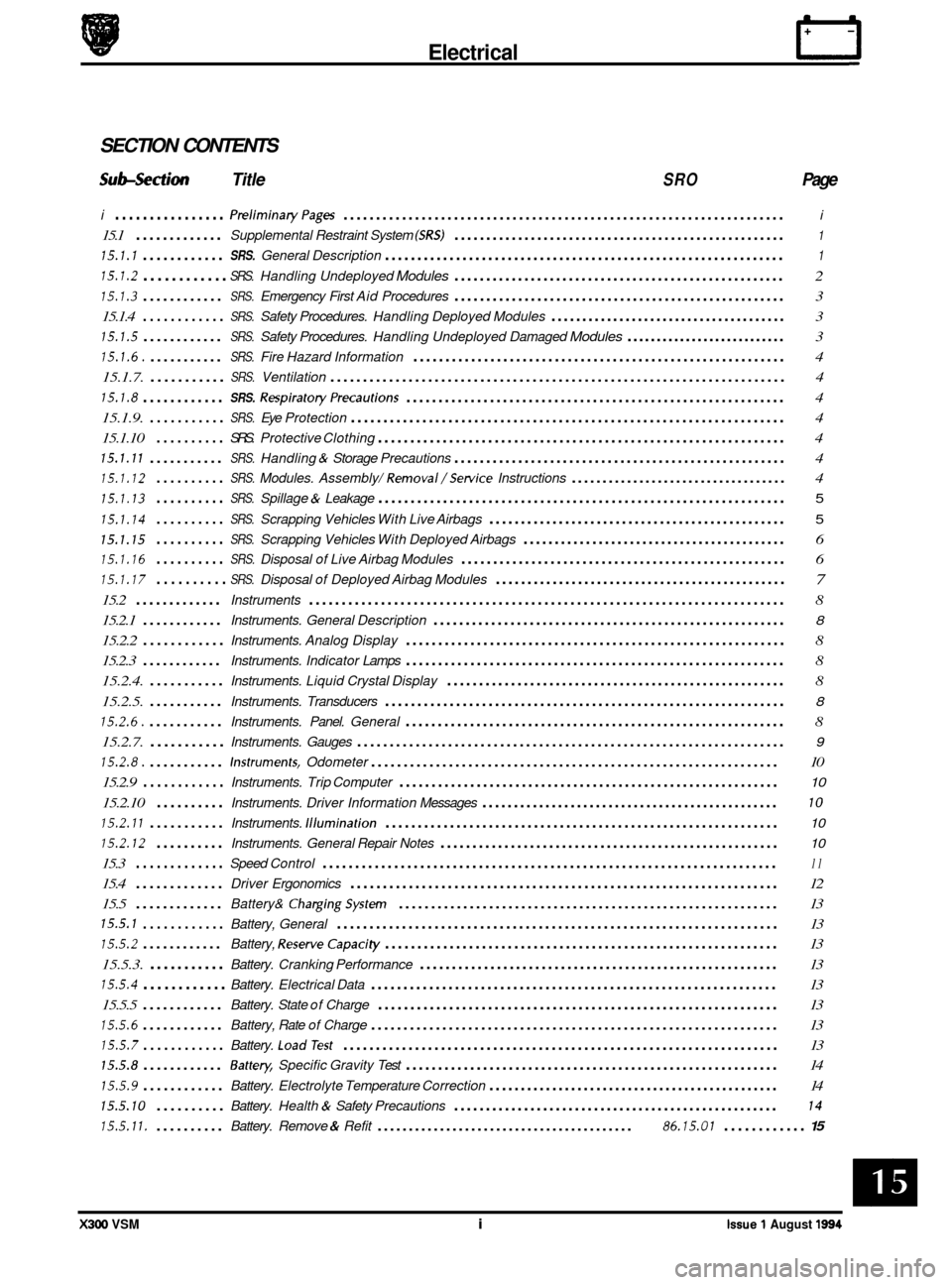
SECTION CONTENTS
Subsection Title SRO Page
i ................ PreliminaryPages .................................................................... i
15.1 ............. Supplemental Restraint System (SRS) .................................................... 1
15.1.1 ............ SRS. General Description .............................................................. 1
15.1.2 ............ SRS. Handling Undeployed Modules .................................................... 2
15.1.3 ............ SRS. Emergency First Aid Procedures .................................................... 3
15.1.4
............ SRS. Safety Procedures. Handling Deployed Modules ...................................... 3
15.1.5 ............ SRS. Safety Procedures. Handling Undeployed Damaged Modules ........................... 3
15.1.6. ........... SRS. Fire Hazard Information .......................................................... 4
15.1.7.
........... SRS. Ventilation ...................................................................... 4
15.1.8 ............ SRS. RespiratoryPrecautions ........................................................... 4
15.1.9.
........... SRS. Eye Protection ................................................................... 4
15.1.10
.......... SRS. Protective Clothing ............................................................... 4
15.1.11 ........... SRS. Handling & Storage Precautions .................................................... 4
15.1.12 .......... SRS. Modules. Assembly/ Removal/Setvice Instructions ................................... 4
15.1.13 .......... SRS. Spillage & Leakage ............................................................... 5
15.1.14 .......... SRS. Scrapping Vehicles With Live Airbags ............................................... 5
15.1.15 .......... SRS. Scrapping Vehicles With Deployed Airbags .......................................... 6
15.1.16 .......... SRS. Disposal of Live Airbag Modules ................................................... 6
15.1.17 .......... SRS. Disposal of Deployed Airbag Modules .............................................. 7
15.2 ............. Instruments ........................................................................\
. 8
15.2.1
............ Instruments. General Description ....................................................... 8
15.2.2 ............ Instruments. Analog Display ........................................................... 8
15.2.3
............ Instruments. Indicator Lamps ........................................................... 8
15.2.4.
........... Instruments. Liquid Crystal Display ..................................................... 8
15.2.5.
........... Instruments. Transducers .............................................................. 8
15.2.6. ........... Instruments. Panel. General ........................................................... 8
15.2.7.
........... Instruments. Gauges .................................................................. 9
15.2.8. ........... Instruments. Odometer ............................................................... 10
15.2.9
............ Instruments. Trip Computer ........................................................... 10
15.2.10 .......... Instruments. Driver Information Messages ............................................... 10
15.2.11 ........... Instruments. Illumination ............................................................. 10
15.2.12 .......... Instruments. General Repair Notes ..................................................... 10
15.3 ............. Speed Control ...................................................................... 11
15.4 ............. Driver Ergonomics .................................................................. 12
15.5
............. Battery& ChargingSystem ........................................................... 13
15.5.1 ............ Battery, General .................................................................... 13
15.5.2 ............ Battery, ReserveCapaci ty ............................................................. 13
15.5.3.
........... Battery. Cranking Performance ........................................................ 13
15.5.4 ............ Battery. Electrical Data ............................................................... 13
15.5.5
............ Battery. State of Charge .............................................................. 13
15.5.6 ............ Battery, Rate of Charge ............................................................... 13
15.5.7 ............ Battery. LoadTest ................................................................... 13
15.5.8 ............ Battey. Specific Gravity Test .......................................................... 14
15.5.9 ............ Battery. Electrolyte Temperature Correction .............................................. 14
15.5.10 .......... Battery. Health & Safety Precautions ................................................... 14
15.5.11. .......... Battery. Remove & Refit ......................................... 86.15.01 ............ 15
e
e
X300 VSM i Issue 1 August 1994
Page 340 of 521
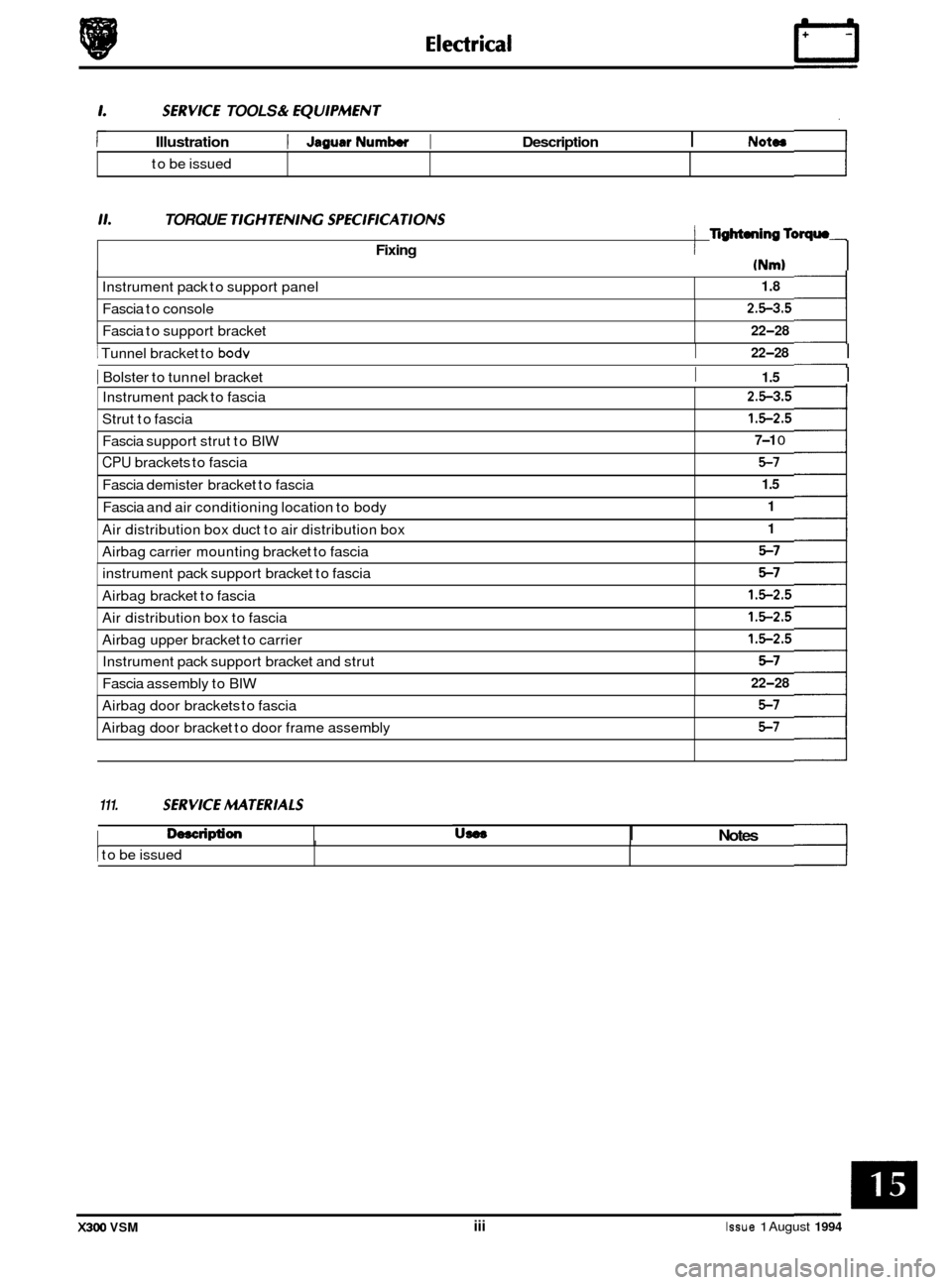
SERVKE TOOLS & EQU1PMENT
Illustration I JagusrNumbw I Description I NOtOS
Instrument pack to support panel
to
be issued
11. TORQUE TlGHTENlNG SPEC1FKATIONS
1.8
Fixing
Fascia to console
Fascia to support bracket
(Nm)
I TigM.ningToqrn
I
2.5-3.5
22-28
Instrument pack to fascia
Strut to fascia 2.5-3.5
1.5-2.5
I I 22-28 1 Tunnel bracket to bodv
I Bolster to tunnel bracket I 1.5 I
Fascia support strut to BIW 7-1 0
CPU brackets to fascia 5-7
Fascia demister bracket to fascia 1.5
Fascia and air conditioning location to body 1
Air distribution box duct to air distribution box
Airbag carrier mounting bracket to fascia 1
5-7
instrument pack support bracket to fascia
Airbag bracket to fascia 5-7
1.5-2.5
Air distribution box to fascia
Airbag upper bracket to carrier 1.5-2.5
1.5-2.5
Instrument pack support bracket and strut
Fascia assembly to BIW 5-7
22-28
111. SERVKE MTERlALS
0, Description
Airbag door brackets to fascia
Airbag door bracket to door frame assembly 5-7
5-7
US08 Notes I I
1 to be issued I I
X300 VSM iii Issue 1 August 1994
Page 343 of 521

15.1.2 Handling Undeployed Modules
The electrically-activated airbag module contains sodium azide and sodium nitrate which are poisonous and
extremely flammable substances.
Their contact with acid, water or heavy metals may produce harmful and irritating gases or combustible compounds.
The airbag module is
non-serviceable and must not be dismantled, punctured, incinerated or welded.
WARNING: DO NOT ATTEMPT ANY REPAIRS TO THE AIRBAG MODULE.
Never measure the resistance of the airbag module, as this may cause the airbag to deploy. Suspect modules must be returned to Jaguar Cars Ltd. or their importer for replacement.
Tampering or mishandling can result in personal injury.
Keep away from heat, sparks and open flames. Do not store
at temperatures exceeding 93O Celsius (200OF).
Keep away from electrical equipment as electrical contact may cause ignition.
Do not drop or impact airbag module.
Always position module 'cover
-up'.
Ensure that the connector is protected to prevent damage.
J76-1058
Fig. 1 The Driver-side Airbag
Store modules in a secure lockable cabinet.
Never position projectile material over the undeployed airbag as this can cause injury in the event of inadvertent
deployment.
Page 344 of 521
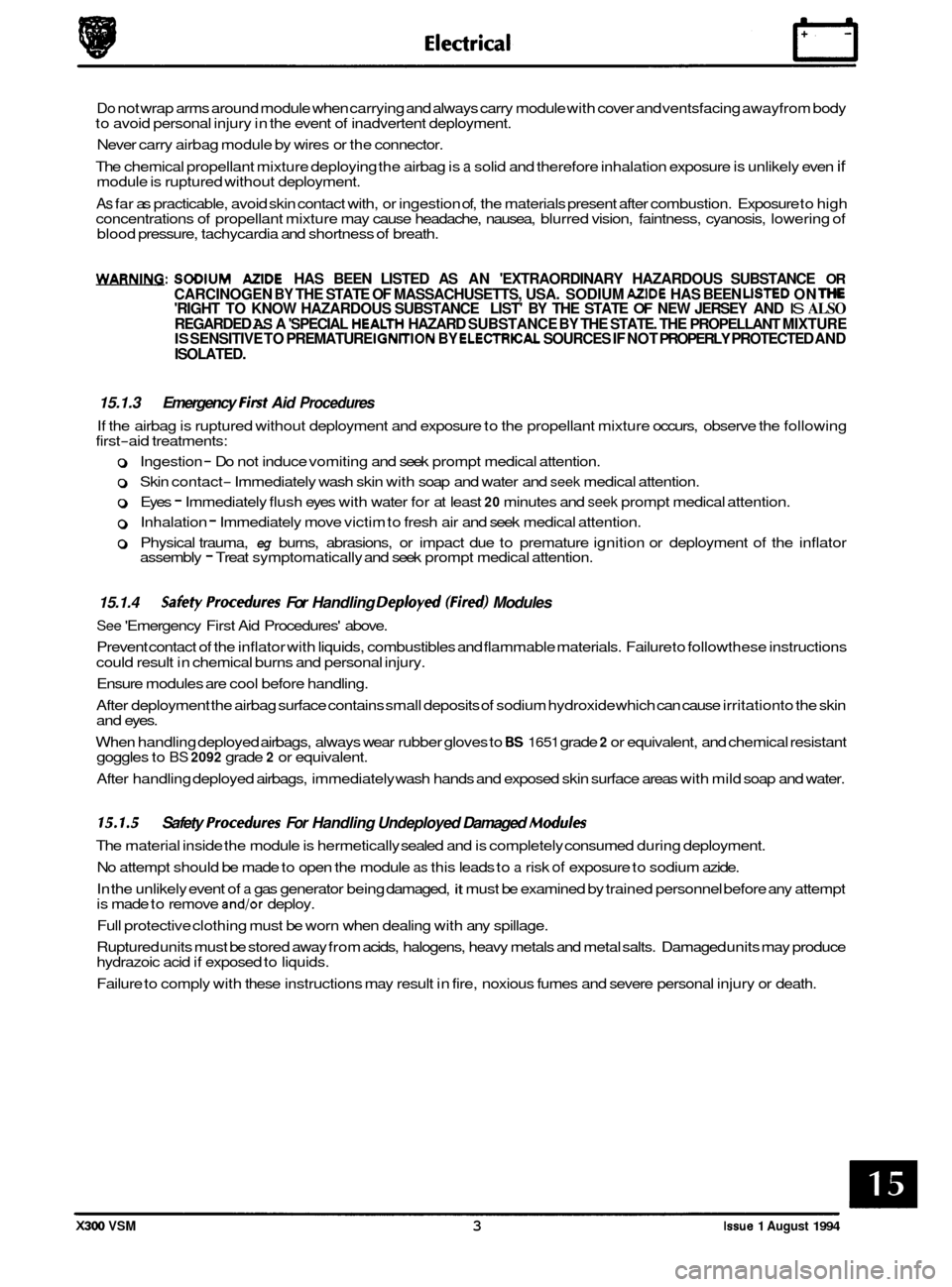
Do not wrap arms around module when carrying and always carry module with cover and ventsfacing awayfrom body
to avoid personal injury in the event of inadvertent deployment.
Never carry airbag module by wires or the connector.
The chemical propellant mixture deploying the airbag is
a solid and therefore inhalation exposure is unlikely even if module is ruptured without deployment.
As far as practicable, avoid skin contact with, or ingestion of, the materials present after combustion. Exposure to high
concentrations of propellant mixture may cause headache, nausea, blurred vision, faintness, cyanosis, lowering of
blood pressure, tachycardia and shortness of breath.
WARNING:SODlUM AZlDE HAS BEEN LISTED AS AN 'EXTRAORDINARY HAZARDOUS SUBSTANCE OR
CARCINOGEN BY THE STATE OF MASSACHUSETTS, USA. SODIUM AZlDE HAS BEEN LISTED ON THE 'RIGHT TO KNOW HAZARDOUS SUBSTANCE LIST' BY THE STATE OF NEW JERSEY AND IS ALSO
REGARDED AS A 'SPECIAL HEALTH HAZARD SUBSTANCE BY THE STATE. THE PROPELLANT MIXTURE IS SENSITIVE TO PREMATURE IGNITION BY ELECTRICAL SOURCES IF NOT PROPERLY PROTECTED AND
ISOLATED.
15.1.3 Emergency First Aid Procedures
If the airbag is ruptured without deployment and exposure to the propellant mixture occurs, observe the following
first-aid treatments:
0 Ingestion - Do not induce vomiting and seek prompt medical attention.
0 Skin contact- Immediately wash skin with soap and water and seek medical attention.
0 Eyes - Immediately flush eyes with water for at least 20 minutes and seek prompt medical attention.
0 Inhalation - Immediately move victim to fresh air and seek medical attention.
0 Physical trauma, eg burns, abrasions, or impact due to premature ignition or deployment of the inflator
assembly - Treat symptomatically and seek prompt medical attention.
0
15.1.4
See 'Emergency First Aid Procedures' above.
Prevent contact of the inflator with liquids, combustibles and flammable materials. Failure to followthese instructions
could result in chemical burns and personal injury.
Ensure modules are cool before handling.
After deployment the airbag surface contains small deposits of sodium hydroxide which can cause irritation to the skin
and eyes.
When handling deployed airbags, always wear rubber gloves to
BS 1651 grade 2 or equivalent, and chemical resistant
goggles to BS 2092 grade 2 or equivalent.
After handling deployed airbags, immediately wash hands and exposed skin surface areas with mild soap and water.
Sakty Procedures For Handling Depbyed (Fid) Modules
15.1.5 Safety Procedures For Handling Undeployed Damaged Modules
The material inside the module is hermetically sealed and is completely consumed during deployment.
No attempt should be made to open the module
as this leads to a risk of exposure to sodium azide.
In the unlikely event of
a gas generator being damaged, it must be examined by trained personnel before any attempt
is made to remove and/or deploy.
Full protective clothing must be worn when dealing with any spillage.
Ruptured units must be stored away from acids, halogens, heavy metals and metal salts. Damaged units may produce
hydrazoic acid if exposed to liquids.
Failure to comply with these instructions may result in fire, noxious fumes and severe personal injury or death.
X300 VSM 3 Issue 1 August 1994
Page 345 of 521
rl Electrical
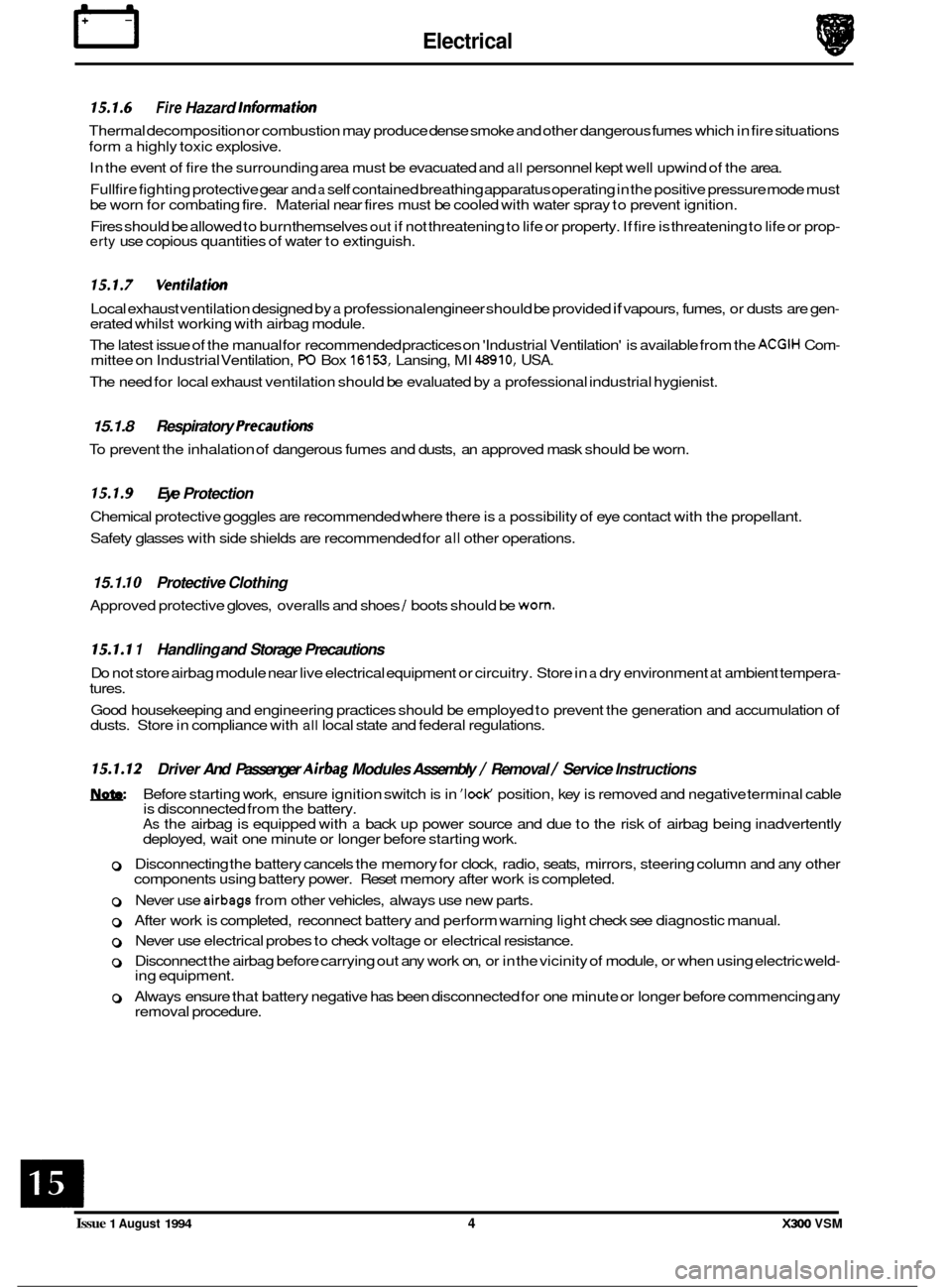
15.1.6 Fire Hazard Infonnath
Thermal decomposition or combustion may produce dense smoke and other dangerous fumes which in fire situations
form
a highly toxic explosive.
In the event of fire the surrounding area must be evacuated and
all personnel kept well upwind of the area.
Full fire fighting protective gear and
a self contained breathing apparatus operating in the positive pressure mode must
be worn for combating fire. Material near fires must be cooled with water spray to prevent ignition.
Fires should be allowed to burn themselves
out if not threatening to life or property. If fire is threatening to life or prop- erty use copious quantities of water to extinguish.
15.1.7 Ventilath
Local exhaust ventilation designed by a professional engineer should be provided if vapours, fumes, or dusts are gen- erated whilst working with airbag module.
The latest issue of the manual for recommended practices on 'Industrial Ventilation' is available from the
ACGIH Com- mittee on Industrial Ventilation, PO Box 16153, Lansing, MI 48910, USA.
The need for local exhaust ventilation should be evaluated by a professional industrial hygienist.
15.1.8 Respiratory Precauth
To prevent the inhalation of dangerous fumes and dusts, an approved mask should be worn.
15.1.9 Eye Protection
Chemical protective goggles are recommended where there is a possibility of eye contact with the propellant.
Safety glasses with side shields are recommended for
all other operations.
15.1. I0 Protective Clothing
Approved protective gloves, overalls and shoes / boots should be worn.
15.1.1 1 Handling and Storage Precautions
Do not store airbag module near live electrical equipment or circuitry. Store in a dry environment at ambient tempera-
tures.
Good housekeeping and engineering practices should be employed to prevent the generation and accumulation of
dusts. Store in compliance with
all local state and federal regulations.
15.1.12 Driver And Passenger Airbag Modules Assembly / Removal / Service Instructions
Before starting work, ensure ignition switch is in 'IocK position, key is removed and negative terminal cable
is disconnected from the battery.
As the airbag is equipped with a back up power source and due to the risk of airbag being inadvertently
deployed, wait one minute or longer before starting work.
0 Disconnecting the battery cancels the memory for clock, radio, seats, mirrors, steering column and any other
components using battery power. Reset memory after work is completed.
0 Never use airbags from other vehicles, always use new parts.
0 After work is completed, reconnect battery and perform warning light check see diagnostic manual.
0 Never use electrical probes to check voltage or electrical resistance.
0 Disconnect the airbag before carrying out any work on, or in the vicinity of module, or when using electric weld- ing equipment.
0 Always ensure that battery negative has been disconnected for one minute or longer before commencing any
removal procedure.
EB
Issue 1 August 1994 4 X300 VSM