fuel cap JAGUAR XJ6 1994 2.G User Guide
[x] Cancel search | Manufacturer: JAGUAR, Model Year: 1994, Model line: XJ6, Model: JAGUAR XJ6 1994 2.GPages: 521, PDF Size: 17.35 MB
Page 156 of 521
Automatic Transmission (V12 & AJl6 Supercharged) Pomrtrain
8.2.1 GENERAL DESCRIPTION
This section provides information relating to the Powertrain 4L80-E transmissions fitted to the 4,O liter supercharged
engine (4,OL SC) and to the 6,O liter engine (6,OL).
The Powertrain 4L80-E is a four-speed, high torque capacity, electronically controlled automatic transmission, which
comprises a torque converter with lock-up direct drive clutch and three planetary gear sets. Five multiple diskclutches,
one intermediate sprag clutch assembly, two roller clutch assemblies and two band assemblies provide the drive el- ements necessary for correct sequential gear engagement and operation.
The torque converter containing
a pump, a turbine (rotor), a stator assembly, and a clutch pressure disksplined to the
turbine, acts as a fluid coupling for smooth torque transmission from the engine. The converter also supplies addi- tional torque multiplication when necessary, and the torque converter clutch (TCC) pressure disk provides a mechan- ical direct drive or 'lock-up' above a certain speed in top gear for greater fuel economy.
Gearshift operations are controlled from the Transmission Control Module (TCM), which governs the electronically
controlled valve body situated within the transmission.
Three planetary gear sets provide reverse and the four forward ratios, the changing of which is fully automatic in rela
- tion to load, vehicle speed and throttle opening. The Transmission Control Module receives and integrates various ve- hicle sensor input signals, and transmits operating signals to the solenoids located in the control valve assembly.
These solenoids govern the transmission operating pressures, up-shift and down-shift gear selection patterns and
also the torque converter clutch operation by pulse width modulated control.
8.2.1.1 Gear Ranges
Selectable gear positions are: P - Park, R - Reverse, N - Neutral, D - Drive, 3, 2.
P - Park position of the shift lever provides a mechanical locking of the output shaft of the transmission, and as such,
must only be engaged when the the vehicle is stationary. In addition, and for
extra safety, the handbrake should also
be applied. It is necessary to have the ignition ON and the footbrake applied to move the shift lever from the Park
position. For ignition key removal the shift lever must be in the Park position. The engine can be started in the Park
position.
R - Reverse enables the vehicle to be operated in a rearwards direction. The engine cannot be started in the Reverse
position.
N
-Neutral position enables the engine to be started and operated without driving the vehicle. It also allows the vehicle
to be moved manually for access, ie for removal of the propeller shaft.
D
-Drive position allows the automatic selection of all four forward gear ratios during normal driving conditions for
maximum efficiency and fuel economy. On acceleration, down-shifts are obtained by depressing the accelerator pedal
or by manual selection. The engine cannot be started in this position.
3
- Manual third position allows automatic operation of the three lower gear ratios but inhibits selection of the fourth
ratio. This position is used for towing a trailer or negotiating hilly terrain when greater engine braking control is re- quired. The engine cannot be started in this position.
2 - Manual second position allows automatic operation of the two lower gear ratios but inhibits selection of the third
and fourth ratios. This position is used for heavy traffic congestion or negotiating hilly terrain when even greater en
- gine braking control is required than is provided by manual third. This ratio may be selected at any vehicle speed - even if the transmission is in third or fourth ratio, the transmission will immediately down-shift to second gear pro- vided the vehicle speed is below 137 km / h (85 mile / h). The engine cannot be started in this position.
N.g!b: With the Performance Mode switch in the NORMAL position, the vehicle will pull away in second gear. How- ever, if more than 75 per cent of throttle is applied when the vehicle speed is between zero and 13 km/ h (8 mile / h), then first gear will be selected. From 13 to 61 km/ h (8 to 38 mile/ h) first gear is obtainable by 'kick-down'.
In 'sport' mode thevehicle pulls away in first gear and the transmission operatesfully in all four forward gears.
X300 VSM 1 Issue 1 August 1994
Page 250 of 521
Body Components & Trim .
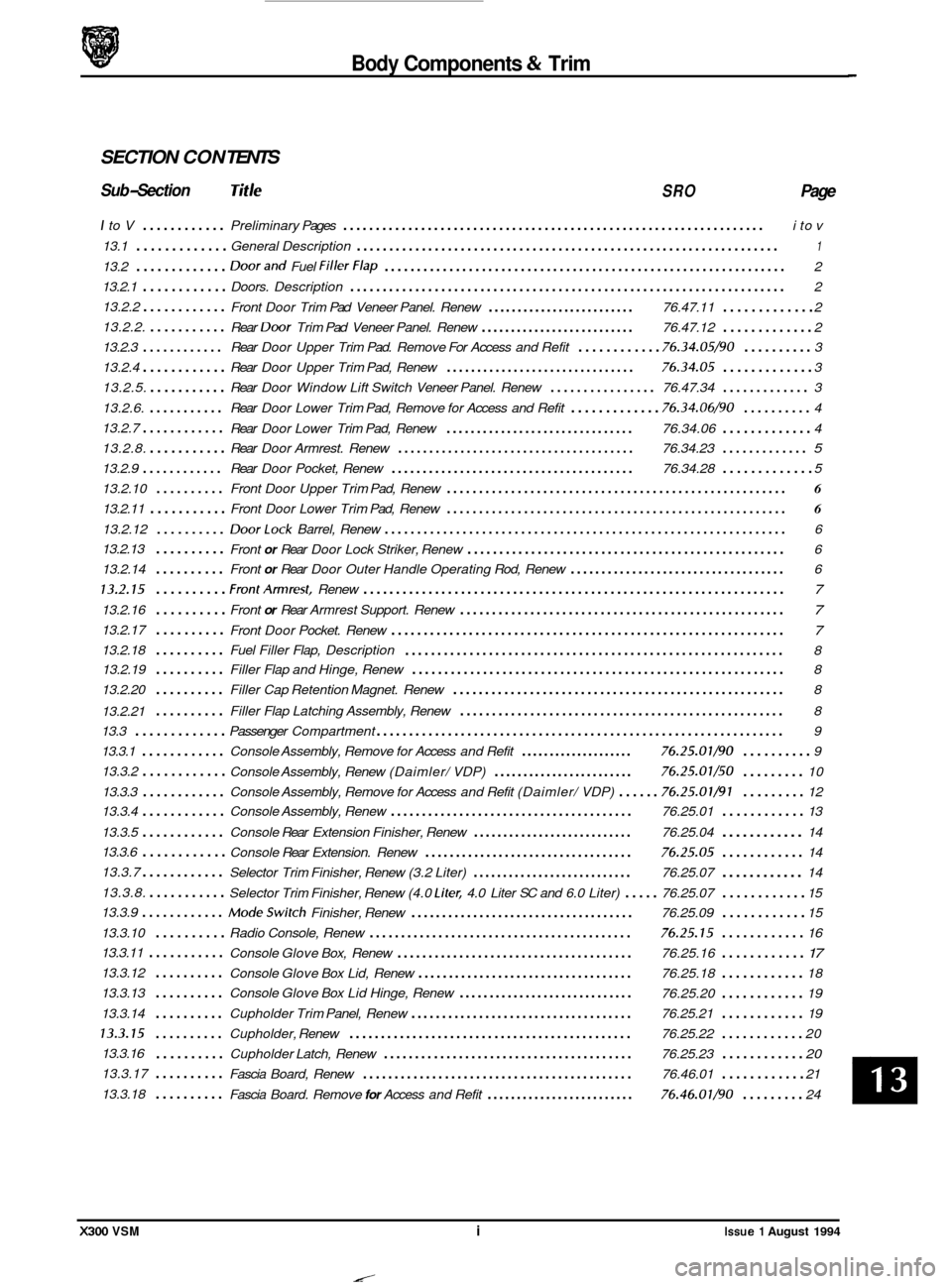
SECTION CON TENTS
Sub-Section Tit /e SRO Page
I to V ............ Preliminary Pages ................................................................. i to v
13.1
............. General Description ................................................................. 1
13.2 ............. Doorand Fuel FillerFlap .............................................................. 2
13.2.1
............ Doors. Description ................................................................... 2
13.2.2
............ Front Door Trim Pad Veneer Panel. Renew ......................... 76.47.11 ............. 2
13.2.2.
...........
13.2.3 ............ Rear Door Upper Trim Pad. Remove For Access and Refit ............ 76.34.05/90 .......... 3
13.2.5.
........... Rear Door Window Lift Switch Veneer Panel. Renew ................ 76.47.34 ............. 3
13.2.6.
........... Rear Door Lower Trim Pad, Remove for Access and Refit ............. 76.34.06/90 .......... 4
13.2.7
............ Rear Door Lower Trim Pad, Renew ............................... 76.34.06 ............. 4
13.2.8.
........... Rear Door Armrest. Renew ...................................... 76.34.23 ............. 5
13.2.9 ............ Rear Door Pocket, Renew ....................................... 76.34.28 ............. 5
13.2.10 .......... Front Door Upper Trim Pad, Renew ..................................................... 6
13.2.11 ........... Front Door Lower Trim Pad, Renew ..................................................... 6
13.2.12 .......... DoorLock Barrel, Renew .............................................................. 6
13.2.13 Front
or Rear Door Lock Striker, Renew .................................................. 6
13.2.14
.......... Front or Rear Door Outer Handle Operating Rod, Renew ................................... 6
13.2.15 .......... FrontArmrest, Renew ................................................................. 7
13.2.16 .......... Front or Rear Armrest Support. Renew ................................................... 7
13.2.17 .......... Front Door Pocket. Renew ............................................................. 7
........................................................... 8
Rear
Door Trim
Pad Veneer Panel. Renew .......................... 76.47.12 ............. 2
13.2.4
............ Rear Door Upper Trim Pad, Renew ............................... 76.34.05 ............. 3
..........
13.2.18 .......... Fuel Filler Flap, Description
13.2.19
.......... Filler Flap and Hinge, Renew .......................................................... 8
13.2.20
.......... Filler Cap Retention Magnet. Renew .................................................... 8
.......... Filler Flap Latching Assembly, Renew ................................................... 8
13.2.21
13.3
............. Passenger Compartment ............................................................... 9
13.3.1
............ Console Assembly, Remove for Access and Refit .................... 76.25.01/90 .......... 9
13.3.2
............ Console Assembly, Renew (Daimler/ VDP) ........................ 76.25.07/50 ......... 10
13.3.3
............ Console Assembly, Remove for Access and Refit (Daimler/ VDP) ...... 76.25.01/91 ......... 12
13.3.4
............ Console Assembly, Renew ....................................... 76.25.01 ............ 13
13.3.5
............ Console Rear Extension Finisher, Renew ........................... 76.25.04 14
Selector Trim Finisher, Renew (3.2 Liter)
........................... 76.25.07 ............ 14
Modeswitch Finisher, Renew .................................... 76.25.09 ............ 15
13.3.10
.......... Radio Console, Renew .......................................... 76.25.15 ............ 16
Console Glove Box, Renew
...................................... 76.25.16 ............ 17
Console Glove Box Lid, Renew ................................... 76.25.18 ............ 18
.......... Console Glove Box Lid Hinge, Renew ............................. 76.25.20 ............ 19
13.3.14
.......... Cupholder Trim Panel, Renew .................................... 76.25.21 ............ 19
13.3.15 .......... Cupholder, Renew ............................................. 76.25.22 ............ 20
.......... Cupholder Latch, Renew ........................................ 76.25.23 ............ 20
Fascia Board, Renew ........................................... 76.46.01 ............ 21
13.3.6
............ Console
Rear Extension. Renew .................................. 76.25.05 ............ 14
13.3.7
............
13.3.8. ........... Selector Trim Finisher, Renew (4.0 Liter, 4.0 Liter SC and 6.0 Liter) ..... 76.25.07 ............ 15
13.3.9
............
............
13.3.11 ...........
13.3.12
13.3.13 ..........
13.3.16
13.3.17
..........
13.3.18 .......... Fascia Board. Remove for Access and Refit ......................... 76.46.01/90 ......... 24
X300 VSM i Issue 1 August 1994
Page 256 of 521
Body Components & Trim
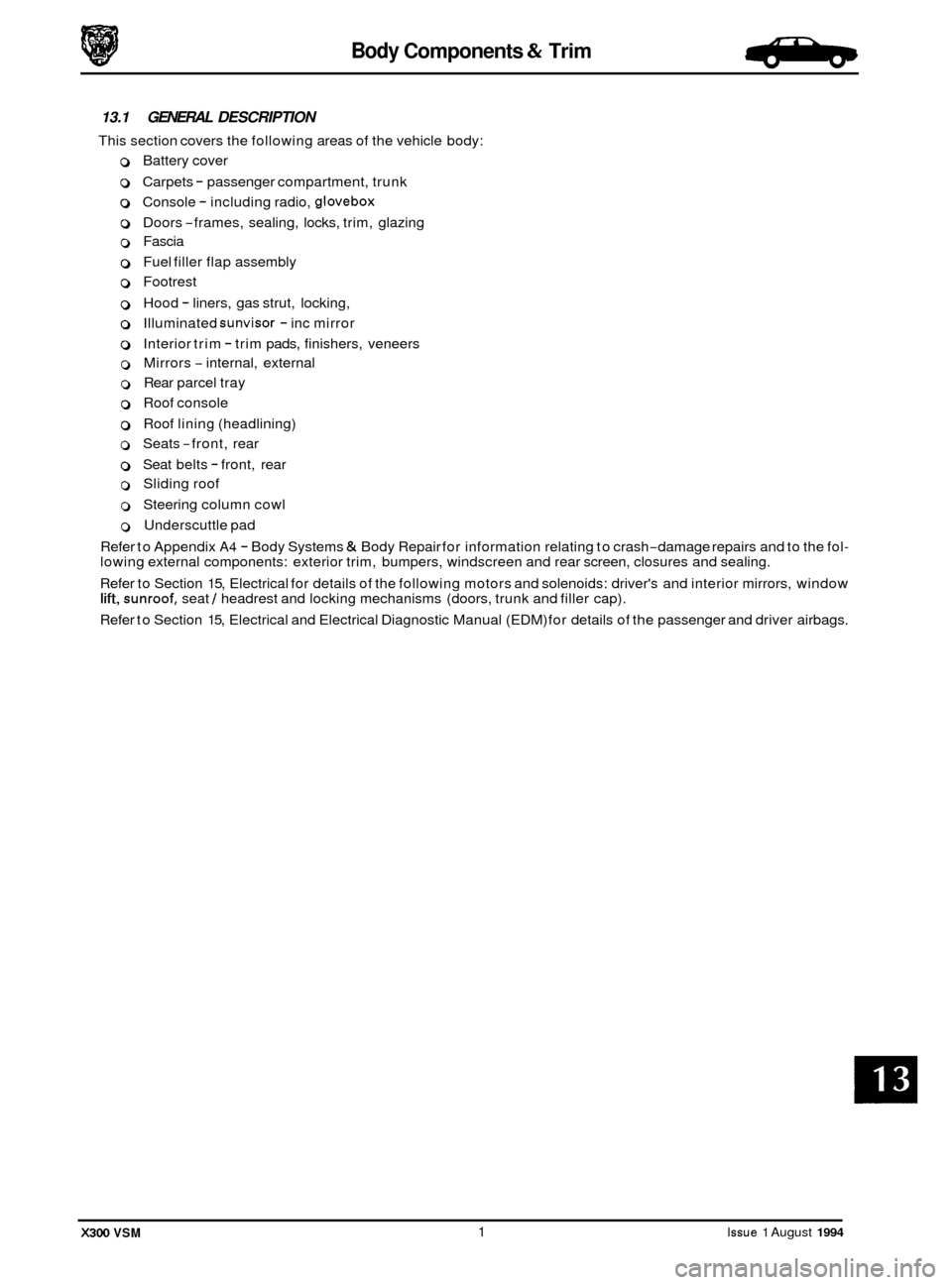
13.1 GENERAL DESCRIPTION
This section covers the following areas of the vehicle body:
0 Battery cover
0 Carpets - passenger compartment, trunk
0 Console - including radio, glovebox
0 Doors -frames, sealing, locks, trim, glazing
0 Fascia
0 Fuel filler flap assembly
0 Footrest
0 Hood - liners, gas strut, locking,
0 Illuminated sunvisor - inc mirror
0 Interior trim - trim pads, finishers, veneers
0 Mirrors - internal, external
0 Rear parcel tray
0 Roof console
0 Roof lining (headlining)
o Seats -front, rear -
0 Seat belts - front, rear
0 Sliding roof
0 Steering column cowl
0 Underscuttle pad
Refer to Appendix
A4 - Body Systems & Body Repair for information relating to crash-damage repairs and to the fol- lowing external components: exterior trim, bumpers, windscreen and rear screen, closures and sealing.
Refer to Section 15, Electrical for details of the following motors and solenoids: driver's and interior mirrors, window
lift, sunroof, seat / headrest and locking mechanisms (doors, trunk and filler cap).
Refer to Section 15, Electrical and Electrical Diagnostic Manual (EDM) for details of the passenger and driver airbags.
X300 VSM 1 Issue 1 August 1994
Page 263 of 521

13.2.18 Fuel Filler Flap, Description
The fuel filler flap comprises a hinged flap attached to the body decking panel by two M5 nuts; the flap incorporates
a rubber buffer, snap
-in striker, hinge spring and the fuel cap stowage magnet. The rubber fuel bowl moulding is at- tached via a steel armature to the body reinforcement panel by five M5 nuts and is retained at the filler neck by a clip.
The mating drain tube is fitted with an internal filter.
The fuel filler flap latch mechanism attached
tothe fuel bowl armature bytwo M5 nuts, includes a locking pin and actua- tor which are both serviceable items. The latch actuator operates independently from the central locking system; it is
driven directly
by the security and locking control module. Locking of the fuel filler flap is achieved only by operation
of the key or by the remote rf transmitter.
13.2.19 Filler Flap and Hinge, Renew
. Disconnect vehicle battery ground lead.
With filler cap open, remove hinge securing screws, fuel
. To refit, carry out reversal of the above procedure.
filler cap
and remove flap and hinge assembly.
13.2.20 Filler Cap Retention Magnet, Renew
. With filler flap open, use a blunt flat bladed implement and
CAUTION: Take care not to damage paintwork.
. To refit, carry out reversal of the above procedure.
Disconnect
vehicle battery ground lead.
remove the magnet assembly.
13.2.21 Filler Flap latching Assembly, Renew
. Disconnect vehicle battery ground lead.
. Depress the latching assembly retaining nut and remove
CAUTION: Take care not to damage paintwork.
. To refit, carry out reversal of the above procedure.
the
assembly.
1. Hingedflap 2. Striker 3. Hinge spring 4. Stowage magnet 5. Fuelbowl
Fig. 1 Fuel Filler Flap
X300 VSM Issue 1 August 1994 8
e
0
0
Page 384 of 521
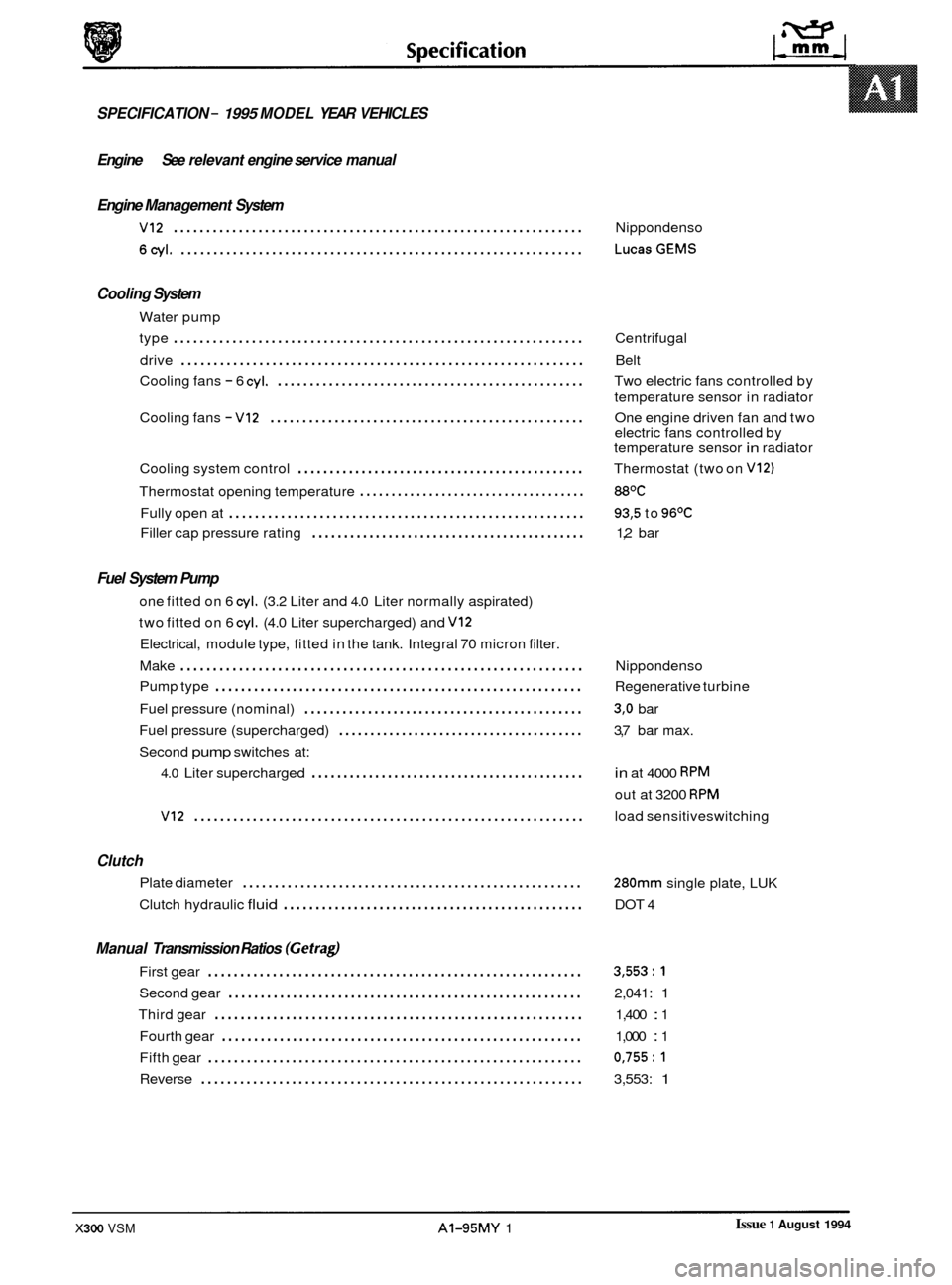
SPECIFICATION - 1995 MODEL YEAR VEHICLES
Engine See relevant engine service manual
Engine Management System
VI2 ............................................................... Nippondenso
6cyl. .............................................................. LucasGEMS
Cooling System
Water pump
type
............................................................... Centrifugal
Cooling fans
- 6 cyl. ................................................ Two electric fans controlled by
Cooling fans
- VI2 ................................................. One engine driven fan and two
Cooling system control
............................................. Thermostat (two on V12)
Thermostat opening temperature .................................... 88OC
Fully open at ....................................................... 93,5 to 96OC
Filler cap pressure rating ........................................... 1,2 bar
drive
.............................................................. Belt
temperature sensor in radiator
electric fans controlled by
temperature sensor
in radiator
Fuel System Pump
one fitted on 6 cyl. (3.2 Liter and 4.0 Liter normally aspirated)
two fitted on 6
cyl. (4.0 Liter supercharged) and VI2
Electrical, module type, fitted in the tank. Integral 70 micron filter.
Make
.............................................................. Nippondenso
Fuel pressure (nominal)
............................................ 3,O bar
Second
pump switches at:
Pump
type
......................................................... Regenerative turbine
Fuel pressure (supercharged)
....................................... 3,7 bar max.
4.0 Liter supercharged ........................................... in at 4000 RPM
out at 3200 RPM
VI2 ............................................................ load sensitiveswitching
Clutch
Plate diameter .....................................................
Clutch hydraulic fluid ............................................... DOT 4
280mm single plate, LUK
Manual Transmission Ratios (Gefragl
First gear .......................................................... 3,553:l
Second gear ....................................................... 2,041: 1
Third gear ......................................................... 1,400 : 1
Fourth gear
........................................................ 1,000 : 1
Fifth gear
.......................................................... 0,755:l
Reverse ........................................................... 3,553: 1
Issue 1 August 1994 X300 VSM AI-95MY 1
Page 391 of 521
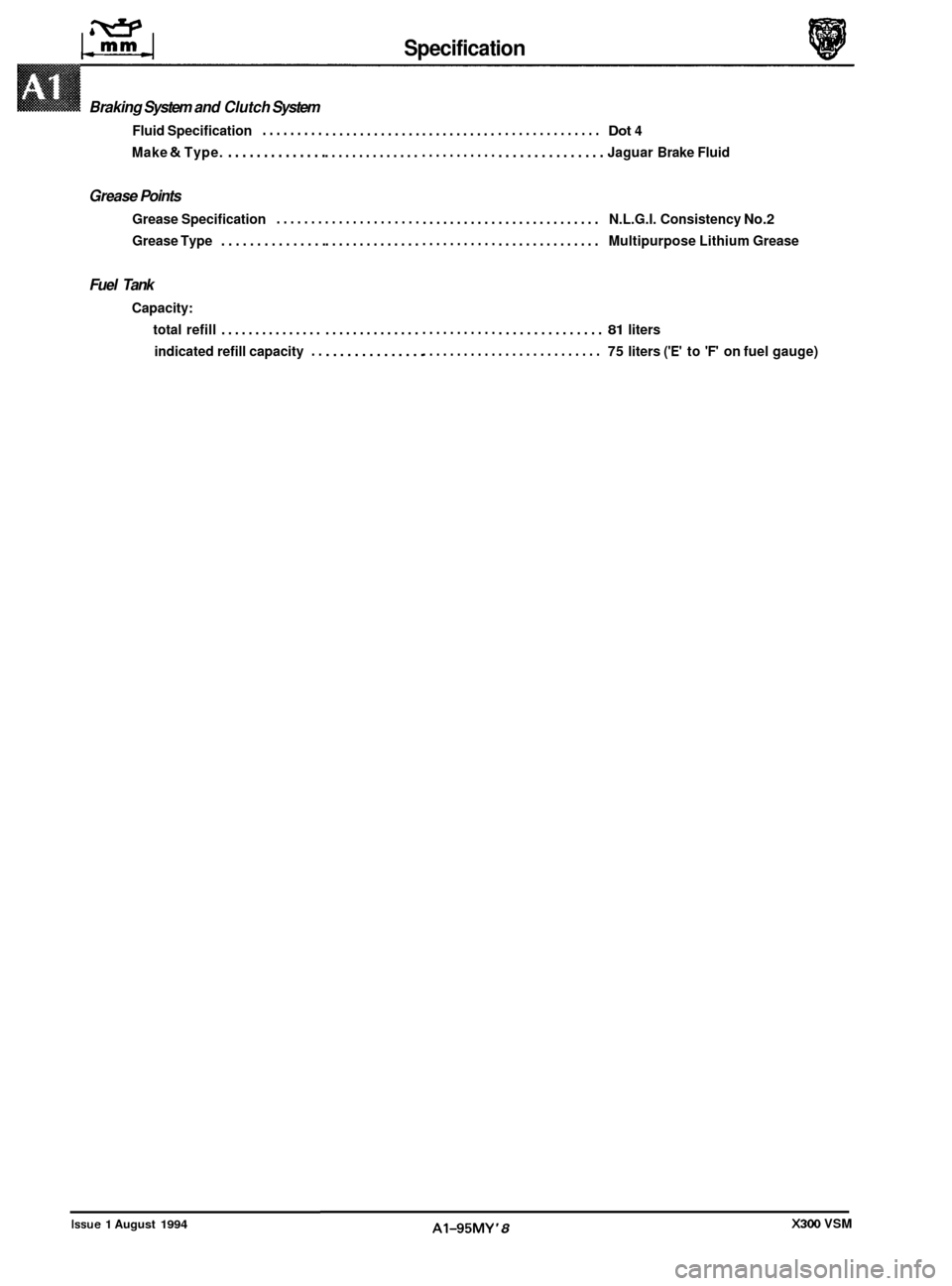
Braking System and Clutch System
Fluid Specification .........
Make & Type. ..............
Grease Points
Grease Specification .......
Grease Type ...............
Fuel Tank
Capacity:
total refill
...............
indicated refill capacity . .
Issue 1 August 1994
Specificat ion
..............
..............
..............
..............
..............
..............
...........
...........
...........
...........
...........
........... ...............
...............
...............
...............
...............
...............
Dot 4
Jaguar
Brake Fluid
N.L.G.I. Consistency
No.2
Multipurpose Lithium Grease
81 liters
75 liters
('E' to 'F' on fuel gauge)
A1-95MY '8 X300 VSM
Page 413 of 521
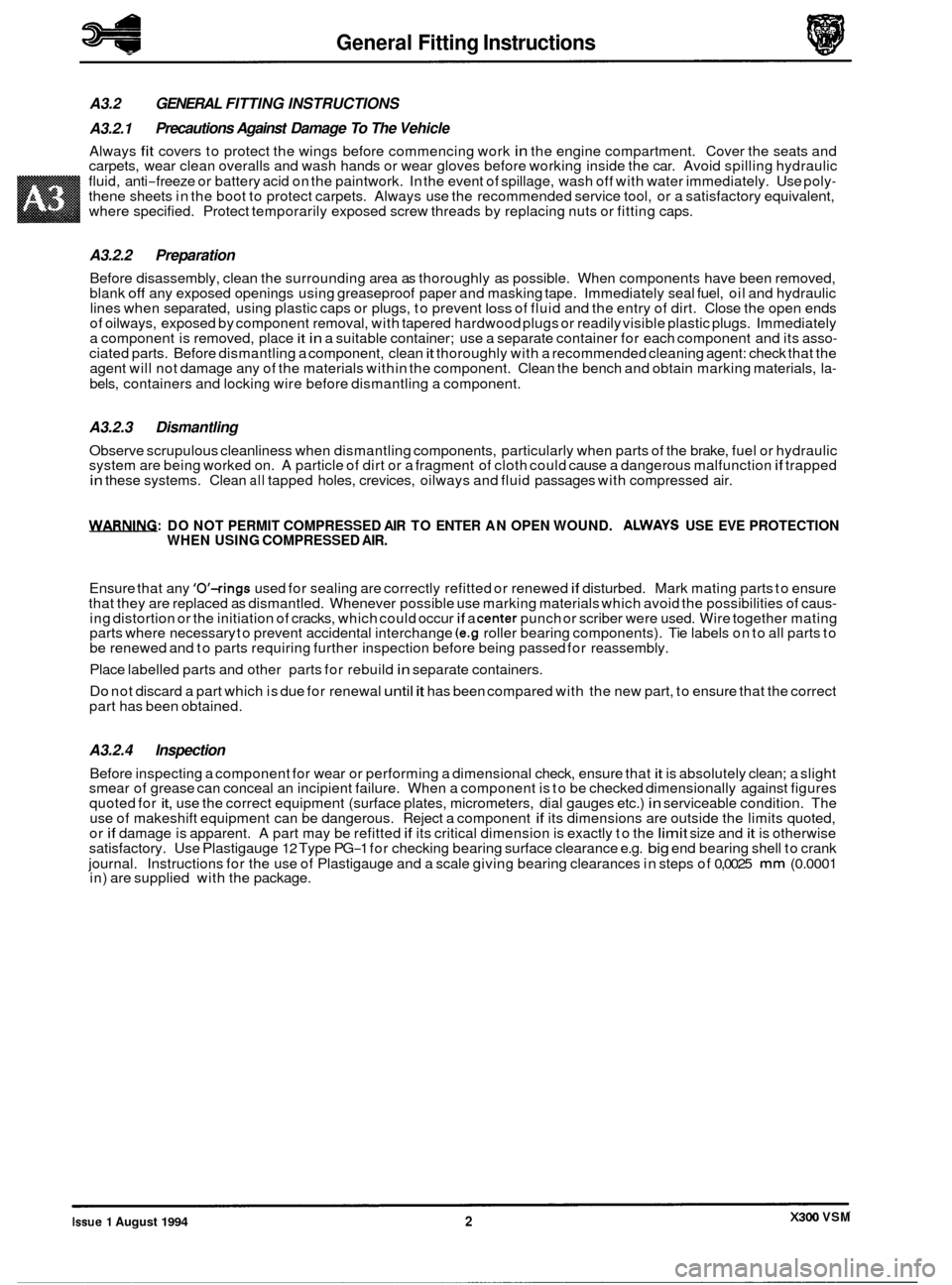
General Fitting Instructions
A3.2 GENERAL FITTING INSTRUCTIONS
A3.2.1
Always fit covers to protect the wings before commencing work in the engine compartment. Cover the seats and
carpets, wear clean overalls and wash hands or wear gloves before working inside the car. Avoid spilling hydraulic
fluid, anti
-freeze or battery acid on the paintwork. In the event of spillage, wash off with water immediately. Use poly- thene sheets in the boot to protect carpets. Always use the recommended service tool, or a satisfactory equivalent,
where specified. Protect temporarily exposed screw threads by replacing nuts or fitting caps.
Precautions Against Damage To The Vehicle
A3.2.2 Preparation
Before disassembly, clean the surrounding area as thoroughly as possible. When components have been removed,
blank off any exposed openings using greaseproof paper and masking tape. Immediately seal fuel, oil and hydraulic
lines when separated, using plastic caps or plugs, to prevent loss of fluid and the entry of dirt. Close the open ends
of oilways, exposed by component removal, with tapered hardwood plugs or readily visible plastic plugs. Immediately
a component is removed, place
it in a suitable container; use a separate container for each component and its asso- ciated parts. Before dismantling a component, clean it thoroughly with a recommended cleaning agent: check that the
agent will not damage any of the materials within the component. Clean the bench and obtain marking materials, la-
bels, containers and locking wire before dismantling a component.
A3.2.3 Dismantling
Observe scrupulous cleanliness when dismantling components, particularly when parts of the brake, fuel or hydraulic
system are being worked on. A particle of dirt or a fragment of cloth could cause a dangerous malfunction if trapped in these systems. Clean all tapped holes, crevices, oilways and fluid passages with compressed air.
WRNIFLG: DO NOT PERMIT COMPRESSED AIR TO ENTER AN OPEN WOUND. ALWAYS USE EVE PROTECTION
WHEN USING COMPRESSED AIR.
Ensure that any 'O'-rings used for sealing are correctly refitted or renewed if disturbed. Mark mating parts to ensure
that they are replaced as dismantled. Whenever possible use marking materials which avoid the possibilities of caus- ing distortion or the initiation of cracks, which could occur if a center punch or scriber were used. Wire together mating
parts where necessary to prevent accidental interchange (e.g roller bearing components). Tie labels on to all parts to
be renewed and to parts requiring further inspection before being passed for reassembly.
Place labelled parts and other parts for rebuild
in separate containers.
Do not discard a part which is due for renewal until it has been compared with the new part, to ensure that the correct
part has been obtained.
A3.2.4 Inspection
Before inspecting a component for wear or performing a dimensional check, ensure that it is absolutely clean; a slight
smear of grease can conceal an incipient failure. When a component is to be checked dimensionally against figures
quoted for
it, use the correct equipment (surface plates, micrometers, dial gauges etc.) in serviceable condition. The
use of makeshift equipment can be dangerous. Reject a component if its dimensions are outside the limits quoted,
or if damage is apparent. A part may be refitted if its critical dimension is exactly to the limit size and it is otherwise
satisfactory. Use Plastigauge 12 Type PG-1 for checking bearing surface clearance e.g. big end bearing shell to crank
journal. Instructions for the use of Plastigauge and a scale giving bearing clearances in steps of
0,0025 mm (0.0001
in) are supplied with the package.
0
0
0
X300 VSM Issue 1 August 1994 2
Page 484 of 521
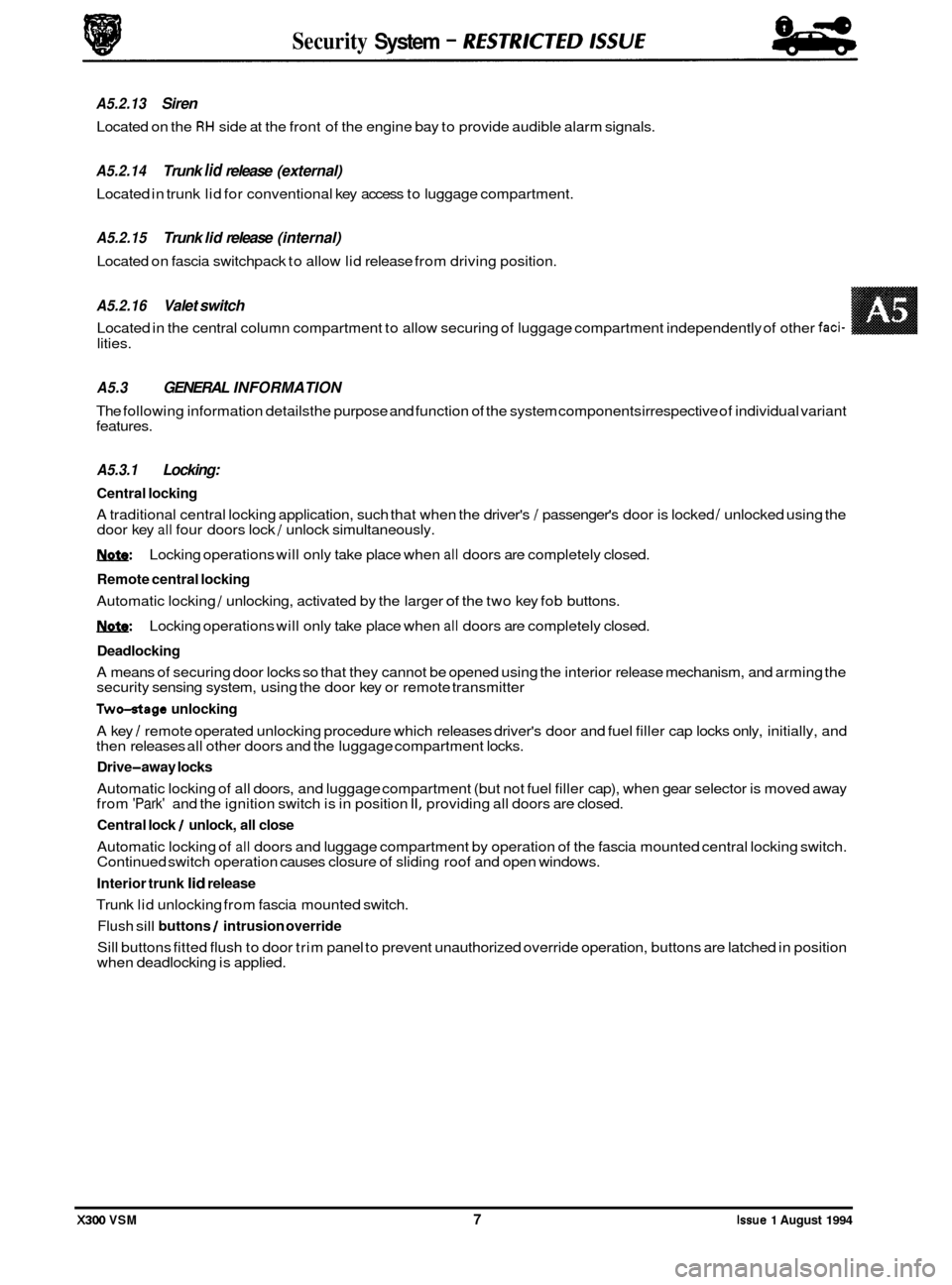
lities.
A5.3 GENERAL INFORMATION
The following information detailsthe purpose and function of the system components irrespective of individual variant
features.
A5.3.1 Locking:
Central locking
A traditional central locking application, such that when the driver's / passenger's door is locked / unlocked using the
door key all four doors lock / unlock simultaneously.
1ynfe: Locking operations will only take place when all doors are completely closed.
Remote central locking
Automatic locking / unlocking, activated by the larger of the two key fob buttons.
1ynfe: Locking operations will only take place when all doors are completely closed.
Deadlocking
A means of securing door locks so that they cannot be opened using the interior release mechanism, and arming the
security sensing system, using the door key or remote transmitter
Two-otage unlocking
A key / remote operated unlocking procedure which releases driver's door and fuel filler cap locks only, initially, and
then releases all other doors and the luggage compartment locks.
Drive-away locks
Automatic locking of all doors, and luggage compartment (but not fuel filler cap), when gear selector is moved away
from 'Park' and the ignition switch is in position II, providing all doors are closed.
Central lock / unlock, all close
Automatic locking of all doors and luggage compartment by operation of the fascia mounted central locking switch.
Continued switch operation causes closure of sliding roof and open windows.
Interior trunk lid release
Trunk lid unlocking from fascia mounted switch.
Flush sill buttons / intrusion override
Sill buttons fitted flush to door trim panel to prevent unauthorized override operation, buttons are latched in position
when deadlocking is applied.
Security System - RESTRKTED lSSUE
A5.2.13 Siren
Located on the RH side at the front of the engine bay to provide audible alarm signals.
A5.2.14 Trunk lid release (external)
Located in trunk lid for conventional key access to luggage compartment.
A5.2.15 Trunk lid release (internal)
Located on fascia switchpack to allow lid release from driving position.
A5.2.16 Valet switch
Located in the central column compartment to allow securing of luggage compartment independently of other faci-
X300 VSM 7 Issue 1 August 1994
Page 486 of 521
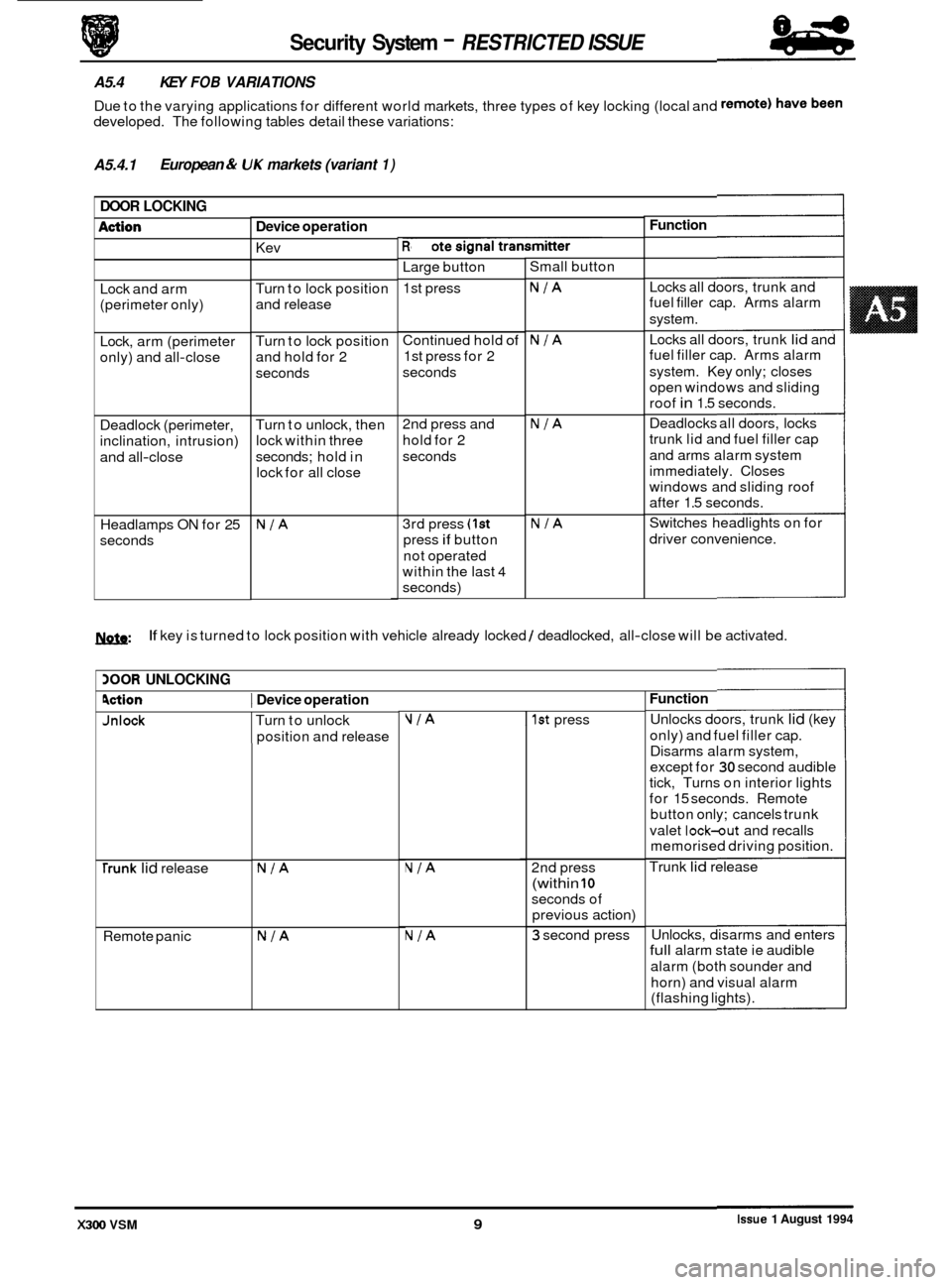
Jnlock Turn to unlock
position and release VIA I 1st press
Security System - RESTRICTED ISSUE
A5.4 KEY FOB VARIATIONS
Due to the varying applications for different world markets, three types of key locking (local and
developed. The following tables detail these variations:
A5.4.1 European & UK markets
(variant 1)
DOOR LOCKING
Function
Device operation
Remote signal transmitter
Kev -
Large button
1st press Small
button
Locks all doors, trunk and
fuel filler cap. Arms alarm
system.
Locks all doors, trunk
lid and
fuel filler cap. Arms alarm
system. Key only; closes
open windows and sliding
roof
in 1.5 seconds.
Deadlocks all doors, locks
trunk lid and fuel filler cap
and arms alarm system
immediately. Closes
windows and sliding roof
after 1.5 seconds.
Switches headlights on for
driver convenience.
Lock
and arm
(perimeter only)
NIA Turn to lock position
and release
Continued hold
of
1st press for 2
seconds NIA
NIA
Lock, arm (perimeter
only) and all
-close Turn
to lock position
and hold for 2
seconds
Deadlock (perimeter,
inclination, intrusion)
and all
-close Turn
to unlock, then
lock within three
seconds; hold in
lock for all close 2nd
press and
hold for 2
seconds
0
Headlamps ON for 25
seconds 3rd
press (1st
press if button
not operated
within the last
4
seconds)
NIA NIA
1ynfn: If key is turned to lock position with vehicle already locked / deadlocked, all-close will be activated.
BOOR UNLOCKING
Function
Unlocks doors, trunk lid (key
only) and fuel filler cap.
Disarms alarm system,
except for
30 second audible
tick, Turns on interior lights
for 15 seconds. Remote
button only; cancels trunk
valet
lock-out and recalls
memorised driving position.
Trunk
lid release
9ction I Device operation
0
0
NIA 2nd press
(within 10
seconds of
previous action)
NIA
NIA
rrunk lid release
Remote panic
NIA 3 second press Unlocks,
disarms and enters full alarm state ie audible
alarm (both sounder and
horn) and visual alarm
(flashing lights).
Issue 1 August 1994 X300 VSM 9
Page 487 of 521
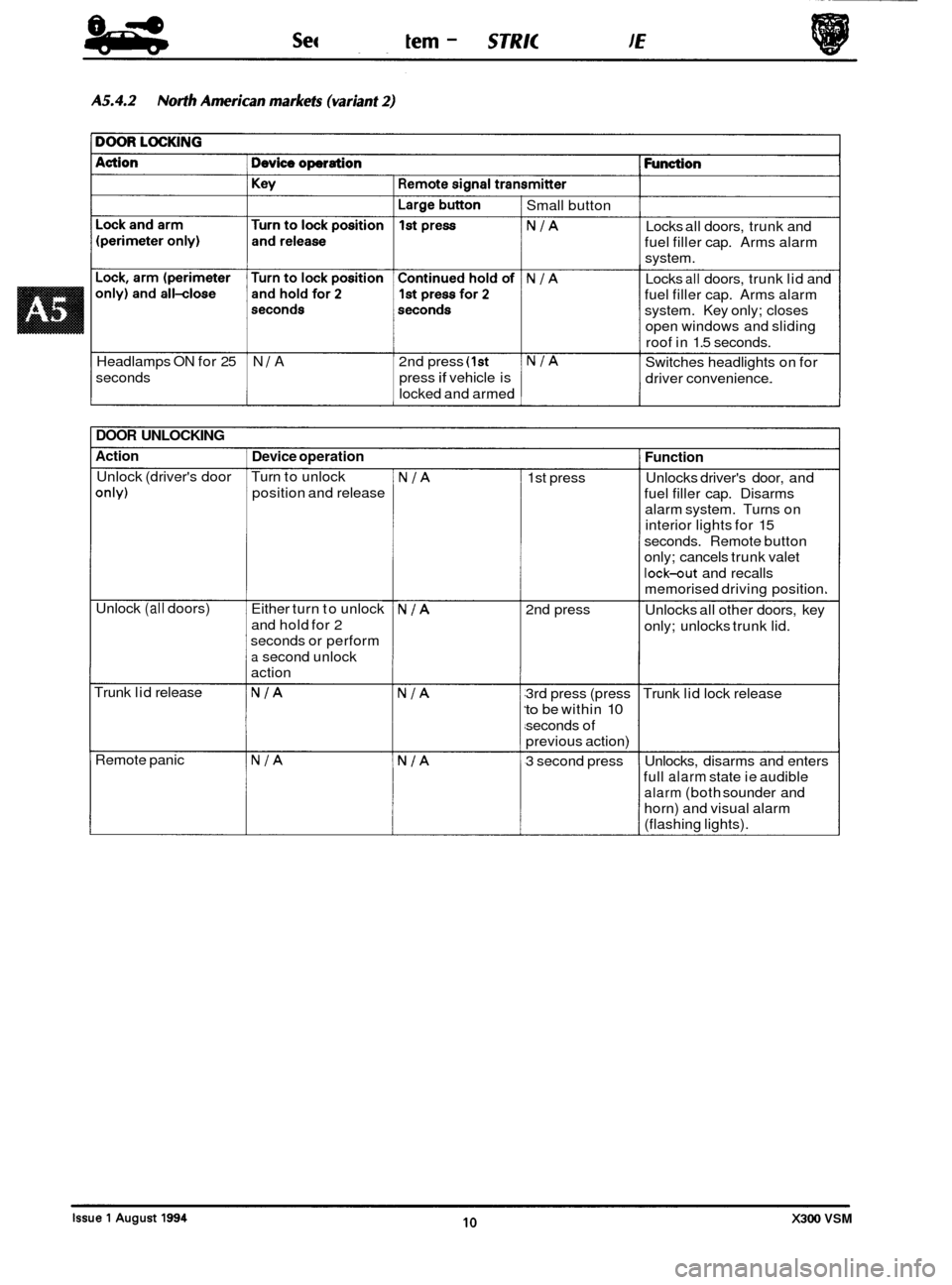
Security System - RESTRICTED ISSUE
Headlamps ON for 25 N 1 A 2nd press (1st
seconds press if vehicle is
locked and armed Small
button
NIA Locks all doors, trunk and
fuel filler cap. Arms alarm
system.
Locks
all doors, trunk lid and
fuel filler cap. Arms alarm
system. Key only; closes
open windows and sliding
roof in 1.5 seconds.
NIA Switches headlights on for
driver convenience.
NIA
DOOR UNLOCKING
Action
Unlock (driver's door
only)
Unlock (all doors)
Trunk lid release
Remote panic
Device operation
Turn to unlock
position and release
Either turn to unlock
and hold for 2
seconds or perform
a second unlock
action
NIA
NIA
NIA
NIA
NIA
NIA
1st press
2nd press
3rd press (press
to be within 10
seconds of
previous action)
3 second press
Function
Unlocks driver's door, and
fuel filler cap. Disarms
alarm system. Turns on
interior lights for 15
seconds. Remote button
only; cancels trunk valet
lock-out and recalls
memorised driving position.
Unlocks all other doors, key
only; unlocks trunk lid.
Trunk lid lock release
Unlocks, disarms and enters
full
alarm state ie audible
alarm (both sounder and
horn) and visual alarm
(flashing lights).
10 X300 VSM