hood open JAGUAR XJ6 1994 2.G Owner's Manual
[x] Cancel search | Manufacturer: JAGUAR, Model Year: 1994, Model line: XJ6, Model: JAGUAR XJ6 1994 2.GPages: 521, PDF Size: 17.35 MB
Page 485 of 521
Security System - RESTRICTED ISSUE 8-8
-
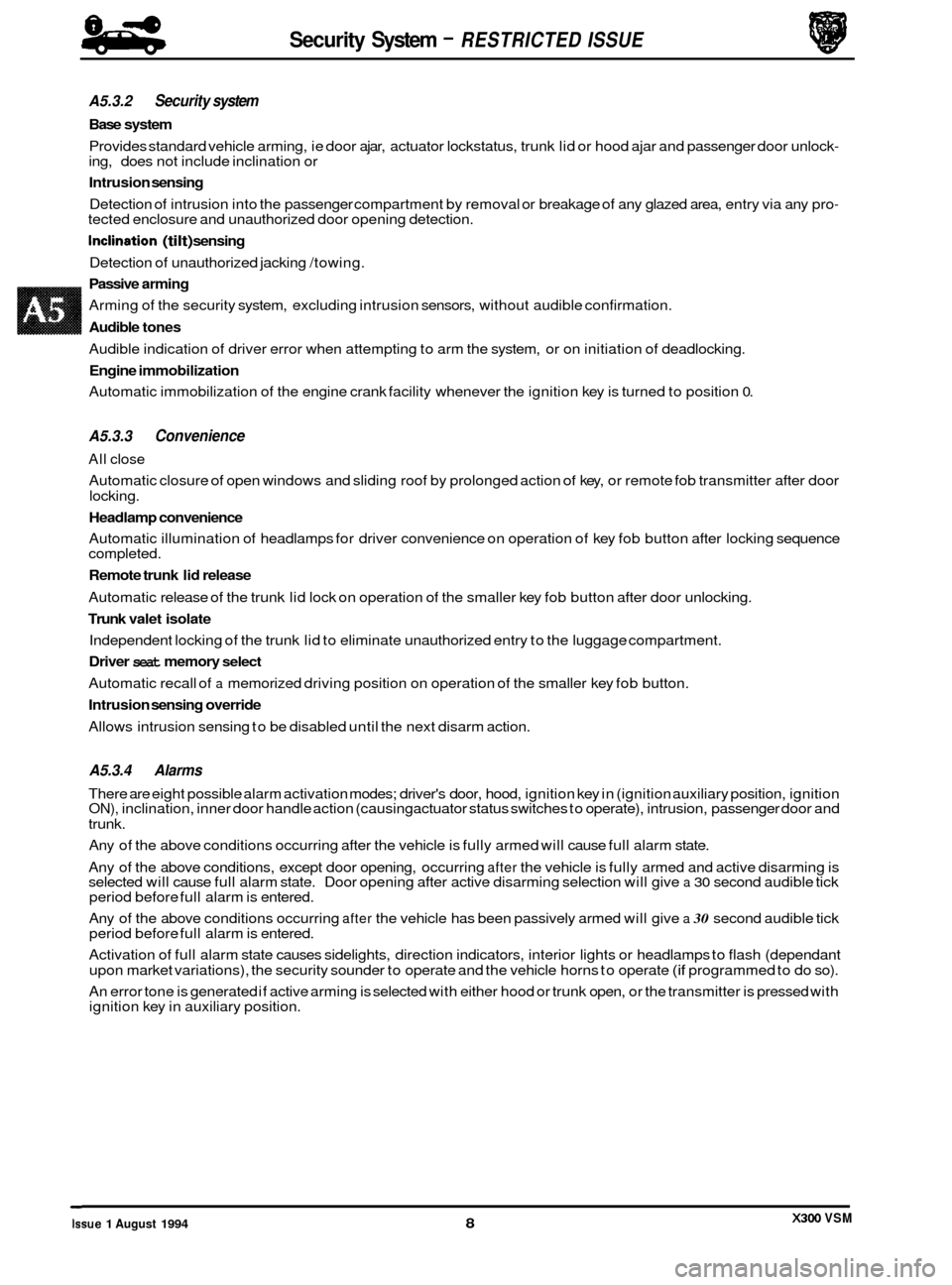
A5.3.2 Security system
Base system
Provides standard vehicle arming, ie door ajar, actuator lockstatus, trunk lid or hood ajar and passenger door unlock- ing, does not include inclination or
Intrusion sensing
Detection of intrusion into the passenger compartment by removal or breakage of any glazed area, entry via any pro- tected enclosure and unauthorized door opening detection.
Inclination (tilt) sensing
Detection of unauthorized jacking /towing.
Passive arming
Arming of the security system, excluding intrusion sensors, without audible confirmation.
Audible tones
Audible indication of driver error when attempting to arm the system, or on initiation of deadlocking.
Engine immobilization
Automatic immobilization of the engine crank facility whenever the ignition key is turned to position 0.
A5.3.3 Convenience
All close
Automatic closure of open windows and sliding roof by prolonged action of key, or remote fob transmitter after door
locking.
Headlamp convenience
Automatic illumination of headlamps for driver convenience on operation of key fob button after locking sequence
completed.
Remote trunk lid release
Automatic release of the trunk lid lock on operation of the smaller key fob button after door unlocking.
Trunk valet isolate
Independent locking of the trunk lid to eliminate unauthorized entry to the luggage compartment.
Driver seat memory select
Automatic recall of a memorized driving position on operation of the smaller key fob button.
Intrusion sensing override
Allows intrusion sensing to be disabled until the next disarm action.
A5.3.4 Alarms
There are eight possible alarm activation modes; driver's door, hood, ignition key in (ignition auxiliary position, ignition ON), inclination, inner door handle action (causing actuator status switches to operate), intrusion, passenger door and
trunk.
Any of the above conditions occurring after the vehicle is fully armed will cause full alarm state.
Any of the above conditions, except door opening, occurring
after the vehicle is fully armed and active disarming is
selected will cause full alarm state. Door opening after active disarming selection will give a 30 second audible tick
period before full alarm is entered.
Any of the above conditions occurring
after the vehicle has been passively armed will give a 30 second audible tick
period before full alarm is entered.
Activation of full alarm state causes sidelights, direction indicators, interior lights or headlamps to flash (dependant
upon market variations), the security sounder to operate and the vehicle horns to operate
(if programmed to do so).
An error tone is generated if active arming is selected with either hood or trunk open, or the transmitter is pressed with
ignition key in auxiliary position.
0
X300 VSM Issue 1 August 1994 8
Page 497 of 521
Security System - RESTRICTED ISSUE
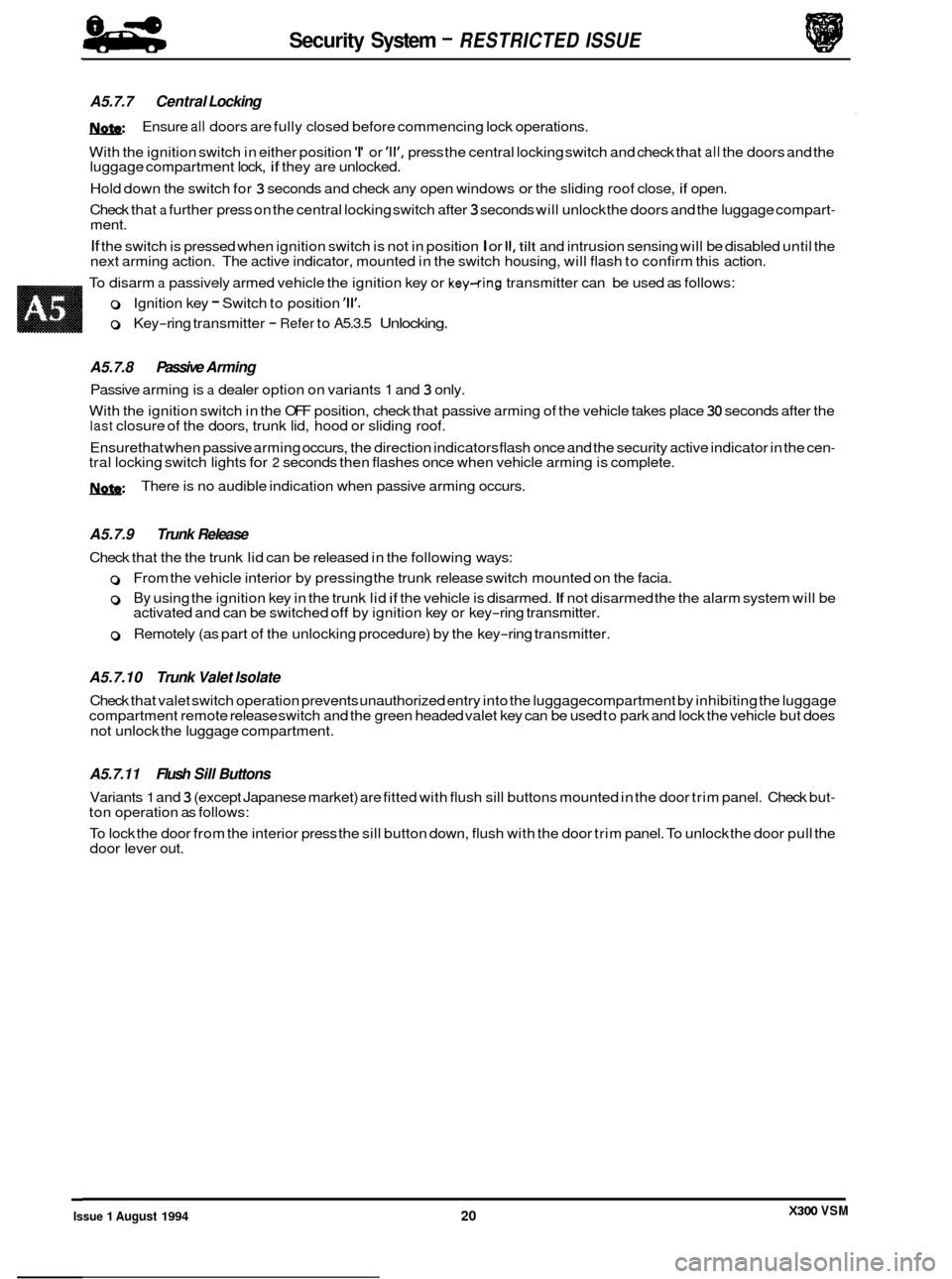
A5.7.7 Central Locking
W
With the ignition switch in either position 'I' or 'll', press the central locking switch and check that all the doors and the
luggage compartment lock, if they are unlocked.
Hold down the switch for
3 seconds and check any open windows or the sliding roof close, if open.
Check that
a further press on the central locking switch after 3 seconds will unlock the doors and the luggage compart- ment.
If the switch is pressed when ignition switch is not in position I or II, tilt and intrusion sensing will be disabled until the
next arming action. The active indicator, mounted in the switch housing, will flash to confirm this action.
To disarm
a passively armed vehicle the ignition key or key-ring transmitter can be used as follows:
Ensure
all doors
are fully closed before commencing lock operations.
0 Ignition key - Switch to position '11'.
0 Key-ring transmitter - Refer to A5.3.5 Unlocking.
A5.7.8 Passive Arming
Passive arming is a dealer option on variants 1 and 3 only.
With the ignition switch in the OFF position, check that passive arming of the vehicle takes place
30 seconds after the last closure of the doors, trunk lid, hood or sliding roof.
Ensurethat when passive arming occurs, the direction indicators flash once and the security active indicator in the cen
- tral locking switch lights for 2 seconds then flashes once when vehicle arming is complete.
W There is no audible indication when passive arming occurs.
A5.7.9 Trunk Release
Check that the the trunk lid can be released in the following ways:
0 From the vehicle interior by pressing the trunk release switch mounted on the facia.
0 By using the ignition key in the trunk lid if the vehicle is disarmed. If not disarmed the the alarm system will be
activated and can be switched off by ignition key or key-ring transmitter.
0 Remotely (as part of the unlocking procedure) by the key-ring transmitter.
A5.7.10 Trunk Valet Isolate
Check that valet switch operation prevents unauthorized entry into the luggagecompartment by inhibiting the luggage
compartment remote release switch and the green headed valet key can be used to park and lock the vehicle but does
not unlock the luggage compartment.
A5.7.11 Flush Sill Buttons
Variants 1 and 3 (except Japanese market) are fitted with flush sill buttons mounted in the door trim panel. Check but- ton operation as follows:
To lock the door from the interior press the sill button down, flush with the door trim panel. To unlock the door pull the
door lever out.
X300 VSM Issue 1 August 1994 20
Page 506 of 521
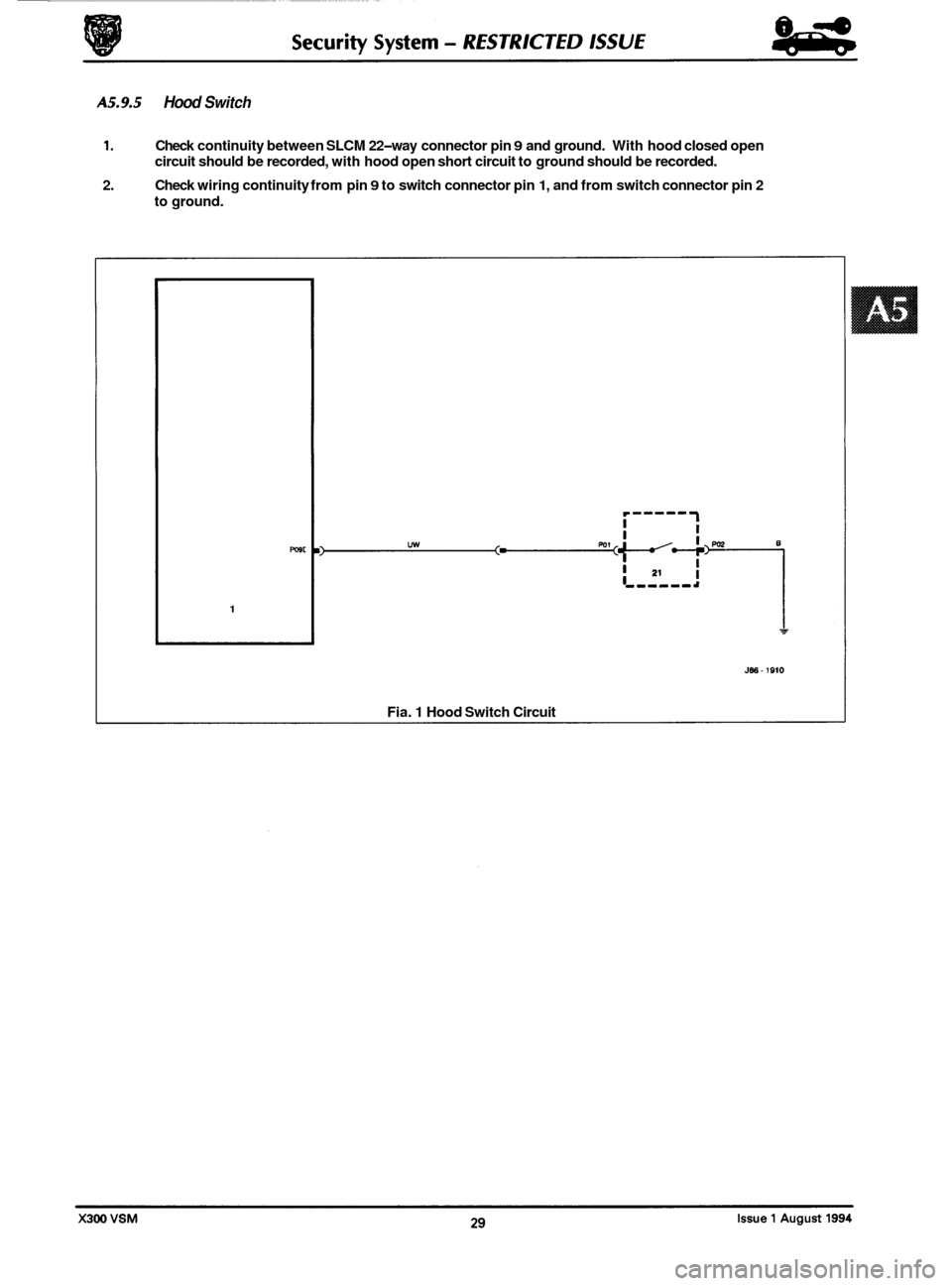
A5.9.5 Hood Switch
8
1.
2. Check
continuity between SLCM 22
-way connector pin 9 and ground. With hood closed open
circuit should be recorded, with hood open short circuit to ground should be recorded.
Check wiring continuity from pin
9 to switch connector pin 1, and from switch connector pin 2
to ground.
Po9c
1
Fia. 1 Hood Switch Circuit
Page 519 of 521

Security System - RESTRICTED ISSUE 84
4!sw
A5.15 SECURITY SIREN
(12 CYL) - RENEW
SRO 86.52.03
= Open the trunk and remove the battery cover.
Disconnect the battery ground lead.
Open the hood and remove the headlamp
/ relay cover.
See
SRO 76.1 1.22, Section 13.
Remove the RH air cleaner element. See SRO 19.10.11, Section 5.2.
Remove the RH air cleaner assembly. See SRO 19.10.02, Section 5.2.
. Identify the RH forward harness relays (1 Fig. 1) for subse- quent refitting. Remove the relays and relay bases from
the mounting bracket.
. Disconnect the siren harness multi-plug (2 Fig. 1).
rn Reposition the side harness (3 Fig. 1) to gain access to the
. Undo the siren securing bolts (1 Fig. 2) and remove the
Note:
. Remove the captive washers and the siren securing bolts.
. Fit the siren securing bolts to a new siren.
. Fit and fully seat the captive washers.
. Align the siren securing bolts to the vehicle chassis.
Refitting the remaining components is the reverse of the re
-
moval procedure.
siren securing bolts.
siren
(2 Fig. 2).
The siren securing bolts remain captive.
Tighten the siren securing bolts.
AS. 16 SECURIN SIREN (6 CYL) - RENEW
SRO 8652.03
. Open the trunk and remove the battery cover.
rn Disconnect the battery ground lead.
. Open the hood and remove the headlamp / relay cover.
See SRO 76.1 1.22, Section 13.
. Identify the RH forward harness relays for subsequent re- fitting. Removethe relays and relay bases from the mount- ing bracket.
. Disconnect the siren harness multi-plug.
Reposition the side harness to gain access to the siren se-
. Undo the siren securing bolts and remove the siren.
curing
bolts.
The siren securing bolts remain captive.
Remove the captive washers and the siren securing bolts.
. Fit the siren securing bolts to a new siren.
. Fit and fully seat the captive washers.
= Align the siren securing bolts to the vehicle chassis.
Refitting the remaining components is the reverse of the re
-
moval procedure.
Tighten
the siren securing bolts.
Fig. 1
Fig. 2
X300 VSM Issue 1 August 1994 42