EGR JAGUAR XJ6 1997 2.G User Guide
[x] Cancel search | Manufacturer: JAGUAR, Model Year: 1997, Model line: XJ6, Model: JAGUAR XJ6 1997 2.GPages: 227, PDF Size: 7.2 MB
Page 103 of 227
3261 Jaguar XJ6
5
Chapter 5
Engine electrical systems
Ignition system
Ignition timing (all models) . . . . . . . . . . . . . . . . . . . . . . . . . . . . . . . . . . . Not adjustable
Ignition coil resistance (at 68°F):
Primary resistance . . . . . . . . . . . . . . . . . . . . . . . . . . . . . . . . . . . . . . . 0.4 to 0.5 ohms
Secondary resistance . . . . . . . . . . . . . . . . . . . . . . . . . . . . . . . . . . . . . 6.0 to 6.5 k-ohms
Charging system
Charging voltage . . . . . . . . . . . . . . . . . . . . . . . . . . . . . . . . . . . . . . . . . . 13.9 to 15.1 volts
Standard amperage:
No load . . . . . . . . . . . . . . . . . . . . . . . . . . . . . . . . . . . . . . . . . . . . . . . . Less than 10 amps
Full load . . . . . . . . . . . . . . . . . . . . . . . . . . . . . . . . . . . . . . . . . . . . . . . 30 amps or more Amplifier - check and renewal . . . . . . . . . . . . . . . . . . . . . . . . . . . . . . 7
Alternator - removal and refitting . . . . . . . . . . . . . . . . . . . . . . . . . . . . 12
Battery cables - check and renewal . . . . . . . . . . . . . . . . . . . . . . . . . 4
Battery check, maintenance and charging . . . . . . . . . . . See Chapter 1
Battery - emergency jump starting . . . . . . . . . . . . . . . . . . . . . . . . . . 2
Battery - removal and refitting . . . . . . . . . . . . . . . . . . . . . . . . . . . . . . 3
Charging system - check . . . . . . . . . . . . . . . . . . . . . . . . . . . . . . . . . . 11
Charging system - general information and precautions . . . . . . . . . 10
CHECK ENGINE light . . . . . . . . . . . . . . . . . . . . . . . . . . . See Chapter 6
Distributor - removal and refitting . . . . . . . . . . . . . . . . . . . . . . . . . . . 9
Drivebelt check, adjustment and renewal . . . . . . . . . . . See Chapter 1General information . . . . . . . . . . . . . . . . . . . . . . . . . . . . . . . . . . . . . . 1
Ignition coil - check and renewal . . . . . . . . . . . . . . . . . . . . . . . . . . . . 8
Ignition system - check . . . . . . . . . . . . . . . . . . . . . . . . . . . . . . . . . . . 6
Ignition system - general information and precautions . . . . . . . . . . . 5
Spark plug renewal . . . . . . . . . . . . . . . . . . . . . . . . . . . . . See Chapter 1
Spark plug lead, distributor cap and rotor check
and renewal . . . . . . . . . . . . . . . . . . . . . . . . . . . . . . . . See Chapter 1
Starter motor - removal and refitting . . . . . . . . . . . . . . . . . . . . . . . . . 15
Starter motor - testing in vehicle . . . . . . . . . . . . . . . . . . . . . . . . . . . . 14
Starter solenoid - removal and refitting . . . . . . . . . . . . . . . . . . . . . . . 16
Starting system - general information and precautions . . . . . . . . . . 13
5•1
Specifications Contents
Easy,suitable for
novice with little
experienceFairly easy,suitable
for beginner with
some experienceFairly difficult,
suitable for competent
DIY mechanic
Difficult,suitable for
experienced DIY
mechanicVery difficult,
suitable for expert DIY
or professional
Degrees of difficulty
54321
1 General information
The engine electrical systems include all
ignition, charging and starting components.
Because of their engine related functions,
these components are discussed separately
from chassis electrical devices such as the
fuses, relays, lights, etc. (which are included in
Chapter 12).
Always observe the following precautions
when working on the electrical systems:
a) Be extremely careful when servicing
engine electrical components. They are
easily damaged if checked, connected or
handled improperly.
b) Never leave the ignition switch on for long
periods of time (10 minutes maximum)
with the engine off.c) Don’t disconnect the battery cables while
the engine is running.
d) Maintain correct polarity when connecting
a battery cable from another vehicle
during jump starting.
e) Always disconnect the negative cable first
and hook it up last or the battery may be
shorted by the tool being used to loosen
the cable clamps.
It’s also a good idea to review the safety-
related information regarding the engine
electrical systems in the Safety first section
near the front of this manual before beginning
any operation included in this Chapter.
2 Battery-
emergency jump starting
1
See “Jump starting”in “Roadside repairs”
at the front of this Manual.
3 Battery- removal and refitting
1
1Disconnect the negative terminal, then the
positive terminal from the battery. On 1989 to
1992 models, the battery is located in the
engine compartment on the passenger side
bulkhead and on 1993 and 1994 models, it is
located in the boot.
Caution: If the stereo in your vehicle is
equipped with an anti-theft system, make
sure you have the correct activation code
before disconnecting the battery.
2Remove the battery hold-down clamp.
3Lift out the battery. Be careful, it’s heavy.
4While the battery is out, inspect the carrier
(tray) for corrosion.
5If you are replacing the battery, make sure
that you get one that’s identical, with the
Page 111 of 227
3261 Jaguar XJ6
6
Chapter 6
Emissions and engine control systems
EGR gas temperature sensor resistance
Temperature:
212° F . . . . . . . . . . . . . . . . . . . . . . . . . . . . . . . . . . . . . . . . . . . . . . . . . 60 to 100 k-ohms
400° F . . . . . . . . . . . . . . . . . . . . . . . . . . . . . . . . . . . . . . . . . . . . . . . . . 3 to 8 k-ohms
662° F . . . . . . . . . . . . . . . . . . . . . . . . . . . . . . . . . . . . . . . . . . . . . . . . . 250 to 350 ohms
Torque wrench settingNm lbf ft
Crankshaft sensor bolt . . . . . . . . . . . . . . . . . . . . . . . . . . . . . . . . . . . . . . 27 20 Air Injection Reactor (AIR) system . . . . . . . . . . . . . . . . . . . . . . . . . . . 5
Catalytic converter . . . . . . . . . . . . . . . . . . . . . . . . . . . . . . . . . . . . . . . 9
CHECK ENGINE light . . . . . . . . . . . . . . . . . . . . . . . . . . . See Section 3
Crankcase ventilation system . . . . . . . . . . . . . . . . . . . . . . . . . . . . . . 8
Electronic control system and ECU . . . . . . . . . . . . . . . . . . . . . . . . . . 2
Evaporative Emission Control (EVAP) system . . . . . . . . . . . . . . . . . . 6Exhaust Gas Recirculation (EGR) system . . . . . . . . . . . . . . . . . . . . . 6
Fuel tank cap gasket renewal . . . . . . . . . . . . . . . . . . . . . See Chapter 1
General information . . . . . . . . . . . . . . . . . . . . . . . . . . . . . . . . . . . . . . 1
Information sensors . . . . . . . . . . . . . . . . . . . . . . . . . . . . . . . . . . . . . 4
On Board Diagnosis (OBD) system -
description and fault code access . . . . . . . . . . . . . . . . . . . . . . . . . 3
6•1
Specifications Contents
Easy,suitable for
novice with little
experienceFairly easy,suitable
for beginner with
some experienceFairly difficult,
suitable for competent
DIY mechanic
Difficult,suitable for
experienced DIY
mechanicVery difficult,
suitable for expert DIY
or professional
Degrees of difficulty
54321
1 General information
To minimise pollution of the atmosphere
from incompletely burned and evaporating
gases and to maintain good driveability and
fuel economy, a number of emission control
systems are used on these vehicles. They
include the:
Air Injection Reactor (AIR) system
Crankcase Ventilation system
Exhaust Gas Recirculation (EGR) system
Electronic Fuel Injection (EFI) system
Evaporative Emission Control (EVAP)
system
Three-way catalytic converter (TWC)
system
The sections in this chapter include general
descriptions, checking procedures within the
scope of the home mechanic and component
renewal procedures (when possible) for each
of the systems listed above.
Before assuming an emissions control
system is malfunctioning, check the fuel and
ignition systems carefully (Chapters 4 and 5).
The diagnosis of some emission control
devices requires specialised tools, equipment
and training. If checking and servicing becometoo difficult or if a procedure is beyond the
scope of your skills, consult your dealer
service department or other repair workshop.
This doesn’t mean, however, that emission
control systems are particularly difficult to
maintain and repair. You can quickly and
easily perform many checks and do most of
the regular maintenance at home with
common tune-up and hand tools. Note:The
most frequent cause of emission problems is
simply a loose or broken electrical connector
or vacuum hose, so always check the
electrical connectors and vacuum hoses first.Pay close attention to any special
precautions outlined in this chapter. It should
be noted that the illustrations of the various
systems may not exactly match the system
installed on your vehicle because of changes
made by the manufacturer during production
or from year-to-year.
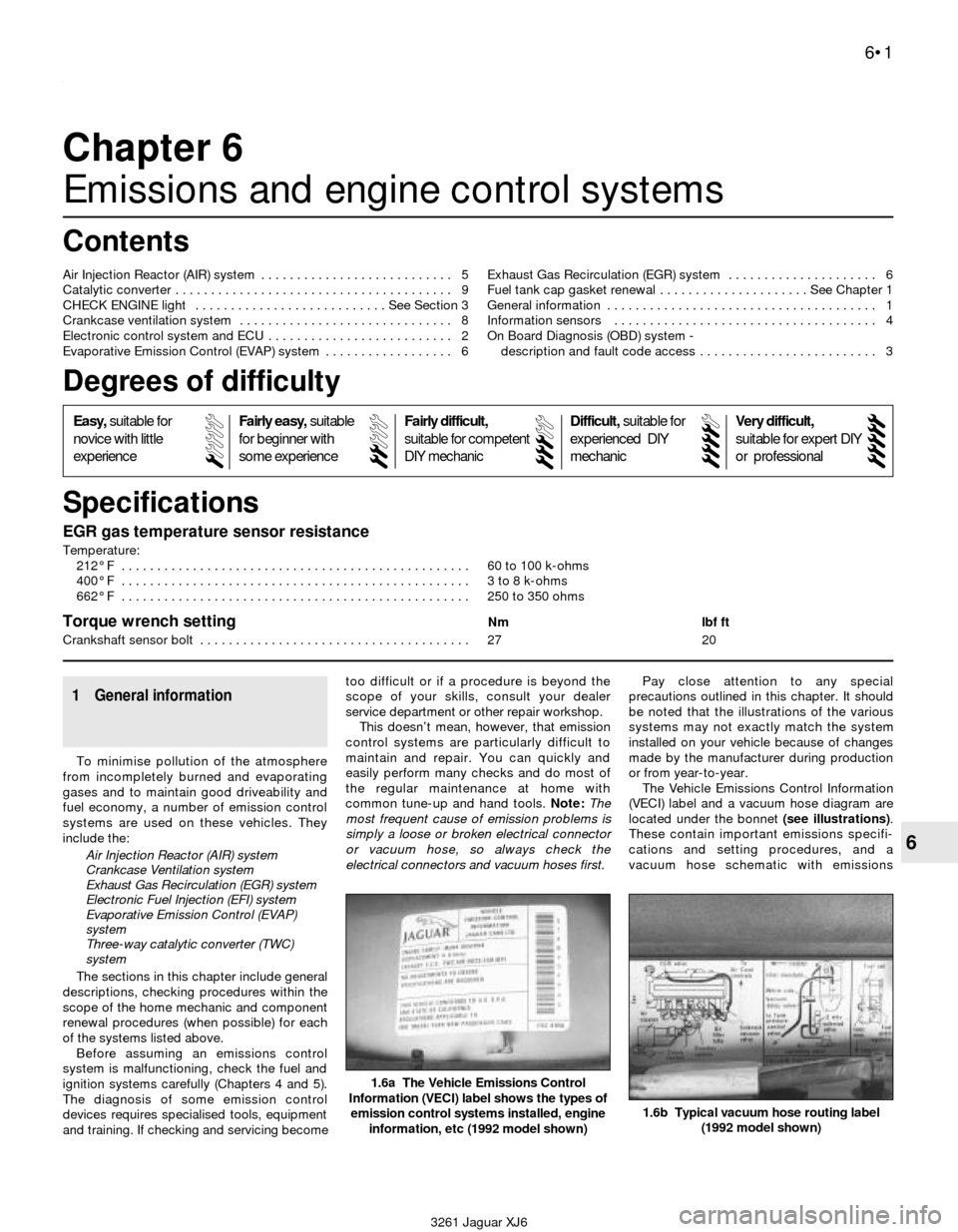
The Vehicle Emissions Control Information
(VECI) label and a vacuum hose diagram are
located under the bonnet (see illustrations).
These contain important emissions specifi-
cations and setting procedures, and a
vacuum hose schematic with emissions
1.6a The Vehicle Emissions Control
Information (VECI) label shows the types of
emission control systems installed, engine
information, etc (1992 model shown)
1.6b Typical vacuum hose routing label
(1992 model shown)
Page 113 of 227
2The CHECK ENGINE warning light, which is
located on the instrument panel, comes on
when the ignition switch is turned to ON and
the engine is not running. When the engine is
started, the warning light should go out. If the
light remains on, the self-diagnosis system
has detected a malfunction. Note: The
CHECK ENGINE light on early models is
displayed on the dashboard VCM panel on the
right side. Later models are equipped with a
separate CHECK ENGINE light on the left side
of the instrument cluster.Note:Not all the
codes will cause the CHECK ENGINE light to
activate. When performing any fuel or
emissions systems diagnosis, always check
for codes that may be stored but not indicated
by the CHECK ENGINE light.
Obtaining fault code output
3To obtain an output of diagnostic codes,
verify first that the battery voltage is above 11
volts, the throttle is fully closed, the
transmission is in Park, the accessory
switches are off and the engine is at normal
operating temperature.
4Turn the ignition switch to ON but don’t
start the engine (Position II). Note:On 1988
and 1989 models, remember to turn the
ignition switch to position II without turning
the key to OFF.
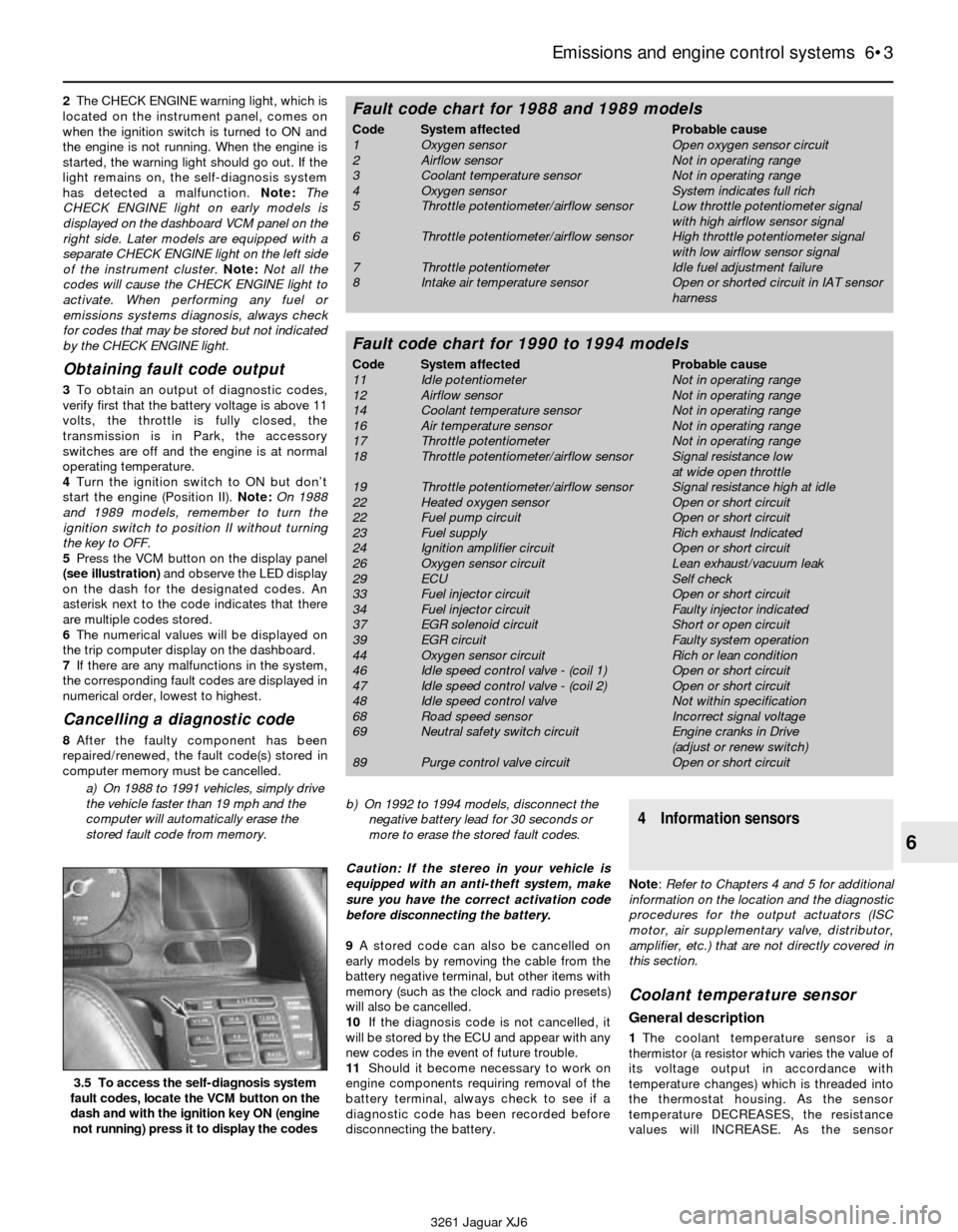
5Press the VCM button on the display panel
(see illustration)and observe the LED display
on the dash for the designated codes. An
asterisk next to the code indicates that there
are multiple codes stored.
6The numerical values will be displayed on
the trip computer display on the dashboard.
7If there are any malfunctions in the system,
the corresponding fault codes are displayed in
numerical order, lowest to highest.
Cancelling a diagnostic code
8After the faulty component has been
repaired/renewed, the fault code(s) stored in
computer memory must be cancelled.
a) On 1988 to 1991 vehicles, simply drive
the vehicle faster than 19 mph and the
computer will automatically erase the
stored fault code from memory.b) On 1992 to 1994 models, disconnect the
negative battery lead for 30 seconds or
more to erase the stored fault codes.
Caution: If the stereo in your vehicle is
equipped with an anti-theft system, make
sure you have the correct activation code
before disconnecting the battery.
9A stored code can also be cancelled on
early models by removing the cable from the
battery negative terminal, but other items with
memory (such as the clock and radio presets)
will also be cancelled.
10If the diagnosis code is not cancelled, it
will be stored by the ECU and appear with any
new codes in the event of future trouble.
11Should it become necessary to work on
engine components requiring removal of the
battery terminal, always check to see if a
diagnostic code has been recorded before
disconnecting the battery.
4 Information sensors
Note: Refer to Chapters 4 and 5 for additional
information on the location and the diagnostic
procedures for the output actuators (ISC
motor, air supplementary valve, distributor,
amplifier, etc.) that are not directly covered in
this section.
Coolant temperature sensor
General description
1The coolant temperature sensor is a
thermistor (a resistor which varies the value of
its voltage output in accordance with
temperature changes) which is threaded into
the thermostat housing. As the sensor
temperature DECREASES, the resistance
values will INCREASE. As the sensor
Emissions and engine control systems 6•3
6
3.5 To access the self-diagnosis system
fault codes, locate the VCM button on the
dash and with the ignition key ON (engine
not running) press it to display the codes
3261 Jaguar XJ6
Fault code chart for 1988 and 1989 models
Code System affected Probable cause
1 Oxygen sensor Open oxygen sensor circuit
2 Airflow sensor Not in operating range
3 Coolant temperature sensor Not in operating range
4 Oxygen sensor System indicates full rich
5 Throttle potentiometer/airflow sensor Low throttle potentiometer signal
with high airflow sensor signal
6 Throttle potentiometer/airflow sensor High throttle potentiometer signal
with low airflow sensor signal
7 Throttle potentiometer Idle fuel adjustment failure
8 Intake air temperature sensor Open or shorted circuit in IAT sensor
harness
Fault code chart for 1990 to 1994 models
Code System affected Probable cause
11 Idle potentiometer Not in operating range
12 Airflow sensor Not in operating range
14 Coolant temperature sensor Not in operating range
16 Air temperature sensor Not in operating range
17 Throttle potentiometer Not in operating range
18 Throttle potentiometer/airflow sensor Signal resistance low
at wide open throttle
19 Throttle potentiometer/airflow sensor Signal resistance high at idle
22 Heated oxygen sensor Open or short circuit
22 Fuel pump circuit Open or short circuit
23 Fuel supply Rich exhaust Indicated
24 Ignition amplifier circuit Open or short circuit
26 Oxygen sensor circuit Lean exhaust/vacuum leak
29 ECU Self check
33 Fuel injector circuit Open or short circuit
34 Fuel injector circuit Faulty injector indicated
37 EGR solenoid circuit Short or open circuit
39 EGR circuit Faulty system operation
44 Oxygen sensor circuit Rich or lean condition
46 Idle speed control valve - (coil 1) Open or short circuit
47 Idle speed control valve - (coil 2) Open or short circuit
48 Idle speed control valve Not within specification
68 Road speed sensor Incorrect signal voltage
69 Neutral safety switch circuit Engine cranks in Drive
(adjust or renew switch)
89 Purge control valve circuit Open or short circuit
Page 117 of 227
42Also, check the reference voltage to the
MAF sensor from the computer. Backprobe
terminal number 6 and make sure that
approximately 5 volts is present.
Renewal
43Disconnect the electrical connector from
the MAF sensor.
44Remove the air cleaner assembly (see
Chapter 4).
45Remove the four bolts and separate the
MAF sensor from the air intake duct.
46Refitting is the reverse of removal.
Intake air temperature
(IAT) sensor
General description
47The intake air temperature sensor is
located inside the air intake duct. This sensor
acts as a resistor which changes value
according to the temperature of the air entering
the engine. Low temperatures produce a high
resistance value (for example, at 68° F the
value is 2.0 to 2.6 k-ohms) while high
temperatures produce low resistance values (at
176° F the resistance is 260 to 330 ohms. The
ECU supplies around 5 volts (reference
voltage) to the air temperature sensor.
The voltage will change according to the
temperature of the incoming air. The voltage
will be high when the air temperature is cold
and low when the air temperature is warm. Any
problems with the air temperature sensor
will usually set a code 8 (1988 and 1989) or
code 16 (1990 to 1994).
Check
48To check the air temperature sensor,
disconnect the two prong electrical connector
and turn the ignition key ON but do not start
the engine.
49Measure the voltage (reference voltage),
which should be approximately 5 volts.
50If the voltage signal is not correct, havethe ECU diagnosed by a dealer service
department or other repair workshop.
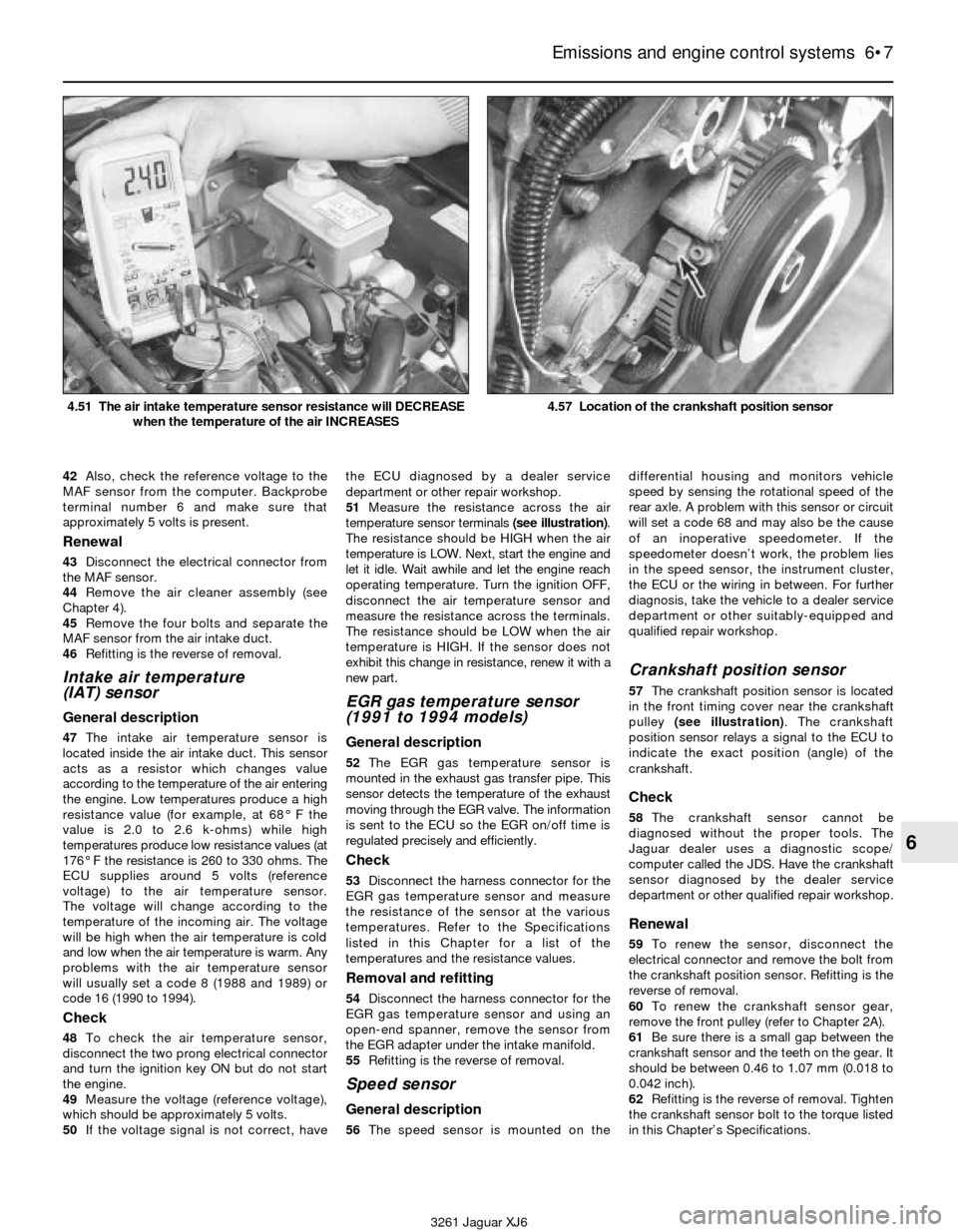
51Measure the resistance across the air
temperature sensor terminals (see illustration).
The resistance should be HIGH when the air
temperature is LOW. Next, start the engine and
let it idle. Wait awhile and let the engine reach
operating temperature. Turn the ignition OFF,
disconnect the air temperature sensor and
measure the resistance across the terminals.
The resistance should be LOW when the air
temperature is HIGH. If the sensor does not
exhibit this change in resistance, renew it with a
new part.
EGR gas temperature sensor
(1991 to 1994 models)
General description
52The EGR gas temperature sensor is
mounted in the exhaust gas transfer pipe. This
sensor detects the temperature of the exhaust
moving through the EGR valve. The information
is sent to the ECU so the EGR on/off time is
regulated precisely and efficiently.
Check
53Disconnect the harness connector for the
EGR gas temperature sensor and measure
the resistance of the sensor at the various
temperatures. Refer to the Specifications
listed in this Chapter for a list of the
temperatures and the resistance values.
Removal and refitting
54Disconnect the harness connector for the
EGR gas temperature sensor and using an
open-end spanner, remove the sensor from
the EGR adapter under the intake manifold.
55Refitting is the reverse of removal.
Speed sensor
General description
56The speed sensor is mounted on thedifferential housing and monitors vehicle
speed by sensing the rotational speed of the
rear axle. A problem with this sensor or circuit
will set a code 68 and may also be the cause
of an inoperative speedometer. If the
speedometer doesn’t work, the problem lies
in the speed sensor, the instrument cluster,
the ECU or the wiring in between. For further
diagnosis, take the vehicle to a dealer service
department or other suitably-equipped and
qualified repair workshop.
Crankshaft position sensor
57The crankshaft position sensor is located
in the front timing cover near the crankshaft
pulley (see illustration). The crankshaft
position sensor relays a signal to the ECU to
indicate the exact position (angle) of the
crankshaft.
Check
58The crankshaft sensor cannot be
diagnosed without the proper tools. The
Jaguar dealer uses a diagnostic scope/
computer called the JDS. Have the crankshaft
sensor diagnosed by the dealer service
department or other qualified repair workshop.
Renewal
59To renew the sensor, disconnect the
electrical connector and remove the bolt from
the crankshaft position sensor. Refitting is the
reverse of removal.
60To renew the crankshaft sensor gear,
remove the front pulley (refer to Chapter 2A).
61Be sure there is a small gap between the
crankshaft sensor and the teeth on the gear. It
should be between 0.46 to 1.07 mm (0.018 to
0.042 inch).
62Refitting is the reverse of removal. Tighten
the crankshaft sensor bolt to the torque listed
in this Chapter’s Specifications.
Emissions and engine control systems 6•7
6
3261 Jaguar XJ6 4.51 The air intake temperature sensor resistance will DECREASE
when the temperature of the air INCREASES
4.57 Location of the crankshaft position sensor
Page 119 of 227

11Swing the pump toward the engine and
remove the drivebelt from the pump.
12Remove the link arm through-bolt.
13Remove the pivot bolt and front spacer,
rear cone and air injection pump from the
engine compartment.
14Remove the nut securing the front pulley
on the air injection pump.
15Remove the clutch snap-ring and the
clutch.
16Refitting is the reverse of removal.
6 Exhaust Gas Recirculation
(EGR) system
Note 1: Some 1990 models have the EGR
vacuum hose routed incorrectly through the
bulkhead securing straps, thereby restricting
the vacuum signal to the EGR valve. Remove
the EGR vacuum hose from the bulkhead
harness and refit a new hose. Secure it to the
engine compartment using tie-wraps and do
not allow any restrictions in the hose.Note 2: Some models have copper sealing
washers that soften and leak around the EGR
valve causing engine performance and
starting problems. Refit steel washers and
pipe adapters into the EGR system. Contact a
Jaguar dealer for the VIN numbers and years
of the models that are affected by this defect.
1To reduce oxides of nitrogen emissions,
some of the exhaust gases are recirculated
through the EGR valve to the intake manifold
to lower combustion temperatures.
2The EGR system consists of the EGR valve,
an EGR solenoid, an EGR gas temperature
sensor and the transfer pipe (see illustration).
Check
EGR valve
3Start the engine and allow it to idle.
4Detach the vacuum hose from the EGR
valve and attach a hand vacuum pump in its
place (see illustration).
5Apply vacuum to the EGR valve. Vacuum
should remain steady and the engine should
run poorly. Note:This action will raise the
pintle and allow exhaust gases to recirculateinto the intake system and cause rough
running condition at idle.Double-check the
movement of the pintle by checking the
diaphragm using the tip of your finger (see
illustration). If the EGR diaphragm moves
smoothly and holds steady when vacuum is
applied, the EGR valve is working properly.
Warning: Don’t burn yourself. If
the EGR valve is hot, wear a
glove or wait until it cools.
a) If the vacuum doesn’t remain steady and
the engine doesn’t run poorly, renew the
EGR valve and recheck it.
b) If the vacuum remains steady but the
engine doesn’t run poorly, remove the
EGR valve and check the valve and the
intake manifold for blockage. Clean or
renew parts as necessary and recheck.EGR system
6Disconnect the hose from the EGR valve,
refit a vacuum gauge and check for vacuum
to the EGR valve. There should be vacuum
present with the engine warmed to operating
temperature (above 140° F) and between
1000 and 4000 rpm (see illustration).
Emissions and engine control systems 6•9
6
3261 Jaguar XJ6 6.2 Schematic of the EGR system
6.4 Apply vacuum to the EGR valve and confirm that the valve
opens and allows exhaust gases to circulate. Once it is activated,
the EGR valve should hold steady (no loss in vacuum)
6.5 Use a fingertip to move the diaphragm inside the EGR valve6.6 Check for vacuum to the EGR valve from the throttle body
Page 120 of 227
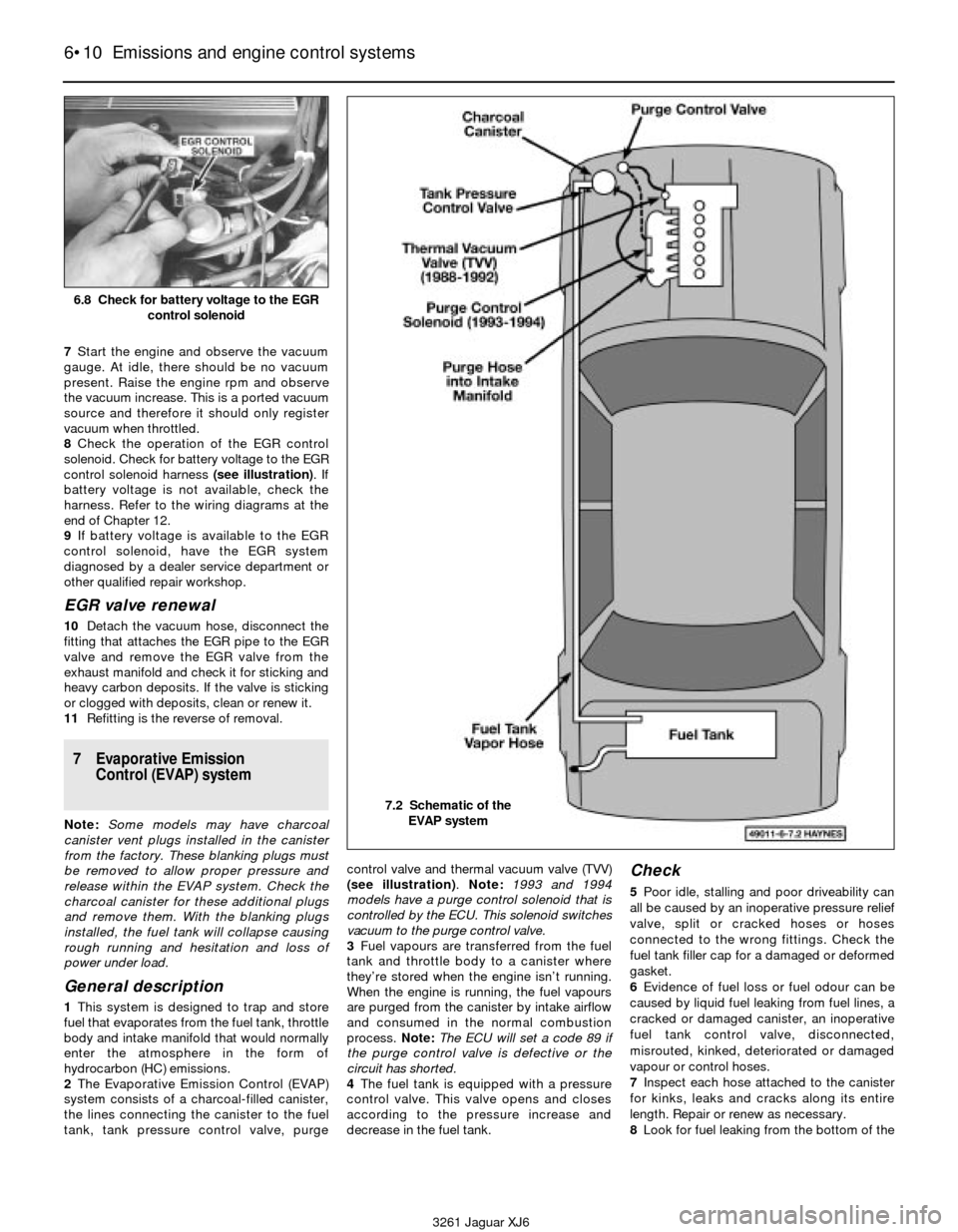
7Start the engine and observe the vacuum
gauge. At idle, there should be no vacuum
present. Raise the engine rpm and observe
the vacuum increase. This is a ported vacuum
source and therefore it should only register
vacuum when throttled.
8Check the operation of the EGR control
solenoid. Check for battery voltage to the EGR
control solenoid harness (see illustration). If
battery voltage is not available, check the
harness. Refer to the wiring diagrams at the
end of Chapter 12.
9If battery voltage is available to the EGR
control solenoid, have the EGR system
diagnosed by a dealer service department or
other qualified repair workshop.
EGR valve renewal
10Detach the vacuum hose, disconnect the
fitting that attaches the EGR pipe to the EGR
valve and remove the EGR valve from the
exhaust manifold and check it for sticking and
heavy carbon deposits. If the valve is sticking
or clogged with deposits, clean or renew it.
11Refitting is the reverse of removal.
7 Evaporative Emission
Control (EVAP) system
Note: Some models may have charcoal
canister vent plugs installed in the canister
from the factory. These blanking plugs must
be removed to allow proper pressure and
release within the EVAP system. Check the
charcoal canister for these additional plugs
and remove them. With the blanking plugs
installed, the fuel tank will collapse causing
rough running and hesitation and loss of
power under load.
General description
1This system is designed to trap and store
fuel that evaporates from the fuel tank, throttle
body and intake manifold that would normally
enter the atmosphere in the form of
hydrocarbon (HC) emissions.
2The Evaporative Emission Control (EVAP)
system consists of a charcoal-filled canister,
the lines connecting the canister to the fuel
tank, tank pressure control valve, purgecontrol valve and thermal vacuum valve (TVV)
(see illustration). Note: 1993 and 1994
models have a purge control solenoid that is
controlled by the ECU. This solenoid switches
vacuum to the purge control valve.
3Fuel vapours are transferred from the fuel
tank and throttle body to a canister where
they’re stored when the engine isn’t running.
When the engine is running, the fuel vapours
are purged from the canister by intake airflow
and consumed in the normal combustion
process.Note: The ECU will set a code 89 if
the purge control valve is defective or the
circuit has shorted.
4The fuel tank is equipped with a pressure
control valve. This valve opens and closes
according to the pressure increase and
decrease in the fuel tank.
Check
5Poor idle, stalling and poor driveability can
all be caused by an inoperative pressure relief
valve, split or cracked hoses or hoses
connected to the wrong fittings. Check the
fuel tank filler cap for a damaged or deformed
gasket.
6Evidence of fuel loss or fuel odour can be
caused by liquid fuel leaking from fuel lines, a
cracked or damaged canister, an inoperative
fuel tank control valve, disconnected,
misrouted, kinked, deteriorated or damaged
vapour or control hoses.
7Inspect each hose attached to the canister
for kinks, leaks and cracks along its entire
length. Repair or renew as necessary.
8Look for fuel leaking from the bottom of the
6•10 Emissions and engine control systems
6.8 Check for battery voltage to the EGR
control solenoid
3261 Jaguar XJ6
7.2 Schematic of the
EVAP system
Page 123 of 227
3261 Jaguar XJ6
9
Chapter 9
Braking system
General
Brake fluid type . . . . . . . . . . . . . . . . . . . . . . . . . . . . . . . . . . . . . . . . . . . . See Chapter 1
Minimum brake pad thickness . . . . . . . . . . . . . . . . . . . . . . . . . . . . . . . . See Chapter 1
Brake disc minimum permissible thickness . . . . . . . . . . . . . . . . . . . . . . Cast into disc
Parallelism . . . . . . . . . . . . . . . . . . . . . . . . . . . . . . . . . . . . . . . . . . . . . . . 0.013 mm (0.0005 inch) maximum
Runout . . . . . . . . . . . . . . . . . . . . . . . . . . . . . . . . . . . . . . . . . . . . . . . . . 0.102 mm (0.004 inch) maximum
Torque wrench settingsNm lbf ft
Brake servo mounting nuts . . . . . . . . . . . . . . . . . . . . . . . . . . . . . . . . . . . 10 7
Caliper bolts (front and rear) . . . . . . . . . . . . . . . . . . . . . . . . . . . . . . . . . . 31 to 40 23 to 29
Caliper bracket bolts
Front bracket . . . . . . . . . . . . . . . . . . . . . . . . . . . . . . . . . . . . . . . . . . . 102 to 128 75 to 94
Rear bracket . . . . . . . . . . . . . . . . . . . . . . . . . . . . . . . . . . . . . . . . . . . . 55 to 62 40 to 45
Master cylinder-to-brake servo nuts . . . . . . . . . . . . . . . . . . . . . . . . . . . 22 to 28 16 to 20
Wheel nuts . . . . . . . . . . . . . . . . . . . . . . . . . . . . . . . . . . . . . . . . . . . . . . . See Chapter 1 Specifications Anti-lock Brake System (ABS) - general information . . . . . . . . . . . . . 2
Brake check . . . . . . . . . . . . . . . . . . . . . . . . . . . . . . . . . . See Chapter 1
Brake disc - inspection, removal and refitting . . . . . . . . . . . . . . . . . . 5
Brake fluid level check . . . . . . . . . . . . . . . . . . . . . . . . . . See Chapter 1
Brake hoses and lines - inspection and renewal . . . . . . . . . . . . . . . . 8
Brake hydraulic system - bleeding . . . . . . . . . . . . . . . . . . . . . . . . . . 9
Brake light switch - check and renewal . . . . . . . . . . . . . . . . . . . . . . . 13
Brake servo - general information, removal and refitting . . . . . . . . . 7Disc brake caliper - removal, overhaul and refitting . . . . . . . . . . . . . 4
Disc brake pads - renewal . . . . . . . . . . . . . . . . . . . . . . . . . . . . . . . . . 3
General information . . . . . . . . . . . . . . . . . . . . . . . . . . . . . . . . . . . . . . 1
Handbrake cable - adjustment . . . . . . . . . . . . . . . . . . . . . . . . . . . . . 10
Handbrake cables - renewal . . . . . . . . . . . . . . . . . . . . . . . . . . . . . . . 11
Handbrake shoes - check and renewal . . . . . . . . . . . . . . . . . . . . . . 12
Master cylinder - removal, overhaul and refitting . . . . . . . . . . . . . . . 6
9•1
Specifications Contents
Easy,suitable for
novice with little
experienceFairly easy,suitable
for beginner with
some experienceFairly difficult,
suitable for competent
DIY mechanic
Difficult,suitable for
experienced DIY
mechanicVery difficult,
suitable for expert DIY
or professional
Degrees of difficulty
54321
1 General information
All models covered by this manual are
equipped with hydraulically operated front
and rear disc brake systems. Both front and
rear brakes are self adjusting.
Hydraulic system
The hydraulic system is divided into
two separate circuits. The master cylinder has
separate reservoirs for the two circuits, and, in
the event of a leak or failure in one hydraulic
circuit, the other circuit will remain operative.
All models are equipped with an Anti-lock
Braking System (ABS).
Brake servo
A hydraulic brake servo system is used on
all models covered by this manual. Thissystem uses hydraulic pressure from an
engine-driven pump on models equipped with
a power hydraulic system, and an electric
pump on models without the power hydraulic
system.
Handbrake
The handbrake lever operates the rear
brakes through cable actuation. It’s activated
by a lever mounted in the centre console. The
handbrake assembly uses a pair of brake
shoes located inside the rear hub/brake disc.
Brake pad wear warning system
The brake pad wear warning system turns
on a red light in the instrument cluster when
the brake pads have worn down to the point
at which they must be replaced. Do NOT
ignore this reminder. If you don’t renew the
pads shortly after the brake pad wear warning
light comes on, the brake discs will be
damaged.The wear sensors are attached to the brake
pads. Once the pads wear down to the point
at which they’re flush with the sensor, the disc
grinds away the side of the sensor facing the
disc, the wire inside the sensor is broken, the
circuit is opened and the red light on the
instrument panel comes on.
Always check the sensor(s) when replacing
the pads. If you change the pads before the
warning light comes on, the sensor(s) may still
be good; once the light has come on, renew
the sensor.
Service
After completing any operation involving
dismantling of any part of the brake system,
always test drive the vehicle to check for
proper braking performance before resuming
normal driving. When testing the brakes,
perform the tests on a clean, dry, flat surface.
Conditions other than these can lead to
inaccurate test results.
Page 124 of 227
Test the brakes at various speeds with both
light and heavy pedal pressure. The vehicle
should stop evenly without pulling to one side
or the other. Avoid locking the brakes,
because this slides the tyres and diminishes
braking efficiency and control of the vehicle.
Tyres, vehicle load and wheel alignment are
factors which also affect braking performance.
2 Anti-lock Brake system
(ABS)- general information
The Anti-lock Brake System is designed to
maintain vehicle steerability, directional stability
and optimum deceleration under severe
braking conditions on most road surfaces. It
does so by monitoring the rotational speed of
each wheel and controlling the brake line
pressure to each wheel during braking. This
prevents the wheels from locking up.
The ABS system has three main units - the
wheel speed sensors, the electronic control unit
and the modulator (hydraulic control unit). The
sensors - one at each wheel - send a variable
voltage signal to the electronic control unit,
which monitors these signals, compares them
to its program and determines whether a wheel
is about to lock up. When a wheel is about to
lock up, the control unit signals the hydraulic
unit to reduce hydraulic pressure (or not
increase it further) at that wheel’s brake caliper.
Pressure modulation is handled by three
electrically-operated solenoid valves - one for
each front wheel and one for the rear wheels -
inside the modulator.
If a problem develops within the system, an
“ABS” warning light will glow on the dashboard.
Sometimes, a visual inspection of the ABS
system can help you locate the problem.
Carefully inspect the ABS wiring harness. Pay
particularly close attention to the harness and
connections near each wheel. Look for signs of
chafing and other damage caused by
incorrectly routed wires. If a wheel sensor
harness is damaged, the sensor should be
replaced (the harness and sensor are integral).
Warning: Do NOT try to repair an
ABS wiring harness. The ABS
system is sensitive to even thesmallest changes in resistance. Repairing
the harness could alter resistance values
and cause the system to malfunction. If the
ABS wiring harness is damaged in any way,
it must be replaced.
Caution: Make sure the ignition is turned
off before unplugging or reattaching any
electrical connections.
Diagnosis and repair
If a dashboard warning light comes on and
stays on while the vehicle is in operation, the
ABS system requires attention. Although
special electronic ABS diagnostic testing tools
are necessary to properly diagnose the system,
you can perform a few preliminary checks
before taking the vehicle to a dealer service
department or other qualified repair workshop.
a) Check the brake fluid level in the master
cylinder reservoir.
b) Verify that all ABS system electrical
connectors in the engine compartment
are plugged in.
c) Check the fuses.
d) Follow the wiring harness to each front
wheel and to the differential sensor and
verify that all connections are secure and
that the wiring is undamaged.
If the above preliminary checks do not
rectify the problem, the vehicle should be
diagnosed by a dealer service department.
Due to the complex nature of this system, all
actual repair work must be done by a dealer
service department or other qualified repair
workshop.
3 Disc brake pads- renewal
2
Warning: Disc brake pads must
be replaced on both front wheels
or both rear wheels at the same
time - never renew the pads on
only one wheel. Also, the dust created by
the brake system may contain asbestos,
which is harmful to your health. Never blow
it out with compressed air and don’t inhale
any of it. An approved filtering mask should
be worn when working on the brakes. Do
not, under any circumstances, use
petroleum-based solvents to clean brake
parts. Use brake system cleaner only!
Note:The following procedure applies to both
the front and rear brake pads.
1Remove the cap from the brake fluid
reservoir and siphon off about two-thirds of
the fluid from the reservoir. Failing to do this
could result in fluid overflowing when the
caliper pistons are pressed into their bores.
2Loosen the wheel nuts, raise the front of the
vehicle and support it securely on axle stands.
3Remove the front wheels. Work on one
brake assembly at a time, using the
assembled brake for reference if necessary.
4Inspect the brake disc (see Section 5).
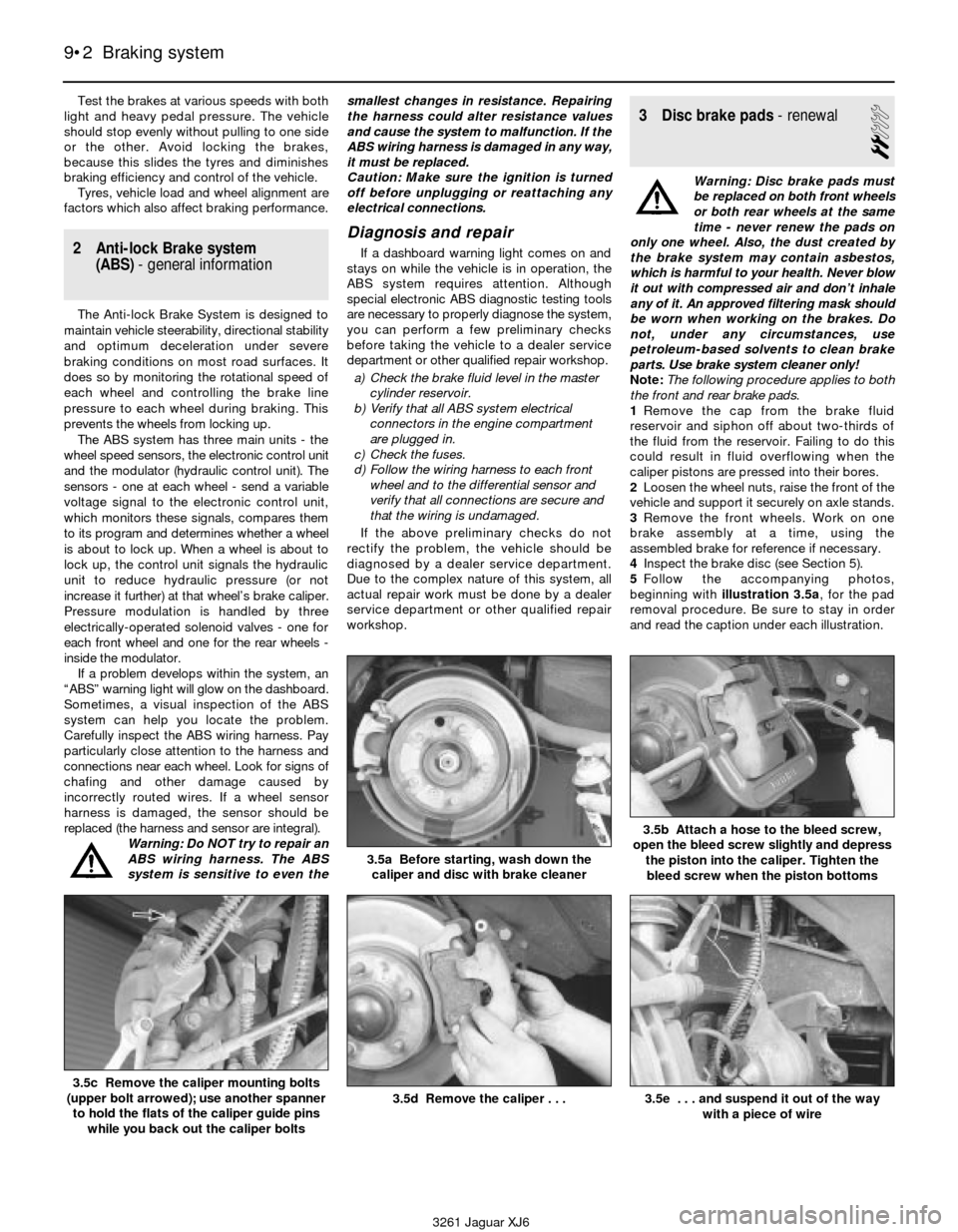
5Follow the accompanying photos,
beginning with illustration 3.5a, for the pad
removal procedure. Be sure to stay in order
and read the caption under each illustration.
9•2 Braking system
3.5a Before starting, wash down the
caliper and disc with brake cleaner
3.5b Attach a hose to the bleed screw,
open the bleed screw slightly and depress
the piston into the caliper. Tighten the
bleed screw when the piston bottoms
3.5c Remove the caliper mounting bolts
(upper bolt arrowed); use another spanner
to hold the flats of the caliper guide pins
while you back out the caliper bolts3.5d Remove the caliper . . .3.5e . . . and suspend it out of the way
with a piece of wire
3261 Jaguar XJ6
Page 137 of 227
3261 Jaguar XJ6
10
Chapter 10
Suspension and steering systems
General
Power steering fluid type . . . . . . . . . . . . . . . . . . . . . . . . . . . . . . . . . . . . See Chapter 1
Torque wrench settingsNm lbf ft
Front suspension
Balljoints
Retaining bolts . . . . . . . . . . . . . . . . . . . . . . . . . . . . . . . . . . . . . . . . . . 55 to 62 41 to 45
Ball stud nuts . . . . . . . . . . . . . . . . . . . . . . . . . . . . . . . . . . . . . . . . . . . 47 to 68 35 to 50
Lower control arm
Spring pan bolts . . . . . . . . . . . . . . . . . . . . . . . . . . . . . . . . . . . . . . . . . 26 to 34 19 to 25
Pivot nuts/bolts . . . . . . . . . . . . . . . . . . . . . . . . . . . . . . . . . . . . . . . . . . 43 to 68 32 to 50
Shock absorber
Lower nut . . . . . . . . . . . . . . . . . . . . . . . . . . . . . . . . . . . . . . . . . . . . . . 61 to 68 45 to 50
Upper nut . . . . . . . . . . . . . . . . . . . . . . . . . . . . . . . . . . . . . . . . . . . . . . 35 to 43 26 to 31
Anti-roll bar
Bushing bracket bolts
Upper . . . . . . . . . . . . . . . . . . . . . . . . . . . . . . . . . . . . . . . . . . . . . . . 22 to 28 16 to 20
Lower . . . . . . . . . . . . . . . . . . . . . . . . . . . . . . . . . . . . . . . . . . . . . . . 24 to 30 18 to 22
Link nuts . . . . . . . . . . . . . . . . . . . . . . . . . . . . . . . . . . . . . . . . . . . . . . . 55 to 60 41 to 44
Upper control arm pivot nuts/bolts . . . . . . . . . . . . . . . . . . . . . . . . . . . . 61 to 75 45 to 55
Rear suspension
Carrier-to-control arm bolt/nut . . . . . . . . . . . . . . . . . . . . . . . . . . . . . . . . 70 to 80 51 to 59
Rear control arm-to-crossmember bolt/nut . . . . . . . . . . . . . . . . . . . . . . 85 to 105 62 to 77
Shock absorber/coil spring assembly
Lower shock-to-control arm bolt/nut . . . . . . . . . . . . . . . . . . . . . . . . . 160 to 200 118 to 147
Upper shock-to-body bolts . . . . . . . . . . . . . . . . . . . . . . . . . . . . . . . . 22 to 28 16 to 20
Steering
Steering wheel-to-steering shaft nut . . . . . . . . . . . . . . . . . . . . . . . . . . . 35 to 45 26 to 33
Steering shaft-to-steering gear pinion shaft U-joint pinch bolt . . . . . . . 19 to 24 14 to 17
Steering gear mounting bracket bolts/nuts . . . . . . . . . . . . . . . . . . . . . . 26 to 29 19 to 21
Tie-rod end-to-steering knuckle nut . . . . . . . . . . . . . . . . . . . . . . . . . . . . 61 to 68 45 to 50 Anti-roll bar (front) - removal and refitting . . . . . . . . . . . . . . . . . . . . . 3
Balljoints - check and renewal . . . . . . . . . . . . . . . . . . . . . . . . . . . . . . 5
Coil spring (front) - removal and refitting . . . . . . . . . . . . . . . . . . . . . . 8
Control arm (rear) - removal and refitting . . . . . . . . . . . . . . . . . . . . . 13
Front wheel bearing - check, repack and adjustment . . See Chapter 1
General information . . . . . . . . . . . . . . . . . . . . . . . . . . . . . . . . . . . . . . 1
Hub and bearing (rear) - renewal . . . . . . . . . . . . . . . . . . . . . . . . . . . . 12
Hub carrier (rear) - removal and refitting . . . . . . . . . . . . . . . . . . . . . . 11
Lower control arm - removal and refitting . . . . . . . . . . . . . . . . . . . . . 9
Power steering fluid level check . . . . . . . . . . . . . . . . . . . See Chapter 1
Power steering pump - removal and refitting . . . . . . . . . . . . . . . . . . 18
Power steering system - bleeding . . . . . . . . . . . . . . . . . . . . . . . . . . . 19
Self-levelling rear suspension system - general information . . . . . . . 2
Shock absorber (front) - removal and refitting . . . . . . . . . . . . . . . . . . 4Shock absorber/coil spring (rear) - removal and refitting . . . . . . . . . 10
Steering and suspension check . . . . . . . . . . . . . . . . . . . See Chapter 1
Steering gear - removal and refitting . . . . . . . . . . . . . . . . . . . . . . . . . 17
Steering gear boots - renewal . . . . . . . . . . . . . . . . . . . . . . . . . . . . . . 16
Steering knuckle - removal and refitting . . . . . . . . . . . . . . . . . . . . . . 6
Steering wheel - removal and refitting . . . . . . . . . . . . . . . . . . . . . . . . 14
Suspension and steering checks . . . . . . . . . . . . . . . . . . See Chapter 1
Tie-rod ends - removal and refitting . . . . . . . . . . . . . . . . . . . . . . . . . 15
Tyre and tyre pressure checks . . . . . . . . . . . . . . . . . . . . See Chapter 1
Tyre rotation . . . . . . . . . . . . . . . . . . . . . . . . . . . . . . . . . . See Chapter 1
Upper control arm - removal and refitting . . . . . . . . . . . . . . . . . . . . . 7
Wheel alignment - general information . . . . . . . . . . . . . . . . . . . . . . . 21
Wheel bearing lubrication . . . . . . . . . . . . . . . . . . . . . . . . See Chapter 1
Wheels and tyres - general information . . . . . . . . . . . . . . . . . . . . . . . 20
10•1
Specifications Contents
Easy,suitable for
novice with little
experienceFairly easy,suitable
for beginner with
some experienceFairly difficult,
suitable for competent
DIY mechanic
Difficult,suitable for
experienced DIY
mechanicVery difficult,
suitable for expert DIY
or professional
Degrees of difficulty
54321
Page 139 of 227
1 General information
Warning: Whenever any of the
suspension or steering fasteners
are loosened or removed, they
must be inspected and if
necessary, replaced with new ones of the
same part number or of original equipment
quality and design. Torque wrench settings
must be followed for proper reassembly
and component retention. Never attempt
to heat, straighten or weld any suspension
or steering component. Instead, renew any
bent or damaged part.
The front suspension (see illustrations)
consists of unequal-length upper and lower
control arms, shock absorbers and coil
springs. The upper ends of the shocks are
attached to the body; the lower ends
are attached to the lower control arms. The
upper ends of the coil springs are seated
against the suspension crossmember; the
lower ends are seated against removable
plates which are bolted to the lower control
arms. The steering knuckles are attached to
balljoints in the upper and lower control arms.
An anti-roll bar is attached to the suspension
crossmember with a pair of bushing brackets
and to the lower control arms via a connecting
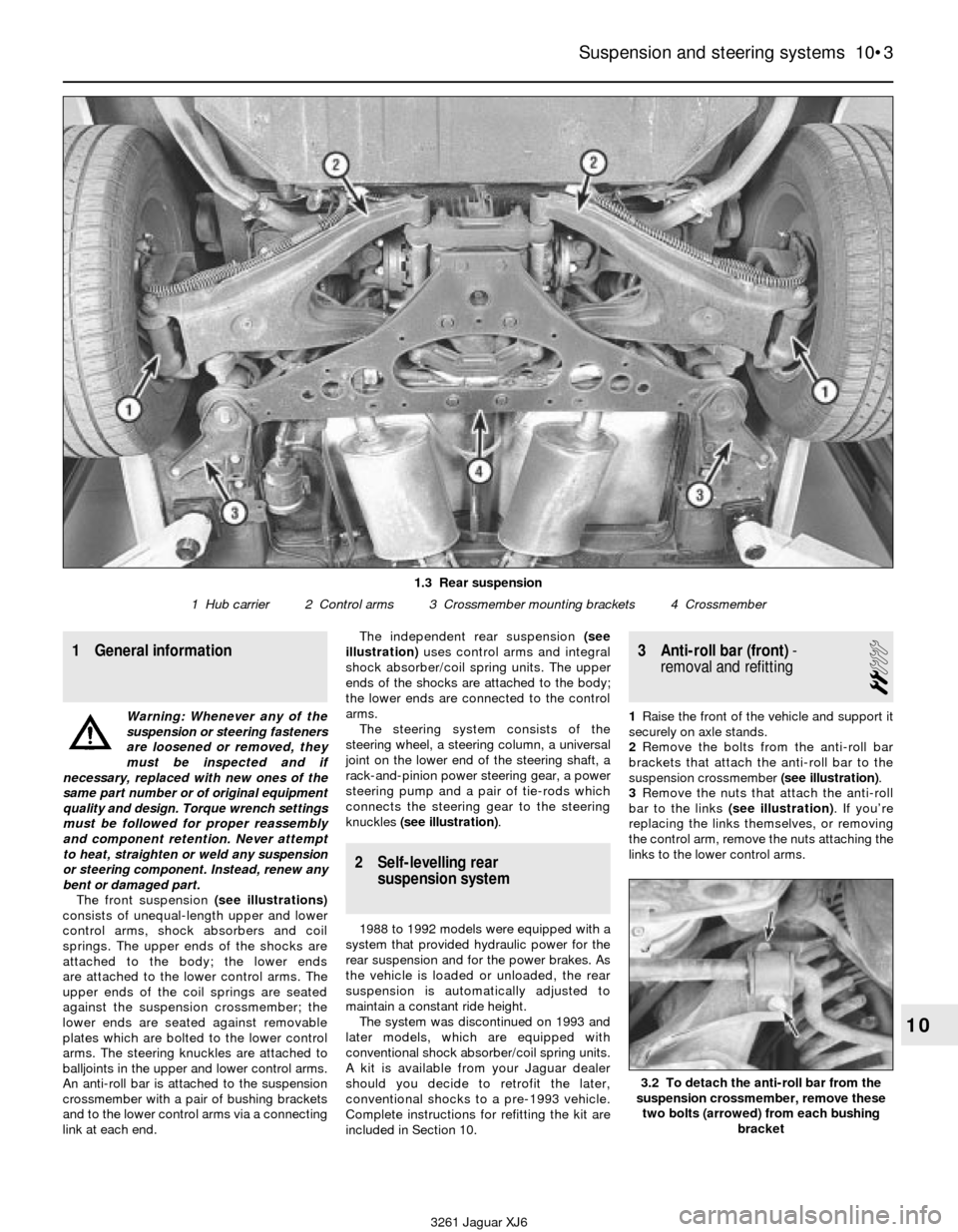
link at each end.The independent rear suspension (see
illustration)uses control arms and integral
shock absorber/coil spring units. The upper
ends of the shocks are attached to the body;
the lower ends are connected to the control
arms.
The steering system consists of the
steering wheel, a steering column, a universal
joint on the lower end of the steering shaft, a
rack-and-pinion power steering gear, a power
steering pump and a pair of tie-rods which
connects the steering gear to the steering
knuckles (see illustration).
2 Self-levelling rear
suspension system
1988 to 1992 models were equipped with a
system that provided hydraulic power for the
rear suspension and for the power brakes. As
the vehicle is loaded or unloaded, the rear
suspension is automatically adjusted to
maintain a constant ride height.
The system was discontinued on 1993 and
later models, which are equipped with
conventional shock absorber/coil spring units.
A kit is available from your Jaguar dealer
should you decide to retrofit the later,
conventional shocks to a pre-1993 vehicle.
Complete instructions for refitting the kit are
included in Section 10.
3 Anti-roll bar (front)-
removal and refitting
2
1Raise the front of the vehicle and support it
securely on axle stands.
2Remove the bolts from the anti-roll bar
brackets that attach the anti-roll bar to the
suspension crossmember (see illustration).
3Remove the nuts that attach the anti-roll
bar to the links (see illustration). If you’re
replacing the links themselves, or removing
the control arm, remove the nuts attaching the
links to the lower control arms.
Suspension and steering systems 10•3
10
1.3 Rear suspension
1 Hub carrier 2 Control arms 3 Crossmember mounting brackets 4 Crossmember
3.2 To detach the anti-roll bar from the
suspension crossmember, remove these
two bolts (arrowed) from each bushing
bracket
3261 Jaguar XJ6