Emissions JAGUAR XJ6 1997 2.G User Guide
[x] Cancel search | Manufacturer: JAGUAR, Model Year: 1997, Model line: XJ6, Model: JAGUAR XJ6 1997 2.GPages: 227, PDF Size: 7.2 MB
Page 115 of 227
e) The silicone boot must be installed in the
correct position to prevent the boot from
being melted and to allow the sensor to
operate properly.
Check
13Locate the oxygen sensor electrical
connector and inspect the oxygen sensor
heater. Disconnect the oxygen sensor
electrical connector and connect an
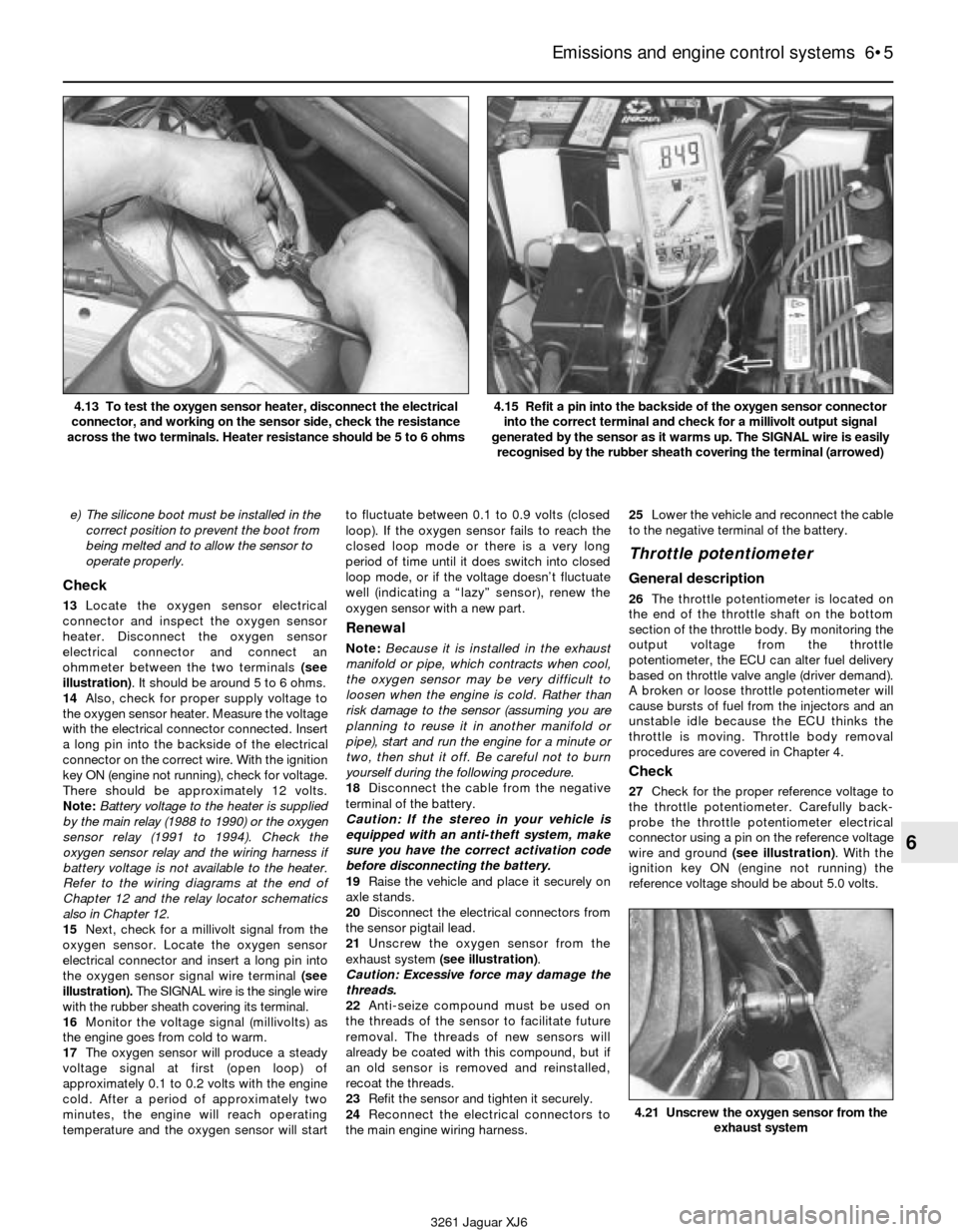
ohmmeter between the two terminals (see
illustration). It should be around 5 to 6 ohms.
14Also, check for proper supply voltage to
the oxygen sensor heater. Measure the voltage
with the electrical connector connected. Insert
a long pin into the backside of the electrical
connector on the correct wire. With the ignition
key ON (engine not running), check for voltage.
There should be approximately 12 volts.
Note:Battery voltage to the heater is supplied
by the main relay (1988 to 1990) or the oxygen
sensor relay (1991 to 1994). Check the
oxygen sensor relay and the wiring harness if
battery voltage is not available to the heater.
Refer to the wiring diagrams at the end of
Chapter 12 and the relay locator schematics
also in Chapter 12.
15Next, check for a millivolt signal from the
oxygen sensor. Locate the oxygen sensor
electrical connector and insert a long pin into
the oxygen sensor signal wire terminal (see
illustration). The SIGNAL wire is the single wire
with the rubber sheath covering its terminal.
16Monitor the voltage signal (millivolts) as
the engine goes from cold to warm.
17The oxygen sensor will produce a steady
voltage signal at first (open loop) of
approximately 0.1 to 0.2 volts with the engine
cold. After a period of approximately two
minutes, the engine will reach operating
temperature and the oxygen sensor will startto fluctuate between 0.1 to 0.9 volts (closed
loop). If the oxygen sensor fails to reach the
closed loop mode or there is a very long
period of time until it does switch into closed
loop mode, or if the voltage doesn’t fluctuate
well (indicating a “lazy” sensor), renew the
oxygen sensor with a new part.
Renewal
Note:Because it is installed in the exhaust
manifold or pipe, which contracts when cool,
the oxygen sensor may be very difficult to
loosen when the engine is cold. Rather than
risk damage to the sensor (assuming you are
planning to reuse it in another manifold or
pipe), start and run the engine for a minute or
two, then shut it off. Be careful not to burn
yourself during the following procedure.
18Disconnect the cable from the negative
terminal of the battery.
Caution: If the stereo in your vehicle is
equipped with an anti-theft system, make
sure you have the correct activation code
before disconnecting the battery.
19Raise the vehicle and place it securely on
axle stands.
20Disconnect the electrical connectors from
the sensor pigtail lead.
21Unscrew the oxygen sensor from the
exhaust system (see illustration).
Caution: Excessive force may damage the
threads.
22Anti-seize compound must be used on
the threads of the sensor to facilitate future
removal. The threads of new sensors will
already be coated with this compound, but if
an old sensor is removed and reinstalled,
recoat the threads.
23Refit the sensor and tighten it securely.
24Reconnect the electrical connectors to
the main engine wiring harness.25Lower the vehicle and reconnect the cable
to the negative terminal of the battery.
Throttle potentiometer
General description
26The throttle potentiometer is located on
the end of the throttle shaft on the bottom
section of the throttle body. By monitoring the
output voltage from the throttle
potentiometer, the ECU can alter fuel delivery
based on throttle valve angle (driver demand).
A broken or loose throttle potentiometer will
cause bursts of fuel from the injectors and an
unstable idle because the ECU thinks the
throttle is moving. Throttle body removal
procedures are covered in Chapter 4.
Check
27Check for the proper reference voltage to
the throttle potentiometer. Carefully back-
probe the throttle potentiometer electrical
connector using a pin on the reference voltage
wire and ground (see illustration). With the
ignition key ON (engine not running) the
reference voltage should be about 5.0 volts.
Emissions and engine control systems 6•5
6
4.21 Unscrew the oxygen sensor from the
exhaust system
3261 Jaguar XJ6 4.13 To test the oxygen sensor heater, disconnect the electrical
connector, and working on the sensor side, check the resistance
across the two terminals. Heater resistance should be 5 to 6 ohms
4.15 Refit a pin into the backside of the oxygen sensor connector
into the correct terminal and check for a millivolt output signal
generated by the sensor as it warms up. The SIGNAL wire is easily
recognised by the rubber sheath covering the terminal (arrowed)
Page 116 of 227
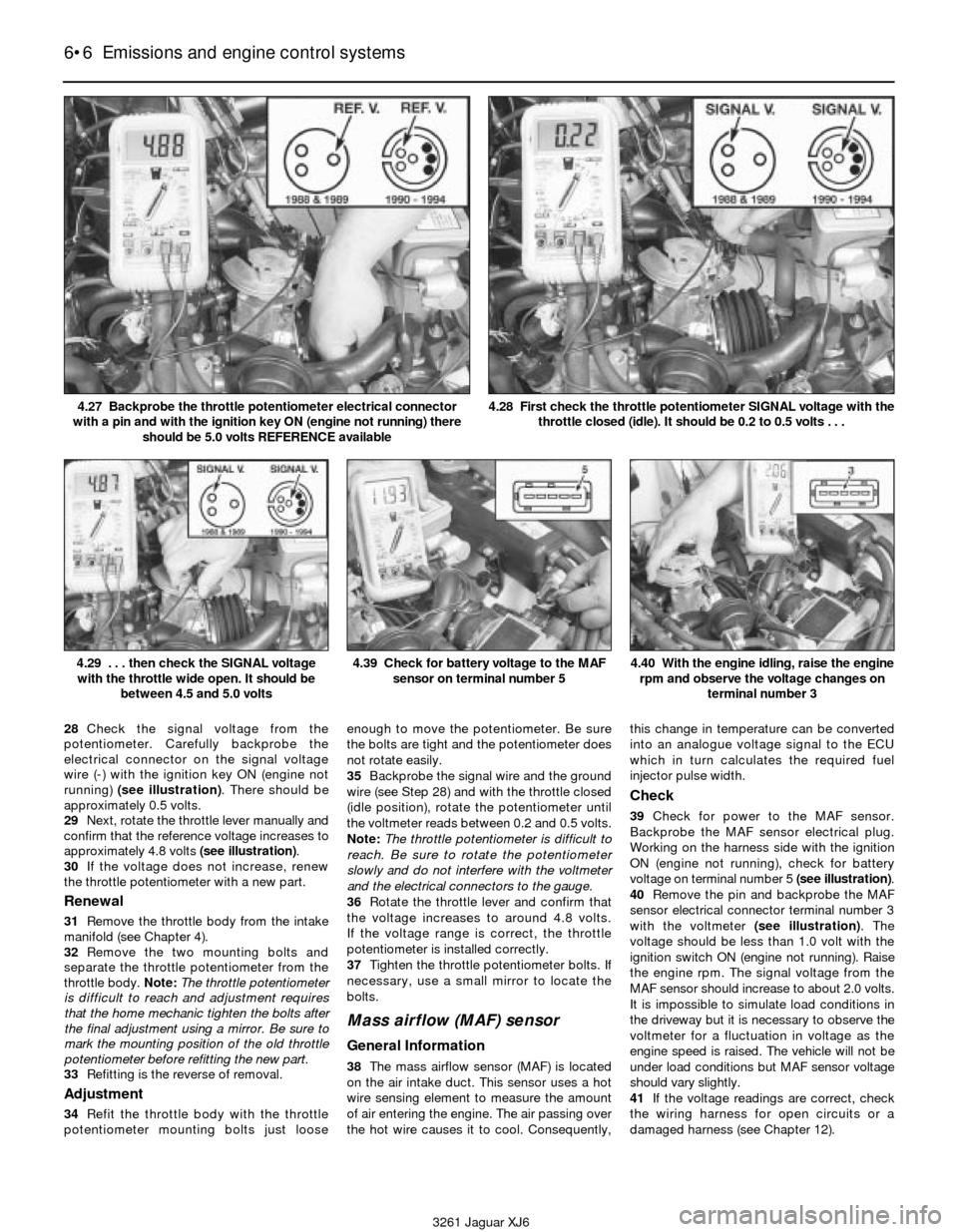
28Check the signal voltage from the
potentiometer. Carefully backprobe the
electrical connector on the signal voltage
wire (-) with the ignition key ON (engine not
running) (see illustration). There should be
approximately 0.5 volts.
29Next, rotate the throttle lever manually and
confirm that the reference voltage increases to
approximately 4.8 volts (see illustration).
30If the voltage does not increase, renew
the throttle potentiometer with a new part.
Renewal
31Remove the throttle body from the intake
manifold (see Chapter 4).
32Remove the two mounting bolts and
separate the throttle potentiometer from the
throttle body. Note:The throttle potentiometer
is difficult to reach and adjustment requires
that the home mechanic tighten the bolts after
the final adjustment using a mirror. Be sure to
mark the mounting position of the old throttle
potentiometer before refitting the new part.
33Refitting is the reverse of removal.
Adjustment
34Refit the throttle body with the throttle
potentiometer mounting bolts just looseenough to move the potentiometer. Be sure
the bolts are tight and the potentiometer does
not rotate easily.
35Backprobe the signal wire and the ground
wire (see Step 28) and with the throttle closed
(idle position), rotate the potentiometer until
the voltmeter reads between 0.2 and 0.5 volts.
Note:The throttle potentiometer is difficult to
reach. Be sure to rotate the potentiometer
slowly and do not interfere with the voltmeter
and the electrical connectors to the gauge.
36Rotate the throttle lever and confirm that
the voltage increases to around 4.8 volts.
If the voltage range is correct, the throttle
potentiometer is installed correctly.
37Tighten the throttle potentiometer bolts. If
necessary, use a small mirror to locate the
bolts.
Mass airflow (MAF) sensor
General Information
38The mass airflow sensor (MAF) is located
on the air intake duct. This sensor uses a hot
wire sensing element to measure the amount
of air entering the engine. The air passing over
the hot wire causes it to cool. Consequently,this change in temperature can be converted
into an analogue voltage signal to the ECU
which in turn calculates the required fuel
injector pulse width.
Check
39Check for power to the MAF sensor.
Backprobe the MAF sensor electrical plug.
Working on the harness side with the ignition
ON (engine not running), check for battery
voltage on terminal number 5 (see illustration).
40Remove the pin and backprobe the MAF
sensor electrical connector terminal number 3
with the voltmeter (see illustration). The
voltage should be less than 1.0 volt with the
ignition switch ON (engine not running). Raise
the engine rpm. The signal voltage from the
MAF sensor should increase to about 2.0 volts.
It is impossible to simulate load conditions in
the driveway but it is necessary to observe the
voltmeter for a fluctuation in voltage as the
engine speed is raised. The vehicle will not be
under load conditions but MAF sensor voltage
should vary slightly.
41If the voltage readings are correct, check
the wiring harness for open circuits or a
damaged harness (see Chapter 12).
6•6 Emissions and engine control systems
4.29 . . . then check the SIGNAL voltage
with the throttle wide open. It should be
between 4.5 and 5.0 volts4.39 Check for battery voltage to the MAF
sensor on terminal number 54.40 With the engine idling, raise the engine
rpm and observe the voltage changes on
terminal number 3
3261 Jaguar XJ6 4.27 Backprobe the throttle potentiometer electrical connector
with a pin and with the ignition key ON (engine not running) there
should be 5.0 volts REFERENCE available
4.28 First check the throttle potentiometer SIGNAL voltage with the
throttle closed (idle). It should be 0.2 to 0.5 volts . . .
Page 117 of 227
42Also, check the reference voltage to the
MAF sensor from the computer. Backprobe
terminal number 6 and make sure that
approximately 5 volts is present.
Renewal
43Disconnect the electrical connector from
the MAF sensor.
44Remove the air cleaner assembly (see
Chapter 4).
45Remove the four bolts and separate the
MAF sensor from the air intake duct.
46Refitting is the reverse of removal.
Intake air temperature
(IAT) sensor
General description
47The intake air temperature sensor is
located inside the air intake duct. This sensor
acts as a resistor which changes value
according to the temperature of the air entering
the engine. Low temperatures produce a high
resistance value (for example, at 68° F the
value is 2.0 to 2.6 k-ohms) while high
temperatures produce low resistance values (at
176° F the resistance is 260 to 330 ohms. The
ECU supplies around 5 volts (reference
voltage) to the air temperature sensor.
The voltage will change according to the
temperature of the incoming air. The voltage
will be high when the air temperature is cold
and low when the air temperature is warm. Any
problems with the air temperature sensor
will usually set a code 8 (1988 and 1989) or
code 16 (1990 to 1994).
Check
48To check the air temperature sensor,
disconnect the two prong electrical connector
and turn the ignition key ON but do not start
the engine.
49Measure the voltage (reference voltage),
which should be approximately 5 volts.
50If the voltage signal is not correct, havethe ECU diagnosed by a dealer service
department or other repair workshop.
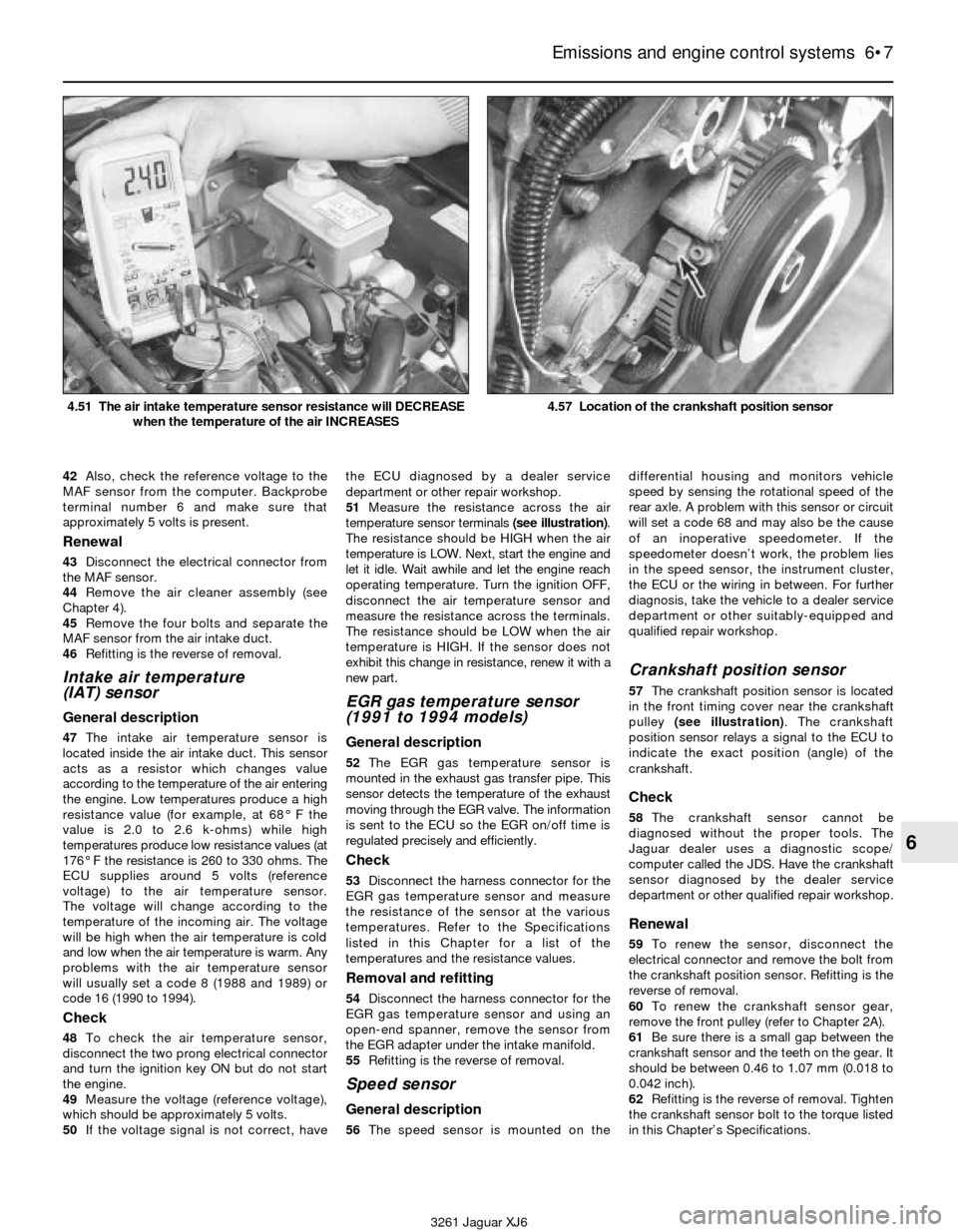
51Measure the resistance across the air
temperature sensor terminals (see illustration).
The resistance should be HIGH when the air
temperature is LOW. Next, start the engine and
let it idle. Wait awhile and let the engine reach
operating temperature. Turn the ignition OFF,
disconnect the air temperature sensor and
measure the resistance across the terminals.
The resistance should be LOW when the air
temperature is HIGH. If the sensor does not
exhibit this change in resistance, renew it with a
new part.
EGR gas temperature sensor
(1991 to 1994 models)
General description
52The EGR gas temperature sensor is
mounted in the exhaust gas transfer pipe. This
sensor detects the temperature of the exhaust
moving through the EGR valve. The information
is sent to the ECU so the EGR on/off time is
regulated precisely and efficiently.
Check
53Disconnect the harness connector for the
EGR gas temperature sensor and measure
the resistance of the sensor at the various
temperatures. Refer to the Specifications
listed in this Chapter for a list of the
temperatures and the resistance values.
Removal and refitting
54Disconnect the harness connector for the
EGR gas temperature sensor and using an
open-end spanner, remove the sensor from
the EGR adapter under the intake manifold.
55Refitting is the reverse of removal.
Speed sensor
General description
56The speed sensor is mounted on thedifferential housing and monitors vehicle
speed by sensing the rotational speed of the
rear axle. A problem with this sensor or circuit
will set a code 68 and may also be the cause
of an inoperative speedometer. If the
speedometer doesn’t work, the problem lies
in the speed sensor, the instrument cluster,
the ECU or the wiring in between. For further
diagnosis, take the vehicle to a dealer service
department or other suitably-equipped and
qualified repair workshop.
Crankshaft position sensor
57The crankshaft position sensor is located
in the front timing cover near the crankshaft
pulley (see illustration). The crankshaft
position sensor relays a signal to the ECU to
indicate the exact position (angle) of the
crankshaft.
Check
58The crankshaft sensor cannot be
diagnosed without the proper tools. The
Jaguar dealer uses a diagnostic scope/
computer called the JDS. Have the crankshaft
sensor diagnosed by the dealer service
department or other qualified repair workshop.
Renewal
59To renew the sensor, disconnect the
electrical connector and remove the bolt from
the crankshaft position sensor. Refitting is the
reverse of removal.
60To renew the crankshaft sensor gear,
remove the front pulley (refer to Chapter 2A).
61Be sure there is a small gap between the
crankshaft sensor and the teeth on the gear. It
should be between 0.46 to 1.07 mm (0.018 to
0.042 inch).
62Refitting is the reverse of removal. Tighten
the crankshaft sensor bolt to the torque listed
in this Chapter’s Specifications.
Emissions and engine control systems 6•7
6
3261 Jaguar XJ6 4.51 The air intake temperature sensor resistance will DECREASE
when the temperature of the air INCREASES
4.57 Location of the crankshaft position sensor
Page 118 of 227

5 Air Injector Reactor
(AIR) system
General information
1The air injection reactor system reduces
carbon monoxide and hydrocarbon content
in the exhaust gases by injecting fresh air into
the hot exhaust gases leaving the exhaust
ports. When fresh air is mixed with hot
exhaust gases, oxidation is increased,
reducing the concentration of hydrocarbons
and carbon monoxide and converting them
into harmless carbon dioxide and water.
2The air injection system is composed of an
air pump, diverter valve (bypass), check valve,
air injection manifold, vacuum delay valve,
vacuum control solenoid, air pump magnetic
clutch, air pump clutch relay and hoses (see
illustration). The air pump is driven by a belt
from the crankshaft and supplies compressed
air to the exhaust manifold(s). The check valve
prevents the reverse flow of exhaust gases into
the system. The vacuum-operated (early
models) or electrically-operated (later models)air cut-off valve prevents air from being drawn
into the exhaust when the air pump is switched
off. System vacuum to the air cut-off valve is
controlled by the solenoid vacuum valve in
parallel circuit with the air pump. A delay valve
prevents vacuum loss to the solenoid valve
during wide open throttle operation.
3Injected air is controlled by the computer,
the air pump clutch and the air pump clutch
relay. The AIR system is used during warm-up
(58 to 83° F) to control emissions while the
engine is running rich. The oxygen sensor
feedback system cannot function while the AIR
system is operating. The computer controls
both systems during warm-up and operating
temperatures. If problems occur with the
AIR system relay or circuit, the on-board
diagnosis system will set a code 66.
Check
4Check the condition of the air pump
drivebelt, the injection hoses and the injection
manifold. Make sure that all components are
intact and there are no leaks.
5Check the operation of the air pump clutch
relay (see illustration)and the air pump
clutch. First remove the relay and check forbattery voltage to the relay. Also, check the
relay itself. Refer to the relay checking
procedure in Chapter 12. Extract codes from
the self-diagnosis system (see Section 3) and
check for a code 66, AIR relay malfunction.
6Make sure the electrical connector is
securely fastened to the diverter valve (see
illustration). If everything appears OK but a
fault code still sets, have the system
diagnosed by a dealer service department or
other qualified repair workshop.
Air pump renewal
7Disconnect the cable from the negative
terminal of the battery.
Caution: If the stereo in your vehicle is
equipped with an anti-theft system, make
sure you have the correct activation code
before disconnecting the battery.
8Disconnect the electrical connector from
the air pump clutch.
9Loosen the clips from the air inlet and outlet
hose and separate them from the air injection
pump.
10Loosen the adjuster and pivot bolts (see
illustration)and nuts but do not remove them
from the air injection pump brackets.
6•8 Emissions and engine control systems
3261 Jaguar XJ6 5.2 Schematic of the Air Injection Reactor (AIR) system
5.6 Location of the AIR diverter valve on a 1992 model - check the
hoses for cracking and the electrical connector for security5.10 Loosen the pivot bolt and then the adjustment nut to remove
the drivebelt from the air pump. The adjustment nut has a lock bolt
that must be loosened before the pump will move down the adjuster
5.5 Location of the AIR pump relay on a 1992 model
Page 119 of 227

11Swing the pump toward the engine and
remove the drivebelt from the pump.
12Remove the link arm through-bolt.
13Remove the pivot bolt and front spacer,
rear cone and air injection pump from the
engine compartment.
14Remove the nut securing the front pulley
on the air injection pump.
15Remove the clutch snap-ring and the
clutch.
16Refitting is the reverse of removal.
6 Exhaust Gas Recirculation
(EGR) system
Note 1: Some 1990 models have the EGR
vacuum hose routed incorrectly through the
bulkhead securing straps, thereby restricting
the vacuum signal to the EGR valve. Remove
the EGR vacuum hose from the bulkhead
harness and refit a new hose. Secure it to the
engine compartment using tie-wraps and do
not allow any restrictions in the hose.Note 2: Some models have copper sealing
washers that soften and leak around the EGR
valve causing engine performance and
starting problems. Refit steel washers and
pipe adapters into the EGR system. Contact a
Jaguar dealer for the VIN numbers and years
of the models that are affected by this defect.
1To reduce oxides of nitrogen emissions,
some of the exhaust gases are recirculated
through the EGR valve to the intake manifold
to lower combustion temperatures.
2The EGR system consists of the EGR valve,
an EGR solenoid, an EGR gas temperature
sensor and the transfer pipe (see illustration).
Check
EGR valve
3Start the engine and allow it to idle.
4Detach the vacuum hose from the EGR
valve and attach a hand vacuum pump in its
place (see illustration).
5Apply vacuum to the EGR valve. Vacuum
should remain steady and the engine should
run poorly. Note:This action will raise the
pintle and allow exhaust gases to recirculateinto the intake system and cause rough
running condition at idle.Double-check the
movement of the pintle by checking the
diaphragm using the tip of your finger (see
illustration). If the EGR diaphragm moves
smoothly and holds steady when vacuum is
applied, the EGR valve is working properly.
Warning: Don’t burn yourself. If
the EGR valve is hot, wear a
glove or wait until it cools.
a) If the vacuum doesn’t remain steady and
the engine doesn’t run poorly, renew the
EGR valve and recheck it.
b) If the vacuum remains steady but the
engine doesn’t run poorly, remove the
EGR valve and check the valve and the
intake manifold for blockage. Clean or
renew parts as necessary and recheck.EGR system
6Disconnect the hose from the EGR valve,
refit a vacuum gauge and check for vacuum
to the EGR valve. There should be vacuum
present with the engine warmed to operating
temperature (above 140° F) and between
1000 and 4000 rpm (see illustration).
Emissions and engine control systems 6•9
6
3261 Jaguar XJ6 6.2 Schematic of the EGR system
6.4 Apply vacuum to the EGR valve and confirm that the valve
opens and allows exhaust gases to circulate. Once it is activated,
the EGR valve should hold steady (no loss in vacuum)
6.5 Use a fingertip to move the diaphragm inside the EGR valve6.6 Check for vacuum to the EGR valve from the throttle body
Page 120 of 227
7Start the engine and observe the vacuum
gauge. At idle, there should be no vacuum
present. Raise the engine rpm and observe
the vacuum increase. This is a ported vacuum
source and therefore it should only register
vacuum when throttled.
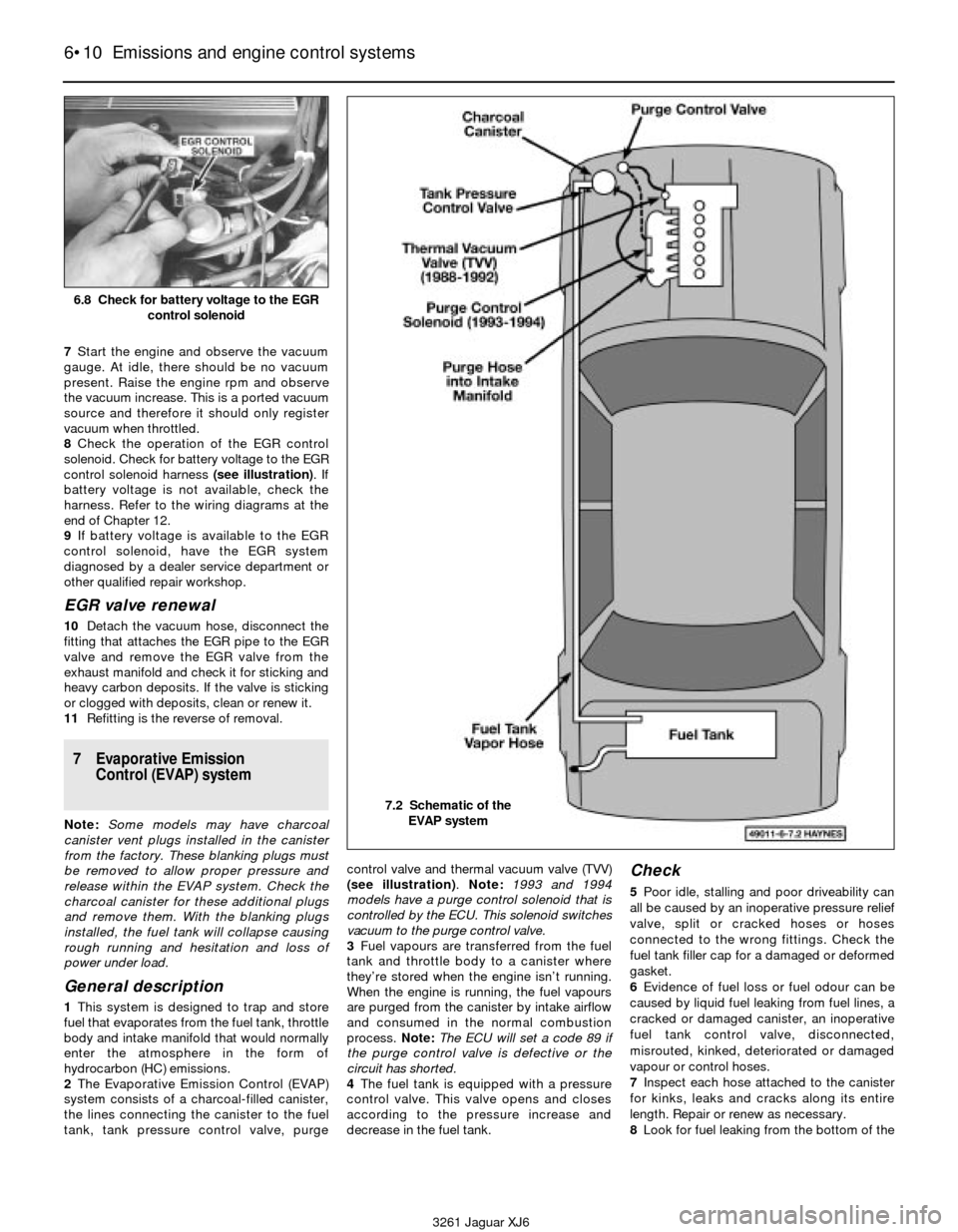
8Check the operation of the EGR control
solenoid. Check for battery voltage to the EGR
control solenoid harness (see illustration). If
battery voltage is not available, check the
harness. Refer to the wiring diagrams at the
end of Chapter 12.
9If battery voltage is available to the EGR
control solenoid, have the EGR system
diagnosed by a dealer service department or
other qualified repair workshop.
EGR valve renewal
10Detach the vacuum hose, disconnect the
fitting that attaches the EGR pipe to the EGR
valve and remove the EGR valve from the
exhaust manifold and check it for sticking and
heavy carbon deposits. If the valve is sticking
or clogged with deposits, clean or renew it.
11Refitting is the reverse of removal.
7 Evaporative Emission
Control (EVAP) system
Note: Some models may have charcoal
canister vent plugs installed in the canister
from the factory. These blanking plugs must
be removed to allow proper pressure and
release within the EVAP system. Check the
charcoal canister for these additional plugs
and remove them. With the blanking plugs
installed, the fuel tank will collapse causing
rough running and hesitation and loss of
power under load.
General description
1This system is designed to trap and store
fuel that evaporates from the fuel tank, throttle
body and intake manifold that would normally
enter the atmosphere in the form of
hydrocarbon (HC) emissions.
2The Evaporative Emission Control (EVAP)
system consists of a charcoal-filled canister,
the lines connecting the canister to the fuel
tank, tank pressure control valve, purgecontrol valve and thermal vacuum valve (TVV)
(see illustration). Note: 1993 and 1994
models have a purge control solenoid that is
controlled by the ECU. This solenoid switches
vacuum to the purge control valve.
3Fuel vapours are transferred from the fuel
tank and throttle body to a canister where
they’re stored when the engine isn’t running.
When the engine is running, the fuel vapours
are purged from the canister by intake airflow
and consumed in the normal combustion
process.Note: The ECU will set a code 89 if
the purge control valve is defective or the
circuit has shorted.
4The fuel tank is equipped with a pressure
control valve. This valve opens and closes
according to the pressure increase and
decrease in the fuel tank.
Check
5Poor idle, stalling and poor driveability can
all be caused by an inoperative pressure relief
valve, split or cracked hoses or hoses
connected to the wrong fittings. Check the
fuel tank filler cap for a damaged or deformed
gasket.
6Evidence of fuel loss or fuel odour can be
caused by liquid fuel leaking from fuel lines, a
cracked or damaged canister, an inoperative
fuel tank control valve, disconnected,
misrouted, kinked, deteriorated or damaged
vapour or control hoses.
7Inspect each hose attached to the canister
for kinks, leaks and cracks along its entire
length. Repair or renew as necessary.
8Look for fuel leaking from the bottom of the
6•10 Emissions and engine control systems
6.8 Check for battery voltage to the EGR
control solenoid
3261 Jaguar XJ6
7.2 Schematic of the
EVAP system
Page 121 of 227
canister. If fuel is leaking, renew the canister
and check the hoses and hose routing.
9Inspect the canister. If it’s cracked or
damaged, renew it.
10Check for a clogged filter or a damaged
pressure relief valve. Using low pressure
compressed air (such as from a tyre pump),
blow into the canister tank pipe. Air should
flow freely from the other pipes. If a problem is
found, renew the canister.
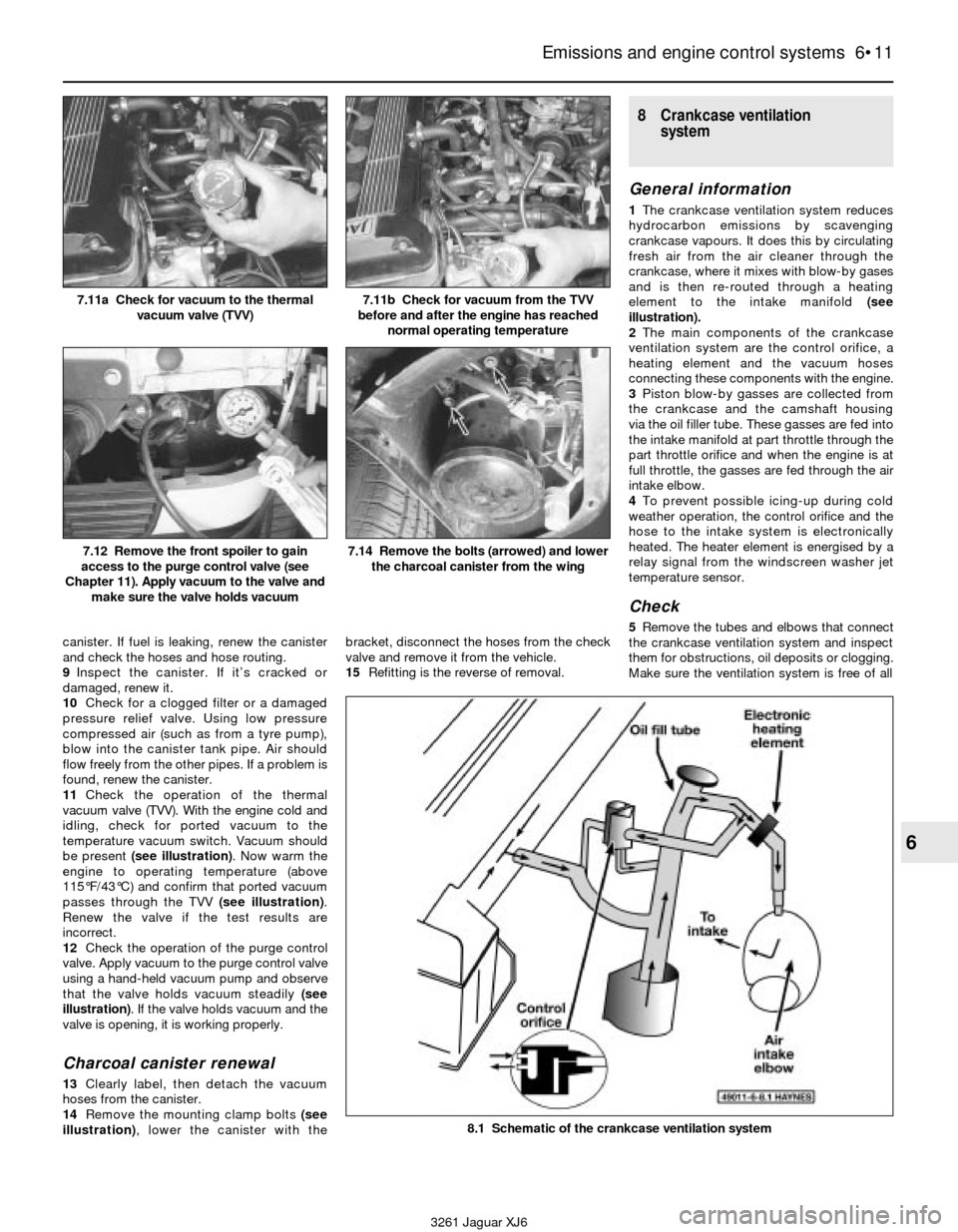
11Check the operation of the thermal
vacuum valve (TVV). With the engine cold and
idling, check for ported vacuum to the
temperature vacuum switch. Vacuum should
be present (see illustration). Now warm the
engine to operating temperature (above
115°F/43°C) and confirm that ported vacuum
passes through the TVV (see illustration).
Renew the valve if the test results are
incorrect.
12Check the operation of the purge control
valve. Apply vacuum to the purge control valve
using a hand-held vacuum pump and observe
that the valve holds vacuum steadily (see
illustration). If the valve holds vacuum and the
valve is opening, it is working properly.
Charcoal canister renewal
13Clearly label, then detach the vacuum
hoses from the canister.
14Remove the mounting clamp bolts (see
illustration), lower the canister with thebracket, disconnect the hoses from the check
valve and remove it from the vehicle.
15Refitting is the reverse of removal.
8 Crankcase ventilation
system
General information
1The crankcase ventilation system reduces
hydrocarbon emissions by scavenging
crankcase vapours. It does this by circulating
fresh air from the air cleaner through the
crankcase, where it mixes with blow-by gases
and is then re-routed through a heating
element to the intake manifold(see
illustration).
2The main components of the crankcase
ventilation system are the control orifice, a
heating element and the vacuum hoses
connecting these components with the engine.
3Piston blow-by gasses are collected from
the crankcase and the camshaft housing
via the oil filler tube. These gasses are fed into
the intake manifold at part throttle through the
part throttle orifice and when the engine is at
full throttle, the gasses are fed through the air
intake elbow.
4To prevent possible icing-up during cold
weather operation, the control orifice and the
hose to the intake system is electronically
heated. The heater element is energised by a
relay signal from the windscreen washer jet
temperature sensor.
Check
5Remove the tubes and elbows that connect
the crankcase ventilation system and inspect
them for obstructions, oil deposits or clogging.
Make sure the ventilation system is free of all
Emissions and engine control systems 6•11
6
7.11a Check for vacuum to the thermal
vacuum valve (TVV)7.11b Check for vacuum from the TVV
before and after the engine has reached
normal operating temperature
7.12 Remove the front spoiler to gain
access to the purge control valve (see
Chapter 11). Apply vacuum to the valve and
make sure the valve holds vacuum7.14 Remove the bolts (arrowed) and lower
the charcoal canister from the wing
8.1 Schematic of the crankcase ventilation system
3261 Jaguar XJ6
Page 122 of 227
obstructions to ensure complete recirculation
of gasses from the crankcase back into the
intake manifold. In the event of clogging, the
pressure will increase causing blow-by and oil
leaks through seals and gaskets.
6Check the operation of the heating element.
Check for battery voltage to the element while
the engine is cold. If no voltage is available
to the heating element, check the circuit from
the windscreen washer jet temperature
sensor.
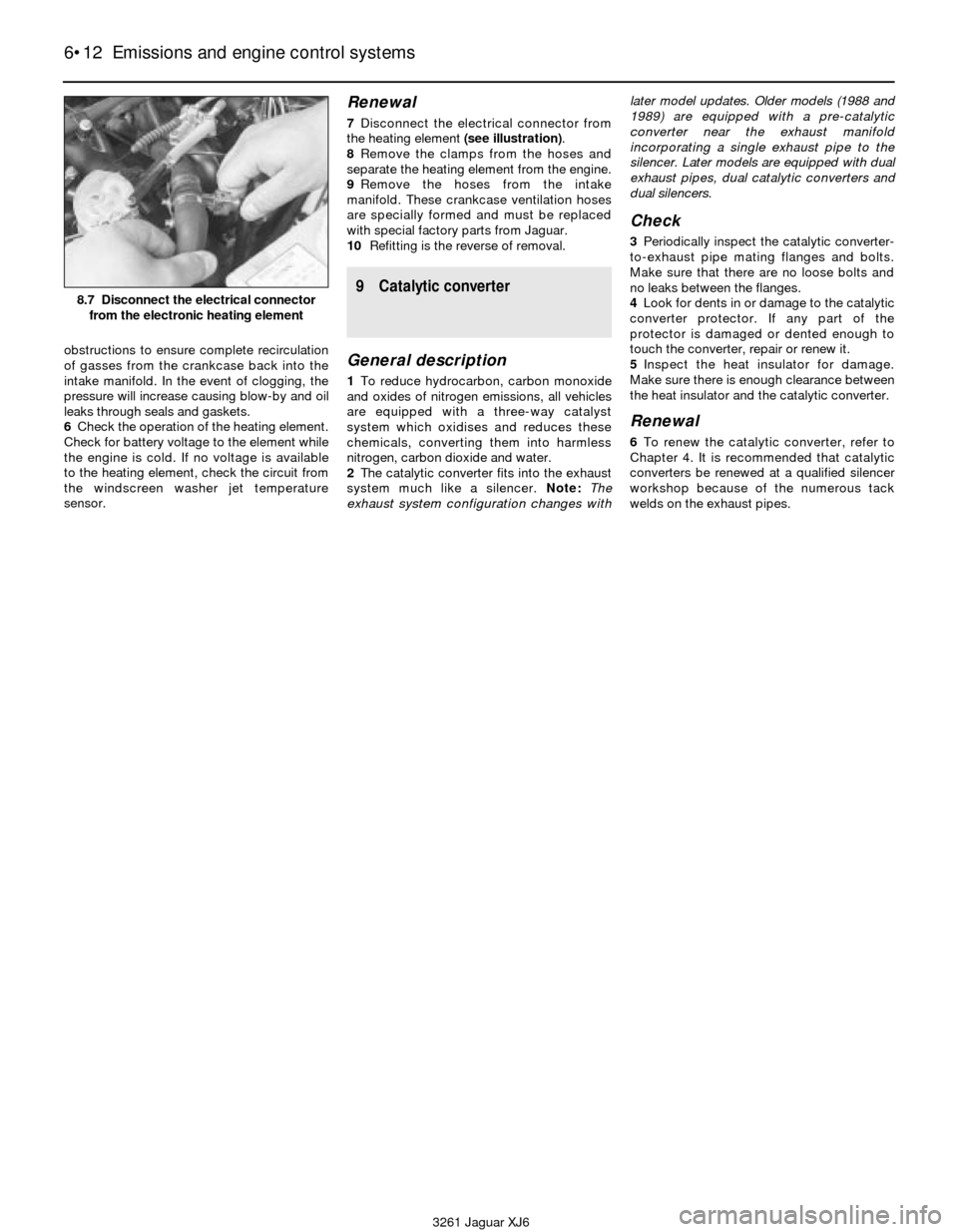
Renewal
7Disconnect the electrical connector from
the heating element (see illustration).
8Remove the clamps from the hoses and
separate the heating element from the engine.
9Remove the hoses from the intake
manifold. These crankcase ventilation hoses
are specially formed and must be replaced
with special factory parts from Jaguar.
10Refitting is the reverse of removal.
9 Catalytic converter
General description
1To reduce hydrocarbon, carbon monoxide
and oxides of nitrogen emissions, all vehicles
are equipped with a three-way catalyst
system which oxidises and reduces these
chemicals, converting them into harmless
nitrogen, carbon dioxide and water.
2The catalytic converter fits into the exhaust
system much like a silencer. Note:The
exhaust system configuration changes withlater model updates. Older models (1988 and
1989) are equipped with a pre-catalytic
converter near the exhaust manifold
incorporating a single exhaust pipe to the
silencer. Later models are equipped with dual
exhaust pipes, dual catalytic converters and
dual silencers.
Check
3Periodically inspect the catalytic converter-
to-exhaust pipe mating flanges and bolts.
Make sure that there are no loose bolts and
no leaks between the flanges.
4Look for dents in or damage to the catalytic
converter protector. If any part of the
protector is damaged or dented enough to
touch the converter, repair or renew it.
5Inspect the heat insulator for damage.
Make sure there is enough clearance between
the heat insulator and the catalytic converter.
Renewal
6To renew the catalytic converter, refer to
Chapter 4. It is recommended that catalytic
converters be renewed at a qualified silencer
workshop because of the numerous tack
welds on the exhaust pipes.
6•12 Emissions and engine control systems
3261 Jaguar XJ6
8.7 Disconnect the electrical connector
from the electronic heating element
Page 206 of 227

3261 Jaguar XJ6
General repair proceduresREF•5
Whenever servicing, repair or overhaul work
is carried out on the car or its components, it
is necessary to observe the following
procedures and instructions. This will assist in
carrying out the operation efficiently and to a
professional standard of workmanship.
Joint mating faces and gaskets
When separating components at their
mating faces, never insert screwdrivers or
similar implements into the joint between the
faces in order to prise them apart. This can
cause severe damage which results in oil
leaks, coolant leaks, etc upon reassembly.
Separation is usually achieved by tapping
along the joint with a soft-faced hammer in
order to break the seal. However, note that
this method may not be suitable where
dowels are used for component location.
Where a gasket is used between the mating
faces of two components, ensure that it is
renewed on reassembly, and fit it dry unless
otherwise stated in the repair procedure. Make
sure that the mating faces are clean and dry,
with all traces of old gasket removed. When
cleaning a joint face, use a tool which is not
likely to score or damage the face, and remove
any burrs or nicks with an oilstone or fine file.
Make sure that tapped holes are cleaned
with a pipe cleaner, and keep them free of
jointing compound, if this is being used,
unless specifically instructed otherwise.
Ensure that all orifices, channels or pipes
are clear, and blow through them, preferably
using compressed air.
Oil seals
Oil seals can be removed by levering them
out with a wide flat-bladed screwdriver or
similar tool. Alternatively, a number of self-
tapping screws may be screwed into the seal,
and these used as a purchase for pliers or
similar in order to pull the seal free.
Whenever an oil seal is removed from its
working location, either individually or as part
of an assembly, it should be renewed.
The very fine sealing lip of the seal is easily
damaged, and will not seal if the surface it
contacts is not completely clean and free from
scratches, nicks or grooves. If the original
sealing surface of the component cannot be
restored, and the manufacturer has not made
provision for slight relocation of the seal
relative to the sealing surface, the component
should be renewed.
Protect the lips of the seal from any surface
which may damage them in the course of
fitting. Use tape or a conical sleeve where
possible. Lubricate the seal lips with oil before
fitting and, on dual-lipped seals, fill the space
between the lips with grease.
Unless otherwise stated, oil seals must be
fitted with their sealing lips toward the
lubricant to be sealed.
Use a tubular drift or block of wood of the
appropriate size to install the seal and, if the
seal housing is shouldered, drive the seal
down to the shoulder. If the seal housing isunshouldered, the seal should be fitted with
its face flush with the housing top face (unless
otherwise instructed).
Screw threads and fastenings
Seized nuts, bolts and screws are quite a
common occurrence where corrosion has set
in, and the use of penetrating oil or releasing
fluid will often overcome this problem if the
offending item is soaked for a while before
attempting to release it. The use of an impact
driver may also provide a means of releasing
such stubborn fastening devices, when used
in conjunction with the appropriate
screwdriver bit or socket. If none of these
methods works, it may be necessary to resort
to the careful application of heat, or the use of
a hacksaw or nut splitter device.
Studs are usually removed by locking two
nuts together on the threaded part, and then
using a spanner on the lower nut to unscrew
the stud. Studs or bolts which have broken off
below the surface of the component in which
they are mounted can sometimes be removed
using a stud extractor. Always ensure that a
blind tapped hole is completely free from oil,
grease, water or other fluid before installing
the bolt or stud. Failure to do this could cause
the housing to crack due to the hydraulic
action of the bolt or stud as it is screwed in.
When tightening a castellated nut to accept
a split pin, tighten the nut to the specified
torque, where applicable, and then tighten
further to the next split pin hole. Never
slacken the nut to align the split pin hole,
unless stated in the repair procedure.
When checking or retightening a nut or bolt
to a specified torque setting, slacken the nut
or bolt by a quarter of a turn, and then
retighten to the specified setting. However,
this should not be attempted where angular
tightening has been used.
For some screw fastenings, notably
cylinder head bolts or nuts, torque wrench
settings are no longer specified for the latter
stages of tightening, “angle-tightening” being
called up instead. Typically, a fairly low torque
wrench setting will be applied to the
bolts/nuts in the correct sequence, followed
by one or more stages of tightening through
specified angles.
Locknuts, locktabs and washers
Any fastening which will rotate against a
component or housing during tightening
should always have a washer between it and
the relevant component or housing.
Spring or split washers should always be
renewed when they are used to lock a critical
component such as a big-end bearing
retaining bolt or nut. Locktabs which are
folded over to retain a nut or bolt should
always be renewed.
Self-locking nuts can be re-used in non-
critical areas, providing resistance can be felt
when the locking portion passes over the bolt
or stud thread. However, it should be noted
that self-locking stiffnuts tend to lose theireffectiveness after long periods of use, and
should be renewed as a matter of course.
Split pins must always be replaced with
new ones of the correct size for the hole.
When thread-locking compound is found
on the threads of a fastener which is to be re-
used, it should be cleaned off with a wire
brush and solvent, and fresh compound
applied on reassembly.
Special tools
Some repair procedures in this manual
entail the use of special tools such as a press,
two or three-legged pullers, spring
compressors, etc. Wherever possible, suitable
readily-available alternatives to the
manufacturer’s special tools are described,
and are shown in use. In some instances,
where no alternative is possible, it has been
necessary to resort to the use of a
manufacturer’s tool, and this has been done
for reasons of safety as well as the efficient
completion of the repair operation. Unless you
are highly-skilled and have a thorough
understanding of the procedures described,
never attempt to bypass the use of any
special tool when the procedure described
specifies its use. Not only is there a very great
risk of personal injury, but expensive damage
could be caused to the components involved.
Environmental considerations
When disposing of used engine oil, brake
fluid, antifreeze, etc, give due consideration to
any detrimental environmental effects. Do not,
for instance, pour any of the above liquids
down drains into the general sewage system,
or onto the ground to soak away. Many local
council refuse tips provide a facility for waste
oil disposal, as do some garages. If none of
these facilities are available, consult your local
Environmental Health Department, or the
National Rivers Authority, for further advice.
With the universal tightening-up of
legislation regarding the emission of
environmentally-harmful substances from
motor vehicles, most current vehicles have
tamperproof devices fitted to the main
adjustment points of the fuel system. These
devices are primarily designed to prevent
unqualified persons from adjusting the fuel/air
mixture, with the chance of a consequent
increase in toxic emissions. If such devices
are encountered during servicing or overhaul,
they should, wherever possible, be renewed
or refitted in accordance with the vehicle
manufacturer’s requirements or current
legislation.
Note: It is
antisocial and
illegal to dump oil
down the drain.
To find the
location of your
local oil recycling
bank, call this
number free.
Page 212 of 227
3261 Jaguar XJ6
MOT test checksREF•11
MExamine the handbrake mechanism,
checking for frayed or broken cables,
excessive corrosion, or wear or insecurity of
the linkage. Check that the mechanism works
on each relevant wheel, and releases fully,
without binding.
MIt is not possible to test brake efficiency
without special equipment, but a road test can
be carried out later to check that the vehicle
pulls up in a straight line.
Fuel and exhaust systems
MInspect the fuel tank (including the filler
cap), fuel pipes, hoses and unions. All
components must be secure and free from
leaks.
MExamine the exhaust system over its entire
length, checking for any damaged, broken or
missing mountings, security of the retaining
clamps and rust or corrosion.
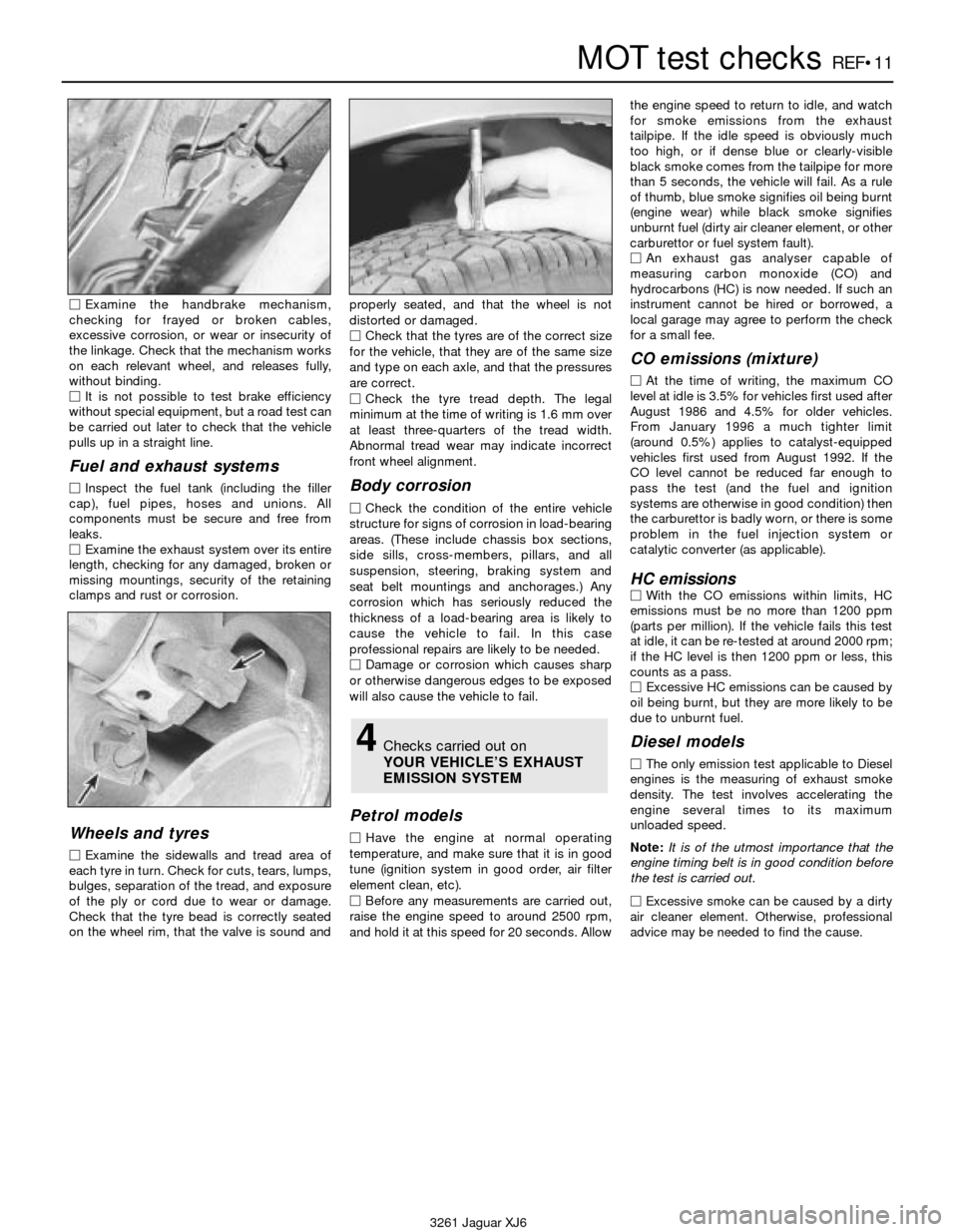
Wheels and tyres
MExamine the sidewalls and tread area of
each tyre in turn. Check for cuts, tears, lumps,
bulges, separation of the tread, and exposure
of the ply or cord due to wear or damage.
Check that the tyre bead is correctly seated
on the wheel rim, that the valve is sound andproperly seated, and that the wheel is not
distorted or damaged.
MCheck that the tyres are of the correct size
for the vehicle, that they are of the same size
and type on each axle, and that the pressures
are correct.
MCheck the tyre tread depth. The legal
minimum at the time of writing is 1.6 mm over
at least three-quarters of the tread width.
Abnormal tread wear may indicate incorrect
front wheel alignment.
Body corrosion
MCheck the condition of the entire vehicle
structure for signs of corrosion in load-bearing
areas. (These include chassis box sections,
side sills, cross-members, pillars, and all
suspension, steering, braking system and
seat belt mountings and anchorages.) Any
corrosion which has seriously reduced the
thickness of a load-bearing area is likely to
cause the vehicle to fail. In this case
professional repairs are likely to be needed.
MDamage or corrosion which causes sharp
or otherwise dangerous edges to be exposed
will also cause the vehicle to fail.
Petrol models
MHave the engine at normal operating
temperature, and make sure that it is in good
tune (ignition system in good order, air filter
element clean, etc).
MBefore any measurements are carried out,
raise the engine speed to around 2500 rpm,
and hold it at this speed for 20 seconds. Allowthe engine speed to return to idle, and watch
for smoke emissions from the exhaust
tailpipe. If the idle speed is obviously much
too high, or if dense blue or clearly-visible
black smoke comes from the tailpipe for more
than 5 seconds, the vehicle will fail. As a rule
of thumb, blue smoke signifies oil being burnt
(engine wear) while black smoke signifies
unburnt fuel (dirty air cleaner element, or other
carburettor or fuel system fault).
MAn exhaust gas analyser capable of
measuring carbon monoxide (CO) and
hydrocarbons (HC) is now needed. If such an
instrument cannot be hired or borrowed, a
local garage may agree to perform the check
for a small fee.
CO emissions (mixture)
MAt the time of writing, the maximum CO
level at idle is 3.5% for vehicles first used after
August 1986 and 4.5% for older vehicles.
From January 1996 a much tighter limit
(around 0.5%) applies to catalyst-equipped
vehicles first used from August 1992. If the
CO level cannot be reduced far enough to
pass the test (and the fuel and ignition
systems are otherwise in good condition) then
the carburettor is badly worn, or there is some
problem in the fuel injection system or
catalytic converter (as applicable).
HC emissionsMWith the CO emissions within limits, HC
emissions must be no more than 1200 ppm
(parts per million). If the vehicle fails this test
at idle, it can be re-tested at around 2000 rpm;
if the HC level is then 1200 ppm or less, this
counts as a pass.
MExcessive HC emissions can be caused by
oil being burnt, but they are more likely to be
due to unburnt fuel.
Diesel models
MThe only emission test applicable to Diesel
engines is the measuring of exhaust smoke
density. The test involves accelerating the
engine several times to its maximum
unloaded speed.
Note: It is of the utmost importance that the
engine timing belt is in good condition before
the test is carried out.
M
Excessive smoke can be caused by a dirty
air cleaner element. Otherwise, professional
advice may be needed to find the cause.
4Checks carried out on
YOUR VEHICLE’S EXHAUST
EMISSION SYSTEM