battery JAGUAR XJ6 1997 2.G User Guide
[x] Cancel search | Manufacturer: JAGUAR, Model Year: 1997, Model line: XJ6, Model: JAGUAR XJ6 1997 2.GPages: 227, PDF Size: 7.2 MB
Page 25 of 227
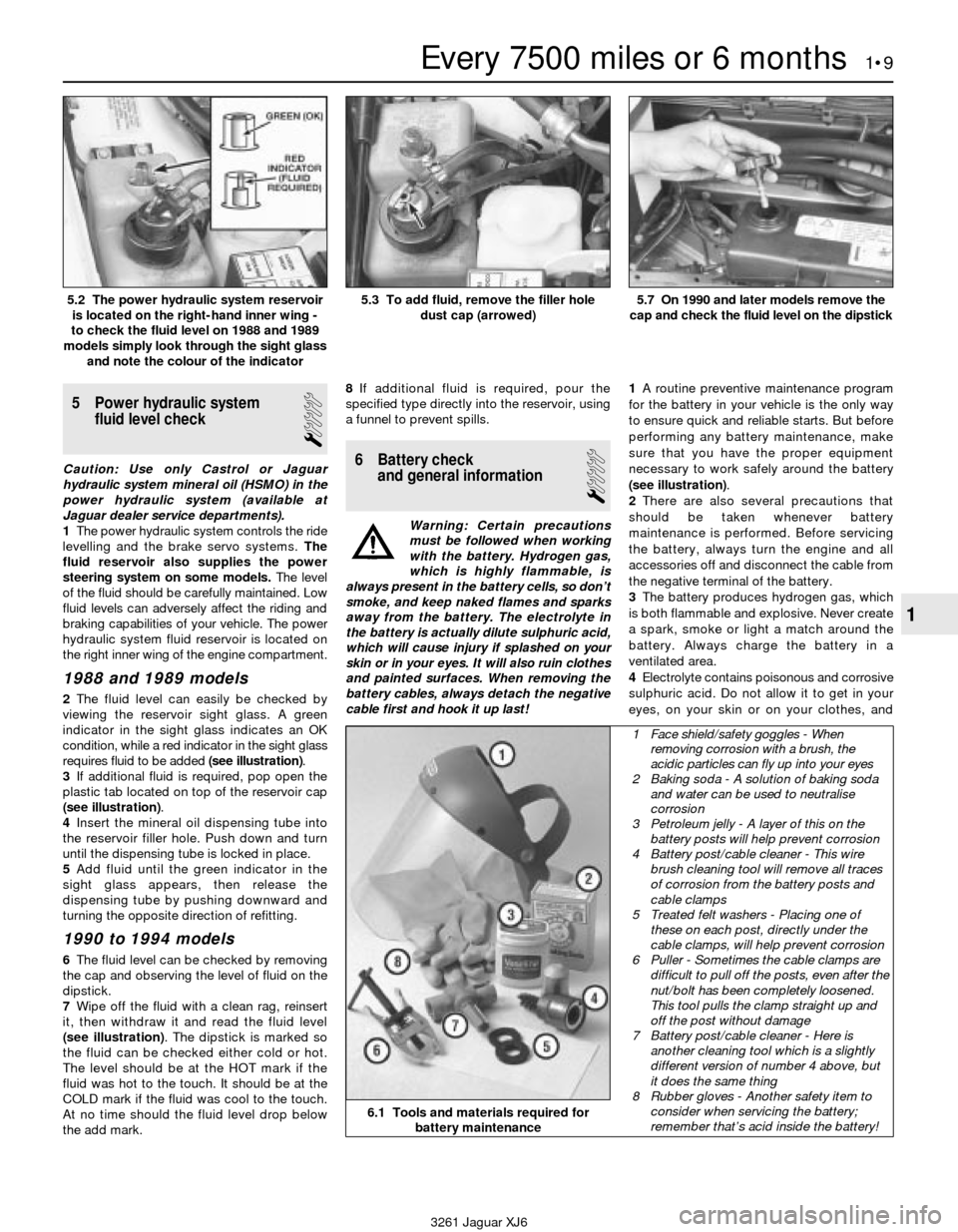
5 Power hydraulic system
fluid level check
1
Caution: Use only Castrol or Jaguar
hydraulic system mineral oil (HSMO) in the
power hydraulic system (available at
Jaguar dealer service departments).
1The power hydraulic system controls the ride
levelling and the brake servo systems. The
fluid reservoir also supplies the power
steering system on some models. The level
of the fluid should be carefully maintained. Low
fluid levels can adversely affect the riding and
braking capabilities of your vehicle. The power
hydraulic system fluid reservoir is located on
the right inner wing of the engine compartment.
1988 and 1989 models
2The fluid level can easily be checked by
viewing the reservoir sight glass. A green
indicator in the sight glass indicates an OK
condition, while a red indicator in the sight glass
requires fluid to be added (see illustration).
3If additional fluid is required, pop open the
plastic tab located on top of the reservoir cap
(see illustration).
4Insert the mineral oil dispensing tube into
the reservoir filler hole. Push down and turn
until the dispensing tube is locked in place.
5Add fluid until the green indicator in the
sight glass appears, then release the
dispensing tube by pushing downward and
turning the opposite direction of refitting.
1990 to 1994 models
6The fluid level can be checked by removing
the cap and observing the level of fluid on the
dipstick.
7Wipe off the fluid with a clean rag, reinsert
it, then withdraw it and read the fluid level
(see illustration). The dipstick is marked so
the fluid can be checked either cold or hot.
The level should be at the HOT mark if the
fluid was hot to the touch. It should be at the
COLD mark if the fluid was cool to the touch.
At no time should the fluid level drop below
the add mark.8If additional fluid is required, pour the
specified type directly into the reservoir, using
a funnel to prevent spills.
6 Battery check
and general information
1
Warning: Certain precautions
must be followed when working
with the battery. Hydrogen gas,
which is highly flammable, is
always present in the battery cells, so don’t
smoke, and keep naked flames and sparks
away from the battery. The electrolyte in
the battery is actually dilute sulphuric acid,
which will cause injury if splashed on your
skin or in your eyes. It will also ruin clothes
and painted surfaces. When removing the
battery cables, always detach the negative
cable first and hook it up last!1A routine preventive maintenance program
for the battery in your vehicle is the only way
to ensure quick and reliable starts. But before
performing any battery maintenance, make
sure that you have the proper equipment
necessary to work safely around the battery
(see illustration).
2There are also several precautions that
should be taken whenever battery
maintenance is performed. Before servicing
the battery, always turn the engine and all
accessories off and disconnect the cable from
the negative terminal of the battery.
3The battery produces hydrogen gas, which
is both flammable and explosive. Never create
a spark, smoke or light a match around the
battery. Always charge the battery in a
ventilated area.
4Electrolyte contains poisonous and corrosive
sulphuric acid. Do not allow it to get in your
eyes, on your skin or on your clothes, and
Every 7500 miles or 6 months 1•9
1
5.2 The power hydraulic system reservoir
is located on the right-hand inner wing -
to check the fluid level on 1988 and 1989
models simply look through the sight glass
and note the colour of the indicator5.3 To add fluid, remove the filler hole
dust cap (arrowed)5.7 On 1990 and later models remove the
cap and check the fluid level on the dipstick
6.1 Tools and materials required for
battery maintenance
1 Face shield/safety goggles - When
removing corrosion with a brush, the
acidic particles can fly up into your eyes
2 Baking soda - A solution of baking soda
and water can be used to neutralise
corrosion
3 Petroleum jelly - A layer of this on the
battery posts will help prevent corrosion
4 Battery post/cable cleaner - This wire
brush cleaning tool will remove all traces
of corrosion from the battery posts and
cable clamps
5 Treated felt washers - Placing one of
these on each post, directly under the
cable clamps, will help prevent corrosion
6 Puller - Sometimes the cable clamps are
difficult to pull off the posts, even after the
nut/bolt has been completely loosened.
This tool pulls the clamp straight up and
off the post without damage
7 Battery post/cable cleaner - Here is
another cleaning tool which is a slightly
different version of number 4 above, but
it does the same thing
8 Rubber gloves - Another safety item to
consider when servicing the battery;
remember that’s acid inside the battery!
3261 Jaguar XJ6
Page 26 of 227
never ingest it. Wear protective safety glasses
when working near the battery. Keep children
away from the battery.
5Note the external condition of the battery. If
the positive terminal and cable clamp on your
vehicle’s battery is equipped with a rubber
protector, make sure it isn’t torn or damaged.
It should completely cover the terminal. Look
for any corroded or loose connections, cracks
in the case or cover or loose hold-down
clamps. Also check the entire length of each
cable for cracks and frayed conductors.
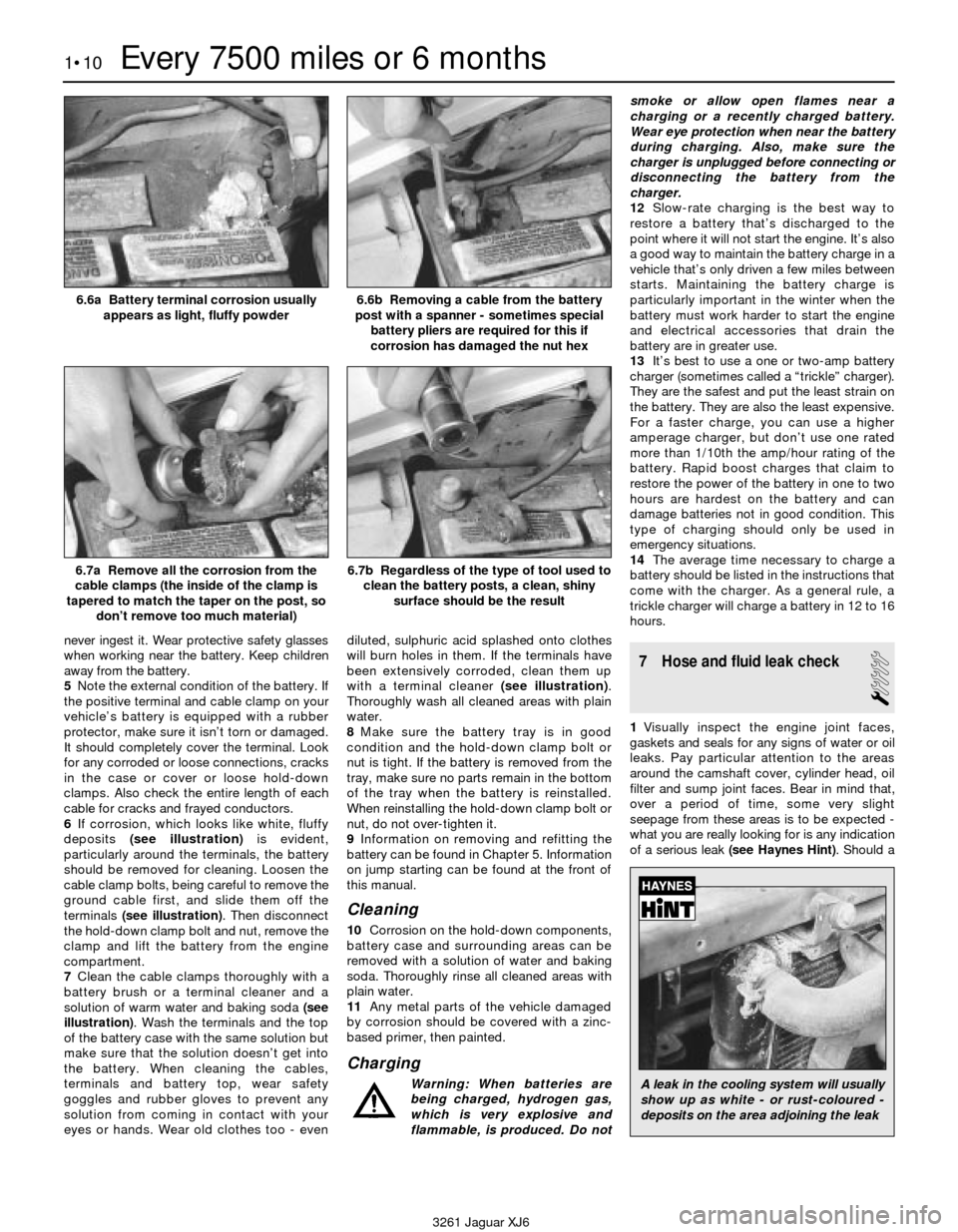
6If corrosion, which looks like white, fluffy
deposits (see illustration)is evident,
particularly around the terminals, the battery
should be removed for cleaning. Loosen the
cable clamp bolts, being careful to remove the
ground cable first, and slide them off the
terminals (see illustration). Then disconnect
the hold-down clamp bolt and nut, remove the
clamp and lift the battery from the engine
compartment.
7Clean the cable clamps thoroughly with a
battery brush or a terminal cleaner and a
solution of warm water and baking soda (see
illustration). Wash the terminals and the top
of the battery case with the same solution but
make sure that the solution doesn’t get into
the battery. When cleaning the cables,
terminals and battery top, wear safety
goggles and rubber gloves to prevent any
solution from coming in contact with your
eyes or hands. Wear old clothes too - evendiluted, sulphuric acid splashed onto clothes
will burn holes in them. If the terminals have
been extensively corroded, clean them up
with a terminal cleaner (see illustration).
Thoroughly wash all cleaned areas with plain
water.
8Make sure the battery tray is in good
condition and the hold-down clamp bolt or
nut is tight. If the battery is removed from the
tray, make sure no parts remain in the bottom
of the tray when the battery is reinstalled.
When reinstalling the hold-down clamp bolt or
nut, do not over-tighten it.
9Information on removing and refitting the
battery can be found in Chapter 5. Information
on jump starting can be found at the front of
this manual.
Cleaning
10Corrosion on the hold-down components,
battery case and surrounding areas can be
removed with a solution of water and baking
soda. Thoroughly rinse all cleaned areas with
plain water.
11Any metal parts of the vehicle damaged
by corrosion should be covered with a zinc-
based primer, then painted.
Charging
Warning: When batteries are
being charged, hydrogen gas,
which is very explosive and
flammable, is produced. Do notsmoke or allow open flames near a
charging or a recently charged battery.
Wear eye protection when near the battery
during charging. Also, make sure the
charger is unplugged before connecting or
disconnecting the battery from the
charger.
12Slow-rate charging is the best way to
restore a battery that’s discharged to the
point where it will not start the engine. It’s also
a good way to maintain the battery charge in a
vehicle that’s only driven a few miles between
starts. Maintaining the battery charge is
particularly important in the winter when the
battery must work harder to start the engine
and electrical accessories that drain the
battery are in greater use.
13It’s best to use a one or two-amp battery
charger (sometimes called a “trickle” charger).
They are the safest and put the least strain on
the battery. They are also the least expensive.
For a faster charge, you can use a higher
amperage charger, but don’t use one rated
more than 1/10th the amp/hour rating of the
battery. Rapid boost charges that claim to
restore the power of the battery in one to two
hours are hardest on the battery and can
damage batteries not in good condition. This
type of charging should only be used in
emergency situations.
14The average time necessary to charge a
battery should be listed in the instructions that
come with the charger. As a general rule, a
trickle charger will charge a battery in 12 to 16
hours.
7 Hose and fluid leak check
1
1Visually inspect the engine joint faces,
gaskets and seals for any signs of water or oil
leaks. Pay particular attention to the areas
around the camshaft cover, cylinder head, oil
filter and sump joint faces. Bear in mind that,
over a period of time, some very slight
seepage from these areas is to be expected -
what you are really looking for is any indication
of a serious leak (see Haynes Hint). Should a
1•10Every 7500 miles or 6 months
6.6a Battery terminal corrosion usually
appears as light, fluffy powder6.6b Removing a cable from the battery
post with a spanner - sometimes special
battery pliers are required for this if
corrosion has damaged the nut hex
6.7a Remove all the corrosion from the
cable clamps (the inside of the clamp is
tapered to match the taper on the post, so
don’t remove too much material)6.7b Regardless of the type of tool used to
clean the battery posts, a clean, shiny
surface should be the result
3261 Jaguar XJ6
A leak in the cooling system will usually
show up as white - or rust-coloured -
deposits on the area adjoining the leak
Page 30 of 227
16 Spark plug renewal
2
Refer to Section 4, renewing the plugs
regardless of their apparent condition.
17 Air cleaner element renewal
1
1The air filter is located inside a housing at
the left side of the engine compartment. To
remove the air filter, release the four spring
clips that secure the two halves of the air
cleaner housing together, then lift the cover
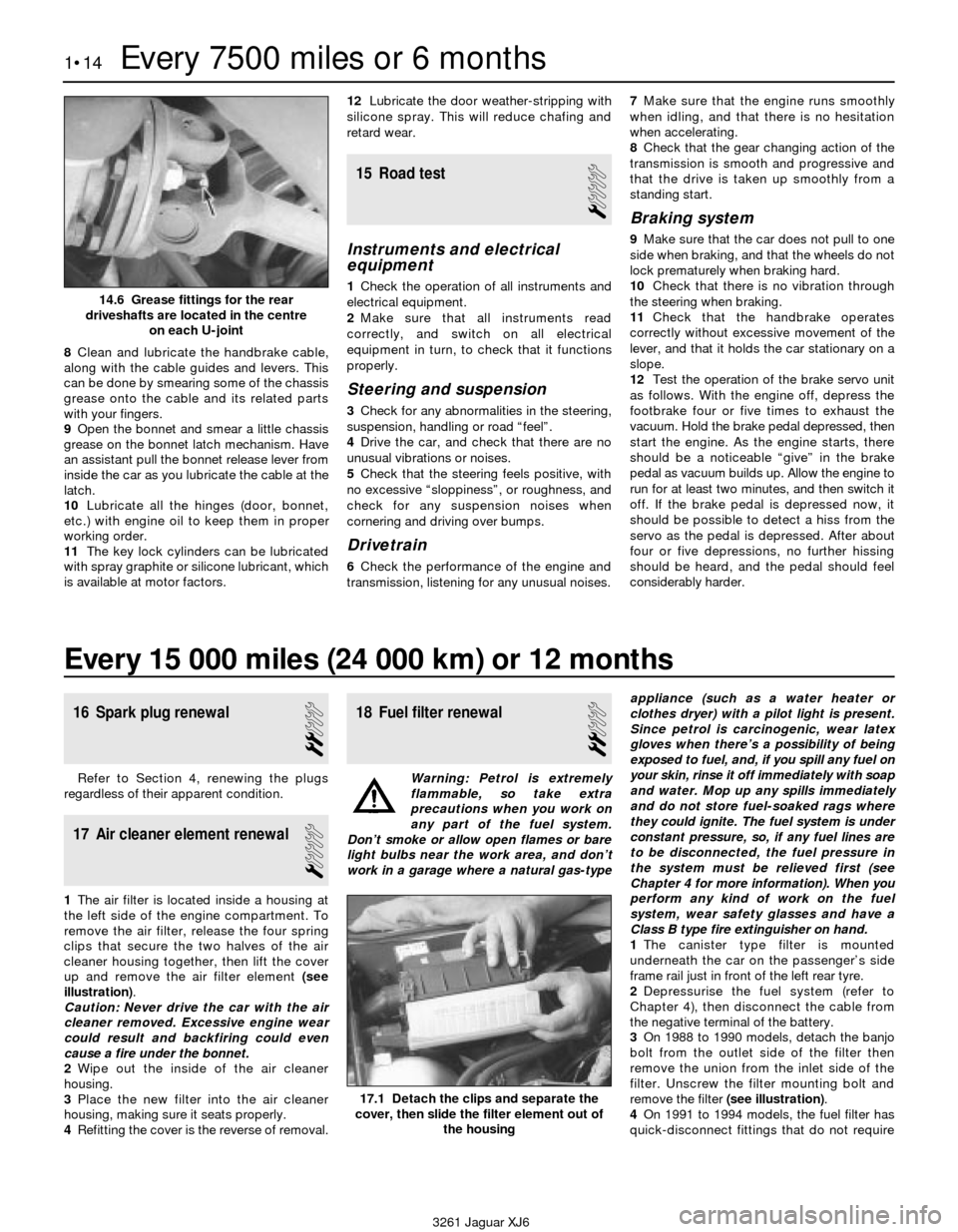
up and remove the air filter element (see
illustration).
Caution: Never drive the car with the air
cleaner removed. Excessive engine wear
could result and backfiring could even
cause a fire under the bonnet.
2Wipe out the inside of the air cleaner
housing.
3Place the new filter into the air cleaner
housing, making sure it seats properly.
4Refitting the cover is the reverse of removal.
18 Fuel filter renewal
2
Warning: Petrol is extremely
flammable, so take extra
precautions when you work on
any part of the fuel system.
Don’t smoke or allow open flames or bare
light bulbs near the work area, and don’t
work in a garage where a natural gas-typeappliance (such as a water heater or
clothes dryer) with a pilot light is present.
Since petrol is carcinogenic, wear latex
gloves when there’s a possibility of being
exposed to fuel, and, if you spill any fuel on
your skin, rinse it off immediately with soap
and water. Mop up any spills immediately
and do not store fuel-soaked rags where
they could ignite. The fuel system is under
constant pressure, so, if any fuel lines are
to be disconnected, the fuel pressure in
the system must be relieved first (see
Chapter 4 for more information). When you
perform any kind of work on the fuel
system, wear safety glasses and have a
Class B type fire extinguisher on hand.
1The canister type filter is mounted
underneath the car on the passenger’s side
frame rail just in front of the left rear tyre.
2Depressurise the fuel system (refer to
Chapter 4), then disconnect the cable from
the negative terminal of the battery.
3On 1988 to 1990 models, detach the banjo
bolt from the outlet side of the filter then
remove the union from the inlet side of the
filter. Unscrew the filter mounting bolt and
remove the filter (see illustration).
4On 1991 to 1994 models, the fuel filter has
quick-disconnect fittings that do not require 8Clean and lubricate the handbrake cable,
along with the cable guides and levers. This
can be done by smearing some of the chassis
grease onto the cable and its related parts
with your fingers.
9Open the bonnet and smear a little chassis
grease on the bonnet latch mechanism. Have
an assistant pull the bonnet release lever from
inside the car as you lubricate the cable at the
latch.
10Lubricate all the hinges (door, bonnet,
etc.) with engine oil to keep them in proper
working order.
11The key lock cylinders can be lubricated
with spray graphite or silicone lubricant, which
is available at motor factors.12Lubricate the door weather-stripping with
silicone spray. This will reduce chafing and
retard wear.
15 Road test
1
Instruments and electrical
equipment
1Check the operation of all instruments and
electrical equipment.
2Make sure that all instruments read
correctly, and switch on all electrical
equipment in turn, to check that it functions
properly.
Steering and suspension
3Check for any abnormalities in the steering,
suspension, handling or road “feel”.
4Drive the car, and check that there are no
unusual vibrations or noises.
5Check that the steering feels positive, with
no excessive “sloppiness”, or roughness, and
check for any suspension noises when
cornering and driving over bumps.
Drivetrain
6Check the performance of the engine and
transmission, listening for any unusual noises.7Make sure that the engine runs smoothly
when idling, and that there is no hesitation
when accelerating.
8Check that the gear changing action of the
transmission is smooth and progressive and
that the drive is taken up smoothly from a
standing start.
Braking system
9Make sure that the car does not pull to one
side when braking, and that the wheels do not
lock prematurely when braking hard.
10Check that there is no vibration through
the steering when braking.
11Check that the handbrake operates
correctly without excessive movement of the
lever, and that it holds the car stationary on a
slope.
12Test the operation of the brake servo unit
as follows. With the engine off, depress the
footbrake four or five times to exhaust the
vacuum. Hold the brake pedal depressed, then
start the engine. As the engine starts, there
should be a noticeable “give” in the brake
pedal as vacuum builds up. Allow the engine to
run for at least two minutes, and then switch it
off. If the brake pedal is depressed now, it
should be possible to detect a hiss from the
servo as the pedal is depressed. After about
four or five depressions, no further hissing
should be heard, and the pedal should feel
considerably harder.
1•14Every 7500 miles or 6 months
17.1 Detach the clips and separate the
cover, then slide the filter element out of
the housing
3261 Jaguar XJ6
14.6 Grease fittings for the rear
driveshafts are located in the centre
on each U-joint
Every 15 000 miles (24 000 km) or 12 months
Page 31 of 227
hand tools to remove. Simply slide back the
locking collars and remove the inlet and outlet
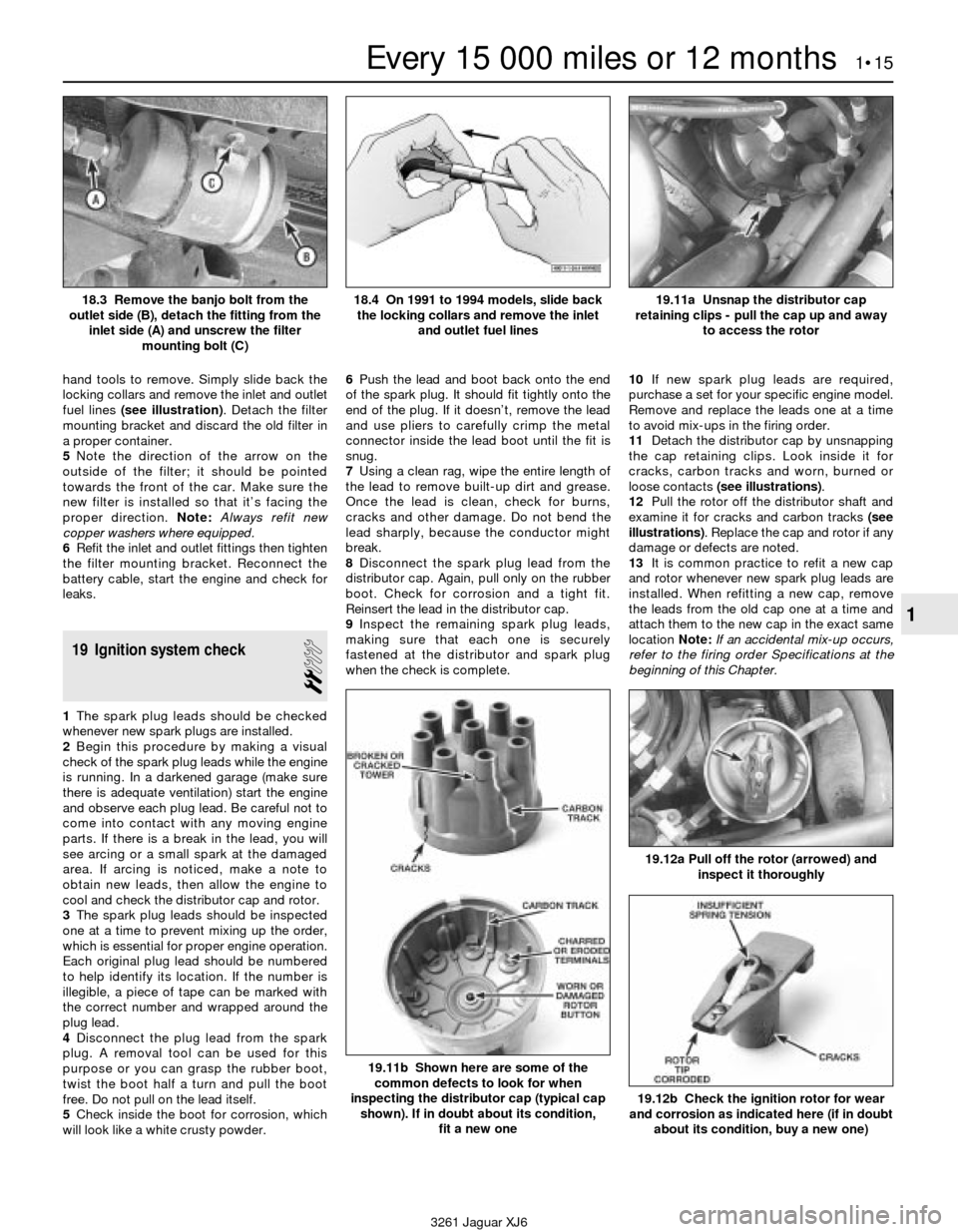
fuel lines (see illustration). Detach the filter
mounting bracket and discard the old filter in
a proper container.
5Note the direction of the arrow on the
outside of the filter; it should be pointed
towards the front of the car. Make sure the
new filter is installed so that it’s facing the
proper direction. Note:Always refit new
copper washers where equipped.
6Refit the inlet and outlet fittings then tighten
the filter mounting bracket. Reconnect the
battery cable, start the engine and check for
leaks.
19 Ignition system check
2
1The spark plug leads should be checked
whenever new spark plugs are installed.
2Begin this procedure by making a visual
check of the spark plug leads while the engine
is running. In a darkened garage (make sure
there is adequate ventilation) start the engine
and observe each plug lead. Be careful not to
come into contact with any moving engine
parts. If there is a break in the lead, you will
see arcing or a small spark at the damaged
area. If arcing is noticed, make a note to
obtain new leads, then allow the engine to
cool and check the distributor cap and rotor.
3The spark plug leads should be inspected
one at a time to prevent mixing up the order,
which is essential for proper engine operation.
Each original plug lead should be numbered
to help identify its location. If the number is
illegible, a piece of tape can be marked with
the correct number and wrapped around the
plug lead.
4Disconnect the plug lead from the spark
plug. A removal tool can be used for this
purpose or you can grasp the rubber boot,
twist the boot half a turn and pull the boot
free. Do not pull on the lead itself.
5Check inside the boot for corrosion, which
will look like a white crusty powder.6Push the lead and boot back onto the end
of the spark plug. It should fit tightly onto the
end of the plug. If it doesn’t, remove the lead
and use pliers to carefully crimp the metal
connector inside the lead boot until the fit is
snug.
7Using a clean rag, wipe the entire length of
the lead to remove built-up dirt and grease.
Once the lead is clean, check for burns,
cracks and other damage. Do not bend the
lead sharply, because the conductor might
break.
8Disconnect the spark plug lead from the
distributor cap. Again, pull only on the rubber
boot. Check for corrosion and a tight fit.
Reinsert the lead in the distributor cap.
9Inspect the remaining spark plug leads,
making sure that each one is securely
fastened at the distributor and spark plug
when the check is complete.10If new spark plug leads are required,
purchase a set for your specific engine model.
Remove and replace the leads one at a time
to avoid mix-ups in the firing order.
11Detach the distributor cap by unsnapping
the cap retaining clips. Look inside it for
cracks, carbon tracks and worn, burned or
loose contacts (see illustrations).
12Pull the rotor off the distributor shaft and
examine it for cracks and carbon tracks (see
illustrations). Replace the cap and rotor if any
damage or defects are noted.
13It is common practice to refit a new cap
and rotor whenever new spark plug leads are
installed. When refitting a new cap, remove
the leads from the old cap one at a time and
attach them to the new cap in the exact same
location Note:If an accidental mix-up occurs,
refer to the firing order Specifications at the
beginning of this Chapter.
Every 15 000 miles or 12 months 1•15
1
19.11a Unsnap the distributor cap
retaining clips - pull the cap up and away
to access the rotor
19.11b Shown here are some of the
common defects to look for when
inspecting the distributor cap (typical cap
shown). If in doubt about its condition,
fit a new one
19.12a Pull off the rotor (arrowed) and
inspect it thoroughly
19.12b Check the ignition rotor for wear
and corrosion as indicated here (if in doubt
about its condition, buy a new one)
3261 Jaguar XJ6 18.3 Remove the banjo bolt from the
outlet side (B), detach the fitting from the
inlet side (A) and unscrew the filter
mounting bolt (C)
18.4 On 1991 to 1994 models, slide back
the locking collars and remove the inlet
and outlet fuel lines
Page 40 of 227
attached to the bolt threaded into the
front of the crankshaft. Apply pressure on
the bolt in a clockwise direction only.
Never turn the bolt anti-clockwise.
b) A remote starter switch, which may save
some time, can also be used. Follow the
instructions included with the switch.
Once the piston is close to TDC, use a
socket and ratchet as described in the
previous paragraph.
c) If an assistant is available to turn the
ignition switch to the Start position in
short bursts, you can get the piston close
to TDC without a remote starter switch.
Make sure your assistant is out of the car,
away from the ignition switch, then use a
socket and ratchet as described in
Paragraph a) to complete the procedure.
5Note the position of the terminal for the
number one spark plug lead on the distributor
cap. If the terminal isn’t marked, follow the
plug lead from the number one cylinder spark
plug to the cap.
6Use a felt-tip pen or chalk to make a mark
on the distributor body directly under the
number one terminal (see Chapter 5).
7Detach the cap from the distributor and set
it aside (see Chapter 1 if necessary).
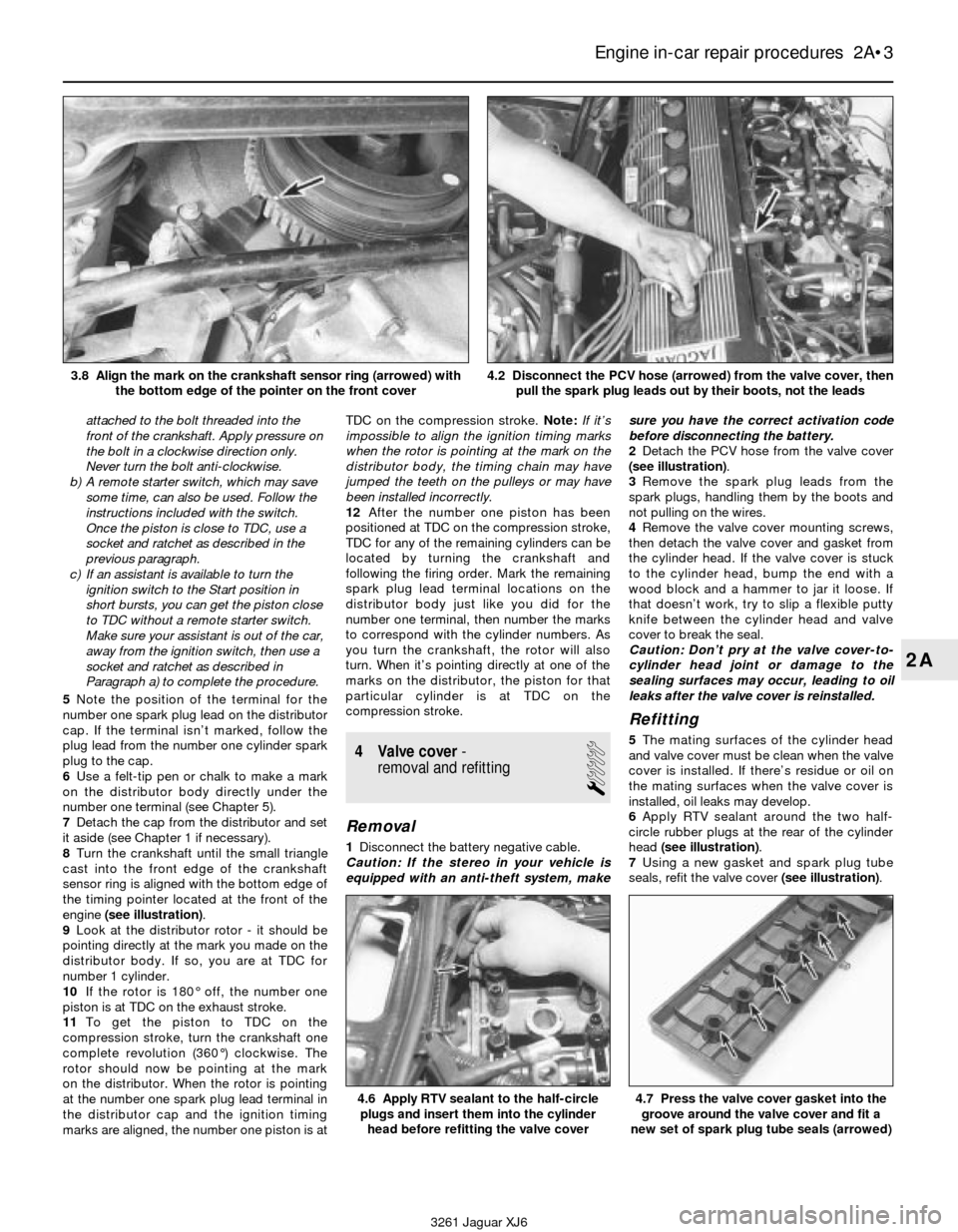
8Turn the crankshaft until the small triangle
cast into the front edge of the crankshaft
sensor ring is aligned with the bottom edge of
the timing pointer located at the front of the
engine(see illustration).
9Look at the distributor rotor - it should be
pointing directly at the mark you made on the
distributor body. If so, you are at TDC for
number 1 cylinder.
10If the rotor is 180° off, the number one
piston is at TDC on the exhaust stroke.
11To get the piston to TDC on the
compression stroke, turn the crankshaft one
complete revolution (360°) clockwise. The
rotor should now be pointing at the mark
on the distributor. When the rotor is pointing
at the number one spark plug lead terminal in
the distributor cap and the ignition timing
marks are aligned, the number one piston is atTDC on the compression stroke. Note:If it’s
impossible to align the ignition timing marks
when the rotor is pointing at the mark on the
distributor body, the timing chain may have
jumped the teeth on the pulleys or may have
been installed incorrectly.
12After the number one piston has been
positioned at TDC on the compression stroke,
TDC for any of the remaining cylinders can be
located by turning the crankshaft and
following the firing order. Mark the remaining
spark plug lead terminal locations on the
distributor body just like you did for the
number one terminal, then number the marks
to correspond with the cylinder numbers. As
you turn the crankshaft, the rotor will also
turn. When it’s pointing directly at one of the
marks on the distributor, the piston for that
particular cylinder is at TDC on the
compression stroke.
4 Valve cover-
removal and refitting
1
Removal
1Disconnect the battery negative cable.
Caution: If the stereo in your vehicle is
equipped with an anti-theft system, makesure you have the correct activation code
before disconnecting the battery.
2Detach the PCV hose from the valve cover
(see illustration).
3Remove the spark plug leads from the
spark plugs, handling them by the boots and
not pulling on the wires.
4Remove the valve cover mounting screws,
then detach the valve cover and gasket from
the cylinder head. If the valve cover is stuck
to the cylinder head, bump the end with a
wood block and a hammer to jar it loose. If
that doesn’t work, try to slip a flexible putty
knife between the cylinder head and valve
cover to break the seal.
Caution: Don’t pry at the valve cover-to-
cylinder head joint or damage to the
sealing surfaces may occur, leading to oil
leaks after the valve cover is reinstalled.
Refitting
5The mating surfaces of the cylinder head
and valve cover must be clean when the valve
cover is installed. If there’s residue or oil on
the mating surfaces when the valve cover is
installed, oil leaks may develop.
6Apply RTV sealant around the two half-
circle rubber plugs at the rear of the cylinder
head (see illustration).
7Using a new gasket and spark plug tube
seals, refit the valve cover (see illustration).
Engine in-car repair procedures 2A•3
2A
4.6 Apply RTV sealant to the half-circle
plugs and insert them into the cylinder
head before refitting the valve cover4.7 Press the valve cover gasket into the
groove around the valve cover and fit a
new set of spark plug tube seals (arrowed)
3261 Jaguar XJ6 3.8 Align the mark on the crankshaft sensor ring (arrowed) with
the bottom edge of the pointer on the front cover
4.2 Disconnect the PCV hose (arrowed) from the valve cover, then
pull the spark plug leads out by their boots, not the leads
Page 41 of 227
8Tighten the screws to the torque listed in
this Chapter’s Specifications in three or four
equal steps.
9Refit the remaining components, start the
engine and check for oil leaks.
5 Intake manifold-
removal and refitting
2
Removal
1Disconnect the negative cable from the
battery.
Caution: If the stereo in your vehicle is
equipped with an anti-theft system, make
sure you have the correct activation code
before disconnecting the battery.
2Refer to Chapter 4 to remove the
accelerator and cruise-control linkage, safely
relieve the fuel system pressure, and
disconnect the fuel supply lines.
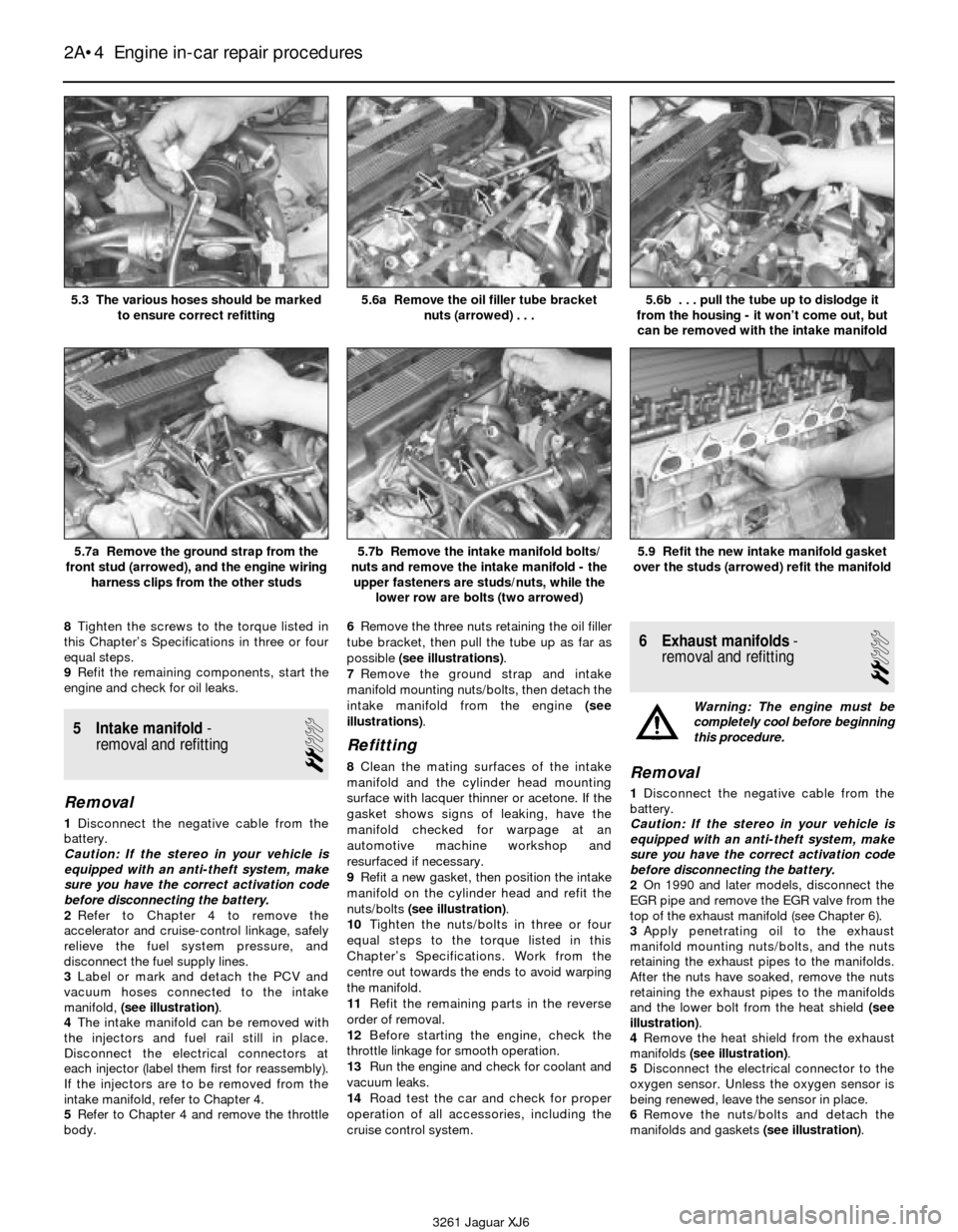
3Label or mark and detach the PCV and
vacuum hoses connected to the intake
manifold, (see illustration).
4The intake manifold can be removed with
the injectors and fuel rail still in place.
Disconnect the electrical connectors at
each injector (label them first for reassembly).
If the injectors are to be removed from the
intake manifold, refer to Chapter 4.
5Refer to Chapter 4 and remove the throttle
body.6Remove the three nuts retaining the oil filler
tube bracket, then pull the tube up as far as
possible (see illustrations).
7Remove the ground strap and intake
manifold mounting nuts/bolts, then detach the
intake manifold from the engine (see
illustrations).
Refitting
8Clean the mating surfaces of the intake
manifold and the cylinder head mounting
surface with lacquer thinner or acetone. If the
gasket shows signs of leaking, have the
manifold checked for warpage at an
automotive machine workshop and
resurfaced if necessary.
9Refit a new gasket, then position the intake
manifold on the cylinder head and refit the
nuts/bolts (see illustration).
10Tighten the nuts/bolts in three or four
equal steps to the torque listed in this
Chapter’s Specifications. Work from the
centre out towards the ends to avoid warping
the manifold.
11Refit the remaining parts in the reverse
order of removal.
12Before starting the engine, check the
throttle linkage for smooth operation.
13Run the engine and check for coolant and
vacuum leaks.
14Road test the car and check for proper
operation of all accessories, including the
cruise control system.
6 Exhaust manifolds-
removal and refitting
2
Warning: The engine must be
completely cool before beginning
this procedure.
Removal
1Disconnect the negative cable from the
battery.
Caution: If the stereo in your vehicle is
equipped with an anti-theft system, make
sure you have the correct activation code
before disconnecting the battery.
2On 1990 and later models, disconnect the
EGR pipe and remove the EGR valve from the
top of the exhaust manifold (see Chapter 6).
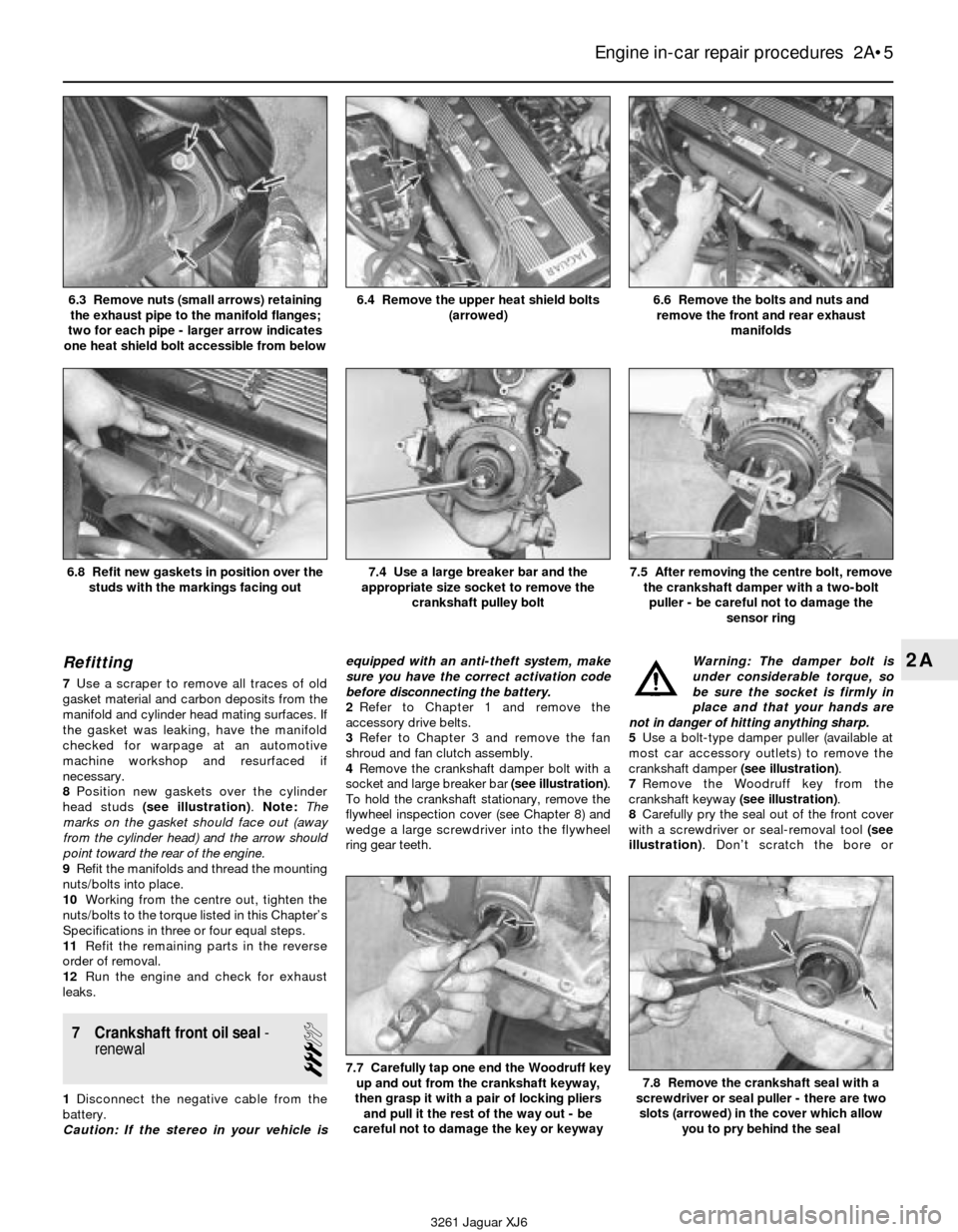
3Apply penetrating oil to the exhaust
manifold mounting nuts/bolts, and the nuts
retaining the exhaust pipes to the manifolds.
After the nuts have soaked, remove the nuts
retaining the exhaust pipes to the manifolds
and the lower bolt from the heat shield (see
illustration).
4Remove the heat shield from the exhaust
manifolds(see illustration).
5Disconnect the electrical connector to the
oxygen sensor. Unless the oxygen sensor is
being renewed, leave the sensor in place.
6Remove the nuts/bolts and detach the
manifolds and gaskets (see illustration).
2A•4 Engine in-car repair procedures
5.3 The various hoses should be marked
to ensure correct refitting5.6a Remove the oil filler tube bracket
nuts (arrowed) . . .5.6b . . . pull the tube up to dislodge it
from the housing - it won’t come out, but
can be removed with the intake manifold
5.7a Remove the ground strap from the
front stud (arrowed), and the engine wiring
harness clips from the other studs5.7b Remove the intake manifold bolts/
nuts and remove the intake manifold - the
upper fasteners are studs/nuts, while the
lower row are bolts (two arrowed)5.9 Refit the new intake manifold gasket
over the studs (arrowed) refit the manifold
3261 Jaguar XJ6
Page 42 of 227
Refitting
7Use a scraper to remove all traces of old
gasket material and carbon deposits from the
manifold and cylinder head mating surfaces. If
the gasket was leaking, have the manifold
checked for warpage at an automotive
machine workshop and resurfaced if
necessary.
8Position new gaskets over the cylinder
head studs (see illustration). Note:The
marks on the gasket should face out (away
from the cylinder head) and the arrow should
point toward the rear of the engine.
9Refit the manifolds and thread the mounting
nuts/bolts into place.
10Working from the centre out, tighten the
nuts/bolts to the torque listed in this Chapter’s
Specifications in three or four equal steps.
11Refit the remaining parts in the reverse
order of removal.
12Run the engine and check for exhaust
leaks.
7 Crankshaft front oil seal-
renewal
3
1Disconnect the negative cable from the
battery.
Caution: If the stereo in your vehicle isequipped with an anti-theft system, make
sure you have the correct activation code
before disconnecting the battery.
2Refer to Chapter 1 and remove the
accessory drive belts.
3Refer to Chapter 3 and remove the fan
shroud and fan clutch assembly.
4Remove the crankshaft damper bolt with a
socket and large breaker bar (see illustration).
To hold the crankshaft stationary, remove the
flywheel inspection cover (see Chapter 8) and
wedge a large screwdriver into the flywheel
ring gear teeth. Warning: The damper bolt is
under considerable torque, so
be sure the socket is firmly in
place and that your hands are
not in danger of hitting anything sharp.
5Use a bolt-type damper puller (available at
most car accessory outlets) to remove the
crankshaft damper (see illustration).
7Remove the Woodruff key from the
crankshaft keyway (see illustration).
8Carefully pry the seal out of the front cover
with a screwdriver or seal-removal tool(see
illustration). Don’t scratch the bore or
Engine in-car repair procedures 2A•5
2A
6.3 Remove nuts (small arrows) retaining
the exhaust pipe to the manifold flanges;
two for each pipe - larger arrow indicates
one heat shield bolt accessible from below6.4 Remove the upper heat shield bolts
(arrowed)6.6 Remove the bolts and nuts and
remove the front and rear exhaust
manifolds
6.8 Refit new gaskets in position over the
studs with the markings facing out
7.7 Carefully tap one end the Woodruff key
up and out from the crankshaft keyway,
then grasp it with a pair of locking pliers
and pull it the rest of the way out - be
careful not to damage the key or keyway7.8 Remove the crankshaft seal with a
screwdriver or seal puller - there are two
slots (arrowed) in the cover which allow
you to pry behind the seal
7.4 Use a large breaker bar and the
appropriate size socket to remove the
crankshaft pulley bolt7.5 After removing the centre bolt, remove
the crankshaft damper with a two-bolt
puller - be careful not to damage the
sensor ring
3261 Jaguar XJ6
Page 43 of 227
damage the crankshaft in the process (if the
crankshaft is damaged, the new seal will end
up leaking).
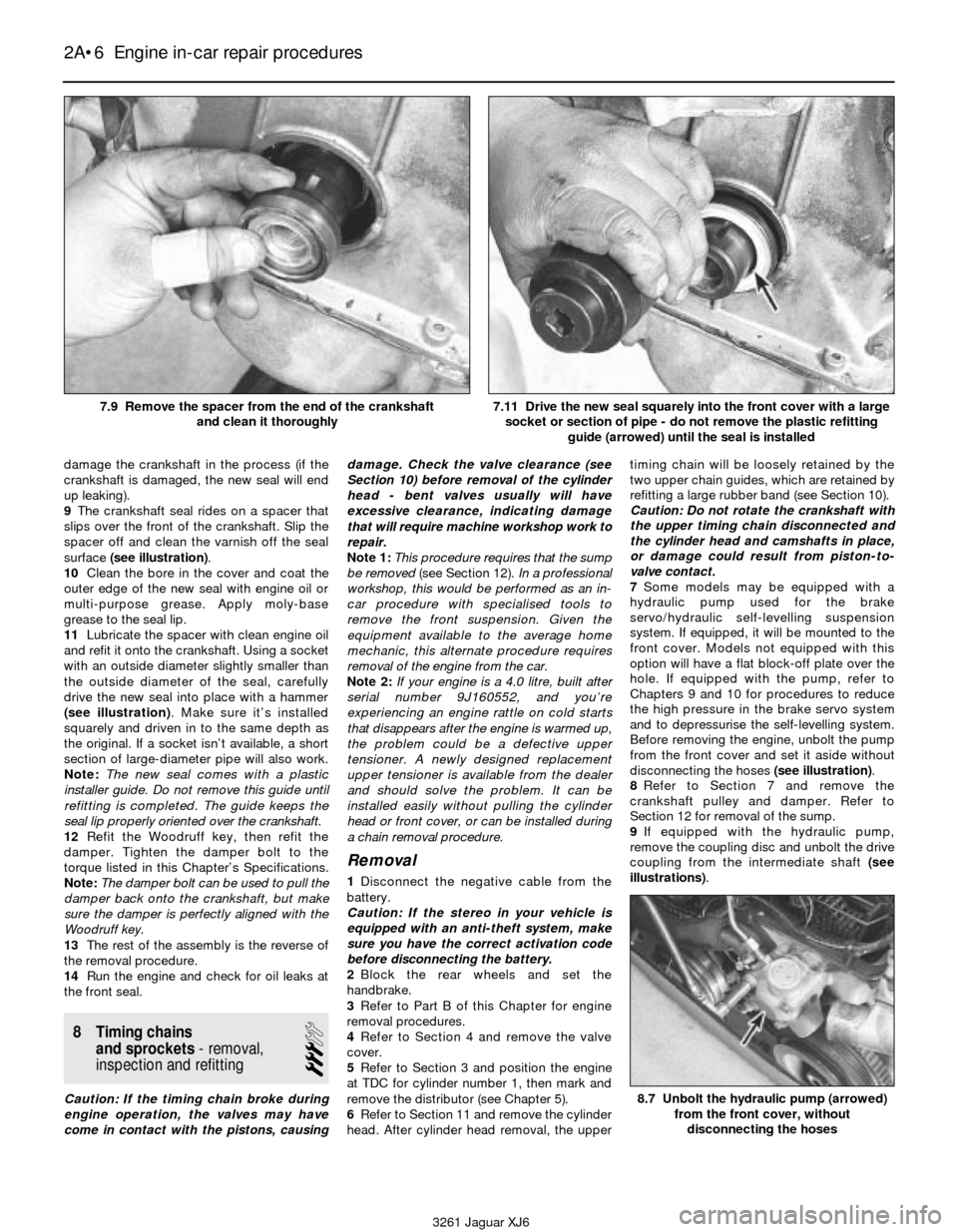
9The crankshaft seal rides on a spacer that
slips over the front of the crankshaft. Slip the
spacer off and clean the varnish off the seal
surface (see illustration).
10Clean the bore in the cover and coat the
outer edge of the new seal with engine oil or
multi-purpose grease. Apply moly-base
grease to the seal lip.
11Lubricate the spacer with clean engine oil
and refit it onto the crankshaft. Using a socket
with an outside diameter slightly smaller than
the outside diameter of the seal, carefully
drive the new seal into place with a hammer
(see illustration). Make sure it’s installed
squarely and driven in to the same depth as
the original. If a socket isn’t available, a short
section of large-diameter pipe will also work.
Note:The new seal comes with a plastic
installer guide. Do not remove this guide until
refitting is completed. The guide keeps the
seal lip properly oriented over the crankshaft.
12Refit the Woodruff key, then refit the
damper. Tighten the damper bolt to the
torque listed in this Chapter’s Specifications.
Note:The damper bolt can be used to pull the
damper back onto the crankshaft, but make
sure the damper is perfectly aligned with the
Woodruff key.
13The rest of the assembly is the reverse of
the removal procedure.
14Run the engine and check for oil leaks at
the front seal.
8 Timing chains
and sprockets- removal,
inspection and refitting
3
Caution: If the timing chain broke during
engine operation, the valves may have
come in contact with the pistons, causingdamage. Check the valve clearance (see
Section 10) before removal of the cylinder
head - bent valves usually will have
excessive clearance, indicating damage
that will require machine workshop work to
repair.
Note 1:This procedure requires that the sump
be removed (see Section 12).In a professional
workshop, this would be performed as an in-
car procedure with specialised tools to
remove the front suspension. Given the
equipment available to the average home
mechanic, this alternate procedure requires
removal of the engine from the car.
Note 2:If your engine is a 4.0 litre, built after
serial number 9J160552, and you’re
experiencing an engine rattle on cold starts
that disappears after the engine is warmed up,
the problem could be a defective upper
tensioner. A newly designed replacement
upper tensioner is available from the dealer
and should solve the problem. It can be
installed easily without pulling the cylinder
head or front cover, or can be installed during
a chain removal procedure.
Removal
1Disconnect the negative cable from the
battery.
Caution: If the stereo in your vehicle is
equipped with an anti-theft system, make
sure you have the correct activation code
before disconnecting the battery.
2Block the rear wheels and set the
handbrake.
3Refer to Part B of this Chapter for engine
removal procedures.
4Refer to Section 4 and remove the valve
cover.
5Refer to Section 3 and position the engine
at TDC for cylinder number 1, then mark and
remove the distributor (see Chapter 5).
6Refer to Section 11 and remove the cylinder
head. After cylinder head removal, the uppertiming chain will be loosely retained by the
two upper chain guides, which are retained by
refitting a large rubber band (see Section 10).
Caution: Do not rotate the crankshaft with
the upper timing chain disconnected and
the cylinder head and camshafts in place,
or damage could result from piston-to-
valve contact.
7Some models may be equipped with a
hydraulic pump used for the brake
servo/hydraulic self-levelling suspension
system. If equipped, it will be mounted to the
front cover. Models not equipped with this
option will have a flat block-off plate over the
hole. If equipped with the pump, refer to
Chapters 9 and 10 for procedures to reduce
the high pressure in the brake servo system
and to depressurise the self-levelling system.
Before removing the engine, unbolt the pump
from the front cover and set it aside without
disconnecting the hoses (see illustration).
8Refer to Section 7 and remove the
crankshaft pulley and damper. Refer to
Section 12 for removal of the sump.
9If equipped with the hydraulic pump,
remove the coupling disc and unbolt the drive
coupling from the intermediate shaft (see
illustrations).
2A•6 Engine in-car repair procedures
8.7 Unbolt the hydraulic pump (arrowed)
from the front cover, without
disconnecting the hoses
3261 Jaguar XJ6 7.9 Remove the spacer from the end of the crankshaft
and clean it thoroughly
7.11 Drive the new seal squarely into the front cover with a large
socket or section of pipe - do not remove the plastic refitting
guide (arrowed) until the seal is installed
Page 45 of 227

23Clean and lubricate the lower tensioner.
Fill the lower tensioner oil reservoir with engine
oil and refit it on the engine block, aligning the
notch in the tensioner with the lug on the back
of the guide (see illustrations). This should
remove all slack from the lower timing chain. If
not, push the lower tensioner guide back and
forth a few times to prime the tensioner.
24Refit the upper chain tensioner guide and
mounting bracket to the engine block.
Caution: Before fully tightening the
mounting bracket to the engine block,
make sure the mount and chain guide are
clear of the lower chain, auxiliary sprocket
and intermediate sprocket. If necessary,
position the mount for clearance before
tightening the mounting bolts.
25Refit the oil pump drive chain and
sprocket to the crankshaft (see Section 13).
26Refit the upper chain fixed guide to the
engine block and place the upper timing chain
over the intermediate sprocket and auxiliary
shaft sprocket, draping the excess chain over
the top of the fixed guide. Lubricate the chain
and sprockets with clean engine oil.27Gather the loose portion of the upper
timing chain and place it between the upper
guides. Use a large rubber band to hold the
two guides snugly around the chain (see
Section 11).
28If necessary, renew the intermediate shaft
seal (see illustrations).
29Apply a thin coat of RTV sealant to the
engine side of the front cover and RTV sealant
to the oil-pan mating surface (bottom of the
front cover), then refit the front cover. Note:
Make sure the top surface of the cover aligns
with the top surface of the engine block, by
checking with a straightedge(see illustration).
30Refer to Section 11 for refitting of the
cylinder head and Section 10 for refitting of
the camshafts and connection of the upper
timing chain to the two camshaft sprockets.
31The remainder of the refitting is the
reverse of the removal procedure. If your car
is equipped with the hydraulic/self-levelling
suspension, refit the drive coupling and
coupling disc to the intermediate shaft (see
illustrations 8.9a and 8.9b). Coat the
mounting surface of the pump with RTVsealant and make sure the tang on the pump
aligns with the slot in the intermediate shaft
before bolting the pump to the front cover.
Refer to Section 7 for refitting of the
crankshaft spacer, damper and puller.
Caution: DO NOT start the engine until
you’re absolutely certain that the timing
chains are installed correctly. Serious and
costly engine damage could occur if the
chains are installed wrong.
32Run the engine and check for proper
operation.
9 Auxiliary shaft- renewal
3
Caution: If the stereo in your vehicle is
equipped with an anti-theft system, make
sure you have the correct activation code
before disconnecting the battery.
1Refer to Chapter 10 and remove the power
steering pump, without disconnecting the
hoses. Remove the plastic power steering
pump drive coupling disc.
2A•8 Engine in-car repair procedures
8.28a Drill a small hole in the intermediate
shaft seal, thread a sheet metal screw into
it and use a small slide-hammer pull the
seal out of the cover8.28b Drive the new seal in with a seal-
driver or socket, to the same depth as the
original seal8.29 Bolt the front cover on hand tight, use
a straightedge to make sure the cover’s
top surface is level with the top of the
engine block, then tighten the cover bolts
3261 Jaguar XJ6 8.23a Add oil to the reservoir in the lower tensioner . . .
8.23b . . . and refit the tensioner against the guide -
after it’s installed, push the tensioner guide back and forth
a few times to prime the tensioner
Page 50 of 227
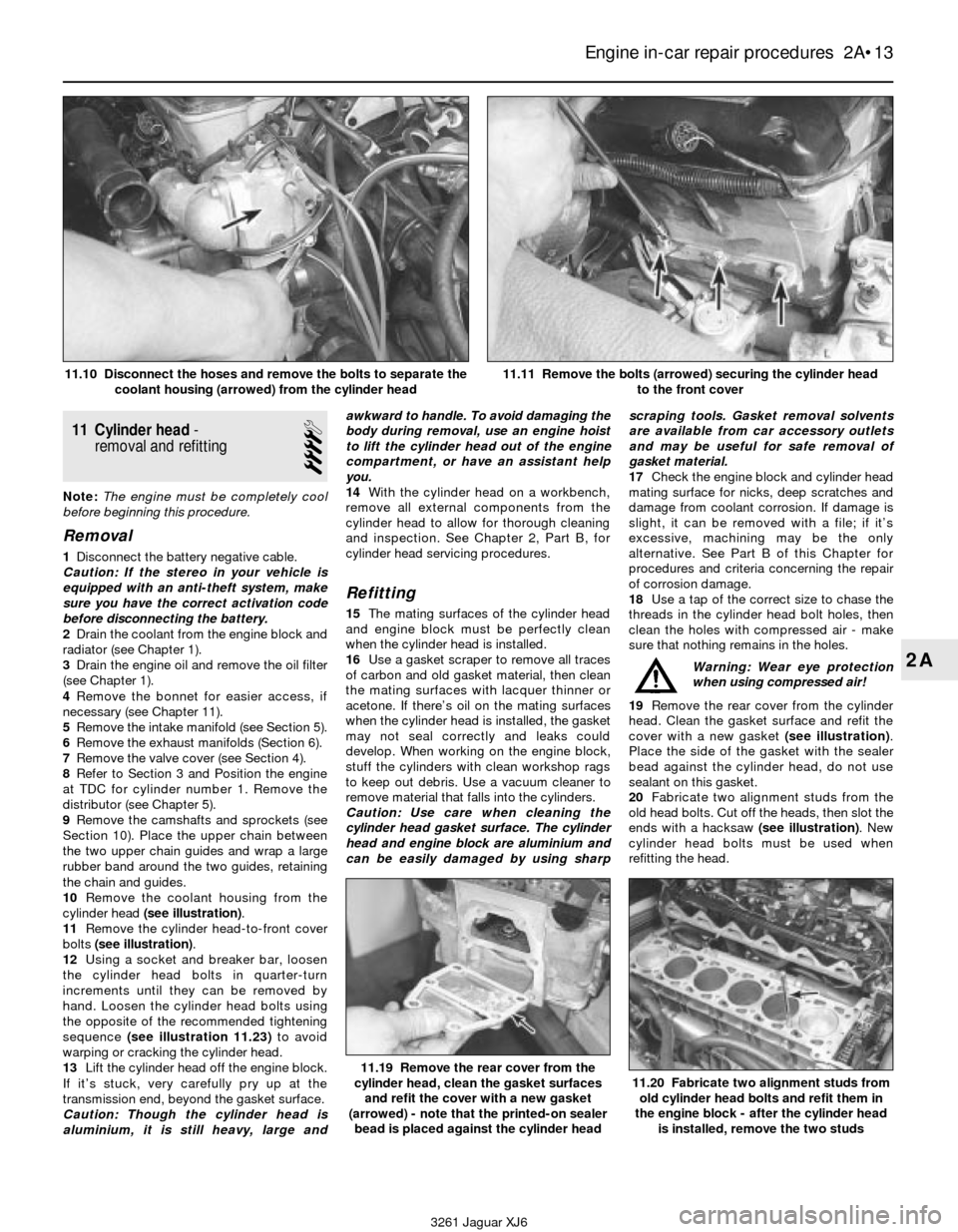
11 Cylinder head-
removal and refitting
4
Note:The engine must be completely cool
before beginning this procedure.
Removal
1Disconnect the battery negative cable.
Caution: If the stereo in your vehicle is
equipped with an anti-theft system, make
sure you have the correct activation code
before disconnecting the battery.
2Drain the coolant from the engine block and
radiator (see Chapter 1).
3Drain the engine oil and remove the oil filter
(see Chapter 1).
4Remove the bonnet for easier access, if
necessary (see Chapter 11).
5Remove the intake manifold (see Section 5).
6Remove the exhaust manifolds (Section 6).
7Remove the valve cover (see Section 4).
8Refer to Section 3 and Position the engine
at TDC for cylinder number 1. Remove the
distributor (see Chapter 5).
9Remove the camshafts and sprockets (see
Section 10). Place the upper chain between
the two upper chain guides and wrap a large
rubber band around the two guides, retaining
the chain and guides.
10Remove the coolant housing from the
cylinder head (see illustration).
11Remove the cylinder head-to-front cover
bolts (see illustration).
12Using a socket and breaker bar, loosen
the cylinder head bolts in quarter-turn
increments until they can be removed by
hand. Loosen the cylinder head bolts using
the opposite of the recommended tightening
sequence (see illustration 11.23)to avoid
warping or cracking the cylinder head.
13Lift the cylinder head off the engine block.
If it’s stuck, very carefully pry up at the
transmission end, beyond the gasket surface.
Caution: Though the cylinder head is
aluminium, it is still heavy, large andawkward to handle. To avoid damaging the
body during removal, use an engine hoist
to lift the cylinder head out of the engine
compartment, or have an assistant help
you.
14With the cylinder head on a workbench,
remove all external components from the
cylinder head to allow for thorough cleaning
and inspection. See Chapter 2, Part B, for
cylinder head servicing procedures.
Refitting
15The mating surfaces of the cylinder head
and engine block must be perfectly clean
when the cylinder head is installed.
16Use a gasket scraper to remove all traces
of carbon and old gasket material, then clean
the mating surfaces with lacquer thinner or
acetone. If there’s oil on the mating surfaces
when the cylinder head is installed, the gasket
may not seal correctly and leaks could
develop. When working on the engine block,
stuff the cylinders with clean workshop rags
to keep out debris. Use a vacuum cleaner to
remove material that falls into the cylinders.
Caution: Use care when cleaning the
cylinder head gasket surface. The cylinder
head and engine block are aluminium and
can be easily damaged by using sharpscraping tools. Gasket removal solvents
are available from car accessory outlets
and may be useful for safe removal of
gasket material.
17Check the engine block and cylinder head
mating surface for nicks, deep scratches and
damage from coolant corrosion. If damage is
slight, it can be removed with a file; if it’s
excessive, machining may be the only
alternative. See Part B of this Chapter for
procedures and criteria concerning the repair
of corrosion damage.
18Use a tap of the correct size to chase the
threads in the cylinder head bolt holes, then
clean the holes with compressed air - make
sure that nothing remains in the holes.
Warning: Wear eye protection
when using compressed air!
19Remove the rear cover from the cylinder
head. Clean the gasket surface and refit the
cover with a new gasket (see illustration).
Place the side of the gasket with the sealer
bead against the cylinder head, do not use
sealant on this gasket.
20Fabricate two alignment studs from the
old head bolts. Cut off the heads, then slot the
ends with a hacksaw (see illustration). New
cylinder head bolts must be used when
refitting the head.
Engine in-car repair procedures 2A•13
2A
11.19 Remove the rear cover from the
cylinder head, clean the gasket surfaces
and refit the cover with a new gasket
(arrowed) - note that the printed-on sealer
bead is placed against the cylinder head11.20 Fabricate two alignment studs from
old cylinder head bolts and refit them in
the engine block - after the cylinder head
is installed, remove the two studs
3261 Jaguar XJ6 11.10 Disconnect the hoses and remove the bolts to separate the
coolant housing (arrowed) from the cylinder head
11.11 Remove the bolts (arrowed) securing the cylinder head
to the front cover