battery JAGUAR XJ6 1997 2.G Repair Manual
[x] Cancel search | Manufacturer: JAGUAR, Model Year: 1997, Model line: XJ6, Model: JAGUAR XJ6 1997 2.GPages: 227, PDF Size: 7.2 MB
Page 113 of 227
2The CHECK ENGINE warning light, which is
located on the instrument panel, comes on
when the ignition switch is turned to ON and
the engine is not running. When the engine is
started, the warning light should go out. If the
light remains on, the self-diagnosis system
has detected a malfunction. Note: The
CHECK ENGINE light on early models is
displayed on the dashboard VCM panel on the
right side. Later models are equipped with a
separate CHECK ENGINE light on the left side
of the instrument cluster.Note:Not all the
codes will cause the CHECK ENGINE light to
activate. When performing any fuel or
emissions systems diagnosis, always check
for codes that may be stored but not indicated
by the CHECK ENGINE light.
Obtaining fault code output
3To obtain an output of diagnostic codes,
verify first that the battery voltage is above 11
volts, the throttle is fully closed, the
transmission is in Park, the accessory
switches are off and the engine is at normal
operating temperature.
4Turn the ignition switch to ON but don’t
start the engine (Position II). Note:On 1988
and 1989 models, remember to turn the
ignition switch to position II without turning
the key to OFF.
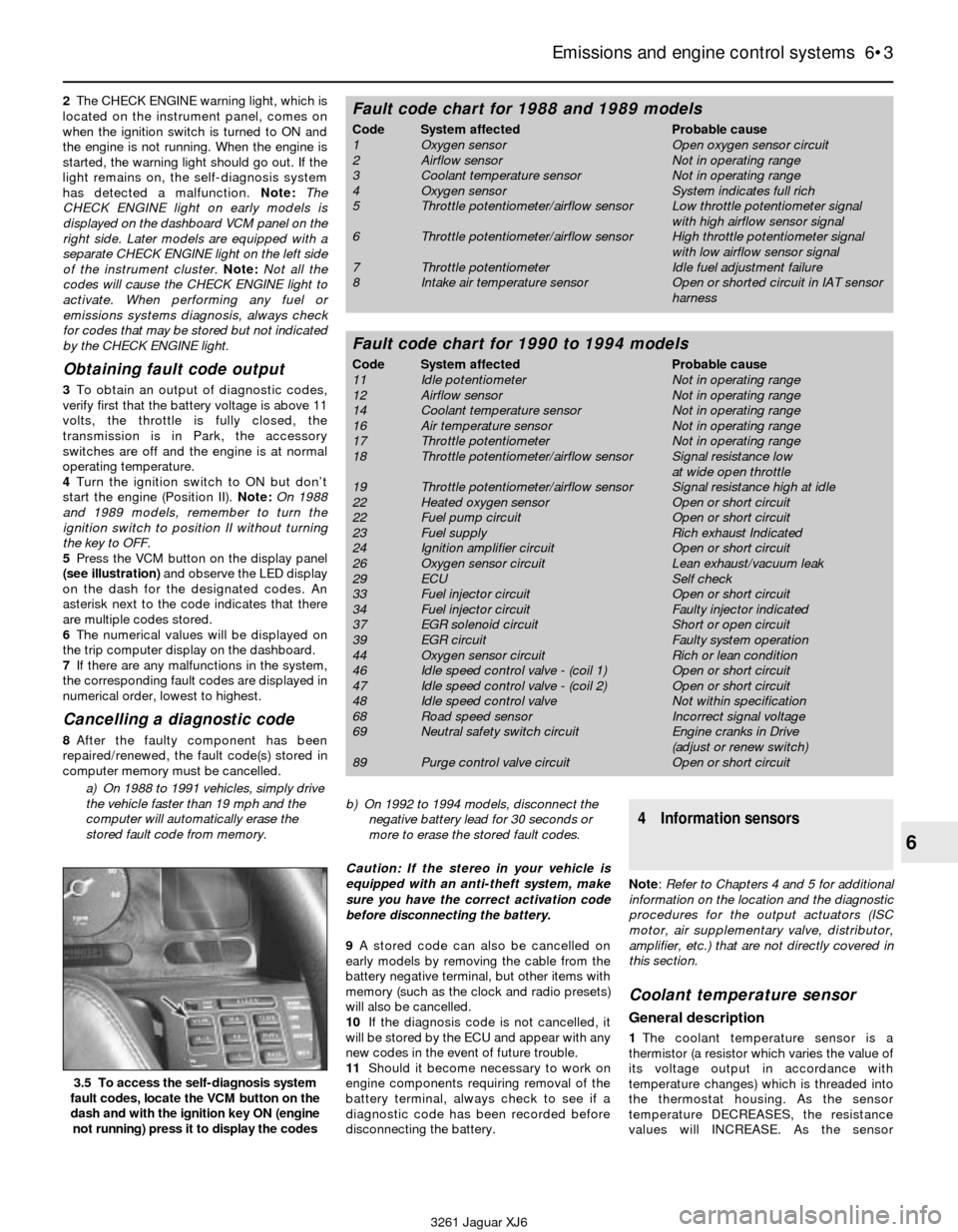
5Press the VCM button on the display panel
(see illustration)and observe the LED display
on the dash for the designated codes. An
asterisk next to the code indicates that there
are multiple codes stored.
6The numerical values will be displayed on
the trip computer display on the dashboard.
7If there are any malfunctions in the system,
the corresponding fault codes are displayed in
numerical order, lowest to highest.
Cancelling a diagnostic code
8After the faulty component has been
repaired/renewed, the fault code(s) stored in
computer memory must be cancelled.
a) On 1988 to 1991 vehicles, simply drive
the vehicle faster than 19 mph and the
computer will automatically erase the
stored fault code from memory.b) On 1992 to 1994 models, disconnect the
negative battery lead for 30 seconds or
more to erase the stored fault codes.
Caution: If the stereo in your vehicle is
equipped with an anti-theft system, make
sure you have the correct activation code
before disconnecting the battery.
9A stored code can also be cancelled on
early models by removing the cable from the
battery negative terminal, but other items with
memory (such as the clock and radio presets)
will also be cancelled.
10If the diagnosis code is not cancelled, it
will be stored by the ECU and appear with any
new codes in the event of future trouble.
11Should it become necessary to work on
engine components requiring removal of the
battery terminal, always check to see if a
diagnostic code has been recorded before
disconnecting the battery.
4 Information sensors
Note: Refer to Chapters 4 and 5 for additional
information on the location and the diagnostic
procedures for the output actuators (ISC
motor, air supplementary valve, distributor,
amplifier, etc.) that are not directly covered in
this section.
Coolant temperature sensor
General description
1The coolant temperature sensor is a
thermistor (a resistor which varies the value of
its voltage output in accordance with
temperature changes) which is threaded into
the thermostat housing. As the sensor
temperature DECREASES, the resistance
values will INCREASE. As the sensor
Emissions and engine control systems 6•3
6
3.5 To access the self-diagnosis system
fault codes, locate the VCM button on the
dash and with the ignition key ON (engine
not running) press it to display the codes
3261 Jaguar XJ6
Fault code chart for 1988 and 1989 models
Code System affected Probable cause
1 Oxygen sensor Open oxygen sensor circuit
2 Airflow sensor Not in operating range
3 Coolant temperature sensor Not in operating range
4 Oxygen sensor System indicates full rich
5 Throttle potentiometer/airflow sensor Low throttle potentiometer signal
with high airflow sensor signal
6 Throttle potentiometer/airflow sensor High throttle potentiometer signal
with low airflow sensor signal
7 Throttle potentiometer Idle fuel adjustment failure
8 Intake air temperature sensor Open or shorted circuit in IAT sensor
harness
Fault code chart for 1990 to 1994 models
Code System affected Probable cause
11 Idle potentiometer Not in operating range
12 Airflow sensor Not in operating range
14 Coolant temperature sensor Not in operating range
16 Air temperature sensor Not in operating range
17 Throttle potentiometer Not in operating range
18 Throttle potentiometer/airflow sensor Signal resistance low
at wide open throttle
19 Throttle potentiometer/airflow sensor Signal resistance high at idle
22 Heated oxygen sensor Open or short circuit
22 Fuel pump circuit Open or short circuit
23 Fuel supply Rich exhaust Indicated
24 Ignition amplifier circuit Open or short circuit
26 Oxygen sensor circuit Lean exhaust/vacuum leak
29 ECU Self check
33 Fuel injector circuit Open or short circuit
34 Fuel injector circuit Faulty injector indicated
37 EGR solenoid circuit Short or open circuit
39 EGR circuit Faulty system operation
44 Oxygen sensor circuit Rich or lean condition
46 Idle speed control valve - (coil 1) Open or short circuit
47 Idle speed control valve - (coil 2) Open or short circuit
48 Idle speed control valve Not within specification
68 Road speed sensor Incorrect signal voltage
69 Neutral safety switch circuit Engine cranks in Drive
(adjust or renew switch)
89 Purge control valve circuit Open or short circuit
Page 115 of 227
e) The silicone boot must be installed in the
correct position to prevent the boot from
being melted and to allow the sensor to
operate properly.
Check
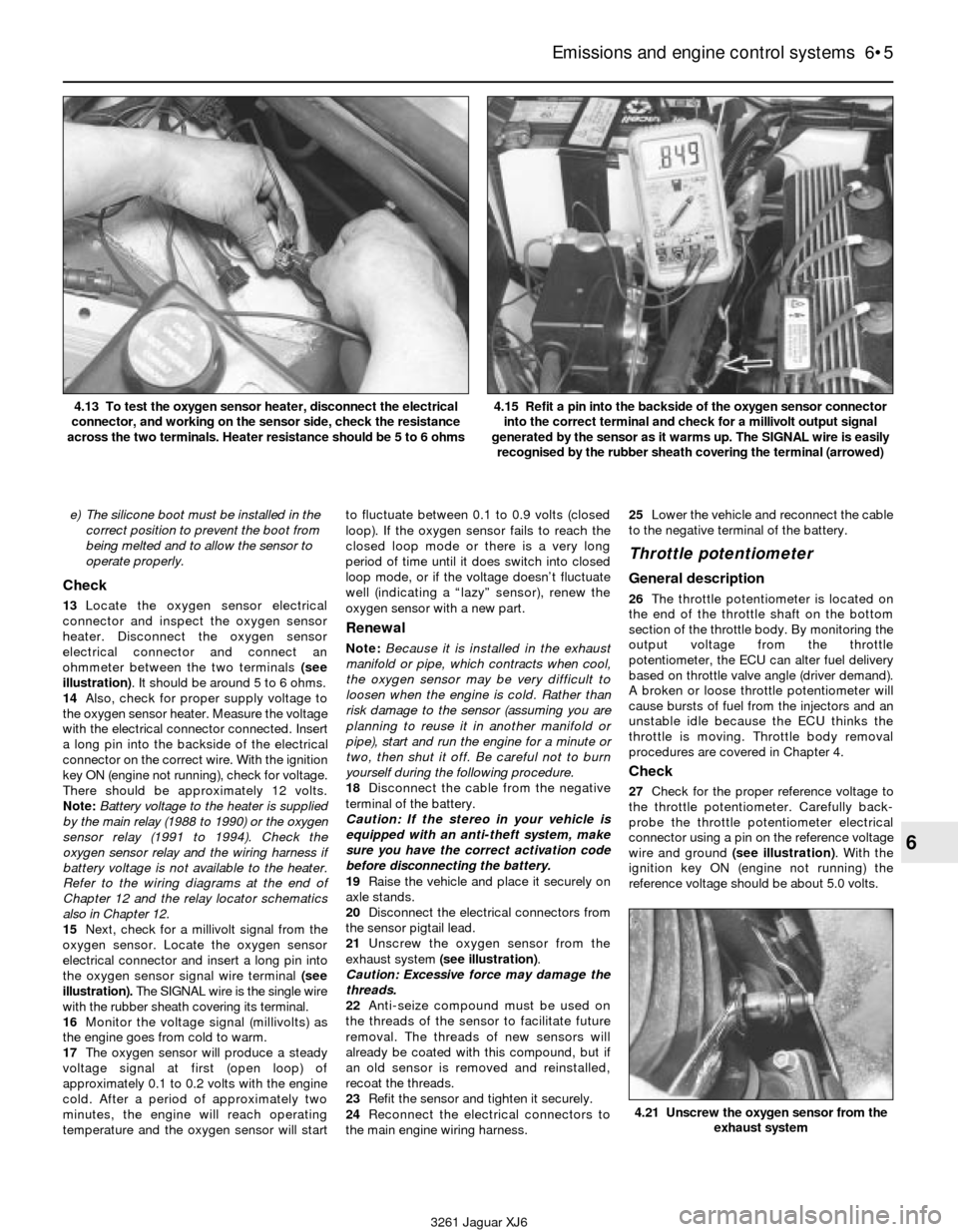
13Locate the oxygen sensor electrical
connector and inspect the oxygen sensor
heater. Disconnect the oxygen sensor
electrical connector and connect an
ohmmeter between the two terminals (see
illustration). It should be around 5 to 6 ohms.
14Also, check for proper supply voltage to
the oxygen sensor heater. Measure the voltage
with the electrical connector connected. Insert
a long pin into the backside of the electrical
connector on the correct wire. With the ignition
key ON (engine not running), check for voltage.
There should be approximately 12 volts.
Note:Battery voltage to the heater is supplied
by the main relay (1988 to 1990) or the oxygen
sensor relay (1991 to 1994). Check the
oxygen sensor relay and the wiring harness if
battery voltage is not available to the heater.
Refer to the wiring diagrams at the end of
Chapter 12 and the relay locator schematics
also in Chapter 12.
15Next, check for a millivolt signal from the
oxygen sensor. Locate the oxygen sensor
electrical connector and insert a long pin into
the oxygen sensor signal wire terminal (see
illustration). The SIGNAL wire is the single wire
with the rubber sheath covering its terminal.
16Monitor the voltage signal (millivolts) as
the engine goes from cold to warm.
17The oxygen sensor will produce a steady
voltage signal at first (open loop) of
approximately 0.1 to 0.2 volts with the engine
cold. After a period of approximately two
minutes, the engine will reach operating
temperature and the oxygen sensor will startto fluctuate between 0.1 to 0.9 volts (closed
loop). If the oxygen sensor fails to reach the
closed loop mode or there is a very long
period of time until it does switch into closed
loop mode, or if the voltage doesn’t fluctuate
well (indicating a “lazy” sensor), renew the
oxygen sensor with a new part.
Renewal
Note:Because it is installed in the exhaust
manifold or pipe, which contracts when cool,
the oxygen sensor may be very difficult to
loosen when the engine is cold. Rather than
risk damage to the sensor (assuming you are
planning to reuse it in another manifold or
pipe), start and run the engine for a minute or
two, then shut it off. Be careful not to burn
yourself during the following procedure.
18Disconnect the cable from the negative
terminal of the battery.
Caution: If the stereo in your vehicle is
equipped with an anti-theft system, make
sure you have the correct activation code
before disconnecting the battery.
19Raise the vehicle and place it securely on
axle stands.
20Disconnect the electrical connectors from
the sensor pigtail lead.
21Unscrew the oxygen sensor from the
exhaust system (see illustration).
Caution: Excessive force may damage the
threads.
22Anti-seize compound must be used on
the threads of the sensor to facilitate future
removal. The threads of new sensors will
already be coated with this compound, but if
an old sensor is removed and reinstalled,
recoat the threads.
23Refit the sensor and tighten it securely.
24Reconnect the electrical connectors to
the main engine wiring harness.25Lower the vehicle and reconnect the cable
to the negative terminal of the battery.
Throttle potentiometer
General description
26The throttle potentiometer is located on
the end of the throttle shaft on the bottom
section of the throttle body. By monitoring the
output voltage from the throttle
potentiometer, the ECU can alter fuel delivery
based on throttle valve angle (driver demand).
A broken or loose throttle potentiometer will
cause bursts of fuel from the injectors and an
unstable idle because the ECU thinks the
throttle is moving. Throttle body removal
procedures are covered in Chapter 4.
Check
27Check for the proper reference voltage to
the throttle potentiometer. Carefully back-
probe the throttle potentiometer electrical
connector using a pin on the reference voltage
wire and ground (see illustration). With the
ignition key ON (engine not running) the
reference voltage should be about 5.0 volts.
Emissions and engine control systems 6•5
6
4.21 Unscrew the oxygen sensor from the
exhaust system
3261 Jaguar XJ6 4.13 To test the oxygen sensor heater, disconnect the electrical
connector, and working on the sensor side, check the resistance
across the two terminals. Heater resistance should be 5 to 6 ohms
4.15 Refit a pin into the backside of the oxygen sensor connector
into the correct terminal and check for a millivolt output signal
generated by the sensor as it warms up. The SIGNAL wire is easily
recognised by the rubber sheath covering the terminal (arrowed)
Page 116 of 227
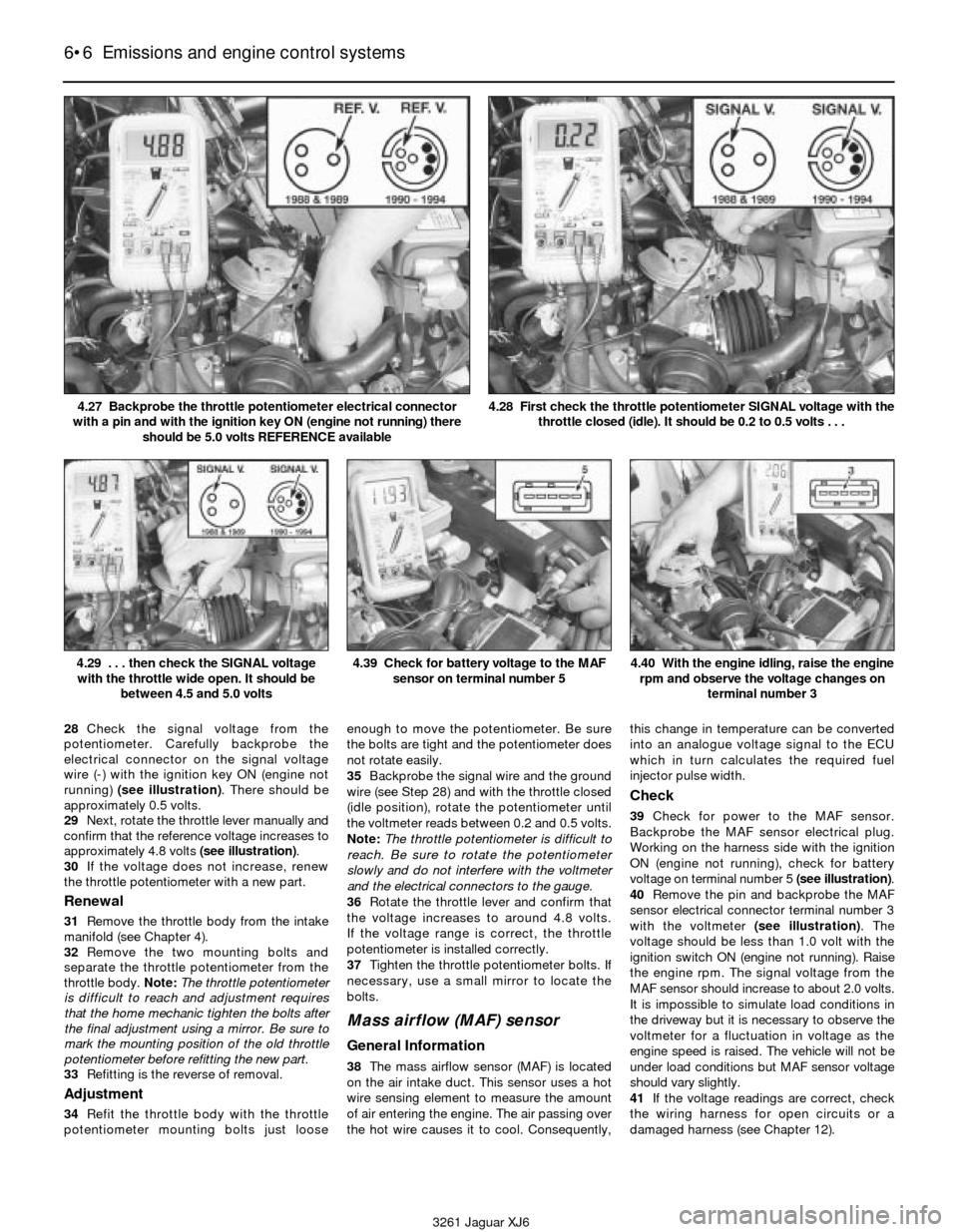
28Check the signal voltage from the
potentiometer. Carefully backprobe the
electrical connector on the signal voltage
wire (-) with the ignition key ON (engine not
running) (see illustration). There should be
approximately 0.5 volts.
29Next, rotate the throttle lever manually and
confirm that the reference voltage increases to
approximately 4.8 volts (see illustration).
30If the voltage does not increase, renew
the throttle potentiometer with a new part.
Renewal
31Remove the throttle body from the intake
manifold (see Chapter 4).
32Remove the two mounting bolts and
separate the throttle potentiometer from the
throttle body. Note:The throttle potentiometer
is difficult to reach and adjustment requires
that the home mechanic tighten the bolts after
the final adjustment using a mirror. Be sure to
mark the mounting position of the old throttle
potentiometer before refitting the new part.
33Refitting is the reverse of removal.
Adjustment
34Refit the throttle body with the throttle
potentiometer mounting bolts just looseenough to move the potentiometer. Be sure
the bolts are tight and the potentiometer does
not rotate easily.
35Backprobe the signal wire and the ground
wire (see Step 28) and with the throttle closed
(idle position), rotate the potentiometer until
the voltmeter reads between 0.2 and 0.5 volts.
Note:The throttle potentiometer is difficult to
reach. Be sure to rotate the potentiometer
slowly and do not interfere with the voltmeter
and the electrical connectors to the gauge.
36Rotate the throttle lever and confirm that
the voltage increases to around 4.8 volts.
If the voltage range is correct, the throttle
potentiometer is installed correctly.
37Tighten the throttle potentiometer bolts. If
necessary, use a small mirror to locate the
bolts.
Mass airflow (MAF) sensor
General Information
38The mass airflow sensor (MAF) is located
on the air intake duct. This sensor uses a hot
wire sensing element to measure the amount
of air entering the engine. The air passing over
the hot wire causes it to cool. Consequently,this change in temperature can be converted
into an analogue voltage signal to the ECU
which in turn calculates the required fuel
injector pulse width.
Check
39Check for power to the MAF sensor.
Backprobe the MAF sensor electrical plug.
Working on the harness side with the ignition
ON (engine not running), check for battery
voltage on terminal number 5 (see illustration).
40Remove the pin and backprobe the MAF
sensor electrical connector terminal number 3
with the voltmeter (see illustration). The
voltage should be less than 1.0 volt with the
ignition switch ON (engine not running). Raise
the engine rpm. The signal voltage from the
MAF sensor should increase to about 2.0 volts.
It is impossible to simulate load conditions in
the driveway but it is necessary to observe the
voltmeter for a fluctuation in voltage as the
engine speed is raised. The vehicle will not be
under load conditions but MAF sensor voltage
should vary slightly.
41If the voltage readings are correct, check
the wiring harness for open circuits or a
damaged harness (see Chapter 12).
6•6 Emissions and engine control systems
4.29 . . . then check the SIGNAL voltage
with the throttle wide open. It should be
between 4.5 and 5.0 volts4.39 Check for battery voltage to the MAF
sensor on terminal number 54.40 With the engine idling, raise the engine
rpm and observe the voltage changes on
terminal number 3
3261 Jaguar XJ6 4.27 Backprobe the throttle potentiometer electrical connector
with a pin and with the ignition key ON (engine not running) there
should be 5.0 volts REFERENCE available
4.28 First check the throttle potentiometer SIGNAL voltage with the
throttle closed (idle). It should be 0.2 to 0.5 volts . . .
Page 118 of 227

5 Air Injector Reactor
(AIR) system
General information
1The air injection reactor system reduces
carbon monoxide and hydrocarbon content
in the exhaust gases by injecting fresh air into
the hot exhaust gases leaving the exhaust
ports. When fresh air is mixed with hot
exhaust gases, oxidation is increased,
reducing the concentration of hydrocarbons
and carbon monoxide and converting them
into harmless carbon dioxide and water.
2The air injection system is composed of an
air pump, diverter valve (bypass), check valve,
air injection manifold, vacuum delay valve,
vacuum control solenoid, air pump magnetic
clutch, air pump clutch relay and hoses (see
illustration). The air pump is driven by a belt
from the crankshaft and supplies compressed
air to the exhaust manifold(s). The check valve
prevents the reverse flow of exhaust gases into
the system. The vacuum-operated (early
models) or electrically-operated (later models)air cut-off valve prevents air from being drawn
into the exhaust when the air pump is switched
off. System vacuum to the air cut-off valve is
controlled by the solenoid vacuum valve in
parallel circuit with the air pump. A delay valve
prevents vacuum loss to the solenoid valve
during wide open throttle operation.
3Injected air is controlled by the computer,
the air pump clutch and the air pump clutch
relay. The AIR system is used during warm-up
(58 to 83° F) to control emissions while the
engine is running rich. The oxygen sensor
feedback system cannot function while the AIR
system is operating. The computer controls
both systems during warm-up and operating
temperatures. If problems occur with the
AIR system relay or circuit, the on-board
diagnosis system will set a code 66.
Check
4Check the condition of the air pump
drivebelt, the injection hoses and the injection
manifold. Make sure that all components are
intact and there are no leaks.
5Check the operation of the air pump clutch
relay (see illustration)and the air pump
clutch. First remove the relay and check forbattery voltage to the relay. Also, check the
relay itself. Refer to the relay checking
procedure in Chapter 12. Extract codes from
the self-diagnosis system (see Section 3) and
check for a code 66, AIR relay malfunction.
6Make sure the electrical connector is
securely fastened to the diverter valve (see
illustration). If everything appears OK but a
fault code still sets, have the system
diagnosed by a dealer service department or
other qualified repair workshop.
Air pump renewal
7Disconnect the cable from the negative
terminal of the battery.
Caution: If the stereo in your vehicle is
equipped with an anti-theft system, make
sure you have the correct activation code
before disconnecting the battery.
8Disconnect the electrical connector from
the air pump clutch.
9Loosen the clips from the air inlet and outlet
hose and separate them from the air injection
pump.
10Loosen the adjuster and pivot bolts (see
illustration)and nuts but do not remove them
from the air injection pump brackets.
6•8 Emissions and engine control systems
3261 Jaguar XJ6 5.2 Schematic of the Air Injection Reactor (AIR) system
5.6 Location of the AIR diverter valve on a 1992 model - check the
hoses for cracking and the electrical connector for security5.10 Loosen the pivot bolt and then the adjustment nut to remove
the drivebelt from the air pump. The adjustment nut has a lock bolt
that must be loosened before the pump will move down the adjuster
5.5 Location of the AIR pump relay on a 1992 model
Page 120 of 227
7Start the engine and observe the vacuum
gauge. At idle, there should be no vacuum
present. Raise the engine rpm and observe
the vacuum increase. This is a ported vacuum
source and therefore it should only register
vacuum when throttled.
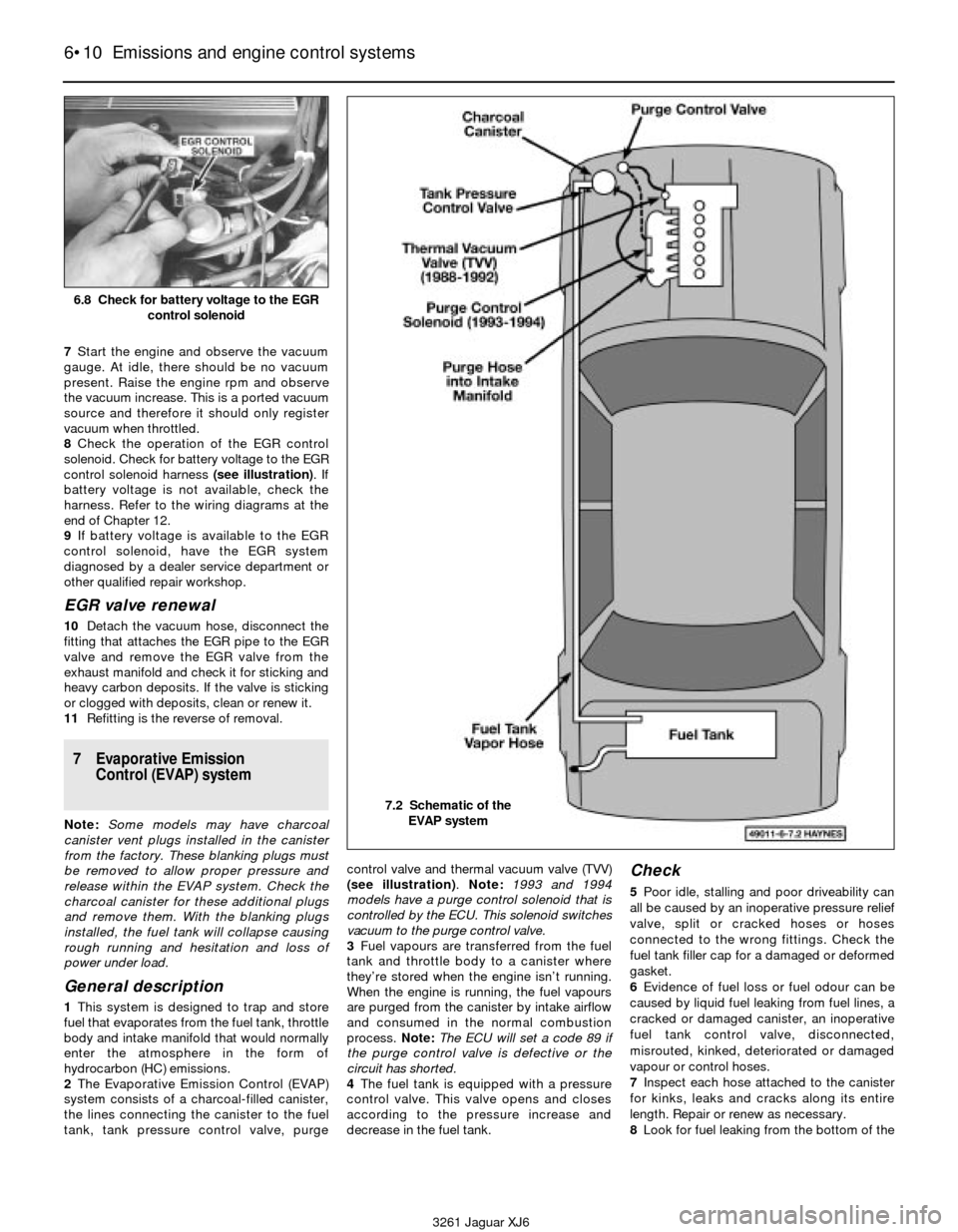
8Check the operation of the EGR control
solenoid. Check for battery voltage to the EGR
control solenoid harness (see illustration). If
battery voltage is not available, check the
harness. Refer to the wiring diagrams at the
end of Chapter 12.
9If battery voltage is available to the EGR
control solenoid, have the EGR system
diagnosed by a dealer service department or
other qualified repair workshop.
EGR valve renewal
10Detach the vacuum hose, disconnect the
fitting that attaches the EGR pipe to the EGR
valve and remove the EGR valve from the
exhaust manifold and check it for sticking and
heavy carbon deposits. If the valve is sticking
or clogged with deposits, clean or renew it.
11Refitting is the reverse of removal.
7 Evaporative Emission
Control (EVAP) system
Note: Some models may have charcoal
canister vent plugs installed in the canister
from the factory. These blanking plugs must
be removed to allow proper pressure and
release within the EVAP system. Check the
charcoal canister for these additional plugs
and remove them. With the blanking plugs
installed, the fuel tank will collapse causing
rough running and hesitation and loss of
power under load.
General description
1This system is designed to trap and store
fuel that evaporates from the fuel tank, throttle
body and intake manifold that would normally
enter the atmosphere in the form of
hydrocarbon (HC) emissions.
2The Evaporative Emission Control (EVAP)
system consists of a charcoal-filled canister,
the lines connecting the canister to the fuel
tank, tank pressure control valve, purgecontrol valve and thermal vacuum valve (TVV)
(see illustration). Note: 1993 and 1994
models have a purge control solenoid that is
controlled by the ECU. This solenoid switches
vacuum to the purge control valve.
3Fuel vapours are transferred from the fuel
tank and throttle body to a canister where
they’re stored when the engine isn’t running.
When the engine is running, the fuel vapours
are purged from the canister by intake airflow
and consumed in the normal combustion
process.Note: The ECU will set a code 89 if
the purge control valve is defective or the
circuit has shorted.
4The fuel tank is equipped with a pressure
control valve. This valve opens and closes
according to the pressure increase and
decrease in the fuel tank.
Check
5Poor idle, stalling and poor driveability can
all be caused by an inoperative pressure relief
valve, split or cracked hoses or hoses
connected to the wrong fittings. Check the
fuel tank filler cap for a damaged or deformed
gasket.
6Evidence of fuel loss or fuel odour can be
caused by liquid fuel leaking from fuel lines, a
cracked or damaged canister, an inoperative
fuel tank control valve, disconnected,
misrouted, kinked, deteriorated or damaged
vapour or control hoses.
7Inspect each hose attached to the canister
for kinks, leaks and cracks along its entire
length. Repair or renew as necessary.
8Look for fuel leaking from the bottom of the
6•10 Emissions and engine control systems
6.8 Check for battery voltage to the EGR
control solenoid
3261 Jaguar XJ6
7.2 Schematic of the
EVAP system
Page 122 of 227
obstructions to ensure complete recirculation
of gasses from the crankcase back into the
intake manifold. In the event of clogging, the
pressure will increase causing blow-by and oil
leaks through seals and gaskets.
6Check the operation of the heating element.
Check for battery voltage to the element while
the engine is cold. If no voltage is available
to the heating element, check the circuit from
the windscreen washer jet temperature
sensor.
Renewal
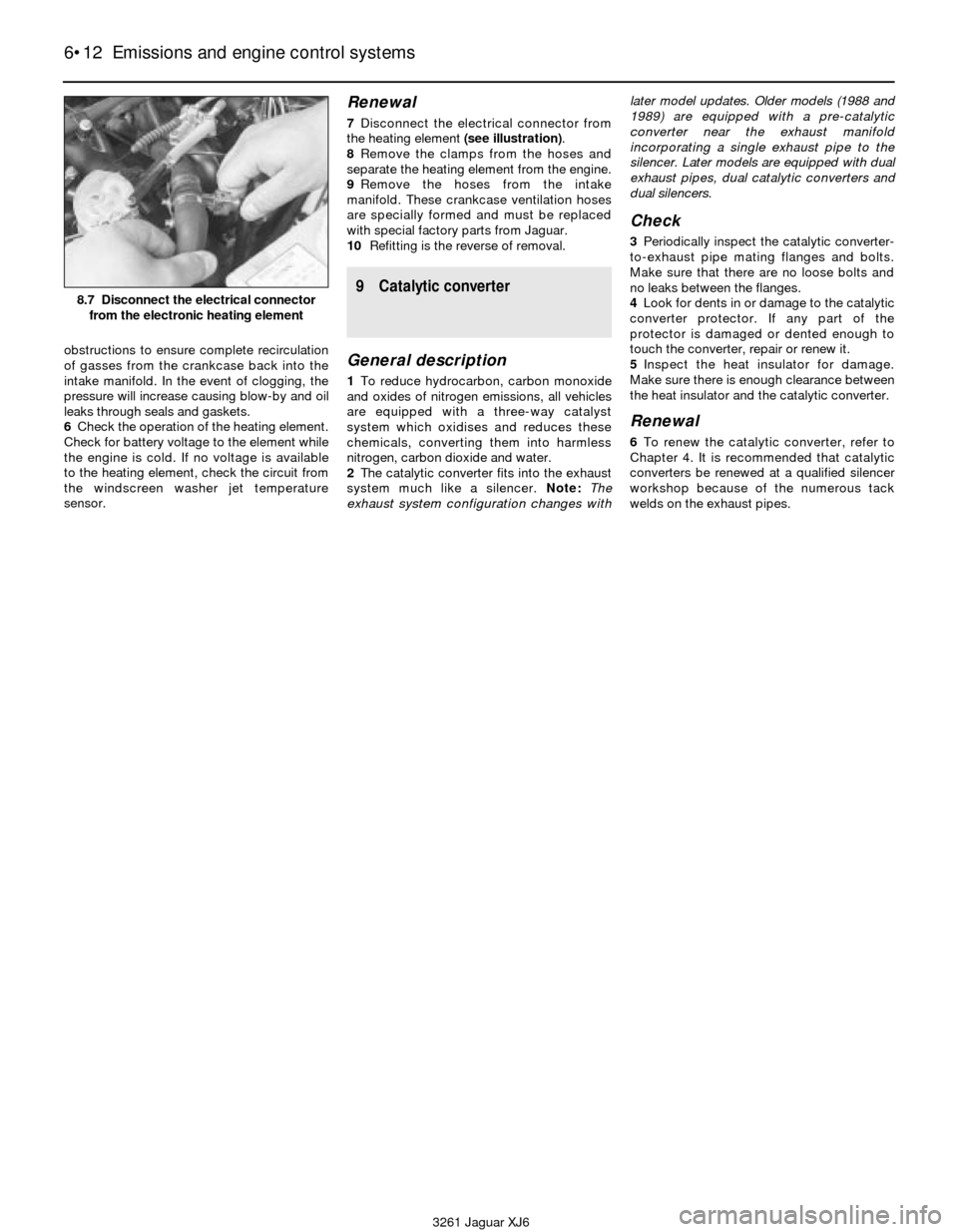
7Disconnect the electrical connector from
the heating element (see illustration).
8Remove the clamps from the hoses and
separate the heating element from the engine.
9Remove the hoses from the intake
manifold. These crankcase ventilation hoses
are specially formed and must be replaced
with special factory parts from Jaguar.
10Refitting is the reverse of removal.
9 Catalytic converter
General description
1To reduce hydrocarbon, carbon monoxide
and oxides of nitrogen emissions, all vehicles
are equipped with a three-way catalyst
system which oxidises and reduces these
chemicals, converting them into harmless
nitrogen, carbon dioxide and water.
2The catalytic converter fits into the exhaust
system much like a silencer. Note:The
exhaust system configuration changes withlater model updates. Older models (1988 and
1989) are equipped with a pre-catalytic
converter near the exhaust manifold
incorporating a single exhaust pipe to the
silencer. Later models are equipped with dual
exhaust pipes, dual catalytic converters and
dual silencers.
Check
3Periodically inspect the catalytic converter-
to-exhaust pipe mating flanges and bolts.
Make sure that there are no loose bolts and
no leaks between the flanges.
4Look for dents in or damage to the catalytic
converter protector. If any part of the
protector is damaged or dented enough to
touch the converter, repair or renew it.
5Inspect the heat insulator for damage.
Make sure there is enough clearance between
the heat insulator and the catalytic converter.
Renewal
6To renew the catalytic converter, refer to
Chapter 4. It is recommended that catalytic
converters be renewed at a qualified silencer
workshop because of the numerous tack
welds on the exhaust pipes.
6•12 Emissions and engine control systems
3261 Jaguar XJ6
8.7 Disconnect the electrical connector
from the electronic heating element
Page 144 of 227
11If you installed another pair of self-
levelling shocks, or removed and installed the
same pair of self-levelling shocks, be sure to
top up the power hydraulic system reservoir
(see Chapter 1).
11 Hub carrier (rear)-
removal and refitting
4
1Loosen the wheel nuts, raise the rear of the
vehicle and support it securely on axle stands.
Remove the wheel.
2Remove the rear caliper and brake pads,
the caliper bracket, the brake disc, the
handbrake cable and the handbrake shoe
assembly (see Chapter 9).
3Disconnect the outer end of the propshaft
from the hub carrier (see Chapter 8).
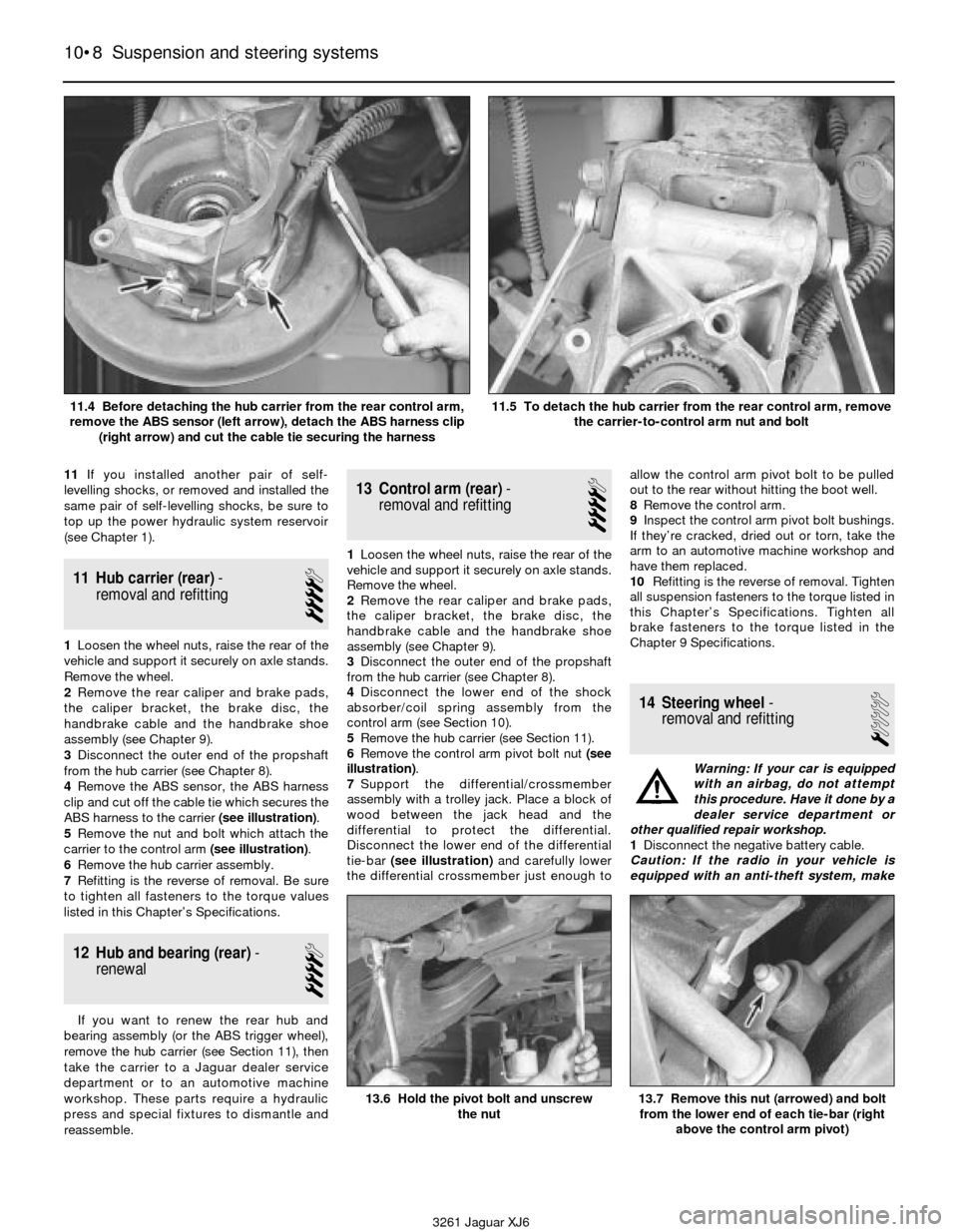
4Remove the ABS sensor, the ABS harness
clip and cut off the cable tie which secures the
ABS harness to the carrier (see illustration).
5Remove the nut and bolt which attach the
carrier to the control arm (see illustration).
6Remove the hub carrier assembly.
7Refitting is the reverse of removal. Be sure
to tighten all fasteners to the torque values
listed in this Chapter’s Specifications.
12 Hub and bearing (rear)-
renewal
4
If you want to renew the rear hub and
bearing assembly (or the ABS trigger wheel),
remove the hub carrier (see Section 11), then
take the carrier to a Jaguar dealer service
department or to an automotive machine
workshop. These parts require a hydraulic
press and special fixtures to dismantle and
reassemble.
13 Control arm (rear)-
removal and refitting
4
1Loosen the wheel nuts, raise the rear of the
vehicle and support it securely on axle stands.
Remove the wheel.
2Remove the rear caliper and brake pads,
the caliper bracket, the brake disc, the
handbrake cable and the handbrake shoe
assembly (see Chapter 9).
3Disconnect the outer end of the propshaft
from the hub carrier (see Chapter 8).
4Disconnect the lower end of the shock
absorber/coil spring assembly from the
control arm (see Section 10).
5Remove the hub carrier (see Section 11).
6Remove the control arm pivot bolt nut (see
illustration).
7Support the differential/crossmember
assembly with a trolley jack. Place a block of
wood between the jack head and the
differential to protect the differential.
Disconnect the lower end of the differential
tie-bar (see illustration)and carefully lower
the differential crossmember just enough toallow the control arm pivot bolt to be pulled
out to the rear without hitting the boot well.
8Remove the control arm.
9Inspect the control arm pivot bolt bushings.
If they’re cracked, dried out or torn, take the
arm to an automotive machine workshop and
have them replaced.
10Refitting is the reverse of removal. Tighten
all suspension fasteners to the torque listed in
this Chapter’s Specifications. Tighten all
brake fasteners to the torque listed in the
Chapter 9 Specifications.
14 Steering wheel-
removal and refitting
1
Warning: If your car is equipped
with an airbag, do not attempt
this procedure. Have it done by a
dealer service department or
other qualified repair workshop.
1Disconnect the negative battery cable.
Caution: If the radio in your vehicle is
equipped with an anti-theft system, make
10•8 Suspension and steering systems
13.6 Hold the pivot bolt and unscrew
the nut13.7 Remove this nut (arrowed) and bolt
from the lower end of each tie-bar (right
above the control arm pivot)
3261 Jaguar XJ6 11.4 Before detaching the hub carrier from the rear control arm,
remove the ABS sensor (left arrow), detach the ABS harness clip
(right arrow) and cut the cable tie securing the harness
11.5 To detach the hub carrier from the rear control arm, remove
the carrier-to-control arm nut and bolt
Page 145 of 227

sure you have the correct activation code
before disconnecting the battery.
2Pry off the centre pad (see illustration).
3Remove the steering wheel nut and mark
the relationship of the steering wheel hub to
the shaft (see illustration).
4Slide the steering wheel off the steering
shaft (see illustration).
5Refitting is the reverse of removal. Make
sure you align the match marks you made on
the steering wheel and the shaft. Tighten the
steering wheel nut to the torque listed in this
Chapter’s Specifications.
15 Tie-rod ends-
removal and refitting
2
1Loosen the wheel nuts, raise the front of the
vehicle and support it securely on axle stands.
Remove the front wheel.
2Back off the locknut that locks the tie-rod
end to the tie-rod, then paint an alignment
mark on the threads to ensure the new tie-rod
end is installed in the same position (see
illustration).
3Loosen the nut on the tie-rod ball stud, then
fit a small puller and pop the ball stud loose
(see illustration). Remove the nut and
separate the ball stud from the steering
knuckle. Unscrew the tie-rod end from the tie-
rod.
4Refitting is the reverse of removal. Make
sure you thread the tie-rod end all the way up
to the mark on the threads, but no further.
Tighten the ball stud nut to the torque listed in
this Chapter’s Specifications. Tighten the
locknut securely.
5Have the toe-in checked and, if necessary,
adjusted at a dealer service department or
alignment workshop.
16 Steering gear boots- renewal
2
1Remove the tie-rod ends (see Section 15).
2Cut the boot clamps at both ends of the old
boots (see illustration)and slide off the
boots.3While the boots are removed, inspect the
seals in the end of the steering gear. If they’re
leaking, have them replaced by a dealer
service department or other qualified repair
workshop, or replace the steering gear with a
new or rebuilt unit (see Section 17).
4Slide the new boots into place and refit new
boot clamps.
5Refit the tie-rod ends (see Section 15).
Suspension and steering systems 10•9
10
14.4 To remove the steering wheel,
simply pull it straight off15.2 Back off this locknut and mark the
threads to ensure that the new tie-rod end
is installed properly
15.3 Loosen the ball stud nut, fit a small
puller and pop the ball stud loose from the
steering knuckle
3261 Jaguar XJ6 14.2 To remove the centre pad from the steering wheel,
simply pry it off
14.3 After removing the steering wheel nut, make a pair of
alignment marks on the steering wheel and steering shaft to
ensure proper reassembly
16.2 Cut off the boot clamps (arrowed)
and slide the boot off the steering gear
Page 155 of 227
8Loosen the bolts or nuts and move the boot
lid into correct alignment. Move it only a little
at a time. Tighten the hinge bolts or nuts and
carefully lower the boot lid to check the
alignment.
9If necessary after refitting, the entire boot
lid striker assembly can be adjusted up and
down as well as from side to side on the boot
lid so the lid closes securely and is flush with
the rear quarter panels. To do this, scribe a
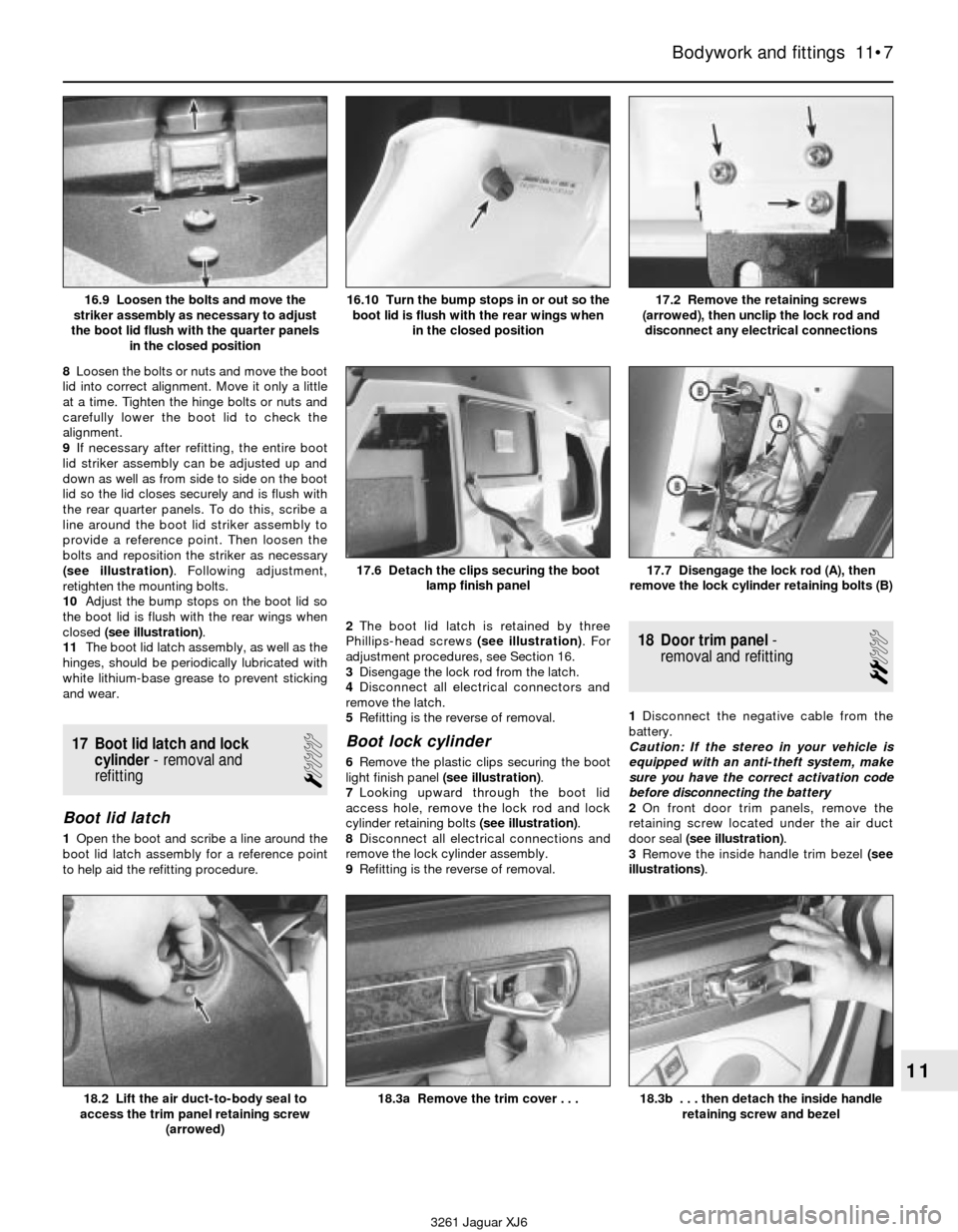
line around the boot lid striker assembly to
provide a reference point. Then loosen the
bolts and reposition the striker as necessary
(see illustration). Following adjustment,
retighten the mounting bolts.
10Adjust the bump stops on the boot lid so
the boot lid is flush with the rear wings when
closed (see illustration).
11The boot lid latch assembly, as well as the
hinges, should be periodically lubricated with
white lithium-base grease to prevent sticking
and wear.
17 Boot lid latch and lock
cylinder- removal and
refitting
1
Boot lid latch
1Open the boot and scribe a line around the
boot lid latch assembly for a reference point
to help aid the refitting procedure.2The boot lid latch is retained by three
Phillips-head screws (see illustration). For
adjustment procedures, see Section 16.
3Disengage the lock rod from the latch.
4Disconnect all electrical connectors and
remove the latch.
5Refitting is the reverse of removal.
Boot lock cylinder
6Remove the plastic clips securing the boot
light finish panel (see illustration).
7Looking upward through the boot lid
access hole, remove the lock rod and lock
cylinder retaining bolts (see illustration).
8Disconnect all electrical connections and
remove the lock cylinder assembly.
9Refitting is the reverse of removal.
18 Door trim panel-
removal and refitting
2
1Disconnect the negative cable from the
battery.
Caution: If the stereo in your vehicle is
equipped with an anti-theft system, make
sure you have the correct activation code
before disconnecting the battery
2On front door trim panels, remove the
retaining screw located under the air duct
door seal (see illustration).
3Remove the inside handle trim bezel (see
illustrations).
Bodywork and fittings 11•7
11
17.6 Detach the clips securing the boot
lamp finish panel17.7 Disengage the lock rod (A), then
remove the lock cylinder retaining bolts (B)
18.2 Lift the air duct-to-body seal to
access the trim panel retaining screw
(arrowed)18.3b . . . then detach the inside handle
retaining screw and bezel18.3a Remove the trim cover . . .
3261 Jaguar XJ6 16.9 Loosen the bolts and move the
striker assembly as necessary to adjust
the boot lid flush with the quarter panels
in the closed position
17.2 Remove the retaining screws
(arrowed), then unclip the lock rod and
disconnect any electrical connections16.10 Turn the bump stops in or out so the
boot lid is flush with the rear wings when
in the closed position
Page 156 of 227
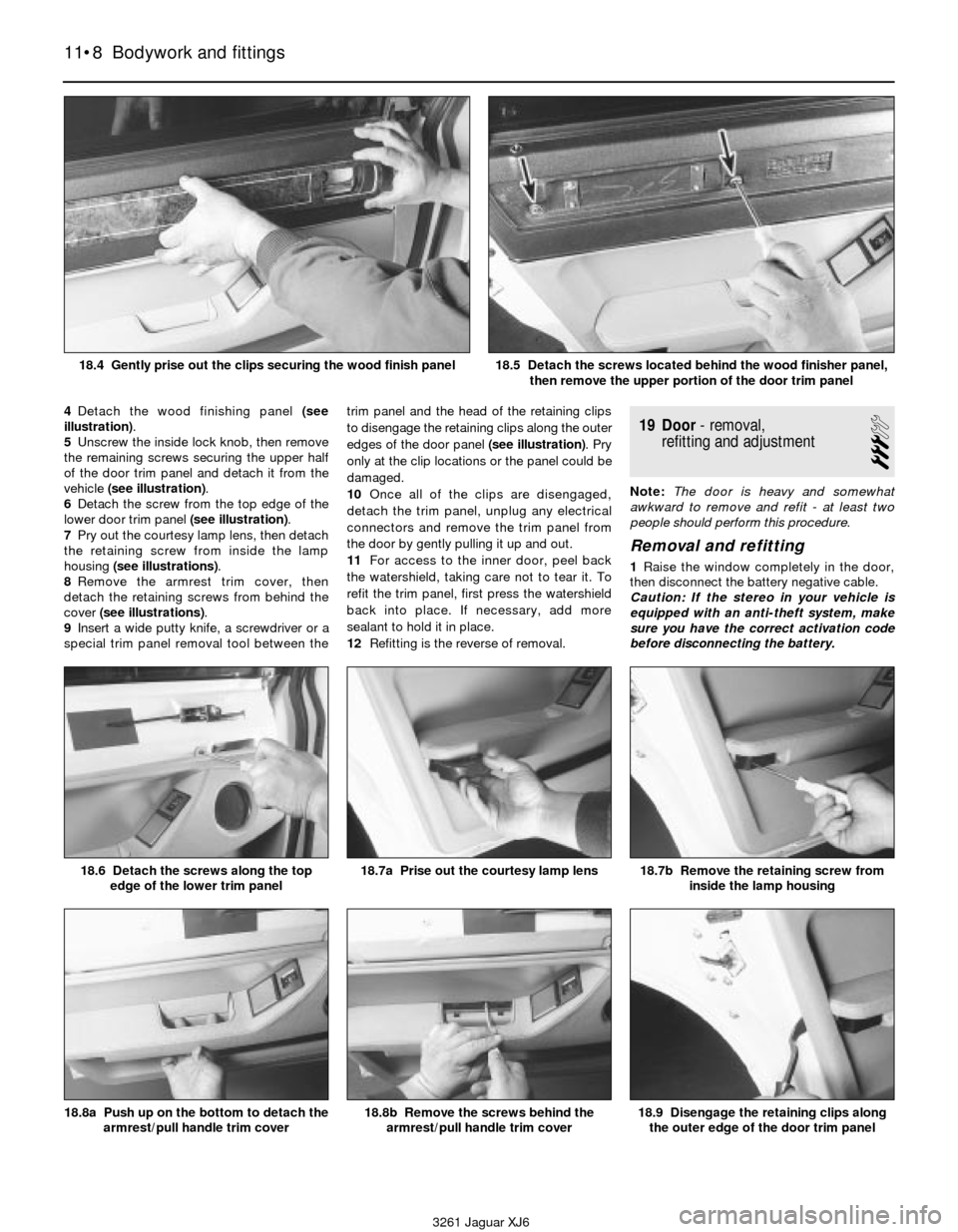
4Detach the wood finishing panel (see
illustration).
5Unscrew the inside lock knob, then remove
the remaining screws securing the upper half
of the door trim panel and detach it from the
vehicle (see illustration).
6Detach the screw from the top edge of the
lower door trim panel (see illustration).
7Pry out the courtesy lamp lens, then detach
the retaining screw from inside the lamp
housing (see illustrations).
8Remove the armrest trim cover, then
detach the retaining screws from behind the
cover (see illustrations).
9Insert a wide putty knife, a screwdriver or a
special trim panel removal tool between thetrim panel and the head of the retaining clips
to disengage the retaining clips along the outer
edges of the door panel (see illustration). Pry
only at the clip locations or the panel could be
damaged.
10Once all of the clips are disengaged,
detach the trim panel, unplug any electrical
connectors and remove the trim panel from
the door by gently pulling it up and out.
11For access to the inner door, peel back
the watershield, taking care not to tear it. To
refit the trim panel, first press the watershield
back into place. If necessary, add more
sealant to hold it in place.
12Refitting is the reverse of removal.19 Door- removal,
refitting and adjustment
3
Note:The door is heavy and somewhat
awkward to remove and refit - at least two
people should perform this procedure.
Removal and refitting
1Raise the window completely in the door,
then disconnect the battery negative cable.
Caution: If the stereo in your vehicle is
equipped with an anti-theft system, make
sure you have the correct activation code
before disconnecting the battery.
11•8 Bodywork and fittings
18.6 Detach the screws along the top
edge of the lower trim panel18.7a Prise out the courtesy lamp lens18.7b Remove the retaining screw from
inside the lamp housing
18.8a Push up on the bottom to detach the
armrest/pull handle trim cover18.8b Remove the screws behind the
armrest/pull handle trim cover18.9 Disengage the retaining clips along
the outer edge of the door trim panel
3261 Jaguar XJ6 18.4 Gently prise out the clips securing the wood finish panel
18.5 Detach the screws located behind the wood finisher panel,
then remove the upper portion of the door trim panel