change time JAGUAR XJ6 1997 2.G User Guide
[x] Cancel search | Manufacturer: JAGUAR, Model Year: 1997, Model line: XJ6, Model: JAGUAR XJ6 1997 2.GPages: 227, PDF Size: 7.2 MB
Page 98 of 227

of these sensors and their corresponding
ECU-controlled relays are not contained
within EFI components, but are located
throughout the engine compartment. For
further information regarding the ECU and its
relationship to the engine electrical and
ignition system, see Chapter 6.
12 Electronic Fuel Injection
(EFI) system- check
2
1Check the earth wire connections for
tightness. Check all wiring and electrical
connectors that are related to the system.
Loose electrical connectors and poor grounds
can cause many problems that resemble
more serious malfunctions.
2Check to see that the battery is fully
charged, as the control unit and sensors
depend on an accurate supply voltage in
order to properly meter the fuel.
3Check the air filter element - a dirty or
partially blocked filter will severely impede
performance and economy (see Chapter 1).
4If a blown fuse is found, renew it and see if
it blows again. If it does, search for a shorted
wire in the harness related to the system.
5Check the air intake duct from the MAF
sensor to the intake manifold for leaks, which
will result in an excessively lean mixture. Also
check the condition of the vacuum hoses
connected to the intake manifold.
6Remove the air intake duct from the throttle
body and check for carbon and residue build-
up. If it’s dirty, clean with aerosol carburettor
cleaner (make sure the can says it’s safe for
use with oxygen sensors and catalytic
converters) and a toothbrush.
7With the engine running, place a
stethoscope against each injector, one at a
time, and listen for a clicking sound, indicating
operation (see illustration).8If there is a problem with an injector,
purchase a special injector test light (noid
light) and refit it into the injector electrical
connector (see illustration). Start the engine
and make sure that each injector connector
flashes the noid light. This will test for the
proper voltage signal to the injector.Caution:
If the engine will not start and the noid
light indicates that each injector is
receiving the proper signal, there is a good
possibility that the injector(s) is stuck open
and allowing fuel into the combustion
chamber in excessive amounts. If the spark
plugs are fouled, detach the primary (low
voltage) wires from the ignition coil, disable
the fuel pump by removing the fuel pump
relay (see Section 2), remove the spark plugs
and crank the engine over. If fuel sprays from
the spark plug holes, the engine is flooded
and the fuel must be removed from the
combustion chambers.
9With the engine OFF and the fuel injector
electrical connectors disconnected, measure
the resistance of each injector (see
illustration). Each injector should measure
about 2.0 to 3.0 ohms. If not, the injector is
probably faulty.10The remainder of the system checks
should be left to a Jaguar service department
or other qualified repair workshop, as there is
a chance that the control unit may be
damaged if not performed properly.
13 Electronic Fuel Injection
(EFI) system- component
check and renewal
3
Warning: Petrol is extremely
flammable, so take extra
precautions when you work on
any part of the fuel system. See
the Warning in Section 2.
Caution: If the stereo in your vehicle is
equipped with an anti-theft system, make
sure you have the correct activation code
before disconnecting the battery.
Throttle body
Check
1Verify that the throttle linkage operates
smoothly.
2Start the engine, detach each vacuum hose
and, using your finger, check the vacuum at
each port on the throttle body with the engine
at idle and above idle. The vacuum available
from the throttle body is ported. Raise the
engine rpm and watch as vacuum increases.
It may be necessary to use a vacuum gauge.
Refer to Chapter 2B for additional information
concerning vacuum checks.
Renewal
Warning: Wait until the engine is
completely cool before
beginning this procedure.
3Detach the cable from the negative terminal
of the battery (see the Cautionat the
beginning of this Section).
4Drain the radiator (see Chapter 1).
4•10 Fuel and exhaust systems
12.9 Using an ohmmeter, measure the
resistance across both terminals
of the injector
3261 Jaguar XJ6 12.7 Use a stethoscope or a screwdriver to determine if the
injectors are working properly - they should make a steady
clicking sound that rises and falls with engine speed changes
12.8 Refit the “noid” light into the fuel injector electrical
connector and check to see that it blinks with the engine running
Page 102 of 227
manifold as a single unit and have it repaired
by a dealer service department. Refer to
Chapter 2 for removal and refitting procedures.
14 Exhaust system servicing-
general information
Warning: Inspection and repair
of exhaust system components
should be done only after the
components have cooled.
1The exhaust system consists of the exhaust
manifold, catalytic converter, the silencer, the
tailpipe and all connecting pipes, brackets,
hangers and clamps. The exhaust system is
attached to the body with mounting brackets
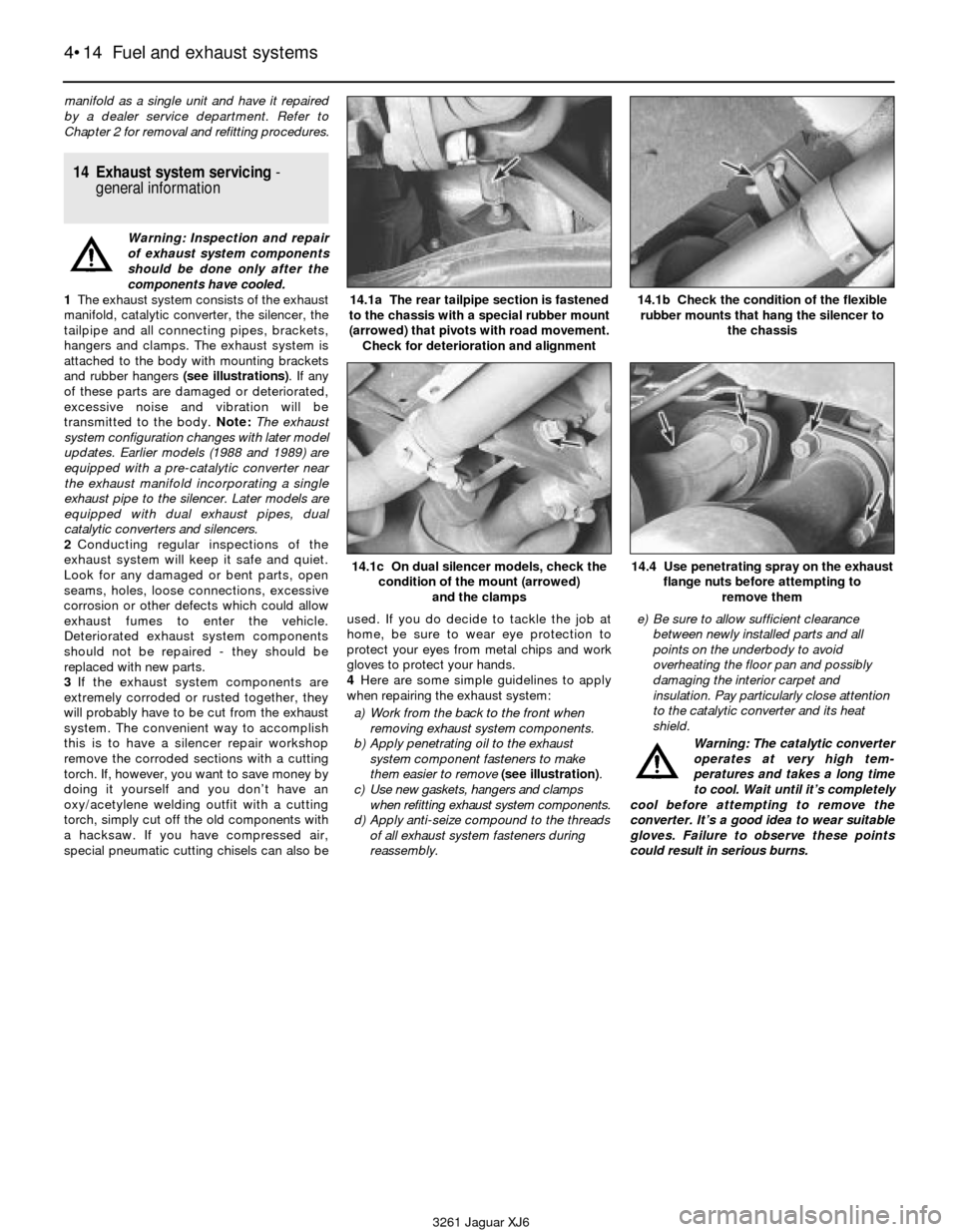
and rubber hangers (see illustrations). If any
of these parts are damaged or deteriorated,
excessive noise and vibration will be
transmitted to the body. Note:The exhaust
system configuration changes with later model
updates. Earlier models (1988 and 1989) are
equipped with a pre-catalytic converter near
the exhaust manifold incorporating a single
exhaust pipe to the silencer. Later models are
equipped with dual exhaust pipes, dual
catalytic converters and silencers.
2Conducting regular inspections of the
exhaust system will keep it safe and quiet.
Look for any damaged or bent parts, open
seams, holes, loose connections, excessive
corrosion or other defects which could allow
exhaust fumes to enter the vehicle.
Deteriorated exhaust system components
should not be repaired - they should be
replaced with new parts.
3If the exhaust system components are
extremely corroded or rusted together, they
will probably have to be cut from the exhaust
system. The convenient way to accomplish
this is to have a silencer repair workshop
remove the corroded sections with a cutting
torch. If, however, you want to save money by
doing it yourself and you don’t have an
oxy/acetylene welding outfit with a cutting
torch, simply cut off the old components with
a hacksaw. If you have compressed air,
special pneumatic cutting chisels can also beused. If you do decide to tackle the job at
home, be sure to wear eye protection to
protect your eyes from metal chips and work
gloves to protect your hands.
4Here are some simple guidelines to apply
when repairing the exhaust system:
a) Work from the back to the front when
removing exhaust system components.
b) Apply penetrating oil to the exhaust
system component fasteners to make
them easier to remove(see illustration).
c) Use new gaskets, hangers and clamps
when refitting exhaust system components.
d) Apply anti-seize compound to the threads
of all exhaust system fasteners during
reassembly.e) Be sure to allow sufficient clearance
between newly installed parts and all
points on the underbody to avoid
overheating the floor pan and possibly
damaging the interior carpet and
insulation. Pay particularly close attention
to the catalytic converter and its heat
shield.
Warning: The catalytic converter
operates at very high tem-
peratures and takes a long time
to cool. Wait until it’s completely
cool before attempting to remove the
converter. It’s a good idea to wear suitable
gloves. Failure to observe these points
could result in serious burns.
4•14 Fuel and exhaust systems
14.1c On dual silencer models, check the
condition of the mount (arrowed)
and the clamps
14.1a The rear tailpipe section is fastened
to the chassis with a special rubber mount
(arrowed) that pivots with road movement.
Check for deterioration and alignment14.1b Check the condition of the flexible
rubber mounts that hang the silencer to
the chassis
14.4 Use penetrating spray on the exhaust
flange nuts before attempting to
remove them
3261 Jaguar XJ6
Page 114 of 227
temperature INCREASES, the resistance
values will DECREASE. A failure in this sensor
circuit should set a Code 3 (1988 and 1989)
or 13 (1990 to 1994). This code indicates a
failure in the coolant temperature sensor
circuit, so in most cases the appropriate
solution to the problem will be either repair of
a connector or wire, or renewal of the sensor.
Check
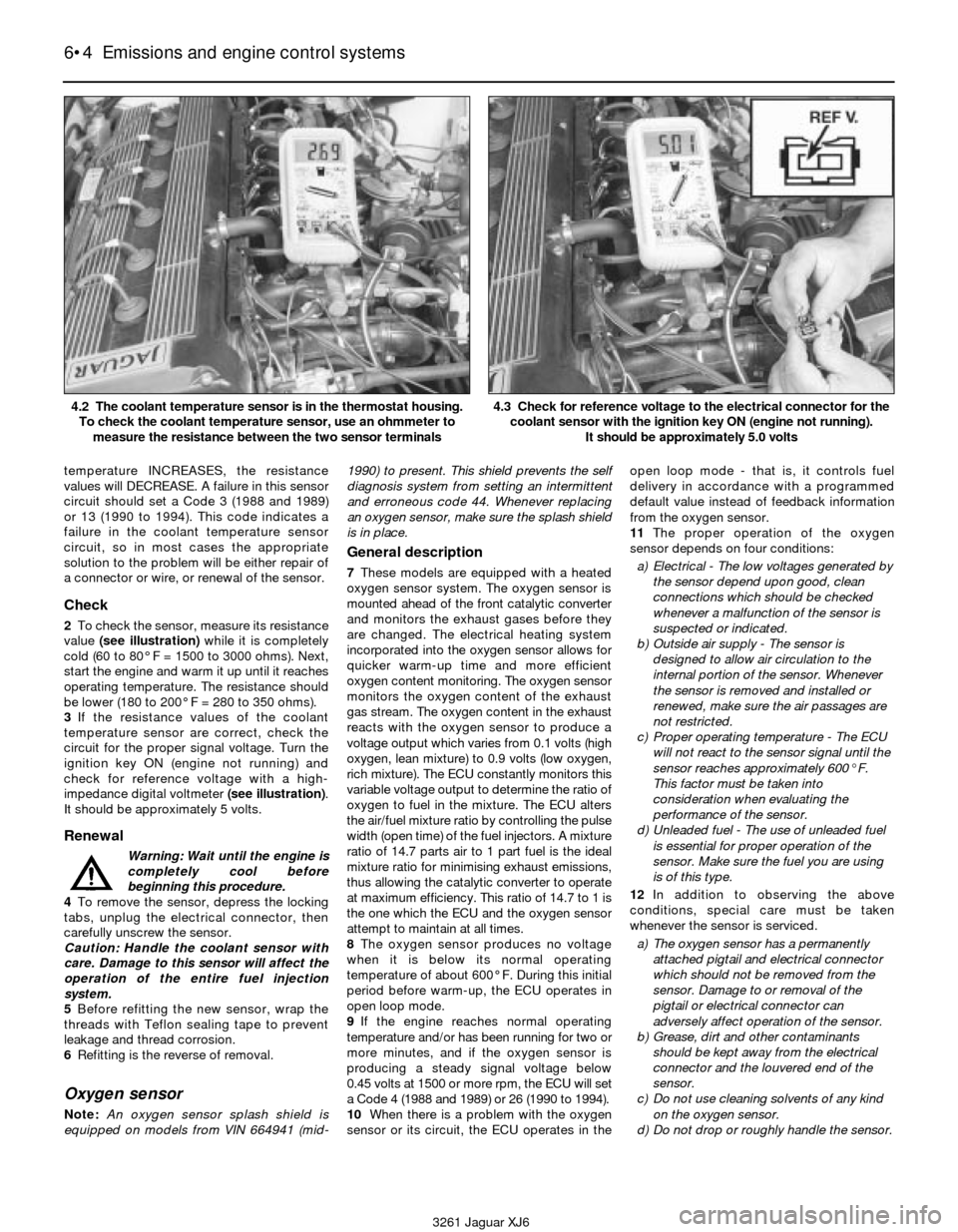
2To check the sensor, measure its resistance
value (see illustration)while it is completely
cold (60 to 80° F = 1500 to 3000 ohms). Next,
start the engine and warm it up until it reaches
operating temperature. The resistance should
be lower (180 to 200° F = 280 to 350 ohms).
3If the resistance values of the coolant
temperature sensor are correct, check the
circuit for the proper signal voltage. Turn the
ignition key ON (engine not running) and
check for reference voltage with a high-
impedance digital voltmeter (see illustration).
It should be approximately 5 volts.
Renewal
Warning: Wait until the engine is
completely cool before
beginning this procedure.
4To remove the sensor, depress the locking
tabs, unplug the electrical connector, then
carefully unscrew the sensor.
Caution: Handle the coolant sensor with
care. Damage to this sensor will affect the
operation of the entire fuel injection
system.
5Before refitting the new sensor, wrap the
threads with Teflon sealing tape to prevent
leakage and thread corrosion.
6Refitting is the reverse of removal.
Oxygen sensor
Note:An oxygen sensor splash shield is
equipped on models from VIN 664941 (mid-1990) to present. This shield prevents the self
diagnosis system from setting an intermittent
and erroneous code 44. Whenever replacing
an oxygen sensor, make sure the splash shield
is in place.
General description
7These models are equipped with a heated
oxygen sensor system. The oxygen sensor is
mounted ahead of the front catalytic converter
and monitors the exhaust gases before they
are changed. The electrical heating system
incorporated into the oxygen sensor allows for
quicker warm-up time and more efficient
oxygen content monitoring. The oxygen sensor
monitors the oxygen content of the exhaust
gas stream. The oxygen content in the exhaust
reacts with the oxygen sensor to produce a
voltage output which varies from 0.1 volts (high
oxygen, lean mixture) to 0.9 volts (low oxygen,
rich mixture). The ECU constantly monitors this
variable voltage output to determine the ratio of
oxygen to fuel in the mixture. The ECU alters
the air/fuel mixture ratio by controlling the pulse
width (open time) of the fuel injectors. A mixture
ratio of 14.7 parts air to 1 part fuel is the ideal
mixture ratio for minimising exhaust emissions,
thus allowing the catalytic converter to operate
at maximum efficiency. This ratio of 14.7 to 1 is
the one which the ECU and the oxygen sensor
attempt to maintain at all times.
8The oxygen sensor produces no voltage
when it is below its normal operating
temperature of about 600° F. During this initial
period before warm-up, the ECU operates in
open loop mode.
9If the engine reaches normal operating
temperature and/or has been running for two or
more minutes, and if the oxygen sensor is
producing a steady signal voltage below
0.45 volts at 1500 or more rpm, the ECU will set
a Code 4 (1988 and 1989) or 26 (1990 to 1994).
10When there is a problem with the oxygen
sensor or its circuit, the ECU operates in theopen loop mode - that is, it controls fuel
delivery in accordance with a programmed
default value instead of feedback information
from the oxygen sensor.
11The proper operation of the oxygen
sensor depends on four conditions:
a) Electrical - The low voltages generated by
the sensor depend upon good, clean
connections which should be checked
whenever a malfunction of the sensor is
suspected or indicated.
b) Outside air supply - The sensor is
designed to allow air circulation to the
internal portion of the sensor. Whenever
the sensor is removed and installed or
renewed, make sure the air passages are
not restricted.
c) Proper operating temperature - The ECU
will not react to the sensor signal until the
sensor reaches approximately 600° F.
This factor must be taken into
consideration when evaluating the
performance of the sensor.
d) Unleaded fuel - The use of unleaded fuel
is essential for proper operation of the
sensor. Make sure the fuel you are using
is of this type.
12In addition to observing the above
conditions, special care must be taken
whenever the sensor is serviced.
a) The oxygen sensor has a permanently
attached pigtail and electrical connector
which should not be removed from the
sensor. Damage to or removal of the
pigtail or electrical connector can
adversely affect operation of the sensor.
b) Grease, dirt and other contaminants
should be kept away from the electrical
connector and the louvered end of the
sensor.
c) Do not use cleaning solvents of any kind
on the oxygen sensor.
d) Do not drop or roughly handle the sensor.
6•4 Emissions and engine control systems
3261 Jaguar XJ6 4.2 The coolant temperature sensor is in the thermostat housing.
To check the coolant temperature sensor, use an ohmmeter to
measure the resistance between the two sensor terminals
4.3 Check for reference voltage to the electrical connector for the
coolant sensor with the ignition key ON (engine not running).
It should be approximately 5.0 volts
Page 117 of 227
42Also, check the reference voltage to the
MAF sensor from the computer. Backprobe
terminal number 6 and make sure that
approximately 5 volts is present.
Renewal
43Disconnect the electrical connector from
the MAF sensor.
44Remove the air cleaner assembly (see
Chapter 4).
45Remove the four bolts and separate the
MAF sensor from the air intake duct.
46Refitting is the reverse of removal.
Intake air temperature
(IAT) sensor
General description
47The intake air temperature sensor is
located inside the air intake duct. This sensor
acts as a resistor which changes value
according to the temperature of the air entering
the engine. Low temperatures produce a high
resistance value (for example, at 68° F the
value is 2.0 to 2.6 k-ohms) while high
temperatures produce low resistance values (at
176° F the resistance is 260 to 330 ohms. The
ECU supplies around 5 volts (reference
voltage) to the air temperature sensor.
The voltage will change according to the
temperature of the incoming air. The voltage
will be high when the air temperature is cold
and low when the air temperature is warm. Any
problems with the air temperature sensor
will usually set a code 8 (1988 and 1989) or
code 16 (1990 to 1994).
Check
48To check the air temperature sensor,
disconnect the two prong electrical connector
and turn the ignition key ON but do not start
the engine.
49Measure the voltage (reference voltage),
which should be approximately 5 volts.
50If the voltage signal is not correct, havethe ECU diagnosed by a dealer service
department or other repair workshop.
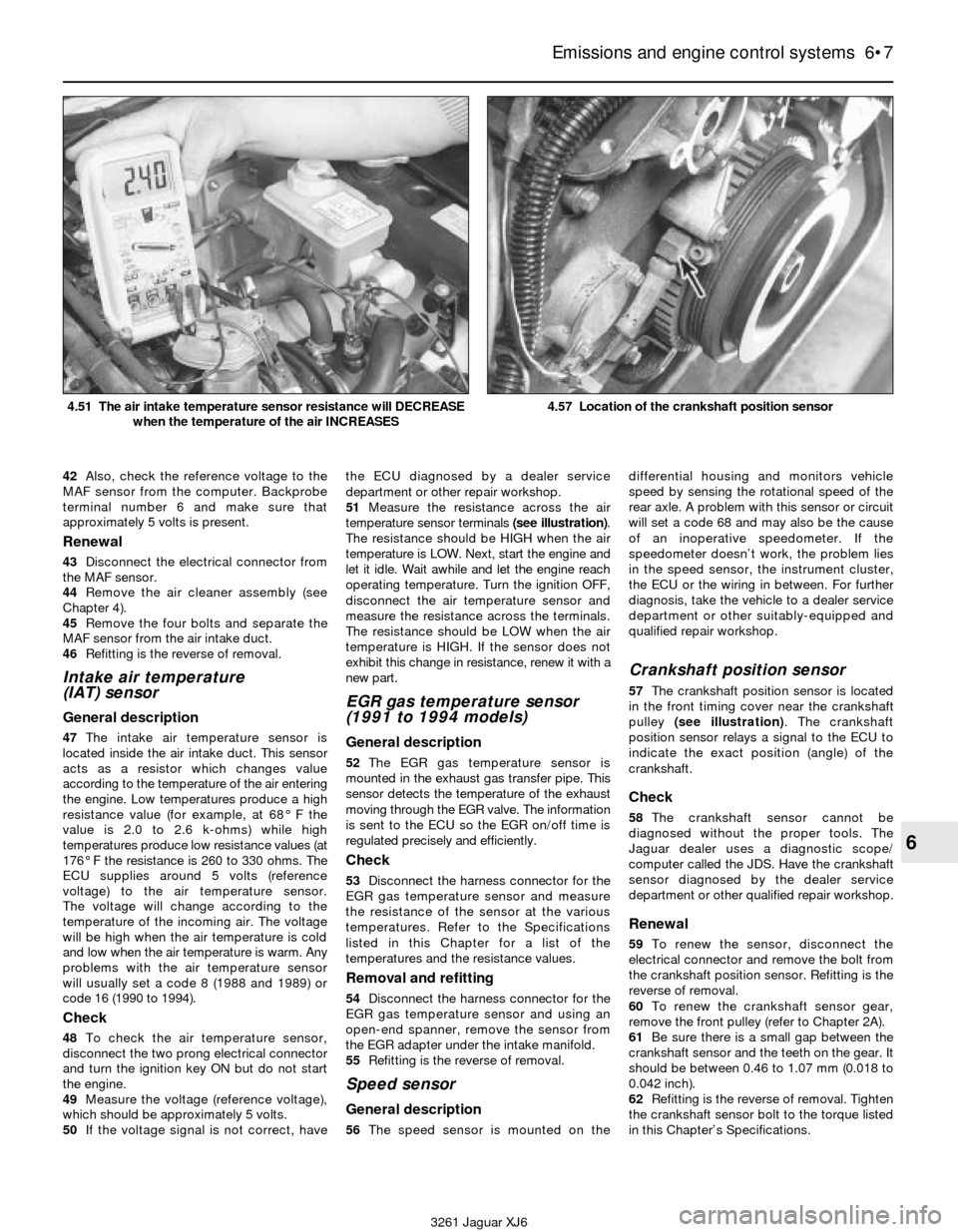
51Measure the resistance across the air
temperature sensor terminals (see illustration).
The resistance should be HIGH when the air
temperature is LOW. Next, start the engine and
let it idle. Wait awhile and let the engine reach
operating temperature. Turn the ignition OFF,
disconnect the air temperature sensor and
measure the resistance across the terminals.
The resistance should be LOW when the air
temperature is HIGH. If the sensor does not
exhibit this change in resistance, renew it with a
new part.
EGR gas temperature sensor
(1991 to 1994 models)
General description
52The EGR gas temperature sensor is
mounted in the exhaust gas transfer pipe. This
sensor detects the temperature of the exhaust
moving through the EGR valve. The information
is sent to the ECU so the EGR on/off time is
regulated precisely and efficiently.
Check
53Disconnect the harness connector for the
EGR gas temperature sensor and measure
the resistance of the sensor at the various
temperatures. Refer to the Specifications
listed in this Chapter for a list of the
temperatures and the resistance values.
Removal and refitting
54Disconnect the harness connector for the
EGR gas temperature sensor and using an
open-end spanner, remove the sensor from
the EGR adapter under the intake manifold.
55Refitting is the reverse of removal.
Speed sensor
General description
56The speed sensor is mounted on thedifferential housing and monitors vehicle
speed by sensing the rotational speed of the
rear axle. A problem with this sensor or circuit
will set a code 68 and may also be the cause
of an inoperative speedometer. If the
speedometer doesn’t work, the problem lies
in the speed sensor, the instrument cluster,
the ECU or the wiring in between. For further
diagnosis, take the vehicle to a dealer service
department or other suitably-equipped and
qualified repair workshop.
Crankshaft position sensor
57The crankshaft position sensor is located
in the front timing cover near the crankshaft
pulley (see illustration). The crankshaft
position sensor relays a signal to the ECU to
indicate the exact position (angle) of the
crankshaft.
Check
58The crankshaft sensor cannot be
diagnosed without the proper tools. The
Jaguar dealer uses a diagnostic scope/
computer called the JDS. Have the crankshaft
sensor diagnosed by the dealer service
department or other qualified repair workshop.
Renewal
59To renew the sensor, disconnect the
electrical connector and remove the bolt from
the crankshaft position sensor. Refitting is the
reverse of removal.
60To renew the crankshaft sensor gear,
remove the front pulley (refer to Chapter 2A).
61Be sure there is a small gap between the
crankshaft sensor and the teeth on the gear. It
should be between 0.46 to 1.07 mm (0.018 to
0.042 inch).
62Refitting is the reverse of removal. Tighten
the crankshaft sensor bolt to the torque listed
in this Chapter’s Specifications.
Emissions and engine control systems 6•7
6
3261 Jaguar XJ6 4.51 The air intake temperature sensor resistance will DECREASE
when the temperature of the air INCREASES
4.57 Location of the crankshaft position sensor
Page 124 of 227
Test the brakes at various speeds with both
light and heavy pedal pressure. The vehicle
should stop evenly without pulling to one side
or the other. Avoid locking the brakes,
because this slides the tyres and diminishes
braking efficiency and control of the vehicle.
Tyres, vehicle load and wheel alignment are
factors which also affect braking performance.
2 Anti-lock Brake system
(ABS)- general information
The Anti-lock Brake System is designed to
maintain vehicle steerability, directional stability
and optimum deceleration under severe
braking conditions on most road surfaces. It
does so by monitoring the rotational speed of
each wheel and controlling the brake line
pressure to each wheel during braking. This
prevents the wheels from locking up.
The ABS system has three main units - the
wheel speed sensors, the electronic control unit
and the modulator (hydraulic control unit). The
sensors - one at each wheel - send a variable
voltage signal to the electronic control unit,
which monitors these signals, compares them
to its program and determines whether a wheel
is about to lock up. When a wheel is about to
lock up, the control unit signals the hydraulic
unit to reduce hydraulic pressure (or not
increase it further) at that wheel’s brake caliper.
Pressure modulation is handled by three
electrically-operated solenoid valves - one for
each front wheel and one for the rear wheels -
inside the modulator.
If a problem develops within the system, an
“ABS” warning light will glow on the dashboard.
Sometimes, a visual inspection of the ABS
system can help you locate the problem.
Carefully inspect the ABS wiring harness. Pay
particularly close attention to the harness and
connections near each wheel. Look for signs of
chafing and other damage caused by
incorrectly routed wires. If a wheel sensor
harness is damaged, the sensor should be
replaced (the harness and sensor are integral).
Warning: Do NOT try to repair an
ABS wiring harness. The ABS
system is sensitive to even thesmallest changes in resistance. Repairing
the harness could alter resistance values
and cause the system to malfunction. If the
ABS wiring harness is damaged in any way,
it must be replaced.
Caution: Make sure the ignition is turned
off before unplugging or reattaching any
electrical connections.
Diagnosis and repair
If a dashboard warning light comes on and
stays on while the vehicle is in operation, the
ABS system requires attention. Although
special electronic ABS diagnostic testing tools
are necessary to properly diagnose the system,
you can perform a few preliminary checks
before taking the vehicle to a dealer service
department or other qualified repair workshop.
a) Check the brake fluid level in the master
cylinder reservoir.
b) Verify that all ABS system electrical
connectors in the engine compartment
are plugged in.
c) Check the fuses.
d) Follow the wiring harness to each front
wheel and to the differential sensor and
verify that all connections are secure and
that the wiring is undamaged.
If the above preliminary checks do not
rectify the problem, the vehicle should be
diagnosed by a dealer service department.
Due to the complex nature of this system, all
actual repair work must be done by a dealer
service department or other qualified repair
workshop.
3 Disc brake pads- renewal
2
Warning: Disc brake pads must
be replaced on both front wheels
or both rear wheels at the same
time - never renew the pads on
only one wheel. Also, the dust created by
the brake system may contain asbestos,
which is harmful to your health. Never blow
it out with compressed air and don’t inhale
any of it. An approved filtering mask should
be worn when working on the brakes. Do
not, under any circumstances, use
petroleum-based solvents to clean brake
parts. Use brake system cleaner only!
Note:The following procedure applies to both
the front and rear brake pads.
1Remove the cap from the brake fluid
reservoir and siphon off about two-thirds of
the fluid from the reservoir. Failing to do this
could result in fluid overflowing when the
caliper pistons are pressed into their bores.
2Loosen the wheel nuts, raise the front of the
vehicle and support it securely on axle stands.
3Remove the front wheels. Work on one
brake assembly at a time, using the
assembled brake for reference if necessary.
4Inspect the brake disc (see Section 5).
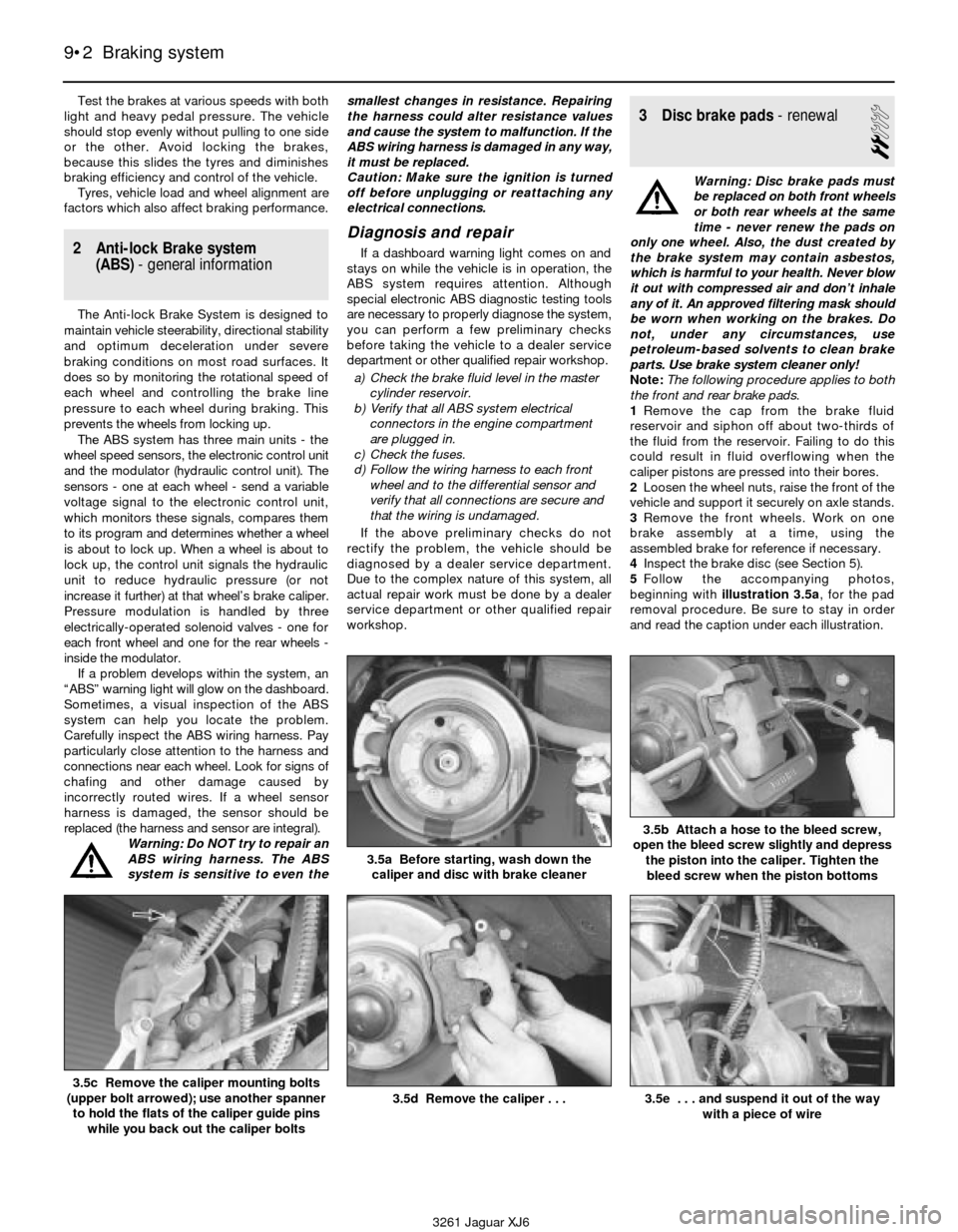
5Follow the accompanying photos,
beginning with illustration 3.5a, for the pad
removal procedure. Be sure to stay in order
and read the caption under each illustration.
9•2 Braking system
3.5a Before starting, wash down the
caliper and disc with brake cleaner
3.5b Attach a hose to the bleed screw,
open the bleed screw slightly and depress
the piston into the caliper. Tighten the
bleed screw when the piston bottoms
3.5c Remove the caliper mounting bolts
(upper bolt arrowed); use another spanner
to hold the flats of the caliper guide pins
while you back out the caliper bolts3.5d Remove the caliper . . .3.5e . . . and suspend it out of the way
with a piece of wire
3261 Jaguar XJ6
Page 125 of 227
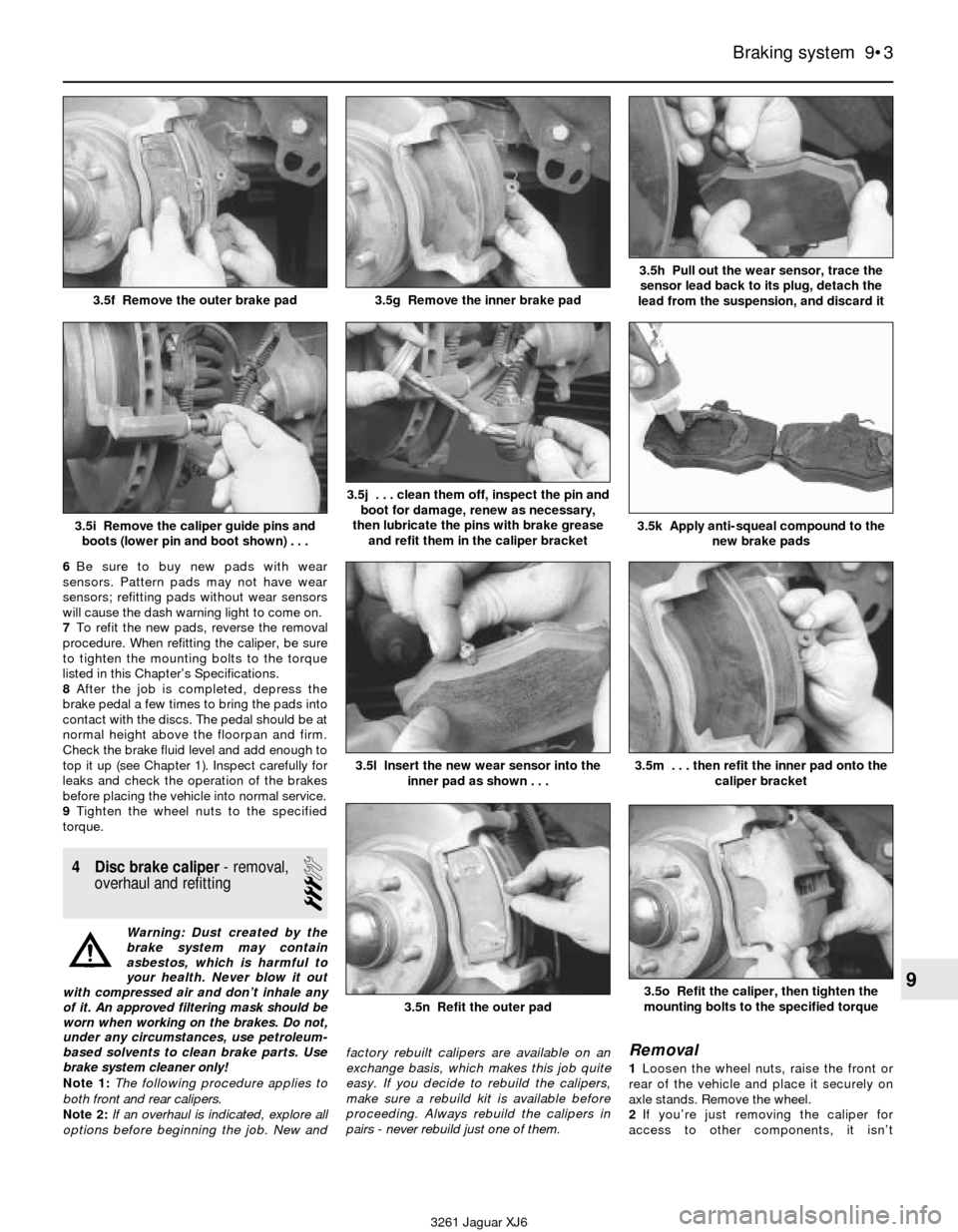
6Be sure to buy new pads with wear
sensors. Pattern pads may not have wear
sensors; refitting pads without wear sensors
will cause the dash warning light to come on.
7To refit the new pads, reverse the removal
procedure. When refitting the caliper, be sure
to tighten the mounting bolts to the torque
listed in this Chapter’s Specifications.
8After the job is completed, depress the
brake pedal a few times to bring the pads into
contact with the discs. The pedal should be at
normal height above the floorpan and firm.
Check the brake fluid level and add enough to
top it up (see Chapter 1). Inspect carefully for
leaks and check the operation of the brakes
before placing the vehicle into normal service.
9Tighten the wheel nuts to the specified
torque.
4 Disc brake caliper- removal,
overhaul and refitting
3
Warning: Dust created by the
brake system may contain
asbestos, which is harmful to
your health. Never blow it out
with compressed air and don’t inhale any
of it. An approved filtering mask should be
worn when working on the brakes. Do not,
under any circumstances, use petroleum-
based solvents to clean brake parts. Use
brake system cleaner only!
Note 1:The following procedure applies to
both front and rear calipers.
Note 2:If an overhaul is indicated, explore all
options before beginning the job. New andfactory rebuilt calipers are available on an
exchange basis, which makes this job quite
easy. If you decide to rebuild the calipers,
make sure a rebuild kit is available before
proceeding. Always rebuild the calipers in
pairs - never rebuild just one of them.
Removal
1Loosen the wheel nuts, raise the front or
rear of the vehicle and place it securely on
axle stands. Remove the wheel.
2If you’re just removing the caliper for
access to other components, it isn’t
Braking system 9•3
9
3.5f Remove the outer brake pad3.5g Remove the inner brake pad
3.5h Pull out the wear sensor, trace the
sensor lead back to its plug, detach the
lead from the suspension, and discard it
3.5i Remove the caliper guide pins and
boots (lower pin and boot shown) . . .
3.5j . . . clean them off, inspect the pin and
boot for damage, renew as necessary,
then lubricate the pins with brake grease
and refit them in the caliper bracket
3.5k Apply anti-squeal compound to the
new brake pads
3261 Jaguar XJ6
3.5l Insert the new wear sensor into the
inner pad as shown . . .
3.5n Refit the outer pad
3.5m . . . then refit the inner pad onto the
caliper bracket
3.5o Refit the caliper, then tighten the
mounting bolts to the specified torque
Page 205 of 227
3261 Jaguar XJ6
REF•4Buying spare parts
Spare parts are available from many
sources, including maker’s appointed
garages, accessory shops, and motor factors.
To be sure of obtaining the correct parts, it
will sometimes be necessary to quote the
vehicle identification number. If possible, it
can also be useful to take the old parts along
for positive identification. Items such as
starter motors and alternators may be
available under a service exchange scheme -
any parts returned should be clean.
Our advice regarding spare parts is as
follows.
Officially appointed garages
This is the best source of parts which are
peculiar to your car, and which are not
otherwise generally available (eg, badges,
interior trim, certain body panels, etc). It is
also the only place at which you should buy
parts if the vehicle is still under warranty.
Accessory shops
These are very good places to buy
materials and components needed for themaintenance of your car (oil, air and fuel
filters, light bulbs, drivebelts, greases, brake
pads, touch-up paint, etc). Components of
this nature sold by a reputable shop are
usually of the same standard as those used
by the car manufacturer.
Besides components, these shops also sell
tools and general accessories, usually have
convenient opening hours, charge lower
prices, and can often be found close to home.
Some accessory shops have parts counters
where components needed for almost any
repair job can be purchased or ordered.
Motor factors
Good factors will stock all the more
important components which wear out
comparatively quickly, and can sometimes
supply individual components needed for the
overhaul of a larger assembly (eg, brake seals
and hydraulic parts, bearing shells, pistons,
valves). They may also handle work such as
cylinder block reboring, crankshaft regrinding,
etc.
Tyre and exhaust specialists
These outlets may be independent, or
members of a local or national chain. They
frequently offer competitive prices when
compared with a main dealer or local garage,
but it will pay to obtain several quotes before
making a decision. When researching prices,
also ask what “extras” may be added - for
instance fitting a new valve and balancing the
wheel are both commonly charged on top of
the price of a new tyre.
Other sources
Beware of parts or materials obtained from
market stalls, car boot sales or similar outlets.
Such items are not invariably sub-standard,
but there is little chance of compensation if
they do prove unsatisfactory. In the case of
safety-critical components such as brake
pads, there is the risk of financial loss, and
also of an accident causing injury or death.
Second-hand parts or assemblies obtained
from a car breaker can be a good buy in some
circumstances, but this sort of purchase is
best made by the experienced DIY mechanic.
Vehicle identification
Modifications are a continuing and
unpublicised process in vehicle manufacture,
quite apart from major model changes. Spare
parts manuals and lists are compiled upon a
numerical basis, the individual vehicle
identification numbers being essential to
correct identification of the part concerned.
When ordering spare parts, always give as
much information as possible. Quote the car
model, year of manufacture and registration,
chassis and engine numbers as appropriate.
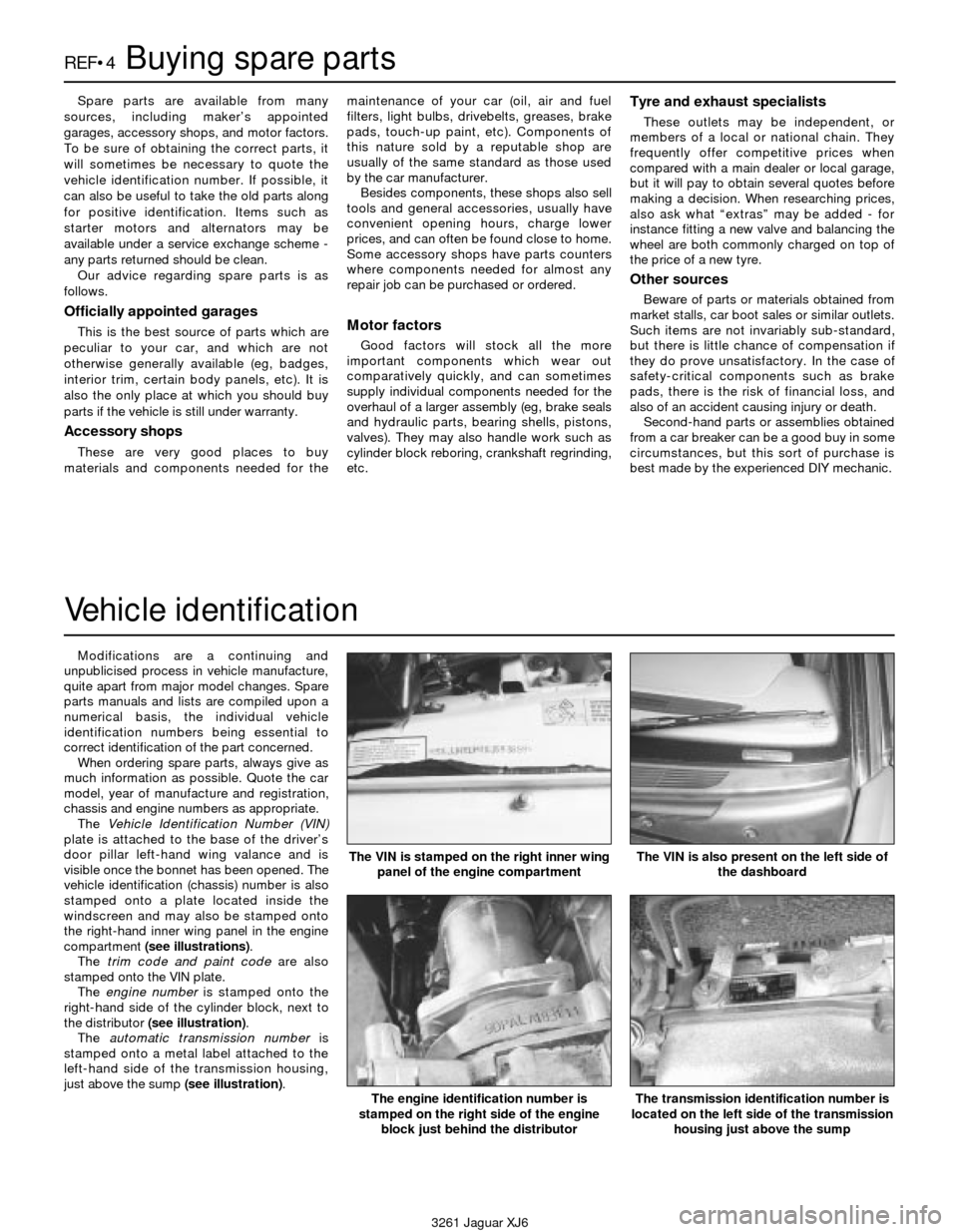
The Vehicle Identification Number (VIN)
plate is attached to the base of the driver’s
door pillar left-hand wing valance and is
visible once the bonnet has been opened. The
vehicle identification (chassis) number is also
stamped onto a plate located inside the
windscreen and may also be stamped onto
the right-hand inner wing panel in the engine
compartment (see illustrations).
The trim code and paint codeare also
stamped onto the VIN plate.
The engine numberis stamped onto the
right-hand side of the cylinder block, next to
the distributor (see illustration).
The automatic transmission numberis
stamped onto a metal label attached to the
left-hand side of the transmission housing,
just above the sump (see illustration).The VIN is stamped on the right inner wing
panel of the engine compartment
The engine identification number is
stamped on the right side of the engine
block just behind the distributorThe transmission identification number is
located on the left side of the transmission
housing just above the sump
The VIN is also present on the left side of
the dashboard