exhaust JAGUAR XJ6 1997 2.G User Guide
[x] Cancel search | Manufacturer: JAGUAR, Model Year: 1997, Model line: XJ6, Model: JAGUAR XJ6 1997 2.GPages: 227, PDF Size: 7.2 MB
Page 38 of 227

3261 Jaguar XJ6
2A
Chapter 2 Part A
Engine in-car repair procedures
General
Cylinder numbers (front to rear) . . . . . . . . . . . . . . . . . . . . . . . . . . . . . . . 1-2-3-4-5-6
Firing order . . . . . . . . . . . . . . . . . . . . . . . . . . . . . . . . . . . . . . . . . . . . . . . 1-5-3-6-2-4
Displacement:
3.2 litre engine . . . . . . . . . . . . . . . . . . . . . . . . . . . . . . . . . . . . . . . . . . 3239 cc
3.6 litre engine . . . . . . . . . . . . . . . . . . . . . . . . . . . . . . . . . . . . . . . . . . 3590 cc
4.0 litre engine . . . . . . . . . . . . . . . . . . . . . . . . . . . . . . . . . . . . . . . . . . 3980 cc
Bore . . . . . . . . . . . . . . . . . . . . . . . . . . . . . . . . . . . . . . . . . . . . . . . . . 91.0 mm (3.583 inches)
Stroke:
3.2 litre engine . . . . . . . . . . . . . . . . . . . . . . . . . . . . . . . . . . . . . . . . . . 83.0 mm (3.268 inches)
3.6 litre engine . . . . . . . . . . . . . . . . . . . . . . . . . . . . . . . . . . . . . . . . . . 92.0 mm (3.622 inches)
4.0 litre engine . . . . . . . . . . . . . . . . . . . . . . . . . . . . . . . . . . . . . . . . . . 102.0 mm (4.016 inches)
Camshafts and lifters
Journal diameter . . . . . . . . . . . . . . . . . . . . . . . . . . . . . . . . . . . . . . . . . . 26.9370 to 26.9494 mm (1.0605 to 1.0610 inches)
Bearing oil clearance . . . . . . . . . . . . . . . . . . . . . . . . . . . . . . . . . . . . . . . 0.037 to 0.063 mm (0.0014 to 0.0024 inch)
Runout limit . . . . . . . . . . . . . . . . . . . . . . . . . . . . . . . . . . . . . . . . . . . . . . . 0.0406 mm (0.0016 inch)
Lobe lift (maximum variation between lobes) . . . . . . . . . . . . . . . . . . . . . 0.0127 mm (0.005 inch)
Valve lifter
Diameter . . . . . . . . . . . . . . . . . . . . . . . . . . . . . . . . . . . . . . . . . . . . . . . 33.34 to 33.35 mm (1.3126 to 1.3130 inches)
Oil clearance . . . . . . . . . . . . . . . . . . . . . . . . . . . . . . . . . . . . . . . . . . . . 0.020 to 0.050 mm (0.0008 to 0.0020 inch)
Valve clearances . . . . . . . . . . . . . . . . . . . . . . . . . . . . . . . . . . . . . . . . . . . 0.30 to 0.36 mm (0.012 to 0.014 inch)
Oil pump
Outer rotor to body clearance, maximum . . . . . . . . . . . . . . . . . . . . . . . 0.2 mm (0.0079 inch)
Outer rotor OD . . . . . . . . . . . . . . . . . . . . . . . . . . . . . . . . . . . . . . . . . . . . 69.774 to 69.825 mm (2.7470 to 2.7490 inches)
Rotor thickness, inner and outer . . . . . . . . . . . . . . . . . . . . . . . . . . . . . . 27.962 to 27.975 mm (1.1008 to 1.1013 inches)
Clearance over rotors, maximum . . . . . . . . . . . . . . . . . . . . . . . . . . . . . . 0.1 mm (0.0039 inch) Auxiliary shaft - renewal . . . . . . . . . . . . . . . . . . . . . . . . . . . . . . . . . . . 9
Camshafts and lifters - removal, inspection and refitting . . . . . . . . . 10
CHECK ENGINE light . . . . . . . . . . . . . . . . . . . . . . . . . . . See Chapter 6
Crankshaft front oil seal - renewal . . . . . . . . . . . . . . . . . . . . . . . . . . . 7
Crankshaft rear oil seal - renewal . . . . . . . . . . . . . . . . . . . . . . . . . . . 15
Cylinder compression check . . . . . . . . . . . . . . . . . . . . See Chapter 2B
Cylinder head - removal and refitting . . . . . . . . . . . . . . . . . . . . . . . . 11
Drivebelt check, adjustment and renewal . . . . . . . . . . . See Chapter 1
Driveplate - removal and refitting . . . . . . . . . . . . . . . . . . . . . . . . . . . 14
Engine mounts - check and renewal . . . . . . . . . . . . . . . . . . . . . . . . . 16
Engine oil and filter change . . . . . . . . . . . . . . . . . . . . . . See Chapter 1
Engine overhaul - general information . . . . . . . . . . . . . See Chapter 2B
Engine - removal and refitting . . . . . . . . . . . . . . . . . . . See Chapter 2BExhaust manifolds - removal and refitting . . . . . . . . . . . . . . . . . . . . . 6
General information . . . . . . . . . . . . . . . . . . . . . . . . . . . . . . . . . . . . . . 1
Intake manifold - removal and refitting . . . . . . . . . . . . . . . . . . . . . . . 5
Sump - removal and refitting . . . . . . . . . . . . . . . . . . . . . . . . . . . . . . . 12
Oil pump - removal, inspection and refitting . . . . . . . . . . . . . . . . . . . 13
Repair operations possible with the engine in the vehicle . . . . . . . . 2
Spark plug renewal . . . . . . . . . . . . . . . . . . . . . . . . . . . . . See Chapter 1
Timing chains and sprockets - removal, inspection and refitting . . . 8
Top Dead Centre (TDC) for number one piston - locating . . . . . . . . . 3
Valve cover - removal and refitting . . . . . . . . . . . . . . . . . . . . . . . . . . 4
Valves - servicing . . . . . . . . . . . . . . . . . . . . . . . . . . . . . See Chapter 2B
Water pump - removal and refitting . . . . . . . . . . . . . . . . See Chapter 3
2A•1
Specifications Contents
Easy,suitable for
novice with little
experienceFairly easy,suitable
for beginner with
some experienceFairly difficult,
suitable for competent
DIY mechanic
Difficult,suitable for
experienced DIY
mechanicVery difficult,
suitable for expert DIY
or professional
Degrees of difficulty
54321
Page 39 of 227
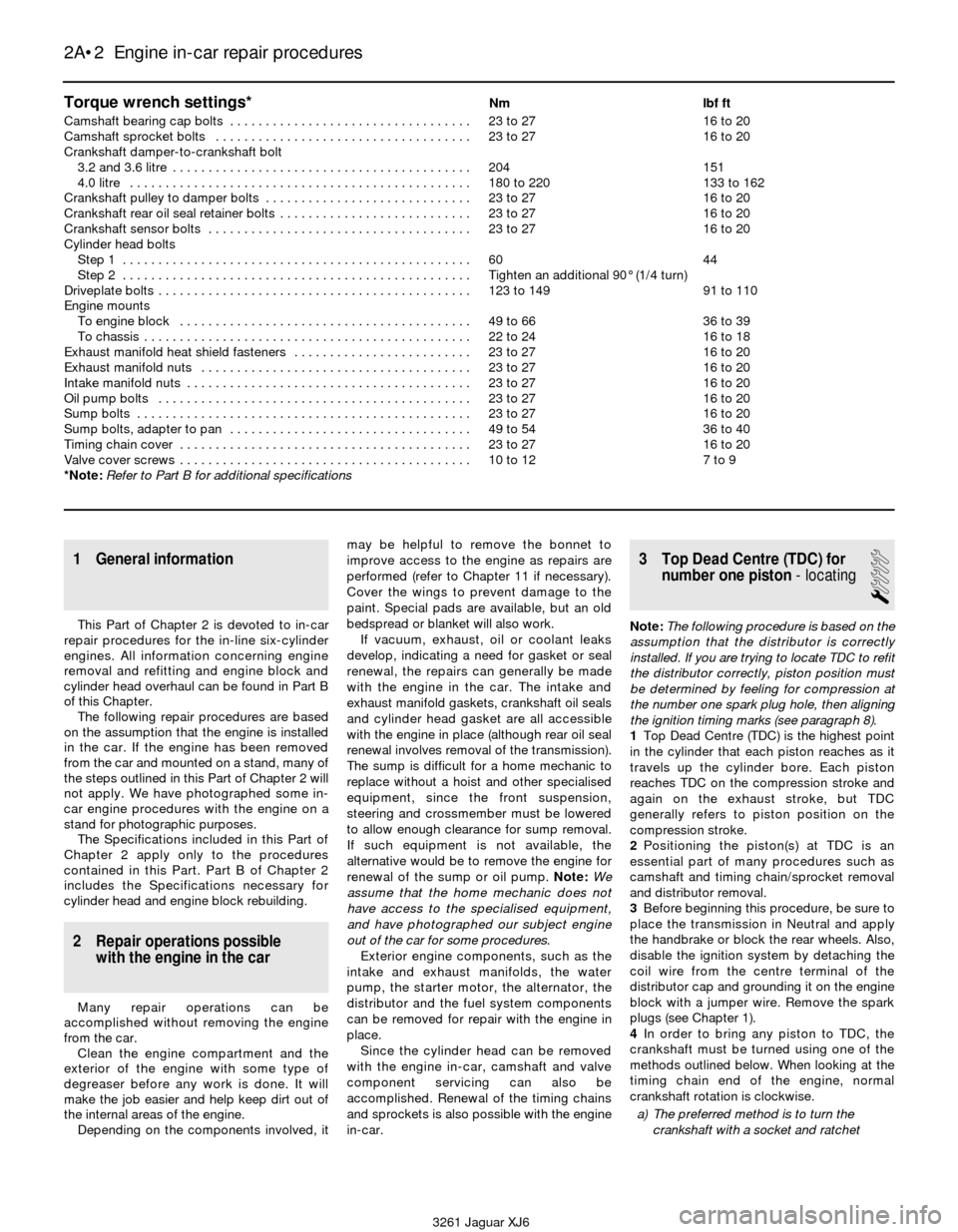
Torque wrench settings*Nm lbf ft
Camshaft bearing cap bolts . . . . . . . . . . . . . . . . . . . . . . . . . . . . . . . . . . 23 to 27 16 to 20
Camshaft sprocket bolts . . . . . . . . . . . . . . . . . . . . . . . . . . . . . . . . . . . . 23 to 27 16 to 20
Crankshaft damper-to-crankshaft bolt
3.2 and 3.6 litre . . . . . . . . . . . . . . . . . . . . . . . . . . . . . . . . . . . . . . . . . . 204 151
4.0 litre . . . . . . . . . . . . . . . . . . . . . . . . . . . . . . . . . . . . . . . . . . . . . . . . 180 to 220 133 to 162
Crankshaft pulley to damper bolts . . . . . . . . . . . . . . . . . . . . . . . . . . . . . 23 to 27 16 to 20
Crankshaft rear oil seal retainer bolts . . . . . . . . . . . . . . . . . . . . . . . . . . . 23 to 27 16 to 20
Crankshaft sensor bolts . . . . . . . . . . . . . . . . . . . . . . . . . . . . . . . . . . . . . 23 to 27 16 to 20
Cylinder head bolts
Step 1 . . . . . . . . . . . . . . . . . . . . . . . . . . . . . . . . . . . . . . . . . . . . . . . . . 60 44
Step 2 . . . . . . . . . . . . . . . . . . . . . . . . . . . . . . . . . . . . . . . . . . . . . . . . . Tighten an additional 90° (1/4 turn)
Driveplate bolts . . . . . . . . . . . . . . . . . . . . . . . . . . . . . . . . . . . . . . . . . . . . 123 to 149 91 to 110
Engine mounts
To engine block . . . . . . . . . . . . . . . . . . . . . . . . . . . . . . . . . . . . . . . . . 49 to 66 36 to 39
To chassis . . . . . . . . . . . . . . . . . . . . . . . . . . . . . . . . . . . . . . . . . . . . . . 22 to 24 16 to 18
Exhaust manifold heat shield fasteners . . . . . . . . . . . . . . . . . . . . . . . . . 23 to 27 16 to 20
Exhaust manifold nuts . . . . . . . . . . . . . . . . . . . . . . . . . . . . . . . . . . . . . . 23 to 27 16 to 20
Intake manifold nuts . . . . . . . . . . . . . . . . . . . . . . . . . . . . . . . . . . . . . . . . 23 to 27 16 to 20
Oil pump bolts . . . . . . . . . . . . . . . . . . . . . . . . . . . . . . . . . . . . . . . . . . . . 23 to 27 16 to 20
Sump bolts . . . . . . . . . . . . . . . . . . . . . . . . . . . . . . . . . . . . . . . . . . . . . . . 23 to 27 16 to 20
Sump bolts, adapter to pan . . . . . . . . . . . . . . . . . . . . . . . . . . . . . . . . . . 49 to 54 36 to 40
Timing chain cover . . . . . . . . . . . . . . . . . . . . . . . . . . . . . . . . . . . . . . . . . 23 to 27 16 to 20
Valve cover screws . . . . . . . . . . . . . . . . . . . . . . . . . . . . . . . . . . . . . . . . . 10 to 12 7 to 9
*Note:Refer to Part B for additional specifications
2A•2 Engine in-car repair procedures
3261 Jaguar XJ6
1 General information
This Part of Chapter 2 is devoted to in-car
repair procedures for the in-line six-cylinder
engines. All information concerning engine
removal and refitting and engine block and
cylinder head overhaul can be found in Part B
of this Chapter.
The following repair procedures are based
on the assumption that the engine is installed
in the car. If the engine has been removed
from the car and mounted on a stand, many of
the steps outlined in this Part of Chapter 2 will
not apply. We have photographed some in-
car engine procedures with the engine on a
stand for photographic purposes.
The Specifications included in this Part of
Chapter 2 apply only to the procedures
contained in this Part. Part B of Chapter 2
includes the Specifications necessary for
cylinder head and engine block rebuilding.
2 Repair operations possible
with the engine in the car
Many repair operations can be
accomplished without removing the engine
from the car.
Clean the engine compartment and the
exterior of the engine with some type of
degreaser before any work is done. It will
make the job easier and help keep dirt out of
the internal areas of the engine.
Depending on the components involved, itmay be helpful to remove the bonnet to
improve access to the engine as repairs are
performed (refer to Chapter 11 if necessary).
Cover the wings to prevent damage to the
paint. Special pads are available, but an old
bedspread or blanket will also work.
If vacuum, exhaust, oil or coolant leaks
develop, indicating a need for gasket or seal
renewal, the repairs can generally be made
with the engine in the car. The intake and
exhaust manifold gaskets, crankshaft oil seals
and cylinder head gasket are all accessible
with the engine in place (although rear oil seal
renewal involves removal of the transmission).
The sump is difficult for a home mechanic to
replace without a hoist and other specialised
equipment, since the front suspension,
steering and crossmember must be lowered
to allow enough clearance for sump removal.
If such equipment is not available, the
alternative would be to remove the engine for
renewal of the sump or oil pump. Note:We
assume that the home mechanic does not
have access to the specialised equipment,
and have photographed our subject engine
out of the car for some procedures.
Exterior engine components, such as the
intake and exhaust manifolds, the water
pump, the starter motor, the alternator, the
distributor and the fuel system components
can be removed for repair with the engine in
place.
Since the cylinder head can be removed
with the engine in-car, camshaft and valve
component servicing can also be
accomplished. Renewal of the timing chains
and sprockets is also possible with the engine
in-car.
3 Top Dead Centre (TDC) for
number one piston- locating
1
Note:The following procedure is based on the
assumption that the distributor is correctly
installed. If you are trying to locate TDC to refit
the distributor correctly, piston position must
be determined by feeling for compression at
the number one spark plug hole, then aligning
the ignition timing marks (see paragraph 8).
1Top Dead Centre (TDC) is the highest point
in the cylinder that each piston reaches as it
travels up the cylinder bore. Each piston
reaches TDC on the compression stroke and
again on the exhaust stroke, but TDC
generally refers to piston position on the
compression stroke.
2Positioning the piston(s) at TDC is an
essential part of many procedures such as
camshaft and timing chain/sprocket removal
and distributor removal.
3Before beginning this procedure, be sure to
place the transmission in Neutral and apply
the handbrake or block the rear wheels. Also,
disable the ignition system by detaching the
coil wire from the centre terminal of the
distributor cap and grounding it on the engine
block with a jumper wire. Remove the spark
plugs (see Chapter 1).
4In order to bring any piston to TDC, the
crankshaft must be turned using one of the
methods outlined below. When looking at the
timing chain end of the engine, normal
crankshaft rotation is clockwise.
a) The preferred method is to turn the
crankshaft with a socket and ratchet
Page 40 of 227
attached to the bolt threaded into the
front of the crankshaft. Apply pressure on
the bolt in a clockwise direction only.
Never turn the bolt anti-clockwise.
b) A remote starter switch, which may save
some time, can also be used. Follow the
instructions included with the switch.
Once the piston is close to TDC, use a
socket and ratchet as described in the
previous paragraph.
c) If an assistant is available to turn the
ignition switch to the Start position in
short bursts, you can get the piston close
to TDC without a remote starter switch.
Make sure your assistant is out of the car,
away from the ignition switch, then use a
socket and ratchet as described in
Paragraph a) to complete the procedure.
5Note the position of the terminal for the
number one spark plug lead on the distributor
cap. If the terminal isn’t marked, follow the
plug lead from the number one cylinder spark
plug to the cap.
6Use a felt-tip pen or chalk to make a mark
on the distributor body directly under the
number one terminal (see Chapter 5).
7Detach the cap from the distributor and set
it aside (see Chapter 1 if necessary).
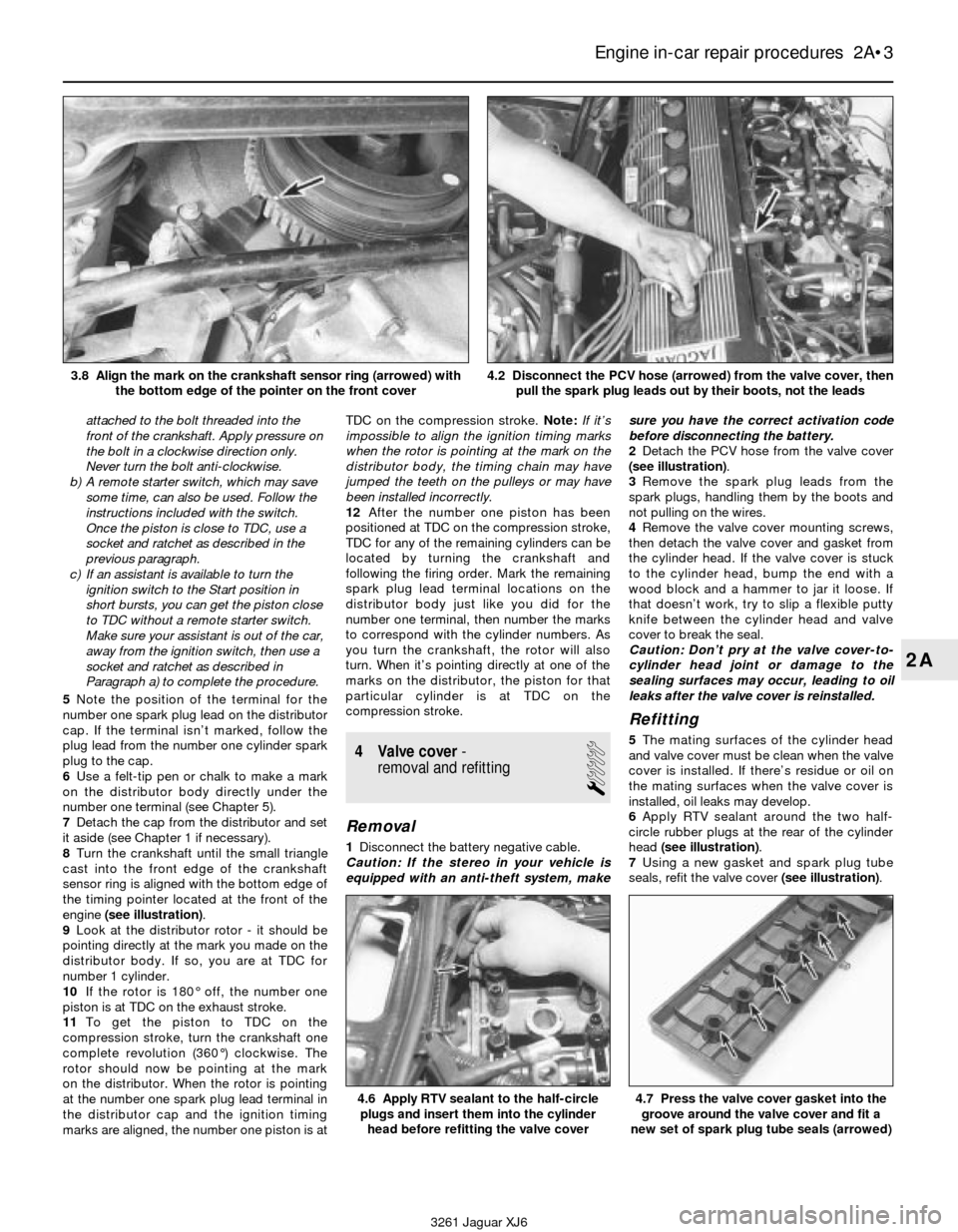
8Turn the crankshaft until the small triangle
cast into the front edge of the crankshaft
sensor ring is aligned with the bottom edge of
the timing pointer located at the front of the
engine(see illustration).
9Look at the distributor rotor - it should be
pointing directly at the mark you made on the
distributor body. If so, you are at TDC for
number 1 cylinder.
10If the rotor is 180° off, the number one
piston is at TDC on the exhaust stroke.
11To get the piston to TDC on the
compression stroke, turn the crankshaft one
complete revolution (360°) clockwise. The
rotor should now be pointing at the mark
on the distributor. When the rotor is pointing
at the number one spark plug lead terminal in
the distributor cap and the ignition timing
marks are aligned, the number one piston is atTDC on the compression stroke. Note:If it’s
impossible to align the ignition timing marks
when the rotor is pointing at the mark on the
distributor body, the timing chain may have
jumped the teeth on the pulleys or may have
been installed incorrectly.
12After the number one piston has been
positioned at TDC on the compression stroke,
TDC for any of the remaining cylinders can be
located by turning the crankshaft and
following the firing order. Mark the remaining
spark plug lead terminal locations on the
distributor body just like you did for the
number one terminal, then number the marks
to correspond with the cylinder numbers. As
you turn the crankshaft, the rotor will also
turn. When it’s pointing directly at one of the
marks on the distributor, the piston for that
particular cylinder is at TDC on the
compression stroke.
4 Valve cover-
removal and refitting
1
Removal
1Disconnect the battery negative cable.
Caution: If the stereo in your vehicle is
equipped with an anti-theft system, makesure you have the correct activation code
before disconnecting the battery.
2Detach the PCV hose from the valve cover
(see illustration).
3Remove the spark plug leads from the
spark plugs, handling them by the boots and
not pulling on the wires.
4Remove the valve cover mounting screws,
then detach the valve cover and gasket from
the cylinder head. If the valve cover is stuck
to the cylinder head, bump the end with a
wood block and a hammer to jar it loose. If
that doesn’t work, try to slip a flexible putty
knife between the cylinder head and valve
cover to break the seal.
Caution: Don’t pry at the valve cover-to-
cylinder head joint or damage to the
sealing surfaces may occur, leading to oil
leaks after the valve cover is reinstalled.
Refitting
5The mating surfaces of the cylinder head
and valve cover must be clean when the valve
cover is installed. If there’s residue or oil on
the mating surfaces when the valve cover is
installed, oil leaks may develop.
6Apply RTV sealant around the two half-
circle rubber plugs at the rear of the cylinder
head (see illustration).
7Using a new gasket and spark plug tube
seals, refit the valve cover (see illustration).
Engine in-car repair procedures 2A•3
2A
4.6 Apply RTV sealant to the half-circle
plugs and insert them into the cylinder
head before refitting the valve cover4.7 Press the valve cover gasket into the
groove around the valve cover and fit a
new set of spark plug tube seals (arrowed)
3261 Jaguar XJ6 3.8 Align the mark on the crankshaft sensor ring (arrowed) with
the bottom edge of the pointer on the front cover
4.2 Disconnect the PCV hose (arrowed) from the valve cover, then
pull the spark plug leads out by their boots, not the leads
Page 41 of 227
8Tighten the screws to the torque listed in
this Chapter’s Specifications in three or four
equal steps.
9Refit the remaining components, start the
engine and check for oil leaks.
5 Intake manifold-
removal and refitting
2
Removal
1Disconnect the negative cable from the
battery.
Caution: If the stereo in your vehicle is
equipped with an anti-theft system, make
sure you have the correct activation code
before disconnecting the battery.
2Refer to Chapter 4 to remove the
accelerator and cruise-control linkage, safely
relieve the fuel system pressure, and
disconnect the fuel supply lines.
3Label or mark and detach the PCV and
vacuum hoses connected to the intake
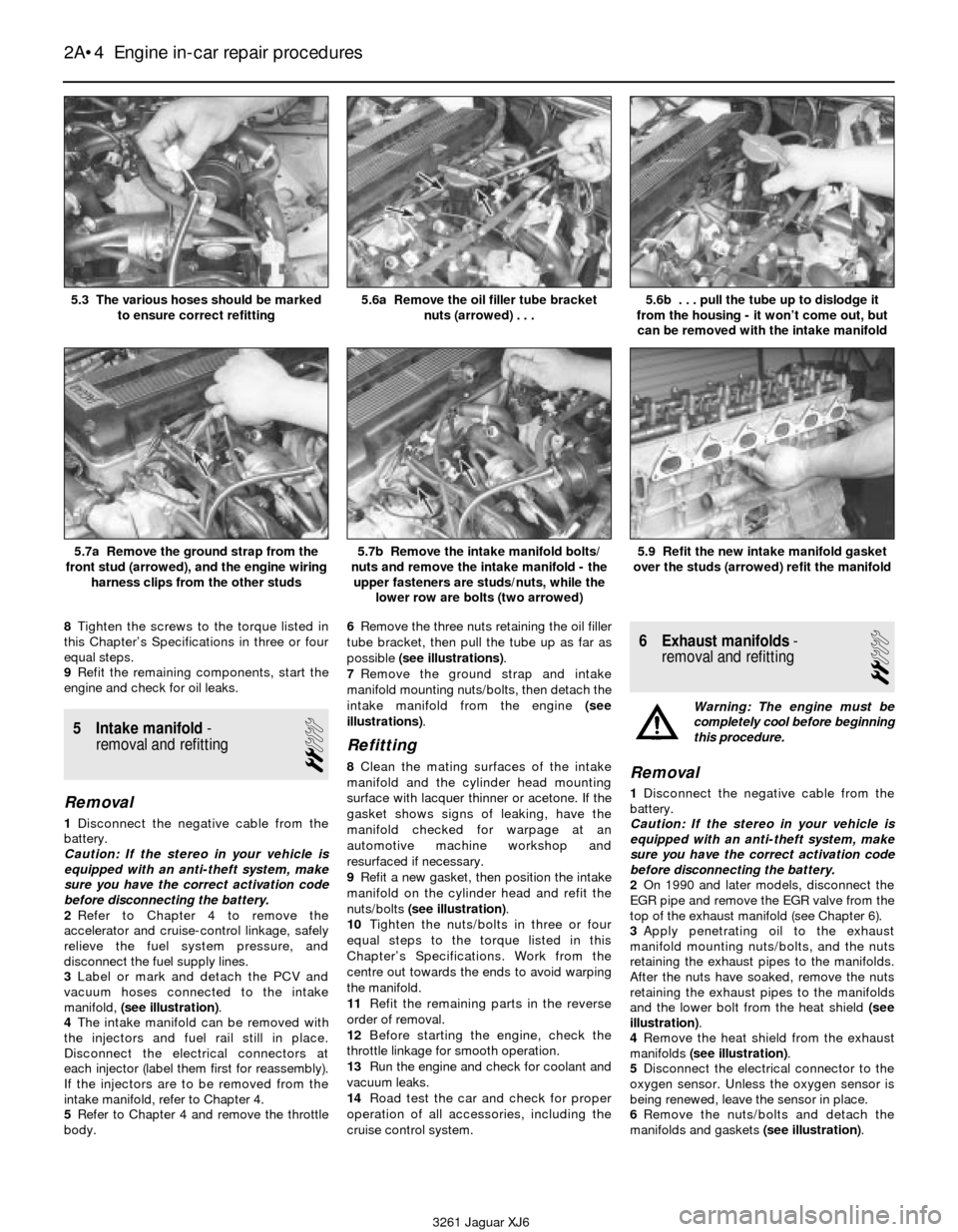
manifold, (see illustration).
4The intake manifold can be removed with
the injectors and fuel rail still in place.
Disconnect the electrical connectors at
each injector (label them first for reassembly).
If the injectors are to be removed from the
intake manifold, refer to Chapter 4.
5Refer to Chapter 4 and remove the throttle
body.6Remove the three nuts retaining the oil filler
tube bracket, then pull the tube up as far as
possible (see illustrations).
7Remove the ground strap and intake
manifold mounting nuts/bolts, then detach the
intake manifold from the engine (see
illustrations).
Refitting
8Clean the mating surfaces of the intake
manifold and the cylinder head mounting
surface with lacquer thinner or acetone. If the
gasket shows signs of leaking, have the
manifold checked for warpage at an
automotive machine workshop and
resurfaced if necessary.
9Refit a new gasket, then position the intake
manifold on the cylinder head and refit the
nuts/bolts (see illustration).
10Tighten the nuts/bolts in three or four
equal steps to the torque listed in this
Chapter’s Specifications. Work from the
centre out towards the ends to avoid warping
the manifold.
11Refit the remaining parts in the reverse
order of removal.
12Before starting the engine, check the
throttle linkage for smooth operation.
13Run the engine and check for coolant and
vacuum leaks.
14Road test the car and check for proper
operation of all accessories, including the
cruise control system.
6 Exhaust manifolds-
removal and refitting
2
Warning: The engine must be
completely cool before beginning
this procedure.
Removal
1Disconnect the negative cable from the
battery.
Caution: If the stereo in your vehicle is
equipped with an anti-theft system, make
sure you have the correct activation code
before disconnecting the battery.
2On 1990 and later models, disconnect the
EGR pipe and remove the EGR valve from the
top of the exhaust manifold (see Chapter 6).
3Apply penetrating oil to the exhaust
manifold mounting nuts/bolts, and the nuts
retaining the exhaust pipes to the manifolds.
After the nuts have soaked, remove the nuts
retaining the exhaust pipes to the manifolds
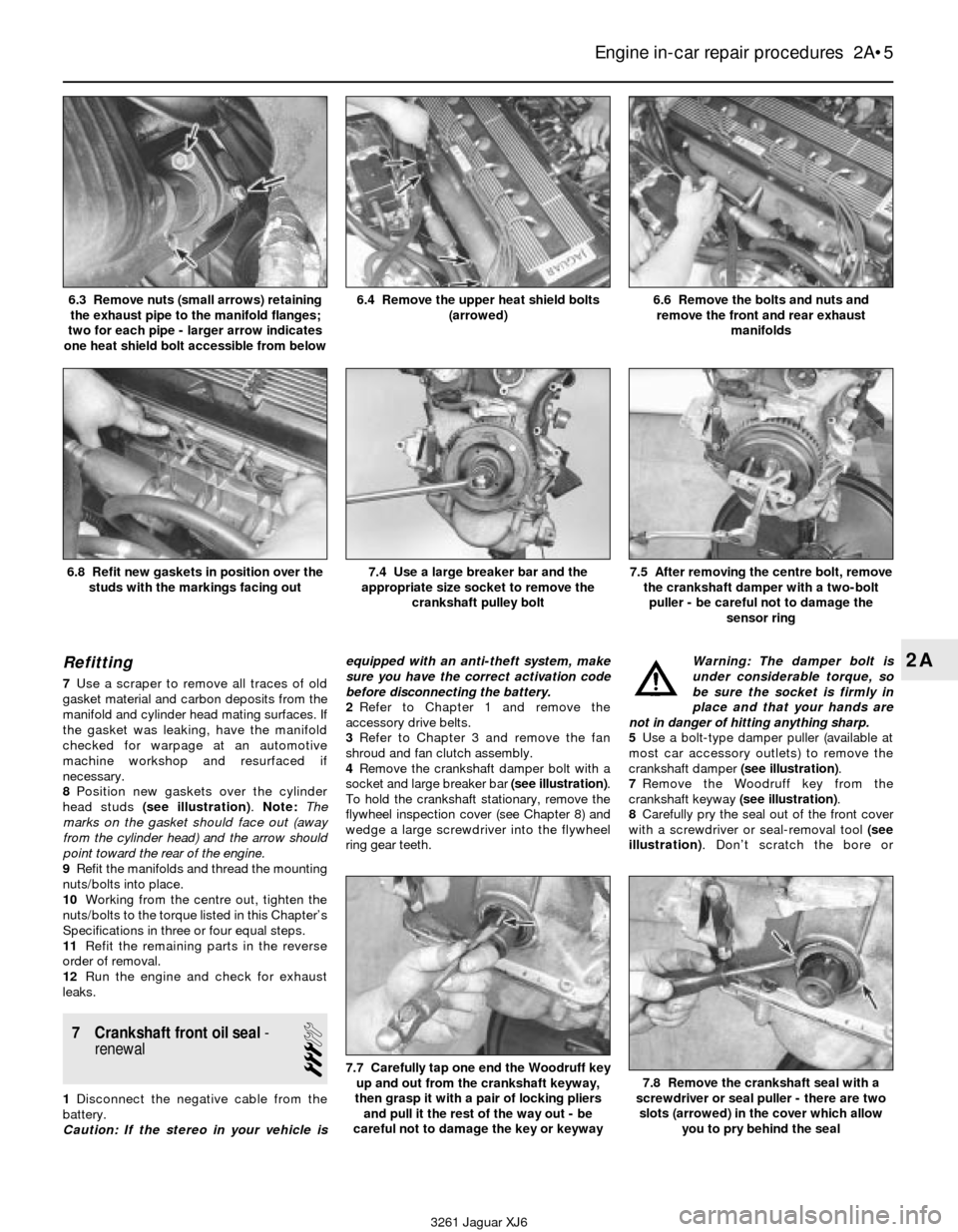
and the lower bolt from the heat shield (see
illustration).
4Remove the heat shield from the exhaust
manifolds(see illustration).
5Disconnect the electrical connector to the
oxygen sensor. Unless the oxygen sensor is
being renewed, leave the sensor in place.
6Remove the nuts/bolts and detach the
manifolds and gaskets (see illustration).
2A•4 Engine in-car repair procedures
5.3 The various hoses should be marked
to ensure correct refitting5.6a Remove the oil filler tube bracket
nuts (arrowed) . . .5.6b . . . pull the tube up to dislodge it
from the housing - it won’t come out, but
can be removed with the intake manifold
5.7a Remove the ground strap from the
front stud (arrowed), and the engine wiring
harness clips from the other studs5.7b Remove the intake manifold bolts/
nuts and remove the intake manifold - the
upper fasteners are studs/nuts, while the
lower row are bolts (two arrowed)5.9 Refit the new intake manifold gasket
over the studs (arrowed) refit the manifold
3261 Jaguar XJ6
Page 42 of 227
Refitting
7Use a scraper to remove all traces of old
gasket material and carbon deposits from the
manifold and cylinder head mating surfaces. If
the gasket was leaking, have the manifold
checked for warpage at an automotive
machine workshop and resurfaced if
necessary.
8Position new gaskets over the cylinder
head studs (see illustration). Note:The
marks on the gasket should face out (away
from the cylinder head) and the arrow should
point toward the rear of the engine.
9Refit the manifolds and thread the mounting
nuts/bolts into place.
10Working from the centre out, tighten the
nuts/bolts to the torque listed in this Chapter’s
Specifications in three or four equal steps.
11Refit the remaining parts in the reverse
order of removal.
12Run the engine and check for exhaust
leaks.
7 Crankshaft front oil seal-
renewal
3
1Disconnect the negative cable from the
battery.
Caution: If the stereo in your vehicle isequipped with an anti-theft system, make
sure you have the correct activation code
before disconnecting the battery.
2Refer to Chapter 1 and remove the
accessory drive belts.
3Refer to Chapter 3 and remove the fan
shroud and fan clutch assembly.
4Remove the crankshaft damper bolt with a
socket and large breaker bar (see illustration).
To hold the crankshaft stationary, remove the
flywheel inspection cover (see Chapter 8) and
wedge a large screwdriver into the flywheel
ring gear teeth. Warning: The damper bolt is
under considerable torque, so
be sure the socket is firmly in
place and that your hands are
not in danger of hitting anything sharp.
5Use a bolt-type damper puller (available at
most car accessory outlets) to remove the
crankshaft damper (see illustration).
7Remove the Woodruff key from the
crankshaft keyway (see illustration).
8Carefully pry the seal out of the front cover
with a screwdriver or seal-removal tool(see
illustration). Don’t scratch the bore or
Engine in-car repair procedures 2A•5
2A
6.3 Remove nuts (small arrows) retaining
the exhaust pipe to the manifold flanges;
two for each pipe - larger arrow indicates
one heat shield bolt accessible from below6.4 Remove the upper heat shield bolts
(arrowed)6.6 Remove the bolts and nuts and
remove the front and rear exhaust
manifolds
6.8 Refit new gaskets in position over the
studs with the markings facing out
7.7 Carefully tap one end the Woodruff key
up and out from the crankshaft keyway,
then grasp it with a pair of locking pliers
and pull it the rest of the way out - be
careful not to damage the key or keyway7.8 Remove the crankshaft seal with a
screwdriver or seal puller - there are two
slots (arrowed) in the cover which allow
you to pry behind the seal
7.4 Use a large breaker bar and the
appropriate size socket to remove the
crankshaft pulley bolt7.5 After removing the centre bolt, remove
the crankshaft damper with a two-bolt
puller - be careful not to damage the
sensor ring
3261 Jaguar XJ6
Page 46 of 227

2Refer to Section 8 and remove the front
cover and upper and lower timing chains.
3Remove the power steering drive coupling
from the auxiliary shaft (see illustration).
4Use a small drill to drill holes in the oil seal,
then use a slide-hammer puller to remove the
seal from the rear of the auxiliary shaft
housing (see illustration).
Caution: Drill straight and carefully to avoid
damaging the auxiliary shaft.
5Use a pair of snap-ring pliers to remove the
snap ring from the rear of the auxiliary shaft
(see illustration).
6Pull the auxiliary shaft out toward the front
of the engine.
7Remove the three internal hex-head bolts
and the auxiliary shaft housing.
8Examine the surface of the auxiliary shaft,
it’s sprocket, and the distributor drive-gear. If
there is noticeable wear or damage, replace
the auxiliary shaft assembly with a new one
(see illustration).
9If the auxiliary shaft housing has been
removed, clean it, scrape away the old gasket
material from the housing and the engine
block and refit the housing with a new gasket
(see illustration).
10Clean the auxiliary shaft, lubricate it with
engine oil and refit it through the front of the
block, then refit the washer (see illustration).
Refit the snap-ring(refer to illustration 9.4).11The new oil seal for the rear of the auxiliary
shaft comes with a plastic refitting sleeve that
keeps the seal lip from folding back during
refitting. Keep this sleeve in place until the seal
is fully installed. Tap the new seal into the
housing with a hammer and appropriate-size
socket until the seal is flush, then remove the
plastic sleeve (see illustration).
12The remainder of the refitting is the
reverse of removal. Note:When refitting the
distributor (see Chapter 5), use a new O-ring
to prevent oil leaks at the distributor.
13Run the engine and check for oil leaks at
the power steering pump-to-housing interface.10 Camshafts and valve lifters-
removal, inspection and
refitting
4
Removal
Note:The renewal of the camshafts requires
the use of several special tools. Read through
the procedure and acquire the special tools,
or their equivalent, before beginning work.
1Remove the valve cover (see Section 4).
2Refer to Section 3 and position the engine
at TDC for number 1 cylinder.
3Refer to Chapter 5 and remove the
distributor cap and set it aside along with the
spark plug leads. Mark the positions of the
distributor body and rotor.
4Using a feeler gauge, measure and record
the clearance between the intake and exhaust
camshaft lobes and the lifters for cylinder
number 1 (see illustration). Rotate the
crankshaft until the next cylinder in the firing
order is at TDC and check and record the
valve clearance for that cylinder. Following the
firing order, check and record the valve
clearance for the remaining valves with the
appropriate cylinder at TDC.
5Return the engine to TDC for cylinder
number 1. Using the special tool (Jaguar tool
no. 18G 1433), check the position of each
Engine in-car repair procedures 2A•9
2A
9.3 Use a screwdriver to hold the drive
coupling (arrowed) stationary while
removing the bolt9.4 Remove the auxiliary shaft seal with a
small slide-hammer puller9.5 Use snap-ring pliers to remove the
snap ring (arrowed) from the shaft - note
the three internal hex-head bolts retaining
the housing to the engine block
9.8 Inspect these areas of the auxiliary
shaft for wear
A Oil seal surface
B Bearing journalC Sprocket
D Distributor drive9.9 Refit the auxiliary shaft rear housing
with a new gasket, aligning the oil slot
(arrowed) with the housing
3261 Jaguar XJ6
9.10 Refit the washer before replacing the
snap-ring
9.11 Tap the seal squarely into the bore
with a socket until the seal is flush
with the housing, then remove the
plastic fitting sleeve
Page 47 of 227
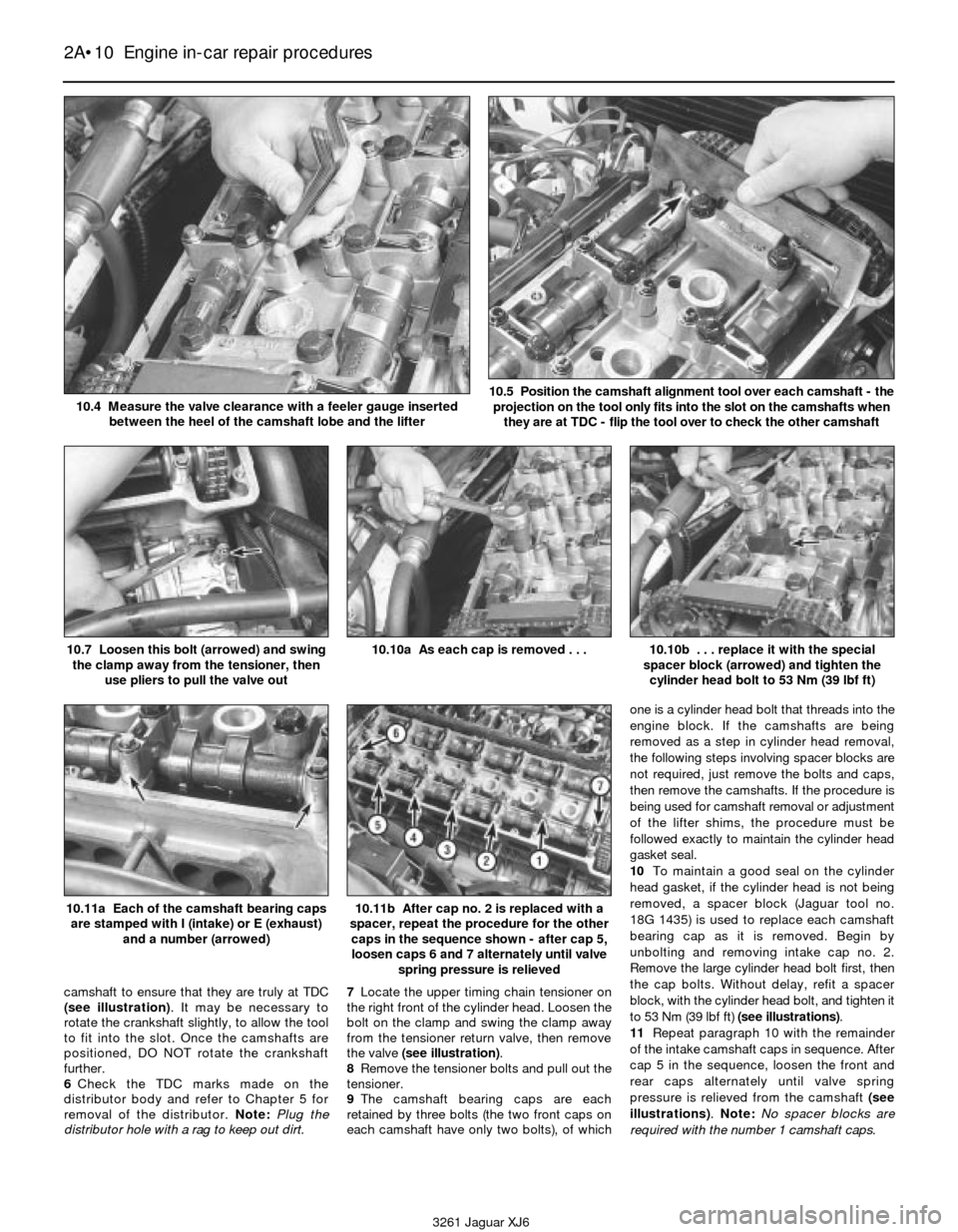
camshaft to ensure that they are truly at TDC
(see illustration). It may be necessary to
rotate the crankshaft slightly, to allow the tool
to fit into the slot. Once the camshafts are
positioned, DO NOT rotate the crankshaft
further.
6Check the TDC marks made on the
distributor body and refer to Chapter 5 for
removal of the distributor. Note:Plug the
distributor hole with a rag to keep out dirt.7Locate the upper timing chain tensioner on
the right front of the cylinder head. Loosen the
bolt on the clamp and swing the clamp away
from the tensioner return valve, then remove
the valve (see illustration).
8Remove the tensioner bolts and pull out the
tensioner.
9The camshaft bearing caps are each
retained by three bolts (the two front caps on
each camshaft have only two bolts), of whichone is a cylinder head bolt that threads into the
engine block. If the camshafts are being
removed as a step in cylinder head removal,
the following steps involving spacer blocks are
not required, just remove the bolts and caps,
then remove the camshafts. If the procedure is
being used for camshaft removal or adjustment
of the lifter shims, the procedure must be
followed exactly to maintain the cylinder head
gasket seal.
10To maintain a good seal on the cylinder
head gasket, if the cylinder head is not being
removed, a spacer block (Jaguar tool no.
18G 1435) is used to replace each camshaft
bearing cap as it is removed. Begin by
unbolting and removing intake cap no. 2.
Remove the large cylinder head bolt first, then
the cap bolts. Without delay, refit a spacer
block, with the cylinder head bolt, and tighten it
to 53 Nm (39 lbf ft) (see illustrations).
11Repeat paragraph 10 with the remainder
of the intake camshaft caps in sequence. After
cap 5 in the sequence, loosen the front and
rear caps alternately until valve spring
pressure is relieved from the camshaft (see
illustrations). Note:No spacer blocks are
required with the number 1 camshaft caps.
2A•10 Engine in-car repair procedures
10.7 Loosen this bolt (arrowed) and swing
the clamp away from the tensioner, then
use pliers to pull the valve out10.10a As each cap is removed . . .10.10b . . . replace it with the special
spacer block (arrowed) and tighten the
cylinder head bolt to 53 Nm (39 lbf ft)
3261 Jaguar XJ6 10.4 Measure the valve clearance with a feeler gauge inserted
between the heel of the camshaft lobe and the lifter
10.5 Position the camshaft alignment tool over each camshaft - the
projection on the tool only fits into the slot on the camshafts when
they are at TDC - flip the tool over to check the other camshaft
10.11a Each of the camshaft bearing caps
are stamped with I (intake) or E (exhaust)
and a number (arrowed)10.11b After cap no. 2 is replaced with a
spacer, repeat the procedure for the other
caps in the sequence shown - after cap 5,
loosen caps 6 and 7 alternately until valve
spring pressure is relieved
Page 49 of 227
Refitting
23If the valve clearance for any valve is
incorrect, as measured in paragraph 4, refit a
thicker or thinner shim on that valve. For
example, if the clearance had been too large
by 0.004-inch (compared to the recommended
clearance in the Specifications), replace the
existing shim there with a new one that is
0.004-inch thicker. If the clearance was too
small, use a shim that is smaller than the
original. Shims are identified alphabetically, in
sizes from 0.085-inch (designated size A, the
smallest) to 0.108-inch (designated size X, the
thickest).
24Lubricate the lifters with a thin coat of
moly-based lubricant on the top, bottom and
sides and refit them in their original positions.
25Lubricate the camshafts with moly-based
grease on the journals and lobes and lay them
carefully in their bearing saddles.
26Using NEW cylinder head bolts, replace
the spacers, one at a time, with the bearing
caps and bolts. Tighten the cap bolts, then
the cylinder head bolts to the torque listed in
this Chapter’s Specifications. The front capshould be installed first, then cap number 7,
then alternately tighten the first and last caps
to bring the camshaft down evenly. Next refit
caps 4, 2, 3, 5, and 6.
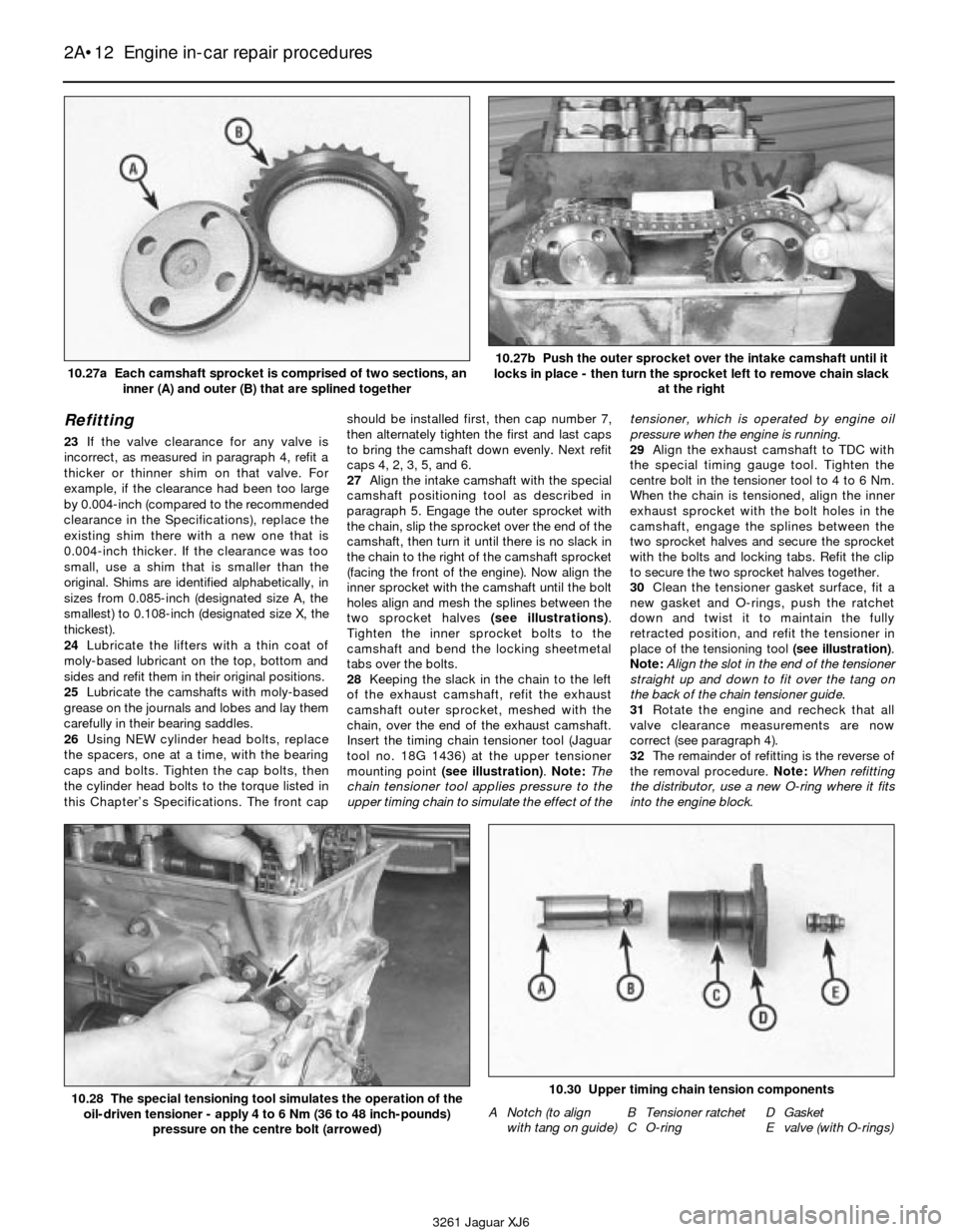
27Align the intake camshaft with the special
camshaft positioning tool as described in
paragraph 5. Engage the outer sprocket with
the chain, slip the sprocket over the end of the
camshaft, then turn it until there is no slack in
the chain to the right of the camshaft sprocket
(facing the front of the engine). Now align the
inner sprocket with the camshaft until the bolt
holes align and mesh the splines between the
two sprocket halves (see illustrations).
Tighten the inner sprocket bolts to the
camshaft and bend the locking sheetmetal
tabs over the bolts.
28Keeping the slack in the chain to the left
of the exhaust camshaft, refit the exhaust
camshaft outer sprocket, meshed with the
chain, over the end of the exhaust camshaft.
Insert the timing chain tensioner tool (Jaguar
tool no. 18G 1436) at the upper tensioner
mounting point (see illustration). Note:The
chain tensioner tool applies pressure to the
upper timing chain to simulate the effect of thetensioner, which is operated by engine oil
pressure when the engine is running.
29Align the exhaust camshaft to TDC with
the special timing gauge tool. Tighten the
centre bolt in the tensioner tool to 4 to 6 Nm.
When the chain is tensioned, align the inner
exhaust sprocket with the bolt holes in the
camshaft, engage the splines between the
two sprocket halves and secure the sprocket
with the bolts and locking tabs. Refit the clip
to secure the two sprocket halves together.
30Clean the tensioner gasket surface, fit a
new gasket and O-rings, push the ratchet
down and twist it to maintain the fully
retracted position, and refit the tensioner in
place of the tensioning tool (see illustration).
Note:Align the slot in the end of the tensioner
straight up and down to fit over the tang on
the back of the chain tensioner guide.
31Rotate the engine and recheck that all
valve clearance measurements are now
correct (see paragraph 4).
32The remainder of refitting is the reverse of
the removal procedure. Note:When refitting
the distributor, use a new O-ring where it fits
into the engine block.
2A•12 Engine in-car repair procedures
3261 Jaguar XJ6 10.27a Each camshaft sprocket is comprised of two sections, an
inner (A) and outer (B) that are splined together
10.27b Push the outer sprocket over the intake camshaft until it
locks in place - then turn the sprocket left to remove chain slack
at the right
10.28 The special tensioning tool simulates the operation of the
oil-driven tensioner - apply 4 to 6 Nm (36 to 48 inch-pounds)
pressure on the centre bolt (arrowed)10.30 Upper timing chain tension components
A Notch (to align
with tang on guide)B Tensioner ratchet
C O-ringD Gasket
E valve (with O-rings)
Page 50 of 227
11 Cylinder head-
removal and refitting
4
Note:The engine must be completely cool
before beginning this procedure.
Removal
1Disconnect the battery negative cable.
Caution: If the stereo in your vehicle is
equipped with an anti-theft system, make
sure you have the correct activation code
before disconnecting the battery.
2Drain the coolant from the engine block and
radiator (see Chapter 1).
3Drain the engine oil and remove the oil filter
(see Chapter 1).
4Remove the bonnet for easier access, if
necessary (see Chapter 11).
5Remove the intake manifold (see Section 5).
6Remove the exhaust manifolds (Section 6).
7Remove the valve cover (see Section 4).
8Refer to Section 3 and Position the engine
at TDC for cylinder number 1. Remove the
distributor (see Chapter 5).
9Remove the camshafts and sprockets (see
Section 10). Place the upper chain between
the two upper chain guides and wrap a large
rubber band around the two guides, retaining
the chain and guides.
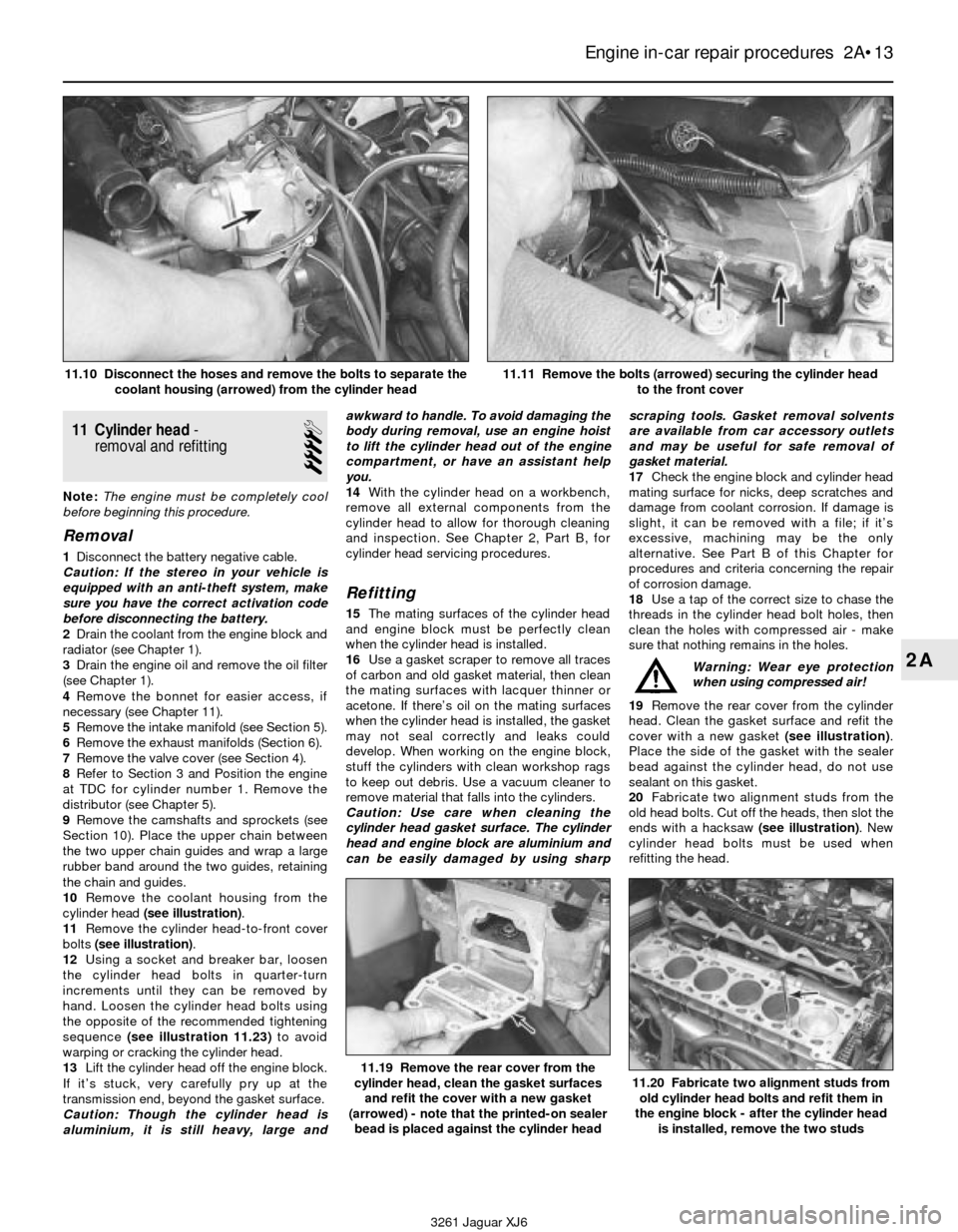
10Remove the coolant housing from the
cylinder head (see illustration).
11Remove the cylinder head-to-front cover
bolts (see illustration).
12Using a socket and breaker bar, loosen
the cylinder head bolts in quarter-turn
increments until they can be removed by
hand. Loosen the cylinder head bolts using
the opposite of the recommended tightening
sequence (see illustration 11.23)to avoid
warping or cracking the cylinder head.
13Lift the cylinder head off the engine block.
If it’s stuck, very carefully pry up at the
transmission end, beyond the gasket surface.
Caution: Though the cylinder head is
aluminium, it is still heavy, large andawkward to handle. To avoid damaging the
body during removal, use an engine hoist
to lift the cylinder head out of the engine
compartment, or have an assistant help
you.
14With the cylinder head on a workbench,
remove all external components from the
cylinder head to allow for thorough cleaning
and inspection. See Chapter 2, Part B, for
cylinder head servicing procedures.
Refitting
15The mating surfaces of the cylinder head
and engine block must be perfectly clean
when the cylinder head is installed.
16Use a gasket scraper to remove all traces
of carbon and old gasket material, then clean
the mating surfaces with lacquer thinner or
acetone. If there’s oil on the mating surfaces
when the cylinder head is installed, the gasket
may not seal correctly and leaks could
develop. When working on the engine block,
stuff the cylinders with clean workshop rags
to keep out debris. Use a vacuum cleaner to
remove material that falls into the cylinders.
Caution: Use care when cleaning the
cylinder head gasket surface. The cylinder
head and engine block are aluminium and
can be easily damaged by using sharpscraping tools. Gasket removal solvents
are available from car accessory outlets
and may be useful for safe removal of
gasket material.
17Check the engine block and cylinder head
mating surface for nicks, deep scratches and
damage from coolant corrosion. If damage is
slight, it can be removed with a file; if it’s
excessive, machining may be the only
alternative. See Part B of this Chapter for
procedures and criteria concerning the repair
of corrosion damage.
18Use a tap of the correct size to chase the
threads in the cylinder head bolt holes, then
clean the holes with compressed air - make
sure that nothing remains in the holes.
Warning: Wear eye protection
when using compressed air!
19Remove the rear cover from the cylinder
head. Clean the gasket surface and refit the
cover with a new gasket (see illustration).
Place the side of the gasket with the sealer
bead against the cylinder head, do not use
sealant on this gasket.
20Fabricate two alignment studs from the
old head bolts. Cut off the heads, then slot the
ends with a hacksaw (see illustration). New
cylinder head bolts must be used when
refitting the head.
Engine in-car repair procedures 2A•13
2A
11.19 Remove the rear cover from the
cylinder head, clean the gasket surfaces
and refit the cover with a new gasket
(arrowed) - note that the printed-on sealer
bead is placed against the cylinder head11.20 Fabricate two alignment studs from
old cylinder head bolts and refit them in
the engine block - after the cylinder head
is installed, remove the two studs
3261 Jaguar XJ6 11.10 Disconnect the hoses and remove the bolts to separate the
coolant housing (arrowed) from the cylinder head
11.11 Remove the bolts (arrowed) securing the cylinder head
to the front cover
Page 58 of 227
rebuilt engine or short block, some rebuilders
will not warranty their engines unless the
radiator has been professionally flushed. Also,
we don’t recommend overhauling the oil
pump - always refit a new one when an engine
is rebuilt.
Before beginning the engine overhaul, read
through the entire procedure to familiarise
yourself with the scope and requirements of
the job. Overhauling an engine isn’t difficult,
but it is time-consuming. Plan on the vehicle
being tied up for a minimum of two weeks,
especially if parts must be taken to an
automotive machine workshop for repair or
reconditioning. Check on availability of parts
and make sure that any necessary special
tools and equipment are obtained in advance.
Most work can be done with typical hand
tools, although a number of precision
measuring tools are required for inspecting
parts to determine if they must be renewed.
Often an automotive machine workshop will
handle the inspection of parts and offer
advice concerning reconditioning and
renewal. Note:Always wait until the engine
has been completely dismantled and all
components, especially the engine block,
have been inspected before deciding what
service and repair operations must be
performed by an automotive machine
workshop. Since the engine block’s condition
will be the major factor to consider when
determining whether to overhaul the original
engine or buy a rebuilt one, never purchase
parts or have machine work done on other
components until the engine block has been
thoroughly inspected. As a general rule, time
is the primary cost of an overhaul, so it
doesn’t pay to refit worn or substandard
parts.
If it turns out that a number of major
components are beyond reconditioning, it
may be cost effective to buy a factory-rebuilt
engine from a Jaguar dealership.
As a final note, to ensure maximum life and
minimum trouble from a rebuilt engine,
everything must be assembled with care in a
spotlessly-clean environment.
3 Vacuum gauge
diagnostic checks
2
A vacuum gauge provides valuable
information about what is going on in the
engine at a low cost. You can check for worn
rings or cylinder walls, leaking cylinder head or
intake manifold gaskets, incorrect carburettor
adjustments, restricted exhaust, stuck or
burned valves, weak valve springs, improper
ignition or valve timing and ignition problems.
Unfortunately, vacuum gauge readings are
easy to misinterpret, so they should be used
with other tests to confirm the diagnosis.
Both the absolute readings and the rate of
needle movement are important for accurate
interpretation. Most gauges measure vacuumin inches of mercury (in-Hg). As vacuum
increases (or atmospheric pressure decreases),
the reading will decrease. Also, for every
1000 foot increase in elevation above sea level;
the gauge readings will decrease about one
inch of mercury.
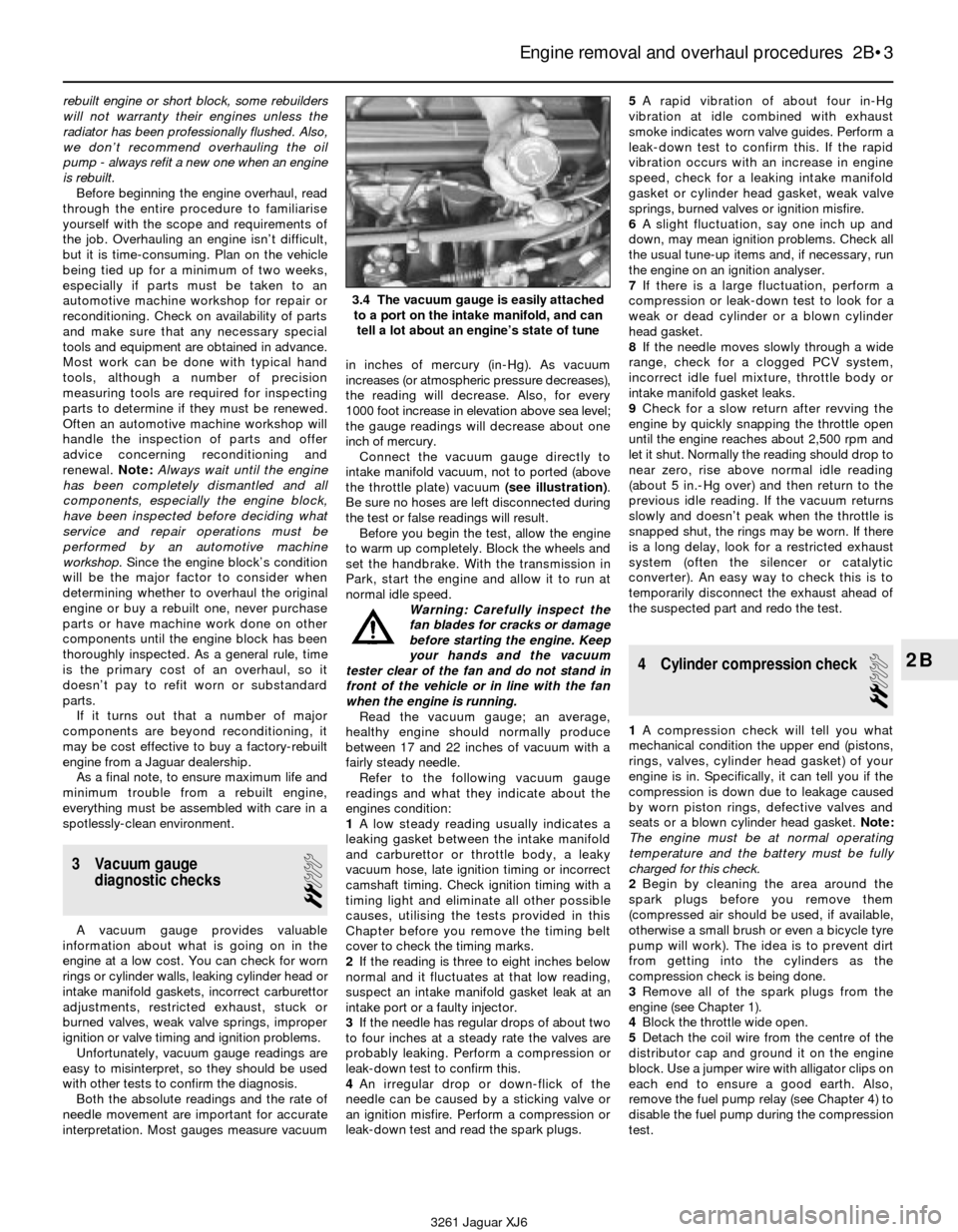
Connect the vacuum gauge directly to
intake manifold vacuum, not to ported (above
the throttle plate) vacuum (see illustration).
Be sure no hoses are left disconnected during
the test or false readings will result.
Before you begin the test, allow the engine
to warm up completely. Block the wheels and
set the handbrake. With the transmission in
Park, start the engine and allow it to run at
normal idle speed.
Warning: Carefully inspect the
fan blades for cracks or damage
before starting the engine. Keep
your hands and the vacuum
tester clear of the fan and do not stand in
front of the vehicle or in line with the fan
when the engine is running.
Read the vacuum gauge; an average,
healthy engine should normally produce
between 17 and 22 inches of vacuum with a
fairly steady needle.
Refer to the following vacuum gauge
readings and what they indicate about the
engines condition:
1A low steady reading usually indicates a
leaking gasket between the intake manifold
and carburettor or throttle body, a leaky
vacuum hose, late ignition timing or incorrect
camshaft timing. Check ignition timing with a
timing light and eliminate all other possible
causes, utilising the tests provided in this
Chapter before you remove the timing belt
cover to check the timing marks.
2If the reading is three to eight inches below
normal and it fluctuates at that low reading,
suspect an intake manifold gasket leak at an
intake port or a faulty injector.
3If the needle has regular drops of about two
to four inches at a steady rate the valves are
probably leaking. Perform a compression or
leak-down test to confirm this.
4An irregular drop or down-flick of the
needle can be caused by a sticking valve or
an ignition misfire. Perform a compression or
leak-down test and read the spark plugs.5A rapid vibration of about four in-Hg
vibration at idle combined with exhaust
smoke indicates worn valve guides. Perform a
leak-down test to confirm this. If the rapid
vibration occurs with an increase in engine
speed, check for a leaking intake manifold
gasket or cylinder head gasket, weak valve
springs, burned valves or ignition misfire.
6A slight fluctuation, say one inch up and
down, may mean ignition problems. Check all
the usual tune-up items and, if necessary, run
the engine on an ignition analyser.
7If there is a large fluctuation, perform a
compression or leak-down test to look for a
weak or dead cylinder or a blown cylinder
head gasket.
8If the needle moves slowly through a wide
range, check for a clogged PCV system,
incorrect idle fuel mixture, throttle body or
intake manifold gasket leaks.
9Check for a slow return after revving the
engine by quickly snapping the throttle open
until the engine reaches about 2,500 rpm and
let it shut. Normally the reading should drop to
near zero, rise above normal idle reading
(about 5 in.-Hg over) and then return to the
previous idle reading. If the vacuum returns
slowly and doesn’t peak when the throttle is
snapped shut, the rings may be worn. If there
is a long delay, look for a restricted exhaust
system (often the silencer or catalytic
converter). An easy way to check this is to
temporarily disconnect the exhaust ahead of
the suspected part and redo the test.
4 Cylinder compression check
2
1A compression check will tell you what
mechanical condition the upper end (pistons,
rings, valves, cylinder head gasket) of your
engine is in. Specifically, it can tell you if the
compression is down due to leakage caused
by worn piston rings, defective valves and
seats or a blown cylinder head gasket. Note:
The engine must be at normal operating
temperature and the battery must be fully
charged for this check.
2Begin by cleaning the area around the
spark plugs before you remove them
(compressed air should be used, if available,
otherwise a small brush or even a bicycle tyre
pump will work). The idea is to prevent dirt
from getting into the cylinders as the
compression check is being done.
3Remove all of the spark plugs from the
engine (see Chapter 1).
4Block the throttle wide open.
5Detach the coil wire from the centre of the
distributor cap and ground it on the engine
block. Use a jumper wire with alligator clips on
each end to ensure a good earth. Also,
remove the fuel pump relay (see Chapter 4) to
disable the fuel pump during the compression
test.
Engine removal and overhaul procedures 2B•3
2B
3.4 The vacuum gauge is easily attached
to a port on the intake manifold, and can
tell a lot about an engine’s state of tune
3261 Jaguar XJ6