exhaust JAGUAR XJ6 1997 2.G Owner's Manual
[x] Cancel search | Manufacturer: JAGUAR, Model Year: 1997, Model line: XJ6, Model: JAGUAR XJ6 1997 2.GPages: 227, PDF Size: 7.2 MB
Page 59 of 227
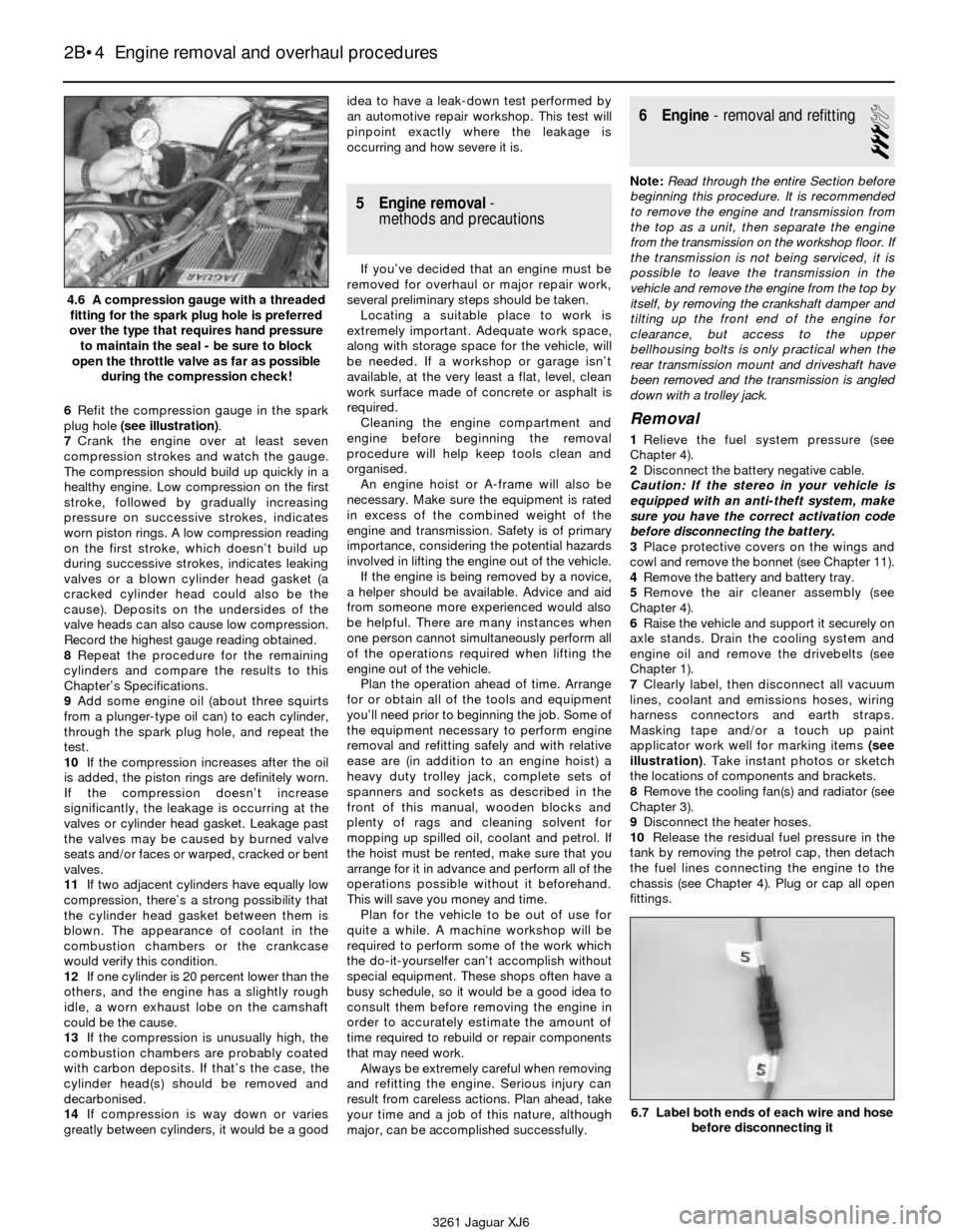
6Refit the compression gauge in the spark
plug hole (see illustration).
7Crank the engine over at least seven
compression strokes and watch the gauge.
The compression should build up quickly in a
healthy engine. Low compression on the first
stroke, followed by gradually increasing
pressure on successive strokes, indicates
worn piston rings. A low compression reading
on the first stroke, which doesn’t build up
during successive strokes, indicates leaking
valves or a blown cylinder head gasket (a
cracked cylinder head could also be the
cause). Deposits on the undersides of the
valve heads can also cause low compression.
Record the highest gauge reading obtained.
8Repeat the procedure for the remaining
cylinders and compare the results to this
Chapter’s Specifications.
9Add some engine oil (about three squirts
from a plunger-type oil can) to each cylinder,
through the spark plug hole, and repeat the
test.
10If the compression increases after the oil
is added, the piston rings are definitely worn.
If the compression doesn’t increase
significantly, the leakage is occurring at the
valves or cylinder head gasket. Leakage past
the valves may be caused by burned valve
seats and/or faces or warped, cracked or bent
valves.
11If two adjacent cylinders have equally low
compression, there’s a strong possibility that
the cylinder head gasket between them is
blown. The appearance of coolant in the
combustion chambers or the crankcase
would verify this condition.
12If one cylinder is 20 percent lower than the
others, and the engine has a slightly rough
idle, a worn exhaust lobe on the camshaft
could be the cause.
13If the compression is unusually high, the
combustion chambers are probably coated
with carbon deposits. If that’s the case, the
cylinder head(s) should be removed and
decarbonised.
14If compression is way down or varies
greatly between cylinders, it would be a goodidea to have a leak-down test performed by
an automotive repair workshop. This test will
pinpoint exactly where the leakage is
occurring and how severe it is.
5 Engine removal-
methods and precautions
If you’ve decided that an engine must be
removed for overhaul or major repair work,
several preliminary steps should be taken.
Locating a suitable place to work is
extremely important. Adequate work space,
along with storage space for the vehicle, will
be needed. If a workshop or garage isn’t
available, at the very least a flat, level, clean
work surface made of concrete or asphalt is
required.
Cleaning the engine compartment and
engine before beginning the removal
procedure will help keep tools clean and
organised.
An engine hoist or A-frame will also be
necessary. Make sure the equipment is rated
in excess of the combined weight of the
engine and transmission. Safety is of primary
importance, considering the potential hazards
involved in lifting the engine out of the vehicle.
If the engine is being removed by a novice,
a helper should be available. Advice and aid
from someone more experienced would also
be helpful. There are many instances when
one person cannot simultaneously perform all
of the operations required when lifting the
engine out of the vehicle.
Plan the operation ahead of time. Arrange
for or obtain all of the tools and equipment
you’ll need prior to beginning the job. Some of
the equipment necessary to perform engine
removal and refitting safely and with relative
ease are (in addition to an engine hoist) a
heavy duty trolley jack, complete sets of
spanners and sockets as described in the
front of this manual, wooden blocks and
plenty of rags and cleaning solvent for
mopping up spilled oil, coolant and petrol. If
the hoist must be rented, make sure that you
arrange for it in advance and perform all of the
operations possible without it beforehand.
This will save you money and time.
Plan for the vehicle to be out of use for
quite a while. A machine workshop will be
required to perform some of the work which
the do-it-yourselfer can’t accomplish without
special equipment. These shops often have a
busy schedule, so it would be a good idea to
consult them before removing the engine in
order to accurately estimate the amount of
time required to rebuild or repair components
that may need work.
Always be extremely careful when removing
and refitting the engine. Serious injury can
result from careless actions. Plan ahead, take
your time and a job of this nature, although
major, can be accomplished successfully.
6 Engine- removal and refitting
3
Note:Read through the entire Section before
beginning this procedure. It is recommended
to remove the engine and transmission from
the top as a unit, then separate the engine
from the transmission on the workshop floor. If
the transmission is not being serviced, it is
possible to leave the transmission in the
vehicle and remove the engine from the top by
itself, by removing the crankshaft damper and
tilting up the front end of the engine for
clearance,but access to the upper
bellhousing bolts is only practical when the
rear transmission mount and driveshaft have
been removed and the transmission is angled
down with a trolley jack.
Removal
1Relieve the fuel system pressure (see
Chapter 4).
2Disconnect the battery negative cable.
Caution: If the stereo in your vehicle is
equipped with an anti-theft system, make
sure you have the correct activation code
before disconnecting the battery.
3Place protective covers on the wings and
cowl and remove the bonnet (see Chapter 11).
4Remove the battery and battery tray.
5Remove the air cleaner assembly (see
Chapter 4).
6Raise the vehicle and support it securely on
axle stands. Drain the cooling system and
engine oil and remove the drivebelts (see
Chapter 1).
7Clearly label, then disconnect all vacuum
lines, coolant and emissions hoses, wiring
harness connectors and earth straps.
Masking tape and/or a touch up paint
applicator work well for marking items (see
illustration). Take instant photos or sketch
the locations of components and brackets.
8Remove the cooling fan(s) and radiator (see
Chapter 3).
9Disconnect the heater hoses.
10Release the residual fuel pressure in the
tank by removing the petrol cap, then detach
the fuel lines connecting the engine to the
chassis (see Chapter 4). Plug or cap all open
fittings.
2B•4 Engine removal and overhaul procedures
4.6 A compression gauge with a threaded
fitting for the spark plug hole is preferred
over the type that requires hand pressure
to maintain the seal - be sure to block
open the throttle valve as far as possible
during the compression check!
6.7 Label both ends of each wire and hose
before disconnecting it
3261 Jaguar XJ6
Page 60 of 227
11Disconnect the throttle linkage,
transmission linkage (and dipstick tube) and
speed control cable, if equipped, from the
engine (see Chapters 4 and 7).
12Refer to Part A of this Chapter and
remove the intake and exhaust manifolds.
13Unbolt the power steering pump (see
Chapter 10). Tie the pump aside without
disconnecting the hoses. Refer to Part A for
removal of the hydraulic pump (if equipped)
from the timing chain cover.
14On air-conditioned models, unbolt the
compressor and set it aside. Do not
disconnect the refrigerant hoses. Note:Wire
the compressor out of the way with a coat
hanger, don’t let the compressor hang on the
hoses.
15Refer to Part A of this Chapter and
remove the drivebelts, water pump pulley and
crankshaft pulley.
16Attach a lifting sling to the engine.
Position a hoist and connect the sling to it.
Take up the slack until there is slight tension
on the hoist.
17With a trolley jack and piece of wood
supporting the bottom of the transmission
sump, refer to Chapter 8 and remove the
driveshaft and rear transmission mount.
Warning: Do not place any part
of your body under the
engine/transmission when it’s
supported only by a hoist or
other lifting device.
18With the hoist taking the weight of the
engine, unbolt the engine mounts (see Part A
of this Chapter).
19Recheck to be sure nothing is still
connecting the engine or transmission to the
vehicle. Disconnect and label anything still
remaining.
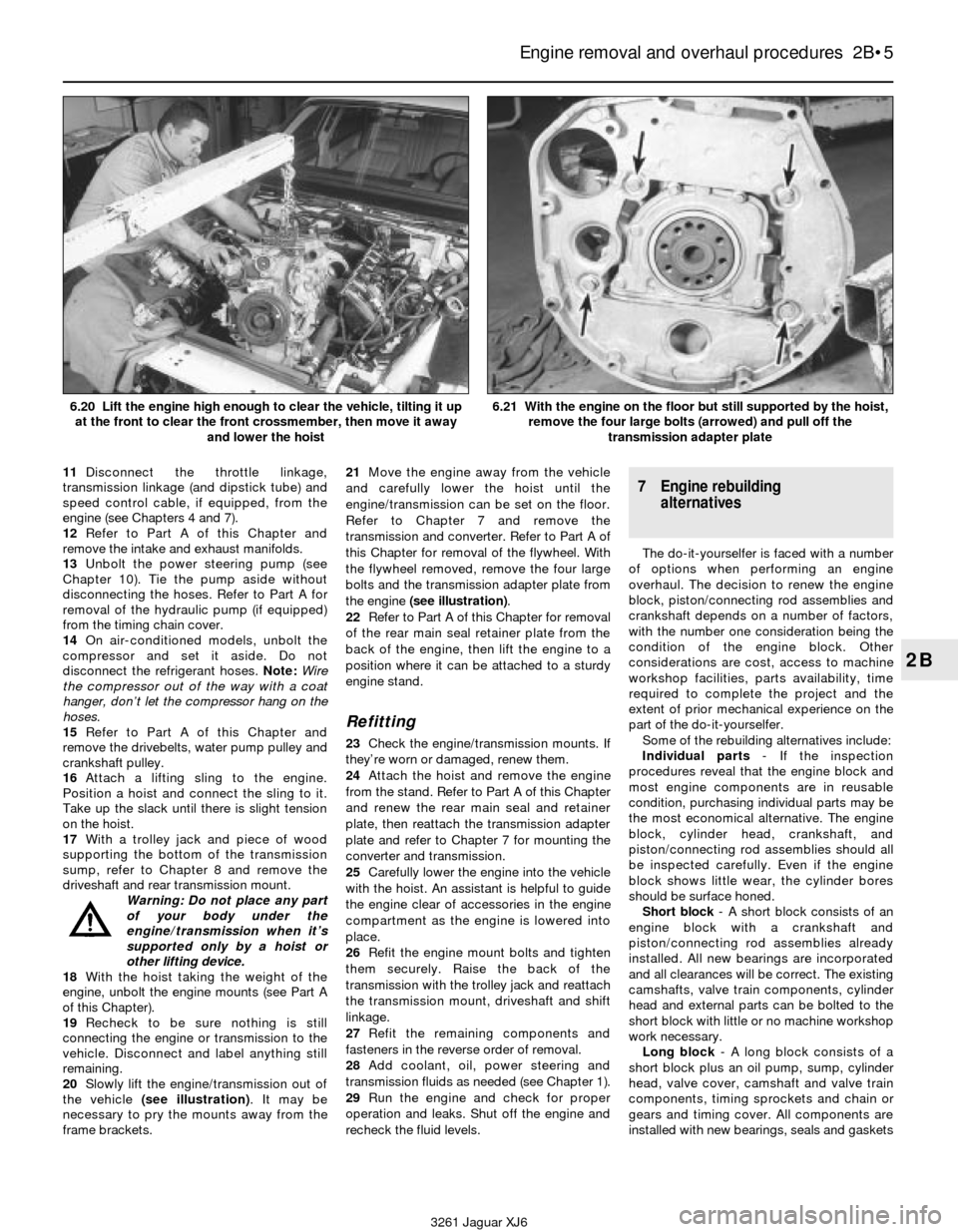
20Slowly lift the engine/transmission out of
the vehicle (see illustration). It may be
necessary to pry the mounts away from the
frame brackets.21Move the engine away from the vehicle
and carefully lower the hoist until the
engine/transmission can be set on the floor.
Refer to Chapter 7 and remove the
transmission and converter. Refer to Part A of
this Chapter for removal of the flywheel. With
the flywheel removed, remove the four large
bolts and the transmission adapter plate from
the engine (see illustration).
22Refer to Part A of this Chapter for removal
of the rear main seal retainer plate from the
back of the engine, then lift the engine to a
position where it can be attached to a sturdy
engine stand.
Refitting
23Check the engine/transmission mounts. If
they’re worn or damaged, renew them.
24Attach the hoist and remove the engine
from the stand. Refer to Part A of this Chapter
and renew the rear main seal and retainer
plate, then reattach the transmission adapter
plate and refer to Chapter 7 for mounting the
converter and transmission.
25Carefully lower the engine into the vehicle
with the hoist. An assistant is helpful to guide
the engine clear of accessories in the engine
compartment as the engine is lowered into
place.
26Refit the engine mount bolts and tighten
them securely. Raise the back of the
transmission with the trolley jack and reattach
the transmission mount, driveshaft and shift
linkage.
27Refit the remaining components and
fasteners in the reverse order of removal.
28Add coolant, oil, power steering and
transmission fluids as needed (see Chapter 1).
29Run the engine and check for proper
operation and leaks. Shut off the engine and
recheck the fluid levels.
7 Engine rebuilding
alternatives
The do-it-yourselfer is faced with a number
of options when performing an engine
overhaul. The decision to renew the engine
block, piston/connecting rod assemblies and
crankshaft depends on a number of factors,
with the number one consideration being the
condition of the engine block. Other
considerations are cost, access to machine
workshop facilities, parts availability, time
required to complete the project and the
extent of prior mechanical experience on the
part of the do-it-yourselfer.
Some of the rebuilding alternatives include:
Individual parts- If the inspection
procedures reveal that the engine block and
most engine components are in reusable
condition, purchasing individual parts may be
the most economical alternative. The engine
block, cylinder head, crankshaft, and
piston/connecting rod assemblies should all
be inspected carefully. Even if the engine
block shows little wear, the cylinder bores
should be surface honed.
Short block- A short block consists of an
engine block with a crankshaft and
piston/connecting rod assemblies already
installed. All new bearings are incorporated
and all clearances will be correct. The existing
camshafts, valve train components, cylinder
head and external parts can be bolted to the
short block with little or no machine workshop
work necessary.
Long block- A long block consists of a
short block plus an oil pump, sump, cylinder
head, valve cover, camshaft and valve train
components, timing sprockets and chain or
gears and timing cover. All components are
installed with new bearings, seals and gaskets
Engine removal and overhaul procedures 2B•5
2B
3261 Jaguar XJ6 6.20 Lift the engine high enough to clear the vehicle, tilting it up
at the front to clear the front crossmember, then move it away
and lower the hoist
6.21 With the engine on the floor but still supported by the hoist,
remove the four large bolts (arrowed) and pull off the
transmission adapter plate
Page 61 of 227
incorporated throughout. The refitting of
manifolds and external parts is all that’s
necessary. Engines in this rebuilt form are
available from Jaguar dealers, and some
independent rebuilders.
Give careful thought to which alternative is
best for you and discuss the situation with
local automotive machine shops, auto parts
dealers and experienced rebuilders before
ordering or purchasing replacement parts.
8 Engine overhaul-
dismantling sequence
1It’s much easier to dismantle and work on
the engine if it’s mounted on a portable
engine stand. A stand can often be rented
quite cheaply from an equipment rental yard.
Before the engine is mounted on a stand, the
driveplate and rear oil seal retainer should be
removed from the engine.
2If a stand isn’t available, it’s possible to
dismantle the engine with it blocked up on the
floor. Be extra careful not to tip or drop the
engine when working without a stand.
3If you’re going to obtain a rebuilt engine, all
external components must come off first, to
be transferred to the replacement engine, just
as they will if you’re doing a complete engine
overhaul yourself. These include:
Alternator and brackets
Emissions control components
Distributor, spark plug leads and spark
plugs
Thermostat and housing cover
Water pump
EFI components
Intake/exhaust manifolds
Oil filter
Engine mounts
Driveplate
Transmission adapter plate
Note:When removing the external
components from the engine, pay close
attention to details that may be helpful or
important during refitting. Note the installed
position of gaskets, seals, spacers, pins,
brackets, washers, bolts and other small items.
4If you’re obtaining a short block, which
consists of the engine block, crankshaft,
pistons and connecting rods all assembled,
then the cylinder head, sump and oil pump will
have to be removed as well from your engine
so that your short-block can be turned in to
the rebuilder as a core. See Engine rebuilding
alternativesfor additional information
regarding the different possibilities to be
considered.
5If you’re planning a complete overhaul, the
engine must be dismantled and the internal
components removed in the following order:
Intake and exhaust manifolds
Valve cover
Upper timing chain and camshaft
sprocketsCamshafts
Timing chain cover
Cylinder head
Sump
Oil pump
Piston/connecting rod assemblies
Crankshaft rear oil seal retainer
Crankshaft and main bearings
6Before beginning the dismantling and
overhaul procedures, make sure the following
items are available. Also, refer to Section 21
for a list of tools and materials needed for
engine reassembly.
Common hand tools
Small cardboard boxes or plastic bags for
storing parts
Gasket scraper
Ridge reamer
Micrometers
Telescoping gauges
Dial indicator set
Valve spring compressor
Cylinder surfacing hone
Piston ring groove-cleaning tool
Electric drill motor
Tap and die set
Wire brushes
Oil gallery brushes
Cleaning solvent
Special Jaguar tools
Engine lifting brackets (18G 1465)
Timing damper simulator (18E 1436)
Camshaft TDC tool (18G 1433)
9 Cylinder head- dismantling
2
Note: New and rebuilt cylinder heads are
available from Jaguar and some independent
rebuilders. Due to the fact that some
specialised tools are necessary for the
dismantling and inspection procedures, and
replacement parts may not be readily
available, it may be more practical and
economical for the home mechanic to
purchase a replacement cylinder head rather
than taking the time to dismantle, inspect and
recondition the original.1Cylinder head dismantling involves removal
of the intake and exhaust valves and related
components. It’s assumed that the lifters and
camshafts have already been removed (see
Part A as needed).
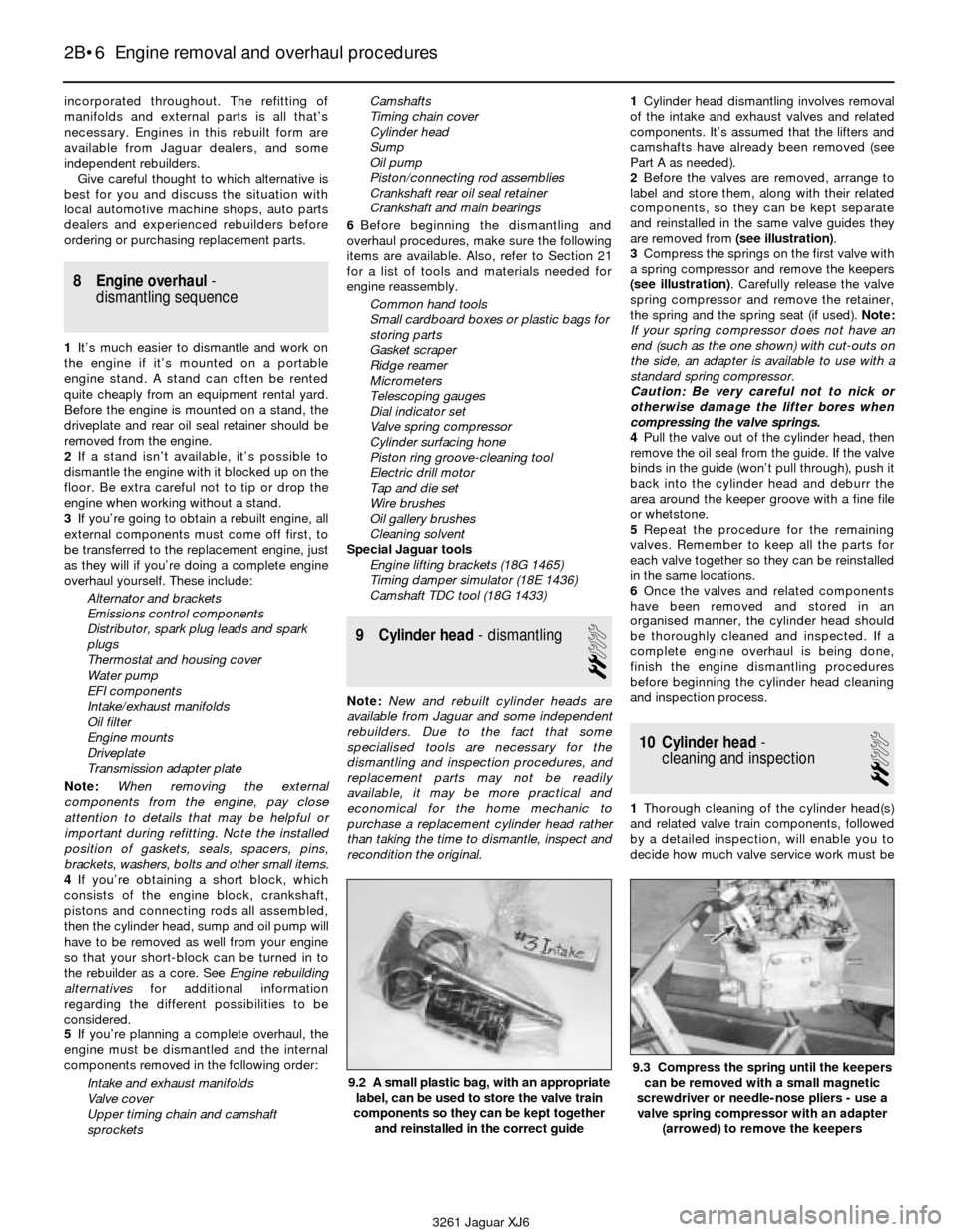
2Before the valves are removed, arrange to
label and store them, along with their related
components, so they can be kept separate
and reinstalled in the same valve guides they
are removed from (see illustration).
3Compress the springs on the first valve with
a spring compressor and remove the keepers
(see illustration). Carefully release the valve
spring compressor and remove the retainer,
the spring and the spring seat (if used). Note:
If your spring compressor does not have an
end (such as the one shown) with cut-outs on
the side, an adapter is available to use with a
standard spring compressor.
Caution: Be very careful not to nick or
otherwise damage the lifter bores when
compressing the valve springs.
4Pull the valve out of the cylinder head, then
remove the oil seal from the guide. If the valve
binds in the guide (won’t pull through), push it
back into the cylinder head and deburr the
area around the keeper groove with a fine file
or whetstone.
5Repeat the procedure for the remaining
valves. Remember to keep all the parts for
each valve together so they can be reinstalled
in the same locations.
6Once the valves and related components
have been removed and stored in an
organised manner, the cylinder head should
be thoroughly cleaned and inspected. If a
complete engine overhaul is being done,
finish the engine dismantling procedures
before beginning the cylinder head cleaning
and inspection process.
10 Cylinder head-
cleaning and inspection
2
1Thorough cleaning of the cylinder head(s)
and related valve train components, followed
by a detailed inspection, will enable you to
decide how much valve service work must be
2B•6 Engine removal and overhaul procedures
9.2 A small plastic bag, with an appropriate
label, can be used to store the valve train
components so they can be kept together
and reinstalled in the correct guide
3261 Jaguar XJ6
9.3 Compress the spring until the keepers
can be removed with a small magnetic
screwdriver or needle-nose pliers - use a
valve spring compressor with an adapter
(arrowed) to remove the keepers
Page 62 of 227

done during the engine overhaul. Note:If the
engine was severely overheated, the cylinder
head is probably warped (see paragraph 12).
Cleaning
2Scrape all traces of old gasket material and
sealing compound off the cylinder head
gasket, intake manifold and exhaust manifold
sealing surfaces. Be very careful not to gouge
the cylinder head. Special gasket-removal
solvents that soften gaskets and make
removal much easier are available at car
accessory outlets.
3Remove all built up scale from the coolant
passages.
4Run a stiff wire brush through the various
holes to remove deposits that may have
formed in them. If there are heavy deposits in
the water passages, the bare head should be
professionally cleaned at a machine
workshop.
5Run an appropriate-size tap into each of the
threaded holes to remove corrosion and
any thread sealant that may be present. If
compressed air is available, use it to clear the
holes of debris produced by this operation.
Warning: Wear eye protection
when using compressed air!
6Clean the exhaust and intake manifold stud
threads with a wire brush.
7Clean the cylinder head with solvent and dry
it thoroughly. Compressed air will speed the
drying process and ensure that all holes and
recessed areas are clean. Note:Decarbonising
chemicals are available and may prove very
useful when cleaning cylinder heads and valve
train components. They are very caustic and
should be used with caution. Be sure to follow
the instructions on the container.
8Clean the lifters with solvent and dry themthoroughly. Compressed air will speed the
drying process and can be used to clean out
the oil passages. Don’t mix them up during
cleaning - keep them in a box with numbered
compartments.
9Clean all the valve springs, spring seats,
keepers and retainers with solvent and dry
them thoroughly. Work on the components
from one valve at a time to avoid mixing up
the parts.
10Scrape off any heavy deposits that may
have formed on the valves, then use a
motorised wire brush to remove deposits from
the valve heads and stems. Again, make sure
that the valves don’t get mixed up.
Inspection
Note:Be sure to perform all of the following
inspection procedures before concluding that
machine workshop work is required. Make a
list of the items that need attention. The
inspection procedures for the lifters and
camshafts, can be found in Part A.
Cylinder head
11Inspect the cylinder head very carefully for
cracks, evidence of coolant leakage and other
damage. If cracks are found, check with an
automotive machine workshop concerning
repair. If repair isn’t possible, a new cylinder
head should be obtained.
12A common problem on aluminium engines
is erosion of the cylinder head or engine block
coolant passages due to improper sealing.
Using a new cylinder head gasket held
against the cylinder head, trace the bolt holes
and coolant passage outlines in pencil on the
cylinder head. Use the gasket to trace the
same on the top of the engine block (see
illustration). If the top of the engine block has
eroded outsideof the pattern around thewater passages or cylinder head bolt holes,
the engine block must be renewed; the
manufacturer doesn’t recommend resurfacing
it. If the cylinder head has eroded outside of
the water passage holes but the erosion is
away fromthe combustion chamber, the
eroded area can be built up with metal-
impregnated epoxy and machined flat again.
13Using a straightedge and feeler gauge,
check the cylinder head gasket mating
surface (on the engine block and cylinder
head) for warpage (see illustration). If the
warpage exceeds the limit found in this
Chapter’s Specifications, it can be resurfaced
at an automotive machine workshop, but no
more then 0.010-inch of material should be
removed. If the cylinder head had been
overheated, take it to the machinist for
inspection before proceeding further. It’s
possible that the overheating could have
annealed (softened) the aluminium of the
cylinder head, making it unsuitable for
machine work. In this case, a new cylinder
head is required.
Note 1:To check if a cylinder head has been
machined previously, measure the height
between the cylinder head gasket surface and
the valve cover mounting surface with a large
micrometer or vernier caliper and compare
with Specifications.
Note 2:Jaguar aluminium cylinder heads
require precision machine work. It is best to
find a machine workshop that has
considerable experience in servicing Jaguar
cylinder heads.
14Examine the valve seats in each of the
combustion chambers. If they’re pitted,
cracked or burned, the cylinder head will
require valve service that’s beyond the scope
of the home mechanic.
Engine removal and overhaul procedures 2B•7
2B
3261 Jaguar XJ6 10.12 Place the new head gasket on the engine block, and trace
around the water passages and bolt holes - make sure there is no
erosion of the aluminium beyond these lines
10.13 Check the cylinder head and engine block gasket surfaces
for warpage by trying to slip a feeler gauge under a precision
straightedge (see the Specifications for the maximum warpage
allowed and use a feeler gauge of that thickness) - check both the
cylinder head and engine block (shown)
Page 70 of 227

21 Engine overhaul-
reassembly sequence
1Before beginning engine reassembly, make
sure you have all the necessary new parts,
gaskets and seals as well as the following
items on hand:
Common hand tools
A 1/2-inch drive torque wrench
Piston ring refitting tool
Piston ring compressor
Short lengths of rubber or plastic hose to
fit over connecting rod bolts
Plastigauge
Feeler gauges
A fine-tooth file
New engine oil
Engine assembly lube or moly-base
grease
Gasket sealer
Thread locking compound
Special Jaguar tools:
Engine lifting brackets (18G 1465)
Timing damper simulator (18E 1436)
Camshaft TDC tool (18G 1433)
2In order to save time and avoid problems,
engine reassembly must be done in the
following general order:
Piston rings (Part B)
Crankshaft and main bearings (Part B)
Piston/connecting rod assemblies (Part B)
Rear main (crankshaft) oil seal (Part B)
Auxiliary shaft (Part A)
Timing chains and sprockets (Part A)
Oil pump (Part A)
Timing chain cover (Part A)
Cylinder head and lifters (Part A)
Camshafts (Part A)
Oil pick-up (Part A)
Sump (Part A)
Intake and exhaust manifolds (Part A)
Valve cover (Part A)
Flywheel/driveplate (Part A)
22 Piston rings- refitting
3
1Before refitting the new piston rings, the ring
end gaps must be checked. It’s assumed that
the piston ring groove clearance has been
checked and verified correct (see Section 18).
2Lay out the piston/connecting rod
assemblies and the new ring sets so the ring
sets will be matched with the same piston and
cylinder during the end gap measurement and
engine assembly.
3Insert the top (number one) ring into the first
cylinder and square it up with the cylinder
walls by pushing it in with the top of the piston
(see illustration). The ring should be near the
bottom of the cylinder, at the lower limit of
ring travel.
4To measure the end gap, slip feeler gauges
between the ends of the ring until a gauge
equal to the gap width is found (see
illustration). The feeler gauge should slide
between the ring ends with a slight amount of
drag. Compare the measurement to that
found in this Chapter’s Specifications. If the
gap is larger or smaller than specified,
double-check to make sure you have the
correct rings before proceeding.
5If the gap is too small, it must be enlarged
or the ring ends may come in contact with
each other during engine operation, which
can cause serious damage to the engine. The
end gap can be increased by filing the ring
ends very carefully with a fine file. Mount thefile in a vice equipped with soft jaws, slip the
ring over the file with the ends contacting the
file face and slowly move the ring to remove
material from the ends(see illustration).
Caution: When performing this operation,
file only from the outside in, and after the
correct gap is achieved, deburr the filed
ends of the rings with a fine whetstone.
6Excess end gap isn’t critical unless it’s
greater than Specifications. Again, double-
check to make sure you have the correct rings
for your engine.
7Repeat the procedure for each ring that will
be installed in the first cylinder and for each
ring in the remaining cylinders. Remember to
keep rings, pistons and cylinders matched.
8Once the ring end gaps have been
checked/corrected, the rings can be installed
on the pistons.
9The oil control ring (lowest one on the
piston) is usually installed first. It’s composed
of three separate components. Slip the
spacer/expander into the groove (see
illustration). If an anti-rotation tang is used,
make sure it’s inserted into the drilled hole in
the ring groove. Next, refit the lower side rail.
Don’t use a piston ring refitting tool on the oil
ring side rails, as they may be damaged.
Instead, place one end of the side rail into the
groove between the spacer/expander and the
ring land, hold it firmly in place and slide a
finger around the piston while pushing the rail
into the groove (see illustrations). Next, refit
the upper side rail in the same manner.
10After the three oil ring components have
been installed, check to make sure that both
Engine removal and overhaul procedures 2B•15
2B
22.3 When checking piston ring end gap,
the ring must be square in the cylinder
bore (this is done by pushing the ring down
with the top of a piston as shown)22.4 With the ring square in the cylinder,
measure the end gap with a feeler gauge22.5 If the end gap is too small, clamp a
file in a vice and file the ring ends (from the
outside in only) to enlarge the gap slightly
22.9a Refit the spacer/expander in the oil
control ring groove22.9b DO NOT use a piston ring refitting
tool when refitting the oil ring side rails
3261 Jaguar XJ6
Page 74 of 227
3261 Jaguar XJ6
3
Chapter 3
Cooling, heating and air conditioning systems
General
Radiator cap pressure rating . . . . . . . . . . . . . . . . . . . . . . . . . . . . . . . . . 13.5 to 117.5 psi
Thermostat rating . . . . . . . . . . . . . . . . . . . . . . . . . . . . . . . . . . . . . . . . . . 180 to 207° F
Torque wrench settingsNm lbf ft
Coolant pipe to block . . . . . . . . . . . . . . . . . . . . . . . . . . . . . . . . . . . . . . . 22 to 28 16 to 21
Fan assembly-to-drive hub nuts . . . . . . . . . . . . . . . . . . . . . . . . . . . . . . . 22 to 28 16 to 21
Fan clutch-to-fan blade bolts . . . . . . . . . . . . . . . . . . . . . . . . . . . . . . . . . 22 to 28 16 to 21
Thermostat cover bolts . . . . . . . . . . . . . . . . . . . . . . . . . . . . . . . . . . . . . . 22 to 28 16 to 21
Thermostat housing-to-block bolts . . . . . . . . . . . . . . . . . . . . . . . . . . . . 22 to 28 16 to 21
Water pump bolts . . . . . . . . . . . . . . . . . . . . . . . . . . . . . . . . . . . . . . . . . . 22 to 28 16 to 21 Air conditioning and heating system - check and maintenance . . . . 13
Air conditioning compressor - removal and refitting . . . . . . . . . . . . . 15
Air conditioning condenser - removal and refitting . . . . . . . . . . . . . . 16
Air conditioning evaporator and expansion valve - removal
and refitting . . . . . . . . . . . . . . . . . . . . . . . . . . . . . . . . . . . . . . . . . . 17
Air conditioning receiver/drier - removal and refitting . . . . . . . . . . . . 14
Antifreeze/coolant - general information . . . . . . . . . . . . . . . . . . . . . . 2
Coolant level check . . . . . . . . . . . . . . . . . . . . . . . . . . . . See Chapter 1
Coolant temperature sender unit - check and renewal . . . . . . . . . . . .9
Cooling system check . . . . . . . . . . . . . . . . . . . . . . . . . . See Chapter 1
Cooling system draining, flushing and refilling . . . . . . . . See Chapter 1
Drivebelt check, adjustment and renewal . . . . . . . . . . . See Chapter 1
Engine cooling fans - check and renewal . . . . . . . . . . . . . . . . . . . . . 4Engine oil cooler - renewal . . . . . . . . . . . . . . . . . . . . . . . . . . . . . . . . 6
General information . . . . . . . . . . . . . . . . . . . . . . . . . . . . . . . . . . . . . . 1
Heater and air conditioning blower motors -circuit check
and component renewal . . . . . . . . . . . . . . . . . . . . . . . . . . . . . . . . 10
Heater and air conditioning control assembly -
check, removal and refitting . . . . . . . . . . . . . . . . . . . . . . . . . . . . . 12
Heater core - removal and refitting . . . . . . . . . . . . . . . . . . . . . . . . . . 11
Radiator, expansion tank and coolant reservoir -
removal and refitting . . . . . . . . . . . . . . . . . . . . . . . . . . . . . . . . . . . 5
Thermostat - check and renewal . . . . . . . . . . . . . . . . . . . . . . . . . . . . 3
Underbonnet hose check and renewal . . . . . . . . . . . . . . See Chapter 1
Water pump - check . . . . . . . . . . . . . . . . . . . . . . . . . . . . . . . . . . . . . 7
Water pump and pipes - renewal . . . . . . . . . . . . . . . . . . . . . . . . . . . 8
3•1
Specifications Contents
Easy,suitable for
novice with little
experienceFairly easy,suitable
for beginner with
some experienceFairly difficult,
suitable for competent
DIY mechanic
Difficult,suitable for
experienced DIY
mechanicVery difficult,
suitable for expert DIY
or professional
Degrees of difficulty
54321
1 General information
Engine cooling system
All vehicles covered by this manual employ a
pressurised engine cooling system with
thermostatically-controlled coolant circulation.
An impeller type water pump mounted on the
front of the block pumps coolant through the
engine. The coolant flows around each cylinder
and toward the rear of the engine. Cast-in
coolant passages direct coolant around the
intake and exhaust ports, near the spark plug
areas and in proximity to the exhaust valve
guides.A wax-pellet type thermostat is located in
the thermostat housing at the front of the
engine. During warm up, the closed
thermostat prevents coolant from circulating
through the radiator. When the engine
reaches normal operating temperature, the
thermostat opens and allows hot coolant to
travel through the radiator, where it is cooled
before returning to the engine.
The cooling system is sealed by a pressure-
type radiator cap. This raises the boiling point
of the coolant, and the higher boiling point of
the coolant increases the cooling efficiency
of the radiator. If the system pressure exceeds
the cap pressure-relief value, the excess
pressure in the system forces the spring-
loaded valve inside the cap off its seat and
allows the coolant to escape through the
overflow tube into a coolant reservoir. Whenthe system cools, the excess coolant is
automatically drawn from the reservoir back
into the radiator. This type of cooling system is
known as a closed design because coolant
that escapes past the pressure cap is saved
and reused.
The Jaguar cooling system on 1988 and
1989 models has both a manifold tank and a
coolant recovery tank. The manifold tank is the
highest point in the cooling system and is the
location of the “radiator” cap (the cap is not on
the radiator). The recovery tank down in the
passenger’s footwell collects heated coolant
as described above. Models from 1990 to
1994 do not have a coolant recovery tank, but
have an enlarged manifold tank. In all models,
the recovery tank has a sensor in it to detect a
low coolant level, and the instrument panel has
a warning light to that effect.
Page 89 of 227
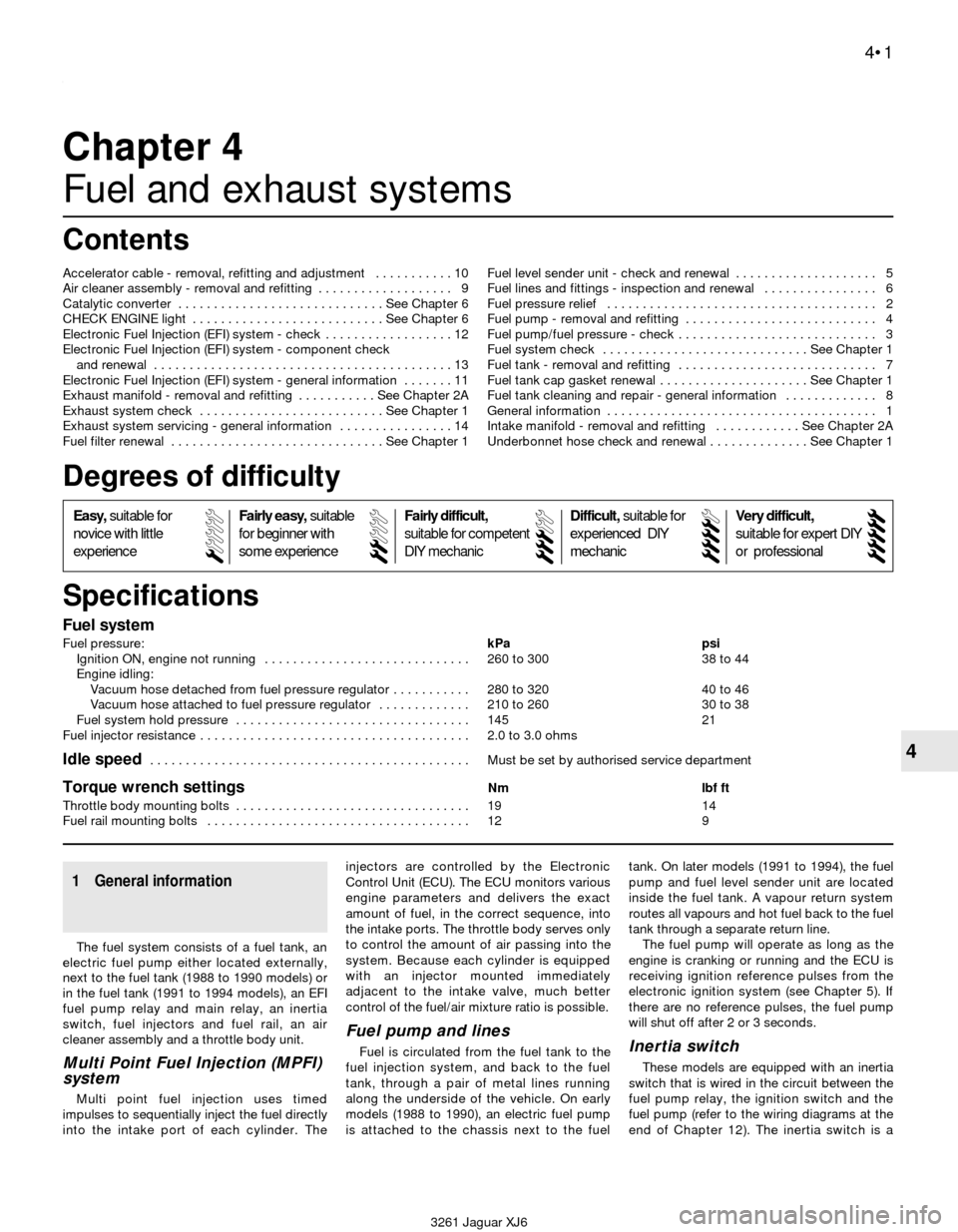
3261 Jaguar XJ6
4
Chapter 4
Fuel and exhaust systems
Fuel system
Fuel pressure:kPa psi
Ignition ON, engine not running . . . . . . . . . . . . . . . . . . . . . . . . . . . . . 260 to 300 38 to 44
Engine idling:
Vacuum hose detached from fuel pressure regulator . . . . . . . . . . . 280 to 320 40 to 46
Vacuum hose attached to fuel pressure regulator . . . . . . . . . . . . . 210 to 260 30 to 38
Fuel system hold pressure . . . . . . . . . . . . . . . . . . . . . . . . . . . . . . . . . 145 21
Fuel injector resistance . . . . . . . . . . . . . . . . . . . . . . . . . . . . . . . . . . . . . . 2.0 to 3.0 ohms
Idle speed . . . . . . . . . . . . . . . . . . . . . . . . . . . . . . . . . . . . . . . . . . . . . Must be set by authorised service department
Torque wrench settingsNm lbf ft
Throttle body mounting bolts . . . . . . . . . . . . . . . . . . . . . . . . . . . . . . . . . 19 14
Fuel rail mounting bolts . . . . . . . . . . . . . . . . . . . . . . . . . . . . . . . . . . . . . 12 9 Accelerator cable - removal, refitting and adjustment . . . . . . . . . . . 10
Air cleaner assembly - removal and refitting . . . . . . . . . . . . . . . . . . . 9
Catalytic converter . . . . . . . . . . . . . . . . . . . . . . . . . . . . . See Chapter 6
CHECK ENGINE light . . . . . . . . . . . . . . . . . . . . . . . . . . . See Chapter 6
Electronic Fuel Injection (EFI) system - check . . . . . . . . . . . . . . . . . . 12
Electronic Fuel Injection (EFI) system - component check
and renewal . . . . . . . . . . . . . . . . . . . . . . . . . . . . . . . . . . . . . . . . . . 13
Electronic Fuel Injection (EFI) system - general information . . . . . . . 11
Exhaust manifold - removal and refitting . . . . . . . . . . . See Chapter 2A
Exhaust system check . . . . . . . . . . . . . . . . . . . . . . . . . . See Chapter 1
Exhaust system servicing - general information . . . . . . . . . . . . . . . . 14
Fuel filter renewal . . . . . . . . . . . . . . . . . . . . . . . . . . . . . . See Chapter 1Fuel level sender unit - check and renewal . . . . . . . . . . . . . . . . . . . . 5
Fuel lines and fittings - inspection and renewal . . . . . . . . . . . . . . . . 6
Fuel pressure relief . . . . . . . . . . . . . . . . . . . . . . . . . . . . . . . . . . . . . . 2
Fuel pump - removal and refitting . . . . . . . . . . . . . . . . . . . . . . . . . . . 4
Fuel pump/fuel pressure - check . . . . . . . . . . . . . . . . . . . . . . . . . . . . 3
Fuel system check . . . . . . . . . . . . . . . . . . . . . . . . . . . . . See Chapter 1
Fuel tank - removal and refitting . . . . . . . . . . . . . . . . . . . . . . . . . . . . 7
Fuel tank cap gasket renewal . . . . . . . . . . . . . . . . . . . . . See Chapter 1
Fuel tank cleaning and repair - general information . . . . . . . . . . . . . 8
General information . . . . . . . . . . . . . . . . . . . . . . . . . . . . . . . . . . . . . . 1
Intake manifold - removal and refitting . . . . . . . . . . . . See Chapter 2A
Underbonnet hose check and renewal . . . . . . . . . . . . . . See Chapter 1
4•1
Specifications Contents
Easy,suitable for
novice with little
experienceFairly easy,suitable
for beginner with
some experienceFairly difficult,
suitable for competent
DIY mechanic
Difficult,suitable for
experienced DIY
mechanicVery difficult,
suitable for expert DIY
or professional
Degrees of difficulty
54321
1 General information
The fuel system consists of a fuel tank, an
electric fuel pump either located externally,
next to the fuel tank (1988 to 1990 models) or
in the fuel tank (1991 to 1994 models), an EFI
fuel pump relay and main relay, an inertia
switch, fuel injectors and fuel rail, an air
cleaner assembly and a throttle body unit.
Multi Point Fuel Injection (MPFI)
system
Multi point fuel injection uses timed
impulses to sequentially inject the fuel directly
into the intake port of each cylinder. Theinjectors are controlled by the Electronic
Control Unit (ECU). The ECU monitors various
engine parameters and delivers the exact
amount of fuel, in the correct sequence, into
the intake ports. The throttle body serves only
to control the amount of air passing into the
system. Because each cylinder is equipped
with an injector mounted immediately
adjacent to the intake valve, much better
control of the fuel/air mixture ratio is possible.
Fuel pump and lines
Fuel is circulated from the fuel tank to the
fuel injection system, and back to the fuel
tank, through a pair of metal lines running
along the underside of the vehicle. On early
models (1988 to 1990), an electric fuel pump
is attached to the chassis next to the fueltank. On later models (1991 to 1994), the fuel
pump and fuel level sender unit are located
inside the fuel tank. A vapour return system
routes all vapours and hot fuel back to the fuel
tank through a separate return line.
The fuel pump will operate as long as the
engine is cranking or running and the ECU is
receiving ignition reference pulses from the
electronic ignition system (see Chapter 5). If
there are no reference pulses, the fuel pump
will shut off after 2 or 3 seconds.Inertia switch
These models are equipped with an inertia
switch that is wired in the circuit between the
fuel pump relay, the ignition switch and the
fuel pump (refer to the wiring diagrams at the
end of Chapter 12). The inertia switch is a
Page 90 of 227
special electrical device that provides circuit
protection by switching off the ignition and
fuel pump upon impact in the event of vehicle
collision. Later Jaguar models are equipped
with an additional specialised inertia switch.
This later device switches OFF all ignition fed
circuits, locks the fuel filler cap, locks the boot
(only if doors are locked) and unlocks the
doors if they are locked during the accident.
All these functions are directed by the inertia
switch. The inertia switch is located behind
the left kick panel. Refer to Chapter 12 for
more information.
Exhaust system
The exhaust system includes an exhaust
manifold equipped with an exhaust oxygen
sensor, a catalytic converter, an exhaust pipe,
and a silencer.
The catalytic converter is an emission
control device added to the exhaust system to
reduce pollutants. A single-bed converter is
used in combination with a three-way
(reduction) catalyst. See Chapter 6 for more
information regarding the catalytic converter.
2 Fuel pressure relief
1
Warning: Petrol is extremely
flammable, so take extra
precautions when you work on
any part of the fuel system.
Don’t smoke or allow open flames or bare
light bulbs near the work area, and don’t
work in a garage where a natural gas-type
appliance (such as a water heater or a
clothes dryer) with a pilot light is present.
Since petrol is carcinogenic, wear latex
gloves when there’s a possibility of being
exposed to fuel, and, if you spill any fuel on
your skin, rinse it off immediately with soap
and water. Mop up any spills immediately
and do not store fuel-soaked rags wherethey could ignite. The fuel system is under
constant pressure, so, if any fuel lines are
to be disconnected, the fuel pressure in
the system must be relieved first. When
you perform any kind of work on the fuel
system, wear safety glasses and have a
Class B type fire extinguisher on hand.
1Before servicing any fuel system
component, you must relieve the fuel pressure
to minimise the risk of fire or personal injury.
2Remove the fuel filler cap - this will relieve
any pressure built up in the tank.
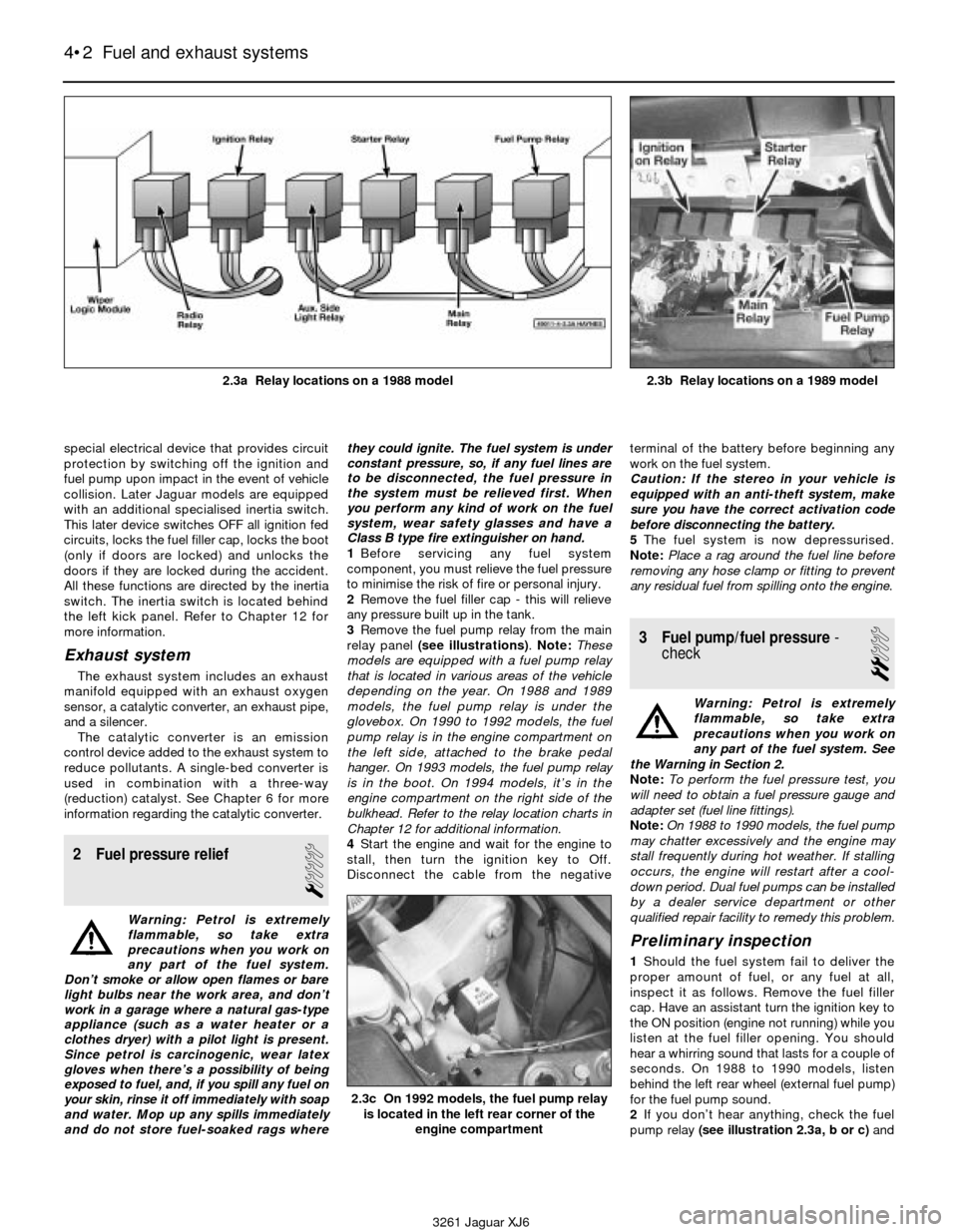
3Remove the fuel pump relay from the main
relay panel (see illustrations). Note:These
models are equipped with a fuel pump relay
that is located in various areas of the vehicle
depending on the year. On 1988 and 1989
models, the fuel pump relay is under the
glovebox. On 1990 to 1992 models, the fuel
pump relay is in the engine compartment on
the left side, attached to the brake pedal
hanger. On 1993 models, the fuel pump relay
is in the boot. On 1994 models, it’s in the
engine compartment on the right side of the
bulkhead. Refer to the relay location charts in
Chapter 12 for additional information.
4Start the engine and wait for the engine to
stall, then turn the ignition key to Off.
Disconnect the cable from the negativeterminal of the battery before beginning any
work on the fuel system.
Caution: If the stereo in your vehicle is
equipped with an anti-theft system, make
sure you have the correct activation code
before disconnecting the battery.
5The fuel system is now depressurised.
Note:Place a rag around the fuel line before
removing any hose clamp or fitting to prevent
any residual fuel from spilling onto the engine.
3 Fuel pump/fuel pressure-
check
2
Warning: Petrol is extremely
flammable, so take extra
precautions when you work on
any part of the fuel system. See
the Warning in Section 2.
Note: To perform the fuel pressure test, you
will need to obtain a fuel pressure gauge and
adapter set (fuel line fittings).
Note: On 1988 to 1990 models, the fuel pump
may chatter excessively and the engine may
stall frequently during hot weather. If stalling
occurs, the engine will restart after a cool-
down period. Dual fuel pumps can be installed
by a dealer service department or other
qualified repair facility to remedy this problem.
Preliminary inspection
1Should the fuel system fail to deliver the
proper amount of fuel, or any fuel at all,
inspect it as follows. Remove the fuel filler
cap. Have an assistant turn the ignition key to
the ON position (engine not running) while you
listen at the fuel filler opening. You should
hear a whirring sound that lasts for a couple of
seconds. On 1988 to 1990 models, listen
behind the left rear wheel (external fuel pump)
for the fuel pump sound.
2If you don’t hear anything, check the fuel
pump relay (see illustration 2.3a, b or c)and
4•2 Fuel and exhaust systems
2.3c On 1992 models, the fuel pump relay
is located in the left rear corner of the
engine compartment
3261 Jaguar XJ6 2.3a Relay locations on a 1988 model
2.3b Relay locations on a 1989 model
Page 91 of 227
circuit. If all circuits are intact and not
damaged, check the inertia switch. Note: The
inertia switch is a special device that shuts
down power to the ignition and the fuel pump
in the event of an accident. See Chapter 12 for
checking and resetting procedures for the
inertia switch.
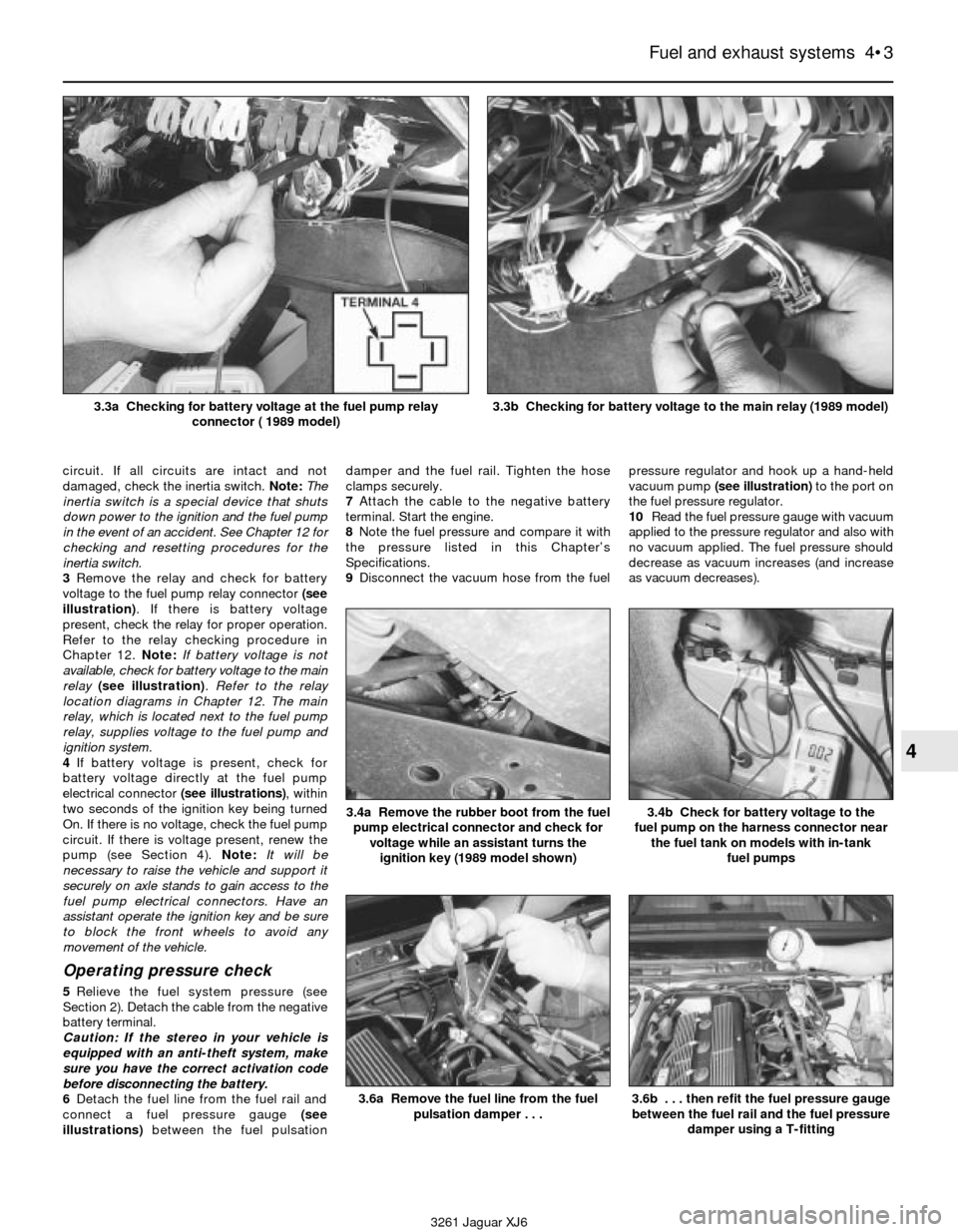
3Remove the relay and check for battery
voltage to the fuel pump relay connector (see
illustration). If there is battery voltage
present, check the relay for proper operation.
Refer to the relay checking procedure in
Chapter 12. Note:If battery voltage is not
available, check for battery voltage to the main
relay(see illustration). Refer to the relay
location diagrams in Chapter 12. The main
relay, which is located next to the fuel pump
relay, supplies voltage to the fuel pump and
ignition system.
4If battery voltage is present, check for
battery voltage directly at the fuel pump
electrical connector (see illustrations), within
two seconds of the ignition key being turned
On. If there is no voltage, check the fuel pump
circuit. If there is voltage present, renew the
pump (see Section 4). Note:It will be
necessary to raise the vehicle and support it
securely on axle stands to gain access to the
fuel pump electrical connectors. Have an
assistant operate the ignition key and be sure
to block the front wheels to avoid any
movement of the vehicle.
Operating pressure check
5Relieve the fuel system pressure (see
Section 2). Detach the cable from the negative
battery terminal.
Caution: If the stereo in your vehicle is
equipped with an anti-theft system, make
sure you have the correct activation code
before disconnecting the battery.
6Detach the fuel line from the fuel rail and
connect a fuel pressure gauge(see
illustrations)between the fuel pulsationdamper and the fuel rail. Tighten the hose
clamps securely.
7Attach the cable to the negative battery
terminal. Start the engine.
8Note the fuel pressure and compare it with
the pressure listed in this Chapter’s
Specifications.
9Disconnect the vacuum hose from the fuelpressure regulator and hook up a hand-held
vacuum pump (see illustration)to the port on
the fuel pressure regulator.
10Read the fuel pressure gauge with vacuum
applied to the pressure regulator and also with
no vacuum applied. The fuel pressure should
decrease as vacuum increases (and increase
as vacuum decreases).
Fuel and exhaust systems 4•3
4
3261 Jaguar XJ6 3.3a Checking for battery voltage at the fuel pump relay
connector ( 1989 model)
3.3b Checking for battery voltage to the main relay (1989 model)
3.6a Remove the fuel line from the fuel
pulsation damper . . .
3.4b Check for battery voltage to the
fuel pump on the harness connector near
the fuel tank on models with in-tank
fuel pumps3.4a Remove the rubber boot from the fuel
pump electrical connector and check for
voltage while an assistant turns the
ignition key (1989 model shown)
3.6b . . . then refit the fuel pressure gauge
between the fuel rail and the fuel pressure
damper using a T-fitting
Page 92 of 227
11Reconnect the vacuum hose to the
regulator and check the fuel pressure at idle,
comparing your reading with the value listed
in this Chapter’s Specifications. Disconnect
the vacuum hose and watch the gauge - the
pressure should jump up considerably as
soon as the hose is disconnected. If it
doesn’t, check for a vacuum signal to the fuel
pressure regulator (see Step 14).
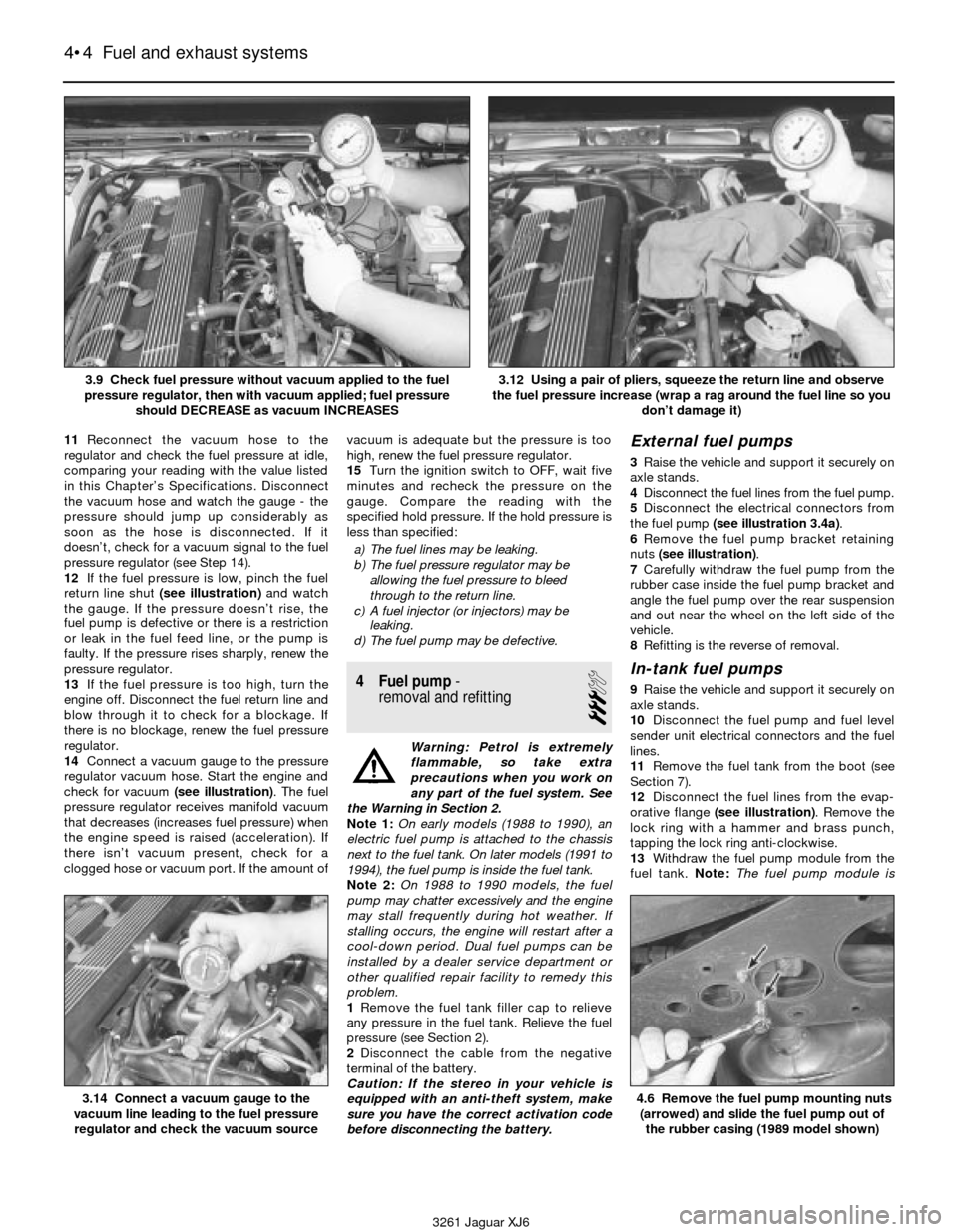
12If the fuel pressure is low, pinch the fuel
return line shut (see illustration)and watch
the gauge. If the pressure doesn’t rise, the
fuel pump is defective or there is a restriction
or leak in the fuel feed line, or the pump is
faulty. If the pressure rises sharply, renew the
pressure regulator.
13If the fuel pressure is too high, turn the
engine off. Disconnect the fuel return line and
blow through it to check for a blockage. If
there is no blockage, renew the fuel pressure
regulator.
14Connect a vacuum gauge to the pressure
regulator vacuum hose. Start the engine and
check for vacuum (see illustration). The fuel
pressure regulator receives manifold vacuum
that decreases (increases fuel pressure) when
the engine speed is raised (acceleration). If
there isn’t vacuum present, check for a
clogged hose or vacuum port. If the amount ofvacuum is adequate but the pressure is too
high, renew the fuel pressure regulator.
15Turn the ignition switch to OFF, wait five
minutes and recheck the pressure on the
gauge. Compare the reading with the
specified hold pressure. If the hold pressure is
less than specified:
a) The fuel lines may be leaking.
b) The fuel pressure regulator may be
allowing the fuel pressure to bleed
through to the return line.
c) A fuel injector (or injectors) may be
leaking.
d) The fuel pump may be defective.
4 Fuel pump-
removal and refitting
3
Warning: Petrol is extremely
flammable, so take extra
precautions when you work on
any part of the fuel system. See
the Warning in Section 2.
Note 1:On early models (1988 to 1990), an
electric fuel pump is attached to the chassis
next to the fuel tank. On later models (1991 to
1994), the fuel pump is inside the fuel tank.
Note 2: On 1988 to 1990 models, the fuel
pump may chatter excessively and the engine
may stall frequently during hot weather. If
stalling occurs, the engine will restart after a
cool-down period. Dual fuel pumps can be
installed by a dealer service department or
other qualified repair facility to remedy this
problem.
1Remove the fuel tank filler cap to relieve
any pressure in the fuel tank. Relieve the fuel
pressure (see Section 2).
2Disconnect the cable from the negative
terminal of the battery.
Caution: If the stereo in your vehicle is
equipped with an anti-theft system, make
sure you have the correct activation code
before disconnecting the battery.
External fuel pumps
3Raise the vehicle and support it securely on
axle stands.
4Disconnect the fuel lines from the fuel pump.
5Disconnect the electrical connectors from
the fuel pump (see illustration 3.4a).
6Remove the fuel pump bracket retaining
nuts (see illustration).
7Carefully withdraw the fuel pump from the
rubber case inside the fuel pump bracket and
angle the fuel pump over the rear suspension
and out near the wheel on the left side of the
vehicle.
8Refitting is the reverse of removal.
In-tank fuel pumps
9Raise the vehicle and support it securely on
axle stands.
10Disconnect the fuel pump and fuel level
sender unit electrical connectors and the fuel
lines.
11Remove the fuel tank from the boot (see
Section 7).
12Disconnect the fuel lines from the evap-
orative flange (see illustration). Remove the
lock ring with a hammer and brass punch,
tapping the lock ring anti-clockwise.
13Withdraw the fuel pump module from the
fuel tank. Note: The fuel pump module is
4•4 Fuel and exhaust systems
3.14 Connect a vacuum gauge to the
vacuum line leading to the fuel pressure
regulator and check the vacuum source4.6 Remove the fuel pump mounting nuts
(arrowed) and slide the fuel pump out of
the rubber casing (1989 model shown)
3261 Jaguar XJ6 3.9 Check fuel pressure without vacuum applied to the fuel
pressure regulator, then with vacuum applied; fuel pressure
should DECREASE as vacuum INCREASES
3.12 Using a pair of pliers, squeeze the return line and observe
the fuel pressure increase (wrap a rag around the fuel line so you
don’t damage it)