power steering JAGUAR XJ6 1997 2.G User Guide
[x] Cancel search | Manufacturer: JAGUAR, Model Year: 1997, Model line: XJ6, Model: JAGUAR XJ6 1997 2.GPages: 227, PDF Size: 7.2 MB
Page 25 of 227
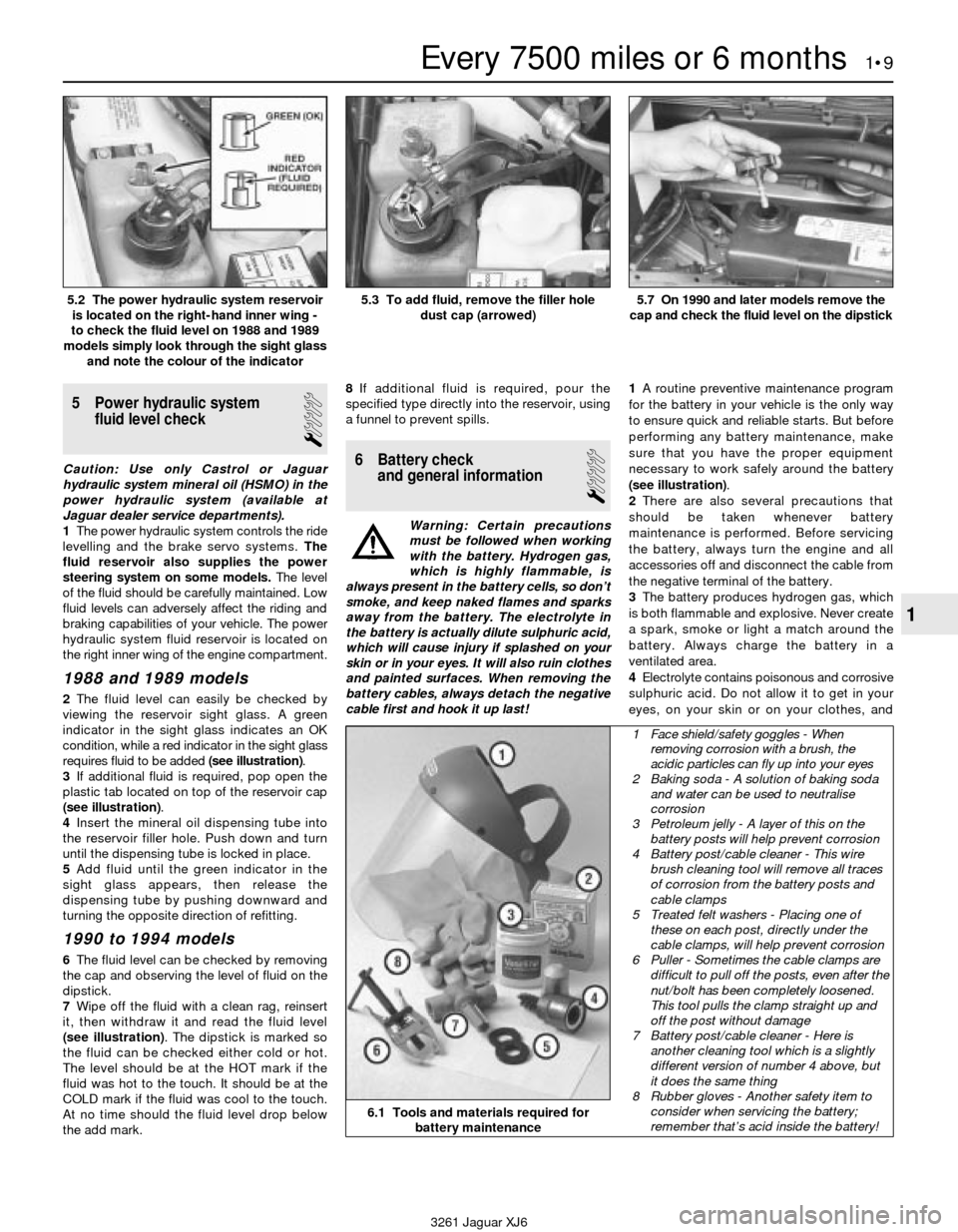
5 Power hydraulic system
fluid level check
1
Caution: Use only Castrol or Jaguar
hydraulic system mineral oil (HSMO) in the
power hydraulic system (available at
Jaguar dealer service departments).
1The power hydraulic system controls the ride
levelling and the brake servo systems. The
fluid reservoir also supplies the power
steering system on some models. The level
of the fluid should be carefully maintained. Low
fluid levels can adversely affect the riding and
braking capabilities of your vehicle. The power
hydraulic system fluid reservoir is located on
the right inner wing of the engine compartment.
1988 and 1989 models
2The fluid level can easily be checked by
viewing the reservoir sight glass. A green
indicator in the sight glass indicates an OK
condition, while a red indicator in the sight glass
requires fluid to be added (see illustration).
3If additional fluid is required, pop open the
plastic tab located on top of the reservoir cap
(see illustration).
4Insert the mineral oil dispensing tube into
the reservoir filler hole. Push down and turn
until the dispensing tube is locked in place.
5Add fluid until the green indicator in the
sight glass appears, then release the
dispensing tube by pushing downward and
turning the opposite direction of refitting.
1990 to 1994 models
6The fluid level can be checked by removing
the cap and observing the level of fluid on the
dipstick.
7Wipe off the fluid with a clean rag, reinsert
it, then withdraw it and read the fluid level
(see illustration). The dipstick is marked so
the fluid can be checked either cold or hot.
The level should be at the HOT mark if the
fluid was hot to the touch. It should be at the
COLD mark if the fluid was cool to the touch.
At no time should the fluid level drop below
the add mark.8If additional fluid is required, pour the
specified type directly into the reservoir, using
a funnel to prevent spills.
6 Battery check
and general information
1
Warning: Certain precautions
must be followed when working
with the battery. Hydrogen gas,
which is highly flammable, is
always present in the battery cells, so don’t
smoke, and keep naked flames and sparks
away from the battery. The electrolyte in
the battery is actually dilute sulphuric acid,
which will cause injury if splashed on your
skin or in your eyes. It will also ruin clothes
and painted surfaces. When removing the
battery cables, always detach the negative
cable first and hook it up last!1A routine preventive maintenance program
for the battery in your vehicle is the only way
to ensure quick and reliable starts. But before
performing any battery maintenance, make
sure that you have the proper equipment
necessary to work safely around the battery
(see illustration).
2There are also several precautions that
should be taken whenever battery
maintenance is performed. Before servicing
the battery, always turn the engine and all
accessories off and disconnect the cable from
the negative terminal of the battery.
3The battery produces hydrogen gas, which
is both flammable and explosive. Never create
a spark, smoke or light a match around the
battery. Always charge the battery in a
ventilated area.
4Electrolyte contains poisonous and corrosive
sulphuric acid. Do not allow it to get in your
eyes, on your skin or on your clothes, and
Every 7500 miles or 6 months 1•9
1
5.2 The power hydraulic system reservoir
is located on the right-hand inner wing -
to check the fluid level on 1988 and 1989
models simply look through the sight glass
and note the colour of the indicator5.3 To add fluid, remove the filler hole
dust cap (arrowed)5.7 On 1990 and later models remove the
cap and check the fluid level on the dipstick
6.1 Tools and materials required for
battery maintenance
1 Face shield/safety goggles - When
removing corrosion with a brush, the
acidic particles can fly up into your eyes
2 Baking soda - A solution of baking soda
and water can be used to neutralise
corrosion
3 Petroleum jelly - A layer of this on the
battery posts will help prevent corrosion
4 Battery post/cable cleaner - This wire
brush cleaning tool will remove all traces
of corrosion from the battery posts and
cable clamps
5 Treated felt washers - Placing one of
these on each post, directly under the
cable clamps, will help prevent corrosion
6 Puller - Sometimes the cable clamps are
difficult to pull off the posts, even after the
nut/bolt has been completely loosened.
This tool pulls the clamp straight up and
off the post without damage
7 Battery post/cable cleaner - Here is
another cleaning tool which is a slightly
different version of number 4 above, but
it does the same thing
8 Rubber gloves - Another safety item to
consider when servicing the battery;
remember that’s acid inside the battery!
3261 Jaguar XJ6
Page 27 of 227
leak be found, renew the offending gasket or
oil seal by referring to the appropriate
Chapters in this manual.
2Also check the security and condition of all
the engine-related pipes and hoses. Ensure
that all cable ties or securing clips are in place
and in good condition. Clips which are broken
or missing can lead to chafing of the hoses,
pipes or wiring, which could cause more
serious problems in the future.
3Carefully check the radiator hoses and
heater hoses along their entire length. Renew
any hose which is cracked, swollen or
deteriorated. Cracks will show up better if
the hose is squeezed. Pay close attention
to the hose clips that secure the hoses to the
cooling system components. Hose clips can
pinch and puncture hoses, resulting in cooling
system leaks.
4Inspect all the cooling system components
(hoses, joint faces etc.) for leaks. A leak in the
cooling system will usually show up as white-
or rust-coloured deposits on the area
adjoining the leak. Where any problems of this
nature are found on system components,
renew the component or gasket with
reference to Chapter 3.
5From within the engine compartment,
check the security of all fuel hose attachments
and pipe unions, and inspect the fuel hoses
and vacuum hoses for kinks, chafing and
deterioration.
6Also check the condition of the power
steering fluid hoses and pipes.
8 Automatic transmission
fluid level check
1
1The level of the automatic transmission fluid
should be carefully maintained. Low fluid level
can lead to slipping or loss of drive, while
overfilling can cause foaming, loss of fluid and
transmission damage.
2The transmission fluid level should only be
checked when the transmission is at its
normal operating temperature.
Caution: If the vehicle has just been driven
for a long time at high speed or in city
traffic in hot weather, or if it has been
pulling a trailer, an accurate fluid level
reading cannot be obtained. Allow the fluid
to cool down for about 30 minutes.
3If the vehicle has not been driven, park the
vehicle on level ground, set the handbrake,
then start the engine and bring it to operating
temperature. While the engine is idling,
depress the brake pedal and move the
selector lever through all the gear ranges,
beginning and ending in Park.
4With the engine still idling, remove the
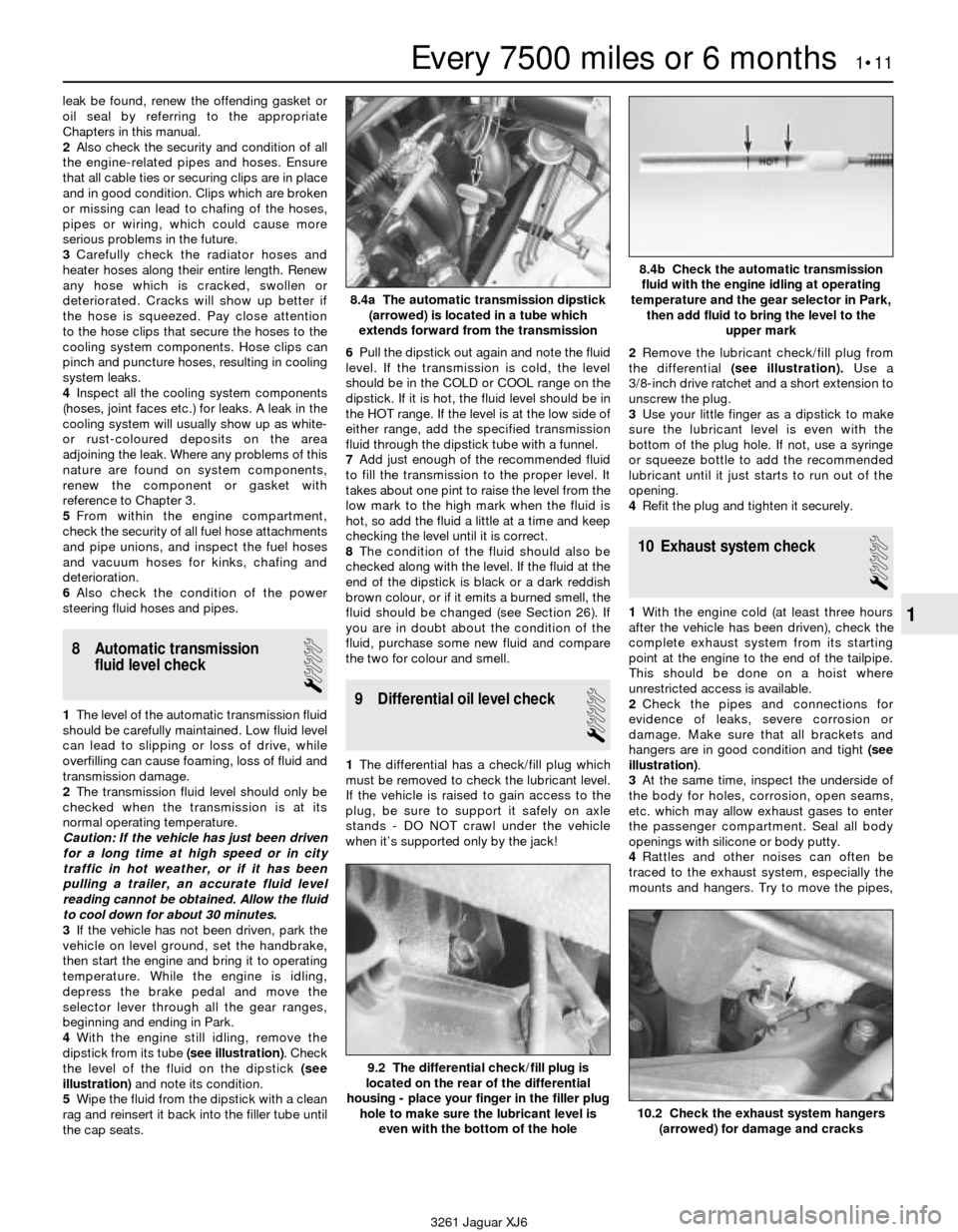
dipstick from its tube (see illustration). Check
the level of the fluid on the dipstick (see
illustration)and note its condition.
5Wipe the fluid from the dipstick with a clean
rag and reinsert it back into the filler tube until
the cap seats.6Pull the dipstick out again and note the fluid
level. If the transmission is cold, the level
should be in the COLD or COOL range on the
dipstick. If it is hot, the fluid level should be in
the HOT range. If the level is at the low side of
either range, add the specified transmission
fluid through the dipstick tube with a funnel.
7Add just enough of the recommended fluid
to fill the transmission to the proper level. It
takes about one pint to raise the level from the
low mark to the high mark when the fluid is
hot, so add the fluid a little at a time and keep
checking the level until it is correct.
8The condition of the fluid should also be
checked along with the level. If the fluid at the
end of the dipstick is black or a dark reddish
brown colour, or if it emits a burned smell, the
fluid should be changed (see Section 26). If
you are in doubt about the condition of the
fluid, purchase some new fluid and compare
the two for colour and smell.9 Differential oil level check
1
1The differential has a check/fill plug which
must be removed to check the lubricant level.
If the vehicle is raised to gain access to the
plug, be sure to support it safely on axle
stands - DO NOT crawl under the vehicle
when it’s supported only by the jack!2Remove the lubricant check/fill plug from
the differential (see illustration).Use a
3/8-inch drive ratchet and a short extension to
unscrew the plug.
3Use your little finger as a dipstick to make
sure the lubricant level is even with the
bottom of the plug hole. If not, use a syringe
or squeeze bottle to add the recommended
lubricant until it just starts to run out of the
opening.
4Refit the plug and tighten it securely.
10 Exhaust system check
1
1With the engine cold (at least three hours
after the vehicle has been driven), check the
complete exhaust system from its starting
point at the engine to the end of the tailpipe.
This should be done on a hoist where
unrestricted access is available.
2Check the pipes and connections for
evidence of leaks, severe corrosion or
damage. Make sure that all brackets and
hangers are in good condition and tight (see
illustration).
3At the same time, inspect the underside of
the body for holes, corrosion, open seams,
etc. which may allow exhaust gases to enter
the passenger compartment. Seal all body
openings with silicone or body putty.
4Rattles and other noises can often be
traced to the exhaust system, especially the
mounts and hangers. Try to move the pipes,
Every 7500 miles or 6 months 1•11
1
9.2 The differential check/fill plug is
located on the rear of the differential
housing - place your finger in the filler plug
hole to make sure the lubricant level is
even with the bottom of the hole
10.2 Check the exhaust system hangers
(arrowed) for damage and cracks
3261 Jaguar XJ6
8.4a The automatic transmission dipstick
(arrowed) is located in a tube which
extends forward from the transmission
8.4b Check the automatic transmission
fluid with the engine idling at operating
temperature and the gear selector in Park,
then add fluid to bring the level to the
upper mark
Page 32 of 227
20 Crankcase ventilation
system check
1
Refer to Chapter 6.
21 Drivebelt check and renewal
2
Check
1The drivebelts, or V-belts as they are
sometimes called, are located at the front of
the engine and play an important role in the
overall operation of the vehicle and its
components. Due to their function and
material make-up, the belts are prone to
failure after a period of time and should be
inspected and adjusted periodically to prevent
major engine damage.
2The number of belts used on a particular
vehicle depends on the accessories installed.
The main belt transmits power from the
crankshaft to the water pump, alternator and
the power steering pump. The second belt
transmits power from the crankshaft to the air
conditioning compressor.
3With the engine off, open the bonnet and
locate the drivebelts. With a flashlight, check
each belt for separation of the adhesive
rubber on both sides of the core, core
separation from the belt side, a severed core,
separation of the ribs from the adhesive
rubber, cracking or separation of the ribs, and
torn or worn ribs or cracks in the inner ridges
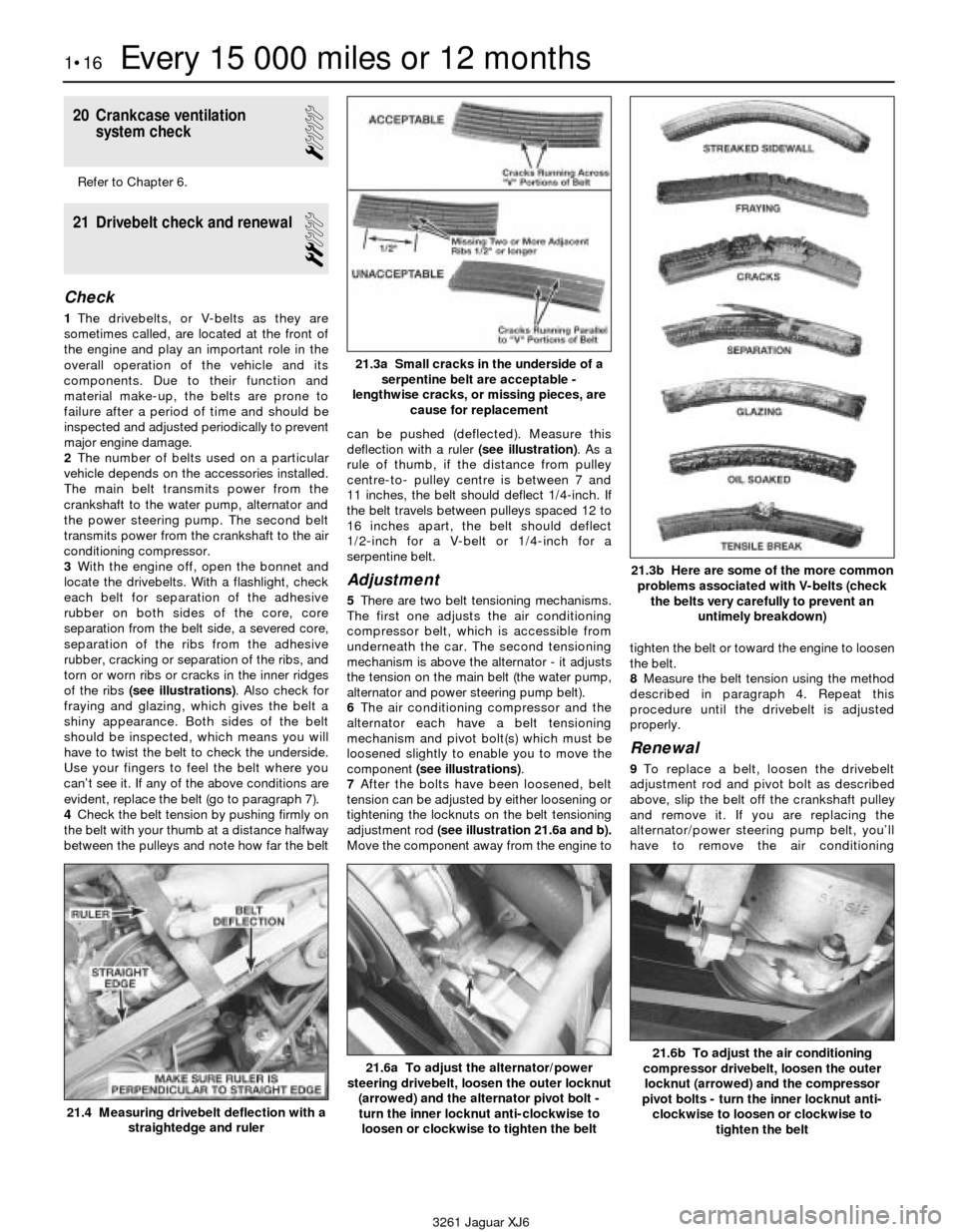
of the ribs (see illustrations). Also check for
fraying and glazing, which gives the belt a
shiny appearance. Both sides of the belt
should be inspected, which means you will
have to twist the belt to check the underside.
Use your fingers to feel the belt where you
can’t see it. If any of the above conditions are
evident, replace the belt (go to paragraph 7).
4Check the belt tension by pushing firmly on
the belt with your thumb at a distance halfway
between the pulleys and note how far the beltcan be pushed (deflected). Measure this
deflection with a ruler (see illustration). As a
rule of thumb, if the distance from pulley
centre-to- pulley centre is between 7 and
11 inches, the belt should deflect 1/4-inch. If
the belt travels between pulleys spaced 12 to
16 inches apart, the belt should deflect
1/2-inch for a V-belt or 1/4-inch for a
serpentine belt.
Adjustment
5There are two belt tensioning mechanisms.
The first one adjusts the air conditioning
compressor belt, which is accessible from
underneath the car. The second tensioning
mechanism is above the alternator - it adjusts
the tension on the main belt (the water pump,
alternator and power steering pump belt).
6The air conditioning compressor and the
alternator each have a belt tensioning
mechanism and pivot bolt(s) which must be
loosened slightly to enable you to move the
component (see illustrations).
7After the bolts have been loosened, belt
tension can be adjusted by either loosening or
tightening the locknuts on the belt tensioning
adjustment rod (see illustration 21.6a and b).
Move the component away from the engine totighten the belt or toward the engine to loosen
the belt.
8Measure the belt tension using the method
described in paragraph 4. Repeat this
procedure until the drivebelt is adjusted
properly.
Renewal
9To replace a belt, loosen the drivebelt
adjustment rod and pivot bolt as described
above, slip the belt off the crankshaft pulley
and remove it. If you are replacing the
alternator/power steering pump belt, you’ll
have to remove the air conditioning
1•16Every 15 000 miles or 12 months
21.3a Small cracks in the underside of a
serpentine belt are acceptable -
lengthwise cracks, or missing pieces, are
cause for replacement
21.3b Here are some of the more common
problems associated with V-belts (check
the belts very carefully to prevent an
untimely breakdown)
21.4 Measuring drivebelt deflection with a
straightedge and ruler
21.6a To adjust the alternator/power
steering drivebelt, loosen the outer locknut
(arrowed) and the alternator pivot bolt -
turn the inner locknut anti-clockwise to
loosen or clockwise to tighten the belt21.6b To adjust the air conditioning
compressor drivebelt, loosen the outer
locknut (arrowed) and the compressor
pivot bolts - turn the inner locknut anti-
clockwise to loosen or clockwise to
tighten the belt
3261 Jaguar XJ6
Page 45 of 227

23Clean and lubricate the lower tensioner.
Fill the lower tensioner oil reservoir with engine
oil and refit it on the engine block, aligning the
notch in the tensioner with the lug on the back
of the guide (see illustrations). This should
remove all slack from the lower timing chain. If
not, push the lower tensioner guide back and
forth a few times to prime the tensioner.
24Refit the upper chain tensioner guide and
mounting bracket to the engine block.
Caution: Before fully tightening the
mounting bracket to the engine block,
make sure the mount and chain guide are
clear of the lower chain, auxiliary sprocket
and intermediate sprocket. If necessary,
position the mount for clearance before
tightening the mounting bolts.
25Refit the oil pump drive chain and
sprocket to the crankshaft (see Section 13).
26Refit the upper chain fixed guide to the
engine block and place the upper timing chain
over the intermediate sprocket and auxiliary
shaft sprocket, draping the excess chain over
the top of the fixed guide. Lubricate the chain
and sprockets with clean engine oil.27Gather the loose portion of the upper
timing chain and place it between the upper
guides. Use a large rubber band to hold the
two guides snugly around the chain (see
Section 11).
28If necessary, renew the intermediate shaft
seal (see illustrations).
29Apply a thin coat of RTV sealant to the
engine side of the front cover and RTV sealant
to the oil-pan mating surface (bottom of the
front cover), then refit the front cover. Note:
Make sure the top surface of the cover aligns
with the top surface of the engine block, by
checking with a straightedge(see illustration).
30Refer to Section 11 for refitting of the
cylinder head and Section 10 for refitting of
the camshafts and connection of the upper
timing chain to the two camshaft sprockets.
31The remainder of the refitting is the
reverse of the removal procedure. If your car
is equipped with the hydraulic/self-levelling
suspension, refit the drive coupling and
coupling disc to the intermediate shaft (see
illustrations 8.9a and 8.9b). Coat the
mounting surface of the pump with RTVsealant and make sure the tang on the pump
aligns with the slot in the intermediate shaft
before bolting the pump to the front cover.
Refer to Section 7 for refitting of the
crankshaft spacer, damper and puller.
Caution: DO NOT start the engine until
you’re absolutely certain that the timing
chains are installed correctly. Serious and
costly engine damage could occur if the
chains are installed wrong.
32Run the engine and check for proper
operation.
9 Auxiliary shaft- renewal
3
Caution: If the stereo in your vehicle is
equipped with an anti-theft system, make
sure you have the correct activation code
before disconnecting the battery.
1Refer to Chapter 10 and remove the power
steering pump, without disconnecting the
hoses. Remove the plastic power steering
pump drive coupling disc.
2A•8 Engine in-car repair procedures
8.28a Drill a small hole in the intermediate
shaft seal, thread a sheet metal screw into
it and use a small slide-hammer pull the
seal out of the cover8.28b Drive the new seal in with a seal-
driver or socket, to the same depth as the
original seal8.29 Bolt the front cover on hand tight, use
a straightedge to make sure the cover’s
top surface is level with the top of the
engine block, then tighten the cover bolts
3261 Jaguar XJ6 8.23a Add oil to the reservoir in the lower tensioner . . .
8.23b . . . and refit the tensioner against the guide -
after it’s installed, push the tensioner guide back and forth
a few times to prime the tensioner
Page 46 of 227

2Refer to Section 8 and remove the front
cover and upper and lower timing chains.
3Remove the power steering drive coupling
from the auxiliary shaft (see illustration).
4Use a small drill to drill holes in the oil seal,
then use a slide-hammer puller to remove the
seal from the rear of the auxiliary shaft
housing (see illustration).
Caution: Drill straight and carefully to avoid
damaging the auxiliary shaft.
5Use a pair of snap-ring pliers to remove the
snap ring from the rear of the auxiliary shaft
(see illustration).
6Pull the auxiliary shaft out toward the front
of the engine.
7Remove the three internal hex-head bolts
and the auxiliary shaft housing.
8Examine the surface of the auxiliary shaft,
it’s sprocket, and the distributor drive-gear. If
there is noticeable wear or damage, replace
the auxiliary shaft assembly with a new one
(see illustration).
9If the auxiliary shaft housing has been
removed, clean it, scrape away the old gasket
material from the housing and the engine
block and refit the housing with a new gasket
(see illustration).
10Clean the auxiliary shaft, lubricate it with
engine oil and refit it through the front of the
block, then refit the washer (see illustration).
Refit the snap-ring(refer to illustration 9.4).11The new oil seal for the rear of the auxiliary
shaft comes with a plastic refitting sleeve that
keeps the seal lip from folding back during
refitting. Keep this sleeve in place until the seal
is fully installed. Tap the new seal into the
housing with a hammer and appropriate-size
socket until the seal is flush, then remove the
plastic sleeve (see illustration).
12The remainder of the refitting is the
reverse of removal. Note:When refitting the
distributor (see Chapter 5), use a new O-ring
to prevent oil leaks at the distributor.
13Run the engine and check for oil leaks at
the power steering pump-to-housing interface.10 Camshafts and valve lifters-
removal, inspection and
refitting
4
Removal
Note:The renewal of the camshafts requires
the use of several special tools. Read through
the procedure and acquire the special tools,
or their equivalent, before beginning work.
1Remove the valve cover (see Section 4).
2Refer to Section 3 and position the engine
at TDC for number 1 cylinder.
3Refer to Chapter 5 and remove the
distributor cap and set it aside along with the
spark plug leads. Mark the positions of the
distributor body and rotor.
4Using a feeler gauge, measure and record
the clearance between the intake and exhaust
camshaft lobes and the lifters for cylinder
number 1 (see illustration). Rotate the
crankshaft until the next cylinder in the firing
order is at TDC and check and record the
valve clearance for that cylinder. Following the
firing order, check and record the valve
clearance for the remaining valves with the
appropriate cylinder at TDC.
5Return the engine to TDC for cylinder
number 1. Using the special tool (Jaguar tool
no. 18G 1433), check the position of each
Engine in-car repair procedures 2A•9
2A
9.3 Use a screwdriver to hold the drive
coupling (arrowed) stationary while
removing the bolt9.4 Remove the auxiliary shaft seal with a
small slide-hammer puller9.5 Use snap-ring pliers to remove the
snap ring (arrowed) from the shaft - note
the three internal hex-head bolts retaining
the housing to the engine block
9.8 Inspect these areas of the auxiliary
shaft for wear
A Oil seal surface
B Bearing journalC Sprocket
D Distributor drive9.9 Refit the auxiliary shaft rear housing
with a new gasket, aligning the oil slot
(arrowed) with the housing
3261 Jaguar XJ6
9.10 Refit the washer before replacing the
snap-ring
9.11 Tap the seal squarely into the bore
with a socket until the seal is flush
with the housing, then remove the
plastic fitting sleeve
Page 60 of 227
11Disconnect the throttle linkage,
transmission linkage (and dipstick tube) and
speed control cable, if equipped, from the
engine (see Chapters 4 and 7).
12Refer to Part A of this Chapter and
remove the intake and exhaust manifolds.
13Unbolt the power steering pump (see
Chapter 10). Tie the pump aside without
disconnecting the hoses. Refer to Part A for
removal of the hydraulic pump (if equipped)
from the timing chain cover.
14On air-conditioned models, unbolt the
compressor and set it aside. Do not
disconnect the refrigerant hoses. Note:Wire
the compressor out of the way with a coat
hanger, don’t let the compressor hang on the
hoses.
15Refer to Part A of this Chapter and
remove the drivebelts, water pump pulley and
crankshaft pulley.
16Attach a lifting sling to the engine.
Position a hoist and connect the sling to it.
Take up the slack until there is slight tension
on the hoist.
17With a trolley jack and piece of wood
supporting the bottom of the transmission
sump, refer to Chapter 8 and remove the
driveshaft and rear transmission mount.
Warning: Do not place any part
of your body under the
engine/transmission when it’s
supported only by a hoist or
other lifting device.
18With the hoist taking the weight of the
engine, unbolt the engine mounts (see Part A
of this Chapter).
19Recheck to be sure nothing is still
connecting the engine or transmission to the
vehicle. Disconnect and label anything still
remaining.
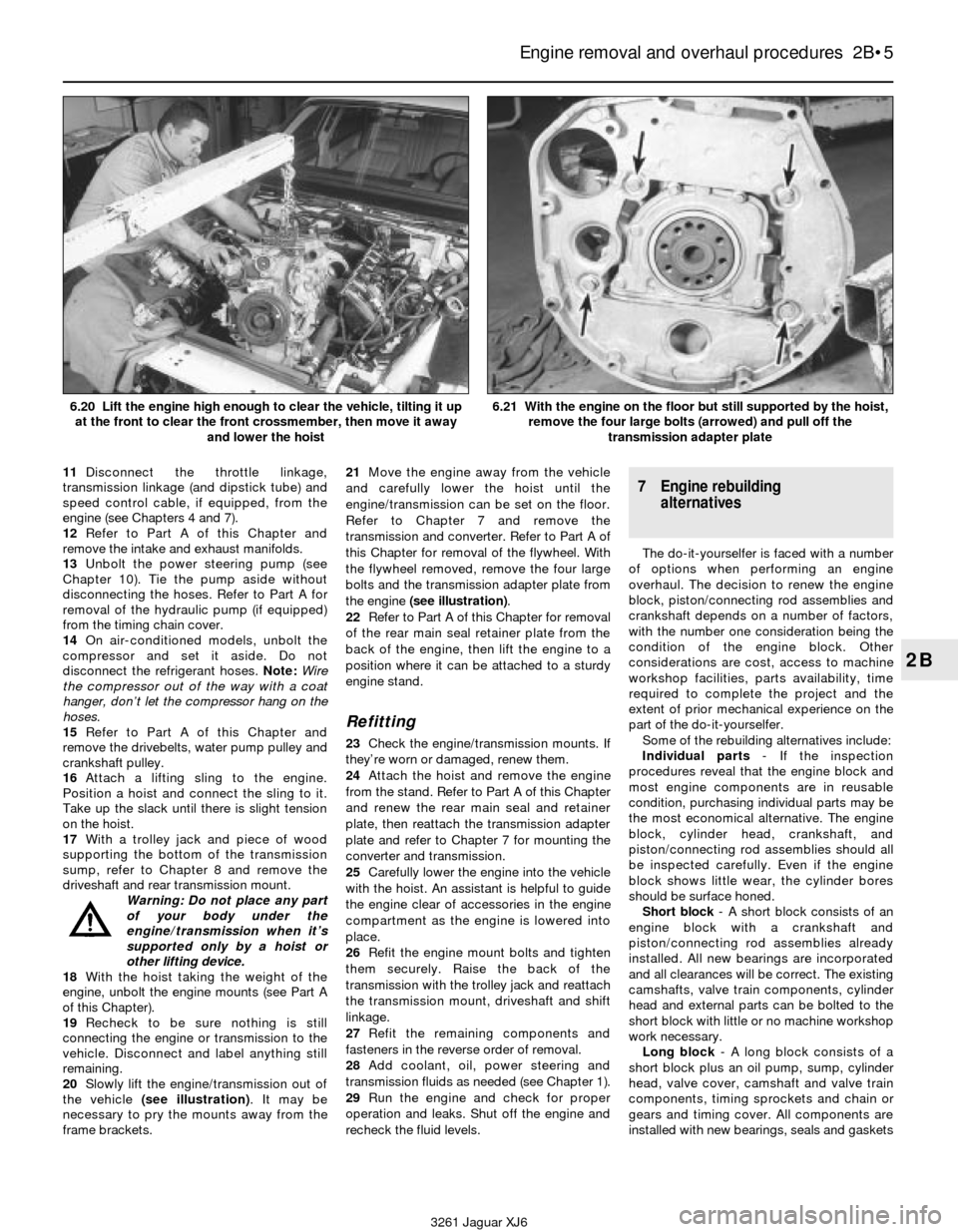
20Slowly lift the engine/transmission out of
the vehicle (see illustration). It may be
necessary to pry the mounts away from the
frame brackets.21Move the engine away from the vehicle
and carefully lower the hoist until the
engine/transmission can be set on the floor.
Refer to Chapter 7 and remove the
transmission and converter. Refer to Part A of
this Chapter for removal of the flywheel. With
the flywheel removed, remove the four large
bolts and the transmission adapter plate from
the engine (see illustration).
22Refer to Part A of this Chapter for removal
of the rear main seal retainer plate from the
back of the engine, then lift the engine to a
position where it can be attached to a sturdy
engine stand.
Refitting
23Check the engine/transmission mounts. If
they’re worn or damaged, renew them.
24Attach the hoist and remove the engine
from the stand. Refer to Part A of this Chapter
and renew the rear main seal and retainer
plate, then reattach the transmission adapter
plate and refer to Chapter 7 for mounting the
converter and transmission.
25Carefully lower the engine into the vehicle
with the hoist. An assistant is helpful to guide
the engine clear of accessories in the engine
compartment as the engine is lowered into
place.
26Refit the engine mount bolts and tighten
them securely. Raise the back of the
transmission with the trolley jack and reattach
the transmission mount, driveshaft and shift
linkage.
27Refit the remaining components and
fasteners in the reverse order of removal.
28Add coolant, oil, power steering and
transmission fluids as needed (see Chapter 1).
29Run the engine and check for proper
operation and leaks. Shut off the engine and
recheck the fluid levels.
7 Engine rebuilding
alternatives
The do-it-yourselfer is faced with a number
of options when performing an engine
overhaul. The decision to renew the engine
block, piston/connecting rod assemblies and
crankshaft depends on a number of factors,
with the number one consideration being the
condition of the engine block. Other
considerations are cost, access to machine
workshop facilities, parts availability, time
required to complete the project and the
extent of prior mechanical experience on the
part of the do-it-yourselfer.
Some of the rebuilding alternatives include:
Individual parts- If the inspection
procedures reveal that the engine block and
most engine components are in reusable
condition, purchasing individual parts may be
the most economical alternative. The engine
block, cylinder head, crankshaft, and
piston/connecting rod assemblies should all
be inspected carefully. Even if the engine
block shows little wear, the cylinder bores
should be surface honed.
Short block- A short block consists of an
engine block with a crankshaft and
piston/connecting rod assemblies already
installed. All new bearings are incorporated
and all clearances will be correct. The existing
camshafts, valve train components, cylinder
head and external parts can be bolted to the
short block with little or no machine workshop
work necessary.
Long block- A long block consists of a
short block plus an oil pump, sump, cylinder
head, valve cover, camshaft and valve train
components, timing sprockets and chain or
gears and timing cover. All components are
installed with new bearings, seals and gaskets
Engine removal and overhaul procedures 2B•5
2B
3261 Jaguar XJ6 6.20 Lift the engine high enough to clear the vehicle, tilting it up
at the front to clear the front crossmember, then move it away
and lower the hoist
6.21 With the engine on the floor but still supported by the hoist,
remove the four large bolts (arrowed) and pull off the
transmission adapter plate
Page 78 of 227
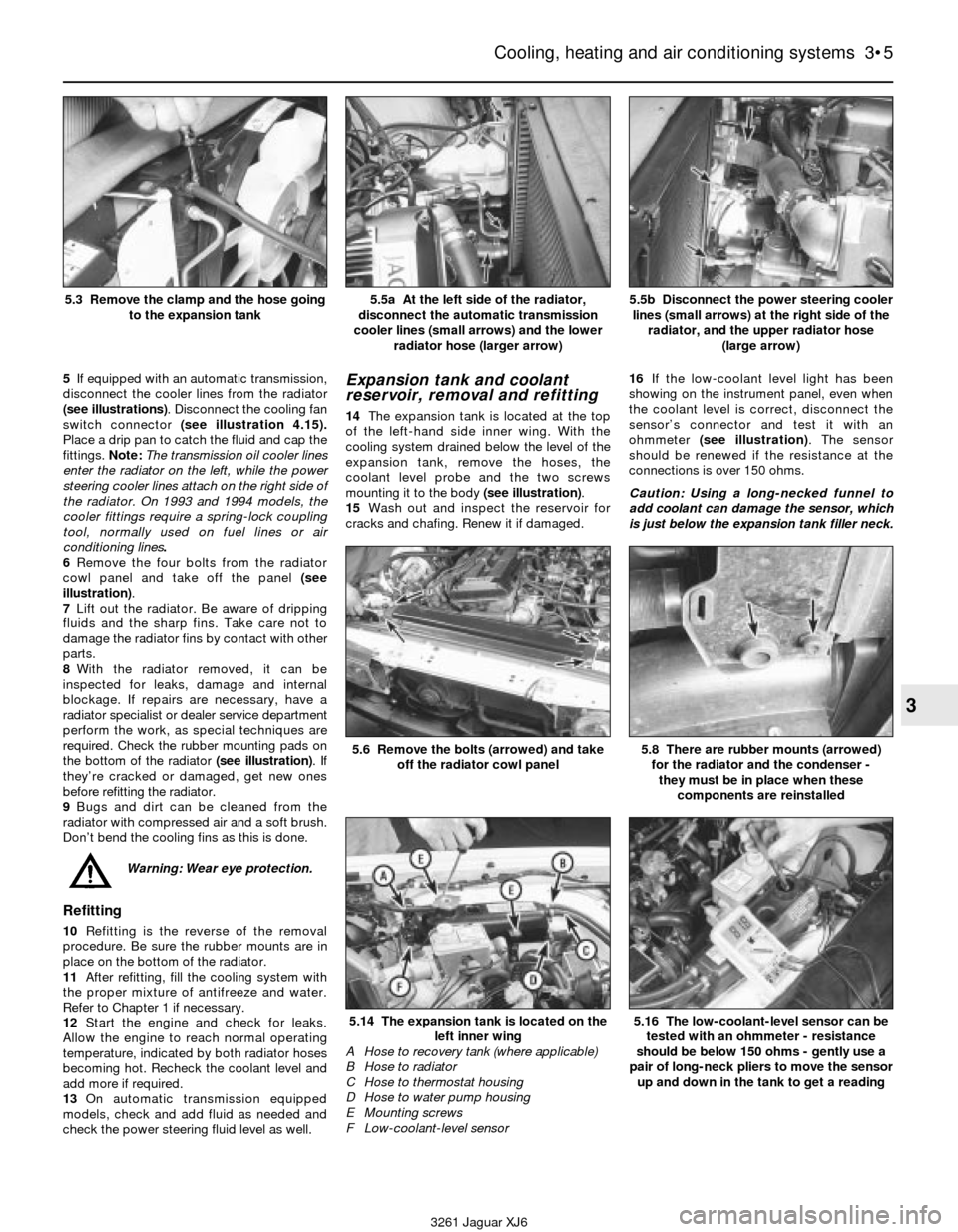
5If equipped with an automatic transmission,
disconnect the cooler lines from the radiator
(see illustrations). Disconnect the cooling fan
switch connector (see illustration 4.15).
Place a drip pan to catch the fluid and cap the
fittings. Note:The transmission oil cooler lines
enter the radiator on the left, while the power
steering cooler lines attach on the right side of
the radiator. On 1993 and 1994 models, the
cooler fittings require a spring-lock coupling
tool, normally used on fuel lines or air
conditioning lines.
6Remove the four bolts from the radiator
cowl panel and take off the panel (see
illustration).
7Lift out the radiator. Be aware of dripping
fluids and the sharp fins. Take care not to
damage the radiator fins by contact with other
parts.
8With the radiator removed, it can be
inspected for leaks, damage and internal
blockage. If repairs are necessary, have a
radiator specialist or dealer service department
perform the work, as special techniques are
required. Check the rubber mounting pads on
the bottom of the radiator (see illustration). If
they’re cracked or damaged, get new ones
before refitting the radiator.
9Bugs and dirt can be cleaned from the
radiator with compressed air and a soft brush.
Don’t bend the cooling fins as this is done.
Warning: Wear eye protection.
Refitting
10Refitting is the reverse of the removal
procedure. Be sure the rubber mounts are in
place on the bottom of the radiator.
11After refitting, fill the cooling system with
the proper mixture of antifreeze and water.
Refer to Chapter 1 if necessary.
12Start the engine and check for leaks.
Allow the engine to reach normal operating
temperature, indicated by both radiator hoses
becoming hot. Recheck the coolant level and
add more if required.
13On automatic transmission equipped
models, check and add fluid as needed and
check the power steering fluid level as well.
Expansion tank and coolant
reservoir, removal and refitting
14The expansion tank is located at the top
of the left-hand side inner wing. With the
cooling system drained below the level of the
expansion tank, remove the hoses, the
coolant level probe and the two screws
mounting it to the body (see illustration).
15Wash out and inspect the reservoir for
cracks and chafing. Renew it if damaged.16If the low-coolant level light has been
showing on the instrument panel, even when
the coolant level is correct, disconnect the
sensor’s connector and test it with an
ohmmeter (see illustration). The sensor
should be renewed if the resistance at the
connections is over 150 ohms.
Caution: Using a long-necked funnel to
add coolant can damage the sensor, which
is just below the expansion tank filler neck.
Cooling, heating and air conditioning systems 3•5
3
5.5a At the left side of the radiator,
disconnect the automatic transmission
cooler lines (small arrows) and the lower
radiator hose (larger arrow)5.5b Disconnect the power steering cooler
lines (small arrows) at the right side of the
radiator, and the upper radiator hose
(large arrow)
3261 Jaguar XJ6 5.3 Remove the clamp and the hose going
to the expansion tank
5.6 Remove the bolts (arrowed) and take
off the radiator cowl panel
5.14 The expansion tank is located on the
left inner wing
A Hose to recovery tank (where applicable)
B Hose to radiator
C Hose to thermostat housing
D Hose to water pump housing
E Mounting screws
F Low-coolant-level sensor
5.8 There are rubber mounts (arrowed)
for the radiator and the condenser -
they must be in place when these
components are reinstalled
5.16 The low-coolant-level sensor can be
tested with an ohmmeter - resistance
should be below 150 ohms - gently use a
pair of long-neck pliers to move the sensor
up and down in the tank to get a reading
Page 104 of 227
same dimensions, amperage rating, cold
cranking rating, etc. as the original.
6Refitting is the reverse of removal.
4 Battery cables-
check and renewal
1
Caution: If the stereo in your vehicle is
equipped with an anti-theft system, make
sure you have the correct activation code
before disconnecting the battery.
1Periodically inspect the entire length of
each battery cable for damage, cracked or
burned insulation and corrosion. Poor battery
cable connections can cause starting
problems and decreased engine performance.
2Check the cable-to-terminal connections at
the ends of the cables for cracks, loose wire
strands and corrosion. The presence of white,
fluffy deposits under the insulation at the
cable terminal connection is a sign that the
cable is corroded and should be renewed.
Check the terminals for distortion, missing
mounting bolts and corrosion.
3When removing the cables, always
disconnect the negative cable first and hook it
up last or the battery may be shorted by the
tool used to loosen the cable clamps. Even if
only the positive cable is being renewed, be
sure to disconnect the negative cable from
the battery first (see Chapter 1 for further
information regarding battery cable removal).
4Disconnect the cables from the battery,
then trace each of them to their opposite ends
and detach them from the starter solenoid
and earth terminals. Note the routing of each
cable to ensure correct refitting.
5If you are replacing either or both of the old
cables, take them with you when buying new
items. It is vitally important that you replace
the cables with identical parts. Cables have
characteristics that make them easy to
identify: positive cables are usually red, larger
in cross-section and have a larger diameter
battery post clamp; earth cables are usually
black, smaller in cross-section and have a
slightly smaller diameter clamp for the
negative post.
6Clean the threads of the solenoid or earth
connection with a wire brush to remove rust
and corrosion. Apply a light coat of battery
terminal corrosion inhibitor, or petroleum jelly,
to the threads to prevent future corrosion.
7Attach the cable to the solenoid or earth
connection and tighten the mounting nut/bolt
securely.
8Before connecting a new cable to the
battery, make sure that it reaches the battery
post without having to be stretched.
9Connect the positive cable first, followed by
the negative cable.
5 Ignition system- general
information and precautions
1All models are equipped with a computerised
ignition system. The ignition system consists of
the ignition coil, the crankshaft position sensor,
the amplifier and the electronic control unit
(ECU). The ignition ECU controls the ignition
timing and advance characteristics for the
engine. The ignition timing is not adjustable,
therefore, changing the position of the distributor
will not change the timing in any way. Note:In
the event the distributor must be removed from
the engine, be sure to follow the precautions
described in Section 9 and mark the engine and
distributor with paint to ensure correct refitting. If
the distributor is not marked and Ihe crankshaft is
turned while the distributor is out of the engine,
have the distributor installed by a dealer service
department. The distributor must be installed
using a special alignment tool.
2The distributor is driven by the intermediate
shaft which also drives the power steering pump.
The crankshaft position sensor is located on the
front timing cover. It detects crank position by
pulsing an electronic signal to the ECU. This
signal is sent to the ECU to provide ignition
timing specifications.
3The computerised ignition system provides
complete control of the ignition timing by
determining the optimum timing in response to
engine speed, coolant temperature, throttle
position and vacuum pressure in the intake
manifold. These parameters are relayed to the
ECU by the crankshaft position sensor, throttle
potentiometer, coolant temperature sensor and
MAF sensor. Ignition timing is altered during
warm-up, idling and warm running conditions by
the ECU. This electronic ignition system also
consists of the ignition switch, battery, coil,
distributor, spark plug leads and spark plugs.
4Refer to a dealer parts department or car
accessory outlet for any questions concerning
the availability of the distributor parts and
assemblies. Testing the crankshaft position
sensor is covered in Chapter 6.
5When working on the ignition system, take
the following precautions:
a) Do not keep the ignition switch on for
more than 10 seconds if the engine will
not start.
b) Always connect a tachometer in
accordance with the manufacturer’s
instructions. Some tachometers may be
incompatible with this ignition system.
Consult a dealer service department
before buying a tachometer for use with
this vehicle.
c) Never allow the ignition coil terminals to
touch earth. Earthing the coil could result
in damage to the igniter and/or the
ignition coil.
d) Do not disconnect the battery when the
engine is running.
6 Ignition system- check
2
Warning: Because of the high
voltage generated by the
ignition system, extreme care
should be taken when working
on the ignition components. This not only
includes the amplifier, coil, distributor and
spark plug leads, but related components
such as connectors, tachometer and other
test equipment also.
1With the ignition switch turned to the “ON”
position, a “Battery” light or an “Oil Pressure”
light is a basic check for ignition and battery
supply to the ECU.
2Check all ignition wiring connections for
tightness, cuts, corrosion or any other signs of a
bad connection.
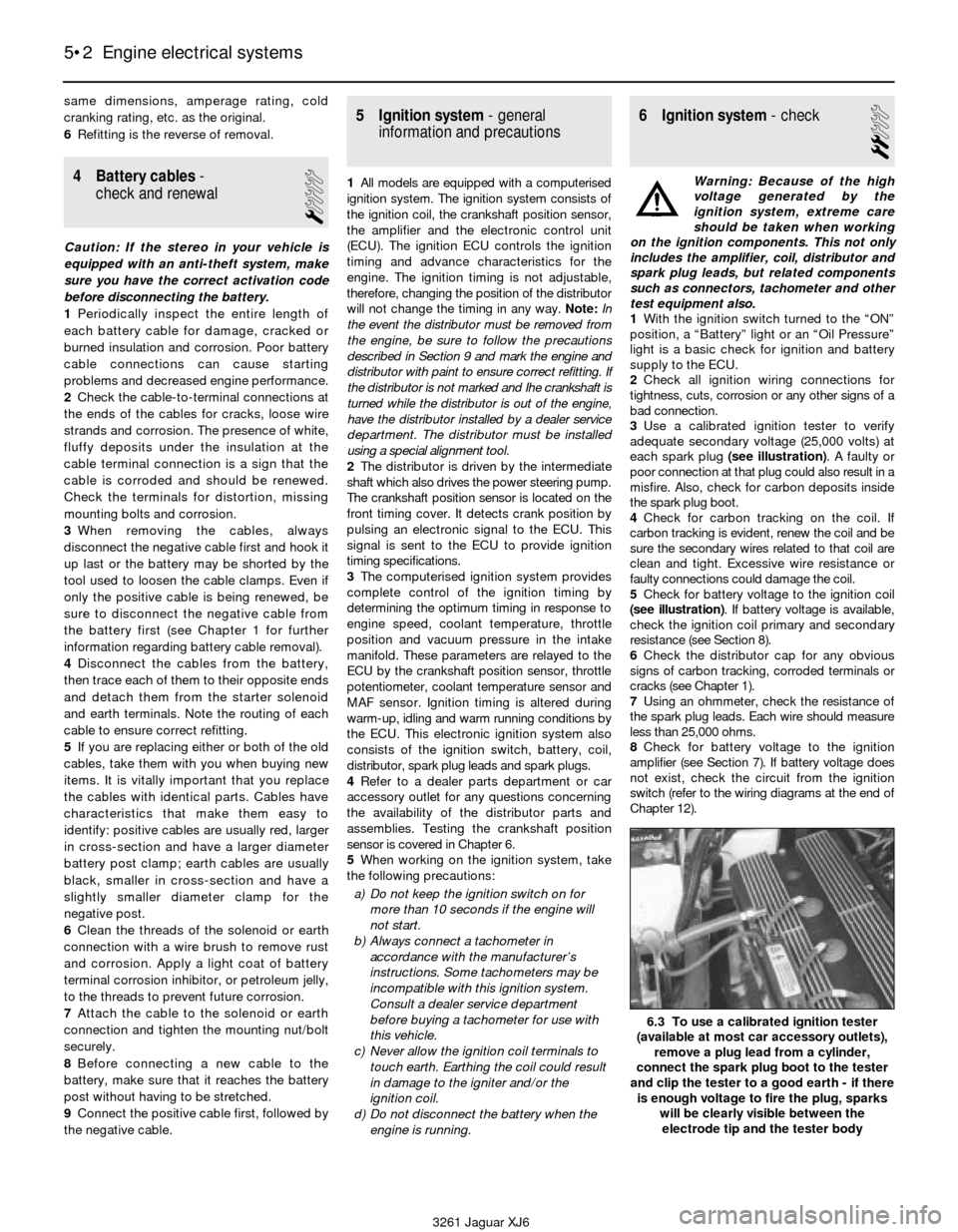
3Use a calibrated ignition tester to verify
adequate secondary voltage (25,000 volts) at
each spark plug (see illustration). A faulty or
poor connection at that plug could also result in a
misfire. Also, check for carbon deposits inside
the spark plug boot.
4Check for carbon tracking on the coil. If
carbon tracking is evident, renew the coil and be
sure the secondary wires related to that coil are
clean and tight. Excessive wire resistance or
faulty connections could damage the coil.
5Check for battery voltage to the ignition coil
(see illustration). If battery voltage is available,
check the ignition coil primary and secondary
resistance (see Section 8).
6Check the distributor cap for any obvious
signs of carbon tracking, corroded terminals or
cracks (see Chapter 1).
7Using an ohmmeter, check the resistance of
the spark plug leads. Each wire should measure
less than 25,000 ohms.
8Check for battery voltage to the ignition
amplifier (see Section 7). If battery voltage does
not exist, check the circuit from the ignition
switch (refer to the wiring diagrams at the end of
Chapter 12).
5•2 Engine electrical systems
6.3 To use a calibrated ignition tester
(available at most car accessory outlets),
remove a plug lead from a cylinder,
connect the spark plug boot to the tester
and clip the tester to a good earth - if there
is enough voltage to fire the plug, sparks
will be clearly visible between the
electrode tip and the tester body
3261 Jaguar XJ6
Page 112 of 227
components identified. When servicing the
engine or emissions systems, the VECI label
in your particular vehicle should always be
checked for up-to-date information.
2 Electronic control system
and ECU
General description
Note: These models are susceptible to ECU
damage if water is allowed to build up in the
front cowl drain and overspill into the dash
area near the computer. Inspect and clear the
front cowl drain as a regular maintenance item
to keep the water draining properly. Remove
the duckbill-type rubber hose and inspect it
for clogging, collapsing or deterioration.
1The Lucas LH Engine Management system
controls the fuel injection system by means of
a microcomputer known as the Electronic
Control unit (ECU).
2The ECU receives signals from various
sensors which monitor changing engine
operating conditions such as intake air mass,
intake air temperature, coolant temperature,
engine rpm, acceleration/deceleration,
exhaust oxygen content, etc. These signals
are utilised by the ECU to determine the
correct injection duration.
3The system is analogous to the central
nervous system in the human body: The
sensors (nerve endings) constantly relay
signals to the ECU (brain), which processes
the data and, if necessary, sends out a
command to change the operating
parameters of the engine (body).
4Here’s a specific example of how one
portion of this system operates: An oxygen
sensor, located in the exhaust manifold,
constantly monitors the oxygen content of the
exhaust gas. If the percentage of oxygen in
the exhaust gas is incorrect, an electrical
signal is sent to the ECU. The ECU takes this
information, processes it and then sends a
command to the fuel injection system telling it
to change the air/fuel mixture. This happens in
a fraction of a second and it goes on
continuously when the engine is running. The
end result is an air/fuel mixture ratio which is
constantly maintained at a predetermined
ratio, regardless of driving conditions.
5In the event of a sensor malfunction, a
backup circuit will take over to provide
driveability until the problem is identified and
fixed.
Precautions
6Follow these steps:
a) Always disconnect the power by either
turning off the ignition switch or
disconnecting the battery terminals before
removing electrical connectors.
Warning: Later models are
equipped with airbags. To
prevent accidental deployment ofthe airbag, which could cause personal
injury, DO NOT work in the vicinity of the
steering column or instrument panel. The
manufacturer recommends that, on airbag
equipped models, the following procedure
should be left to a dealer service
department or other repair workshop
because of the special tools and techniques
required to disable the airbag system.
Caution: If the stereo in your vehicle is
equipped with an anti-theft system, make
sure you have the correct activation code
before disconnecting the battery.
b) When refitting a battery, be particularly
careful to avoid reversing the positive and
negative battery cables. Also, make sure
the ignition key is in the Off position when
connecting or disconnecting the battery.
c) Do not subject EFI components,
emissions-related components or the
ECU to severe impact during removal or
refitting.
d) Do not be careless during fault diagnosis.
Even slight terminal contact can invalidate
a testing procedure and damage one of
the numerous transistor circuits.
e) Never attempt to work on the ECU or
open the ECU cover. The ECU is
protected by a government-mandated
extended warranty that will be nullified if
you tamper with or damage the ECU.
f) If you are inspecting electronic control
system components during rainy weather,
make sure that water does not enter any
part. When washing the engine
compartment, do not spray these parts or
their electrical connectors with water.
g) These models are susceptible to ECU
damage if water is allowed to build up in
the front cowl drain and overspill into the
dash area. Inspect and clear the front
cowl drain system as a regular
maintenance item to keep the water
draining properly. Remove the duckbill
type rubber hose and inspect it for
clogging, collapsing or deterioration.
ECU removal and refitting
7Disconnect the negative cable from the
battery (see Chapter 5).
Warning: Later models are
equipped with airbags. To
prevent the accidental deploy-
ment of the airbag, which could
cause personal injury, DO NOT work in the
vicinity of the steering column or
instrument panel. The manufacturer
recommends that, on airbag equipped
models, the following procedure should be
left to a dealer service department or other
repair workshop because of the special
tools and techniques required to disable
the airbag system.
Caution: If the stereo in your vehicle is
equipped with an anti-theft system, make
sure you have the correct activation code
before disconnecting the battery.8Remove the lower instrument panel on the
passenger side under the glove compartment
(see Chapter 11).
9Remove the glove compartment from the
passenger compartment (see Chapter 11).
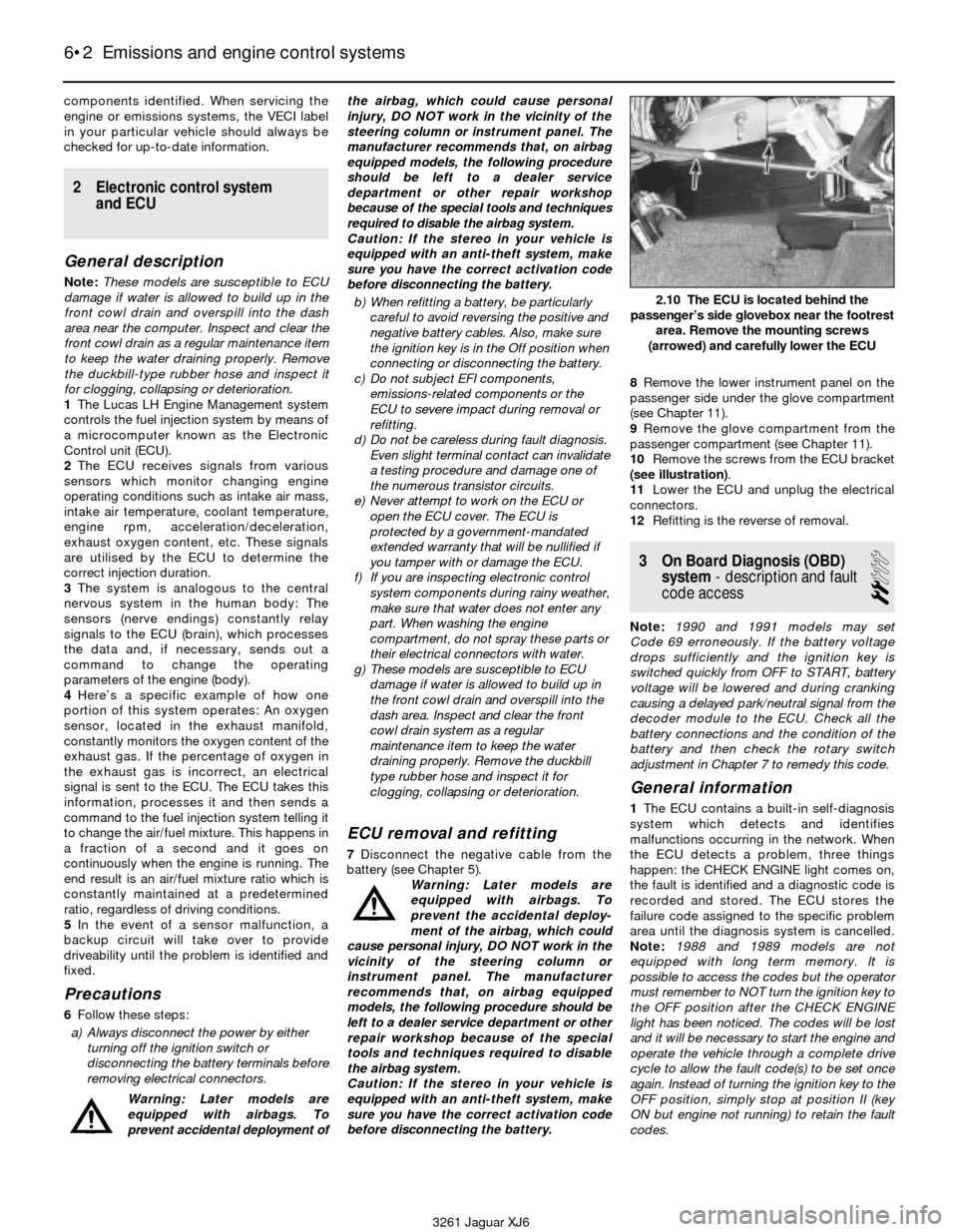
10Remove the screws from the ECU bracket
(see illustration).
11Lower the ECU and unplug the electrical
connectors.
12Refitting is the reverse of removal.
3 On Board Diagnosis (OBD)
system- description and fault
code access
2
Note: 1990 and 1991 models may set
Code 69 erroneously. If the battery voltage
drops sufficiently and the ignition key is
switched quickly from OFF to START, battery
voltage will be lowered and during cranking
causing a delayed park/neutral signal from the
decoder module to the ECU. Check all the
battery connections and the condition of the
battery and then check the rotary switch
adjustment in Chapter 7 to remedy this code.
General information
1The ECU contains a built-in self-diagnosis
system which detects and identifies
malfunctions occurring in the network. When
the ECU detects a problem, three things
happen: the CHECK ENGINE light comes on,
the fault is identified and a diagnostic code is
recorded and stored. The ECU stores the
failure code assigned to the specific problem
area until the diagnosis system is cancelled.
Note: 1988 and 1989 models are not
equipped with long term memory. It is
possible to access the codes but the operator
must remember to NOT turn the ignition key to
the OFF position after the CHECK ENGINE
light has been noticed. The codes will be lost
and it will be necessary to start the engine and
operate the vehicle through a complete drive
cycle to allow the fault code(s) to be set once
again. Instead of turning the ignition key to the
OFF position, simply stop at position II (key
ON but engine not running) to retain the fault
codes.
6•2 Emissions and engine control systems
3261 Jaguar XJ6
2.10 The ECU is located behind the
passenger’s side glovebox near the footrest
area. Remove the mounting screws
(arrowed) and carefully lower the ECU
Page 137 of 227
3261 Jaguar XJ6
10
Chapter 10
Suspension and steering systems
General
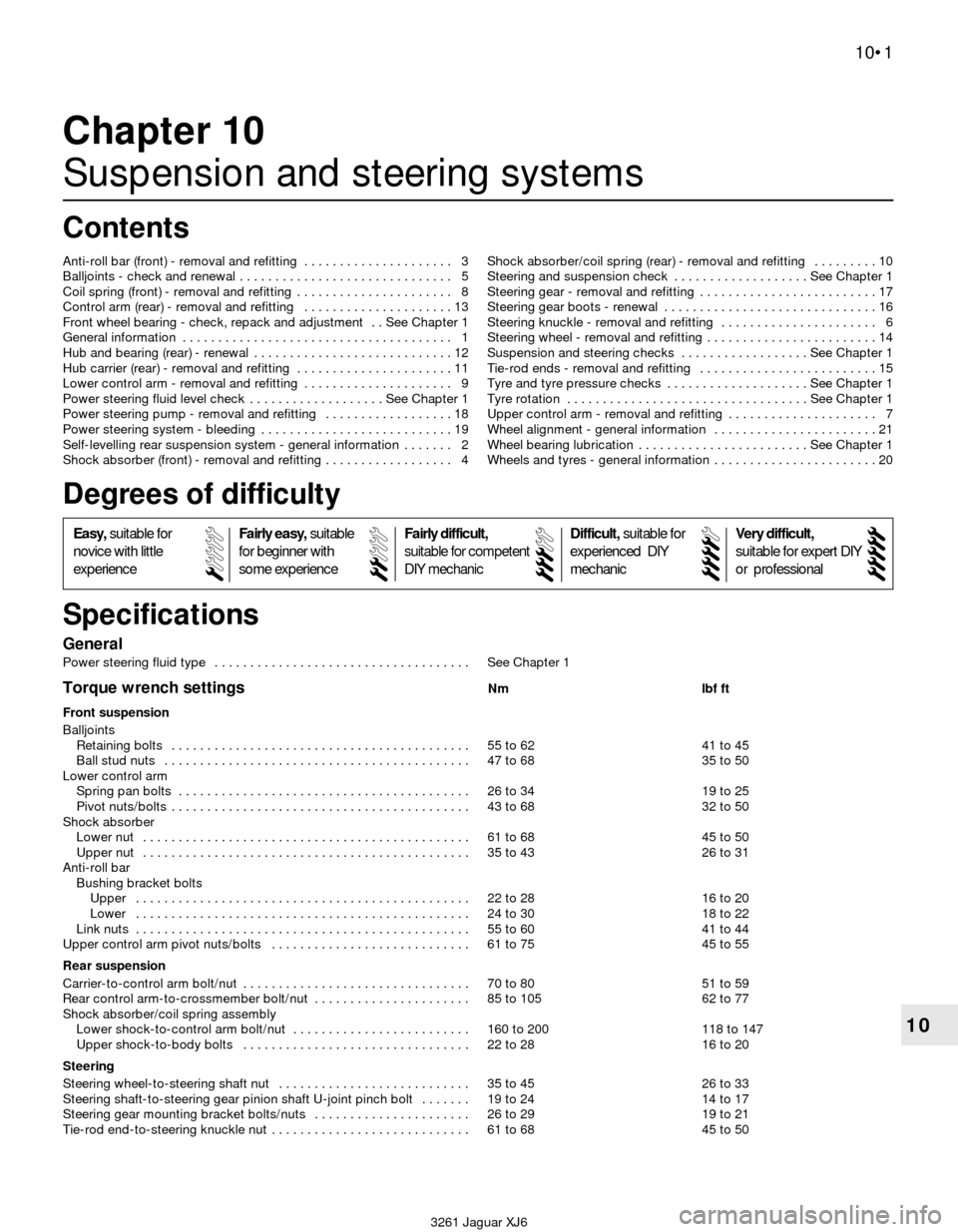
Power steering fluid type . . . . . . . . . . . . . . . . . . . . . . . . . . . . . . . . . . . . See Chapter 1
Torque wrench settingsNm lbf ft
Front suspension
Balljoints
Retaining bolts . . . . . . . . . . . . . . . . . . . . . . . . . . . . . . . . . . . . . . . . . . 55 to 62 41 to 45
Ball stud nuts . . . . . . . . . . . . . . . . . . . . . . . . . . . . . . . . . . . . . . . . . . . 47 to 68 35 to 50
Lower control arm
Spring pan bolts . . . . . . . . . . . . . . . . . . . . . . . . . . . . . . . . . . . . . . . . . 26 to 34 19 to 25
Pivot nuts/bolts . . . . . . . . . . . . . . . . . . . . . . . . . . . . . . . . . . . . . . . . . . 43 to 68 32 to 50
Shock absorber
Lower nut . . . . . . . . . . . . . . . . . . . . . . . . . . . . . . . . . . . . . . . . . . . . . . 61 to 68 45 to 50
Upper nut . . . . . . . . . . . . . . . . . . . . . . . . . . . . . . . . . . . . . . . . . . . . . . 35 to 43 26 to 31
Anti-roll bar
Bushing bracket bolts
Upper . . . . . . . . . . . . . . . . . . . . . . . . . . . . . . . . . . . . . . . . . . . . . . . 22 to 28 16 to 20
Lower . . . . . . . . . . . . . . . . . . . . . . . . . . . . . . . . . . . . . . . . . . . . . . . 24 to 30 18 to 22
Link nuts . . . . . . . . . . . . . . . . . . . . . . . . . . . . . . . . . . . . . . . . . . . . . . . 55 to 60 41 to 44
Upper control arm pivot nuts/bolts . . . . . . . . . . . . . . . . . . . . . . . . . . . . 61 to 75 45 to 55
Rear suspension
Carrier-to-control arm bolt/nut . . . . . . . . . . . . . . . . . . . . . . . . . . . . . . . . 70 to 80 51 to 59
Rear control arm-to-crossmember bolt/nut . . . . . . . . . . . . . . . . . . . . . . 85 to 105 62 to 77
Shock absorber/coil spring assembly
Lower shock-to-control arm bolt/nut . . . . . . . . . . . . . . . . . . . . . . . . . 160 to 200 118 to 147
Upper shock-to-body bolts . . . . . . . . . . . . . . . . . . . . . . . . . . . . . . . . 22 to 28 16 to 20
Steering
Steering wheel-to-steering shaft nut . . . . . . . . . . . . . . . . . . . . . . . . . . . 35 to 45 26 to 33
Steering shaft-to-steering gear pinion shaft U-joint pinch bolt . . . . . . . 19 to 24 14 to 17
Steering gear mounting bracket bolts/nuts . . . . . . . . . . . . . . . . . . . . . . 26 to 29 19 to 21
Tie-rod end-to-steering knuckle nut . . . . . . . . . . . . . . . . . . . . . . . . . . . . 61 to 68 45 to 50 Anti-roll bar (front) - removal and refitting . . . . . . . . . . . . . . . . . . . . . 3
Balljoints - check and renewal . . . . . . . . . . . . . . . . . . . . . . . . . . . . . . 5
Coil spring (front) - removal and refitting . . . . . . . . . . . . . . . . . . . . . . 8
Control arm (rear) - removal and refitting . . . . . . . . . . . . . . . . . . . . . 13
Front wheel bearing - check, repack and adjustment . . See Chapter 1
General information . . . . . . . . . . . . . . . . . . . . . . . . . . . . . . . . . . . . . . 1
Hub and bearing (rear) - renewal . . . . . . . . . . . . . . . . . . . . . . . . . . . . 12
Hub carrier (rear) - removal and refitting . . . . . . . . . . . . . . . . . . . . . . 11
Lower control arm - removal and refitting . . . . . . . . . . . . . . . . . . . . . 9
Power steering fluid level check . . . . . . . . . . . . . . . . . . . See Chapter 1
Power steering pump - removal and refitting . . . . . . . . . . . . . . . . . . 18
Power steering system - bleeding . . . . . . . . . . . . . . . . . . . . . . . . . . . 19
Self-levelling rear suspension system - general information . . . . . . . 2
Shock absorber (front) - removal and refitting . . . . . . . . . . . . . . . . . . 4Shock absorber/coil spring (rear) - removal and refitting . . . . . . . . . 10
Steering and suspension check . . . . . . . . . . . . . . . . . . . See Chapter 1
Steering gear - removal and refitting . . . . . . . . . . . . . . . . . . . . . . . . . 17
Steering gear boots - renewal . . . . . . . . . . . . . . . . . . . . . . . . . . . . . . 16
Steering knuckle - removal and refitting . . . . . . . . . . . . . . . . . . . . . . 6
Steering wheel - removal and refitting . . . . . . . . . . . . . . . . . . . . . . . . 14
Suspension and steering checks . . . . . . . . . . . . . . . . . . See Chapter 1
Tie-rod ends - removal and refitting . . . . . . . . . . . . . . . . . . . . . . . . . 15
Tyre and tyre pressure checks . . . . . . . . . . . . . . . . . . . . See Chapter 1
Tyre rotation . . . . . . . . . . . . . . . . . . . . . . . . . . . . . . . . . . See Chapter 1
Upper control arm - removal and refitting . . . . . . . . . . . . . . . . . . . . . 7
Wheel alignment - general information . . . . . . . . . . . . . . . . . . . . . . . 21
Wheel bearing lubrication . . . . . . . . . . . . . . . . . . . . . . . . See Chapter 1
Wheels and tyres - general information . . . . . . . . . . . . . . . . . . . . . . . 20
10•1
Specifications Contents
Easy,suitable for
novice with little
experienceFairly easy,suitable
for beginner with
some experienceFairly difficult,
suitable for competent
DIY mechanic
Difficult,suitable for
experienced DIY
mechanicVery difficult,
suitable for expert DIY
or professional
Degrees of difficulty
54321