radio JAGUAR XJ6 1997 2.G User Guide
[x] Cancel search | Manufacturer: JAGUAR, Model Year: 1997, Model line: XJ6, Model: JAGUAR XJ6 1997 2.GPages: 227, PDF Size: 7.2 MB
Page 169 of 227

11 Fuel, oil and temperature
gauges- check
1
Warning: Later models are
equipped with airbags. To
prevent accidental deployment
of the airbag, which could cause
personal injury or damage to the airbag
system, DO NOT work in the vicinity of the
steering column or instrument panel. The
manufacturer recommends that, on airbag
equipped models, the following procedure
be performed at a dealer service
department or other properly equipped
repair facility because of the special tools
and techniques required to disable the
airbag system.
1All tests below require the ignition switch to
be turned to ON position when testing.
2Check the fuse if the gauge pointer does
not move from the empty, low or cold
positions. If the fuse is OK, locate the
particular sender unit for the circuit you’re
working on (see Chapter 4 for fuel sender unit
location, Chapter 2 for oil sender unit location,
or Chapter 3 for temperature sender unit
location). Connect the sender unit connector
to earth If the pointer goes to the full, high or
hot position renew the sender unit. If the
pointer stays in same position use a jumper
wire to earth the terminal on the back of the
gauge. If the pointer moves with the back of
the gauge earthed the problem lies in the wire
between the gauge and the sender unit. If the
pointer does not moves with the back of the
gauge earthed check for voltage at the other
terminal of the gauge. If voltage is present
renew the gauge.
12 Instrument cluster-
removal and refitting
1
Warning: Later models are
equipped with airbags. To
prevent accidental deployment
of the airbag, which could cause
personal injury or damage to the airbag
system, DO NOT work in the vicinity of the
steering column or instrument panel. The
manufacturer recommends that, on airbag
equipped models, the following procedure
be performed at a dealer service
department or other properly equipped
repair facility because of the special tools
and techniques required to disable the
airbag system.
Caution: If the stereo in your vehicle is
equipped with an anti-theft system, make
sure you have the correct activation code
before disconnecting the battery.
1Disconnect the negative battery cable.
2Remove the instrument cluster housing (see
Chapter 11).
3Remove the instrument cluster mounting
screws (see illustration). Separate the
instrument cluster from the cluster housing.
4Refitting is the reverse of removal.
13 Radio and speakers-
removal and refitting
2
Warning: Later models are
equipped with airbags. To
prevent accidental deployment
of the airbag, which could cause
personal injury or damage to the airbag
system, DO NOT work in the vicinity of the
steering column or instrument panel. The
manufacturer recommends that, on airbagequipped models, the following procedure
be performed at a dealer service
department or other properly equipped
repair facility because of the special tools
and techniques required to disable the
airbag system.
Caution: If the stereo in your vehicle is
equipped with an anti-theft system, make
sure you have the correct activation code
before disconnecting the battery.
1Disconnect the negative battery cable.
Radio
2Remove the radio trim bezel (Chapter 11).
3Remove the retaining screws (see
illustration), pull the radio/control panel
outward to access the backside and
disconnect the electrical connectors and
aerial lead. Detach the retaining clips and
separate the radio from the control panel.
4Refitting is the reverse of removal.
Speakers
5Remove the door trim panel (Chapter 11).
6Remove the nuts from the speaker
mounting studs (see illustration). Disconnect
the electrical connector and remove the
speaker from the vehicle.
7Refitting is the reverse of removal.
Body electrical system 12•7
12
3261 Jaguar XJ6 12.3 Remove the instrument cluster retaining screws (arrowed)
then separate the instrument cluster from the cluster housing
13.3 Remove the retaining screws (arrowed) and pull the
radio/control panel out enough to unplug the connectors
13.6 Remove the nuts from the retaining
studs (arrowed) to remove the speaker
Page 170 of 227
14 Electric aerial-
removal and refitting
2
Aerial motor assembly
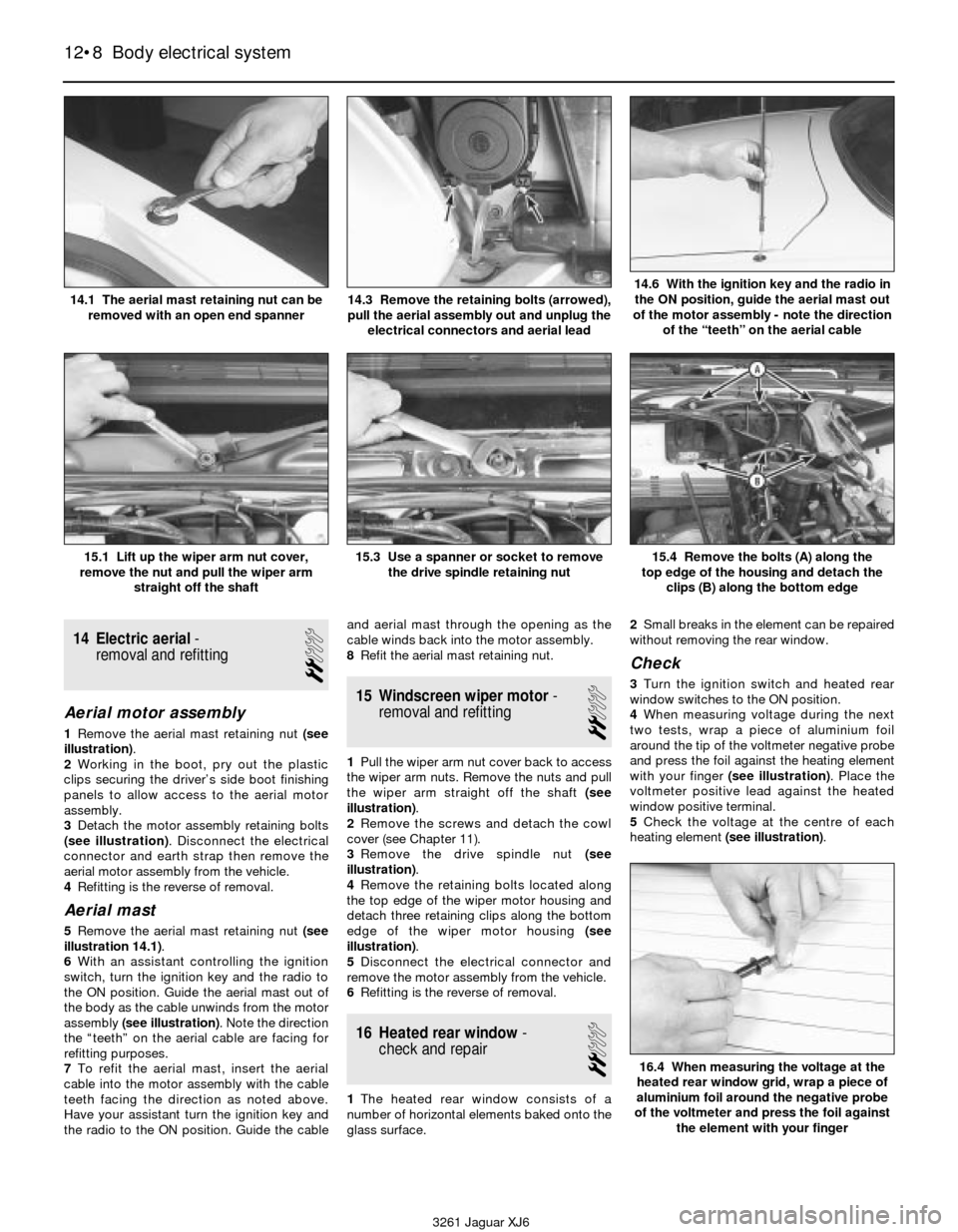
1Remove the aerial mast retaining nut (see
illustration).
2Working in the boot, pry out the plastic
clips securing the driver’s side boot finishing
panels to allow access to the aerial motor
assembly.
3Detach the motor assembly retaining bolts
(see illustration). Disconnect the electrical
connector and earth strap then remove the
aerial motor assembly from the vehicle.
4Refitting is the reverse of removal.
Aerial mast
5Remove the aerial mast retaining nut (see
illustration 14.1).
6With an assistant controlling the ignition
switch, turn the ignition key and the radio to
the ON position. Guide the aerial mast out of
the body as the cable unwinds from the motor
assembly (see illustration). Note the direction
the “teeth” on the aerial cable are facing for
refitting purposes.
7To refit the aerial mast, insert the aerial
cable into the motor assembly with the cable
teeth facing the direction as noted above.
Have your assistant turn the ignition key and
the radio to the ON position. Guide the cableand aerial mast through the opening as the
cable winds back into the motor assembly.
8Refit the aerial mast retaining nut.
15 Windscreen wiper motor-
removal and refitting
2
1Pull the wiper arm nut cover back to access
the wiper arm nuts. Remove the nuts and pull
the wiper arm straight off the shaft (see
illustration).
2Remove the screws and detach the cowl
cover (see Chapter 11).
3Remove the drive spindle nut (see
illustration).
4Remove the retaining bolts located along
the top edge of the wiper motor housing and
detach three retaining clips along the bottom
edge of the wiper motor housing (see
illustration).
5Disconnect the electrical connector and
remove the motor assembly from the vehicle.
6Refitting is the reverse of removal.
16 Heated rear window-
check and repair
2
1The heated rear window consists of a
number of horizontal elements baked onto the
glass surface.2Small breaks in the element can be repaired
without removing the rear window.
Check
3Turn the ignition switch and heated rear
window switches to the ON position.
4When measuring voltage during the next
two tests, wrap a piece of aluminium foil
around the tip of the voltmeter negative probe
and press the foil against the heating element
with your finger (see illustration). Place the
voltmeter positive lead against the heated
window positive terminal.
5Check the voltage at the centre of each
heating element (see illustration).
12•8 Body electrical system
14.1 The aerial mast retaining nut can be
removed with an open end spanner14.3 Remove the retaining bolts (arrowed),
pull the aerial assembly out and unplug the
electrical connectors and aerial lead14.6 With the ignition key and the radio in
the ON position, guide the aerial mast out
of the motor assembly - note the direction
of the “teeth” on the aerial cable
15.1 Lift up the wiper arm nut cover,
remove the nut and pull the wiper arm
straight off the shaft15.3 Use a spanner or socket to remove
the drive spindle retaining nut15.4 Remove the bolts (A) along the
top edge of the housing and detach the
clips (B) along the bottom edge
3261 Jaguar XJ6
16.4 When measuring the voltage at the
heated rear window grid, wrap a piece of
aluminium foil around the negative probe
of the voltmeter and press the foil against
the element with your finger
Page 202 of 227

3261 Jaguar XJ6
Dimensions and weights . . . . . . . . . . . . . . . . . . .REF•1
Jacking and vehicle support . . . . . . . . . . . . . . . .REF•1
Radio/cassette unit anti-theft system . . . . . . . . .REF•1
Conversion factors . . . . . . . . . . . . . . . . . . . . . . .REF•2
Use of English . . . . . . . . . . . . . . . . . . . . . . . . . . .REF•3
Buying spare parts . . . . . . . . . . . . . . . . . . . . . . . .REF•4
Vehicle identification . . . . . . . . . . . . . . . . . . . . . .REF•4General repair procedures . . . . . . . . . . . . . . . . .REF•5
Tools and working facilities . . . . . . . . . . . . . . . . .REF•6
MOT test checks . . . . . . . . . . . . . . . . . . . . . . . . .REF•8
Fault finding . . . . . . . . . . . . . . . . . . . . . . . . . . . .REF•12
Glossary of technical terms . . . . . . . . . . . . . . . .REF•18
Index . . . . . . . . . . . . . . . . . . . . . . . . . . . . . . . . .REF•22
Dimensions and weights
Note:All figures are approximate, and may vary according to model. Refer to manufacturer’s data for exact figures.
Dimensions
Overall length . . . . . . . . . . . . . . . . . . . . . . . . . . . . . . . . . . . . . . . . . . . . . 4988 mm
Overall width (including mirrors) . . . . . . . . . . . . . . . . . . . . . . . . . . . . . . . 2015 mm
Overall height (unladen) . . . . . . . . . . . . . . . . . . . . . . . . . . . . . . . . . . . . . 1358 mm
Wheelbase . . . . . . . . . . . . . . . . . . . . . . . . . . . . . . . . . . . . . . . . . . . . . . . 2870 mm
Weights
Kerb weight . . . . . . . . . . . . . . . . . . . . . . . . . . . . . . . . . . . . . . . . . . . . . . . 1770 kg
Maximum gross vehicle weight . . . . . . . . . . . . . . . . . . . . . . . . . . . . . . . 2190 kg
Maximum towing weight:
Braked trailer . . . . . . . . . . . . . . . . . . . . . . . . . . . . . . . . . . . . . . . . . . . . 1500 kg
Unbraked trailer . . . . . . . . . . . . . . . . . . . . . . . . . . . . . . . . . . . . . . . . . 750 kg
Maximum axle load:
Front axle . . . . . . . . . . . . . . . . . . . . . . . . . . . . . . . . . . . . . . . . . . . . . . 1050 kg
Rear axle . . . . . . . . . . . . . . . . . . . . . . . . . . . . . . . . . . . . . . . . . . . . . . . 1170 kg
Maximum roof rack load . . . . . . . . . . . . . . . . . . . . . . . . . . . . . . . . . . . . . 100 kg
ReferenceREF•1
Radio/cassette unit anti-theft system - precaution
Some models are equipped with an audio
system which includes an anti-theft feature, to
deter thieves. If the power source to the unit is
cut, the anti-theft system will activate. Even if
the power source is immediately reconnected,
the radio/cassette unit will not function untilthe correct security code has been entered.
Therefore if you do not know the correct
security code for the unit, do notdisconnect
the battery negative lead, or remove the
radio/cassette unit from the vehicle.The procedure for reprogramming a unit
that has been disconnected from its power
supply varies from model to model - consult
the handbook supplied with the unit for
specific details or refer to your Jaguar dealer. The jack supplied with the vehicle tool kit
should only be used for changing the
roadwheels - see “Wheel changing”at the
front of this manual. When carrying out any
other kind of work, raise the vehicle using a
hydraulic (or “trolley”) jack, and always
supplement the jack with axle stands
positioned under the vehicle jacking points.
To raise the front of the vehicle, place a
block of wood on the jack head and positionthe jack underneath the centre of the front
crossmember. Lift the vehicle to the required
height and support it on axle stands
positioned underneath the vehicle jacking
points on the sills.
To raise the rear of the vehicle, place a
block of wood on the jack head and position
the jack underneath the centre of the rear
crossmember. Lift the vehicle to the required
height and support it on axle standspositioned underneath the vehicle jacking
points on the sills.
The jack supplied with the vehicle locates in
the jacking points on the sills. Ensure that the
jack head is correctly engaged before
attempting to raise the vehicle.
Neverwork under, around, or near a raised
vehicle, unless it is adequately supported in at
least two places.
Jacking and vehicle support
Page 225 of 227

3261 Jaguar XJ6
NNeutral start switch -7•5
Notes for UK readers -0•4, REF•3
Number plate light - 12•12
OObtaining diagnostic code output -6•3
Oil cooler -3•6
Oil filter -1•6
Oil gauge - 12•7
Oil pump -2A•15
Oil seals -2A•5, 2A•17, 2B•17, 7•7, 8•4, 8•5, REF•5
Oil,differential -1•2, 1•11, 1•20
Oil,engine -0•11, 0•16, 1•2, 1•6
On Board Diagnosis (OBD) system -6•2
Open circuit check - 12•2
Output shaft -7•7
Oxygen sensor -6•4
PPads (brake) -9•1, 9•2
Painting - 11•2
Parking lights - 12•11
Piston rings -2B•15
Pistons -2B•9, 2B•12, 2B•17
Poisonous or irritant substances -0•5
Power hydraulic system -0•16
fluid - 1•9
Power steering - 10•10, 10•11
fluid - 0•13, 0•16
Propshaft -1•18, 8•1, 8•2, 8•3
Punctures- 0•8
RRadiator -3•4
grille - 11•5
Radio - 12•7, REF•1
Rear lights - 12•12
Receiver/drier -3•12
Regulator (window) - 11•10
Relays - 12•3
Repair procedures - REF•5
Reversing lights -7•5, 12•12
Road test -1•14
Roadside repairs-0•6et seq
Routine maintenance and servicing-1•1et seq
Rust holes - 11•2
SSafety first -0•5
Scalding -0•5
Scratches - 11•2Screw threads and fastenings - REF•5
Seat belts -1•13, REF•9
Seats - 11•14, REF•9
Self-levelling rear suspension system - 10•3
Servo -1•12, 9•1, 9•9
Shift cable -7•4
Shock absorber - 10•4, 10•6, REF•9, REF•10
Shoes (brake) -1•20, 9•11
Short circuit check - 12•1
Side marker lights - 12•11
Spare parts - REF•4
Spark plugs -1•7, 1•14
Speakers - 12•7
Speed sensor -6•7
Spoiler - 11•5
Springs - 10•5, 10•6, REF•10
Starter motor -5•7
Steering - See Suspension and steering systems
Steering wheel and column - 11•13, 12•5, REF•8
Sump -2A•14
Sunroof - 12•14
Supplementary air valve -4•13
Suspension and steering systems- 1•12, 10•1et seq, REF•9, REF•10
fault finding - REF•16, REF•17
Switches -4•1, 7•5, 9•13, 12•5, 12•6, 12•12
TTail lights - 12•12
Temperature gauge - 12•7
Temperature sender unit -3•7
Thermostat -3•2
Throttle body -4•10
Throttle potentiometer -6•5
Tie-rod ends - 10•9
Timing chains -2A•6
Tools - REF•5, REF•6, REF•7
Top Dead Centre (TDC) for number one piston -2A•2
Torque converter -7•7
Towing -0•6
Trim panels - 11•7, 11•13
Tyres - 0•14, 10•11, REF•11
UUK readers information -0•4, REF•3
Universal joint -8•1, 8•2, 8•5
Upholstery - 11•1
VVacuum gauge checks -2B•3
Valve cover -2A•3
Valve lifters -2A•9
Valves -2B•8
Vehicle identification - REF•4, REF•9
Vehicle support - REF•1
Vinyl trim - 11•1
Voltage checks - 12•1
REF•24Index