ECU JAGUAR XJ6 1997 2.G Repair Manual
[x] Cancel search | Manufacturer: JAGUAR, Model Year: 1997, Model line: XJ6, Model: JAGUAR XJ6 1997 2.GPages: 227, PDF Size: 7.2 MB
Page 118 of 227

5 Air Injector Reactor
(AIR) system
General information
1The air injection reactor system reduces
carbon monoxide and hydrocarbon content
in the exhaust gases by injecting fresh air into
the hot exhaust gases leaving the exhaust
ports. When fresh air is mixed with hot
exhaust gases, oxidation is increased,
reducing the concentration of hydrocarbons
and carbon monoxide and converting them
into harmless carbon dioxide and water.
2The air injection system is composed of an
air pump, diverter valve (bypass), check valve,
air injection manifold, vacuum delay valve,
vacuum control solenoid, air pump magnetic
clutch, air pump clutch relay and hoses (see
illustration). The air pump is driven by a belt
from the crankshaft and supplies compressed
air to the exhaust manifold(s). The check valve
prevents the reverse flow of exhaust gases into
the system. The vacuum-operated (early
models) or electrically-operated (later models)air cut-off valve prevents air from being drawn
into the exhaust when the air pump is switched
off. System vacuum to the air cut-off valve is
controlled by the solenoid vacuum valve in
parallel circuit with the air pump. A delay valve
prevents vacuum loss to the solenoid valve
during wide open throttle operation.
3Injected air is controlled by the computer,
the air pump clutch and the air pump clutch
relay. The AIR system is used during warm-up
(58 to 83° F) to control emissions while the
engine is running rich. The oxygen sensor
feedback system cannot function while the AIR
system is operating. The computer controls
both systems during warm-up and operating
temperatures. If problems occur with the
AIR system relay or circuit, the on-board
diagnosis system will set a code 66.
Check
4Check the condition of the air pump
drivebelt, the injection hoses and the injection
manifold. Make sure that all components are
intact and there are no leaks.
5Check the operation of the air pump clutch
relay (see illustration)and the air pump
clutch. First remove the relay and check forbattery voltage to the relay. Also, check the
relay itself. Refer to the relay checking
procedure in Chapter 12. Extract codes from
the self-diagnosis system (see Section 3) and
check for a code 66, AIR relay malfunction.
6Make sure the electrical connector is
securely fastened to the diverter valve (see
illustration). If everything appears OK but a
fault code still sets, have the system
diagnosed by a dealer service department or
other qualified repair workshop.
Air pump renewal
7Disconnect the cable from the negative
terminal of the battery.
Caution: If the stereo in your vehicle is
equipped with an anti-theft system, make
sure you have the correct activation code
before disconnecting the battery.
8Disconnect the electrical connector from
the air pump clutch.
9Loosen the clips from the air inlet and outlet
hose and separate them from the air injection
pump.
10Loosen the adjuster and pivot bolts (see
illustration)and nuts but do not remove them
from the air injection pump brackets.
6•8 Emissions and engine control systems
3261 Jaguar XJ6 5.2 Schematic of the Air Injection Reactor (AIR) system
5.6 Location of the AIR diverter valve on a 1992 model - check the
hoses for cracking and the electrical connector for security5.10 Loosen the pivot bolt and then the adjustment nut to remove
the drivebelt from the air pump. The adjustment nut has a lock bolt
that must be loosened before the pump will move down the adjuster
5.5 Location of the AIR pump relay on a 1992 model
Page 119 of 227

11Swing the pump toward the engine and
remove the drivebelt from the pump.
12Remove the link arm through-bolt.
13Remove the pivot bolt and front spacer,
rear cone and air injection pump from the
engine compartment.
14Remove the nut securing the front pulley
on the air injection pump.
15Remove the clutch snap-ring and the
clutch.
16Refitting is the reverse of removal.
6 Exhaust Gas Recirculation
(EGR) system
Note 1: Some 1990 models have the EGR
vacuum hose routed incorrectly through the
bulkhead securing straps, thereby restricting
the vacuum signal to the EGR valve. Remove
the EGR vacuum hose from the bulkhead
harness and refit a new hose. Secure it to the
engine compartment using tie-wraps and do
not allow any restrictions in the hose.Note 2: Some models have copper sealing
washers that soften and leak around the EGR
valve causing engine performance and
starting problems. Refit steel washers and
pipe adapters into the EGR system. Contact a
Jaguar dealer for the VIN numbers and years
of the models that are affected by this defect.
1To reduce oxides of nitrogen emissions,
some of the exhaust gases are recirculated
through the EGR valve to the intake manifold
to lower combustion temperatures.
2The EGR system consists of the EGR valve,
an EGR solenoid, an EGR gas temperature
sensor and the transfer pipe (see illustration).
Check
EGR valve
3Start the engine and allow it to idle.
4Detach the vacuum hose from the EGR
valve and attach a hand vacuum pump in its
place (see illustration).
5Apply vacuum to the EGR valve. Vacuum
should remain steady and the engine should
run poorly. Note:This action will raise the
pintle and allow exhaust gases to recirculateinto the intake system and cause rough
running condition at idle.Double-check the
movement of the pintle by checking the
diaphragm using the tip of your finger (see
illustration). If the EGR diaphragm moves
smoothly and holds steady when vacuum is
applied, the EGR valve is working properly.
Warning: Don’t burn yourself. If
the EGR valve is hot, wear a
glove or wait until it cools.
a) If the vacuum doesn’t remain steady and
the engine doesn’t run poorly, renew the
EGR valve and recheck it.
b) If the vacuum remains steady but the
engine doesn’t run poorly, remove the
EGR valve and check the valve and the
intake manifold for blockage. Clean or
renew parts as necessary and recheck.EGR system
6Disconnect the hose from the EGR valve,
refit a vacuum gauge and check for vacuum
to the EGR valve. There should be vacuum
present with the engine warmed to operating
temperature (above 140° F) and between
1000 and 4000 rpm (see illustration).
Emissions and engine control systems 6•9
6
3261 Jaguar XJ6 6.2 Schematic of the EGR system
6.4 Apply vacuum to the EGR valve and confirm that the valve
opens and allows exhaust gases to circulate. Once it is activated,
the EGR valve should hold steady (no loss in vacuum)
6.5 Use a fingertip to move the diaphragm inside the EGR valve6.6 Check for vacuum to the EGR valve from the throttle body
Page 120 of 227
7Start the engine and observe the vacuum
gauge. At idle, there should be no vacuum
present. Raise the engine rpm and observe
the vacuum increase. This is a ported vacuum
source and therefore it should only register
vacuum when throttled.
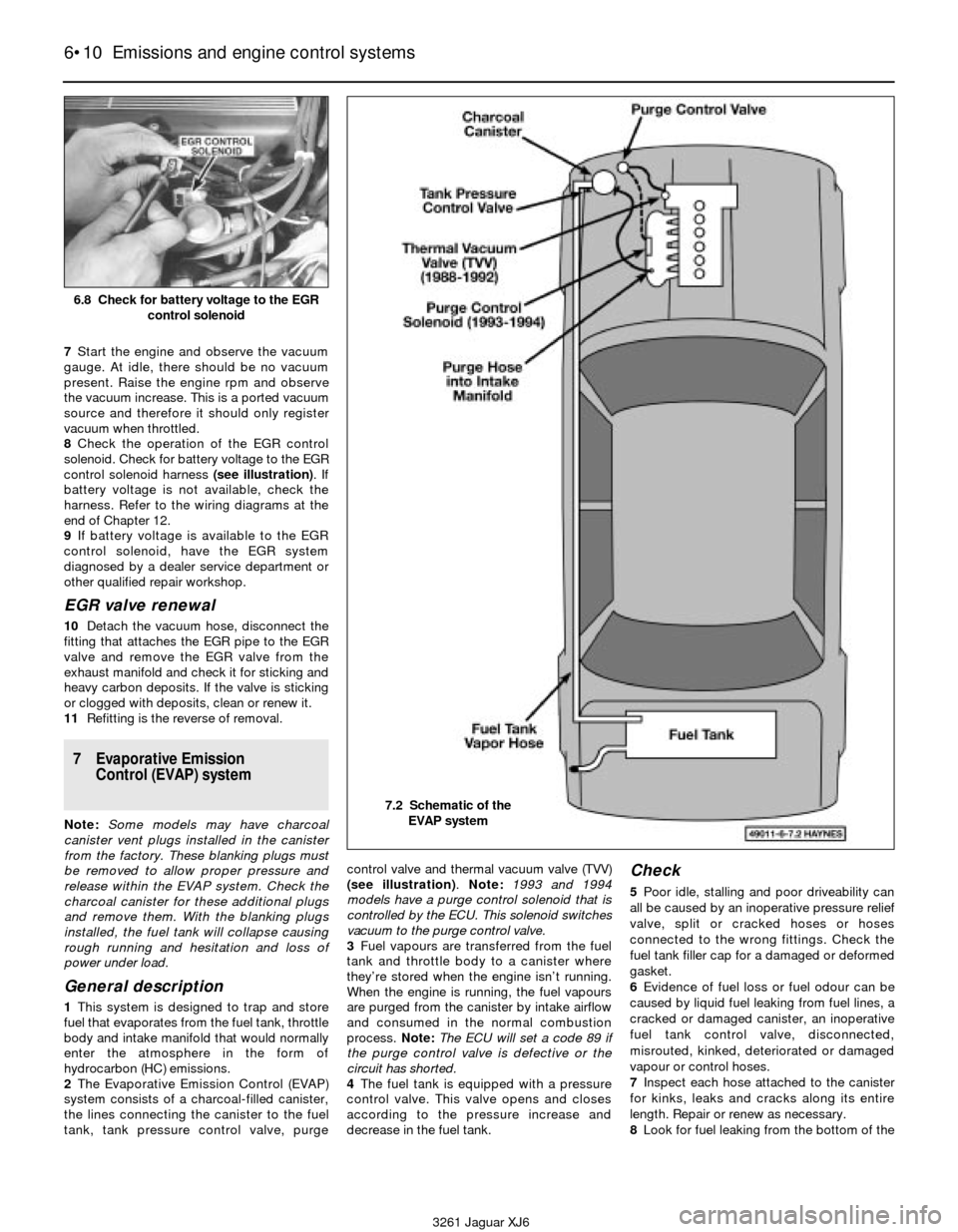
8Check the operation of the EGR control
solenoid. Check for battery voltage to the EGR
control solenoid harness (see illustration). If
battery voltage is not available, check the
harness. Refer to the wiring diagrams at the
end of Chapter 12.
9If battery voltage is available to the EGR
control solenoid, have the EGR system
diagnosed by a dealer service department or
other qualified repair workshop.
EGR valve renewal
10Detach the vacuum hose, disconnect the
fitting that attaches the EGR pipe to the EGR
valve and remove the EGR valve from the
exhaust manifold and check it for sticking and
heavy carbon deposits. If the valve is sticking
or clogged with deposits, clean or renew it.
11Refitting is the reverse of removal.
7 Evaporative Emission
Control (EVAP) system
Note: Some models may have charcoal
canister vent plugs installed in the canister
from the factory. These blanking plugs must
be removed to allow proper pressure and
release within the EVAP system. Check the
charcoal canister for these additional plugs
and remove them. With the blanking plugs
installed, the fuel tank will collapse causing
rough running and hesitation and loss of
power under load.
General description
1This system is designed to trap and store
fuel that evaporates from the fuel tank, throttle
body and intake manifold that would normally
enter the atmosphere in the form of
hydrocarbon (HC) emissions.
2The Evaporative Emission Control (EVAP)
system consists of a charcoal-filled canister,
the lines connecting the canister to the fuel
tank, tank pressure control valve, purgecontrol valve and thermal vacuum valve (TVV)
(see illustration). Note: 1993 and 1994
models have a purge control solenoid that is
controlled by the ECU. This solenoid switches
vacuum to the purge control valve.
3Fuel vapours are transferred from the fuel
tank and throttle body to a canister where
they’re stored when the engine isn’t running.
When the engine is running, the fuel vapours
are purged from the canister by intake airflow
and consumed in the normal combustion
process.Note: The ECU will set a code 89 if
the purge control valve is defective or the
circuit has shorted.
4The fuel tank is equipped with a pressure
control valve. This valve opens and closes
according to the pressure increase and
decrease in the fuel tank.
Check
5Poor idle, stalling and poor driveability can
all be caused by an inoperative pressure relief
valve, split or cracked hoses or hoses
connected to the wrong fittings. Check the
fuel tank filler cap for a damaged or deformed
gasket.
6Evidence of fuel loss or fuel odour can be
caused by liquid fuel leaking from fuel lines, a
cracked or damaged canister, an inoperative
fuel tank control valve, disconnected,
misrouted, kinked, deteriorated or damaged
vapour or control hoses.
7Inspect each hose attached to the canister
for kinks, leaks and cracks along its entire
length. Repair or renew as necessary.
8Look for fuel leaking from the bottom of the
6•10 Emissions and engine control systems
6.8 Check for battery voltage to the EGR
control solenoid
3261 Jaguar XJ6
7.2 Schematic of the
EVAP system
Page 124 of 227
Test the brakes at various speeds with both
light and heavy pedal pressure. The vehicle
should stop evenly without pulling to one side
or the other. Avoid locking the brakes,
because this slides the tyres and diminishes
braking efficiency and control of the vehicle.
Tyres, vehicle load and wheel alignment are
factors which also affect braking performance.
2 Anti-lock Brake system
(ABS)- general information
The Anti-lock Brake System is designed to
maintain vehicle steerability, directional stability
and optimum deceleration under severe
braking conditions on most road surfaces. It
does so by monitoring the rotational speed of
each wheel and controlling the brake line
pressure to each wheel during braking. This
prevents the wheels from locking up.
The ABS system has three main units - the
wheel speed sensors, the electronic control unit
and the modulator (hydraulic control unit). The
sensors - one at each wheel - send a variable
voltage signal to the electronic control unit,
which monitors these signals, compares them
to its program and determines whether a wheel
is about to lock up. When a wheel is about to
lock up, the control unit signals the hydraulic
unit to reduce hydraulic pressure (or not
increase it further) at that wheel’s brake caliper.
Pressure modulation is handled by three
electrically-operated solenoid valves - one for
each front wheel and one for the rear wheels -
inside the modulator.
If a problem develops within the system, an
“ABS” warning light will glow on the dashboard.
Sometimes, a visual inspection of the ABS
system can help you locate the problem.
Carefully inspect the ABS wiring harness. Pay
particularly close attention to the harness and
connections near each wheel. Look for signs of
chafing and other damage caused by
incorrectly routed wires. If a wheel sensor
harness is damaged, the sensor should be
replaced (the harness and sensor are integral).
Warning: Do NOT try to repair an
ABS wiring harness. The ABS
system is sensitive to even thesmallest changes in resistance. Repairing
the harness could alter resistance values
and cause the system to malfunction. If the
ABS wiring harness is damaged in any way,
it must be replaced.
Caution: Make sure the ignition is turned
off before unplugging or reattaching any
electrical connections.
Diagnosis and repair
If a dashboard warning light comes on and
stays on while the vehicle is in operation, the
ABS system requires attention. Although
special electronic ABS diagnostic testing tools
are necessary to properly diagnose the system,
you can perform a few preliminary checks
before taking the vehicle to a dealer service
department or other qualified repair workshop.
a) Check the brake fluid level in the master
cylinder reservoir.
b) Verify that all ABS system electrical
connectors in the engine compartment
are plugged in.
c) Check the fuses.
d) Follow the wiring harness to each front
wheel and to the differential sensor and
verify that all connections are secure and
that the wiring is undamaged.
If the above preliminary checks do not
rectify the problem, the vehicle should be
diagnosed by a dealer service department.
Due to the complex nature of this system, all
actual repair work must be done by a dealer
service department or other qualified repair
workshop.
3 Disc brake pads- renewal
2
Warning: Disc brake pads must
be replaced on both front wheels
or both rear wheels at the same
time - never renew the pads on
only one wheel. Also, the dust created by
the brake system may contain asbestos,
which is harmful to your health. Never blow
it out with compressed air and don’t inhale
any of it. An approved filtering mask should
be worn when working on the brakes. Do
not, under any circumstances, use
petroleum-based solvents to clean brake
parts. Use brake system cleaner only!
Note:The following procedure applies to both
the front and rear brake pads.
1Remove the cap from the brake fluid
reservoir and siphon off about two-thirds of
the fluid from the reservoir. Failing to do this
could result in fluid overflowing when the
caliper pistons are pressed into their bores.
2Loosen the wheel nuts, raise the front of the
vehicle and support it securely on axle stands.
3Remove the front wheels. Work on one
brake assembly at a time, using the
assembled brake for reference if necessary.
4Inspect the brake disc (see Section 5).
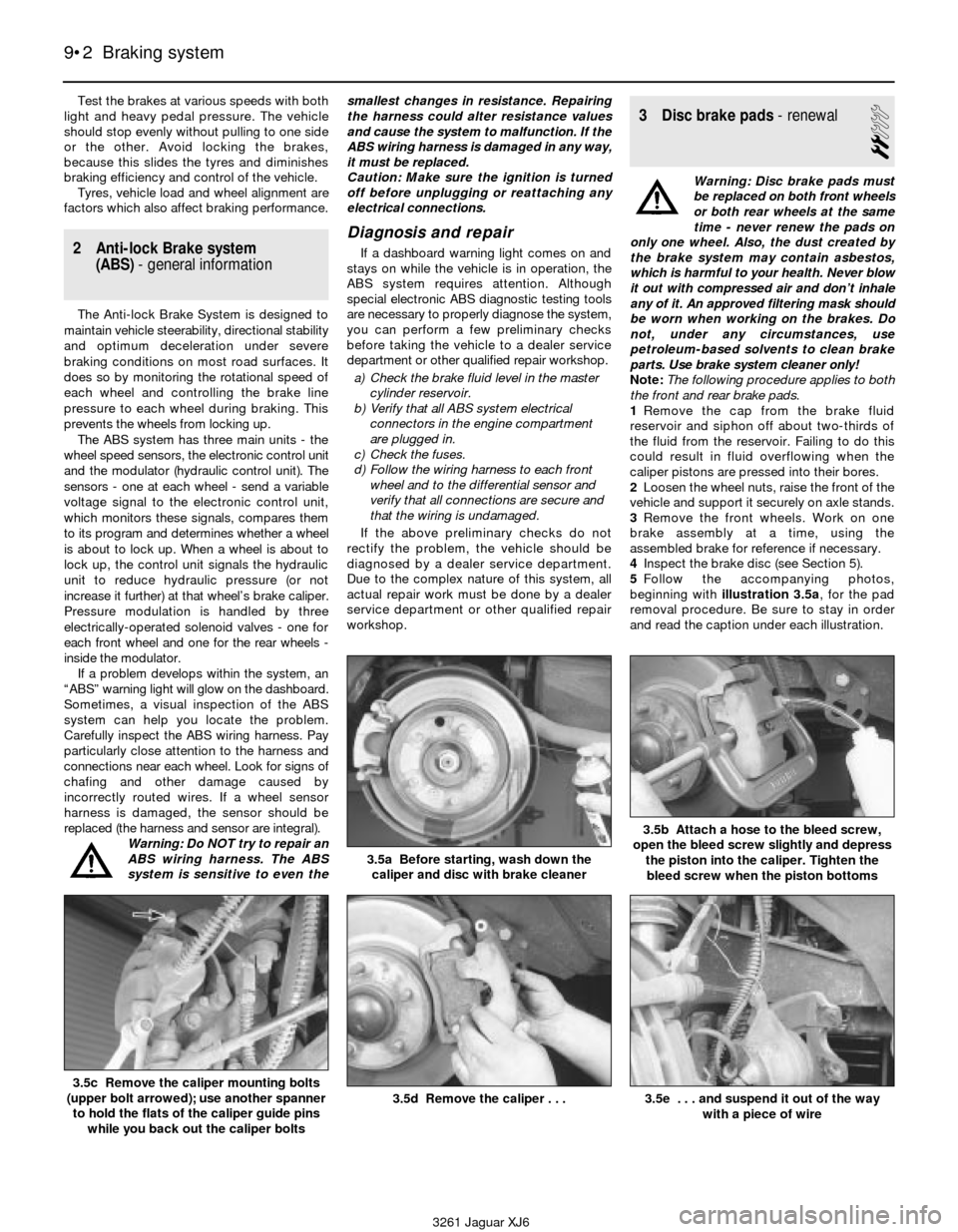
5Follow the accompanying photos,
beginning with illustration 3.5a, for the pad
removal procedure. Be sure to stay in order
and read the caption under each illustration.
9•2 Braking system
3.5a Before starting, wash down the
caliper and disc with brake cleaner
3.5b Attach a hose to the bleed screw,
open the bleed screw slightly and depress
the piston into the caliper. Tighten the
bleed screw when the piston bottoms
3.5c Remove the caliper mounting bolts
(upper bolt arrowed); use another spanner
to hold the flats of the caliper guide pins
while you back out the caliper bolts3.5d Remove the caliper . . .3.5e . . . and suspend it out of the way
with a piece of wire
3261 Jaguar XJ6
Page 125 of 227
6Be sure to buy new pads with wear
sensors. Pattern pads may not have wear
sensors; refitting pads without wear sensors
will cause the dash warning light to come on.
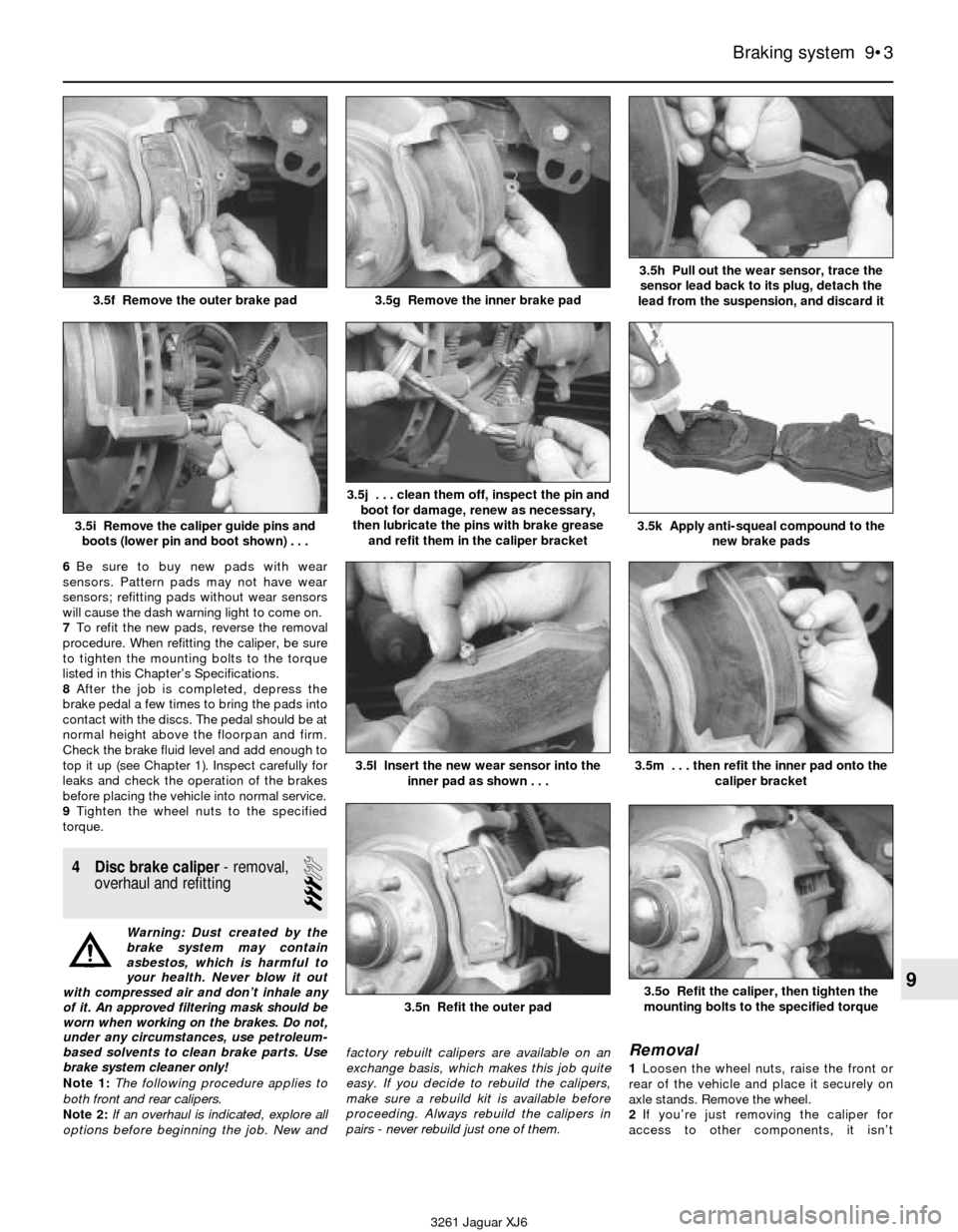
7To refit the new pads, reverse the removal
procedure. When refitting the caliper, be sure
to tighten the mounting bolts to the torque
listed in this Chapter’s Specifications.
8After the job is completed, depress the
brake pedal a few times to bring the pads into
contact with the discs. The pedal should be at
normal height above the floorpan and firm.
Check the brake fluid level and add enough to
top it up (see Chapter 1). Inspect carefully for
leaks and check the operation of the brakes
before placing the vehicle into normal service.
9Tighten the wheel nuts to the specified
torque.
4 Disc brake caliper- removal,
overhaul and refitting
3
Warning: Dust created by the
brake system may contain
asbestos, which is harmful to
your health. Never blow it out
with compressed air and don’t inhale any
of it. An approved filtering mask should be
worn when working on the brakes. Do not,
under any circumstances, use petroleum-
based solvents to clean brake parts. Use
brake system cleaner only!
Note 1:The following procedure applies to
both front and rear calipers.
Note 2:If an overhaul is indicated, explore all
options before beginning the job. New andfactory rebuilt calipers are available on an
exchange basis, which makes this job quite
easy. If you decide to rebuild the calipers,
make sure a rebuild kit is available before
proceeding. Always rebuild the calipers in
pairs - never rebuild just one of them.
Removal
1Loosen the wheel nuts, raise the front or
rear of the vehicle and place it securely on
axle stands. Remove the wheel.
2If you’re just removing the caliper for
access to other components, it isn’t
Braking system 9•3
9
3.5f Remove the outer brake pad3.5g Remove the inner brake pad
3.5h Pull out the wear sensor, trace the
sensor lead back to its plug, detach the
lead from the suspension, and discard it
3.5i Remove the caliper guide pins and
boots (lower pin and boot shown) . . .
3.5j . . . clean them off, inspect the pin and
boot for damage, renew as necessary,
then lubricate the pins with brake grease
and refit them in the caliper bracket
3.5k Apply anti-squeal compound to the
new brake pads
3261 Jaguar XJ6
3.5l Insert the new wear sensor into the
inner pad as shown . . .
3.5n Refit the outer pad
3.5m . . . then refit the inner pad onto the
caliper bracket
3.5o Refit the caliper, then tighten the
mounting bolts to the specified torque
Page 126 of 227

necessary to detach the brake line. If you’re
removing the caliper for overhaul, detach the
hose from the metal line at the frame bracket
(see Section 8), then disconnect the brake line
from the caliper with a flare-nut spanner to
protect the fitting (see illustration). Plug the
metal line to keep contaminants out of the
brake system and to prevent losing brake
fluid.
3Refer to illustration 3.5c and unbolt the
front or rear caliper.
Overhaul
4Before you remove the piston, place a
wood block between the piston and caliper to
prevent damage as it is removed.
5To remove the piston from the caliper,
apply compressed air to the brake fluid hose
connection on the caliper body (see
illustration). Use only enough pressure to
ease the piston out of its bore. Remove the
dust boot.
Warning: Be careful not to place
your fingers between the piston
and the caliper as the piston
may come out with some force.
Be sure to wear eye protection when using
compressed air.
6Inspect the mating surfaces of the piston
and caliper bore wall. If there is any scoring,
rust, pitting or bright areas, renew the
complete caliper unit with a new one.
7If these components are in good condition,
remove the piston seal from the caliper bore
using a wooden or plastic tool (see
illustration). Metal tools may damage the
cylinder bore.
8Remove the caliper guide pins and the
rubber dust boots from the caliper bracket.
9Wash all the components in brake system
cleaner.
10Using the correct rebuild kit for your
vehicle, reassemble the caliper as follows.11Submerge the new rubber seal in clean
brake fluid and refit it in the lower groove in
the caliper bore, making sure it isn’t twisted.
12Coat the piston with clean brake fluid and
stretch the new dust boot over the bottom of
the piston. Hold the piston over the caliper
bore and insert the rubber flange of the dust
boot into the upper groove in the bore. Start
with the side farthest from you and work your
way around toward the front until it is
completely seated. Push the piston into the
caliper bore until it is bottomed in the bore,
then seat the top of the dust boot in the
groove in the piston.
13Lubricate the sliding surfaces of the guide
pins with silicone-based grease (usually
supplied in the kit), then refit the new dust
boots and pins into the caliper bracket.
Refitting
14Refit the caliper by reversing the removal
procedure (see Section 3).
15If the brake hose was disconnected from
the caliper, bleed the brake system (see
Section 9).
5 Brake disc- inspection,
removal and refitting
2
Note:The following procedure applies to both
the front and rear brake discs.
Inspection
1Loosen the wheel nuts, raise the vehicle
and support it securely on axle stands.
Remove the wheel and refit three nuts to hold
the disc in place. If the rear brake disc is being
worked on, release the handbrake.
2Remove the brake caliper as outlined in
Section 4. It is not necessary to disconnect
the brake hose. After removing the caliper,
suspend it out of the way with a piece of wire.
3Visually inspect the disc surface for scoring
or damage. Light scratches and shallow
grooves are normal after use and may not
always be detrimental to brake operation, but
deep scoring - over 0.015 inch - requires disc
removal and refinishing by an automotive
machine shop. Be sure to check both sides of
the disc (see illustration). If pulsating has
9•4 Braking system
4.7 Remove the piston seal from the
caliper bore using a wooden or plastic tool
(metal tools may damage the
cylinder bore)5.3 The brake pads on this vehicle were
obviously neglected, as they wore down to
the rivets and cut deep grooves into the
disc - this disc must be replaced
3261 Jaguar XJ6 4.2 Use a flare-nut spanner to protect the brake hose fitting when
unscrewing it from the caliper
4.5 With the caliper padded to catch the piston, use compressed
air to force the piston out of its bore - make sure your fingers are
not between the piston and the caliper
Page 128 of 227
Refitting
8Place the disc on the hub and refit the disc
retaining screw. Tighten the screw securely.
9Refit the caliper mounting bracket, using a
new safety wire on the mounting bolts.
10Refit the brake pads and caliper (see
Section 3). Tighten all fasteners to the torque
listed in this Chapter’s Specifications.
11Refit the wheel and wheel nuts, then lower
the vehicle to the ground. Tighten the wheel
nuts to the specified torque (see Chapter 1
Specifications). Depress the brake pedal a
few times to bring the brake pads into contact
with the disc.
12Adjust the handbrake shoes, if necessary.
13Check the operation of the brakes
carefully, if possible before driving the vehicle
on public roads.
6 Master cylinder- removal,
overhaul and refitting
3
Note:Although master cylinder parts and
rebuild kits are available for most models, we
recommend replacing the master cylinder with
a new or remanufactured unit, if possible.
Removal
1The master cylinder is connected to the
brake servo, which is attached to the pedal
box, in front of the bulkhead on the driver’s
side of the engine compartment.
2Remove as much fluid as you can from the
reservoir with a syringe.
3Place rags under the line fittings and
prepare caps or plastic bags to cover the
ends of the lines once they are disconnected.
Caution: Brake fluid will damage paint.
Cover all body parts and be careful not to
spill fluid during this procedure.
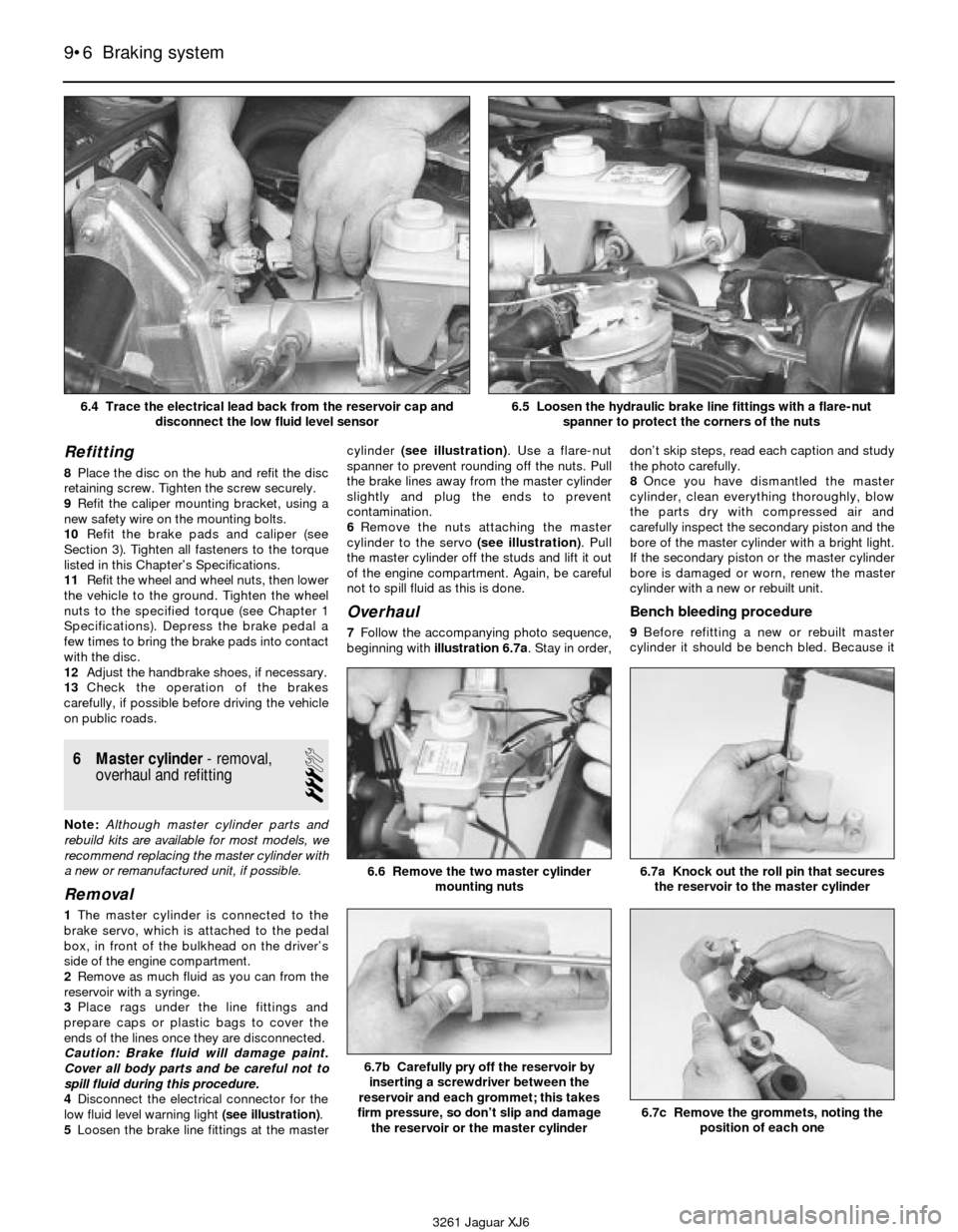
4Disconnect the electrical connector for the
low fluid level warning light (see illustration).
5Loosen the brake line fittings at the mastercylinder (see illustration). Use a flare-nut
spanner to prevent rounding off the nuts. Pull
the brake lines away from the master cylinder
slightly and plug the ends to prevent
contamination.
6Remove the nuts attaching the master
cylinder to the servo (see illustration). Pull
the master cylinder off the studs and lift it out
of the engine compartment. Again, be careful
not to spill fluid as this is done.
Overhaul
7Follow the accompanying photo sequence,
beginning with illustration 6.7a. Stay in order,don’t skip steps, read each caption and study
the photo carefully.
8Once you have dismantled the master
cylinder, clean everything thoroughly, blow
the parts dry with compressed air and
carefully inspect the secondary piston and the
bore of the master cylinder with a bright light.
If the secondary piston or the master cylinder
bore is damaged or worn, renew the master
cylinder with a new or rebuilt unit.
Bench bleeding procedure
9Before refitting a new or rebuilt master
cylinder it should be bench bled. Because it
9•6 Braking system
6.7a Knock out the roll pin that secures
the reservoir to the master cylinder
6.7b Carefully pry off the reservoir by
inserting a screwdriver between the
reservoir and each grommet; this takes
firm pressure, so don’t slip and damage
the reservoir or the master cylinder
6.7c Remove the grommets, noting the
position of each one
6.6 Remove the two master cylinder
mounting nuts
3261 Jaguar XJ6 6.4 Trace the electrical lead back from the reservoir cap and
disconnect the low fluid level sensor
6.5 Loosen the hydraulic brake line fittings with a flare-nut
spanner to protect the corners of the nuts
Page 131 of 227
being drawn back into the master cylinder.
Wait several seconds for brake fluid to be
drawn from the reservoir into the piston bore,
then depress the piston again, removing your
finger as brake fluid is expelled. Be sure to put
your finger back over the hole each time
before releasing the piston, and when the
bleeding procedure is complete for that outlet,
renew the plug and snug it up before going on
to the other port.
Refitting
16Refit the master cylinder over the studs on
the brake servo and tighten the mounting nuts
only finger tight at this time.
17Thread the brake line fittings into the
master cylinder. Since the master cylinder is
still a bit loose, it can be moved slightly to
allow the fitting threads to start easily. Do not
strip the threads as the fittings are tightened.
18Tighten the brake fittings securely and the
mounting nuts to the torque listed in this
Chapter’s Specifications.
19Fill the master cylinder reservoir with fluid,
then bleed the master cylinder and the brake
system (see Section 9).
20To bleed the master cylinder on the
vehicle, have an assistant pump the brake
pedal several times and then hold the pedal to
the floor. Loosen the fitting nut to allow air and
fluid to escape, then tighten the nut. Repeat
this procedure on both fittings until the fluid is
clear of air bubbles. Test the operation of the
brake system carefully before placing the
vehicle into service.
7 Brake servo-
general information,
removal and refitting
2
General information
1A hydraulic brake servo system assists
braking when the brake pedal is depressed.
The booster unit, located between the brake
pedal box and the master cylinder, is operated
by hydraulic pressure generated by an engine-
driven pump (on early models) or by an electric
pump (on later models). When the engine isrunning, the pump supplies hydraulic pressure
to an accumulator. The accumulator stores and
regulates the pressure to the hydraulic brake
servo. When you depress the brake pedal, the
pressure in the booster helps actuate the
master cylinder, reducing pedal effort.
2The hydraulic brake servo isn’t rebuildable;
if it fails, it must be replaced. Basic operation
can be checked (see Chapter 1, Section 15),
but in-depth testing of the system requires
special tools, so diagnosis is beyond the
scope of the home mechanic. If the system
fails, take it to a dealer service department or
other qualified repair workshop for repairs.
However, if the unit must be replaced, you
can do it yourself as follows.
Removal and refitting
3With the engine off, discharge the hydraulic
accumulator by depressing the brake pedal
several times until it feels hard to depress.
4Remove the master cylinder (see Section 6).
5Clean the area around the return and
supply tube nuts, then disconnect them with a
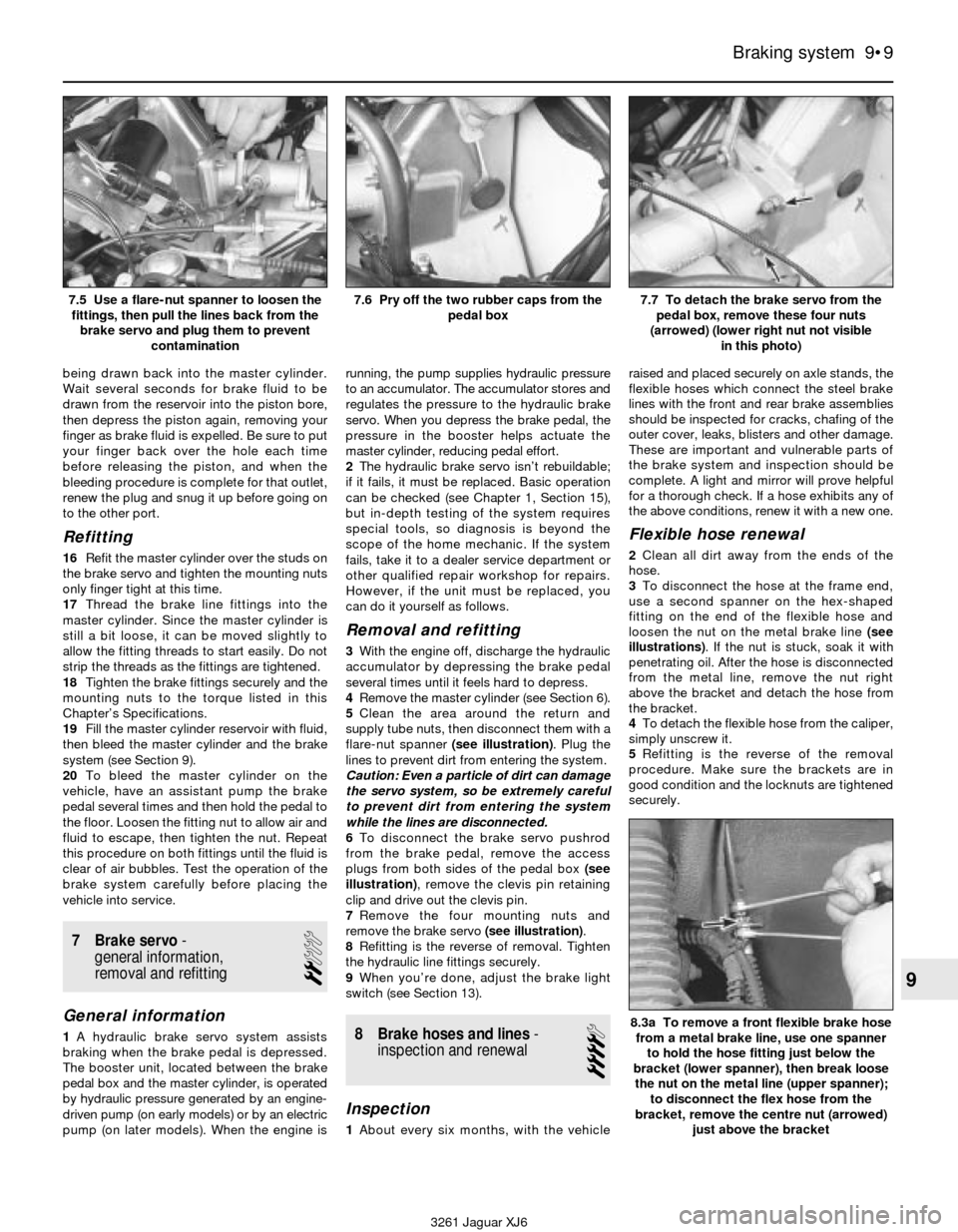
flare-nut spanner (see illustration). Plug the
lines to prevent dirt from entering the system.
Caution: Even a particle of dirt can damage
the servo system, so be extremely careful
to prevent dirt from entering the system
while the lines are disconnected.
6To disconnect the brake servo pushrod
from the brake pedal, remove the access
plugs from both sides of the pedal box (see
illustration), remove the clevis pin retaining
clip and drive out the clevis pin.
7Remove the four mounting nuts and
remove the brake servo (see illustration).
8Refitting is the reverse of removal. Tighten
the hydraulic line fittings securely.
9When you’re done, adjust the brake light
switch (see Section 13).
8 Brake hoses and lines-
inspection and renewal
4
Inspection
1About every six months, with the vehicleraised and placed securely on axle stands, the
flexible hoses which connect the steel brake
lines with the front and rear brake assemblies
should be inspected for cracks, chafing of the
outer cover, leaks, blisters and other damage.
These are important and vulnerable parts of
the brake system and inspection should be
complete. A light and mirror will prove helpful
for a thorough check. If a hose exhibits any of
the above conditions, renew it with a new one.
Flexible hose renewal
2Clean all dirt away from the ends of the
hose.
3To disconnect the hose at the frame end,
use a second spanner on the hex-shaped
fitting on the end of the flexible hose and
loosen the nut on the metal brake line (see
illustrations). If the nut is stuck, soak it with
penetrating oil. After the hose is disconnected
from the metal line, remove the nut right
above the bracket and detach the hose from
the bracket.
4To detach the flexible hose from the caliper,
simply unscrew it.
5Refitting is the reverse of the removal
procedure. Make sure the brackets are in
good condition and the locknuts are tightened
securely.
Braking system 9•9
9
7.5 Use a flare-nut spanner to loosen the
fittings, then pull the lines back from the
brake servo and plug them to prevent
contamination7.6 Pry off the two rubber caps from the
pedal box7.7 To detach the brake servo from the
pedal box, remove these four nuts
(arrowed) (lower right nut not visible
in this photo)
8.3a To remove a front flexible brake hose
from a metal brake line, use one spanner
to hold the hose fitting just below the
bracket (lower spanner), then break loose
the nut on the metal line (upper spanner);
to disconnect the flex hose from the
bracket, remove the centre nut (arrowed)
just above the bracket
3261 Jaguar XJ6
Page 132 of 227
6Carefully check to make sure the
suspension and steering components do not
make contact with the hoses. Have an
assistant push on the vehicle and also turn the
steering wheel from lock-to-lock during
inspection.
7Bleed the brake system (see Section 9).
Metal brake line renewal
8When replacing brake lines, use the proper
parts only. Do not use copper line for any
brake system connections. Purchase steel
brake lines from a dealer or motor factors..
9Unless you’re using factory renewal brake
lines, you may need a tubing bender to bend
the lines to the proper shape.
10First, remove the line you intend to renew,
lay it on a clean workbench and measure it
carefully. Obtain a new line of the same length
and bend it to match the pattern of the old
line.
Warning: Do not crimp or
damage the line. No bend should
have a smaller radius than
9/16-inch. Make sure the
protective coating on the new line is
undamaged at the bends.
11When refitting the new line, make sure it’s
well supported by the brackets, the routing
matches the original and there’s plenty of
clearance between moving or hot
components.
12After refitting, check the master cylinder
fluid level and add fluid as necessary. Bleed
the brake system as outlined in Section 9 and
test the brakes carefully before driving the
vehicle. Be sure there are no leaks.
9 Brake hydraulic system-
bleeding
2
Warning: Wear eye protection
when bleeding the brake
system. If the fluid comes in
contact with your eyes,
immediately rinse them with water and
seek medical attention.Note:Bleeding the hydraulic system is
necessary to remove any air which has entered
the system during removal and refitting of a
hose, line, caliper or master cylinder.
1It will probably be necessary to bleed the
system at all four brakes if air has entered the
system due to low fluid level or if the brake
lines have been disconnected at the master
cylinder.
2If a brake line was disconnected at only one
wheel, then only that caliper or wheel cylinder
must be bled.
3If a brake line is disconnected at a fitting
located between the master cylinder and any
of the brakes, that part of the system served
by the disconnected line must be bled.
4Bleed the right rear, the left rear, the right
front and the left front caliper, in that order,
when the entire system is involved.
5Remove any residual vacuum from the
servo and pressure in the anti-lock braking
system (if equipped) by applying the brake
about 30 times with the engine off.
6Remove the master cylinder reservoir cover
and fill the reservoir with brake fluid. Refit the
cover. Note:Check the fluid level often during
the bleeding operation and add fluid as
necessary to prevent the fluid level from falling
low enough to allow air into the master
cylinder.
7Have an assistant on hand, as well as a
supply of new brake fluid, an empty clear
plastic container, a length of 3/16-inch clear
tubing to fit over the bleed screws and a
spanner to open and close the bleed screws.
8Beginning at the right rear wheel, loosen the
bleed screw slightly, then tighten it to a point
where it is snug but can still be loosened
quickly and easily.
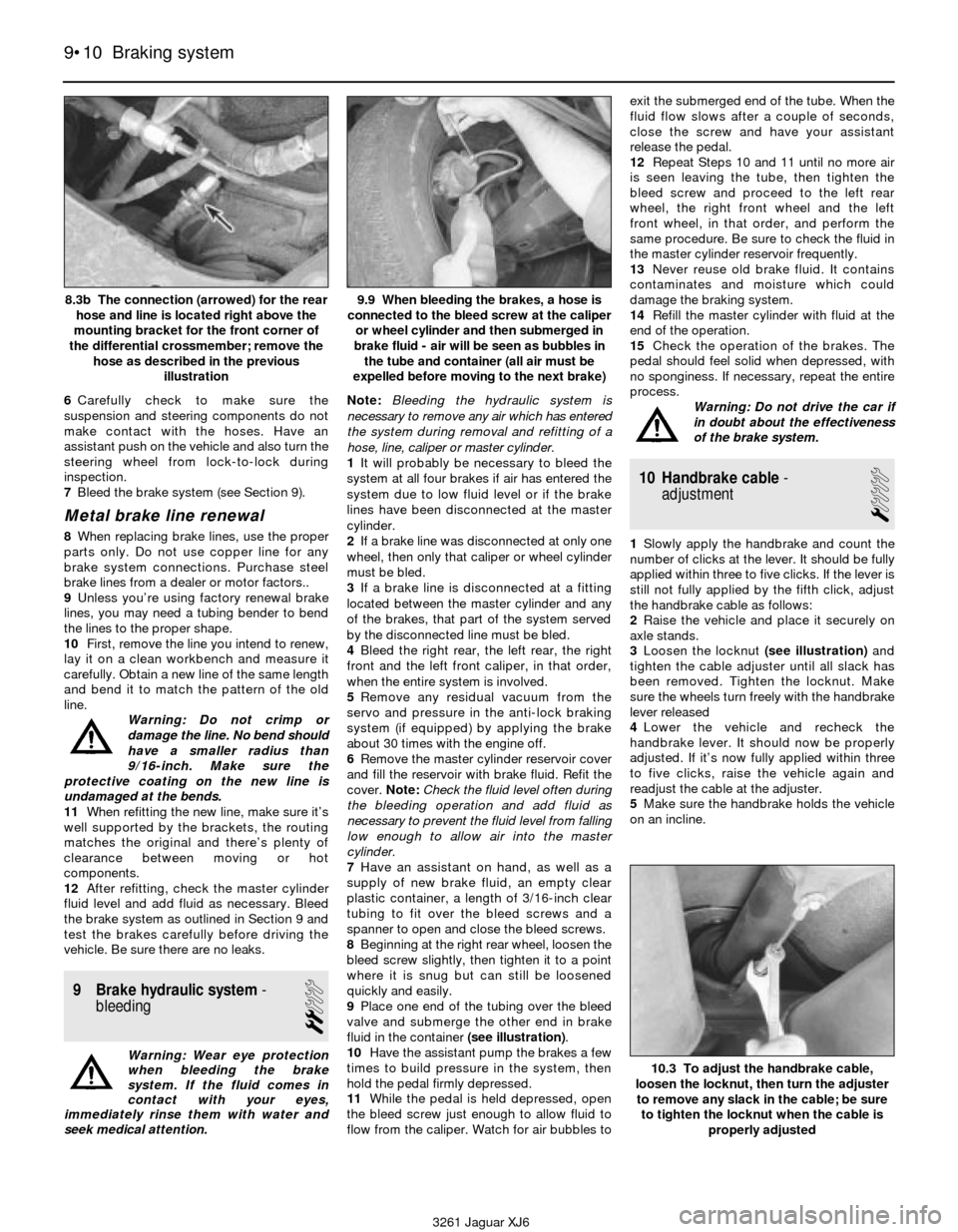
9Place one end of the tubing over the bleed
valve and submerge the other end in brake
fluid in the container (see illustration).
10Have the assistant pump the brakes a few
times to build pressure in the system, then
hold the pedal firmly depressed.
11While the pedal is held depressed, open
the bleed screw just enough to allow fluid to
flow from the caliper. Watch for air bubbles toexit the submerged end of the tube. When the
fluid flow slows after a couple of seconds,
close the screw and have your assistant
release the pedal.
12Repeat Steps 10 and 11 until no more air
is seen leaving the tube, then tighten the
bleed screw and proceed to the left rear
wheel, the right front wheel and the left
front wheel, in that order, and perform the
same procedure. Be sure to check the fluid in
the master cylinder reservoir frequently.
13Never reuse old brake fluid. It contains
contaminates and moisture which could
damage the braking system.
14Refill the master cylinder with fluid at the
end of the operation.
15Check the operation of the brakes. The
pedal should feel solid when depressed, with
no sponginess. If necessary, repeat the entire
process.
Warning: Do not drive the car if
in doubt about the effectiveness
of the brake system.
10 Handbrake cable-
adjustment
1
1Slowly apply the handbrake and count the
number of clicks at the lever. It should be fully
applied within three to five clicks. If the lever is
still not fully applied by the fifth click, adjust
the handbrake cable as follows:
2Raise the vehicle and place it securely on
axle stands.
3Loosen the locknut (see illustration)and
tighten the cable adjuster until all slack has
been removed. Tighten the locknut. Make
sure the wheels turn freely with the handbrake
lever released
4Lower the vehicle and recheck the
handbrake lever. It should now be properly
adjusted. If it’s now fully applied within three
to five clicks, raise the vehicle again and
readjust the cable at the adjuster.
5Make sure the handbrake holds the vehicle
on an incline.
9•10 Braking system
8.3b The connection (arrowed) for the rear
hose and line is located right above the
mounting bracket for the front corner of
the differential crossmember; remove the
hose as described in the previous
illustration9.9 When bleeding the brakes, a hose is
connected to the bleed screw at the caliper
or wheel cylinder and then submerged in
brake fluid - air will be seen as bubbles in
the tube and container (all air must be
expelled before moving to the next brake)
10.3 To adjust the handbrake cable,
loosen the locknut, then turn the adjuster
to remove any slack in the cable; be sure
to tighten the locknut when the cable is
properly adjusted
3261 Jaguar XJ6
Page 133 of 227
11 Handbrake cable(s)- renewal
2
1Raise the vehicle and place it securely on
axle stands.
Front cable
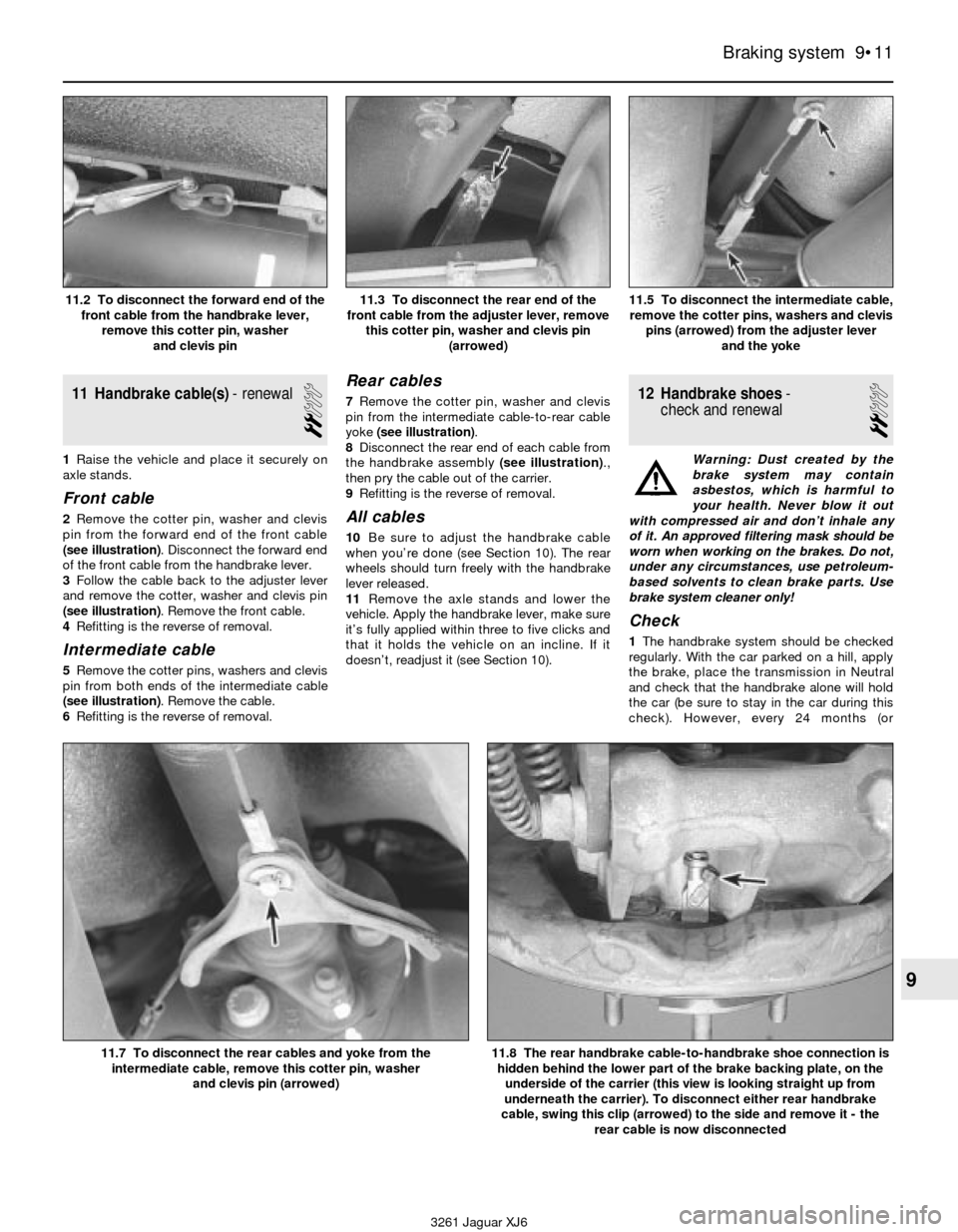
2Remove the cotter pin, washer and clevis
pin from the forward end of the front cable
(see illustration). Disconnect the forward end
of the front cable from the handbrake lever.
3Follow the cable back to the adjuster lever
and remove the cotter, washer and clevis pin
(see illustration). Remove the front cable.
4Refitting is the reverse of removal.
Intermediate cable
5Remove the cotter pins, washers and clevis
pin from both ends of the intermediate cable
(see illustration). Remove the cable.
6Refitting is the reverse of removal.
Rear cables
7Remove the cotter pin, washer and clevis
pin from the intermediate cable-to-rear cable
yoke (see illustration).
8Disconnect the rear end of each cable from
the handbrake assembly (see illustration).,
then pry the cable out of the carrier.
9Refitting is the reverse of removal.
All cables
10Be sure to adjust the handbrake cable
when you’re done (see Section 10). The rear
wheels should turn freely with the handbrake
lever released.
11Remove the axle stands and lower the
vehicle. Apply the handbrake lever, make sure
it’s fully applied within three to five clicks and
that it holds the vehicle on an incline. If it
doesn’t, readjust it (see Section 10).
12 Handbrake shoes-
check and renewal
2
Warning: Dust created by the
brake system may contain
asbestos, which is harmful to
your health. Never blow it out
with compressed air and don’t inhale any
of it. An approved filtering mask should be
worn when working on the brakes. Do not,
under any circumstances, use petroleum-
based solvents to clean brake parts. Use
brake system cleaner only!
Check
1The handbrake system should be checked
regularly. With the car parked on a hill, apply
the brake, place the transmission in Neutral
and check that the handbrake alone will hold
the car (be sure to stay in the car during this
check). However, every 24 months (or
Braking system 9•11
9
3261 Jaguar XJ6 11.2 To disconnect the forward end of the
front cable from the handbrake lever,
remove this cotter pin, washer
and clevis pin
11.3 To disconnect the rear end of the
front cable from the adjuster lever, remove
this cotter pin, washer and clevis pin
(arrowed)11.5 To disconnect the intermediate cable,
remove the cotter pins, washers and clevis
pins (arrowed) from the adjuster lever
and the yoke
11.7 To disconnect the rear cables and yoke from the
intermediate cable, remove this cotter pin, washer
and clevis pin (arrowed)11.8 The rear handbrake cable-to-handbrake shoe connection is
hidden behind the lower part of the brake backing plate, on the
underside of the carrier (this view is looking straight up from
underneath the carrier). To disconnect either rear handbrake
cable, swing this clip (arrowed) to the side and remove it - the
rear cable is now disconnected