service JAGUAR XJ6 1997 2.G Repair Manual
[x] Cancel search | Manufacturer: JAGUAR, Model Year: 1997, Model line: XJ6, Model: JAGUAR XJ6 1997 2.GPages: 227, PDF Size: 7.2 MB
Page 145 of 227

sure you have the correct activation code
before disconnecting the battery.
2Pry off the centre pad (see illustration).
3Remove the steering wheel nut and mark
the relationship of the steering wheel hub to
the shaft (see illustration).
4Slide the steering wheel off the steering
shaft (see illustration).
5Refitting is the reverse of removal. Make
sure you align the match marks you made on
the steering wheel and the shaft. Tighten the
steering wheel nut to the torque listed in this
Chapter’s Specifications.
15 Tie-rod ends-
removal and refitting
2
1Loosen the wheel nuts, raise the front of the
vehicle and support it securely on axle stands.
Remove the front wheel.
2Back off the locknut that locks the tie-rod
end to the tie-rod, then paint an alignment
mark on the threads to ensure the new tie-rod
end is installed in the same position (see
illustration).
3Loosen the nut on the tie-rod ball stud, then
fit a small puller and pop the ball stud loose
(see illustration). Remove the nut and
separate the ball stud from the steering
knuckle. Unscrew the tie-rod end from the tie-
rod.
4Refitting is the reverse of removal. Make
sure you thread the tie-rod end all the way up
to the mark on the threads, but no further.
Tighten the ball stud nut to the torque listed in
this Chapter’s Specifications. Tighten the
locknut securely.
5Have the toe-in checked and, if necessary,
adjusted at a dealer service department or
alignment workshop.
16 Steering gear boots- renewal
2
1Remove the tie-rod ends (see Section 15).
2Cut the boot clamps at both ends of the old
boots (see illustration)and slide off the
boots.3While the boots are removed, inspect the
seals in the end of the steering gear. If they’re
leaking, have them replaced by a dealer
service department or other qualified repair
workshop, or replace the steering gear with a
new or rebuilt unit (see Section 17).
4Slide the new boots into place and refit new
boot clamps.
5Refit the tie-rod ends (see Section 15).
Suspension and steering systems 10•9
10
14.4 To remove the steering wheel,
simply pull it straight off15.2 Back off this locknut and mark the
threads to ensure that the new tie-rod end
is installed properly
15.3 Loosen the ball stud nut, fit a small
puller and pop the ball stud loose from the
steering knuckle
3261 Jaguar XJ6 14.2 To remove the centre pad from the steering wheel,
simply pry it off
14.3 After removing the steering wheel nut, make a pair of
alignment marks on the steering wheel and steering shaft to
ensure proper reassembly
16.2 Cut off the boot clamps (arrowed)
and slide the boot off the steering gear
Page 146 of 227

17 Steering gear-
removal and refitting
3
Warning: On models with an
airbag, do not apply excessive
force or severe shock to the
steering column shaft, or
accidental deployment of the airbag could
occur.
1Using a large syringe or hand pump, empty
the power steering fluid reservoir.
2Loosen the wheel nuts, raise the vehicle
and support it securely on axle stands.
Remove the wheels.
3Mark the relationship of the steering shaft
U-joint to the steering gear pinion shaft (see
illustration)to ensure proper alignment when
they’re reassembled. Remove the nut and bolt
that clamp the U-joint to the pinion shaft.
4Disconnect the power steering pressure
and return lines from the steering gear. Place
a container under the lines to catch spilledfluid. Plug the lines to prevent excessive fluid
loss and contamination. Discard the sealing
washers (new ones should be used when
reassembling).
5Disconnect the tie-rod ends from the
steering knuckle arms (see Section 17).
6Remove the nuts and bolts from the steering
gear mounting brackets (see illustration).
7Remove the steering gear assembly,
detaching the U-joint as you lower it. Don’t
damage the steering gear dust boots.
8Refitting is the reverse of removal. Ensure the
marks you made on the U-joint and the pinion
shaft are aligned before you tighten the U-joint
clamp bolt and nut. Tighten the mounting bolts,
the tie-rod end nuts and the U-joint shaft
clamping bolts to the specified torque.
9After lowering the vehicle, fill the reservoir
with the recommended fluid (see Chapter 1).
10Bleed the power steering system (see
Section 19).
11Have the front wheels aligned by a dealer
service department or alignment workshop
after reassembly.
18 Power steering pump-
removal and refitting
3
1Raise the vehicle and support it securely on
axle stands. Remove the engine under-cover.
2Loosen the hose clamp and disconnect the
fluid return hose from the top of the pump
(see illustration)and drain the power steering
fluid from the reservoir into a clean container.
Unscrew the pressure line fitting from the
back of the pump. Plug the return hose and
the pressure line to prevent fluid from leaking
and to protect the power steering system
from contamination.
3Remove the bolts (see illustration)that
attach the power steering pump adapter to
the auxiliary shaft housing.
4Remove the power steering pump and
adapter.
5Take the power steering pump and adapter
to a Jaguar dealer service department and
have the adapter removed from the old pump
10•10 Suspension and steering systems
18.2 Disconnect the steering fluid return hose from the upper
pipe (arrowed) and disconnect the pressure line
from the back of the pump18.3 To detach the pump adapter from the auxiliary shaft
housing, remove these bolts
3261 Jaguar XJ6 17.3 Mark the relationship of the steering shaft U-joint to the
steering gear pinion shaft, then unscrew the pressure and return
line fittings (arrowed) - plug the lines to prevent contamination
from entering the system
17.6 To detach the steering gear from the vehicle, remove these
nuts and bolts (arrowed) from the mounting brackets (right
bracket shown, left bracket similar)
Page 158 of 227
remove the door trim panel and watershield
as described in Section 18.
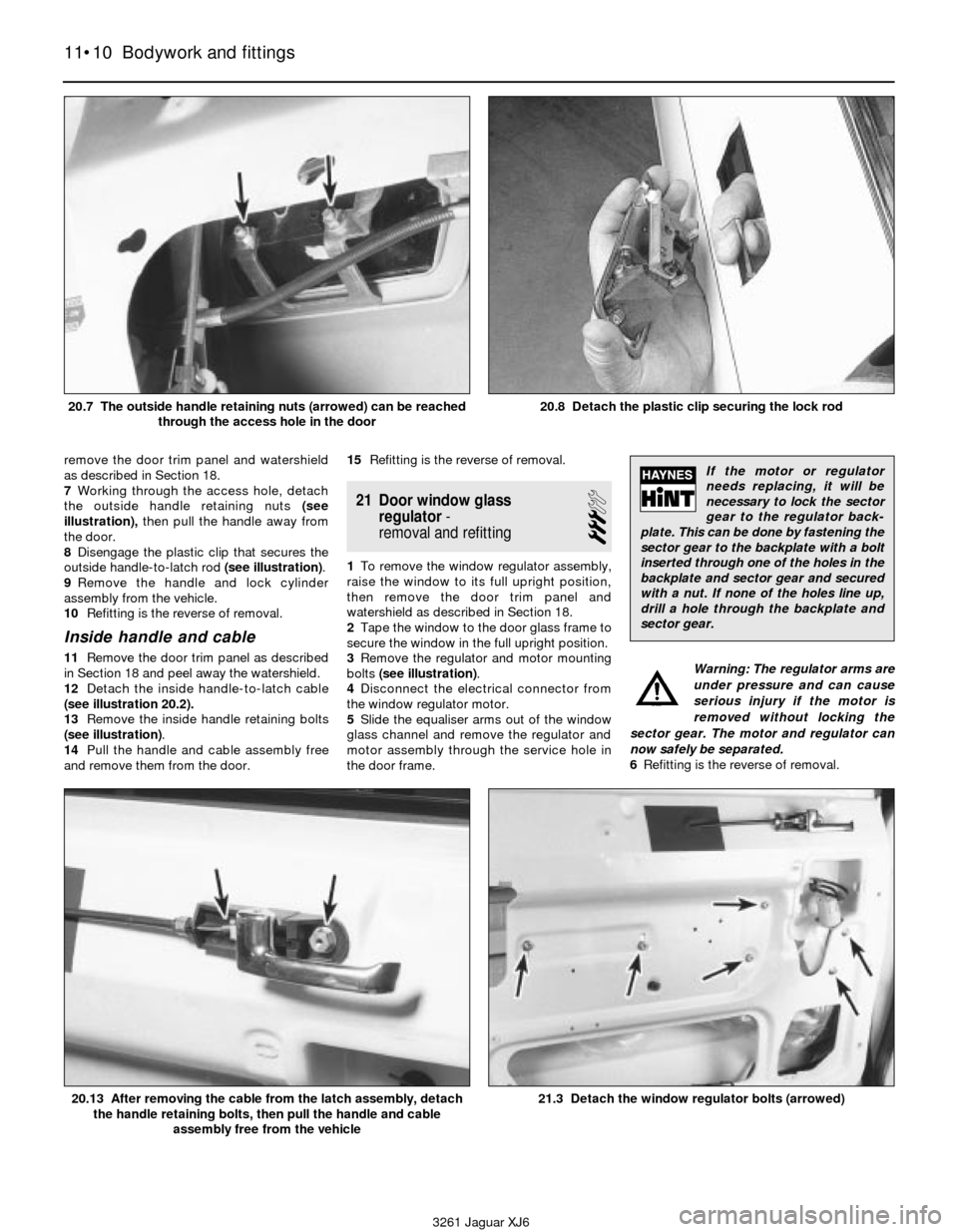
7Working through the access hole, detach
the outside handle retaining nuts (see
illustration),then pull the handle away from
the door.
8Disengage the plastic clip that secures the
outside handle-to-latch rod (see illustration).
9Remove the handle and lock cylinder
assembly from the vehicle.
10Refitting is the reverse of removal.
Inside handle and cable
11Remove the door trim panel as described
in Section 18 and peel away the watershield.
12Detach the inside handle-to-latch cable
(see illustration 20.2).
13Remove the inside handle retaining bolts
(see illustration).
14Pull the handle and cable assembly free
and remove them from the door.15Refitting is the reverse of removal.
21 Door window glass
regulator-
removal and refitting
3
1To remove the window regulator assembly,
raise the window to its full upright position,
then remove the door trim panel and
watershield as described in Section 18.
2Tape the window to the door glass frame to
secure the window in the full upright position.
3Remove the regulator and motor mounting
bolts (see illustration).
4Disconnect the electrical connector from
the window regulator motor.
5Slide the equaliser arms out of the window
glass channel and remove the regulator and
motor assembly through the service hole in
the door frame.Warning: The regulator arms are
under pressure and can cause
serious injury if the motor is
removed without locking the
sector gear. The motor and regulator can
now safely be separated.
6Refitting is the reverse of removal.
11•10 Bodywork and fittings
3261 Jaguar XJ6 20.7 The outside handle retaining nuts (arrowed) can be reached
through the access hole in the door
20.8 Detach the plastic clip securing the lock rod
20.13 After removing the cable from the latch assembly, detach
the handle retaining bolts, then pull the handle and cable
assembly free from the vehicle21.3 Detach the window regulator bolts (arrowed)
If the motor or regulator
needs replacing, it will be
necessary to lock the sector
gear to the regulator back-
plate. This can be done by fastening the
sector gear to the backplate with a bolt
inserted through one of the holes in the
backplate and sector gear and secured
with a nut. If none of the holes line up,
drill a hole through the backplate and
sector gear.
Page 160 of 227
selector towards the rear of the vehicle. Pull
up on the rear half of the radio trim bezel while
gently detaching the clips securing the front,
then remove the bezel from the vehicle.
6Remove the radio and heater control
assembly (see Chapter 12).
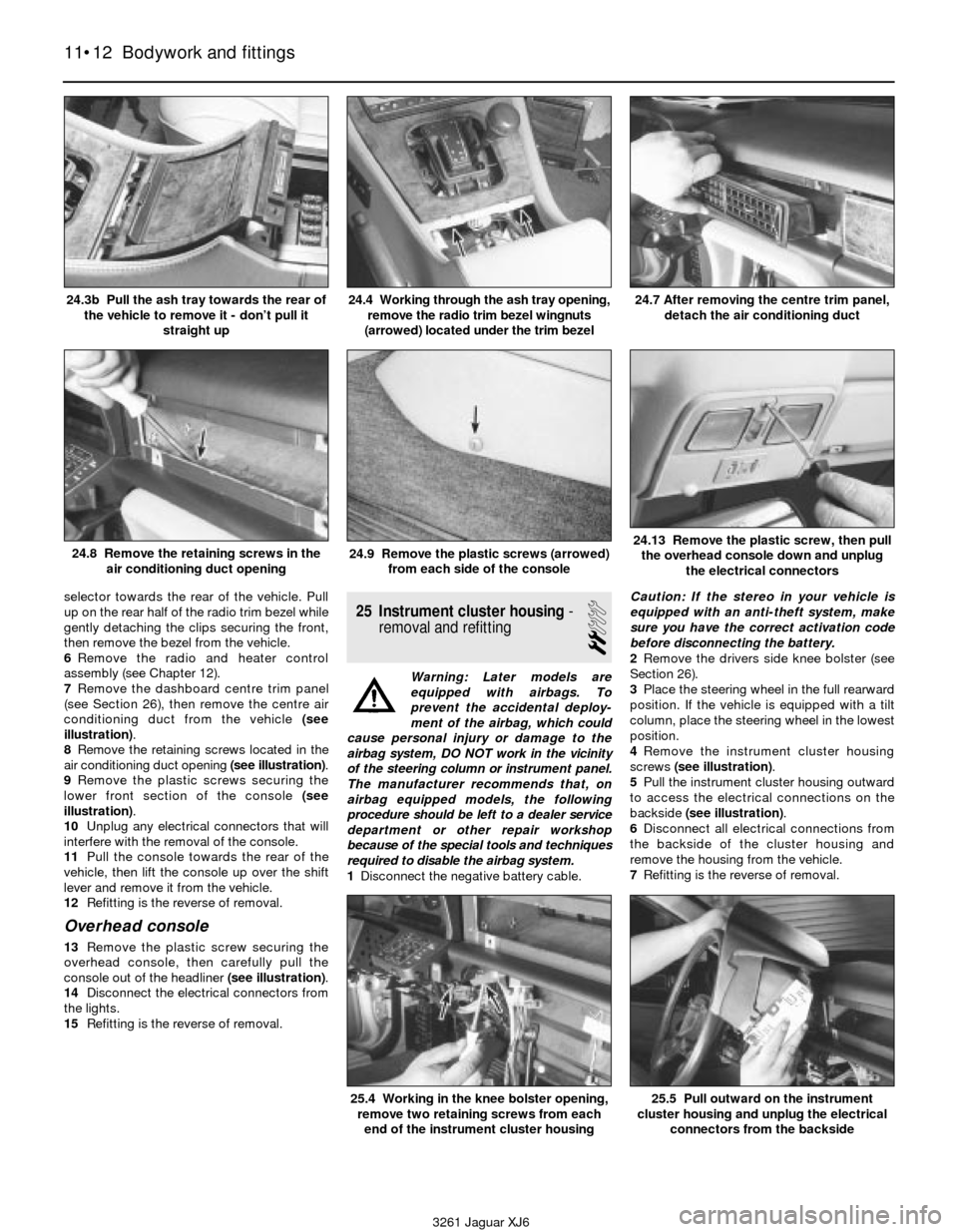
7Remove the dashboard centre trim panel
(see Section 26), then remove the centre air
conditioning duct from the vehicle (see
illustration).
8Remove the retaining screws located in the
air conditioning duct opening (see illustration).
9Remove the plastic screws securing the
lower front section of the console (see
illustration).
10Unplug any electrical connectors that will
interfere with the removal of the console.
11Pull the console towards the rear of the
vehicle, then lift the console up over the shift
lever and remove it from the vehicle.
12Refitting is the reverse of removal.
Overhead console
13Remove the plastic screw securing the
overhead console, then carefully pull the
console out of the headliner (see illustration).
14Disconnect the electrical connectors from
the lights.
15Refitting is the reverse of removal.
25 Instrument cluster housing-
removal and refitting
2
Warning: Later models are
equipped with airbags. To
prevent the accidental deploy-
ment of the airbag, which could
cause personal injury or damage to the
airbag system, DO NOT work in the vicinity
of the steering column or instrument panel.
The manufacturer recommends that, on
airbag equipped models, the following
procedure should be left to a dealer service
department or other repair workshop
because of the special tools and techniques
required to disable the airbag system.
1Disconnect the negative battery cable. Caution: If the stereo in your vehicle is
equipped with an anti-theft system, make
sure you have the correct activation code
before disconnecting the battery.
2Remove the drivers side knee bolster (see
Section 26).
3Place the steering wheel in the full rearward
position. If the vehicle is equipped with a tilt
column, place the steering wheel in the lowest
position.
4Remove the instrument cluster housing
screws (see illustration).
5Pull the instrument cluster housing outward
to access the electrical connections on the
backside (see illustration).
6Disconnect all electrical connections from
the backside of the cluster housing and
remove the housing from the vehicle.
7Refitting is the reverse of removal.
11•12 Bodywork and fittings
24.3b Pull the ash tray towards the rear of
the vehicle to remove it - don’t pull it
straight up24.4 Working through the ash tray opening,
remove the radio trim bezel wingnuts
(arrowed) located under the trim bezel24.7 After removing the centre trim panel,
detach the air conditioning duct
24.8 Remove the retaining screws in the
air conditioning duct opening24.9 Remove the plastic screws (arrowed)
from each side of the console24.13 Remove the plastic screw, then pull
the overhead console down and unplug
the electrical connectors
3261 Jaguar XJ6
25.4 Working in the knee bolster opening,
remove two retaining screws from each
end of the instrument cluster housing25.5 Pull outward on the instrument
cluster housing and unplug the electrical
connectors from the backside
Page 161 of 227
26 Dashboard trim panels-
removal and refitting
2
Warning: Later models are
equipped with airbags. To
prevent the accidental deploy-
ment of the airbag, which could
cause personal injury or damage to the
airbag system, DO NOT work in the vicinity
of the steering column or instrument panel.
The manufacturer recommends that, on
airbag equipped models, the following
procedure should be left to a dealer service
department or other repair workshop
because of the special tools and techniques
required to disable the airbag system.
Caution: If the stereo in your vehicle is
equipped with an anti-theft system, make
sure you have the correct activation code
before disconnecting the battery
Knee bolster
1Knee bolsters are located on the lower half
of the instrument panel on the driver and
passenger sides of the vehicle. The removal of
these covers will allow access to a variety of
electrical, heating and air conditioning
components.
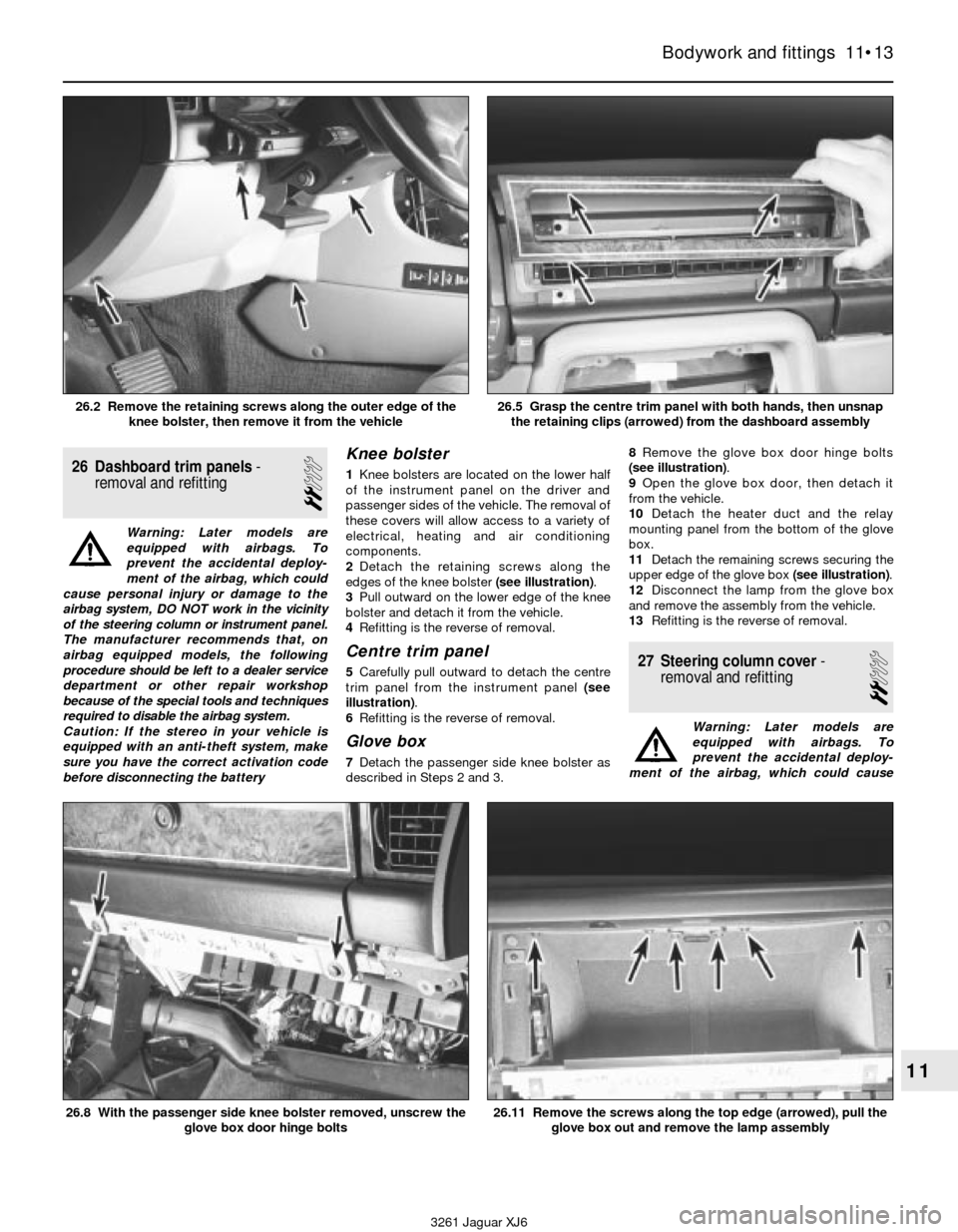
2Detach the retaining screws along the
edges of the knee bolster (see illustration).
3Pull outward on the lower edge of the knee
bolster and detach it from the vehicle.
4Refitting is the reverse of removal.
Centre trim panel
5Carefully pull outward to detach the centre
trim panel from the instrument panel (see
illustration).
6Refitting is the reverse of removal.
Glove box
7Detach the passenger side knee bolster as
described in Steps 2 and 3.8Remove the glove box door hinge bolts
(see illustration).
9Open the glove box door, then detach it
from the vehicle.
10Detach the heater duct and the relay
mounting panel from the bottom of the glove
box.
11Detach the remaining screws securing the
upper edge of the glove box (see illustration).
12Disconnect the lamp from the glove box
and remove the assembly from the vehicle.
13Refitting is the reverse of removal.
27 Steering column cover-
removal and refitting
2
Warning: Later models are
equipped with airbags. To
prevent the accidental deploy-
ment of the airbag, which could cause
Bodywork and fittings 11•13
11
3261 Jaguar XJ6 26.2 Remove the retaining screws along the outer edge of the
knee bolster, then remove it from the vehicle
26.5 Grasp the centre trim panel with both hands, then unsnap
the retaining clips (arrowed) from the dashboard assembly
26.8 With the passenger side knee bolster removed, unscrew the
glove box door hinge bolts26.11 Remove the screws along the top edge (arrowed), pull the
glove box out and remove the lamp assembly
Page 162 of 227

personal injury or damage to the airbag
system, DO NOT work in the vicinity of the
steering column or instrument panel. The
manufacturer recommends that, on airbag
equipped models, the following procedure
should be left to a dealer service
department or other repair workshop
because of the special tools and techniques
required to disable the airbag system.
1Remove the steering wheel (Chapter 10)
2Remove the knob from the rheostat
(dimmer) for the instrument panel lights (see
illustration).
3Remove the lower steering column cover
screws (see illustration), then detach the
lower cover.
4Working through the lower cover opening,
remove the four screws securing the upper
half of the cover, then pull the cover forward
and out to remove it (see illustration).
5Refitting is the reverse of removal.
28 Cowl cover-
removal and refitting
2
1Remove the windscreen wiper arms (see
Chapter 12).2Remove the retaining screws located along
the top of the cowl cover (see illustration).
3Lift the cowl cover up slightly, then detach
the electrical connectors and the spray nozzle
hoses from the backside of the cowl cover.
4Detach the cowl cover from the vehicle.
5Refitting is the reverse of removal.
29 Seats- removal and refitting
2
Front seat
1Position the seat all the way forward or all
the way to the rear to access the front seat
retaining bolts.
2Detach any bolt trim covers and remove the
retaining bolts (see illustration).
3Tilt the seat upward to access the
underneath, then unplug any electrical
connectors and lift the seat from the vehicle.
4Refitting is the reverse of removal.
Rear seat
5Remove retaining screws at the lower edge
of the seat cushion (see illustration). Then lift
up on the front edge and remove the cushion
from the vehicle.
6Detach the retaining bolts at the lower edge
of the seat back.
7Lift up on the lower edge of the seat back to
release the clips securing the top. Then
remove it from the vehicle.
8Refitting is the reverse of removal.
11•14 Bodywork and fittings
27.4 Remove the four screws securing the
upper half of the steering column cover
28.2 Remove the screws (arrowed)
located along the top of the cowl cover29.2 Use a Torx bit to remove the front
seat retaining bolts (arrowed)
3261 Jaguar XJ6 27.2 Pull off the knob from the instrument panel light rheostat
27.3 Remove the lower steering column cover screws
29.5 Detach the screws (arrowed) along
the lower edge of the seat cove
Page 163 of 227
3261 Jaguar XJ6
12
Chapter 12
Body electrical system
1 General information
The electrical system is a 12-volt, negative
earth type. Power for the lights and all
electrical accessories is supplied by a
lead/acid-type battery which is charged by
the alternator.
This Chapter covers repair and service
procedures for the various electrical
components not associated with the engine.
Information on the battery, alternator,
distributor and starter motor will be found in
Chapter 5.
It should be noted that when portions of the
electrical system are serviced, the cable
should be disconnected from the negative
battery terminal to prevent electrical shorts
and/or fires.
2 Electrical fault finding-
general information
A typical electrical circuit consists of an
electrical component, any switches, relays,
motors, fuses, fusible links, in-line fuses or
circuit breakers related to that component
and the wiring and electrical connectors that
link the component to both the battery andthe chassis. To help you pinpoint an electrical
circuit problem, wiring diagrams are included
at the end of this Chapter.
Before tackling any troublesome electrical
circuit, first study the appropriate wiring
diagrams to get a complete understanding of
what makes up that individual circuit. Trouble
spots, for instance, can often be narrowed
down by noting if other components related to
the circuit are operating properly. If several
components or circuits fail at one time,
chances are the problem is in a fuse or earth
connection, because several circuits are often
routed through the same fuse and earth
connections.
Electrical problems usually stem from
simple causes, such as loose or corroded
connections, a blown fuse, a melted fusible
link or a bad relay. Visually inspect the
condition of all fuses, wires and connections
in a problem circuit before diagnosing it.
If testing instruments are going to be
utilised, use the diagrams to plan ahead of
time where you will make the necessary
connections in order to accurately pinpoint
the trouble spot.
The basic tools needed for electrical fault
finding include a circuit tester or voltmeter (a
12-volt bulb with a set of test leads can also
be used), a continuity tester, which includes a
bulb, battery and set of test leads, and a
jumper wire, preferably with a circuit breaker
incorporated, which can be used to bypasselectrical components. Before attempting to
locate a problem with test instruments,
use the wiring diagram(s) to decide where to
make the connections.
Voltage checks
Voltage checks should be performed if a
circuit is not functioning properly. Connect
one lead of a circuit tester to either the
negative battery terminal or a known good
earth. Connect the other lead to a electrical
connector in the circuit being tested,
preferably nearest to the battery or fuse. If the
bulb of the tester lights, voltage is present,
which means that the part of the circuit
between the electrical connector and the
battery is problem free. Continue checking the
rest of the circuit in the same fashion. When
you reach a point at which no voltage is
present, the problem lies between that point
and the last test point with voltage. Most of
the time the problem can be traced to a loose
connection. Note:Keep in mind that some
circuits receive voltage only when the ignition
key is in the Accessory or Run position.
Finding a short
One method of finding shorts in a circuit is
to remove the fuse and connect a test light or
voltmeter in its place. There should be no
voltage present in the circuit. Move the wiring
harness from side to side while watching the
test light. If the bulb goes on, there is a short Airbag system - general information . . . . . . . . . . . . . . . . . . . . . . . . . 28
Bulb renewal . . . . . . . . . . . . . . . . . . . . . . . . . . . . . . . . . . . . . . . . . . . 21
Central locking system - description and check . . . . . . . . . . . . . . . . 25
Circuit breakers - general information . . . . . . . . . . . . . . . . . . . . . . . . 5
Cruise control system - description and check . . . . . . . . . . . . . . . . . 23
Direction indicators/hazard flashers - general information . . . . . . . . 7
Electric aerial - removal and refitting . . . . . . . . . . . . . . . . . . . . . . . . . 14
Electric side view mirrors - description and check . . . . . . . . . . . . . . 26
Electric sunroof - description and check . . . . . . . . . . . . . . . . . . . . . . 27
Electric window system - description and check . . . . . . . . . . . . . . . 24
Electrical fault finding - general information . . . . . . . . . . . . . . . . . . . 2
Fuel, oil and temperature gauges - check . . . . . . . . . . . . . . . . . . . . . 11
Fuses - general information . . . . . . . . . . . . . . . . . . . . . . . . . . . . . . . . 3
General information . . . . . . . . . . . . . . . . . . . . . . . . . . . . . . . . . . . . . . 1
Headlight housing (1992 to 1994 models) - removal and refitting . . . 19Headlights - adjustment . . . . . . . . . . . . . . . . . . . . . . . . . . . . . . . . . . 18
Headlights - renewal . . . . . . . . . . . . . . . . . . . . . . . . . . . . . . . . . . . . . 17
Heated rear window - check and repair . . . . . . . . . . . . . . . . . . . . . . 16
Horn - check and renewal . . . . . . . . . . . . . . . . . . . . . . . . . . . . . . . . . 20
Ignition switch and key lock cylinder - removal and refitting . . . . . . 9
Inertia switch - description and check . . . . . . . . . . . . . . . . . . . . . . . . 22
In-line fuses - general information . . . . . . . . . . . . . . . . . . . . . . . . . . . 4
Instrument cluster - removal and refitting . . . . . . . . . . . . . . . . . . . . . 12
Instrument panel switches - removal and refitting . . . . . . . . . . . . . . 10
Radio and speakers - removal and refitting . . . . . . . . . . . . . . . . . . . 13
Relays - general information and testing . . . . . . . . . . . . . . . . . . . . . . 6
Steering column switches - removal and refitting . . . . . . . . . . . . . . . 8
Windscreen wiper motor - removal and refitting . . . . . . . . . . . . . . . . 15
Wiring diagrams - general information . . . . . . . . . . . . . . . . . . . . . . . 29
12•1
Contents
Easy,suitable for
novice with little
experienceFairly easy,suitable
for beginner with
some experienceFairly difficult,
suitable for competent
DIY mechanic
Difficult,suitable for
experienced DIY
mechanicVery difficult,
suitable for expert DIY
or professional
Degrees of difficulty
54321
Page 166 of 227

can be removed and tested using the
procedure below or by a dealer service
department or a repair workshop. Defective
relays must be replaced as a unit.
Testing
1It’s best to refer to the wiring diagram for
the circuit to determine the proper
connections for the relay you’re testing.
However, if you’re not able to determine the
correct connection from the wiring diagrams,
you may be able to determine the test
connections from the information that follows.
2On most relays, two of the terminals are the
relay’s control circuit (they connect to the
relay coil which, when energised, closes the
large contacts to complete the circuit). The
other terminals are the power circuit (they are
connected together within the relay when the
control-circuit coil is energised).
3Relays are sometimes marked as an aid to
help you determine which terminals are the
control circuit and which are the powercircuit (see illustration). As a general rule,
the two thicker wires connected to the relay
are the power circuit; the thinner wires are
the control circuit.
4Remove the relay from the vehicle and check
for continuity between the relay power circuit
terminals. There should be no continuity.5Connect a fused jumper wire between one
of the two control circuit terminals and the
positive battery terminal. Connect another
jumper wire between the other control circuit
terminal and earth. When the connections are
made, the relay should click. On some relays,
polarity may be critical, so, if the relay doesn’t
click, try swapping the jumper wires on the
control circuit terminals.
6With the jumper wires connected, check for
continuity between the power circuit
terminals. Now, there should be continuity.
8If the relay fails any of the above tests,
renew it.
7 Direction indicator/hazard
flasher- general information
Warning: Later model vehicles
are equipped with airbags. To
prevent accidental deployment6.3 Most relays are marked on the outside
to easily identify the control circuit and
power circuits
12•4 Body electrical system
3261 Jaguar XJ6 1990 to 1992 relay location details
Page 167 of 227

of the airbag, which could cause personal
injury or damage to the airbag system, DO
NOT work in the vicinity of the steering
column or instrument panel. The
manufacturer recommends that, on airbag
equipped models, the following procedure
be performed at a dealer service
department or other properly equipped
repair facility because of the special tools
and techniques required to disable the
airbag system.
The direction indicator and hazard flasher
systems are governed by the central
processing unit. The central processing unit
requires special testers and diagnostic
procedures which are beyond the scope of
this manual.
If the direction indicator/hazard flasher
system fails and the indicator bulbs are in
working condition take the vehicle to a dealer
service department or an automotive
electrical specialist for further diagnosis and
repair.8 Steering column switches-
removal and refitting
1
Warning: Later models are
equipped with airbags. To
prevent accidental deployment
of the airbag, which could cause
personal injury or damage to the airbag
system, DO NOT work in the vicinity of the
steering column or instrument panel. The
manufacturer recommends that, on airbag
equipped models, the following procedure
be performed at a dealer service
department or other properly equipped
repair facility because of the special tools
and techniques required to disable the
airbag system.
Caution: If the stereo in your vehicle is
equipped with an anti-theft system, make
sure you have the correct activation code
before disconnecting the battery.1Disconnect the negative battery cable.
2Remove the steering wheel (Chapter 10).
3Remove the lower steering column cover
(see Chapter 11).
4Remove the switch retaining screw(s) (see
illustration).
Body electrical system 12•5
12
3261 Jaguar XJ6 1993 to 1994 relay location details
8.4 Remove the switch retaining screws,
disconnect the electrical connectors and
pull the switches outward (arrowed)
Page 168 of 227
5Disconnect the electrical connectors from
underneath the steering column and remove
the switch or switches from the vehicle.
6Refitting is the reverse of removal.
9 Ignition switch
and key lock cylinder-
removal and refitting
2
Warning: Later models are
equipped with airbags. To
prevent accidental deployment
of the airbag, which could cause
personal injury or damage to the airbag
system, DO NOT work in the vicinity of the
steering column or instrument panel. The
manufacturer recommends that, on airbag
equipped models, the following procedure
be performed at a dealer service
department or other properly equipped
repair facility because of the special tools
and techniques required to disable the
airbag system.
Caution: If the stereo in your vehicle is
equipped with an anti-theft system, make
sure you have the correct activation code
before disconnecting the battery.1Disconnect the negative battery cable.
2Remove the steering wheel (Chapter 10).
3Remove the steering column trim covers
(see Chapter 11).
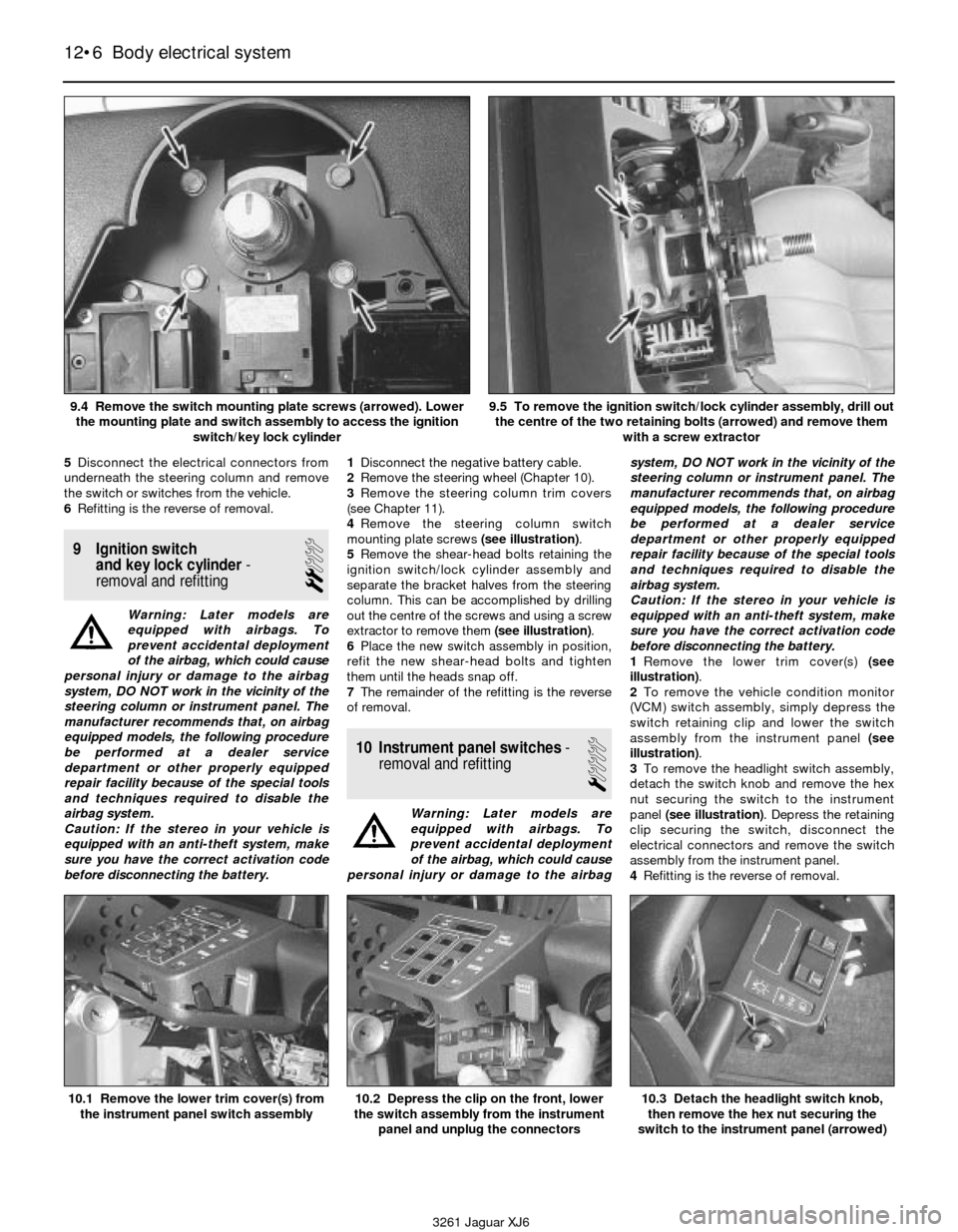
4Remove the steering column switch
mounting plate screws (see illustration).
5Remove the shear-head bolts retaining the
ignition switch/lock cylinder assembly and
separate the bracket halves from the steering
column. This can be accomplished by drilling
out the centre of the screws and using a screw
extractor to remove them (see illustration).
6Place the new switch assembly in position,
refit the new shear-head bolts and tighten
them until the heads snap off.
7The remainder of the refitting is the reverse
of removal.
10 Instrument panel switches-
removal and refitting
1
Warning: Later models are
equipped with airbags. To
prevent accidental deployment
of the airbag, which could cause
personal injury or damage to the airbagsystem, DO NOT work in the vicinity of the
steering column or instrument panel. The
manufacturer recommends that, on airbag
equipped models, the following procedure
be performed at a dealer service
department or other properly equipped
repair facility because of the special tools
and techniques required to disable the
airbag system.
Caution: If the stereo in your vehicle is
equipped with an anti-theft system, make
sure you have the correct activation code
before disconnecting the battery.
1Remove the lower trim cover(s) (see
illustration).
2To remove the vehicle condition monitor
(VCM) switch assembly, simply depress the
switch retaining clip and lower the switch
assembly from the instrument panel (see
illustration).
3To remove the headlight switch assembly,
detach the switch knob and remove the hex
nut securing the switch to the instrument
panel (see illustration). Depress the retaining
clip securing the switch, disconnect the
electrical connectors and remove the switch
assembly from the instrument panel.
4Refitting is the reverse of removal.
12•6 Body electrical system
10.1 Remove the lower trim cover(s) from
the instrument panel switch assembly10.2 Depress the clip on the front, lower
the switch assembly from the instrument
panel and unplug the connectors10.3 Detach the headlight switch knob,
then remove the hex nut securing the
switch to the instrument panel (arrowed)
3261 Jaguar XJ6 9.4 Remove the switch mounting plate screws (arrowed). Lower
the mounting plate and switch assembly to access the ignition
switch/key lock cylinder
9.5 To remove the ignition switch/lock cylinder assembly, drill out
the centre of the two retaining bolts (arrowed) and remove them
with a screw extractor