front JEEP CHEROKEE 1994 Service Repair Manual
[x] Cancel search | Manufacturer: JEEP, Model Year: 1994, Model line: CHEROKEE, Model: JEEP CHEROKEE 1994Pages: 1784, PDF Size: 77.09 MB
Page 417 of 1784
(6) Install motor mounting screws. Tighten screws
to 10.5 Nzm (96 in. lbs.).
Be sure wire harness is not pinched or cut when
windshield frame is rotated to upright position.
(7) Raise windshield to upright position and install
left and right windshield holddown bolts.
(8) Install nuts attaching pivots to windshield
frame. Tighten nuts to 10 Nzm (7.5 ft. lbs.).(9) Turn wipers on to allow motor to cycle to park
position.
(10) Install left and right wiper arms (Fig. 3).
(11) Install necessary top components on wind-
shield frame.
FRONT WIPER MOTOR
REMOVAL
(1) Remove the necessary hard or soft top compo-
nents from the windshield frame.
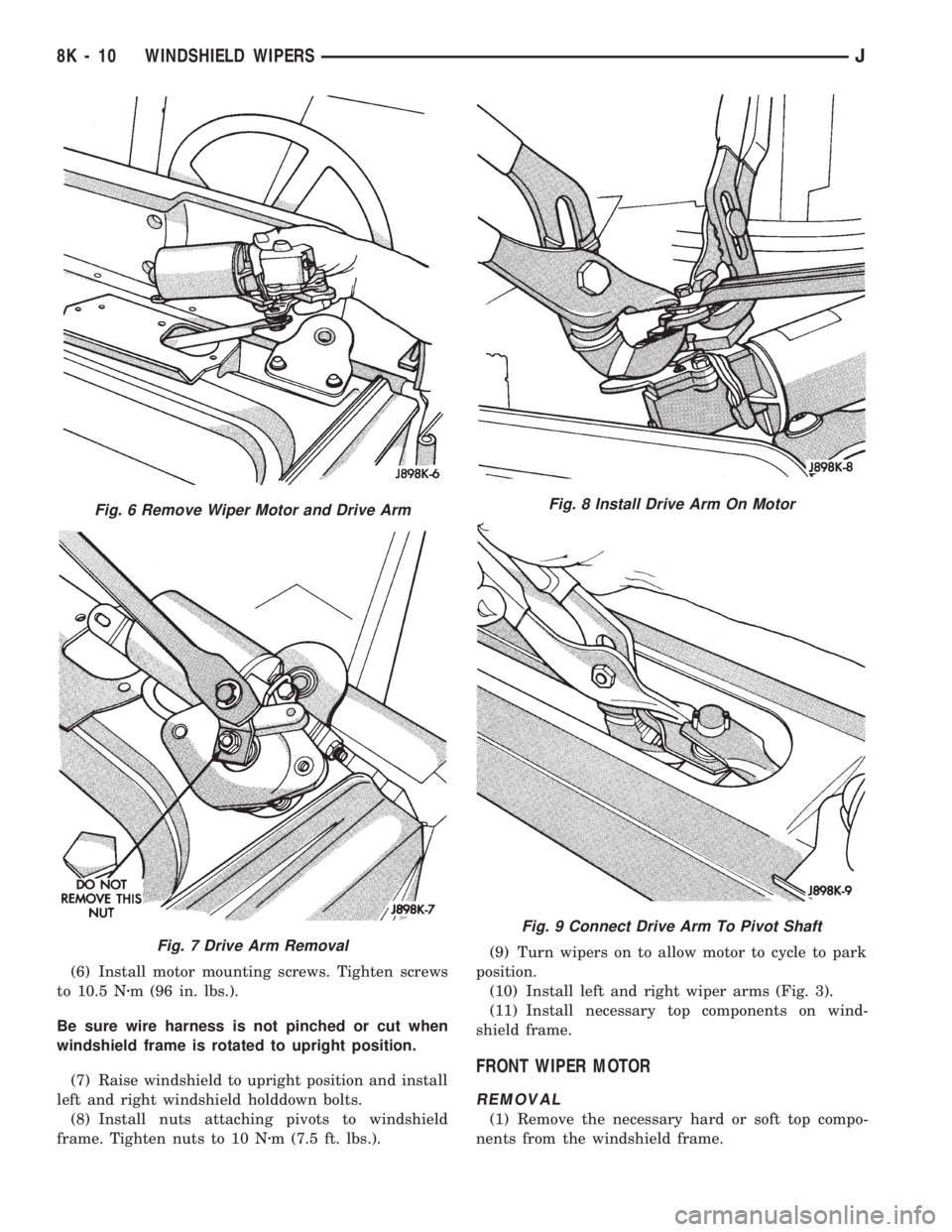
Fig. 6 Remove Wiper Motor and Drive Arm
Fig. 7 Drive Arm Removal
Fig. 8 Install Drive Arm On Motor
Fig. 9 Connect Drive Arm To Pivot Shaft
8K - 10 WINDSHIELD WIPERSJ
Page 420 of 1784
REAR WASHER PUMP REPLACEMENT
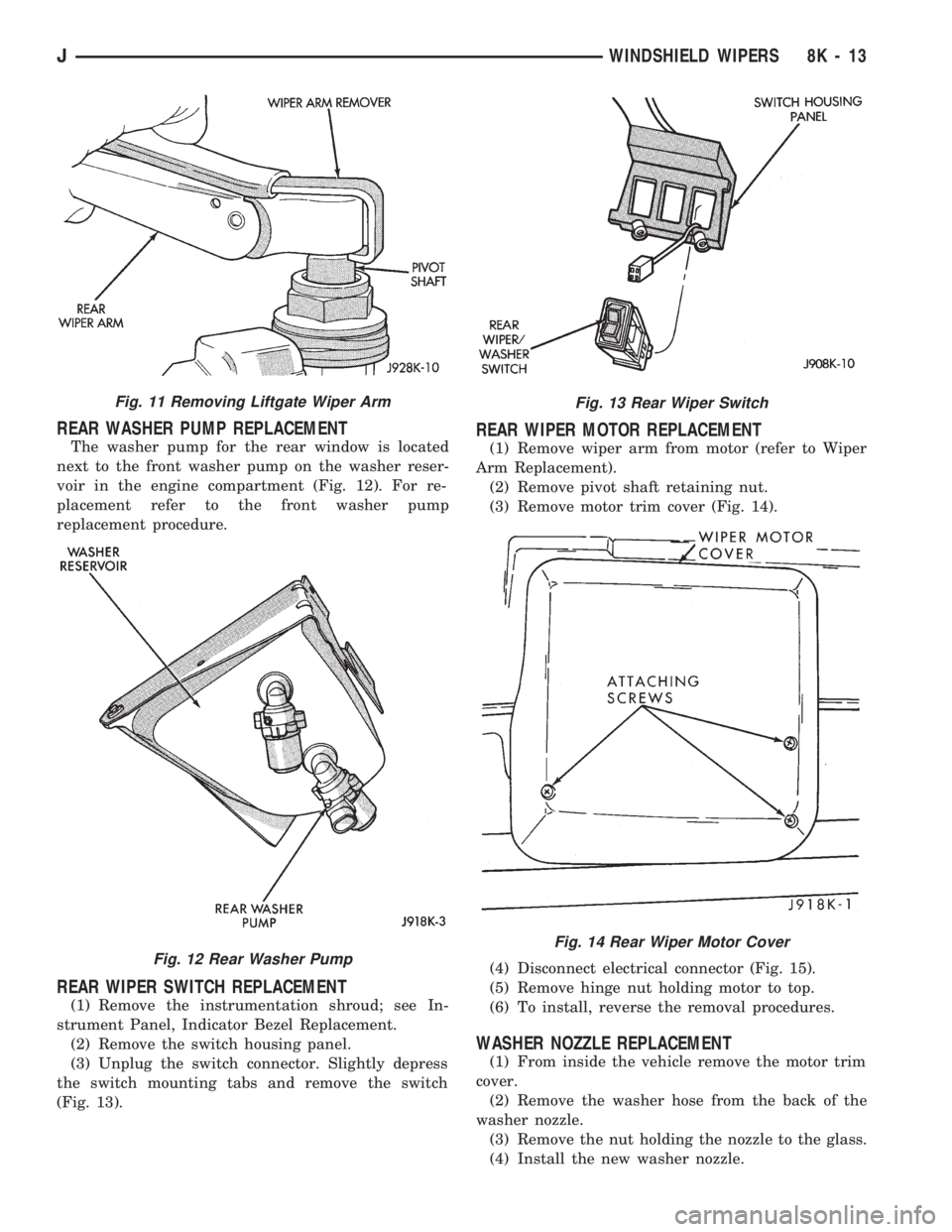
The washer pump for the rear window is located
next to the front washer pump on the washer reser-
voir in the engine compartment (Fig. 12). For re-
placement refer to the front washer pump
replacement procedure.
REAR WIPER SWITCH REPLACEMENT
(1) Remove the instrumentation shroud; see In-
strument Panel, Indicator Bezel Replacement.
(2) Remove the switch housing panel.
(3) Unplug the switch connector. Slightly depress
the switch mounting tabs and remove the switch
(Fig. 13).
REAR WIPER MOTOR REPLACEMENT
(1) Remove wiper arm from motor (refer to Wiper
Arm Replacement).
(2) Remove pivot shaft retaining nut.
(3) Remove motor trim cover (Fig. 14).
(4) Disconnect electrical connector (Fig. 15).
(5) Remove hinge nut holding motor to top.
(6) To install, reverse the removal procedures.
WASHER NOZZLE REPLACEMENT
(1) From inside the vehicle remove the motor trim
cover.
(2) Remove the washer hose from the back of the
washer nozzle.
(3) Remove the nut holding the nozzle to the glass.
(4) Install the new washer nozzle.
Fig. 11 Removing Liftgate Wiper Arm
Fig. 12 Rear Washer Pump
Fig. 13 Rear Wiper Switch
Fig. 14 Rear Wiper Motor Cover
JWINDSHIELD WIPERS 8K - 13
Page 428 of 1784
LAMPS
CONTENTS
page page
EXTERIOR LAMPS....................... 1
INTERIOR LAMPS...................... 19SPECIFICATIONS....................... 23
EXTERIOR LAMPS
INDEX
page page
Back-up/Rear Turn Signal/Tail Lamp Bulb
Replacement........................... 9
Center High Mounted Stop Lamp (CHMSL)ÐXJ . 10
Center High Mounted Stop Lamp (CHMSL)ÐYJ . 11
Daytime Running Lights (Canada Only)........ 16
DRL Module Replacement.................. 16
Fog Lamp Beam Adjustment................ 12
Fog Lamp Bulb/Element Replacement......... 13
Fog Lamp Replacement................... 15
Fog Lamp Service Information............... 12
Fog Lamp Switch Replacement.............. 14
Fog Lamp Trouble Diagnosis................ 12
Front Park/Turn Signal Lamp Bulb Replacement . . 8
Headlamp Beam Adjustment................. 3
Headlamp Bulb Replacement................ 3
Headlamp Delay Function Trouble DiagnosisÐXJ
Vehicles.............................. 16Headlamp Delay Module ReplacementÐXJ
Vehicles.............................. 16
Headlamp Dimmer Switch Replacement........ 6
Headlamp Switch Replacement............... 4
Headlamp Trouble DiagnosisÐXJ Vehicles...... 1
Headlamp Trouble DiagnosisÐYJ Vehicles...... 2
License Plate Lamp....................... 10
Sentinel Headlamp Delay ModuleÐXJ Vehicles . . 15
Service Information........................ 1
Side Marker Lamp Bulb Replacement.......... 7
Switch Tests............................. 2
Underhood Lamp Bulb Replacement.......... 18
Underhood Lamp Replacement.............. 18
Underhood Lamp Service Information......... 17
SERVICE INFORMATION
Exterior lamp circuits are comprised of the head-
lamp circuit, fog lamp circuit, and tail/side marker/
park lamp circuit. Battery voltage is controlled by
both the headlamp ON/OFF switch and headlamp
dimmer switch.
The dimmer switch functions as a fog lamp switch.
Voltage is applied to the fog lamp switch only when
the dimmer switch is in the low beam position.
HEADLAMP TROUBLE DIAGNOSISÐXJ VEHICLES
LOW AND HIGH BEAM INOPERATIVE BOTH
HEADLAMPS
(1) Place the headlamp switch in the ON position.
(2) Test the 40 amp fuse for continuity. If bad, re-
place fuse.
(3) Insert the test probe into terminal 5 of the
front lamp wire harness connector. Measure the re-
sistance from terminal 5 to body ground. The ohm-
meter should indicate zero ohms. If not OK, repair
the open circuit in the harness to body ground.(4) Disconnect the front lamp wire connector. Mea-
sure resistance between connector terminals 5 and 2.
Next measure between terminal 5 and 7. The ohm-
meter should indicate zero ohms for both measure-
ments. If not OK, replace the headlamp bulbs.
(5) Measure the voltage between the dimmer
switch wire connector terminal 2 and body ground.
The voltmeter should indicate battery voltage. If not
OK, continue with the next step.
The dimmer switch is integral with the turn
signal and is located on the steering column.
The dimmer switch switches the headlamp beam
when the turn signal lever is pulled rearward.
(6) Disconnect the dimmer switch wire connector
and place the headlamp switch in the OFF position.
Measure the resistance from terminal 2 to vehicle
body ground. The ohmmeter should indicate infinite
resistance. If OK, replace the headlamp switch and
continue with the next step. If not OK, repair the
short circuit in the wire harness that leads to termi-
nal 2.
JLAMPS 8L - 1
Page 431 of 1784
(3) Move vehicle with the headlamps located di-
rectly above the 7.62-meters (25-feet) reference line.
(4) Equalize all the tire pressures.
(5) Rock vehicle from side to side to stabilize the
springs and shock absorbers.
(6) Use tape to attach a vehicle centerline on the
screen/wall (6). Ensure that it is aligned with and
represents the centerline of the vehicle.
(7) Measure distance between the vehicle head-
lamp centers. Divide this distance by two. Measure
the one/half distance outward from each side of the
vehicle centerline (6). Use tape to attach the right
and left lamp vertical centerline (4 and 5) on the
screen/wall (6).
(8) Measure the distance from the center of each
headlamp to the floor.
(9) Measure the lamp-to-floor distance upward
from the floor at each lamp vertical centerline (4 and
5). Use tape to attach the lamp horizontal centerline
(3) on the screen/wall.
ADJUSTMENT
(1) Remove screws and both headlamp bezels.
(2) Clean front of the headlamps.
(3) Place headlamps on LOW beam.
(4) Cover front of the headlamp that is not being
adjusted.
(5) Turn vertical adjustment screw until the head-
lamp beam pattern on screen/wall is similar to the
pattern depicted in Figure 6.
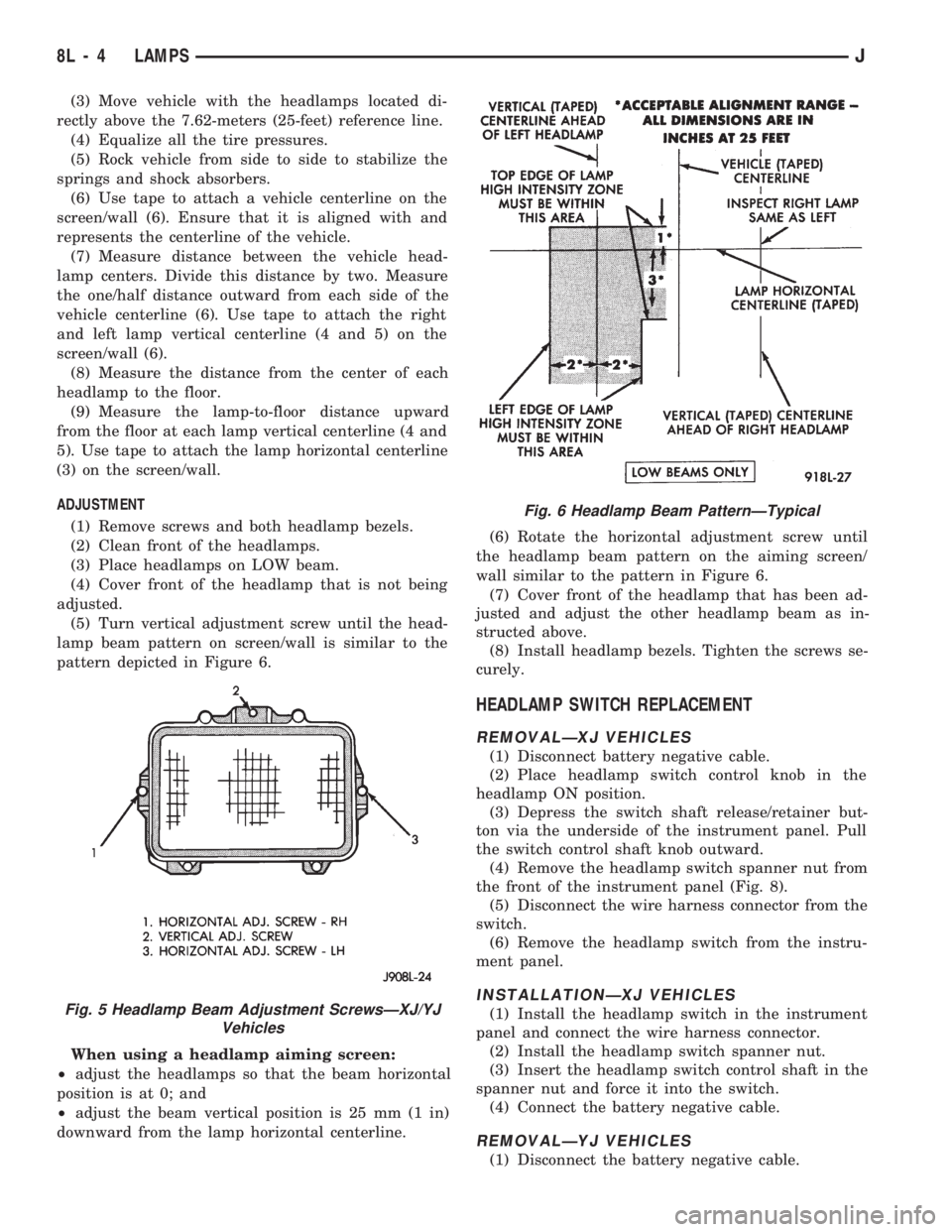
When using a headlamp aiming screen:
²adjust the headlamps so that the beam horizontal
position is at 0; and
²adjust the beam vertical position is 25 mm (1 in)
downward from the lamp horizontal centerline.(6) Rotate the horizontal adjustment screw until
the headlamp beam pattern on the aiming screen/
wall similar to the pattern in Figure 6.
(7) Cover front of the headlamp that has been ad-
justed and adjust the other headlamp beam as in-
structed above.
(8) Install headlamp bezels. Tighten the screws se-
curely.
HEADLAMP SWITCH REPLACEMENT
REMOVALÐXJ VEHICLES
(1) Disconnect battery negative cable.
(2) Place headlamp switch control knob in the
headlamp ON position.
(3) Depress the switch shaft release/retainer but-
ton via the underside of the instrument panel. Pull
the switch control shaft knob outward.
(4) Remove the headlamp switch spanner nut from
the front of the instrument panel (Fig. 8).
(5) Disconnect the wire harness connector from the
switch.
(6) Remove the headlamp switch from the instru-
ment panel.
INSTALLATIONÐXJ VEHICLES
(1) Install the headlamp switch in the instrument
panel and connect the wire harness connector.
(2) Install the headlamp switch spanner nut.
(3) Insert the headlamp switch control shaft in the
spanner nut and force it into the switch.
(4) Connect the battery negative cable.
REMOVALÐYJ VEHICLES
(1) Disconnect the battery negative cable.
Fig. 5 Headlamp Beam Adjustment ScrewsÐXJ/YJ
Vehicles
Fig. 6 Headlamp Beam PatternÐTypical
8L - 4 LAMPSJ
Page 435 of 1784
INSTALLATIONÐYJ VEHICLES
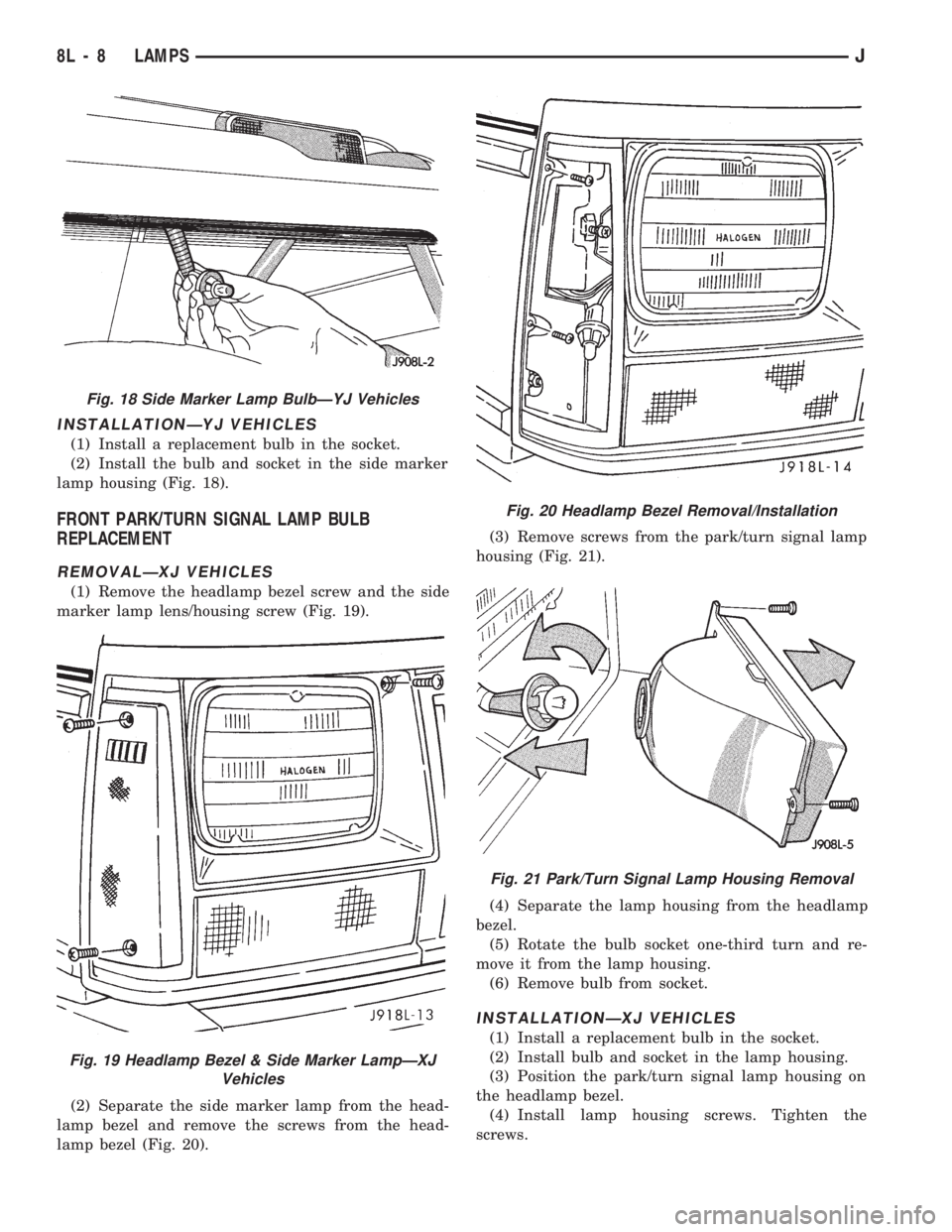
(1) Install a replacement bulb in the socket.
(2) Install the bulb and socket in the side marker
lamp housing (Fig. 18).
FRONT PARK/TURN SIGNAL LAMP BULB
REPLACEMENT
REMOVALÐXJ VEHICLES
(1) Remove the headlamp bezel screw and the side
marker lamp lens/housing screw (Fig. 19).
(2) Separate the side marker lamp from the head-
lamp bezel and remove the screws from the head-
lamp bezel (Fig. 20).(3) Remove screws from the park/turn signal lamp
housing (Fig. 21).
(4) Separate the lamp housing from the headlamp
bezel.
(5) Rotate the bulb socket one-third turn and re-
move it from the lamp housing.
(6) Remove bulb from socket.
INSTALLATIONÐXJ VEHICLES
(1) Install a replacement bulb in the socket.
(2) Install bulb and socket in the lamp housing.
(3) Position the park/turn signal lamp housing on
the headlamp bezel.
(4) Install lamp housing screws. Tighten the
screws.
Fig. 18 Side Marker Lamp BulbÐYJ Vehicles
Fig. 19 Headlamp Bezel & Side Marker LampÐXJ
Vehicles
Fig. 20 Headlamp Bezel Removal/Installation
Fig. 21 Park/Turn Signal Lamp Housing Removal
8L - 8 LAMPSJ
Page 446 of 1784
INTERIOR LAMPS
INDEX
page page
Dome Lamp Replacement.................. 20
Dome/Courtesy Lamp Service Information...... 19
Dome/Courtesy Lamp Trouble Diagnosis....... 19
Hardtop Dome/Cargo Lamp Bulb ReplacementÐYJ
Vehicles.............................. 20Illuminated Entry System Service Information . . . 20
Illuminated Entry System Trouble Diagnosis.... 21
Lighted Vanity Mirror...................... 19
Lighted Vanity Mirror Trouble Diagnosis....... 19
Overhead ConsoleÐXJ Vehicles............. 20
DOME/COURTESY LAMP SERVICE INFORMATION
XJ VEHICLES
Voltage is applied at all times via the dome lamp
fuse to each of the interior lamp bulbs. The interior
lamp bulbs illuminate when they are connected to
body ground via the switch:
²headlamp switch,
²glove box switch,
²door pillar switch, and
²liftgate switch (if the cargo lamp is ON.)
If equipped with Security Alarm Module, refer to
Group 8QÐVehicle Theft Security System.
YJ VEHICLES
The dome/cargo and courtesy lamps are controlled
via ON/OFF switches. The ON/OFF switches are in
the lamp ground circuits. Voltage via the dome/cour-
tesy lamp fuse is applied directly to the lamp bulbs.
When either door is opened, the door pillar switch
contacts close and provide a direct path to vehicle
body ground.
The cargo/cargo and courtesy lamps can also be
turned on via the interior lamp illumination rheo-
stat.
DOME/COURTESY LAMP TROUBLE DIAGNOSIS
ALL LAMPS INOPERATIVE
(1) Rotate the headlamp switch rheostat clockwise.
The lamps should light. If not OK, remove, inspect
and test the dome lamp fuse. Replace if bad.
(2) If the fuse is OK, repair the open circuit in the
wire harness to vehicle body ground.
ONE LAMP INOPERATIVE
(1) Measure the resistance across the bulb holder
terminals. The ohmmeter should indicate zero ohms.
If not, replace the bulb.
(2) Measure the voltage between the voltage side
of the bulb holder and vehicle body ground. The volt-
meter should indicate battery voltage. If not, repair
the open circuit in the wire harness to the splice.
LAMPS INOPERATIVE WITH ONE OR MORE
DOORS OPENED
(1) Remove the inoperative switch from the door
pillar and connect the switch wire directly to ground.
The lamp should light.
(2) If not, check for an open circuit in black
(ground) wire. Repair as necessary. If lamps still do
not light, replace the switch.
LIGHTED VANITY MIRROR
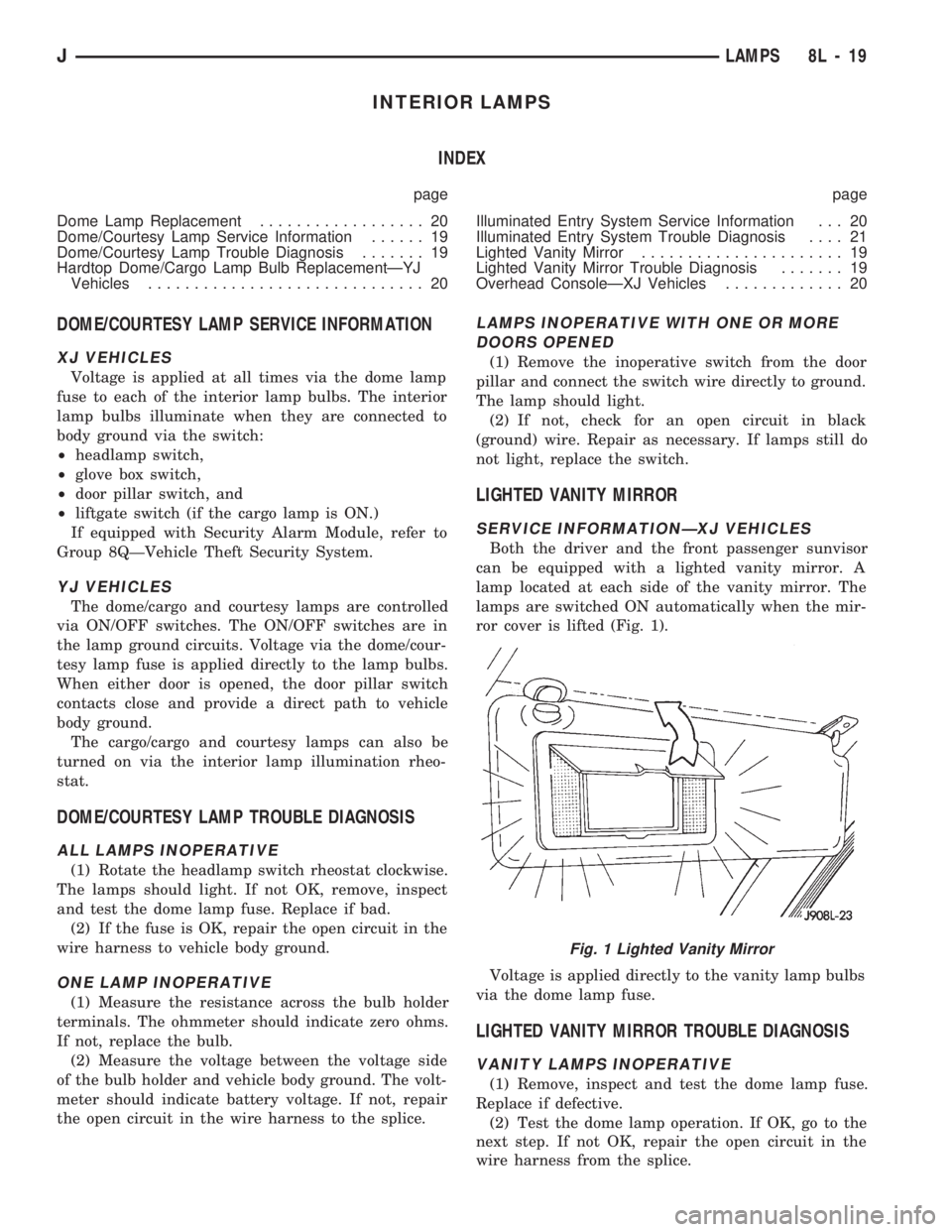
SERVICE INFORMATIONÐXJ VEHICLES
Both the driver and the front passenger sunvisor
can be equipped with a lighted vanity mirror. A
lamp located at each side of the vanity mirror. The
lamps are switched ON automatically when the mir-
ror cover is lifted (Fig. 1).
Voltage is applied directly to the vanity lamp bulbs
via the dome lamp fuse.
LIGHTED VANITY MIRROR TROUBLE DIAGNOSIS
VANITY LAMPS INOPERATIVE
(1) Remove, inspect and test the dome lamp fuse.
Replace if defective.
(2) Test the dome lamp operation. If OK, go to the
next step. If not OK, repair the open circuit in the
wire harness from the splice.
Fig. 1 Lighted Vanity Mirror
JLAMPS 8L - 19
Page 447 of 1784
(3) Measure the voltage between the pink wire on
the switch connector and vehicle body ground. The
voltmeter should indicate battery voltage. If not OK,
repair the open circuit in the wire harness from the
splice.
(4) Connect a jumper wire from the ground side of
the switch to a good vehicle body ground. Measure
the resistance to vehicle body ground. The ohmmeter
should indicate zero ohms. If not, repair the open cir-
cuit in the wire harness to vehicle body ground.
DOME LAMP REPLACEMENT
REMOVALÐXJ VEHICLES
(1) Remove the dome lamp lens by squeezing it at
both sides. This will separate the lens retainer tabs
from the lamp housing shoulders.
(2) Pull the lens downward to remove it from the
lamp housing.
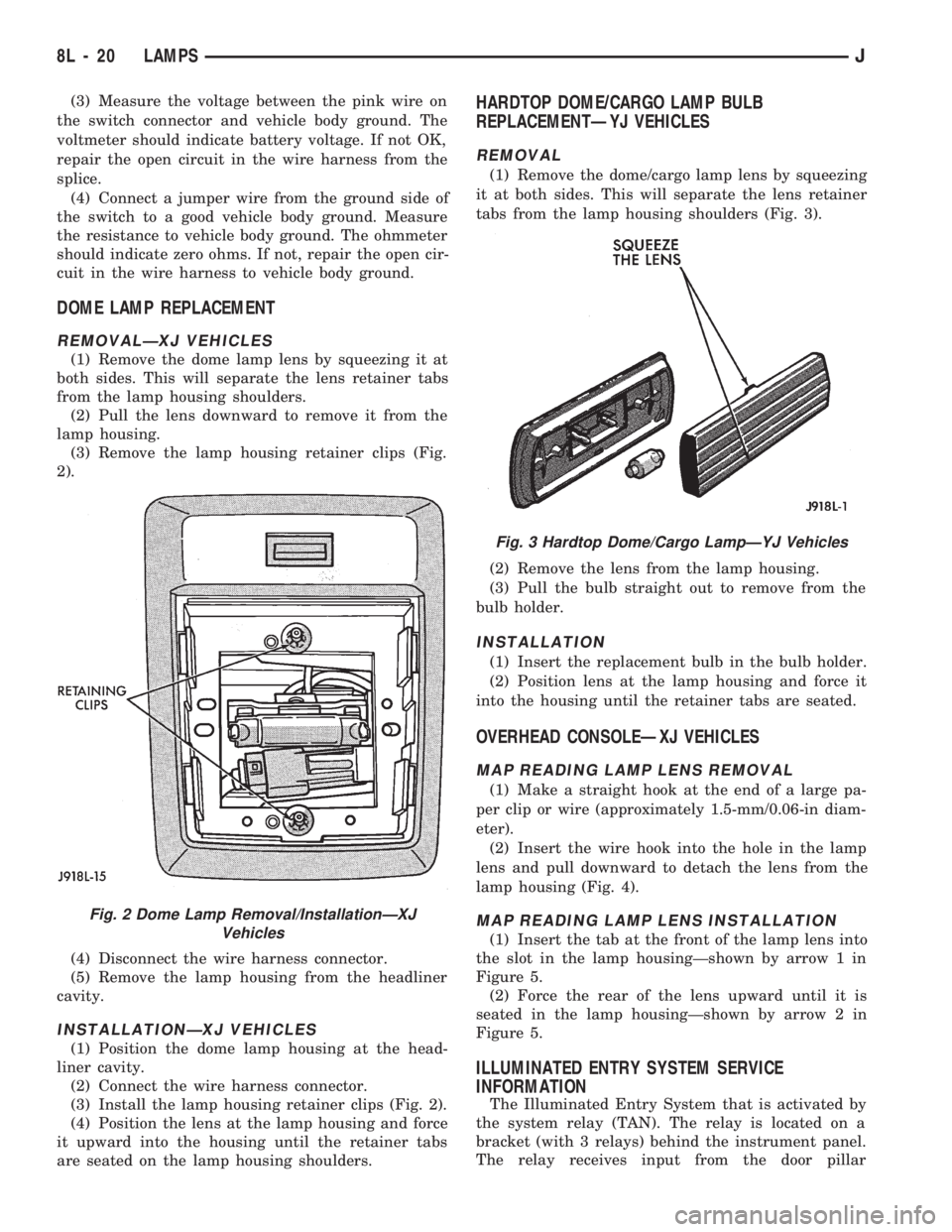
(3) Remove the lamp housing retainer clips (Fig.
2).
(4) Disconnect the wire harness connector.
(5) Remove the lamp housing from the headliner
cavity.
INSTALLATIONÐXJ VEHICLES
(1) Position the dome lamp housing at the head-
liner cavity.
(2) Connect the wire harness connector.
(3) Install the lamp housing retainer clips (Fig. 2).
(4) Position the lens at the lamp housing and force
it upward into the housing until the retainer tabs
are seated on the lamp housing shoulders.
HARDTOP DOME/CARGO LAMP BULB
REPLACEMENTÐYJ VEHICLES
REMOVAL
(1) Remove the dome/cargo lamp lens by squeezing
it at both sides. This will separate the lens retainer
tabs from the lamp housing shoulders (Fig. 3).
(2) Remove the lens from the lamp housing.
(3) Pull the bulb straight out to remove from the
bulb holder.
INSTALLATION
(1) Insert the replacement bulb in the bulb holder.
(2) Position lens at the lamp housing and force it
into the housing until the retainer tabs are seated.
OVERHEAD CONSOLEÐXJ VEHICLES
MAP READING LAMP LENS REMOVAL
(1) Make a straight hook at the end of a large pa-
per clip or wire (approximately 1.5-mm/0.06-in diam-
eter).
(2) Insert the wire hook into the hole in the lamp
lens and pull downward to detach the lens from the
lamp housing (Fig. 4).
MAP READING LAMP LENS INSTALLATION
(1) Insert the tab at the front of the lamp lens into
the slot in the lamp housingÐshown by arrow 1 in
Figure 5.
(2) Force the rear of the lens upward until it is
seated in the lamp housingÐshown by arrow 2 in
Figure 5.
ILLUMINATED ENTRY SYSTEM SERVICE
INFORMATION
The Illuminated Entry System that is activated by
the system relay (TAN). The relay is located on a
bracket (with 3 relays) behind the instrument panel.
The relay receives input from the door pillar
Fig. 2 Dome Lamp Removal/InstallationÐXJ
Vehicles
Fig. 3 Hardtop Dome/Cargo LampÐYJ Vehicles
8L - 20 LAMPSJ
Page 466 of 1784
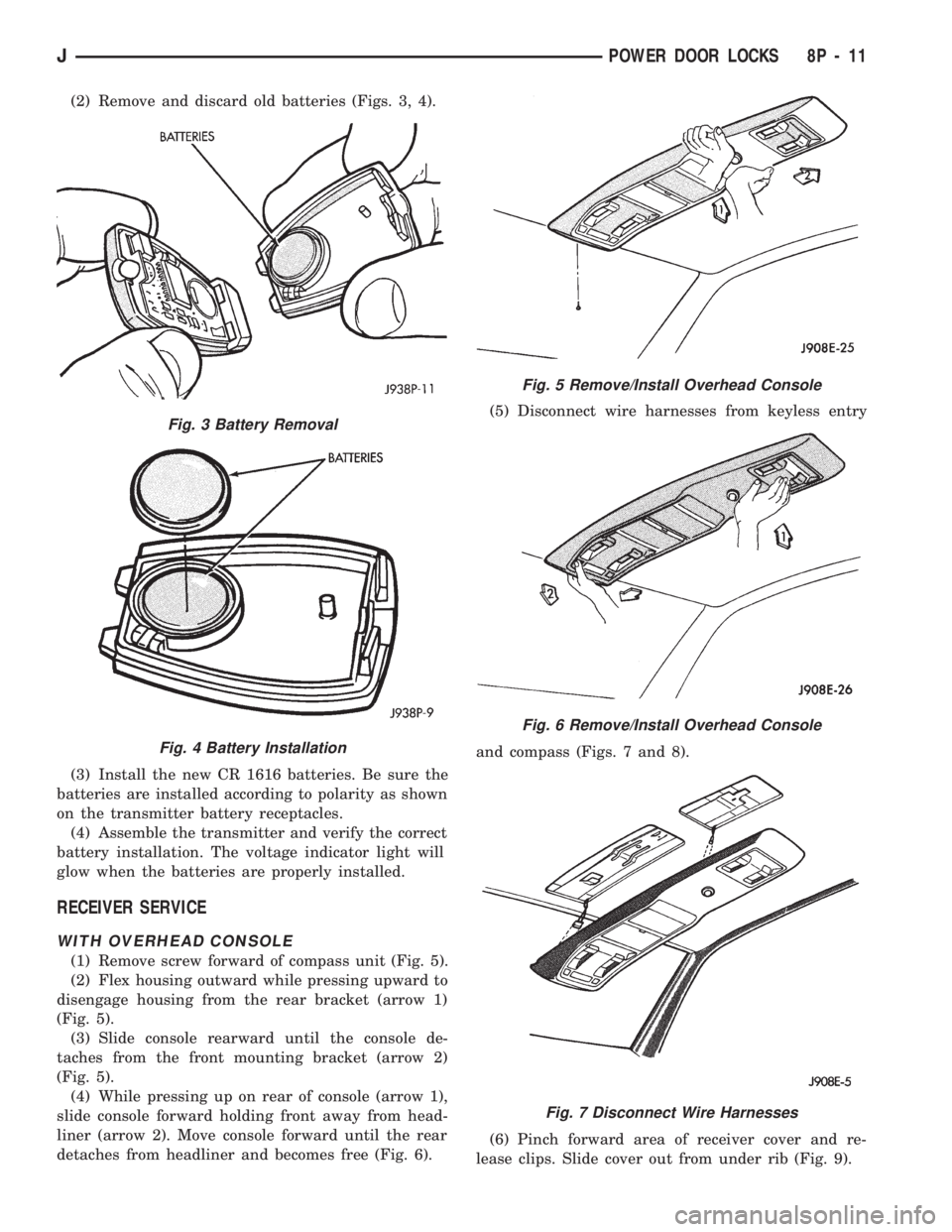
(2) Remove and discard old batteries (Figs. 3, 4).
(3) Install the new CR 1616 batteries. Be sure the
batteries are installed according to polarity as shown
on the transmitter battery receptacles.
(4) Assemble the transmitter and verify the correct
battery installation. The voltage indicator light will
glow when the batteries are properly installed.
RECEIVER SERVICE
WITH OVERHEAD CONSOLE
(1) Remove screw forward of compass unit (Fig. 5).
(2) Flex housing outward while pressing upward to
disengage housing from the rear bracket (arrow 1)
(Fig. 5).
(3) Slide console rearward until the console de-
taches from the front mounting bracket (arrow 2)
(Fig. 5).
(4) While pressing up on rear of console (arrow 1),
slide console forward holding front away from head-
liner (arrow 2). Move console forward until the rear
detaches from headliner and becomes free (Fig. 6).(5) Disconnect wire harnesses from keyless entry
and compass (Figs. 7 and 8).
(6) Pinch forward area of receiver cover and re-
lease clips. Slide cover out from under rib (Fig. 9).
Fig. 3 Battery Removal
Fig. 4 Battery Installation
Fig. 5 Remove/Install Overhead Console
Fig. 6 Remove/Install Overhead Console
Fig. 7 Disconnect Wire Harnesses
JPOWER DOOR LOCKS 8P - 11
Page 468 of 1784
POWER SEATS
CONTENTS
page page
DIAGNOSIS............................. 1
GENERAL.............................. 1POWER SEAT MOTOR REPLACEMENT....... 2
SWITCH TESTING....................... 2
GENERAL
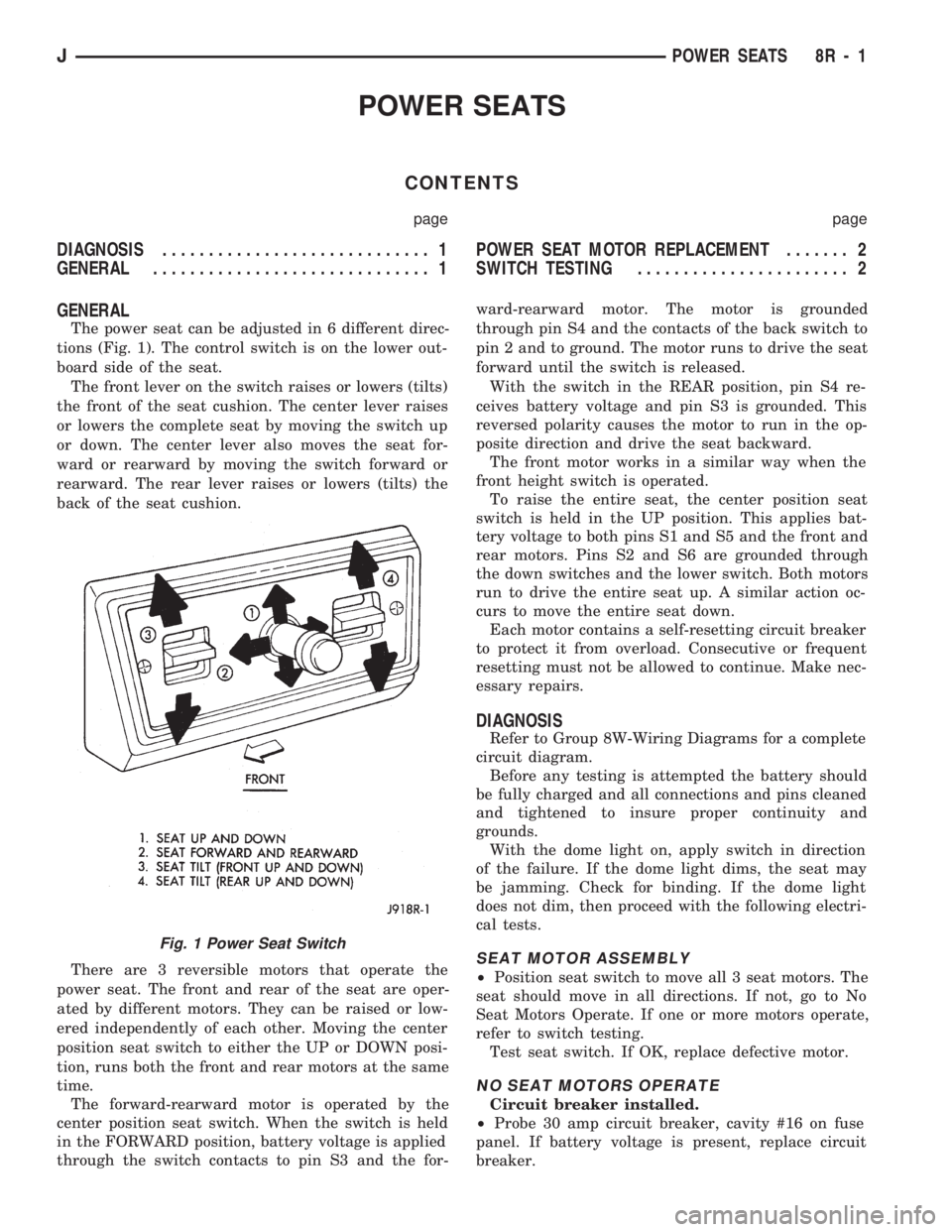
The power seat can be adjusted in 6 different direc-
tions (Fig. 1). The control switch is on the lower out-
board side of the seat.
The front lever on the switch raises or lowers (tilts)
the front of the seat cushion. The center lever raises
or lowers the complete seat by moving the switch up
or down. The center lever also moves the seat for-
ward or rearward by moving the switch forward or
rearward. The rear lever raises or lowers (tilts) the
back of the seat cushion.
There are 3 reversible motors that operate the
power seat. The front and rear of the seat are oper-
ated by different motors. They can be raised or low-
ered independently of each other. Moving the center
position seat switch to either the UP or DOWN posi-
tion, runs both the front and rear motors at the same
time.
The forward-rearward motor is operated by the
center position seat switch. When the switch is held
in the FORWARD position, battery voltage is applied
through the switch contacts to pin S3 and the for-ward-rearward motor. The motor is grounded
through pin S4 and the contacts of the back switch to
pin 2 and to ground. The motor runs to drive the seat
forward until the switch is released.
With the switch in the REAR position, pin S4 re-
ceives battery voltage and pin S3 is grounded. This
reversed polarity causes the motor to run in the op-
posite direction and drive the seat backward.
The front motor works in a similar way when the
front height switch is operated.
To raise the entire seat, the center position seat
switch is held in the UP position. This applies bat-
tery voltage to both pins S1 and S5 and the front and
rear motors. Pins S2 and S6 are grounded through
the down switches and the lower switch. Both motors
run to drive the entire seat up. A similar action oc-
curs to move the entire seat down.
Each motor contains a self-resetting circuit breaker
to protect it from overload. Consecutive or frequent
resetting must not be allowed to continue. Make nec-
essary repairs.
DIAGNOSIS
Refer to Group 8W-Wiring Diagrams for a complete
circuit diagram.
Before any testing is attempted the battery should
be fully charged and all connections and pins cleaned
and tightened to insure proper continuity and
grounds.
With the dome light on, apply switch in direction
of the failure. If the dome light dims, the seat may
be jamming. Check for binding. If the dome light
does not dim, then proceed with the following electri-
cal tests.
SEAT MOTOR ASSEMBLY
²Position seat switch to move all 3 seat motors. The
seat should move in all directions. If not, go to No
Seat Motors Operate. If one or more motors operate,
refer to switch testing.
Test seat switch. If OK, replace defective motor.
NO SEAT MOTORS OPERATE
Circuit breaker installed.
²Probe 30 amp circuit breaker, cavity #16 on fuse
panel. If battery voltage is present, replace circuit
breaker.
Fig. 1 Power Seat Switch
JPOWER SEATS 8R - 1
Page 472 of 1784
POWER WINDOWS
CONTENTS
page page
DESCRIPTION........................... 1
DIAGNOSIS (Figs. 1 and 2)............... 1SWITCH TESTING....................... 5
WINDOW REGULATOR REPLACEMENT...... 9
DESCRIPTION
All XJ vehicles, equipped with power windows,
have a cable driven window regulator system. A per-
manent magnet motor moves each power window.
Each motor raises or lowers the glass when voltage
is supplied to the motor. The direction the motor
turns depends on the polarity of the supply voltage.
The control switches control the supply voltage polar-
ity.
With the ignition switch in the ON position voltage
from the 60 amp fuse in the Power Distribution Cen-
ter is applied through the power window circuit
breaker. Power then goes to the master switch termi-
nal BY and to the passenger's window switches.
When the driver's window switch is moved UP, the
contacts close a current path to:
²terminal DV
²driver's side front window motor
²terminal CV
²the DOWN contact of the driver's side front win-
dow to ground.
The motor then moves the glass up.
Current flows in a similar way when the UP con-
tact in one of the passenger's window switches is
closed. Current flow through the passenger's window
motors must go through the driver's and the passen-
ger's window switches before it reaches ground.
Each motor is protected by a built-in circuit
breaker. If a window switch is held on too long with
the window obstructed or after the window is fully
up or down, the circuit breaker opens the circuit. The
circuit breaker resets automatically as it cools. Do
not allow frequent or consecutive resetting of the cir-
cuit breaker to continue.
DIAGNOSIS (Figs. 1 and 2)
For information concerning wiring or connectors,
refer to Group 8W - Wiring Diagrams.
NO WINDOWS OPERATE
²Measure voltage at power window feed connector
at fuse panel. Meter should read battery voltage. If
not, replace 60 amp fuse in Power Distribution Cen-
ter.
²Turn ignition switch to OFF and measure resis-
tance from side of cigar lighter socket to ground.
Meter should read zero ohms. If not, repair open to
ground.
²Remove master door lock/power window switch as-
sembly mounting screws. Measure resistance at BLK
wire (terminal DX) at driver's side switch. Meter
should read zero ohms. If not, repair open to ground
splice of instrument panel harness.
²Turn ignition switch to ON and measure voltage
at terminal BY at driver's side switch. Meter should
read battery voltage. If not, repair open to circuit
breaker.
²Operate window switch. If the windows move up
and down go to Switch Testing.
²Perform Switch Test Driver's Door. If switch
passes test, replace defective motors.
ONE WINDOW OPERATES
Remove door panel of inoperative window,
probe harness side of unplugged motor connec-
tor.
²Measure voltage at terminal A of connector, hold-
ing switch in the DOWN position. Meter should read
battery voltage. If not, repair open back to master
switch. If additional switch is in circuit (not driver's
side motor), refer to Switch Testing.
²Measure resistance at terminal B of connector,
holding switch in the DOWN position. Meter should
read zero ohms. Caution, maintain DOWN position
while meter lead is attached. If not, repair open back
to master switch. If additional switch is in circuit
(not driver's side motor), refer to Switch Testing. If
both tests are OK, replace regulator.
JPOWER WINDOWS 8S - 1