warning JEEP CHEROKEE 1995 Service Repair Manual
[x] Cancel search | Manufacturer: JEEP, Model Year: 1995, Model line: CHEROKEE, Model: JEEP CHEROKEE 1995Pages: 2198, PDF Size: 82.83 MB
Page 1993 of 2198
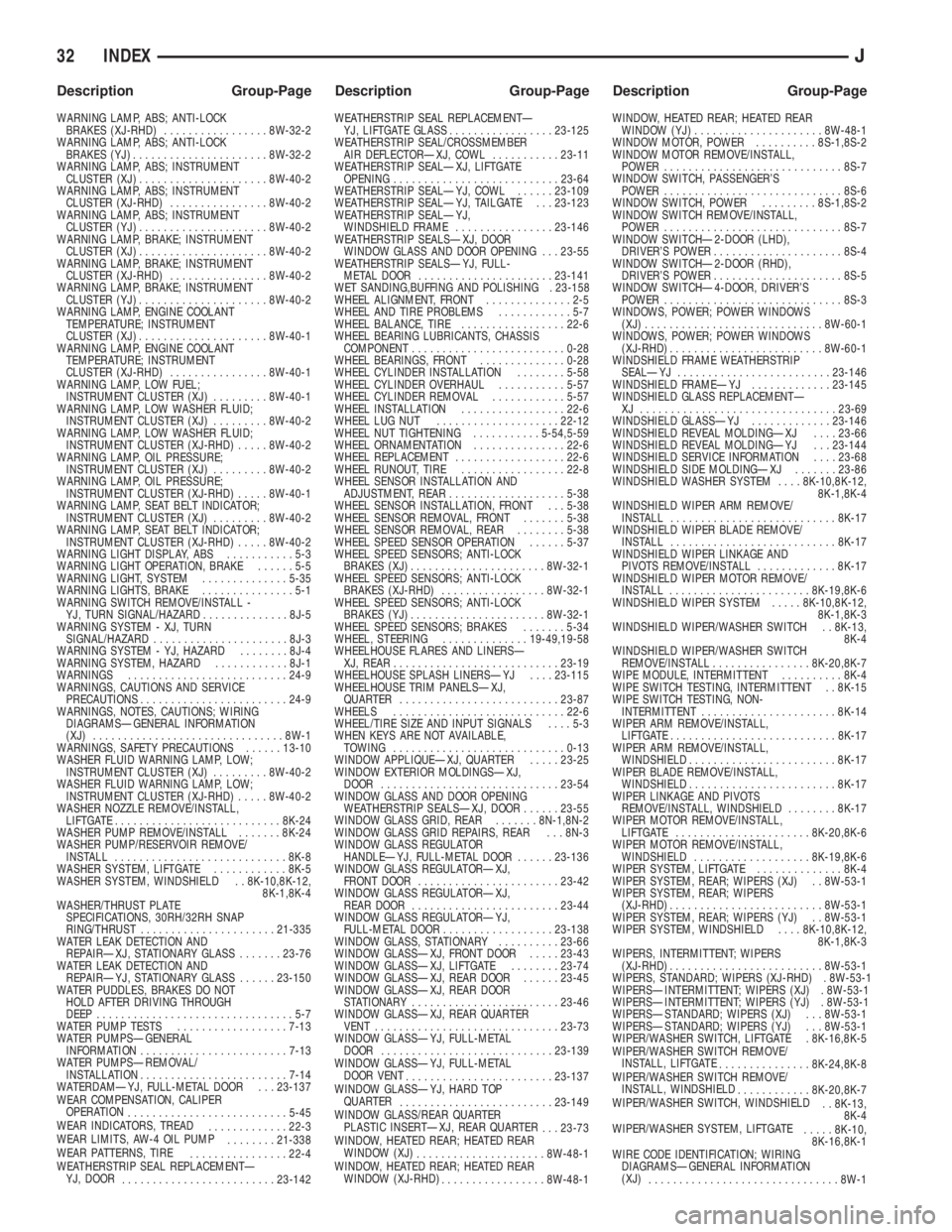
WARNING LAMP, ABS; ANTI-LOCK
BRAKES (XJ-RHD).................8W-32-2
WARNING LAMP, ABS; ANTI-LOCK
BRAKES (YJ)......................8W-32-2
WARNING LAMP, ABS; INSTRUMENT
CLUSTER (XJ).....................8W-40-2
WARNING LAMP, ABS; INSTRUMENT
CLUSTER (XJ-RHD)................8W-40-2
WARNING LAMP, ABS; INSTRUMENT
CLUSTER (YJ).....................8W-40-2
WARNING LAMP, BRAKE; INSTRUMENT
CLUSTER (XJ).....................8W-40-2
WARNING LAMP, BRAKE; INSTRUMENT
CLUSTER (XJ-RHD)................8W-40-2
WARNING LAMP, BRAKE; INSTRUMENT
CLUSTER (YJ).....................8W-40-2
WARNING LAMP, ENGINE COOLANT
TEMPERATURE; INSTRUMENT
CLUSTER (XJ).....................8W-40-1
WARNING LAMP, ENGINE COOLANT
TEMPERATURE; INSTRUMENT
CLUSTER (XJ-RHD)................8W-40-1
WARNING LAMP, LOW FUEL;
INSTRUMENT CLUSTER (XJ).........8W-40-1
WARNING LAMP, LOW WASHER FLUID;
INSTRUMENT CLUSTER (XJ).........8W-40-2
WARNING LAMP, LOW WASHER FLUID;
INSTRUMENT CLUSTER (XJ-RHD).....8W-40-2
WARNING LAMP, OIL PRESSURE;
INSTRUMENT CLUSTER (XJ).........8W-40-2
WARNING LAMP, OIL PRESSURE;
INSTRUMENT CLUSTER (XJ-RHD).....8W-40-1
WARNING LAMP, SEAT BELT INDICATOR;
INSTRUMENT CLUSTER (XJ).........8W-40-2
WARNING LAMP, SEAT BELT INDICATOR;
INSTRUMENT CLUSTER (XJ-RHD).....8W-40-2
WARNING LIGHT DISPLAY, ABS...........5-3
WARNING LIGHT OPERATION, BRAKE......5-5
WARNING LIGHT, SYSTEM..............5-35
WARNING LIGHTS, BRAKE...............5-1
WARNING SWITCH REMOVE/INSTALL -
YJ, TURN SIGNAL/HAZARD..............8J-5
WARNING SYSTEM - XJ, TURN
SIGNAL/HAZARD......................8J-3
WARNING SYSTEM - YJ, HAZARD........8J-4
WARNING SYSTEM, HAZARD............8J-1
WARNINGS..........................24-9
WARNINGS, CAUTIONS AND SERVICE
PRECAUTIONS........................24-9
WARNINGS, NOTES, CAUTIONS; WIRING
DIAGRAMSÐGENERAL INFORMATION
(XJ)...............................8W-1
WARNINGS, SAFETY PRECAUTIONS......13-10
WASHER FLUID WARNING LAMP, LOW;
INSTRUMENT CLUSTER (XJ).........8W-40-2
WASHER FLUID WARNING LAMP, LOW;
INSTRUMENT CLUSTER (XJ-RHD).....8W-40-2
WASHER NOZZLE REMOVE/INSTALL,
LIFTGATE...........................8K-24
WASHER PUMP REMOVE/INSTALL.......8K-24
WASHER PUMP/RESERVOIR REMOVE/
INSTALL............................8K-8
WASHER SYSTEM, LIFTGATE............8K-5
WASHER SYSTEM, WINDSHIELD . . 8K-10,8K-12,
8K-1,8K-4
WASHER/THRUST PLATE
SPECIFICATIONS, 30RH/32RH SNAP
RING/THRUST......................21-335
WATER LEAK DETECTION AND
REPAIRÐXJ, STATIONARY GLASS.......23-76
WATER LEAK DETECTION AND
REPAIRÐYJ, STATIONARY GLASS......23-150
WATER PUDDLES, BRAKES DO NOT
HOLD AFTER DRIVING THROUGH
DEEP................................5-7
WATER PUMP TESTS..................7-13
WATER PUMPSÐGENERAL
INFORMATION........................7-13
WATER PUMPSÐREMOVAL/
INSTALLATION........................7-14
WATERDAMÐYJ, FULL-METAL DOOR . . . 23-137
WEAR COMPENSATION, CALIPER
OPERATION
..........................5-45
WEAR INDICATORS, TREAD
.............22-3
WEAR LIMITS, AW-4 OIL PUMP
........21-338
WEAR PATTERNS, TIRE
................22-4
WEATHERSTRIP SEAL REPLACEMENTÐ
YJ, DOOR
.........................23-142WEATHERSTRIP SEAL REPLACEMENTÐ
YJ, LIFTGATE GLASS.................23-125
WEATHERSTRIP SEAL/CROSSMEMBER
AIR DEFLECTORÐXJ, COWL...........23-11
WEATHERSTRIP SEALÐXJ, LIFTGATE
OPENING...........................23-64
WEATHERSTRIP SEALÐYJ, COWL......23-109
WEATHERSTRIP SEALÐYJ, TAILGATE . . . 23-123
WEATHERSTRIP SEALÐYJ,
WINDSHIELD FRAME................23-146
WEATHERSTRIP SEALSÐXJ, DOOR
WINDOW GLASS AND DOOR OPENING . . . 23-55
WEATHERSTRIP SEALSÐYJ, FULL-
METAL DOOR......................23-141
WET SANDING,BUFFING AND POLISHING . 23-158
WHEEL ALIGNMENT, FRONT..............2-5
WHEEL AND TIRE PROBLEMS............5-7
WHEEL BALANCE, TIRE.................22-6
WHEEL BEARING LUBRICANTS, CHASSIS
COMPONENT.........................0-28
WHEEL BEARINGS, FRONT..............0-28
WHEEL CYLINDER INSTALLATION........5-58
WHEEL CYLINDER OVERHAUL...........5-57
WHEEL CYLINDER REMOVAL............5-57
WHEEL INSTALLATION.................22-6
WHEEL LUG NUT....................22-12
WHEEL NUT TIGHTENING...........5-54,5-59
WHEEL ORNAMENTATION...............22-6
WHEEL REPLACEMENT..................22-6
WHEEL RUNOUT, TIRE.................22-8
WHEEL SENSOR INSTALLATION AND
ADJUSTMENT, REAR...................5-38
WHEEL SENSOR INSTALLATION, FRONT . . . 5-38
WHEEL SENSOR REMOVAL, FRONT.......5-38
WHEEL SENSOR REMOVAL, REAR........5-38
WHEEL SPEED SENSOR OPERATION......5-37
WHEEL SPEED SENSORS; ANTI-LOCK
BRAKES (XJ)......................8W-32-1
WHEEL SPEED SENSORS; ANTI-LOCK
BRAKES (XJ-RHD).................8W-32-1
WHEEL SPEED SENSORS; ANTI-LOCK
BRAKES (YJ)......................8W-32-1
WHEEL SPEED SENSORS; BRAKES.......5-34
WHEEL, STEERING..............19-49,19-58
WHEELHOUSE FLARES AND LINERSÐ
XJ, REAR...........................23-19
WHEELHOUSE SPLASH LINERSÐYJ....23-115
WHEELHOUSE TRIM PANELSÐXJ,
QUARTER..........................23-87
WHEELS............................22-6
WHEEL/TIRE SIZE AND INPUT SIGNALS....5-3
WHEN KEYS ARE NOT AVAILABLE,
TOWING............................0-13
WINDOW APPLIQUEÐXJ, QUARTER.....23-25
WINDOW EXTERIOR MOLDINGSÐXJ,
DOOR.............................23-54
WINDOW GLASS AND DOOR OPENING
WEATHERSTRIP SEALSÐXJ, DOOR......23-55
WINDOW GLASS GRID, REAR.......8N-1,8N-2
WINDOW GLASS GRID REPAIRS, REAR . . . 8N-3
WINDOW GLASS REGULATOR
HANDLEÐYJ, FULL-METAL DOOR......23-136
WINDOW GLASS REGULATORÐXJ,
FRONT DOOR.......................23-42
WINDOW GLASS REGULATORÐXJ,
REAR DOOR........................23-44
WINDOW GLASS REGULATORÐYJ,
FULL-METAL DOOR..................23-138
WINDOW GLASS, STATIONARY..........23-66
WINDOW GLASSÐXJ, FRONT DOOR.....23-43
WINDOW GLASSÐXJ, LIFTGATE........23-74
WINDOW GLASSÐXJ, REAR DOOR......23-45
WINDOW GLASSÐXJ, REAR DOOR
STATIONARY........................23-46
WINDOW GLASSÐXJ, REAR QUARTER
VENT..............................23-73
WINDOW GLASSÐYJ, FULL-METAL
DOOR............................23-139
WINDOW GLASSÐYJ, FULL-METAL
DOOR VENT
........................23-137
WINDOW GLASSÐYJ, HARD TOP
QUARTER
.........................23-149
WINDOW GLASS/REAR QUARTER
PLASTIC INSERTÐXJ, REAR QUARTER
. . . 23-73
WINDOW, HEATED REAR; HEATED REAR
WINDOW (XJ)
.....................8W-48-1
WINDOW, HEATED REAR; HEATED REAR
WINDOW (XJ-RHD)
.................8W-48-1WINDOW, HEATED REAR; HEATED REAR
WINDOW (YJ).....................8W-48-1
WINDOW MOTOR, POWER..........8S-1,8S-2
WINDOW MOTOR REMOVE/INSTALL,
POWER.............................8S-7
WINDOW SWITCH, PASSENGER'S
POWER.............................8S-6
WINDOW SWITCH, POWER.........8S-1,8S-2
WINDOW SWITCH REMOVE/INSTALL,
POWER.............................8S-7
WINDOW SWITCHÐ2-DOOR (LHD),
DRIVER'S POWER.....................8S-4
WINDOW SWITCHÐ2-DOOR (RHD),
DRIVER'S POWER.....................8S-5
WINDOW SWITCHÐ4-DOOR, DRIVER'S
POWER.............................8S-3
WINDOWS, POWER; POWER WINDOWS
(XJ).............................8W-60-1
WINDOWS, POWER; POWER WINDOWS
(XJ-RHD).........................8W-60-1
WINDSHIELD FRAME WEATHERSTRIP
SEALÐYJ.........................23-146
WINDSHIELD FRAMEÐYJ.............23-145
WINDSHIELD GLASS REPLACEMENTÐ
XJ ................................23-69
WINDSHIELD GLASSÐYJ.............23-146
WINDSHIELD REVEAL MOLDINGÐXJ....23-66
WINDSHIELD REVEAL MOLDINGÐYJ . . . 23-144
WINDSHIELD SERVICE INFORMATION....23-68
WINDSHIELD SIDE MOLDINGÐXJ.......23-86
WINDSHIELD WASHER SYSTEM....8K-10,8K-12,
8K-1,8K-4
WINDSHIELD WIPER ARM REMOVE/
INSTALL...........................8K-17
WINDSHIELD WIPER BLADE REMOVE/
INSTALL...........................8K-17
WINDSHIELD WIPER LINKAGE AND
PIVOTS REMOVE/INSTALL.............8K-17
WINDSHIELD WIPER MOTOR REMOVE/
INSTALL.......................8K-19,8K-6
WINDSHIELD WIPER SYSTEM.....8K-10,8K-12,
8K-1,8K-3
WINDSHIELD WIPER/WASHER SWITCH . . 8K-13,
8K-4
WINDSHIELD WIPER/WASHER SWITCH
REMOVE/INSTALL................8K-20,8K-7
WIPE MODULE, INTERMITTENT..........8K-4
WIPE SWITCH TESTING, INTERMITTENT . . 8K-15
WIPE SWITCH TESTING, NON-
INTERMITTENT......................8K-14
WIPER ARM REMOVE/INSTALL,
LIFTGATE...........................8K-17
WIPER ARM REMOVE/INSTALL,
WINDSHIELD........................8K-17
WIPER BLADE REMOVE/INSTALL,
WINDSHIELD........................8K-17
WIPER LINKAGE AND PIVOTS
REMOVE/INSTALL, WINDSHIELD........8K-17
WIPER MOTOR REMOVE/INSTALL,
LIFTGATE......................8K-20,8K-6
WIPER MOTOR REMOVE/INSTALL,
WINDSHIELD...................8K-19,8K-6
WIPER SYSTEM, LIFTGATE..............8K-4
WIPER SYSTEM, REAR; WIPERS (XJ) . . 8W-53-1
WIPER SYSTEM, REAR; WIPERS
(XJ-RHD).........................8W-53-1
WIPER SYSTEM, REAR; WIPERS (YJ) . . 8W-53-1
WIPER SYSTEM, WINDSHIELD....8K-10,8K-12,
8K-1,8K-3
WIPERS, INTERMITTENT; WIPERS
(XJ-RHD).........................8W-53-1
WIPERS, STANDARD; WIPERS (XJ-RHD) . 8W-53-1
WIPERSÐINTERMITTENT; WIPERS (XJ) . 8W-53-1
WIPERSÐINTERMITTENT; WIPERS (YJ) . 8W-53-1
WIPERSÐSTANDARD; WIPERS (XJ) . . . 8W-53-1
WIPERSÐSTANDARD; WIPERS (YJ) . . . 8W-53-1
WIPER/WASHER SWITCH, LIFTGATE . 8K-16,8K-5
WIPER/WASHER SWITCH REMOVE/
INSTALL, LIFTGATE
...............8K-24,8K-8
WIPER/WASHER SWITCH REMOVE/
INSTALL, WINDSHIELD
............8K-20,8K-7
WIPER/WASHER SWITCH, WINDSHIELD
. . 8K-13,
8K-4
WIPER/WASHER SYSTEM, LIFTGATE
.....8K-10,
8K-16,8K-1
WIRE CODE IDENTIFICATION; WIRING
DIAGRAMSÐGENERAL INFORMATION
(XJ)
...............................8W-1
32 INDEXJ
Description Group-Page Description Group-Page Description Group-Page
Page 1996 of 2198
WIRING DIAGRAMS
CONTENTS
page page
8W-01 GENERAL INFORMATIONÐWIRING
DIAGRAMS...................... 8W-01-1
8W-10 FUSE/FUSE BLOCK........... 8W-10-1
8W-11 POWER DISTRIBUTION........ 8W-11-1
8W-15 GROUND DISTRIBUTION....... 8W-15-1
8W-20 CHARGING SYSTEM.......... 8W-20-1
8W-21 STARTING SYSTEM........... 8W-21-1
8W-30 FUEL/IGNITION.............. 8W-30-1
8W-31 TRANSMISSION CONTROLS.... 8W-31-1
8W-32 ANTI-LOCK BRAKES.......... 8W-32-1
8W-40 INSTRUMENT CLUSTER....... 8W-40-1
8W-41 HORN/CIGAR LIGHTER........ 8W-41-18W-42 AIR CONDITIONING/HEATER.... 8W-42-1
8W-44 INTERIOR LIGHTING.......... 8W-44-1
8W-47 AUDIO SYSTEM.............. 8W-47-1
8W-48 HEATED REAR WINDOW....... 8W-48-1
8W-50 FRONT LIGHTING............ 8W-50-1
8W-51 REAR LIGHTING............. 8W-51-1
8W-52 TURN SIGNALS.............. 8W-52-1
8W-53 WIPERS.................... 8W-53-1
8W-70 SPLICE INFORMATION........ 8W-70-1
8W-80 CONNECTOR PIN OUTS....... 8W-80-1
8W-90 CONNECTOR LOCATIONS...... 8W-90-1
8W-95 SPLICE LOCATIONS........... 8W-95-1
HOW TO USE THIS GROUP
The purpose of this group is to show the electrical
circuits in a clear, simple fashion and to make trou-
bleshooting easier. Components that work together
are shown together. All electrical components used in
a specific system are shown on one diagram. The feed
for a system is shown at the top of the page. All
wires, connectors, splices, and components are shown
in the flow of current to the bottom of the page. Wir-
ing which is not part of the circuit represented is ref-
erenced to another page/section, where the complete
circuit is shown. In addition, all switches, compo-
nents, and modules are shown in theat rest posi-
tion with the doors closed and the key removed
from the ignition.
If a component is part of several different circuits,
it is shown in the diagram for each. For example, the
headlamp switch is the main part of the exterior
lighting, but it also affects the interior lighting and
the chime warning system.
It is important to realize that no attempt is
made on the diagrams to represent components
and wiring as they appear on the vehicle. For
example, a short piece of wire is treated the
same as a long one. In addition, switches and
other components are shown as simply as pos-
sible, with regard to function only.
The wiring diagram show circuits for all wheel-
bases. If there is a difference in systems or compo-
nents between wheel-bases, an identifier is placed
next to the component.
SECTION IDENTIFICATION
Sections in Group 8W are organized by sub-sys-
tems. The sections contain circuit operation descrip-
tions, helpful information, and system diagrams. The
intention is to organize information by system, con-
sistently from year to year.
CONNECTOR LOCATIONS
Section 8W-90 contains Connector Location illus-
trations. The illustrations contain the connector
number and component identification. Connector Lo-
cation charts in Section 8W-90 reference the illustra-
tion number for components and connectors.
Section 8W-80 shows each connector and the cir-
cuits involved with that connector. The connectors
are identified using the number on the Diagram
pages.
SPLICE LOCATIONS
Splice Location charts in Section 8W-70 show the
entire splice, and provide references to other sections
the splice serves.
Section 8W-95 contains illustrations that show the
general location of the splices in each harness. The
illustrations show the splice by number, and provide
a written location.
JWIRING DIAGRAMSÐÐYJ VEHICLES 8W - 1 - 1
Page 2051 of 2198
module provides voltage to and receives input from.
Circuit B210 from cavity 41 of the ABS control mod-
ule provides voltage to the sensor. Circuit B258 car-
ries the signal from the sensor to cavity 16 of the
ABS module.
BRAKE SWITCH INPUT
Circuit L50 from the stop lamp provides the brake
switch input to the ABS control module. When the
brake pedal is pressed, the stop lamp switch closes to
supply battery voltage from circuit F32 to circuit
L50. Circuit L50 connects to cavity 32 of the ABS
control module. Circuit F32 originates at fuse 3 in
the fuse block.
Circuit A6 from Power Distribution Center (PDC)
fuse 3 supplies voltage to the fuse block for circuit
F32.
HYDRAULIC CONTROL UNIT
When the ABS power relay energizes, two branches
of circuit B15 splice to supply voltage to the isolation
and decay solenoids in the hydraulic control unit.
The hydraulic control unit contains three separate
isolation solenoids and three separate decay sole-
noids. The ABS control module activates the decay
and isolation solenoids by providing separate ground
paths for each.
The ABS module provides a ground path for the
rear isolation solenoid on circuit B251. Circuit B251
connects to cavity 54 of the ABS control module.
For the right front isolation solenoid, the ABS mod-
ule provides a ground path on circuit B249. Circuit
B249 connects to cavity 38 of the ABS control mod-
ule.
On circuit B245, the ABS module provides ground
for the left front isolation solenoid. Circuit B245 con-
nects to cavity 20 of the ABS control module.
The ABS module provides a ground path for the
rear decay solenoid on circuit B254. Circuit B254
connects to cavity 36 of the ABS control module.
For the right front decay solenoid, the ABS module
provides a ground path on circuit B248. Circuit B248
connects to cavity 21 of the ABS control module.
On circuit B243, the ABS module provides ground
for the left decay solenoid. Circuit B243 connects to
cavity 2 of the ABS control module.
ABS WARNING LAMP
Circuit G5 provides power for the ABS warning
lamp at the instrument cluster. Ground for the ABS
warning lamp is provided by either the ABS control
module or by the ABS power relay when the relay is
not energized. The ABS control module illuminates
the lamp by providing ground on circuit G19.
Circuit G19 splices to connect to circuit B15
through a diode. When the ABS power relay is notenergized, it connects circuit B15 to circuit Z12. The
ground path for the warning lamp is through the di-
ode to circuit B15, through the ABS power relay to
ground on circuit Z12.
The diode between circuit G19 and B15 prevents
voltage from flowing to the ABS control module when
the ABS power relay switches to supply power on cir-
cuit B15.
DATA LINK CONNECTOR
Circuit D11 from cavity 23 of the ABS control mod-
ule receives data from the DRB scan tool through the
data link connector. The ABS control module trans-
mits data to the scan tool through the connector on
circuit D12. Circuit D12 originates at cavity 42 of the
ABS control module.
Through the data link connector, circuit Z12 pro-
vides ground for the DRB scan tool. Circuit Z12 ter-
minates at the right rear of the dash panel.
Circuit A4 from fuse 8 in the Power Distribution
Center (PDC) supplies power to fuse 16 in the PDC.
Fuse 16 powers circuit M1 which supplies battery
voltage to the scan tool through the diagnostic con-
nector.
HELPFUL INFORMATION
²Check fuses 4, 9 and 10 in the PDC
²Check fuse 13 in the fuse block
DIAGRAM INDEX
Component Page
ABS Power Relay........................8W-32-4
ABS Pump Motor/Sensor...................8W-32-5
ABS Warning Lamp.......................8W-32-4
ABS Control Module..................8W-32-3 thru 7
ABS Pump Motor Relay....................8W-32-5
Brake Pedal Travel Sensor...................8W-32-6
Data Link Connector......................8W-32-6
Fuse 1 Fuse Block........................8W-32-4
Fuse 3 Fuse Block........................8W-32-6
Fuse 3 (PDC)...........................8W-32-6
Fuse 4 (PDC)...........................8W-32-4
Fuse 8 (PDC)...........................8W-32-6
Fuse 10 (PDC)..........................8W-32-4
Fuse 12 Fuse Block.......................8W-32-4
Fuse 12 (PDC)..........................8W-32-6
Fuse 13 (PDC)..........................8W-32-4
Hydraulic Actuation Unit....................8W-32-3
Ignition Switch..........................8W-32-4
Powertrain Control Module (PCM)..............8W-32-6
Stop Lamp Switch........................8W-32-6
Wheel Speed Sensors......................8W-32-7
8W - 32 - 2 8W-32 ANTI-LOCK BRAKESÐYJ VEHICLESJ
Page 2058 of 2198
INSTRUMENT CLUSTER
INSTRUMENT CLUSTER
The instrument cluster contains the gauges and
warning lamps. All gauges have magnetic move-
ments.
When the ignition switch is in either the START or
RUN position, circuit A1 from fuse 4 in the Power
Distribution Center (PDC) connects to circuit A21.
Circuit A21 powers fuse 9 in the fuse block. Fuse 9
powers circuit G5. One branch of circuit G5 connects
directly to the combination buzzer. The other branch
of circuit G5 splices to power the gauges, speedome-
ter, tachometer, voltmeter, indicator lamps, and
warning lamps in the instrument cluster.
When the parking lamps or headlamps are ON, the
headlamp switch connects circuit F33 to circuit L7.
Circuit L7 splices to the dimmer switch. Circuit E1
from the dimmer switch powers fuse 10 in the fuse
block when the parking lamps or headlamps are ON.
Circuit E2 from fuse 10 in the fuse block feeds the
illumination lamps in the instrument cluster.
Circuit Z1 provides ground the instrument cluster
illumination lamps, gauges and warning lamps.
HELPFUL INFORMATION
²Circuit G5 also powers the heated rear window,
A/C compressor clutch relay. On Canadian vehicles,
circuit G5 powers the Daytime Running Lamps
(DRL) module.
²Circuit F33 originates at fuse 8 in the fuse block.
Circuit A6 from fuse 3 in the PDC powers fuse 8 in
the fuse block.
ENGINE COOLANT TEMPERATURE GAUGE
Circuit G20 connects the engine coolant tempera-
ture gauge to the engine coolant temperature sensor.
The sensor is a variable resistor and case grounded
to the engine. Circuit G5 connects to the instrument
cluster and supplies voltage for the gauge.
The gauge uses two coils. The first coil has fixed
current flowing through it to maintain magnetic field
strength. Circuit Z1 provides ground for the fixed
current coil. The current level passing through the
second coil is controlled by the variable resistor in
the engine coolant temperature sender. The changing
current varies the magnetic field in the second coil.
Refer to group 8E, Instrument Panel and Gauges
for gauge operation.
FUEL GAUGE
Circuit G4 connects the fuel level sensor to the fuel
gauge in the instrument cluster. Circuit G5 supplies
voltage to the fuel gauge. The fuel level sensor draws
voltage from circuit G5 through the fuel gauge on cir-
cuit G4.The gauge uses two coils. The first coil has fixed
current flowing through it to maintain magnetic field
strength. Circuit Z1 provides ground for the fixed
current coil. The current level passing through the
second coil is controlled by the variable resistor in
the fuel level sensor. The changing current varies the
magnetic field in the second coil.
Circuit Z2 provides the ground path for the fuel
level sensor.
Refer to group 8E, Instrument Panel and Gauges
for gauge operation.
OIL PRESSURE GAUGE
The case grounded oil pressure sending unit is a
variable resistor. The sending unit connects to the oil
pressure gauge on circuit G60.
Circuit G5 connects to the instrument cluster and
supplies battery voltage to the oil pressure gauge.
The gauge uses two coils. The first coil has fixed cur-
rent flowing through it to maintain magnetic field
strength. Circuit Z1 provides ground for the fixed
current coil. The current level passing through the
second coil is controlled by the variable resistor in
the oil pressure sending unit. The changing current
varies the magnetic field in the second coil.
Refer to group 8E, Instrument Panel and Gauges
for gauge operation.
TACHOMETER
The Powertrain Control Module (PCM) provides
the tachometer signal to the electronic tachometer on
circuit G21. Circuit G21 originates at cavity 43 of the
PCM. Circuit Z1 provides ground for the tachometer's
internal logic circuits.
SPEEDOMETER
The electronic speedometer and odometer receive a
signal from the vehicle speed sensor on circuit G7.
Circuit G5 connects to the instrument cluster and
supplies battery voltage to the speedometer. Circuit
Z1 provides ground for the speedometer internal logic
circuits.
Circuit G7 splices to connect to the Powertrain
Control Module (PCM) and if equipped, the Daytime
Running Lamps (DRL) module.
FOUR-WHEEL DRIVE (4WD) INDICATOR LAMP
When the 4WD switch closes, circuit Z1 provides
ground for the 4WD indicator lamp in the instrument
panel. Circuit G5 connects to the instrument cluster
and supplies battery voltage to the 4WD indicator
lamp. Circuit G1 connects the indicator lamp to the
4WD switch.
J8W-40 INSTRUMENT CLUSTERÐYJ VEHICLES 8W - 40 - 1
Page 2059 of 2198
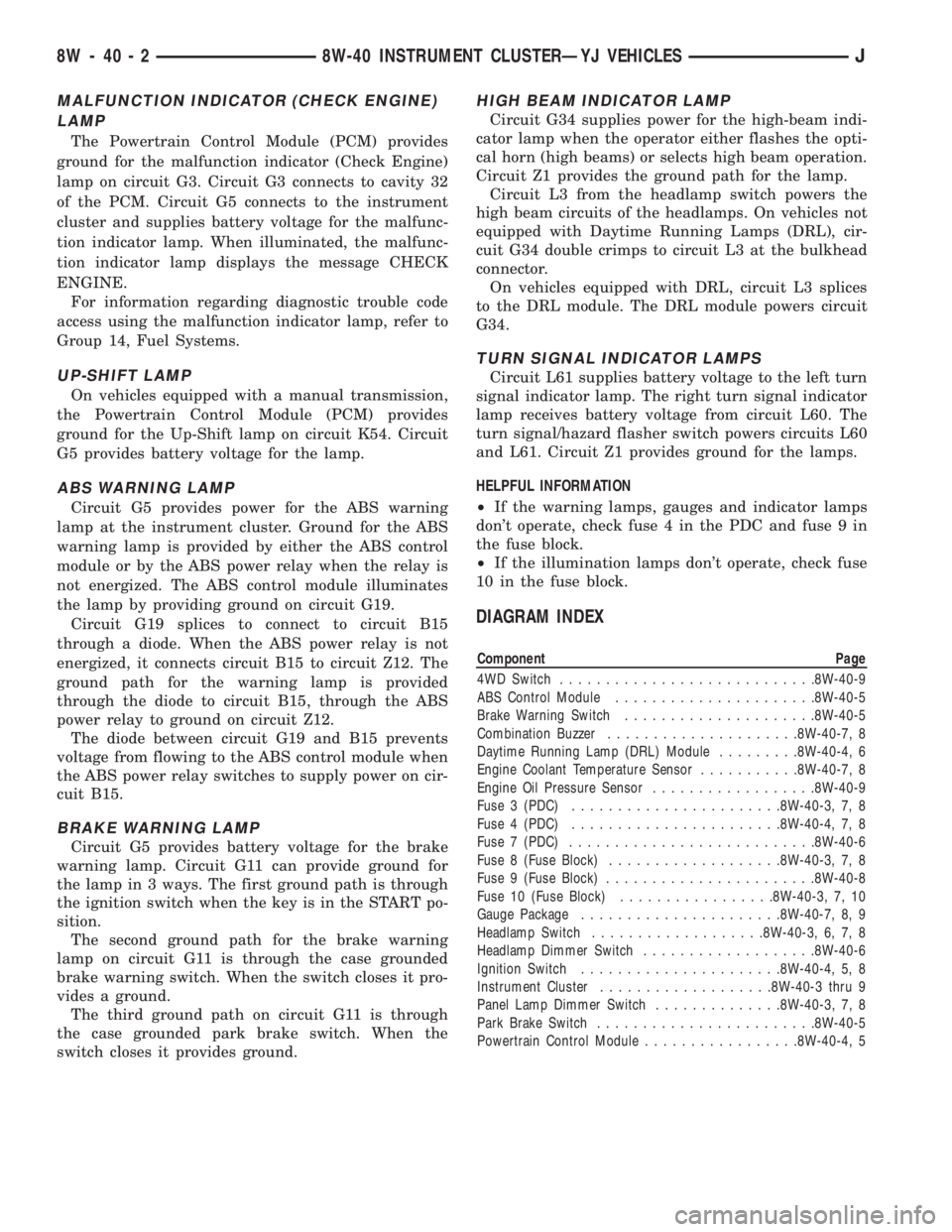
MALFUNCTION INDICATOR (CHECK ENGINE)
LAMP
The Powertrain Control Module (PCM) provides
ground for the malfunction indicator (Check Engine)
lamp on circuit G3. Circuit G3 connects to cavity 32
of the PCM. Circuit G5 connects to the instrument
cluster and supplies battery voltage for the malfunc-
tion indicator lamp. When illuminated, the malfunc-
tion indicator lamp displays the message CHECK
ENGINE.
For information regarding diagnostic trouble code
access using the malfunction indicator lamp, refer to
Group 14, Fuel Systems.
UP-SHIFT LAMP
On vehicles equipped with a manual transmission,
the Powertrain Control Module (PCM) provides
ground for the Up-Shift lamp on circuit K54. Circuit
G5 provides battery voltage for the lamp.
ABS WARNING LAMP
Circuit G5 provides power for the ABS warning
lamp at the instrument cluster. Ground for the ABS
warning lamp is provided by either the ABS control
module or by the ABS power relay when the relay is
not energized. The ABS control module illuminates
the lamp by providing ground on circuit G19.
Circuit G19 splices to connect to circuit B15
through a diode. When the ABS power relay is not
energized, it connects circuit B15 to circuit Z12. The
ground path for the warning lamp is provided
through the diode to circuit B15, through the ABS
power relay to ground on circuit Z12.
The diode between circuit G19 and B15 prevents
voltage from flowing to the ABS control module when
the ABS power relay switches to supply power on cir-
cuit B15.
BRAKE WARNING LAMP
Circuit G5 provides battery voltage for the brake
warning lamp. Circuit G11 can provide ground for
the lamp in 3 ways. The first ground path is through
the ignition switch when the key is in the START po-
sition.
The second ground path for the brake warning
lamp on circuit G11 is through the case grounded
brake warning switch. When the switch closes it pro-
vides a ground.
The third ground path on circuit G11 is through
the case grounded park brake switch. When the
switch closes it provides ground.
HIGH BEAM INDICATOR LAMP
Circuit G34 supplies power for the high-beam indi-
cator lamp when the operator either flashes the opti-
cal horn (high beams) or selects high beam operation.
Circuit Z1 provides the ground path for the lamp.
Circuit L3 from the headlamp switch powers the
high beam circuits of the headlamps. On vehicles not
equipped with Daytime Running Lamps (DRL), cir-
cuit G34 double crimps to circuit L3 at the bulkhead
connector.
On vehicles equipped with DRL, circuit L3 splices
to the DRL module. The DRL module powers circuit
G34.
TURN SIGNAL INDICATOR LAMPS
Circuit L61 supplies battery voltage to the left turn
signal indicator lamp. The right turn signal indicator
lamp receives battery voltage from circuit L60. The
turn signal/hazard flasher switch powers circuits L60
and L61. Circuit Z1 provides ground for the lamps.
HELPFUL INFORMATION
²If the warning lamps, gauges and indicator lamps
don't operate, check fuse 4 in the PDC and fuse 9 in
the fuse block.
²If the illumination lamps don't operate, check fuse
10 in the fuse block.
DIAGRAM INDEX
Component Page
4WD Switch............................8W-40-9
ABS Control Module......................8W-40-5
Brake Warning Switch.....................8W-40-5
Combination Buzzer.....................8W-40-7, 8
Daytime Running Lamp (DRL) Module.........8W-40-4, 6
Engine Coolant Temperature Sensor...........8W-40-7, 8
Engine Oil Pressure Sensor..................8W-40-9
Fuse 3 (PDC).......................8W-40-3, 7, 8
Fuse 4 (PDC).......................8W-40-4, 7, 8
Fuse 7 (PDC)...........................8W-40-6
Fuse 8 (Fuse Block)...................8W-40-3, 7, 8
Fuse 9 (Fuse Block).......................8W-40-8
Fuse 10 (Fuse Block).................8W-40-3, 7, 10
Gauge Package......................8W-40-7, 8, 9
Headlamp Switch...................8W-40-3, 6, 7, 8
Headlamp Dimmer Switch...................8W-40-6
Ignition Switch......................8W-40-4, 5, 8
Instrument Cluster...................8W-40-3 thru 9
Panel Lamp Dimmer Switch..............8W-40-3, 7, 8
Park Brake Switch........................8W-40-5
Powertrain Control Module.................8W-40-4, 5
8W - 40 - 2 8W-40 INSTRUMENT CLUSTERÐYJ VEHICLESJ
Page 2078 of 2198
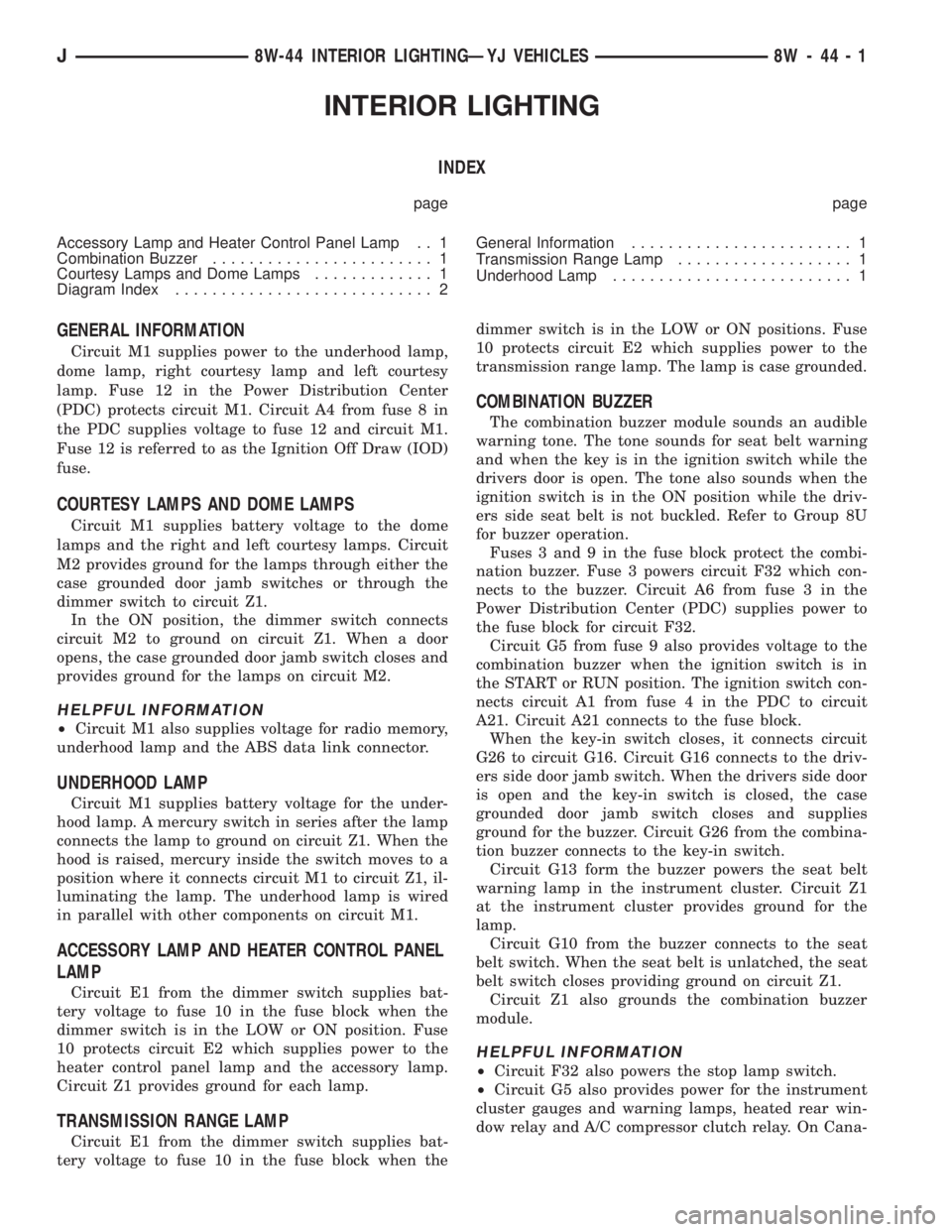
INTERIOR LIGHTING
INDEX
page page
Accessory Lamp and Heater Control Panel Lamp . . 1
Combination Buzzer........................ 1
Courtesy Lamps and Dome Lamps............. 1
Diagram Index............................ 2General Information........................ 1
Transmission Range Lamp................... 1
Underhood Lamp.......................... 1
GENERAL INFORMATION
Circuit M1 supplies power to the underhood lamp,
dome lamp, right courtesy lamp and left courtesy
lamp. Fuse 12 in the Power Distribution Center
(PDC) protects circuit M1. Circuit A4 from fuse 8 in
the PDC supplies voltage to fuse 12 and circuit M1.
Fuse 12 is referred to as the Ignition Off Draw (IOD)
fuse.
COURTESY LAMPS AND DOME LAMPS
Circuit M1 supplies battery voltage to the dome
lamps and the right and left courtesy lamps. Circuit
M2 provides ground for the lamps through either the
case grounded door jamb switches or through the
dimmer switch to circuit Z1.
In the ON position, the dimmer switch connects
circuit M2 to ground on circuit Z1. When a door
opens, the case grounded door jamb switch closes and
provides ground for the lamps on circuit M2.
HELPFUL INFORMATION
²Circuit M1 also supplies voltage for radio memory,
underhood lamp and the ABS data link connector.
UNDERHOOD LAMP
Circuit M1 supplies battery voltage for the under-
hood lamp. A mercury switch in series after the lamp
connects the lamp to ground on circuit Z1. When the
hood is raised, mercury inside the switch moves to a
position where it connects circuit M1 to circuit Z1, il-
luminating the lamp. The underhood lamp is wired
in parallel with other components on circuit M1.
ACCESSORY LAMP AND HEATER CONTROL PANEL
LAMP
Circuit E1 from the dimmer switch supplies bat-
tery voltage to fuse 10 in the fuse block when the
dimmer switch is in the LOW or ON position. Fuse
10 protects circuit E2 which supplies power to the
heater control panel lamp and the accessory lamp.
Circuit Z1 provides ground for each lamp.
TRANSMISSION RANGE LAMP
Circuit E1 from the dimmer switch supplies bat-
tery voltage to fuse 10 in the fuse block when thedimmer switch is in the LOW or ON positions. Fuse
10 protects circuit E2 which supplies power to the
transmission range lamp. The lamp is case grounded.
COMBINATION BUZZER
The combination buzzer module sounds an audible
warning tone. The tone sounds for seat belt warning
and when the key is in the ignition switch while the
drivers door is open. The tone also sounds when the
ignition switch is in the ON position while the driv-
ers side seat belt is not buckled. Refer to Group 8U
for buzzer operation.
Fuses 3 and 9 in the fuse block protect the combi-
nation buzzer. Fuse 3 powers circuit F32 which con-
nects to the buzzer. Circuit A6 from fuse 3 in the
Power Distribution Center (PDC) supplies power to
the fuse block for circuit F32.
Circuit G5 from fuse 9 also provides voltage to the
combination buzzer when the ignition switch is in
the START or RUN position. The ignition switch con-
nects circuit A1 from fuse 4 in the PDC to circuit
A21. Circuit A21 connects to the fuse block.
When the key-in switch closes, it connects circuit
G26 to circuit G16. Circuit G16 connects to the driv-
ers side door jamb switch. When the drivers side door
is open and the key-in switch is closed, the case
grounded door jamb switch closes and supplies
ground for the buzzer. Circuit G26 from the combina-
tion buzzer connects to the key-in switch.
Circuit G13 form the buzzer powers the seat belt
warning lamp in the instrument cluster. Circuit Z1
at the instrument cluster provides ground for the
lamp.
Circuit G10 from the buzzer connects to the seat
belt switch. When the seat belt is unlatched, the seat
belt switch closes providing ground on circuit Z1.
Circuit Z1 also grounds the combination buzzer
module.
HELPFUL INFORMATION
²Circuit F32 also powers the stop lamp switch.
²Circuit G5 also provides power for the instrument
cluster gauges and warning lamps, heated rear win-
dow relay and A/C compressor clutch relay. On Cana-
J8W-44 INTERIOR LIGHTINGÐYJ VEHICLES 8W - 44 - 1
Page 2187 of 2198
CAUTION
ALL SERVICE AND REBUILDING INSTRUCTIONS CONTAINED HEREIN
ARE APPLICABLE TO, AND FOR THE CONVENIENCE OF, THE AUTOMOTIVE
TRADE ONLY. All test and repair procedures on components or assemblies in
non-automotive applications should be repaired in accordance with instructions
supplied by the manufacturer of the total product.
Proper service and repair is important to the safe, reliable, operation of all motor
vehicles. The service procedures recommended and described in this publication were
developed for professional service personnel and are effective methods for performing
vehicle repair. Following these procedures will help assure efficient economical vehicle
performance and service reliability. Some of these service procedures require the use
of special tools designed for specific procedures. These special tools should be used
when recommended throughout this publication.
Special attention should be exercised when working with spring or tension loaded
fasteners and devices such as E-Clips, Circlips, Snap rings, etc., as careless removal
may cause personal injury. Always wear safety goggles whenever working on vehicles
or vehicle components.
It is important to note that this publication contains variousCautionsandWarnings.
These should be carefully read in order to minimize the risk of personal injury, or the
possibility that improper service methods may damage the vehicle or render it unsafe.
It is important to note that theseCautionsandWarningscover only the situations
and procedures DaimlerChrysler Corporation has encountered and recommended.
DaimlerChrysler Corporation could not possibly know, evaluate, and advise the
service trade of all conceivable ways that service may be performed, or of the possible
hazards of each. Consequently, DaimlerChrysler Corporation has not undertaken any
such broad service review. Accordingly, anyone who uses a service procedure, or tool,
that is not recommended in this publication must assure oneself thoroughly that
neither personal safety, nor vehicle safety, be jeopardized by the service methods they
select.
SERVICE AND OWNER MANUALS
Available for Chrysler, Plymouth, Dodge,
Dodge Truck, and Jeep
Tvehicles.
Telephone orders may be placed at the number below.
Credit cards are accepted (no CODs). Please have your
order information available at time of call.
CALL: (800) 890-4038 OR FAX: (440) 572-0815
FOR A FREE CATALOG OR TO PLACE AN ORDER.
NEXT PAGE©
llllllllllll