ECO mode JEEP CHEROKEE 2015 KL / 5.G Service Manual
[x] Cancel search | Manufacturer: JEEP, Model Year: 2015, Model line: CHEROKEE, Model: JEEP CHEROKEE 2015 KL / 5.GPages: 772, PDF Size: 18.21 MB
Page 494 of 772
to operate. The Malfunction Indicator Light (MIL) may be
illuminated. Limp Home Mode allows the vehicle to be
driven to an authorized dealer for service without dam-
aging the transmission.
In the event of a momentary problem, the transmission
can be reset to regain all forward gears by performing the
following steps:
1. Stop the vehicle.
2. Shift the transmission into PARK.
3. Turn the ignition switch to the OFF position.
4. Wait approximately 10 seconds.
5. Restart the engine.
6. Shift into the desired gear range. If the problem is no
longer detected, the transmission will return to normal
operation.
NOTE:Even if the transmission can be reset, we recom-
mend that you visit your authorized dealer at your
earliest possible convenience. Your authorized dealer has
diagnostic equipment to determine if the problem could
recur. If the transmission cannot be reset, authorized
dealer service is required.
Electronic Range Select (ERS) Operation
The Electronic Range Select (ERS) shift control allows the
driver to limit the highest available gear. For example, if
you shift the transmission into 5 (fifth gear), the trans-
mission will not shift above fifth gear, but will shift
through the lower gears normally.
You can switch between DRIVE and ERS mode at any
vehicle speed. When the shift lever is in the DRIVE
position, the transmission will operate automatically,
shifting between all available gears.
492 STARTING AND OPERATING
Page 495 of 772
Moving the shift lever to the ERS position (beside
DRIVE) will activate ERS mode, display the current gear
in the instrument cluster, and maintain that gear as the
top available gear. Once in ERS mode, moving the shift
lever forward (-) or rearward (+) will change the top
available gear.
To exit ERS mode, simply return the shift lever to the
DRIVE position.
WARNING!
Do not downshift for additional engine braking on a
slippery surface. The drive wheels could lose their
grip and the vehicle could skid, causing a collision or
personal injury.
NOTE:To select the proper gear position for maximum
deceleration (engine braking), move the shift lever into
the ERS position, then simply press and hold it forward
(-). The transmission will shift to the range from which
the vehicle can best be slowed down.
Torque Converter Clutch
A feature designed to improve fuel economy has been
included in the automatic transmission on your vehicle.
A clutch within the torque converter engages automati-
cally at calibrated speeds. This may result in a slightly
different feeling or response during normal operation in
the upper gears. When the vehicle speed drops or during
some accelerations, the clutch automatically disengages.
5
STARTING AND OPERATING 493
Page 506 of 772
Selec-Terrain™ offers the following modes:
•Auto— Fully automatic full time four-wheel drive
operation can be used on and off road. Balances
traction with seamless steering feel to provide im-
proved handling and acceleration over two-wheel
drive vehicles.
•Snow— Tuning set for additional stability in inclem-
ent weather. Use on and off road on loose traction
surfaces such as snow. When in SNOW mode (depend-
ing on certain operating conditions), the transmission
may use second gear (rather than first gear) during
launches, to minimize wheel slippage.
•Sport— This mode alters the transmission’s automatic
shift schedule for sportier driving. Upshift speeds are
increased to make full use of available engine power.
NOTE:SPORT mode is not available when 4WD LOW is
selected.
•Sand/Mud— Off road calibration for use on low
traction surfaces such as mud, sand, or wet grass.
Driveline is maximized for traction. Some binding may
be felt on less forgiving surfaces. The electronic brake
controls are set to limit traction control management of
throttle and wheel spin.
•Rock— Off-road calibration only available in 4WD
LOW range. Traction based tuning with improved
steer-ability for use on high traction off-road surfaces.
Use for low speed obstacles such as large rocks, deep
ruts, etc.
NOTE:
•Rock mode is only available on the vehicles equipped
with the Off-Road package.
•Activate the Hill Descent Control or Selec Speed Control
for steep downhill control. See “Electronic Brake Control
System” in this section for further information.
504 STARTING AND OPERATING
Page 518 of 772
Safehold
Safehold is a safety feature of the Electric Park Brake
System that will engage the park brake automatically if
the vehicle is left unsecured while the ignition switch is
in RUN.
For automatic transmissions, the park brake will auto-
matically engage if all of the following conditions are
met:
•The vehicle is at a standstill
•There is no attempt to depress the brake pedal or
accelerator pedal
•The seat belt is unbuckled
•The driver door is open
For manual transmissions, the park brake will automati-
cally engage if all of the following conditions are met:
•The vehicle is at a standstill
•There is no attempt to depress the brake pedal or
accelerator pedal
•The clutch pedal is not pressed
•The seat belt is unbuckled
•The driver door is open
Safehold can be temporarily bypassed by pressing the
Electric Park Brake Switch while the driver door is open.
Once manually bypassed, Safehold will be enabled again
once the vehicle reaches 12 mph (20 km/h) or the ignition
is turned to the OFF position and back to ON again.
Brake Service Mode
We recommend having your brakes serviced by your
authorized dealer. You should only make repairs for
which you have the knowledge and the right equipment.
You should only enter Brake Service Mode during brake
service.
516 STARTING AND OPERATING
Page 538 of 772
WARNING!
•When in “Partial Off” mode, the TCS functionality
of ESC, (except for the limited slip feature de-
scribed in the TCS section), has been disabled and
the “ESC Off Indicator Light” will be illuminated.
When in “Partial Off” mode, the engine power
reduction feature of TCS is disabled, and the
enhanced vehicle stability offered by the ESC sys-
tem is reduced.
•Trailer Sway Control (TSC) is disabled when the
ESC system is in the%Partial Off%mode.
NOTE:To improve the vehicle’s traction when driving
with snow chains, or when starting off in deep snow,
sand, or gravel, it may be desirable to switch to the
“Partial Off” mode by momentarily pressing the “ESC
Off” button. Once the situation requiring “Partial Off”
mode is overcome, turn ESC back on by momentarily
pressing the “ESC Off” button. This may be done while
the vehicle is in motion.
Full Off — Four-Wheel Drive Vehicles In 4WD High
And 4WD Low Range
The “Full Off” mode is intended for off-highway and
off-road use when ESC stability features could inhibit
vehicle maneuverability due to trail conditions.
The “ESC Off” button is located in the lower switch bank
above the climate control panel. To enter “Full Off”
mode, press and hold the “ESC Off” button for five
seconds while the vehicle is stopped with the engine
536 STARTING AND OPERATING
Page 539 of 772
running. After five seconds, the#ESC Off#indicator light
will illuminate and an “ESC Off” message will appear in
the odometer.
In this mode, ESC and TCS are turned off (except for the
“limited slip” feature described in the TCS section) until
the vehicle reaches a speed of 40 mph (64 km/h). At
speeds over 40 mph (64 km/h), the system automatically
switches to “Partial Off” mode, described above. When
the vehicle speed returns to less than 35 mph (56 km/h),
the ESC system will return to “Full Off” mode. The#ESC
OFF#indicator light is always illuminated when ESC is
off. To turn ESC on again, momentarily press the “ESC
Off” button. This will restore the normal “ESC On” mode
of operation.
WARNING!
With the ESC switched off, the enhanced vehicle
stability offered by ESC is unavailable. In an emer-
gency evasive maneuver, the ESC system will not
engage to assist in maintaining stability. “Full Off”
mode is only intended for off-highway or off-road
use.
NOTE:
•“Full Off” is the only operating mode for ESC in 4WD
LOW range. The ESC system will be in this mode
whenever the vehicle is started in 4WD LOW range or the
power transfer unit is shifted into 4WD LOW range.
•The “ESC OFF” message will display and a chime will
sound when the shift lever is moved from any position
5
STARTING AND OPERATING 537
Page 541 of 772
when ESC becomes inactive following the maneuver
that caused the ESC activation.
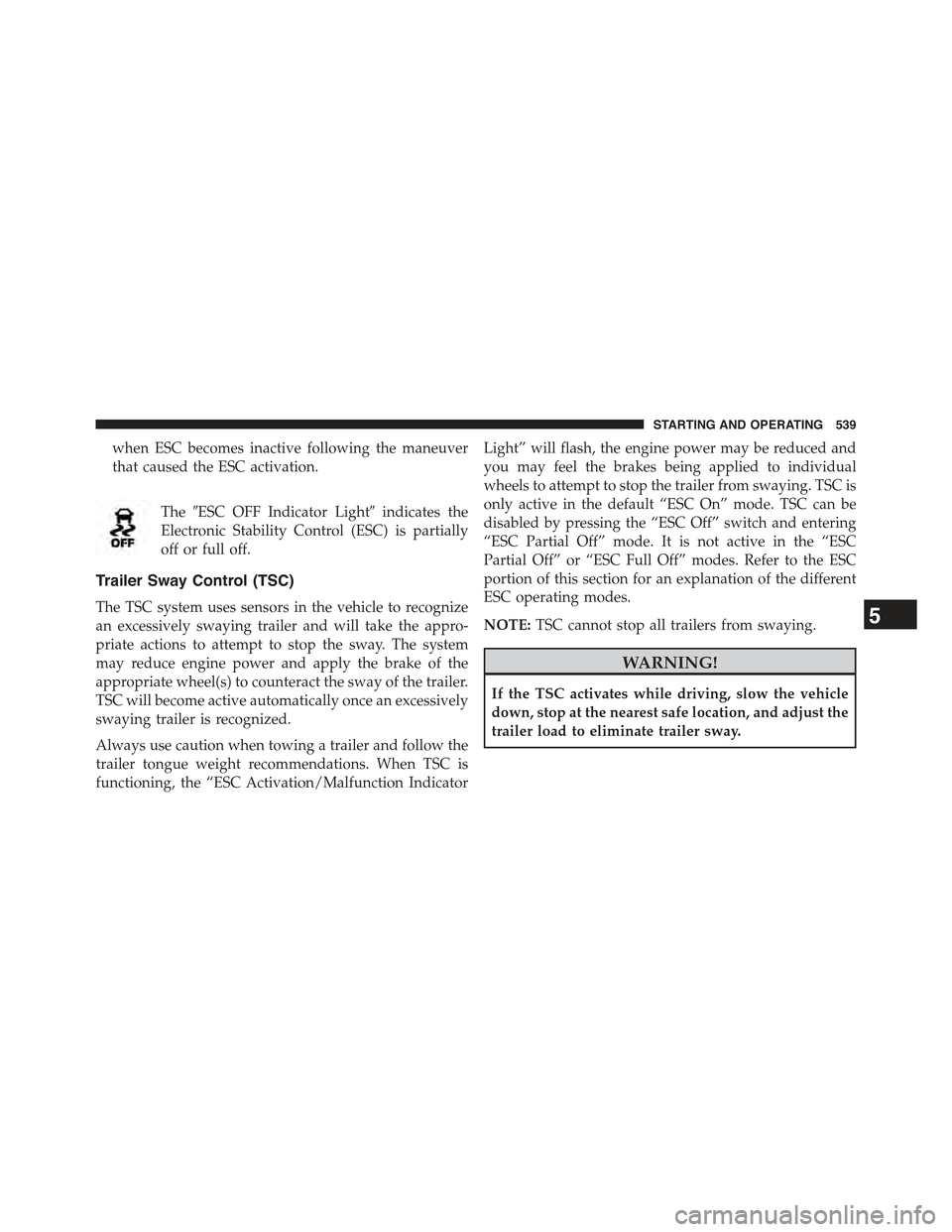
The#ESC OFF Indicator Light#indicates the
Electronic Stability Control (ESC) is partially
off or full off.
Trailer Sway Control (TSC)
The TSC system uses sensors in the vehicle to recognize
an excessively swaying trailer and will take the appro-
priate actions to attempt to stop the sway. The system
may reduce engine power and apply the brake of the
appropriate wheel(s) to counteract the sway of the trailer.
TSC will become active automatically once an excessively
swaying trailer is recognized.
Always use caution when towing a trailer and follow the
trailer tongue weight recommendations. When TSC is
functioning, the “ESC Activation/Malfunction Indicator
Light” will flash, the engine power may be reduced and
you may feel the brakes being applied to individual
wheels to attempt to stop the trailer from swaying. TSC is
only active in the default “ESC On” mode. TSC can be
disabled by pressing the “ESC Off” switch and entering
“ESC Partial Off” mode. It is not active in the “ESC
Partial Off” or “ESC Full Off” modes. Refer to the ESC
portion of this section for an explanation of the different
ESC operating modes.
NOTE:TSC cannot stop all trailers from swaying.
WARNING!
If the TSC activates while driving, slow the vehicle
down, stop at the nearest safe location, and adjust the
trailer load to eliminate trailer sway.
5
STARTING AND OPERATING 539
Page 560 of 772
While studded tires improve performance on ice, skid
and traction capability on wet or dry surfaces may be
poorer than that of non-studded tires. Some states pro-
hibit studded tires; therefore, local laws should be
checked before using these tire types.
Run Flat Tires — If Equipped
Run Flat tires allow you the capability to drive 50 miles
(80 km) at 50 mph (80 km/h) after a rapid loss of inflation
pressure. This rapid loss of inflation is referred to as the
Run Flat mode. A Run Flat mode occurs when the tire
inflation pressure is of/or below 14 psi (96 kPa). Once a
Run Flat tire reaches the run flat mode it has limited
driving capabilities and needs to be replaced immedi-
ately. A Run Flat tire is not repairable.
It is not recommended driving a vehicle loaded at full
capacity or to tow a trailer while a tire is in the run flat
mode.
See the tire pressure monitoring section for more infor-
mation.
Spare Tires — If Equipped
NOTE:For vehicles equipped with Tire Service Kit
instead of a spare tire, please refer to “Tire Service Kit” in
“What To Do In Emergencies” for further information.
CAUTION!
Because of the reduced ground clearance, do not take
your vehicle through an automatic car wash with a
compact or limited-use temporary spare installed.
Damage to the vehicle may result.
Spare Tire Matching Original Equipped Tire And
Wheel — If Equipped
Your vehicle may be equipped with a spare tire and
wheel equivalent in look and function to the original
558 STARTING AND OPERATING
Page 566 of 772
WARNING!(Continued)
•Never use a tire with a smaller load index or
capacity, other than what was originally equipped
on your vehicle. Using a tire with a smaller load
index could result in tire overloading and failure.
You could lose control and have a collision.
•Failure to equip your vehicle with tires having
adequate speed capability can result in sudden tire
failure and loss of vehicle control.
CAUTION!
Replacing original tires with tires of a different size
may result in false speedometer and odometer read-
ings.
TIRE CHAINS (TRACTION DEVICES)
Use of traction devices require sufficient tire-to-body
clearance. Follow these recommendations to guard
against damage.
•Traction device must be of proper size for the tire, as
recommended by the traction device manufacturer
•Use on Front Tires Only
•Due to limited clearance, the following traction de-
vices are recommended:
Front Wheel Drive (FWD) Models
•Original equipment 225/60R17 and 225/55R18 tire
sizes are not chainable.
•The use of 7mm snow chains is permitted with the use
of 215/60R17 tires on size 17 x 7.0 ET41 wheels.
564 STARTING AND OPERATING
Page 618 of 772
NOTE:There are steps that you can take to slow down
an impending overheat condition:
•If your air conditioner (A/C) is on, turn it off. The A/C
system adds heat to the engine cooling system and
turning the A/C off can help remove this heat.
•You can also turn the temperature control to maximum
heat, the mode control to floor and the blower control
to high. This allows the heater core to act as a
supplement to the radiator and aids in removing heat
from the engine cooling system.
WARNING!
You or others can be badly burned by hot engine
coolant (antifreeze) or steam from your radiator. If
you see or hear steam coming from under the hood,
do not open the hood until the radiator has had time
to cool. Never try to open a cooling system pressure
cap when the radiator or coolant bottle is hot.
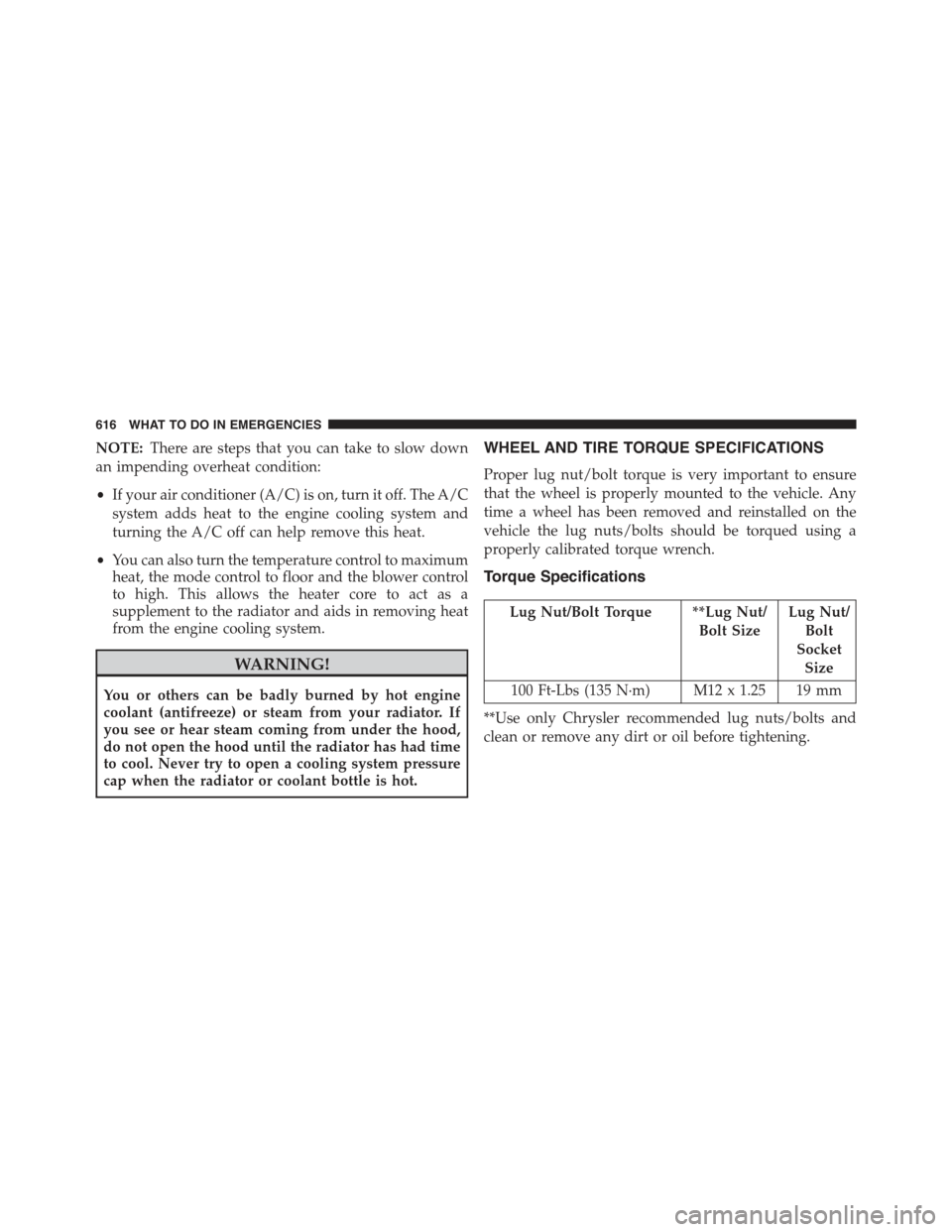
WHEEL AND TIRE TORQUE SPECIFICATIONS
Proper lug nut/bolt torque is very important to ensure
that the wheel is properly mounted to the vehicle. Any
time a wheel has been removed and reinstalled on the
vehicle the lug nuts/bolts should be torqued using a
properly calibrated torque wrench.
Torque Specifications
Lug Nut/Bolt Torque **Lug Nut/
Bolt Size
Lug Nut/
Bolt
Socket
Size
100 Ft-Lbs (135 N·m) M12 x 1.25 19 mm
**Use only Chrysler recommended lug nuts/bolts and
clean or remove any dirt or oil before tightening.
616 WHAT TO DO IN EMERGENCIES