service JEEP CJ 1953 Service Manual
[x] Cancel search | Manufacturer: JEEP, Model Year: 1953, Model line: CJ, Model: JEEP CJ 1953Pages: 376, PDF Size: 19.96 MB
Page 255 of 376
'Jeep*
UNIVERSAL SERIES SERVICE
MANUAL
J
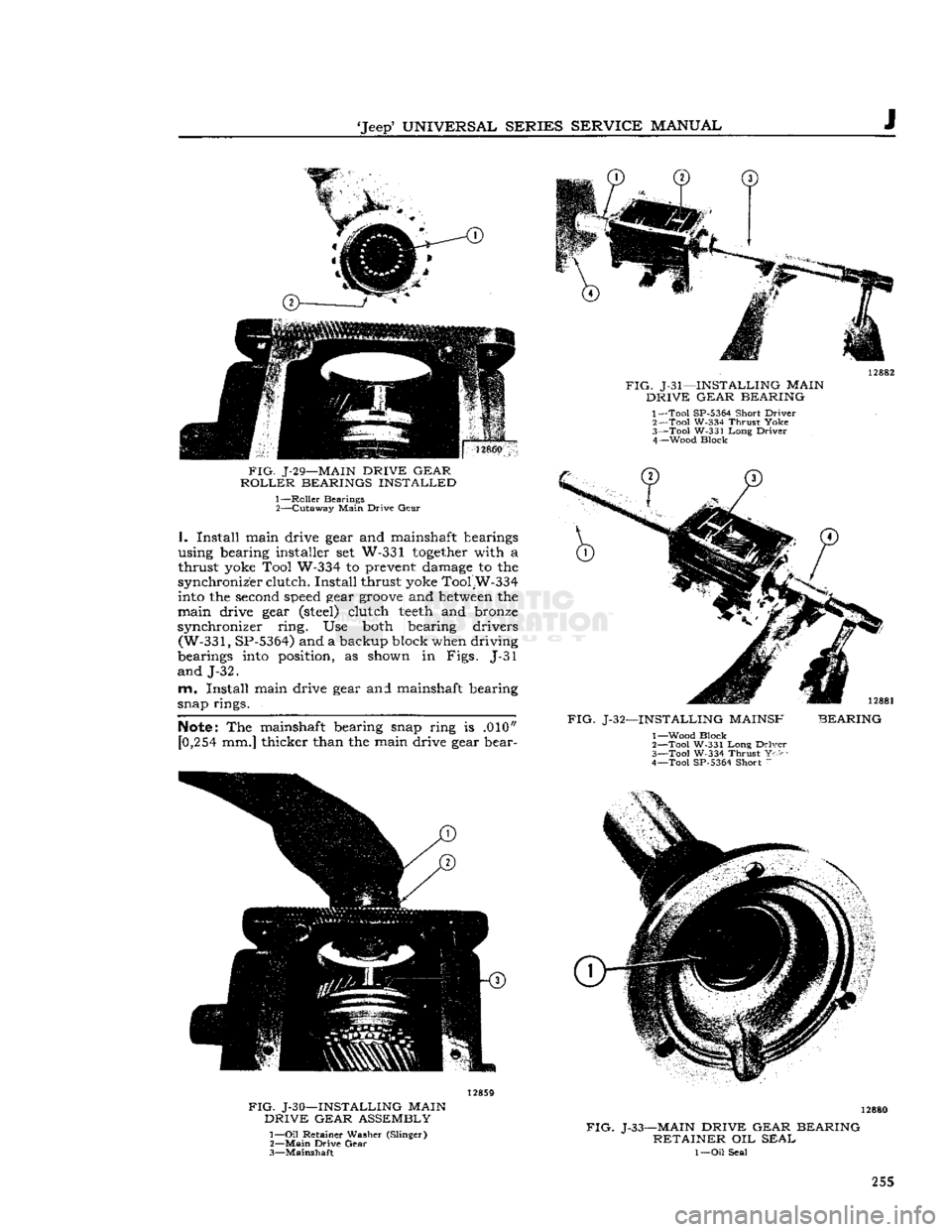
FIG.
J-29—MAIN
DRIVE GEAR
ROLLER
BEARINGS INSTALLED
1—
Roller
Bearings 2— Cutaway
Main
Drive
Gear
I.
Install main drive gear and mainshaft bearings
using bearing installer set W-331
together
with a
thrust yoke Tool W-334 to prevent
damage
to the
synchronizer clutch. Install thrust yoke Tool.W-334
into
the
second
speed
gear
groove
and
between
the
main drive gear
(steel)
clutch
teeth
and bronze
synchronizer ring. Use
both
bearing drivers (W-331, SP-5364) and a backup block when driving
bearings
into
position, as shown in Figs. J-31 and J-32.
m. Install main drive gear and mainshaft bearing
snap rings.
Note:
The mainshaft bearing snap ring is .010"
[0,254
mm.] thicker than the main drive gear bear-
12882
FIG.
J-31—INSTALLING
MAIN
DRIVE GEAR BEARING
1—
Tool
SP-5364 Short Driver 2—
Tool
W-334 Thrust Yoke
3—
Tool
W-331 Long Driver 4— Wood Block
FIG.
J-32—INSTALLING
MAINSF
BEARING
1— Wood Block
2—
Tool
W-331 Long Driver
3—
Tool
W-334 Thrust Yok -
4—
Tool
SP-5364 Short T
FIG.
J-30—INSTALLING
MAIN
DRIVE GEAR ASSEMBLY
1—
Oil
Retainer Washer (Slinger)
2—
Main
Drive
Gear
3— Mainshaft
FIG.
J-33—MAIN
DRIVE GEAR BEARING
RETAINER
OIL
SEAL
255
Page 257 of 376
'Jeep*
UNIVERSAL
SERIES
SERVICE
MANUAL
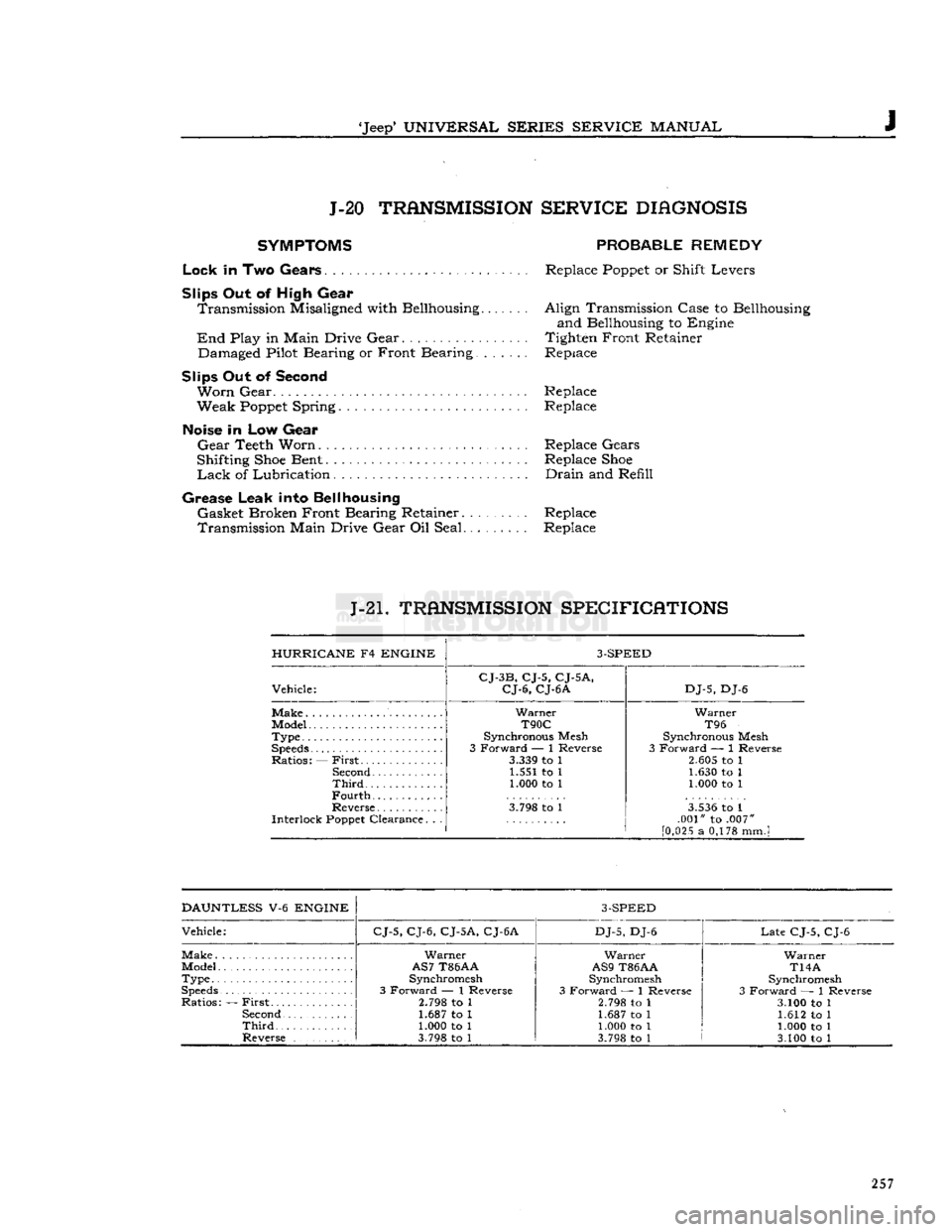
J J-20
TRANSMISSION
SERVICE
DIAGNOSIS
SYMPTOMS
PROBABLE
REMEDY
Lock
in Two
Gears
Replace
Poppet
or Shift Levers
Slips
Out of High Gear Transmission Misaligned with Bellhousing
End
Play in Main Drive Gear Damaged Pilot Bearing or Front Bearing.
Slips
Out of Second
Worn
Gear Replace
Weak
Poppet
Spring Replace
Noise
in Low Gear
Gear
Teeth Worn Replace Gears
Shifting
Shoe
Bent Replace
Shoe
Lack
of Lubrication Drain and Refill
Grease
Leak into Bellhousing Gasket Broken Front Bearing Retainer Replace
Transmission Main Drive Gear Oil Seal Replace Align Transmission Case to Bellhousing
and Bellhousing to Engine
Tighten Front Retainer
Replace
J-21.
TRANSMISSION
SPECIFICATIONS
HURRICANE
F4
ENGINE
3-SPEED
Vehicle:
CJ-3B,
CJ-5,
CJ-5A,
CJ-6,
CJ-6A
DJ-5,
DJ-6
Make
Type
Speeds
Ratios: —
First
Second
Third
Fourth
Warner
T90C
Synchronous Mesh
3 Forward — 1 Reverse
3.339
to 1 1.551 to 1 1.000 to 1
Warner
T96
Synchronous Mesh
3 Forward — 1 Reverse
2.605
to 1 1.630 to 1
1.000 to 1
Reverse
Interlock
Poppet
Clearance. . .
3.798
to 1
3.536
to 1
.001" to .007"
[0,025
a 0,178 mmJ
DAUNTLESS
V-6
ENGINE
3-SPEED
Vehicle:
CJ-5,
CJ-6,
CJ-5A,
CJ-6A
DJ-5,
DJ-6
Late
CJ-5, CJ-6
Make
Warner
Warner Warner
Model
AS7
T86AA
AS9
T86AA
T14A
Type..
Synchromesh
Synchromesh Synchromesh
Speeds
3 Forward — 1 Reverse 3 Forward — 1 Reverse 3 Forward — 1 Reverse
Ratios: —
First
2.798
to 1
2.798
to 1
3.100 to 1
Second
1.687 to 1 1.687 to 1 1.612 to 1
Third
1.000 to 1
1.000 to 1 1.000 to 1
Reverse
3.798
to 1
3.798
to 1 3.100 to 1 257
Page 259 of 376
'Jeep'
UNIVERSAL
SERIES
SERVICE
MANUAL
Jl
FOUR-SPEED
TRANSMISSION
Contents
SUBJECT
PAF.
GENERAL.
Jl-1
FOUR-SPEED
TRANSMISSION
REMOVAL.
Jl-2
Four-Speed Transmission
Disassembly
.
Jl-3 Four-Speed Transmission Control Housing
Disassembly
Jl-4
Four-Speed Transmission Reassembly Jl-5
SUBJECT
PAR.
Four-Speed Transmission Control Housing
Reasse mbly Jl-6
Transfer
Case Adapter Plate Oil Seal .
.
Jl-8
Four-Speed Transmission Installation Jl-7
FOUR-SPEED
TRANSMISSION
SPECIFICATIONS.
.
.
Jl-10
SERVICE
DIAGNOSIS
Jl-9 10771
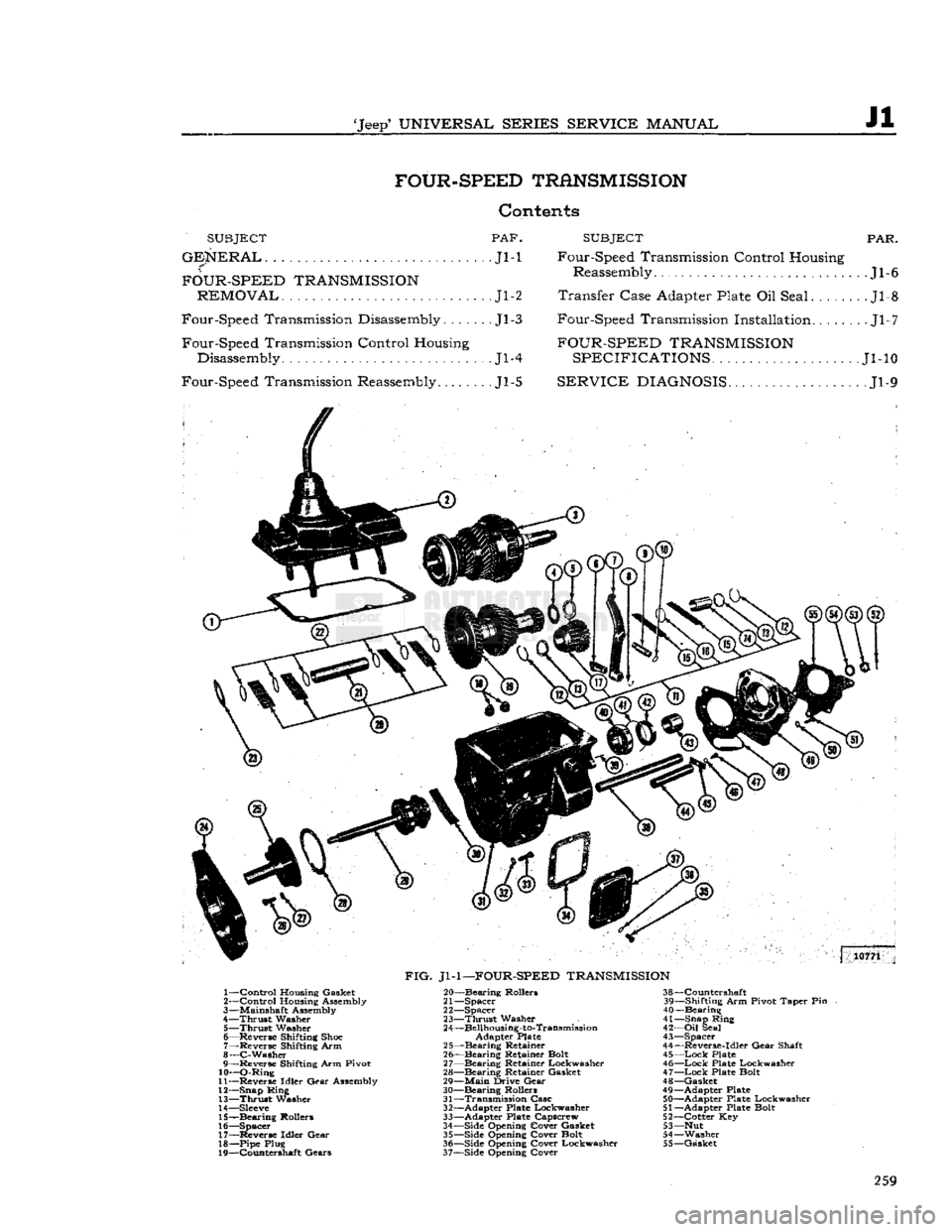
FIG.
Jl-1—FOUR-SPEED
TRANSMISSION
1—
Control
Housing Gasket
2—
Control
Housing Assembly
3— Mainshaft Assembly
4—
Thrust
Washer
5—
Thrust
Washer
6— Reverse Shifting
Shoe
7— Reverse Shifting Arm
8—
C-Washer
9— Reverse Shifting Arm Pivot
10—
O-Ring
11— Reverse Idler
Gear
Assembly
12— Snap Ring
13—
Thrust
Washer
14—
Sleeve
15— Bearing Rollers
16— Spacer
17— Reverse Idler
Gear
18— Pipe Plug
19— Countershaft Gears 20— Bearing Rollers
21— Spacer 22— Spacer
23—
Thrust
Washer
2
4
—Bellhousi ng-to-Transmission Adapter Plate
25— Bearing Retainer
26— Bearing Retainer Bolt
27— Bearing Retainer Lockwasher
28— Bearing Retainer Gasket
29—
Main
Drive
Gear
30— Bearing Rollers 31— Transmission Case
32— Adapter Plate Lockwasher
33— Adapter Plate Capscrew
34— Side Opening Cover Gasket
35— Side Opening Cover Bolt
36— Side Opening Cover Lockwasher
37— Side Opening Cover 38— Countershaft
39— Shifting Arm Pivot Taper Pin
40— Bearing
41— Snap Ring
42—
Oil
Seal 43— Spacer
44— Reverse-Idler
Gear
Shaft 45—
Lock
Plate
46—
Lock
Plate Lockwasher
47—
Lock
Plate Bolt
48— Gasket
49— Adapter Plate 50— Adapter Plate Lockwasher
51— Adapter Plate Bolt
52— Cotter Key
53— Nut 54— Washer
55— Gasket 259
Page 261 of 376
'Jeep*
UNIVERSAL
SERIES SERVICE
MANUAL
Jl
1—
Blocking
Rir
2—
Direct
and 1
3—
Snap
Ring
4—
Spring
5—
Shifting
Plat
6—
Direct
and 1 7—
Third
Speed
J1-3
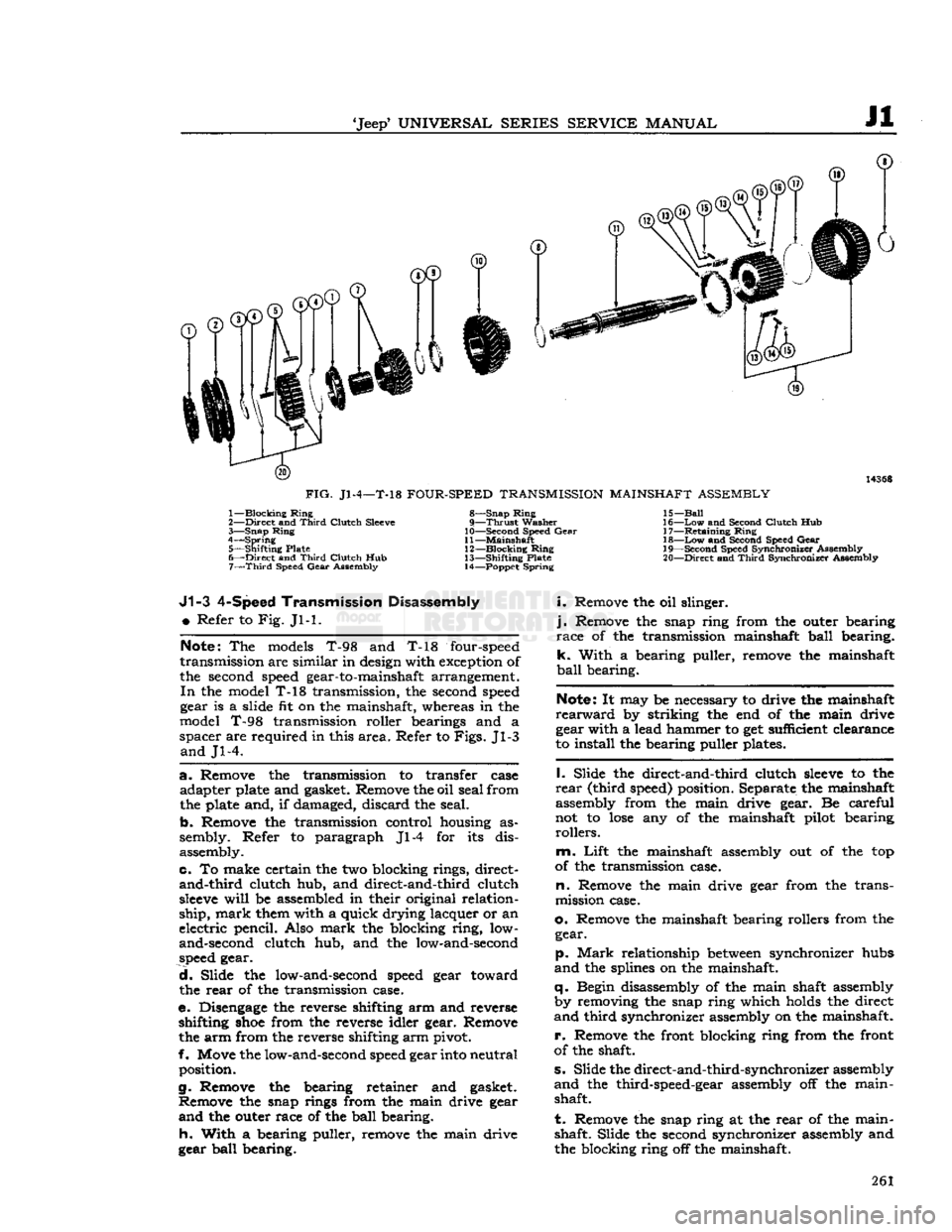
4-Speed Transmission Disassembly
•
Refer to Fig. Jl-1.
Note;
The
models
T-98 and T-18 four-speed
transmission are similar in design with exception of
the second
speed
gear-to-mainshaft arrangement.
In
the model T-18 transmission, the second
speed
gear is a slide fit on the mainshaft, whereas in the
model T-98 transmission roller bearings and a
spacer are required in this area. Refer to Figs. Jl-3
and
Jl-4.
a.
Remove the transmission to transfer case adapter plate and gasket. Remove the oil seal from
the plate and, if damaged, discard the seal.
b. Remove the transmission control housing as
sembly. Refer to paragraph Jl-4 for its dis
assembly.
c. To make certain the two blocking rings, direct-
and-third
clutch hub, and direct-and-third clutch
sleeve
will
be assembled in their original relation
ship,
mark them with a quick drying lacquer or an
electric pencil. Also mark the blocking ring, low-
and-second clutch hub, and the low-and-second
speed
gear.
d.
Slide the low-and-second
speed
gear toward the rear of the transmission case.
e.
Disengage
the reverse shifting arm and reverse shifting
shoe
from the reverse idler gear. Remove
the arm from the reverse shifting arm pivot.
f. Move the low-and-second
speed
gear
into
neutral position.
g. Remove the bearing retainer and gasket.
Remove the snap rings from the main drive gear
and
the outer race of the ball bearing.
h.
With a bearing puller, remove the main drive
gear ball bearing. 1436S
i
Hub
Gear
izer
Assembly
ironizer
Assembly
i.
Remove the oil slinger.
j.
Remove the snap ring from the outer bearing
race
of the transmission mainshaft ball bearing.
k. With a bearing puller, remove the mainshaft
ball
bearing.
Note:
It may be necessary to drive the mainshaft
rearward
by striking the end of the main drive gear with a lead hammer to get sufficient clearance
to install the bearing puller plates.
I.
Slide the direct-and-third clutch
sleeve
to the
rear
(third
speed)
position. Separate the mainshaft
assembly from the main drive gear. Be careful
not to
lose
any of the mainshaft pilot bearing
rollers.
m.
Lift
the mainshaft assembly out of the top
of the transmission case.
n.
Remove the main drive gear from the trans
mission case.
o. Remove the mainshaft bearing rollers from the gear.
p.
Mark
relationship
between
synchronizer hubs
and
the splines on the mainshaft.
q. Begin disassembly of the main shaft assembly by removing the snap ring which holds the direct
and
third synchronizer assembly on the mainshaft,
r.
Remove the front blocking ring from the front
of the shaft.
s. Slide the direct-and-third-synchronizer assembly
and
the third-speed-gear assembly off the main-shaft.
t. Remove the snap ring at the rear of the main-
shaft. Slide the second synchronizer assembly and the blocking ring off the mainshaft.
FIG.
Jl-4—T-18
FOUR-SPEED TRANSMISSION MAINSHAFT ASSEMBLY
ng 8—Snap
Ring
15—Ball
third
Clutch
Sleeve
9—Thrust
Washer 16—Low and Second
Clutch
10—
Second
Speed
Gear
17—Retaining
Ring
11—
Mainshaft
18—Low and Second Speed
te 12—Blocking
Ring
19—Second Speed
Synchroni
rhird
Clutch
Hub 13—Shifting Plate 20—Direct and
Third
Synch
Gear
Assembly 14—Poppet
Spring
261
Page 262 of 376
Jl
FOUR-SPEED
TRANSMISSION
U.
On the T-98 transmission remove the snap rings
holding the thrust washer, bearing rollers, second-
speed
gear, and spacer on the mainshaft. Slide
these
components
off the shaft. Refer to Fig. Jl-3.
Note:
The second
speed
gear in the T-18 trans
mission is a slide fit
onto
the mainshaft and
does
not contain roller bearings or a spacer.
v. If the synchronizer assemblies are to be dis
assembled and serviced proceed as follows:
Wrap
the
second-speed
synchronizer assembly in a cloth
to prevent losing the lock balls and springs. Push the clutch hub out of the low-and-second-speed
gear in a direction
opposite
the shift fork
groove.
Remove the cloth.
Lift
the balls, springs, and
plates out of the hub.
w. Remove the lockplate for the countershaft and
reverse idler gear shaft.
x.
Use a pry bar in the
slot
of the reverse idler gear
shaft to
loosen
the shaft.
Then,
slip the reverse
idler
gear shaft out of the housing and gear.
Lift
the reverse idler gear assembly from the transmission case.
y. To remove the countershaft, use a heavy brass
drift
and drive the countershaft toward the
rear
of
the transmission case. When the countershaft end
is just about even with the inside of the trans mission case, use a dummy shaft to force it the
remainder of the way. (Since a dummy shaft is a
FIG.
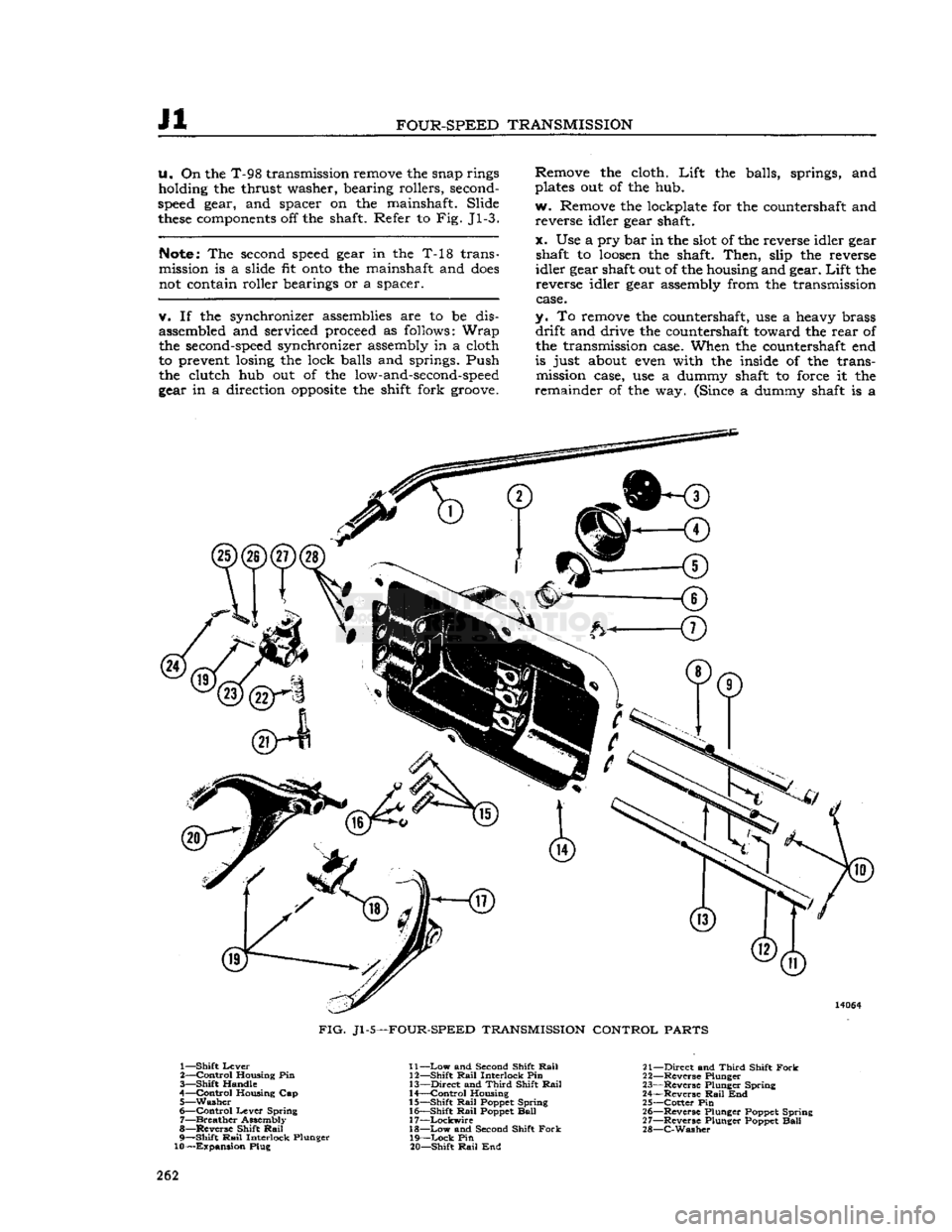
Jl -5—FOUR-SPEED TRANSMISSION CONTROL PARTS
1—
Shift
Lever
2—
Control
Housing Pin
3—
Shift
Handle
4—
Control
Housing Cap 5—
Washer
6—
Control
Lever
Spring
7—
Breather
Assembly
8— Reverse Shift
Rail
9—
Shift
Rail
Interlock Plunger
10—Expansion
Plug 11—
Low
and Second Shift
Rail
12—
Shift
Rail
Interlock Pin
13—
Direct
and
Third
Shift
Rail
14—
Control
Housing
15—
Shift
Rail
Poppet Spring
16—
Shift
Rail
Poppet
Ball
17—
Lockwire
18—
Low
and Second Shift
Fork
19—
Lock
Pin
20—
Shift
Rail
End 21—
Direct
and
Third
Shift
Fork
22— Reverse Plunger
23— Reverse Plunger Spring
24— Reverse
Rail
End
25—
Cotter
Pin
26— Reverse Plunger Poppet Spring
27— Reverse Plunger Poppet
Ball
28—
C-Washer
262
Page 263 of 376
![JEEP CJ 1953 Service Manual
Jeep*
UNIVERSAL
SERIES
SERVICE
MANUAL
Jl
necessity for assembly, one should be made at this
time to assist on disassembly. One can be made by
using a \Y%N [2,86 cm.] diameter steel rod cut](/img/16/57040/w960_57040-262.png "JEEP CJ 1953 Service Manual
Jeep*
UNIVERSAL
SERIES
SERVICE
MANUAL
Jl
necessity for assembly, one should be made at this
time to assist on disassembly. One can be made by
using a \Y%N [2,86 cm.] diameter steel rod cut")
'Jeep*
UNIVERSAL
SERIES
SERVICE
MANUAL
Jl
necessity for assembly, one should be made at this
time to assist on disassembly. One can be made by
using a \Y%N [2,86 cm.] diameter steel rod cut to
9.850*
{25,02
cm.] long.
Break
sharp
edges
with a
mill
file.) Keep the dummy shaft in contact with
the countershaft at all times to prevent dropping
the bearing rollers or thrust washers,
z.
With
the dummy shaft in position, place the
transmission
case on its side and carefully
roll
the countershaft gear cluster out of the case,
aa.
Complete the disassembly by removing the dummy shaft, thrust washers, four
sets
of bearing
rollers,
and spacers.
bb.
To disassemble the reverse idler gear assembly,
remove one of the snap rings and tap out the
washers,
both
sets
of bearing rollers, center spacer,
and
sleeve.
Remove the remaining snap
ring.
J1-4.
4-Speed
Transmission
Control
Housing
Disassembly
•
Refer to Fig. Jl-5.
The
gearshift lever, spring, and spring seat were previously removed for removal of the transmission
from
the vehicle.
a.
Remove the lock pins from the gearshift forks
and
gearshift rod ends. Remove the expansion plugs
from
the front and
rear
of the gearshift lever base. Remove back-up light switch.
b.
Remove the center (third and high) gearshift
rod
first. Drive this gearshift rod out the
rear
of the gearshift lever base. As the gearshift rod is
withdrawn
from the center section of the gearshift base, remove the interlock pin from the cross
over
hole
in the gearshift rod. Before the gearshift
rod
is removed from the center section of the gear
shift base, place a finger over the
hole
to prevent
loss
of the
ball
and spring.
Then
remove the rod.
c»
Remove the low- and second-speed gearshift rod
in
the same manner.
d.
Remove the gearshift rod lock balls and springs
and.
with a piece of
wire,
push the two gearshift rod
interlock
plungers out of the pockets in the center
section of the gearshift base.
In
the reverse gearshift rod end is a spring-loaded
plunger which prevents the
driver
from accidentally
shifting into reverse gear. Should this part require
servicing,
proceed as follows:
Remove the cotter key from the rod end assembly
and
at the same time hold a finger over the
hole
to prevent
loss
of the spring.
Then
shake out the
spring
and
ball.
Compress the plunger and spring
until
the C-washer
groove
just clears the end of
the casting. Remove the C-washer.
J1-5.
4-speed
Transmission Reassembly •
Refer to Fig. Jl-1.
Assemble the unit in the reverse order of dis
assembly noting the following points:
a.
Assemble the countershaft assembly with the
fabricated
dummy shaft. The bronze front thrust
washer
and the steel backed bronze
rear
thrust
washer
should be coated with stiff lubricant and
installed
with the lugs
engaged
in the notches
in
the end of the gear cluster. Place the assembly
in
the transmission case and install the counter
shaft from the
rear,
keeping the countershaft and
dummy shaft in contact to prevent dropping
bearing
rollers or washers. Tap the countershaft
lightly into position in the front of the case but
do not seat it until the reverse idler gear assembly
and
shaft have been installed in the case.
b.
Install
the reverse idler gear shaft in the case
until
the lock plate slot is adjacent to the slot in
the countershaft. Insert the lock plate in the
slots
of the shafts making sure the plate ends are square
with
the slots.
Install
the lock plate screw and
lockwasher
to act as a pilot while tapping the
shafts alternately into position in the case. Tighten
the lock plate screw securely.
c.
Begin assembly of the second speed synchronizer assembly (see
Fig.
Jl-6) by installing the low-and
-
second-speed clutch hub in the low-and-second-
speed gear.
Install
the retaining ring in the speed gear.
Install
the retaining ring in the low and
FIG.
Jl
-6—ASSEMBLING
SECOND-SPEED
SYNCHRONIZER
1—
Low
and Second
Clutch
Gear
2—
Ball
3—
Low
and Second
Clutch
Hub
4—
Shifting
Plate
second speed gear. Slide the hub out of the gear
in
the direction
opposite
the shift fork
groove
until
the
holes
in the hub are clear of the gear.
Install
the shifter plates and springs. Push the
hub back into the gear until the springs touch the
internal
teeth
of the gear. Push one of the shifter
plates toward the center of the gear while installing
ball.
See
Fig.
Jl-6 .
This
will
hold the
ball
in position.
Install
the other two balls in the same manner.
Be
careful when rotating the assembly to prevent the hub from slipping out of the gear. When the
balls
are installed, push the hub into the gear
until
the balls snap into the neutral position.
d.
Assemble the
direct
-
and
-
third
synchronizer as
sembly in accordance with the instructions given
in
Section J, Par.
J-lle.
e.
Start
assembly of the mainshaft assembly by 263
Page 265 of 376
'Jeep'
UNIVERSAL SERIES SERVICE
MANUAL
Jl
FIG.
Jl-9—INCORRECT
OIL
SEAL POSITION J1-7.
Installing
4-Speed
Transmission
Install
the four-speed transmission in the reverse
order
of the removal, noting the following points:
When
installing the front adapter plate (Fig. Jl-1,
insert
the bearing retainer in the adapter plate and
position the adapter plate against the flywheel
housing.
With
the adapter plate cap screws tight, make sure the bearing retainer can be removed
freely. If not, relocate the adapter plate and tighten
again to
test
proper location of adapter plate.
When
installing
rear
adapter plate, be sure cap
screw heads do not protrude beyond the adapter
plate face or interfere with transfer case fitting
tightly against
rear
adapter plate.
When
installing transfer case gear on the trans-
FIG.
Jl-10—CORRECT
OIL
SEAL POSITION
mission
rear
splined drive shaft tighten the large
gear nut securely and insert cotter pin.
Sink
cotter
pin
well into nut
slots
so it
will
clear
P.T.O.
drive.
J1-8.
Adapter Plate
Oil
Seal
It
is important that the four-speed transmission
adapter plate oil seal be correctly installed to
prevent flow of lubricant from the transfer case
to the transmission. Should the lubricant level be
low in the transfer case and high in the transmission,
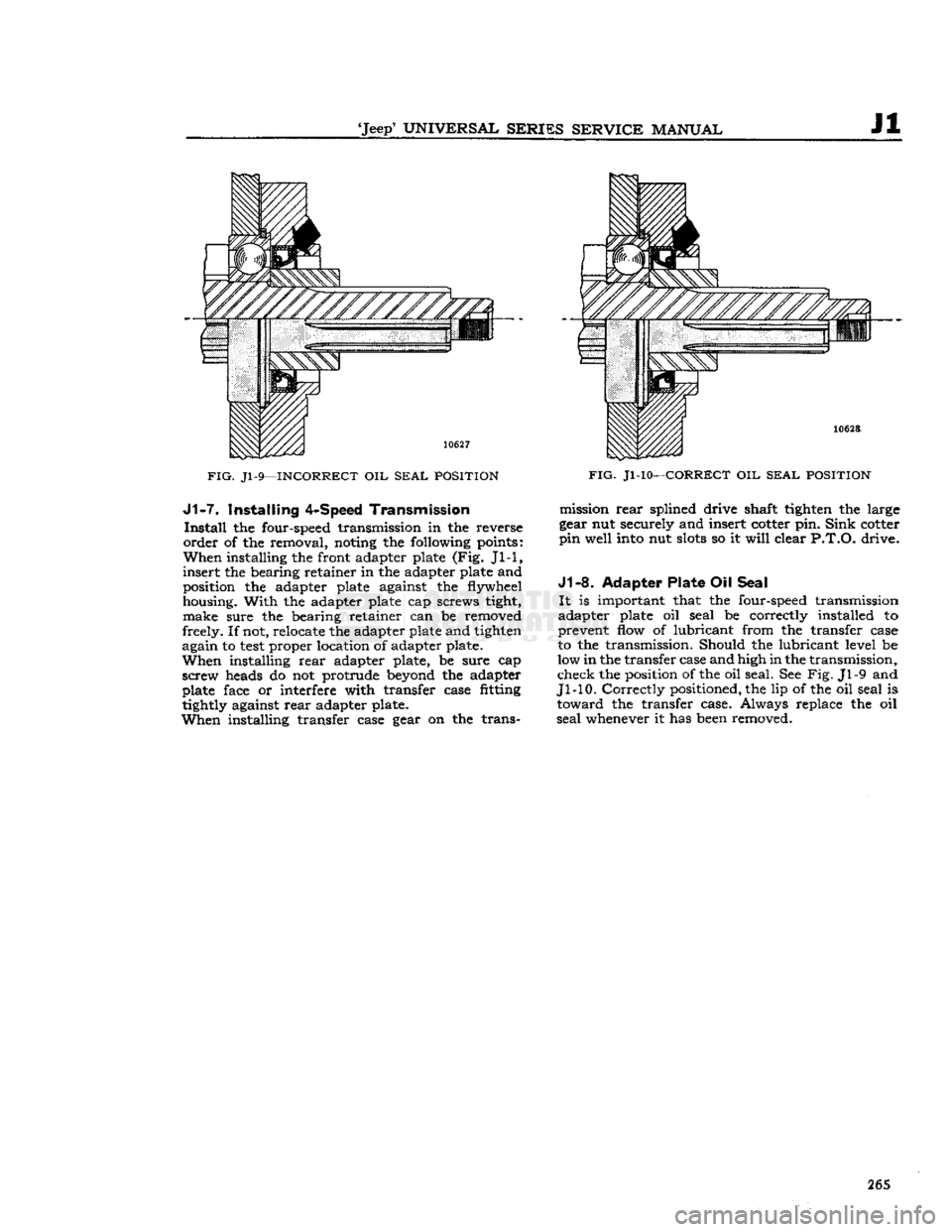
check the position of the oil seal. See Fig. Jl-9 and
Jl-10.
Correctly
positioned, the lip of the oil seal is
toward
the transfer case. Always replace the oil
seal
whenever it has been removed. 265
Page 267 of 376
'Jeep'
UNIVERSAL SERIES SERVICE
MANUAL
ft
TRANSFER CASE
Contents
SUBJECT
PAR.
GENERAL
. . .K-1
TRANSFER CASE REMOVAL
K-2
TRANSFER CASE DISASSEMBLY
K-3
Front
Bearing Cap K-4
Rear
Bearing Cap K-5
TRANSFER CASE REASSEMBLY.
. .K-6
TRANSFER CASE INSTALLATION
K-7
TRANSFER CASE LINKAGE
ADJUSTMENT
K-8
SERVICE
DIAGNOSIS
K-9
SPECIFICATIONS
.K-10
K-1. GENERAL
All
4-wheel-drive models are equipped with a
transfer
case to connect the power to the front
axle.
It is essentially a
two-speed
transmission
located at the
rear
of the standard transmission
and
provides a low and direct gear.
The
transfer case gears are controlled by the
driver
through
one shift lever.
Early
'Jeep'
Universal
Models with the F4-134
Hurricane
engine
are equipped with two transfer case shift control levers.
a.
On vehicles equipped with one transfer case
shift
lever, the transfer case shift lever has four
positions: 2WD
High,
4WD
High,
Neutral, and
4WD
low. The forward position of the lever 2WD
High
allows the
rear
wheels only to drive. The
first
rear
position (4WD High)
engages
the 4- wheel drive and provides high range 4-wheel drive.
The
second
rear
position (Neutral)
disengages
all power to the wheels and is used for stationary
power take-off operations. The last
rear
position
(4WD
Low) provides low range 4-wheel drive.
b.
On vehicles equipped with two transfer case
shift
levers, the transfer case front axle drive lever (left hand lever)
gives
a choice of 2-wheel or 4-
wheel drive. In the forward (out) position the
vehicle is in 2-wheel drive. Move the lever to the
rear
(in) position for 4-wheel drive operation.
The
4-wheel-drive
auxiliary-range
shift lever (right
hand
lever) has three positions; low, neutral, and
high.
The forward position (low)
gives
low-range
4-wheel drive. The center position (neutral) dis
engages
all power to the wheels and is used for
stationary
power take-off operations. A built-in in
terlock
prevents shifting into low range, 2-wheel
drive.
This
feature protects the
rear
axle from over
load.
K-2.
Removal of
Transfer
Case
The
transfer case may be removed from the vehicle
without removing the transmission. Where both
transmission
and transfer case are to be removed
together,
refer to Section J. To remove only the
transfer
case from the vehicle, proceed as follows:
a.
Drain
transmission
and transfer case and replace
drain
plugs.
b.
Disconnect the brake cable.
c.
Disconnect front and
rear
propeller shafts at
the transfer case. See "Propeller Shafts and
Uni
versal
Joints."
d.
Disconnect
speedometer
cable at transfer case. e. Disconnect the transfer case shift levers. On
vehicles equipped with two shift levers
loosen
set screw and remove pivot pin. Use a screw
driver
to pry shift lever springs away from shift levers.
Lift
levers from transfer case. On models equipped
with
a single shift lever remove pivot pin cotter
key,
and the adjusting rod attaching nut to remove
shift
lever. See Fig. K-4.
f. Remove cover plate on
rear
face of transfer case.
Remove
cotter key, nut and washer from trans
mission
main shaft.
g. If possible, at this point remove the transfer case main drive gear from the transmission main
shaft.
If not possible, see
step
j below.
h.
Remove transfer case torque reaction support
bracket
bolt and nut.
i.
Remove transmission to transfer case bolts.
j.
Remove transfer case. If the transfer case main
drive
gear has not been removed in
step
g above,
proceed as follows:
Brace
the end of the trans
mission
main shaft so that it cannot
move
in the
transmission,
pull
the transfer case to the
rear
to 267
Page 271 of 376
'Jeep'
UNIVERSAL SERIES SERVICE
MANUAL
K
the
bottom.
Remove
rear
bearing
cone
and roller
assembly from the shaft by striking the end of the
shaft lightly against a
wooden
block,
j.
Remove the set screw in sliding gear shift fork.
Remove shift rod.
See the following paragraphs for disassembly of
the front and
rear
bearing caps.
K-4.
Front
Bearing Cap Disassembly
•
Refer to Fig. K-1, K-2.
The
front bearing cap is a separate assembly which
may
be removed for service. Should difficulty be
experienced in this section of the transfer case,
follow
the
sequence
below
for removal and dis assembly.
a.
Remove the output shaft yoke as outlined in
Par. K-3.
Remove the
poppet
balls and
move
the
front wheel drive shift rod forward as outlined in
Par.
K-3f.
b.
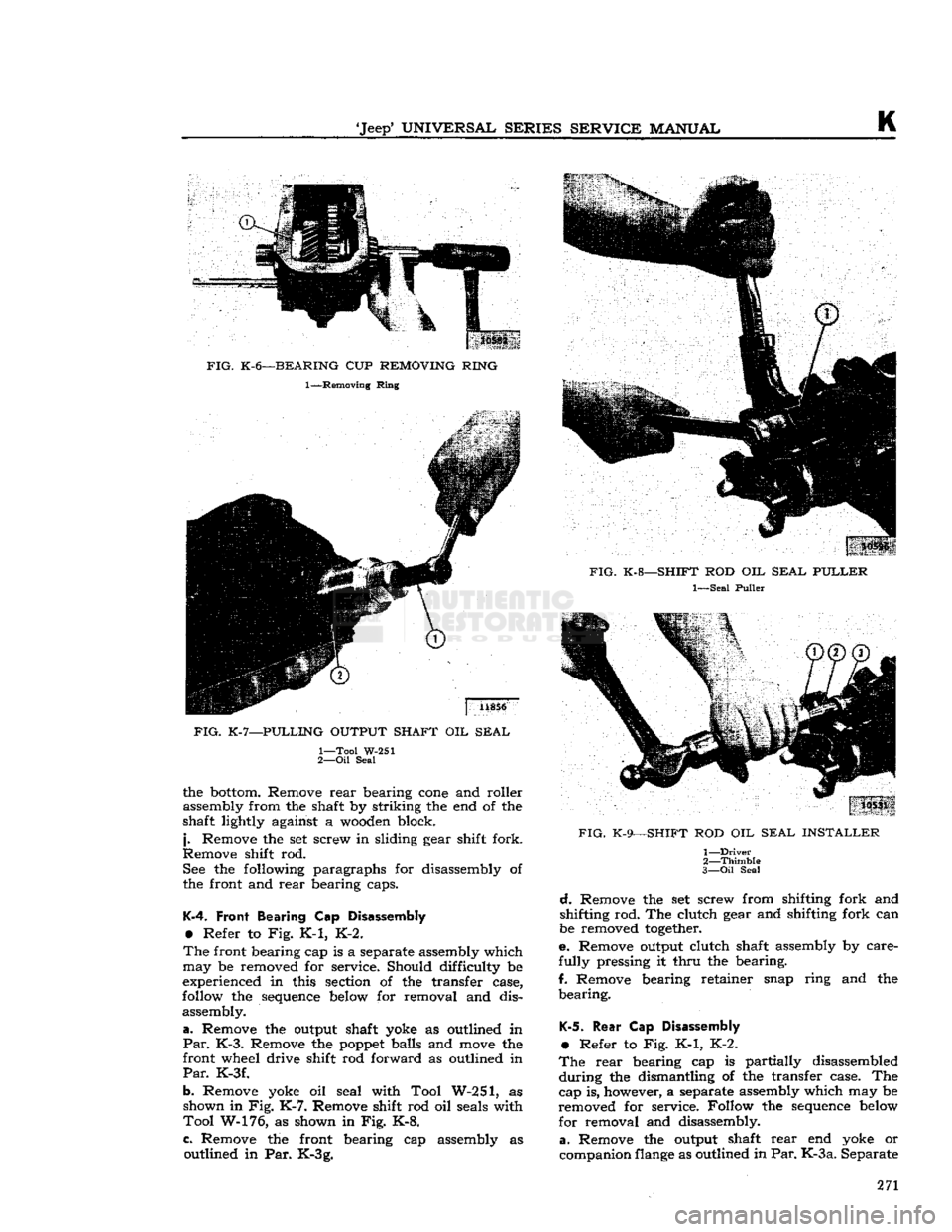
Remove yoke oil seal with Tool W-251, as shown in Fig.
K-7.
Remove shift rod oil seals with
Tool
W-176, as shown in Fig. K-8.
c.
Remove the front bearing cap assembly as outlined in Par. K-3g.
FIG.
K-9—SHIFT
ROD OIL
SEAL INSTALLER
1—
Driver
2—
Thimble
3— Oil
Seal
d.
Remove the set screw from shifting fork and
shifting rod. The clutch gear and shifting fork can
be removed
together.
e. Remove output clutch shaft assembly by care
fully
pressing it
thru
the bearing.
f. Remove bearing retainer snap ring and the
bearing.
K-5.
Rear
Cap Disassembly
•
Refer to Fig. K-1, K-2.
The
rear
bearing cap is partially disassembled
during
the dismantling of the transfer case. The
cap is, however, a separate assembly which may be
removed for service. Follow the
sequence
below
for removal and disassembly,
a.
Remove the output shaft
rear
end yoke or
companion
flange
as outlined in
Par. K-3 a.
Separate 271
Page 272 of 376
K
TRANSFER
CASE
the brake drum and companion
flange
by remov
ing bolts, lockwashers, and nuts.
b.
Remove the oil seal with Tool W-251, as shown
in
Fig. K-7.
c.
Remove
speedometer
driven gear assembly.
d.
Remove the cap screws attaching the cap and
brake
backing plate to the case.
Take
precautions
not to
lose
or damage bearing adjusting shims placed
between
the cap and the transfer case
housing.
e. Separate the
rear
cap and brake backing plate
assembly. See Section P for brake service pro
cedures.
f. Remove
speedometer
driving gear.
K-6.
Transfer
Case
Reassembly
•
Refer to Fig. K-1, K-2.
Reassembly
of the transfer case is reversal of the
foregoing
procedure of disassembly. The output shaft snap ring may
best
be installed with Tool
FIG.
K-11—OUTPUT
SHAFT
SNAP
RING
INSTALLER
1—
Snap
Ring
2—
Snap
Ring
Installer Tool W-131
FIG.
K-12—OUTPUT
SHAFT
OIL
SEAL
DRIVER
1—
Driver
Tool W-143
2—
Seal
W-131,
output shaft snap ring installing thimble
and
driver,
shown in
Fig.
K-ll.
Use a
piece
of tub
ing for installing the bearing
cone
and roller as semblies on the output shaft to prevent damage
to the assemblies.
Early
production transfer cases were equipped with
a
lVs" [2,86 cm.] diameter intermediate shaft
and
caged
needle
bearings. When installing the intermediate gear in early production transfer cases,
insert
the bearings in the gear, support the front
thrust
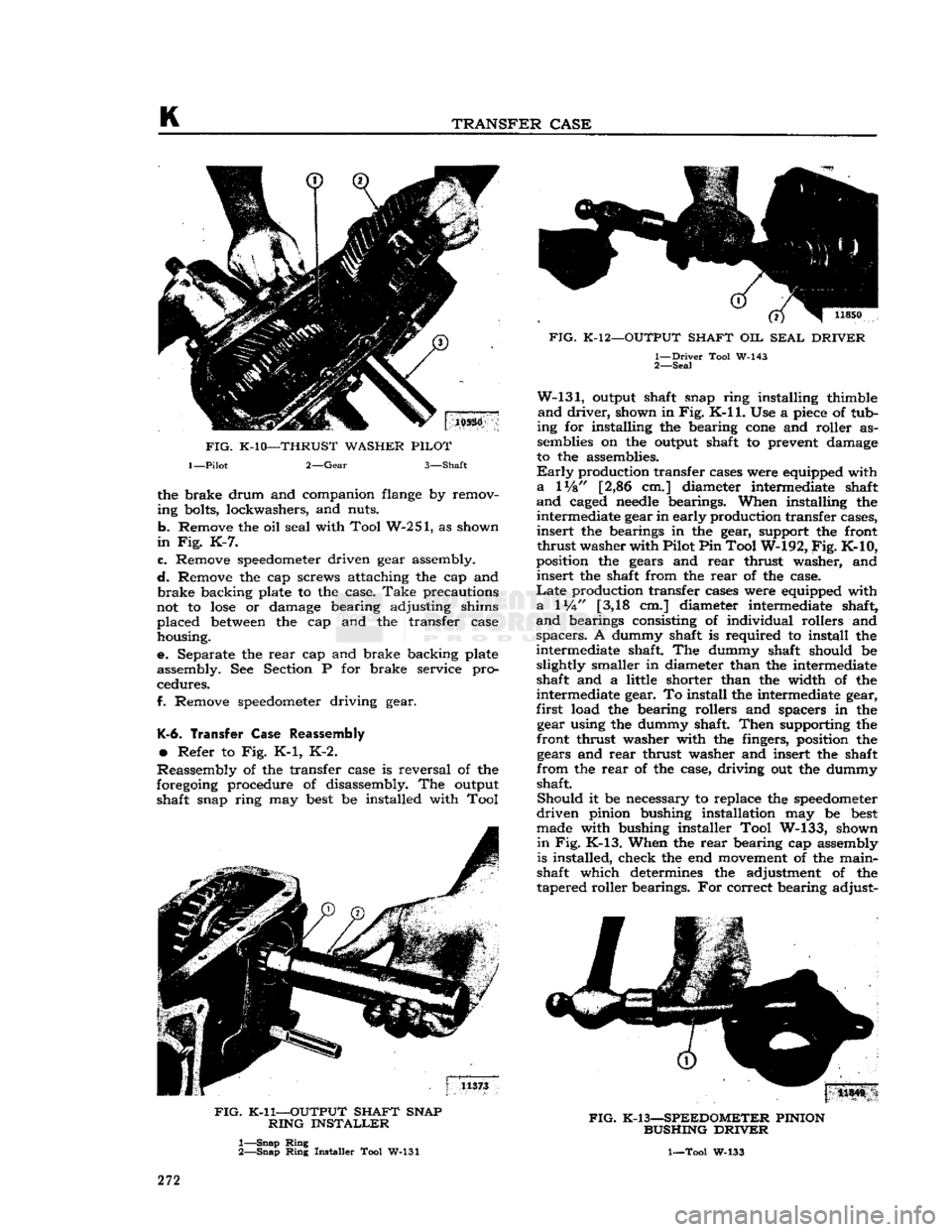
washer with Pilot Pin Tool W-192,
Fig.
K-10,
position the gears and
rear
thrust washer, and
insert
the shaft from the
rear
of the case.
Late
production transfer cases were equipped with
a
1
Vi"
[3,18 cm.] diameter intermediate shaft,
and
bearings consisting of individual rollers and
spacers.
A dummy shaft is required to install the
intermediate shaft. The dummy shaft should be slightly smaller in diameter than the intermediate
shaft and a little shorter than the width of the
intermediate gear. To install the intermediate gear,
first
load the bearing rollers and spacers in the gear using the dummy shaft.
Then
supporting the
front thrust washer with the fingers, position the gears and
rear
thrust washer and insert the shaft
from
the
rear
of the case, driving out the dummy
shaft.
Should
it be necessary to replace the
speedometer
driven
pinion bushing installation may be
best
made with bushing installer Tool W-133, shown
in
Fig. K-13. When the
rear
bearing cap assembly
is installed, check the end
movement
of the main-
shaft which determines the adjustment of the
tapered roller bearings. For correct bearing adjust-
|
11S4S
FIG.
K-13—SPEEDOMETER
PINION
BUSHING
DRIVER
1—Tool W-133
272