radiator cap JEEP COMPASS 2015 1.G Owners Manual
[x] Cancel search | Manufacturer: JEEP, Model Year: 2015, Model line: COMPASS, Model: JEEP COMPASS 2015 1.GPages: 560, PDF Size: 11.51 MB
Page 432 of 560
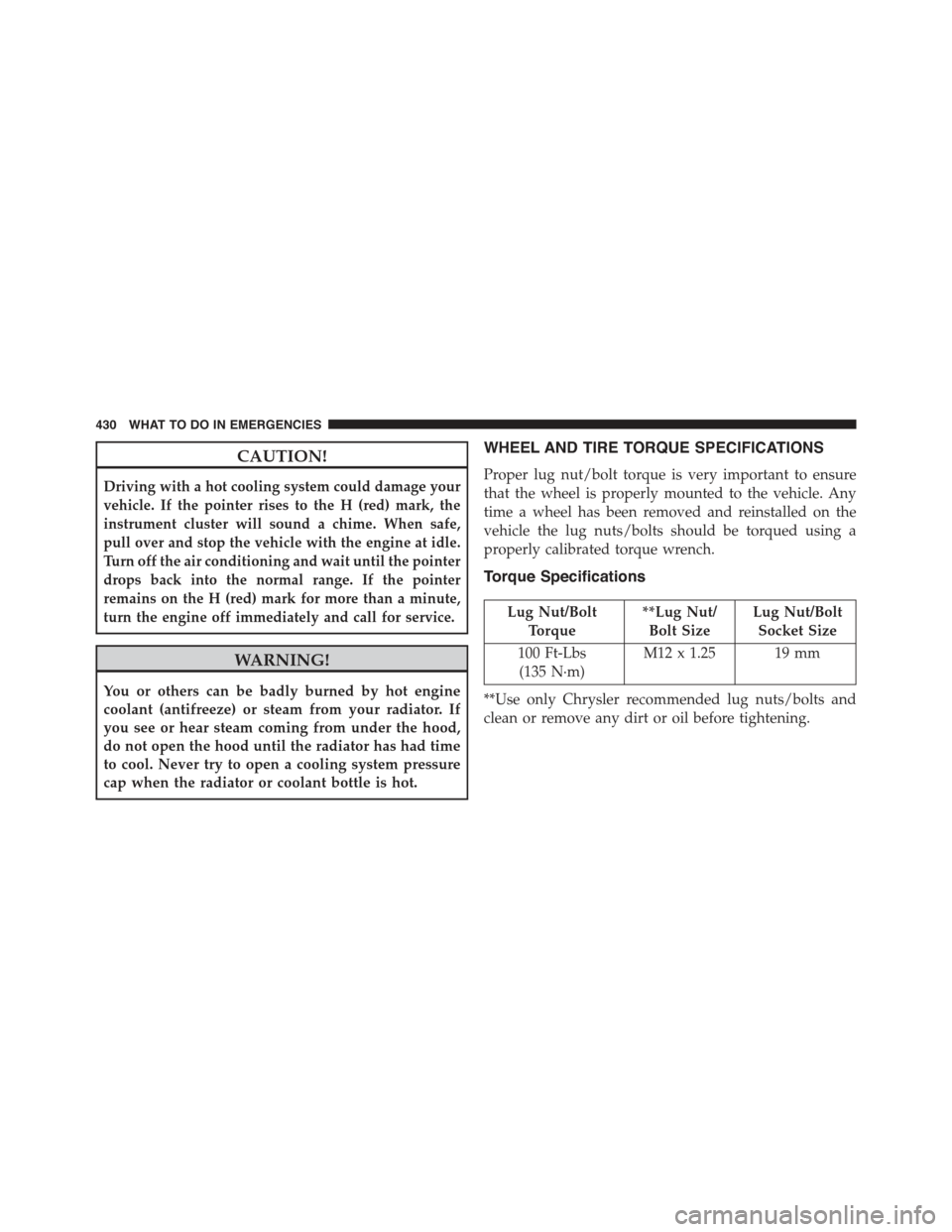
CAUTION!
Driving with a hot cooling system could damage your
vehicle. If the pointer rises to the H (red) mark, the
instrument cluster will sound a chime. When safe,
pull over and stop the vehicle with the engine at idle.
Turn off the air conditioning and wait until the pointer
drops back into the normal range. If the pointer
remains on the H (red) mark for more than a minute,
turn the engine off immediately and call for service.
WARNING!
You or others can be badly burned by hot engine
coolant (antifreeze) or steam from your radiator. If
you see or hear steam coming from under the hood,
do not open the hood until the radiator has had time
to cool. Never try to open a cooling system pressure
cap when the radiator or coolant bottle is hot.
WHEEL AND TIRE TORQUE SPECIFICATIONS
Proper lug nut/bolt torque is very important to ensure
that the wheel is properly mounted to the vehicle. Any
time a wheel has been removed and reinstalled on the
vehicle the lug nuts/bolts should be torqued using a
properly calibrated torque wrench.
Torque Specifications
Lug Nut/Bolt
Torque
**Lug Nut/
Bolt Size
Lug Nut/Bolt
Socket Size
100 Ft-Lbs
(135 N·m)
M12 x 1.25 19 mm
**Use only Chrysler recommended lug nuts/bolts and
clean or remove any dirt or oil before tightening.
430 WHAT TO DO IN EMERGENCIES
Page 487 of 560
Cooling System
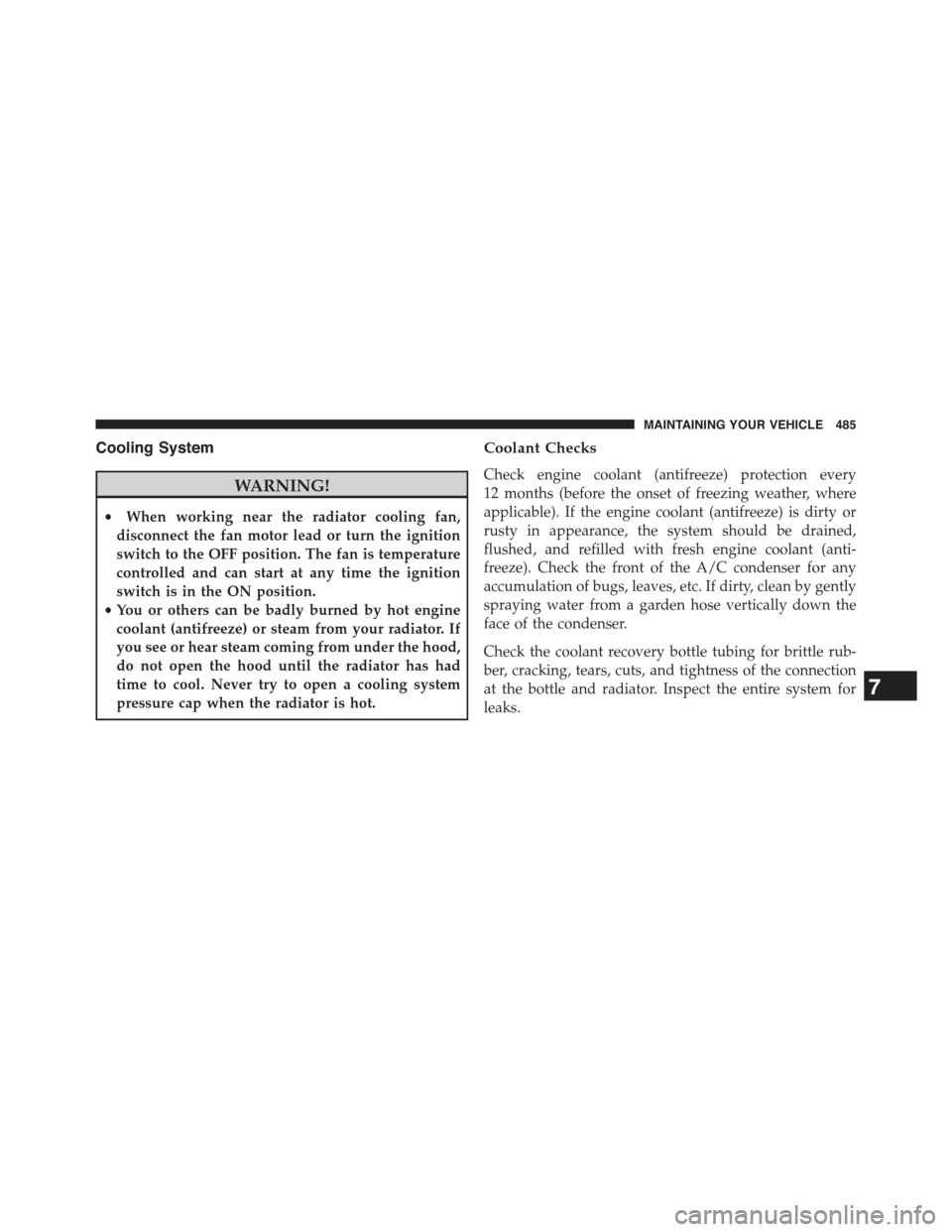
WARNING!
•When working near the radiator cooling fan,
disconnect the fan motor lead or turn the ignition
switch to the OFF position. The fan is temperature
controlled and can start at any time the ignition
switch is in the ON position.
•You or others can be badly burned by hot engine
coolant (antifreeze) or steam from your radiator. If
you see or hear steam coming from under the hood,
do not open the hood until the radiator has had
time to cool. Never try to open a cooling system
pressure cap when the radiator is hot.
Coolant Checks
Check engine coolant (antifreeze) protection every
12 months (before the onset of freezing weather, where
applicable). If the engine coolant (antifreeze) is dirty or
rusty in appearance, the system should be drained,
flushed, and refilled with fresh engine coolant (anti-
freeze). Check the front of the A/C condenser for any
accumulation of bugs, leaves, etc. If dirty, clean by gently
spraying water from a garden hose vertically down the
face of the condenser.
Check the coolant recovery bottle tubing for brittle rub-
ber, cracking, tears, cuts, and tightness of the connection
at the bottle and radiator. Inspect the entire system for
leaks.
7
MAINTAINING YOUR VEHICLE 485
Page 490 of 560
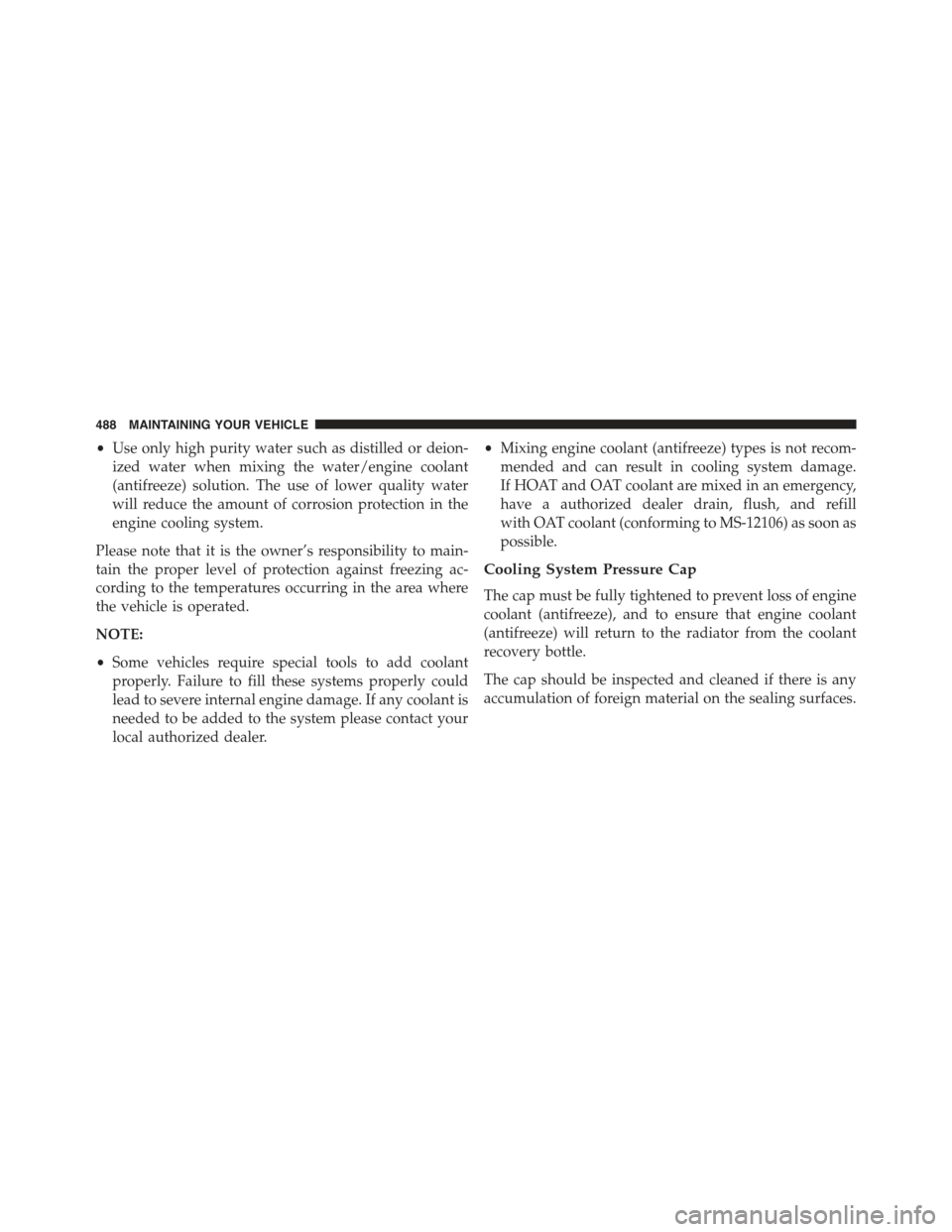
•Use only high purity water such as distilled or deion-
ized water when mixing the water/engine coolant
(antifreeze) solution. The use of lower quality water
will reduce the amount of corrosion protection in the
engine cooling system.
Please note that it is the owner’s responsibility to main-
tain the proper level of protection against freezing ac-
cording to the temperatures occurring in the area where
the vehicle is operated.
NOTE:
•Some vehicles require special tools to add coolant
properly. Failure to fill these systems properly could
lead to severe internal engine damage. If any coolant is
needed to be added to the system please contact your
local authorized dealer.
•Mixing engine coolant (antifreeze) types is not recom-
mended and can result in cooling system damage.
If HOAT and OAT coolant are mixed in an emergency,
have a authorized dealer drain, flush, and refill
with OAT coolant (conforming to MS-12106) as soon as
possible.
Cooling System Pressure Cap
The cap must be fully tightened to prevent loss of engine
coolant (antifreeze), and to ensure that engine coolant
(antifreeze) will return to the radiator from the coolant
recovery bottle.
The cap should be inspected and cleaned if there is any
accumulation of foreign material on the sealing surfaces.
488 MAINTAINING YOUR VEHICLE
Page 492 of 560
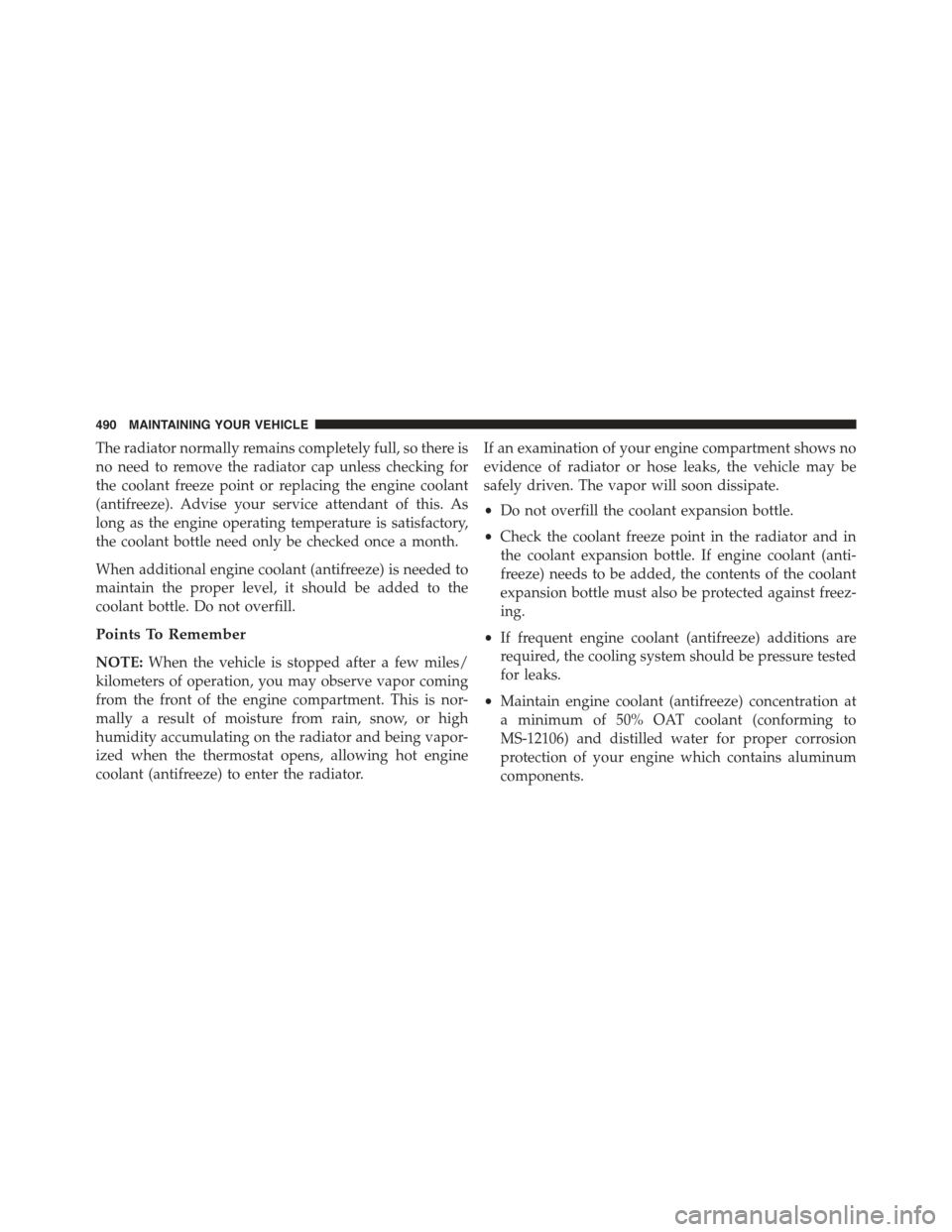
The radiator normally remains completely full, so there is
no need to remove the radiator cap unless checking for
the coolant freeze point or replacing the engine coolant
(antifreeze). Advise your service attendant of this. As
long as the engine operating temperature is satisfactory,
the coolant bottle need only be checked once a month.
When additional engine coolant (antifreeze) is needed to
maintain the proper level, it should be added to the
coolant bottle. Do not overfill.
Points To Remember
NOTE:When the vehicle is stopped after a few miles/
kilometers of operation, you may observe vapor coming
from the front of the engine compartment. This is nor-
mally a result of moisture from rain, snow, or high
humidity accumulating on the radiator and being vapor-
ized when the thermostat opens, allowing hot engine
coolant (antifreeze) to enter the radiator.
If an examination of your engine compartment shows no
evidence of radiator or hose leaks, the vehicle may be
safely driven. The vapor will soon dissipate.
•Do not overfill the coolant expansion bottle.
•Check the coolant freeze point in the radiator and in
the coolant expansion bottle. If engine coolant (anti-
freeze) needs to be added, the contents of the coolant
expansion bottle must also be protected against freez-
ing.
•If frequent engine coolant (antifreeze) additions are
required, the cooling system should be pressure tested
for leaks.
•Maintain engine coolant (antifreeze) concentration at
a minimum of 50% OAT coolant (conforming to
MS-12106) and distilled water for proper corrosion
protection of your engine which contains aluminum
components.
490 MAINTAINING YOUR VEHICLE
Page 493 of 560
•Make sure that the coolant expansion bottle overflow
hoses are not kinked or obstructed.
•Keep the front of the radiator clean. If your vehicle is
equipped with air conditioning, keep the front of the
condenser clean.
•Do not change the thermostat for Summer or Winter
operation. If replacement is ever necessary, install
ONLY the correct type thermostat. Other designs may
result in unsatisfactory engine coolant (antifreeze)
performance, poor gas mileage, and increased emis-
sions.
Brake System
In order to assure brake system performance, all brake
system components should be inspected periodically.
Refer to the “Maintenance Schedule” for the proper
maintenance intervals.
WARNING!
Riding the brakes can lead to brake failure and
possibly a collision. Driving with your foot resting or
riding on the brake pedal can result in abnormally
high brake temperatures, excessive lining wear, and
possible brake damage. You would not have your full
braking capacity in an emergency.
Brake Master Cylinder
The fluid level in the master cylinder should be checked
when performing under hood services, or immediately if
the brake system warning light is on.
Be sure to clean the top of the master cylinder area before
removing the cap. If necessary, add fluid to bring the
fluid level up to the requirements described on the brake
7
MAINTAINING YOUR VEHICLE 491
Page 542 of 560
Calibration, Compass......................239
Camera, Rear............................176
Capacities, Antifreeze (Engine Coolant)..........514
Capacities, Fluid..........................514
Caps, Filler
Fuel.................................407
Oil (Engine)...........................467
Power Steering.........................352
Radiator (Coolant Pressure)................488
Carbon Monoxide Warning...................99
Cargo Area Cover.........................200
Cargo Area Features.......................200
Cargo Compartment.......................200
Light................................200
Luggage Carrier........................206
Cargo Light.............................200
Cargo Load Floor.........................202
Cargo Tie-Downs.........................202
Car Washes.............................500
Cellular Phone...........................111
Center High Mounted Stop Light..............514
Chains, Tire.............................391
Changing A Flat Tire.......................432
Chart, Tire Sizing.........................371
Check Engine Light (Malfunction Indicator Light) . .470
Checking Your Vehicle For Safety...............98
Checks, Safety............................98
Child Restraint............................76
Child Restraints
Booster Seats...........................80
Child Restraints.........................76
Child Seat Installation.....................94
How To Stow An Unused ALR Seat Belt........90
Infants And Child Restraints................78
Install A LATCH-compatible Child Restraint.....89
Installing Child Restraints Using The Vehicle
Seat Belt..............................91
Lower Anchors And Tethers For Children.......83
540 INDEX
Page 543 of 560
Older Children And Child Restraints..........79
Seating Positions........................82
Child Safety Locks.........................34
Clean Air Gasoline........................403
Cleaning
Wheels...............................501
Climate Control..........................297
Clock..................................243
Clutch.................................491
Clutch Fluid.............................491
Coin Holder.............................199
Cold Weather Operation....................318
Compact Disc (CD) Maintenance..............296
Compact Spare Tire........................386
Compass...............................228
Compass Calibration.......................239
Compass Variance.........................239
Connector
UCI . . . . . . . . . . . . . . . . . . . . . . . . . . . . . . . ..287
Universal Consumer Interface (UCI)..........287
Console................................199
Contract, Service..........................531
Coolant (Antifreeze).......................514
Coolant Pressure Cap (Radiator Cap)...........488
Cooling System...........................485
Adding Coolant (Antifreeze)...............487
Coolant Level..........................485
Disposal of Used Coolant.................489
Drain, Flush, and Refill...................486
Inspection............................489
Points to Remember.....................490
Pressure Cap..........................488
Radiator Cap..........................488
Selection of Coolant (Antifreeze).............486
Corrosion Protection.......................499
Cruise Light.............................220
Cupholders.............................199
CustomerAssistance.......................52910
INDEX 541
Page 552 of 560
Outlet (Auxiliary Electrical Outlet)...........191
Steering..............................351
Sunroof..............................188
Transfer Unit..........................499
Windows..............................35
Power Steering Fluid.......................517
Power Transfer Unit.......................499
Pregnant Women and Seat Belts................54
Preparation for Jacking.....................433
Pretensioners
Seat Belts..............................54
Programmable Electronic Features.............236
Radial Ply Tires..........................383
Radiator Cap (Coolant Pressure Cap)...........488
Radio Operation..........................241
Radio (Sound Systems).....................241
Rear Axle (Differential).....................498
Rear Camera............................176
Rear Drive Assembly.......................498
Rear Liftgate (Sedan).......................38
Rear Seat, Folding.........................159
Rearview Mirrors.........................107
Rear Window Defroster.....................205
Rear Window Features.....................204
Rear Wiper/Washer........................204
Recorder, Event Data.......................75
Recreational Towing.......................425
Reformulated Gasoline.....................403
Refrigerant..............................479
Remote Control
Door Locks............................20
Security Alarm..........................18
Remote Keyless Entry (RKE)
FCC General Information..................26
Remote Keyless Entry (Sedan).................20
Remote Sound System (Radio) Controls.........294
Remote Starting System......................26
550 INDEX