warning JEEP COMPASS 2017 2.G User Guide
[x] Cancel search | Manufacturer: JEEP, Model Year: 2017, Model line: COMPASS, Model: JEEP COMPASS 2017 2.GPages: 429, PDF Size: 3.46 MB
Page 31 of 429
To Exit Remote Start Mode Without Driving The
Vehicle
Push and release the Remote Startbutton one time or
allow the engine to run for the entire 15-minute cycle.
NOTE: To avoid unintentional shut downs, the system will
disable the one time push of the Remote Start
button
for two seconds after receiving a valid Remote Start
request.
To Exit Remote Start Mode And Drive The Vehicle
Before the end of the 15-minute cycle, push and release the
unlock
button on the key fob to unlock the doors and
disarm the Vehicle Security Alarm (if equipped). Then,
insert the key into the ignition and place the ignition in
the ON/RUN position.
NOTE: The ignition must be placed in the ON/RUN
position in order to drive the vehicle.
DOOR LOCKS
Manual Door Locks
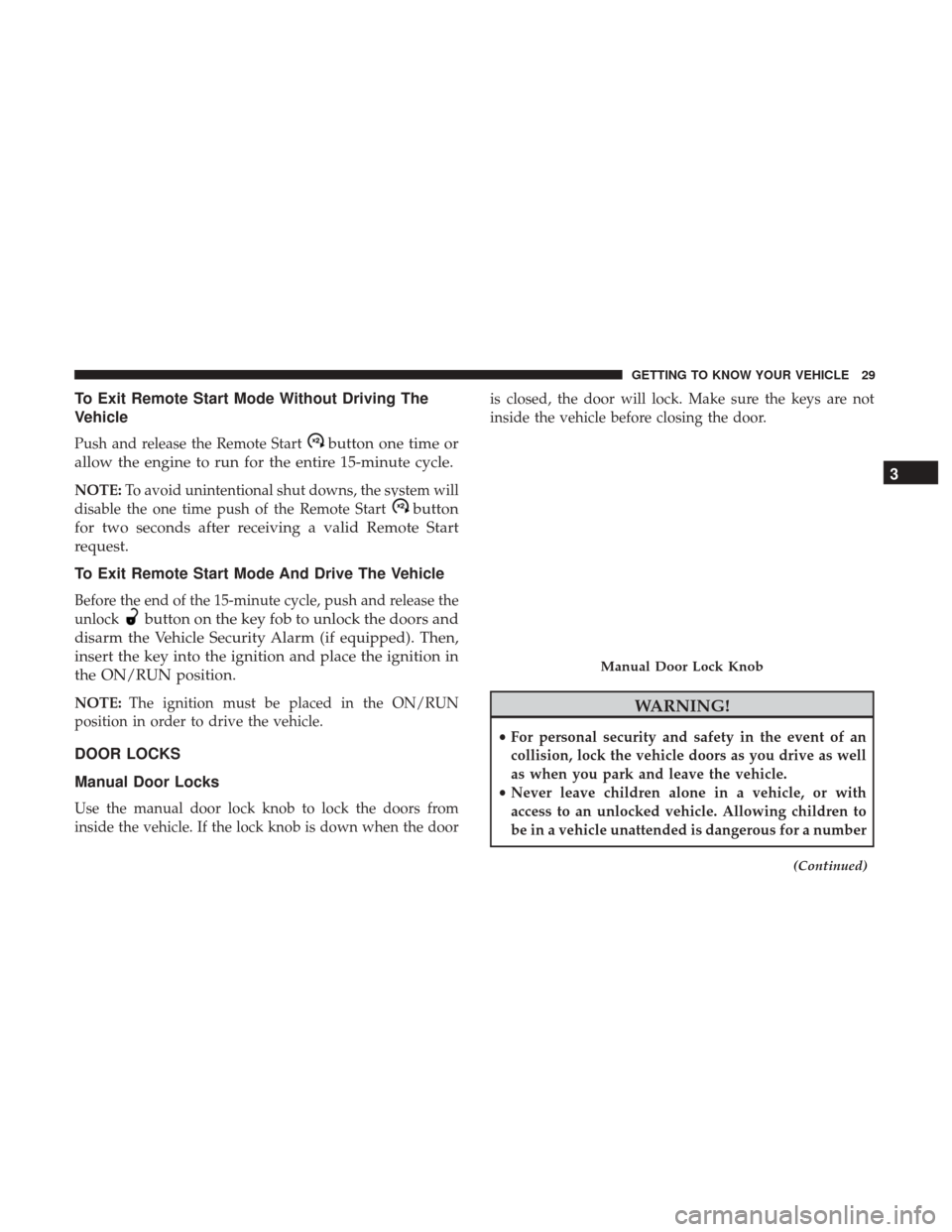
Use the manual door lock knob to lock the doors from
inside the vehicle. If the lock knob is down when the door is closed, the door will lock. Make sure the keys are not
inside the vehicle before closing the door.
WARNING!
•
For personal security and safety in the event of an
collision, lock the vehicle doors as you drive as well
as when you park and leave the vehicle.
• Never leave children alone in a vehicle, or with
access to an unlocked vehicle. Allowing children to
be in a vehicle unattended is dangerous for a number
(Continued)
Manual Door Lock Knob
3
GETTING TO KNOW YOUR VEHICLE 29
Page 32 of 429
WARNING!(Continued)
of reasons. A child or others could be seriously or
fatally injured. Children should be warned not to
touch the parking brake, brake pedal or the gear
selector.
• Do not leave the key fob in or near the vehicle, or in
a location accessible to children. A child could oper-
ate power windows, other controls, or move the
vehicle.
CAUTION!
Always remove the key fobs from the vehicle and lock
all doors when leaving the vehicle unattended.
Power Door Locks
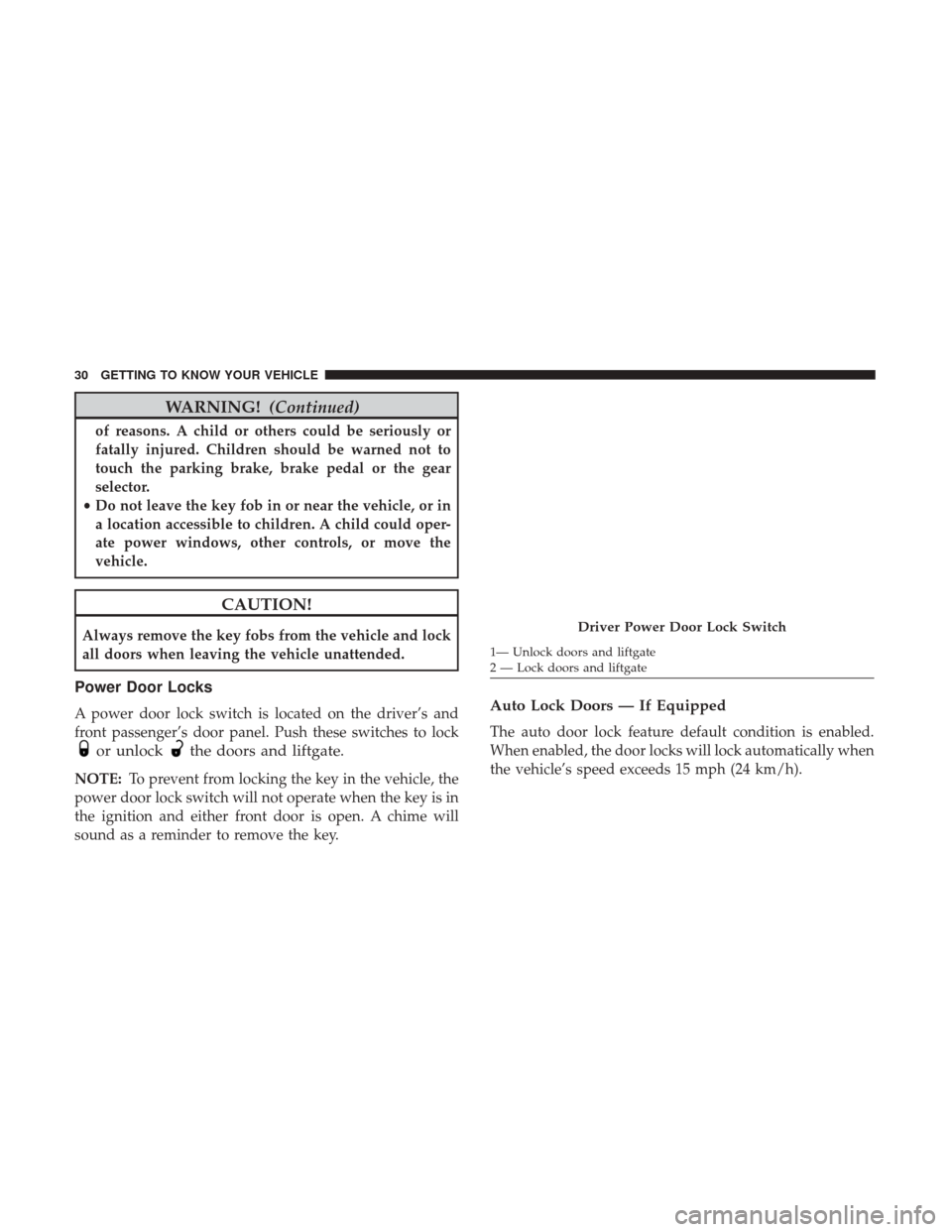
A power door lock switch is located on the driver’s and
front passenger’s door panel. Push these switches to lock
or unlockthe doors and liftgate.
NOTE: To prevent from locking the key in the vehicle, the
power door lock switch will not operate when the key is in
the ignition and either front door is open. A chime will
sound as a reminder to remove the key.
Auto Lock Doors — If Equipped
The auto door lock feature default condition is enabled.
When enabled, the door locks will lock automatically when
the vehicle’s speed exceeds 15 mph (24 km/h).
Driver Power Door Lock Switch
1— Unlock doors and liftgate
2 — Lock doors and liftgate
30 GETTING TO KNOW YOUR VEHICLE
Page 35 of 429
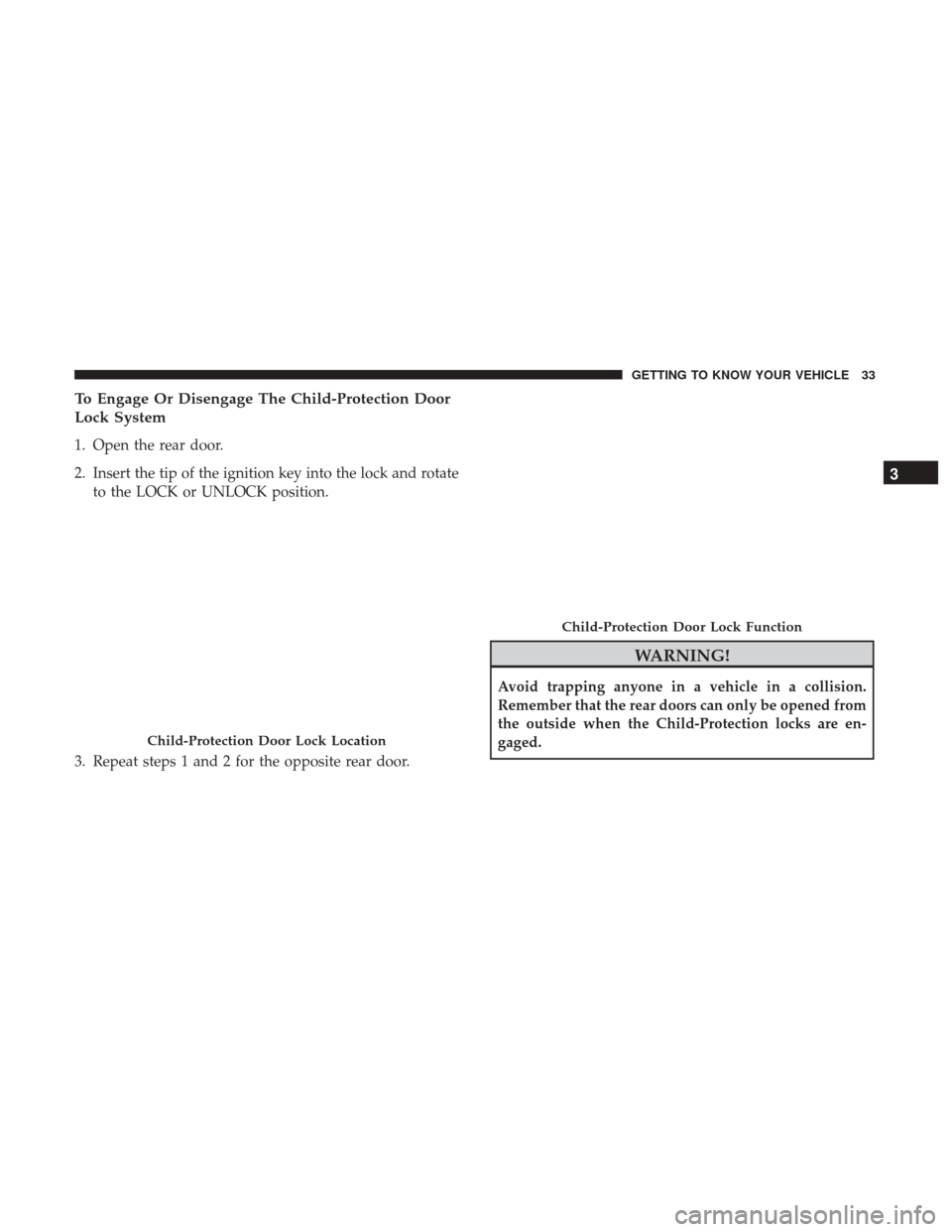
To Engage Or Disengage The Child-Protection Door
Lock System
1. Open the rear door.
2. Insert the tip of the ignition key into the lock and rotateto the LOCK or UNLOCK position.
3. Repeat steps 1 and 2 for the opposite rear door.
WARNING!
Avoid trapping anyone in a vehicle in a collision.
Remember that the rear doors can only be opened from
the outside when the Child-Protection locks are en-
gaged.
Child-Protection Door Lock Location
Child-Protection Door Lock Function
3
GETTING TO KNOW YOUR VEHICLE 33
Page 36 of 429
NOTE:For emergency exit with the system engaged,
move the lock knob up (unlocked position), roll down the
window, and open the door with the outside door handle.
SEATS
Seats are a part of the Occupant Restraint System of the
vehicle.
WARNING!
• It is dangerous to ride in a cargo area, inside or
outside of a vehicle. In a collision, people riding in
these areas are more likely to be seriously injured or
killed.
• Do not allow people to ride in any area of your
vehicle that is not equipped with seats and seat belts.
In a collision, people riding in these areas are more
likely to be seriously injured or killed.
• Be sure everyone in your vehicle is in a seat and
using a seat belt properly.
Manual Front Seat Adjustment
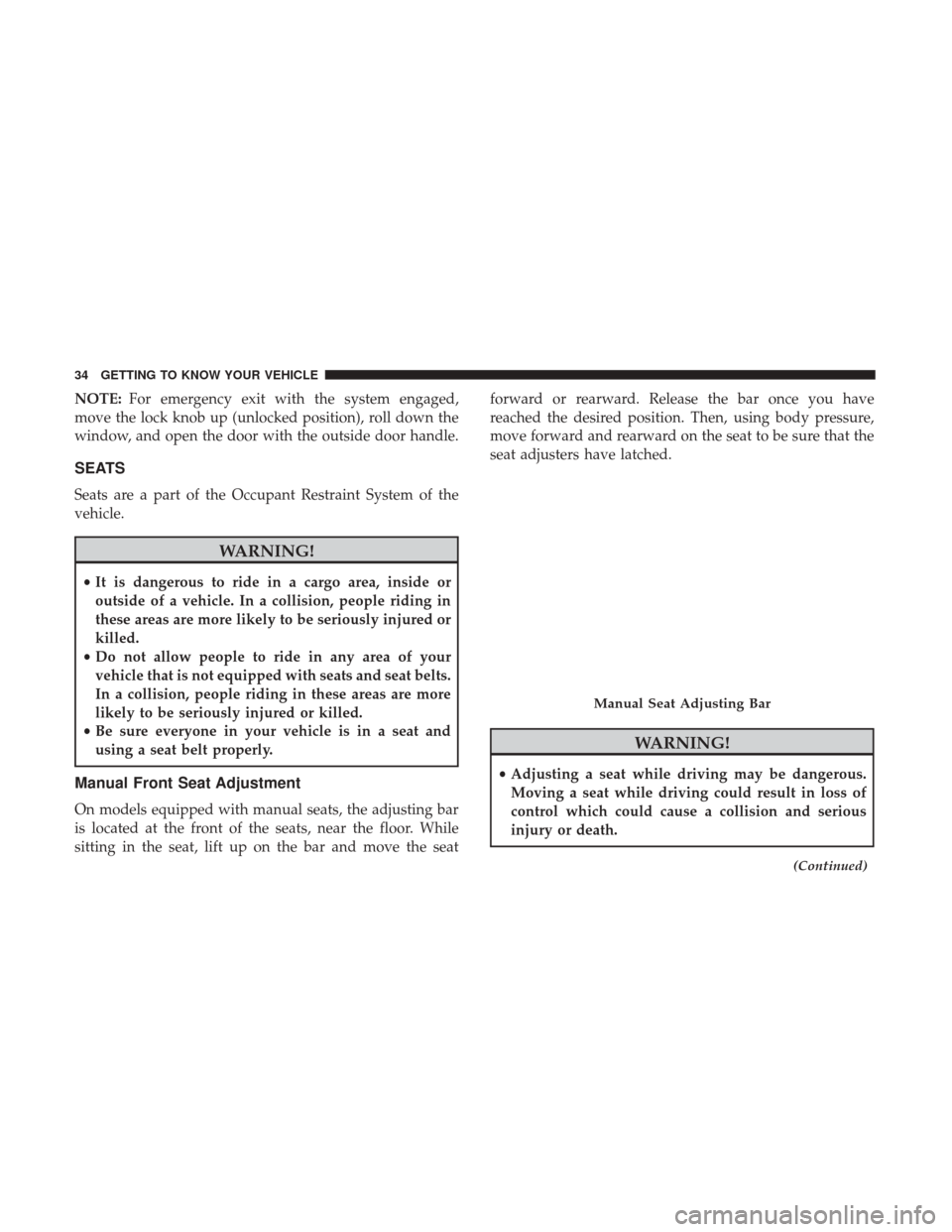
On models equipped with manual seats, the adjusting bar
is located at the front of the seats, near the floor. While
sitting in the seat, lift up on the bar and move the seat forward or rearward. Release the bar once you have
reached the desired position. Then, using body pressure,
move forward and rearward on the seat to be sure that the
seat adjusters have latched.
WARNING!
•
Adjusting a seat while driving may be dangerous.
Moving a seat while driving could result in loss of
control which could cause a collision and serious
injury or death.
(Continued)
Manual Seat Adjusting Bar
34 GETTING TO KNOW YOUR VEHICLE
Page 37 of 429
WARNING!(Continued)
•Seats should be adjusted before fastening the seat
belts and while the vehicle is parked. Serious injury
or death could result from a poorly adjusted seat belt.
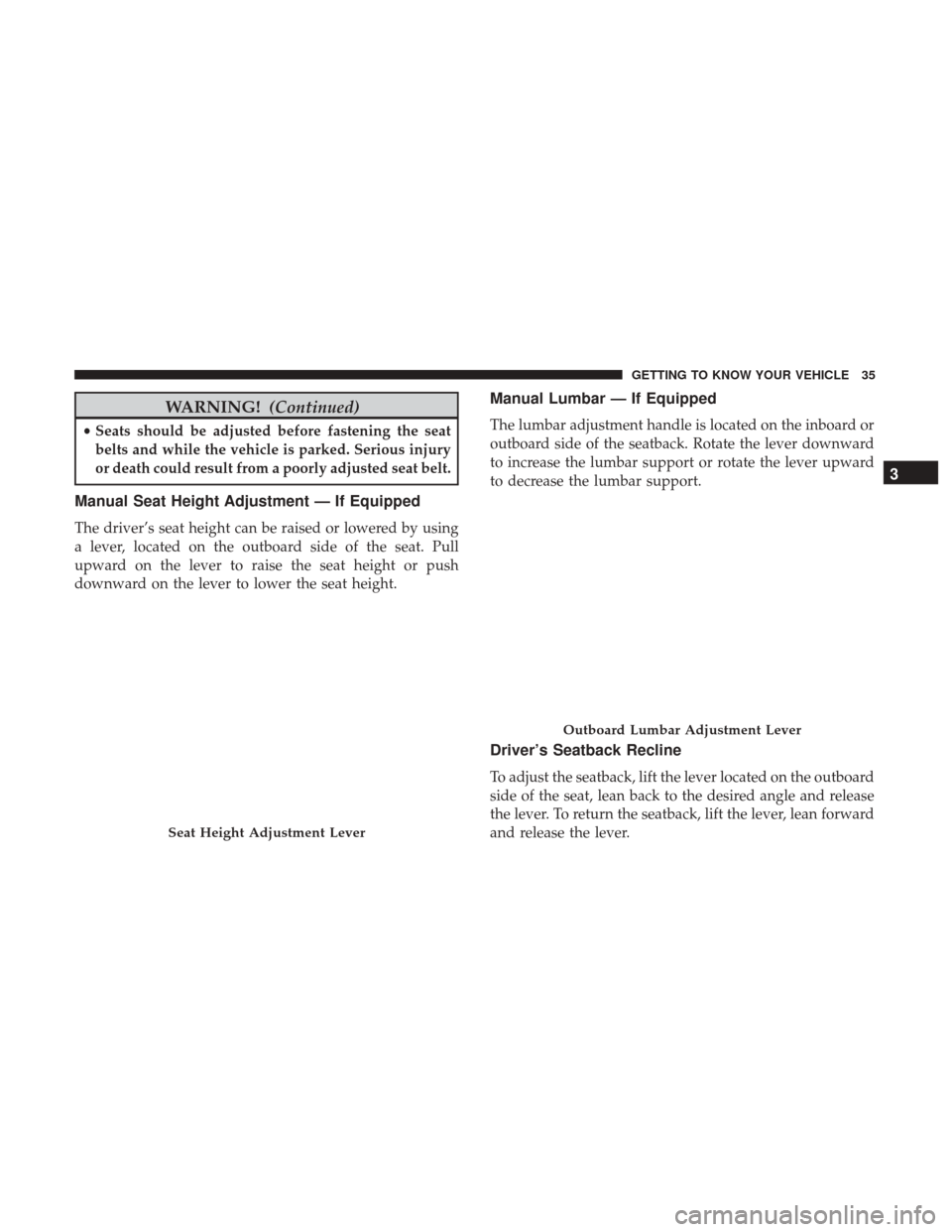
Manual Seat Height Adjustment — If Equipped
The driver’s seat height can be raised or lowered by using
a lever, located on the outboard side of the seat. Pull
upward on the lever to raise the seat height or push
downward on the lever to lower the seat height.
Manual Lumbar — If Equipped
The lumbar adjustment handle is located on the inboard or
outboard side of the seatback. Rotate the lever downward
to increase the lumbar support or rotate the lever upward
to decrease the lumbar support.
Driver’s Seatback Recline
To adjust the seatback, lift the lever located on the outboard
side of the seat, lean back to the desired angle and release
the lever. To return the seatback, lift the lever, lean forward
and release the lever.
Seat Height Adjustment Lever
Outboard Lumbar Adjustment Lever
3
GETTING TO KNOW YOUR VEHICLE 35
Page 38 of 429
WARNING!
Do not ride with the seatback reclined so that the
shoulder belt is no longer resting against your chest. In
a collision you could slide under the seat belt, which
could result in serious injury or death.
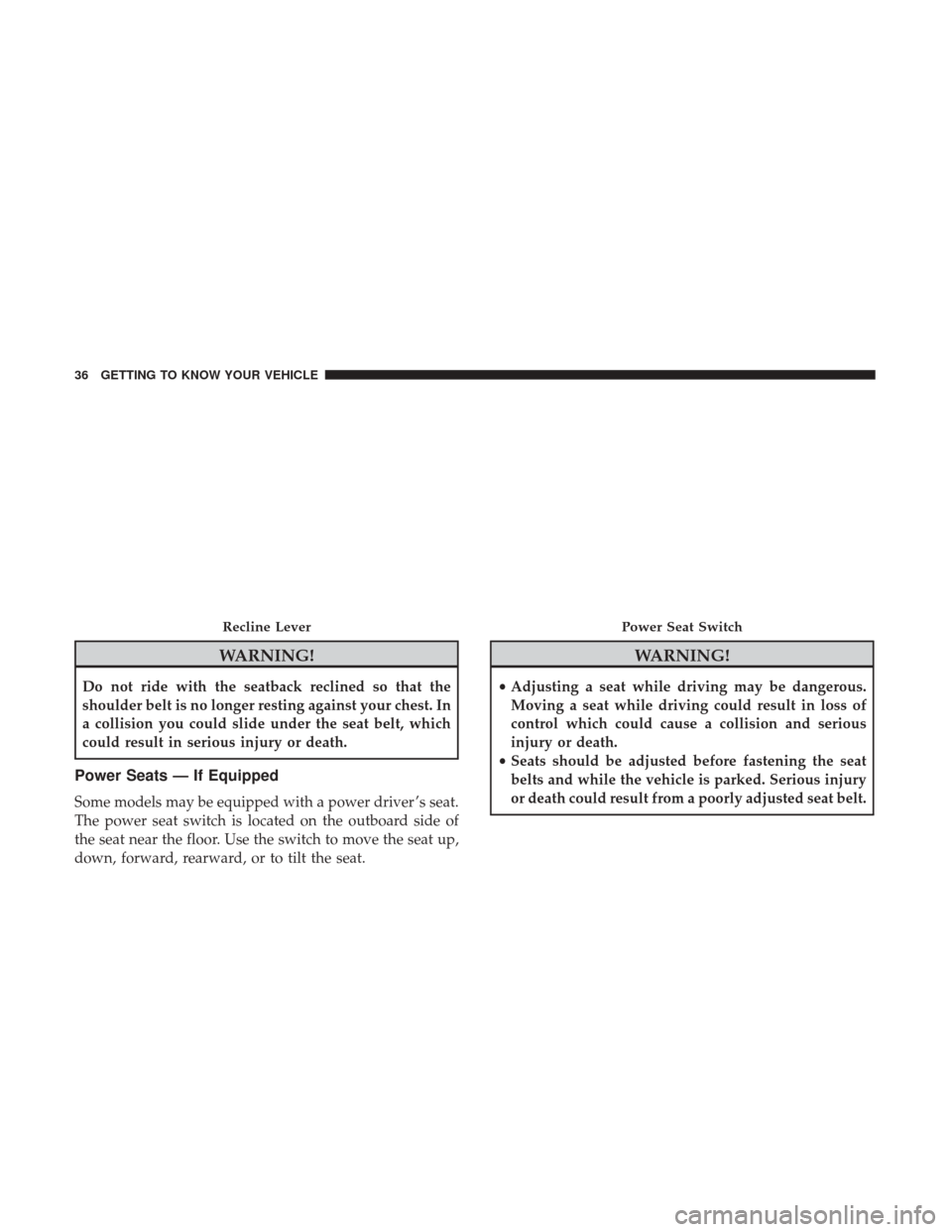
Power Seats — If Equipped
Some models may be equipped with a power driver ’s seat.
The power seat switch is located on the outboard side of
the seat near the floor. Use the switch to move the seat up,
down, forward, rearward, or to tilt the seat.
WARNING!
•Adjusting a seat while driving may be dangerous.
Moving a seat while driving could result in loss of
control which could cause a collision and serious
injury or death.
• Seats should be adjusted before fastening the seat
belts and while the vehicle is parked. Serious injury
or death could result from a poorly adjusted seat belt.
Recline LeverPower Seat Switch
36 GETTING TO KNOW YOUR VEHICLE
Page 40 of 429
NOTE:Once a heat setting is selected, heat will be felt
within two to five minutes.
WARNING!
• Persons who are unable to feel pain to the skin
because of advanced age, chronic illness, diabetes,
spinal cord injury, medication, alcohol use, exhaus-
tion or other physical condition must exercise care
when using the seat heater. It may cause burns even
at low temperatures, especially if used for long
periods of time.
• Do not place anything on the seat or seatback that
insulates against heat, such as a blanket or cushion.
This may cause the seat heater to overheat. Sitting in
a seat that has been overheated could cause serious
burns due to the increased surface temperature of the
seat.
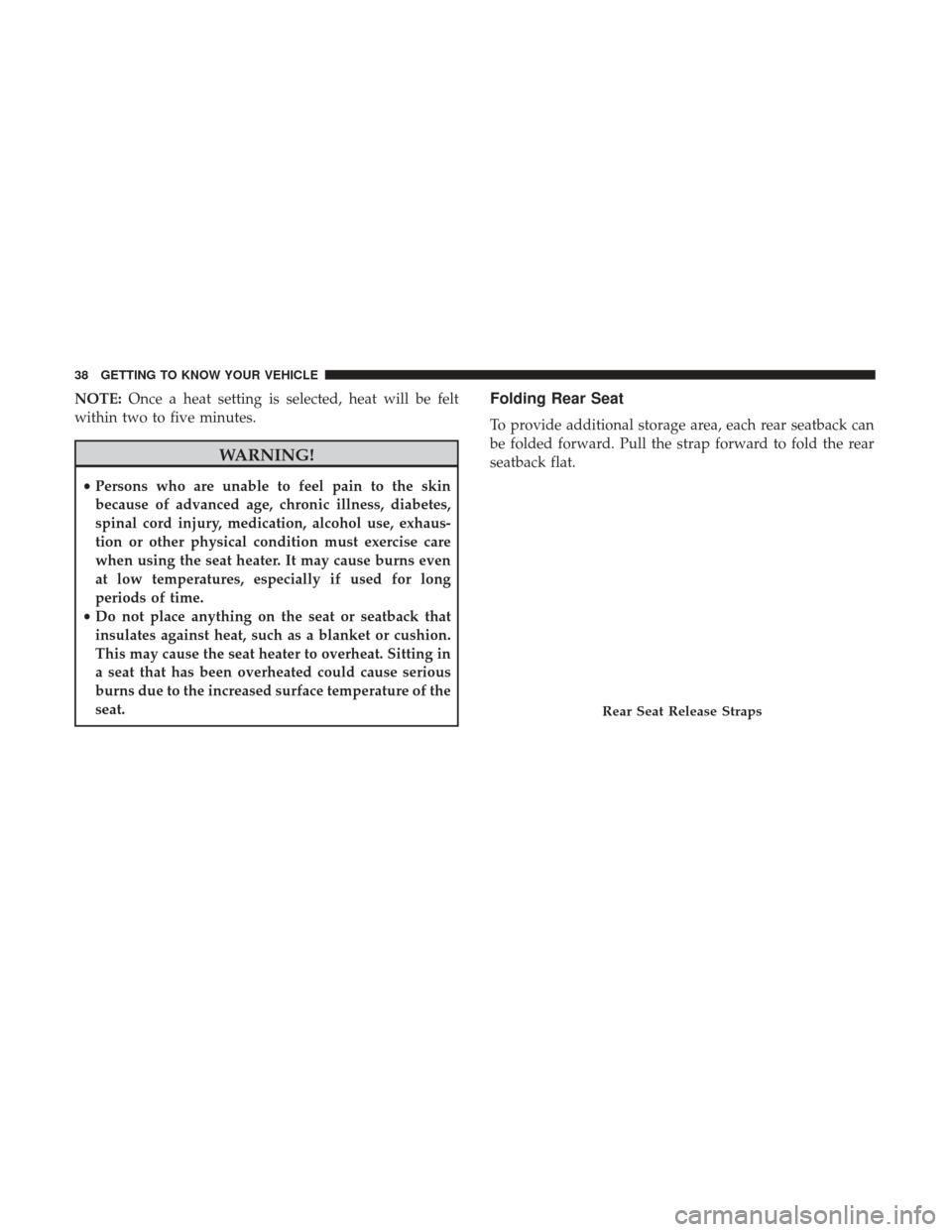
Folding Rear Seat
To provide additional storage area, each rear seatback can
be folded forward. Pull the strap forward to fold the rear
seatback flat.
Rear Seat Release Straps
38 GETTING TO KNOW YOUR VEHICLE
Page 41 of 429
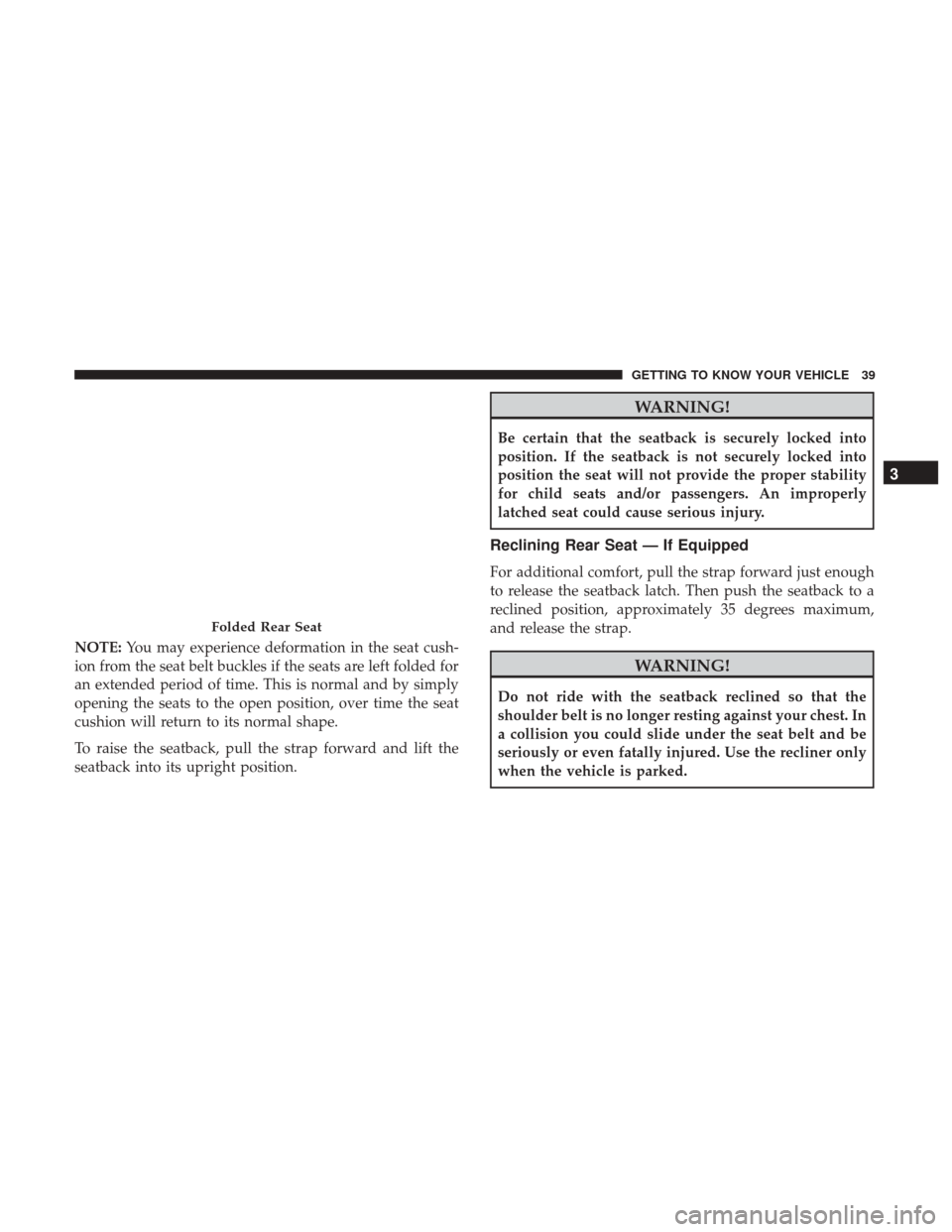
NOTE:You may experience deformation in the seat cush-
ion from the seat belt buckles if the seats are left folded for
an extended period of time. This is normal and by simply
opening the seats to the open position, over time the seat
cushion will return to its normal shape.
To raise the seatback, pull the strap forward and lift the
seatback into its upright position.
WARNING!
Be certain that the seatback is securely locked into
position. If the seatback is not securely locked into
position the seat will not provide the proper stability
for child seats and/or passengers. An improperly
latched seat could cause serious injury.
Reclining Rear Seat — If Equipped
For additional comfort, pull the strap forward just enough
to release the seatback latch. Then push the seatback to a
reclined position, approximately 35 degrees maximum,
and release the strap.
WARNING!
Do not ride with the seatback reclined so that the
shoulder belt is no longer resting against your chest. In
a collision you could slide under the seat belt and be
seriously or even fatally injured. Use the recliner only
when the vehicle is parked.
Folded Rear Seat
3
GETTING TO KNOW YOUR VEHICLE 39
Page 42 of 429

HEAD RESTRAINTS
Head restraints are designed to reduce the risk of injury by
restricting head movement in the event of a rear impact.
Head restraints should be adjusted so that the top of the
head restraint is located above the top of your ear.
WARNING!
•All occupants, including the driver, should not oper-
ate a vehicle or sit in a vehicle’s seat until the head
restraints are placed in their proper positions in
order to minimize the risk of neck injury in the event
of a crash.
• Head restraints should never be adjusted while the
vehicle is in motion. Driving a vehicle with the head
restraints improperly adjusted or removed could
cause serious injury or death in the event of a
collision.
Supplemental Active Head Restraints — Front
Seats
Active Head Restraints (AHRs) are passive, deployable
components, and vehicles with this equipment cannot be
readily identified by any markings, only through visual
inspection of the head restraint. The head restraint will be
split in two halves, with the front half being soft foam and
trim, the back half being decorative plastic.
When AHRs deploy during a rear impact, the front half of
the head restraint extends forward to minimize the gap
between the back of the occupant’s head and the AHR. This
system is designed to help prevent or reduce the extent of
injuries to the driver and front passenger in certain types of
rear impacts. Refer to “Occupant Restraints” in “Safety” for
further information.
40 GETTING TO KNOW YOUR VEHICLE
Page 44 of 429
NOTE:
•The head restraints should only be removed by qualified
technicians, for service purposes only. If either of the
head restraints require removal, see your authorized
dealer.
• In the event of deployment of an Active Head Restraint,
refer to “Occupant Restraints” in “Safety” for further
information.
WARNING!
•All occupants, including the driver, should not oper-
ate a vehicle or sit in a vehicle’s seat until the head
restraints are placed in their proper positions in
order to minimize the risk of neck injury in the event
of a collision.
• Do not place items over the top of the Active Head
Restraint, such as coats, seat covers or portable DVD
players. These items may interfere with the opera-
tion of the Active Head Restraint in the event of a
collision and could result in serious injury or death.
• Active Head Restraints may be deployed if they are
struck by an object such as a hand, foot or loose
cargo. To avoid accidental deployment of the Active
Head Restraint ensure that all cargo is secured, as
loose cargo could contact the Active Head Restraint
during sudden stops. Failure to follow this warning
could cause personal injury if the Active Head Re-
straint is deployed.
Active Head Restraint (Tilted Position)
42 GETTING TO KNOW YOUR VEHICLE