air condition JEEP DJ 1953 Owner's Manual
[x] Cancel search | Manufacturer: JEEP, Model Year: 1953, Model line: DJ, Model: JEEP DJ 1953Pages: 376, PDF Size: 19.96 MB
Page 112 of 376
E
FUEL
SYSTEM
9
©
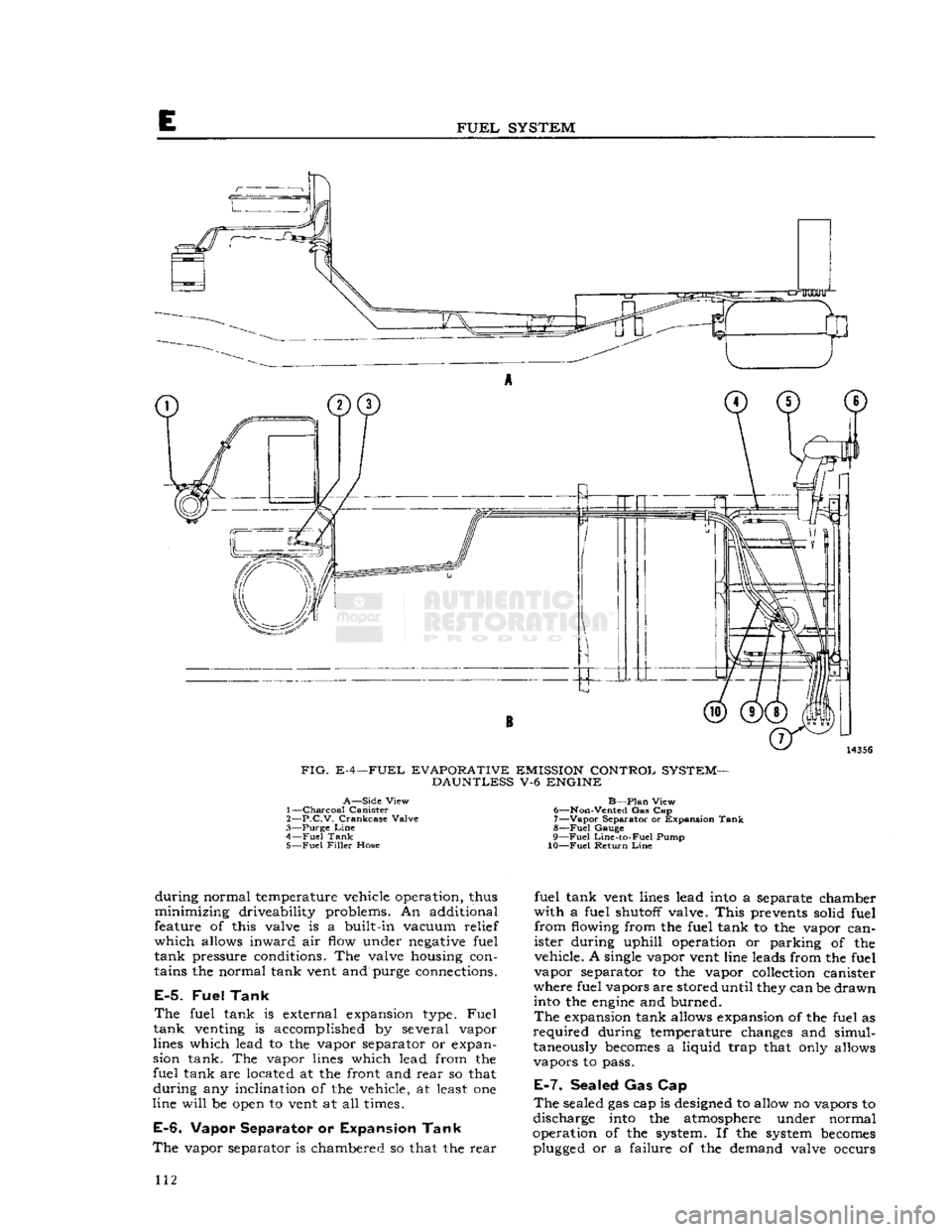
FIG.
E-4—FUEL
EVAPORATIVE
EMISSION
CONTROL
SYSTEM-
DAUNTLESS
V-6
ENGINE
A—Side
View
1—
Charcoal
Canister
2—
P.C.V.
Crankcase
Valve
3—
Purge
Line
4—
Fuel
Tank
5—
Fuel
Filler
Hose
B—Plan
View
6—
Non-Vented
Gas Cap 7—
Vapor
Separator or Expansion
Tank
g—Fuei
Gauge
9—Fuel
Line-to-Fuel
Pump
10—Fuei
Return
Line
during
normal temperature vehicle operation, thus
minimizing
driveability problems. An additional
feature of this valve is a built-in vacuum relief
which
allows inward air flow under negative fuel
tank
pressure conditions. The valve housing con
tains the normal tank vent and purge connections.
E-5.
Fuel Tank
The
fuel tank is external expansion type.
Fuel
tank
venting is accomplished by several vapor
lines which lead to the vapor separator or expan
sion tank. The vapor lines which lead from the
fuel tank are located at the front and
rear
so that
during
any inclination of the vehicle, at least one
line
will
be open to vent at all times.
E-6.
Vapor Separator
or
Expansion Tank
The
vapor separator is chambered so that the
rear
fuel tank vent lines lead into a separate chamber
with
a fuel shutofl valve.
This
prevents solid fuel
from
flowing from the fuel tank to the vapor can
ister during uphill operation or parking of the
vehicle. A single vapor vent line leads from the fuel
vapor separator to the vapor collection canister
where fuel vapors are stored until they can be drawn into the
engine
and burned.
The
expansion tank allows expansion of the fuel as
required
during temperature changes and simul taneously
becomes
a liquid trap that only allows
vapors to pass.
E-7.
Sealed
Gas Cap
The
sealed gas cap is designed to allow no vapors to
discharge into the atmosphere under normal
operation of the system. If the system
becomes
plugged or a failure of the demand valve occurs 112
Page 114 of 376
FUEL
SYSTEM
14261
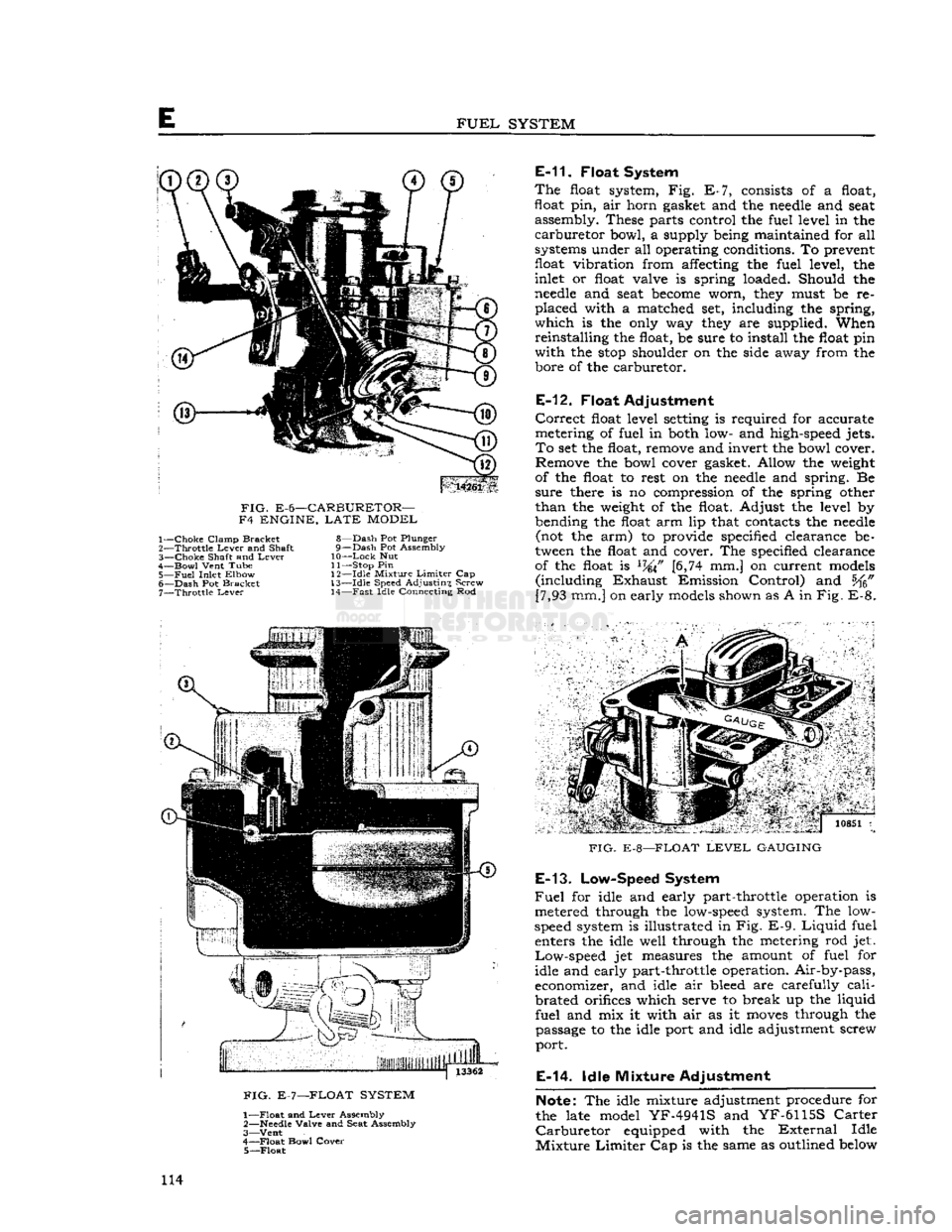
FIG.
E-6—CARBURETOR—
F4 ENGINE,
LATE
MODEL 1—
Choke
Clamp Bracket
2—
Throttle
Lever
and Shaft
3—
Choke
Shaft and
Lever
4—
Bowl
Vent Tube
5—
Fuel
Inlet Elbow
6—
Dash
Pot Bracket 7—
Throttle
Lever
8—
Dash
Pot Plunger
9—
Dash
Pot Assembly
10—
Lock
Nut
11— Stop Pin
1
2—Idle Mixture
Limiter
Cap
13—
Idle
Speed Adjusting Screw 14—
Fast
Idle Connecting Rod
E-11.
Float System
The
float system, Fig. E-7, consists of a float,
float
pin,
air horn gasket and the
needle
and seat assembly. These parts control the fuel level in the
carburetor
bowl, a supply being maintained for all
systems under all operating conditions. To prevent
float
vibration
from affecting the fuel level, the
inlet or float valve is spring loaded. Should the
needle
and seat
become
worn, they must be re
placed
with a matched set, including the spring,
which
is the only way they are supplied. When
reinstalling
the float, be sure to install the float pin
with
the
stop
shoulder on the side away from the bore of the carburetor.
E-12.
Float Adjustment
Correct
float level setting is required for accurate
metering of fuel in both low- and high-speed jets.
To
set the float, remove and invert the bowl cover. Remove the bowl cover gasket. Allow the weight
of the float to rest on the
needle
and spring. Be
sure
there is no compression of the spring other
than
the weight of the float. Adjust the level by
bending the float arm lip that contacts the
needle
(not the arm) to provide specified clearance be
tween the float and cover. The specified clearance of the float is
L74\F
[6,74 mm.] on current models
(including
Exhaust
Emission Control) and [7,93 mm.] on early models shown as A in
Fig.
E-8.
FIG.
E-7—FLOAT SYSTEM
1—
Float
and
Lever
Assembly
2—
Needle
Valve and Seat Assembly
3—
Vent
4—
Float
Bowl Cover 5—
Float
7 '.. j
io8Si
i
FIG.
E-8—FLOAT
LEVEL
GAUGING
E-13.
Low-Speed System
Fuel
for idle and early part-throttle operation is
metered through the low-speed system. The low-
speed system is illustrated in Fig.
E-9.
Liquid
fuel enters the idle well through the metering rod jet.
Low-speed
jet measures the amount of fuel for
idle and early part-throttle operation. Air-by-pass,
economizer, and idle air bleed are carefully
cali
brated
orifices which serve to break up the liquid
fuel
and mix it with air as it
moves
through the passage to the idle port and idle adjustment screw
port.
E-14.
Idle Mixture Adjustment
Note:
The idle mixture adjustment procedure for
the late model
YF-4941S
and
YF-6115S
Carter
Carburetor
equipped with the
External
Idle
Mixture
Limiter
Cap is the same as outlined below 114
Page 115 of 376
'Jeep*
UNIVERSAL
SERIES
SERVICE
MANUAL
E
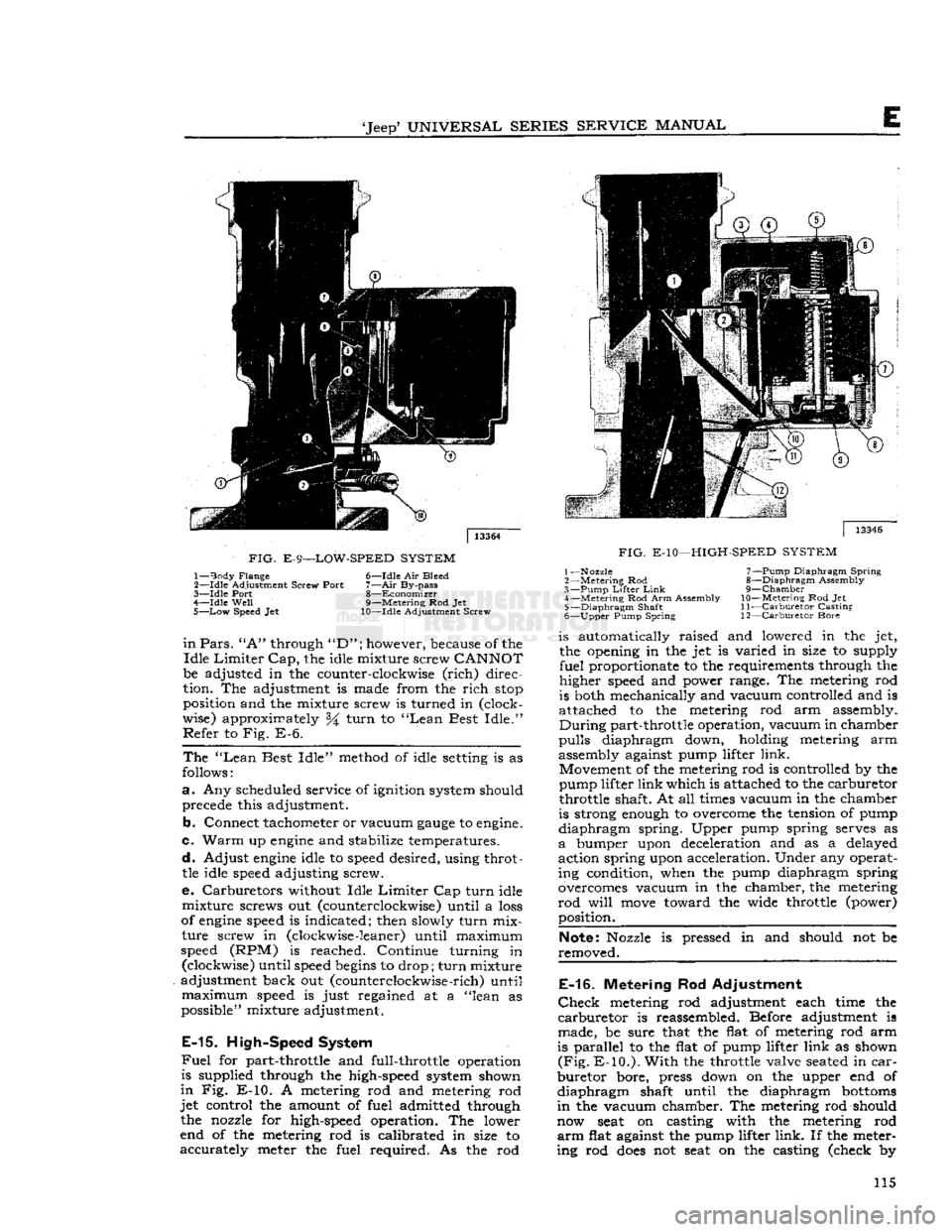
FIG.
E-9—LOW-SPEED
SYSTEM
1—
Body
Flange 6—Idle Air Bleed
2—
-Idle
Adjustment Screw Port
7—Air
By-pass
3—
Idle
Port 8—Economizer
4—
Idle
Well
9—Metering Rod Jet
5—
Low
Speed Jet 10—Idle Adjustment Screw
in
Pars.
"A"
through
"D";
however, because of the
Idle
Limiter
Cap,
the idle mixture screw
CANNOT
be adjusted in the counter-clockwise
(rich)
direc
tion. The adjustment is made from the
rich
stop
position and the mixture screw is turned in (clock
wise) approximately %
turn
to
"Lean
Best
Idle."
Refer
to Fig. E-6.
The
"Lean
Best
Idle"
method of idle
setting
is as
follows:
a.
Any scheduled service of ignition system should precede this adjustment.
b.
Connect tachometer or vacuum
gauge
to
engine.
c.
Warm
up
engine
and stabilize temperatures.
d.
Adjust
engine
idle to
speed
desired, using throttle idle
speed
adjusting screw.
e. Carburetors without Idle
Limiter
Cap
turn
idle
mixture
screws out (counterclockwise) until a
loss
of
engine
speed
is indicated; then slowly
turn
mix
ture
screw in (clockwise
-leaner)
until maximum
speed
(RPM) is reached. Continue turning in (clockwise) until
speed
begins
to drop;
turn
mixture
adjustment back out (counterclockwise
-rich)
until
maximum
speed
is just regained at a "lean as
possible" mixture adjustment.
E-15.
High-Speed System
Fuel
for part-throttle and full-throttle operation
is supplied through the high-speed system shown
in
Fig. E-10. A metering rod and metering rod
jet
control the amount of fuel admitted through the nozzle for high-speed operation. The lower
end of the metering rod is calibrated in size to
accurately
meter the fuel required. As the rod
|
13346
FIG.
E-10—HIGH-SPEED
SYSTEM
1—Nozzle 7—Pump Diaphragm
Spring
2
—Metering
Rod 8—Diaphragm Assembly
3—
Pump
Lifter
Link
9—Chamber
4—
Metering
Rod Arm Assembly
10—Metering
Rod Jet 5—
Diaphragm
Shaft
11—Carburetor
Casting
6—
Upper
Pump Spring 12—Carburetor Bore is automatically raised and lowered in the jet,
the opening in the jet is varied in size to supply
fuel
proportionate to the requirements through the
higher
speed
and power range. The metering rod
is both mechanically and vacuum controlled and is
attached to the metering rod arm assembly.
During
part-throttle operation, vacuum in chamber
pulls
diaphragm down, holding metering arm
assembly against pump lifter
link.
Movement of the metering rod is controlled by the
pump lifter
link
which is attached to the carburetor
throttle shaft. At all
times
vacuum in the chamber
is strong
enough
to overcome the tension of pump
diaphragm
spring. Upper pump spring serves as
a
bumper upon deceleration and as a delayed
action spring upon acceleration. Under any operat ing condition, when the pump diaphragm spring
overcomes vacuum in the chamber, the metering
rod
will
move
toward the wide throttle (power) position.
Note:
Nozzle is pressed in and should not be
removed.
E-16.
Metering Rod Adjustment
Check
metering rod adjustment each time the
carburetor
is reassembled. Before adjustment is
made, be sure that the flat of metering rod arm
is parallel to the flat of pump lifter
link
as shown
(Fig.
E-10.).
With
the throttle valve
seated
in
car
buretor
bore, press down on the upper end of
diaphragm
shaft until the diaphragm
bottoms
in
the vacuum chamber. The metering rod should
now
seat
on casting with the metering rod
arm
flat against the pump lifter
link.
If the meter
ing rod
does
not
seat
on the casting (check by 115
Page 124 of 376
FUEL
SYSTEM
1-5/32
133S2
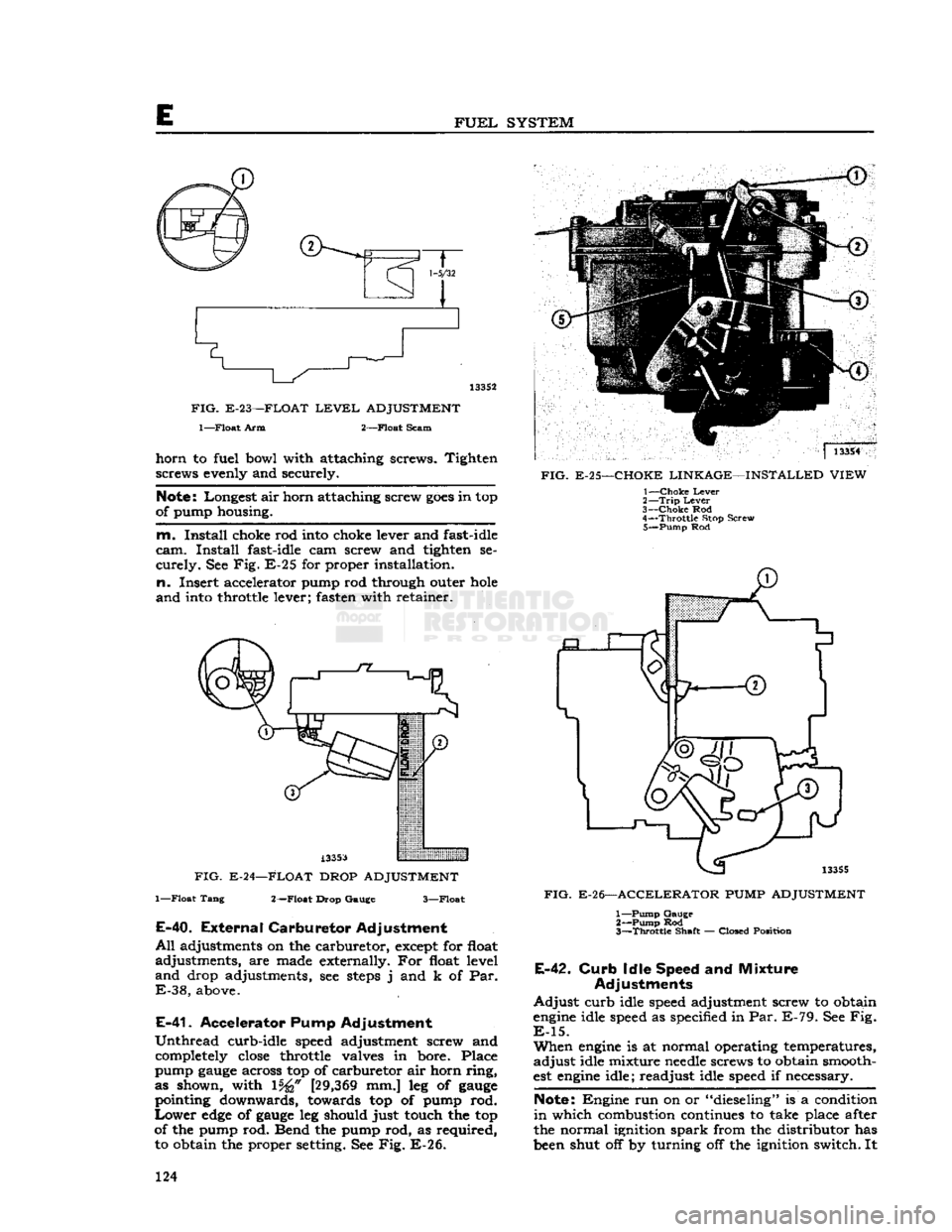
FIG.
E-23—FLOAT
LEVEL
ADJUSTMENT
l—Float
Arm 2—Float Scam
horn
to fuel bowl with attaching screws. Tighten screws evenly and securely.
Note:
Longest air horn attaching screw
goes
in top
of pump housing.
m.
Install
choke rod into choke lever and fast-idle
cam.
Install
fast-idle cam screw and tighten se
curely.
See Fig. E-25 for proper installation,
n.
Insert accelerator pump rod through outer
hole
and
into throttle lever; fasten with retainer.
A33S3
FIG. E-24—FLOAT DROP ADJUSTMENT
1—Float Tang 2—Float Drop Gauge 3—Float
E-40.
External
Carburetor
Adjustment
All
adjustments on the carburetor, except for float
adjustments, are made externally. For float level
and
drop adjustments, see
steps
j and k of Par.
E-38,
above.
E-41.
Accelerator Pump Adjustment
Unthread
curb-idle speed adjustment screw and completely
close
throttle valves in bore. Place
pump
gauge
across top of carburetor air horn ring,
as shown, with 15^" [29,369 mm.] leg of
gauge
pointing downwards, towards top of pump rod.
Lower
edge
of
gauge
leg should just touch the top
of the pump rod. Bend the pump rod, as required, to obtain the proper setting. See Fig. E-26. ]
13354
FIG.
E-25—CHOKE LINKAGE—INSTALLED VIEW 1—
Choke
Lever
2—
Trip
Lever
3—
Choke
Rod
4—
Throttle
Stop Screw 5—
Pump
Rod
13355
FIG.
E-26—ACCELERATOR
PUMP
ADJUSTMENT 1—
Pump
Gauge 2—
Pump
Rod
3—
Throttle
Shaft — Closed Position
E-42.
Curb
Idle Speed and Mixture
Adjustments
Adjust
curb idle speed adjustment screw to obtain
engine
idle speed as specified in Par. E-79. See Fig.
E-15.
When
engine
is at normal operating temperatures,
adjust
idle mixture
needle
screws to obtain smooth
est
engine
idle; readjust idle speed if necessary.
Note:
Engine run on or "dieseling" is a condition
in
which combustion continues to take place after
the normal ignition spark from the distributor has
been shut off by turning off the ignition switch. It 124
Page 127 of 376
'Jeep'
UNIVERSAL
SERIES
SERVICE
MANUAL
E
E-47.
Reassembly
•
Refer to Fig. E-29.
Install
the valve gaskets, valves, valve retainer and
secure them with the valve retainer screws. Make
sure that the inlet and
outlet
valves are in their proper positions. Place the diaphragm spring re
tainer in position on the diaphragm
pull
rod
and
install diaphragm spring. Position the
dia
phragm assembly in pump
body
and attach the
cover to pump body, with file marks aligned, with
the six attaching screws. Do not draw the screws
up tight.
Install
rocker arm spring, rocker arm
pin
washers, rocker arm and rocker arm pin.
With
rocker
arm positioned on the diaphragm rod, draw
the six pump
body
screws up evenly and securely.
Install
the filter screen, cork gasket and sediment
bowl and secure them firmly with the thumb screw
on the bowl clamp.
E-48.
Vacuum
Pump
The
double-action fuel pump resembles two single-
action pumps placed one
above
the other. A single
fuel pump rocker arm actuates the two separate diaphragms. One diaphragm is part of the fuel
delivery pump and operates as described in Par.
E-45.
The other diaphragm is part of the vacuum
pump and operates as described here.
As
the actuating lever forces the diaphragm upward against spring pressure, air is forced through the
outlet
port
into
the
engine's
intake manifold. On
the return stroke, spring pressure forces the
dia
phragm downward, creating a
partial
vacuum and
opening the inlet valve. In this manner, air is pumped out of the windshield wiper motor and
into
the intake manifold. When the wiper motor is shut off, manifold vacuum holds the diaphragm against its spring so that the
full
motion of the actuating
lever is not accompanied by a
complete
up-and-
down motion of the diaphragm.
When
the windshield wiper motor is turned on, but manifold vacuum is greater than the vacuum
created by the
booster
pump, air
flows
from the
wiper motor through both valves of the vacuum
booster.
As manifold vacuum drops off as a result
of the
engine
operating under low
speed
and high load, the vacuum created by the vacuum
booster
will
be greater than
engine
intake manifold vacuum
and
the pump
will
operate the wiper motor when the wiper control switch is turned on.
•
Refer to Fig. E-29. Remove the
eight
cover attaching screws and
lockwashers, and remove the cover, diaphragm
spring
and spring seat. Detach the diaphragm rod
from the rocker arm and remove the diaphragm.
The
valve assemblies are pressed
into
the cover
and
body
and lightly staked. They may be removed
with the point of a knife blade. If installing new valves be sure the inlet and
outlet
valves are
correctly positioned and stake them lightly with
a
small punch.
Assemble the vacuum pump in the reverse order
of disassembly, drawing the cover attaching screws up evenly and tightly.
E-49.
Fuel
Pump
Testing
Four
tests
are presented in following paragraphs to
test
for proper operation of the fuel pump. In addi
tion, check the following:
a.
Check
for secure mounting of the fuel pump.
The
rocker arm may be working the entire pump
up and down, rather than just the pump
dia
phragms.
b. Remove and clean the fuel sediment bowl.
c.
Check
all fuel lines.
E-50.
Volume
Check
To
measure fuel pump capacity (amount of fuel
delivered in a given time) disconnect the pump-to-
carburetor
line at the carburetor end. Place the
open
end of the line in a suitable container.
Start
the
engine
and operate at normal idle speed.
Delivery
should be one quart U.S. [1 ltr.] within
one minute.
E-51.
Pressure
Check
To
measure fuel pump pressure (force of fuel de
livery)
disconnect the pump-to-carburetor line
at the carburetor end. Plug a pressure
gauge
and T-fitting
into
the
open
end of this line and
into
the
carburetor.
Start
the
engine
and operate at normal
idle speed. Pressure should be 2J4 to 3% psi.
[0,716
a
0,264
kg-cm2] at 1800 rpm. and at 16"
[406 mm.]
above
the
outlet.
E-52.
Vacuum
Check
To
measure fuel pump vacuum (pull of. the pump
at the inlet side) disconnect the pump-to-fuel-tank
line at the fuel pump. Attach a vacuum
gauge
to the fuel pump inlet.
Start
the
engine,
accelerate to
specified speed, and hold this
engine
speed
while
taking a
gauge
reading. Permissible
gauge
reading
is 8* [203 mm.] of mercury [Hg] at 1200 rpm. and
10j^'
[267 mm.] at 1800 rpm.
E-53.
Vacuum
Booster
Check
To
test
the condition of the vacuum
booster
pump,
disconnect both inlet and
outlet
lines at the pump.
Attach
a vacuum
gauge
to the windshield wiper
connection at the pump.
Start
the
engine,
accelerate
to
2000
rpm., and hold this
engine
speed
while taking a
gauge
reading. Permissible
gauge
reading
is 10* to 14" [254 a 356 cm.] of mercury [Hg].
E-54.'
FUEL
PUMP
(SINGLE-ACTION)
—
HURRICANE
F4
ENGINE
•
Early
Models.
Vehicles with electric windshield wiper motors are
equipped with a single-action fuel pump (Fig.
E-30).
The fuel pump cam lever is activated by an eccentric on the
engine
camshaft. When the
car
buretor float
needle
valve closes, accumulation of
fuel in the pump
extends
the diaphragm spring.
This
action causes the rocker arm linkage to be
come
inoperative until the pressure on the
dia
phragm and spring is reduced. The fuel pump dis
charge pressure is thus controlled by the diaphragm
spring.
This
provides a steady supply of fuel to the
carburetor
at a fairly constant pressure. 127
Page 134 of 376
E
FUEL
SYSTEM
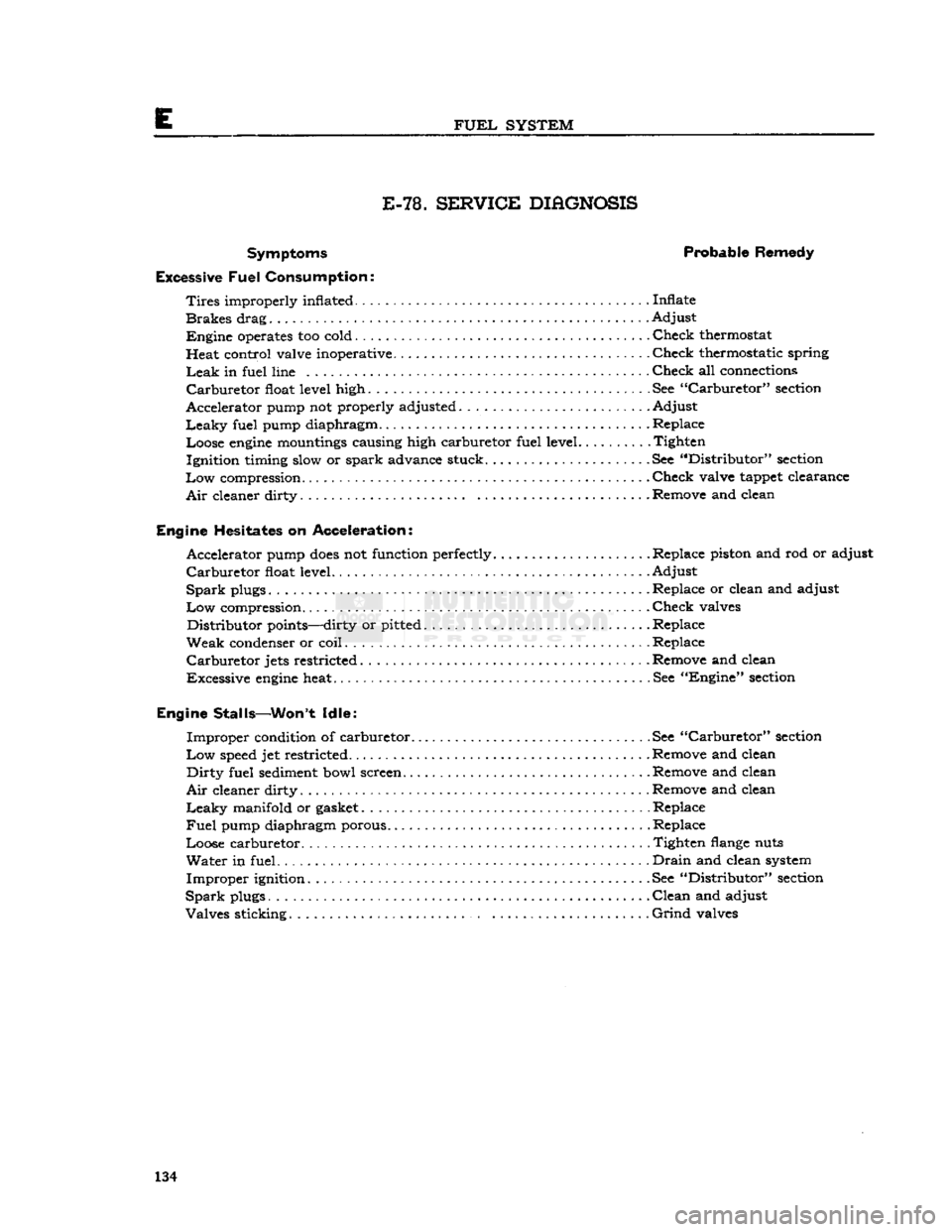
E-78. SERVICE DIHGNOSIS
Symptoms Probable Remedy
Excessive
Fuel
Consumption:
Tires
improperly inflated Inflate
Brakes
drag Adjust
Engine
operates too cold Check thermostat
Heat control valve inoperative Check thermostatic spring
Leak
in fuel line Check all connections
Carburetor
float level high. See
"Carburetor"
section
Accelerator pump not properly adjusted Adjust
Leaky
fuel pump diaphragm Replace
Loose
engine
mountings causing high carburetor fuel level Tighten Ignition timing slow or spark advance stuck See "Distributor" section
Low
compression. Check valve tappet clearance
Air
cleaner dirty
.
Remove and clean
Engine
Hesitates on Acceleration: Accelerator pump
does
not function perfectly.
...................
.Replace piston and rod or adjust
Carburetor
float level. ... .Adjust
Spark
plugs Replace or clean and adjust
Low
compression Check valves
Distributor
points—dirty or pitted Replace
Weak
condenser or coil Replace
Carburetor
jets restricted Remove and clean
Excessive
engine
heat See "Engine" section
Engine
Stalls—Won't Idle:
Improper
condition of carburetor See
"Carburetor"
section
Low
speed
jet restricted Remove and clean
Dirty
fuel sediment bowl screen Remove and clean
Air
cleaner dirty Remove and clean
Leaky
manifold or gasket Replace
Fuel
pump diaphragm porous. Replace
Loose carburetor. Tighten
flange
nuts
Water
in fuel
Drain
and clean system
Improper
ignition. .See "Distributor" section
Spark
plugs Clean and adjust
Valves
sticking.
Grind
valves 134
Page 143 of 376
'Jeep'
UNIVERSAL SERIES SERVICE
MANUAL
Fl
EXHHUST
EMISSION
CONTROL
SYSTEM
Contents
HURRICANE
F4-134
ENGINE
SUBJECT
PAR.
GENERAL
Fl-1
AIR
PUMP
Fl-2
PUMP
AIR
FILTER
Fl-3
AIR
DELIVERY
MANIFOLD
Fl-4
AIR INJECTION TUBES.
Fl-5
ANTI-BACKFIRE
DIVERTER
VALVE.
.Fl-6
ENGINE
COMPONENTS
. .Fl-7
Carburetor
. .Fl-8
Distributor
........
.Fl-9
Exhaust
Manifold Fl-10
MAINTENANCE
Fl-11
Carburetor
Fl-12,
Fl-13
Distributor
Fl-14
Anti-Backfire
Diverter
Valve.
.........
.Fl-15
Check
Valve Fl-16
Fl-1. GENERAL—F4-134
Engine
The
Hurricane
F4-134
engine
Exhaust
Emission
Control
System consists of a belt driven air pump
which
directs compressed air through connecting
hoses
to a steel distribution manifold into stainless steel injection
tubes
in the exhaust port adjacent
to each exhaust valve stem.
This
air with its normal
oxygen
content, reacts with the hot but incom
pletely burned exhaust
gases
and permits further combustion in the exhaust port or manifold.
Fl-2. AIR
PUMP
The
air injection pump is a positive displacement
vane type which is permanently lubricated and
requires
no periodic maintenance.
The
pump contains an integral relief valve which controls the air supplied to the
engine
exhaust ports
during
high speed operation to limit maximum ex
haust system temperatures.
Fl-3. PUMP
AIR
FILTER
The
air filter attached to the pump is a replaceable
element type constructed of conventional pleated
paper
with steel end plates.
The
filter should be replaced every
12,000
miles
[19,200
km.] under normal conditions or sooner
under
adverse weather or driving conditions.
Fl-4.
AIR
DELIVERY
MANIFOLD
The
air delivery manifold, constructed of cold
rolled
steel with a zinc plating, distributes the air
from
the pump to each of the air delivery
tubes
in
a uniform manner.
A
check valve is attached to the air delivery
SUBJECT
PAR.
Air
Pump Fl-17
Carburetor
Air Cleaner Fl-18
REMOVAL PROCEDURES
.Fl-19
Air
Pump
Fl-20
Anti-Backfire
Diverter Valve Fl-21
Air
Distribution Manifold,
And
Air Injection Tubes
Fl-22
REQUIRED
EQUIPMENT
.Fl-23
REPLACEMENT
PARTS
Fl-24
WARRANTY
Fl-25
DIAGNOSIS
GUIDE
Fl-26
MAINTENANCE CHART
Fl-27
CARBURETOR SPECIFICATIONS
Fl-28
DISTRIBUTOR SPECIFICATIONS
Fl-29
SPARK PLUG
GAP
.Fl-30
manifold.
Its function is to prevent the reverse flow
of exhaust
gases
to the pump should the pump
drive
fail.
This
reverse flow would damage the air
pump and connecting
hose.
Fl-5.
AIR
INJECTION
TUBES
The
air injection
tubes
of stainless steel are inserted
into machined
bosses
of the exhaust manifold. The
tubes
project into the exhaust ports directing air
into the vicinity of the exhaust valve stem.
Fl-6.
ANTI-BACKFIRE DIVERTER VALVE
The
anti-backfire diverter valve prevents
engine
backfire
by briefly interrupting the air being in
jected into the exhaust manifold during periods of deceleration (rapid throttle closure).
Fl-7.
ENGINE
COMPONENTS
The
following items
vary
in design or specifications
from
those
on vehicles not equipped with the Ex
haust Emission
Control
System.
Fl-8.
Carburetor
A
carburetor with a specific flow characteristic is used for exhaust emission control.
A
carburetor dashpot is provided to control the throttle closing speed.
Fl-t.
Distributor
The
ignition distributor used with the exhaust emission system requires a different advance curve
from
that used on the F4-134
engine
prior
to the
introduction of exhaust emission systems. 143
Page 145 of 376
'Jeep'
UNIVERSAL
SERIES SERVICE
MANUAL
Fl
b. Connect tachometer to
engine.
c.
Warm
up
engine
and stabilize temperatures.
d.
Adjust
engine
idle to
speed
desired, using throt
tle idle
speed
adjusting screw.
e.
Carburetors without Idle
Limiter
Cap turn idle mixture screws out (counterclockwise) until a
loss
of
engine
speed
is indicated; then, slowly turn mix
ture screw in (clockwise-leaner) until maximum
speed
(RPM) is reached. Continue turning in (clockwise) until
speed
begins
to drop; turn mixture
adjustment back out (counterclockwise-richer) un
til
maximum
speed
is just regained at a "lean as
possible" mixture adjustment.
Fl-14.
Distributor
Check
the distributor number for proper appli
cation.
Check
the distributor cam dwell angle and
point condition and adjust to specifications or re place as required. (Specifications listed at the end
of this section)
Check
ignition timing and set at
0°
or
TDC.
Fl-15.
Anti-iackfire
Diverter Valve
The
anti-backfire valve remains closed
except
when
the throttle is closed rapidly from an
open
position.
To
check the valve for proper operation, accelerate
the
engine
in neutral, allowing the throttle to
close
rapidly.
The valve is operating satisfactorily when
no exhaust system backfire occurs. A further check
to determine whether the valve is functioning can be made by removing from the anti-backfire valve
the large
hose
Which
connects to the check valve.
Accelerate the
engine
to allow the throttle to
close
rapidly.
The valve is operating satisfactorily if a
momentary interruption of rushing air is audible.
Fl-16.
Check Valve
The
check valve prevents the reverse flow of ex
haust
gases
to the pump in the
event
the pump
should, for any reason,
become
inoperative or should exhaust pressure ever
exceed
pump pressure.
To
check this valve for proper operation, remove the air supply
hose
from the pump at the
distri
bution manifold.
With
the
engine
running, listen for exhaust leakage at the check valve which is
connected to the distribution manifold.
Fl-17.
Air
Pump
Check
for proper drive belt tension with belt tension
gauge
W-283. The belt strand tension should be
50-60
pounds on a belt with previous service, meas
ured
on the
longest
accessible span
between
two pulleys. When installing a new belt, adjust the
tension to
60-80
pounds tension. DO NOT PRY
ON
THE DIE
CAST
PUMP
HOUSING.
To
check the pump for proper operation, remove the air
outlet
hose
at the pump.
With
the
engine
running,
air discharge should be
felt
at the pump
outlet
opening. The pump
outlet
air pressure, as determined by the relief valve, is preset and is not
adjustable.
The
air pump
rear
cover assembly, housing the pressed in inlet and discharge tubes, and the pres
sure relief valve are the only pump
components
recommended for service replacement. These parts
are
to be replaced only when damaged as a result
of handling or in the
event
the relief valve was
tampered with.
Fl-18.
Carburetor
Air
Cleaner
Every
6000
miles
[9,600
km.] clean the inside
sur
face at the sump and
refill
to indicated oil level with
SAE
40 or 50
engine
oil
above
32 F; SAE 20
below
32 F. Wash filter
element
in kerosene and
drain.
Reassemble the air cleaner.
More
frequent cleaning and replacement is advis able when the car is operated in dusty areas or on
unpaved roads. Accumulated dirt restricts air flow,
reducing fuel
economy
and performance.
Fl-19.
REMOVAL
PROCEDURES
The
following paragraphs
give
the procedures for removing the major units of the Exhaust Emission
Control
System and the required equipment
needed.
Fl-20.
Air
Pump
Loosen
the air pump adjusting strap to facilitate
drive
belt removal. Remove the air pump air dis
charge hose(s) and air filter attachment. Separate
the air pump from its mounting bracket. At time of installation, torque tighten the air pump mounting
bolts
to
30-40
lbs-ft. [4,15 a 5,53 kg-m.]. Adjust
the belt strand tension to
50-60
pounds on a belt
with previous service and
60-80
pounds on a new
belt.
Fl-21.
Anti-Backfire
Diverter Valve
The
anti-backfire diverter valve removal requires disconnecting the
hoses
and bracket to
engine
at
taching screws.
Fl-22.
Air
Distribution
Manifold
and
Injection Tubes
In
order to remove the air distribution manifold
without bending the tubing, which could result in
fractures
or leakage, it is necessary to remove the
exhaust manifold as an assembly from the
engine.
After
the exhaust manifold assembly is removed
from
the
engine,
place the manifold in a vise and
loosen
the air distribution manifold
tube
retaining nuts at each cylinder exhaust port. Tap the injec
tion
tubes
lightly to allow the air distribution mani
fold to be pulled away partially from the exhaust manifold. The stainless steel injection
tubes
in the
exhaust manifold may have
become
partially fused
to the air distribution manifold and, therefore, may
require
application of heat to the joint in order to
separate. While applying heat to the joint, rotate
the injection
tubes
with pliers being careful not to
damage the
tubes
by applying excessive force.
At
time of installation, the air injection
tubes
must
be positioned into the exhaust manifold prior to
placing the exhaust manifold assembly on the en gine.
Note:
Two different length injection
tubes
are used.
The
shorter length injection
tubes
must be inserted into cylinders 1 and 4. 145
Page 146 of 376
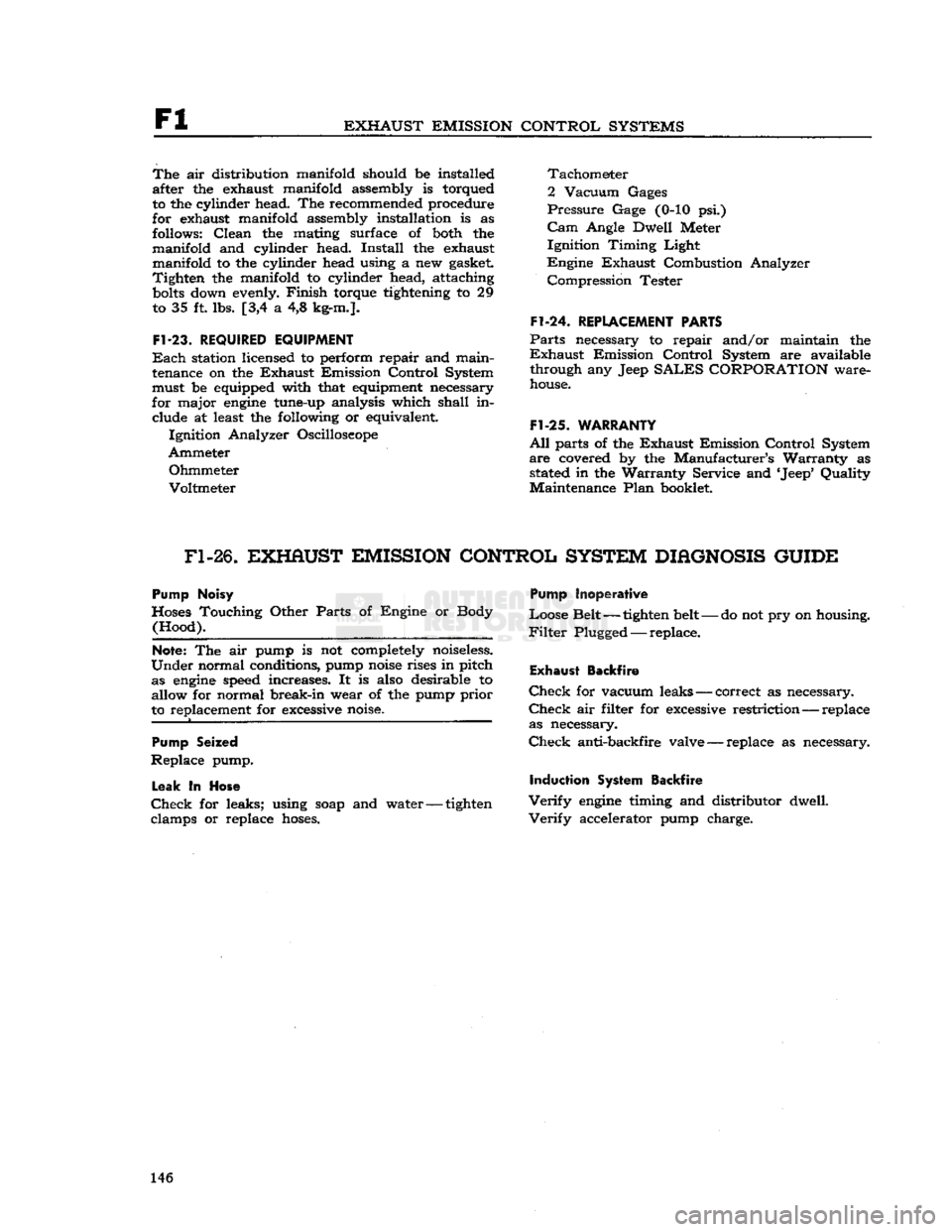
Fl
EXHAUST
EMISSION CONTROL SYSTEMS The
air distribution manifold should be installed
after the exhaust manifold assembly is torqued
to the cylinder head. The recommended procedure
for exhaust manifold assembly installation is as follows:
Clean
the mating surface of both the
manifold and cylinder head.
Install
the exhaust manifold to the cylinder head using a new gasket.
Tighten
the manifold to cylinder head, attaching
bolts
down evenly.
Finish
torque tightening to 29
to 35 ft. lbs. [3,4 a 4,8 kg-m.].
Fl-23.
REQUIRED
EQUIPMENT
Each
station licensed to perform repair and main
tenance on the Exhaust Emission Control System
must be equipped with that equipment necessary
for major
engine
tune-up analysis which shall in clude at least the following or equivalent.
Ignition Analyzer Oscilloscope
Ammeter
Ohmmeter
Voltmeter Tachometer
2 Vacuum Gages
Pressure
Gage (0-10 psi.)
Cam
Angle Dwell Meter Ignition Timing
Light
Engine
Exhaust Combustion Analyzer Compression Tester
Fl-24.
REPLACEMENT
PARTS
Parts
necessary to repair and/or maintain the
Exhaust
Emission Control System are available through any Jeep
SALES CORPORATION
ware
house.
Fl-25.
WARRANTY
All
parts of the Exhaust Emission Control System
are
covered by the Manufacturer's Warranty as stated in the Warranty Service and 'Jeep' Quality
Maintenance Plan booklet.
Fl-26.
EXHAUST EMISSION CONTROL
SYSTEM
DIAGNOSIS GUIDE
Pump Noisy
Hoses Touching Other Parts of Engine or Body (Hood).
Note:
The air pump is not completely noiseless.
Under
normal conditions, pump
noise
rises in pitch as
engine
speed
increases. It is also desirable to
allow for normal break-in wear of the pump prior
to replacement for excessive noise.
Pump Seized
Replace
pump.
Leak
In
Hose
Check
for leaks; using
soap
and water — tighten
clamps or replace
hoses.
Pump
Inoperative
Loose Belt — tighten belt — do not pry on housing.
Filter
Plugged — replace.
Exhaust Backfire
Check
for vacuum leaks — correct as necessary.
Check
air filter for excessive
restriction
— replace as necessary.
Check
anti-backfire valve — replace as necessary.
Induction System Backfire
Verify
engine
timing and distributor dwell.
Verify
accelerator pump charge. 146
Page 147 of 376
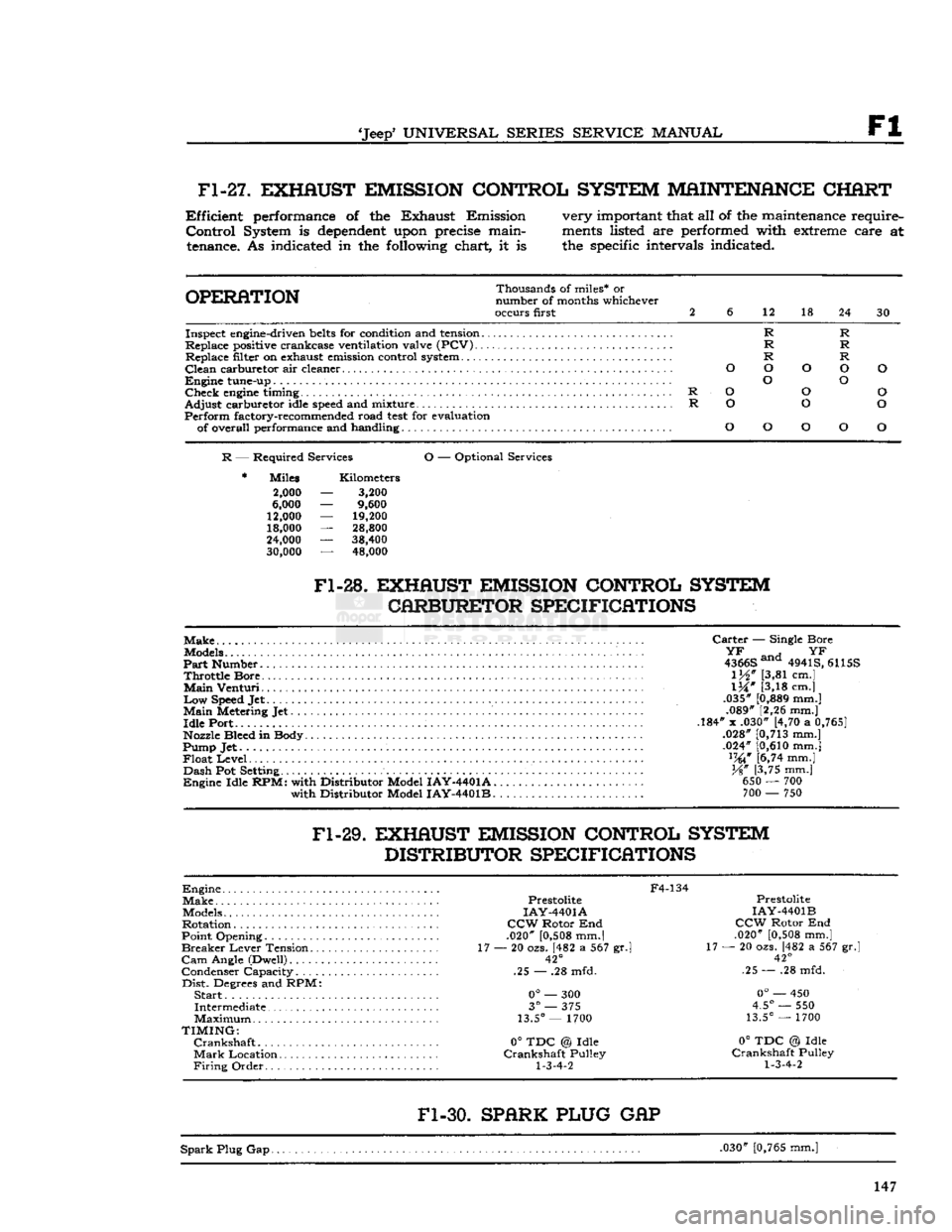
'Jeep'
UNIVERSAL SERIES
SERVICE
MANUAL
Fl
Fl-27.
EXHAUST EMISSION CONTROL SYSTEM MAINTENANCE CHART
Efficient
performance of the Exhaust Emission
Control
System is
dependent
upon precise maintenance. As indicated in the following chart, it is very important that all of the maintenance require
ments
listed are performed with extreme care at
the specific intervals indicated.
OPERATION
Thousands of miles* or
number of months whichever
occurs first 2
6
12 18
24 30
R R
R R
R R
O O o O
O
o O
R
O
o
o
R
o
o o
o
o
o
O
o
Inspect engine-driven
belts
for condition and tension...
Replace positive crankcase ventilation valve (PCV) Replace filter on exhaust emission control system
Clean
carburetor air cleaner
Engine
tune-up
Check
engine
timing
Adjust
carburetor idle
speed
and mixture
Perform
factory-recommended road
test
for evaluation of overall performance and handling
R
— Required Services
O
— Optional Services
Miles
2,000
6,000
12,000
18,000
24,000
30,000
Kilometers
3,200
9,600
19,200
28,800
38,400 48,000
Fl-28.
EXHAUST EMISSION CONTROL SYSTEM CARBURETOR SPECIFICATIONS
Make
Models
Part
Number
Throttle
Bore
Main
Venturi
Low
Speed Jet
Main
Metering Jet
Idle
Port
Nozzle Bleed in Body
Pump Jet
Float
Level
Dash
Pot Setting
Engine
Idle
RPM:
with Distributor Model
IAY-4401A.
with Distributor Model
IAY-4401B.
Carter
— Single Bore
^ an H
YF
4366S ana 4941S, 6115S
1M"
[3,81 cm.]
IX"
[3,18 cm.]
.035"
[0,889
mm.] .089" [2,26 mm.]
.184" x .030" [4,70 a
0,765]
.028"
[0,713
mm.]
.024"
[0,610
mm.] lW [6,74 mm.]
%"
[3,75 mm.] 650 — 700 700 — 750
Fl-29.
EXHAUST EMISSION CONTROL SYSTEM DISTRIBUTOR SPECIFICATIONS
Engine
Make
Models
Rotation
Point Opening
Breaker
Lever
Tension..
Cam
Angle (Dwell)
Condenser Capacity
Dist.
Degrees and RPM:
Start..
Intermediate
Maximum
TIMING:
Crankshaft
Mark
Location
Firing
Order
F4-134
Prestolite
IAY-4401A
CCW
Rotor End
.020"
[0,508
mm.|
17 — 20 ozs. [482 a 567 gr.l
42°
.25 — .28 mfd.
0°
— 300
3°
— 375
13.5°
— 1700
0°
TDC @ Idle
Crankshaft
Pulley
1-3-4-2
Prestolite
IAY-4401B
CCW
Rotor End
.020"
[0,508
mm.]
17 — 20 ozs. [482 a 567 gr.
42°
.25 — .28 mfd.
0°
— 450
4.5°
— 550
13.5°
— 1700
0°
TDC @ Idle
Crankshaft
Pulley
1-3-4-2
Fl-30.
SPARK PLUG
GAP
Spark
Plug Gap. .030"
[0,765
mm.] 147