ignition JEEP GLADIATOR 2023 Owners Manual
[x] Cancel search | Manufacturer: JEEP, Model Year: 2023, Model line: GLADIATOR, Model: JEEP GLADIATOR 2023Pages: 448, PDF Size: 17.37 MB
Page 338 of 448
336IN CASE OF EMERGENCY
PREPARATIONS FOR JACKING
1. Park on a firm, level surface. Avoid ice or
slippery areas.
2. Turn on the Hazard Warning Flashers.
3. Apply the parking brake.
4. Shift the automatic transmission into PARK (P), or a manual transmission into REVERSE.
5. Cycle the ignition to OFF.
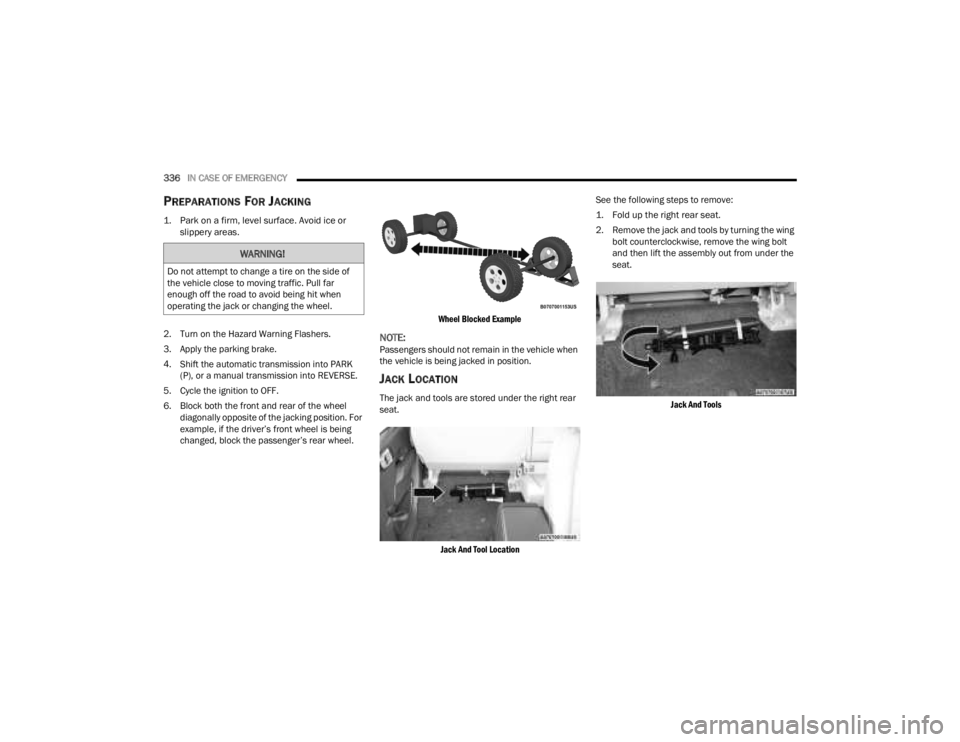
6. Block both the front and rear of the wheel diagonally opposite of the jacking position. For
example, if the driver’s front wheel is being
changed, block the passenger’s rear wheel.
Wheel Blocked Example
NOTE:Passengers should not remain in the vehicle when
the vehicle is being jacked in position.
JACK LOCATION
The jack and tools are stored under the right rear
seat.
Jack And Tool Location
See the following steps to remove:
1. Fold up the right rear seat.
2. Remove the jack and tools by turning the wing
bolt counterclockwise, remove the wing bolt
and then lift the assembly out from under the
seat.
Jack And Tools
WARNING!
Do not attempt to change a tire on the side of
the vehicle close to moving traffic. Pull far
enough off the road to avoid being hit when
operating the jack or changing the wheel.
23_JT_OM_EN_USC_t.book Page 336
Page 346 of 448
344IN CASE OF EMERGENCY
(Continued)
PREPARATIONS FOR JUMP START
Supplemental Battery — If Equipped
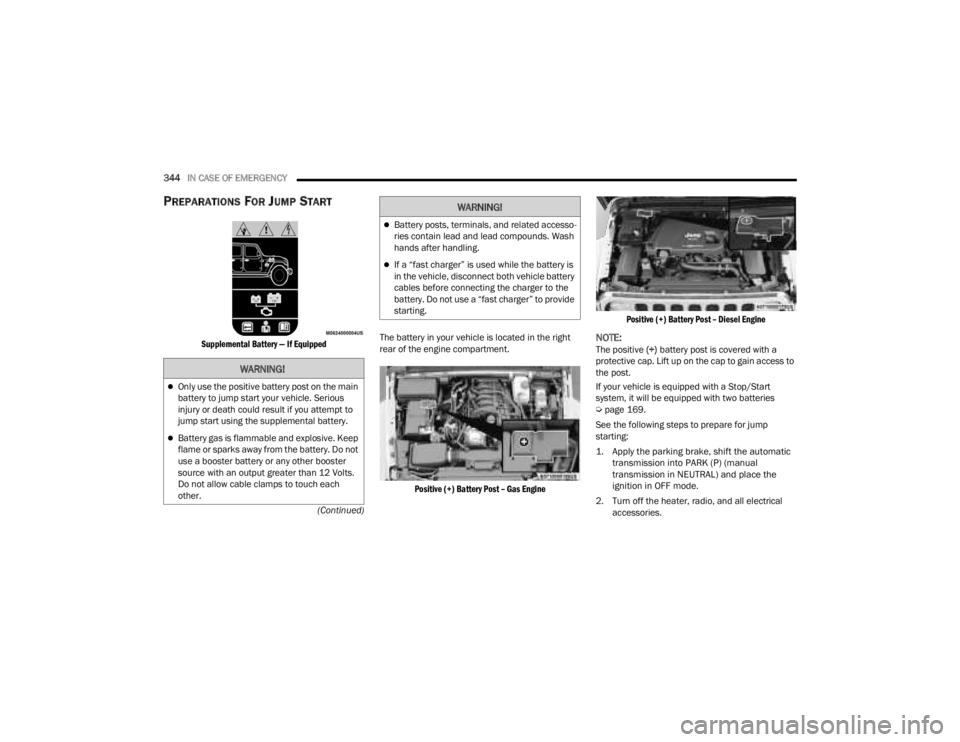
The battery in your vehicle is located in the right
rear of the engine compartment.
Positive (+) Battery Post – Gas Engine Positive (+) Battery Post – Diesel Engine
NOTE:The positive
(+) battery post is covered with a
protective cap. Lift up on the cap to gain access to
the post.
If your vehicle is equipped with a Stop/Start
system, it will be equipped with two batteries
Ú page 169.
See the following steps to prepare for jump
starting:
1. Apply the parking brake, shift the automatic transmission into PARK (P) (manual
transmission in NEUTRAL) and place the
ignition in OFF mode.
2. Turn off the heater, radio, and all electrical accessories.
WARNING!
Only use the positive battery post on the main
battery to jump start your vehicle. Serious
injury or death could result if you attempt to
jump start using the supplemental battery.
Battery gas is flammable and explosive. Keep
flame or sparks away from the battery. Do not
use a booster battery or any other booster
source with an output greater than 12 Volts.
Do not allow cable clamps to touch each
other.
Battery posts, terminals, and related accesso -
ries contain lead and lead compounds. Wash
hands after handling.
If a “fast charger” is used while the battery is
in the vehicle, disconnect both vehicle battery
cables before connecting the charger to the
battery. Do not use a “fast charger” to provide
starting.
WARNING!
23_JT_OM_EN_USC_t.book Page 344
Page 347 of 448
IN CASE OF EMERGENCY345
3. If using another vehicle to jump start the battery, park the vehicle within the jumper
cable’s reach, apply the parking brake and
make sure the ignition is OFF.
JUMP STARTING PROCEDURE
NOTE:Make sure at all times that unused ends of jumper
cables are not contacting each other or either
vehicle while making connections.
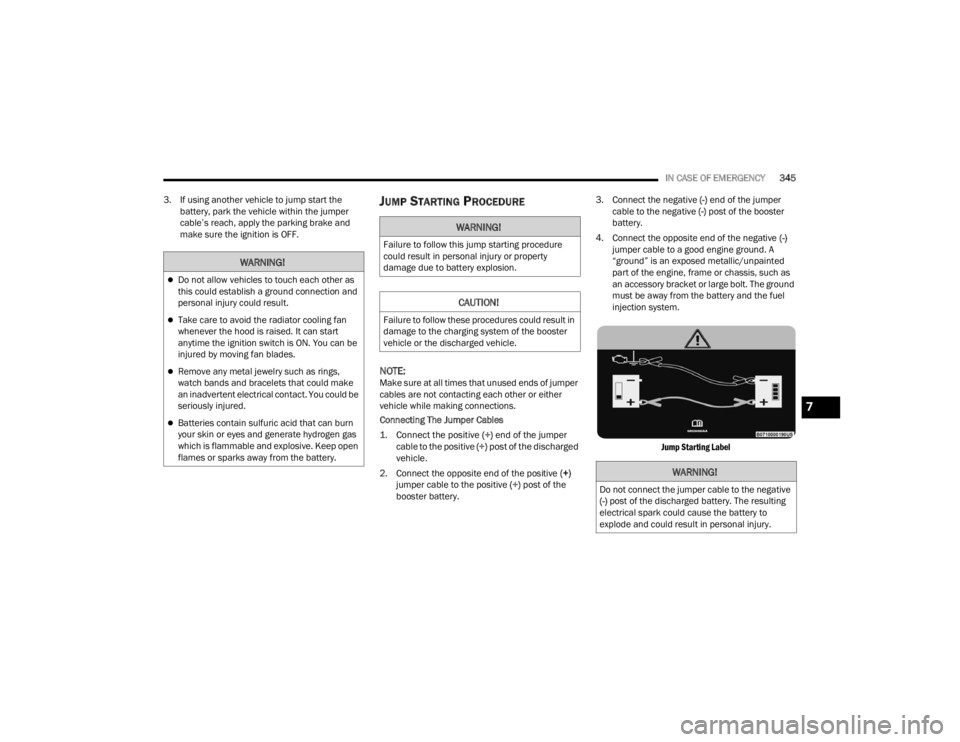
Connecting The Jumper Cables
1. Connect the positive
(+) end of the jumper
cable to the positive (+)
post of the discharged
vehicle.
2. Connect the opposite end of the positive (+)
jumper cable to the positive (+) post of the
booster battery. 3. Connect the negative
(-) end of the jumper
cable to the negative (-) post of the booster
battery.
4. Connect the opposite end of the negative (-)
jumper cable to a good engine ground. A
“ground” is an exposed metallic/unpainted
part of the engine, frame or chassis, such as
an accessory bracket or large bolt. The ground
must be away from the battery and the fuel
injection system.
Jump Starting Label
WARNING!
Do not allow vehicles to touch each other as
this could establish a ground connection and
personal injury could result.
Take care to avoid the radiator cooling fan
whenever the hood is raised. It can start
anytime the ignition switch is ON. You can be
injured by moving fan blades.
Remove any metal jewelry such as rings,
watch bands and bracelets that could make
an inadvertent electrical contact. You could be
seriously injured.
Batteries contain sulfuric acid that can burn
your skin or eyes and generate hydrogen gas
which is flammable and explosive. Keep open
flames or sparks away from the battery.
WARNING!
Failure to follow this jump starting procedure
could result in personal injury or property
damage due to battery explosion.
CAUTION!
Failure to follow these procedures could result in
damage to the charging system of the booster
vehicle or the discharged vehicle.
WARNING!
Do not connect the jumper cable to the negative
(-) post of the discharged battery. The resulting
electrical spark could cause the battery to
explode and could result in personal injury.
7
23_JT_OM_EN_USC_t.book Page 345
Page 353 of 448
IN CASE OF EMERGENCY351
Proper towing or lifting equipment is required to
prevent damage to your vehicle. Use only tow bars
and other equipment designed for this purpose,
following equipment manufacturer’s instructions.
Use of safety chains is mandatory. Attach a tow bar
or other towing device to main structural members
of the vehicle, not to fascia/bumpers or associated
brackets. State and local laws regarding vehicles
under tow must be observed.
If you must use the accessories (wipers,
defrosters, etc.) while being towed, the ignition
must be in the ON/RUN position, not the ACC
position.
If the vehicle's battery is discharged, instructions
on shifting the automatic transmission out of
PARK (P) in order to move the vehicle Úpage 348.
FOUR–WHEEL DRIVE MODELS
FCA LLC US recommends towing with all wheels
OFF the ground. Acceptable methods are to tow
the vehicle on a flatbed or with one end of the
vehicle raised and the opposite end on a towing
dolly.
If flatbed equipment is not available and the
transfer case is operable, the vehicle may be
towed (in the forward direction, with ALL wheels on
the ground), IF the transfer case is in NEUTRAL (N)
and the transmission is in PARK (P) (for automatic
transmissions) or in gear ( NOT in NEUTRAL , for
manual transmissions) Ú page 205.
WITHOUT THE KEY FOB
Special care must be taken when the vehicle is
towed with the ignition in the OFF position. The only
approved method of towing without the key fob is
with a flatbed truck. Proper towing equipment is
necessary to prevent damage to the vehicle.
EMERGENCY TOW HOOKS —
I
F EQUIPPED
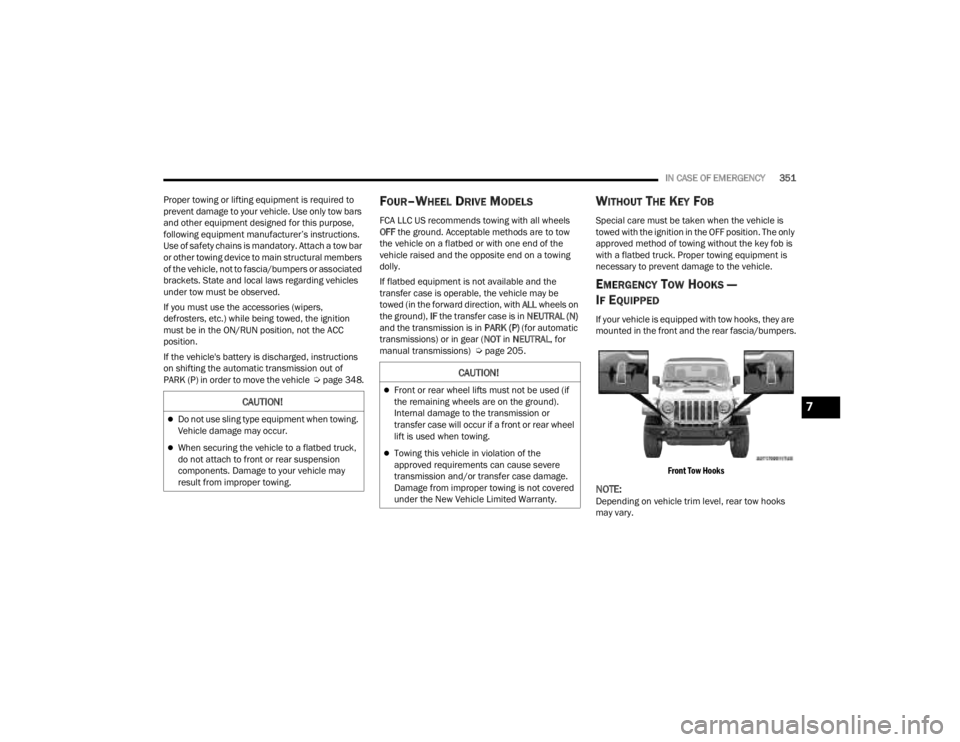
If your vehicle is equipped with tow hooks, they are
mounted in the front and the rear fascia/bumpers.
Front Tow Hooks
NOTE:Depending on vehicle trim level, rear tow hooks
may vary.
CAUTION!
Do not use sling type equipment when towing.
Vehicle damage may occur.
When securing the vehicle to a flatbed truck,
do not attach to front or rear suspension
components. Damage to your vehicle may
result from improper towing.
CAUTION!
Front or rear wheel lifts must not be used (if
the remaining wheels are on the ground).
Internal damage to the transmission or
transfer case will occur if a front or rear wheel
lift is used when towing.
Towing this vehicle in violation of the
approved requirements can cause severe
transmission and/or transfer case damage.
Damage from improper towing is not covered
under the New Vehicle Limited Warranty.
7
23_JT_OM_EN_USC_t.book Page 351
Page 370 of 448
368SERVICING AND MAINTENANCE
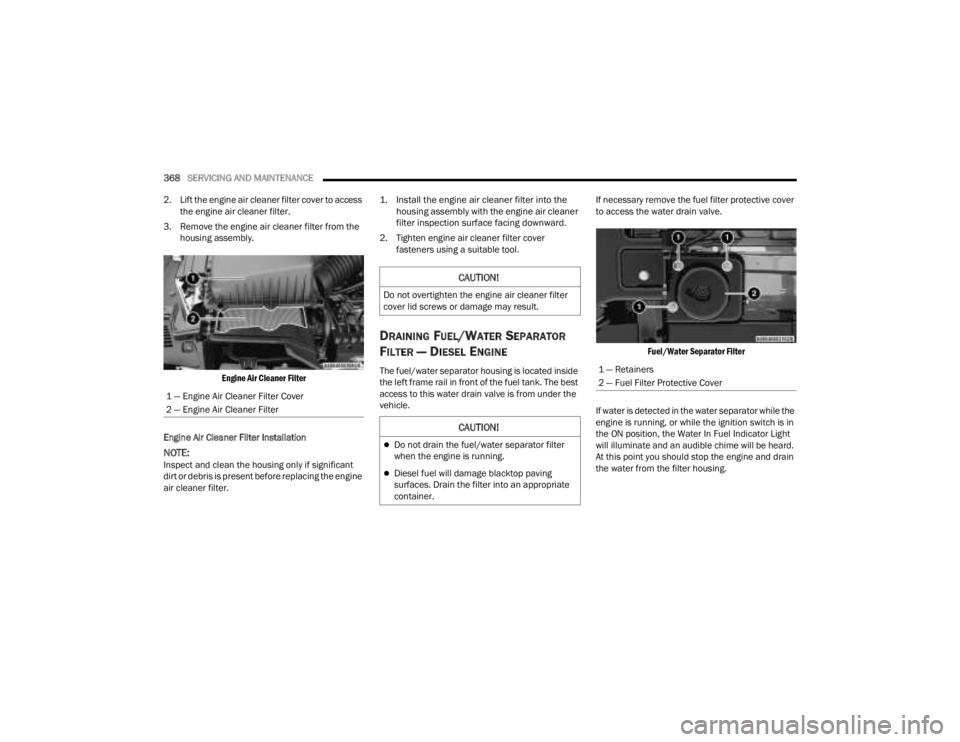
2. Lift the engine air cleaner filter cover to access the engine air cleaner filter.
3. Remove the engine air cleaner filter from the housing assembly.
Engine Air Cleaner Filter
Engine Air Cleaner Filter Installation
NOTE:Inspect and clean the housing only if significant
dirt or debris is present before replacing the engine
air cleaner filter.
1. Install the engine air cleaner filter into the
housing assembly with the engine air cleaner
filter inspection surface facing downward.
2. Tighten engine air cleaner filter cover fasteners using a suitable tool.
DRAINING FUEL/WATER SEPARATOR
F
ILTER — DIESEL ENGINE
The fuel/water separator housing is located inside
the left frame rail in front of the fuel tank. The best
access to this water drain valve is from under the
vehicle. If necessary remove the fuel filter protective cover
to access the water drain valve.
Fuel/Water Separator Filter
If water is detected in the water separator while the
engine is running, or while the ignition switch is in
the ON position, the Water In Fuel Indicator Light
will illuminate and an audible chime will be heard.
At this point you should stop the engine and drain
the water from the filter housing.
1 — Engine Air Cleaner Filter Cover
2 — Engine Air Cleaner Filter
CAUTION!
Do not overtighten the engine air cleaner filter
cover lid screws or damage may result.
CAUTION!
Do not drain the fuel/water separator filter
when the engine is running.
Diesel fuel will damage blacktop paving
surfaces. Drain the filter into an appropriate
container.
1 — Retainers
2 — Fuel Filter Protective Cover
23_JT_OM_EN_USC_t.book Page 368
Page 372 of 448
370SERVICING AND MAINTENANCE
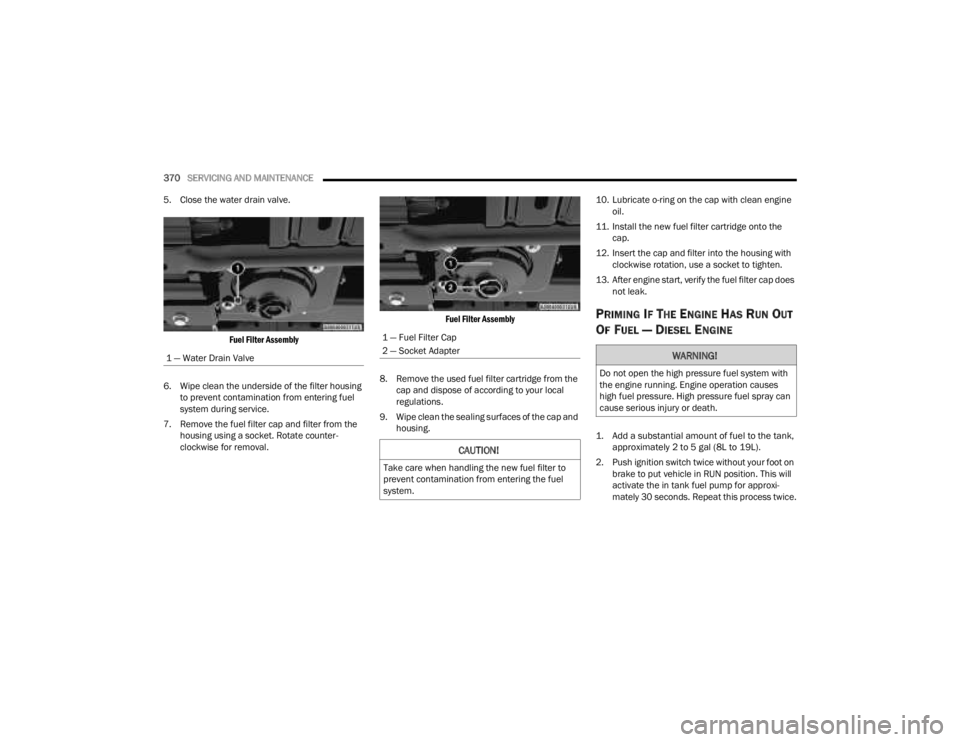
5. Close the water drain valve.
Fuel Filter Assembly
6. Wipe clean the underside of the filter housing to prevent contamination from entering fuel
system during service.
7. Remove the fuel filter cap and filter from the housing using a socket. Rotate counter -
clockwise for removal.
Fuel Filter Assembly
8. Remove the used fuel filter cartridge from the cap and dispose of according to your local
regulations.
9. Wipe clean the sealing surfaces of the cap and housing. 10. Lubricate o-ring on the cap with clean engine
oil.
11. Install the new fuel filter cartridge onto the cap.
12. Insert the cap and filter into the housing with clockwise rotation, use a socket to tighten.
13. After engine start, verify the fuel filter cap does not leak.
PRIMING IF THE ENGINE HAS RUN OUT
O
F FUEL — DIESEL ENGINE
1. Add a substantial amount of fuel to the tank,
approximately 2 to 5 gal (8L to 19L).
2. Push ignition switch twice without your foot on brake to put vehicle in RUN position. This will
activate the in tank fuel pump for approxi -
mately 30 seconds. Repeat this process twice.
1 — Water Drain Valve
1 — Fuel Filter Cap
2 — Socket Adapter
CAUTION!
Take care when handling the new fuel filter to
prevent contamination from entering the fuel
system.
WARNING!
Do not open the high pressure fuel system with
the engine running. Engine operation causes
high fuel pressure. High pressure fuel spray can
cause serious injury or death.
23_JT_OM_EN_USC_t.book Page 370
Page 374 of 448
372SERVICING AND MAINTENANCE
(Continued)
ACCESSORY DRIVE BELT INSPECTION
When inspecting accessory drive belts small
cracks, that run across ribbed surface of belt from
rib to rib, are considered normal. This is not a
reason to replace the belt. However, cracks
running along a rib (not across) are not normal. Any
belt with cracks running along a rib must be
replaced. In addition, have the belt replaced if it
has excessive wear, frayed cords, or severe
glazing.
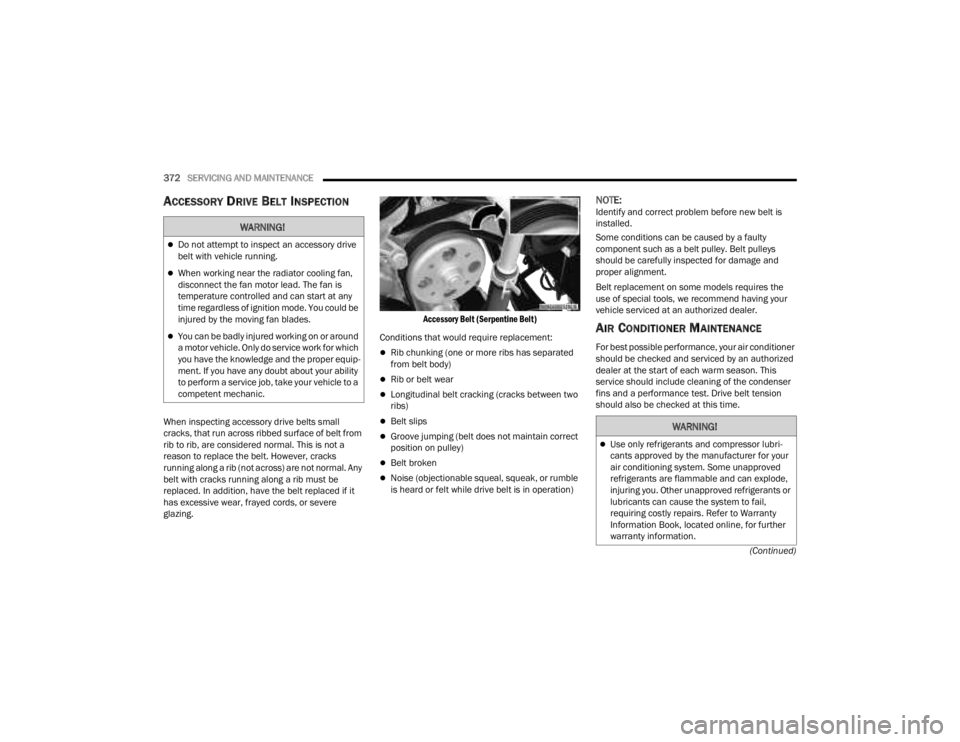
Accessory Belt (Serpentine Belt)
Conditions that would require replacement:
Rib chunking (one or more ribs has separated
from belt body)
Rib or belt wear
Longitudinal belt cracking (cracks between two
ribs)
Belt slips
Groove jumping (belt does not maintain correct
position on pulley)
Belt broken
Noise (objectionable squeal, squeak, or rumble
is heard or felt while drive belt is in operation)
NOTE:Identify and correct problem before new belt is
installed.
Some conditions can be caused by a faulty
component such as a belt pulley. Belt pulleys
should be carefully inspected for damage and
proper alignment.
Belt replacement on some models requires the
use of special tools, we recommend having your
vehicle serviced at an authorized dealer.
AIR CONDITIONER MAINTENANCE
For best possible performance, your air conditioner
should be checked and serviced by an authorized
dealer at the start of each warm season. This
service should include cleaning of the condenser
fins and a performance test. Drive belt tension
should also be checked at this time.
WARNING!
Do not attempt to inspect an accessory drive
belt with vehicle running.
When working near the radiator cooling fan,
disconnect the fan motor lead. The fan is
temperature controlled and can start at any
time regardless of ignition mode. You could be
injured by the moving fan blades.
You can be badly injured working on or around
a motor vehicle. Only do service work for which
you have the knowledge and the proper equip -
ment. If you have any doubt about your ability
to perform a service job, take your vehicle to a
competent mechanic.
WARNING!
Use only refrigerants and compressor lubri -
cants approved by the manufacturer for your
air conditioning system. Some unapproved
refrigerants are flammable and can explode,
injuring you. Other unapproved refrigerants or
lubricants can cause the system to fail,
requiring costly repairs. Refer to Warranty
Information Book, located online, for further
warranty information.
23_JT_OM_EN_USC_t.book Page 372
Page 375 of 448
SERVICING AND MAINTENANCE373
Refrigerant Recovery And Recycling
R-1234yf
R-1234yf Air Conditioning Refrigerant is a Hydroflu -
oroolefin (HFO) that is endorsed by the
Environmental Protection Agency and is an
ozone-friendly substance with a low
global-warming potential. The manufacturer
recommends that air conditioning service be
performed by an authorized dealer using recovery
and recycling equipment.
NOTE:Use only manufacturer approved A/C system PAG
compressor oil, and refrigerants.
Cabin Air Filter Replacement
The cabin air filter is located in the fresh air inlet
behind the glove compartment. Perform the
following procedure to replace the filter:
1. Open the glove compartment and remove all contents.
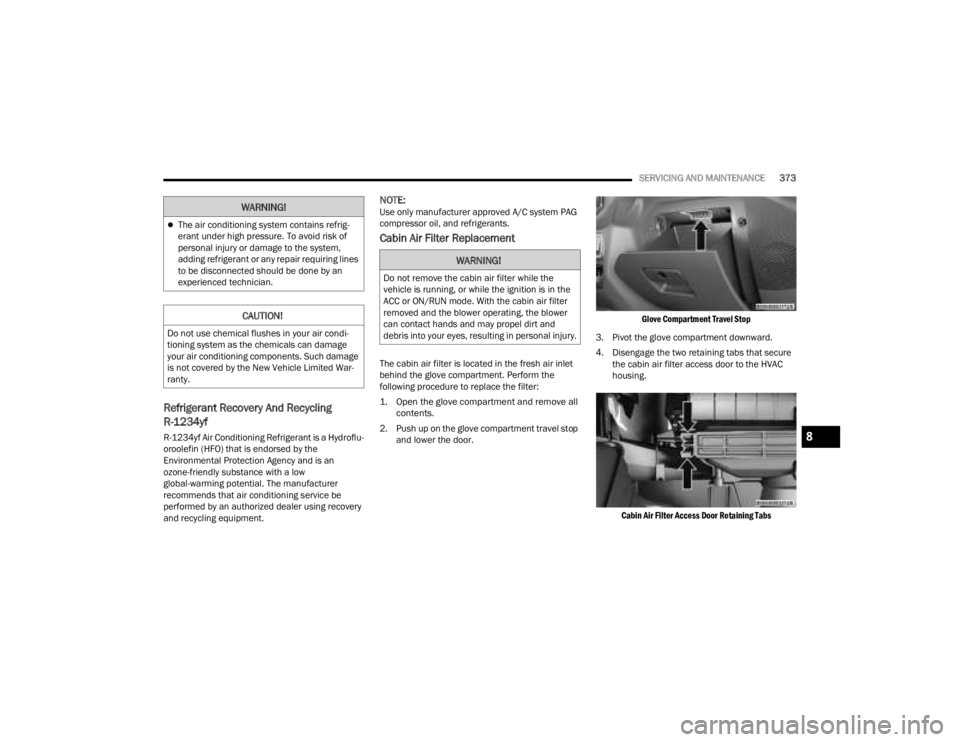
2. Push up on the glove compartment travel stop and lower the door.
Glove Compartment Travel Stop
3. Pivot the glove compartment downward.
4. Disengage the two retaining tabs that secure the cabin air filter access door to the HVAC
housing.
Cabin Air Filter Access Door Retaining Tabs
The air conditioning system contains refrig -
erant under high pressure. To avoid risk of
personal injury or damage to the system,
adding refrigerant or any repair requiring lines
to be disconnected should be done by an
experienced technician.
CAUTION!
Do not use chemical flushes in your air condi -
tioning system as the chemicals can damage
your air conditioning components. Such damage
is not covered by the New Vehicle Limited War -
ranty.
WARNING!
WARNING!
Do not remove the cabin air filter while the
vehicle is running, or while the ignition is in the
ACC or ON/RUN mode. With the cabin air filter
removed and the blower operating, the blower
can contact hands and may propel dirt and
debris into your eyes, resulting in personal injury.
8
23_JT_OM_EN_USC_t.book Page 373
Page 378 of 448

376SERVICING AND MAINTENANCE
(Continued)
EXHAUST SYSTEM
The best protection against carbon monoxide entry
into the vehicle body is a properly maintained
engine exhaust system.
If you notice a change in the sound of the exhaust
system, or if the exhaust fumes can be detected
inside the vehicle, or when the underside or rear of
the vehicle is damaged, have an authorized
technician inspect the complete exhaust system
and adjacent body areas for broken, damaged,
deteriorated, or mispositioned parts. Open seams
or loose connections could permit exhaust fumes
to seep into the passenger compartment. In
addition, have the exhaust system inspected each
time the vehicle is raised for lubrication or oil
change. Replace as required. Under normal operating conditions, the catalytic
converter will not require maintenance. However, it
is important to keep the engine properly tuned to
ensure proper catalyst operation and prevent
possible catalyst damage.
NOTE:Intentional tampering with emissions control
systems can result in civil penalties being
assessed against you.
In unusual situations involving grossly
malfunctioning engine operation, a scorching odor
may suggest severe and abnormal catalyst
overheating. If this occurs, stop the vehicle, turn off
the engine and allow it to cool. Service, including a
tune-up to manufacturer's specifications, should
be obtained immediately.
To minimize the possibility of catalytic converter
damage:
Do not interrupt the ignition when the transmis
-
sion is in gear and the vehicle is in motion.
Do not try to start the vehicle by pushing or
towing the vehicle.
Do not idle the engine with any ignition compo -
nents disconnected or removed, such as when
diagnostic testing, or for prolonged periods
during very rough idle or malfunctioning oper -
ating conditions.
WARNING!
Exhaust gases can injure or kill. They contain
Carbon Monoxide (CO), which is colorless and
odorless. Breathing it can make you uncon -
scious and can eventually poison you. To
avoid breathing CO see Ú page 328.
A hot exhaust system can start a fire if you
park over materials that can burn, such as
grass or leaves, and those items that come
into contact with your exhaust system. Do not
park or operate your vehicle in areas where
your exhaust system can contact anything that
can burn.
CAUTION!
The catalytic converter requires the use of
unleaded fuel only. Leaded gasoline will
destroy the effectiveness of the catalyst as an
emissions control device, may seriously
reduce engine performance and cause
serious damage to the engine.
Damage to the catalytic converter can result if
your vehicle is not kept in proper operating
condition. In the event of engine malfunction,
particularly involving engine misfire or other
apparent loss of performance, have your
vehicle serviced promptly. Continued opera -
tion of your vehicle with a severe malfunction
could cause the converter to overheat,
resulting in possible damage to the converter
and vehicle.
WARNING!
23_JT_OM_EN_USC_t.book Page 376
Page 379 of 448

SERVICING AND MAINTENANCE377
COOLING SYSTEM
Coolant Checks
Check the engine coolant (antifreeze) protection
every 12 months (before the onset of freezing
weather, where applicable). If the engine coolant is
dirty or rusty in appearance, the system should be
drained, flushed, and refilled with fresh Organic
Additive Technology (OAT) coolant (conforming to MS.90032) by an authorized dealer. Check the
front of the A/C condenser (if equipped) or radiator
for any accumulation of bugs, leaves, etc. If dirty,
clean by gently spraying water from a garden hose
vertically down the face of the A/C condenser (if
equipped) or the back of the radiator core.
Check the engine cooling system hoses for brittle
rubber, cracking, tears, cuts, and tightness of the
connection at the coolant recovery bottle and
radiator. Inspect the entire system for leaks. DO
NOT REMOVE THE COOLANT PRESSURE CAP
WHEN THE COOLING SYSTEM IS HOT.
Cooling System — Drain, Flush, And Refill
Some vehicles require special tools to add coolant
properly. Failure to fill these systems properly
could lead to severe internal engine damage. If any
coolant is needed to be added to the system
please contact an authorized dealer.
If the engine coolant (antifreeze) is dirty or
contains visible sediment, have an authorized
dealer clean and flush with OAT coolant
(conforming to MS.90032).
For the proper maintenance intervals see
Ú
page 354 for gas engines or Ú page 358 for
diesel engines.
Selection Of Coolant
For further information Ú page 424.
NOTE:
Mixing of engine coolant (antifreeze), other than
specified Organic Additive Technology (OAT)
engine coolant, may result in engine damage
and may decrease corrosion protection. OAT
engine coolant is different and should not be
mixed with Hybrid Organic Additive Technology
(HOAT) engine coolant or any “globally compat -
ible” coolant. If a non-OAT engine coolant is
introduced into the cooling system in an emer -
gency, the cooling system will need to be
drained, flushed, and refilled with fresh OAT
coolant (conforming to MS.90032), by an autho -
rized dealer as soon as possible.
Do not use water alone or alcohol-based engine
coolant products. Do not use additional rust
inhibitors or anti-rust products, as they may not
be compatible with the radiator engine coolant
and may clog the radiator.
This vehicle has not been designed for use with
propylene glycol-based engine coolant. Use of
propylene glycol-based engine coolant is not
recommended.
Some vehicles require special tools to add
coolant properly. Failure to fill these systems
properly could lead to severe internal engine
damage. If any coolant is needed to be added to
the system please contact an authorized dealer.
WARNING!
You or others can be badly burned by hot
engine coolant (antifreeze) or steam from your
radiator. If you see or hear steam coming from
under the hood, do not open the hood until the
radiator has had time to cool. Never open a
cooling system pressure cap when the radi -
ator or coolant bottle is hot.
Keep hands, tools, clothing, and jewelry away
from the radiator cooling fan when the hood is
raised. The fan starts automatically and may
start at any time, whether the engine is
running or not.
When working near the radiator cooling fan,
disconnect the fan motor lead or turn the igni -
tion to the OFF position. The fan is tempera -
ture controlled and can start at any time the
ignition is in the ON position.
8
23_JT_OM_EN_USC_t.book Page 377