air bag JEEP GLADIATOR 2023 Owner's Manual
[x] Cancel search | Manufacturer: JEEP, Model Year: 2023, Model line: GLADIATOR, Model: JEEP GLADIATOR 2023Pages: 448, PDF Size: 17.37 MB
Page 322 of 448

320SAFETY
(Continued)
Infant And Child Restraints
Safety experts recommend that children ride
rear-facing in the vehicle until they are two years
old or until they reach either the height or weight
limit of their rear-facing child restraint. Two types of
child restraints can be used rear-facing: infant
carriers and convertible child seats.
The infant carrier is only used rear-facing in the
vehicle. It is recommended for children from birth
until they reach the weight or height limit of the
infant carrier. Convertible child seats can be used
either rear-facing or forward-facing in the vehicle.
Convertible child seats often have a higher weight
limit in the rear-facing direction than infant carriers
do, so they can be used rear-facing by children who
have outgrown their infant carrier but are still less
than at least two years old. Children should remain
rear-facing until they reach the highest weight or
height allowed by their convertible child seat.
Older Children And Child Restraints
Children who are two years old or who have
outgrown their rear-facing convertible child seat
can ride forward-facing in the vehicle.
Forward-facing child seats and convertible child
seats used in the forward-facing direction are for
children who are over two years old or who have
outgrown the rear-facing weight or height limit of
their rear-facing convertible child seat. Children
should remain in a forward-facing child seat with a
harness for as long as possible, up to the highest
weight or height allowed by the child seat.
All children whose weight or height is above the
forward-facing limit for the child seat should use a
belt-positioning booster seat until the vehicle’s
seat belts fit properly. If the child cannot sit with
knees bent over the vehicle’s seat cushion while
the child’s back is against the seatback, they should use a belt-positioning booster seat. The
child and belt-positioning booster seat are held in
the vehicle by the seat belt.
WARNING!
Never place a rear-facing child restraint in
front of an air bag. A deploying passenger
front air bag can cause death or serious injury
to a child 12 years or younger, including a
child in a rear-facing child restraint.
Never install a rear-facing child restraint in the
front seat of a vehicle. Only use a rear-facing
child restraint in the rear seat. If the vehicle
does not have a rear seat, do not transport a
rear-facing child restraint in that vehicle.
WARNING!
WARNING!
Improper installation can lead to failure of an
infant or child restraint. It could come loose in
a collision. The child could be badly injured or
killed. Follow the child restraint manufac
-
turer’s directions exactly when installing an
infant or child restraint.
After a child restraint is installed in the
vehicle, do not move the vehicle seat forward
or rearward because it can loosen the child
restraint attachments. Remove the child
restraint before adjusting the vehicle seat
position. When the vehicle seat has been
adjusted, reinstall the child restraint.
When your child restraint is not in use, secure
it in the vehicle with the seat belt or LATCH
anchorages, or remove it from the vehicle. Do
not leave it loose in the vehicle. In a sudden
stop or accident, it could strike the occupants
or seatbacks and cause serious personal
injury.
23_JT_OM_EN_USC_t.book Page 320
Page 331 of 448
SAFETY329
(Continued)
TRANSPORTING PETS
Air Bags deploying in the front seat could harm
your pet. An unrestrained pet will be thrown about
and possibly injured, or injure a passenger during
panic braking or in a collision.
Pets should be restrained in the rear seat (if
equipped) in pet harnesses or pet carriers that are
secured by seat belts.
CONNECTED VEHICLES
Privacy of any wireless and wired communications
cannot be assured. Third parties may unlawfully
intercept information and private communications
without your consent. For further information, refer
to “Data Collection & Privacy” in your Uconnect
Owner’s Manual Supplement or “Onboard
Diagnostic System (OBD II) Cybersecurity”
Ú page 142.
SAFETY CHECKS YOU SHOULD MAKE
I
NSIDE THE VEHICLE
Seat Belts
Inspect the seat belt system periodically, checking
for cuts, frays, and loose parts. Damaged parts
must be replaced immediately. Do not
disassemble or modify the system.
If your vehicle is involved in a collision, or if you
have questions regarding the seat belt or retractor
conditions, take your vehicle to an authorized FCA
dealer or authorized FCA Certified Collision Care
Program facility for inspection.
Air Bag Warning Light
The Air Bag Warning Light will turn on for
four to eight seconds as a bulb check
when the ignition switch is first placed in
the ON/RUN position. If the light is either
not on during starting, stays on, or turns on while
driving, have the system inspected at an
authorized dealer as soon as possible. This light
will illuminate with a single chime when a fault with
the Air Bag Warning Light has been detected, it will
stay on until the fault is removed. If the light comes
on intermittently or remains on while driving, have
an authorized dealer service the vehicle
immediately Ú page 306.
Defroster
Check operation by selecting the defrost mode and
place the blower control on high speed. You should
be able to feel the air directed against the
windshield. See an authorized dealer for service if
your defroster is inoperable.
Floor Mat Safety Information
Always use floor mats designed to fit your vehicle.
Only use a floor mat that does not interfere with the
operation of the pedal assemblies. Only use a floor
mat that is securely attached using the floor mat
fasteners so it cannot slip out of position and
interfere with the pedal assemblies or impair safe
operation of your vehicle in other ways.
WARNING!
It is not possible to know or to predict all of the
possible outcomes if your vehicle’s systems are
breached. It may be possible that vehicle
systems, including safety related systems, could
be impaired or a loss of vehicle control could
occur that may result in an accident involving
serious injury or death.
WARNING!
An improperly attached, damaged, folded, or
stacked floor mat, or damaged floor mat
fasteners may cause your floor mat to interfere
with the accelerator, brake, or clutch pedals and
cause a loss of vehicle control. To prevent
SERIOUS INJURY or DEATH:
ALWAYS securely attach your floor
mat using the floor mat fasteners. DO
NOT install your floor mat upside down
or turn your floor mat over. Lightly pull
to confirm mat is secured using the floor mat
fasteners on a regular basis.
6
23_JT_OM_EN_USC_t.book Page 329
Page 336 of 448

334IN CASE OF EMERGENCY
(Continued)
SOS Call System Limitations
Vehicles sold in Mexico
DO NOT have SOS Call
system capabilities.
SOS or other emergency line operators in Mexico
may not answer or respond to SOS system calls.
If the SOS Call system detects a malfunction, any
of the following may occur at the time the
malfunction is detected, and at the beginning of
each ignition cycle:
The light located within the ASSIST and SOS
buttons will continuously be illuminated red.
The Device Screen will display the following
message “Vehicle device requires service.
Please contact an authorized dealer.”
An In-Vehicle Audio message will state “Vehicle
device requires service. Please contact an
authorized dealer.” Even if the SOS Call system is fully functional,
factors beyond FCA US LLC’s control may prevent
or stop the SOS Call system operation. These
include, but are not limited to, the following
factors:The ignition is in the OFF position
The vehicle’s electrical systems are not intact
The SOS Call system software and/or hardware
are damaged during a crash
The vehicle battery loses power or becomes
disconnected during a vehicle crash
LTE (voice/data) or 4G (data) network and/or
Global Positioning Satellite signals are unavail
-
able or obstructed
Equipment malfunction at the SOS operator
facility
Never place anything on or near the vehicle’s
operable network and GPS antennas. You
could prevent operable network and GPS
signal reception, which can prevent your
vehicle from placing an emergency call. An
operable network and GPS signal reception is
required for the SOS Call system to function
properly.
The SOS Call system is embedded into the
vehicle’s electrical system. Do not add after -
market electrical equipment to the vehicle’s
electrical system. This may prevent your
vehicle from sending a signal to initiate an
emergency call. To avoid interference that can
cause the SOS Call system to fail, never add
aftermarket equipment (e.g., two-way mobile
radio, CB radio, data recorder, etc.) to your
vehicle’s electrical system or modify the
antennas on your vehicle. IF YOUR VEHICLE
LOSES BATTERY POWER FOR ANY REASON
(INCLUDING DURING OR AFTER AN ACCI -
DENT), THE UCONNECT FEATURES, APPS AND
SERVICES, AMONG OTHERS, WILL NOT
OPERATE.
Modifications to any part of the SOS Call
system could cause the air bag system to fail
when you need it. You could be injured if the
air bag system is not there to help protect you.
WARNING!
WARNING!
Ignoring the Rearview Mirror light could mean
you will not have SOS Call services. If the Rear -
view Mirror light is illuminated, have an autho -
rized dealer service the SOS Call system
immediately.
The Occupant Restraint Control module turns
on the Air Bag Warning Light on the instru -
ment panel if a malfunction in any part of the
system is detected. If the Air Bag Warning
Light is illuminated, have an authorized dealer
service the Occupant Restraint Control system
immediately.
WARNING!
23_JT_OM_EN_USC_t.book Page 334
Page 337 of 448
IN CASE OF EMERGENCY335
Operator error by the SOS operator
LTE (voice/data) or 4G (data) network conges -
tion
Weather
Buildings, structures, geographic terrain, or
tunnels
NOTE:
Your vehicle may be transmitting data as autho -
rized by the subscriber.
Never place anything on or near the vehicle’s
LTE (voice/data) or 4G (data) and GPS
antennas. You could prevent LTE (voice/data) or
4G (data) and GPS signal reception, which can
prevent your vehicle from placing an emergency
call. An operable LTE (voice/data) or 4G (data) network connection and a GPS signal is
required for the SOS Call system to function
properly.
Changes or modifications not expressly
approved by the party responsible for compli
-
ance could void the user's authority to operate
the equipment.
Automatic SOS — If Equipped
Automatic SOS is a hands-free safety service that
can immediately connect you with help in the event
that your vehicle’s airbags deploy. Please refer to
your provided radio supplement for complete
information.
JACKING AND TIRE CHANGING
Use this QR code to access your
digital experience.
WARNING!
ALWAYS obey traffic laws and pay attention to
the road. ALWAYS drive safely with your hands on
the steering wheel. You have full responsibility
and assume all risks related to the use of the
features and applications in this vehicle. Only
use the features and applications when it is safe
to do so. Failure to do so may result in an
accident involving serious injury or death.
CAUTION!
To avoid damage to the mirror during cleaning,
never spray any cleaning solution directly onto
the mirror. Apply the solution onto a clean cloth
and wipe the mirror clean.
WARNING!
Do not attempt to change a tire on the side of
the vehicle close to moving traffic. Pull far
enough off the road to avoid the danger of
being hit when operating the jack or changing
the wheel.
Being under a jacked-up vehicle is dangerous.
The vehicle could slip off the jack and fall on
you. You could be crushed. Never put any part
of your body under a vehicle that is on a jack.
If you need to get under a raised vehicle, take
the vehicle to a service center where it can be
raised on a lift.
Never start or run the engine while the vehicle
is on a jack.
The jack is designed to be used as a tool for
changing tires only. The jack should not be
used to lift the vehicle for service purposes.
The vehicle should be jacked on a firm level
surface only. Avoid ice or slippery areas.7
23_JT_OM_EN_USC_t.book Page 335
Page 354 of 448
352IN CASE OF EMERGENCY
(Continued)
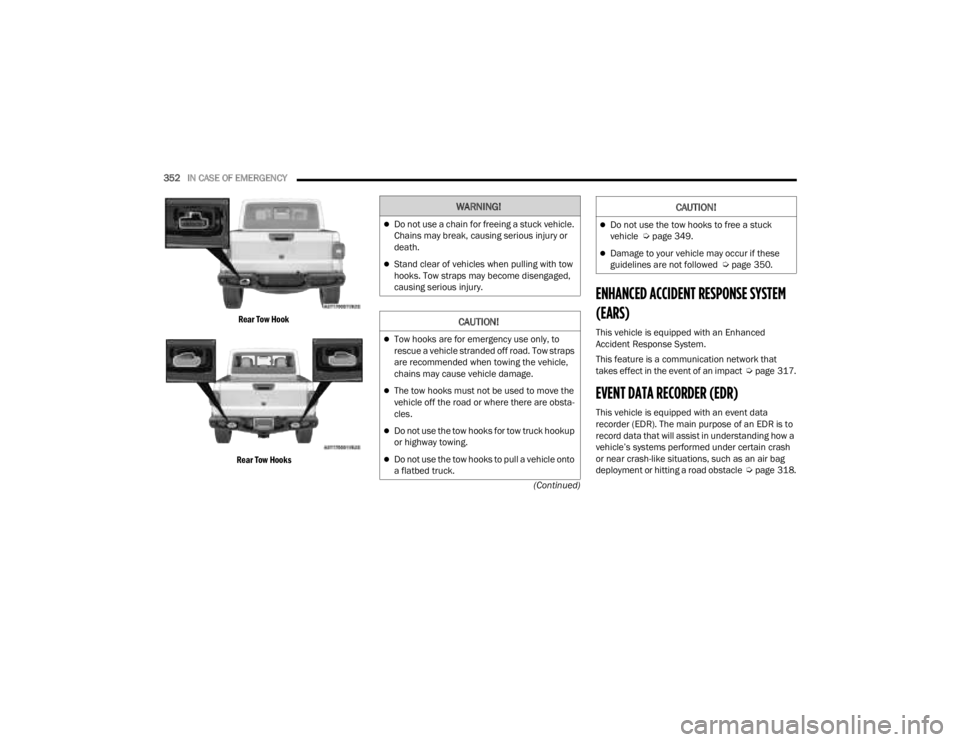
Rear Tow Hook
Rear Tow Hooks
ENHANCED ACCIDENT RESPONSE SYSTEM
(EARS)
This vehicle is equipped with an Enhanced
Accident Response System.
This feature is a communication network that
takes effect in the event of an impact Úpage 317.
EVENT DATA RECORDER (EDR)
This vehicle is equipped with an event data
recorder (EDR). The main purpose of an EDR is to
record data that will assist in understanding how a
vehicle’s systems performed under certain crash
or near crash-like situations, such as an air bag
deployment or hitting a road obstacle Úpage 318.
WARNING!
Do not use a chain for freeing a stuck vehicle.
Chains may break, causing serious injury or
death.
Stand clear of vehicles when pulling with tow
hooks. Tow straps may become disengaged,
causing serious injury.
CAUTION!
Tow hooks are for emergency use only, to
rescue a vehicle stranded off road. Tow straps
are recommended when towing the vehicle,
chains may cause vehicle damage.
The tow hooks must not be used to move the
vehicle off the road or where there are obsta -
cles.
Do not use the tow hooks for tow truck hookup
or highway towing.
Do not use the tow hooks to pull a vehicle onto
a flatbed truck.
Do not use the tow hooks to free a stuck
vehicle Ú page 349.
Damage to your vehicle may occur if these
guidelines are not followed Ú page 350.
CAUTION!
23_JT_OM_EN_USC_t.book Page 352
Page 385 of 448
SERVICING AND MAINTENANCE383
The fuses protect electrical systems against
excessive electrical current.
When a device does not work, you must check the
fuse element inside the blade fuse for a break/
melt.
Also, please be aware that when using power
outlets for an extended period of time with the
engine off, it may result in vehicle battery
discharge.
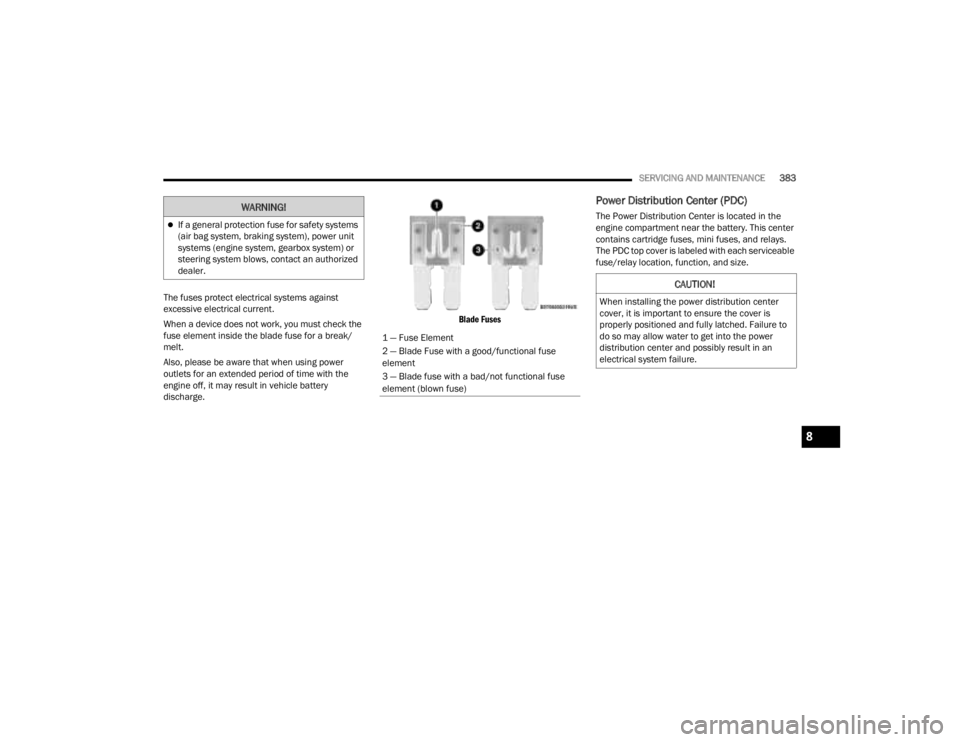
Blade Fuses
Power Distribution Center (PDC)
The Power Distribution Center is located in the
engine compartment near the battery. This center
contains cartridge fuses, mini fuses, and relays.
The PDC top cover is labeled with each serviceable
fuse/relay location, function, and size.If a general protection fuse for safety systems
(air bag system, braking system), power unit
systems (engine system, gearbox system) or
steering system blows, contact an authorized
dealer.
WARNING!
1 — Fuse Element
2 — Blade Fuse with a good/functional fuse
element
3 — Blade fuse with a bad/not functional fuse
element (blown fuse)
CAUTION!
When installing the power distribution center
cover, it is important to ensure the cover is
properly positioned and fully latched. Failure to
do so may allow water to get into the power
distribution center and possibly result in an
electrical system failure.
8
23_JT_OM_EN_USC_t.book Page 383
Page 389 of 448

SERVICING AND MAINTENANCE387
F20 30 Amp Pink –Central Body Controller (CBC) 1-INTERIOR LIGHTS
F21 ––Spare*
F22 –10 Amp RedEngine Control Module (ECM)/Powertrain Control Module
(PCM)
F23 –10 Amp RedPowertrain Control Module (PCM)/Engine Control Module
(ECM)
F24 ––Spare*
F25 –10 Amp Red Module Shift By Wire (MOD_SBW)
F26 40 Amp Green –Central Body Controller (CBC) 2-EXTERIOR LIGHTS #1
F27 30 Amp Pink –Front Wipers
F28 40 Amp Green –Central Body Controller (CBC) 3-POWER LOCKS
F29 40 Amp Green –Central Body Controller (CBC) 4-EXTERIOR LIGHTS #2
F30 ––Spare*
F31 –10 Amp Red DIAGNOSTIC PORT
F32 –10 Amp RedHeating Ventilation Air Conditioning Mod (HVAC CTRL MOD)/
Steering Column Lock (SCL)/Occupant Classification Module
(OCM)/Driver Presence Detection Module (DPDM)
F33 –10 Amp RedParkTronics System (PTS)/Infrared Camera Module (IRCM)/
Airbag Disable Lamps (AIRBAG DISABLE LMPS)
F34 –10 Amp RedElectronic Stability Control (ESC)/Electric Hydraulic Power
Steering (EHPS)/Smart Bar Control Module (SBCM) WAKE UP
F35 30 Amp Pink –BRAKE VAC PMP*
Cavity Cartridge Fuse Micro Fuse Description
* If Equipped
8
23_JT_OM_EN_USC_t.book Page 387
Page 392 of 448

390SERVICING AND MAINTENANCE
F74 ––Spare*
F75 ––Spare*
F76 –20 Amp Yellow ECM (GAS)/PCM (DSL)
F77 –10 Amp Red Heated Mirrors
F78 ––Spare*
F79 –20 Amp Yellow SMART BAR CTRL MOD
F80 –15 Amp Blue Powertrain Control Module (PCM)/Solenoid 1 2 Block Shift
F81 30 Amp Pink –REAR DEFROSTER (EBL)
F82 30 Amp Pink –FUEL HTR*
F83 60 Amp Yellow –GLOW PLUG*
F84 30 Amp Pink –UREA HTR CTRL UNIT*
F85 –10 Amp Red PM SENSOR*
F86 ––Spare*
F87 –10 Amp Red SUPPLY/PURGING PMP*
F88 20 Amp Blue –NOx SENSOR #1/#2*
F89 –10 Amp RedSteering Column Control Module (SCCM)/Cruise Control
(CRUISE CTL)/Digital TV (DTV)/Airbag Disable Lamp
F90 20 Amp Blue –TRAILER TOW PARK LMP*
F91 –20 Amp Yellow Horn
F92 40 Amp Green –HD ACCY #2*
Cavity Cartridge Fuse Micro Fuse Description
* If Equipped
23_JT_OM_EN_USC_t.book Page 390
Page 435 of 448

433
INDEX
A
About Your Brakes......................................... 418Accessory Drive Belt Inspection..................... 372Adaptive Cruise Control (ACC)
(Cruise Control).............................................. 173Adding Engine Coolant (Antifreeze)............... 378Adding Fuel.......................................... 191, 192Additives, Fuel............................................... 419Advance Phone Connectivity......................... 252Air BagAir Bag Operation...................................... 308Air Bag Warning Light............. 132, 306, 309Enhanced Accident Response......... 317, 352Event Data Recorder (EDR)....................... 352Front Air Bag................................... 307, 309If Deployment Occurs................................ 316Knee Impact Bolsters................................ 314Maintaining Your Air Bag System.............. 317Maintenance............................................. 317Redundant Air Bag Warning Light.............307Transporting Pets...................................... 329Air Bag Light........................................ 306, 329Air Cleaner, Engine (Engine Air Cleaner
Filter)............................................................. 366Air Conditioner Maintenance......................... 372Air Conditioner Refrigerant.................. 372, 373
Air Conditioner System................................. 372Air Conditioning Filter..............................68, 373Air Conditioning System................................... 67Air Conditioning, Operating Tips....................... 67Air Filter........................................................ 366Air PressureTires......................................................... 402AlarmArm The System.......................................... 23Disarm The System..................................... 23Security Alarm............................................. 23Alterations/ModificationsVehicle......................................................... 11Android Auto........................................ 254, 255Android Auto™
S
........................................ 254Antifreeze (Engine Coolant)................. 377, 423Disposal................................................... 378Anti-Lock Brake System (ABS)............. 135, 279Apple CarPlay....................................... 254, 257Apple CarPlay®
S
...................................... 256Assist, Hill Start............................................. 283Audio Settings............................................... 240Audio Systems (Radio).................................. 214Auto Down Power Windows............................. 81Automatic Dimming Mirror............................... 51Automatic Door Locks...................................... 27
Automatic Headlights.......................................58Automatic High Beams.....................................58Automatic Temperature Control (ATC)..............67Automatic Transmission................................ 157Adding Fluid.............................................. 382Autostick................................................... 160Fluid And Filter Change............................. 382Fluid Change............................................. 382Fluid Level Check............................. 381, 382Fluid Type........................................ 382, 426Gear Ranges............................................. 157Special Additives...................................... 381Automatic Transmission Limp Home Mode... 159AutoPark....................................................... 145AUX..................................................................71Auxiliary Electrical Outlet (Power Outlet)..........77Auxiliary Power Outlet......................................77Auxiliary Switches............................................79Axle Fluid....................................................... 426Axle Lock.............................................. 165, 166
B
Battery.......................................................... 364Charging System Light.............................. 133Keyless Key Fob Replacement....................16Bed Lights........................................................59
11
23_JT_OM_EN_USC_t.book Page 433
Page 440 of 448

438
Leaks, Fluid
................................................... 330Leather Surfaces........................................... 417Life Of Tires................................................... 404Light Bulbs........................................... 330, 392Lights............................................................. 3304WD.......................................................... 1384WD Auto.................................................. 1394WD Low................................................... 1384WD Part Time.......................................... 138AdBlue UREA Injection System Failure...... 138Air Bag.................................... 132, 306, 329Automatic Headlights.................................. 58Axle Locker Fault....................................... 138Bed.............................................................. 59Brake Assist Warning................................ 283Brake Warning.......................................... 132Bulb Replacement..................................... 393Cargo......................................................... 139Center Mounted Stop................................ 395Daytime Running......................................... 57Dimmer Switch, Headlight........................... 57Electronic Throttle Control......................... 133Engine Check Malfunction Indicator..........136Engine Coolant Temperature..................... 133Exterior............................................... 56, 330Fog............................................58, 140, 394Front And Rear Axle Lock.......................... 138Hazard Warning Flasher............................ 332Headlight Switch......................................... 56Headlights.......................................... 56, 393
High Beam..........................................57, 141High Beam/Low Beam Select...................... 57Hood Open............................................... 133Instrument Cluster....................................... 56Interior......................................................... 59Lights On Reminder..................................... 58Low Diesel Exhaust Emissions Additive.... 139Low Fuel................................................... 136Neutral..................................................... 139Off Road................................................... 139Oil Pressure.............................................. 134Oil Temperature........................................ 134Passing........................................................ 58Rear Axle Lock.......................................... 138Rear Servicing.......................................... 395Rear Tail Lamps....................................... 395Seat Belt Reminder.................................. 134Security Alarm.......................................... 135Service..................................................... 393Service 4WD............................................. 136Service Forward Collision......................... 137Side Marker.............................................. 395StopStart.................................................. 140Sway Bar Fault.......................................... 137Tire Pressure Monitoring (TPMS)..... 137, 294Traction Control........................................ 283Transmission Temperature....................... 134Turn Signal............................................... 330Turn Signals........................... 140, 394, 395Two Wheel Drive High............................... 140
Load Shed Battery Saver Mode..................... 127Loading Vehicle............................................. 195Tires.......................................................... 400Locking Axle.................................................. 165, 166LocksAutomatic Door............................................27Child Protection...........................................27Power Door..................................................25Low Tire Pressure System............................. 294Lowering The Soft Top
S
........................83, 86Lubrication, Body.......................................... 374Lug Nuts/Bolts.............................................. 418Luggage Carrier............................................. 115
M
Maintenance Free Battery............................ 364Maintenance Schedule........................ 353, 357ManualPark Release............................................ 348Service...................................................... 431Manual Transmission........................... 153, 381Fluid Level Check...................................... 381Lubricant Selection.......................... 381, 426Shift Speeds............................................. 154Media Mode.................................................. 242Methanol....................................................... 420Methylcyclopentadienyl Manganese
Tricarbonyl (MMT) In Gasoline...................... 420
23_JT_OM_EN_USC_t.book Page 438