lift JEEP GLADIATOR 2023 Owner's Manual
[x] Cancel search | Manufacturer: JEEP, Model Year: 2023, Model line: GLADIATOR, Model: JEEP GLADIATOR 2023Pages: 448, PDF Size: 17.37 MB
Page 106 of 448
104GETTING TO KNOW YOUR VEHICLE
DOOR FRAME — IF EQUIPPED WITH A SOFT
TOP DOOR FRAME REMOVAL
NOTE:The rear door frames must be removed first,
followed by the front door frames.
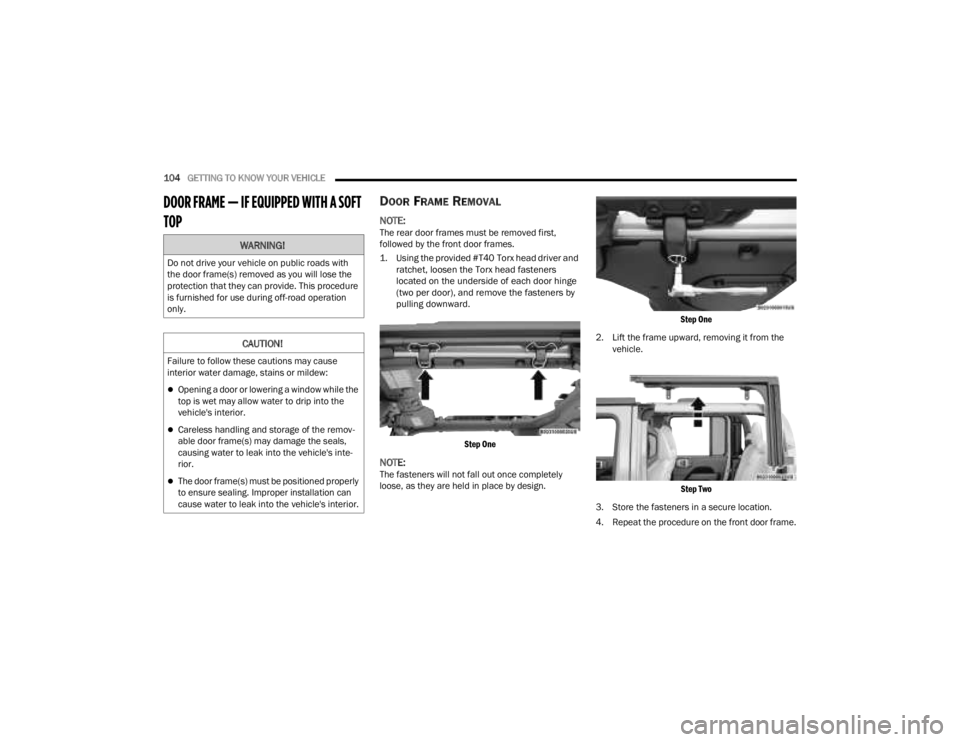
1. Using the provided #T40 Torx head driver and
ratchet, loosen the Torx head fasteners
located on the underside of each door hinge
(two per door), and remove the fasteners by
pulling downward.
Step One
NOTE:The fasteners will not fall out once completely
loose, as they are held in place by design.
Step One
2. Lift the frame upward, removing it from the vehicle.
Step Two
3. Store the fasteners in a secure location.
4. Repeat the procedure on the front door frame.
WARNING!
Do not drive your vehicle on public roads with
the door frame(s) removed as you will lose the
protection that they can provide. This procedure
is furnished for use during off-road operation
only.
CAUTION!
Failure to follow these cautions may cause
interior water damage, stains or mildew:
Opening a door or lowering a window while the
top is wet may allow water to drip into the
vehicle's interior.
Careless handling and storage of the remov -
able door frame(s) may damage the seals,
causing water to leak into the vehicle's inte -
rior.
The door frame(s) must be positioned properly
to ensure sealing. Improper installation can
cause water to leak into the vehicle's interior.
23_JT_OM_EN_USC_t.book Page 104
Page 111 of 448
GETTING TO KNOW YOUR VEHICLE109
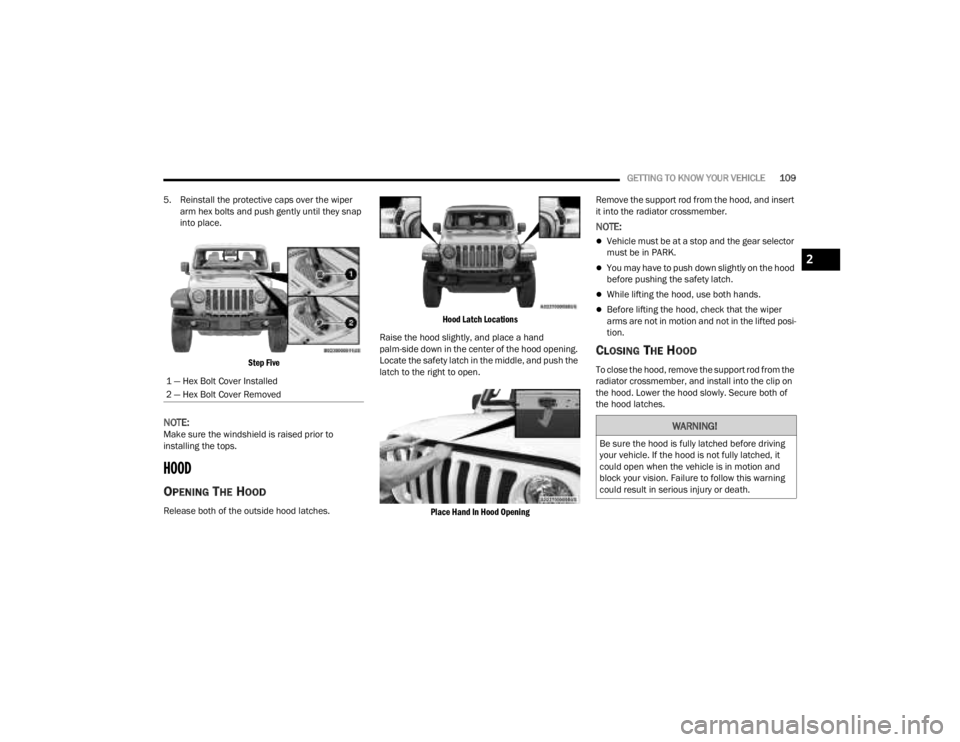
5. Reinstall the protective caps over the wiper arm hex bolts and push gently until they snap
into place.
Step Five
NOTE:Make sure the windshield is raised prior to
installing the tops.
HOOD
OPENING THE HOOD
Release both of the outside hood latches.
Hood Latch Locations
Raise the hood slightly, and place a hand
palm-side down in the center of the hood opening.
Locate the safety latch in the middle, and push the
latch to the right to open.
Place Hand In Hood Opening
Remove the support rod from the hood, and insert
it into the radiator crossmember.
NOTE:
Vehicle must be at a stop and the gear selector
must be in PARK.
You may have to push down slightly on the hood
before pushing the safety latch.
While lifting the hood, use both hands.
Before lifting the hood, check that the wiper
arms are not in motion and not in the lifted posi
-
tion.
CLOSING THE HOOD
To close the hood, remove the support rod from the
radiator crossmember, and install into the clip on
the hood. Lower the hood slowly. Secure both of
the hood latches.
1 — Hex Bolt Cover Installed
2 — Hex Bolt Cover Removed
WARNING!
Be sure the hood is fully latched before driving
your vehicle. If the hood is not fully latched, it
could open when the vehicle is in motion and
block your vision. Failure to follow this warning
could result in serious injury or death.
2
23_JT_OM_EN_USC_t.book Page 109
Page 113 of 448
GETTING TO KNOW YOUR VEHICLE111
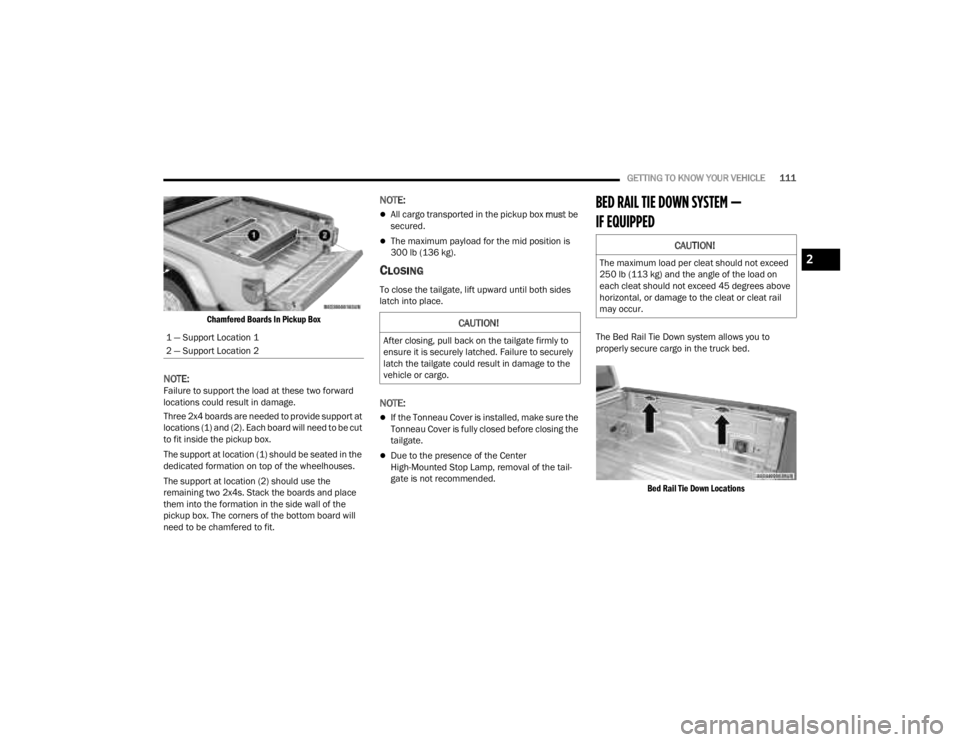
Chamfered Boards In Pickup Box
NOTE:Failure to support the load at these two forward
locations could result in damage.
Three 2x4 boards are needed to provide support at
locations (1) and (2). Each board will need to be cut
to fit inside the pickup box.
The support at location (1) should be seated in the
dedicated formation on top of the wheelhouses.
The support at location (2) should use the
remaining two 2x4s. Stack the boards and place
them into the formation in the side wall of the
pickup box. The corners of the bottom board will
need to be chamfered to fit.
NOTE:
All cargo transported in the pickup box must be
secured.
The maximum payload for the mid position is
300 lb (136 kg).
CLOSING
To close the tailgate, lift upward until both sides
latch into place.
NOTE:
If the Tonneau Cover is installed, make sure the
Tonneau Cover is fully closed before closing the
tailgate.
Due to the presence of the Center
High-Mounted Stop Lamp, removal of the tail -
gate is not recommended.
BED RAIL TIE DOWN SYSTEM —
IF EQUIPPED
The Bed Rail Tie Down system allows you to
properly secure cargo in the truck bed.
Bed Rail Tie Down Locations
1 — Support Location 1
2 — Support Location 2
CAUTION!
After closing, pull back on the tailgate firmly to
ensure it is securely latched. Failure to securely
latch the tailgate could result in damage to the
vehicle or cargo.
CAUTION!
The maximum load per cleat should not exceed
250 lb (113 kg) and the angle of the load on
each cleat should not exceed 45 degrees above
horizontal, or damage to the cleat or cleat rail
may occur.2
23_JT_OM_EN_USC_t.book Page 111
Page 117 of 448
GETTING TO KNOW YOUR VEHICLE115
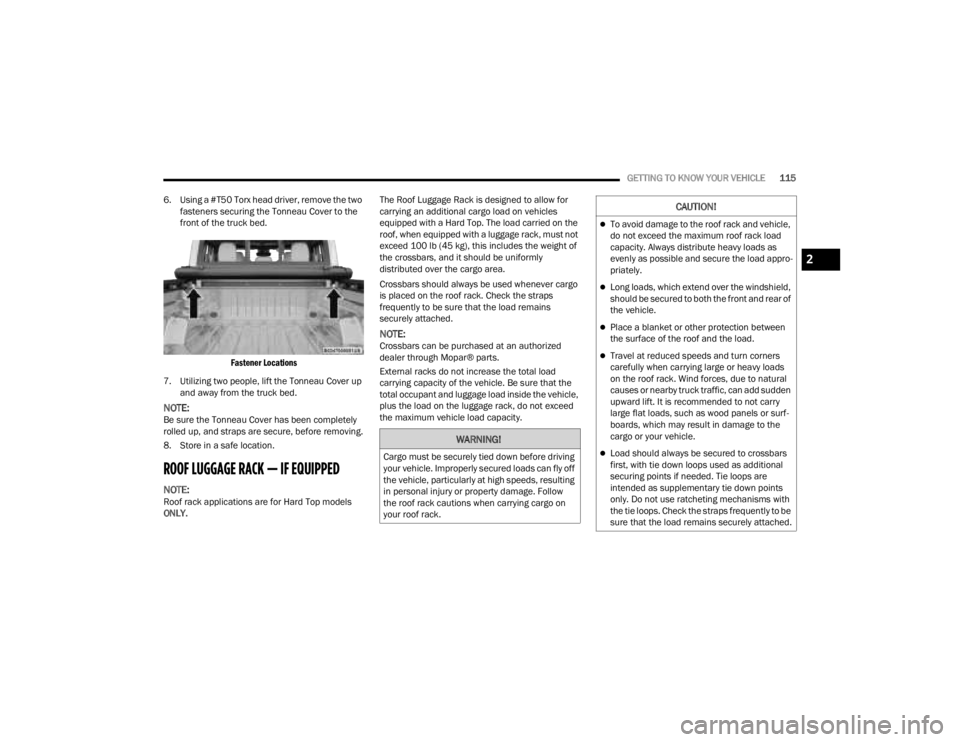
6. Using a #T50 Torx head driver, remove the two fasteners securing the Tonneau Cover to the
front of the truck bed.
Fastener Locations
7. Utilizing two people, lift the Tonneau Cover up and away from the truck bed.
NOTE:Be sure the Tonneau Cover has been completely
rolled up, and straps are secure, before removing.
8. Store in a safe location.
ROOF LUGGAGE RACK — IF EQUIPPED
NOTE:Roof rack applications are for Hard Top models
ONLY. The Roof Luggage Rack is designed to allow for
carrying an additional cargo load on vehicles
equipped with a Hard Top. The load carried on the
roof, when equipped with a luggage rack, must not
exceed 100 lb (45 kg), this includes the weight of
the crossbars, and it should be uniformly
distributed over the cargo area.
Crossbars should always be used whenever cargo
is placed on the roof rack. Check the straps
frequently to be sure that the load remains
securely attached.
NOTE:Crossbars can be purchased at an authorized
dealer through Mopar® parts.
External racks do not increase the total load
carrying capacity of the vehicle. Be sure that the
total occupant and luggage load inside the vehicle,
plus the load on the luggage rack, do not exceed
the maximum vehicle load capacity.
WARNING!
Cargo must be securely tied down before driving
your vehicle. Improperly secured loads can fly off
the vehicle, particularly at high speeds, resulting
in personal injury or property damage. Follow
the roof rack cautions when carrying cargo on
your roof rack.
CAUTION!
To avoid damage to the roof rack and vehicle,
do not exceed the maximum roof rack load
capacity. Always distribute heavy loads as
evenly as possible and secure the load appro
-
priately.
Long loads, which extend over the windshield,
should be secured to both the front and rear of
the vehicle.
Place a blanket or other protection between
the surface of the roof and the load.
Travel at reduced speeds and turn corners
carefully when carrying large or heavy loads
on the roof rack. Wind forces, due to natural
causes or nearby truck traffic, can add sudden
upward lift. It is recommended to not carry
large flat loads, such as wood panels or surf -
boards, which may result in damage to the
cargo or your vehicle.
Load should always be secured to crossbars
first, with tie down loops used as additional
securing points if needed. Tie loops are
intended as supplementary tie down points
only. Do not use ratcheting mechanisms with
the tie loops. Check the straps frequently to be
sure that the load remains securely attached.
2
23_JT_OM_EN_USC_t.book Page 115
Page 156 of 448
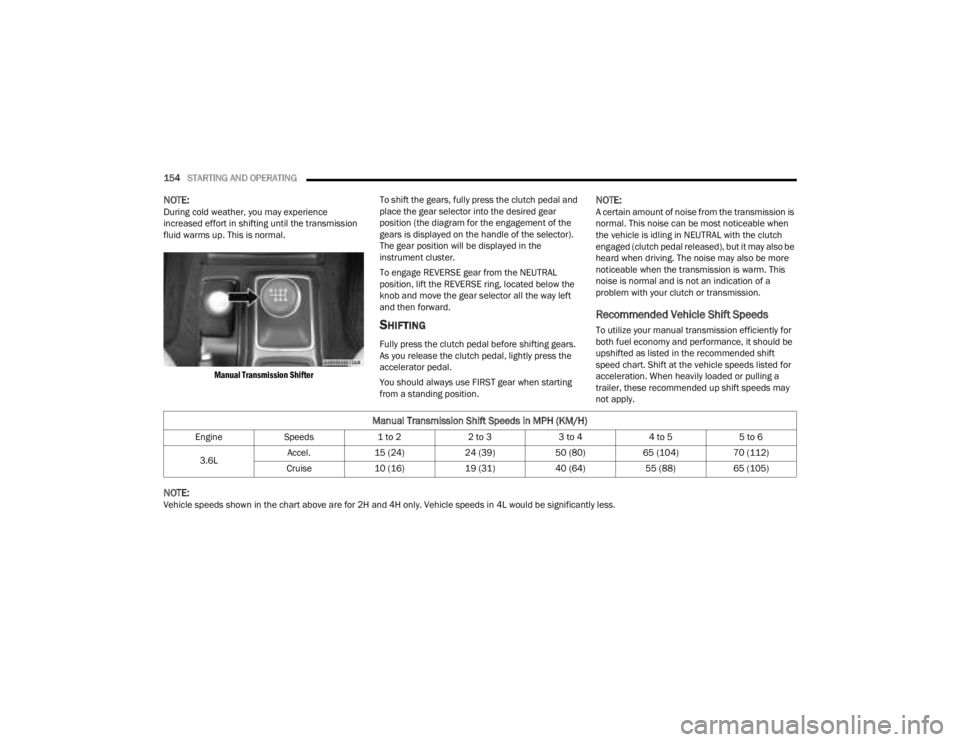
154STARTING AND OPERATING
NOTE:During cold weather, you may experience
increased effort in shifting until the transmission
fluid warms up. This is normal.
Manual Transmission Shifter
To shift the gears, fully press the clutch pedal and
place the gear selector into the desired gear
position (the diagram for the engagement of the
gears is displayed on the handle of the selector).
The gear position will be displayed in the
instrument cluster.
To engage REVERSE gear from the NEUTRAL
position, lift the REVERSE ring, located below the
knob and move the gear selector all the way left
and then forward.
SHIFTING
Fully press the clutch pedal before shifting gears.
As you release the clutch pedal, lightly press the
accelerator pedal.
You should always use FIRST gear when starting
from a standing position.
NOTE:A certain amount of noise from the transmission is
normal. This noise can be most noticeable when
the vehicle is idling in NEUTRAL with the clutch
engaged (clutch pedal released), but it may also be
heard when driving. The noise may also be more
noticeable when the transmission is warm. This
noise is normal and is not an indication of a
problem with your clutch or transmission.
Recommended Vehicle Shift Speeds
To utilize your manual transmission efficiently for
both fuel economy and performance, it should be
upshifted as listed in the recommended shift
speed chart. Shift at the vehicle speeds listed for
acceleration. When heavily loaded or pulling a
trailer, these recommended up shift speeds may
not apply.
NOTE:Vehicle speeds shown in the chart above are for 2H and 4H only. Vehicle speeds in 4L would be significantly less.
Manual Transmission Shift Speeds in MPH (KM/H)
Engine
Speeds 1 to 22 to 33 to 44 to 55 to 6
3.6L Accel.
15 (24) 24 (39)50 (80)65 (104) 70 (112)
Cruise 10 (16) 19 (31)40 (64)55 (88)65 (105)
23_JT_OM_EN_USC_t.book Page 154
Page 212 of 448

210STARTING AND OPERATING
until it makes contact with the object. Apply the
throttle lightly while holding a light brake pressure
and ease the vehicle up and over the object.
USING A SPOTTER
There are many times where it is hard to see the
obstacle or determine the correct path.
Determining the correct path can be extremely
difficult when you are confronting many obstacles.
In these cases have someone guide you over,
through, or around the obstacle. Have the person
stand a safe distance in front of you where they
can see the obstacle, watch your tires and
undercarriage, and guide you through.
CROSSING LARGE ROCKS
When approaching large rocks, choose a path
which ensures you drive over the largest of them
with your tires. This will lift your undercarriage over
the obstacle. The tread of the tire is tougher and
thicker than the side wall and is designed to take
the abuse. Always look ahead and make every
effort to cross the large rocks with your tires.
CROSSING A RAVINE, GULLY, DITCH,
WASHOUT OR RUT
When crossing a ravine, gully, ditch, washout or a
large rut, the angled approach is the key to
maintaining your vehicle's mobility. Approach
these obstacles at a 45-degree angle and let each
tire go through the obstacle independently. You
need to use caution when crossing large obstacles
with steep sides. Do not attempt to cross any large
obstacle with steep sides at an angle great enough
to put the vehicle at risk of a rollover. If you get
caught in a rut, dig a small trench to the right or left
at a 45-degree angle ahead of the front tires. Use
the removed dirt to fill the rut ahead of the turnout
you just created. You should now be able to drive
out following the trench you just created at a
45-degree angle.
CROSSING LOGS
To cross a log, approach it at a slight angle
(approximately 10 to 15 degrees). This allows one
front tire to be on top of the log while the other just
starts to climb the log. While climbing the log,
modulate your brake and accelerator to avoid
spinning the log out from under your tires. Then
ease the vehicle off the log using your brakes.
GETTING HIGH-CENTERED
If you get hung up or high-centered on an object,
get out of the vehicle and try to determine what the
vehicle is hung up on, where it is contacting the
underbody and what is the best direction to
recover the vehicle. Depending on what you are in
contact with, jack the vehicle up and place a few
rocks under the tires so the weight is off of the high
point when you let the vehicle down. You can also
try rocking the vehicle or winching the vehicle off
the object.
WARNING!
Crossing obstacles can cause abrupt steering
system loading which could cause you to lose
control of your vehicle.
CAUTION!
Never attempt to straddle a rock that is large
enough to strike your axles or undercarriage.
Never attempt to drive over a rock which is
large enough to contact the door sills.
WARNING!
There is an increased risk of rollover when
crossing an obstacle, at any angle, with steep
sides.
CAUTION!
Do not attempt to cross a log with a greater
diameter than the running ground clearance or
the vehicle will become high-centered.
CAUTION!
Winching or rocking the vehicle off hard objects
increases the risk of underbody damage.
23_JT_OM_EN_USC_t.book Page 210
Page 268 of 448

266MULTIMEDIA
The doors, hood, and trunk/liftgate are closed.
The vehicle’s check engine light must be off.
The vehicle must have at least a quarter tank of
fuel, along with oil and battery power.
The vehicle’s hazard lights must be off.
If equipped, the vehicle must have an automatic
transmission.
The vehicle must be in an open area with cell
tower reception.
Your mobile device must have a cellular or Wi-Fi
connection.
If the Panic button has been pressed, the
vehicle must be started at least once after
alarming the system.
NOTE:
The SiriusXM Guardian™ Customer Care agents are
not authorized for Remote Vehicle Start services.
Contact the Uconnect Care Team for assistance.
Remote Horn & Lights
Description
It is easy to locate a vehicle in a dark, crowded or
noisy parking area by activating the horn and
lights. It may also help if you need to draw attention
to your vehicle for any reason.
If you want, you can set up push notifications every
time a command is sent to turn on the horn and
lights. Working Vehicle Conditions
The vehicle must in PARK or at a standstill.
The vehicle must be in an open area with cell
tower reception.
Your mobile device must have a cellular or Wi-Fi
connection.
NOTE:The Remote Horn & Lights feature is designed to
be loud and get noticed. Please keep in mind the
surroundings when using this feature. You are
responsible for compliance with local laws, rules
and ordinances in the location of your vehicle
when using Remote Horn & Lights.
Assist — If Equipped
Description
Vehicles equipped with the SiriusXM Guardian™
connected services feature may contain an ASSIST
button in the vehicle. Once your SiriusXM
Guardian™ connected services have been
activated, the ASSIST button can connect you
directly to the Customer Care call center (if
equipped). You will be directed to one of the
following four services:
Roadside Assistance
— If you get a flat tire or
need a tow, you’ll be connected to someone
who can help anytime.
Connected Services — Contact the SiriusXM
Guardian™ Customer Care call center to acti -vate your services, renew after your trial has
expired, for in-vehicle support for your SiriusXM
Guardian™ connected services, or help
answering any general questions surrounding
your connected services.
Uconnect Care — In-vehicle support for all
non-connected Uconnect system features, such
as radio and Bluetooth® connections.
Vehicle Care
— Total support for your vehicle.
SiriusXM Guardian™ In-Vehicle Assistance
Features — If Equipped
With SiriusXM Guardian™, your vehicle has
onboard assistance features located on the
rearview mirror or overhead console designed to
enhance your driving experience if you should ever
need assistance or support.
How It Works
Simply push the ASSIST button in the vehicle and
you will be presented with your ASSIST options on
the touchscreen. Make your selection by pressing
the touchscreen.
Requirements
This feature is available only on vehicles sold in
the US and Canada.
Vehicle must be properly equipped with the
SiriusXM Guardian™ connected services.
Vehicle must have an operable LTE (voice/data)
or 4G (data) network connection.
23_JT_OM_EN_USC_t.book Page 266
Page 282 of 448

280SAFETY
If the ABS Warning Light is on, the brake system
should be serviced as soon as possible to restore
the benefits of Anti-Lock Brakes. If the ABS
Warning Light does not come on when the ignition
is placed in the ON/RUN mode, have the light
repaired as soon as possible.
ELECTRONIC BRAKE CONTROL (EBC)
S
YSTEM
Your vehicle is equipped with an advanced
Electronic Brake Control (EBC) system. This system
includes Anti-Lock Brake System (ABS), Brake
Assist System (BAS), Electronic Brake Force
Distribution (EBD), Electronic Roll Mitigation
(ERM), Electronic Stability Control (ESC), Hill Start
Assist (HSA), and Traction Control System (TCS).
These systems work together to enhance both
vehicle stability and control in various driving
conditions.
Your vehicle may also be equipped with Rain Brake
Support (RBS), Ready Alert Braking (RAB),
Selec-Speed Control (SSC), and Trailer Sway
Control (TSC).
Brake System Warning Light
The red Brake System Warning Light will turn on
when the ignition is placed in the ON/RUN mode,
and may stay on for as long as four seconds. If the Brake System Warning Light remains on or
comes on while driving, it indicates that the brake
system is not functioning properly and that
immediate service is required. If the Brake System
Warning Light does not come on when the ignition
is placed in the ON/RUN mode, have the light
repaired as soon as possible.
Brake Assist System (BAS)
The BAS is designed to optimize the vehicle’s
braking capability during emergency braking
maneuvers. The system detects an emergency
braking situation by sensing the rate and amount
of brake application, and then applies optimum
pressure to the brakes. This can help reduce
braking distances. The BAS complements the
Anti-Lock Brake System (ABS) by applying the
brakes very quickly, creating the most efficient
braking assistance possible. To receive the benefit
of the system, you must apply continuous braking
pressure during the stopping sequence (do not
“pump” the brakes). Do not reduce brake pedal
pressure unless braking is no longer desired. Once
the brake pedal is released, the BAS is
deactivated.
Electronic Brake Force Distribution (EBD)
The EBD function manages the distribution of the
braking torque between the front and rear axles by
limiting braking pressure to the rear axle. This is
done to prevent overslip of the rear wheels to avoid
vehicle instability, and to prevent the rear axle from
entering ABS before the front axle.
Electronic Roll Mitigation (ERM)
The ERM system anticipates the potential for
wheel lift by monitoring the driver’s steering wheel
input and the speed of the vehicle. When ERM
determines that the rate of change of the steering
wheel angle and vehicle’s speed are sufficient to
potentially cause wheel lift, it then applies the
appropriate brake and may also reduce engine
WARNING!
The Brake Assist System (BAS) cannot prevent
the natural laws of physics from acting on the
vehicle, nor can it increase the traction afforded
by prevailing road conditions. BAS cannot
prevent collisions, including those resulting from
excessive speed in turns, driving on very slippery
surfaces, or hydroplaning. The capabilities of a
BAS-equipped vehicle must never be exploited in
a reckless or dangerous manner, which could
jeopardize the user's safety or the safety of
others.
23_JT_OM_EN_USC_t.book Page 280
Page 283 of 448

SAFETY281
power to lessen the chance that wheel lift will
occur. ERM can only reduce the chance of wheel
lift occurring during severe or evasive driving
maneuvers; it cannot prevent wheel lift due to
other factors, such as road conditions, leaving the
roadway, striking objects or other vehicles.
NOTE:ERM is disabled any time the ESC is in “Full Off”
mode (if equipped). See Ú page 281 for a
complete explanation of the available ESC modes.
Electronic Stability Control (ESC)
The ESC system enhances directional control and
stability of the vehicle under various driving
conditions. ESC corrects for oversteering or
understeering of the vehicle by applying the brake of the appropriate wheel(s) to counteract the
above conditions. Engine power may also be
reduced to help the vehicle maintain the desired
path.
Oversteer — when the vehicle is turning more
than appropriate for the steering wheel position.
Understeer — when the vehicle is turning less
than appropriate for the steering wheel position.
ESC uses sensors in the vehicle to determine the
vehicle path intended by the driver and compares
it to the actual path of the vehicle. When the actual
path does not match the intended path, ESC
applies the brake of the appropriate wheel to
assist in counteracting the oversteer or understeer
condition.
The ESC Activation/Malfunction Indicator Light
located in the instrument cluster will start to flash
as soon as the ESC system becomes active. The
ESC Activation/Malfunction Indicator Light also
flashes when the Traction Control System (TCS) is
active. If the ESC Activation/Malfunction Indicator
Light begins to flash during acceleration, ease up
on the accelerator and apply as little throttle as
possible. Be sure to adapt your speed and driving
to the prevailing road conditions.
WARNING!
Many factors, such as vehicle loading, road
conditions and driving conditions, influence the
chance that wheel lift or rollover may occur. ERM
cannot prevent all wheel lift or rollovers,
especially those that involve leaving the roadway
or striking objects or other vehicles. The
capabilities of an ERM-equipped vehicle must
never be exploited in a reckless or dangerous
manner which could jeopardize the user's safety
or the safety of others.
WARNING!
Electronic Stability Control (ESC) cannot
prevent the natural laws of physics from acting
on the vehicle, nor can it increase the traction
afforded by prevailing road conditions. ESC
cannot prevent accidents, including those
resulting from excessive speed in turns, driving
on very slippery surfaces, or hydroplaning. ESC
also cannot prevent accidents resulting from
loss of vehicle control due to inappropriate
driver input for the conditions. Only a safe,
attentive, and skillful driver can prevent acci -
dents. The capabilities of an ESC equipped
vehicle must never be exploited in a reckless or
dangerous manner which could jeopardize the
user’s safety or the safety of others.
Vehicle modifications, or failure to properly
maintain your vehicle, may change the handling
characteristics of your vehicle, and may nega -
tively affect the performance of the ESC system.
Changes to the steering system, suspension,
braking system, tire type and size or wheel size
may adversely affect ESC performance. Improp -
erly inflated and unevenly worn tires may also
degrade ESC performance. Any vehicle modifi-
cation or poor vehicle maintenance that
reduces the effectiveness of the ESC system
can increase the risk of loss of vehicle control,
vehicle rollover, personal injury and death.
6
23_JT_OM_EN_USC_t.book Page 281
Page 333 of 448

SAFETY331
EXHAUST GAS The best protection against carbon monoxide entry
into the vehicle body is a properly maintained
engine exhaust system.
Whenever a change is noticed in the sound of the
exhaust system, when exhaust fumes can be
detected inside the vehicle, or when the underside
or rear of the vehicle is damaged, have an
authorized dealer inspect the complete exhaust
system and adjacent body areas for broken,
damaged, deteriorated, or mispositioned parts.
Open seams or loose connections could permit
exhaust fumes to seep into the passenger
compartment. In addition, inspect the exhaust
system each time the vehicle is raised for
lubrication or oil change. Replace as required.CARBON MONOXIDE WARNINGS
WARNING!
Exhaust gases can injure or kill. They contain
carbon monoxide (CO), which is colorless and
odorless. Breathing it can make you
unconscious and can eventually poison you. To
avoid breathing (CO), follow these safety tips:
Do not run the engine in a closed garage or in
confined areas any longer than needed to
move your vehicle in or out of the area.
If you are required to drive with the trunk/lift -
gate/rear doors open, make sure that all
windows are closed and the climate control
BLOWER switch is set at high speed. DO NOT
use the recirculation mode.
If it is necessary to sit in a parked vehicle with
the engine running, adjust your heating or
cooling controls to force outside air into the
vehicle. Set the blower at high speed.
WARNING!
Carbon monoxide (CO) in exhaust gases is
deadly. Follow the precautions below to prevent
carbon monoxide poisoning:
Do not inhale exhaust gases. They contain
carbon monoxide, a colorless and odorless
gas, which can kill. Never run the engine in a
closed area, such as a garage, and never sit in
a parked vehicle with the engine running for
an extended period. If the vehicle is stopped in
an open area with the engine running for more
than a short period, adjust the ventilation
system to force fresh, outside air into the
vehicle.
Guard against carbon monoxide with proper
maintenance. Have the exhaust system
inspected every time the vehicle is raised.
Have any abnormal conditions repaired
promptly. Until repaired, drive with all side
windows fully open.
6
23_JT_OM_EN_USC_t.book Page 331