lift JEEP GLADIATOR 2023 Service Manual
[x] Cancel search | Manufacturer: JEEP, Model Year: 2023, Model line: GLADIATOR, Model: JEEP GLADIATOR 2023Pages: 448, PDF Size: 17.37 MB
Page 370 of 448
368SERVICING AND MAINTENANCE
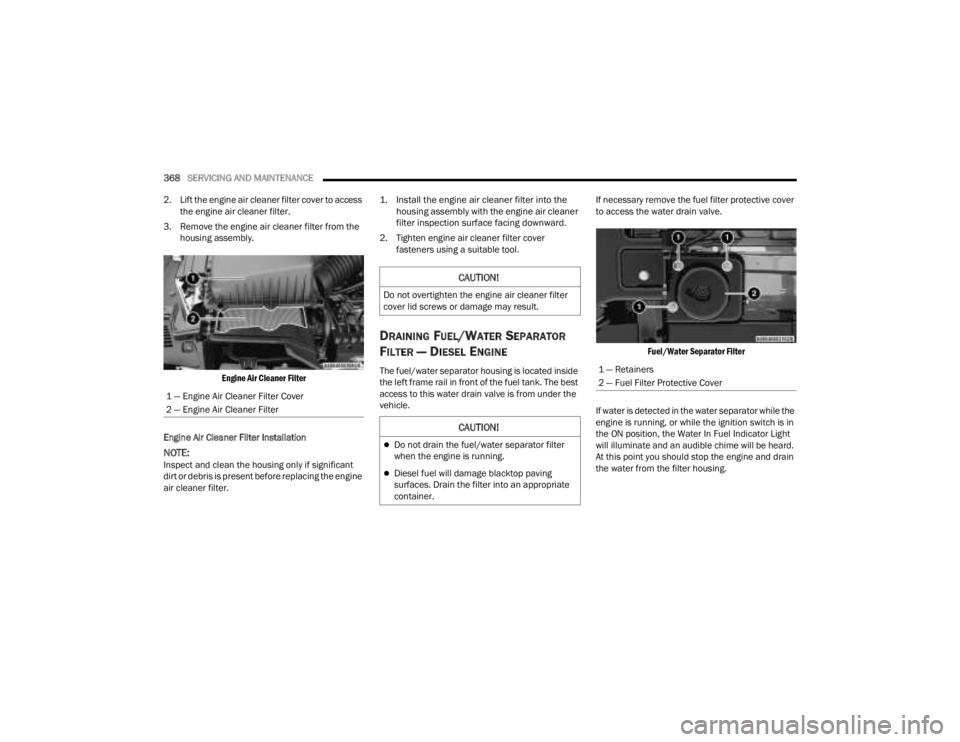
2. Lift the engine air cleaner filter cover to access the engine air cleaner filter.
3. Remove the engine air cleaner filter from the housing assembly.
Engine Air Cleaner Filter
Engine Air Cleaner Filter Installation
NOTE:Inspect and clean the housing only if significant
dirt or debris is present before replacing the engine
air cleaner filter.
1. Install the engine air cleaner filter into the
housing assembly with the engine air cleaner
filter inspection surface facing downward.
2. Tighten engine air cleaner filter cover fasteners using a suitable tool.
DRAINING FUEL/WATER SEPARATOR
F
ILTER — DIESEL ENGINE
The fuel/water separator housing is located inside
the left frame rail in front of the fuel tank. The best
access to this water drain valve is from under the
vehicle. If necessary remove the fuel filter protective cover
to access the water drain valve.
Fuel/Water Separator Filter
If water is detected in the water separator while the
engine is running, or while the ignition switch is in
the ON position, the Water In Fuel Indicator Light
will illuminate and an audible chime will be heard.
At this point you should stop the engine and drain
the water from the filter housing.
1 — Engine Air Cleaner Filter Cover
2 — Engine Air Cleaner Filter
CAUTION!
Do not overtighten the engine air cleaner filter
cover lid screws or damage may result.
CAUTION!
Do not drain the fuel/water separator filter
when the engine is running.
Diesel fuel will damage blacktop paving
surfaces. Drain the filter into an appropriate
container.
1 — Retainers
2 — Fuel Filter Protective Cover
23_JT_OM_EN_USC_t.book Page 368
Page 371 of 448
SERVICING AND MAINTENANCE369
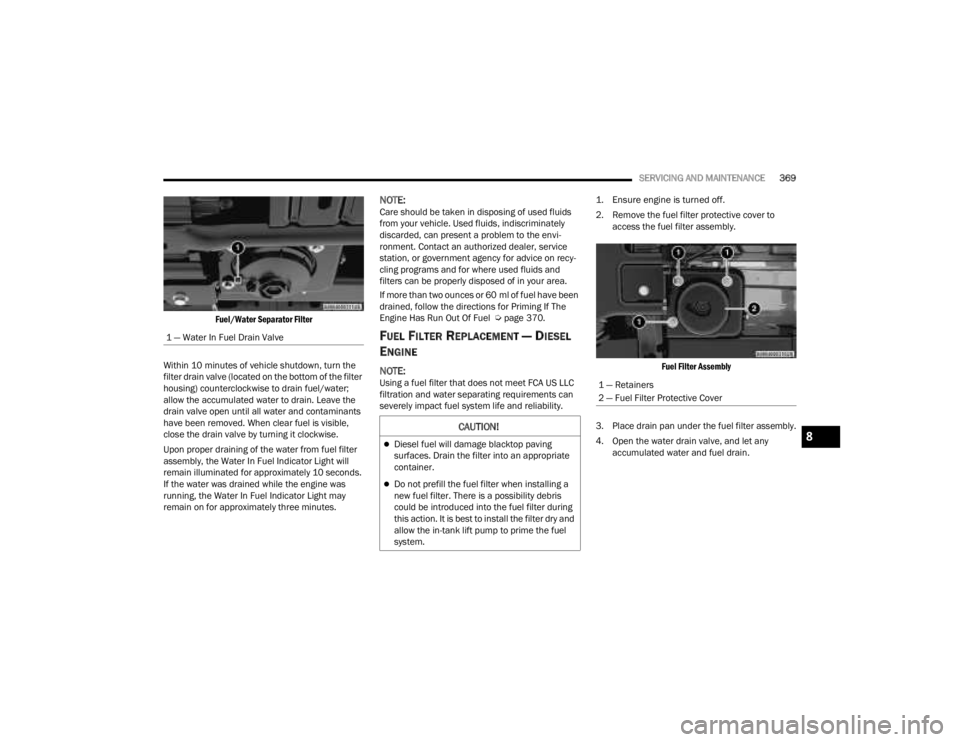
Fuel/Water Separator Filter
Within 10 minutes of vehicle shutdown, turn the
filter drain valve (located on the bottom of the filter
housing) counterclockwise to drain fuel/water;
allow the accumulated water to drain. Leave the
drain valve open until all water and contaminants
have been removed. When clear fuel is visible,
close the drain valve by turning it clockwise.
Upon proper draining of the water from fuel filter
assembly, the Water In Fuel Indicator Light will
remain illuminated for approximately 10 seconds.
If the water was drained while the engine was
running, the Water In Fuel Indicator Light may
remain on for approximately three minutes.
NOTE:Care should be taken in disposing of used fluids
from your vehicle. Used fluids, indiscriminately
discarded, can present a problem to the envi -
ronment. Contact an authorized dealer, service
station, or government agency for advice on recy -
cling programs and for where used fluids and
filters can be properly disposed of in your area.
If more than two ounces or 60 ml of fuel have been
drained, follow the directions for Priming If The
Engine Has Run Out Of Fuel Ú page 370.
FUEL FILTER REPLACEMENT — DIESEL
E
NGINE
NOTE:Using a fuel filter that does not meet FCA US LLC
filtration and water separating requirements can
severely impact fuel system life and reliability.
1. Ensure engine is turned off.
2. Remove the fuel filter protective cover to
access the fuel filter assembly.
Fuel Filter Assembly
3. Place drain pan under the fuel filter assembly.
4. Open the water drain valve, and let any accumulated water and fuel drain.
1 — Water In Fuel Drain Valve
CAUTION!
Diesel fuel will damage blacktop paving
surfaces. Drain the filter into an appropriate
container.
Do not prefill the fuel filter when installing a
new fuel filter. There is a possibility debris
could be introduced into the fuel filter during
this action. It is best to install the filter dry and
allow the in-tank lift pump to prime the fuel
system.
1 — Retainers
2 — Fuel Filter Protective Cover
8
23_JT_OM_EN_USC_t.book Page 369
Page 376 of 448
374SERVICING AND MAINTENANCE
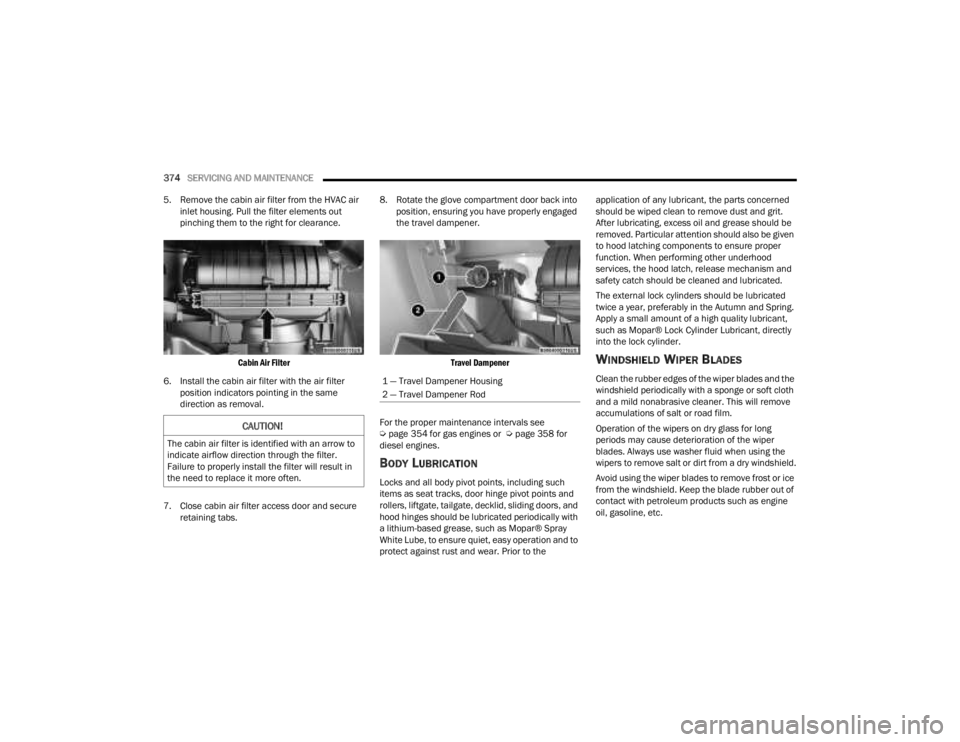
5. Remove the cabin air filter from the HVAC air inlet housing. Pull the filter elements out
pinching them to the right for clearance.
Cabin Air Filter
6. Install the cabin air filter with the air filter position indicators pointing in the same
direction as removal.
7. Close cabin air filter access door and secure retaining tabs. 8. Rotate the glove compartment door back into
position, ensuring you have properly engaged
the travel dampener.
Travel Dampener
For the proper maintenance intervals see
Ú page 354 for gas engines or Ú page 358 for
diesel engines.
BODY LUBRICATION
Locks and all body pivot points, including such
items as seat tracks, door hinge pivot points and
rollers, liftgate, tailgate, decklid, sliding doors, and
hood hinges should be lubricated periodically with
a lithium-based grease, such as Mopar® Spray
White Lube, to ensure quiet, easy operation and to
protect against rust and wear. Prior to the application of any lubricant, the parts concerned
should be wiped clean to remove dust and grit.
After lubricating, excess oil and grease should be
removed. Particular attention should also be given
to hood latching components to ensure proper
function. When performing other underhood
services, the hood latch, release mechanism and
safety catch should be cleaned and lubricated.
The external lock cylinders should be lubricated
twice a year, preferably in the Autumn and Spring.
Apply a small amount of a high quality lubricant,
such as Mopar® Lock Cylinder Lubricant, directly
into the lock cylinder.
WINDSHIELD WIPER BLADES
Clean the rubber edges of the wiper blades and the
windshield periodically with a sponge or soft cloth
and a mild nonabrasive cleaner. This will remove
accumulations of salt or road film.
Operation of the wipers on dry glass for long
periods may cause deterioration of the wiper
blades. Always use washer fluid when using the
wipers to remove salt or dirt from a dry windshield.
Avoid using the wiper blades to remove frost or ice
from the windshield. Keep the blade rubber out of
contact with petroleum products such as engine
oil, gasoline, etc.
CAUTION!
The cabin air filter is identified with an arrow to
indicate airflow direction through the filter.
Failure to properly install the filter will result in
the need to replace it more often.
1 — Travel Dampener Housing
2 — Travel Dampener Rod
23_JT_OM_EN_USC_t.book Page 374
Page 377 of 448
SERVICING AND MAINTENANCE375
NOTE:Life expectancy of wiper blades varies depending
on geographical area and frequency of use. If chat -
tering, marks, water lines, or wet spots are
present, clean the wiper blades or replace as
necessary.
The wiper blades and wiper arms should be
inspected periodically, not just when wiper
performance problems are experienced. This
inspection should include the following points:
Wear or uneven edges
Foreign material
Hardening or cracking
Deformation or fatigue
If a wiper blade or wiper arm is damaged, replace
the affected wiper arm or blade with a new unit. Do
not attempt to repair a wiper arm or blade that is
damaged.
Wiper Blade Removal/Installation
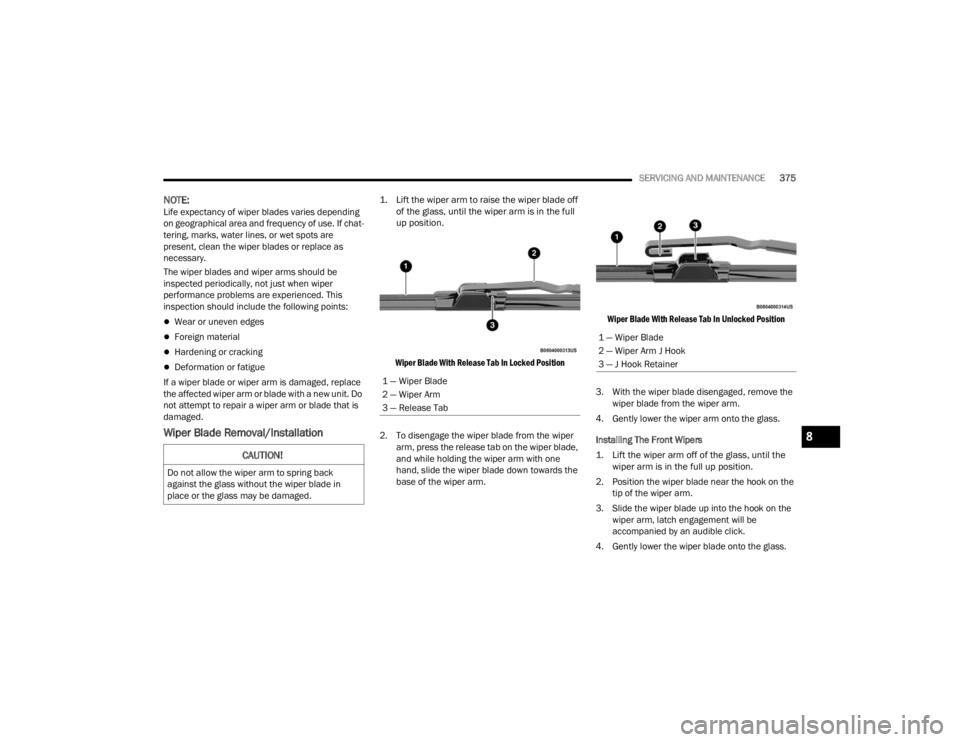
1. Lift the wiper arm to raise the wiper blade off of the glass, until the wiper arm is in the full
up position.
Wiper Blade With Release Tab In Locked Position
2. To disengage the wiper blade from the wiper arm, press the release tab on the wiper blade,
and while holding the wiper arm with one
hand, slide the wiper blade down towards the
base of the wiper arm.
Wiper Blade With Release Tab In Unlocked Position
3. With the wiper blade disengaged, remove the wiper blade from the wiper arm.
4. Gently lower the wiper arm onto the glass.
Installing The Front Wipers
1. Lift the wiper arm off of the glass, until the wiper arm is in the full up position.
2. Position the wiper blade near the hook on the tip of the wiper arm.
3. Slide the wiper blade up into the hook on the wiper arm, latch engagement will be
accompanied by an audible click.
4. Gently lower the wiper blade onto the glass.
CAUTION!
Do not allow the wiper arm to spring back
against the glass without the wiper blade in
place or the glass may be damaged.
1 — Wiper Blade
2 — Wiper Arm
3 — Release Tab
1 — Wiper Blade
2 — Wiper Arm J Hook
3 — J Hook Retainer
8
23_JT_OM_EN_USC_t.book Page 375
Page 418 of 448
416SERVICING AND MAINTENANCE
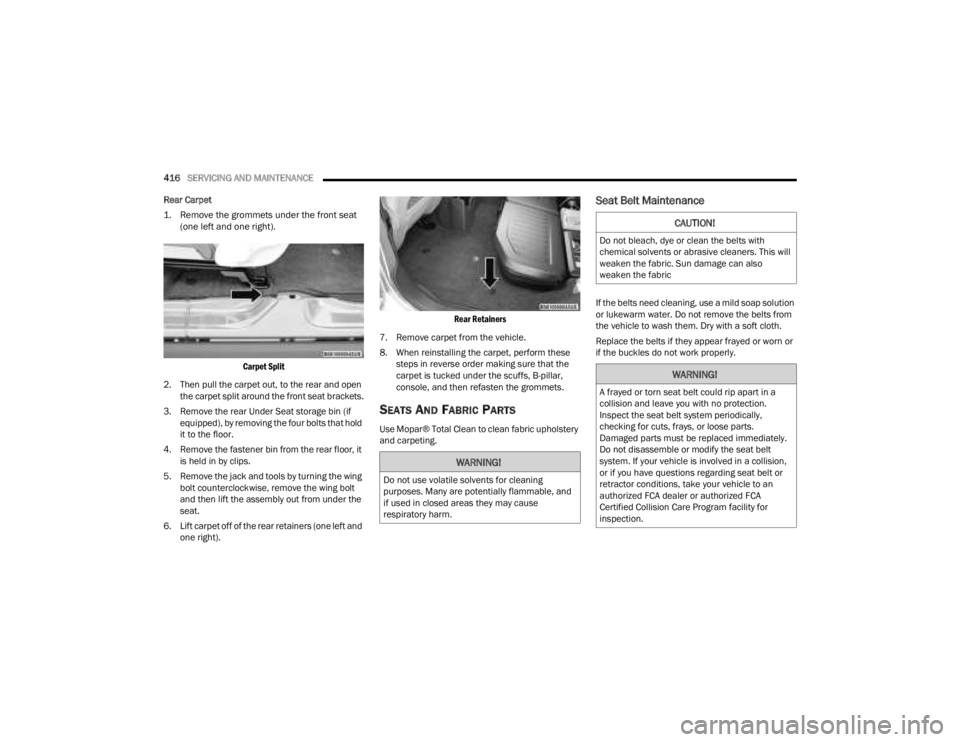
Rear Carpet
1. Remove the grommets under the front seat (one left and one right).
Carpet Split
2. Then pull the carpet out, to the rear and open the carpet split around the front seat brackets.
3. Remove the rear Under Seat storage bin (if equipped), by removing the four bolts that hold
it to the floor.
4. Remove the fastener bin from the rear floor, it is held in by clips.
5. Remove the jack and tools by turning the wing bolt counterclockwise, remove the wing bolt
and then lift the assembly out from under the
seat.
6. Lift carpet off of the rear retainers (one left and one right).
Rear Retainers
7. Remove carpet from the vehicle.
8. When reinstalling the carpet, perform these steps in reverse order making sure that the
carpet is tucked under the scuffs, B-pillar,
console, and then refasten the grommets.
SEATS AND FABRIC PARTS
Use Mopar® Total Clean to clean fabric upholstery
and carpeting.
Seat Belt Maintenance
If the belts need cleaning, use a mild soap solution
or lukewarm water. Do not remove the belts from
the vehicle to wash them. Dry with a soft cloth.
Replace the belts if they appear frayed or worn or
if the buckles do not work properly.
WARNING!
Do not use volatile solvents for cleaning
purposes. Many are potentially flammable, and
if used in closed areas they may cause
respiratory harm.
CAUTION!
Do not bleach, dye or clean the belts with
chemical solvents or abrasive cleaners. This will
weaken the fabric. Sun damage can also
weaken the fabric
WARNING!
A frayed or torn seat belt could rip apart in a
collision and leave you with no protection.
Inspect the seat belt system periodically,
checking for cuts, frays, or loose parts.
Damaged parts must be replaced immediately.
Do not disassemble or modify the seat belt
system. If your vehicle is involved in a collision,
or if you have questions regarding seat belt or
retractor conditions, take your vehicle to an
authorized FCA dealer or authorized FCA
Certified Collision Care Program facility for
inspection.
23_JT_OM_EN_USC_t.book Page 416