manual transmission JEEP GLADIATOR 2023 Service Manual
[x] Cancel search | Manufacturer: JEEP, Model Year: 2023, Model line: GLADIATOR, Model: JEEP GLADIATOR 2023Pages: 448, PDF Size: 17.37 MB
Page 338 of 448
336IN CASE OF EMERGENCY
PREPARATIONS FOR JACKING
1. Park on a firm, level surface. Avoid ice or
slippery areas.
2. Turn on the Hazard Warning Flashers.
3. Apply the parking brake.
4. Shift the automatic transmission into PARK (P), or a manual transmission into REVERSE.
5. Cycle the ignition to OFF.
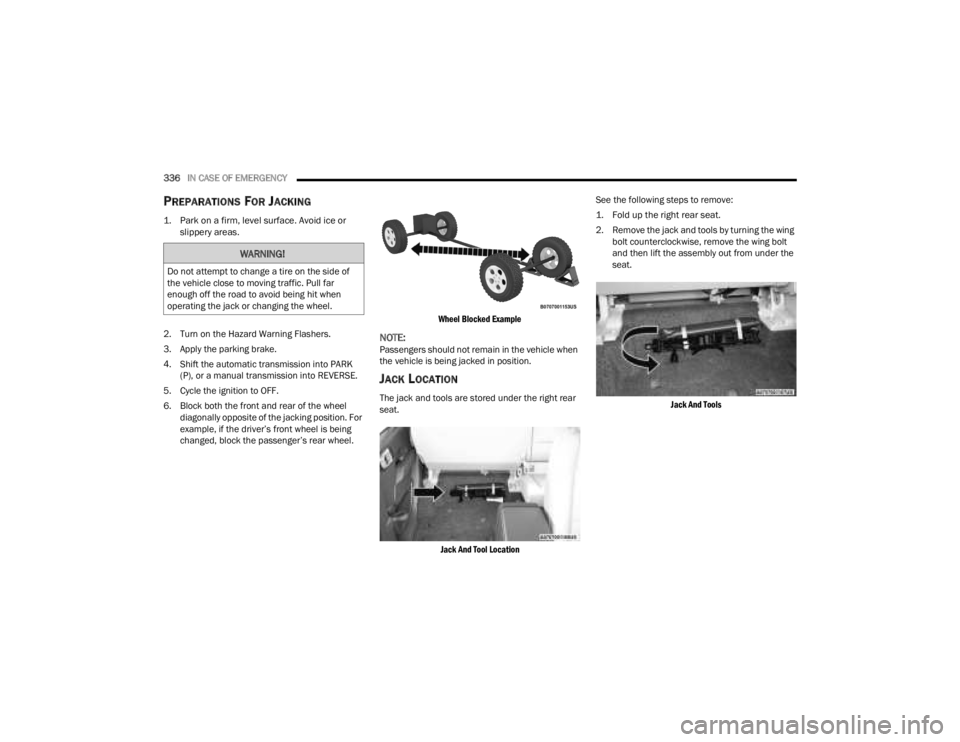
6. Block both the front and rear of the wheel diagonally opposite of the jacking position. For
example, if the driver’s front wheel is being
changed, block the passenger’s rear wheel.
Wheel Blocked Example
NOTE:Passengers should not remain in the vehicle when
the vehicle is being jacked in position.
JACK LOCATION
The jack and tools are stored under the right rear
seat.
Jack And Tool Location
See the following steps to remove:
1. Fold up the right rear seat.
2. Remove the jack and tools by turning the wing
bolt counterclockwise, remove the wing bolt
and then lift the assembly out from under the
seat.
Jack And Tools
WARNING!
Do not attempt to change a tire on the side of
the vehicle close to moving traffic. Pull far
enough off the road to avoid being hit when
operating the jack or changing the wheel.
23_JT_OM_EN_USC_t.book Page 336
Page 341 of 448
IN CASE OF EMERGENCY339
(Continued)
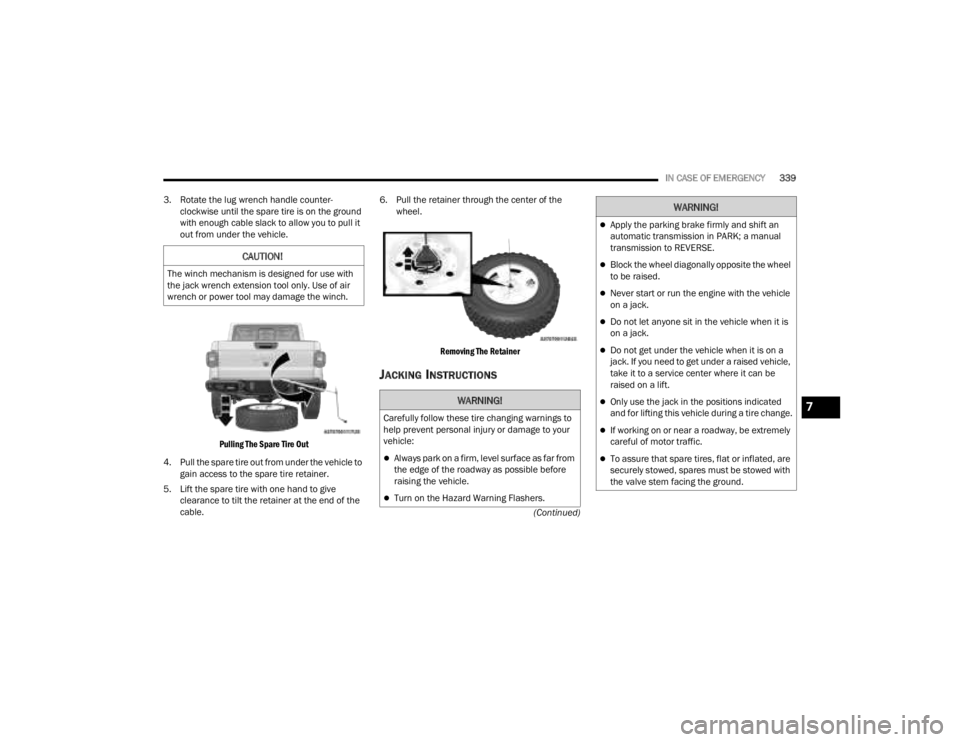
3. Rotate the lug wrench handle counter-
clockwise until the spare tire is on the ground
with enough cable slack to allow you to pull it
out from under the vehicle.
Pulling The Spare Tire Out
4. Pull the spare tire out from under the vehicle to gain access to the spare tire retainer.
5. Lift the spare tire with one hand to give clearance to tilt the retainer at the end of the
cable. 6. Pull the retainer through the center of the
wheel.
Removing The Retainer
JACKING INSTRUCTIONS
CAUTION!
The winch mechanism is designed for use with
the jack wrench extension tool only. Use of air
wrench or power tool may damage the winch.
WARNING!
Carefully follow these tire changing warnings to
help prevent personal injury or damage to your
vehicle:
Always park on a firm, level surface as far from
the edge of the roadway as possible before
raising the vehicle.
Turn on the Hazard Warning Flashers.
Apply the parking brake firmly and shift an
automatic transmission in PARK; a manual
transmission to REVERSE.
Block the wheel diagonally opposite the wheel
to be raised.
Never start or run the engine with the vehicle
on a jack.
Do not let anyone sit in the vehicle when it is
on a jack.
Do not get under the vehicle when it is on a
jack. If you need to get under a raised vehicle,
take it to a service center where it can be
raised on a lift.
Only use the jack in the positions indicated
and for lifting this vehicle during a tire change.
If working on or near a roadway, be extremely
careful of motor traffic.
To assure that spare tires, flat or inflated, are
securely stowed, spares must be stowed with
the valve stem facing the ground.
WARNING!
7
23_JT_OM_EN_USC_t.book Page 339
Page 346 of 448
344IN CASE OF EMERGENCY
(Continued)
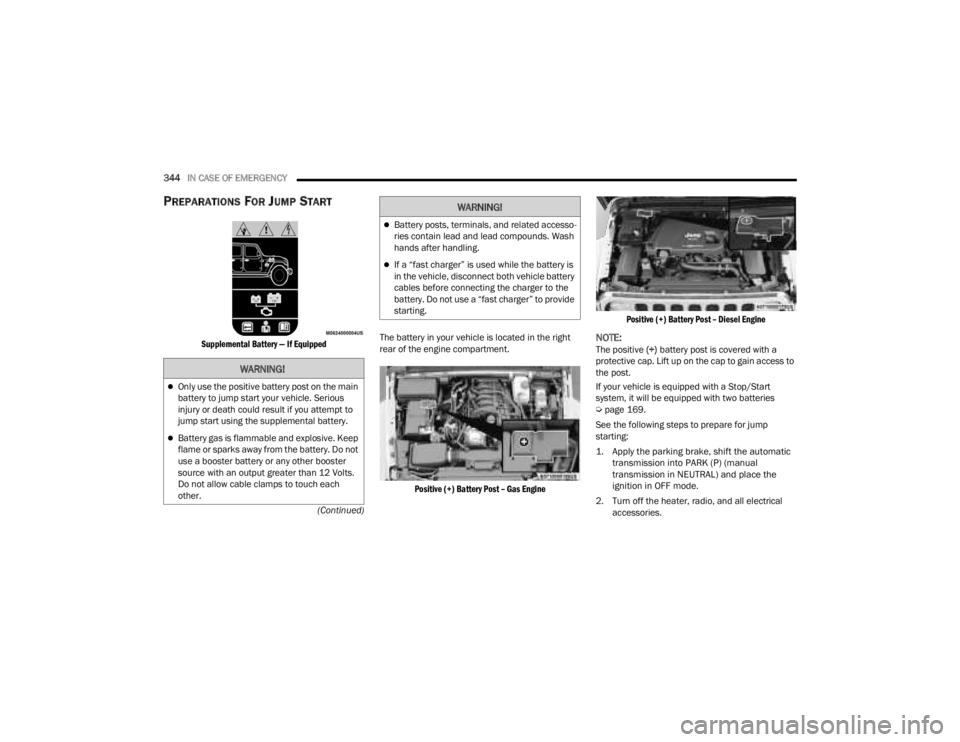
PREPARATIONS FOR JUMP START
Supplemental Battery — If Equipped
The battery in your vehicle is located in the right
rear of the engine compartment.
Positive (+) Battery Post – Gas Engine Positive (+) Battery Post – Diesel Engine
NOTE:The positive
(+) battery post is covered with a
protective cap. Lift up on the cap to gain access to
the post.
If your vehicle is equipped with a Stop/Start
system, it will be equipped with two batteries
Ú page 169.
See the following steps to prepare for jump
starting:
1. Apply the parking brake, shift the automatic transmission into PARK (P) (manual
transmission in NEUTRAL) and place the
ignition in OFF mode.
2. Turn off the heater, radio, and all electrical accessories.
WARNING!
Only use the positive battery post on the main
battery to jump start your vehicle. Serious
injury or death could result if you attempt to
jump start using the supplemental battery.
Battery gas is flammable and explosive. Keep
flame or sparks away from the battery. Do not
use a booster battery or any other booster
source with an output greater than 12 Volts.
Do not allow cable clamps to touch each
other.
Battery posts, terminals, and related accesso -
ries contain lead and lead compounds. Wash
hands after handling.
If a “fast charger” is used while the battery is
in the vehicle, disconnect both vehicle battery
cables before connecting the charger to the
battery. Do not use a “fast charger” to provide
starting.
WARNING!
23_JT_OM_EN_USC_t.book Page 344
Page 350 of 448
348IN CASE OF EMERGENCY
In the event it is observed that the temperature
gauge is moving towards or close to the HOT (H)
position, you can reduce the potential for
overheating by taking the appropriate action.
On the highways — slow down.
In city traffic — while stopped, place the trans -
mission in NEUTRAL (N), but do not increase the
engine idle speed while preventing vehicle
motion with the brakes.
If your Air Conditioner (A/C) is on, turn it off. The
A/C system adds heat to the engine cooling
system and turning the A/C off can help remove
this heat.
You can also turn the temperature control to
maximum heat, the mode control to floor and
the blower control to high. This allows the heater
core to act as a supplement to the radiator and
aids in removing heat from the engine cooling
system.
MANUAL PARK RELEASE
In order to move the vehicle in cases where the
transmission will not shift out of Park (P) (such as
a depleted battery), a Manual Park Release is
available. See the following steps to use the Manual Park
Release:
1. Firmly apply the parking brake.
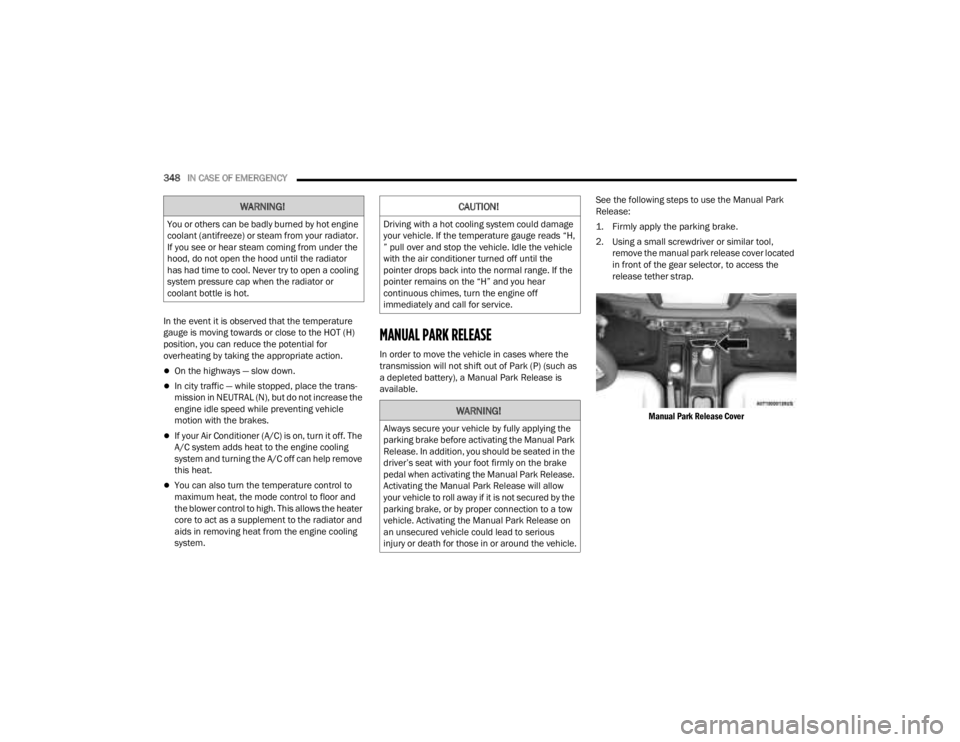
2. Using a small screwdriver or similar tool,
remove the manual park release cover located
in front of the gear selector, to access the
release tether strap.
Manual Park Release Cover
WARNING!
You or others can be badly burned by hot engine
coolant (antifreeze) or steam from your radiator.
If you see or hear steam coming from under the
hood, do not open the hood until the radiator
has had time to cool. Never try to open a cooling
system pressure cap when the radiator or
coolant bottle is hot.
CAUTION!
Driving with a hot cooling system could damage
your vehicle. If the temperature gauge reads “H,
” pull over and stop the vehicle. Idle the vehicle
with the air conditioner turned off until the
pointer drops back into the normal range. If the
pointer remains on the “H” and you hear
continuous chimes, turn the engine off
immediately and call for service.
WARNING!
Always secure your vehicle by fully applying the
parking brake before activating the Manual Park
Release. In addition, you should be seated in the
driver’s seat with your foot firmly on the brake
pedal when activating the Manual Park Release.
Activating the Manual Park Release will allow
your vehicle to roll away if it is not secured by the
parking brake, or by proper connection to a tow
vehicle. Activating the Manual Park Release on
an unsecured vehicle could lead to serious
injury or death for those in or around the vehicle.
23_JT_OM_EN_USC_t.book Page 348
Page 351 of 448
IN CASE OF EMERGENCY349
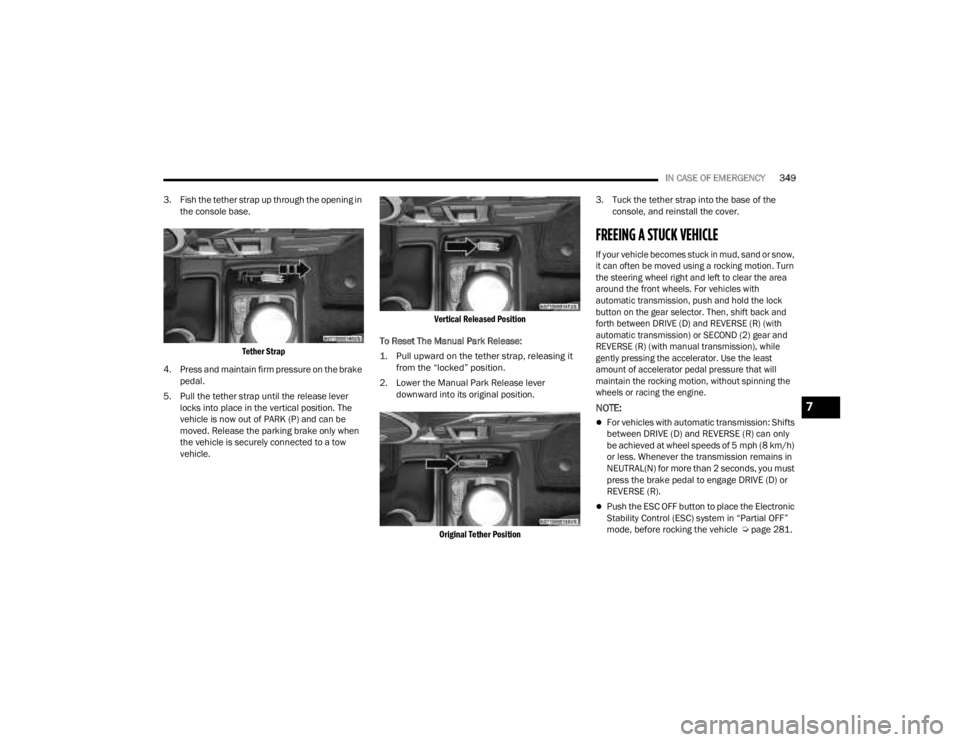
3. Fish the tether strap up through the opening in the console base.
Tether Strap
4. Press and maintain firm pressure on the brake pedal.
5. Pull the tether strap until the release lever locks into place in the vertical position. The
vehicle is now out of PARK (P) and can be
moved. Release the parking brake only when
the vehicle is securely connected to a tow
vehicle.
Vertical Released Position
To Reset The Manual Park Release:
1. Pull upward on the tether strap, releasing it from the “locked” position.
2. Lower the Manual Park Release lever downward into its original position.
Original Tether Position
3. Tuck the tether strap into the base of the
console, and reinstall the cover.
FREEING A STUCK VEHICLE
If your vehicle becomes stuck in mud, sand or snow,
it can often be moved using a rocking motion. Turn
the steering wheel right and left to clear the area
around the front wheels. For vehicles with
automatic transmission, push and hold the lock
button on the gear selector. Then, shift back and
forth between DRIVE (D) and REVERSE (R) (with
automatic transmission) or SECOND (2) gear and
REVERSE (R) (with manual transmission), while
gently pressing the accelerator. Use the least
amount of accelerator pedal pressure that will
maintain the rocking motion, without spinning the
wheels or racing the engine.
NOTE:
For vehicles with automatic transmission: Shifts
between DRIVE (D) and REVERSE (R) can only
be achieved at wheel speeds of 5 mph (8 km/h)
or less. Whenever the transmission remains in
NEUTRAL(N) for more than 2 seconds, you must
press the brake pedal to engage DRIVE (D) or
REVERSE (R).
Push the ESC OFF button to place the Electronic
Stability Control (ESC) system in “Partial OFF”
mode, before rocking the vehicle Ú page 281.
7
23_JT_OM_EN_USC_t.book Page 349
Page 352 of 448

350IN CASE OF EMERGENCY
(Continued)
Once the vehicle has been freed, push the ESC
OFF button again to restore “ESC On” mode.
TOWING A DISABLED VEHICLE
This section describes procedures for towing a disabled vehicle using a commercial towing service. If the transmission and drivetrain are operable, disabled
vehicles may also be towed as described on Ú
page 205.
WARNING!
Fast spinning tires can be dangerous. Forces
generated by excessive wheel speeds may
cause damage, or even failure, of the axle and
tires. A tire could explode and injure someone.
Do not spin your vehicle's wheels faster than
30 mph (48 km/h) or for longer than 30 sec-
onds continuously without stopping when you
are stuck and do not let anyone near a spinning
wheel, no matter what the speed.
CAUTION!
Racing the engine or spinning the wheels may
lead to transmission overheating and failure.
Allow the engine to idle with the transmission
in NEUTRAL (N) for at least one minute after
every five rocking-motion cycles. This will mini -
mize overheating and reduce the risk of clutch
or transmission failure during prolonged
efforts to free a stuck vehicle.When “rocking” a stuck vehicle by shifting
between DRIVE/SECOND gear and REVERSE,
do not spin the wheels faster than 15 mph
(24 km/h), or drivetrain damage may result.
Revving the engine or spinning the wheels too
fast may lead to transmission overheating and
failure. It can also damage the tires. Do not
spin the wheels above 30 mph (48 km/h) while
in gear (no transmission shifting occurring).
CAUTION!
Towing Condition Wheels OFF The Ground 4WD MODELS
Flat Tow NONE
Automatic Transmission in PARK (P)
Manual Transmission in gear ( NOT in NEUTRAL)
Transfer Case in NEUTRAL (N)
Tow in forward direction
Wheel Lift Or Dolly Tow Front
NOT ALLOWED
Rear NOT ALLOWED
Flatbed ALLBEST METHOD
NOTE:When towing your vehicle, always follow applicable state and provincial laws. Contact state and provincial Highway Safety offices for additional details.
23_JT_OM_EN_USC_t.book Page 350
Page 353 of 448
IN CASE OF EMERGENCY351
Proper towing or lifting equipment is required to
prevent damage to your vehicle. Use only tow bars
and other equipment designed for this purpose,
following equipment manufacturer’s instructions.
Use of safety chains is mandatory. Attach a tow bar
or other towing device to main structural members
of the vehicle, not to fascia/bumpers or associated
brackets. State and local laws regarding vehicles
under tow must be observed.
If you must use the accessories (wipers,
defrosters, etc.) while being towed, the ignition
must be in the ON/RUN position, not the ACC
position.
If the vehicle's battery is discharged, instructions
on shifting the automatic transmission out of
PARK (P) in order to move the vehicle Úpage 348.
FOUR–WHEEL DRIVE MODELS
FCA LLC US recommends towing with all wheels
OFF the ground. Acceptable methods are to tow
the vehicle on a flatbed or with one end of the
vehicle raised and the opposite end on a towing
dolly.
If flatbed equipment is not available and the
transfer case is operable, the vehicle may be
towed (in the forward direction, with ALL wheels on
the ground), IF the transfer case is in NEUTRAL (N)
and the transmission is in PARK (P) (for automatic
transmissions) or in gear ( NOT in NEUTRAL , for
manual transmissions) Ú page 205.
WITHOUT THE KEY FOB
Special care must be taken when the vehicle is
towed with the ignition in the OFF position. The only
approved method of towing without the key fob is
with a flatbed truck. Proper towing equipment is
necessary to prevent damage to the vehicle.
EMERGENCY TOW HOOKS —
I
F EQUIPPED
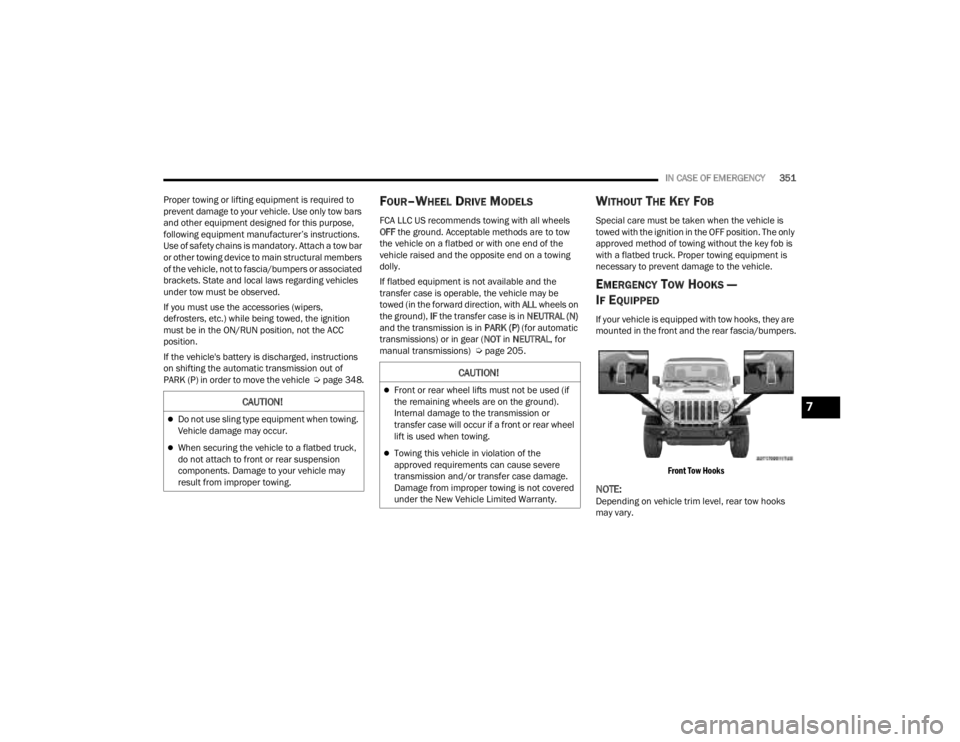
If your vehicle is equipped with tow hooks, they are
mounted in the front and the rear fascia/bumpers.
Front Tow Hooks
NOTE:Depending on vehicle trim level, rear tow hooks
may vary.
CAUTION!
Do not use sling type equipment when towing.
Vehicle damage may occur.
When securing the vehicle to a flatbed truck,
do not attach to front or rear suspension
components. Damage to your vehicle may
result from improper towing.
CAUTION!
Front or rear wheel lifts must not be used (if
the remaining wheels are on the ground).
Internal damage to the transmission or
transfer case will occur if a front or rear wheel
lift is used when towing.
Towing this vehicle in violation of the
approved requirements can cause severe
transmission and/or transfer case damage.
Damage from improper towing is not covered
under the New Vehicle Limited Warranty.
7
23_JT_OM_EN_USC_t.book Page 351
Page 358 of 448

356SERVICING AND MAINTENANCE
Change the manual transmission fluid if using your vehicle for
any of the following: trailer towing, snow plowing, heavy
loading, taxi, police, delivery service (commercial service),
off-road, desert operation or more than 50% of your driving is
at sustained high speeds during hot weather, above 90°F
(32°C). X
XXXX
Change transfer case fluid if using your vehicle for any of the
following: police, taxi, fleet, or frequent trailer towing. X
X
Inspect and replace PCV valve if necessary. X
Change front and rear axle fluid if using your vehicle for police,
taxi, fleet, off-road or frequent trailer towing. X
XX
1. The spark plug change interval is mileage based only, yearly intervals do not apply.
Mileage Or Time Passed (Whichever Comes First)
20,000
30,000
40,000
50,000
60,000
70,000
80,000
90,000
100,000
110,000
120,000
130,000
140,000
150,000
Or Years: 2 3 4 5 6 7 8 9 10 11 12 13 14 15
Or Kilometers:
32,000
48,000
64,000
80,000
96,000
112,000
128,000
144,000
160,000
176,000
192,000
208,000
224,000
240,000
WARNING!
You can be badly injured working on or around a motor vehicle. Do only service work for which you have the knowledge and the right equipment. If you have
any doubt about your ability to perform a service job, take your vehicle to a competent mechanic.
Failure to properly inspect and maintain your vehicle could result in a component malfunction and affect vehicle handling and performance. This could cause
an accident.
23_JT_OM_EN_USC_t.book Page 356
Page 383 of 448
SERVICING AND MAINTENANCE381
TRANSFER CASE
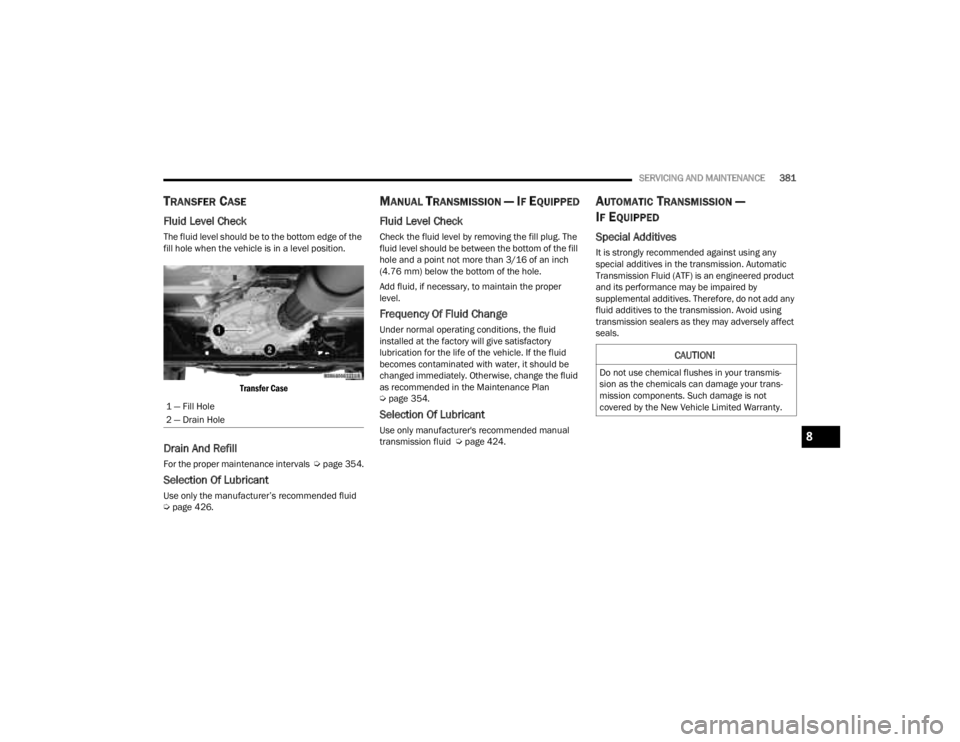
Fluid Level Check
The fluid level should be to the bottom edge of the
fill hole when the vehicle is in a level position.
Transfer Case
Drain And Refill
For the proper maintenance intervals Úpage 354.
Selection Of Lubricant
Use only the manufacturer’s recommended fluid
Úpage 426.
MANUAL TRANSMISSION — IF EQUIPPED
Fluid Level Check
Check the fluid level by removing the fill plug. The
fluid level should be between the bottom of the fill
hole and a point not more than 3/16 of an inch
(4.76 mm) below the bottom of the hole.
Add fluid, if necessary, to maintain the proper
level.
Frequency Of Fluid Change
Under normal operating conditions, the fluid
installed at the factory will give satisfactory
lubrication for the life of the vehicle. If the fluid
becomes contaminated with water, it should be
changed immediately. Otherwise, change the fluid
as recommended in the Maintenance Plan
Úpage 354.
Selection Of Lubricant
Use only manufacturer's recommended manual
transmission fluid Ú page 424.
AUTOMATIC TRANSMISSION —
I
F EQUIPPED
Special Additives
It is strongly recommended against using any
special additives in the transmission. Automatic
Transmission Fluid (ATF) is an engineered product
and its performance may be impaired by
supplemental additives. Therefore, do not add any
fluid additives to the transmission. Avoid using
transmission sealers as they may adversely affect
seals.
1 — Fill Hole
2 — Drain Hole
CAUTION!
Do not use chemical flushes in your transmis -
sion as the chemicals can damage your trans -
mission components. Such damage is not
covered by the New Vehicle Limited Warranty.
8
23_JT_OM_EN_USC_t.book Page 381
Page 429 of 448

TECHNICAL SPECIFICATIONS427
CHASSIS FLUIDS AND LUBRICANTS
Component Fluid, Lubricant, or Genuine Part
Automatic Transmission – If Equipped
Use only Mopar® ZF 8 & 9 Speed ATF Automatic Transmission Fluid or
equivalent. Failure to use the correct fluid may affect the function or
performance of your transmission.
Manual Transmission – If Equipped We recommend using Mopar® ATF+4 Automatic Transmission Fluid.
Transfer Case We recommend using Mopar® ATF+4 Automatic Transmission Fluid.
Front Axle Differential We recommend using Mopar® Gear & Axle Lubricant (SAE 75W85) (API GL-5).
Rear Axle Differential (M220 Sales Codes DRE/DRF) We recommend using Mopar® Gear & Axle Lubricant (SAE 75W85) (API GL-5).
Models equipped with Trac-Lok Limited Slip Differential require a friction
modifier additive.
Brake Master Cylinder We recommend using Mopar® DOT 3 Brake Fluid, SAE J1703.
Power Steering Reservoir We recommend using Mopar® Electric Steering Pump Fluid.
9
23_JT_OM_EN_USC_t.book Page 427