parking brake JEEP GLADIATOR 2023 Service Manual
[x] Cancel search | Manufacturer: JEEP, Model Year: 2023, Model line: GLADIATOR, Model: JEEP GLADIATOR 2023Pages: 448, PDF Size: 17.37 MB
Page 346 of 448
344IN CASE OF EMERGENCY
(Continued)
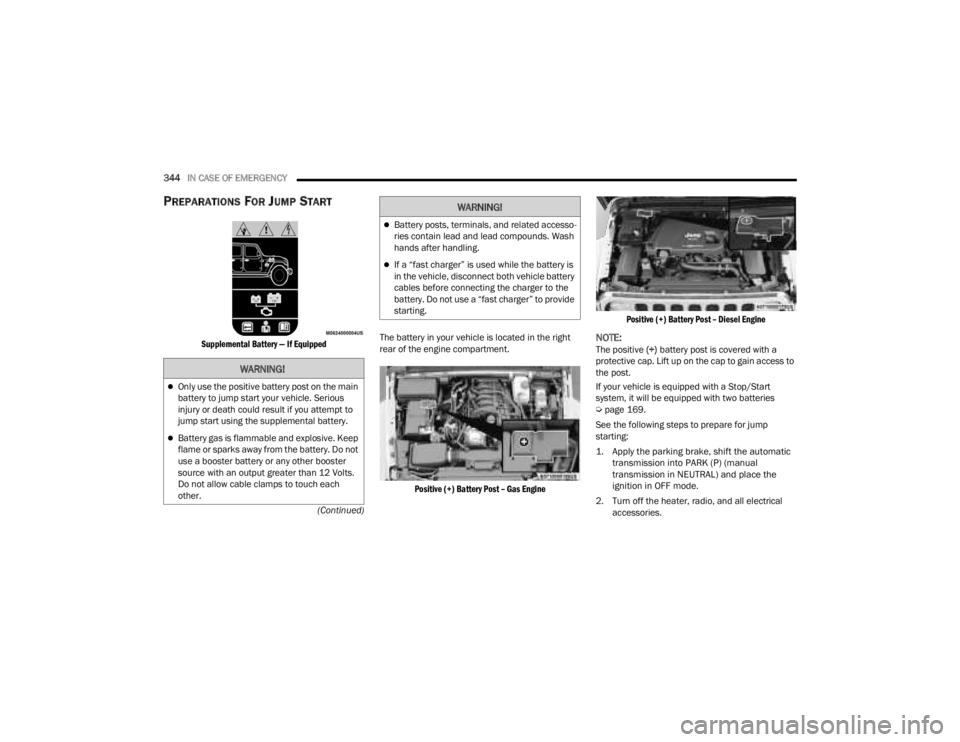
PREPARATIONS FOR JUMP START
Supplemental Battery — If Equipped
The battery in your vehicle is located in the right
rear of the engine compartment.
Positive (+) Battery Post – Gas Engine Positive (+) Battery Post – Diesel Engine
NOTE:The positive
(+) battery post is covered with a
protective cap. Lift up on the cap to gain access to
the post.
If your vehicle is equipped with a Stop/Start
system, it will be equipped with two batteries
Ú page 169.
See the following steps to prepare for jump
starting:
1. Apply the parking brake, shift the automatic transmission into PARK (P) (manual
transmission in NEUTRAL) and place the
ignition in OFF mode.
2. Turn off the heater, radio, and all electrical accessories.
WARNING!
Only use the positive battery post on the main
battery to jump start your vehicle. Serious
injury or death could result if you attempt to
jump start using the supplemental battery.
Battery gas is flammable and explosive. Keep
flame or sparks away from the battery. Do not
use a booster battery or any other booster
source with an output greater than 12 Volts.
Do not allow cable clamps to touch each
other.
Battery posts, terminals, and related accesso -
ries contain lead and lead compounds. Wash
hands after handling.
If a “fast charger” is used while the battery is
in the vehicle, disconnect both vehicle battery
cables before connecting the charger to the
battery. Do not use a “fast charger” to provide
starting.
WARNING!
23_JT_OM_EN_USC_t.book Page 344
Page 347 of 448
IN CASE OF EMERGENCY345
3. If using another vehicle to jump start the battery, park the vehicle within the jumper
cable’s reach, apply the parking brake and
make sure the ignition is OFF.
JUMP STARTING PROCEDURE
NOTE:Make sure at all times that unused ends of jumper
cables are not contacting each other or either
vehicle while making connections.
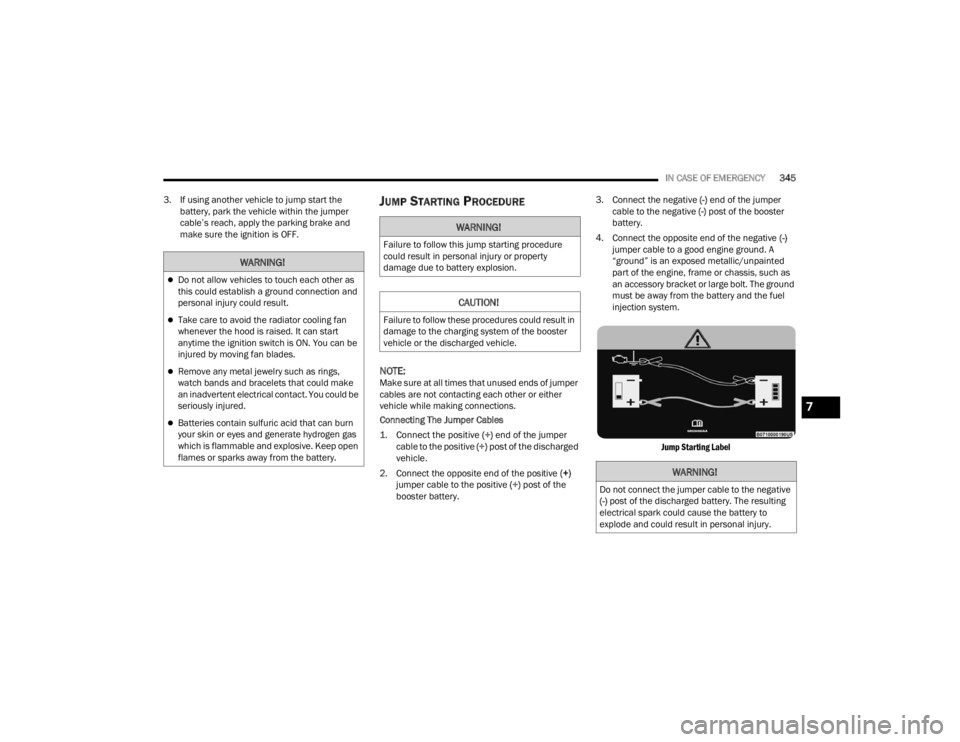
Connecting The Jumper Cables
1. Connect the positive
(+) end of the jumper
cable to the positive (+)
post of the discharged
vehicle.
2. Connect the opposite end of the positive (+)
jumper cable to the positive (+) post of the
booster battery. 3. Connect the negative
(-) end of the jumper
cable to the negative (-) post of the booster
battery.
4. Connect the opposite end of the negative (-)
jumper cable to a good engine ground. A
“ground” is an exposed metallic/unpainted
part of the engine, frame or chassis, such as
an accessory bracket or large bolt. The ground
must be away from the battery and the fuel
injection system.
Jump Starting Label
WARNING!
Do not allow vehicles to touch each other as
this could establish a ground connection and
personal injury could result.
Take care to avoid the radiator cooling fan
whenever the hood is raised. It can start
anytime the ignition switch is ON. You can be
injured by moving fan blades.
Remove any metal jewelry such as rings,
watch bands and bracelets that could make
an inadvertent electrical contact. You could be
seriously injured.
Batteries contain sulfuric acid that can burn
your skin or eyes and generate hydrogen gas
which is flammable and explosive. Keep open
flames or sparks away from the battery.
WARNING!
Failure to follow this jump starting procedure
could result in personal injury or property
damage due to battery explosion.
CAUTION!
Failure to follow these procedures could result in
damage to the charging system of the booster
vehicle or the discharged vehicle.
WARNING!
Do not connect the jumper cable to the negative
(-) post of the discharged battery. The resulting
electrical spark could cause the battery to
explode and could result in personal injury.
7
23_JT_OM_EN_USC_t.book Page 345
Page 350 of 448
348IN CASE OF EMERGENCY
In the event it is observed that the temperature
gauge is moving towards or close to the HOT (H)
position, you can reduce the potential for
overheating by taking the appropriate action.
On the highways — slow down.
In city traffic — while stopped, place the trans -
mission in NEUTRAL (N), but do not increase the
engine idle speed while preventing vehicle
motion with the brakes.
If your Air Conditioner (A/C) is on, turn it off. The
A/C system adds heat to the engine cooling
system and turning the A/C off can help remove
this heat.
You can also turn the temperature control to
maximum heat, the mode control to floor and
the blower control to high. This allows the heater
core to act as a supplement to the radiator and
aids in removing heat from the engine cooling
system.
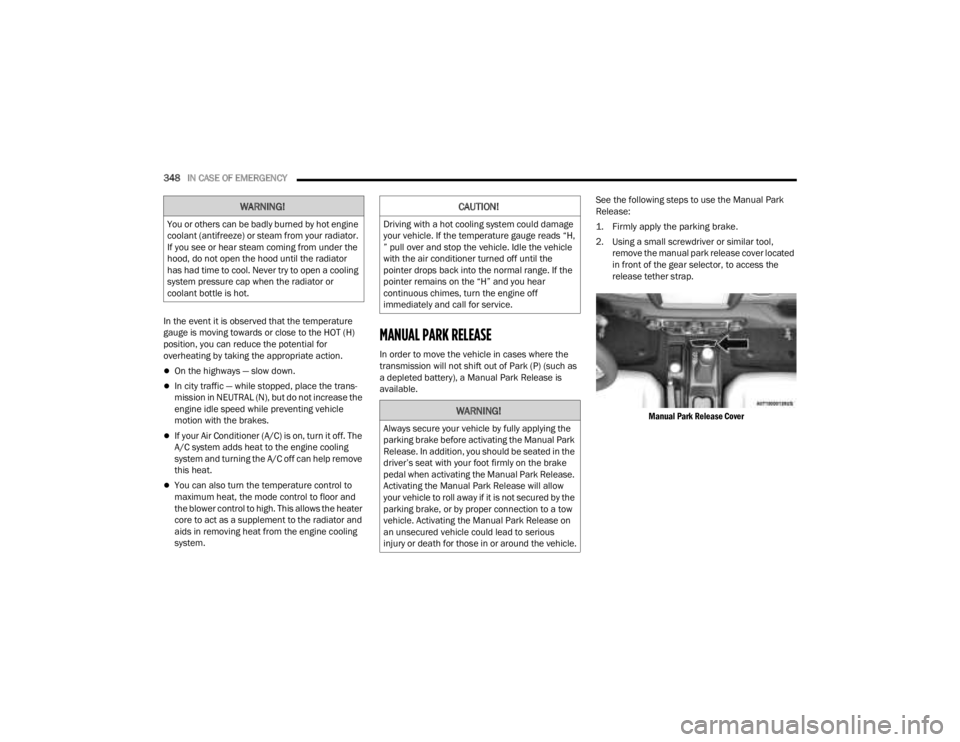
MANUAL PARK RELEASE
In order to move the vehicle in cases where the
transmission will not shift out of Park (P) (such as
a depleted battery), a Manual Park Release is
available. See the following steps to use the Manual Park
Release:
1. Firmly apply the parking brake.
2. Using a small screwdriver or similar tool,
remove the manual park release cover located
in front of the gear selector, to access the
release tether strap.
Manual Park Release Cover
WARNING!
You or others can be badly burned by hot engine
coolant (antifreeze) or steam from your radiator.
If you see or hear steam coming from under the
hood, do not open the hood until the radiator
has had time to cool. Never try to open a cooling
system pressure cap when the radiator or
coolant bottle is hot.
CAUTION!
Driving with a hot cooling system could damage
your vehicle. If the temperature gauge reads “H,
” pull over and stop the vehicle. Idle the vehicle
with the air conditioner turned off until the
pointer drops back into the normal range. If the
pointer remains on the “H” and you hear
continuous chimes, turn the engine off
immediately and call for service.
WARNING!
Always secure your vehicle by fully applying the
parking brake before activating the Manual Park
Release. In addition, you should be seated in the
driver’s seat with your foot firmly on the brake
pedal when activating the Manual Park Release.
Activating the Manual Park Release will allow
your vehicle to roll away if it is not secured by the
parking brake, or by proper connection to a tow
vehicle. Activating the Manual Park Release on
an unsecured vehicle could lead to serious
injury or death for those in or around the vehicle.
23_JT_OM_EN_USC_t.book Page 348
Page 351 of 448
IN CASE OF EMERGENCY349
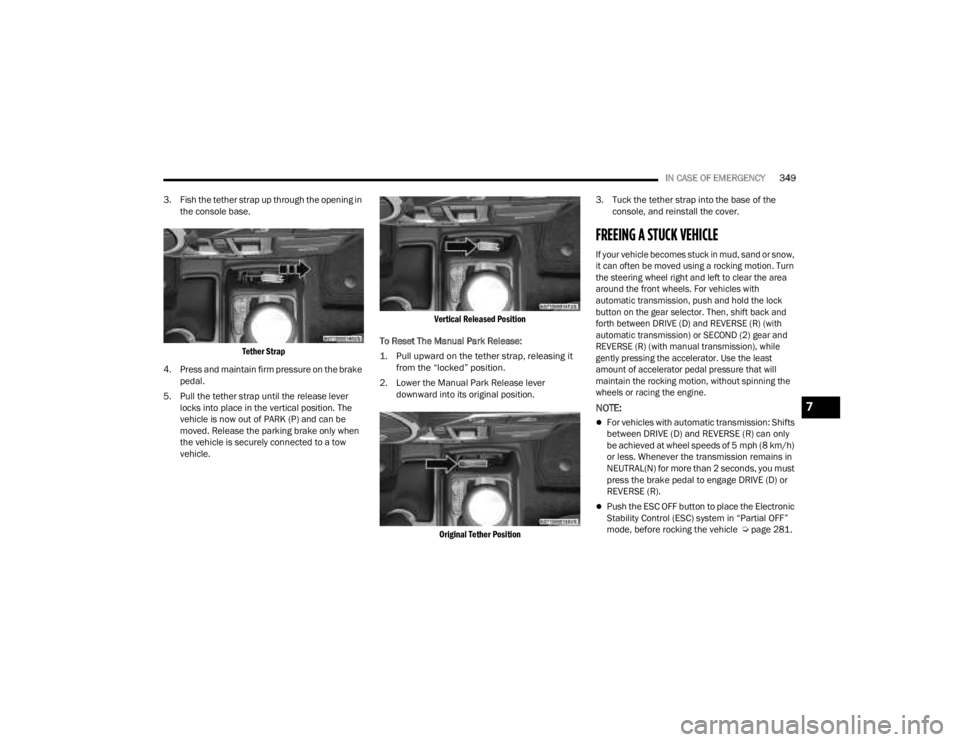
3. Fish the tether strap up through the opening in the console base.
Tether Strap
4. Press and maintain firm pressure on the brake pedal.
5. Pull the tether strap until the release lever locks into place in the vertical position. The
vehicle is now out of PARK (P) and can be
moved. Release the parking brake only when
the vehicle is securely connected to a tow
vehicle.
Vertical Released Position
To Reset The Manual Park Release:
1. Pull upward on the tether strap, releasing it from the “locked” position.
2. Lower the Manual Park Release lever downward into its original position.
Original Tether Position
3. Tuck the tether strap into the base of the
console, and reinstall the cover.
FREEING A STUCK VEHICLE
If your vehicle becomes stuck in mud, sand or snow,
it can often be moved using a rocking motion. Turn
the steering wheel right and left to clear the area
around the front wheels. For vehicles with
automatic transmission, push and hold the lock
button on the gear selector. Then, shift back and
forth between DRIVE (D) and REVERSE (R) (with
automatic transmission) or SECOND (2) gear and
REVERSE (R) (with manual transmission), while
gently pressing the accelerator. Use the least
amount of accelerator pedal pressure that will
maintain the rocking motion, without spinning the
wheels or racing the engine.
NOTE:
For vehicles with automatic transmission: Shifts
between DRIVE (D) and REVERSE (R) can only
be achieved at wheel speeds of 5 mph (8 km/h)
or less. Whenever the transmission remains in
NEUTRAL(N) for more than 2 seconds, you must
press the brake pedal to engage DRIVE (D) or
REVERSE (R).
Push the ESC OFF button to place the Electronic
Stability Control (ESC) system in “Partial OFF”
mode, before rocking the vehicle Ú page 281.
7
23_JT_OM_EN_USC_t.book Page 349
Page 356 of 448

354SERVICING AND MAINTENANCE
MAINTENANCE PLAN
Refer to the maintenance plan for the required maintenance intervals.
NOTE:Using white lithium grease, lubricate the door hinge joints twice a year to prevent premature wear.
At Every Oil Change Interval As Indicated By Oil Change Indicator System:
Change oil and filter.
Rotate the tires at the first sign of irregular wear, even if it occurs before the oil indicator system turns on.
Inspect battery and clean and tighten terminals as required.
Inspect the CV/Universal joints.
Inspect brake pads, shoes, rotors, drums, hoses and parking brake.
Inspect engine cooling system protection and hoses.
Inspect exhaust system.
Inspect engine air cleaner filter if using in dusty or off-road conditions, replace engine air cleaner filter if necessary.
Inspect all door latches for presence of grease, reapply if necessary.
23_JT_OM_EN_USC_t.book Page 354
Page 357 of 448

SERVICING AND MAINTENANCE355
Mileage Or Time Passed (Whichever Comes First)
20,000
30,000
40,000
50,000
60,000
70,000
80,000
90,000
100,000
110,000
120,000
130,000
140,000
150,000
Or Years: 2 3 4 5 6 7 8 9 10 11 12 13 14 15
Or Kilometers:
32,000
48,000
64,000
80,000
96,000
112,000
128,000
144,000
160,000
176,000
192,000
208,000
224,000
240,000
Additional Inspections
Inspect the CV/Universal joints. X X X X X X X X X X X X X X
Inspect front suspension, rear suspension, tie rod ends, and
replace if necessary. X
XXXXXX
Inspect the front and rear axle fluid. XXXX
Inspect the brake linings, replace as necessary. XXXXXXX
Adjust parking brake on vehicles equipped with four wheel disc
brakes. X
XXXXXX
Inspect transfer case fluid. XXX
Additional Maintenance
Replace engine air cleaner filter. XXXXX
Replace cabin air filter. To be replaced every 12,000 miles (19,000 km).
Replace spark plugs – 3.6L Engine.
1X
Flush and replace the engine coolant at 10 years or
150,000 miles (240,000 km), whichever comes first. X
X
8
23_JT_OM_EN_USC_t.book Page 355
Page 360 of 448

358SERVICING AND MAINTENANCE
MAINTENANCE PLAN — DIESEL FUEL UP TO B5 BIODIESEL
Refer to the Maintenance Plans for required maintenance.
At Every Oil Change Interval As Indicated By Oil Change Indicator System:
Change oil and filter.
Completely fill the Diesel Exhaust Fluid tank.
Drain water from fuel filter assembly.
Rotate the tires at the first sign of irregular wear, even if it occurs before the oil indicator system turns on.
Inspect battery and clean and tighten terminals as required.
Inspect the CV/Universal joints.
Inspect brake pads, shoes, rotors, drums, hoses and parking brake.
Inspect engine cooling system protection and hoses.
Inspect exhaust system.
Inspect engine air cleaner filter if using in dusty or off-road conditions, replace engine air cleaner filter if necessary.
At Every Second Oil Change Interval As Indicated By Oil Change Indicator System:
Change fuel filter.
23_JT_OM_EN_USC_t.book Page 358
Page 361 of 448

SERVICING AND MAINTENANCE359
Mileage Or Time Passed (Whichever Comes First)
10,000
20,000
30,000
40,000
50,000
60,000
70,000
80,000
90,000
100,000
110,000
120,000
130,000
140,000
150,000
Or Years: 1 2 3 4 5 6 7 8 9 10 11 12 13 14 15
Or Kilometers:
16,000
32,000
48,000
64,000
80,000
96,000
112,000
128,000
144,000
160,000
176,000
192,000
208,000
224,000
240,000
Additional Inspections
Completely fill the Diesel Exhaust Fluid tank. X X X X X X X X X X X X X X X
Inspect the CV/Universal joints. X X X X X X X X X X X X X X X
Inspect front suspension, tie rod ends, and replace if
necessary. X X X X X X X
Inspect the front and rear axle fluid, change if using your
vehicle for police, taxi, fleet, off-road or frequent trailer
towing. X X X X X X X
Inspect the brake linings, parking brake function. X X X X X X X
Inspect transfer case fluid. XXX
Additional Maintenance
Drain water from fuel filter assembly. X X X X X X X X X X X X X X X
8
23_JT_OM_EN_USC_t.book Page 359
Page 410 of 448

408SERVICING AND MAINTENANCE
When cleaning extremely dirty wheels, including
excessive brake dust, care must be taken in the
selection of tire and wheel cleaning chemicals and
equipment to prevent damage to the wheels.
Mopar® Wheel Treatment or Mopar® Chrome
Cleaner, or their equivalent, is recommended or
select a non-abrasive, non-acidic cleaner for
aluminum or chrome wheels.
NOTE:If you intend parking or storing your vehicle for an
extended period after cleaning the wheels with
wheel cleaner, drive your vehicle and apply the
brakes to remove the water droplets from the
brake components. This activity will remove the
red rust on the brake rotors and prevent vehicle
vibration when braking.
Dark Vapor Chrome, Black Satin Chrome, or Low
Gloss Clear Coat WheelsSNOW TRACTION DEVICES
Use of traction devices require sufficient
tire-to-body clearance. Due to limited clearance,
the following snow traction devices are
recommended. Follow these recommendations to
guard against damage:
Snow traction device must be of proper size for
the tire, as recommended by the snow traction
device manufacturer.
No other tire sizes are recommended for use
with the snow traction device.
Please follow the table below for the recom -
mended tire size, axle and snow traction device:
CAUTION!
Do not use scouring pads, steel wool, a bristle
brush, metal polishes, or oven cleaner. These
products may damage the wheel's protective
finish. Such damage is not covered by the New
Vehicle Limited Warranty. Only car wash soap,
Mopar® Wheel Cleaner or equivalent is
recommended.CAUTION!
If your vehicle is equipped with these specialty
wheels, DO NOT USE wheel cleaners, abrasives,
or polishing compounds. They will permanently
damage this finish and such damage is not
covered by the New Vehicle Limited Warranty.
HAND WASH ONLY USING MILD SOAP AND WATER
WITH A SOFT CLOTH. Used on a regular basis; this
is all that is required to maintain this finish.
Trim Level AxleTire/Wheel SizeSnow Traction Device (Maximum
Projection Beyond Tire Profile Or Equivalent)
SPORT
OVERLAND Rear
245/75R17 S Class or Autosock
RUBICON
HIGH ALTITUDE MOJAVE RearLT285/70R17C
255/70R18
275/55R20 Autosock
23_JT_OM_EN_USC_t.book Page 408
Page 436 of 448

434
Belts, Seat
..................................................... 329Blind Spot Monitoring.................................... 287Bluetooth Connecting To A Particular Mobile Phone Or Audio Device After Pairing
................248Body Mechanism Lubrication........................ 374B-Pillar Location............................................. 400Brake Assist System...................................... 280Brake Control System.................................... 280Brake Fluid.......................................... 380, 426Brake System...................................... 380, 418Anti-Lock (ABS).......................................... 418Fluid Check............................................... 380Master Cylinder......................................... 380Parking...................................................... 152Warning Light............................................ 132Brake/Transmission Interlock....................... 157Bulb Replacement............................... 392, 393Bulbs, Light.......................................... 330, 392Bumper End Cap Removal............................. 208
C
Camera, Rear................................................ 189Capacities, Fluid............................................ 423Caps, FillerFuel........................................................... 191Oil (Engine)................................................ 362Radiator (Coolant Pressure)...................... 378Car Washes................................................... 412Carbon Monoxide Warning............................ 331
Carpet Safety Information............................. 414Carpeting...................................................... 415CD................................................................. 242Cellular Phone.............................................. 276Center High Mounted Stop Light................... 395Certification Label......................................... 195Chains, Tire................................................... 408Charge Air Cooler.......................................... 379Chart, Tire Sizing........................................... 397Checking Your Vehicle For Safety................. 328Checks, Safety.............................................. 328Child Restraint.............................................. 318Child RestraintsBooster Seats........................................... 321Child Seat Installation.............................. 327How To Stow An unused ALR Seat Belt.... 325Infant And Child Restraints....................... 320Locating The LATCH Anchorages.............. 324Lower Anchors And Tethers For Children.. 322Older Children And Child Restraints......... 320Seating Positions...................................... 321Clean Air Gasoline......................................... 419CleaningWheels..................................................... 407Climate Control................................................ 61Automatic.................................................... 62Manual........................................................ 64CNG And LP Fuel System Modifications........ 420Cold Weather Operation............................... 146Compact Spare Tire...................................... 406
Connected Services...................................... 258Connected Services FAQ............................... 272Connected Services Features....................... 261Connected Services, Getting Started............ 260Connected Services, Introduction................. 258ConnectorUCI...............................................................71Universal Consumer Interface (UCI).............71Console............................................................69Floor............................................................69Contract, Service........................................... 430Controls........................................................ 234Cooling Pressure Cap (Radiator Cap)............ 378Cooling System............................................. 377Adding Coolant (Antifreeze)...................... 378Coolant Level............................................ 379Cooling Capacity....................................... 423Disposal Of Used Coolant......................... 378Drain, Flush, And Refill............................. 377Inspection........................................ 377, 379Points To Remember................................ 379Pressure Cap............................................ 378Radiator Cap............................................. 378Selection Of Coolant (Antifreeze)......................... 377, 423, 424Corrosion Protection..................................... 411Cruise Control (Speed
Control)............................. 139, 140, 141, 173Customer Assistance.................................... 428Cybersecurity................................................ 214
23_JT_OM_EN_USC_t.book Page 434