child lock JEEP GRAND CHEROKEE 2013 Owner handbook (in English)
[x] Cancel search | Manufacturer: JEEP, Model Year: 2013, Model line: GRAND CHEROKEE, Model: JEEP GRAND CHEROKEE 2013Pages: 408, PDF Size: 3.21 MB
Page 14 of 408
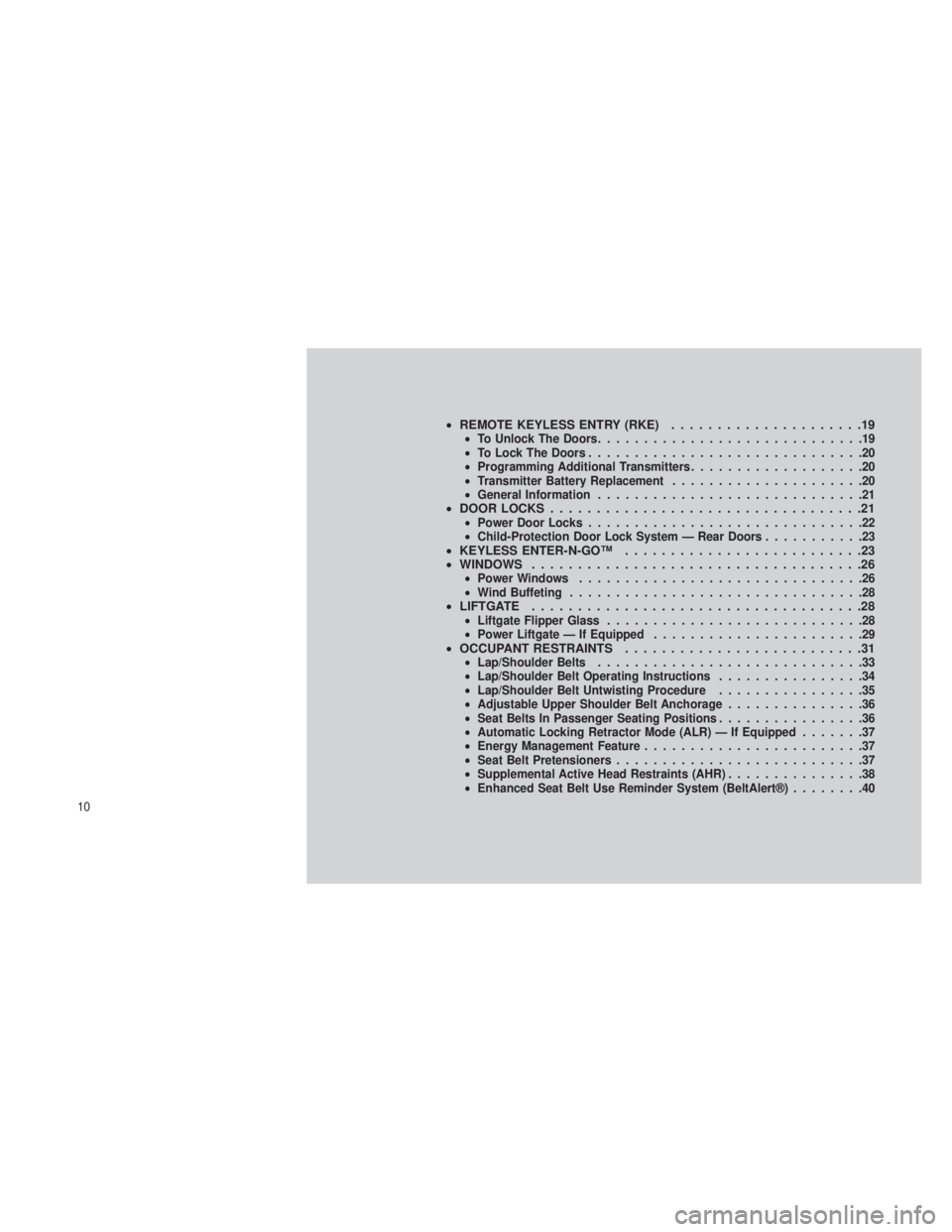
•REMOTE KEYLESS ENTRY (RKE) .....................19•To Unlock The Doors .............................19
• To Lock The Doors ..............................20
• Programming Additional Transmitters ...................20
• Transmitter Battery Replacement .....................20
• General Information .............................21
•DOOR LOCKS ..................................21•Power Door Locks ..............................22
• Child-Protection Door Lock System — Rear Doors ...........23
•KEYLESS ENTER-N-GO™ ..........................23
• WINDOWS ....................................26
•Power Windows ...............................26
• Wind Buffeting ................................28
•LIFTGATE ....................................28•Liftgate Flipper Glass ............................28
• Power Liftgate — If Equipped .......................29
•OCCUPANT RESTRAINTS ..........................31•Lap/Shoulder Belts .............................33
• Lap/Shoulder Belt Operating Instructions ................34
• Lap/Shoulder Belt Untwisting Procedure ................35
• Adjustable Upper Shoulder Belt Anchorage ...............36
• Seat Belts In Passenger Seating Positions ................36
• Automatic Locking Retractor Mode (ALR) — If Equipped .......37
• Energy Management Feature ........................37
• Seat Belt Pretensioners ...........................37
• Supplemental Active Head Restraints (AHR) ...............38
• Enhanced Seat Belt Use Reminder System (BeltAlert®) ........40
10
Page 15 of 408
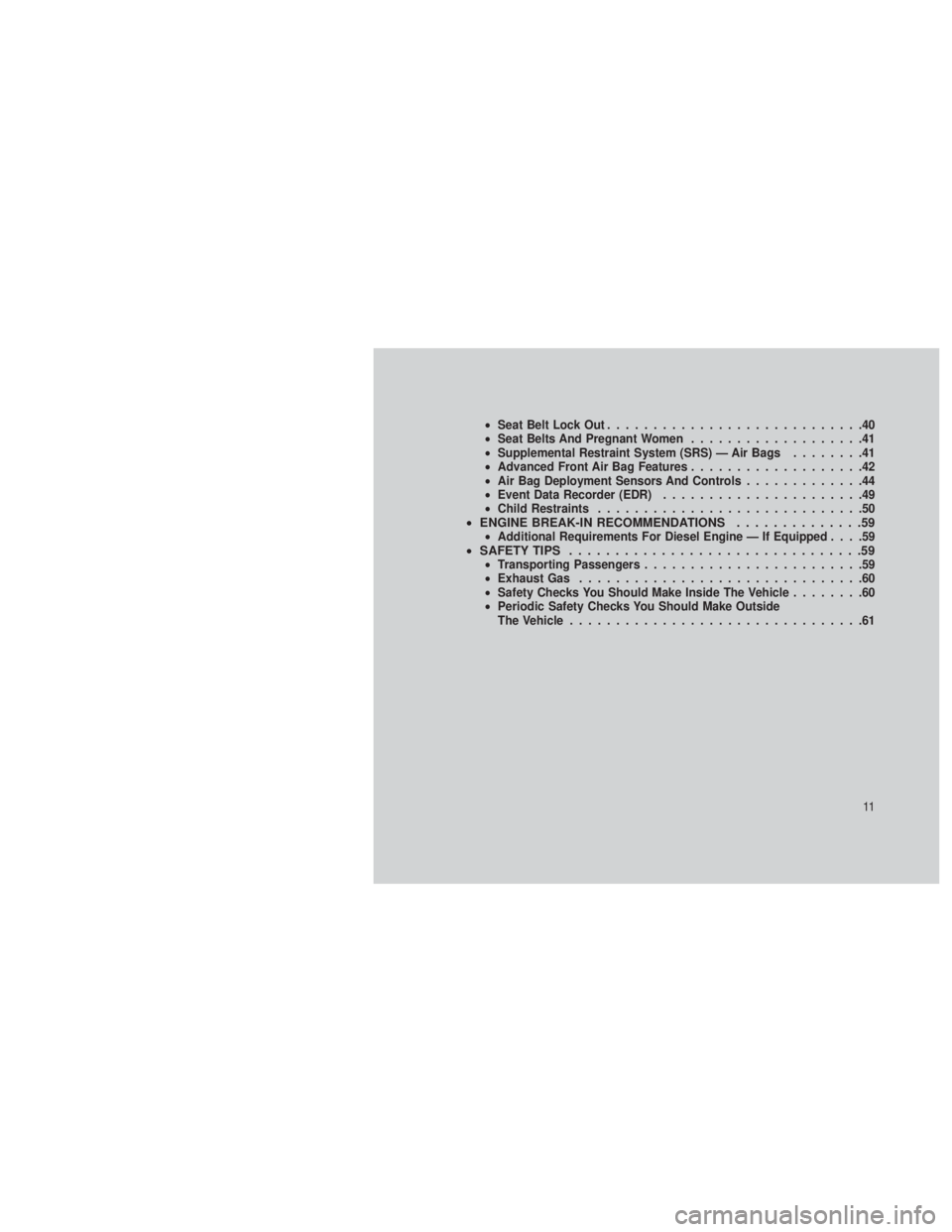
•Seat Belt Lock Out ............................40
• Seat Belts And Pregnant Women ...................41
• Supplemental Restraint System (SRS) — Air Bags ........41
• Advanced Front Air Bag Features ...................42
• Air Bag Deployment Sensors And Controls .............44
• Event Data Recorder (EDR) ......................49
• Child Restraints .............................50
•ENGINE BREAK-IN RECOMMENDATIONS ..............59•Additional Requirements For Diesel Engine — If Equipped ....59•SAFETY TIPS ................................59•Transporting Passengers ........................59
• Exhaust Gas ...............................60
• Safety Checks You Should Make Inside The Vehicle ........60
• Periodic Safety Checks You Should Make Outside
The Vehicle ................................61
11
Page 17 of 408
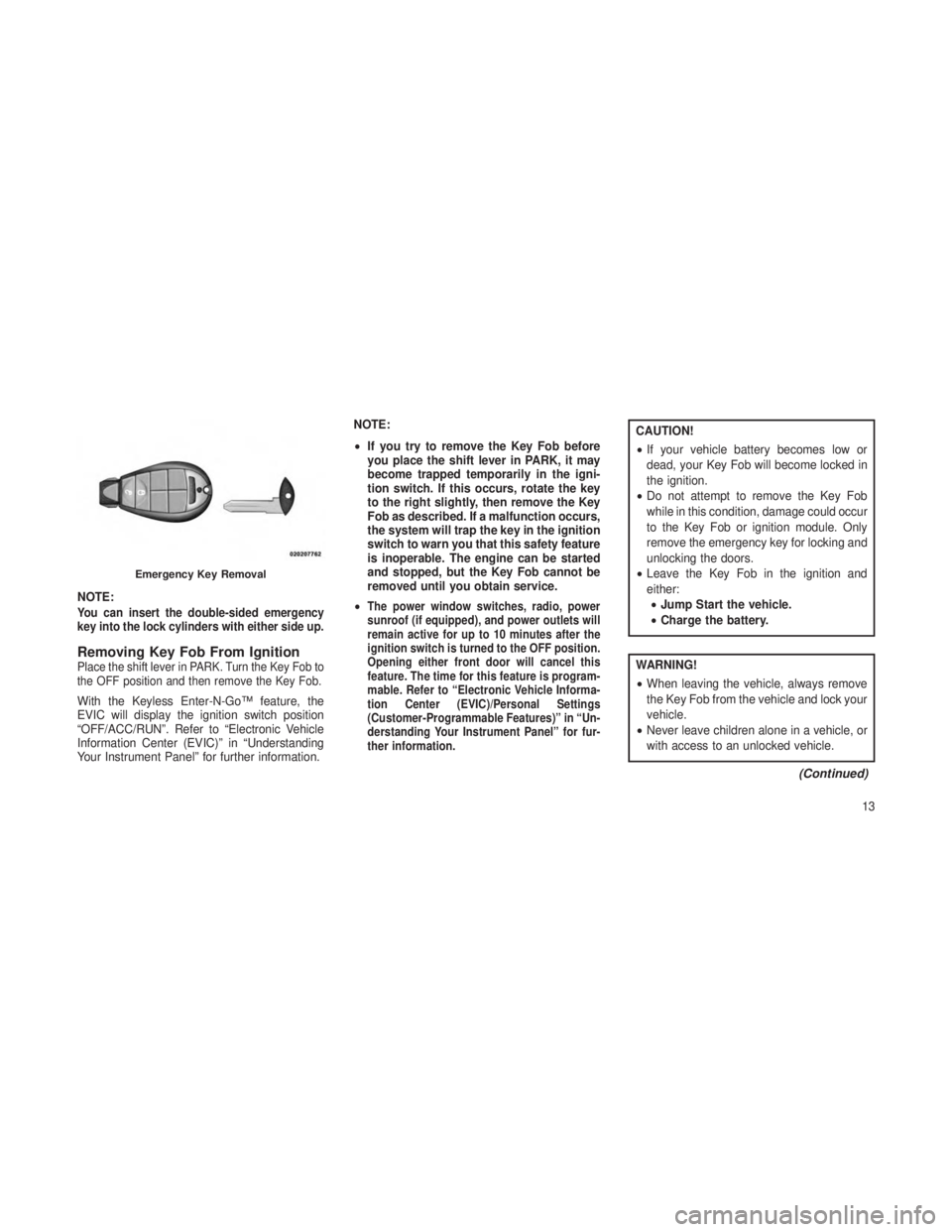
NOTE:You can insert the double-sided emergency
key into the lock cylinders with either side up.
Removing Key Fob From IgnitionPlace the shift lever in PARK. Turn the Key Fob to
the OFF position and then remove the Key Fob.
With the Keyless Enter-N-Go™ feature, the
EVIC will display the ignition switch position
“OFF/ACC/RUN”. Refer to “Electronic Vehicle
Information Center (EVIC)” in “Understanding
Your Instrument Panel” for further information.NOTE:
•
If you try to remove the Key Fob before
you place the shift lever in PARK, it may
become trapped temporarily in the igni-
tion switch. If this occurs, rotate the key
to the right slightly, then remove the Key
Fob as described. If a malfunction occurs,
the system will trap the key in the ignition
switch to warn you that this safety feature
is inoperable. The engine can be started
and stopped, but the Key Fob cannot be
removed until you obtain service.
•
The power window switches, radio, power
sunroof (if equipped), and power outlets will
remain active for up to 10 minutes after the
ignition switch is turned to the OFF position.
Opening either front door will cancel this
feature. The time for this feature is program-
mable. Refer to “Electronic Vehicle Informa-
tion Center (EVIC)/Personal Settings
(Customer-Programmable Features)” in “Un-
derstanding Your Instrument Panel” for fur-
ther information.
CAUTION!
• If your vehicle battery becomes low or
dead, your Key Fob will become locked in
the ignition.
• Do not attempt to remove the Key Fob
while in this condition, damage could occur
to the Key Fob or ignition module. Only
remove the emergency key for locking and
unlocking the doors.
• Leave the Key Fob in the ignition and
either:
• Jump Start the vehicle.
• Charge the battery.
WARNING!
•When leaving the vehicle, always remove
the Key Fob from the vehicle and lock your
vehicle.
• Never leave children alone in a vehicle, or
with access to an unlocked vehicle.
(Continued)
Emergency Key Removal
13
Page 18 of 408
WARNING!(Continued)
•Allowing children to be in a vehicle unat-
tended is dangerous for a number of rea-
sons. A child or others could be seriously or
fatally injured. Children should be warned
not to touch the parking brake, brake pedal
or the shift lever.
•Do not leave the Key Fob in or near the
vehicle, or in a location accessible to chil-
dren, and do not leave a vehicle equipped
with Keyless Enter-N-Go™ in the ACC or
ON/RUN mode. A child could operate
power windows, other controls, or move
the vehicle.
• Do not leave children or animals inside
parked vehicles in hot weather. Interior
heat build-up may cause serious injury or
death.
CAUTION!
An unlocked car is an invitation to thieves.
Always remove Key Fob from the ignition
and lock all doors when leaving the vehicle
unattended.
Key-In-Ignition ReminderOpening the driver’s door when the Key Fob is
in the ignition and the ignition switch position is
OFF or ACC, sounds a signal to remind you to
remove the Key Fob.
NOTE:
The Key-In-Ignition reminder only sounds
when the Key Fob is placed in the OFF or
ACC ignition position.
With the Keyless Enter-N-Go™ feature, open-
ing the driver’s door when the vehicle’s ignition
switch is placed in ACC or ON/RUN (engine
stopped) will cause the reminder chime to
sound. Refer to “Starting Procedures” in “Start-
ing And Operating” for further information.
STEERING WHEEL LOCK — IF
EQUIPPED
Your vehicle may be equipped with a passive
electronic steering wheel lock. This lock pre-
vents steering the vehicle without the ignition
key. The steering wheel lock has six positions
(one every 60 degrees). If the steering wheel is
moved to one of these six position with the key
in the off positions, the steering wheel will lock.
To Manually Lock The Steering WheelWith the engine running, rotate the steering
wheel one-half revolution in either direction
(three o’clock or nine o’clock position), turn off
the engine and remove the key. Turn the steer-
ing wheel slightly in either direction until the lock
engages.
14
Page 26 of 408
WARNING!
•For personal security and safety in the
event of a collision, lock the vehicle doors
before you drive as well as when you park
and leave the vehicle.
•
When leaving the vehicle, always remove
the Key Fob from the vehicle and lock your
vehicle. Unsupervised use of vehicle equip-
ment may cause severe personal injuries or
death.
•Never leave children alone in a vehicle, or
with access to an unlocked vehicle. Allowing
children to be in a vehicle unattended is
dangerous for a number of reasons. A child
or others could be seriously or fatally injured.
Children should be warned not to touch the
parking brake, brake pedal or the shift lever.
•Do not leave the Key Fob in or near the
vehicle, or in a location accessible to children,
and do not leave a vehicle equipped with
Keyless Enter-N-Go™ in the ACC or ON/RUN
mode. A child could operate power windows,
other controls, or move the vehicle.
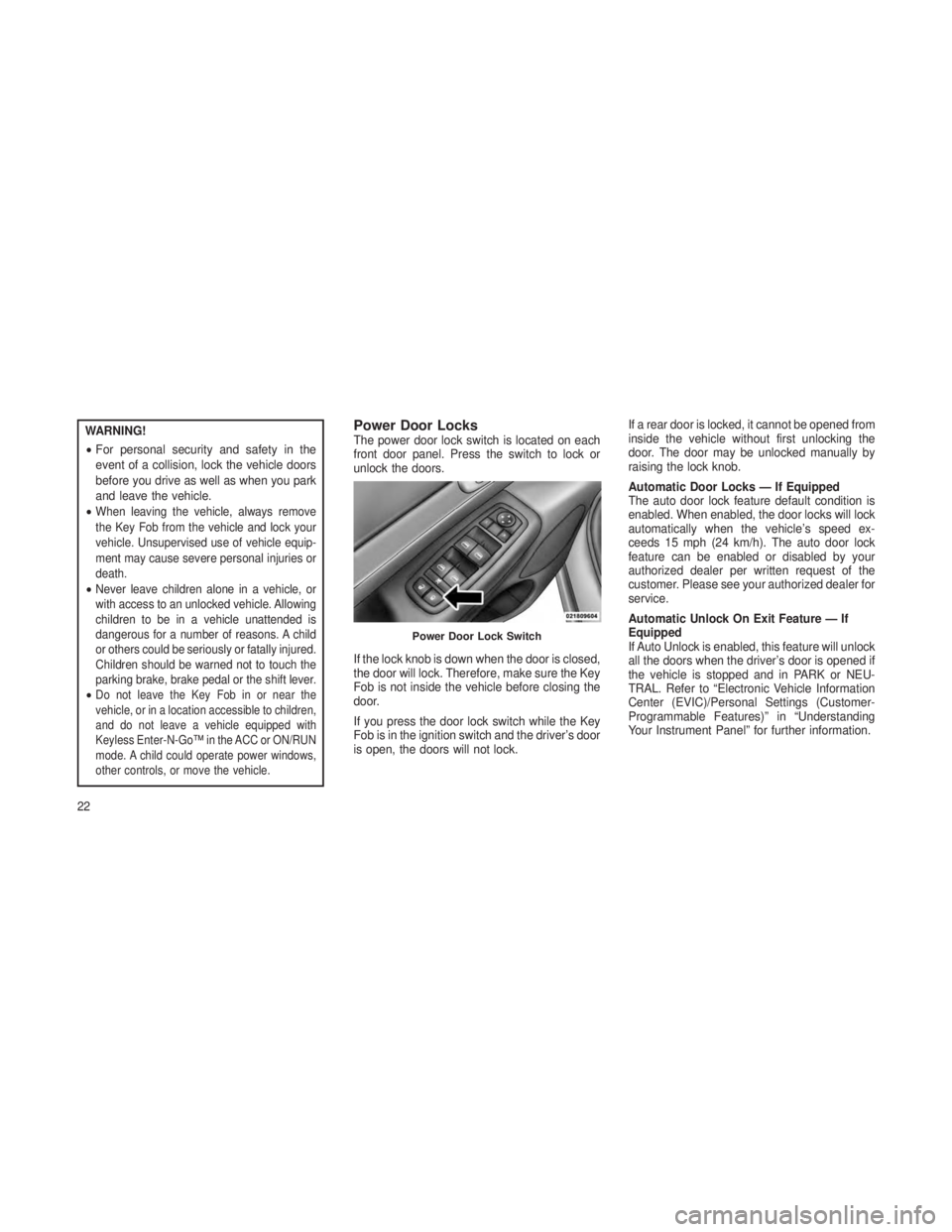
Power Door LocksThe power door lock switch is located on each
front door panel. Press the switch to lock or
unlock the doors.
If the lock knob is down when the door is closed,
the door will lock. Therefore, make sure the Key
Fob is not inside the vehicle before closing the
door.
If you press the door lock switch while the Key
Fob is in the ignition switch and the driver’s door
is open, the doors will not lock. If a rear door is locked, it cannot be opened from
inside the vehicle without first unlocking the
door. The door may be unlocked manually by
raising the lock knob.
Automatic Door Locks — If Equipped
The auto door lock feature default condition is
enabled. When enabled, the door locks will lock
automatically when the vehicle’s speed ex-
ceeds 15 mph (24 km/h). The auto door lock
feature can be enabled or disabled by your
authorized dealer per written request of the
customer. Please see your authorized dealer for
service.
Automatic Unlock On Exit Feature — If
Equipped
If Auto Unlock is enabled, this feature will unlock
all the doors when the driver’s door is opened if
the vehicle is stopped and in PARK or NEU-
TRAL. Refer to “Electronic Vehicle Information
Center (EVIC)/Personal Settings (Customer-
Programmable Features)” in “Understanding
Your Instrument Panel” for further information.
Power Door Lock Switch
22
Page 27 of 408
Child-Protection Door Lock
System — Rear Doors
To provide a safer environment for small children
riding in the rear seats, the rear doors are equipped
with Child-Protection Door Lock system.
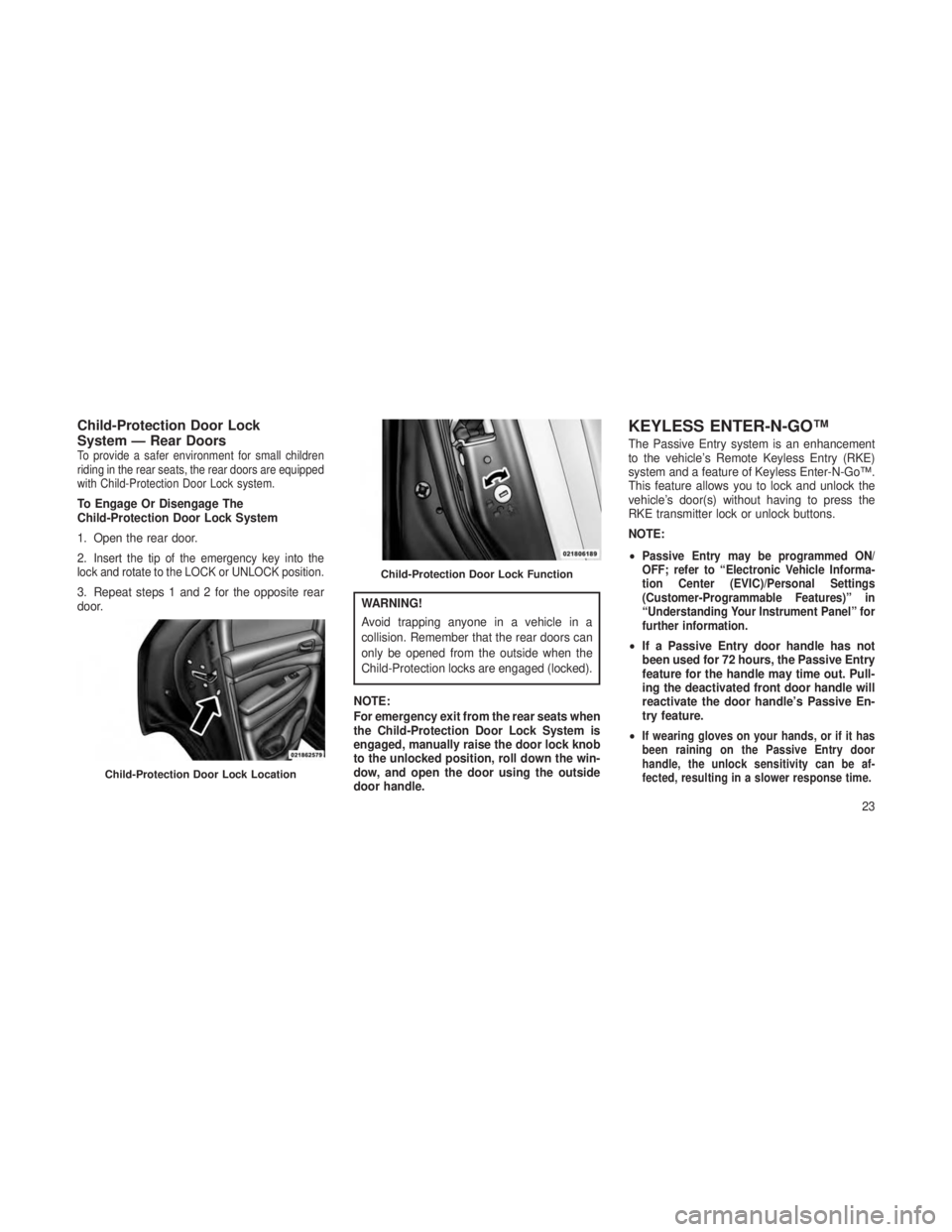
To Engage Or Disengage The
Child-Protection Door Lock System
1. Open the rear door.
2.
Insert the tip of the emergency key into the
lock and rotate to the LOCK or UNLOCK position.
3. Repeat steps 1 and 2 for the opposite rear
door.WARNING!
Avoid trapping anyone in a vehicle in a
collision. Remember that the rear doors can
only be opened from the outside when the
Child-Protection locks are engaged (locked).
NOTE:
For emergency exit from the rear seats when
the Child-Protection Door Lock System is
engaged, manually raise the door lock knob
to the unlocked position, roll down the win-
dow, and open the door using the outside
door handle.
KEYLESS ENTER-N-GO™
The Passive Entry system is an enhancement
to the vehicle’s Remote Keyless Entry (RKE)
system and a feature of Keyless Enter-N-Go™.
This feature allows you to lock and unlock the
vehicle’s door(s) without having to press the
RKE transmitter lock or unlock buttons.
NOTE:
•
Passive Entry may be programmed ON/
OFF; refer to “Electronic Vehicle Informa-
tion Center (EVIC)/Personal Settings
(Customer-Programmable Features)” in
“Understanding Your Instrument Panel” for
further information.
• If a Passive Entry door handle has not
been used for 72 hours, the Passive Entry
feature for the handle may time out. Pull-
ing the deactivated front door handle will
reactivate the door handle’s Passive En-
try feature.
•
If wearing gloves on your hands, or if it has
been raining on the Passive Entry door
handle, the unlock sensitivity can be af-
fected, resulting in a slower response time.
Child-Protection Door Lock Location
Child-Protection Door Lock Function
23
Page 30 of 408
NOTE:
•After pressing the door handle LOCK but-
ton, you must wait two seconds before
you can lock or unlock the doors, using
either Passive Entry door handle. This is
done to allow you to check if the vehicle is
locked by pulling the door handle, without
the vehicle reacting and unlocking.
• The Passive Entry system will not operate
if the RKE transmitter battery is dead.
The vehicle doors can also be locked by using
the RKE transmitter lock button or the lock
button located on the vehicle’s interior door
panel.WINDOWS
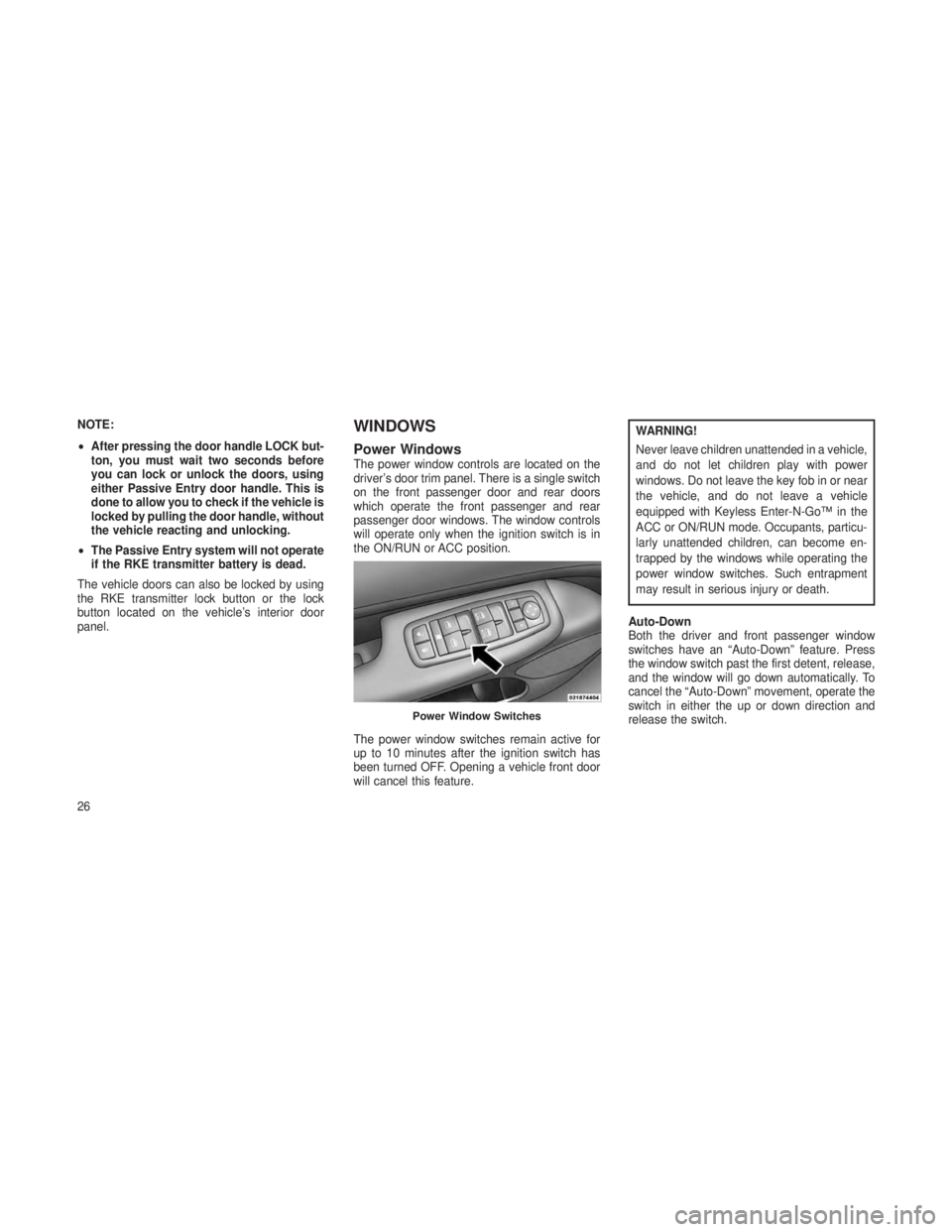
Power WindowsThe power window controls are located on the
driver’s door trim panel. There is a single switch
on the front passenger door and rear doors
which operate the front passenger and rear
passenger door windows. The window controls
will operate only when the ignition switch is in
the ON/RUN or ACC position.
The power window switches remain active for
up to 10 minutes after the ignition switch has
been turned OFF. Opening a vehicle front door
will cancel this feature.
WARNING!
Never leave children unattended in a vehicle,
and do not let children play with power
windows. Do not leave the key fob in or near
the vehicle, and do not leave a vehicle
equipped with Keyless Enter-N-Go™ in the
ACC or ON/RUN mode. Occupants, particu-
larly unattended children, can become en-
trapped by the windows while operating the
power window switches. Such entrapment
may result in serious injury or death.
Auto-Down
Both the driver and front passenger window
switches have an “Auto-Down” feature. Press
the window switch past the first detent, release,
and the window will go down automatically. To
cancel the “Auto-Down” movement, operate the
switch in either the up or down direction and
release the switch.
Power Window Switches
26
Page 35 of 408
Gas props support the liftgate in the open
position. However, because the gas pressure
drops with temperature, it may be necessary to
assist the props when opening the liftgate in
cold weather.
OCCUPANT RESTRAINTS
Some of the most important safety features in
your vehicle are the restraint systems:
•Three-point lap and shoulder belts for the
driver and all passengers
• Advanced Front Air Bags for driver and front
passenger
• Supplemental Active Head Restraints (AHR)
located on top of the front seats (integrated
into the head restraint)
• Supplemental Driver Side Knee Air Bag
• Supplemental Side Air Bag Inflatable Cur-
tains (SABIC) for the driver and passengers
seated next to a window
• Supplemental Seat-Mounted Side Air
Bags (SAB) •
An energy-absorbing steering column and
steering wheel
•
Knee bolsters/blockers for front seat occupant
• Front seat belts incorporate pretensioners
that may enhance occupant protection by
managing occupant energy during an impact
event
• All seat belt systems (except the driver’s and
front passenger) include Automatic Locking
Retractors (ALRs), which lock the seat belt
webbing into position by extending the belt all
the way out and then adjusting the belt to the
desired length to restrain a child seat or
secure a large item in a seat — if equipped
Please pay close attention to the information in
this section. It tells you how to use your restraint
system properly, to keep you and your passen-
gers as safe as possible.
If you will be carrying children too small for
adult-sized seat belts, the seat belts or the ISO-
FIX feature also can be used to hold infant and
child restraint systems. Refer to ISOFIX — Child
Seat Anchorage System for more information.
NOTE:
The Advanced Front Air Bags have a multi-
stage inflator design. This allows the air bag
to have different rates of inflation based on
several factors, including the severity and
type of collision.
Here are some simple steps you can take to
minimize the risk of harm from a deploying air
bag:
1. Children 12 years old and under should
always ride buckled up in a rear seat.
WARNING!
Infants in rear facing child restraints should
never ride in the front seat of a vehicle with a
passenger Advanced Front Air Bag. An air
bag deployment can cause severe injury or
death to infants in that position.
Children that are not big enough to wear the
vehicle seat belt properly (see section on Child
Restraints) should be secured in the rear seat in
child restraints or belt-positioning booster seats.
31
Page 40 of 408
3. Slide the latch plate upward over the folded
webbing. The folded webbing must enter the
slot at the top of the latch plate.
4. Continue to slide the latch plate up until it
clears the folded webbing.
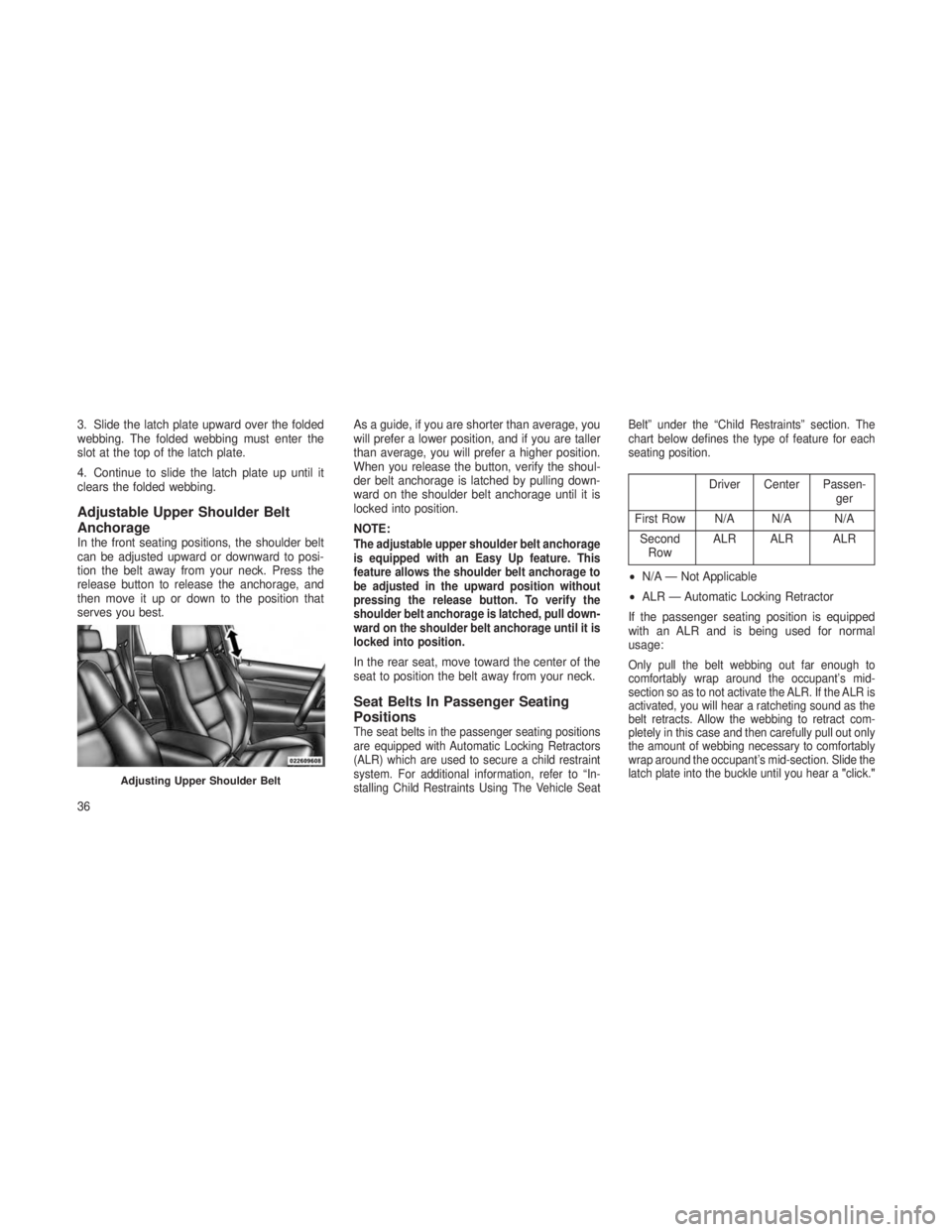
Adjustable Upper Shoulder Belt
Anchorage
In the front seating positions, the shoulder belt
can be adjusted upward or downward to posi-
tion the belt away from your neck. Press the
release button to release the anchorage, and
then move it up or down to the position that
serves you best.As a guide, if you are shorter than average, you
will prefer a lower position, and if you are taller
than average, you will prefer a higher position.
When you release the button, verify the shoul-
der belt anchorage is latched by pulling down-
ward on the shoulder belt anchorage until it is
locked into position.
NOTE:The adjustable upper shoulder belt anchorage
is equipped with an Easy Up feature. This
feature allows the shoulder belt anchorage to
be adjusted in the upward position without
pressing the release button. To verify the
shoulder belt anchorage is latched, pull down-
ward on the shoulder belt anchorage until it is
locked into position.
In the rear seat, move toward the center of the
seat to position the belt away from your neck.
Seat Belts In Passenger Seating
Positions
The seat belts in the passenger seating positions
are equipped with Automatic Locking Retractors
(ALR) which are used to secure a child restraint
system. For additional information, refer to “In-
stalling Child Restraints Using The Vehicle Seat Belt” under the “Child Restraints” section. The
chart below defines the type of feature for each
seating position.
Driver Center Passen-
ger
First Row N/A N/A N/A Second Row ALR ALR ALR
• N/A — Not Applicable
• ALR — Automatic Locking Retractor
If the passenger seating position is equipped
with an ALR and is being used for normal
usage:
Only pull the belt webbing out far enough to
comfortably wrap around the occupant’s mid-
section so as to not activate the ALR. If the ALR is
activated, you will hear a ratcheting sound as the
belt retracts. Allow the webbing to retract com-
pletely in this case and then carefully pull out only
the amount of webbing necessary to comfortably
wrap around the occupant’s mid-section. Slide the
latch plate into the buckle until you hear a "click."
Adjusting Upper Shoulder Belt
36
Page 41 of 408
Automatic Locking Retractor Mode
(ALR) — If Equipped
In this mode, the shoulder belt is automatically
pre-locked. The belt will still retract to remove
any slack in the shoulder belt. The Automatic
Locking Mode is available on all rear
passenger-seating positions with a combination
lap/shoulder belt. Use the Automatic Locking
Mode anytime a child safety seat is installed in
a seating position that has a belt with this
feature. Children 12 years old and under should
always be properly restrained in the rear seat.
How To Engage The Automatic Locking
Mode
1. Buckle the combination lap and shoulder
belt.
2. Grasp the shoulder portion and pull down-
ward until the entire belt is extracted.
3. Allow the belt to retract. As the belt retracts,
you will hear a clicking sound. This indicates the
safety belt is now in the Automatic Locking
Mode.How To Disengage The Automatic Locking
Mode
Unbuckle the combination lap/shoulder belt and
allow it to retract completely to disengage the
Automatic Locking Mode and activate the ve-
hicle sensitive (emergency) locking mode.
WARNING!
•
The belt and retractor assembly must be
replaced if the seat belt assembly Auto-
matic Locking Retractor (ALR) feature or
any other seat belt function is not working
properly when checked according to the
procedures in the Service Manual.
• Failure to replace the belt and retractor
assembly could increase the risk of injury
in collisions.
Energy Management FeatureThis vehicle has a safety belt system with an
Energy Management feature in the front seating
positions to help further reduce the risk of injury
in the event of a head-on collision. This safety belt system has a retractor assem-
bly that is designed to release webbing in a
controlled manner. This feature is designed to
help reduce the belt force acting on the occu-
pant’s chest.
Seat Belt PretensionersThe seat belts for both front seating positions are
equipped with pretensioning devices that are de-
signed to remove slack from the seat belt in the
event of a collision. These devices may improve
the performance of the seat belt by assuring that
the belt is tight about the occupant early in a
collision. Pretensioners work for all size occu-
pants, including those in child restraints.
NOTE:
These devices are not a substitute for
proper seat belt placement by the occupant.
The seat belt still must be worn snugly and
positioned properly.
The pretensioners are triggered by the Occupant
Restraint Controller (ORC). Like the air bags, the
pretensioners are single use items. A deployed
pretensioner or a deployed air bag must be re-
placed immediately.
37