parking brake JEEP GRAND CHEROKEE 2013 Owner handbook (in English)
[x] Cancel search | Manufacturer: JEEP, Model Year: 2013, Model line: GRAND CHEROKEE, Model: JEEP GRAND CHEROKEE 2013Pages: 408, PDF Size: 3.21 MB
Page 18 of 408
WARNING!(Continued)
•Allowing children to be in a vehicle unat-
tended is dangerous for a number of rea-
sons. A child or others could be seriously or
fatally injured. Children should be warned
not to touch the parking brake, brake pedal
or the shift lever.
•Do not leave the Key Fob in or near the
vehicle, or in a location accessible to chil-
dren, and do not leave a vehicle equipped
with Keyless Enter-N-Go™ in the ACC or
ON/RUN mode. A child could operate
power windows, other controls, or move
the vehicle.
• Do not leave children or animals inside
parked vehicles in hot weather. Interior
heat build-up may cause serious injury or
death.
CAUTION!
An unlocked car is an invitation to thieves.
Always remove Key Fob from the ignition
and lock all doors when leaving the vehicle
unattended.
Key-In-Ignition ReminderOpening the driver’s door when the Key Fob is
in the ignition and the ignition switch position is
OFF or ACC, sounds a signal to remind you to
remove the Key Fob.
NOTE:
The Key-In-Ignition reminder only sounds
when the Key Fob is placed in the OFF or
ACC ignition position.
With the Keyless Enter-N-Go™ feature, open-
ing the driver’s door when the vehicle’s ignition
switch is placed in ACC or ON/RUN (engine
stopped) will cause the reminder chime to
sound. Refer to “Starting Procedures” in “Start-
ing And Operating” for further information.
STEERING WHEEL LOCK — IF
EQUIPPED
Your vehicle may be equipped with a passive
electronic steering wheel lock. This lock pre-
vents steering the vehicle without the ignition
key. The steering wheel lock has six positions
(one every 60 degrees). If the steering wheel is
moved to one of these six position with the key
in the off positions, the steering wheel will lock.
To Manually Lock The Steering WheelWith the engine running, rotate the steering
wheel one-half revolution in either direction
(three o’clock or nine o’clock position), turn off
the engine and remove the key. Turn the steer-
ing wheel slightly in either direction until the lock
engages.
14
Page 26 of 408
WARNING!
•For personal security and safety in the
event of a collision, lock the vehicle doors
before you drive as well as when you park
and leave the vehicle.
•
When leaving the vehicle, always remove
the Key Fob from the vehicle and lock your
vehicle. Unsupervised use of vehicle equip-
ment may cause severe personal injuries or
death.
•Never leave children alone in a vehicle, or
with access to an unlocked vehicle. Allowing
children to be in a vehicle unattended is
dangerous for a number of reasons. A child
or others could be seriously or fatally injured.
Children should be warned not to touch the
parking brake, brake pedal or the shift lever.
•Do not leave the Key Fob in or near the
vehicle, or in a location accessible to children,
and do not leave a vehicle equipped with
Keyless Enter-N-Go™ in the ACC or ON/RUN
mode. A child could operate power windows,
other controls, or move the vehicle.
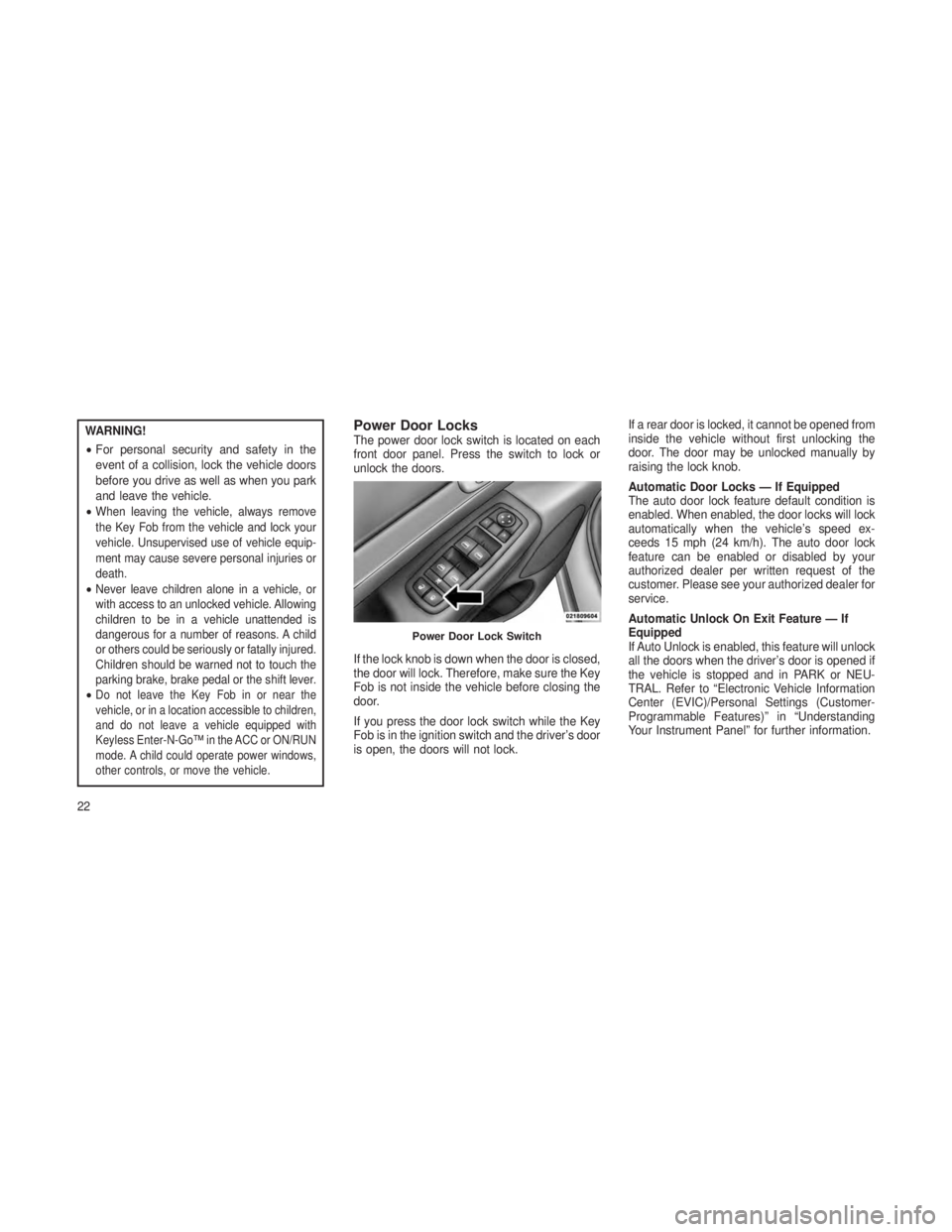
Power Door LocksThe power door lock switch is located on each
front door panel. Press the switch to lock or
unlock the doors.
If the lock knob is down when the door is closed,
the door will lock. Therefore, make sure the Key
Fob is not inside the vehicle before closing the
door.
If you press the door lock switch while the Key
Fob is in the ignition switch and the driver’s door
is open, the doors will not lock. If a rear door is locked, it cannot be opened from
inside the vehicle without first unlocking the
door. The door may be unlocked manually by
raising the lock knob.
Automatic Door Locks — If Equipped
The auto door lock feature default condition is
enabled. When enabled, the door locks will lock
automatically when the vehicle’s speed ex-
ceeds 15 mph (24 km/h). The auto door lock
feature can be enabled or disabled by your
authorized dealer per written request of the
customer. Please see your authorized dealer for
service.
Automatic Unlock On Exit Feature — If
Equipped
If Auto Unlock is enabled, this feature will unlock
all the doors when the driver’s door is opened if
the vehicle is stopped and in PARK or NEU-
TRAL. Refer to “Electronic Vehicle Information
Center (EVIC)/Personal Settings (Customer-
Programmable Features)” in “Understanding
Your Instrument Panel” for further information.
Power Door Lock Switch
22
Page 112 of 408
NOTE:
This system will not activate until the ve-
hicle is at or above 20 mph (32 km/h).
To Deactivate
1. Pull the multifunction lever toward you (or
rearward in car) to manually deactivate the
system (normal operation of low beams).
2. Push back on the multifunction lever once
again to reactivate the system.
Daytime Running Lights — If
Equipped
The Daytime Running Lights (low intensity)
come on whenever the engine is running, and
the transmission is not in the PARK position.
The lights will remain on until the ignition is
switched to the OFF or ACC position or the
parking brake is engaged. Also, if a turn signal is
activated, the DRL lamp on the same side of the
vehicle will turn off for the duration of the turn
signal activation. Once the turn signal is no
longer active, the DRL lamp will illuminate. The
headlight switch must be used for normal night-
time driving.Disabling The Daytime Running Lights
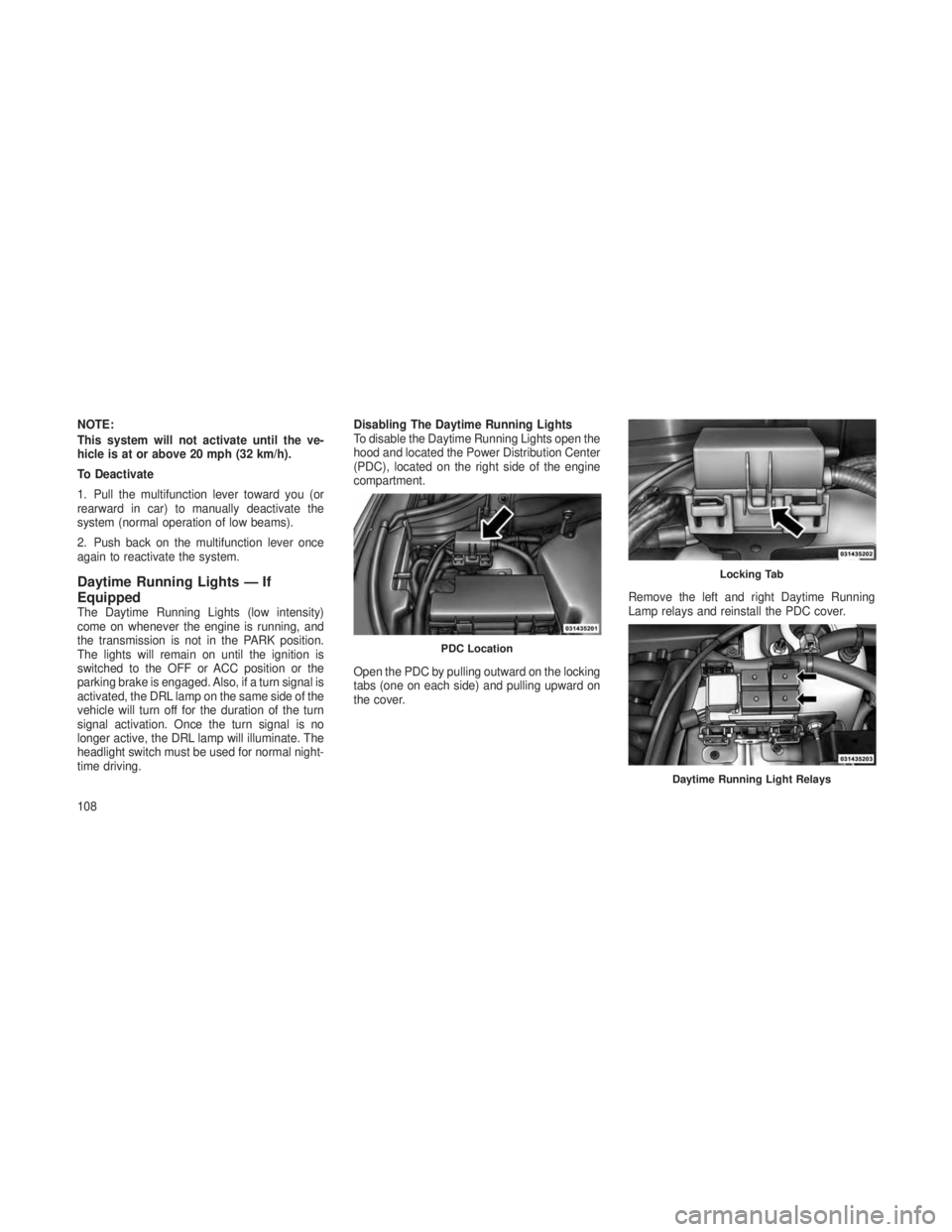
To disable the Daytime Running Lights open the
hood and located the Power Distribution Center
(PDC), located on the right side of the engine
compartment.
Open the PDC by pulling outward on the locking
tabs (one on each side) and pulling upward on
the cover.
Remove the left and right Daytime Running
Lamp relays and reinstall the PDC cover.
PDC Location
Locking Tab
Daytime Running Light Relays
108
Page 125 of 408
Activating Adaptive Cruise
Control (ACC)
You can only activate ACC if the vehicle speed
is above 18 mph (30 km/h).
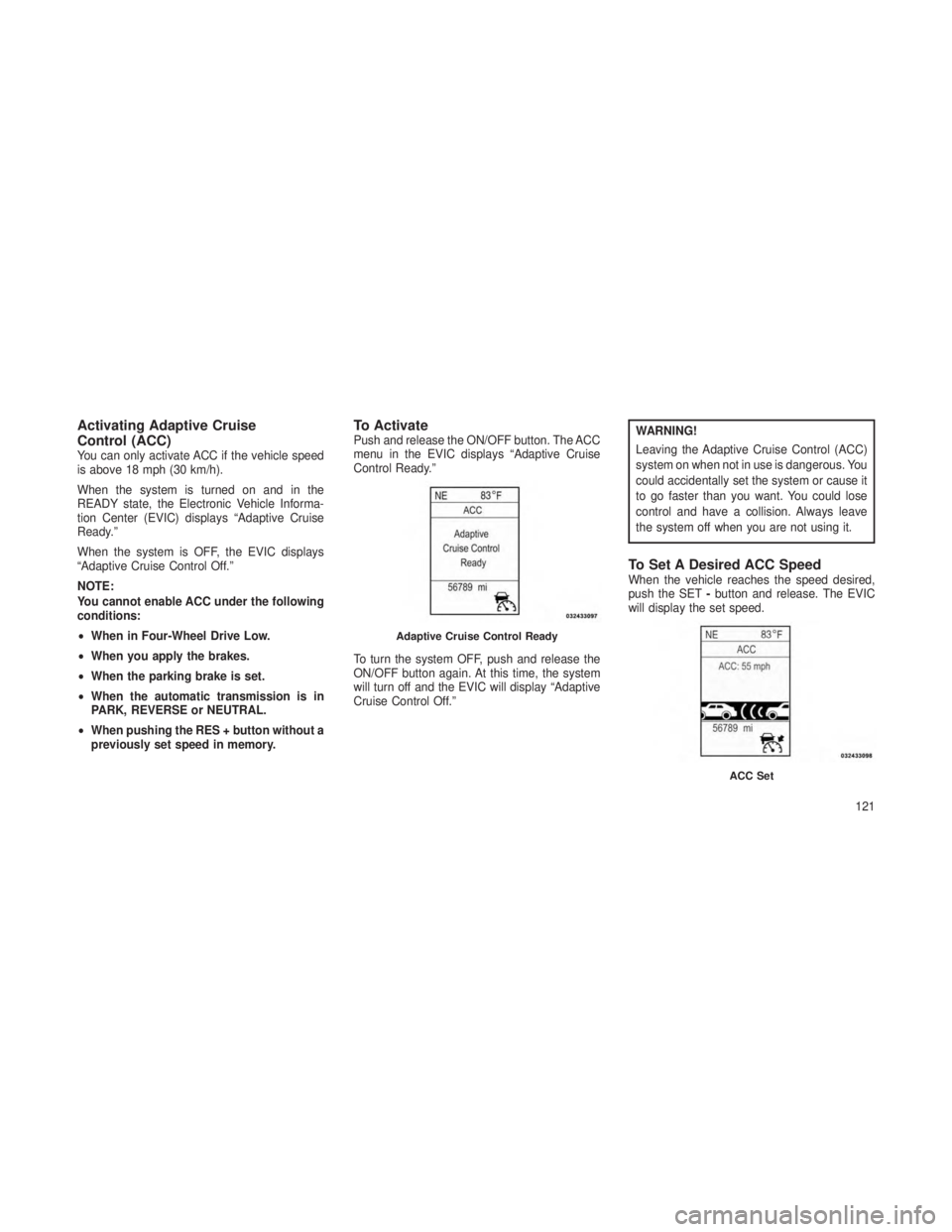
When the system is turned on and in the
READY state, the Electronic Vehicle Informa-
tion Center (EVIC) displays “Adaptive Cruise
Ready.”
When the system is OFF, the EVIC displays
“Adaptive Cruise Control Off.”
NOTE:
You cannot enable ACC under the following
conditions:
•When in Four-Wheel Drive Low.
• When you apply the brakes.
• When the parking brake is set.
• When the automatic transmission is in
PARK, REVERSE or NEUTRAL.
• When pushing the RES + button without a
previously set speed in memory.
To ActivatePush and release the ON/OFF button. The ACC
menu in the EVIC displays “Adaptive Cruise
Control Ready.”
To turn the system OFF, push and release the
ON/OFF button again. At this time, the system
will turn off and the EVIC will display “Adaptive
Cruise Control Off.”WARNING!
Leaving the Adaptive Cruise Control (ACC)
system on when not in use is dangerous. You
could accidentally set the system or cause it
to go faster than you want. You could lose
control and have a collision. Always leave
the system off when you are not using it.
To Set A Desired ACC SpeedWhen the vehicle reaches the speed desired,
push the SET -button and release. The EVIC
will display the set speed.
Adaptive Cruise Control Ready
ACC Set
121
Page 169 of 408
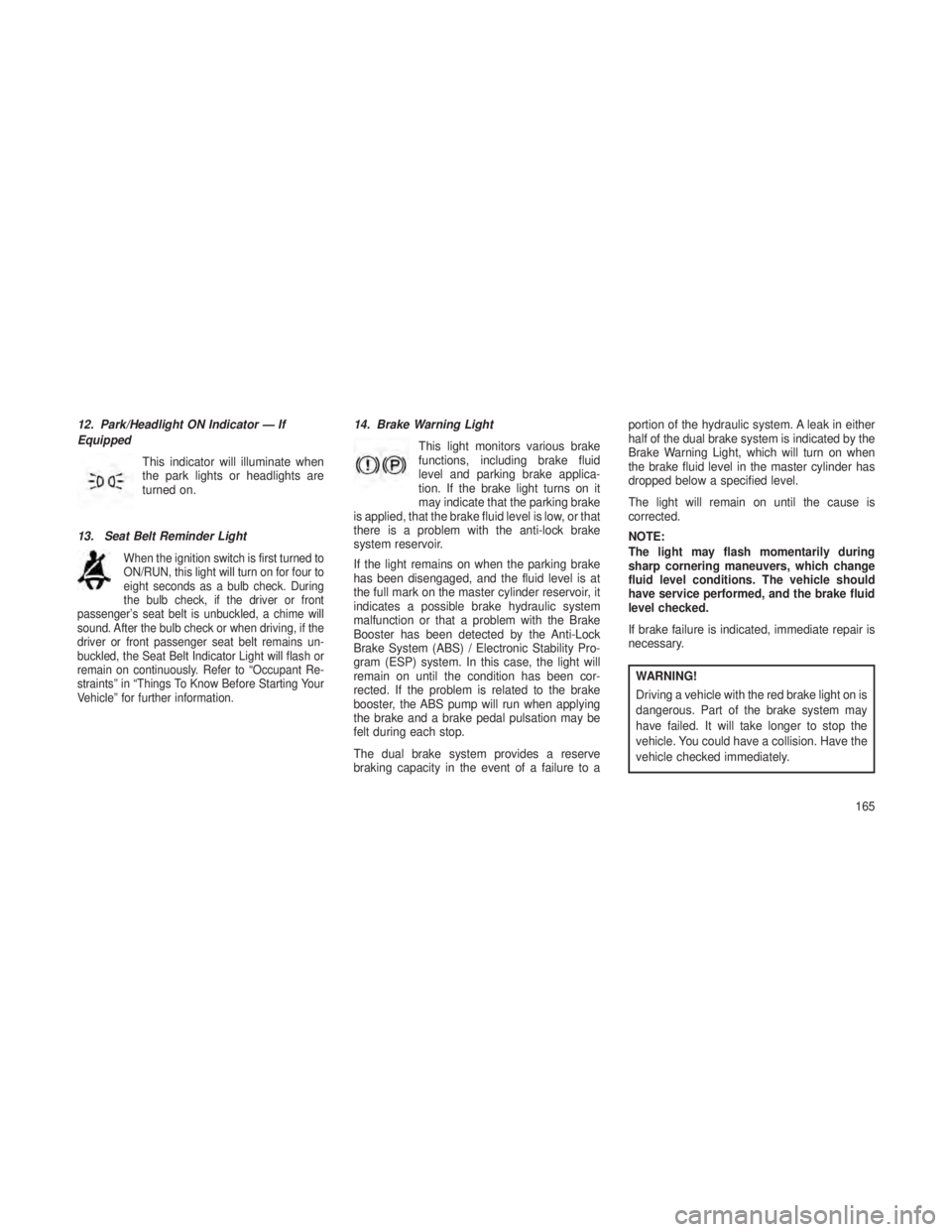
12. Park/Headlight ON Indicator — If
EquippedThis indicator will illuminate when
the park lights or headlights are
turned on.
13. Seat Belt Reminder Light
When the ignition switch is first turned to
ON/RUN, this light will turn on for four to
eight seconds as a bulb check. During
the bulb check, if the driver or front
passenger’s seat belt is unbuckled, a chime will
sound. After the bulb check or when driving, if the
driver or front passenger seat belt remains un-
buckled, the Seat Belt Indicator Light will flash or
remain on continuously. Refer to “Occupant Re-
straints” in “Things To Know Before Starting Your
Vehicle” for further information.
14. Brake Warning Light
This light monitors various brake
functions, including brake fluid
level and parking brake applica-
tion. If the brake light turns on it
may indicate that the parking brake
is applied, that the brake fluid level is low, or that
there is a problem with the anti-lock brake
system reservoir.
If the light remains on when the parking brake
has been disengaged, and the fluid level is at
the full mark on the master cylinder reservoir, it
indicates a possible brake hydraulic system
malfunction or that a problem with the Brake
Booster has been detected by the Anti-Lock
Brake System (ABS) / Electronic Stability Pro-
gram (ESP) system. In this case, the light will
remain on until the condition has been cor-
rected. If the problem is related to the brake
booster, the ABS pump will run when applying
the brake and a brake pedal pulsation may be
felt during each stop.
The dual brake system provides a reserve
braking capacity in the event of a failure to a portion of the hydraulic system. A leak in either
half of the dual brake system is indicated by the
Brake Warning Light, which will turn on when
the brake fluid level in the master cylinder has
dropped below a specified level.
The light will remain on until the cause is
corrected.
NOTE:
The light may flash momentarily during
sharp cornering maneuvers, which change
fluid level conditions. The vehicle should
have service performed, and the brake fluid
level checked.
If brake failure is indicated, immediate repair is
necessary.
WARNING!
Driving a vehicle with the red brake light on is
dangerous. Part of the brake system may
have failed. It will take longer to stop the
vehicle. You could have a collision. Have the
vehicle checked immediately.
165
Page 170 of 408
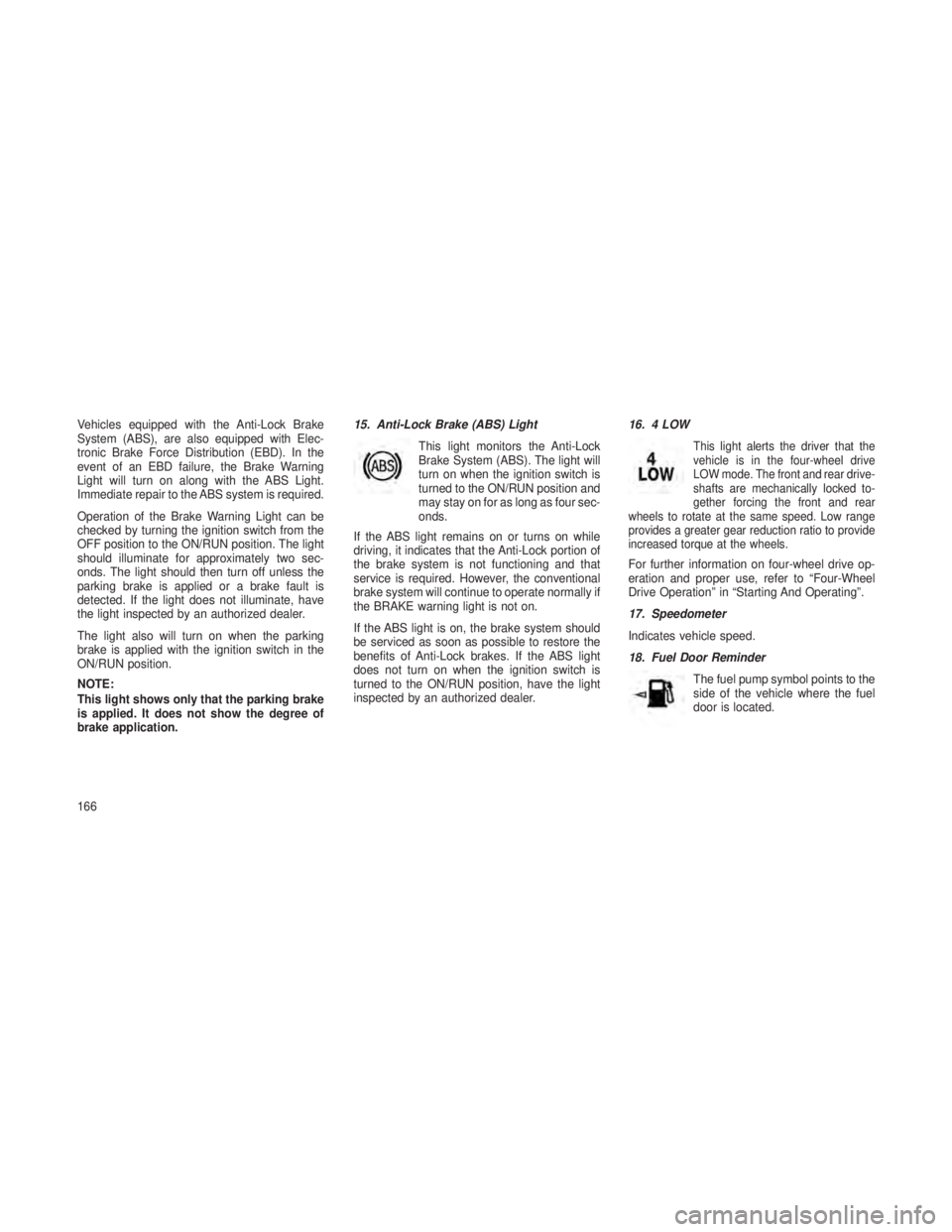
Vehicles equipped with the Anti-Lock Brake
System (ABS), are also equipped with Elec-
tronic Brake Force Distribution (EBD). In the
event of an EBD failure, the Brake Warning
Light will turn on along with the ABS Light.
Immediate repair to the ABS system is required.
Operation of the Brake Warning Light can be
checked by turning the ignition switch from the
OFF position to the ON/RUN position. The light
should illuminate for approximately two sec-
onds. The light should then turn off unless the
parking brake is applied or a brake fault is
detected. If the light does not illuminate, have
the light inspected by an authorized dealer.
The light also will turn on when the parking
brake is applied with the ignition switch in the
ON/RUN position.
NOTE:
This light shows only that the parking brake
is applied. It does not show the degree of
brake application.15. Anti-Lock Brake (ABS) Light
This light monitors the Anti-Lock
Brake System (ABS). The light will
turn on when the ignition switch is
turned to the ON/RUN position and
may stay on for as long as four sec-
onds.
If the ABS light remains on or turns on while
driving, it indicates that the Anti-Lock portion of
the brake system is not functioning and that
service is required. However, the conventional
brake system will continue to operate normally if
the BRAKE warning light is not on.
If the ABS light is on, the brake system should
be serviced as soon as possible to restore the
benefits of Anti-Lock brakes. If the ABS light
does not turn on when the ignition switch is
turned to the ON/RUN position, have the light
inspected by an authorized dealer. 16. 4 LOW
This light alerts the driver that the
vehicle is in the four-wheel drive
LOW mode. The front and rear drive-
shafts are mechanically locked to-
gether forcing the front and rear
wheels to rotate at the same speed. Low range
provides a greater gear reduction ratio to provide
increased torque at the wheels.
For further information on four-wheel drive op-
eration and proper use, refer to “Four-Wheel
Drive Operation” in “Starting And Operating”.
17. Speedometer
Indicates vehicle speed.
18. Fuel Door Reminder
The fuel pump symbol points to the
side of the vehicle where the fuel
door is located.
166
Page 221 of 408
•PARKING BRAKE .............................250
• ELECTRONIC BRAKE CONTROL SYSTEM .............252
•Anti-Lock Brake System (ABS) ...................252
• Traction Control System (TCS) ....................252
• Brake Assist System (BAS) ..................... .252
• Electronic Roll Mitigation (ERM) ...................253
• Electronic Stability Control (ESC) ..................253
• Trailer Sway Control (TSC) ..................... .255
• Hill Start Assist (HSA) ........................ .256
• Ready Alert Braking ......................... .257
• Rain Brake Support .......................... .257
• Hill Descent Control (HDC) — Four-Wheel Drive Models With
MP3023 Two-Speed Transfer Case Only ..............257
• ESC Activation/Malfunction Indicator Light And ESC OFF
Indicator Light ............................ .258
•TIRES — GENERAL INFORMATION ..................259•Tire Pressure ............................. .259
• Tire Inflation Pressures ........................260
• Tire Pressures For High Speed Operation .............260
• Radial Ply Tires ............................ .261
• All Season Tires – If Equipped ....................261
• Summer Or Three Season Tires – If Equipped ...........261
• Snow Tires .............................. .261
• Spare Tire Matching Original Equipped Tire And Wheel – If
Equipped ................................ .262
• Compact Spare Tire – If Equipped ..................262
• Full Size Spare – If Equipped .................... .262
217
Page 224 of 408
STARTING PROCEDURES
Before starting your vehicle, adjust your seat,
adjust the inside and outside mirrors, fasten
your seat belt, and if present, instruct all other
occupants to buckle their seat belts.
WARNING!
•When leaving the vehicle, always remove
the key fob from the ignition and lock your
vehicle.
• Never leave children alone in a vehicle, or
with access to an unlocked vehicle. Allow-
ing children to be in a vehicle unattended
is dangerous for a number of reasons.
A child or others could be seriously or
fatally injured. Children should be warned
not to touch the parking brake, brake pedal
or the shift lever.
(Continued)
WARNING!(Continued)
•Do not leave the key fob in or near the
vehicle (or in a location accessible to chil-
dren), and do not leave a vehicle equipped
with Keyless Enter-N-Go™ in the ACC or
ON/RUN mode. A child could operate
power windows, other controls, or move
the vehicle.
Automatic TransmissionThe shift lever must be in the NEUTRAL or PARK
position before you can start the engine. Apply the
brakes before shifting into any driving gear.
CAUTION!
Damage to the transmission may occur if the
following precautions are not observed:
•Do not shift from REVERSE, PARK, or
NEUTRAL into any forward gear when the
engine is above idle speed.
(Continued)
CAUTION!(Continued)
•Shift into PARK only after the vehicle has
come to a complete stop.
• Shift into or out of REVERSE only after the
vehicle has come to a complete stop and
the engine is at idle speed.
• Before shifting into any gear, make sure
your foot is firmly on the brake pedal.
Using Fob With Integrated Key (Tip Start)
NOTE:
Normal starting of either a cold or a warm
engine is obtained without pumping or press-
ing the accelerator pedal.
Do not press the accelerator. Use the Fob with
Integrated Key to briefly turn the ignition switch to
the START position and release it as soon as the
starter engages. The starter motor will continue to
run, and it will disengage automatically when the
engine is running. If the engine fails to start, the
starter will disengage automatically in 10 sec-
onds. If this occurs, turn the ignition switch to the
LOCK position, wait 10 to 15 seconds, then
repeat the “Normal Starting” procedure.
220
Page 229 of 408
Engine Idling – In Cold Weather
Avoid prolonged idling in ambient temperatures
below 0°F (-18°C). Long periods of idling may
be harmful to your engine because combustion
chamber temperatures can drop so low that the
fuel may not burn completely. Incomplete com-
bustion allows carbon and varnish to form on
piston rings and injector nozzles. Also, the
unburned fuel can enter the crankcase, diluting
the oil and causing rapid wear to the engine.
Stopping The Engine
Before turning off your turbo diesel engine,
always allow the engine to return to normal idle
speed and run for several seconds. This as-
sures proper lubrication of the turbocharger.
This is particularly necessary after any period of
hard driving.
Idle the engine a few minutes before routine
shutdown. After full load operation, idle the
engine three to five minutes before shutting it
down. This idle period will allow the lubricating
oil and coolant to carry excess heat away from
the combustion chamber, bearings, internal
components, and turbocharger. This is espe-
cially important for turbocharged, charge air
cooled engines.AUTOMATIC TRANSMISSION
CAUTION!
Damage to the transmission may occur if the
following precautions are not observed:
•Shift into PARK only after the vehicle has
come to a complete stop.
• Shift into or out of REVERSE only after the
vehicle has come to a complete stop and
the engine is at idle speed.
• Do not shift between PARK, REVERSE,
NEUTRAL, or DRIVE when the engine is
above idle speed.
•
Before shifting into any gear, make sure your
foot is firmly pressing the brake pedal.
NOTE:
You must press and hold the brake pedal
while shifting out of PARK.
WARNING!
• Unintended movement of a vehicle could
injure those in or near the vehicle. As with
all vehicles, you should never exit a ve-
hicle while the engine is running. Before
exiting a vehicle, always apply the parking
brake, shift the transmission into PARK,
turn the engine OFF, and remove the key
fob. When the ignition is in the OFF posi-
tion, the shift lever is locked in PARK,
securing the vehicle against unwanted
movement.
• It is dangerous to shift out of PARK or
NEUTRAL if the engine speed is higher
than idle speed. If your foot is not firmly
pressing the brake pedal, the vehicle could
accelerate quickly forward or in reverse.
You could lose control of the vehicle and
hit someone or something. Only shift into
gear when the engine is idling normally
and your foot is firmly pressing the brake
pedal.
(Continued)
225
Page 230 of 408
WARNING!(Continued)
•When leaving the vehicle, always remove
the key fob and lock your vehicle.
• Never leave children alone in a vehicle, or
with access to an unlocked vehicle. Allow-
ing children to be in a vehicle unattended
is dangerous for a number of reasons.
A child or others could be seriously or
fatally injured.
• Children should be warned not to touch the
parking brake, brake pedal or the shift
lever.
•
Do not leave the key fob in or near the
vehicle (or in a location accessible to chil-
dren), and do not leave Keyless Enter-N-
Go™ in the ACC or ON/RUN position.
A child could operate power windows, other
controls, or move the vehicle.
Key Ignition Park InterlockThis vehicle is equipped with a Key Ignition Park
Interlock which requires the shift lever to be in
PARK before the ignition switch can be turned
to the OFF position. The key fob can only be
removed from the ignition when the ignition is in
the OFF position, and the shift lever is locked in
PARK whenever the ignition switch is in the
OFF position.
NOTE:
If a malfunction occurs, the system will trap
the key fob in the ignition switch to warn you
that this safety feature is inoperable. The
engine can be started and stopped but the
key fob cannot be removed until you obtain
service.
Brake/Transmission Shift Interlock
System
This vehicle is equipped with a Brake Transmis-
sion Shift Interlock system (BTSI) that holds the
shift lever in PARK unless the brakes are ap-
plied. To shift the transmission out of PARK, the
ignition switch must be turned to the ON/RUN
position (engine running or not) and the brake
pedal must be pressed.
Five-Speed Automatic Transmission
(3.6L and 3.0L Diesel Engine) — If
Equipped
The shift lever position display (located in the
instrument cluster) indicates the transmission
gear range. You must press the brake pedal to
move the shift lever out of PARK (refer to
“Brake/Transmission Shift Interlock System” in
this section). To drive, move the shift lever from
PARK or NEUTRAL to the DRIVE position.
The electronically-controlled transmission pro-
vides a precise shift schedule. The transmission
electronics are self-calibrating; therefore, the
first few shifts on a new vehicle may be some-
what abrupt. This is a normal condition, and
precision shifts will develop within a few hun-
dred miles (kilometers).
Only shift from DRIVE to PARK or REVERSE
when the accelerator pedal is released and the
vehicle is stopped. Be sure to keep your foot on
the brake pedal when shifting between these
gears.
226