spare tire JEEP GRAND CHEROKEE 2013 Owner handbook (in English)
[x] Cancel search | Manufacturer: JEEP, Model Year: 2013, Model line: GRAND CHEROKEE, Model: JEEP GRAND CHEROKEE 2013Pages: 408, PDF Size: 3.21 MB
Page 65 of 408
Floor Mat Safety Information
Always use floor mats designed to fit the foot-
well of your vehicle. Use only floor mats that
leave the pedal area unobstructed and that are
firmly secured so that they cannot slip out of
position and interfere with the pedals or impair
safe operation of your vehicle in other ways.
WARNING!
Pedals that cannot move freely can cause
loss of vehicle control and increase the risk
of serious personal injury.
•
Always make sure that floor mats are prop-
erly attached to the floor mat fasteners.
•Never place or install floor mats or other
floor coverings in the vehicle that cannot
be properly secured to prevent them from
moving and interfering with the pedals or
the ability to control the vehicle.
(Continued)
WARNING!(Continued)
•Never put floor mats or other floor cover-
ings on top of already installed floor mats.
Additional floor mats and other coverings
will reduce the size of the pedal area and
interfere with the pedals.
• Check mounting of mats on a regular
basis. Always properly reinstall and secure
floor mats that have been removed for
cleaning.
• Always make sure that objects cannot fall
into the driver footwell while the vehicle is
moving. Objects can become trapped un-
der the brake pedal and accelerator pedal
causing a loss of vehicle control.
• If required, mounting posts must be prop-
erly installed, if not equipped from the
factory.
Failure to properly follow floor mat installa-
tion or mounting can cause interference with
the brake pedal and accelerator pedal opera-
tion causing loss of control of the vehicle.
Periodic Safety Checks You Should
Make Outside The Vehicle
Tires
Examine tires for excessive tread wear and
uneven wear patterns. Check for stones, nails,
glass, or other objects lodged in the tread or
sidewall. Inspect the tread for cuts and cracks.
Inspect sidewalls for cuts, cracks and bulges.
Check the wheel nuts for tightness. Check the
tires (including spare) for proper cold inflation
pressure.
Lights
Have someone observe the operation of brake
lights and exterior lights while you work the
controls. Check turn signal and high beam
indicator lights on the instrument panel.
Door Latches
Check for positive closing, latching, and locking.
Fluid Leaks
Check area under vehicle after overnight park-
ing for fuel, engine coolant, oil, or other fluid
leaks. Also, if gasoline fumes are detected or if
fuel, power steering fluid, or brake fluid leaks
are suspected, the cause should be located and
corrected immediately.
61
Page 168 of 408
10. Electronic Vehicle Information Center
(EVIC) Display/Odometer Display
The odometer display shows the total distance
the vehicle has been driven.
The Electronic Vehicle Information Center
(EVIC). Refer to “Electronic Vehicle Information
Center”.
11. Tire Pressure Monitoring Telltale LightEach tire, including the spare (if
provided), should be checked
monthly when cold and inflated
to the inflation pressure recom-
mended by the vehicle manufac-
turer on the vehicle placard or tire inflation
pressure label. (If your vehicle has tires of a
different size than the size indicated on the
vehicle placard or tire inflation pressure label,
you should determine the proper tire inflation
pressure for those tires.)
As an added safety feature, your vehicle has
been equipped with a Tire Pressure Monitoring
System (TPMS) that illuminates a low tire pres-
sure telltale when one or more of your tires is
significantly under-inflated. Accordingly, when the low tire pressure telltale illuminates, you
should stop and check your tires as soon as
possible, and inflate them to the proper pres-
sure. Driving on a significantly under-inflated
tire causes the tire to overheat and can lead to
tire failure. Under-inflation also reduces fuel
efficiency and tire tread life, and may affect the
vehicle’s handling and stopping ability.
Please note that the TPMS is not a substitute for
proper tire maintenance, and it is the driver’s
responsibility to maintain correct tire pressure,
even if under-inflation has not reached the level
to trigger illumination of the TPMS low tire
pressure telltale.
Your vehicle has also been equipped with a
TPMS malfunction indicator to indicate when
the system is not operating properly. The TPMS
malfunction indicator is combined with the low
tire pressure telltale. When the system detects
a malfunction, the telltale will flash for approxi-
mately one minute and then remain continu-
ously illuminated. This sequence will continue
upon subsequent vehicle start-ups as long as
the malfunction exists. When the malfunction
indicator is illuminated, the system may not be
able to detect or signal low tire pressure as
intended. TPMS malfunctions may occur for a
variety of reasons, including the installation of
replacement or alternate tires or wheels on the
vehicle that prevent the TPMS from functioning
properly. Always check the TPMS malfunction
telltale after replacing one or more tires or
wheels on your vehicle, to ensure that the
replacement or alternate tires and wheels allow
the TPMS to continue to function properly.
CAUTION!
The TPMS has been optimized for the origi-
nal equipment tires and wheels. TPMS pres-
sures and warning have been established for
the tire size equipped on your vehicle. Un-
desirable system operation or sensor dam-
age may result when using replacement
equipment that is not of the same size, type,
and/or style. Aftermarket wheels can cause
sensor damage. Do not use tire sealant from
a can or balance beads if your vehicle is
equipped with a TPMS, as damage to the
sensors may result.
164
Page 221 of 408
•PARKING BRAKE .............................250
• ELECTRONIC BRAKE CONTROL SYSTEM .............252
•Anti-Lock Brake System (ABS) ...................252
• Traction Control System (TCS) ....................252
• Brake Assist System (BAS) ..................... .252
• Electronic Roll Mitigation (ERM) ...................253
• Electronic Stability Control (ESC) ..................253
• Trailer Sway Control (TSC) ..................... .255
• Hill Start Assist (HSA) ........................ .256
• Ready Alert Braking ......................... .257
• Rain Brake Support .......................... .257
• Hill Descent Control (HDC) — Four-Wheel Drive Models With
MP3023 Two-Speed Transfer Case Only ..............257
• ESC Activation/Malfunction Indicator Light And ESC OFF
Indicator Light ............................ .258
•TIRES — GENERAL INFORMATION ..................259•Tire Pressure ............................. .259
• Tire Inflation Pressures ........................260
• Tire Pressures For High Speed Operation .............260
• Radial Ply Tires ............................ .261
• All Season Tires – If Equipped ....................261
• Summer Or Three Season Tires – If Equipped ...........261
• Snow Tires .............................. .261
• Spare Tire Matching Original Equipped Tire And Wheel – If
Equipped ................................ .262
• Compact Spare Tire – If Equipped ..................262
• Full Size Spare – If Equipped .................... .262
217
Page 222 of 408
•Limited-Use Spare – If Equipped .....................262
• Tire Spinning ............................... .263
• Tread Wear Indicators .......................... .263
• Life Of Tire ................................ .264
• Replacement Tires ............................ .264
•TIRE CHAINS (TRACTION DEVICES) ...................265
• TIRE ROTATION RECOMMENDATIONS ..................266
•Non-Directional Tires Only ........................ .266•TIRE PRESSURE MONITOR SYSTEM (TPMS) ..............266•Base System ................................ .268
• Premium System – If Equipped ..................... .269
• TPMS Deactivation ............................ .272
• General Information ........................... .272
•FUEL REQUIREMENTS — GASOLINE ENGINE .............273•3.6L Engine ................................. .273
• 5.7L Engine ................................. .273
• Methanol .................................. .273
• Ethanol ................................... .274
• Clean Air Gasoline ............................ .274
• MMT In Gasoline ............................. .274
• Materials Added To Fuel ......................... .274
•FUEL REQUIREMENTS — DIESEL ENGINE ...............275
• ADDING FUEL .................................276
•Fuel Filler Cap (Gas Cap) ........................ .276
• Loose Fuel Filler Cap Message .....................278
218
Page 247 of 408
The system requires that the engine be running
for all changes. When lowering the vehicle all of
the doors, including the liftgate, must be closed.
If a door is opened at any time while the vehicle
is lowering the change will not be completed
until the open door(s) is closed.
The Quadra-Lift™ air suspension system uses
a lifting and lowering pattern which keeps the
headlights from incorrectly shining into oncom-
ing traffic. When raising the vehicle, the rear of
the vehicle will move up first and then the front.
When lowering the vehicle, the front will move
down first and then the rear.
After the engine is turned off, it may be noticed
that the air suspension system operates briefly,
this is normal. The system is correcting the
position of the vehicle to ensure a proper ap-
pearance.
To assist with changing a spare tire, the
Quadra-Lift™ air suspension system has a fea-
ture which allows the automatic leveling to be
disabled. Press and hold both the “Up” and
“Down” buttons simultaneously between 5 and
10 seconds, a message will appear in the EVIC
stating leveling has been disabled immediatelyafter both buttons have been released. Refer to
“Electronic Vehicle Information Center (EVIC)”
in “Understanding Your Instrument Panel” for
further information. Driving the vehicle over
5 mph (8 km/h) will return the air suspension to
normal operation. Refer to “Jacking and Tire
Changing” in “What To Do In Emergencies” for
further information.
WARNING!
The air suspension system uses a high pres-
sure volume of air to operate the system. To
avoid personal injury or damage to the sys-
tem, see your authorized dealer for service.
Electronic Vehicle Information
Center (EVIC) Display Messages
When the appropriate conditions exist, a mes-
sage will appear in the EVIC display. Refer to
“Electronic Vehicle Information Center (EVIC)”
in “Understanding Your Instrument Panel” for
further information.
An audible chime will be heard whenever a
system error has been detected.
OperationThe indicator lamps 3 through 6 will illuminate to
show the current position of the vehicle. Flash-
ing indicator lamps will show a position which
the system is working to achieve. When raising,
if multiple indicator lamps are flashing on the
“Up” button, the highest flashing indicator lamp
is the position the system is working to achieve.
When lowering, if multiple indicators are flash-
ing on the
"Up"button the lowest solid indicator
lamp is the position the system is working to
achieve.
Pressing the “UP” button once will move the
suspension one position higher from the current
position, assuming all conditions are met (i.e.
engine running, speed below threshold, etc).
The “UP” button can be pressed multiple times,
each press will raise the requested level by one
position up to a maximum position of OR2 or the
highest position allowed based on current con-
ditions (i.e. vehicle speed, etc).
243
Page 266 of 408
Spare Tire Matching Original
Equipped Tire And Wheel – If
Equipped
Your vehicle may be equipped with a spare tire
and wheel equivalent in look and function to the
original equipment tire and wheel found on the
front or rear axle of your vehicle. This spare tire
may be used in the tire rotation for your vehicle.
If your vehicle has this option refer to an autho-
rized tire dealer for the recommended tire rota-
tion pattern.
Compact Spare Tire – If EquippedThe compact spare is for temporary emergency
use only. You can identify if your vehicle is
equipped with a compact spare by looking at
the spare tire description on the Tire and Load-
ing Information Placard located on the driver’s
side door opening or on the sidewall of the tire.
Compact spare tire descriptions begin with the
letter “T” or “S” preceding the size designation.
Example: T145/80D18 103M.
T, S = Temporary Spare TireSince this tire has limited tread life the original
equipment tire should be repaired (or replaced)
and reinstalled on your vehicle at the first op-
portunity.
Do not install a wheel cover or attempt to mount
a conventional tire on the compact spare wheel,
since the wheel is designed specifically for the
compact spare tire. Do not install more than one
compact spare tire and wheel on the vehicle at
any given time.
WARNING!
Compact spares are for temporary emer-
gency use only. With these spares, do not
drive more than 50 mph (80 km/h). Tempo-
rary use spares have limited tread life. When
the tread is worn to the tread wear indicators,
the temporary use spare tire needs to be
replaced. Be sure to follow the warnings,
which apply to your spare. Failure to do so
could result in spare tire failure and loss of
vehicle control.
Full Size Spare – If EquippedThe full size spare is for temporary emergency
use only. This tire may look like the originally
equipped tire on the front or rear axle of your
vehicle, but it is not. This spare tire may have
limited tread life. When the tread is worn to the
tread wear indicators, the temporary use full size
spare tire needs to be replaced. Since it is not the
same as your original equipment tire, replace (or
repair) the original equipment tire and reinstall on
the vehicle at the first opportunity.
Limited-Use Spare – If EquippedThe limited-use spare tire is for temporary emer-
gency use only. This tire is identified by a label
located on the limited-use spare wheel. This label
contains the driving limitations for this spare. This
tire may look like the original equipped tire on the
front or rear axle of your vehicle, but it is not.
Installation of this limited-use spare tire affects
vehicle handling. Since it is not the same as your
original equipment tire, replace (or repair) the
original equipment tire and reinstall on the vehicle
at the first opportunity.
262
Page 267 of 408
WARNING!
Limited-use spares are for emergency use
only. Installation of this limited-use spare tire
affects vehicle handling. With this tire, do not
drive more than the speed listed on the
limit-use spare wheel. Keep inflated to the
cold tire inflation pressures listed on your
Tire and Loading Information Placard lo-
cated on the driver’s side B-Pillar or the rear
edge of the driver’s side door. Replace (or
repair) the original equipment tire at the first
opportunity and reinstall it on your vehicle.
Failure to do so could result in loss of vehicle
control.Tire SpinningWhen stuck in mud, sand, snow, or ice conditions,
do not spin your vehicle’s wheels above 30 mph
(48 km/h) or for longer than 30 seconds continu-
ously without stopping when you are stuck.
Refer to “Freeing A Stuck Vehicle” in “What To
Do In Emergencies” for further information.
WARNING!
Fast spinning tires can be dangerous. Forces
generated by excessive wheel speeds may
cause tire damage or failure. A tire could
explode and injure someone. Do not spin your
vehicle’s wheels faster than 30 mph (48 km/h)
for more than 30 seconds continuously when
you are stuck, and do not let anyone near a
spinning wheel, no matter what the speed.
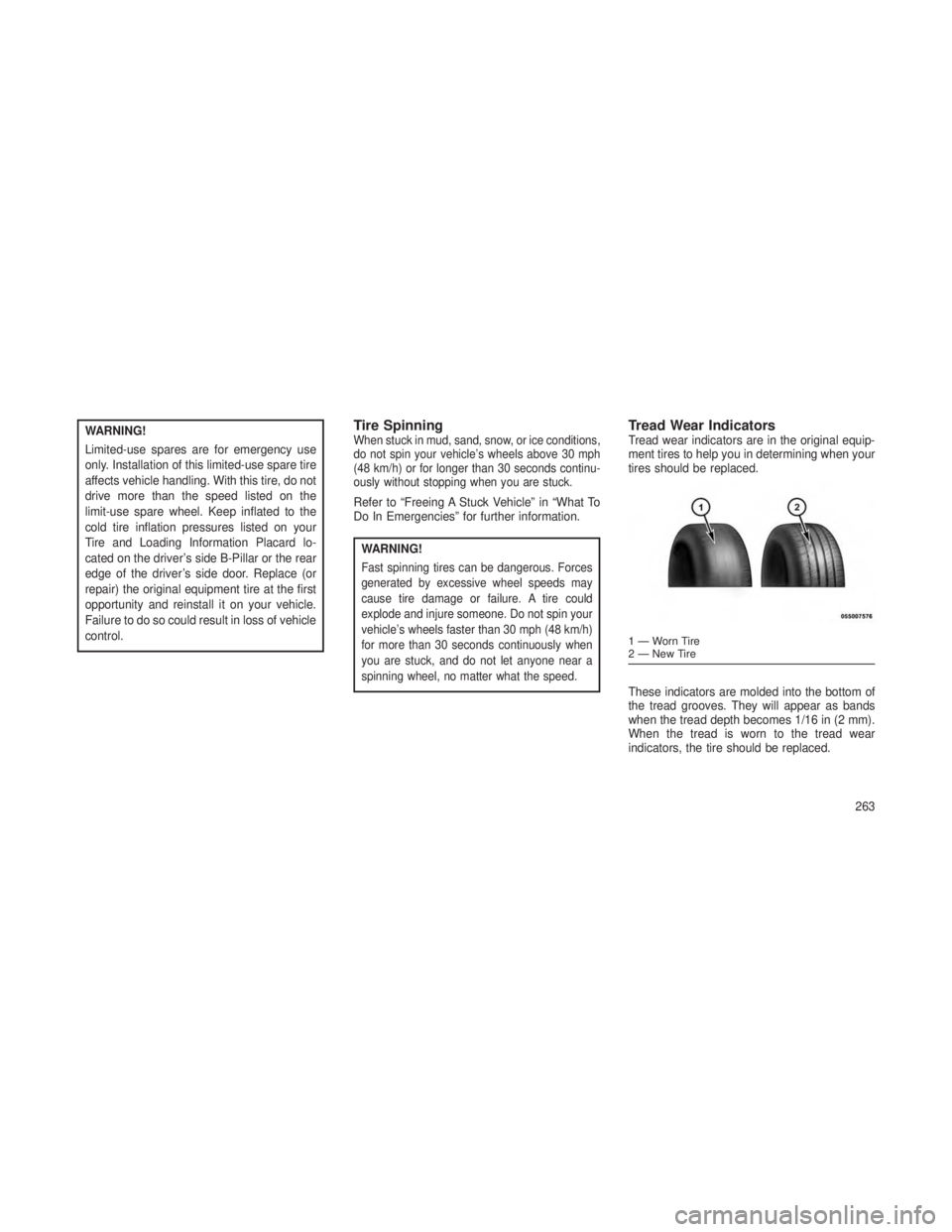
Tread Wear IndicatorsTread wear indicators are in the original equip-
ment tires to help you in determining when your
tires should be replaced.
These indicators are molded into the bottom of
the tread grooves. They will appear as bands
when the tread depth becomes 1/16 in (2 mm).
When the tread is worn to the tread wear
indicators, the tire should be replaced.
1—WornTire
2 — New Tire
263
Page 268 of 408
Life Of TireThe service life of a tire is dependent upon
varying factors including, but not limited to:
•Driving style
• Tire pressure
• Distance driven
• Performance tires, tires with a speed rating of
V or higher, and summer tires typically have
a reduced tread life. Rotation of these tires
per the vehicle maintenance schedule is
highly recommended.
WARNING!
Tires and the spare tire should be replaced
after six years, regardless of the remaining
tread. Failure to follow this warning can
result in sudden tire failure. You could lose
control and have a collision resulting in seri-
ous injury or death.
Keep dismounted tires in a cool, dry place with
as little exposure to light as possible. Protect
tires from contact with oil, grease, and gasoline.
Replacement TiresThe tires on your new vehicle provide a balance
of many characteristics. They should be in-
spected regularly for wear and correct cold tire
inflation pressure. The manufacturer strongly
recommends that you use tires equivalent to the
originals in size, quality and performance when
replacement is needed. Refer to the paragraph
on “Tread Wear Indicators”. Refer to the “Tire
and Loading Information” placard for the size
designation of your tire. The Load Index and
Speed Symbol for your tire will be found on the
original equipment tire sidewall. See the Tire
Sizing Chart example found in the Tire Safety
Information section of this manual for more
information relating to the Load Index and
Speed Symbol of a tire.
It is recommended to replace the two front tires
or two rear tires as a pair. Replacing just one tire
can seriously affect your vehicle’s handling. If
you ever replace a wheel, make sure that the
wheel’s specifications match those of the origi-
nal wheels. It is recommended you contact your authorized
tire or original equipment vehicle dealer with
any questions you may have on tire specifica-
tions or capability. Failure to use equivalent
replacement tires may adversely affect the
safety, handling, and ride of your vehicle.
WARNING!
•
Do not use a tire, wheel size or rating other
than that specified for your vehicle. Some
combinations of unapproved tires and
wheels may change suspension dimen-
sions and performance characteristics, re-
sulting in changes to steering, handling,
and braking of your vehicle. This can
cause unpredictable handling and stress
to steering and suspension components.
You could lose control and have a collision
resulting in serious injury or death. Use
only the tire and wheel sizes with load
ratings approved for your vehicle.
(Continued)
264
Page 270 of 408
CAUTION!(Continued)
•Observe the traction device manufactur-
er’s instructions on the method of installa-
tion, operating speed, and conditions for
use. Always use the suggested operating
speed of the device manufacturer’s if it is
less than 30 mph (48 km/h).
• Do not use traction devices on a compact
spare tire.
TIRE ROTATION
RECOMMENDATIONS
Non-Directional Tires OnlyTires on the front and rear axles of vehicles
operate at different loads and perform different
steering, handling, and braking functions. For
these reasons, they wear at unequal rates. These effects can be reduced by timely rotation
of tires. The benefits of rotation are especially
worthwhile with aggressive tread designs such
as those on On/Off-Road type tires. Rotation
will increase tread life, help to maintain mud,
snow, and wet traction levels, and contribute to
a smooth, quiet ride.
Refer to the “Maintenance Schedule” for the
proper maintenance intervals. More frequent
rotation is permissible if desired. The reasons
for any rapid or unusual wear should be cor-
rected prior to rotation being performed.
NOTE:
The premium Tire Pressure Monitor System
will automatically locate the pressure values
displayed in the correct vehicle position
following a tire rotation.
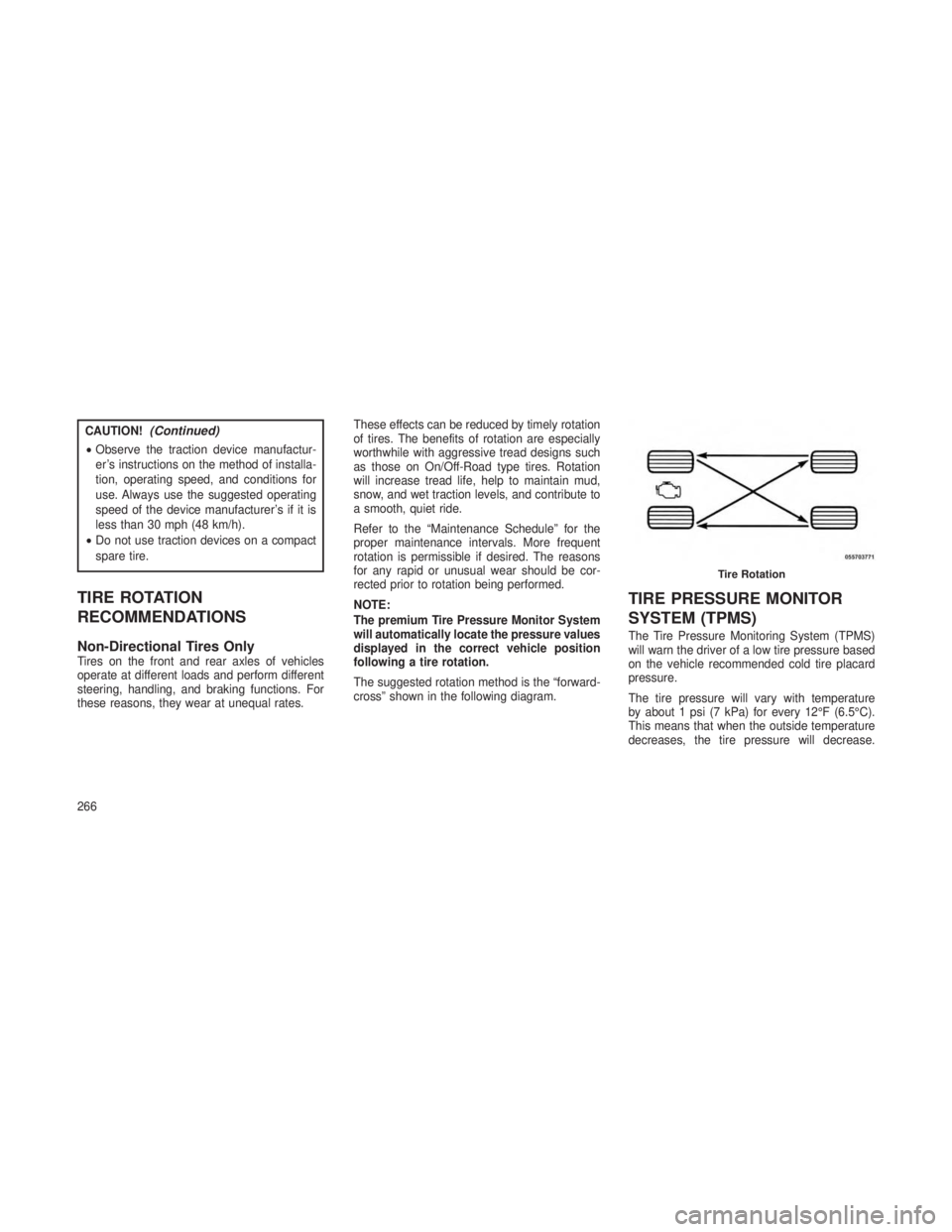
The suggested rotation method is the “forward-
cross” shown in the following diagram.
TIRE PRESSURE MONITOR
SYSTEM (TPMS)
The Tire Pressure Monitoring System (TPMS)
will warn the driver of a low tire pressure based
on the vehicle recommended cold tire placard
pressure.
The tire pressure will vary with temperature
by about 1 psi (7 kPa) for every 12°F (6.5°C).
This means that when the outside temperature
decreases, the tire pressure will decrease.
Tire Rotation
266
Page 272 of 408
NOTE:
•The TPMS is not intended to replace nor-
mal tire care and maintenance, or to pro-
vide warning of a tire failure or condition.
• The TPMS should not be used as a tire
pressure gauge while adjusting your tire
pressure.
• Driving on a significantly under-inflated
tire causes the tire to overheat and can
lead to tire failure. Under-inflation also
reduces fuel efficiency and tire tread life,
and may affect the vehicle’s handling and
stopping ability.
• The TPMS is not a substitute for proper
tire maintenance, and it is the driver’s
responsibility to maintain correct tire
pressure using an accurate tire gauge,
even if under-inflation has not reached
the level to trigger illumination of the Tire
Pressure Monitoring Telltale Light.
• Seasonal temperature changes will affect
tire pressure, and the TPMS will monitor
the actual tire pressure in the tire.Base SystemThe Tire Pressure Monitor System (TPMS)
uses wireless technology with wheel rim-
mounted electronic sensors to monitor tire pres-
sure levels. Sensors, mounted to each wheel as
part of the valve stem, transmit tire pressure
readings to the Receiver Module.
NOTE:
It is particularly important, for you to regu-
larly check the tire pressure in all of your
tires, and to maintain the proper pressure.
The TPMS consists of the following compo-
nents:
•Receiver Module
• Four Tire Pressure Monitoring Sensors
• Tire Pressure Monitoring Telltale Light
A low spare tire will not cause the Tire Pressure
Monitoring Telltale Light to illuminate, a warning
message to appear, or the chime to sound. The Tire Pressure Monitoring Telltale
Light will illuminate in the instrument
cluster, a “LOW TIRE PRESSURE”
message will display in the instrument
cluster for 5 seconds, an "Inflate to XXX"mes-
sage will be displayed and an audible chime will
be activated, when one or more of the four
active road tire pressures are low. Should this
occur, you should stop as soon as possible,
check the inflation pressure of each tire on your
vehicle, and inflate each tire to the vehicle’s
recommended cold placard pressure value dis-
played in the "Inflate to XXX" message. The
system will automatically update and the Tire
Pressure Monitoring Telltale Light will extin-
guish, once the updated tire pressures have
been received. The vehicle may need to be
driven for up to 20 minutes above 15 mph
(24 km/h) to receive this information.
268