belt JEEP GRAND CHEROKEE 2023 Owners Manual
[x] Cancel search | Manufacturer: JEEP, Model Year: 2023, Model line: GRAND CHEROKEE, Model: JEEP GRAND CHEROKEE 2023Pages: 424, PDF Size: 15.48 MB
Page 9 of 424
7
REAR SEAT ENTERTAINMENT (RSE) WITH
AMAZON FIRE TV BUILT-IN — IF EQUIPPED ..... 234 Overview......................................................... 234
Getting Started .............................................. 235Accessing Rear Seat Entertainment with Fire
TV built-in from the Front Radio Screen....... 235Accessing Rear Seat Entertainment with Fire
TV built-in from the Rear Screens ................ 236
Accessing Rear Seat Entertainment with Fire TV
built-in from the Passenger Screen —
If Equipped..................................................... 236
First Time Starting Up
(Using the Rear Screens) .............................. 236Alexa Voice Control........................................ 237
Listen Via Vehicle Speakers ......................... 237Quick Menu.................................................... 237
Parental Controls (Using the Rear Screens) .. 238
Voice Remote with Alexa Pairing (Using the
Rear Screens) ................................................ 238
Media Sources Input (Using the Front Radio and
Rear Screens) ................................................ 238
Voice Remote with Alexa............................... 239 Replacing the Voice Remote with
Alexa Batteries .............................................. 239
Rear Seat Entertainment with Fire TV Built-In
streaming (Using the Front Radio and Rear
Screens) ......................................................... 240
Fire TV Apps/Games
(Using the Rear Screens) .............................. 241
Are We There Yet? ......................................... 241
Using The Video USB Port ............................. 242
Play Video Games ......................................... 242
Headphones Operation................................. 242
Rear Climate Controls ................................... 243Legal & Compliance ...................................... 245
OFF-ROAD PAGES — IF EQUIPPED.................... 245
Off-Road Pages Status Bar .......................... 245
Vehicle Dynamics ......................................... 246
Accessory Gauges ........................................ 246Pitch & Roll ................................................... 246
Selec-Terrain — If Equipped ......................... 246
Suspension — If Equipped ............................ 247
RADIO OPERATION AND MOBILE PHONES ..... 247
Regulatory And Safety Information .............. 247
SAFETY
SAFETY FEATURES .............................................. 248 Anti-Lock Brake System (ABS) ..................... 248
Drowsy Driver Detection (DDD) — If Equipped .... 249
Rear Seat Reminder Alert (RSRA) ................ 249Electronic Brake Control (EBC) System ...... 250
AUXILIARY DRIVING SYSTEMS .......................... 258
Blind Spot Monitoring (BSM) ........................ 258Forward Collision Warning (FCW)
With Mitigation .............................................. 261
Tire Pressure Monitoring System (TPMS) .... 264
OCCUPANT RESTRAINT SYSTEMS ................... 269
Occupant Restraint Systems Features ....... 269
Important Safety Precautions ...................... 269
Seat Belt Systems ........................................ 270
Supplemental Restraint Systems (SRS) ...... 277Child Restraints ............................................. 289
SAFETY TIPS ........................................................ 303
Transporting Passengers.............................. 303
Transporting Pets ......................................... 303
Connected Vehicles ...................................... 303
Safety Checks You Should Make Inside The
Vehicle .......................................................... 303Periodic Safety Checks You Should Make
Outside The Vehicle ...................................... 305
Exhaust Gas................................................... 305
Carbon Monoxide Warnings ......................... 306
23_WL_OM_EN_USC_t.book Page 7
Page 10 of 424
8
IN CASE OF EMERGENCY
HAZARD WARNING FLASHERS ......................... 307
ASSIST AND SOS SYSTEM — IF EQUIPPED ...... 307
JACKING AND TIRE CHANGING ........................ 310 Preparations For Jacking .............................. 311Jack Location ................................................. 311
Spare Tire Stowage ...................................... 313Spare Tire Removal ....................................... 313
Jacking Instructions ...................................... 315
JUMP STARTING................................................... 319
Preparations For Jump Start......................... 320Jump Starting Procedure .............................. 320
REFUELING IN EMERGENCY .............................. 321
IF YOUR ENGINE OVERHEATS ............................ 322
MANUAL PARK RELEASE .................................. 323
FREEING A STUCK VEHICLE .............................. 325
TOWING A DISABLED VEHICLE .......................... 326
Rear-Wheel Drive Models ............................. 327
Four-Wheel Drive Models.............................. 328Emergency Tow Hooks — If Equipped .......... 328 ENHANCED ACCIDENT RESPONSE SYSTEM
(EARS) .................................................................. 329
EVENT DATA RECORDER (EDR) ........................ 329
SERVICING AND MAINTENANCE
SCHEDULED SERVICING ................................... 330
Maintenance Plan ......................................... 331
ENGINE COMPARTMENT .................................... 334
2.0L Engine .................................................. 334
3.6L Engine ................................................... 335
5.7L Engine ................................................... 336
Checking Oil Level ........................................ 337Adding Washer Fluid ..................................... 337
Maintenance-Free Battery ........................... 338Pressure Washing ......................................... 338
VEHICLE MAINTENANCE..................................... 338
Engine Oil ....................................................... 338
Engine Oil Filter ............................................. 339Engine Air Cleaner Filter ............................... 339
Air Conditioner Maintenance ....................... 340
Accessory Drive Belt Inspection ................... 342Body Lubrication ........................................... 343 Windshield Wiper Blades.............................. 343
Exhaust System ............................................ 345
Cooling System.............................................. 346
Brake System ............................................... 350
Automatic Transmission ............................... 351
Front/Rear Axle Fluid ................................... 351
Transfer Case ............................................... 352Fuses.............................................................. 352
Bulb Replacement ........................................ 374
TIRES ..................................................................... 374
Tire Safety Information ................................ 374Tires — General Information ......................... 382
Tire Types....................................................... 385Spare Tires — If Equipped ............................ 386
Wheel And Wheel Trim Care ........................ 388Snow Traction Devices ................................. 389
Tire Rotation Recommendations ................ 391
DEPARTMENT OF TRANSPORTATION UNIFORM
TIRE QUALITY GRADES ...................................... 391
Treadwear...................................................... 391
Traction Grades ............................................. 392Temperature Grades..................................... 392
23_WL_OM_EN_USC_t.book Page 8
Page 13 of 424
11
SYMBOLS KEY
If you do not read the entire Owner’s Manual, you may miss important
information. Observe all Cautions and Warnings.
ROLLOVER WARNING
Utility vehicles have a significantly higher rollover rate than other types of
vehicles. This vehicle has a higher ground clearance and a higher center of
gravity than many passenger vehicles. It is capable of performing better in a
wide variety of off-road applications. Driven in an unsafe manner, all vehicles
can go out of control. Because of the higher center of gravity, if this vehicle is
out of control, it may roll over while some other vehicles may not.
Do not attempt sharp turns, abrupt maneuvers, or other unsafe driving actions
that can cause loss of vehicle control. Failure to operate this vehicle safely may
result in a collision, rollover of the vehicle, and severe or fatal injury. Drive
carefully.
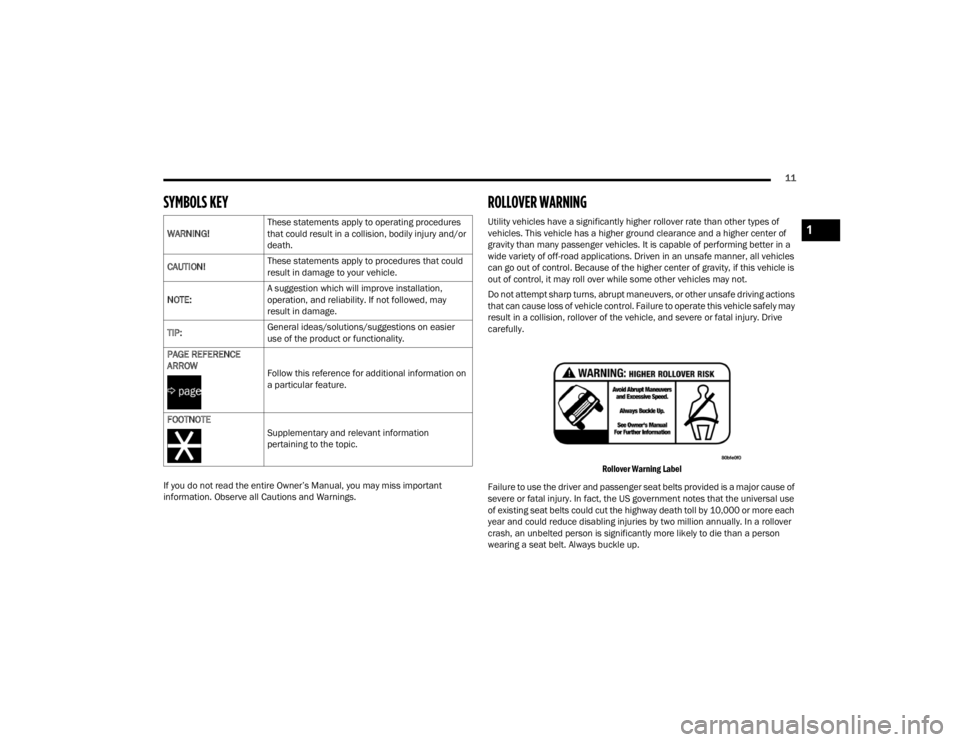
Rollover Warning Label
Failure to use the driver and passenger seat belts provided is a major cause of
severe or fatal injury. In fact, the US government notes that the universal use
of existing seat belts could cut the highway death toll by 10,000 or more each
year and could reduce disabling injuries by two million annually. In a rollover
crash, an unbelted person is significantly more likely to die than a person
wearing a seat belt. Always buckle up.
WARNING!
These statements apply to operating procedures
that could result in a collision, bodily injury and/or
death.
CAUTION! These statements apply to procedures that could
result in damage to your vehicle.
NOTE: A suggestion which will improve installation,
operation, and reliability. If not followed, may
result in damage.
TIP: General ideas/solutions/suggestions on easier
use of the product or functionality.
PAGE REFERENCE
ARROW Follow this reference for additional information on
a particular feature.
FOOTNOTE Supplementary and relevant information
pertaining to the topic. 1
23_WL_OM_EN_USC_t.book Page 11
Page 15 of 424
13
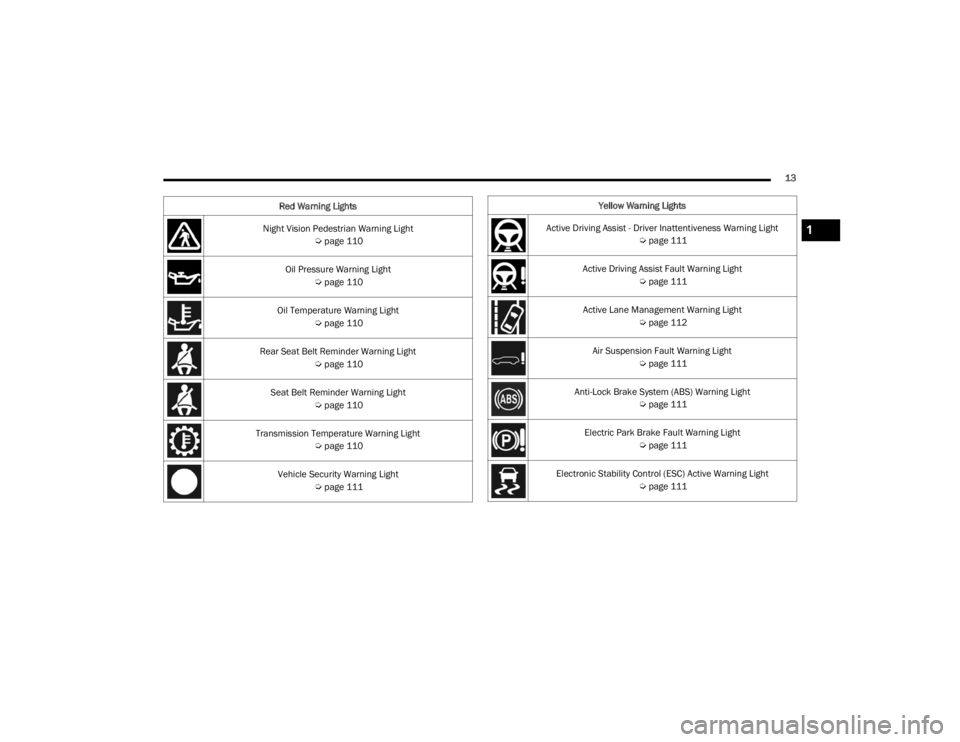
Night Vision Pedestrian Warning Light Úpage 110
Oil Pressure Warning Light Úpage 110
Oil Temperature Warning Light Úpage 110
Rear Seat Belt Reminder Warning Light Úpage 110
Seat Belt Reminder Warning Light Úpage 110
Transmission Temperature Warning Light Úpage 110
Vehicle Security Warning Light Úpage 111
Red Warning Lights
Yellow Warning Lights
Active Driving Assist - Driver Inattentiveness Warning Light Úpage 111
Active Driving Assist Fault Warning Light Úpage 111
Active Lane Management Warning Light Úpage 112
Air Suspension Fault Warning Light Úpage 111
Anti-Lock Brake System (ABS) Warning Light Úpage 111
Electric Park Brake Fault Warning Light Úpage 111
Electronic Stability Control (ESC) Active Warning Light Úpage 111
1
23_WL_OM_EN_USC_t.book Page 13
Page 18 of 424
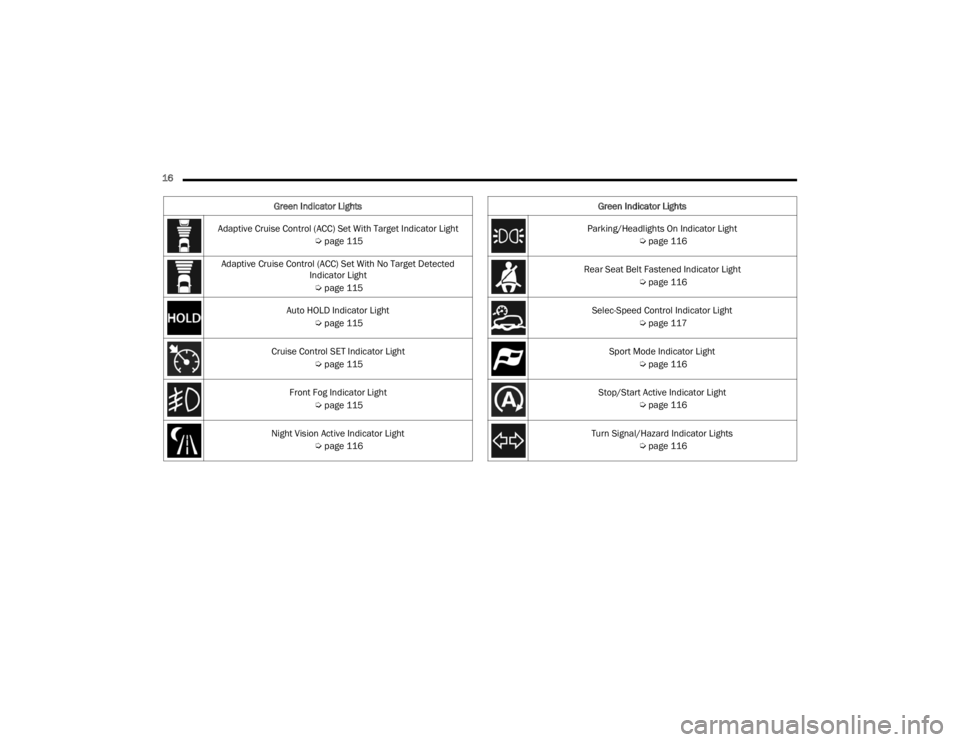
16 Adaptive Cruise Control (ACC) Set With Target Indicator Light Úpage 115
Adaptive Cruise Control (ACC) Set With No Target Detected Indicator Light
Ú page 115
Auto HOLD Indicator Light Úpage 115
Cruise Control SET Indicator Light Úpage 115
Front Fog Indicator Light Úpage 115
Night Vision Active Indicator Light Úpage 116
Green Indicator Lights
Parking/Headlights On Indicator Light
Úpage 116
Rear Seat Belt Fastened Indicator Light Úpage 116
Selec-Speed Control Indicator Light Úpage 117
Sport Mode Indicator Light Úpage 116
Stop/Start Active Indicator Light Úpage 116
Turn Signal/Hazard Indicator Lights Úpage 116
Green Indicator Lights
23_WL_OM_EN_USC_t.book Page 16
Page 38 of 424
36GETTING TO KNOW YOUR VEHICLE
(Continued)
MEMORY POSITION RECALL
NOTE:Memory Recall is available when not in PARK, if the
vehicle speed is below 5 mph (8 km/h).
To recall a memory settings profile using the
memory switches, push memory button (1) or
(2) on the memory switch.
To recall the driver’s side memory settings using
the key fob, push the unlock button on the key
fob linked to memory position 1 or 2.
A recall can be canceled by pushing any of the
memory buttons during a recall (S, 1, or 2), or by
pushing any of the seat adjustment switches.
When a recall is canceled, the seat and power tilt/
telescopic steering column (if equipped) will stop
moving. A delay of one second will occur before
another recall can be selected.
SEATS
Seats are a part of the Occupant Restraint system
of the vehicle.
MANUAL ADJUSTMENT (FRONT SEATS) —
I
F EQUIPPED
Manual Front Passenger Seat Forward/
Rearward Adjustment
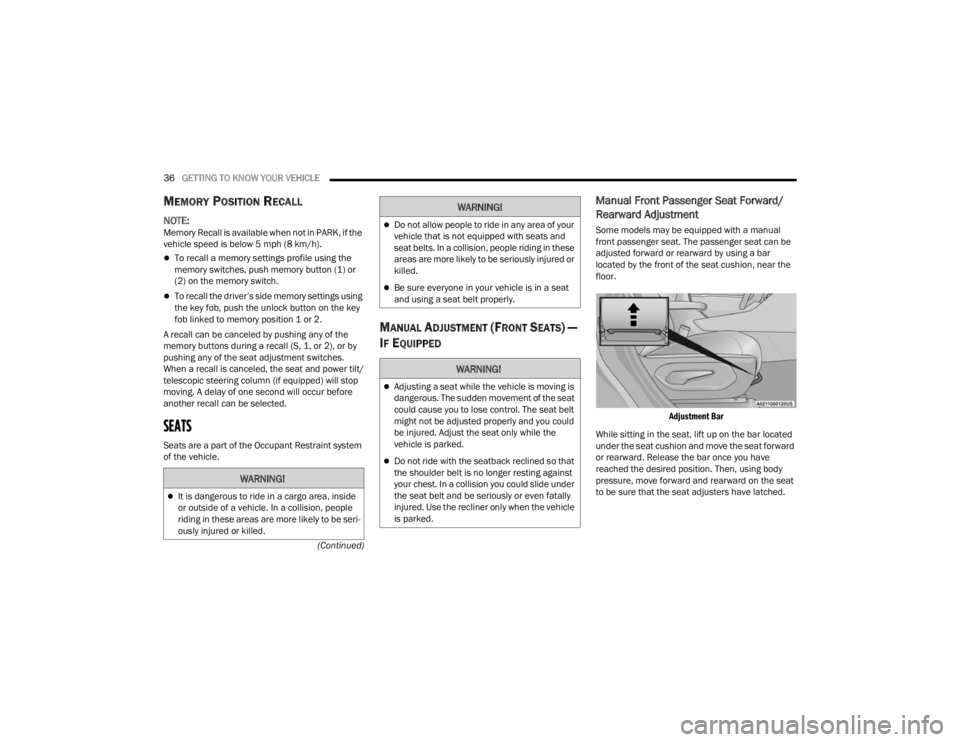
Some models may be equipped with a manual
front passenger seat. The passenger seat can be
adjusted forward or rearward by using a bar
located by the front of the seat cushion, near the
floor.
Adjustment Bar
While sitting in the seat, lift up on the bar located
under the seat cushion and move the seat forward
or rearward. Release the bar once you have
reached the desired position. Then, using body
pressure, move forward and rearward on the seat
to be sure that the seat adjusters have latched.
WARNING!
It is dangerous to ride in a cargo area, inside
or outside of a vehicle. In a collision, people
riding in these areas are more likely to be seri -
ously injured or killed.
Do not allow people to ride in any area of your
vehicle that is not equipped with seats and
seat belts. In a collision, people riding in these
areas are more likely to be seriously injured or
killed.
Be sure everyone in your vehicle is in a seat
and using a seat belt properly.
WARNING!
Adjusting a seat while the vehicle is moving is
dangerous. The sudden movement of the seat
could cause you to lose control. The seat belt
might not be adjusted properly and you could
be injured. Adjust the seat only while the
vehicle is parked.
Do not ride with the seatback reclined so that
the shoulder belt is no longer resting against
your chest. In a collision you could slide under
the seat belt and be seriously or even fatally
injured. Use the recliner only when the vehicle
is parked.
WARNING!
23_WL_OM_EN_USC_t.book Page 36
Page 39 of 424
GETTING TO KNOW YOUR VEHICLE37
Manual Front Passenger Seatback
Adjustment — Recline
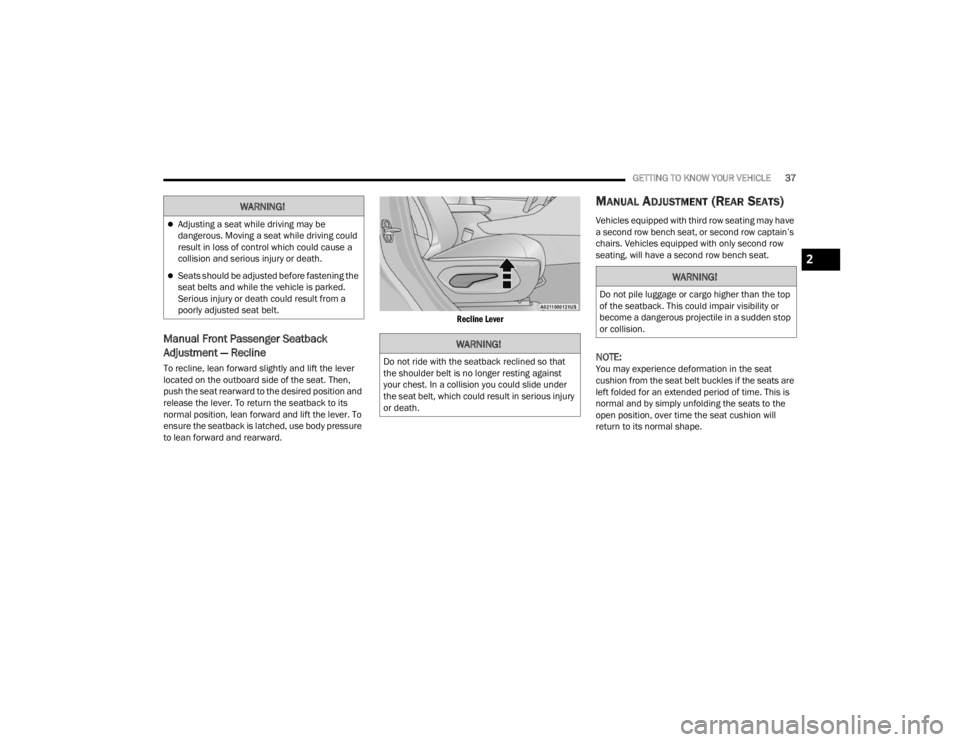
To recline, lean forward slightly and lift the lever
located on the outboard side of the seat. Then,
push the seat rearward to the desired position and
release the lever. To return the seatback to its
normal position, lean forward and lift the lever. To
ensure the seatback is latched, use body pressure
to lean forward and rearward.
Recline Lever
MANUAL ADJUSTMENT (REAR SEATS)
Vehicles equipped with third row seating may have
a second row bench seat, or second row captain’s
chairs. Vehicles equipped with only second row
seating, will have a second row bench seat.
NOTE:You may experience deformation in the seat
cushion from the seat belt buckles if the seats are
left folded for an extended period of time. This is
normal and by simply unfolding the seats to the
open position, over time the seat cushion will
return to its normal shape.
WARNING!
Adjusting a seat while driving may be
dangerous. Moving a seat while driving could
result in loss of control which could cause a
collision and serious injury or death.
Seats should be adjusted before fastening the
seat belts and while the vehicle is parked.
Serious injury or death could result from a
poorly adjusted seat belt.
WARNING!
Do not ride with the seatback reclined so that
the shoulder belt is no longer resting against
your chest. In a collision you could slide under
the seat belt, which could result in serious injury
or death.
WARNING!
Do not pile luggage or cargo higher than the top
of the seatback. This could impair visibility or
become a dangerous projectile in a sudden stop
or collision.
2
23_WL_OM_EN_USC_t.book Page 37
Page 40 of 424
38GETTING TO KNOW YOUR VEHICLE
Second Row Bench Seat — If Equipped
SECOND ROW BENCH SEAT FORWARD/REAR -
WARD ADJUSTMENT
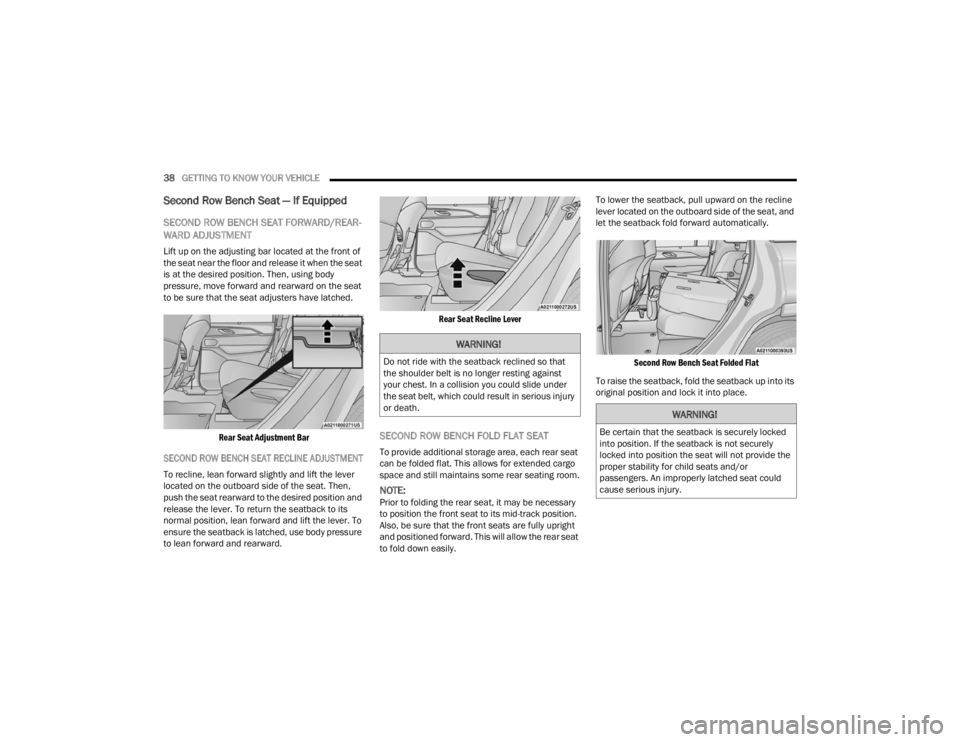
Lift up on the adjusting bar located at the front of
the seat near the floor and release it when the seat
is at the desired position. Then, using body
pressure, move forward and rearward on the seat
to be sure that the seat adjusters have latched.
Rear Seat Adjustment Bar
SECOND ROW BENCH SEAT RECLINE ADJUSTMENT
To recline, lean forward slightly and lift the lever
located on the outboard side of the seat. Then,
push the seat rearward to the desired position and
release the lever. To return the seatback to its
normal position, lean forward and lift the lever. To
ensure the seatback is latched, use body pressure
to lean forward and rearward.
Rear Seat Recline Lever
SECOND ROW BENCH FOLD FLAT SEAT
To provide additional storage area, each rear seat
can be folded flat. This allows for extended cargo
space and still maintains some rear seating room.
NOTE:Prior to folding the rear seat, it may be necessary
to position the front seat to its mid-track position.
Also, be sure that the front seats are fully upright
and positioned forward. This will allow the rear seat
to fold down easily.To lower the seatback, pull upward on the recline
lever located on the outboard side of the seat, and
let the seatback fold forward automatically.
Second Row Bench Seat Folded Flat
To raise the seatback, fold the seatback up into its
original position and lock it into place.
WARNING!
Do not ride with the seatback reclined so that
the shoulder belt is no longer resting against
your chest. In a collision you could slide under
the seat belt, which could result in serious injury
or death.
WARNING!
Be certain that the seatback is securely locked
into position. If the seatback is not securely
locked into position the seat will not provide the
proper stability for child seats and/or
passengers. An improperly latched seat could
cause serious injury.
23_WL_OM_EN_USC_t.book Page 38
Page 42 of 424
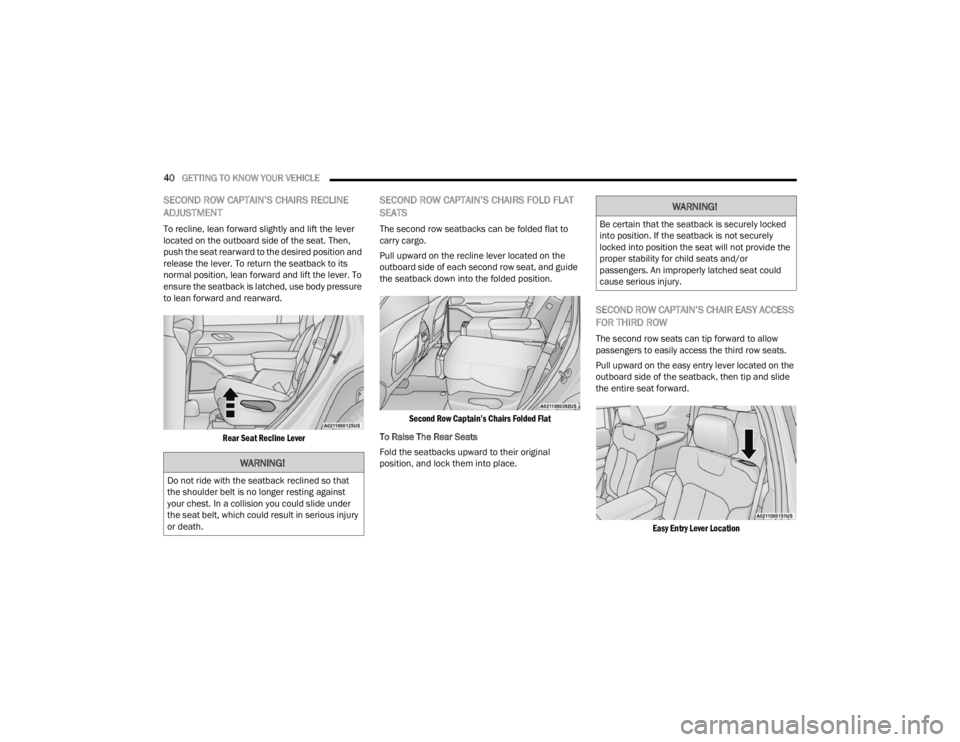
40GETTING TO KNOW YOUR VEHICLE
SECOND ROW CAPTAIN’S CHAIRS RECLINE
ADJUSTMENT
To recline, lean forward slightly and lift the lever
located on the outboard side of the seat. Then,
push the seat rearward to the desired position and
release the lever. To return the seatback to its
normal position, lean forward and lift the lever. To
ensure the seatback is latched, use body pressure
to lean forward and rearward.
Rear Seat Recline Lever
SECOND ROW CAPTAIN’S CHAIRS FOLD FLAT
SEATS
The second row seatbacks can be folded flat to
carry cargo.
Pull upward on the recline lever located on the
outboard side of each second row seat, and guide
the seatback down into the folded position.
Second Row Captain’s Chairs Folded Flat
To Raise The Rear Seats
Fold the seatbacks upward to their original
position, and lock them into place.
SECOND ROW CAPTAIN’S CHAIR EASY ACCESS
FOR THIRD ROW
The second row seats can tip forward to allow
passengers to easily access the third row seats.
Pull upward on the easy entry lever located on the
outboard side of the seatback, then tip and slide
the entire seat forward.
Easy Entry Lever Location
WARNING!
Do not ride with the seatback reclined so that
the shoulder belt is no longer resting against
your chest. In a collision you could slide under
the seat belt, which could result in serious injury
or death.
WARNING!
Be certain that the seatback is securely locked
into position. If the seatback is not securely
locked into position the seat will not provide the
proper stability for child seats and/or
passengers. An improperly latched seat could
cause serious injury.
23_WL_OM_EN_USC_t.book Page 40
Page 44 of 424

42GETTING TO KNOW YOUR VEHICLE
Adjusting The Seat Forward Or Rearward
The seat can be adjusted both forward and
rearward. Push the seat switch forward or
rearward. The seat will move in the direction of the
switch. Release the switch when the desired
position has been reached.
Adjusting The Seat Up Or Down
The height of the seats can be adjusted up or
down. Pull upward or push downward on the rear of
seat switch, the seat will move in the direction of
the switch. Release the switch when the desired
position has been reached.
Tilting The Seat Up Or Down
The angle of the seat cushion can be adjusted in
two directions. Pull upward or push downward on
the front of the seat switch, the front of the seat
cushion will move in the direction of the switch.
Release the switch when the desired position has
been reached.
Reclining The Seatback
The angle of the seatback can be adjusted forward
or rearward. Push the seatback switch forward or
rearward, the seat will move in the direction of the
switch. Release the switch when the desired
position is reached.
Seatback Bolster Adjustment
The front driver and passenger seatback bolsters
can be extended outward, or retracted inward by
pushing the bolster adjustment button located in
the center of the seatback switch.
Push the top of the button to extend the bolsters,
or push the bottom of the button to retract the
bolsters.
Seatback Bolster Adjustment Button
WARNING!
Adjusting a seat while driving may be
dangerous. Moving a seat while driving could
result in loss of control which could cause a
collision and serious injury or death.
Seats should be adjusted before fastening the
seat belts and while the vehicle is parked.
Serious injury or death could result from a
poorly adjusted seat belt.
Do not ride with the seatback reclined so that
the shoulder belt is no longer resting against
your chest. In a collision you could slide under
the seat belt, which could result in serious
injury or death.
CAUTION!
Do not place any article under a power seat or
impede its ability to move as it may cause
damage to the seat controls. Seat travel may
become limited if movement is stopped by an
obstruction in the seat's path.
1 — Extend Seatback Bolsters
2 — Retract Seatback Bolsters
23_WL_OM_EN_USC_t.book Page 42