control panel JEEP LIBERTY 2002 KJ / 1.G Workshop Manual
[x] Cancel search | Manufacturer: JEEP, Model Year: 2002, Model line: LIBERTY, Model: JEEP LIBERTY 2002 KJ / 1.GPages: 1803, PDF Size: 62.3 MB
Page 1167 of 1803
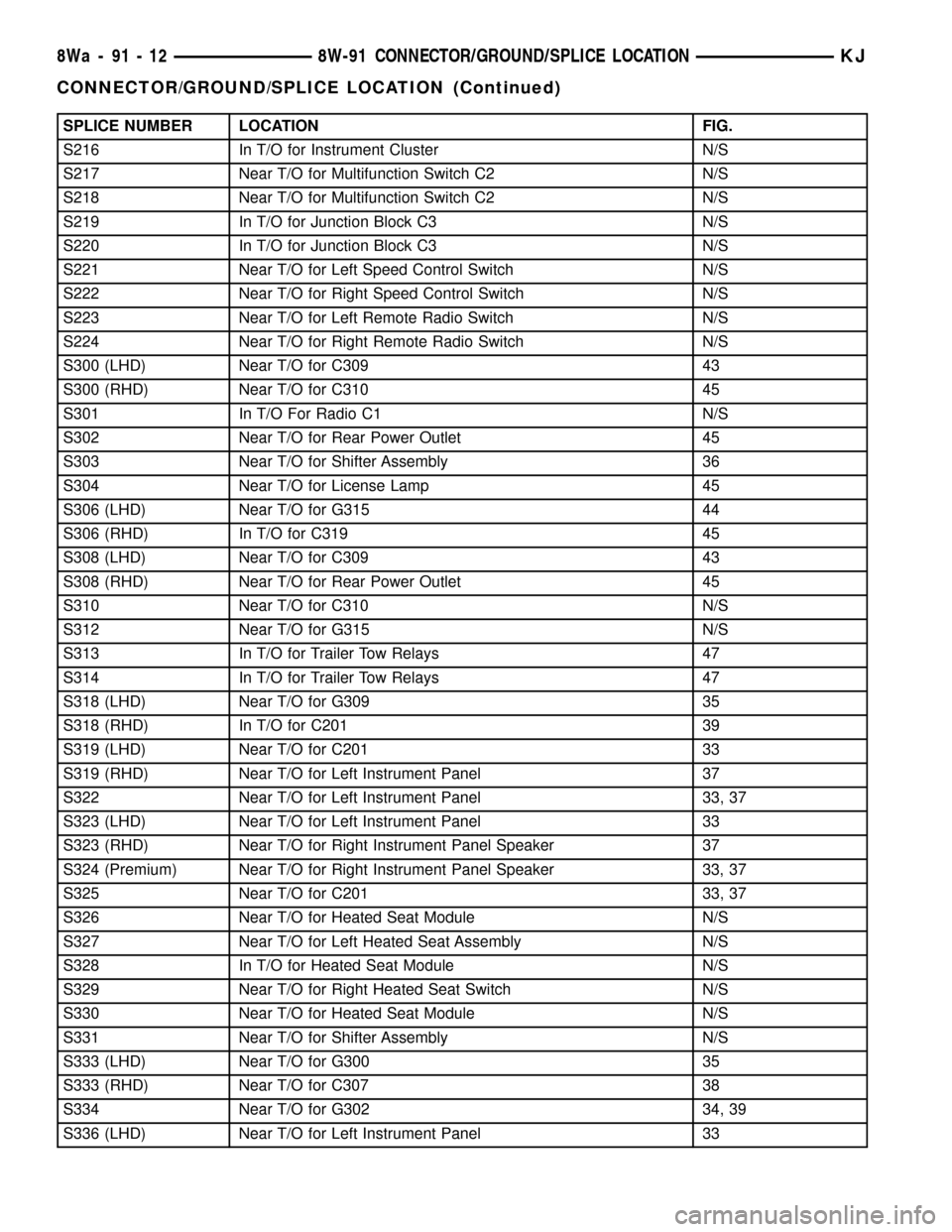
SPLICE NUMBER LOCATION FIG.
S216 In T/O for Instrument Cluster N/S
S217 Near T/O for Multifunction Switch C2 N/S
S218 Near T/O for Multifunction Switch C2 N/S
S219 In T/O for Junction Block C3 N/S
S220 In T/O for Junction Block C3 N/S
S221 Near T/O for Left Speed Control Switch N/S
S222 Near T/O for Right Speed Control Switch N/S
S223 Near T/O for Left Remote Radio Switch N/S
S224 Near T/O for Right Remote Radio Switch N/S
S300 (LHD) Near T/O for C309 43
S300 (RHD) Near T/O for C310 45
S301 In T/O For Radio C1 N/S
S302 Near T/O for Rear Power Outlet 45
S303 Near T/O for Shifter Assembly 36
S304 Near T/O for License Lamp 45
S306 (LHD) Near T/O for G315 44
S306 (RHD) In T/O for C319 45
S308 (LHD) Near T/O for C309 43
S308 (RHD) Near T/O for Rear Power Outlet 45
S310 Near T/O for C310 N/S
S312 Near T/O for G315 N/S
S313 In T/O for Trailer Tow Relays 47
S314 In T/O for Trailer Tow Relays 47
S318 (LHD) Near T/O for G309 35
S318 (RHD) In T/O for C201 39
S319 (LHD) Near T/O for C201 33
S319 (RHD) Near T/O for Left Instrument Panel 37
S322 Near T/O for Left Instrument Panel 33, 37
S323 (LHD) Near T/O for Left Instrument Panel 33
S323 (RHD) Near T/O for Right Instrument Panel Speaker 37
S324 (Premium) Near T/O for Right Instrument Panel Speaker 33, 37
S325 Near T/O for C201 33, 37
S326 Near T/O for Heated Seat Module N/S
S327 Near T/O for Left Heated Seat Assembly N/S
S328 In T/O for Heated Seat Module N/S
S329 Near T/O for Right Heated Seat Switch N/S
S330 Near T/O for Heated Seat Module N/S
S331 Near T/O for Shifter Assembly N/S
S333 (LHD) Near T/O for G300 35
S333 (RHD) Near T/O for C307 38
S334 Near T/O for G302 34, 39
S336 (LHD) Near T/O for Left Instrument Panel 33
8Wa - 91 - 12 8W-91 CONNECTOR/GROUND/SPLICE LOCATIONKJ
CONNECTOR/GROUND/SPLICE LOCATION (Continued)
Page 1391 of 1803

FUEL LEVEL SENDING UNIT /
SENSOR
DESCRIPTION
The fuel gauge sending unit (fuel level sensor) is
attached to the side of the fuel pump module. The
sending unit consists of a float, an arm, and a vari-
able resistor track (card).
OPERATION
The fuel pump module has 4 different circuits
(wires). Two of these circuits are used for the fuel
gauge sending unit for fuel gauge operation, and for
certain OBD II emission requirements. The other 2
wires are used for electric fuel pump operation.
For Fuel Gauge Operation:A constant current
source of approximately 32 milliamps is supplied to
the resistor track on the fuel gauge sending unit.
This is fed directly from the Powertrain Control Mod-
ule (PCM).NOTE: For diagnostic purposes, this
12V power source can only be verified with the
circuit opened (fuel pump module electrical
connector unplugged). With the connectors
plugged, output voltages will vary from about
0.6 volts at FULL, to about 8.6 volts at EMPTY
(about 8.6 volts at EMPTY for Jeep models, and
about 7.0 volts at EMPTY for Dodge Truck mod-
els).The resistor track is used to vary the voltage
(resistance) depending on fuel tank float level. As
fuel level increases, the float and arm move up,
which decreases voltage. As fuel level decreases, the
float and arm move down, which increases voltage.
The varied voltage signal is returned back to the
PCM through the sensor return circuit.
Both of the electrical circuits between the fuel
gauge sending unit and the PCM are hard-wired (not
multi-plexed). After the voltage signal is sent from
the resistor track, and back to the PCM, the PCM
will interpret the resistance (voltage) data and send
a message across the multi-plex bus circuits to the
instrument panel cluster. Here it is translated into
the appropriate fuel gauge level reading. Refer to
Instrument Panel for additional information.
For OBD II Emission Monitor Requirements:
The PCM will monitor the voltage output sent from
the resistor track on the sending unit to indicate fuel
level. The purpose of this feature is to prevent the
OBD II system from recording/setting false misfire
and fuel system monitor diagnostic trouble codes.
The feature is activated if the fuel level in the tank
is less than approximately 15 percent of its rated
capacity. If equipped with a Leak Detection Pump
(EVAP system monitor), this feature will also be acti-
vated if the fuel level in the tank is more than
approximately 85 percent of its rated capacity.
DIAGNOSIS AND TESTING - FUEL LEVEL
SENDING UNIT
The fuel level sending unit contains a variable
resistor (track). As the float moves up or down, elec-
trical resistance will change. Refer to Instrument
Panel and Gauges for Fuel Gauge testing. To test the
gauge sending unit only, it must be removed from
vehicle. The unit is a separate part of the lower fuel
pump module section. Refer to Fuel Pump Module
Removal/Installation for procedures (remove only the
upper section of the fuel pump module). Measure the
resistance across the sending unit terminals. With
float in up position, resistance should be 20 ohms (+/-
5%). With float in down position, resistance should be
270 ohms (+/- 5%).
REMOVAL
The fuel level sending unit (fuel level sensor) and
float assembly is located on the side of the lower sec-
tion of the fuel pump module. The lower section of
the fuel pump module is located within the fuel tank.
(1) Remove lower section of fuel pump module
from fuel tank. Refer to Fuel Pump Module Removal/
Installation.
(2) To remove sending unit from pump module, lift
on plastic locking tab (Fig. 8) while sliding sending
unit upwards.
(3) Disconnect 4±wire electrical connector (Fig. 9)
from bottom of upper section of fuel pump module.
Separate necessary sending unit wiring.
Fig. 8 FUEL LEVEL SENDING UNIT
1 - LIFT TAB HERE FOR REMOVAL
2 - FUEL LEVEL SENDING UNIT
3 - LOWER SECTION OF PUMP MODULE
KJFUEL DELIVERY 14 - 9
Page 1427 of 1803

THROTTLE CONTROL CABLE
REMOVAL
2.4L
CAUTION: Be careful not to damage or kink the
cable core wire (within the cable sheathing) while
servicing accelerator pedal or throttle cable.
(1) From inside vehicle, hold up accelerator pedal.
Remove plastic cable retainer (clip) and throttle cable
core wire from upper end of pedal arm (Fig. 26).
Plastic cable retainer snaps into top of pedal arm.
(2) Remove cable core wire at pedal arm.
(3) From inside vehicle, remove metal clip holding
cable to dashpanel (Fig. 26).
(4) Remove air box at throttle body.
(5) Unsnap cable from dashpanel routing clip.
(6) Remove cable housing from dash panel and
pull into engine compartment.
(7) Hold throttle in wide open position. While held
in this position, slide throttle cable pin (Fig. 27) from
throttle body bellcrank.(8) Using a pick or small screwdriver, press release
tab (Fig. 27) to release plastic cable mount from
bracket.Press on tab only enough to release
cable from bracket. If tab is pressed too much,
it will be broken.To remove throttle cable from
throttle body bracket, slide cable towards front of
vehicle.
(9) Remove throttle cable from vehicle.
3.7L
CAUTION: Be careful not to damage or kink the
cable core wire (within the cable sheathing) while
servicing accelerator pedal or throttle cable.
(1) From inside vehicle, hold up accelerator pedal.
Remove plastic cable retainer (clip) and throttle cable
core wire from upper end of pedal arm (Fig. 28).
Plastic cable retainer snaps into top of pedal arm.
(2) Remove cable core wire at pedal arm.
(3) From inside vehicle, remove metal clip holding
cable to dashpanel (Fig. 28).
(4) Remove air box at throttle body.
(5) Unsnap cable from dashpanel routing clip.
(6) Remove cable housing from dash panel and
pull into engine compartment.
(7) Hold throttle in wide open position. While held
in this position, slide throttle cable pin (Fig. 29) from
throttle body bellcrank.
Fig. 26 ACCELERATOR PEDAL/BRACKET
ASSEMBLY
1 - METAL THROTTLE CABLE CLIP
2 - THROTTLE CABLE
3 - PLASTIC CABLE RETAINER
4 - PEDAL/BRACKET ASSEMBLY
5 - PEDAL MOUNTING NUTS (2)
6 - PEDAL MOUNTING STUDS (2)
Fig. 27 THROTTLE CABLE, PIN, RELEASE TAB-2.4L
1 - MOUNTING BRACKET
2 - SPEED CONTROL CABLE
3 - THROTTLE CABLE
4 - RELEASE TAB
5 - CABLE PINS
6 - BELLCRANK
KJFUEL INJECTION 14 - 45
Page 1428 of 1803

(8) Using a pick or small screwdriver, press release
tab (Fig. 30) to release plastic cable mount from
bracket.Press on tab only enough to release
cable from bracket. If tab is pressed too much,
it will be broken.Slide plastic mount (Fig. 30)
towards right side of vehicle to remove throttle cable
from throttle body bracket.
(9) Remove throttle cable from vehicle.
INSTALLATION
(1) Slide accelerator cable plastic mount into throt-
tle body mounting bracket. Continue sliding until
release tab (Fig. 30) is aligned to hole in mounting
bracket.
(2) Hold throttle in wide open position. While held
in this position, slide throttle cable pin (Fig. 29) into
throttle body bellcrank.
(3) Push cable housing into rubber grommet and
through opening in dash panel.
(4) From inside vehicle, install metal clip holding
cable to dashpanel (Fig. 28).
(5) From inside vehicle, slide throttle cable core
wire into opening (slot) in top of pedal arm.
(6) Push plastic cable retainer (clip) into pedal arm
opening until it snaps in place.
(7) Install air box to throttle body.
(8) Before starting engine, operate accelerator
pedal to check for any binding.
Fig. 28 ACCELERATOR PEDAL/BRACKET
ASSEMBLY
1 - METAL THROTTLE CABLE CLIP
2 - THROTTLE CABLE
3 - PLASTIC CABLE RETAINER
4 - PEDAL/BRACKET ASSEMBLY
5 - PEDAL MOUNTING NUTS (2)
6 - PEDAL MOUNTING STUDS (2)
Fig. 29 THROTTLE CABLE PIN-3.7L
1 - THROTTLE CABLE PIN
2 - THROTTLE BODY BELLCRANK
3 - PUSH UP HERE
Fig. 30 THROTTLE CABLE RELEASE TAB-3.7L
1 - THROTTLE CABLE
2 - RELEASE TAB
3 - PICK OR SCREWDRIVER
4 - PLASTIC CABLE MOUNT
14 - 46 FUEL INJECTIONKJ
THROTTLE CONTROL CABLE (Continued)
Page 1437 of 1803

INSTALLATION
(1) Align and install column into the steering cou-
pler.(2) Install column harness and connect harness to
switches.
(3) Reroute the shifter interlock cable through the
tie straps.
(4) Install the column onto the mounting studs.
(5) Install the two mounting nuts and the two
mounting bolts all finger tight.
CAUTION: Lower nuts must be installed and tight-
ened first then the upper nuts in order to prevent
damage to the capsules.
(6) Tighten the lower mounting nuts to 17 N´m
(150 in. lbs.).
(7) Tighten the upper mounting nuts to 17 N´m
(150 in. lbs.).
(8) Install the steering column coupler bolt and
tighten to 49 N´m (36 ft. lbs.).
(9) Reconnect the shifter interlock cable.
(10) Center the clock spring (if necessary) and
install it on the column, (Refer to 8 - ELECTRICAL/
RESTRAINTS/CLOCKSPRING - INSTALLATION).
(11) Snap together the column shrouds and install
the mounting screws.
(12) Install the knee blocker and the knee blocker
cover, (Refer to 23 - BODY/INSTRUMENT PANEL/
KNEE BLOCKER - INSTALLATION).
(13)
NOTE: Do not reuse the old steering wheel bolt (a
new bolt must be used)
NOTE: Be certain that the steering wheel mounting
bolt is tightened to the proper torque specification
to ensure proper clockspring operation.Install the
steering wheel and tighten bolt to 54 N´m (40 ft.
lbs.) (Refer to 19 - STEERING/COLUMN/STEERING
WHEEL - INSTALLATION).
NOTE: If equipped with cruise control, connect
clock spring harness to cruise switch harness on
the steering wheel.
(14) Install the airbag, (Refer to 8 - ELECTRICAL/
RESTRAINTS/DRIVER AIRBAG - INSTALLATION).
(15) Install the negative battery terminal.
Fig. 5 WIRING HARNESS COLUMN
1 - Column Wiring Harness
2 - Multi-function Switch
3 - Ignition Switch
4 - Steering Column
Fig. 6 CLOCK SPRING
1 - Tilt Lever
2 - Ignition Switch
3 - Clockspring
4 - Steering Column
5 - SKIM
KJCOLUMN 19 - 7
COLUMN (Continued)
Page 1467 of 1803

DIAGNOSIS AND TESTING
DIAGNOSIS AND TESTING - WATER LEAKS
Water leaks can be caused by poor sealing,
improper body component alignment, body seam
porosity, missing plugs, or blocked drain holes. Cen-
trifugal and gravitational force can cause water to
drip from a location away from the actual leak point,
making leak detection difficult. All body sealing
points should be water tight in normal wet-driving
conditions. Water flowing downward from the front of
the vehicle should not enter the passenger or luggage
compartment. Moving sealing surfaces will not
always seal water tight under all conditions. At
times, side glass or door seals will allow water to
enter the passenger compartment during high pres-
sure washing or hard driving rain (severe) condi-
tions. Overcompensating on door or glass
adjustments to stop a water leak that occurs under
severe conditions can cause premature seal wear and
excessive closing or latching effort. After completing
a repair, water test vehicle to verify leak has stopped
before returning vehicle to use.
VISUAL INSPECTION BEFORE WATER LEAK TESTS
Verify that floor and body plugs are in place, body
drains are clear, and body components are properly
aligned and sealed. If component alignment or seal-
ing is necessary, refer to the appropriate section of
this group for proper procedures.
WATER LEAK TESTS
WARNING: DO NOT USE ELECTRIC SHOP LIGHTS
OR TOOLS IN WATER TEST AREA. PERSONAL
INJURY CAN RESULT.
When the conditions causing a water leak have
been determined, simulate the conditions as closely
as possible.
²If a leak occurs with the vehicle parked in a
steady light rain, flood the leak area with an open-
ended garden hose.
²If a leak occurs while driving at highway speeds
in a steady rain, test the leak area with a reasonable
velocity stream or fan spray of water. Direct the
spray in a direction comparable to actual conditions.
²If a leak occurs when the vehicle is parked on an
incline, hoist the end or side of the vehicle to simu-
late this condition. This method can be used when
the leak occurs when the vehicle accelerates, stops or
turns. If the leak occurs on acceleration, hoist the
front of the vehicle. If the leak occurs when braking,
hoist the back of the vehicle. If the leak occurs on left
turns, hoist the left side of the vehicle. If the leak
occurs on right turns, hoist the right side of the vehi-cle. For hoisting recommendations refer to Group 0,
Lubrication and Maintenance, General Information
section.
WATER LEAK DETECTION
To detect a water leak point-of-entry, do a water
test and watch for water tracks or droplets forming
on the inside of the vehicle. If necessary, remove inte-
rior trim covers or panels to gain visual access to the
leak area. If the hose cannot be positioned without
being held, have someone help do the water test.
Some water leaks must be tested for a considerable
length of time to become apparent. When a leak
appears, find the highest point of the water track or
drop. The highest point usually will show the point of
entry. After leak point has been found, repair the
leak and water test to verify that the leak has
stopped.
Locating the entry point of water that is leaking
into a cavity between panels can be difficult. The
trapped water may splash or run from the cavity,
often at a distance from the entry point. Most water
leaks of this type become apparent after accelerating,
stopping, turning, or when on an incline.
MIRROR INSPECTION METHOD
When a leak point area is visually obstructed, use
a suitable mirror to gain visual access. A mirror can
also be used to deflect light to a limited-access area
to assist in locating a leak point.
BRIGHT LIGHT LEAK TEST METHOD
Some water leaks in the luggage compartment can
be detected without water testing. Position the vehi-
cle in a brightly lit area. From inside the darkened
luggage compartment inspect around seals and body
seams. If necessary, have a helper direct a drop light
over the suspected leak areas around the luggage
compartment. If light is visible through a normally
sealed location, water could enter through the open-
ing.
PRESSURIZED LEAK TEST METHOD
When a water leak into the passenger compart-
ment cannot be detected by water testing, pressurize
the passenger compartment and soap test exterior of
the vehicle. To pressurize the passenger compart-
ment, close all doors and windows, start engine, and
set heater control to high blower in HEAT position. If
engine can not be started, connect a charger to the
battery to ensure adequate voltage to the blower.
With interior pressurized, apply dish detergent solu-
tion to suspected leak area on the exterior of the
vehicle. Apply detergent solution with spray device or
soft bristle brush. If soap bubbles occur at a body
seam, joint, seal or gasket, the leak entry point could
be at that location.
23 - 2 BODYKJ
BODY (Continued)
Page 1475 of 1803
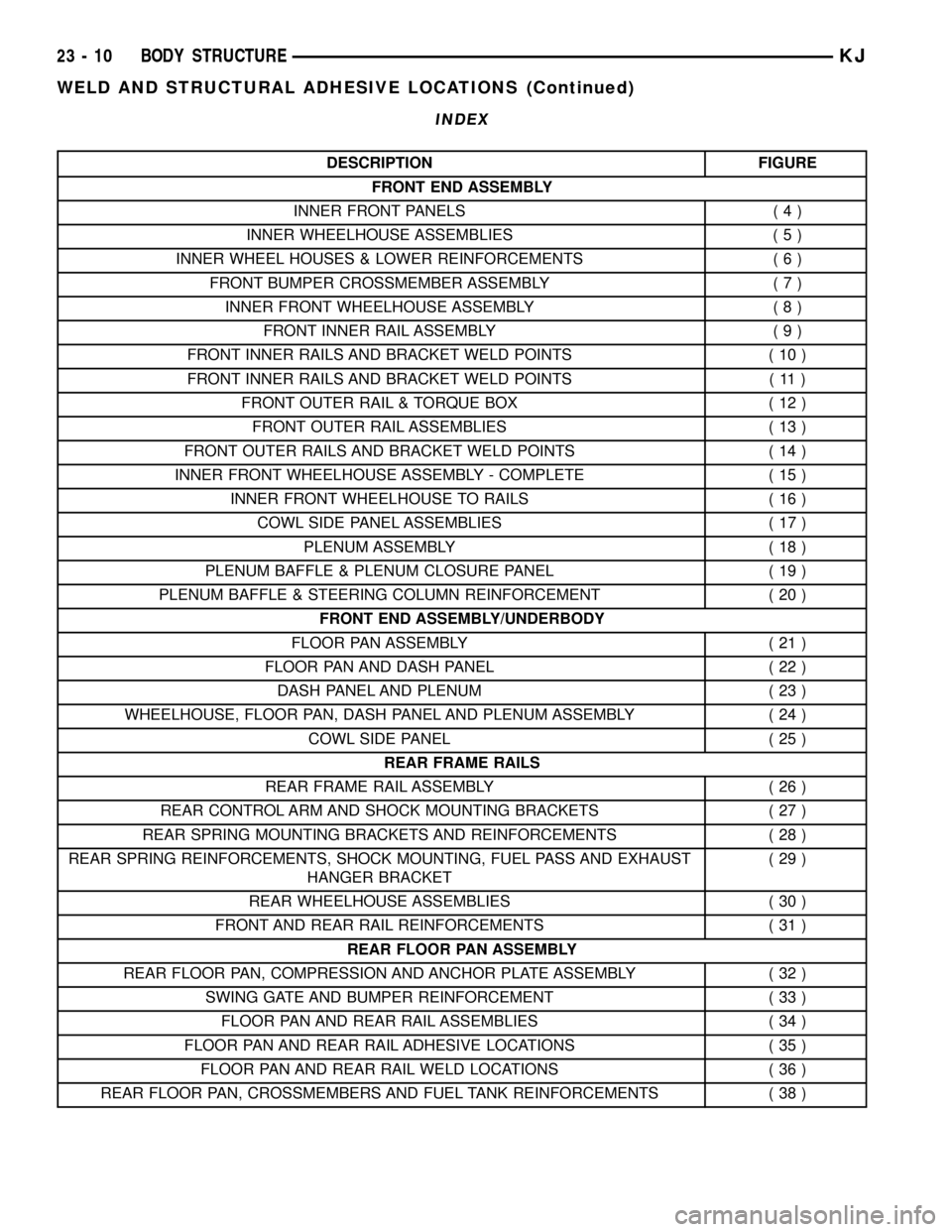
INDEX
DESCRIPTION FIGURE
FRONT END ASSEMBLY
INNER FRONT PANELS ( 4 )
INNER WHEELHOUSE ASSEMBLIES ( 5 )
INNER WHEEL HOUSES & LOWER REINFORCEMENTS ( 6 )
FRONT BUMPER CROSSMEMBER ASSEMBLY ( 7 )
INNER FRONT WHEELHOUSE ASSEMBLY ( 8 )
FRONT INNER RAIL ASSEMBLY ( 9 )
FRONT INNER RAILS AND BRACKET WELD POINTS ( 10 )
FRONT INNER RAILS AND BRACKET WELD POINTS ( 11 )
FRONT OUTER RAIL & TORQUE BOX ( 12 )
FRONT OUTER RAIL ASSEMBLIES ( 13 )
FRONT OUTER RAILS AND BRACKET WELD POINTS ( 14 )
INNER FRONT WHEELHOUSE ASSEMBLY - COMPLETE ( 15 )
INNER FRONT WHEELHOUSE TO RAILS ( 16 )
COWL SIDE PANEL ASSEMBLIES ( 17 )
PLENUM ASSEMBLY ( 18 )
PLENUM BAFFLE & PLENUM CLOSURE PANEL ( 19 )
PLENUM BAFFLE & STEERING COLUMN REINFORCEMENT ( 20 )
FRONT END ASSEMBLY/UNDERBODY
FLOOR PAN ASSEMBLY ( 21 )
FLOOR PAN AND DASH PANEL ( 22 )
DASH PANEL AND PLENUM ( 23 )
WHEELHOUSE, FLOOR PAN, DASH PANEL AND PLENUM ASSEMBLY ( 24 )
COWL SIDE PANEL ( 25 )
REAR FRAME RAILS
REAR FRAME RAIL ASSEMBLY ( 26 )
REAR CONTROL ARM AND SHOCK MOUNTING BRACKETS ( 27 )
REAR SPRING MOUNTING BRACKETS AND REINFORCEMENTS ( 28 )
REAR SPRING REINFORCEMENTS, SHOCK MOUNTING, FUEL PASS AND EXHAUST
HANGER BRACKET(29)
REAR WHEELHOUSE ASSEMBLIES ( 30 )
FRONT AND REAR RAIL REINFORCEMENTS ( 31 )
REAR FLOOR PAN ASSEMBLY
REAR FLOOR PAN, COMPRESSION AND ANCHOR PLATE ASSEMBLY ( 32 )
SWING GATE AND BUMPER REINFORCEMENT ( 33 )
FLOOR PAN AND REAR RAIL ASSEMBLIES ( 34 )
FLOOR PAN AND REAR RAIL ADHESIVE LOCATIONS ( 35 )
FLOOR PAN AND REAR RAIL WELD LOCATIONS ( 36 )
REAR FLOOR PAN, CROSSMEMBERS AND FUEL TANK REINFORCEMENTS ( 38 )
23 - 10 BODY STRUCTUREKJ
WELD AND STRUCTURAL ADHESIVE LOCATIONS (Continued)
Page 1585 of 1803

LATCH
REMOVAL
(1) Remove the grill. (Refer to 23 - BODY/EXTERI-
OR/GRILLE - REMOVAL)
(2) Remove the latch support bracket bolts and
position the latch assembly aside. (Fig. 1)
(3) Remove the two latch nuts.
(4) Disconnect the release cable.
INSTALLATION
(1) Connect the release cable and install the latch
onto the support bracket.
(2) Install the two nuts and tighten to 12 N´m (9
ft. lbs.).
(3) Install the support bracket and the bolts.
(4) Tighten the bolts to 12 N´m (9 ft. lbs.).
(5) Install the grill. (Refer to 23 - BODY/EXTERI-
OR/GRILLE - INSTALLATION)
LATCH RELEASE CABLE
REMOVAL
(1) Remove the battery. (Refer to 8 - ELECTRI-
CAL/BATTERY SYSTEM/BATTERY - REMOVAL)
(2) Remove the hood latch. (Refer to 23 - BODY/
HOOD/LATCH - REMOVAL)(3) Remove the powertrain control module. (Refer
to 8 - ELECTRICAL/ELECTRONIC CONTROL
MODULES/POWERTRAIN CONTROL MODULE -
REMOVAL)
(4) Remove the hood release handle. (Refer to 23 -
BODY/HOOD/LATCH RELEASE HANDLE -
REMOVAL)
(5) Disconnect the attaching clips and remove the
cable from the inside.
INSTALLATION
(1) Install the cable from the inside and attach the
retaining clips.
(2) Install the hood latch release handle. (Refer to
23 - BODY/HOOD/LATCH RELEASE HANDLE -
INSTALLATION)
(3) Install the powertrain control module. (Refer to
8 - ELECTRICAL/ELECTRONIC CONTROL MOD-
ULES/POWERTRAIN CONTROL MODULE -
INSTALLATION)
(4) Install the hood latch. (Refer to 23 - BODY/
HOOD/LATCH - INSTALLATION)
(5) Install the battery. (Refer to 8 - ELECTRICAL/
BATTERY SYSTEM/BATTERY - INSTALLATION)
SUPPORT CYLINDER
REMOVAL
(1) Open the hood and support.
(2) Release the upper and lower clips.
(3) Remove the support cylinder.
INSTALLATION
(1) Install the support cylinder over the ball studs
with the thin end down.
(2) Install the retaining clips and remove the sup-
port from the hood.
LATCH RELEASE HANDLE
REMOVAL
(1) Remove the cowl trim panel. (Refer to 23 -
BODY/INTERIOR/COWL TRIM COVER -
REMOVAL)
(2) Remove the three screws and remove the han-
dle.
(3) Disconnect the hood release cable.
INSTALLATION
(1) Connect the hood release cable to the handle.
(2) Install the handle and install the three screws.
(3) Install the cowl trim cover. (Refer to 23 -
BODY/INTERIOR/COWL TRIM COVER - INSTAL-
LATION)
Fig. 1 RADIATOR CROSSMEMBER
1 - CROSSMEMBER
2 - BOLTS (2)
3 - BOLTS (4)
4 - BOLTS (2)
5 - HOOD LATCH SUPPORT
23 - 120 HOODKJ
Page 1640 of 1803

SUNROOF
TABLE OF CONTENTS
page page
SUNROOF
DESCRIPTION........................175
DIAGNOSIS AND TESTING
WATER DRAINAGE AND WIND NOISE
DIAGNOSIS.........................176
DIAGNOSTIC PROCEDURES...........176
GLASS PANEL
REMOVAL............................178
INSTALLATION........................178
ADJUSTMENTS
SUNROOF GLASS PANEL ADJUSTMENT . . 178
GLASS PANEL SEAL
REMOVAL............................178
INSTALLATION........................178
SUNSHADE
REMOVAL............................179
INSTALLATION........................179
GUIDE ASSEMBLY
REMOVAL............................179
INSTALLATION........................179
WIND DEFLECTOR
REMOVAL............................180INSTALLATION........................180
OPENING TRIM LACE
REMOVAL............................180
INSTALLATION........................180
DRAIN TUBE
REMOVAL............................180
INSTALLATION........................181
MODULE ASSEMBLY
REMOVAL............................181
INSTALLATION........................181
DRIVE MOTOR
REMOVAL............................182
INSTALLATION........................182
CONTROL MODULE
REMOVAL............................183
INSTALLATION........................183
CONTROL SWITCH
DESCRIPTION........................184
OPERATION..........................184
DIAGNOSIS AND TESTING...............184
REMOVAL............................184
INSTALLATION........................184
SUNROOF
DESCRIPTION
WARNING: Keep fingers and other body parts out
of sunroof opening at all times.
The sunroof features a power sliding glass panel
and a sunshade which can be manually positioned
anywhere along its travel, rearward of glass panel
front edge.
The sunroof is electrically operated from two
switches located on the windshield header, rearwardof the map lamp. To operate the sunroof the ignition
switch must be in either the Accessory or On/Run
position. One switch (vent) is a push button type and
opens the sunroof to the vent position only. The other
switch (open/close) is a rocker type for opening and
closing the sunroof. Pressing and releasing the open
button once the sunroof will express open and the
wind deflector will raise. If the button is pressed a
second time the sunroof will stop in that position.
Pressing and holding the close button will close the
sunroof. If the close button is released the sunroof
will stop in that position.
KJSUNROOF 23 - 175
Page 1641 of 1803
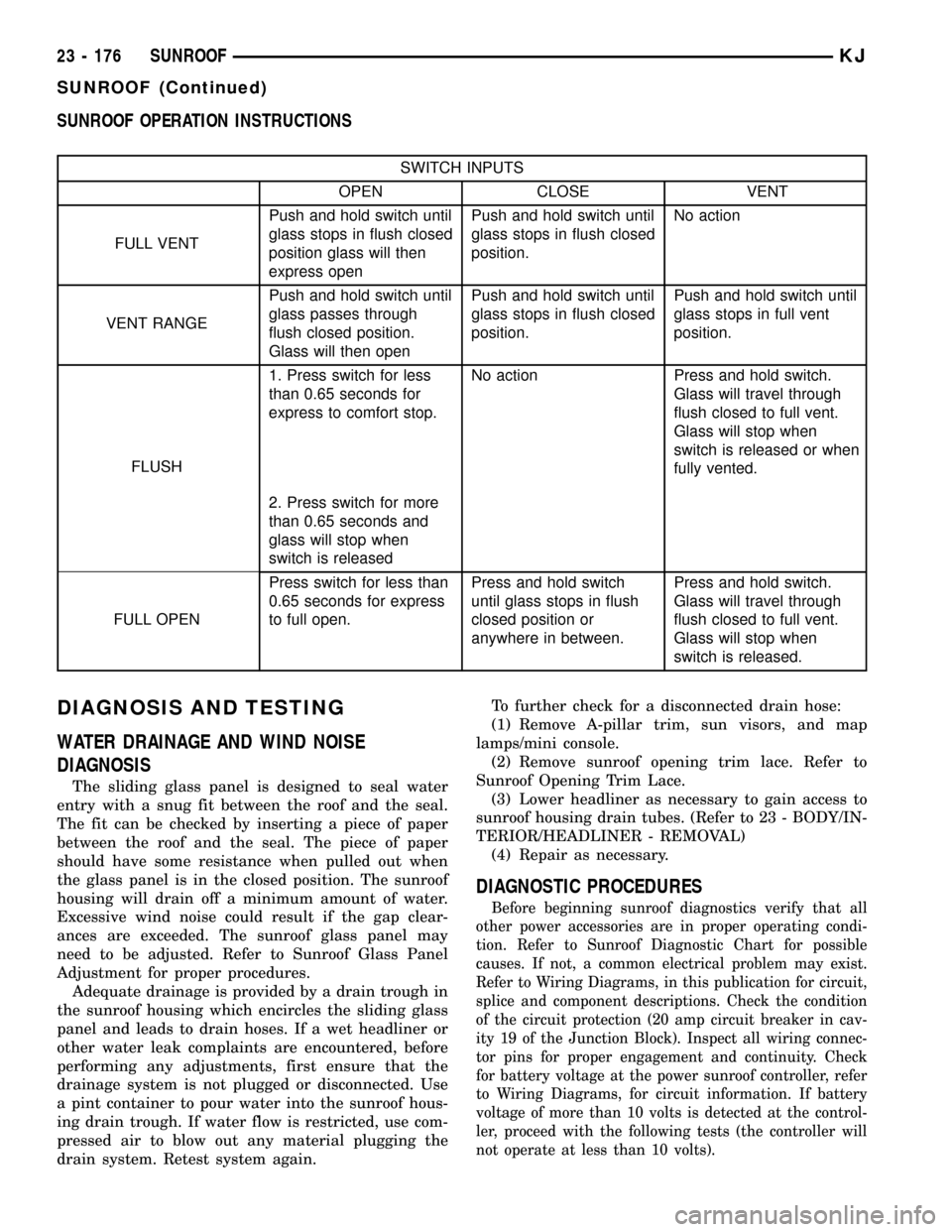
SUNROOF OPERATION INSTRUCTIONS
SWITCH INPUTS
OPEN CLOSE VENT
FULL VENTPush and hold switch until
glass stops in flush closed
position glass will then
express openPush and hold switch until
glass stops in flush closed
position.No action
VENT RANGEPush and hold switch until
glass passes through
flush closed position.
Glass will then openPush and hold switch until
glass stops in flush closed
position.Push and hold switch until
glass stops in full vent
position.
FLUSH1. Press switch for less
than 0.65 seconds for
express to comfort stop.No action Press and hold switch.
Glass will travel through
flush closed to full vent.
Glass will stop when
switch is released or when
fully vented.
2. Press switch for more
than 0.65 seconds and
glass will stop when
switch is released
FULL OPENPress switch for less than
0.65 seconds for express
to full open.Press and hold switch
until glass stops in flush
closed position or
anywhere in between.Press and hold switch.
Glass will travel through
flush closed to full vent.
Glass will stop when
switch is released.
DIAGNOSIS AND TESTING
WATER DRAINAGE AND WIND NOISE
DIAGNOSIS
The sliding glass panel is designed to seal water
entry with a snug fit between the roof and the seal.
The fit can be checked by inserting a piece of paper
between the roof and the seal. The piece of paper
should have some resistance when pulled out when
the glass panel is in the closed position. The sunroof
housing will drain off a minimum amount of water.
Excessive wind noise could result if the gap clear-
ances are exceeded. The sunroof glass panel may
need to be adjusted. Refer to Sunroof Glass Panel
Adjustment for proper procedures.
Adequate drainage is provided by a drain trough in
the sunroof housing which encircles the sliding glass
panel and leads to drain hoses. If a wet headliner or
other water leak complaints are encountered, before
performing any adjustments, first ensure that the
drainage system is not plugged or disconnected. Use
a pint container to pour water into the sunroof hous-
ing drain trough. If water flow is restricted, use com-
pressed air to blow out any material plugging the
drain system. Retest system again.To further check for a disconnected drain hose:
(1) Remove A-pillar trim, sun visors, and map
lamps/mini console.
(2) Remove sunroof opening trim lace. Refer to
Sunroof Opening Trim Lace.
(3) Lower headliner as necessary to gain access to
sunroof housing drain tubes. (Refer to 23 - BODY/IN-
TERIOR/HEADLINER - REMOVAL)
(4) Repair as necessary.
DIAGNOSTIC PROCEDURES
Before beginning sunroof diagnostics verify that all
other power accessories are in proper operating condi-
tion. Refer to Sunroof Diagnostic Chart for possible
causes. If not, a common electrical problem may exist.
Refer to Wiring Diagrams, in this publication for circuit,
splice and component descriptions. Check the condition
of the circuit protection (20 amp circuit breaker in cav-
ity 19 of the Junction Block). Inspect all wiring connec-
tor pins for proper engagement and continuity. Check
for battery voltage at the power sunroof controller, refer
to Wiring Diagrams, for circuit information. If battery
voltage of more than 10 volts is detected at the control-
ler, proceed with the following tests (the controller will
not operate at less than 10 volts).
23 - 176 SUNROOFKJ
SUNROOF (Continued)