control panel JEEP LIBERTY 2002 KJ / 1.G Workshop Manual
[x] Cancel search | Manufacturer: JEEP, Model Year: 2002, Model line: LIBERTY, Model: JEEP LIBERTY 2002 KJ / 1.GPages: 1803, PDF Size: 62.3 MB
Page 722 of 1803

WASHER RESERVOIR
DESCRIPTION
A single washer fluid reservoir is used for both the
front and rear washer systems (Fig. 22). The molded
plastic washer fluid reservoir is mounted on the out-
board side of the right front frame rail in front of the
right front wheel, where it is concealed by the right
front wheel house splash shield. The only visible
component of the washer reservoir is the filler neck
and cap unit, which extends through a hole in the
right front wheel house extension panel into the
engine compartment. A bright yellow plastic filler cap
with an integral bail strap and filler neck mounting
bracket is labeled with an International Control and
Display Symbol icon for ªWindshield Washerº and the
text ªWasher Fluid Onlyº molded into it. The cap
snaps over the open end of the filler neck.
There is a dedicated hole on the outboard side of
the reservoir provided for the mounting of the
washer pump/motor unit, and another dedicated hole
on the rear of the reservoir for the washer fluid level
switch. A snap post receptacle molded into the reser-
voir allows for mounting of the washer pump without
the use of fasteners. The reservoir also features inte-
gral hose routing troughs on its outboard side and
integral routing clips along its top. The washer res-
ervoir is secured to the outboard side of the right
front frame rail by two screws and an integral
molded tab that engages in a slot in the right front
frame rail. Another screw secures the reservoir fillerneck to the upper radiator crossmember in the front
of the engine compartment. The right front fender
wheel house splash shield must be removed to access
the washer reservoir for service.
OPERATION
The washer fluid reservoir provides a secure,
on-vehicle storage location for a large reserve of
washer fluid for operation of the front and rear
washer systems. The washer reservoir filler neck pro-
vides a clearly marked and readily accessible point
from which to add washer fluid to the reservoir. The
washer/pump motor unit is located in a sump area
near the front of the reservoir to be certain that
washer fluid will be available to the pump as the
fluid level in the reservoir becomes depleted. The
washer pump/motor unit is mounted in the lowest
position in the sump. The washer fluid level switch is
mounted just above the sump area of the reservoir so
that there will be adequate warning to the vehicle
operator that the washer fluid level is low, before the
washer system will no longer operate.
REMOVAL
(1) Turn the front wheels full lock to the right.
(2) Unlatch and open the hood.
(3) Disconnect and isolate the battery negative
cable.
(4) Remove the air cleaner housing from the top of
the right front fender wheel house. (Refer to 9 -
ENGINE/AIR INTAKE SYSTEM/AIR CLEANER
ELEMENT - REMOVAL).
(5) Remove the screw that secures the washer res-
ervoir filler neck support to upper radiator cross-
member (Fig. 23).
Fig. 22 Washer Reservoir
1 - CAP
2 - RESERVOIR
3- SNAP POST RECEPTACLE
4 - FRONT HOSE TROUGH
5 - WASHER PUMP HOLE
6 - REAR HOSE TROUGH
7 - HOOK
Fig. 23 Washer Reservoir Cap Remove/Install
1 - SCREW (1)
2 - CAP
3 - UPPER RADIATOR CROSSMEMBER
KJFRONT WIPERS/WASHERS 8R - 21
Page 728 of 1803

REAR WIPERS/WASHERS
TABLE OF CONTENTS
page page
REAR WIPERS/WASHERS
DESCRIPTION.........................27
OPERATION...........................29
DIAGNOSIS AND TESTING - REAR WIPER &
WASHER SYSTEM....................30
CLEANING - REAR WIPER & WASHER
SYSTEM............................32
INSPECTION - REAR WIPER & WASHER
SYSTEM............................33
REAR CHECK VALVE
DESCRIPTION.........................34
OPERATION...........................34
REMOVAL.............................34
INSTALLATION.........................35
REAR WASHER HOSES/TUBES
DESCRIPTION.........................35
OPERATION...........................36
REAR WASHER NOZZLE
DESCRIPTION.........................36
OPERATION...........................36
REMOVAL.............................36
INSTALLATION.........................37REAR WIPER ARM
DESCRIPTION.........................37
OPERATION...........................38
REMOVAL.............................38
INSTALLATION.........................38
REAR WIPER BLADE
DESCRIPTION.........................39
OPERATION...........................39
REMOVAL.............................40
INSTALLATION.........................40
REAR WIPER MOTOR
DESCRIPTION.........................41
OPERATION...........................41
REMOVAL.............................42
INSTALLATION.........................42
REAR WIPER/WASHER SWITCH
DESCRIPTION.........................43
OPERATION...........................43
WIPER ARM PARK RAMP
REMOVAL.............................43
INSTALLATION.........................43
REAR WIPERS/WASHERS
DESCRIPTION
An electrically operated fixed interval intermittent
rear wiper and washer system is standard factory-in-
stalled equipment on this model (Fig. 1). The rear
wiper and washer system includes the following
major components, which are described in further
detail elsewhere in this service information:
²Multi-Function Switch- The multi-function
switch is located on the top of the steering column,
just below the steering wheel. The multi-function
switch includes a left (lighting) control stalk and a
right (wiper) control stalk. The right control stalk is
dedicated to providing all of the driver controls for
both the front and rear wiper systems. (Refer to 8 -
ELECTRICAL/LAMPS/LIGHTING - EXTERIOR/
MULTI-FUNCTION SWITCH - DESCRIPTION).
²Rear Check Valve- The rear washer system
check valve is located in the washer plumbing
between the rear roof header and the roof outer
panel near the rear washer nozzle.
²Rear Washer Nozzle- The rear washer nozzle
is secured by a snap fit into a mounting hole in the
roof outer panel above the rear flip-up glass opening.²Rear Washer Plumbing- The plumbing for
the rear washer system consists of rubber hoses and
molded plastic fittings. The plumbing is routed along
the right side of the engine compartment from the
washer reservoir, through the dash into the passen-
ger compartment, up the right cowl side and A-pillar
to the headliner, and above the headliner to the rear
washer nozzle fitting within the rear roof header.
²Rear Wiper Arm- The single rear wiper arm is
secured by a nut directly to the rear wiper motor out-
put shaft, which extends through the center of the
tailgate outer panel near the base of the rear flip-up
glass.
²Rear Wiper Arm Park Ramp- The molded
rubber rear wiper arm park ramp is secured with a
screw to the tailgate outer panel to the right of the
rear wiper motor output shaft bezel. When the rear
wiper system is not in operation, the rear wiper arm
is parked off of the rear flip-up glass on this ramp so
that it will not interfere with or be damaged by the
flip-up glass operation.
²Rear Wiper Blade- The single rear wiper
blade is secured to the rear wiper arm with an inte-
gral latch, and is parked off of the rear flip-up glass
when the rear wiper system is not in operation.
KJREAR WIPERS/WASHERS 8R - 27
Page 732 of 1803

mation includes wiring diagrams, proper wire and
connector repair procedures, details of wire harness
routing and retention, connector pin-out information
and location views for the various wire harness con-
nectors, splices and grounds.
WARNING: ON VEHICLES EQUIPPED WITH AIR-
BAGS, DISABLE THE SUPPLEMENTAL RESTRAINT
SYSTEM BEFORE ATTEMPTING ANY STEERING
WHEEL, STEERING COLUMN, DRIVER AIRBAG,
PASSENGER AIRBAG, SEAT BELT TENSIONER,
SIDE CURTAIN AIRBAG, OR INSTRUMENT PANEL
COMPONENT DIAGNOSIS OR SERVICE. DISCON-
NECT AND ISOLATE THE BATTERY NEGATIVE
(GROUND) CABLE, THEN WAIT TWO MINUTES FOR
THE SYSTEM CAPACITOR TO DISCHARGE BEFORE
PERFORMING FURTHER DIAGNOSIS OR SERVICE.
THIS IS THE ONLY SURE WAY TO DISABLE THE
SUPPLEMENTAL RESTRAINT SYSTEM. FAILURE TO
TAKE THE PROPER PRECAUTIONS COULD
RESULT IN ACCIDENTAL AIRBAG DEPLOYMENT
AND POSSIBLE PERSONAL INJURY.
(1) Check that the interior lighting switch on the
left (lighting) control stalk of the multi-function
switch is not in the dome lamp disable position. With
all four doors and the tailgate closed, open the rear
flip-up glass. The interior lamps should light. Close
the rear flip-up glass. Note whether the interior
lamps remain lighted. They should turn off after
about thirty seconds. If OK, go to Step 2. If not OK,
go to Step 9.
(2) Check the fused B(+) fuse (Fuse 17 - 15
ampere) in the Junction Block (JB). If OK, go to Step
3. If not OK, repair the shorted circuit or component
as required and replace the faulty fuse.
(3) Check for battery voltage at the fused B(+) fuse
(Fuse 17 - 15 ampere) in the JB. If OK, go to Step 4.
If not OK, repair the open fused B(+) circuit between
the JB and the Power Distribution Center (PDC) as
required.
(4) Check the fused ignition switch output (run-
acc) fuse (Fuse 22 - 10 ampere) in the JB. If OK, go
to Step 5. If not OK, repair the shorted circuit or
component as required and replace the faulty fuse.
(5) Turn the ignition switch to the On position.
Check for battery voltage at the fused ignition switch
output (run-acc) fuse (Fuse 22 - 10 ampere) in the
JB. If OK, turn the ignition switch to the Off position
and go to Step 6. If not OK, repair the open fused
ignition switch output (run-acc) circuit between the
JB and the ignition switch as required.
(6) Disconnect and isolate the battery negative
cable. Disconnect the instrument panel wire harness
connector for the multi-function switch (Connector
C-2) from the switch connector receptacle. Reconnect
the battery negative cable. Turn the ignition switchto the On position. Check for battery voltage at the
fused ignition switch output (run-acc) circuit cavity of
the instrument panel wire harness connector for the
multi-function switch (Connector C-2). If OK, go to
Step 7. If not OK, repair the open fused ignition
switch output (run-acc) circuit between the multi-
function switch and the JB as required.
(7) Turn the ignition switch to the Off position.
Disconnect and isolate the battery negative cable.
Test the multi-function switch. (Refer to 8 - ELEC-
TRICAL/LAMPS/LIGHTING - EXTERIOR/MULTI-
FUNCTION SWITCH - DIAGNOSIS AND
TESTING). If the multi-function switch tests OK,
reconnect the instrument panel wire harness connec-
tors for the multi-function switch to the switch con-
nector receptacles and go to Step 8. If the multi-
function switch does not test OK, replace the faulty
switch.
(8) Remove the tailgate inner trim panel. Discon-
nect the tailgate wire harness connector for the rear
wiper module from the module connector receptacle.
Check for continuity between the ground circuit cav-
ity of the tailgate wire harness connector for the rear
wiper module and a good ground. There should be
continuity. If OK, go to Step 9. If not OK, repair the
open ground circuit to ground (G312) as required.
(9) Check for continuity between the flip-up glass
ajar switch sense circuit cavity of the tailgate wire
harness connector for the rear wiper module and a
good ground. There should be continuity with the
rear flip-up glass open, and no continuity with the
rear flip-up glass closed. If OK, go to Step 10. If not
OK, repair the open flip-up glass ajar circuit between
the rear wiper module and the flip-up glass ajar
switch as required.
(10) Reconnect the battery negative cable. Check
for battery voltage at the fused B(+) circuit cavity of
the tailgate wire harness connector for the rear wiper
module. If OK, go to Step 11. If not OK, repair the
open fused B(+) circuit between the rear wiper mod-
ule and the JB as required.
(11) Turn the ignition switch to the On position.
Turn the control ring on the right (wiper) control
stalk of the multi-function switch to the Delay posi-
tion. Check for battery voltage at the rear wiper
intermittent driver circuit cavity of the tailgate wire
harness connector for the rear wiper module. If OK,
go to Step 12. If not OK, repair the open rear wiper
intermittent driver circuit between the rear wiper
module and the multi-function switch as required.
(12) Turn the control ring on the right (wiper) con-
trol stalk of the multi-function switch to the On posi-
tion. Check for battery voltage at the rear wiper on
driver circuit cavity of the tailgate wire harness con-
nector for the rear wiper module. If OK, replace the
faulty rear wiper module. If not OK, repair the open
KJREAR WIPERS/WASHERS 8R - 31
REAR WIPERS/WASHERS (Continued)
Page 733 of 1803

rear wiper on driver circuit between the rear wiper
module and the multi-function switch as required.
REAR WASHER SYSTEM
The diagnosis found here addresses an electrically
inoperative rear washer system. If the washer pump/
motor operates, but no washer fluid is emitted from
the rear washer nozzle, be certain to check the fluid
level in the reservoir. Also inspect the rear washer
system components as required. (Refer to 8 - ELEC-
TRICAL/REAR WIPERS/WASHERS - INSPECTION).
Refer to the appropriate wiring information. The wir-
ing information includes wiring diagrams, proper
wire and connector repair procedures, details of wire
harness routing and retention, connector pin-out
information and location views for the various wire
harness connectors, splices and grounds.
WARNING: ON VEHICLES EQUIPPED WITH AIR-
BAGS, DISABLE THE SUPPLEMENTAL RESTRAINT
SYSTEM BEFORE ATTEMPTING ANY STEERING
WHEEL, STEERING COLUMN, DRIVER AIRBAG,
PASSENGER AIRBAG, SEAT BELT TENSIONER,
SIDE CURTAIN AIRBAG, OR INSTRUMENT PANEL
COMPONENT DIAGNOSIS OR SERVICE. DISCON-
NECT AND ISOLATE THE BATTERY NEGATIVE
(GROUND) CABLE, THEN WAIT TWO MINUTES FOR
THE SYSTEM CAPACITOR TO DISCHARGE BEFORE
PERFORMING FURTHER DIAGNOSIS OR SERVICE.
THIS IS THE ONLY SURE WAY TO DISABLE THE
SUPPLEMENTAL RESTRAINT SYSTEM. FAILURE TO
TAKE THE PROPER PRECAUTIONS COULD
RESULT IN ACCIDENTAL AIRBAG DEPLOYMENT
AND POSSIBLE PERSONAL INJURY.
(1) Turn the ignition switch to the On position.
Turn the control ring on the right (wiper) control
stalk of the multi-function switch to the On position.
Check whether the rear wiper system is operating. If
OK, go to Step 2. If not OK, test and repair the rear
wiper system before continuing with these tests.
Refer to REAR WIPER SYSTEM .
(2) Pull the right (wiper) control stalk of the multi-
function switch toward the steering wheel. Check
whether the front washer system is operating. If OK,
test the multi-function switch. (Refer to 8 - ELEC-
TRICAL/LAMPS/LIGHTING - EXTERIOR/MULTI-
FUNCTION SWITCH - DIAGNOSIS AND
TESTING). If the multi-function switch tests OK, go
to Step 3. If the multi-function switch does not test
OK, replace the faulty switch.
(3) Turn the ignition switch to the Off position.
Disconnect and isolate the battery negative cable.
Disconnect the headlamp and dash wire harness con-
nector for the washer pump/motor unit from the
pump/motor unit connector receptacle. Check for con-
tinuity between the washer pump driver circuit cav-ity of the headlamp and dash wire harness connector
for the washer pump/motor unit and a good ground.
There should be no continuity. If OK, go to Step 4. If
not OK, repair the shorted washer pump driver cir-
cuit between the washer pump/motor unit and the
multi-function switch as required.
(4) Check for continuity between the washer pump
driver circuit cavities of the headlamp and dash wire
harness connector for the washer pump/motor unit
and the instrument panel wire harness connector for
the multi-function switch (Connector C-2). There
should be continuity. If OK, go to Step 5. If not OK,
repair the open washer pump driver circuit between
the washer pump/motor unit and the multi-function
switch as required.
(5) Check for continuity between the washer pump
sense circuit cavity of the headlamp and dash wire
harness connector for the washer pump/motor unit
and a good ground. There should be no continuity. If
OK, go to Step 6. If not OK, repair the shorted
washer pump sense circuit between the washer
pump/motor unit and the multi-function switch as
required.
(6) Check for continuity between the washer pump
sense circuit cavities of the headlamp and dash wire
harness connector for the washer pump/motor unit
and the instrument panel wire harness connector for
the multi-function switch (Connector C-2). There
should be continuity. If OK, replace the faulty washer
pump/motor unit. If not OK, repair the open washer
pump sense circuit between the washer pump/motor
unit and the multi-function switch as required.
CLEANING - REAR WIPER & WASHER SYSTEM
REAR WIPER SYSTEM
The squeegee of a wiper blade exposed to the ele-
ments for a long time tends to lose its wiping effec-
tiveness. Periodic cleaning of the squeegee is
suggested to remove any deposits of salt or road film.
The wiper blade, arm, and rear flip-up glass should
only be cleaned using a sponge or soft cloth and
windshield washer fluid, a mild detergent, or a non-
abrasive cleaner. If the wiper blade continues to
leave streaks, smears, hazing, or beading on the
glass after thorough cleaning of the squeegees and
the glass, the entire wiper blade assembly must be
replaced.
CAUTION: Protect the rubber squeegee of the wiper
blade from any petroleum-based cleaners, solvents,
or contaminants. These products can rapidly deteri-
orate the rubber squeegee.
8R - 32 REAR WIPERS/WASHERSKJ
REAR WIPERS/WASHERS (Continued)
Page 739 of 1803

A wiper arm cannot be adjusted or repaired. If
damaged or faulty, the entire wiper arm unit must be
replaced.
OPERATION
The rear wiper arm is designed to mechanically
transmit the motion from the rear wiper motor out-
put shaft to the rear wiper blade. The wiper arm
must be properly indexed to the motor output shaft
in order to maintain the proper wiper blade travel on
the glass. The wiper arm support is designed to lift
and support the rear wiper arm and blade off of the
glass when the rear wiper blade is parked. This sup-
port and the park ramp on the tailgate outer panel
below the glass also provide an alignment reference
to ensure accurate rear wiper arm and blade instal-
lation. The tapered hole in the wiper arm pivot end
is interlocks with the serrations on the outer circum-
ference of the tapered motor output shaft, allowing
positive engagement and finite adjustment of this
connection. A hex nut secures the wiper arm pivot
end to the threads on the rear wiper motor output
shaft and the pivot cover hinges and snaps over this
connection for a neat appearance. The spring-loaded
wiper arm hinge controls the down-force applied
through the tip of the wiper arm to the wiper blade
on the glass. The hook formation on the tip of the
wiper arm provides a cradle for securing and latching
the wiper blade pivot block to the wiper arm.
REMOVAL
(1) Lift the rear wiper arm pivot cover by lifting it
at the rear wiper motor output shaft end of the arm
(Fig. 9).
(2) Remove the nut that secures the rear wiper
arm to the rear wiper motor output shaft.
(3) If necessary, use a battery terminal puller to
disengage the wiper arm from the rear wiper motor
output shaft splines (Fig. 10).
NOTE: Depending upon the size and type of puller
used, it may be necessary to remove the spare tire
from the tailgate. Refer to the owner's manual in the
vehicle glove box for information on removing the
spare tire from the tailgate.
(4) Remove the rear wiper arm pivot end from the
motor output shaft.
INSTALLATION
NOTE: Always install the wiper arm and blade with
the wiper motor in the Park position.
(1) The rear wiper arm must be indexed to the
motor output shaft with the rear wiper motor in the
park position to be properly installed. Place thewiper arm onto the tailgate with the wiper arm sup-
port positioned on the park ramp and the tapered
mounting hole on the pivot end of the arm positioned
over the rear wiper motor output shaft.
(2) Position the tab on the back of the rear wiper
arm support on the tailgate park ramp in the Instal-
lation Position (Fig. 11).
(3) With the wiper arm in the Installation Posi-
tion, push the tapered mounting hole on the pivot
end of the wiper arm down over the rear wiper motor
output shaft.
Fig. 9 Rear Wiper Arm Remove/Install
1 - SPARE TIRE
2 - WRENCH
3 - FLIP-UP GLASS
4 - PARK RAMP
5 - REAR WIPER ARM
6 - PIVOT COVER
Fig. 10 Wiper Arm Puller - Typical
1 - WIPER ARM
2 - WIPER PIVOT
3 - BATTERY TERMINAL PULLER
8R - 38 REAR WIPERS/WASHERSKJ
REAR WIPER ARM (Continued)
Page 742 of 1803

(3) Raise the pivot block latch release tab until it
is perpendicular to the rear wiper blade superstruc-
ture (Fig. 14).
(4) Insert the hook formation on the tip of the
wiper arm through the window in the wiper blade
pivot block/latch unit.
(5) Slide the wiper blade pivot block/latch up into
the hook formation on the tip of the wiper arm until
the hook is firmly seated against the pivot block.
(6) Press the pivot block latch release tab down-
ward until it snaps into its locked position over the
top of the wiper arm.
(7) Gently lower the wiper arm and place the arm
support in the tailgate park ramp.
REAR WIPER MOTOR
DESCRIPTION
The rear wiper motor is concealed within the tail-
gate, below the rear flip-up glass opening and behind
the tailgate inner trim panel. The end of the motor
output shaft that protrudes through the tailgate
outer panel to drive the rear wiper arm and blade is
the only visible component of the rear wiper motor
(Fig. 15). A rubber gasket, a bezel, and a nut secure
and seal the motor output shaft to the tailgate outer
panel. A molded plastic nut cover snaps onto the
bezel to conceal the nut and improve appearance. An
integral connector receptacle connects the rear wipermotor to the vehicle electrical system through a ded-
icated take out and connector of the tailgate wire
harness. The rear wiper motor consists of the follow-
ing major components:
²Bracket- The rear wiper motor bracket consists
of a stamped steel mounting plate for the wiper
motor that is secured with screws through two rub-
ber insulators to the tailgate inner panel.
²Rear Wiper Module- The rear wiper motor
electronic controls are concealed beneath a molded
plastic cover and includes the rear wiper system elec-
tronic logic and rear wiper motor electronic controls.
²Motor- The permanent magnet rear wiper
motor is secured with screws to the rear wiper motor
bracket. The wiper motor includes an integral trans-
mission, and the motor output shaft.
The rear wiper motor cannot be adjusted or
repaired. If any component of the motor is faulty or
damaged, the entire rear wiper motor unit must be
replaced. The motor output shaft gasket, bezel, nut,
and nut cover are available for service replacement.
OPERATION
The rear wiper motor receives non-switched bat-
tery current through a fuse in the Junction Block
(JB) on a fused B(+) circuit and is connected to
ground at all times. The rear wiper motor operation
is controlled by the vehicle operator through battery
current signal inputs received by the rear wiper
motor electronic control module from the rear wiper
switch circuitry that is integral to the right (wiper)
control stalk of the multi-function switch on the
steering column. The module also receives an exter-
nal control input from the flip-up glass ajar switch
sense circuit. If the rear wiper module senses that
the flip-up glass is ajar, it will not allow the rear
wiper motor to operate.
The rear wiper module electronic control logic uses
these inputs, its internal inputs, and its program-
ming to provide a continuous wipe mode, an inter-
mittent wipe mode, a wipe-after-wash mode, and off-
the-glass wiper blade parking. The wiper blade
cycling is controlled by the internal electronic con-
trols of the module. The module controls current flow
to the wiper motor brushes and provides an elec-
tronic speed control that speeds the wiper blade near
the center of the glass, but slows the wiper blade
during directional reversals at each end of the wipe
pattern and during wiper blade off-the-glass parking
for quieter operation. The wiper motor transmission
converts the rotary output of the wiper motor to the
back and forth wiping motion of the rear wiper arm
and blade on the rear flip-up glass.
Fig. 15 Rear Wiper Motor
1 - SCREW (2)
2 - INSULATOR (2)
3 - BRACKET
4 - OUTPUT SHAFT
5 - SEAL
6 - CONNECTOR RECEPTACLE
7 - COVER
8 - MOTOR
KJREAR WIPERS/WASHERS 8R - 41
REAR WIPER BLADE (Continued)
Page 744 of 1803

(7) Reconnect the tailgate wire harness connector
for the flip-up glass ajar switch to the flip-up glass
latch connector receptacle.
(8) Reinstall the trim panel onto the tailgate inner
panel. (Refer to 23 - BODY/SWING GATE/TRIM
PANEL - INSTALLATION).
(9) From the outside of the tailgate, press the nut
cover firmly and evenly over the rear wiper motor
output shaft bezel using hand pressure until it snaps
into place.
(10) Reinstall the rear wiper arm onto the rear
wiper motor output shaft. (Refer to 8 - ELECTRI-
CAL/REAR WIPERS/WASHERS/REAR WIPER ARM
- INSTALLATION).
(11) Reconnect the battery negative cable.
REAR WIPER/WASHER
SWITCH
DESCRIPTION
The rear wiper and washer switches are integral to
the right (wiper) control stalk of the multi-function
switch. (Refer to 8 - ELECTRICAL/LAMPS/LIGHT-
ING - EXTERIOR/MULTI-FUNCTION SWITCH -
DESCRIPTION).
OPERATION
The rear wiper and washer switches are integral to
the right (wiper) control stalk of the multi-function
switch. (Refer to 8 - ELECTRICAL/LAMPS/LIGHT-
ING - EXTERIOR/MULTI-FUNCTION SWITCH -
OPERATION).
WIPER ARM PARK RAMP
REMOVAL
(1) Disengage the rear wiper arm support from the
wiper arm park ramp on the right side of the tailgate
just below the rear flip-up glass.(2) Lift the wiper arm and blade away from the
tailgate until the wiper arm hinge is in its over-cen-
ter position.
Remove the screw that secures the wiper arm park
ramp to the tailgate outer panel (Fig. 18).
(3) Remove the wiper arm park ramp from the
tailgate outer panel.
INSTALLATION
(1) Position the wiper arm park ramp onto the
tailgate outer panel (Fig. 18).
(2) Install and tighten the screw that secures the
wiper arm park ramp to the tailgate outer panel.
Tighten the screw to 5 N´m (45 in. lbs.).
(3) Lower the rear wiper arm and blade and place
the wiper arm support onto the wiper arm park
ramp.
Fig. 18 Wiper Arm Park Ramp Remove/Install
1 - SCREW (1)
2 - PARK RAMP
3 - RIVET NUT (1)
4 - TAILGATE OUTER PANEL
KJREAR WIPERS/WASHERS 8R - 43
REAR WIPER MOTOR (Continued)
Page 753 of 1803
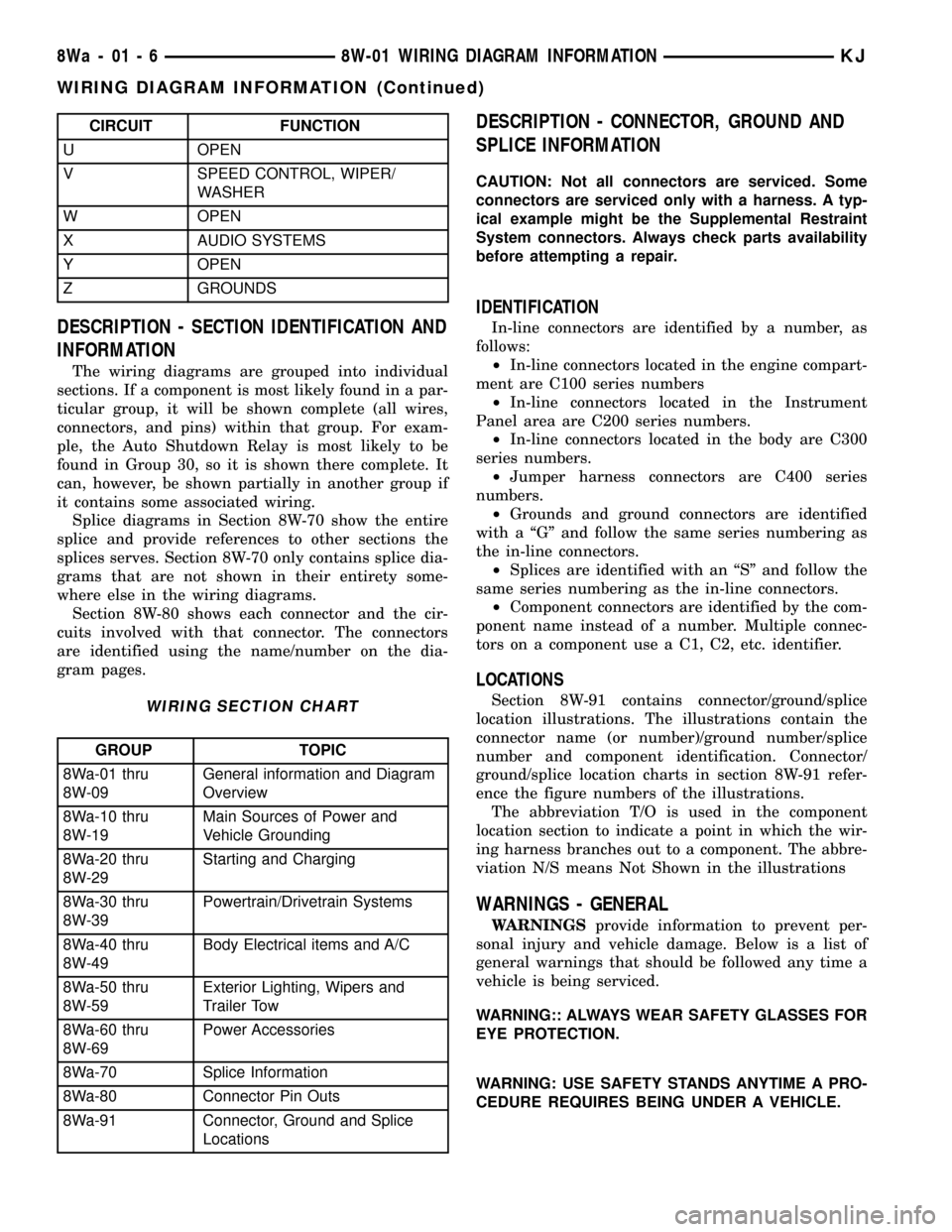
CIRCUIT FUNCTION
U OPEN
V SPEED CONTROL, WIPER/
WASHER
W OPEN
X AUDIO SYSTEMS
Y OPEN
Z GROUNDS
DESCRIPTION - SECTION IDENTIFICATION AND
INFORMATION
The wiring diagrams are grouped into individual
sections. If a component is most likely found in a par-
ticular group, it will be shown complete (all wires,
connectors, and pins) within that group. For exam-
ple, the Auto Shutdown Relay is most likely to be
found in Group 30, so it is shown there complete. It
can, however, be shown partially in another group if
it contains some associated wiring.
Splice diagrams in Section 8W-70 show the entire
splice and provide references to other sections the
splices serves. Section 8W-70 only contains splice dia-
grams that are not shown in their entirety some-
where else in the wiring diagrams.
Section 8W-80 shows each connector and the cir-
cuits involved with that connector. The connectors
are identified using the name/number on the dia-
gram pages.
WIRING SECTION CHART
GROUP TOPIC
8Wa-01 thru
8W-09General information and Diagram
Overview
8Wa-10 thru
8W-19Main Sources of Power and
Vehicle Grounding
8Wa-20 thru
8W-29Starting and Charging
8Wa-30 thru
8W-39Powertrain/Drivetrain Systems
8Wa-40 thru
8W-49Body Electrical items and A/C
8Wa-50 thru
8W-59Exterior Lighting, Wipers and
Trailer Tow
8Wa-60 thru
8W-69Power Accessories
8Wa-70 Splice Information
8Wa-80 Connector Pin Outs
8Wa-91 Connector, Ground and Splice
Locations
DESCRIPTION - CONNECTOR, GROUND AND
SPLICE INFORMATION
CAUTION: Not all connectors are serviced. Some
connectors are serviced only with a harness. A typ-
ical example might be the Supplemental Restraint
System connectors. Always check parts availability
before attempting a repair.
IDENTIFICATION
In-line connectors are identified by a number, as
follows:
²In-line connectors located in the engine compart-
ment are C100 series numbers
²In-line connectors located in the Instrument
Panel area are C200 series numbers.
²In-line connectors located in the body are C300
series numbers.
²Jumper harness connectors are C400 series
numbers.
²Grounds and ground connectors are identified
with a ªGº and follow the same series numbering as
the in-line connectors.
²Splices are identified with an ªSº and follow the
same series numbering as the in-line connectors.
²Component connectors are identified by the com-
ponent name instead of a number. Multiple connec-
tors on a component use a C1, C2, etc. identifier.
LOCATIONS
Section 8W-91 contains connector/ground/splice
location illustrations. The illustrations contain the
connector name (or number)/ground number/splice
number and component identification. Connector/
ground/splice location charts in section 8W-91 refer-
ence the figure numbers of the illustrations.
The abbreviation T/O is used in the component
location section to indicate a point in which the wir-
ing harness branches out to a component. The abbre-
viation N/S means Not Shown in the illustrations
WARNINGS - GENERAL
WARNINGSprovide information to prevent per-
sonal injury and vehicle damage. Below is a list of
general warnings that should be followed any time a
vehicle is being serviced.
WARNING:: ALWAYS WEAR SAFETY GLASSES FOR
EYE PROTECTION.
WARNING: USE SAFETY STANDS ANYTIME A PRO-
CEDURE REQUIRES BEING UNDER A VEHICLE.
8Wa - 01 - 6 8W-01 WIRING DIAGRAM INFORMATIONKJ
WIRING DIAGRAM INFORMATION (Continued)
Page 762 of 1803

8W-02 COMPONENT INDEX
Component Page
A/C Compressor Clutch Relay........... 8Wa-42
A/C Compressor Clutch................ 8Wa-42
A/C-Heater Control................... 8Wa-42
A/C High Pressure Switch.............. 8Wa-42
A/C Low Pressure Switch............... 8Wa-42
A/C Pressure Transducer............... 8Wa-42
Accelerator Pedal Position Sensor........ 8Wa-30
Airbag Control Module................. 8Wa-43
Ambient Temperature Sensor............ 8Wa-45
Antenna Module...................... 8Wa-47
Antenna............................ 8Wa-47
Ash Receiver Lamp................... 8Wa-44
Auto Shut Down Relay................. 8Wa-30
Back-Up Lamp Switch................. 8Wa-31
Battery Temperature Sensor......... 8Wa-20, 30
Battery............................. 8Wa-20
Blend Door Actuator................... 8Wa-42
Blower Motor Relay................... 8Wa-42
Blower Motor Resistor Block............ 8Wa-42
Blower Motor........................ 8Wa-42
Body Control Module.................. 8Wa-45
Boost Pressure Sensor................. 8Wa-30
Brake Lamp Switch................... 8Wa-33
Brake Pressure Switch................. 8Wa-35
Cabin Heater Relay................... 8Wa-42
Cabin Heater........................ 8Wa-42
Camshaft Position Sensor.............. 8Wa-30
Capacitor........................... 8Wa-30
Cargo Lamp......................... 8Wa-44
CD Changer......................... 8Wa-47
Center High Mounted Stop Lamp........ 8Wa-51
Cigar Lighter........................ 8Wa-41
Circuit Breakers...................... 8Wa-12
Clockspring................. 8Wa-33, 41, 43, 47
Clutch Interlock Switch................ 8Wa-21
Clutch Switch Override Relay........... 8Wa-21
Coil On Plugs........................ 8Wa-30
Coil Rail............................ 8Wa-30
Compass Mini-Trip Computer........... 8Wa-49
Controller Antilock Brake.............. 8Wa-35
Courtesy Lamps...................... 8Wa-44
Crankshaft Position Sensor............. 8Wa-30
Curtain Airbags...................... 8Wa-43
Cylinder Lock Switches................ 8Wa-61
Data Link Connector.................. 8Wa-18
Daytime Running Lamp Relay........... 8Wa-50
Defogger Relay....................... 8Wa-48
Diagnostic Junction Port............... 8Wa-18
Dome Lamp......................... 8Wa-44
Door Ajar Switches.................... 8Wa-45
Door Lock Motor/Ajar Switches.......... 8Wa-61
Door Lock Relay...................... 8Wa-61Component Page
Door Lock Switches................... 8Wa-61
Door Speakers....................... 8Wa-47
Driver Airbag Squib 1................. 8Wa-43
Driver Airbag Squib 2................. 8Wa-43
Driver Door Unlock Relay.............. 8Wa-61
Driver Seat Belt Switch................ 8Wa-40
Driver Seat Belt Tensioner.............. 8Wa-43
EGR Solenoid........................ 8Wa-30
Electric Brake Provision................ 8Wa-54
Engine Control Module................ 8Wa-30
Engine Coolant Level Sensor............ 8Wa-40
Engine Coolant Temperature Sensor...... 8Wa-30
Engine Oil Pressure Sensor............. 8Wa-30
EVAP/Purge Solenoid.................. 8Wa-30
Flip-Up Glass Release Motor............ 8Wa-61
Flip-Up Glass Release Switch........... 8Wa-61
Fog Lamps.......................... 8Wa-50
Front Fog Lamp Relay................. 8Wa-50
Front Wiper Motor.................... 8Wa-53
Fuel Heater Relay.................... 8Wa-30
Fuel Heater......................... 8Wa-30
Fuel Injectors........................ 8Wa-30
Fuel Pressure Sensor.................. 8Wa-30
Fuel Pressure Solenoid................. 8Wa-30
Fuel Pump Module.................... 8Wa-30
Fuel Pump Relay..................... 8Wa-30
Fuses........................... 8Wa-10, 12
Fusible Link......................... 8Wa-20
Grounds............................ 8Wa-15
Generator........................... 8Wa-20
Glow Plugs.......................... 8Wa-30
Hazard Switch/Combination Flasher...... 8Wa-52
Headlamp Leveling Switch.............. 8Wa-50
Headlamps.......................... 8Wa-50
Heated Seats........................ 8Wa-63
High Beam Relay..................... 8Wa-50
Horns.............................. 8Wa-41
Hood Ajar Switch..................... 8Wa-45
Idle Air Control Motor................. 8Wa-30
Ignition Switch....................... 8Wa-10
Impact Sensors....................... 8Wa-43
Input Speed Sensor................... 8Wa-31
Instrument Cluster................... 8Wa-40
Instrument Panel Speakers............. 8Wa-47
Intake Air Temperature Sensor.......... 8Wa-30
Intrusion Sensor..................... 8Wa-49
Junction Block....................... 8Wa-12
Knock Sensor........................ 8Wa-30
Leak Detection Pump.................. 8Wa-30
Leveling Motors...................... 8Wa-50
License Lamp........................ 8Wa-51
Line Pressure Sensor.................. 8Wa-31
KJ8W-02 COMPONENT INDEX8Wa-02-1
Page 968 of 1803

8W-47 AUDIO SYSTEM
Component Page
Antenna.......................... 8Wa-47-2
Antenna Module.................... 8Wa-47-2
Body Control Module................ 8Wa-47-9
Cd Changer........................ 8Wa-47-5
Clockspring........................ 8Wa-47-9
Diagnostic Junction Port............ 8Wa-47-2, 9
Fuse 18........................... 8Wa-47-6
Fuse 20........................... 8Wa-47-2
Fuse 32........................... 8Wa-47-2
Fuse 34........................... 8Wa-47-2
G200............................. 8Wa-47-7
G301............................. 8Wa-47-6Component Page
Instrument Cluster.................. 8Wa-47-2
Junction Block.................... 8Wa-47-2, 6
Left Front Door Speaker.......... 8Wa-47-3, 7, 8
Left Instrument Panel Speaker....... 8Wa-47-3, 7
Left Rear Door Speaker............. 8Wa-47-4, 8
Left Remote Radio Switch............. 8Wa-47-9
Radio............... 8Wa-47-2, 3, 4, 5, 6, 7, 8, 9
Radio Choke................... 8Wa-47-2, 6, 7
Right Front Door Speaker......... 8Wa-47-3, 7, 8
Right Instrument Panel Speaker...... 8Wa-47-3, 7
Right Rear Door Speaker........... 8Wa-47-4, 8
Right Remote Radio Switch............ 8Wa-47-9
KJ8W-47 AUDIO SYSTEM8Wa-47-1