Power outlet JEEP LIBERTY 2002 KJ / 1.G User Guide
[x] Cancel search | Manufacturer: JEEP, Model Year: 2002, Model line: LIBERTY, Model: JEEP LIBERTY 2002 KJ / 1.GPages: 1803, PDF Size: 62.3 MB
Page 1135 of 1803
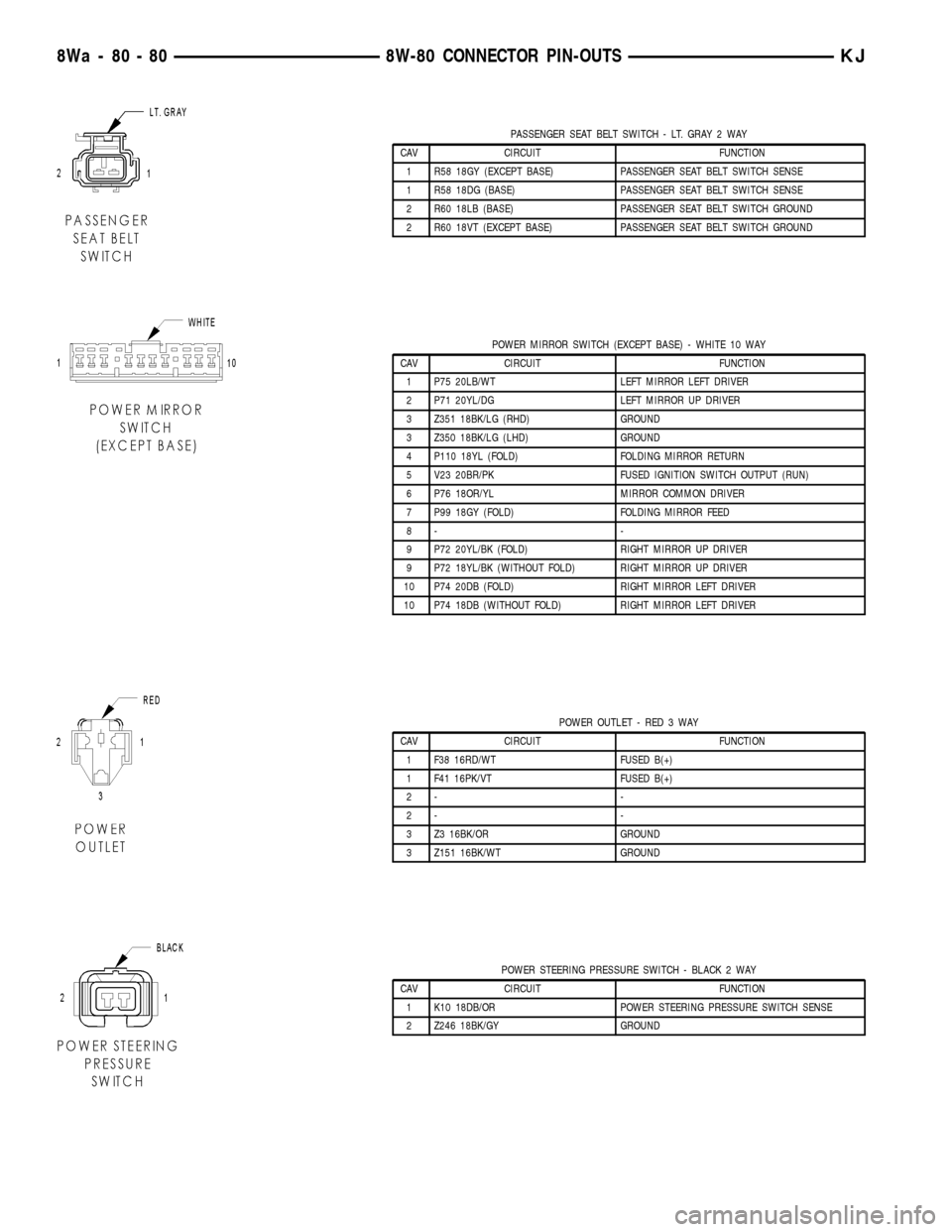
PASSENGER SEAT BELT SWITCH - LT. GRAY 2 WAY
CAV CIRCUIT FUNCTION
1 R58 18GY (EXCEPT BASE) PASSENGER SEAT BELT SWITCH SENSE
1 R58 18DG (BASE) PASSENGER SEAT BELT SWITCH SENSE
2 R60 18LB (BASE) PASSENGER SEAT BELT SWITCH GROUND
2 R60 18VT (EXCEPT BASE) PASSENGER SEAT BELT SWITCH GROUND
POWER MIRROR SWITCH (EXCEPT BASE) - WHITE 10 WAY
CAV CIRCUIT FUNCTION
1 P75 20LB/WT LEFT MIRROR LEFT DRIVER
2 P71 20YL/DG LEFT MIRROR UP DRIVER
3 Z351 18BK/LG (RHD) GROUND
3 Z350 18BK/LG (LHD) GROUND
4 P110 18YL (FOLD) FOLDING MIRROR RETURN
5 V23 20BR/PK FUSED IGNITION SWITCH OUTPUT (RUN)
6 P76 18OR/YL MIRROR COMMON DRIVER
7 P99 18GY (FOLD) FOLDING MIRROR FEED
8- -
9 P72 20YL/BK (FOLD) RIGHT MIRROR UP DRIVER
9 P72 18YL/BK (WITHOUT FOLD) RIGHT MIRROR UP DRIVER
10 P74 20DB (FOLD) RIGHT MIRROR LEFT DRIVER
10 P74 18DB (WITHOUT FOLD) RIGHT MIRROR LEFT DRIVER
POWER OUTLET - RED 3 WAY
CAV CIRCUIT FUNCTION
1 F38 16RD/WT FUSED B(+)
1 F41 16PK/VT FUSED B(+)
2- -
2- -
3 Z3 16BK/OR GROUND
3 Z151 16BK/WT GROUND
POWER STEERING PRESSURE SWITCH - BLACK 2 WAY
CAV CIRCUIT FUNCTION
1 K10 18DB/OR POWER STEERING PRESSURE SWITCH SENSE
2 Z246 18BK/GY GROUND
8Wa - 80 - 80 8W-80 CONNECTOR PIN-OUTSKJ
Page 1140 of 1803
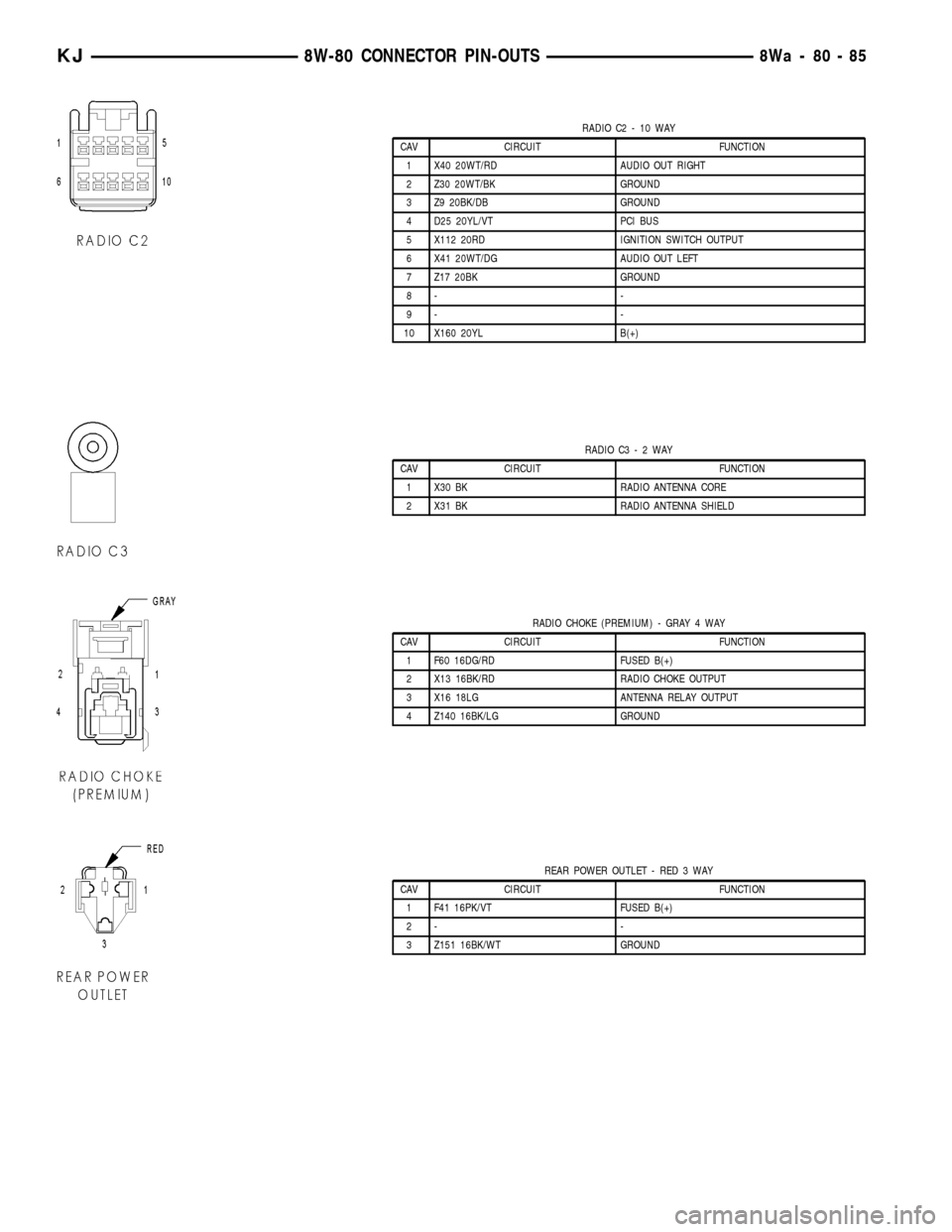
RADIO C2 - 10 WAY
CAV CIRCUIT FUNCTION
1 X40 20WT/RD AUDIO OUT RIGHT
2 Z30 20WT/BK GROUND
3 Z9 20BK/DB GROUND
4 D25 20YL/VT PCI BUS
5 X112 20RD IGNITION SWITCH OUTPUT
6 X41 20WT/DG AUDIO OUT LEFT
7 Z17 20BK GROUND
8- -
9- -
10 X160 20YL B(+)
RADIO C3-2WAY
CAV CIRCUIT FUNCTION
1 X30 BK RADIO ANTENNA CORE
2 X31 BK RADIO ANTENNA SHIELD
RADIO CHOKE (PREMIUM) - GRAY 4 WAY
CAV CIRCUIT FUNCTION
1 F60 16DG/RD FUSED B(+)
2 X13 16BK/RD RADIO CHOKE OUTPUT
3 X16 18LG ANTENNA RELAY OUTPUT
4 Z140 16BK/LG GROUND
REAR POWER OUTLET - RED 3 WAY
CAV CIRCUIT FUNCTION
1 F41 16PK/VT FUSED B(+)
2- -
3 Z151 16BK/WT GROUND
KJ8W-80 CONNECTOR PIN-OUTS8Wa-80-85
Page 1162 of 1803
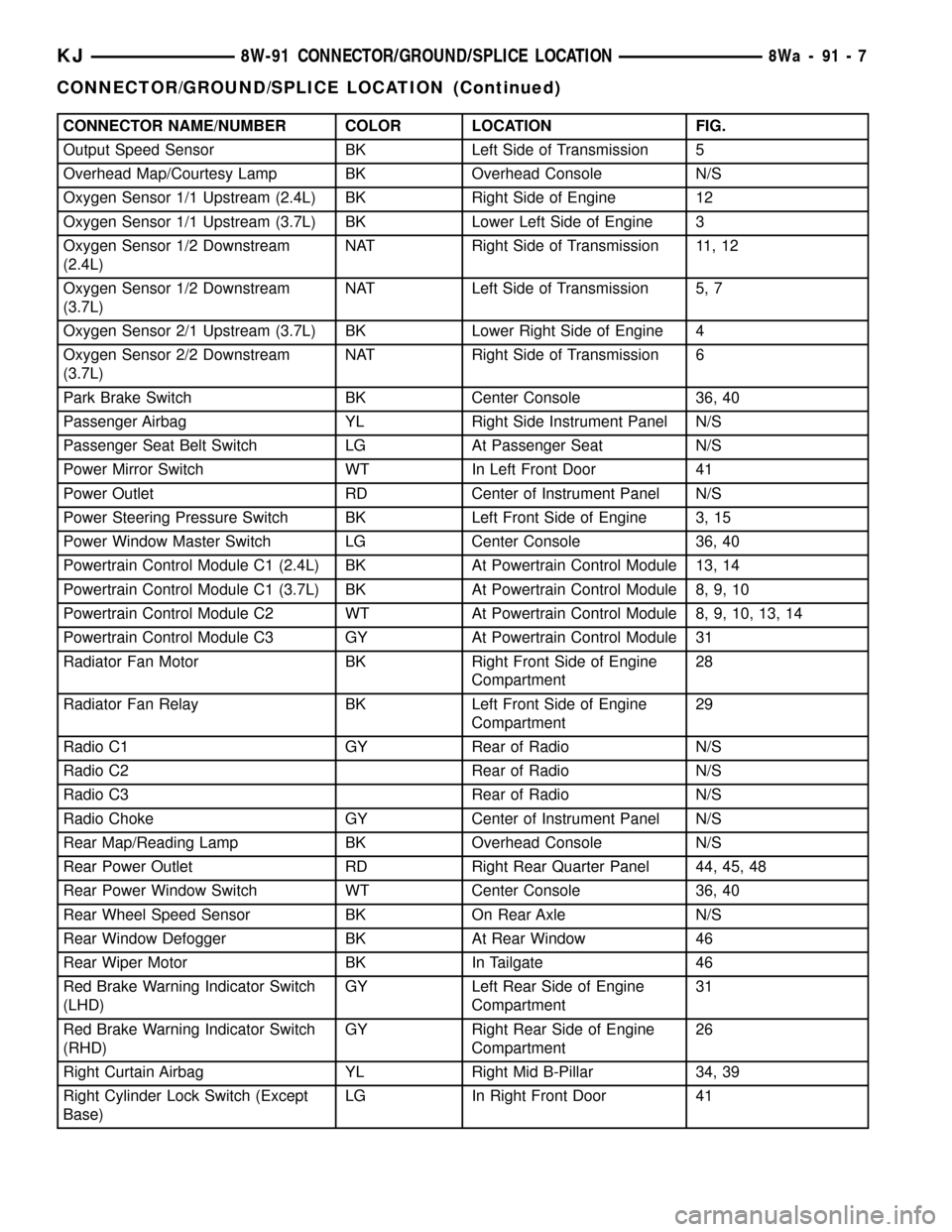
CONNECTOR NAME/NUMBER COLOR LOCATION FIG.
Output Speed Sensor BK Left Side of Transmission 5
Overhead Map/Courtesy Lamp BK Overhead Console N/S
Oxygen Sensor 1/1 Upstream (2.4L) BK Right Side of Engine 12
Oxygen Sensor 1/1 Upstream (3.7L) BK Lower Left Side of Engine 3
Oxygen Sensor 1/2 Downstream
(2.4L)NAT Right Side of Transmission 11, 12
Oxygen Sensor 1/2 Downstream
(3.7L)NAT Left Side of Transmission 5, 7
Oxygen Sensor 2/1 Upstream (3.7L) BK Lower Right Side of Engine 4
Oxygen Sensor 2/2 Downstream
(3.7L)NAT Right Side of Transmission 6
Park Brake Switch BK Center Console 36, 40
Passenger Airbag YL Right Side Instrument Panel N/S
Passenger Seat Belt Switch LG At Passenger Seat N/S
Power Mirror Switch WT In Left Front Door 41
Power Outlet RD Center of Instrument Panel N/S
Power Steering Pressure Switch BK Left Front Side of Engine 3, 15
Power Window Master Switch LG Center Console 36, 40
Powertrain Control Module C1 (2.4L) BK At Powertrain Control Module 13, 14
Powertrain Control Module C1 (3.7L) BK At Powertrain Control Module 8, 9, 10
Powertrain Control Module C2 WT At Powertrain Control Module 8, 9, 10, 13, 14
Powertrain Control Module C3 GY At Powertrain Control Module 31
Radiator Fan Motor BK Right Front Side of Engine
Compartment28
Radiator Fan Relay BK Left Front Side of Engine
Compartment29
Radio C1 GY Rear of Radio N/S
Radio C2 Rear of Radio N/S
Radio C3 Rear of Radio N/S
Radio Choke GY Center of Instrument Panel N/S
Rear Map/Reading Lamp BK Overhead Console N/S
Rear Power Outlet RD Right Rear Quarter Panel 44, 45, 48
Rear Power Window Switch WT Center Console 36, 40
Rear Wheel Speed Sensor BK On Rear Axle N/S
Rear Window Defogger BK At Rear Window 46
Rear Wiper Motor BK In Tailgate 46
Red Brake Warning Indicator Switch
(LHD)GY Left Rear Side of Engine
Compartment31
Red Brake Warning Indicator Switch
(RHD)GY Right Rear Side of Engine
Compartment26
Right Curtain Airbag YL Right Mid B-Pillar 34, 39
Right Cylinder Lock Switch (Except
Base)LG In Right Front Door 41
KJ8W-91 CONNECTOR/GROUND/SPLICE LOCATION8Wa-91-7
CONNECTOR/GROUND/SPLICE LOCATION (Continued)
Page 1167 of 1803
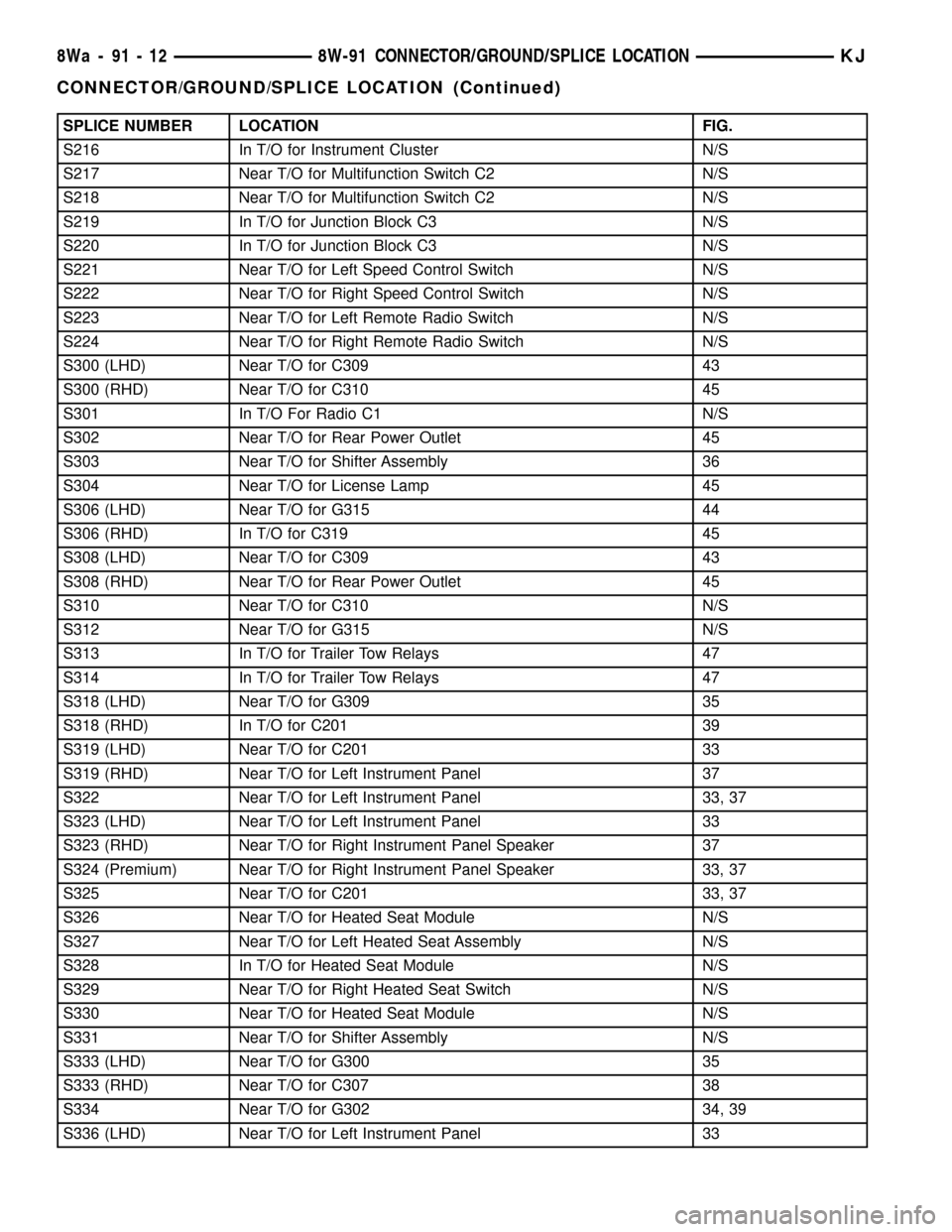
SPLICE NUMBER LOCATION FIG.
S216 In T/O for Instrument Cluster N/S
S217 Near T/O for Multifunction Switch C2 N/S
S218 Near T/O for Multifunction Switch C2 N/S
S219 In T/O for Junction Block C3 N/S
S220 In T/O for Junction Block C3 N/S
S221 Near T/O for Left Speed Control Switch N/S
S222 Near T/O for Right Speed Control Switch N/S
S223 Near T/O for Left Remote Radio Switch N/S
S224 Near T/O for Right Remote Radio Switch N/S
S300 (LHD) Near T/O for C309 43
S300 (RHD) Near T/O for C310 45
S301 In T/O For Radio C1 N/S
S302 Near T/O for Rear Power Outlet 45
S303 Near T/O for Shifter Assembly 36
S304 Near T/O for License Lamp 45
S306 (LHD) Near T/O for G315 44
S306 (RHD) In T/O for C319 45
S308 (LHD) Near T/O for C309 43
S308 (RHD) Near T/O for Rear Power Outlet 45
S310 Near T/O for C310 N/S
S312 Near T/O for G315 N/S
S313 In T/O for Trailer Tow Relays 47
S314 In T/O for Trailer Tow Relays 47
S318 (LHD) Near T/O for G309 35
S318 (RHD) In T/O for C201 39
S319 (LHD) Near T/O for C201 33
S319 (RHD) Near T/O for Left Instrument Panel 37
S322 Near T/O for Left Instrument Panel 33, 37
S323 (LHD) Near T/O for Left Instrument Panel 33
S323 (RHD) Near T/O for Right Instrument Panel Speaker 37
S324 (Premium) Near T/O for Right Instrument Panel Speaker 33, 37
S325 Near T/O for C201 33, 37
S326 Near T/O for Heated Seat Module N/S
S327 Near T/O for Left Heated Seat Assembly N/S
S328 In T/O for Heated Seat Module N/S
S329 Near T/O for Right Heated Seat Switch N/S
S330 Near T/O for Heated Seat Module N/S
S331 Near T/O for Shifter Assembly N/S
S333 (LHD) Near T/O for G300 35
S333 (RHD) Near T/O for C307 38
S334 Near T/O for G302 34, 39
S336 (LHD) Near T/O for Left Instrument Panel 33
8Wa - 91 - 12 8W-91 CONNECTOR/GROUND/SPLICE LOCATIONKJ
CONNECTOR/GROUND/SPLICE LOCATION (Continued)
Page 1317 of 1803

Possible indications of the cylinder head gasket
leaking between a cylinder and an adjacent water
jacket are:
²Engine overheating
²Loss of coolant
²Excessive steam (white smoke) emitting from
exhaust
²Coolant foaming
CYLINDER-TO-CYLINDER LEAKAGE TEST
To determine if an engine cylinder head gasket is
leaking between adjacent cylinders, follow the proce-
dures in Cylinder Compression Pressure Test (Refer
to 9 - ENGINE - DIAGNOSIS AND TESTING). An
engine cylinder head gasket leaking between adja-
cent cylinders will result in approximately a 50±70%
reduction in compression pressure.
CYLINDER-TO-WATER JACKET LEAKAGE TEST
WARNING: USE EXTREME CAUTION WHEN THE
ENGINE IS OPERATING WITH COOLANT PRES-
SURE CAP REMOVED.
VISUAL TEST METHOD
With the engine cool, remove the coolant pressure
cap. Start the engine and allow it to warm up until
thermostat opens.
If a large combustion/compression pressure leak
exists, bubbles will be visible in the coolant.
COOLING SYSTEM TESTER METHOD
WARNING: WITH COOLING SYSTEM TESTER IN
PLACE, PRESSURE WILL BUILD UP FAST. EXCES-
SIVE PRESSURE BUILT UP, BY CONTINUOUS
ENGINE OPERATION, MUST BE RELEASED TO A
SAFE PRESSURE POINT. NEVER PERMIT PRES-
SURE TO EXCEED 138 kPa (20 psi).
Install Cooling System Tester 7700 or equivalent to
pressure cap neck. Start the engine and observe the
tester's pressure gauge. If gauge pulsates with every
power stroke of a cylinder a combustion pressure
leak is evident.
CHEMICAL TEST METHOD
Combustion leaks into the cooling system can also
be checked by using Bloc-Chek Kit C-3685-A or
equivalent. Perform test following the procedures
supplied with the tool kit.
REMOVAL - CYLINDER HEAD
(1) Perform fuel system pressure release procedure
before attempting any repairs.(Refer to 14 -FUEL SYSTEM/FUEL DELIVERY - SPECIFICA-
TIONS)
(2) Disconnect battery negative cable.
(3) Drain cooling system. (Refer to 7 - COOLING -
STANDARD PROCEDURE)
(4) Remove air filter housing and inlet tube.
(5) Remove intake manifold.
(6) Remove heater tube support bracket from cyl-
inder head.
(7) Disconnect radiator upper and heater supply
hoses from water outlet connections.
(8) Remove accessory drive belts. (Refer to 7 -
COOLING/ACCESSORY DRIVE/DRIVE BELTS -
REMOVAL)
(9) Raise vehicle and remove exhaust pipe from
manifold.
(10) Remove power steering pump and set aside.
Do not disconnect lines.
(11) Remove accessory drive bracket
(12) Remove ignition coil and wires from engine.
(13) Disconnect cam sensor and fuel injector wir-
ing connectors.
(14) Remove timing belt and camshaft sprockets.
(Refer to 9 - ENGINE/VALVE TIMING/TIMING
BELT/CHAIN AND SPROCKETS - REMOVAL)
(15) Remove timing belt idler pulley and rear tim-
ing belt cover. (Refer to 9 - ENGINE/VALVE TIM-
ING/TIMING BELT / CHAIN COVER(S) -
REMOVAL)
(16) Remove cylinder head cover. (Refer to 9 -
ENGINE/CYLINDER HEAD/CYLINDER HEAD
COVER(S) - REMOVAL)
(17) Remove camshafts (Refer to 9 - ENGINE/
CYLINDER HEAD/CAMSHAFT(S) - REMOVAL).
NOTE: Identify rocker arm position to ensure cor-
rect re-installation in original position, if reused.
(18) Remove rocker arms. (Refer to 9 - ENGINE/
CYLINDER HEAD/ROCKER ARMS - REMOVAL).
(19) Remove cylinder head bolts in REVERSE
sequence of tightening.
(20) Remove cylinder head from engine block.
(21) Inspect and clean cylinder head. (Refer to 9 -
ENGINE/CYLINDER HEAD - INSPECTION) (Refer
to 9 - ENGINE/CYLINDER HEAD - CLEANING)
CLEANING
To ensure engine gasket sealing, proper surface
preparation must be performed, especially with the
use of aluminum engine components and multi-layer
steel cylinder head gaskets.
NOTE: Multi-Layer Steel (MLS) head gaskets require
a scratch free sealing surface.
9s - 20 ENGINEKJ
CYLINDER HEAD (Continued)
Page 1397 of 1803

FUEL PUMP
DESCRIPTION
The electric fuel pump is located inside of the fuel
pump module. A 12 volt, permanent magnet, electric
motor powers the fuel pump. The electric fuel pump
is not a separate, serviceable component.
OPERATION
Voltage to operate the electric pump is supplied
through the fuel pump relay.
Fuel is drawn in through a filter at the bottom of
the module and pushed through the electric motor
gearset to the pump outlet.
Check Valve Operation:The bottom section of
the fuel pump module contains a one-way check
valve to prevent fuel flow back into the tank and to
maintain fuel supply line pressure (engine warm)
when pump is not operational. It is also used to keep
the fuel supply line full of gasoline when pump is not
operational. After the vehicle has cooled down, fuel
pressure may drop to 0 psi (cold fluid contracts), but
liquid gasoline will remain in fuel supply line
between the check valve and fuel injectors.Fuel
pressure that has dropped to 0 psi on a cooled
down vehicle (engine off) is a normal condition.
Refer to the Fuel Pressure Leak Down Test for more
information.
The electric fuel pump is not a separate, service-
able component.
DIAGNOSIS AND TESTING
DIAGNOSIS AND TESTING - FUEL PUMP
CAPACITY TEST
Before performing this test, verify fuel pump
pressure. Refer to Fuel Pump Pressure Test.
Use this test in conjunction with the Fuel Pres-
sure Leak Down Test.
(1) Release fuel system pressure. Refer to Fuel
Pressure Release Procedure.
(2) Disconnect fuel supply line at fuel rail. Refer to
Quick-Connect Fittings. Some engines may require
air cleaner housing removal before line disconnection.
(3) Obtain correct Fuel Line Pressure Test Adapter
Tool Hose. Tool number 6539 is used for 5/16º fuel
lines and tool number 6631 is used for 3/8º fuel lines.
(4) Connect correct Fuel Line Pressure Test
Adapter Tool Hose into disconnected fuel supply line.
Insert other end of Adaptor Tool Hose into a gradu-
ated container.
(5) Remove fuel fill cap.(6) To activate fuel pump and pressurize system,
obtain DRBtscan tool and actuate ASD Fuel System
Test.
(7) A good fuel pump will deliver at least 1/10 liter
of fuel in 7 seconds. Do not operate fuel pump for
longer than 7 seconds with fuel line disconnected as
fuel pump module reservoir may run empty.
(a) If capacity is lower than specification, but
fuel pump can be heard operating through fuel fill
cap opening, check for a kinked/damaged fuel sup-
ply line somewhere between fuel rail and fuel
pump module.
(b) If line is not kinked/damaged, and fuel pres-
sure is OK, but capacity is low, replace fuel filter.
Refer to Fuel Filter Removal/Installation for addi-
tional information.
(c) If both fuel pressure and capacity are low,
replace bottom section of fuel pump module. Refer
to Fuel Pump Module Removal/Installation.
DIAGNOSIS AND TESTING - FUEL PUMP
PRESSURE TEST
Use this test in conjunction with the Fuel Pump
Capacity Test, Fuel Pressure Leak Down Test and
Fuel Pump Amperage Test found elsewhere in this
group.
Check Valve Operation:The bottom section of
the fuel pump module contains a one-way check
valve to prevent fuel flow back into the tank and to
maintain fuel supply line pressure (engine warm)
when pump is not operational. It is also used to keep
the fuel supply line full of gasoline when pump is not
operational. After the vehicle has cooled down, fuel
pressure may drop to 0 psi (cold fluid contracts), but
liquid gasoline will remain in fuel supply line
between the check valve and fuel injectors.Fuel
pressure that has dropped to 0 psi on a cooled
down vehicle (engine off) is a normal condition.
When the electric fuel pump is activated, fuel pres-
sure shouldimmediately(1±2 seconds) rise to spec-
ification.
The fuel system is equipped with a separate fuel
pump module mounted, fuel pressure regulator. The
fuel filter is remotely mounted. The fuel pressure
regulator is not controlled by engine vacuum.
WARNING: THE FUEL SYSTEM IS UNDER CON-
STANT FUEL PRESSURE EVEN WITH THE ENGINE
OFF. BEFORE DISCONNECTING FUEL LINE AT
FUEL RAIL, THIS PRESSURE MUST BE RELEASED.
REFER TO THE FUEL SYSTEM PRESSURE
RELEASE PROCEDURE.
KJFUEL DELIVERY 14 - 15
Page 1415 of 1803

FUEL INJECTOR
DESCRIPTION
An individual fuel injector (Fig. 9) is used for each
individual cylinder.
OPERATION
OPERATION - FUEL INJECTOR
The top (fuel entry) end of the injector (Fig. 9) is
attached into an opening on the fuel rail.
The fuel injectors are electrical solenoids. The
injector contains a pintle that closes off an orifice at
the nozzle end. When electric current is supplied to
the injector, the armature and needle move a short
distance against a spring, allowing fuel to flow out
the orifice. Because the fuel is under high pressure, a
fine spray is developed in the shape of a pencil
stream. The spraying action atomizes the fuel, add-
ing it to the air entering the combustion chamber.
The nozzle (outlet) ends of the injectors are posi-
tioned into openings in the intake manifold just
above the intake valve ports of the cylinder head.
The engine wiring harness connector for each fuel
injector is equipped with an attached numerical tag
(INJ 1, INJ 2 etc.). This is used to identify each fuel
injector.
The injectors are energized individually in a
sequential order by the Powertrain Control Module(PCM). The PCM will adjust injector pulse width by
switching the ground path to each individual injector
on and off. Injector pulse width is the period of time
that the injector is energized. The PCM will adjust
injector pulse width based on various inputs it
receives.
Battery voltage is supplied to the injectors through
the ASD relay.
The PCM determines injector pulse width based on
various inputs.
OPERATION - PCM OUTPUT
The nozzle ends of the injectors are positioned into
openings in the intake manifold just above the intake
valve ports of the cylinder head. The engine wiring
harness connector for each fuel injector is equipped
with an attached numerical tag (INJ 1, INJ 2 etc.).
This is used to identify each fuel injector with its
respective cylinder number.
The injectors are energized individually in a
sequential order by the Powertrain Control Module
(PCM). The PCM will adjust injector pulse width by
switching the ground path to each individual injector
on and off. Injector pulse width is the period of time
that the injector is energized. The PCM will adjust
injector pulse width based on various inputs it
receives.
Battery voltage (12 volts +) is supplied to the injec-
tors through the ASD relay. The ASD relay will shut-
down the 12 volt power source to the fuel injectors if
the PCM senses the ignition is on, but the engine is
not running. This occurs after the engine has not
been running for approximately 1.8 seconds.
The PCM determines injector on-time (pulse width)
based on various inputs.
DIAGNOSIS AND TESTING - FUEL INJECTOR
To perform a complete test of the fuel injectors and
their circuitry, use the DRB scan tool and refer to the
appropriate Powertrain Diagnostics Procedures man-
ual. To test the injector only, refer to the following:
Disconnect the fuel injector wire harness connector
from the injector. The injector is equipped with 2
electrical terminals (pins). Place an ohmmeter across
the terminals. Resistance reading should be approxi-
mately 12 ohms 1.2 ohms at 20ÉC (68ÉF).
Fig. 9 FUEL INJECTOR Ð TYPICAL
KJFUEL INJECTION 14 - 33
Page 1656 of 1803
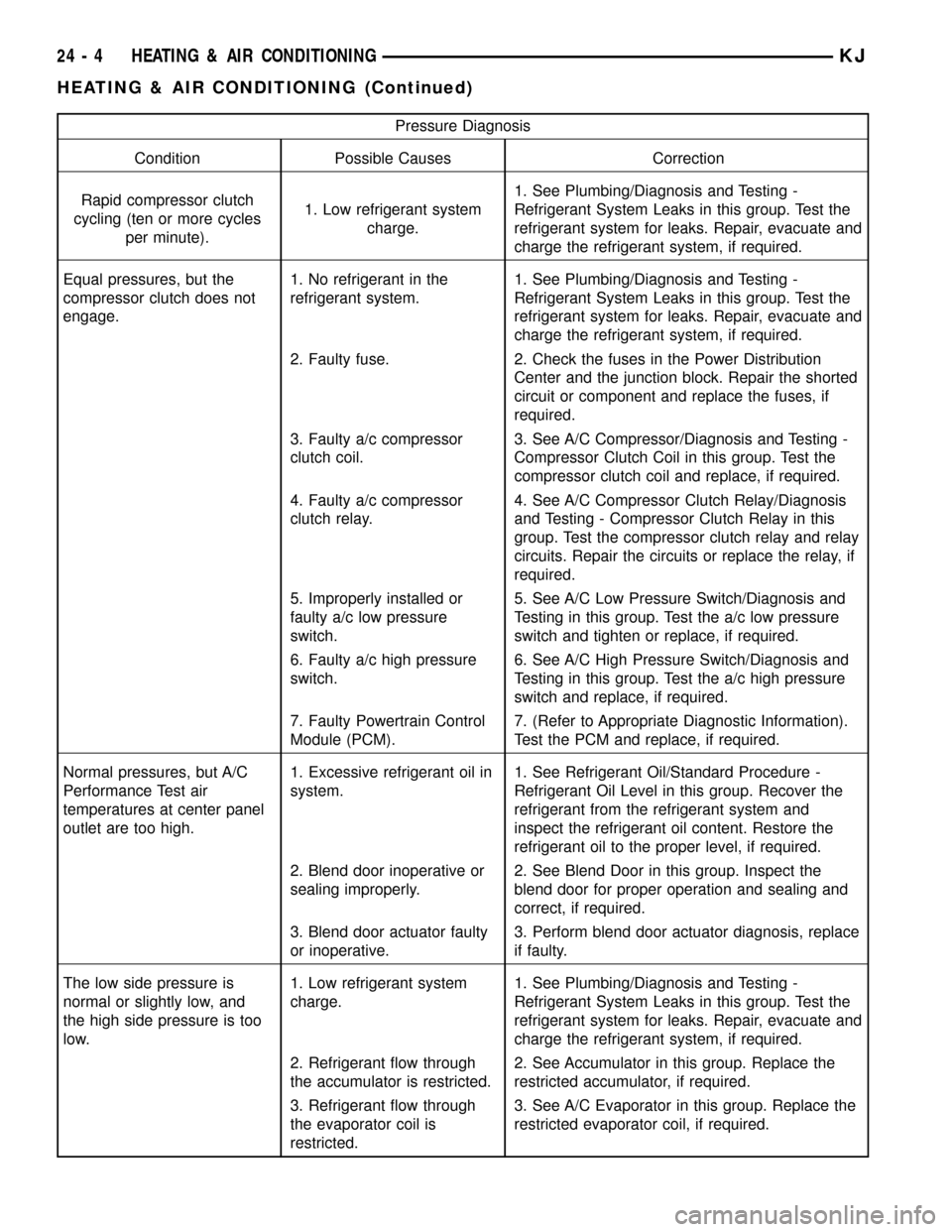
Pressure Diagnosis
Condition Possible Causes Correction
Rapid compressor clutch
cycling (ten or more cycles
per minute).1. Low refrigerant system
charge.1. See Plumbing/Diagnosis and Testing -
Refrigerant System Leaks in this group. Test the
refrigerant system for leaks. Repair, evacuate and
charge the refrigerant system, if required.
Equal pressures, but the
compressor clutch does not
engage.1. No refrigerant in the
refrigerant system.1. See Plumbing/Diagnosis and Testing -
Refrigerant System Leaks in this group. Test the
refrigerant system for leaks. Repair, evacuate and
charge the refrigerant system, if required.
2. Faulty fuse. 2. Check the fuses in the Power Distribution
Center and the junction block. Repair the shorted
circuit or component and replace the fuses, if
required.
3. Faulty a/c compressor
clutch coil.3. See A/C Compressor/Diagnosis and Testing -
Compressor Clutch Coil in this group. Test the
compressor clutch coil and replace, if required.
4. Faulty a/c compressor
clutch relay.4. See A/C Compressor Clutch Relay/Diagnosis
and Testing - Compressor Clutch Relay in this
group. Test the compressor clutch relay and relay
circuits. Repair the circuits or replace the relay, if
required.
5. Improperly installed or
faulty a/c low pressure
switch.5. See A/C Low Pressure Switch/Diagnosis and
Testing in this group. Test the a/c low pressure
switch and tighten or replace, if required.
6. Faulty a/c high pressure
switch.6. See A/C High Pressure Switch/Diagnosis and
Testing in this group. Test the a/c high pressure
switch and replace, if required.
7. Faulty Powertrain Control
Module (PCM).7. (Refer to Appropriate Diagnostic Information).
Test the PCM and replace, if required.
Normal pressures, but A/C
Performance Test air
temperatures at center panel
outlet are too high.1. Excessive refrigerant oil in
system.1. See Refrigerant Oil/Standard Procedure -
Refrigerant Oil Level in this group. Recover the
refrigerant from the refrigerant system and
inspect the refrigerant oil content. Restore the
refrigerant oil to the proper level, if required.
2. Blend door inoperative or
sealing improperly.2. See Blend Door in this group. Inspect the
blend door for proper operation and sealing and
correct, if required.
3. Blend door actuator faulty
or inoperative.3. Perform blend door actuator diagnosis, replace
if faulty.
The low side pressure is
normal or slightly low, and
the high side pressure is too
low.1. Low refrigerant system
charge.1. See Plumbing/Diagnosis and Testing -
Refrigerant System Leaks in this group. Test the
refrigerant system for leaks. Repair, evacuate and
charge the refrigerant system, if required.
2. Refrigerant flow through
the accumulator is restricted.2. See Accumulator in this group. Replace the
restricted accumulator, if required.
3. Refrigerant flow through
the evaporator coil is
restricted.3. See A/C Evaporator in this group. Replace the
restricted evaporator coil, if required.
24 - 4 HEATING & AIR CONDITIONINGKJ
HEATING & AIR CONDITIONING (Continued)
Page 1672 of 1803

(2) Install and tighten the a/c low pressure switch
on the accumulator fitting. The switch should be
hand-tightened onto the accumulator fitting.
(3) Plug the wire harness connector into the a/c
low pressure switch.
(4) Connect the battery negative cable.
BLEND DOOR ACTUATOR
REMOVAL
WARNING: ON VEHICLES EQUIPPED WITH AIR-
BAGS, DISABLE THE AIRBAG SYSTEM BEFORE
ATTEMPTING ANY STEERING WHEEL, STEERING
COLUMN, OR INSTRUMENT PANEL COMPONENT
DIAGNOSIS OR SERVICE. DISCONNECT AND ISO-
LATE THE BATTERY NEGATIVE (GROUND) CABLE,
THEN WAIT TWO MINUTES FOR THE AIRBAG SYS-
TEM CAPACITOR TO DISCHARGE BEFORE PER-
FORMING FURTHER DIAGNOSIS OR SERVICE. THIS
IS THE ONLY SURE WAY TO DISABLE THE AIRBAG
SYSTEM. FAILURE TO TAKE THE PROPER PRE-
CAUTIONS COULD RESULT IN AN ACCIDENTAL
AIRBAG DEPLOYMENT AND POSSIBLE PERSONAL
INJURY.
(1) Disconnect and isolate the battery negative
cable.
(2) Remove A/C housing from vehicle(Refer to 24 -
HEATING & AIR CONDITIONING/DISTRIBUTION/
HVAC HOUSING - REMOVAL).
(3) Remove the screws that secure the blend door
actuator to the top of the HVAC housing. (Fig. 14).
(4) Remove the blend door actuator.
INSTALLATION
(1) Install the blend door actuator in place.
(2) Install and tighten the screws that secure the
blend door actuator to the housing. Tighten the
mounting screws to 2.4 ( .34) N´m (21 ( 3) in. lbs.).
(3) Install the HVAC housing into the vehicle(Re-
fer to 24 - HEATING & AIR CONDITIONING/DIS-
TRIBUTION/HVAC HOUSING - INSTALLATION).
(4) Install the blend door actuator electrical con-
nector from the wiring harness through the glove
box.
(5) Connect the battery negative cable.
BLOWER MOTOR RELAY
DESCRIPTION
The blower motor relay is a International Stan-
dards Organization (ISO)-type relay. The relay is a
electromechanical device that switches battery cur-
rent from a fuse in the Power Distribution Center
(PDC) directly to the blower motor. The relay is ener-
gized when the relay coil is provided a voltage signal
by the ignition switch. (Refer to 24 - HEATING &
AIR CONDITIONING/CONTROLS/BLOWER
MOTOR RELAY - DIAGNOSIS AND TESTING)
OPERATION
The blower motor relay is installed in a wire har-
ness connector that is secured to the passenger side
outboard end of the HVAC housing in the passenger
compartment, next to the HVAC wire harness con-
nector.
The blower motor relay cannot be repaired and, if
faulty or damaged, it must be replaced.
Fig. 14 HEATER CORE REMOVAL/INSTALLATION
1 - HEATER CORE
2- MOUNTING SCREW HOLE
3- INLET AND OUTLET TUBES
4- VACUUM HARNESS
5- ACTUATOR SCREWS (3)
6- ELECTRIC BLEND DOOR ACTUATOR
7- MOUNTING SCREW HOLE
8- HEATER CORE RETAINER TABS (4)
24 - 20 CONTROLSKJ
A/C LOW PRESSURE SWITCH (Continued)
Page 1741 of 1803

ANTENNA BODY & CABLE - OPERATION . . . 8A-5
ANTENNA BODY & CABLE - REMOVAL.....8A-6
ANTENNA BODY AND CABLE -
DIAGNOSIS AND TESTING..............8A-5
ANTENNA CABLE - INSTALLATION,
INSTRUMENT PANEL..................8A-8
ANTENNA CABLE - REMOVAL,
INSTRUMENT PANEL..................8A-7
ANTILOCK BRAKE - INSTALLATION,
CONTROLLER.......................8E-10
ANTILOCK BRAKE - REMOVAL,
CONTROLLER.......................8E-10
ANTILOCK BRAKING SYSTEM -
DIAGNOSIS AND TESTING..............5-33
A-PILLAR SEAL - INSTALLATION.......23-185
A-PILLAR SEAL - REMOVAL...........23-185
A-PILLAR TRIM AND GRAB HANDLE -
INSTALLATION......................23-156
A-PILLAR TRIM AND GRAB HANDLE -
REMOVAL.........................23-156
A-PILLAR WEATHERSTRIP/RETAINER -
INSTALLATION, WINDSHIELD..........23-187
A-PILLAR WEATHERSTRIP/RETAINER -
REMOVAL, WINDSHIELD..............23-186
APPLICATION TABLE, SPECIFICATIONS -
A/C ................................24-9
AREA LEAKS - DIAGNOSIS AND
TESTING, REAR SEAL..................9-61
ARM - DESCRIPTION, FRONT WIPER.....8R-12
ARM - DESCRIPTION, LOWER CONTROL . . . 2-21
ARM - DESCRIPTION, REAR WIPER......8R-37
ARM - DESCRIPTION, ROCKER......9-29,9-37
ARM - INSTALLATION, FRONT WIPER....8R-13
ARM - INSTALLATION, LOWER CONTROL . . 2-10,
2-21
ARM - INSTALLATION, REAR WIPER.....8R-38
ARM - INSTALLATION, ROCKER..........9-37
ARM - INSTALLATION, UPPER CONTROL . . . 2-21
ARM - OPERATION, FRONT WIPER......8R-12
ARM - OPERATION, LOWER CONTROL.....2-21
ARM - OPERATION, REAR WIPER.......8R-38
ARM - REMOVAL, FRONT WIPER........8R-12
ARM - REMOVAL, LOWER CONTROL . . 2-10,2-21
ARM - REMOVAL, REAR WIPER.........8R-38
ARM - REMOVAL, ROCKER..............9-37
ARM - REMOVAL, UPPER CONTROL......2-20
ARM, BUSHINGS, AND BALL JOINT -
DESCRIPTION, UPPER SUSPENSION......2-20
ARM, BUSHINGS, AND BALL JOINT -
OPERATION, UPPER SUSPENSION........2-20
ARM PARK RAMP - INSTALLATION,
WIPER.............................8R-43
ARM PARK RAMP - REMOVAL, WIPER . . . 8R-43
ASD AND FUEL PUMP RELAYS -
DIAGNOSIS AND TESTING...............8I-4
ASD SENSE - PCM INPUT - OPERATION....8I-4
ASH RECEIVER LAMP BULB -
INSTALLATION.......................8L-71
ASH RECEIVER LAMP BULB - REMOVAL . . 8L-71
ASH RECEIVER LAMP UNIT -
INSTALLATION.......................8L-72
ASH RECEIVER LAMP UNIT - REMOVAL . . 8L-72
ASSEMBLY - ASSEMBLY, INPUT CLUTCH . 21-138
ASSEMBLY - DESCRIPTION, INPUT
CLUTCH...........................21-133
ASSEMBLY - DESCRIPTION,
TRANSMISSION SOLENOID/TRS........21-169
ASSEMBLY - DISASSEMBLY, INPUT
CLUTCH...........................21-135
ASSEMBLY - INSTALLATION.........8W-97-11
ASSEMBLY - INSTALLATION, GUIDE.....23-179
ASSEMBLY - INSTALLATION,
INSTRUMENT PANEL.................23-151
ASSEMBLY - INSTALLATION, MODULE . . . 23-181
ASSEMBLY - INSTALLATION,
TRANSMISSION SOLENOID/TRS........21-170
ASSEMBLY - OPERATION, INPUT
CLUTCH...........................21-135
ASSEMBLY - OPERATION,
TRANSMISSION SOLENOID/TRS........21-169
ASSEMBLY - POWER DISTRIBUTION
CENTER ASSEMBLY
...............8W-97-10
ASSEMBLY - REMOVAL, GUIDE
........23-179
ASSEMBLY - REMOVAL, INSTRUMENT
PANEL
............................23-149
ASSEMBLY - REMOVAL, MODULE
......23-181
ASSEMBLY - REMOVAL, TRANSMISSION
SOLENOID/TRS
.....................21-170ASSEMBLY, 4C RETAINER/BULKHEAD....21-123
ASSEMBLY, ASSEMBLY - POWER
DISTRIBUTION CENTER............8W-97-10
ASSEMBLY, DIAGNOSIS AND TESTING....21-90
ASSEMBLY, DIFFERENTIAL.........3-105,3-41
ASSEMBLY, DIFFERENTIAL - TRAC-LOK . . . 3-109,
3-77
ASSEMBLY, DISC BRAKE CALIPERS.......5-16
ASSEMBLY, HVAC HOUSING............24-34
ASSEMBLY, INPUT CLUTCH ASSEMBLY . . 21-138
ASSEMBLY, INSTRUMENT CLUSTER......8J-10
ASSEMBLY, LOW/REVERSE CLUTCH.....21-146
ASSEMBLY, MANUAL - NV1500.........21-13
ASSEMBLY, MANUAL - NV3550.........21-48
ASSEMBLY, OIL PUMP.................9-67
ASSEMBLY, OIL PUMP...............21-151
ASSEMBLY, PLANETARY GEARTRAIN....21-160
ASSEMBLY, SINGLE CARDAN
UNIVERSAL JOINTS....................3-9
ASSEMBLY, TRANSFER CASE - NV231 . . . 21-194
ASSEMBLY, TRANSFER CASE - NV242 . . . 21-230
ASSEMBLY, VALVE BODY.............21-176
ASSEMBLY, WHEEL CYLINDERS..........5-29
ASSEMBLY WINDOW DEFOGGER
FUNCTION - DIAGNOSIS AND TESTING,
REAR HVAC CONTROL.................8G-9
ASSIST HANDLE - INSTALLATION.......23-157
ASSIST HANDLE - REMOVAL............23-157
AUDIO - DESCRIPTION.................8A-1
AUDIO - DIAGNOSIS AND TESTING.......8A-2
AUDIO - OPERATION...................8A-1
AUTOMATIC TRANSMISSION - 45RFE -
DESCRIPTION.......................21-76
AUTOMATIC TRANSMISSION - 45RFE -
OPERATION.........................21-77
AUTOMATIC TRANSMISSION -
DIAGNOSIS AND TESTING.............21-77
AUTOMATIC TRANSMISSION FLUID -
DESCRIPTION.........................0-2
AUTOMATIC TRANSMISSION FLUID -
OPERATION...........................0-4
AXLE - 186FIA - ADJUSTMENTS, FRONT . . . 3-25
AXLE - 186FIA - DESCRIPTION, FRONT....3-19
AXLE - 186FIA - INSTALLATION, FRONT....3-24
AXLE - 186FIA - OPERATION, FRONT......3-19
AXLE - 186FIA - REMOVAL, FRONT.......3-24
AXLE - 198RBI - DESCRIPTION, REAR.....3-49
AXLE - 198RBI - INSTALLATION, REAR....3-54
AXLE - 198RBI - OPERATION, REAR.......3-49
AXLE - 198RBI - REMOVAL, REAR........3-54
AXLE - 8 1/4 - ADJUSTMENTS, REAR.....3-92
AXLE - 8 1/4 - DESCRIPTION, REAR......3-86
AXLE - 8 1/4 - INSTALLATION, REAR......3-91
AXLE - 8 1/4 - OPERATION, REAR........3-86
AXLE - 8 1/4 - REMOVAL, REAR..........3-91
AXLE - DESCRIPTION...................0-2
AXLE - DIAGNOSIS AND TESTING....3-20,3-51,
3-88
AXLE - INSTALLATION, 198 RBI..........5-28
AXLE - INSTALLATION, 8 1/4............5-28
AXLE - REMOVAL, 198 RBI..............5-27
AXLE - REMOVAL, 8 1/4................5-27
AXLE - SPECIFICATIONS, FRONT.........3-33
AXLE - SPECIFICATIONS, REAR..........3-62
AXLE BEARINGS - INSTALLATION....3-102,3-38
AXLE BEARINGS - REMOVAL.......3-102,3-38
AXLE BEARING/SEAL - INSTALLATION.....3-67
AXLE BEARING/SEAL - REMOVAL.........3-66
AXLE SHAFT SEALS - INSTALLATION . 3-102,3-38
AXLE SHAFT SEALS - REMOVAL....3-101,3-37
AXLE SHAFTS - INSTALLATION . . 3-101,3-37,3-65
AXLE SHAFTS - REMOVAL.....3-101,3-37,3-65
AXLE, SPECIAL TOOLS - 8 1/4 ...........3-98
AXLE, SPECIAL TOOLS - FRONT..........3-34
AXLE, SPECIAL TOOLS - REAR...........3-63
AXLE, SPECIFICATIONS - REAR..........3-98
BACK - FRONT - INSTALLATION, SEAT . . . 23-166
BACK - FRONT - REMOVAL, SEAT.......23-166
BACK - REAR - INSTALLATION, SEAT....23-168
BACK - REAR - REMOVAL, SEAT.......23-168
BACK COVER - FRONT - INSTALLATION,
SEAT
.............................23-167
BACK COVER - FRONT - REMOVAL, SEAT
. 23-166
BACK COVER - REAR - INSTALLATION,
SEAT
.............................23-169
BACK COVER - REAR - REMOVAL, SEAT
. 23-169
BACK CUSHION - FRONT -
INSTALLATION, SEAT
.................23-167BACK CUSHION - FRONT - REMOVAL,
SEAT .............................23-167
BACK CUSHION - REAR - INSTALLATION,
SEAT .............................23-170
BACK CUSHION - REAR - REMOVAL,
SEAT .............................23-170
BACK FRAME - REAR - INSTALLATION,
SEAT .............................23-171
BACK FRAME - REAR - REMOVAL, SEAT . 23-171
BACK LATCH / LOCK - INSTALLATION,
FOLDING REAR SEAT................23-170
BACK LATCH / LOCK - REMOVAL,
FOLDING REAR SEAT................23-170
BACK LATCH STRIKER - INSTALLATION,
REAR SEAT........................23-171
BACK LATCH STRIKER - REMOVAL,
REAR SEAT........................23-170
BACK RECLINER - FRONT -
INSTALLATION, SEAT.................23-166
BACK RECLINER - FRONT - REMOVAL,
SEAT .............................23-166
BACKUP LAMP SWITCH - DESCRIPTION . . 8L-15
BACKUP LAMP SWITCH - DIAGNOSIS
AND TESTING.......................8L-15
BACKUP LAMP SWITCH - OPERATION....8L-15
BAFFLE SEAL - INSTALLATION,
COWL/PLENUM WINDOW.............23-187
BAFFLE SEAL - REMOVAL, COWL/
PLENUM WINDOW..................23-187
BALANCE SHAFT - INSTALLATION........9-74
BALANCE SHAFT - REMOVAL............9-74
BALANCING - STANDARD PROCEDURE,
WHEEL.............................22-4
BALL JOINT - DESCRIPTION, UPPER
SUSPENSION ARM, BUSHINGS..........2-20
BALL JOINT - DIAGNOSIS AND TESTING,
LOWER.............................2-10
BALL JOINT - INSTALLATION, UPPER.....2-20
BALL JOINT - OPERATION, UPPER
SUSPENSION ARM, BUSHINGS..........2-20
BALL JOINT - REMOVAL, UPPER.........2-20
BAR - INSTALLATION, STABILIZER....2-14,2-19
BAR - REMOVAL, STABILIZER.......2-14,2-19
BAR BUSHINGS - INSTALLATION,
STABILIZER...........................2-9
BAR BUSHINGS - REMOVAL, STABILIZER . . . 2-9
BARRELS - INSTALLATION, PANEL
OUTLET............................24-29
BARRELS - REMOVAL, PANEL OUTLET . . . 24-29
BASE - DESCRIPTION, BRAKES...........5-2
BASE - WARNING, BRAKES..............5-2
BASE BRAKE SYSTEM - DIAGNOSIS AND
TESTING.............................5-3
BASE BRAKES, SPECIAL TOOLS...........5-7
BASE COAT/CLEAR COAT FINISH -
DESCRIPTION......................23-162
BATTERIES - STANDARD PROCEDURE,
RKE TRANSMITTER...................8N-8
BATTERY - DESCRIPTION...............8F-7
BATTERY - DIAGNOSIS AND TESTING.....8F-8
BATTERY CABLES - DESCRIPTION.......8F-18
BATTERY CABLES - DIAGNOSIS AND
TESTING...........................8F-19
BATTERY CABLES - OPERATION.........8F-18
BATTERY CHARGING - STANDARD
PROCEDURE.........................8F-8
BATTERY HOLDDOWN - DESCRIPTION....8F-17
BATTERY HOLDDOWN - INSTALLATION . . . 8F-17
BATTERY HOLDDOWN - OPERATION.....8F-17
BATTERY HOLDDOWN - REMOVAL.......8F-17
BATTERY SYSTEM - CLEANING...........8F-5
BATTERY SYSTEM - DESCRIPTION........8F-1
BATTERY SYSTEM - DIAGNOSIS AND
TESTING............................8F-2
BATTERY SYSTEM - INSPECTION.........8F-6
BATTERY SYSTEM - OPERATION.........8F-2
BATTERY SYSTEM - SPECIAL TOOLS......8F-7
BATTERY SYSTEM - SPECIFICATIONS......8F-6
BATTERY TEMPERATURE SENSOR -
DESCRIPTION.......................8F-24
BATTERY TEMPERATURE SENSOR -
INSTALLATION
.......................8F-24
BATTERY TEMPERATURE SENSOR -
OPERATION
.........................8F-24
BATTERY TEMPERATURE SENSOR -
REMOVAL
..........................8F-24
BATTERY TRAY - DESCRIPTION
.........8F-21
BATTERY TRAY - INSTALLATION
.........8F-21
2 INDEXKJ
Description Group-Page Description Group-Page Description Group-Page