alignment JEEP LIBERTY 2002 KJ / 1.G User Guide
[x] Cancel search | Manufacturer: JEEP, Model Year: 2002, Model line: LIBERTY, Model: JEEP LIBERTY 2002 KJ / 1.GPages: 1803, PDF Size: 62.3 MB
Page 45 of 1803
(2) Remove the control arm from the vise.
(3) Install the lower control arm (Refer to 2 - SUS-
PENSION/FRONT/LOWER CONTROL ARM -
INSTALLATION).
(4) Reset the vehicle ride height (Refer to 2 - SUS-
PENSION/WHEEL ALIGNMENT - STANDARD
PROCEDURE).
(5) Perform a wheel alignment (Refer to 2 - SUS-
PENSION/WHEEL ALIGNMENT - STANDARD
PROCEDURE).
INSTALLATION - CLEVIS BRACKET BUSHING
NOTE: Extreme pressure lubrication must be used
on the threaded portions of the tool. This will
increase the longevity of the tool and insure proper
operation during the removal and installation pro-
cess.
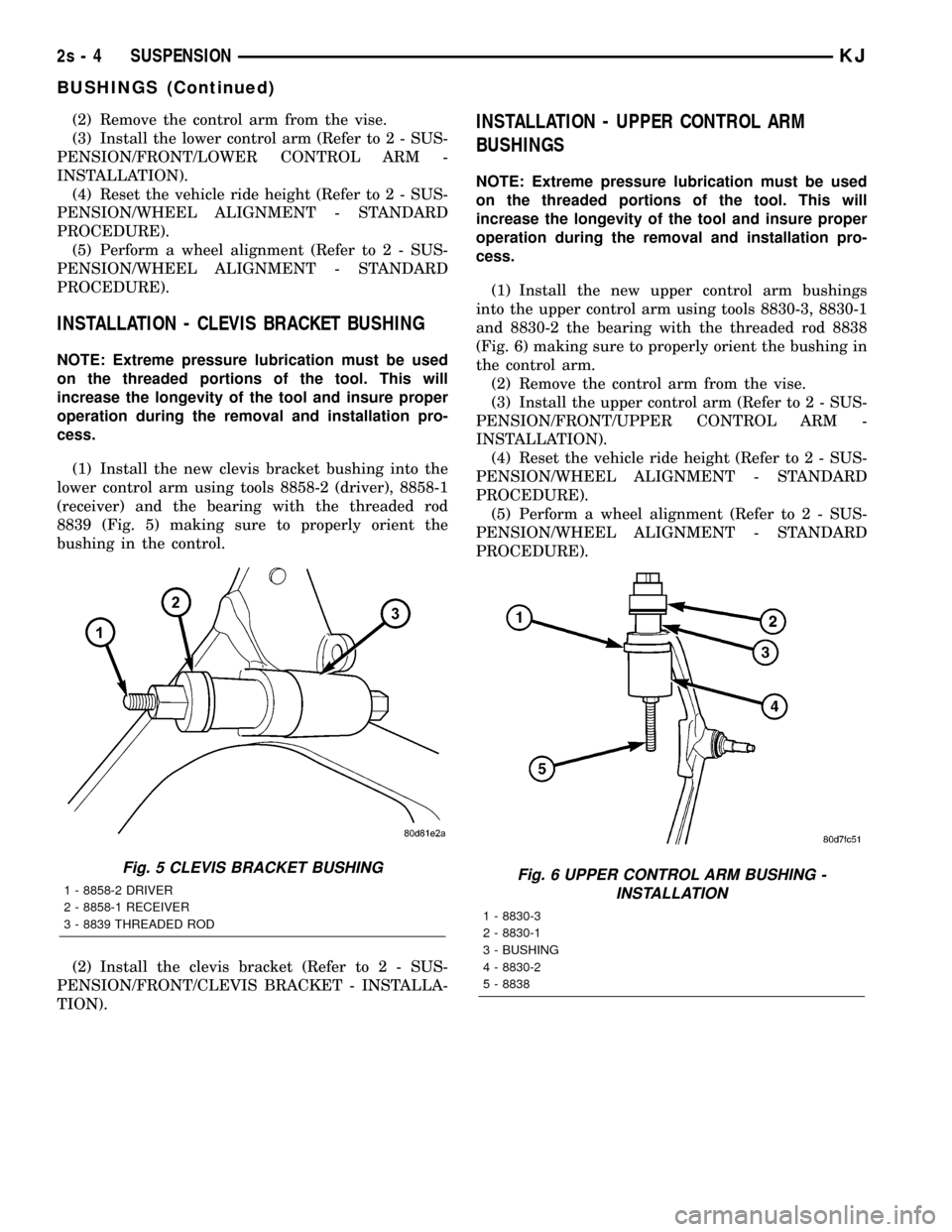
(1) Install the new clevis bracket bushing into the
lower control arm using tools 8858-2 (driver), 8858-1
(receiver) and the bearing with the threaded rod
8839 (Fig. 5) making sure to properly orient the
bushing in the control.
(2) Install the clevis bracket (Refer to 2 - SUS-
PENSION/FRONT/CLEVIS BRACKET - INSTALLA-
TION).
INSTALLATION - UPPER CONTROL ARM
BUSHINGS
NOTE: Extreme pressure lubrication must be used
on the threaded portions of the tool. This will
increase the longevity of the tool and insure proper
operation during the removal and installation pro-
cess.
(1) Install the new upper control arm bushings
into the upper control arm using tools 8830-3, 8830-1
and 8830-2 the bearing with the threaded rod 8838
(Fig. 6) making sure to properly orient the bushing in
the control arm.
(2) Remove the control arm from the vise.
(3) Install the upper control arm (Refer to 2 - SUS-
PENSION/FRONT/UPPER CONTROL ARM -
INSTALLATION).
(4) Reset the vehicle ride height (Refer to 2 - SUS-
PENSION/WHEEL ALIGNMENT - STANDARD
PROCEDURE).
(5) Perform a wheel alignment (Refer to 2 - SUS-
PENSION/WHEEL ALIGNMENT - STANDARD
PROCEDURE).
Fig. 5 CLEVIS BRACKET BUSHING
1 - 8858-2 DRIVER
2 - 8858-1 RECEIVER
3 - 8839 THREADED RODFig. 6 UPPER CONTROL ARM BUSHING -
INSTALLATION
1 - 8830-3
2 - 8830-1
3 - BUSHING
4 - 8830-2
5 - 8838
2s - 4 SUSPENSIONKJ
BUSHINGS (Continued)
Page 46 of 1803
LOWER BALL JOINT
REMOVAL
(1) Remove the tire and wheel assembly.
(2) Remove the brake caliper and rotor (Refer to 5
- BRAKES/HYDRAULIC/MECHANICAL/ROTORS -
REMOVAL).
(3) Disconnect the tie rod from the steering
knuckle (Refer to 19 - STEERING/LINKAGE/TIE
ROD END - REMOVAL).
(4) Remove the steering knuckle (Refer to 2 - SUS-
PENSION/FRONT/KNUCKLE - REMOVAL).
(5) Move the halfshaft to the side and support the
halfshaft out of the way (If Equipped).
NOTE: Extreme pressure lubrication must be used
on the threaded portions of the tool. This will
increase the longevity of the tool and insure proper
operation during the removal and installation pro-
cess.
(6) Secure the steering knuckle in a vise.
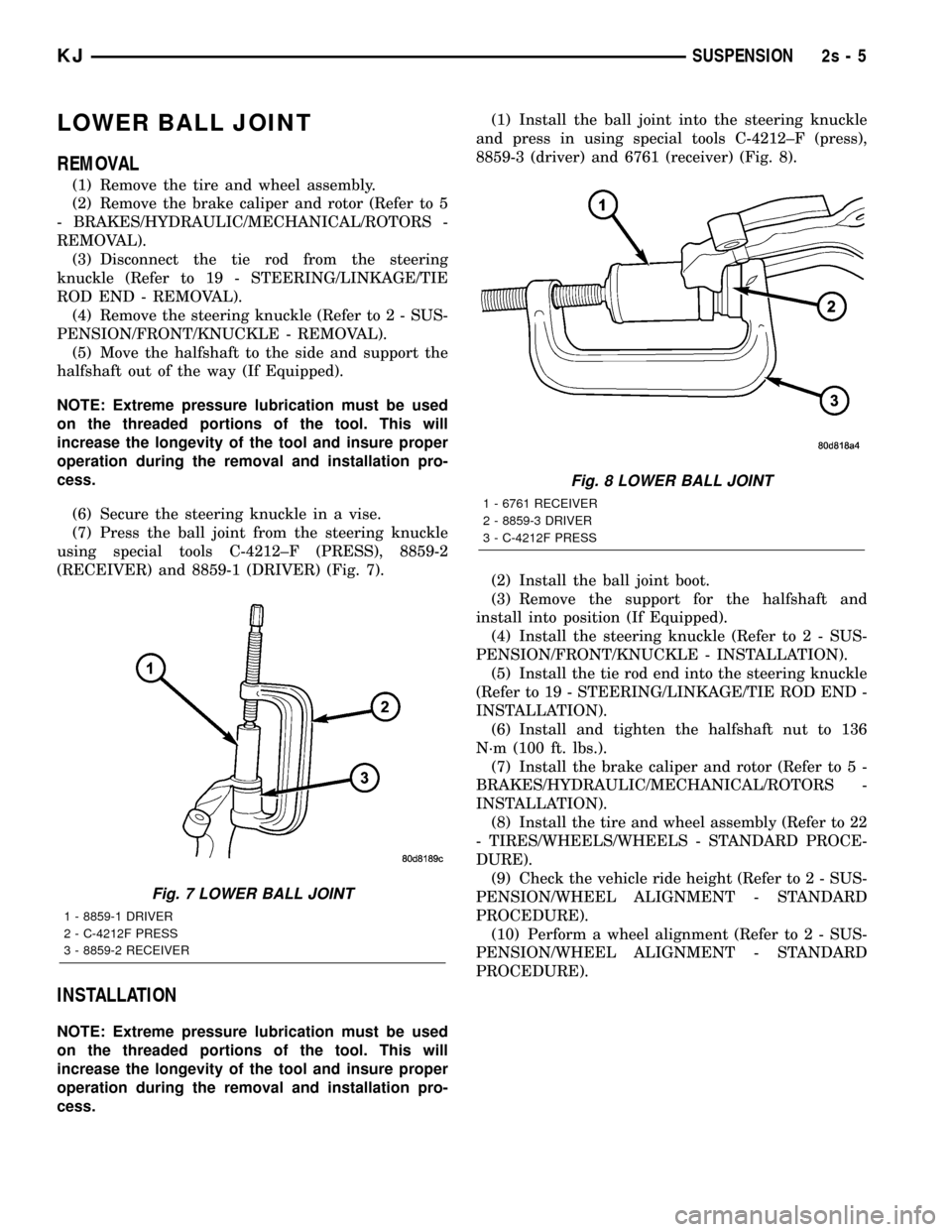
(7) Press the ball joint from the steering knuckle
using special tools C-4212±F (PRESS), 8859-2
(RECEIVER) and 8859-1 (DRIVER) (Fig. 7).
INSTALLATION
NOTE: Extreme pressure lubrication must be used
on the threaded portions of the tool. This will
increase the longevity of the tool and insure proper
operation during the removal and installation pro-
cess.(1) Install the ball joint into the steering knuckle
and press in using special tools C-4212±F (press),
8859-3 (driver) and 6761 (receiver) (Fig. 8).
(2) Install the ball joint boot.
(3) Remove the support for the halfshaft and
install into position (If Equipped).
(4) Install the steering knuckle (Refer to 2 - SUS-
PENSION/FRONT/KNUCKLE - INSTALLATION).
(5) Install the tie rod end into the steering knuckle
(Refer to 19 - STEERING/LINKAGE/TIE ROD END -
INSTALLATION).
(6) Install and tighten the halfshaft nut to 136
N´m (100 ft. lbs.).
(7) Install the brake caliper and rotor (Refer to 5 -
BRAKES/HYDRAULIC/MECHANICAL/ROTORS -
INSTALLATION).
(8) Install the tire and wheel assembly (Refer to 22
- TIRES/WHEELS/WHEELS - STANDARD PROCE-
DURE).
(9) Check the vehicle ride height (Refer to 2 - SUS-
PENSION/WHEEL ALIGNMENT - STANDARD
PROCEDURE).
(10) Perform a wheel alignment (Refer to 2 - SUS-
PENSION/WHEEL ALIGNMENT - STANDARD
PROCEDURE).
Fig. 7 LOWER BALL JOINT
1 - 8859-1 DRIVER
2 - C-4212F PRESS
3 - 8859-2 RECEIVER
Fig. 8 LOWER BALL JOINT
1 - 6761 RECEIVER
2 - 8859-3 DRIVER
3 - C-4212F PRESS
KJSUSPENSION 2s - 5
Page 59 of 1803
HALF SHAFT
TABLE OF CONTENTS
page page
HALF SHAFT
CAUTION.............................10
DIAGNOSIS AND TESTING - HALF SHAFT....10
REMOVAL.............................10
INSTALLATION.........................11
SPECIFICATIONS
HALF SHAFT.........................11SPECIAL TOOLS.......................12
CV JOINT/BOOT-OUTER
REMOVAL.............................12
INSTALLATION.........................13
CV JOINT/BOOT-INNER
REMOVAL.............................15
INSTALLATION.........................17
HALF SHAFT
CAUTION
CAUTION:: Never grasp half shaft assembly by the
boots. This may cause the boot to pucker or crease
and reduce the service life of the boot.
Avoid over angulating or stroking the C/V joints
when handling the half shaft.
Half shafts exposed to battery acid, transmission
fluid, brake fluid, differential fluid or gasoline may
cause the boots to deteriorate.
DIAGNOSIS AND TESTING - HALF SHAFT
Check for grease at the inboard and outboard C/V
joint. This is a sign of boot or boot clamp damage.
NOISE AND/OR VIBRATION IN TURNS
A clicking noise or a vibration in turns could be
caused by a damaged outer C/V or inner tripod joint
seal boot or seal boot clamps. This will result in the
loss/contamination of the joint grease, resulting in
inadequate lubrication of the joint. Noise could also
be caused by another component of the vehicle com-
ing in contact with the half shafts.
CLUNKING NOISE DURING ACCELERATION
This noise may be a result of a damaged or worn
C/V joint. A torn boot or loose/missing clamp on the
inner/outer joint which has allowed the grease to be
lost will damage the C/V joint.
SHUDDER OR VIBRATION DURING ACCELERATION
This problem could be a result of a worn/damaged
inner tripod joint or a sticking tripod joint. Improper
wheel alignment may also cause a shudder or vibration.
VIBRATION AT HIGHWAY SPEEDS
This problem could be a result of out of balance
front tires or tire/wheel runout. Foreign material
(mud, etc.) packed on the backside of the wheel(s)
will also cause a vibration.
REMOVAL
(1) Raise and support vehicle.
(2) Remove wheel and tire assembly.
(3) Remove half shaft hub nut.
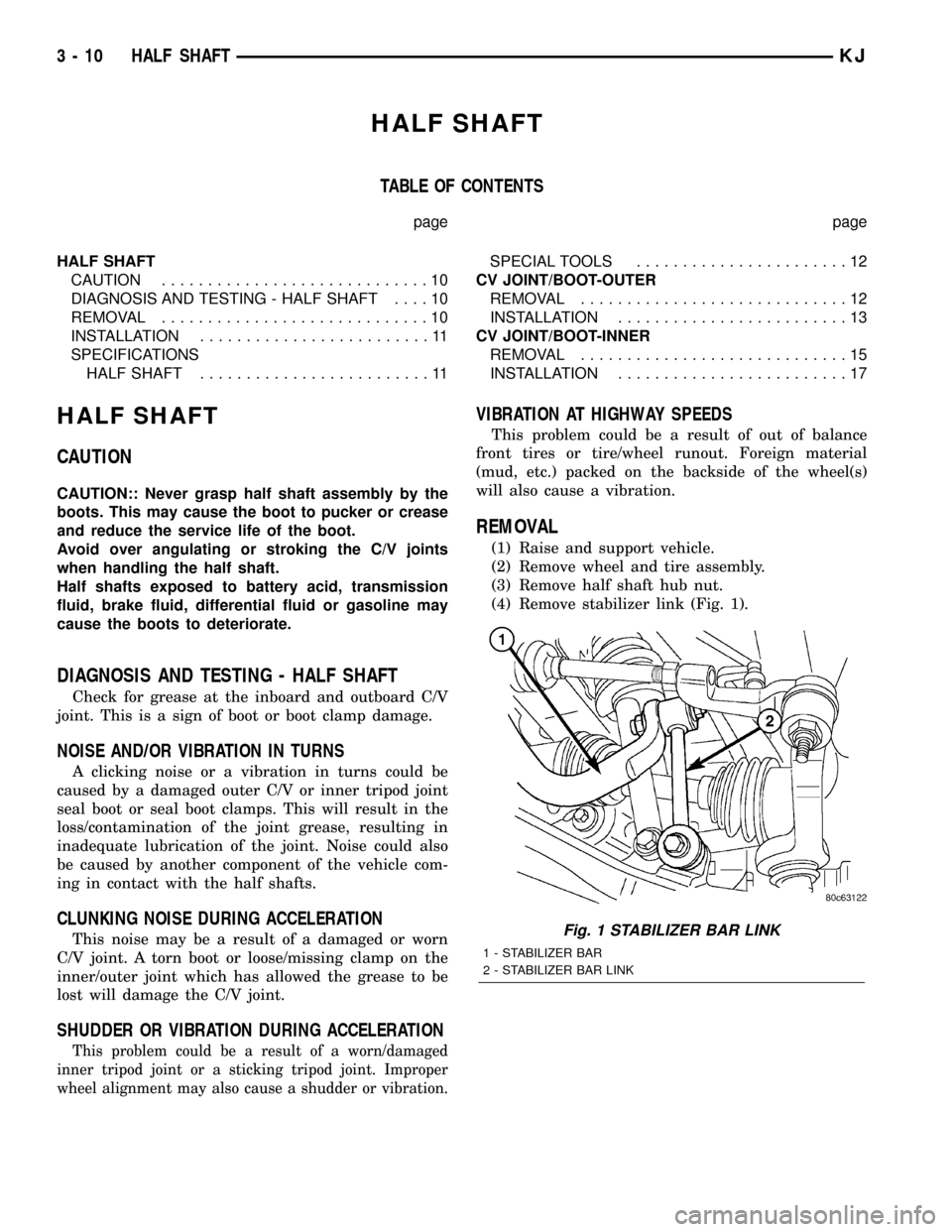
(4) Remove stabilizer link (Fig. 1).
Fig. 1 STABILIZER BAR LINK
1 - STABILIZER BAR
2 - STABILIZER BAR LINK
3 - 10 HALF SHAFTKJ
Page 61 of 1803
SPECIAL TOOLS
CV JOINT/BOOT-OUTER
REMOVAL
(1) Clamp shaft in a vise (with soft jaws) and sup-
port C/V joint.
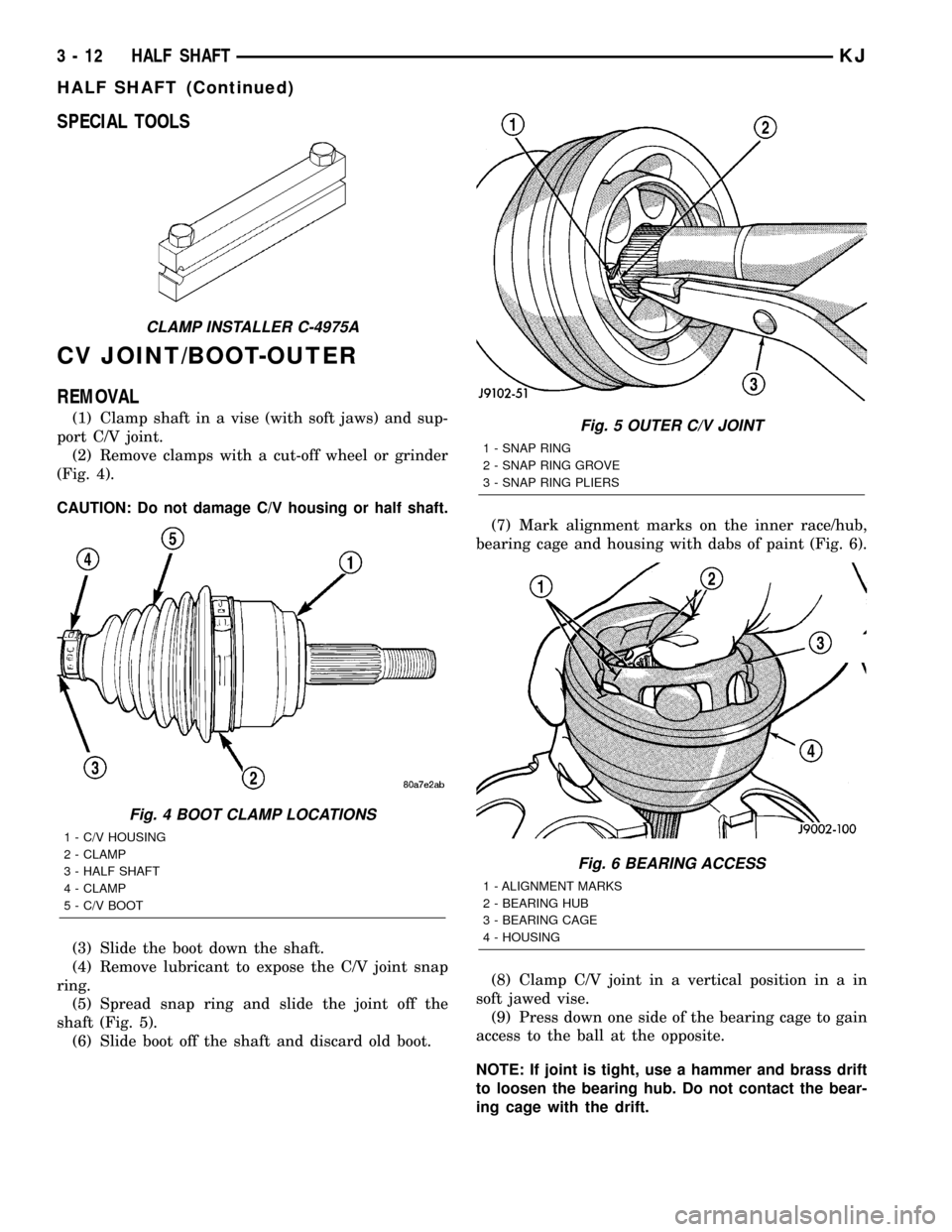
(2) Remove clamps with a cut-off wheel or grinder
(Fig. 4).
CAUTION: Do not damage C/V housing or half shaft.
(3) Slide the boot down the shaft.
(4) Remove lubricant to expose the C/V joint snap
ring.
(5) Spread snap ring and slide the joint off the
shaft (Fig. 5).
(6) Slide boot off the shaft and discard old boot.(7) Mark alignment marks on the inner race/hub,
bearing cage and housing with dabs of paint (Fig. 6).
(8) Clamp C/V joint in a vertical position in a in
soft jawed vise.
(9) Press down one side of the bearing cage to gain
access to the ball at the opposite.
NOTE: If joint is tight, use a hammer and brass drift
to loosen the bearing hub. Do not contact the bear-
ing cage with the drift.
CLAMP INSTALLER C-4975A
Fig. 4 BOOT CLAMP LOCATIONS
1 - C/V HOUSING
2 - CLAMP
3 - HALF SHAFT
4 - CLAMP
5 - C/V BOOT
Fig. 5 OUTER C/V JOINT
1 - SNAP RING
2 - SNAP RING GROVE
3 - SNAP RING PLIERS
Fig. 6 BEARING ACCESS
1 - ALIGNMENT MARKS
2 - BEARING HUB
3 - BEARING CAGE
4 - HOUSING
3 - 12 HALF SHAFTKJ
HALF SHAFT (Continued)
Page 62 of 1803
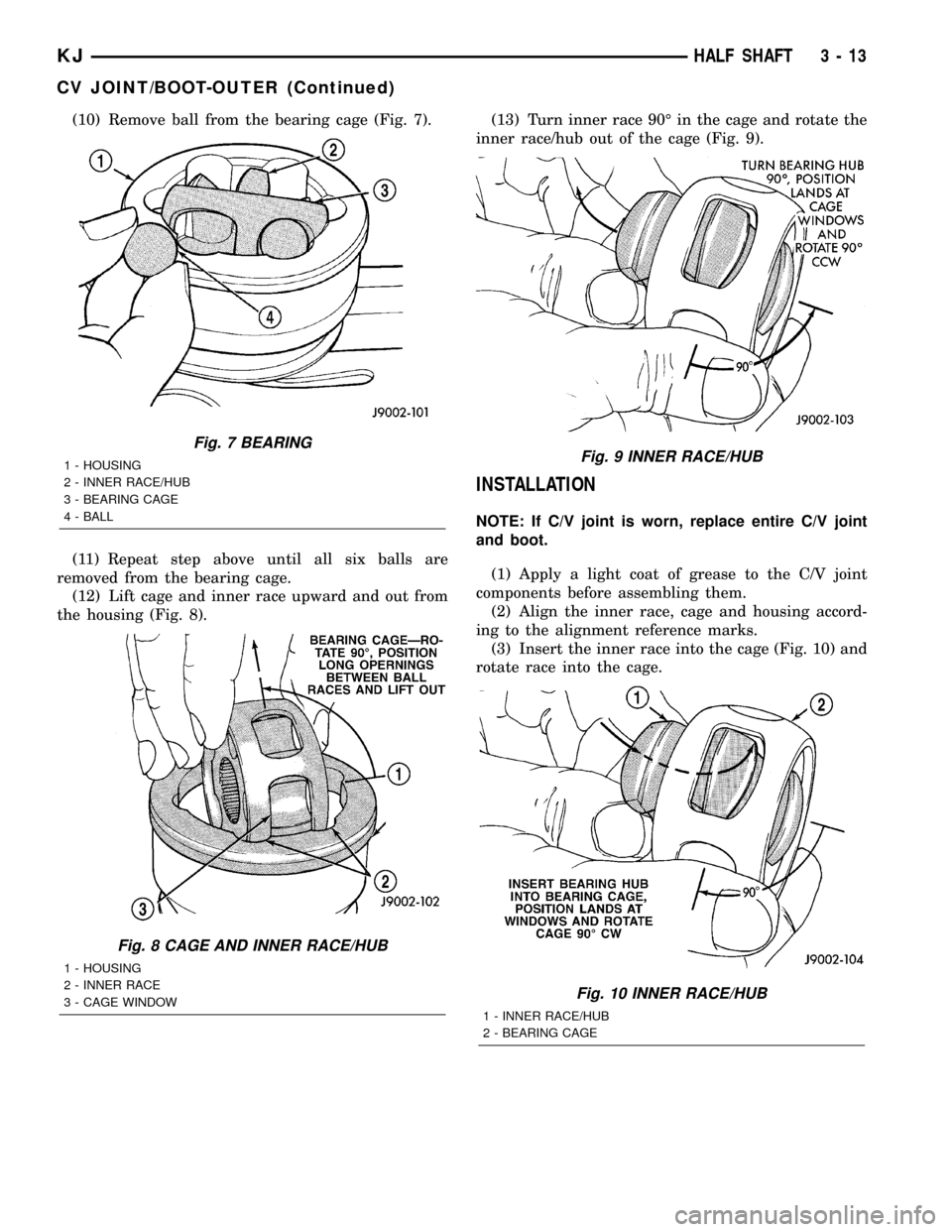
(10) Remove ball from the bearing cage (Fig. 7).
(11) Repeat step above until all six balls are
removed from the bearing cage.
(12) Lift cage and inner race upward and out from
the housing (Fig. 8).(13) Turn inner race 90É in the cage and rotate the
inner race/hub out of the cage (Fig. 9).
INSTALLATION
NOTE: If C/V joint is worn, replace entire C/V joint
and boot.
(1) Apply a light coat of grease to the C/V joint
components before assembling them.
(2) Align the inner race, cage and housing accord-
ing to the alignment reference marks.
(3) Insert the inner race into the cage (Fig. 10) and
rotate race into the cage.
Fig. 7 BEARING
1 - HOUSING
2 - INNER RACE/HUB
3 - BEARING CAGE
4 - BALL
Fig. 8 CAGE AND INNER RACE/HUB
1 - HOUSING
2 - INNER RACE
3 - CAGE WINDOW
Fig. 9 INNER RACE/HUB
Fig. 10 INNER RACE/HUB
1 - INNER RACE/HUB
2 - BEARING CAGE
KJHALF SHAFT 3 - 13
CV JOINT/BOOT-OUTER (Continued)
Page 70 of 1803
DRIVELINE SNAP
A snap or clunk noise when the vehicle is shifted
into gear (or the clutch engaged) can be caused by:
²High engine idle speed.
²Transmission shift operation.
²Loose engine/transmission/transfer case mounts.
²Worn U-joints.
²Loose spring mounts.
²Loose pinion gear nut and yoke.²Excessive ring gear backlash.
²Excessive side gear to case clearance.
The source of a snap or a clunk noise can be deter-
mined with the assistance of a helper. Raise the vehi-
cle on a hoist with the wheels free to rotate. Instruct
the helper to shift the transmission into gear. Listen
for the noise, a mechanics stethoscope is helpful in
isolating the source of a noise.
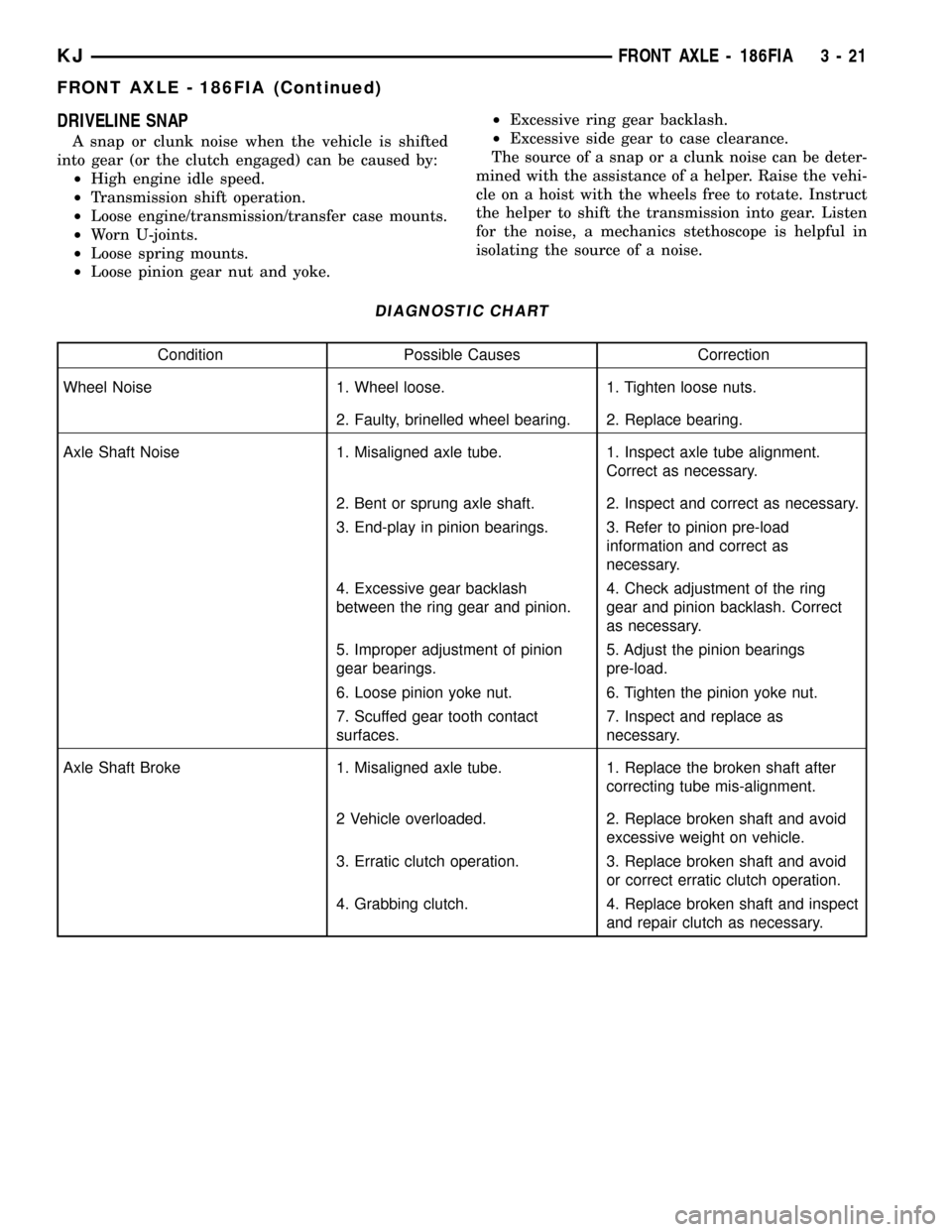
DIAGNOSTIC CHART
Condition Possible Causes Correction
Wheel Noise 1. Wheel loose. 1. Tighten loose nuts.
2. Faulty, brinelled wheel bearing. 2. Replace bearing.
Axle Shaft Noise 1. Misaligned axle tube. 1. Inspect axle tube alignment.
Correct as necessary.
2. Bent or sprung axle shaft. 2. Inspect and correct as necessary.
3. End-play in pinion bearings. 3. Refer to pinion pre-load
information and correct as
necessary.
4. Excessive gear backlash
between the ring gear and pinion.4. Check adjustment of the ring
gear and pinion backlash. Correct
as necessary.
5. Improper adjustment of pinion
gear bearings.5. Adjust the pinion bearings
pre-load.
6. Loose pinion yoke nut. 6. Tighten the pinion yoke nut.
7. Scuffed gear tooth contact
surfaces.7. Inspect and replace as
necessary.
Axle Shaft Broke 1. Misaligned axle tube. 1. Replace the broken shaft after
correcting tube mis-alignment.
2 Vehicle overloaded. 2. Replace broken shaft and avoid
excessive weight on vehicle.
3. Erratic clutch operation. 3. Replace broken shaft and avoid
or correct erratic clutch operation.
4. Grabbing clutch. 4. Replace broken shaft and inspect
and repair clutch as necessary.
KJFRONT AXLE - 186FIA 3 - 21
FRONT AXLE - 186FIA (Continued)
Page 74 of 1803
(8) Install lower control arms, refer to 2 Suspen-
sion for procedures.
(9) Install new half shaft hub nuts and tighten to
136 N´m (100 ft. lbs.).
(10) Install axle vent hose.
(11) Fill differential with gear lubricant.
(12) Install skid plate.
(13) Install wheel and tire assemblies.
(14) Remove support and lower vehicle.
(15) Check vehicle alignment.
ADJUSTMENTS
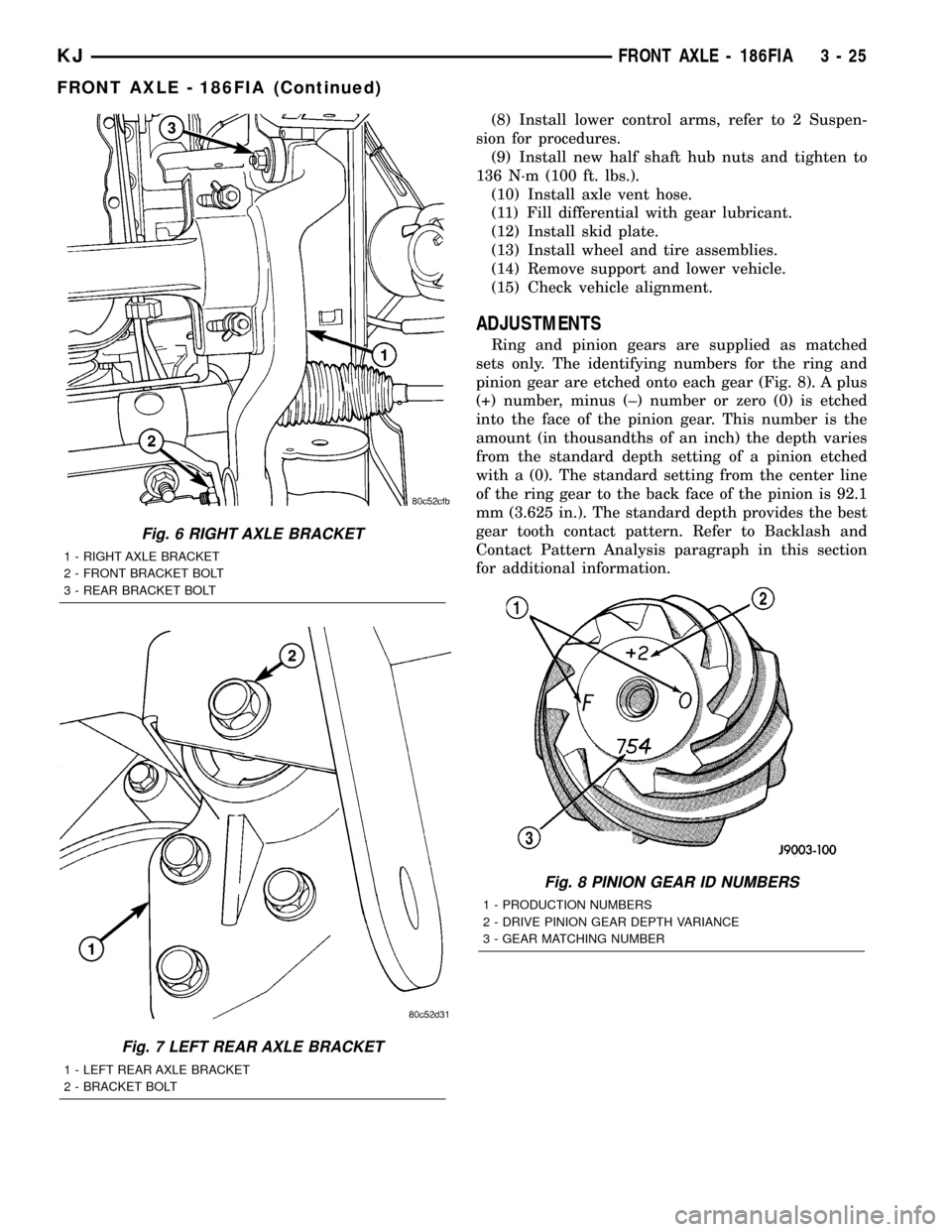
Ring and pinion gears are supplied as matched
sets only. The identifying numbers for the ring and
pinion gear are etched onto each gear (Fig. 8). A plus
(+) number, minus (±) number or zero (0) is etched
into the face of the pinion gear. This number is the
amount (in thousandths of an inch) the depth varies
from the standard depth setting of a pinion etched
with a (0). The standard setting from the center line
of the ring gear to the back face of the pinion is 92.1
mm (3.625 in.). The standard depth provides the best
gear tooth contact pattern. Refer to Backlash and
Contact Pattern Analysis paragraph in this section
for additional information.
Fig. 6 RIGHT AXLE BRACKET
1 - RIGHT AXLE BRACKET
2 - FRONT BRACKET BOLT
3 - REAR BRACKET BOLT
Fig. 7 LEFT REAR AXLE BRACKET
1 - LEFT REAR AXLE BRACKET
2 - BRACKET BOLT
Fig. 8 PINION GEAR ID NUMBERS
1 - PRODUCTION NUMBERS
2 - DRIVE PINION GEAR DEPTH VARIANCE
3 - GEAR MATCHING NUMBER
KJFRONT AXLE - 186FIA 3 - 25
FRONT AXLE - 186FIA (Continued)
Page 93 of 1803
INSTALLATION
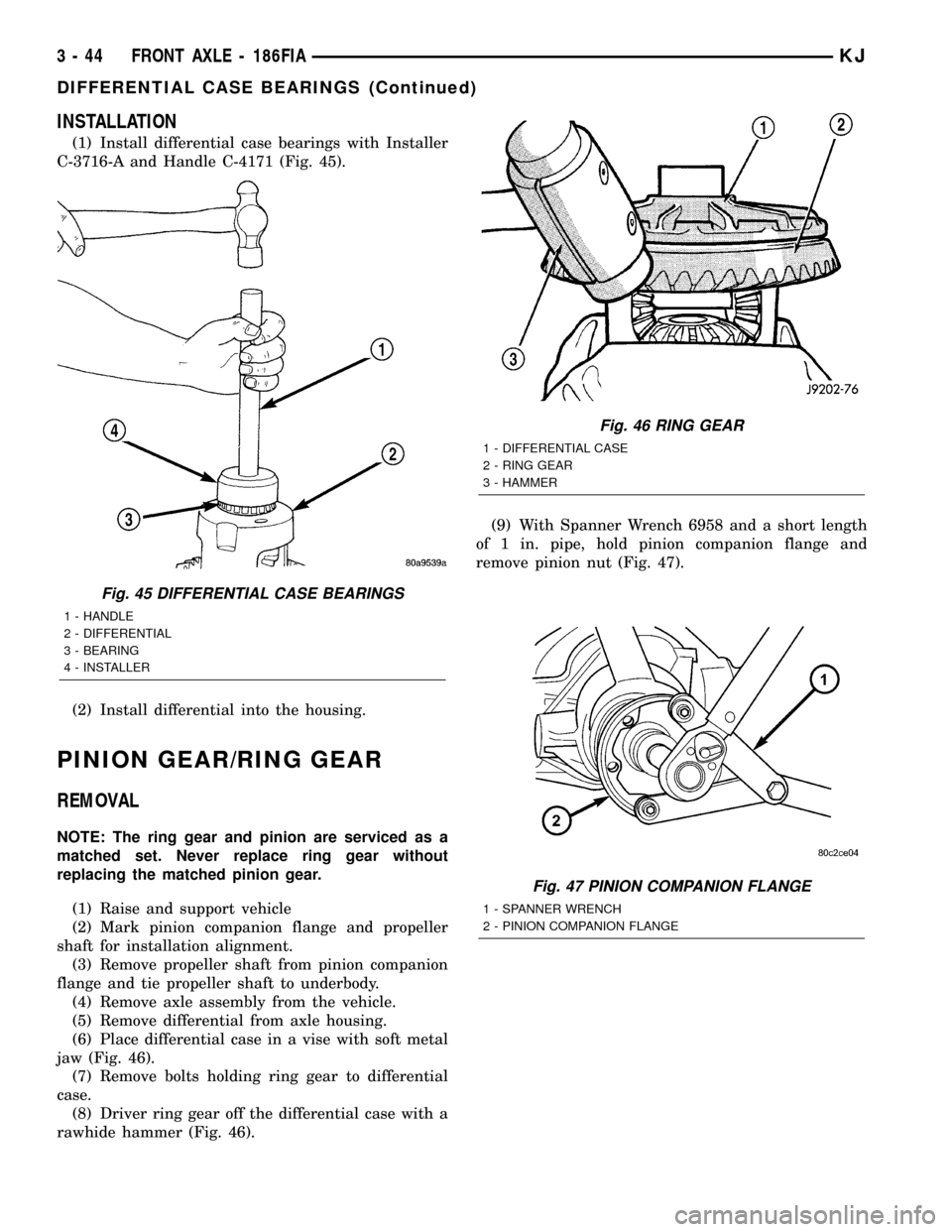
(1) Install differential case bearings with Installer
C-3716-A and Handle C-4171 (Fig. 45).
(2) Install differential into the housing.
PINION GEAR/RING GEAR
REMOVAL
NOTE: The ring gear and pinion are serviced as a
matched set. Never replace ring gear without
replacing the matched pinion gear.
(1) Raise and support vehicle
(2) Mark pinion companion flange and propeller
shaft for installation alignment.
(3) Remove propeller shaft from pinion companion
flange and tie propeller shaft to underbody.
(4) Remove axle assembly from the vehicle.
(5) Remove differential from axle housing.
(6) Place differential case in a vise with soft metal
jaw (Fig. 46).
(7) Remove bolts holding ring gear to differential
case.
(8) Driver ring gear off the differential case with a
rawhide hammer (Fig. 46).(9) With Spanner Wrench 6958 and a short length
of 1 in. pipe, hold pinion companion flange and
remove pinion nut (Fig. 47).
Fig. 45 DIFFERENTIAL CASE BEARINGS
1 - HANDLE
2 - DIFFERENTIAL
3 - BEARING
4 - INSTALLER
Fig. 46 RING GEAR
1 - DIFFERENTIAL CASE
2 - RING GEAR
3 - HAMMER
Fig. 47 PINION COMPANION FLANGE
1 - SPANNER WRENCH
2 - PINION COMPANION FLANGE
3 - 44 FRONT AXLE - 186FIAKJ
DIFFERENTIAL CASE BEARINGS (Continued)
Page 97 of 1803
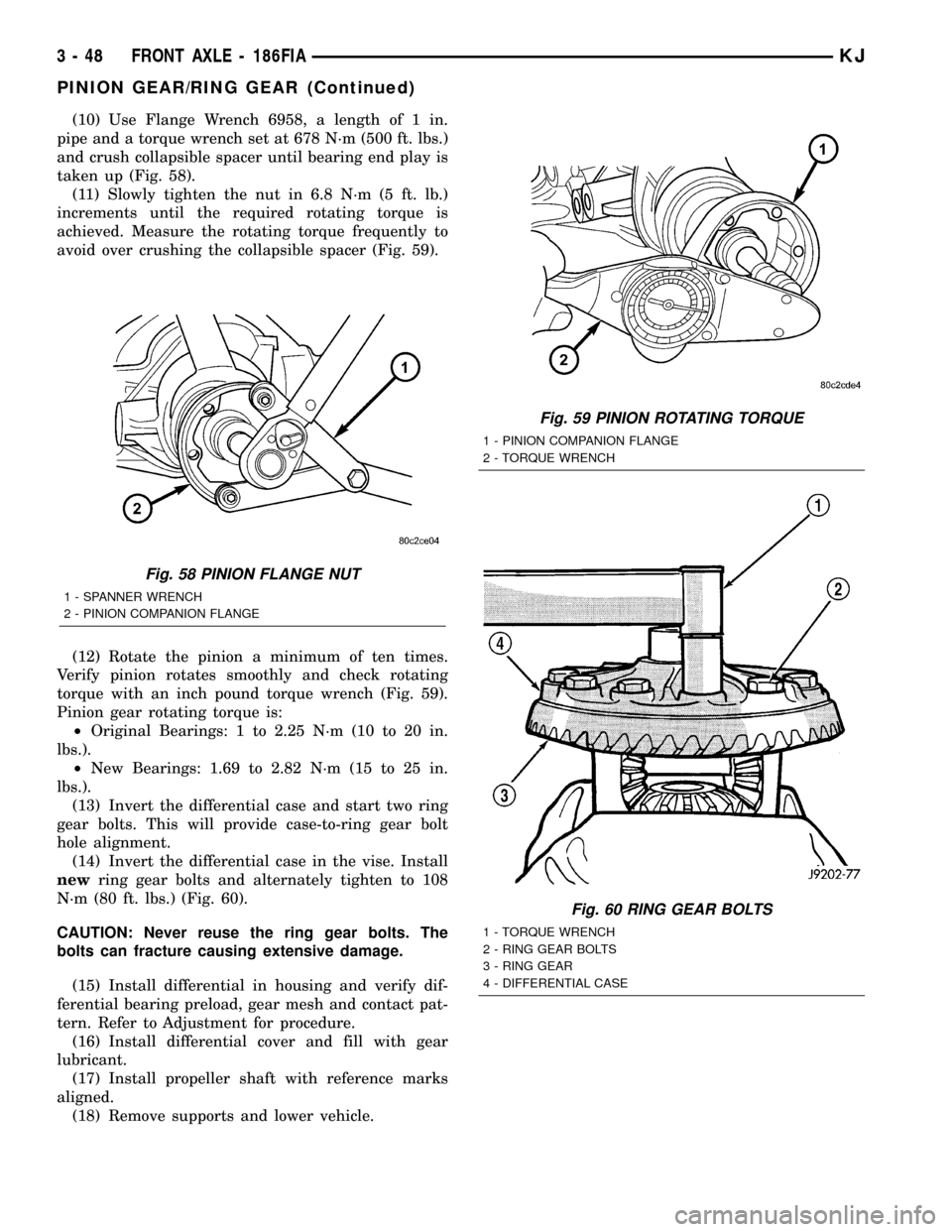
(10) Use Flange Wrench 6958, a length of 1 in.
pipe and a torque wrench set at 678 N´m (500 ft. lbs.)
and crush collapsible spacer until bearing end play is
taken up (Fig. 58).
(11) Slowly tighten the nut in 6.8 N´m (5 ft. lb.)
increments until the required rotating torque is
achieved. Measure the rotating torque frequently to
avoid over crushing the collapsible spacer (Fig. 59).
(12) Rotate the pinion a minimum of ten times.
Verify pinion rotates smoothly and check rotating
torque with an inch pound torque wrench (Fig. 59).
Pinion gear rotating torque is:
²Original Bearings: 1 to 2.25 N´m (10 to 20 in.
lbs.).
²New Bearings: 1.69 to 2.82 N´m (15 to 25 in.
lbs.).
(13) Invert the differential case and start two ring
gear bolts. This will provide case-to-ring gear bolt
hole alignment.
(14) Invert the differential case in the vise. Install
newring gear bolts and alternately tighten to 108
N´m (80 ft. lbs.) (Fig. 60).
CAUTION: Never reuse the ring gear bolts. The
bolts can fracture causing extensive damage.
(15) Install differential in housing and verify dif-
ferential bearing preload, gear mesh and contact pat-
tern. Refer to Adjustment for procedure.
(16) Install differential cover and fill with gear
lubricant.
(17) Install propeller shaft with reference marks
aligned.
(18) Remove supports and lower vehicle.
Fig. 58 PINION FLANGE NUT
1 - SPANNER WRENCH
2 - PINION COMPANION FLANGE
Fig. 59 PINION ROTATING TORQUE
1 - PINION COMPANION FLANGE
2 - TORQUE WRENCH
Fig. 60 RING GEAR BOLTS
1 - TORQUE WRENCH
2 - RING GEAR BOLTS
3 - RING GEAR
4 - DIFFERENTIAL CASE
3 - 48 FRONT AXLE - 186FIAKJ
PINION GEAR/RING GEAR (Continued)
Page 101 of 1803
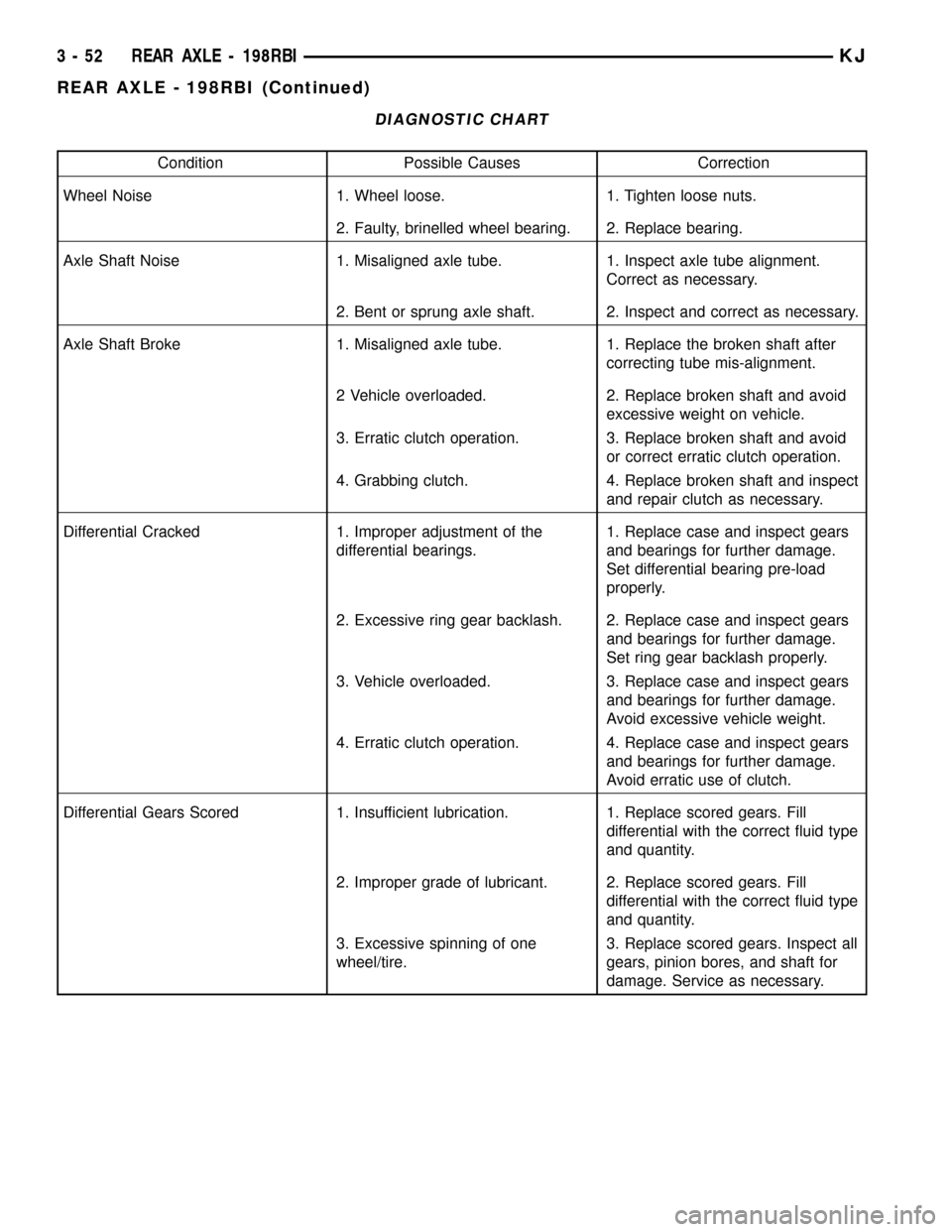
DIAGNOSTIC CHART
Condition Possible Causes Correction
Wheel Noise 1. Wheel loose. 1. Tighten loose nuts.
2. Faulty, brinelled wheel bearing. 2. Replace bearing.
Axle Shaft Noise 1. Misaligned axle tube. 1. Inspect axle tube alignment.
Correct as necessary.
2. Bent or sprung axle shaft. 2. Inspect and correct as necessary.
Axle Shaft Broke 1. Misaligned axle tube. 1. Replace the broken shaft after
correcting tube mis-alignment.
2 Vehicle overloaded. 2. Replace broken shaft and avoid
excessive weight on vehicle.
3. Erratic clutch operation. 3. Replace broken shaft and avoid
or correct erratic clutch operation.
4. Grabbing clutch. 4. Replace broken shaft and inspect
and repair clutch as necessary.
Differential Cracked 1. Improper adjustment of the
differential bearings.1. Replace case and inspect gears
and bearings for further damage.
Set differential bearing pre-load
properly.
2. Excessive ring gear backlash. 2. Replace case and inspect gears
and bearings for further damage.
Set ring gear backlash properly.
3. Vehicle overloaded. 3. Replace case and inspect gears
and bearings for further damage.
Avoid excessive vehicle weight.
4. Erratic clutch operation. 4. Replace case and inspect gears
and bearings for further damage.
Avoid erratic use of clutch.
Differential Gears Scored 1. Insufficient lubrication. 1. Replace scored gears. Fill
differential with the correct fluid type
and quantity.
2. Improper grade of lubricant. 2. Replace scored gears. Fill
differential with the correct fluid type
and quantity.
3. Excessive spinning of one
wheel/tire.3. Replace scored gears. Inspect all
gears, pinion bores, and shaft for
damage. Service as necessary.
3 - 52 REAR AXLE - 198RBIKJ
REAR AXLE - 198RBI (Continued)