alignment JEEP LIBERTY 2002 KJ / 1.G Owner's Guide
[x] Cancel search | Manufacturer: JEEP, Model Year: 2002, Model line: LIBERTY, Model: JEEP LIBERTY 2002 KJ / 1.GPages: 1803, PDF Size: 62.3 MB
Page 231 of 1803

SERPENTINE DRIVE BELT DIAGNOSIS CHART
CONDITION POSSIBLE CAUSES CORRECTION
RIB CHUNKING (ONE OR MORE
RIBS HAS SEPARATED FROM
BELT BODY)1. Foreign objects imbedded in pulley
grooves.1. Remove foreign objects from
pulley grooves. Replace belt.
2. Installation damage. 2. Replace belt.
RIB OR BELT WEAR 1. Pulley(s) misaligned. 1. Align pulley(s).
2. Abrasive environment. 2. Clean pulley(s). Replace belt if
necessary.
3. Rusted pulley(s). 3. Clean rust from pulley(s).
4. Sharp or jagged pulley groove tips. 4. Replace pulley.
5. Rubber deteriorated. 5. Replace belt.
LONGITUDINAL BELT
CRACKING (CRACKS BETWEEN
TWO RIBS)1. Belt has mistracked from pulley
groove.1. Replace belt.
2. Pulley groove tip has worn away
rubber to tensile member.2. Replace belt.
BELT SLIPS 1. Belt slipping because of insufficient
tension.1. Replace automatic belt tensioner.
2. Belt routed 2. Verify belt routing.
incorrectly
3. Incorrect belt. 3. Replace belt.
4. Belt or pulley subjected to
substance (belt dressing, oil ethylene
glycol) that has reduced friction.4. Replace belt and clean pulleys.
5. Driven component bearing failure. 5. Replace faulty component
bearing.
6. Belt glazed and hardened from
heat and excessive slippage.6. Replace belt.
ªGROOVE JUMPING9(BELT
DOES NOT MAINTAIN CORRECT
POSITION ON PULLEY)1. Belt tension either too high or too
low.1. Replace automatic belt tensioner.
2. Belt routed 2. Verify belt routing.
incorrectly.
3. Incorrect belt. 3. Replace belt.
4. Pulley(s) not within design
tolerance.4. Replace pulley(s).
5. Foreign object(s) in grooves. 5. Remove foreign objects from
grooves.
6. Pulley misalignment. 6. Check and replace.
7. Belt cord line is broken. 7. Replace belt.
7 - 16 ACCESSORY DRIVEKJ
ACCESSORY DRIVE (Continued)
Page 232 of 1803
CONDITION POSSIBLE CAUSES CORRECTION
BELT BROKEN (NOTE: IDENTIFY
AND CORRECT PROBLEM
BEFORE NEW BELT IS
INSTALLED)1. Excessive tension. 1. Replace belt and automatic belt
tensioner.
2. Incorrect belt. 2. Replace belt.
3. Tensile member damaged during
belt installation.3. Replace belt.
4. Severe misalignment. 4. Check and replace.
5. Bracket, pulley, or bearing failure. 5. Replace defective component
and belt.
NOISE (OBJECTIONABLE
SQUEAL, SQUEAK, OR RUMBLE
IS HEARD OR FELT WHILE
DRIVE BELT IS IN OPERATION)1. Belt slippage. 1. Replace belt or automatic belt
tensioner.
2. Bearing noise. 2. Locate and repair.
3. Belt misalignment. 3. Replace belt.
4. Belt-to-pulley mismatch. 4. Install correct belt.
BELT TENSIONERS
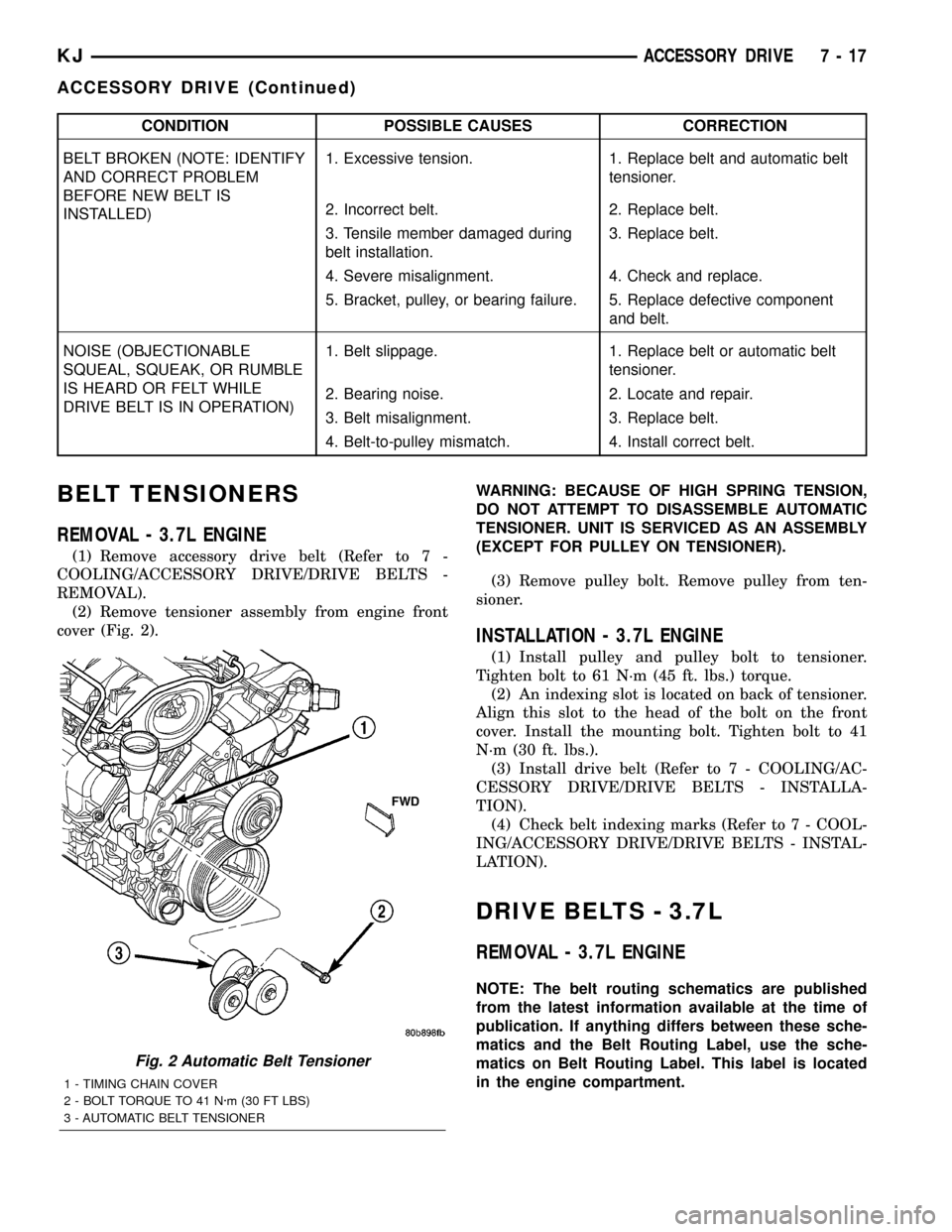
REMOVAL - 3.7L ENGINE
(1) Remove accessory drive belt (Refer to 7 -
COOLING/ACCESSORY DRIVE/DRIVE BELTS -
REMOVAL).
(2) Remove tensioner assembly from engine front
cover (Fig. 2).WARNING: BECAUSE OF HIGH SPRING TENSION,
DO NOT ATTEMPT TO DISASSEMBLE AUTOMATIC
TENSIONER. UNIT IS SERVICED AS AN ASSEMBLY
(EXCEPT FOR PULLEY ON TENSIONER).
(3) Remove pulley bolt. Remove pulley from ten-
sioner.
INSTALLATION - 3.7L ENGINE
(1) Install pulley and pulley bolt to tensioner.
Tighten bolt to 61 N´m (45 ft. lbs.) torque.
(2) An indexing slot is located on back of tensioner.
Align this slot to the head of the bolt on the front
cover. Install the mounting bolt. Tighten bolt to 41
N´m (30 ft. lbs.).
(3) Install drive belt (Refer to 7 - COOLING/AC-
CESSORY DRIVE/DRIVE BELTS - INSTALLA-
TION).
(4) Check belt indexing marks (Refer to 7 - COOL-
ING/ACCESSORY DRIVE/DRIVE BELTS - INSTAL-
LATION).
DRIVE BELTS - 3.7L
REMOVAL - 3.7L ENGINE
NOTE: The belt routing schematics are published
from the latest information available at the time of
publication. If anything differs between these sche-
matics and the Belt Routing Label, use the sche-
matics on Belt Routing Label. This label is located
in the engine compartment.
Fig. 2 Automatic Belt Tensioner
1 - TIMING CHAIN COVER
2 - BOLT TORQUE TO 41 N´m (30 FT LBS)
3 - AUTOMATIC BELT TENSIONER
KJACCESSORY DRIVE 7 - 17
ACCESSORY DRIVE (Continued)
Page 239 of 1803

(3) Remove the front grill (Refer to 23 - BODY/EX-
TERIOR/GRILLE - REMOVAL).
(4) Remove the cooling fan from the engine, if
equipped.
(5) Remove the two radiator mounting bolts.
(6) Disconnect both transmission cooler lines from
radiator.
(7) Disconnect the connector for the electric fan.
(8) Disconnect the power steering cooler line from
cooler.
(9) Disconnect the radiator upper and lower hoses.
(10) Disconnect the overflow hose from radiator.
(11) The lower part of radiator is equipped with
two alignment dowel pins (Fig. 9). They are located
on the bottom of radiator tank and fit into rubber
grommets. These rubber grommets are pressed into
the radiator lower crossmember.
WARNING: THE AIR CONDITIONING SYSTEM (IF
EQUIPPED) IS UNDER A CONSTANT PRESSURE
EVEN WITH THE ENGINE OFF. REFER TO REFRIG-
ERANT WARNINGS IN, HEATING AND AIR CONDI-
TIONING BEFORE HANDLING ANY AIR
CONDITIONING COMPONENT.
NOTE: The radiator and radiator cooling fan can be
removed as an assembly. It is not necessary toremove the cooling fan before removing or install-
ing the radiator.
(12) Gently lift up and remove radiator from vehi-
cle. Be careful not to scrape the radiator fins against
any other component. Also be careful not to disturb
the air conditioning condenser (if equipped).
CLEANING
Clean radiator fins With the engine cold, apply cold
water and compressed air to the back (engine side) of
the radiator to flush the radiator and/or A/C con-
denser of debris.
INSPECTION
The radiator cooling fins should be checked for
damage or deterioration. Inspect cooling fins to make
sure they are not bent or crushed, these areas result
in reduced heat exchange causing the cooling system
to operate at higher temperatures. Inspect the plastic
end tanks for cracks, damage or leaks.
Inspect the radiator neck for damage or distortion.
INSTALLATION
CAUTION: Before installing the radiator or A/C con-
denser, be sure the radiator-to-body and radiator-to-
A/C condenser rubber air seals are properly
fastened to their original positions. These are used
at the top, bottom and sides of the radiator and A/C
condenser. To prevent overheating, these seals
must be installed to their original positions.
(1) Gently lower the radiator and fan shroud into
the vehicle. Guide the two radiator alignment dowels
into the rubber grommets located in lower radiator
crossmember.
(2) Connect the radiator upper and lower hoses
and hose clamps to radiator.
CAUTION: The tangs on the hose clamps must be
positioned straight down.
(3) Install coolant reserve/overflow tank hose at
radiator.
(4) Connect both transmission cooler lines at the
radiator.
(5) Install both radiator mounting bolts.
(6) Reconnect the electric cooling fan.
(7) Install the grill (Refer to 23 - BODY/EXTERI-
OR/GRILLE - INSTALLATION).
(8) Reinstall the cooling fan to the engine.
(9) Rotate the fan blades (by hand) and check for
interference at fan shroud.
(10) Refill cooling system (Refer to 7 - COOLING -
STANDARD PROCEDURE).
(11) Connect battery cable at battery.
(12) Start and warm engine. Check for leaks.
Fig. 9 Radiator Alignment Dowels - Typical
1 - RADIATOR
2 - ALIGNMENT DOWEL
3 - RADIATOR LOWER ISOLATOR
4 - RADIATOR LOWER CROSSMEMBER
7 - 24 ENGINEKJ
RADIATOR (Continued)
Page 263 of 1803
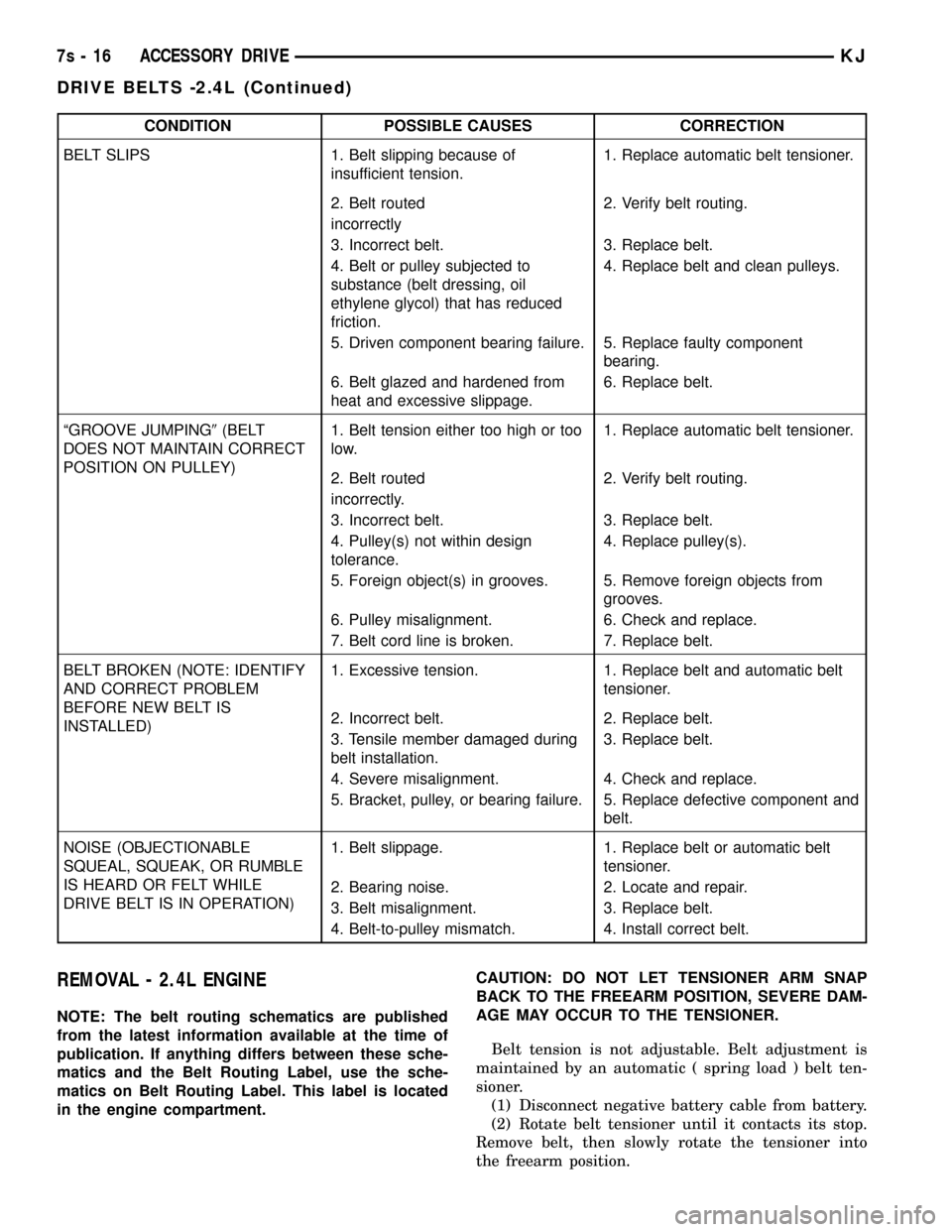
CONDITION POSSIBLE CAUSES CORRECTION
BELT SLIPS 1. Belt slipping because of
insufficient tension.1. Replace automatic belt tensioner.
2. Belt routed 2. Verify belt routing.
incorrectly
3. Incorrect belt. 3. Replace belt.
4. Belt or pulley subjected to
substance (belt dressing, oil
ethylene glycol) that has reduced
friction.4. Replace belt and clean pulleys.
5. Driven component bearing failure. 5. Replace faulty component
bearing.
6. Belt glazed and hardened from
heat and excessive slippage.6. Replace belt.
ªGROOVE JUMPING9(BELT
DOES NOT MAINTAIN CORRECT
POSITION ON PULLEY)1. Belt tension either too high or too
low.1. Replace automatic belt tensioner.
2. Belt routed 2. Verify belt routing.
incorrectly.
3. Incorrect belt. 3. Replace belt.
4. Pulley(s) not within design
tolerance.4. Replace pulley(s).
5. Foreign object(s) in grooves. 5. Remove foreign objects from
grooves.
6. Pulley misalignment. 6. Check and replace.
7. Belt cord line is broken. 7. Replace belt.
BELT BROKEN (NOTE: IDENTIFY
AND CORRECT PROBLEM
BEFORE NEW BELT IS
INSTALLED)1. Excessive tension. 1. Replace belt and automatic belt
tensioner.
2. Incorrect belt. 2. Replace belt.
3. Tensile member damaged during
belt installation.3. Replace belt.
4. Severe misalignment. 4. Check and replace.
5. Bracket, pulley, or bearing failure. 5. Replace defective component and
belt.
NOISE (OBJECTIONABLE
SQUEAL, SQUEAK, OR RUMBLE
IS HEARD OR FELT WHILE
DRIVE BELT IS IN OPERATION)1. Belt slippage. 1. Replace belt or automatic belt
tensioner.
2. Bearing noise. 2. Locate and repair.
3. Belt misalignment. 3. Replace belt.
4. Belt-to-pulley mismatch. 4. Install correct belt.
REMOVAL - 2.4L ENGINE
NOTE: The belt routing schematics are published
from the latest information available at the time of
publication. If anything differs between these sche-
matics and the Belt Routing Label, use the sche-
matics on Belt Routing Label. This label is located
in the engine compartment.CAUTION: DO NOT LET TENSIONER ARM SNAP
BACK TO THE FREEARM POSITION, SEVERE DAM-
AGE MAY OCCUR TO THE TENSIONER.
Belt tension is not adjustable. Belt adjustment is
maintained by an automatic ( spring load ) belt ten-
sioner.
(1) Disconnect negative battery cable from battery.
(2) Rotate belt tensioner until it contacts its stop.
Remove belt, then slowly rotate the tensioner into
the freearm position.
7s - 16 ACCESSORY DRIVEKJ
DRIVE BELTS -2.4L (Continued)
Page 271 of 1803

(8) Disconnect the power steering cooler line from
cooler.
(9) Disconnect the radiator upper and lower hoses.
(10) Disconnect the overflow hose from radiator.
(11) The lower part of radiator is equipped with
two alignment dowel pins (Fig. 8). They are located
on the bottom of radiator tank and fit into rubber
grommets. These rubber grommets are pressed into
the radiator lower crossmember.
WARNING: THE AIR CONDITIONING SYSTEM (IF
EQUIPPED) IS UNDER A CONSTANT PRESSURE
EVEN WITH THE ENGINE OFF. REFER TO REFRIG-
ERANT WARNINGS IN, HEATING AND AIR CONDI-
TIONING BEFORE HANDLING ANY AIR
CONDITIONING COMPONENT.
NOTE: The radiator and radiator cooling fan can be
removed as an assembly. It is not necessary to
remove the cooling fan before removing or install-
ing the radiator.
(12) Gently lift up and remove radiator from vehi-
cle. Be careful not to scrape the radiator fins against
any other component. Also be careful not to disturb
the air conditioning condenser (if equipped).CLEANING
Clean radiator fins With the engine cold, apply cold
water and compressed air to the back (engine side) of
the radiator to flush the radiator and/or A/C con-
denser of debris.
INSPECTION
The radiator cooling fins should be checked for
damage or deterioration. Inspect cooling fins to make
sure they are not bent or crushed, these areas result
in reduced heat exchange causing the cooling system
to operate at higher temperatures. Inspect the plastic
end tanks for cracks, damage or leaks.
Inspect the radiator neck for damage or distortion.
INSTALLATION
CAUTION: Before installing the radiator or A/C con-
denser, be sure the radiator-to-body and radiator-to-
A/C condenser rubber air seals are properly
fastened to their original positions. These are used
at the top, bottom and sides of the radiator and A/C
condenser. To prevent overheating, these seals
must be installed to their original positions.
(1) Gently lower the radiator and fan shroud into
the vehicle. Guide the two radiator alignment dowels
into the rubber grommets located in lower radiator
crossmember.
(2) Connect the radiator upper and lower hoses
and hose clamps to radiator.
CAUTION: The tangs on the hose clamps must be
positioned straight down.
(3) Install coolant reserve/overflow tank hose at
radiator.
(4) Connect both transmission cooler lines at the
radiator.
(5) Install both radiator mounting bolts.
(6) Reconnect the electric cooling fan.
(7) Install the grill (Refer to 23 - BODY/EXTERI-
OR/GRILLE - INSTALLATION).
(8) Reinstall the cooling fan to the engine.
(9) Rotate the fan blades (by hand) and check for
interference at fan shroud.
(10) Refill cooling system (Refer to 7 - COOLING -
STANDARD PROCEDURE).
(11) Connect battery cable at battery.
(12) Start and warm engine. Check for leaks.
Fig. 8 Radiator Alignment Dowels - Typical
1 - RADIATOR
2 - ALIGNMENT DOWEL
3 - RADIATOR LOWER ISOLATOR
4 - RADIATOR LOWER CROSSMEMBER
7s - 24 ENGINEKJ
RADIATOR (Continued)
Page 466 of 1803

FRONT FOG LAMP UNIT
REMOVAL
(1) Turn the front wheels full lock in the direction
of the fog lamp bulb that is to be changed.
(2) Disconnect and isolate the battery negative
cable.
(3) Reach into the front wheel opening to unsnap
and lift the cover over the access hole at the front of
the front wheelhouse splash shield (Fig. 14).
(4) Reach through the access hole to remove the
three screws that secure the front fog lamp unit to
the front bumper fascia.
(5) From the front of the vehicle, pull the front fog
lamp unit out of the front bumper fascia far enough
to access and disconnect the wire harness connector
for the front fog lamp unit from the lamp socket con-
nector receptacle (Fig. 15).
(6) Remove the front fog lamp unit from the front
bumper fascia.
INSTALLATION
(1) Position the front fog lamp unit to the front
bumper fascia.
(2) Reconnect the wire harness connector for the
front fog lamp to the lamp socket connector recepta-
cle (Fig. 15).
(3) Position the front fog lamp unit into the front
bumper fascia.
(4) Reach into the front wheel opening and
through the access hole to install and tighten the
three screws that secure the front fog lamp unithousing to the front bumper fascia (Fig. 14). Tighten
the screws to 3 N´m (25 in. lbs.).
(5) Lower and snap shut the cover over the access
hole at the front of the front wheelhouse splash
shield.
(6) Reconnect the battery negative cable.
(7) Confirm proper front fog lamp unit alignment.
(Refer to 8 - ELECTRICAL/LAMPS/LIGHTING -
EXTERIOR/FRONT FOG LAMP UNIT - ADJUST-
MENTS).
ADJUSTMENTS
ADJUSTMENT - FRONT FOG LAMP UNIT
VEHICLE PREPARATION FOR FOG LAMP ALIGNMENT
(1) Repair or replace any faulty or damaged com-
ponents that could hinder proper lamp alignment.
(2) Verify proper tire inflation.
(3) Clean the front fog lamp lenses.
(4) Verify that the cargo area is not heavily loaded.
(5) The fuel tank should be Full. Add 2.94 kilo-
grams (6.5 pounds) of weight over the fuel tank for
each estimated gallon of missing fuel.
FOG LAMP ALIGNMENT
Prepare an alignment screen as illustrated. A prop-
erly aligned front fog lamp will project a pattern on
the alignment screen 100 millimeters (4 inches)
below the fog lamp centerline and straight ahead of
the lamp.
Fig. 14 Front Fog Lamp Unit Remove/Install
1 - FRONT FOG LAMP UNIT
2 - SCREW (3)
3 - FRONT WHEELHOUSE SPLASH SHIELD
4 - FRONT BUMPER FASCIA
5 - ACCESS HOLE
Fig. 15 Front Fog Lamp Unit
1 - ADJUSTING SCREW
2 - MOUNTING BRACKET
3 - HOUSING
4 - SOCKET & BULB
5 - LENS
KJLAMPS/LIGHTING - EXTERIOR 8L - 25
Page 467 of 1803

(1) Position the vehicle on a level surface perpen-
dicular to a flat wall 7.62 meters (25 feet) away from
the front of the front fog lamp lens (Fig. 16). If nec-
essary, tape a line on the floor 7.62 meters (25 feet)
away from and parallel to the wall.
(2) Measure up on the wall 1.27 meters (5 feet)
from the floor and tape a vertical line on the align-
ment screen at the centerline of the vehicle. Sight
along the centerline of the vehicle (from the rear of
the vehicle forward) to verify the accuracy of the cen-
terline placement.
(3) Rock the vehicle from side-to-side three times
to allow the suspension to stabilize, then jounce the
front suspension three times by pushing downward
on the front bumper and releasing. Measure the dis-
tance from the center of the front fog lamp lens to
the floor. Transfer this measurement to the align-
ment screen and tape a horizontal line on the wall at
this mark. This line will be used for up-and-down
adjustment reference.
(4) Measure the distance from the centerline of the
vehicle to the center of each front fog lamp beingaligned. Transfer these measurements to the align-
ment screen and tape a vertical line this distance to
each side of the vehicle centerline. These lines will be
used for left/right reference.
(5) Rotate the front fog lamp adjusting screws to
adjust the beam height as required (Fig. 17).
FRONT LAMP BULB
REMOVAL
The front lamp unit may contain either one or two
bulbs, depending upon the market for which the
vehicle was manufactured. The service procedures for
one bulb or for both bulbs is the same, only the bulb
sizes and types may differ. Be certain any removed
bulb is replaced with the same bulb size and type
that was removed.
(1) Disconnect and isolate the battery negative
cable.
(2) Remove the front lamp unit from the front
bumper fascia. (Refer to 8 - ELECTRICAL/LAMPS/
Fig. 16 Front Fog Lamp Alignment - Typical
1 - VEHICLE CENTERLINE
2 - CENTER OF VEHICLE TO CENTER OF FOG LAMP LENS
3 - HIGH-INTENSITY AREA
4 - FLOOR TO CENTER OF FOG LAMP LENS5 - 100 MILLIMETERS (4 INCHES)
6 - 7.62 METERS (25 FEET)
7 - FRONT OF FOG LAMP
8L - 26 LAMPS/LIGHTING - EXTERIORKJ
FRONT FOG LAMP UNIT (Continued)
Page 469 of 1803

engage the tab on the inboard end of the front lamp
unit housing from the receptacle in the fascia.
(4) Pull the front lamp unit away from the front
bumper fascia far enough to access and disconnect
the wire harness connector(s) for the front lamp unit
from the lamp socket pigtail wire(s).
(5) Remove the front lamp unit from the front
bumper fascia.
INSTALLATION
(1) Position the front lamp unit to the front
bumper fascia.
(2) Reconnect the wire harness connector(s) for the
front lamp unit to the lamp socket pigtail wire(s).
(3) Engage the tab on the inboard end of the front
lamp unit housing into the receptacle in the front
bumper fascia.
(4) Position the outboard end of the front lamp
unit housing to the front bumper fascia.
(5) Install and tighten the screw that secures the
outboard end of the front lamp unit housing to the
front bumper fascia (Fig. 19). Tighten the screw to 2
N´m (20 in. lbs.).
(6) Reconnect the battery negative cable.
FRONT POSITION LAMP BULB
REMOVAL
The front position lamps are integral to the head-
lamp units on vehicles manufactured for certain mar-
kets where these lamps are required.
(1) Disconnect and isolate the battery negative
cable.
(2) Remove the headlamp unit from the front grille
opening reinforcement. (Refer to 8 - ELECTRICAL/
LAMPS/LIGHTING - EXTERIOR/HEADLAMP UNIT
- REMOVAL).
(3) Rotate the front position lamp socket near the
bottom of the headlamp unit housing counterclock-
wise about 30 degrees (Fig. 20).
(4) Pull the socket and bulb straight out of the
headlamp unit housing.
(5) Pull the bulb straight out of the front position
lamp socket.
INSTALLATION
The front position lamps are integral to the head-
lamp units on vehicles manufactured for certain mar-
kets where these lamps are required.CAUTION: Always use the correct bulb size and
type for replacement. An incorrect bulb size or type
may overheat and cause damage to the lamp, the
socket and/or the lamp wiring.
(1) Align the base of the bulb with the receptacle
in the front position lamp socket.
(2) Push the bulb straight into the front position
lamp socket until it is firmly seated.
(3) Align the socket and bulb with the socket open-
ing near the bottom of the headlamp unit housing
(Fig. 20).
(4) Push the socket and bulb straight into the
headlamp unit housing until it is firmly seated
(5) Rotate the front position lamp socket near the
bottom of the headlamp unit housing clockwise about
30 degrees.
(6) Reinstall the headlamp unit onto the grille
opening reinforcement. (Refer to 8 - ELECTRICAL/
LAMPS/LIGHTING - EXTERIOR/HEADLAMP UNIT
- INSTALLATION).
(7) Reconnect the battery negative cable.
(8) Confirm proper headlamp unit alignment.
(Refer to 8 - ELECTRICAL/LAMPS/LIGHTING -
EXTERIOR/HEADLAMP UNIT - ADJUSTMENTS).
Fig. 20 Front Position Lamp Bulb Remove/Install
1 - HEADLAMP HOUSING
2 - SOCKET
3 - BULB
8L - 28 LAMPS/LIGHTING - EXTERIORKJ
FRONT LAMP UNIT (Continued)
Page 470 of 1803

HAZARD SWITCH
DESCRIPTION
The hazard switch is integral to the hazard switch
module, which is secured near the center of instrument
panel just above the radio (Fig. 21). Only the hazard
switch button is visible through a dedicated, round, bev-
eled opening on the outer surface of the instrument
panel between the two center panel outlets of the heater
and air conditioning system. A red, stencil-like Interna-
tional Control and Display Symbol icon for ªHazard
Warningº identifies the hazard switch button. On the
opposite end of the black, molded plastic hazard switch
module housing from the switch button is an integral
connector receptacle and a stamped steel mounting
bracket with two latch feature tabs that extend down-
ward, while a short dowel-like alignment pin is integral
to each side of the housing just below the switch button.
The switch module is connected to the vehicle electrical
system through a dedicated take out and connector of
the instrument panel wire harness. Within the hazard
switch module housing is the hazard switch circuitry
and an electronic circuit board with the integral combi-
nation flasher circuitry. The electronic combination
flasher circuitry performs both the hazard flasher and
turn signal flasher functions.
The hazard switch module cannot be adjusted or
repaired and, if faulty or damaged, the unit must be
replaced.
OPERATION
The hazard switch button is slightly recessed in the
instrument panel when the switch is in the Off position,
and latches at a position that is flush with the outer
surface of the instrument panel when in the On posi-tion. The hazard switch module produces an audible
clicking sound that emulates the sound of a conven-
tional flasher whenever the turn signals or the hazard
warning system are activated. The hazard switch mod-
ule receives battery current on a fused B(+) circuit from
a fuse in the Junction Block (JB) at all times for oper-
ation of the hazard warning, and on a fused ignition
switch output (run) circuit from another fuse in the JB
whenever the ignition switch is in the On position for
operation of the turn signals. The module receives a
path to ground through a splice block located in the
instrument panel wire harness with an eyelet terminal
connector that is secured by a nut to a ground stud on
the driver side instrument panel end bracket near the
JB. Inputs to and outputs from the hazard switch mod-
ule include:
²Panel Lamps Dimmer Input- A non-service-
able incandescent bulb soldered onto the hazard
switch module circuit board provides illumination of
the switch button when the exterior lighting is
turned On through an input received on the fused
panel lamps dimmer switch signal circuit. However,
this bulb flashes on and off at full intensity whenever
the hazard switch button is in the On position,
regardless of the status of the exterior lighting.
²Hazard Switch Input- The combination
flasher circuitry of the hazard switch module receives
an internal ground input from the hazard switch to
request hazard flasher operation.
²Multi-Function Switch Input- The combina-
tion flasher circuitry of the hazard switch module
receives separate ground inputs from the turn signal
switch circuitry of the multi-function switch on right
and left turn switch sense circuits to request right or
left turn signal flasher operation.
²Body Control Module Input- The Body Con-
trol Module (BCM) can request hazard flasher opera-
tion by providing a ground path to the combination
flasher circuitry of the hazard switch module through
a hazard lamp control circuit.
²Turn Signal Output- The combination flasher
circuitry within the hazard switch module responds
to the flasher request inputs by energizing and
de-energizing two miniature relays on the module
circuit board. These relays control the switch output
through the right and left turn signal circuits. One
relay controls the right lamps, while the other con-
trols the left.
Because of active electronic elements within the
hazard switch module, it cannot be tested with con-
ventional automotive electrical test equipment. If the
hazard switch module is believed to be faulty, replace
the switch with a known good unit to confirm system
operation.
Fig. 21 Hazard Switch
1 - HAZARD SWITCH BUTTON
2 - SCREW (1)
3 - MOUNTING BRACKET TABS
KJLAMPS/LIGHTING - EXTERIOR 8L - 29
Page 471 of 1803

REMOVAL
WARNING: ON VEHICLES EQUIPPED WITH AIRBAGS,
DISABLE THE SUPPLEMENTAL RESTRAINT SYSTEM
BEFORE ATTEMPTING ANY STEERING WHEEL,
STEERING COLUMN, DRIVER AIRBAG, PASSENGER
AIRBAG, SEAT BELT TENSIONER, FRONT IMPACT
SENSORS, SIDE CURTAIN AIRBAG, OR INSTRUMENT
PANEL COMPONENT DIAGNOSIS OR SERVICE. DIS-
CONNECT AND ISOLATE THE BATTERY NEGATIVE
(GROUND) CABLE, THEN WAIT TWO MINUTES FOR
THE SYSTEM CAPACITOR TO DISCHARGE BEFORE
PERFORMING FURTHER DIAGNOSIS OR SERVICE.
THIS IS THE ONLY SURE WAY TO DISABLE THE SUP-
PLEMENTAL RESTRAINT SYSTEM. FAILURE TO TAKE
THE PROPER PRECAUTIONS COULD RESULT IN
ACCIDENTAL AIRBAG DEPLOYMENT AND POSSIBLE
PERSONAL INJURY.
(1)Disconnect and isolate the battery negative cable.
(2)Remove the radio from the instrument panel.
(Refer to 8 - ELECTRICAL/AUDIO/RADIO - REMOVAL).
(3) Remove the screw at the top of the instrument
panel radio opening that secures the hazard switch
to the instrument panel trim (Fig. 22).
(4) Reach through and above the instrument panel
radio opening to access the two latch tabs of the
stamped metal hazard switch mounting bracket.
(5) Using two fingertips, pull rearward and down-
ward on the latch tabs on the back of the hazard
switch until it is disengaged from the instrument
panel trim.(6) Push the hazard switch button through the
button opening of the instrument panel far enough to
disengage the alignment pins on each side of the
switch housing from the saddle formations of the two
stanchions on the back of the instrument panel trim,
just below and to either side of the button opening.
(7) Disconnect the instrument panel wire harness
connector for the hazard switch from the switch con-
nector receptacle.
(8) Remove the hazard switch through the instru-
ment panel radio opening.
INSTALLATION
WARNING: ON VEHICLES EQUIPPED WITH AIRBAGS,
DISABLE THE SUPPLEMENTAL RESTRAINT SYSTEM
BEFORE ATTEMPTING ANY STEERING WHEEL,
STEERING COLUMN, DRIVER AIRBAG, PASSENGER
AIRBAG, SEAT BELT TENSIONER, FRONT IMPACT
SENSORS, SIDE CURTAIN AIRBAG, OR INSTRUMENT
PANEL COMPONENT DIAGNOSIS OR SERVICE. DIS-
CONNECT AND ISOLATE THE BATTERY NEGATIVE
(GROUND) CABLE, THEN WAIT TWO MINUTES FOR
THE SYSTEM CAPACITOR TO DISCHARGE BEFORE
PERFORMING FURTHER DIAGNOSIS OR SERVICE.
THIS IS THE ONLY SURE WAY TO DISABLE THE SUP-
PLEMENTAL RESTRAINT SYSTEM. FAILURE TO TAKE
THE PROPER PRECAUTIONS COULD RESULT IN
ACCIDENTAL AIRBAG DEPLOYMENT AND POSSIBLE
PERSONAL INJURY.
(1) Position the hazard switch through the instru-
ment panel radio opening.
(2) Reconnect the instrument panel wire harness
connector for the hazard switch to the switch connec-
tor receptacle.
(3) Reach through and above the instrument panel
radio opening to position the hazard switch for
installation.
(4) Guide the hazard switch button through the
button opening of the instrument panel, which will
engage the alignment pins on each side of the switch
housing with the saddle formations of the two stan-
chions on the back of the instrument panel trim, just
below and to either side of the button opening.
(5) Using hand pressure, press upward on the
back of the hazard switch until the latch tabs of the
mounting bracket on the back of the switch are both
engaged with the instrument panel trim (Fig. 22).
(6) Install and tighten the screw at the top of the
instrument panel radio opening that secures the haz-
ard switch to the instrument panel trim. Tighten the
screw to 2 N´m (17 in. lbs.).
(7) Reinstall the radio into the instrument panel.
(Refer to 8 - ELECTRICAL/AUDIO/RADIO -
INSTALLATION).
(8) Reconnect the battery negative cable.
Fig. 22 Hazard Switch Remove/Install
1 - WIRE HARNESS CONNECTOR
2 - HAZARD SWITCH
3 - ALIGNMENT PIN (2)
4 - STANCHION (2)
5 - INSTRUMENT PANEL
6 - SCREW (1)
7 - MOUNTING BRACKET LATCH TAB (2)
8L - 30 LAMPS/LIGHTING - EXTERIORKJ
HAZARD SWITCH (Continued)