sunroof JEEP LIBERTY 2002 KJ / 1.G User Guide
[x] Cancel search | Manufacturer: JEEP, Model Year: 2002, Model line: LIBERTY, Model: JEEP LIBERTY 2002 KJ / 1.GPages: 1803, PDF Size: 62.3 MB
Page 1059 of 1803

Component Page
Sunroof Switch.................... 8Wa-80-95
Tailgate Cylinder Lock Switch......... 8Wa-80-95
Tailgate Flip-Up Ajar Switch.......... 8Wa-80-95
Tailgate Lock Motor/Ajar Switch....... 8Wa-80-95
Throttle Position Sensor............. 8Wa-80-96
Trailer Tow Brake Lamp Relay........ 8Wa-80-96
Trailer Tow Circuit Breaker.......... 8Wa-80-96
Trailer Tow Connector............... 8Wa-80-96
Trailer Tow Left Turn Relay.......... 8Wa-80-97Component Page
Trailer Tow Relay.................. 8Wa-80-97
Trailer Tow Right Turn Relay......... 8Wa-80-97
Transfer Case Position Sensor......... 8Wa-80-97
Transmission Control Module (3.7L).... 8Wa-80-98
Transmission Solenoid/TRS Assembly
(3.7L).......................... 8Wa-80-99
Washer Fluid Level Switch........... 8Wa-80-99
Washer Pump.................... 8Wa-80-100
Water In Fuel Sensor (Diesel)........ 8Wa-80-100
8Wa - 80 - 4 8W-80 CONNECTOR PIN-OUTSKJ
Page 1096 of 1803
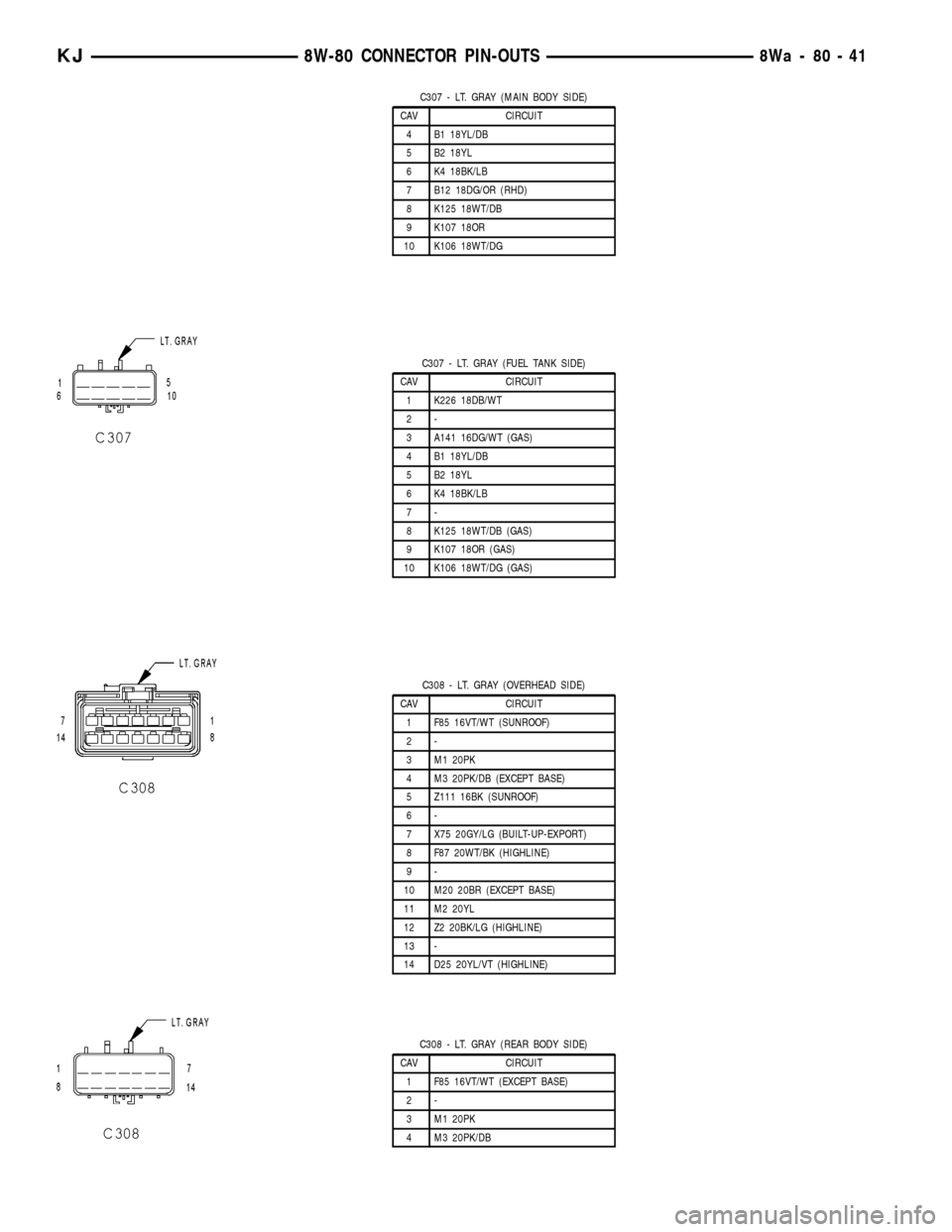
C307 - LT. GRAY (MAIN BODY SIDE)
CAV CIRCUIT
4 B1 18YL/DB
5 B2 18YL
6 K4 18BK/LB
7 B12 18DG/OR (RHD)
8 K125 18WT/DB
9 K107 18OR
10 K106 18WT/DG
C307 - LT. GRAY (FUEL TANK SIDE)
CAV CIRCUIT
1 K226 18DB/WT
2-
3 A141 16DG/WT (GAS)
4 B1 18YL/DB
5 B2 18YL
6 K4 18BK/LB
7-
8 K125 18WT/DB (GAS)
9 K107 18OR (GAS)
10 K106 18WT/DG (GAS)
C308 - LT. GRAY (OVERHEAD SIDE)
CAV CIRCUIT
1 F85 16VT/WT (SUNROOF)
2-
3 M1 20PK
4 M3 20PK/DB (EXCEPT BASE)
5 Z111 16BK (SUNROOF)
6-
7 X75 20GY/LG (BUILT-UP-EXPORT)
8 F87 20WT/BK (HIGHLINE)
9-
10 M20 20BR (EXCEPT BASE)
11 M2 20YL
12 Z2 20BK/LG (HIGHLINE)
13 -
14 D25 20YL/VT (HIGHLINE)
C308 - LT. GRAY (REAR BODY SIDE)
CAV CIRCUIT
1 F85 16VT/WT (EXCEPT BASE)
2-
3 M1 20PK
4 M3 20PK/DB
KJ8W-80 CONNECTOR PIN-OUTS8Wa-80-41
Page 1150 of 1803
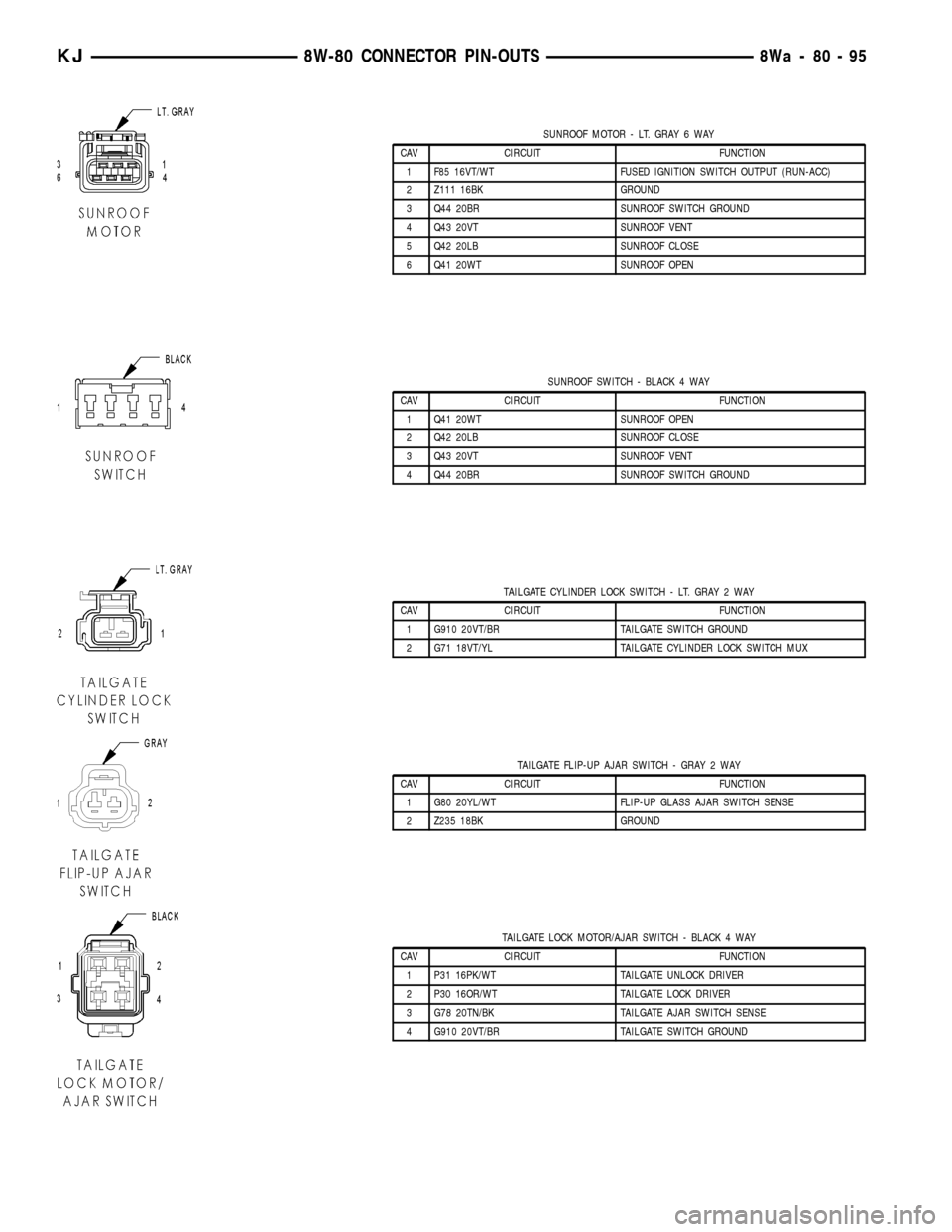
SUNROOF MOTOR - LT. GRAY 6 WAY
CAV CIRCUIT FUNCTION
1 F85 16VT/WT FUSED IGNITION SWITCH OUTPUT (RUN-ACC)
2 Z111 16BK GROUND
3 Q44 20BR SUNROOF SWITCH GROUND
4 Q43 20VT SUNROOF VENT
5 Q42 20LB SUNROOF CLOSE
6 Q41 20WT SUNROOF OPEN
SUNROOF SWITCH - BLACK 4 WAY
CAV CIRCUIT FUNCTION
1 Q41 20WT SUNROOF OPEN
2 Q42 20LB SUNROOF CLOSE
3 Q43 20VT SUNROOF VENT
4 Q44 20BR SUNROOF SWITCH GROUND
TAILGATE CYLINDER LOCK SWITCH - LT. GRAY 2 WAY
CAV CIRCUIT FUNCTION
1 G910 20VT/BR TAILGATE SWITCH GROUND
2 G71 18VT/YL TAILGATE CYLINDER LOCK SWITCH MUX
TAILGATE FLIP-UP AJAR SWITCH - GRAY 2 WAY
CAV CIRCUIT FUNCTION
1 G80 20YL/WT FLIP-UP GLASS AJAR SWITCH SENSE
2 Z235 18BK GROUND
TAILGATE LOCK MOTOR/AJAR SWITCH - BLACK 4 WAY
CAV CIRCUIT FUNCTION
1 P31 16PK/WT TAILGATE UNLOCK DRIVER
2 P30 16OR/WT TAILGATE LOCK DRIVER
3 G78 20TN/BK TAILGATE AJAR SWITCH SENSE
4 G910 20VT/BR TAILGATE SWITCH GROUND
KJ8W-80 CONNECTOR PIN-OUTS8Wa-80-95
Page 1164 of 1803
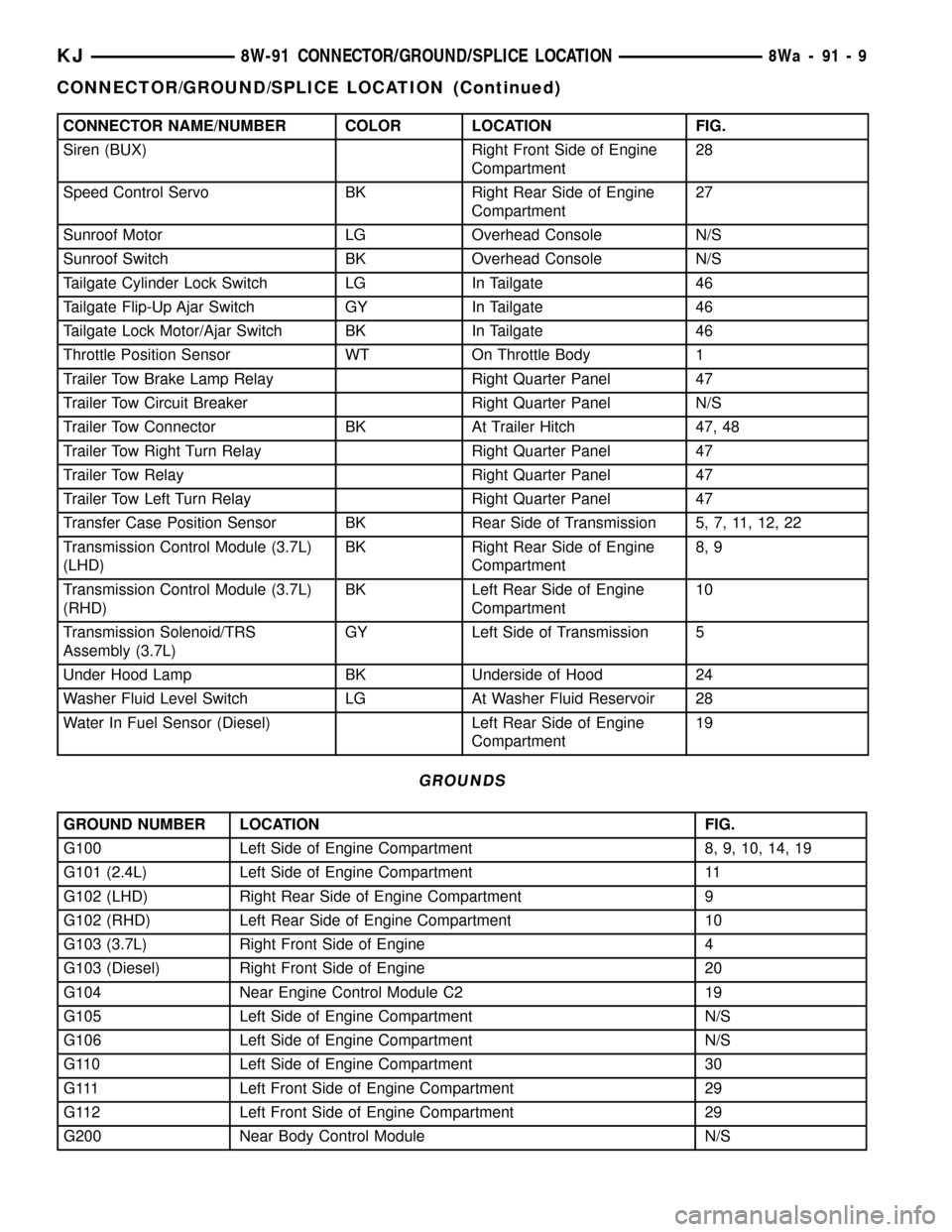
CONNECTOR NAME/NUMBER COLOR LOCATION FIG.
Siren (BUX) Right Front Side of Engine
Compartment28
Speed Control Servo BK Right Rear Side of Engine
Compartment27
Sunroof Motor LG Overhead Console N/S
Sunroof Switch BK Overhead Console N/S
Tailgate Cylinder Lock Switch LG In Tailgate 46
Tailgate Flip-Up Ajar Switch GY In Tailgate 46
Tailgate Lock Motor/Ajar Switch BK In Tailgate 46
Throttle Position Sensor WT On Throttle Body 1
Trailer Tow Brake Lamp Relay Right Quarter Panel 47
Trailer Tow Circuit Breaker Right Quarter Panel N/S
Trailer Tow Connector BK At Trailer Hitch 47, 48
Trailer Tow Right Turn Relay Right Quarter Panel 47
Trailer Tow Relay Right Quarter Panel 47
Trailer Tow Left Turn Relay Right Quarter Panel 47
Transfer Case Position Sensor BK Rear Side of Transmission 5, 7, 11, 12, 22
Transmission Control Module (3.7L)
(LHD)BK Right Rear Side of Engine
Compartment8, 9
Transmission Control Module (3.7L)
(RHD)BK Left Rear Side of Engine
Compartment10
Transmission Solenoid/TRS
Assembly (3.7L)GY Left Side of Transmission 5
Under Hood Lamp BK Underside of Hood 24
Washer Fluid Level Switch LG At Washer Fluid Reservoir 28
Water In Fuel Sensor (Diesel) Left Rear Side of Engine
Compartment19
GROUNDS
GROUND NUMBER LOCATION FIG.
G100 Left Side of Engine Compartment 8, 9, 10, 14, 19
G101 (2.4L) Left Side of Engine Compartment 11
G102 (LHD) Right Rear Side of Engine Compartment 9
G102 (RHD) Left Rear Side of Engine Compartment 10
G103 (3.7L) Right Front Side of Engine 4
G103 (Diesel) Right Front Side of Engine 20
G104 Near Engine Control Module C2 19
G105 Left Side of Engine Compartment N/S
G106 Left Side of Engine Compartment N/S
G110 Left Side of Engine Compartment 30
G111 Left Front Side of Engine Compartment 29
G112 Left Front Side of Engine Compartment 29
G200 Near Body Control Module N/S
KJ8W-91 CONNECTOR/GROUND/SPLICE LOCATION8Wa-91-9
CONNECTOR/GROUND/SPLICE LOCATION (Continued)
Page 1466 of 1803
BODY
TABLE OF CONTENTS
page page
BODY
WARNING
SAFETY PRECAUTIONS AND WARNINGS . . . 1
DIAGNOSIS AND TESTING
DIAGNOSIS AND TESTING - WATER LEAKS . 2
DIAGNOSIS AND TESTING - WIND NOISE . . . 3
STANDARD PROCEDURE
STANDARD PROCEDURE - BODY
LUBRICATION.........................3
STANDARD PROCEDURE - HEAT STAKING . . 3
SPECIFICATIONS........................4
SPECIAL TOOLS
BODY...............................5BODY STRUCTURE.......................6
HOOD................................119
DOOR - FRONT........................121
DOORS - REAR........................128
SWING GATE..........................135
EXTERIOR............................140
INSTRUMENT PANEL....................147
INTERIOR.............................156
PAINT................................162
SEATS...............................164
STATIONARY GLASS....................172
SUNROOF.............................175
WEATHERSTRIP/SEALS..................185
BODY
WARNING
SAFETY PRECAUTIONS AND WARNINGS
WARNING: EYE PROTECTION SHOULD BE USED
WHEN SERVICING GLASS COMPONENTS. PER-
SONAL INJURY CAN RESULT.
²USE A OSHA APPROVED BREATHING FILTER
WHEN SPRAYING PAINT OR SOLVENTS IN A CON-
FINED AREA. PERSONAL INJURY CAN RESULT.
²AVOID PROLONGED SKIN CONTACT WITH
PETROLEUM OR ALCOHOL±BASED CLEANING
SOLVENTS. PERSONAL INJURY CAN RESULT.
²DO NOT STAND UNDER A HOISTED VEHICLE
THAT IS NOT PROPERLY SUPPORTED ON SAFETY
STANDS. PERSONAL INJURY CAN RESULT.
CAUTION: When holes must be drilled or punched
in an inner body panel, verify depth of space to the
outer body panel, electrical wiring, or other compo-
nents. Damage to vehicle can result.
²Do not weld exterior panels unless combustible
material on the interior of vehicle is removed from
the repair area. Fire or hazardous conditions, can
result.
²Always have a fire extinguisher ready for use
when welding.
²Disconnect the negative (-) cable clamp from
the battery when servicing electrical components
that are live when the ignition is OFF. Damage to
electrical system can result.²Do not use abrasive chemicals or compounds
on painted surfaces. Damage to finish can result.
²Do not use harsh alkaline based cleaning sol-
vents on painted or upholstered surfaces. Damage
to finish or color can result.
²Do not hammer or pound on plastic trim panel
when servicing interior trim. Plastic panels can
break.
DaimlerChrysler Corporation uses many different
types of push-in fasteners to secure the interior and
exterior trim to the body. Most of these fasteners can
be reused to assemble the trim during various repair
procedures. At times, a push-in fastener cannot be
removed without damaging the fastener or the com-
ponent it is holding. If it is not possible to remove a
fastener without damaging a component or body, cut
or break the fastener and use a new one when
installing the component. Never pry or pound on a
plastic or pressed-board trim component. Using a
suitable fork-type prying device, pry the fastener
from the retaining hole behind the component being
removed. When installing, verify fastener alignment
with the retaining hole by hand. Push directly on or
over the fastener until it seats. Apply a low-force pull
to the panel to verify that it is secure.
When it is necessary to remove components to ser-
vice another, it should not be necessary to apply
excessive force or bend a component to remove it.
Before damaging a trim component, verify hidden
fasteners or captured edges holding the component in
place.
KJBODY 23 - 1
Page 1476 of 1803
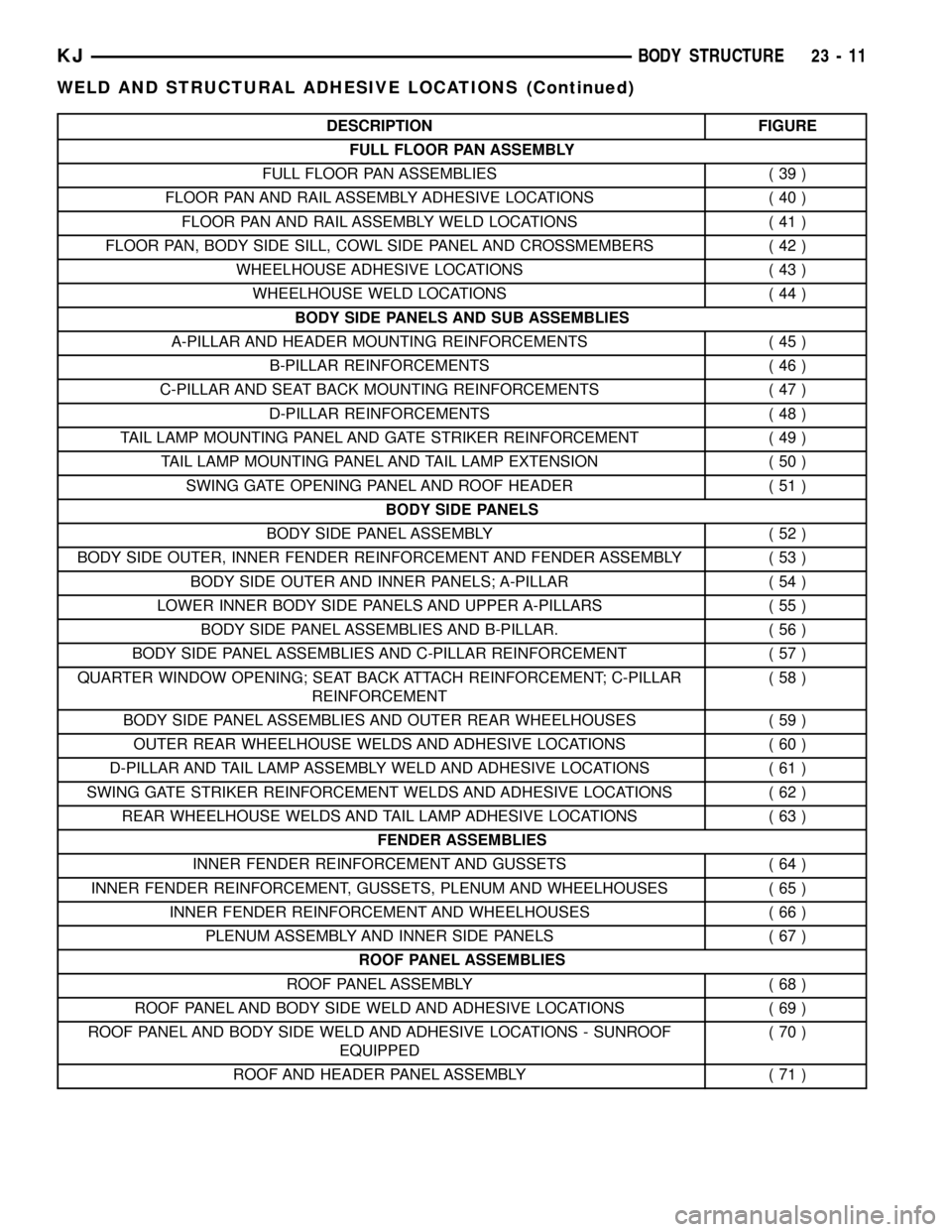
DESCRIPTION FIGURE
FULL FLOOR PAN ASSEMBLY
FULL FLOOR PAN ASSEMBLIES ( 39 )
FLOOR PAN AND RAIL ASSEMBLY ADHESIVE LOCATIONS ( 40 )
FLOOR PAN AND RAIL ASSEMBLY WELD LOCATIONS ( 41 )
FLOOR PAN, BODY SIDE SILL, COWL SIDE PANEL AND CROSSMEMBERS ( 42 )
WHEELHOUSE ADHESIVE LOCATIONS ( 43 )
WHEELHOUSE WELD LOCATIONS ( 44 )
BODY SIDE PANELS AND SUB ASSEMBLIES
A-PILLAR AND HEADER MOUNTING REINFORCEMENTS ( 45 )
B-PILLAR REINFORCEMENTS ( 46 )
C-PILLAR AND SEAT BACK MOUNTING REINFORCEMENTS ( 47 )
D-PILLAR REINFORCEMENTS ( 48 )
TAIL LAMP MOUNTING PANEL AND GATE STRIKER REINFORCEMENT ( 49 )
TAIL LAMP MOUNTING PANEL AND TAIL LAMP EXTENSION ( 50 )
SWING GATE OPENING PANEL AND ROOF HEADER ( 51 )
BODY SIDE PANELS
BODY SIDE PANEL ASSEMBLY ( 52 )
BODY SIDE OUTER, INNER FENDER REINFORCEMENT AND FENDER ASSEMBLY ( 53 )
BODY SIDE OUTER AND INNER PANELS; A-PILLAR ( 54 )
LOWER INNER BODY SIDE PANELS AND UPPER A-PILLARS ( 55 )
BODY SIDE PANEL ASSEMBLIES AND B-PILLAR. ( 56 )
BODY SIDE PANEL ASSEMBLIES AND C-PILLAR REINFORCEMENT ( 57 )
QUARTER WINDOW OPENING; SEAT BACK ATTACH REINFORCEMENT; C-PILLAR
REINFORCEMENT(58)
BODY SIDE PANEL ASSEMBLIES AND OUTER REAR WHEELHOUSES ( 59 )
OUTER REAR WHEELHOUSE WELDS AND ADHESIVE LOCATIONS ( 60 )
D-PILLAR AND TAIL LAMP ASSEMBLY WELD AND ADHESIVE LOCATIONS ( 61 )
SWING GATE STRIKER REINFORCEMENT WELDS AND ADHESIVE LOCATIONS ( 62 )
REAR WHEELHOUSE WELDS AND TAIL LAMP ADHESIVE LOCATIONS ( 63 )
FENDER ASSEMBLIES
INNER FENDER REINFORCEMENT AND GUSSETS ( 64 )
INNER FENDER REINFORCEMENT, GUSSETS, PLENUM AND WHEELHOUSES ( 65 )
INNER FENDER REINFORCEMENT AND WHEELHOUSES ( 66 )
PLENUM ASSEMBLY AND INNER SIDE PANELS ( 67 )
ROOF PANEL ASSEMBLIES
ROOF PANEL ASSEMBLY ( 68 )
ROOF PANEL AND BODY SIDE WELD AND ADHESIVE LOCATIONS ( 69 )
ROOF PANEL AND BODY SIDE WELD AND ADHESIVE LOCATIONS - SUNROOF
EQUIPPED(70)
ROOF AND HEADER PANEL ASSEMBLY ( 71 )
KJBODY STRUCTURE 23 - 11
WELD AND STRUCTURAL ADHESIVE LOCATIONS (Continued)
Page 1624 of 1803

HEADLINER
REMOVAL
(1) Remove the a-pillar trim. (Refer to 23 - BODY/
INTERIOR/A-PILLAR TRIM AND GRAB HANDLE -
REMOVAL)
(2) Remove the visors. (Refer to 23 - BODY/INTE-
RIOR/SUN VISOR - REMOVAL)
(3) Remove the sun visor support. (Refer to 23 -
BODY/INTERIOR/SUN VISOR SUPPORT -
REMOVAL)
(4) Remove the overhead console. (Refer to 8 -
ELECTRICAL/OVERHEAD CONSOLE - REMOVAL)
(5) Cut rear washer hose at the mark about half-
way up the a-pillar.
(6) Remove the upper b-pillar trim. (Refer to 23 -
BODY/INTERIOR/B-PILLAR UPPER TRIM -
REMOVAL)
(7) Remove the assist handles. (Refer to 23 -
BODY/INTERIOR/ASSIST HANDLE - REMOVAL)
(8) Remove the quarter trim. (Refer to 23 - BODY/
INTERIOR/QUARTER TRIM PANEL - REMOVAL)
(9) Disconnect the electrical connector along the
left d-pillar and remove the ground wire.
(10) Remove the dome light in the rear.
(11) Remove the sunroof opening trim lace, if
equipped. (Refer to 23 - BODY/SUNROOF/OPENING
TRIM LACE - REMOVAL)(12) Remove the rear washer nozzle.
(13) Remove the headliner.
INSTALLATION
(1) Install the headliner.
(2) Install the assist handles. (Refer to 23 - BODY/
INTERIOR/ASSIST HANDLE - INSTALLATION)
(3) Install the visors. (Refer to 23 - BODY/INTERI-
OR/SUN VISOR - INSTALLATION)
(4) Install the visor supports. (Refer to 23 - BODY/
INTERIOR/SUN VISOR SUPPORT - INSTALLA-
TION)
(5) Install the overhead console. (Refer to 8 -
ELECTRICAL/OVERHEAD CONSOLE - INSTALLA-
TION)
(6) Connect the rear washer hose, previously cut,
with a hose junction.
(7) Install the a-pillar trim and grab handles.
(Refer to 23 - BODY/INTERIOR/A-PILLAR TRIM -
INSTALLATION)
(8) Install the upper b-pillar trim. (Refer to 23 -
BODY/INTERIOR/B-PILLAR UPPER TRIM -
INSTALLATION)
(9) Install the rear washer nozzle.
(10) Connect the electrical connector and ground
wire at the left d-pillar.
(11) Install the quarter trim panels. (Refer to 23 -
BODY/INTERIOR/QUARTER TRIM PANEL -
INSTALLATION)
(12) Install the rear dome light.
(13) Install the sunroof opening trim lace, if
equipped. (Refer to 23 - BODY/SUNROOF/OPENING
TRIM LACE - INSTALLATION)
QUARTER TRIM PANEL
REMOVAL
(1) Using a trim stick C-4755 or equivalent,
remove the rear header trim.
(2) Using a trim stick C-4755 or equivalent,
remove the rear sill plate.
(3) Remove the hook pin type connector.
(4) Fold down the rear seat.
(5) Remove the seat belt anchor and pivot. (Refer
to 8 - ELECTRICAL/RESTRAINTS/SEAT BELT &
RETRACTOR - REMOVAL)
(6) Remove the belt access panel. (Fig. 4)
(7) Remove the storage cover.
(8) Disconnect the 12v power supply electrical con-
nector, if equipped.
INSTALLATION
(1) Position the 12v power supply electrical con-
nector, if equipped.
(2) Install the storage cover.
Fig. 3 FLOOR CONSOLE
1 - SHIFT BEZEL
2 - ACCESSORY CUP
3 - BOLTS (4)
4 - FLOOR CONSOLE
KJINTERIOR 23 - 159
FLOOR CONSOLE LID LATCH (Continued)
Page 1640 of 1803

SUNROOF
TABLE OF CONTENTS
page page
SUNROOF
DESCRIPTION........................175
DIAGNOSIS AND TESTING
WATER DRAINAGE AND WIND NOISE
DIAGNOSIS.........................176
DIAGNOSTIC PROCEDURES...........176
GLASS PANEL
REMOVAL............................178
INSTALLATION........................178
ADJUSTMENTS
SUNROOF GLASS PANEL ADJUSTMENT . . 178
GLASS PANEL SEAL
REMOVAL............................178
INSTALLATION........................178
SUNSHADE
REMOVAL............................179
INSTALLATION........................179
GUIDE ASSEMBLY
REMOVAL............................179
INSTALLATION........................179
WIND DEFLECTOR
REMOVAL............................180INSTALLATION........................180
OPENING TRIM LACE
REMOVAL............................180
INSTALLATION........................180
DRAIN TUBE
REMOVAL............................180
INSTALLATION........................181
MODULE ASSEMBLY
REMOVAL............................181
INSTALLATION........................181
DRIVE MOTOR
REMOVAL............................182
INSTALLATION........................182
CONTROL MODULE
REMOVAL............................183
INSTALLATION........................183
CONTROL SWITCH
DESCRIPTION........................184
OPERATION..........................184
DIAGNOSIS AND TESTING...............184
REMOVAL............................184
INSTALLATION........................184
SUNROOF
DESCRIPTION
WARNING: Keep fingers and other body parts out
of sunroof opening at all times.
The sunroof features a power sliding glass panel
and a sunshade which can be manually positioned
anywhere along its travel, rearward of glass panel
front edge.
The sunroof is electrically operated from two
switches located on the windshield header, rearwardof the map lamp. To operate the sunroof the ignition
switch must be in either the Accessory or On/Run
position. One switch (vent) is a push button type and
opens the sunroof to the vent position only. The other
switch (open/close) is a rocker type for opening and
closing the sunroof. Pressing and releasing the open
button once the sunroof will express open and the
wind deflector will raise. If the button is pressed a
second time the sunroof will stop in that position.
Pressing and holding the close button will close the
sunroof. If the close button is released the sunroof
will stop in that position.
KJSUNROOF 23 - 175
Page 1641 of 1803
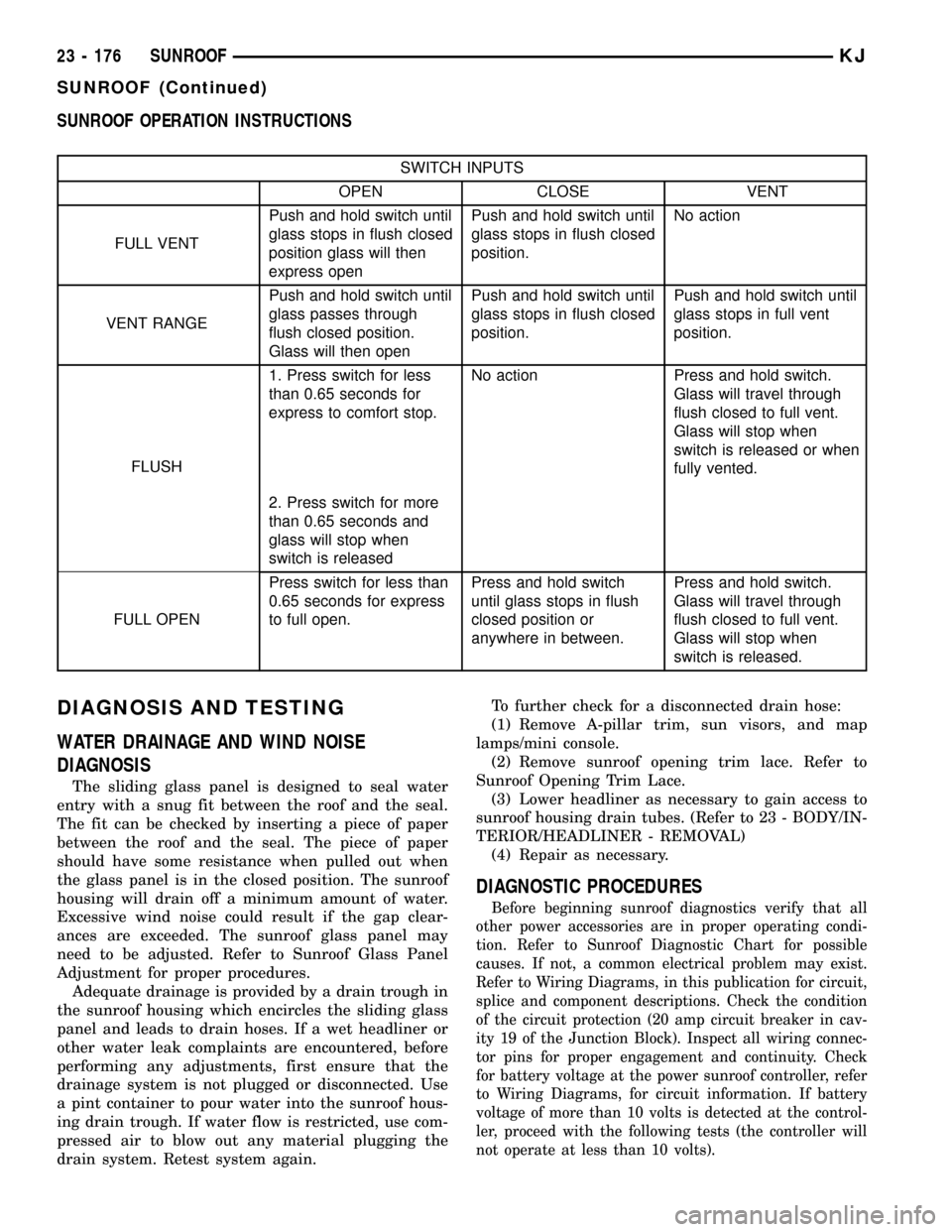
SUNROOF OPERATION INSTRUCTIONS
SWITCH INPUTS
OPEN CLOSE VENT
FULL VENTPush and hold switch until
glass stops in flush closed
position glass will then
express openPush and hold switch until
glass stops in flush closed
position.No action
VENT RANGEPush and hold switch until
glass passes through
flush closed position.
Glass will then openPush and hold switch until
glass stops in flush closed
position.Push and hold switch until
glass stops in full vent
position.
FLUSH1. Press switch for less
than 0.65 seconds for
express to comfort stop.No action Press and hold switch.
Glass will travel through
flush closed to full vent.
Glass will stop when
switch is released or when
fully vented.
2. Press switch for more
than 0.65 seconds and
glass will stop when
switch is released
FULL OPENPress switch for less than
0.65 seconds for express
to full open.Press and hold switch
until glass stops in flush
closed position or
anywhere in between.Press and hold switch.
Glass will travel through
flush closed to full vent.
Glass will stop when
switch is released.
DIAGNOSIS AND TESTING
WATER DRAINAGE AND WIND NOISE
DIAGNOSIS
The sliding glass panel is designed to seal water
entry with a snug fit between the roof and the seal.
The fit can be checked by inserting a piece of paper
between the roof and the seal. The piece of paper
should have some resistance when pulled out when
the glass panel is in the closed position. The sunroof
housing will drain off a minimum amount of water.
Excessive wind noise could result if the gap clear-
ances are exceeded. The sunroof glass panel may
need to be adjusted. Refer to Sunroof Glass Panel
Adjustment for proper procedures.
Adequate drainage is provided by a drain trough in
the sunroof housing which encircles the sliding glass
panel and leads to drain hoses. If a wet headliner or
other water leak complaints are encountered, before
performing any adjustments, first ensure that the
drainage system is not plugged or disconnected. Use
a pint container to pour water into the sunroof hous-
ing drain trough. If water flow is restricted, use com-
pressed air to blow out any material plugging the
drain system. Retest system again.To further check for a disconnected drain hose:
(1) Remove A-pillar trim, sun visors, and map
lamps/mini console.
(2) Remove sunroof opening trim lace. Refer to
Sunroof Opening Trim Lace.
(3) Lower headliner as necessary to gain access to
sunroof housing drain tubes. (Refer to 23 - BODY/IN-
TERIOR/HEADLINER - REMOVAL)
(4) Repair as necessary.
DIAGNOSTIC PROCEDURES
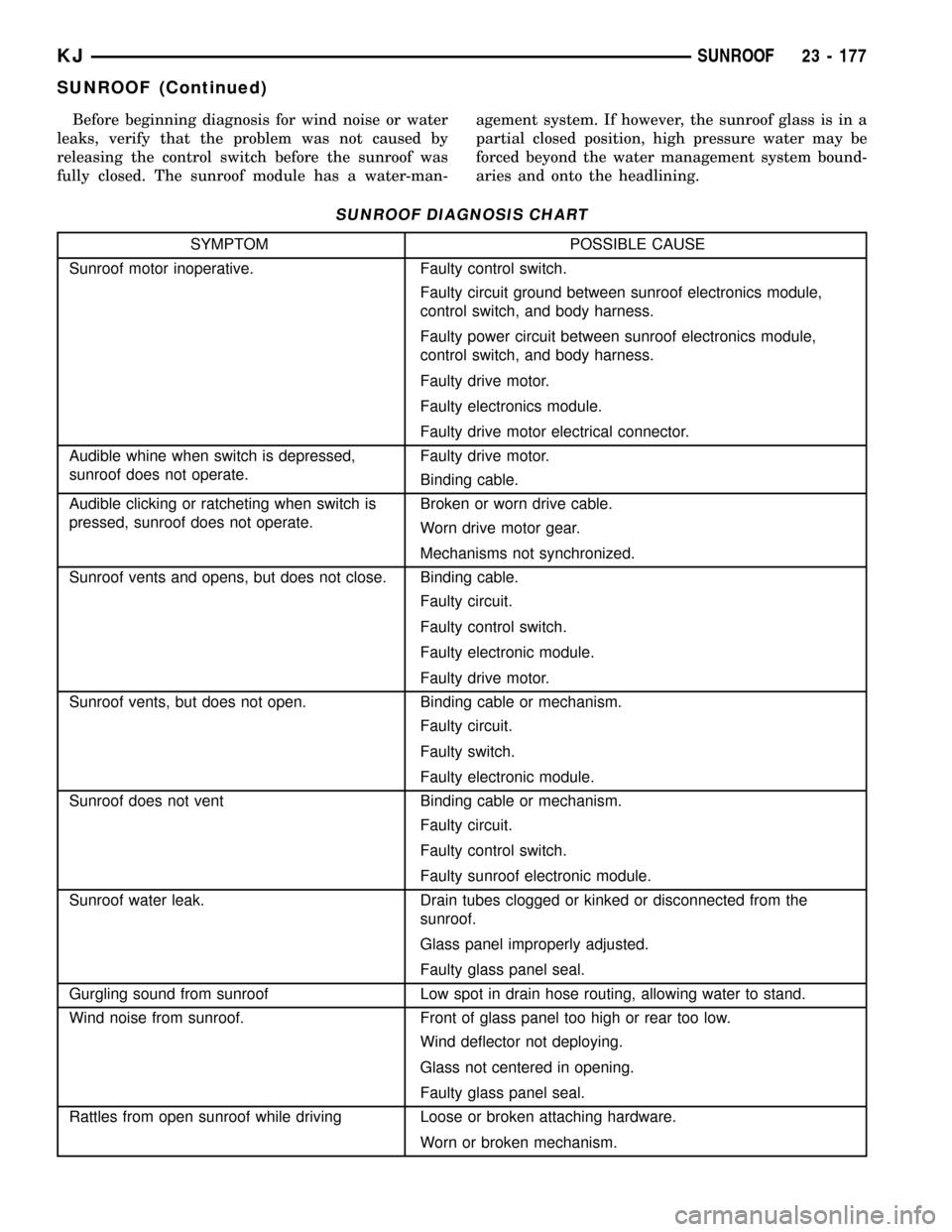
Before beginning sunroof diagnostics verify that all
other power accessories are in proper operating condi-
tion. Refer to Sunroof Diagnostic Chart for possible
causes. If not, a common electrical problem may exist.
Refer to Wiring Diagrams, in this publication for circuit,
splice and component descriptions. Check the condition
of the circuit protection (20 amp circuit breaker in cav-
ity 19 of the Junction Block). Inspect all wiring connec-
tor pins for proper engagement and continuity. Check
for battery voltage at the power sunroof controller, refer
to Wiring Diagrams, for circuit information. If battery
voltage of more than 10 volts is detected at the control-
ler, proceed with the following tests (the controller will
not operate at less than 10 volts).
23 - 176 SUNROOFKJ
SUNROOF (Continued)
Page 1642 of 1803
Before beginning diagnosis for wind noise or water
leaks, verify that the problem was not caused by
releasing the control switch before the sunroof was
fully closed. The sunroof module has a water-man-agement system. If however, the sunroof glass is in a
partial closed position, high pressure water may be
forced beyond the water management system bound-
aries and onto the headlining.
SUNROOF DIAGNOSIS CHART
SYMPTOM POSSIBLE CAUSE
Sunroof motor inoperative. Faulty control switch.
Faulty circuit ground between sunroof electronics module,
control switch, and body harness.
Faulty power circuit between sunroof electronics module,
control switch, and body harness.
Faulty drive motor.
Faulty electronics module.
Faulty drive motor electrical connector.
Audible whine when switch is depressed,
sunroof does not operate.Faulty drive motor.
Binding cable.
Audible clicking or ratcheting when switch is
pressed, sunroof does not operate.Broken or worn drive cable.
Worn drive motor gear.
Mechanisms not synchronized.
Sunroof vents and opens, but does not close. Binding cable.
Faulty circuit.
Faulty control switch.
Faulty electronic module.
Faulty drive motor.
Sunroof vents, but does not open. Binding cable or mechanism.
Faulty circuit.
Faulty switch.
Faulty electronic module.
Sunroof does not vent Binding cable or mechanism.
Faulty circuit.
Faulty control switch.
Faulty sunroof electronic module.
Sunroof water leak. Drain tubes clogged or kinked or disconnected from the
sunroof.
Glass panel improperly adjusted.
Faulty glass panel seal.
Gurgling sound from sunroof Low spot in drain hose routing, allowing water to stand.
Wind noise from sunroof. Front of glass panel too high or rear too low.
Wind deflector not deploying.
Glass not centered in opening.
Faulty glass panel seal.
Rattles from open sunroof while driving Loose or broken attaching hardware.
Worn or broken mechanism.
KJSUNROOF 23 - 177
SUNROOF (Continued)