torque JEEP LIBERTY 2002 KJ / 1.G User Guide
[x] Cancel search | Manufacturer: JEEP, Model Year: 2002, Model line: LIBERTY, Model: JEEP LIBERTY 2002 KJ / 1.GPages: 1803, PDF Size: 62.3 MB
Page 51 of 1803
DRIVELINE VIBRATION
Drive Condition Possible Cause Correction
Propeller Shaft Noise 1. Undercoating or other foreign
material on shaft.1. Clean exterior of shaft and wash
with solvent.
2. Loose U-joint clamp screws. 2. Install new clamps and screws
and tighten to proper torque.
3. Loose or bent U-joint yoke or
excessive runout.3. Install new yoke.
4. Incorrect driveline angularity. 4. Measure and correct driveline
angles.
5. Worn joint. 5. Install new joint.
6. Propeller shaft damaged or out
of balance.6. Installl new propeller shaft.
7. Broken rear spring. 7. Install new rear spring.
8. Excessive runout or unbalanced
condition.8. Re-index propeller shaft, test, and
evaluate.
9. Excessive drive pinion gear shaft
runout.9. Re-index propeller shaft and
evaluate.
10. Excessive axle yoke deflection. 10. Inspect and replace yoke if
necessary.
11. Excessive transfer case runout. 11. Inspect and repair as necessary.
Joint Noise 1. Loose U-joint clamp screws. 1. Install new clamps and screws
and tighten to proper torque.
2. Lack of lubrication. 2. Replace joints as necessary.
BALANCE
NOTE: Removing and re-indexing the propeller
shaft 180É relative to the yoke may eliminate some
vibrations.
If propeller shaft is suspected of being unbalanced,
it can be verified with the following procedure:
(1) Raise the vehicle.
(2) Clean all the foreign material from the propel-
ler shaft and the universal joints.
(3) Inspect the propeller shaft for missing balance
weights, broken welds, and bent areas.If the pro-
peller shaft is bent, it must be replaced.
(4) Inspect the universal joints to ensure that they
are not worn, are properly installed, and are cor-
rectly aligned with the shaft.
(5) Check the universal joint clamp screws torque.
(6) Remove the wheels and tires. Install the wheel
lug nuts to retain the brake drums or rotors.
(7) Mark and number the shaft six inches from the
yoke end at four positions 90É apart.
(8) Run and accelerate the vehicle until vibration
occurs. Note the intensity and speed the vibration
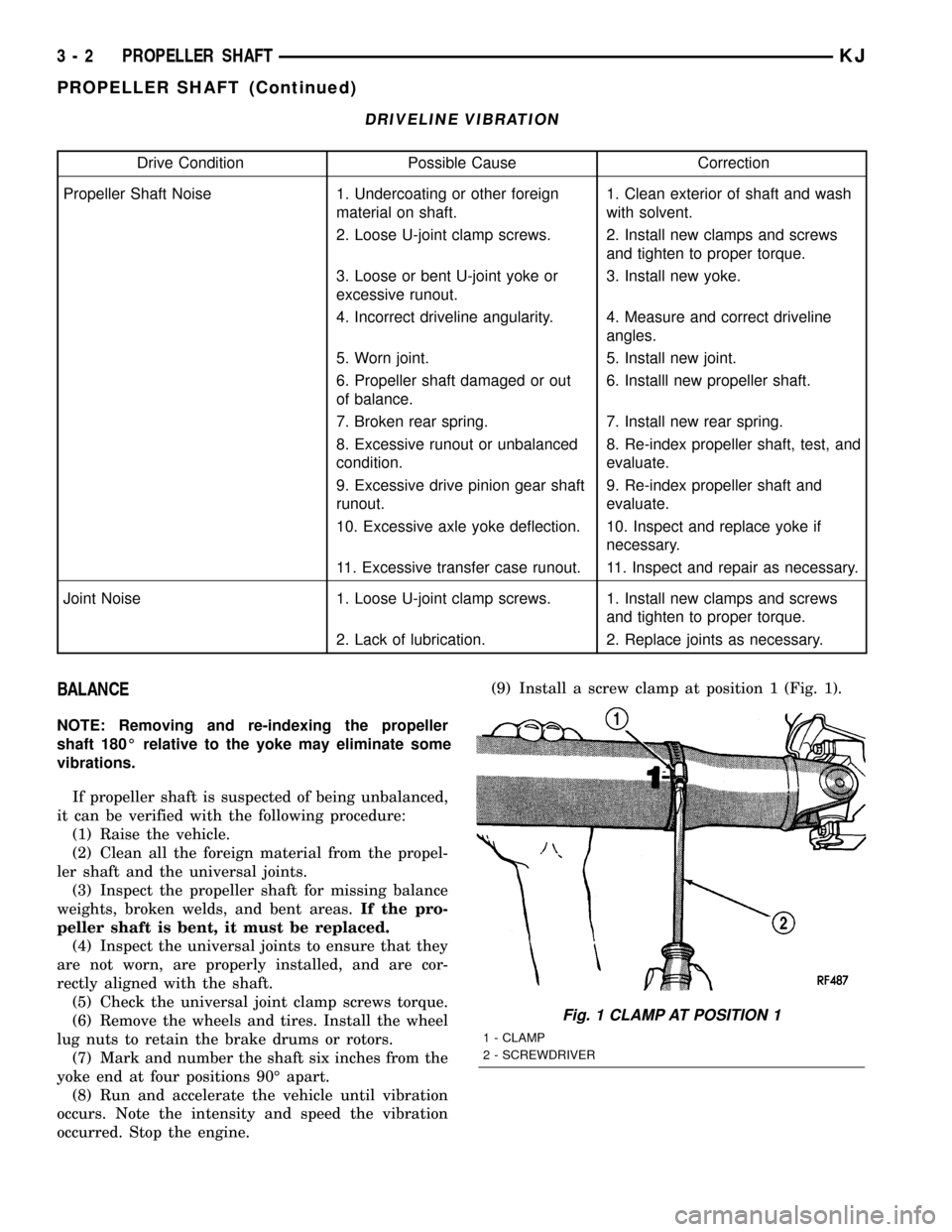
occurred. Stop the engine.(9) Install a screw clamp at position 1 (Fig. 1).
Fig. 1 CLAMP AT POSITION 1
1 - CLAMP
2 - SCREWDRIVER
3 - 2 PROPELLER SHAFTKJ
PROPELLER SHAFT (Continued)
Page 55 of 1803
SPECIFICATIONS
PROPELLER SHAFT
TORQUE SPECIFICATIONS
DESCRIPTION N´m Ft. Lbs. In. Lbs.
Front Shaft - Companion
Flange Bolts30 22 -
Rear Shaft - Yoke Nuts 18 13 -
SPECIAL TOOLS
PROPELLER SHAFT - FRONT
REMOVAL
(1) Shift transmission and transfer case into Neu-
tral.
(2) Raise and support the vehicle.
(3) Mark companion flanges and C/V joints at the
front and rear of the propeller shaft for installation
reference.
(4) Remove bolts from the front and rear C/V
joints.
(5) Push propeller shaft forward to clear transfer
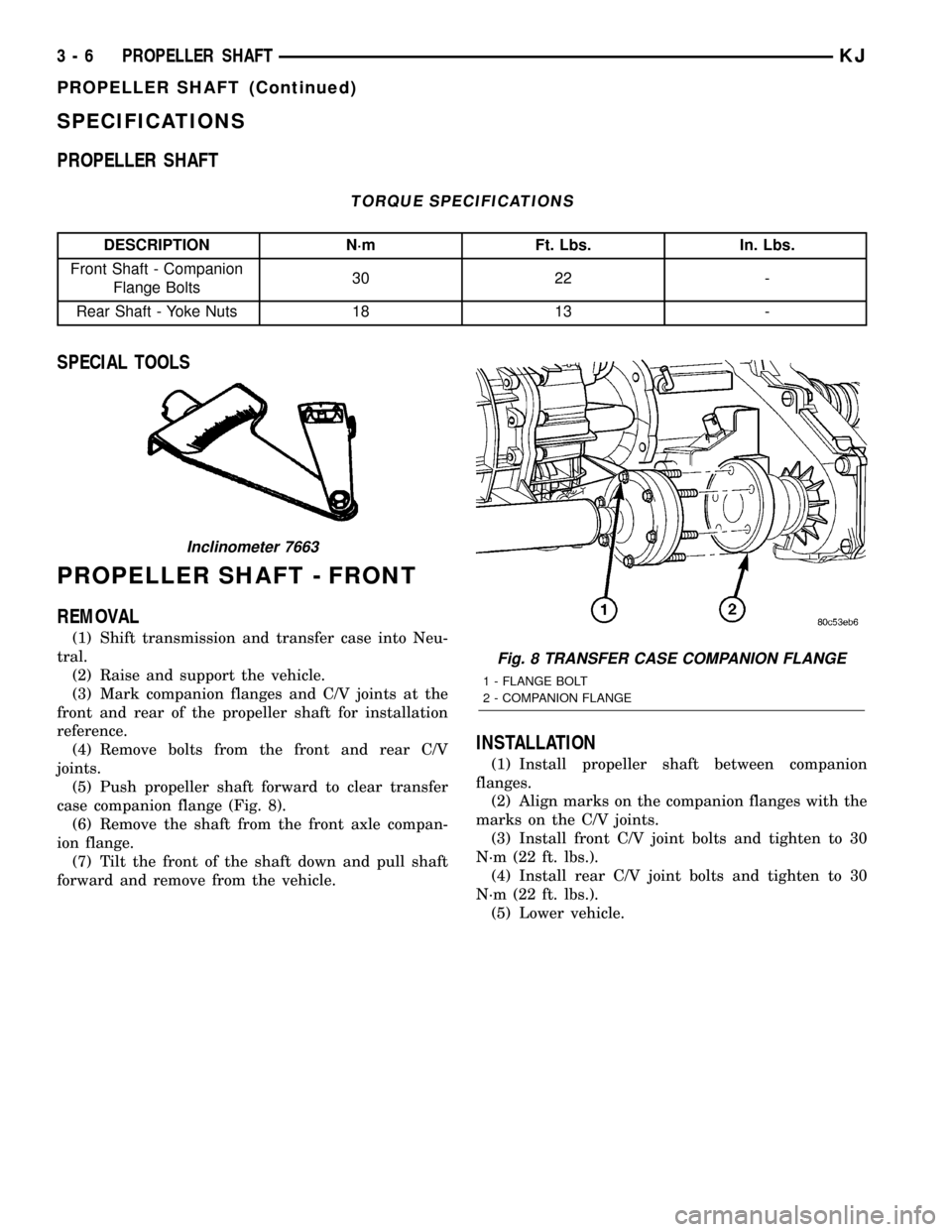
case companion flange (Fig. 8).
(6) Remove the shaft from the front axle compan-
ion flange.
(7) Tilt the front of the shaft down and pull shaft
forward and remove from the vehicle.
INSTALLATION
(1) Install propeller shaft between companion
flanges.
(2) Align marks on the companion flanges with the
marks on the C/V joints.
(3) Install front C/V joint bolts and tighten to 30
N´m (22 ft. lbs.).
(4) Install rear C/V joint bolts and tighten to 30
N´m (22 ft. lbs.).
(5) Lower vehicle.
Inclinometer 7663
Fig. 8 TRANSFER CASE COMPANION FLANGE
1 - FLANGE BOLT
2 - COMPANION FLANGE
3 - 6 PROPELLER SHAFTKJ
PROPELLER SHAFT (Continued)
Page 60 of 1803
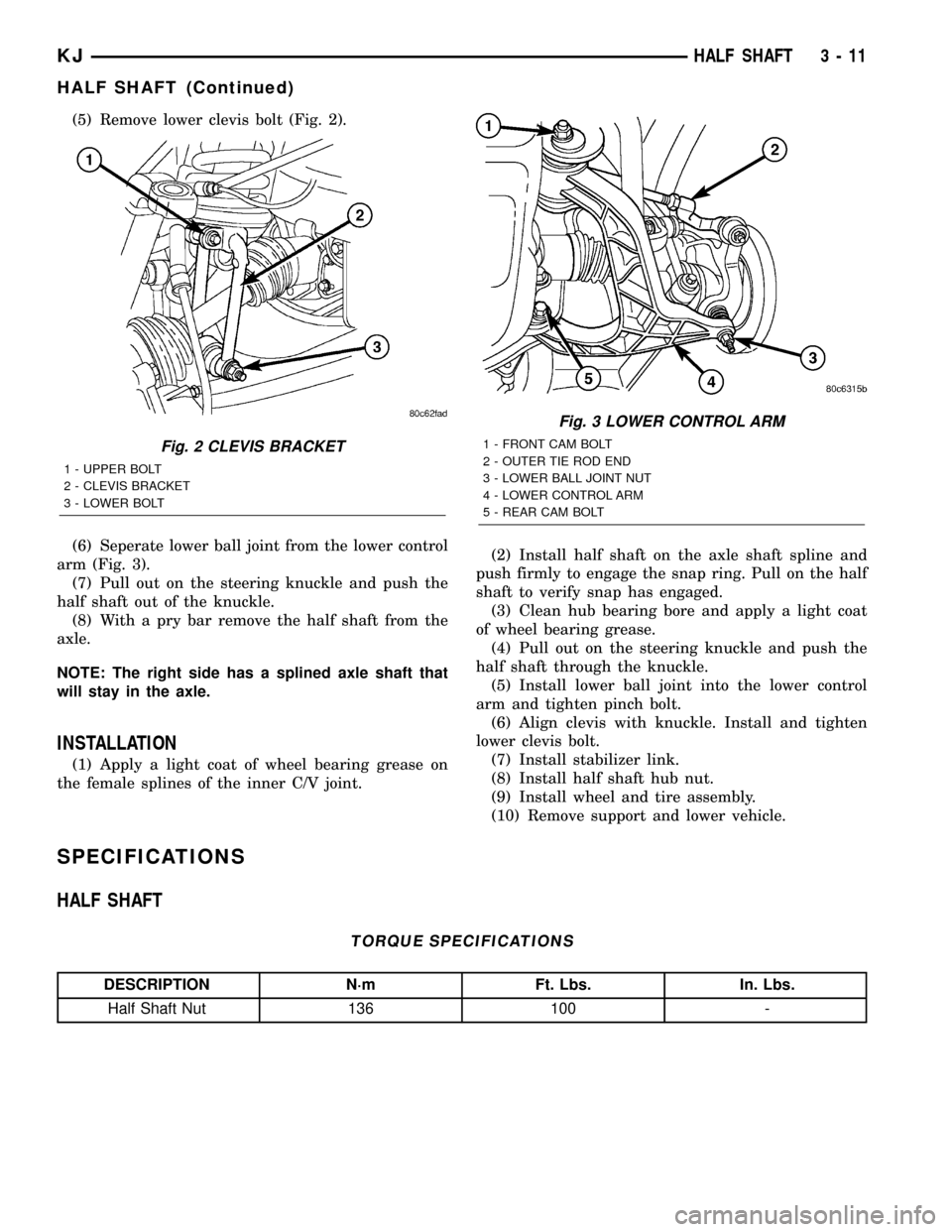
(5) Remove lower clevis bolt (Fig. 2).
(6) Seperate lower ball joint from the lower control
arm (Fig. 3).
(7) Pull out on the steering knuckle and push the
half shaft out of the knuckle.
(8) With a pry bar remove the half shaft from the
axle.
NOTE: The right side has a splined axle shaft that
will stay in the axle.
INSTALLATION
(1) Apply a light coat of wheel bearing grease on
the female splines of the inner C/V joint.(2) Install half shaft on the axle shaft spline and
push firmly to engage the snap ring. Pull on the half
shaft to verify snap has engaged.
(3) Clean hub bearing bore and apply a light coat
of wheel bearing grease.
(4) Pull out on the steering knuckle and push the
half shaft through the knuckle.
(5) Install lower ball joint into the lower control
arm and tighten pinch bolt.
(6) Align clevis with knuckle. Install and tighten
lower clevis bolt.
(7) Install stabilizer link.
(8) Install half shaft hub nut.
(9) Install wheel and tire assembly.
(10) Remove support and lower vehicle.
SPECIFICATIONS
HALF SHAFT
TORQUE SPECIFICATIONS
DESCRIPTION N´m Ft. Lbs. In. Lbs.
Half Shaft Nut 136 100 -
Fig. 3 LOWER CONTROL ARM
1 - FRONT CAM BOLT
2 - OUTER TIE ROD END
3 - LOWER BALL JOINT NUT
4 - LOWER CONTROL ARM
5 - REAR CAM BOLTFig. 2 CLEVIS BRACKET
1 - UPPER BOLT
2 - CLEVIS BRACKET
3 - LOWER BOLT
KJHALF SHAFT 3 - 11
HALF SHAFT (Continued)
Page 68 of 1803
FRONT AXLE - 186FIA
TABLE OF CONTENTS
page page
FRONT AXLE - 186FIA
DESCRIPTION.........................19
OPERATION...........................19
DIAGNOSIS AND TESTING - AXLE..........20
REMOVAL.............................24
INSTALLATION.........................24
ADJUSTMENTS........................25
SPECIFICATIONS - FRONT AXLE...........33
SPECIAL TOOLS
FRONT AXLE........................34
AXLE SHAFTS
REMOVAL.............................37
INSTALLATION.........................37
AXLE SHAFT SEALS
REMOVAL.............................37
INSTALLATION.........................38
AXLE BEARINGS
REMOVAL.............................38INSTALLATION.........................38
PINION SEAL
REMOVAL.............................38
INSTALLATION.........................39
DIFFERENTIAL
REMOVAL.............................40
DISASSEMBLY.........................41
ASSEMBLY............................41
INSTALLATION.........................42
DIFFERENTIAL CASE BEARINGS
REMOVAL.............................43
INSTALLATION.........................44
PINION GEAR/RING GEAR
REMOVAL.............................44
INSTALLATION.........................46
FRONT AXLE - 186FIA
DESCRIPTION
The 186FIA (Model 30) axle consists of an alumu-
num center section with an axle tube extending from
one side. The tube is pressed into the differential
housing. The integral type housing, hypoid gear
design has the centerline of the pinion set below the
centerline of the ring gear.
The differential case is a one-piece design. The differ-
ential pinion mate shaft is retained with a roll-pin. Dif-
ferential bearing preload and ring gear backlash is
adjusted by the use of shims (select thickness). The
shims are located between the differential bearing cups
and the axle housing. Pinion bearing preload is set and
maintained by the use of a collapsible spacer.
The power is transferred from the axle through two
constant velocity (C/V) drive shafts to the wheel hubs.
The differential cover provides a means for inspec-
tion and service without removing the axle from the
vehicle. The cover has a vent tube used to relieve
internal pressure caused by vaporization and inter-
nal expansion.
OPERATION
The axle receives power from the transfer case through
the front propeller shaft. The front propeller shaft is con-
nected to the pinion gear which rotates the differential
through the gear mesh with the ring gear bolted to thedifferential case. The engine power is transmitted to the
axle shafts through the pinion mate and side gears. The
side gears are splined to the axle shafts.
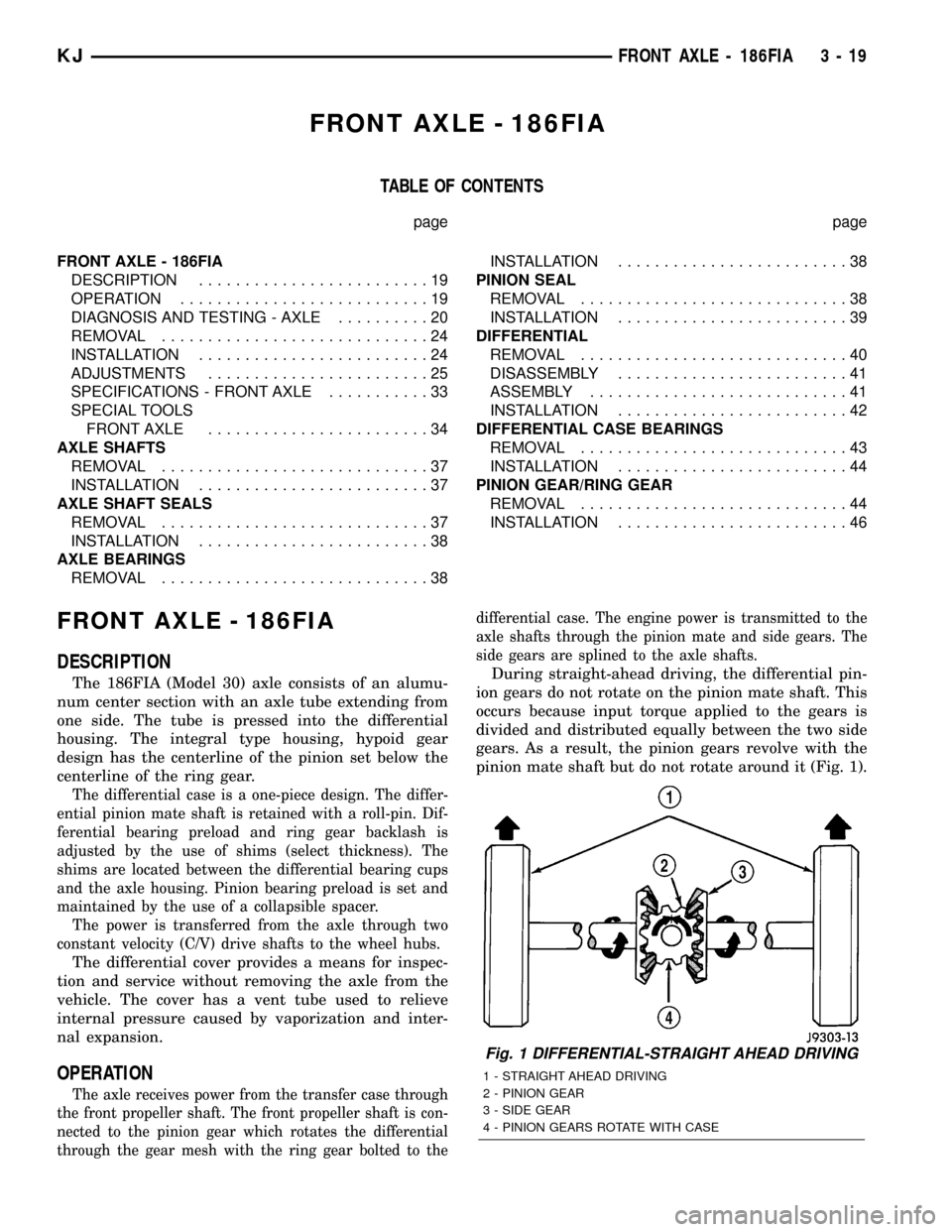
During straight-ahead driving, the differential pin-
ion gears do not rotate on the pinion mate shaft. This
occurs because input torque applied to the gears is
divided and distributed equally between the two side
gears. As a result, the pinion gears revolve with the
pinion mate shaft but do not rotate around it (Fig. 1).
Fig. 1 DIFFERENTIAL-STRAIGHT AHEAD DRIVING
1 - STRAIGHT AHEAD DRIVING
2 - PINION GEAR
3 - SIDE GEAR
4 - PINION GEARS ROTATE WITH CASE
KJFRONT AXLE - 186FIA 3 - 19
Page 69 of 1803
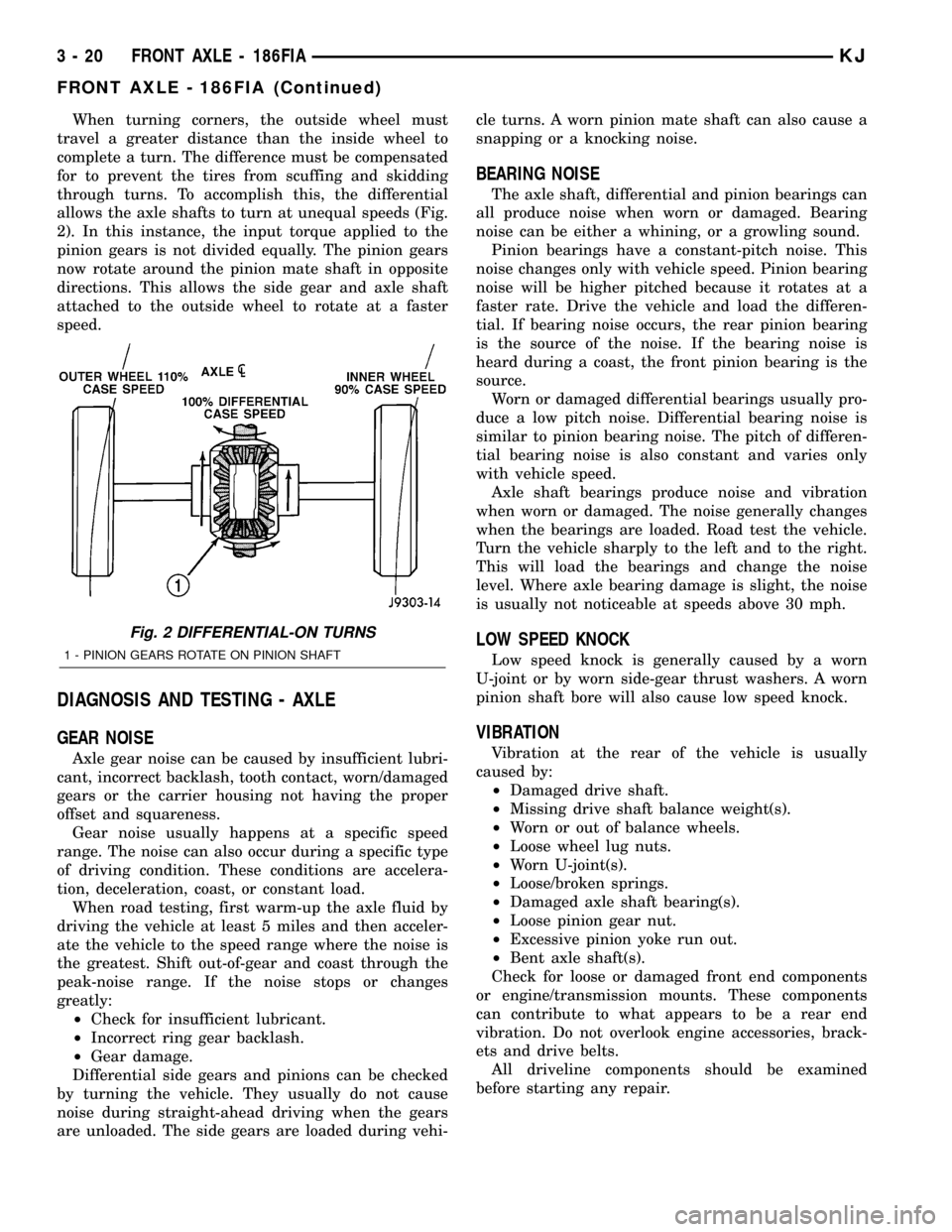
When turning corners, the outside wheel must
travel a greater distance than the inside wheel to
complete a turn. The difference must be compensated
for to prevent the tires from scuffing and skidding
through turns. To accomplish this, the differential
allows the axle shafts to turn at unequal speeds (Fig.
2). In this instance, the input torque applied to the
pinion gears is not divided equally. The pinion gears
now rotate around the pinion mate shaft in opposite
directions. This allows the side gear and axle shaft
attached to the outside wheel to rotate at a faster
speed.
DIAGNOSIS AND TESTING - AXLE
GEAR NOISE
Axle gear noise can be caused by insufficient lubri-
cant, incorrect backlash, tooth contact, worn/damaged
gears or the carrier housing not having the proper
offset and squareness.
Gear noise usually happens at a specific speed
range. The noise can also occur during a specific type
of driving condition. These conditions are accelera-
tion, deceleration, coast, or constant load.
When road testing, first warm-up the axle fluid by
driving the vehicle at least 5 miles and then acceler-
ate the vehicle to the speed range where the noise is
the greatest. Shift out-of-gear and coast through the
peak-noise range. If the noise stops or changes
greatly:
²Check for insufficient lubricant.
²Incorrect ring gear backlash.
²Gear damage.
Differential side gears and pinions can be checked
by turning the vehicle. They usually do not cause
noise during straight-ahead driving when the gears
are unloaded. The side gears are loaded during vehi-cle turns. A worn pinion mate shaft can also cause a
snapping or a knocking noise.
BEARING NOISE
The axle shaft, differential and pinion bearings can
all produce noise when worn or damaged. Bearing
noise can be either a whining, or a growling sound.
Pinion bearings have a constant-pitch noise. This
noise changes only with vehicle speed. Pinion bearing
noise will be higher pitched because it rotates at a
faster rate. Drive the vehicle and load the differen-
tial. If bearing noise occurs, the rear pinion bearing
is the source of the noise. If the bearing noise is
heard during a coast, the front pinion bearing is the
source.
Worn or damaged differential bearings usually pro-
duce a low pitch noise. Differential bearing noise is
similar to pinion bearing noise. The pitch of differen-
tial bearing noise is also constant and varies only
with vehicle speed.
Axle shaft bearings produce noise and vibration
when worn or damaged. The noise generally changes
when the bearings are loaded. Road test the vehicle.
Turn the vehicle sharply to the left and to the right.
This will load the bearings and change the noise
level. Where axle bearing damage is slight, the noise
is usually not noticeable at speeds above 30 mph.
LOW SPEED KNOCK
Low speed knock is generally caused by a worn
U-joint or by worn side-gear thrust washers. A worn
pinion shaft bore will also cause low speed knock.
VIBRATION
Vibration at the rear of the vehicle is usually
caused by:
²Damaged drive shaft.
²Missing drive shaft balance weight(s).
²Worn or out of balance wheels.
²Loose wheel lug nuts.
²Worn U-joint(s).
²Loose/broken springs.
²Damaged axle shaft bearing(s).
²Loose pinion gear nut.
²Excessive pinion yoke run out.
²Bent axle shaft(s).
Check for loose or damaged front end components
or engine/transmission mounts. These components
can contribute to what appears to be a rear end
vibration. Do not overlook engine accessories, brack-
ets and drive belts.
All driveline components should be examined
before starting any repair.
Fig. 2 DIFFERENTIAL-ON TURNS
1 - PINION GEARS ROTATE ON PINION SHAFT
3 - 20 FRONT AXLE - 186FIAKJ
FRONT AXLE - 186FIA (Continued)
Page 72 of 1803
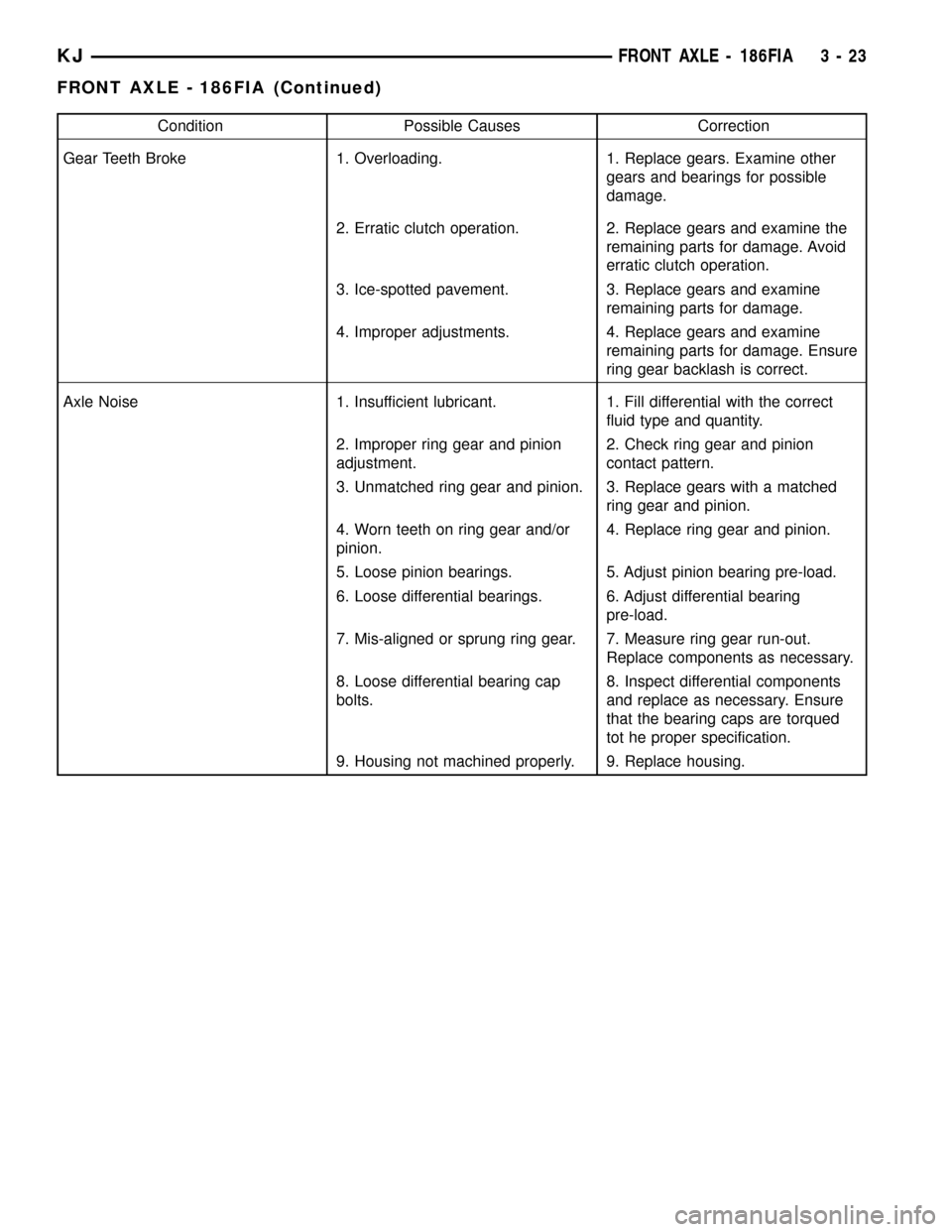
Condition Possible Causes Correction
Gear Teeth Broke 1. Overloading. 1. Replace gears. Examine other
gears and bearings for possible
damage.
2. Erratic clutch operation. 2. Replace gears and examine the
remaining parts for damage. Avoid
erratic clutch operation.
3. Ice-spotted pavement. 3. Replace gears and examine
remaining parts for damage.
4. Improper adjustments. 4. Replace gears and examine
remaining parts for damage. Ensure
ring gear backlash is correct.
Axle Noise 1. Insufficient lubricant. 1. Fill differential with the correct
fluid type and quantity.
2. Improper ring gear and pinion
adjustment.2. Check ring gear and pinion
contact pattern.
3. Unmatched ring gear and pinion. 3. Replace gears with a matched
ring gear and pinion.
4. Worn teeth on ring gear and/or
pinion.4. Replace ring gear and pinion.
5. Loose pinion bearings. 5. Adjust pinion bearing pre-load.
6. Loose differential bearings. 6. Adjust differential bearing
pre-load.
7. Mis-aligned or sprung ring gear. 7. Measure ring gear run-out.
Replace components as necessary.
8. Loose differential bearing cap
bolts.8. Inspect differential components
and replace as necessary. Ensure
that the bearing caps are torqued
tot he proper specification.
9. Housing not machined properly. 9. Replace housing.
KJFRONT AXLE - 186FIA 3 - 23
FRONT AXLE - 186FIA (Continued)
Page 79 of 1803
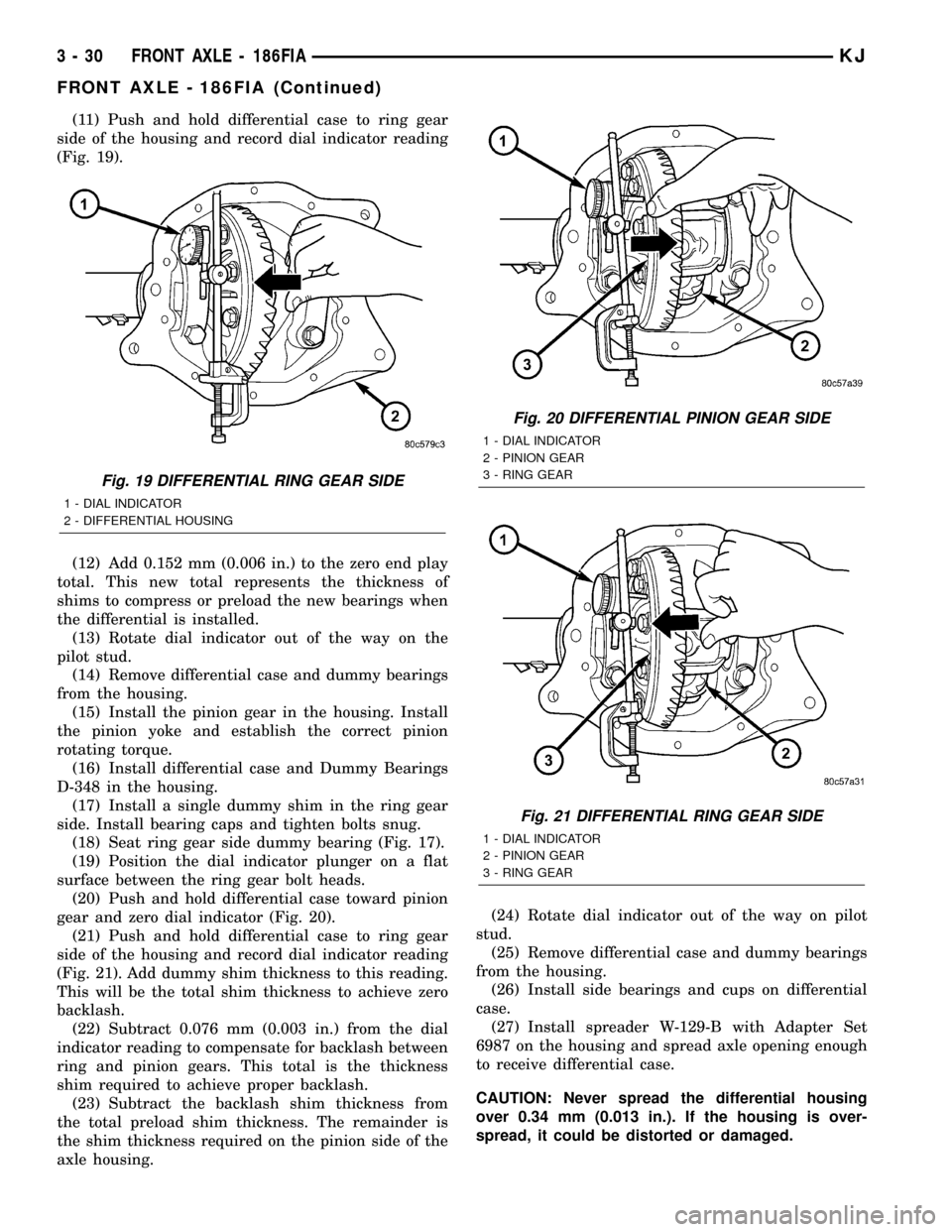
(11) Push and hold differential case to ring gear
side of the housing and record dial indicator reading
(Fig. 19).
(12) Add 0.152 mm (0.006 in.) to the zero end play
total. This new total represents the thickness of
shims to compress or preload the new bearings when
the differential is installed.
(13) Rotate dial indicator out of the way on the
pilot stud.
(14) Remove differential case and dummy bearings
from the housing.
(15) Install the pinion gear in the housing. Install
the pinion yoke and establish the correct pinion
rotating torque.
(16) Install differential case and Dummy Bearings
D-348 in the housing.
(17) Install a single dummy shim in the ring gear
side. Install bearing caps and tighten bolts snug.
(18) Seat ring gear side dummy bearing (Fig. 17).
(19) Position the dial indicator plunger on a flat
surface between the ring gear bolt heads.
(20) Push and hold differential case toward pinion
gear and zero dial indicator (Fig. 20).
(21) Push and hold differential case to ring gear
side of the housing and record dial indicator reading
(Fig. 21). Add dummy shim thickness to this reading.
This will be the total shim thickness to achieve zero
backlash.
(22) Subtract 0.076 mm (0.003 in.) from the dial
indicator reading to compensate for backlash between
ring and pinion gears. This total is the thickness
shim required to achieve proper backlash.
(23) Subtract the backlash shim thickness from
the total preload shim thickness. The remainder is
the shim thickness required on the pinion side of the
axle housing.(24) Rotate dial indicator out of the way on pilot
stud.
(25) Remove differential case and dummy bearings
from the housing.
(26) Install side bearings and cups on differential
case.
(27) Install spreader W-129-B with Adapter Set
6987 on the housing and spread axle opening enough
to receive differential case.
CAUTION: Never spread the differential housing
over 0.34 mm (0.013 in.). If the housing is over-
spread, it could be distorted or damaged.
Fig. 19 DIFFERENTIAL RING GEAR SIDE
1 - DIAL INDICATOR
2 - DIFFERENTIAL HOUSING
Fig. 20 DIFFERENTIAL PINION GEAR SIDE
1 - DIAL INDICATOR
2 - PINION GEAR
3 - RING GEAR
Fig. 21 DIFFERENTIAL RING GEAR SIDE
1 - DIAL INDICATOR
2 - PINION GEAR
3 - RING GEAR
3 - 30 FRONT AXLE - 186FIAKJ
FRONT AXLE - 186FIA (Continued)
Page 82 of 1803
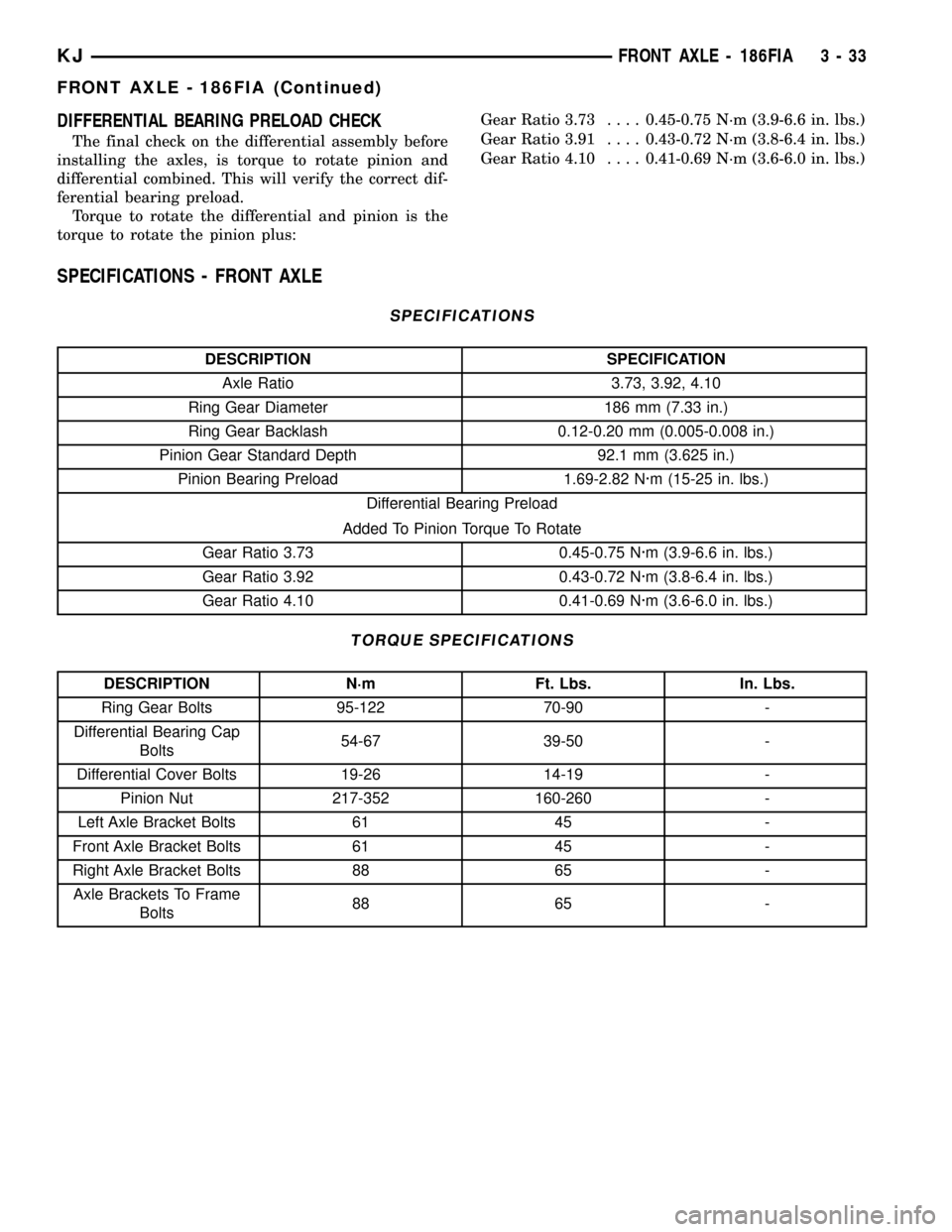
DIFFERENTIAL BEARING PRELOAD CHECK
The final check on the differential assembly before
installing the axles, is torque to rotate pinion and
differential combined. This will verify the correct dif-
ferential bearing preload.
Torque to rotate the differential and pinion is the
torque to rotate the pinion plus:Gear Ratio 3.73....0.45-0.75 N´m (3.9-6.6 in. lbs.)
Gear Ratio 3.91....0.43-0.72 N´m (3.8-6.4 in. lbs.)
Gear Ratio 4.10....0.41-0.69 N´m (3.6-6.0 in. lbs.)
SPECIFICATIONS - FRONT AXLE
SPECIFICATIONS
DESCRIPTION SPECIFICATION
Axle Ratio 3.73, 3.92, 4.10
Ring Gear Diameter 186 mm (7.33 in.)
Ring Gear Backlash 0.12-0.20 mm (0.005-0.008 in.)
Pinion Gear Standard Depth 92.1 mm (3.625 in.)
Pinion Bearing Preload 1.69-2.82 N´m (15-25 in. lbs.)
Differential Bearing Preload
Added To Pinion Torque To Rotate
Gear Ratio 3.73 0.45-0.75 N´m (3.9-6.6 in. lbs.)
Gear Ratio 3.92 0.43-0.72 N´m (3.8-6.4 in. lbs.)
Gear Ratio 4.10 0.41-0.69 N´m (3.6-6.0 in. lbs.)
TORQUE SPECIFICATIONS
DESCRIPTION N´m Ft. Lbs. In. Lbs.
Ring Gear Bolts 95-122 70-90 -
Differential Bearing Cap
Bolts54-67 39-50 -
Differential Cover Bolts 19-26 14-19 -
Pinion Nut 217-352 160-260 -
Left Axle Bracket Bolts 61 45 -
Front Axle Bracket Bolts 61 45 -
Right Axle Bracket Bolts 88 65 -
Axle Brackets To Frame
Bolts88 65 -
KJFRONT AXLE - 186FIA 3 - 33
FRONT AXLE - 186FIA (Continued)
Page 87 of 1803
INSTALLATION
(1) Apply a light coat of lubricant on the lip of the
shaft seal.
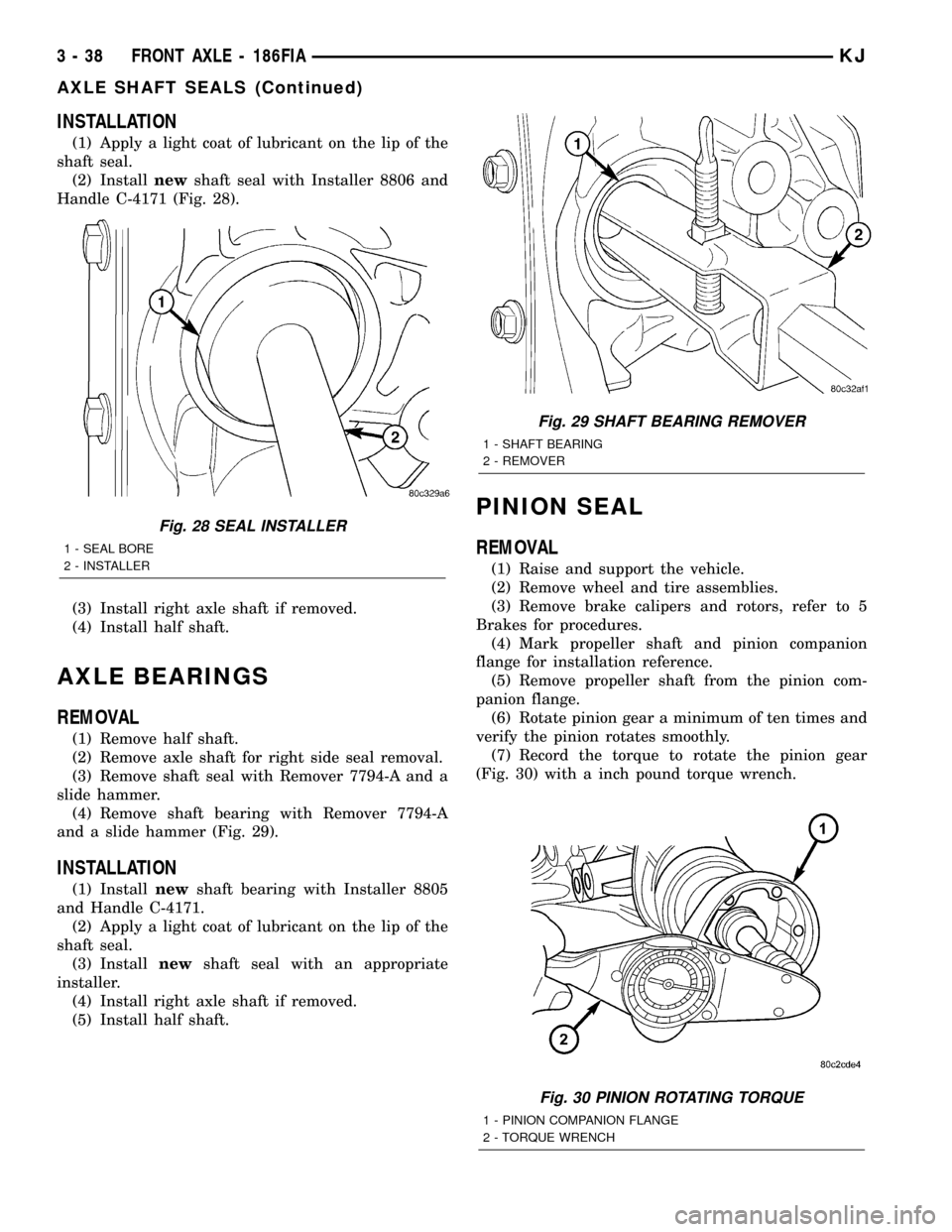
(2) Installnewshaft seal with Installer 8806 and
Handle C-4171 (Fig. 28).
(3) Install right axle shaft if removed.
(4) Install half shaft.
AXLE BEARINGS
REMOVAL
(1) Remove half shaft.
(2) Remove axle shaft for right side seal removal.
(3) Remove shaft seal with Remover 7794-A and a
slide hammer.
(4) Remove shaft bearing with Remover 7794-A
and a slide hammer (Fig. 29).
INSTALLATION
(1) Installnewshaft bearing with Installer 8805
and Handle C-4171.
(2) Apply a light coat of lubricant on the lip of the
shaft seal.
(3) Installnewshaft seal with an appropriate
installer.
(4) Install right axle shaft if removed.
(5) Install half shaft.
PINION SEAL
REMOVAL
(1) Raise and support the vehicle.
(2) Remove wheel and tire assemblies.
(3) Remove brake calipers and rotors, refer to 5
Brakes for procedures.
(4) Mark propeller shaft and pinion companion
flange for installation reference.
(5) Remove propeller shaft from the pinion com-
panion flange.
(6) Rotate pinion gear a minimum of ten times and
verify the pinion rotates smoothly.
(7) Record the torque to rotate the pinion gear
(Fig. 30) with a inch pound torque wrench.
Fig. 28 SEAL INSTALLER
1 - SEAL BORE
2 - INSTALLER
Fig. 29 SHAFT BEARING REMOVER
1 - SHAFT BEARING
2 - REMOVER
Fig. 30 PINION ROTATING TORQUE
1 - PINION COMPANION FLANGE
2 - TORQUE WRENCH
3 - 38 FRONT AXLE - 186FIAKJ
AXLE SHAFT SEALS (Continued)
Page 88 of 1803
(8) Using a short piece of pipe and Spanner
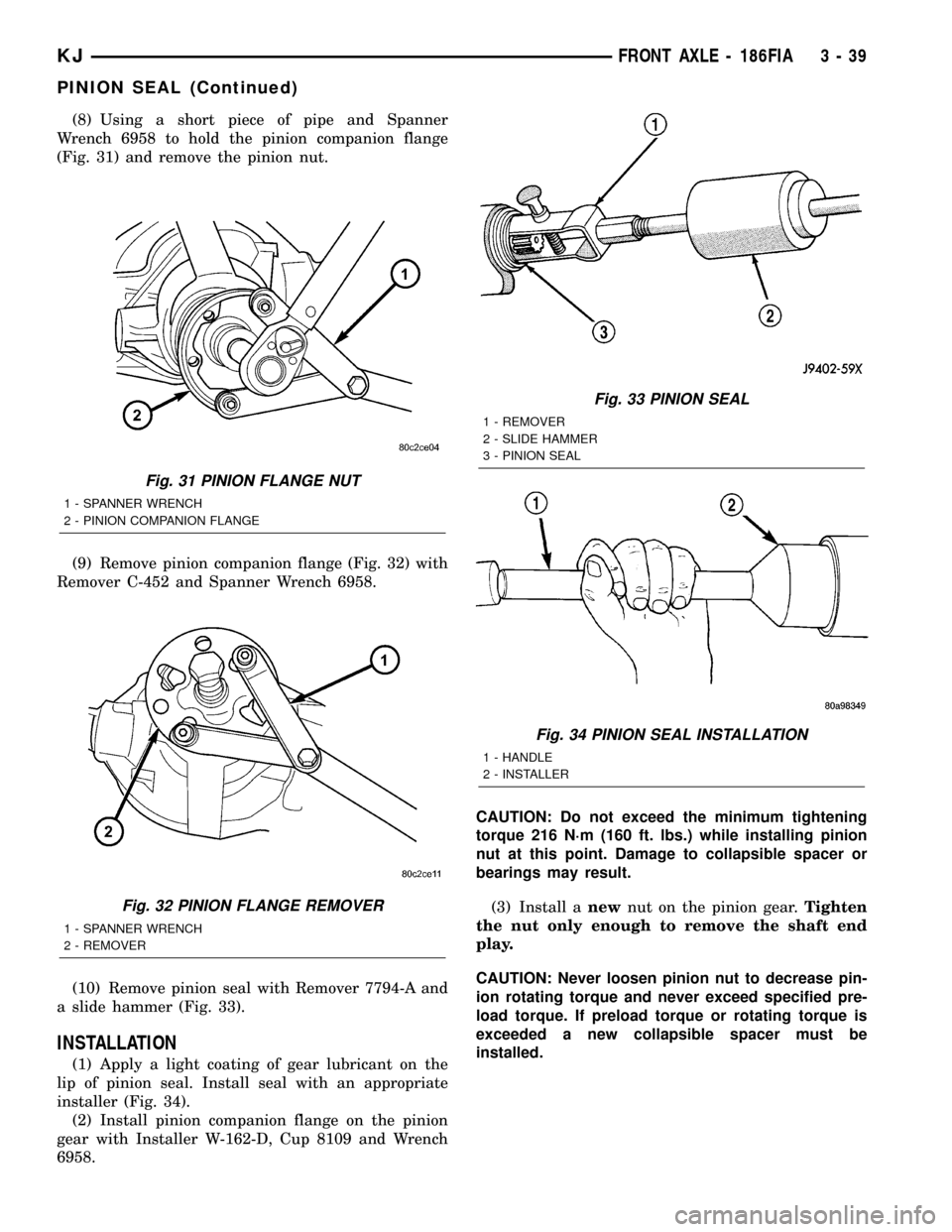
Wrench 6958 to hold the pinion companion flange
(Fig. 31) and remove the pinion nut.
(9) Remove pinion companion flange (Fig. 32) with
Remover C-452 and Spanner Wrench 6958.
(10) Remove pinion seal with Remover 7794-A and
a slide hammer (Fig. 33).
INSTALLATION
(1) Apply a light coating of gear lubricant on the
lip of pinion seal. Install seal with an appropriate
installer (Fig. 34).
(2) Install pinion companion flange on the pinion
gear with Installer W-162-D, Cup 8109 and Wrench
6958.CAUTION: Do not exceed the minimum tightening
torque 216 N´m (160 ft. lbs.) while installing pinion
nut at this point. Damage to collapsible spacer or
bearings may result.
(3) Install anewnut on the pinion gear.Tighten
the nut only enough to remove the shaft end
play.
CAUTION: Never loosen pinion nut to decrease pin-
ion rotating torque and never exceed specified pre-
load torque. If preload torque or rotating torque is
exceeded a new collapsible spacer must be
installed.
Fig. 31 PINION FLANGE NUT
1 - SPANNER WRENCH
2 - PINION COMPANION FLANGE
Fig. 32 PINION FLANGE REMOVER
1 - SPANNER WRENCH
2 - REMOVER
Fig. 33 PINION SEAL
1 - REMOVER
2 - SLIDE HAMMER
3 - PINION SEAL
Fig. 34 PINION SEAL INSTALLATION
1 - HANDLE
2 - INSTALLER
KJFRONT AXLE - 186FIA 3 - 39
PINION SEAL (Continued)