removal JEEP LIBERTY 2002 KJ / 1.G Workshop Manual
[x] Cancel search | Manufacturer: JEEP, Model Year: 2002, Model line: LIBERTY, Model: JEEP LIBERTY 2002 KJ / 1.GPages: 1803, PDF Size: 62.3 MB
Page 503 of 1803

Relays conforming to the ISO specifications have
common physical dimensions, current capacities, ter-
minal patterns, and terminal functions. The relay is
contained within a small, rectangular, molded plastic
housing and is connected to all of the required inputs
and outputs by five integral male spade-type termi-
nals that extend from the bottom of the relay base.
The trailer tow relays cannot be adjusted or
repaired and, if faulty or damaged, the inoperative
relay must be replaced.
OPERATION
The trailer tow relays are electromechanical
switches. The relays each use an input from the cir-
cuit that they isolate from the trailer wiring to con-
trol a high current output to the trailer. The movable
common feed contact point is held against the fixed
normally closed contact point by spring pressure.
When the relay coil is energized, an electromagnetic
field is produced by the coil windings. This electro-
magnetic field draws the movable relay contact point
away from the fixed normally closed contact point,
and holds it against the fixed normally open contact
point. When the relay coil is de-energized, spring
pressure returns the movable contact point back
against the fixed normally closed contact point. A
resistor is connected in parallel with the relay coil in
the relay, and helps to dissipate voltage spikes and
electromagnetic interference that can be generated as
the electromagnetic field of the relay coil collapses.
The terminals of each trailer tow relay are con-
nected to the vehicle electrical system through a con-nector bank in the rear lighting wire harness above
the right rear wheelhouse. Refer to the appropriate
wiring information. The wiring information includes
wiring diagrams, proper wire and connector repair
procedures, details of wire harness routing and
retention, connector pin-out information and location
views for the various wire harness connectors, splices
and grounds. The trailer tow relays can be diagnosed
using conventional diagnostic tools and methods.
DIAGNOSIS AND TESTING - TRAILER TOW
RELAY
The trailer tow relays (Fig. 65) are located in a
connector bank above the right rear wheelhouse.
Refer to the appropriate wiring information. The wir-
ing information includes wiring diagrams, proper
wire and connector repair procedures, details of wire
harness routing and retention, connector pin-out
information and location views for the various wire
harness connectors, splices and grounds.
WARNING: ON VEHICLES EQUIPPED WITH AIR-
BAGS, DISABLE THE SUPPLEMENTAL RESTRAINT
SYSTEM BEFORE ATTEMPTING ANY STEERING
WHEEL, STEERING COLUMN, DRIVER AIRBAG,
PASSENGER AIRBAG, SEAT BELT TENSIONER,
FRONT IMPACT SENSORS, SIDE CURTAIN AIRBAG,
OR INSTRUMENT PANEL COMPONENT DIAGNOSIS
OR SERVICE. DISCONNECT AND ISOLATE THE
BATTERY NEGATIVE (GROUND) CABLE, THEN
WAIT TWO MINUTES FOR THE SYSTEM CAPACI-
TOR TO DISCHARGE BEFORE PERFORMING FUR-
THER DIAGNOSIS OR SERVICE. THIS IS THE ONLY
SURE WAY TO DISABLE THE SUPPLEMENTAL
RESTRAINT SYSTEM. FAILURE TO TAKE THE
PROPER PRECAUTIONS COULD RESULT IN ACCI-
DENTAL AIRBAG DEPLOYMENT AND POSSIBLE
PERSONAL INJURY.
(1) Remove the trailer tow relay from the connec-
tor bank. (Refer to 8 - ELECTRICAL/LAMPS/LIGHT-
ING - EXTERIOR/TRAILER TOW RELAY -
REMOVAL).
(2) A relay in the de-energized position should
have continuity between terminals 87A and 30, and
no continuity between terminals 87 and 30. If OK, go
to Step 3. If not OK, replace the faulty relay.
(3) Resistance between terminals 85 and 86 (elec-
tromagnet) should be 75 8 ohms. If OK, go to Step
4. If not OK, replace the faulty relay.
(4) Connect a battery to terminals 85 and 86.
There should now be continuity between terminals
30 and 87, and no continuity between terminals 87A
and 30. If OK, test the input and output circuits of
the relay. Refer to the appropriate wiring informa-
tion.
Fig. 64 Trailer Tow Relays
1 - RELAY CONNECTOR BANK
2 - REAR BODY WIRE HARNESS
3 - LEFT TURN RELAY
4 - RIGHT TURN RELAY
5 - BRAKE LAMP RELAY
6 - FUSED IGNITION SWITCH OUTPUT (RUN) RELAY
8L - 62 LAMPS/LIGHTING - EXTERIORKJ
TRAILER TOW RELAY (Continued)
Page 504 of 1803

REMOVAL
The trailer tow relay bank contains four relays.
The service procedures for each relay are the same.
Be certain any removed relay is replaced with the
same relay size and type that was removed.
WARNING: ON VEHICLES EQUIPPED WITH AIR-
BAGS, DISABLE THE SUPPLEMENTAL RESTRAINT
SYSTEM BEFORE ATTEMPTING ANY STEERING
WHEEL, STEERING COLUMN, DRIVER AIRBAG,
PASSENGER AIRBAG, SEAT BELT TENSIONER,
FRONT IMPACT SENSORS, SIDE CURTAIN AIRBAG,
OR INSTRUMENT PANEL COMPONENT DIAGNOSIS
OR SERVICE. DISCONNECT AND ISOLATE THE
BATTERY NEGATIVE (GROUND) CABLE, THEN
WAIT TWO MINUTES FOR THE SYSTEM CAPACI-
TOR TO DISCHARGE BEFORE PERFORMING FUR-
THER DIAGNOSIS OR SERVICE. THIS IS THE ONLY
SURE WAY TO DISABLE THE SUPPLEMENTAL
RESTRAINT SYSTEM. FAILURE TO TAKE THE
PROPER PRECAUTIONS COULD RESULT IN ACCI-
DENTAL AIRBAG DEPLOYMENT AND POSSIBLE
PERSONAL INJURY.
(1) Disconnect and isolate the battery negative
cable.
(2) Remove the trim from the right side quarter
inner panel. (Refer to 23 - BODY/INTERIOR/QUAR-
TER TRIM PANEL - REMOVAL).
(3) Reach through the access hole in the quarter
inner panel behind the right rear wheelhouse to
locate and retrieve the trailer tow relay connector
bank, which is enveloped in foam rubber and placedon the top of the right rear wheelhouse between the
quarter inner and outer panels (Fig. 66).
(4) Pull the trailer tow relay connector bank into
the cargo area far enough to access the unit for ser-
vice.
(5) Carefully remove the trailer tow relay connec-
tor bank from the foam wrap.
(6) Remove the trailer tow relay by grasping it
firmly and pulling it straight out from the connector
bank (Fig. 67).
Fig. 65 ISO Micro Relay
30 - COMMON FEED
85 - COIL GROUND
86 - COIL BATTERY
87 - NORMALLY OPEN
87A - NORMALLY CLOSED
Fig. 66 Trailer Tow Relay Wrap
1 - FOAM WRAP
2 - REAR BODY WIRE HARNESS
Fig. 67 Trailer Tow Relay Remove/Install
1 - RELAY CONNECTOR BANK
2 - REAR BODY WIRE HARNESS
3 - LEFT TURN RELAY
4 - RIGHT TURN RELAY
5 - BRAKE LAMP RELAY
6 - FUSED IGNITION SWITCH OUTPUT (RUN) RELAY
KJLAMPS/LIGHTING - EXTERIOR 8L - 63
TRAILER TOW RELAY (Continued)
Page 506 of 1803

LAMPS/LIGHTING - INTERIOR
TABLE OF CONTENTS
page page
LAMPS/LIGHTING - INTERIOR
DESCRIPTION.........................65
OPERATION...........................67
DIAGNOSIS AND TESTING - LAMPS/
LIGHTING - INTERIOR..................68
SPECIFICATIONS - LAMPS/LIGHTING -
INTERIOR...........................71
ASH RECEIVER LAMP BULB
REMOVAL.............................71
INSTALLATION.........................71
ASH RECEIVER LAMP UNIT
REMOVAL.............................72
INSTALLATION.........................72
CARGO LAMP BULB
REMOVAL.............................72
INSTALLATION.........................73
CARGO LAMP SWITCH
REMOVAL.............................73
INSTALLATION.........................74
CARGO LAMP UNIT
REMOVAL.............................74
INSTALLATION.........................74
COMPASS MINI-TRIP ILLUMINATION BULB
REMOVAL.............................74
INSTALLATION.........................75
COURTESY LAMP BULB
REMOVAL.............................75
INSTALLATION.........................76
COURTESY LAMP UNIT
REMOVAL.............................76INSTALLATION.........................77
DOOR AJAR SWITCH
DESCRIPTION.........................77
OPERATION...........................77
FLIP-UP GLASS AJAR SWITCH
DESCRIPTION.........................77
OPERATION...........................77
HEATER-A/C CONTROL ILLUMINATION BULB
REMOVAL.............................78
INSTALLATION.........................78
READING LAMP BULB
REMOVAL.............................79
INSTALLATION.........................79
READING LAMP SWITCH
REMOVAL.............................80
INSTALLATION.........................80
READING LAMP UNIT
REMOVAL.............................81
INSTALLATION.........................81
TAILGATE AJAR SWITCH
DESCRIPTION.........................82
OPERATION...........................82
TRANSMISSION RANGE INDICATOR
ILLUMINATION BULB
REMOVAL.............................82
INSTALLATION.........................83
VANITY LAMP BULB
REMOVAL.............................83
INSTALLATION.........................84
LAMPS/LIGHTING - INTERIOR
DESCRIPTION
The interior lighting system (Fig. 1) for this model
includes the following incandescent interior lamps:
²Ash Receiver Lamp- An available ash receiver
lamp is located above the ash receiver housing
behind the instrument panel center bezel, and is con-
trolled by the panel lamps dimmer circuit.
²Cargo Lamp- An available cargo lamp with an
integral lens-actuated courtesy disable switch is
located in the headliner near the rear roof header,
and is controlled by the courtesy lamp circuit.
²Courtesy Lamps- Available courtesy lamps are
located below both the right and left side of the
instrument panel, and are controlled by the courtesy
lamp circuit.²Compass Mini-Trip Control Illumination
Lamps- The optional Compass Mini-Trip Computer
(CMTC) has three replaceable control illumination
bulb/bulb holder units on its circuit board that are
controlled by the panel lamps dimmer circuit.
²Dome Lamp- A standard front dome lamp that
does not include an on-off switch is located in the
headliner near the windshield header, and is con-
trolled by the courtesy lamp circuit.
²Hazard Switch Illumination/Indicator
Lamp- The hazard switch control button has a non-
replaceable illumination/indicator bulb soldered onto
its circuit board that is controlled by both the hazard
switch circuitry and the panel lamps dimmer circuit.
(Refer to 8 - ELECTRICAL/LAMPS/LIGHTING -
EXTERIOR/HAZARD SWITCH - DESCRIPTION).
²Heater-Air Conditioner Control Illumina-
tion Lamps- The heater-air conditioner control has
KJLAMPS/LIGHTING - INTERIOR 8L - 65
Page 512 of 1803
SPECIFICATIONS - LAMPS/LIGHTING -
INTERIOR
BULB SPECIFICATIONS
LAMP BULB
Ash Receiver 161
Cargo 214-2
Cluster Illumination 103
Compass Mini-Trip
IlluminationMOPAR 4437661
Courtesy 906
Heater-A/C Control
Illumination74
Map/Reading 192
Transmission Range
Indicator IlluminationS14V
Vanity Mirror MOPAR 6501966
ASH RECEIVER LAMP BULB
REMOVAL
WARNING: ON VEHICLES EQUIPPED WITH AIR-
BAGS, DISABLE THE SUPPLEMENTAL RESTRAINT
SYSTEM BEFORE ATTEMPTING ANY STEERING
WHEEL, STEERING COLUMN, DRIVER AIRBAG,
PASSENGER AIRBAG, SEAT BELT TENSIONER,
FRONT IMPACT SENSORS, SIDE CURTAIN AIRBAG,
OR INSTRUMENT PANEL COMPONENT DIAGNOSIS
OR SERVICE. DISCONNECT AND ISOLATE THE
BATTERY NEGATIVE (GROUND) CABLE, THEN
WAIT TWO MINUTES FOR THE SYSTEM CAPACI-
TOR TO DISCHARGE BEFORE PERFORMING FUR-
THER DIAGNOSIS OR SERVICE. THIS IS THE ONLY
SURE WAY TO DISABLE THE SUPPLEMENTAL
RESTRAINT SYSTEM. FAILURE TO TAKE THE
PROPER PRECAUTIONS COULD RESULT IN ACCI-
DENTAL AIRBAG DEPLOYMENT AND POSSIBLE
PERSONAL INJURY.
(1) Disconnect and isolate the battery negative
cable.
(2) Remove the ash receiver lamp unit from the
top of the ash receiver housing. (Refer to 8 - ELEC-
TRICAL/LAMPS/LIGHTING - INTERIOR/ASH
RECEIVER LAMP UNIT - REMOVAL).
(3) Carefully disengage the ash receiver lamp hood
from the integral snap features on each side of the
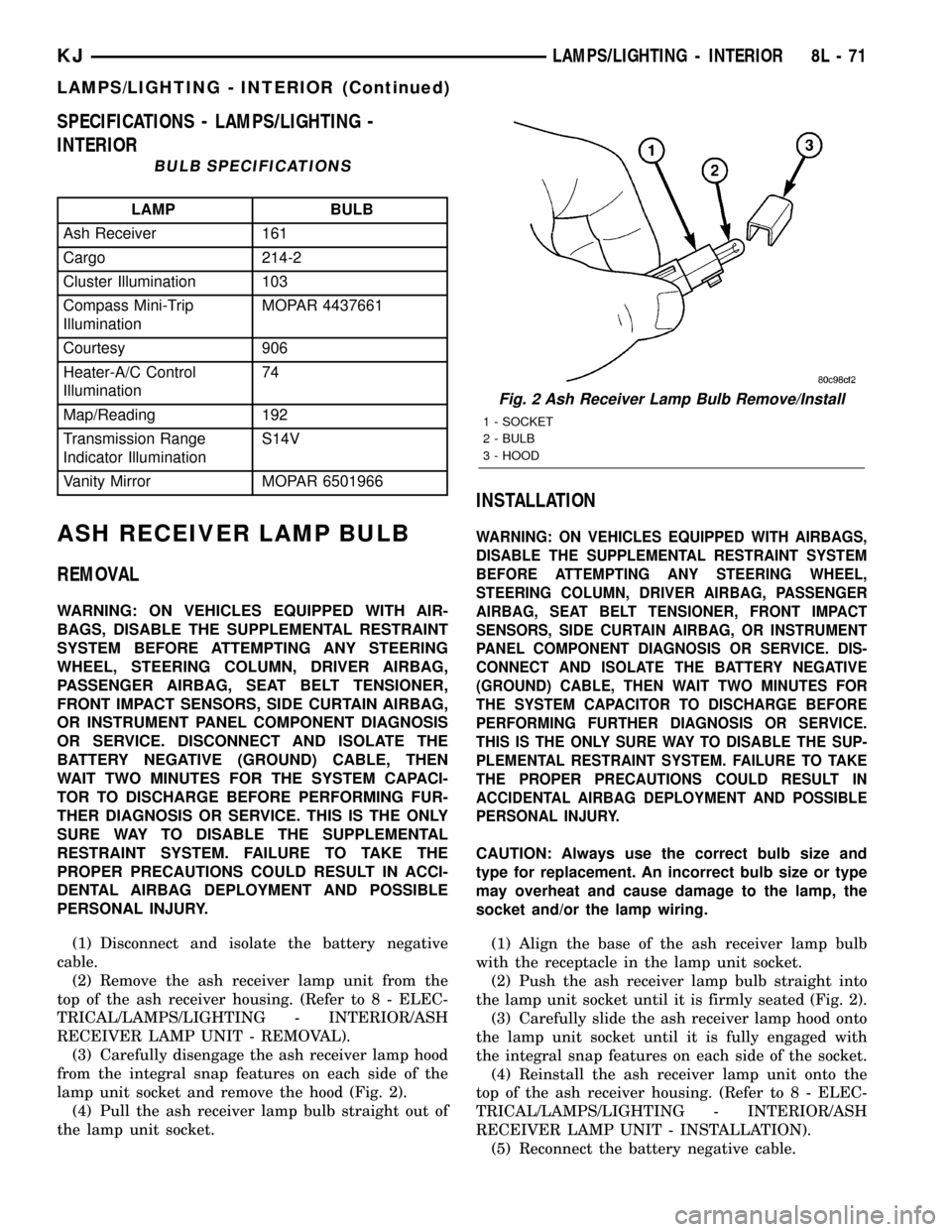
lamp unit socket and remove the hood (Fig. 2).
(4) Pull the ash receiver lamp bulb straight out of
the lamp unit socket.
INSTALLATION
WARNING: ON VEHICLES EQUIPPED WITH AIRBAGS,
DISABLE THE SUPPLEMENTAL RESTRAINT SYSTEM
BEFORE ATTEMPTING ANY STEERING WHEEL,
STEERING COLUMN, DRIVER AIRBAG, PASSENGER
AIRBAG, SEAT BELT TENSIONER, FRONT IMPACT
SENSORS, SIDE CURTAIN AIRBAG, OR INSTRUMENT
PANEL COMPONENT DIAGNOSIS OR SERVICE. DIS-
CONNECT AND ISOLATE THE BATTERY NEGATIVE
(GROUND) CABLE, THEN WAIT TWO MINUTES FOR
THE SYSTEM CAPACITOR TO DISCHARGE BEFORE
PERFORMING FURTHER DIAGNOSIS OR SERVICE.
THIS IS THE ONLY SURE WAY TO DISABLE THE SUP-
PLEMENTAL RESTRAINT SYSTEM. FAILURE TO TAKE
THE PROPER PRECAUTIONS COULD RESULT IN
ACCIDENTAL AIRBAG DEPLOYMENT AND POSSIBLE
PERSONAL INJURY.
CAUTION: Always use the correct bulb size and
type for replacement. An incorrect bulb size or type
may overheat and cause damage to the lamp, the
socket and/or the lamp wiring.
(1) Align the base of the ash receiver lamp bulb
with the receptacle in the lamp unit socket.
(2) Push the ash receiver lamp bulb straight into
the lamp unit socket until it is firmly seated (Fig. 2).
(3) Carefully slide the ash receiver lamp hood onto
the lamp unit socket until it is fully engaged with
the integral snap features on each side of the socket.
(4) Reinstall the ash receiver lamp unit onto the
top of the ash receiver housing. (Refer to 8 - ELEC-
TRICAL/LAMPS/LIGHTING - INTERIOR/ASH
RECEIVER LAMP UNIT - INSTALLATION).
(5) Reconnect the battery negative cable.
Fig. 2 Ash Receiver Lamp Bulb Remove/Install
1 - SOCKET
2 - BULB
3 - HOOD
KJLAMPS/LIGHTING - INTERIOR 8L - 71
LAMPS/LIGHTING - INTERIOR (Continued)
Page 513 of 1803

ASH RECEIVER LAMP UNIT
REMOVAL
WARNING: ON VEHICLES EQUIPPED WITH AIR-
BAGS, DISABLE THE SUPPLEMENTAL RESTRAINT
SYSTEM BEFORE ATTEMPTING ANY STEERING
WHEEL, STEERING COLUMN, DRIVER AIRBAG,
PASSENGER AIRBAG, SEAT BELT TENSIONER,
FRONT IMPACT SENSORS, SIDE CURTAIN AIRBAG,
OR INSTRUMENT PANEL COMPONENT DIAGNOSIS
OR SERVICE. DISCONNECT AND ISOLATE THE
BATTERY NEGATIVE (GROUND) CABLE, THEN
WAIT TWO MINUTES FOR THE SYSTEM CAPACI-
TOR TO DISCHARGE BEFORE PERFORMING FUR-
THER DIAGNOSIS OR SERVICE. THIS IS THE ONLY
SURE WAY TO DISABLE THE SUPPLEMENTAL
RESTRAINT SYSTEM. FAILURE TO TAKE THE
PROPER PRECAUTIONS COULD RESULT IN ACCI-
DENTAL AIRBAG DEPLOYMENT AND POSSIBLE
PERSONAL INJURY.
(1) Disconnect and isolate the battery negative
cable.
(2) Remove the center bezel from the instrument
panel. (Refer to 23 - BODY/INSTRUMENT PANEL/
INSTRUMENT PANEL CENTER BEZEL - REMOV-
AL).
(3) While pulling the ash receiver lamp unit away
from the top of the ash receiver housing, from inside
the housing carefully release the four integral latches
that secure the lamp unit to the mounting hole in the
top of the housing.
(4) Remove the ash receiver lamp unit from the
top of the ash receiver housing (Fig. 3).
INSTALLATION
WARNING: ON VEHICLES EQUIPPED WITH AIR-
BAGS, DISABLE THE SUPPLEMENTAL RESTRAINT
SYSTEM BEFORE ATTEMPTING ANY STEERING
WHEEL, STEERING COLUMN, DRIVER AIRBAG,
PASSENGER AIRBAG, SEAT BELT TENSIONER,
FRONT IMPACT SENSORS, SIDE CURTAIN AIRBAG,
OR INSTRUMENT PANEL COMPONENT DIAGNOSIS
OR SERVICE. DISCONNECT AND ISOLATE THE
BATTERY NEGATIVE (GROUND) CABLE, THEN
WAIT TWO MINUTES FOR THE SYSTEM CAPACI-
TOR TO DISCHARGE BEFORE PERFORMING FUR-
THER DIAGNOSIS OR SERVICE. THIS IS THE ONLY
SURE WAY TO DISABLE THE SUPPLEMENTAL
RESTRAINT SYSTEM. FAILURE TO TAKE THE
PROPER PRECAUTIONS COULD RESULT IN ACCI-
DENTAL AIRBAG DEPLOYMENT AND POSSIBLE
PERSONAL INJURY.
(1) Align the four integral latches of the ash
receiver lamp unit to the mounting hole on the top of
the ash receiver housing (Fig. 3).
(2) Using hand pressure, press firmly and evenly
on the ash receiver lamp unit until the four integral
latches snap into place in the ash receiver housing
mounting hole.
(3) Reinstall the center bezel onto the instrument
panel. (Refer to 23 - BODY/INSTRUMENT PANEL/
INSTRUMENT PANEL CENTER BEZEL - INSTAL-
LATION).
(4) Reconnect the battery negative cable.
CARGO LAMP BULB
REMOVAL
(1) Disconnect and isolate the battery negative
cable.
(2) Using a small thin-bladed screwdriver, gently
pry outward on either side near the top of the cargo
lamp lens until the lens pivot unsnaps from the pivot
pin within the lamp unit housing (Fig. 4).
(3) Move the cargo lamp lens upward far enough
to disengage the switch tab at the bottom of the lens
from between the switch plunger and the lamp unit
housing.
(4) Remove the cargo lamp lens from the lamp
unit housing.
(5) Firmly grasp the cargo lamp bulb and pull each
end outward until it is disengaged from its respective
bulb holder within the lamp unit housing (Fig. 5).
(6) Remove the cargo lamp bulb from the lamp
unit housing.
Fig. 3 Ash Receiver Lamp Unit Remove/Install
1 - CENTER BEZEL
2 - ASH RECEIVER HOUSING
3 - ASH RECEIVER LAMP UNIT
8L - 72 LAMPS/LIGHTING - INTERIORKJ
Page 514 of 1803

INSTALLATION
CAUTION: Always use the correct bulb size and
type for replacement. An incorrect bulb size or type
may overheat and cause damage to the lamp, the
socket and/or the lamp wiring.
(1) Position the cargo lamp bulb into the lamp unit
housing.(2) Align the ends of the cargo lamp bulb with
each of the bulb holders within the lamp unit hous-
ing (Fig. 5).
(3) Using hand pressure, press firmly and evenly
on both ends of the cargo lamp bulb until they snap
into their respective bulb holders within the lamp
unit housing.
(4) Position the cargo lamp lens to the lamp unit
housing.
(5) Insert the switch tab at the bottom of the cargo
lamp lens between the switch plunger and the lamp
unit housing.
(6) Align the pivots on each side near the top of
the cargo lamp lens with the pivot pins within the
lamp unit housing.
(7) Using hand pressure, press firmly and evenly
on the cargo lamp lens over both pivots until they
snap into place over the pivot pins within the lamp
unit housing.
(8) Reconnect the battery negative cable.
CARGO LAMP SWITCH
REMOVAL
(1) Disconnect and isolate the battery negative
cable.
(2) Remove the cargo lamp unit from the headliner
near the rear roof header. (Refer to 8 - ELECTRI-
CAL/LAMPS/LIGHTING - INTERIOR/CARGO
LAMP UNIT - REMOVAL).
(3) From the back of the cargo lamp unit housing,
firmly grasp the switch body (Fig. 6).
Fig. 4 Cargo Lamp Lens Remove
1 - HEADLINER
2 - CARGO LAMP
3 - LENS
4 - SCREWDRIVER
Fig. 5 Cargo Lamp Bulb Remove/Install
1 - HEADLINER
2 - CARGO LAMP
3 - LENS PIVOT PIN
4 - BULB
5 - SWITCH
Fig. 6 Cargo Lamp Switch Remove/Install
1 - CARGO LAMP UNIT HOUSING
2 - SWITCH
KJLAMPS/LIGHTING - INTERIOR 8L - 73
CARGO LAMP BULB (Continued)
Page 515 of 1803

(4) Using hand pressure, pull the cargo lamp
switch toward the outside of the lamp unit housing
until it unsnaps from the housing.
(5) Continue sliding the cargo lamp switch away
from the terminal pins and out of the lamp unit
housing.
INSTALLATION
(1) Align the terminal receptacles in the cargo
lamp switch with the terminal pins of the lamp unit
housing (Fig. 6).
(2) Using hand pressure, push the cargo lamp
switch toward the terminals of the lamp unit housing
until it snaps into the housing.
(3) Reinstall the cargo lamp unit onto the head-
liner near the rear roof header. (Refer to 8 - ELEC-
TRICAL/LAMPS/LIGHTING - INTERIOR/CARGO
LAMP UNIT - INSTALLATION).
(4) Reconnect the battery negative cable.
CARGO LAMP UNIT
REMOVAL
(1) Disconnect and isolate the battery negative
cable.
(2) Using a trim stick or another suitable wide
flat-bladed tool, gently pry between the flange
around the edge of the cargo lamp unit housing and
the headliner to release the metal snap clip on each
side of the housing from the receptacles in the rear
roof header (Fig. 7).(3) Pull the cargo lamp unit away from the head-
liner far enough to access and disconnect the rear
body wire harness connector for the lamp from the
connector receptacle on the lamp unit housing.
(4) Remove the cargo lamp unit from the mounting
hole in the headliner.
INSTALLATION
(1) Position the cargo lamp unit to the mounting
hole in the headliner.
(2) Reconnect the rear body wire harness connec-
tor for the cargo lamp to the connector receptacle on
the lamp unit housing.
(3) With the finger depression in the cargo lamp
lens oriented towards the rear of the vehicle, position
the cargo lamp unit housing into the headliner
mounting hole and align the metal snap clip on each
side of the housing with their receptacles in the rear
roof header (Fig. 7).
(4) Using hand pressure, press upward firmly and
evenly on both ends of the cargo lamp unit until both
snap clips are fully engaged in their receptacles.
(5) Reconnect the battery negative cable.
COMPASS MINI-TRIP
ILLUMINATION BULB
REMOVAL
The Compass Mini-Trip Computer (CMTC) in the
overhead console includes either two or three incan-
descent illumination bulb and bulb holder units.
Three bulbs are used only on models that also fea-
ture the optional Universal Garage Door Opener
(UGDO).
WARNING: ON VEHICLES EQUIPPED WITH AIR-
BAGS, DISABLE THE SUPPLEMENTAL RESTRAINT
SYSTEM BEFORE ATTEMPTING ANY STEERING
WHEEL, STEERING COLUMN, DRIVER AIRBAG,
PASSENGER AIRBAG, SEAT BELT TENSIONER,
FRONT IMPACT SENSORS, SIDE CURTAIN AIRBAG,
OR INSTRUMENT PANEL COMPONENT DIAGNOSIS
OR SERVICE. DISCONNECT AND ISOLATE THE
BATTERY NEGATIVE (GROUND) CABLE, THEN
WAIT TWO MINUTES FOR THE SYSTEM CAPACI-
TOR TO DISCHARGE BEFORE PERFORMING FUR-
THER DIAGNOSIS OR SERVICE. THIS IS THE ONLY
SURE WAY TO DISABLE THE SUPPLEMENTAL
RESTRAINT SYSTEM. FAILURE TO TAKE THE
PROPER PRECAUTIONS COULD RESULT IN ACCI-
DENTAL AIRBAG DEPLOYMENT AND POSSIBLE
PERSONAL INJURY.
Fig. 7 Cargo Lamp Unit Remove/Install
1 - CARGO LAMP UNIT
2 - HEADLINER
3 - TRIM STICK
8L - 74 LAMPS/LIGHTING - INTERIORKJ
CARGO LAMP SWITCH (Continued)
Page 516 of 1803

(1) Disconnect and isolate the battery negative
cable.
(2) Remove the overhead console from the head-
liner. (Refer to 8 - ELECTRICAL/OVERHEAD CON-
SOLE - REMOVAL).
(3) From the back of the unit, use a small thin-
bladed screwdriver to rotate the compass mini-trip
illumination bulb holder counterclockwise about 30
degrees on the circuit board (Fig. 8).
(4) Pull the compass mini-trip illumination bulb
holder and bulb unit straight out of the circuit board
bulb mounting hole.
INSTALLATION
The Compass Mini-Trip Computer (CMTC) in the
overhead console includes either two or three incan-
descent illumination bulb and bulb holder units.
Three bulbs are used only on models that also fea-
ture the optional Universal Garage Door Opener
(UGDO).
WARNING: ON VEHICLES EQUIPPED WITH AIR-
BAGS, DISABLE THE SUPPLEMENTAL RESTRAINT
SYSTEM BEFORE ATTEMPTING ANY STEERING
WHEEL, STEERING COLUMN, DRIVER AIRBAG,
PASSENGER AIRBAG, SEAT BELT TENSIONER,
FRONT IMPACT SENSORS, SIDE CURTAIN AIRBAG,
OR INSTRUMENT PANEL COMPONENT DIAGNOSIS
OR SERVICE. DISCONNECT AND ISOLATE THE
BATTERY NEGATIVE (GROUND) CABLE, THEN
WAIT TWO MINUTES FOR THE SYSTEM CAPACI-
TOR TO DISCHARGE BEFORE PERFORMING FUR-
THER DIAGNOSIS OR SERVICE. THIS IS THE ONLY
SURE WAY TO DISABLE THE SUPPLEMENTALRESTRAINT SYSTEM. FAILURE TO TAKE THE
PROPER PRECAUTIONS COULD RESULT IN ACCI-
DENTAL AIRBAG DEPLOYMENT AND POSSIBLE
PERSONAL INJURY.
CAUTION: Always use the correct bulb size and
type for replacement. An incorrect bulb size or type
may overheat and cause damage to the lamp, the
socket and/or the lamp wiring.
(1) Align the compass mini-trip illumination bulb
holder and bulb unit with the circuit board bulb
mounting hole.
(2) Insert the compass mini-trip illumination bulb
holder and bulb unit straight into the circuit board
bulb mounting hole until it is firmly seated (Fig. 8).
(3) Using a small thin-bladed screwdriver, rotate
the compass mini-trip illumination bulb holder clock-
wise about 30 degrees on the circuit board.
(4) Reinstall the overhead console onto the head-
liner. (Refer to 8 - ELECTRICAL/OVERHEAD CON-
SOLE - INSTALLATION).
(5) Reconnect the battery negative cable.
COURTESY LAMP BULB
REMOVAL
WARNING: ON VEHICLES EQUIPPED WITH AIR-
BAGS, DISABLE THE SUPPLEMENTAL RESTRAINT
SYSTEM BEFORE ATTEMPTING ANY STEERING
WHEEL, STEERING COLUMN, DRIVER AIRBAG,
PASSENGER AIRBAG, SEAT BELT TENSIONER,
FRONT IMPACT SENSORS, SIDE CURTAIN AIRBAG,
OR INSTRUMENT PANEL COMPONENT DIAGNOSIS
OR SERVICE. DISCONNECT AND ISOLATE THE
BATTERY NEGATIVE (GROUND) CABLE, THEN
WAIT TWO MINUTES FOR THE SYSTEM CAPACI-
TOR TO DISCHARGE BEFORE PERFORMING FUR-
THER DIAGNOSIS OR SERVICE. THIS IS THE ONLY
SURE WAY TO DISABLE THE SUPPLEMENTAL
RESTRAINT SYSTEM. FAILURE TO TAKE THE
PROPER PRECAUTIONS COULD RESULT IN ACCI-
DENTAL AIRBAG DEPLOYMENT AND POSSIBLE
PERSONAL INJURY.
(1) Disconnect and isolate the battery negative
cable.
(2) Support the courtesy lamp unit housing with
one hand while firmly grasping the flange on the
outer circumference of the lens with the other hand,
then pull the lens straight down to unsnap it from
the housing (Fig. 9).
(3) Pull the courtesy lamp bulb straight out of the
lamp unit socket.
Fig. 8 Compass Mini-Trip Illumination Bulb
Remove/Install
1 - OVERHEAD CONSOLE
2 - BULB & HOLDER (3)
3 - COMPASS MINI-TRIP COMPUTER
KJLAMPS/LIGHTING - INTERIOR 8L - 75
COMPASS MINI-TRIP ILLUMINATION BULB (Continued)
Page 517 of 1803

INSTALLATION
WARNING: ON VEHICLES EQUIPPED WITH AIR-
BAGS, DISABLE THE SUPPLEMENTAL RESTRAINT
SYSTEM BEFORE ATTEMPTING ANY STEERING
WHEEL, STEERING COLUMN, DRIVER AIRBAG,
PASSENGER AIRBAG, SEAT BELT TENSIONER,
FRONT IMPACT SENSORS, SIDE CURTAIN AIRBAG,
OR INSTRUMENT PANEL COMPONENT DIAGNOSIS
OR SERVICE. DISCONNECT AND ISOLATE THE
BATTERY NEGATIVE (GROUND) CABLE, THEN
WAIT TWO MINUTES FOR THE SYSTEM CAPACI-
TOR TO DISCHARGE BEFORE PERFORMING FUR-
THER DIAGNOSIS OR SERVICE. THIS IS THE ONLY
SURE WAY TO DISABLE THE SUPPLEMENTAL
RESTRAINT SYSTEM. FAILURE TO TAKE THE
PROPER PRECAUTIONS COULD RESULT IN ACCI-
DENTAL AIRBAG DEPLOYMENT AND POSSIBLE
PERSONAL INJURY.
CAUTION: Always use the correct bulb size and
type for replacement. An incorrect bulb size or type
may overheat and cause damage to the lamp, the
socket and/or the lamp wiring.
(1) Align the base of the courtesy lamp bulb with
the receptacle in the lamp unit socket.
(2) Push the courtesy lamp bulb straight into the
lamp unit socket until it is firmly seated (Fig. 9).
(3) Align the courtesy lamp lens with the lamp
unit housing.
(4) Support the courtesy lamp unit housing with
one hand while firmly and evenly pushing the lensinto the housing with the other hand, until the lens
snaps into place.
(5) Reconnect the battery negative cable.
COURTESY LAMP UNIT
REMOVAL
WARNING: ON VEHICLES EQUIPPED WITH AIR-
BAGS, DISABLE THE SUPPLEMENTAL RESTRAINT
SYSTEM BEFORE ATTEMPTING ANY STEERING
WHEEL, STEERING COLUMN, DRIVER AIRBAG,
PASSENGER AIRBAG, SEAT BELT TENSIONER,
FRONT IMPACT SENSORS, SIDE CURTAIN AIRBAG,
OR INSTRUMENT PANEL COMPONENT DIAGNOSIS
OR SERVICE. DISCONNECT AND ISOLATE THE
BATTERY NEGATIVE (GROUND) CABLE, THEN
WAIT TWO MINUTES FOR THE SYSTEM CAPACI-
TOR TO DISCHARGE BEFORE PERFORMING FUR-
THER DIAGNOSIS OR SERVICE. THIS IS THE ONLY
SURE WAY TO DISABLE THE SUPPLEMENTAL
RESTRAINT SYSTEM. FAILURE TO TAKE THE
PROPER PRECAUTIONS COULD RESULT IN ACCI-
DENTAL AIRBAG DEPLOYMENT AND POSSIBLE
PERSONAL INJURY.
(1) Disconnect and isolate the battery negative
cable.
(2) Remove the screw that secures the integral
mounting tab of the courtesy lamp unit to the lower
instrument panel (Fig. 10).
(3) Pull the courtesy lamp unit down from the
lower instrument panel far enough to access and dis-
connect the instrument panel wire harness connector
Fig. 9 Courtesy Lamp Lens Remove/Install
1 - COURTESY LAMP
2 - LOWER INSTRUMENT PANEL
3 - BULB
4 - LENS
Fig. 10 Courtesy Lamp Unit Remove/Install
1 - COURTESY LAMP UNIT
2 - SCREW (1)
3 - LOWER INSTRUMENT PANEL
8L - 76 LAMPS/LIGHTING - INTERIORKJ
COURTESY LAMP BULB (Continued)
Page 518 of 1803

for the courtesy lamp from the connector receptacle
on the back of the lamp unit housing.
(4) Remove the courtesy lamp unit from under the
instrument panel.
INSTALLATION
WARNING: ON VEHICLES EQUIPPED WITH AIR-
BAGS, DISABLE THE SUPPLEMENTAL RESTRAINT
SYSTEM BEFORE ATTEMPTING ANY STEERING
WHEEL, STEERING COLUMN, DRIVER AIRBAG,
PASSENGER AIRBAG, SEAT BELT TENSIONER,
FRONT IMPACT SENSORS, SIDE CURTAIN AIRBAG,
OR INSTRUMENT PANEL COMPONENT DIAGNOSIS
OR SERVICE. DISCONNECT AND ISOLATE THE
BATTERY NEGATIVE (GROUND) CABLE, THEN
WAIT TWO MINUTES FOR THE SYSTEM CAPACI-
TOR TO DISCHARGE BEFORE PERFORMING FUR-
THER DIAGNOSIS OR SERVICE. THIS IS THE ONLY
SURE WAY TO DISABLE THE SUPPLEMENTAL
RESTRAINT SYSTEM. FAILURE TO TAKE THE
PROPER PRECAUTIONS COULD RESULT IN ACCI-
DENTAL AIRBAG DEPLOYMENT AND POSSIBLE
PERSONAL INJURY.
(1) Position the courtesy lamp unit under the
instrument panel.
(2) Reconnect the instrument panel wire harness
connector for the courtesy lamp to the connector
receptacle on the back of the lamp unit housing.
(3) Position the courtesy lamp unit to the lower
instrument panel (Fig. 10).
(4) Install and tighten the screw that secures the
integral mounting tab of the courtesy lamp unit to
the lower instrument panel.
(5) Reconnect the battery negative cable.
DOOR AJAR SWITCH
DESCRIPTION
This vehicle has four door ajar switches, one for
each door. Each switch is concealed within and inte-
gral to its respective door latch unit. The switches
are momentary leaf contact-type units that are actu-
ated by the door latch mechanisms. A short pigtail
wire and connector on each door latch connects the
door ajar switch to the vehicle electrical system
through its respective door wire harness. The door
ajar switches cannot be adjusted or repaired and, if
faulty or damaged, the door latch unit must be
replaced. (Refer to 23 - BODY/DOOR - FRONT/
LATCH - REMOVAL) or (Refer to 23 - BODY/DOOR -
REAR/LATCH - REMOVAL).
OPERATION
The door ajar switches are actuated by the door
latch mechanisms. When a door is closed and prop-
erly latched, its door ajar switch is an open circuit.
When a door is open or only partially latched, the
door ajar switch is a closed circuit. The door ajar
switches are hard wired between a body ground and
the Body Control Module (BCM). The driver side
front door ajar switch is connected to the BCM
through a driver door ajar switch sense circuit, while
the remaining three door ajar switches are connected
to the BCM through a passenger door ajar switch
sense circuit in a parallel-series arrangement. The
BCM reads the door ajar switch status through an
internal pull-up, then uses these inputs to control
many electronic functions and features of the vehicle.
The door ajar switches can be diagnosed using con-
ventional diagnostic tools and methods; however, for
proper diagnosis of the BCM, and both the hard
wired and electronic BCM outputs affected by the
door ajar switch inputs, a DRBIIItscan tool is
required. Refer to the appropriate diagnostic infor-
mation.
FLIP-UP GLASS AJAR SWITCH
DESCRIPTION
A flip-up glass ajar switch is standard equipment
in this vehicle. This switch is concealed within and
integral to the flip-up glass latch unit. The switch is
a momentary leaf contact-type unit that is actuated
by the flip-up glass latch mechanism. A dedicated
connector receptacle on the flip-up glass latch unit
connects the flip-up glass ajar switch to the vehicle
electrical system through the tailgate wire harness.
The flip-up glass ajar switch cannot be adjusted or
repaired and, if faulty or damaged, the flip-up glass
latch unit must be replaced. (Refer to 23 - BODY/
SWING GATE/FLIP-UP GLASS LATCH - REMOV-
AL).
OPERATION
The flip-up glass ajar switch is actuated by the
flip-up glass latch mechanism. When the flip-up glass
is closed and properly latched, the flip-up glass ajar
switch is an open circuit. When the flip-up glass is
open or only partially latched, the flip-up glass ajar
switch is a closed circuit. The flip-up glass ajar
switch is hard wired between a body ground, the
Body Control Module (BCM), and the rear wiper
motor. The output of the switch is connected to the
BCM and rear wiper motor through a flip-up glass
ajar switch sense circuit. The BCM reads the flip-up
glass ajar switch status through an internal pull-up,
then uses this input to control many electronic func-
KJLAMPS/LIGHTING - INTERIOR 8L - 77
COURTESY LAMP UNIT (Continued)